文档文本内容
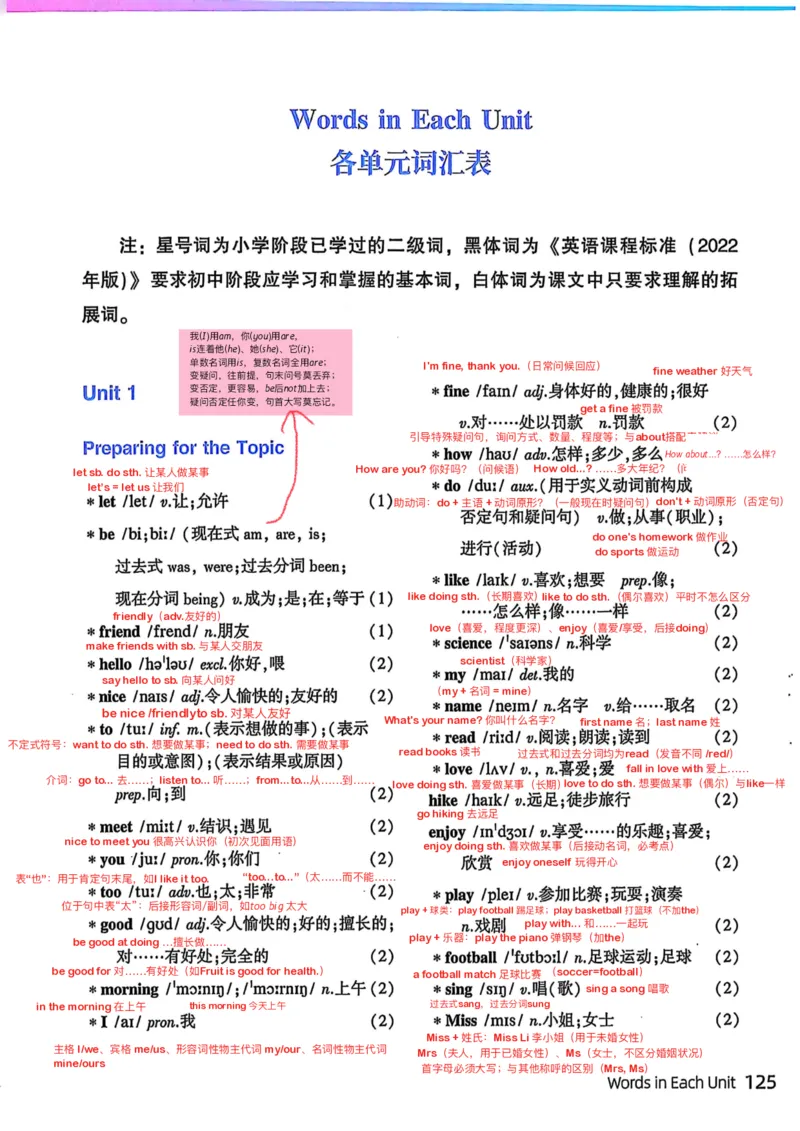
let sb. do sth. 让某⼈做某事
let’s = let us 让我们
make friends with sb. 与某⼈交朋友
say hello to sb. 向某⼈问好
be nice /friendlyto sb. 对某⼈友好
friendly(adv.友好的)
不定式符号:want to do sth. 想要做某事;need to do sth. 需要做某事(后接动词原形)
介词:go to... 去……;listen to... 听……;from...to...从……到……
nice to meet you 很⾼兴认识你(初次⻅⾯⽤语)
表“也”:⽤于肯定句末尾,如I like it too.
位于句中表“太”:后接形容词/副词,如too big 太⼤
“too...to...”(太……⽽不能……
be good at doing …擅⻓做……
be good for 对……有好处(如Fruit is good for health.)
in the morning 在上午
this morning 今天上午
主格 I/we、宾格 me/us、形容词性物主代词 my/our、名词性物主代词  mine/ours
I'm fine, thank you.(⽇常问候回应)
fine weather 好天⽓
get a fine 被罚款
引导特殊疑问句,询问⽅式、数量、程度等;与about搭配表建议
How are you? 你好吗?(问候语)How old...? ……多⼤年纪?(问年龄)

How about...? ……怎么样?
助动词:do + 主语 + 动词原形?(⼀般现在时疑问句)don't + 动词原形(否定句)
do one's homework 做作业
do sports 做运动
like doing sth.(⻓期喜欢)
like to do sth.(偶尔喜欢)
love(喜爱,程度更深)、enjoy(喜爱/享受,后接doing)
scientist(科学家)
(my + 名词 = mine)
What's your name? 你叫什么名字?
first name 名;last name 姓
read books 读书
过去式和过去分词均为read(发⾳不同 /red/)
love doing sth. 喜爱做某事(⻓期)
love to do sth. 想要做某事(偶尔)
fall in love with 爱上……
go hiking 去远⾜
enjoy doing sth. 喜欢做某事(后接动名词,必考点)
enjoy oneself 玩得开⼼
play + 球类:play football 踢⾜球;play basketball 打篮球(不加the)
play + 乐器:play the piano 弹钢琴(加the)
play with... 和……⼀起玩
a football match ⾜球⽐赛
过去式sang,过去分词sung
sing a song 唱歌
Miss + 姓⽒:Miss Li 李⼩姐(⽤于未婚⼥性)
Mrs(夫⼈,⽤于已婚⼥性)、Ms(⼥⼠,不区分婚姻状况)
⾸字⺟必须⼤写;与其他称呼的区别(Mrs, Ms)
我(I)⽤am,你(you)⽤are,
is连着他(he)、她(she)、它(it);
单数名词⽤is,复数名词全⽤are;
变疑问,往前提,句末问号莫丢弃;
变否定,更容易,be后not加上去;
疑问否定任你变,句⾸⼤写莫忘记。
(soccer=football)
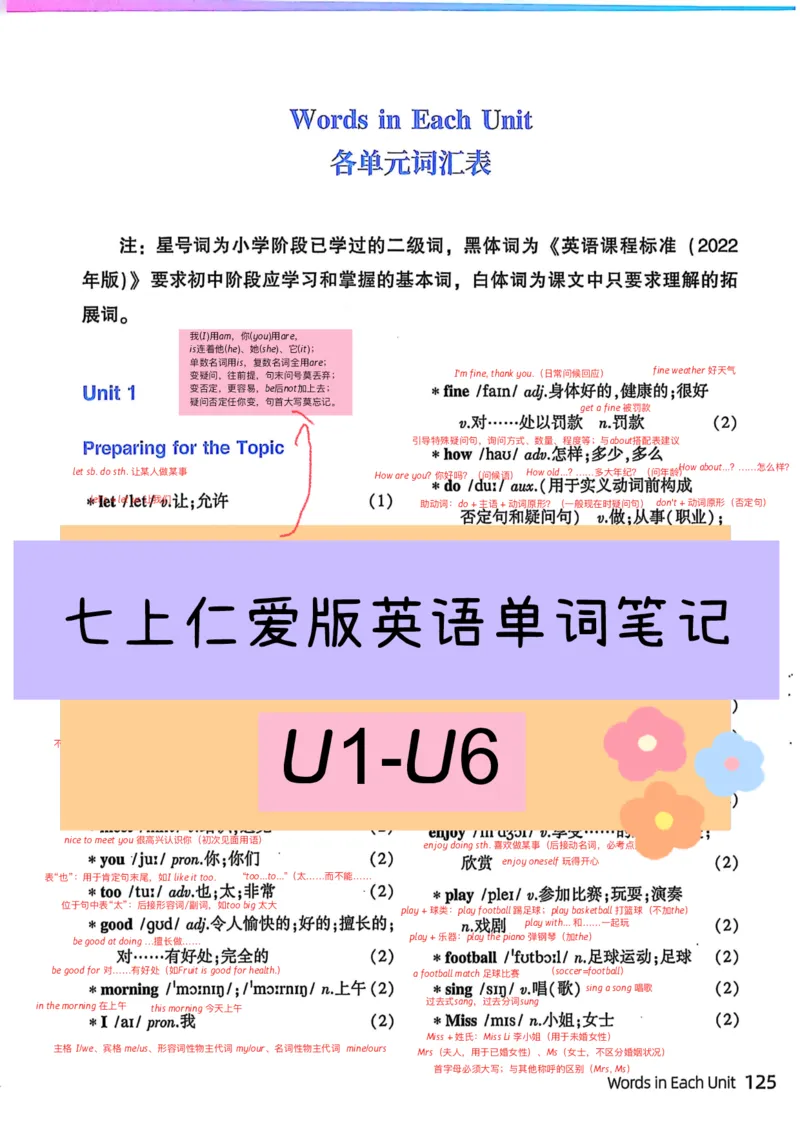
七上仁爱版英语单词笔记
U1-U6
let sb. do sth. 让某⼈做某事
let’s = let us 让我们
make friends with sb. 与某⼈交朋友
say hello to sb. 向某⼈问好
be nice /friendlyto sb. 对某⼈友好
friendly(adv.友好的)
不定式符号:want to do sth. 想要做某事;need to do sth. 需要做某事
介词:go to... 去……;listen to... 听……;from...to...从……到……
nice to meet you 很⾼兴认识你(初次⻅⾯⽤语)
表“也”:⽤于肯定句末尾,如I like it too.
位于句中表“太”:后接形容词/副词,如too big 太⼤
“too...to...”(太……⽽不能……
be good at doing …擅⻓做……
be good for 对……有好处(如Fruit is good for health.)
in the morning 在上午
this morning 今天上午
主格 I/we、宾格 me/us、形容词性物主代词 my/our、名词性物主代词
mine/ours
I'm fine, thank you.(⽇常问候回应)
fine weather 好天⽓
get a fine 被罚款
引导特殊疑问句,询问⽅式、数量、程度等;与about搭配表建议
How are you? 你好吗?(问候语)How old...? ……多⼤年纪?(问年龄)

How about...? ……怎么样?
助动词:do + 主语 + 动词原形?(⼀般现在时疑问句)don't + 动词原形(否定句)
do one's homework 做作业
do sports 做运动
like doing sth.(⻓期喜欢)like to do sth.(偶尔喜欢)平时不怎么区分
love(喜爱,程度更深)、enjoy(喜爱/享受,后接doing)
scientist(科学家)
(my + 名词 = mine)
What's your name? 你叫什么名字?
first name 名;last name 姓
read books 读书
过去式和过去分词均为read(发⾳不同 /red/)
love doing sth. 喜爱做某事(⻓期)love to do sth. 想要做某事(偶尔)与like⼀样
go hiking 去远⾜
enjoy doing sth. 喜欢做某事(后接动名词,必考点)
enjoy oneself 玩得开⼼
play + 球类:play football 踢⾜球;play basketball 打篮球(不加the)
play + 乐器:play the piano 弹钢琴(加the)
play with... 和……⼀起玩
a football match ⾜球⽐赛
过去式sang,过去分词sung
sing a song 唱歌
Miss + 姓⽒:Miss Li 李⼩姐(⽤于未婚⼥性)
Mrs(夫⼈,⽤于已婚⼥性)、Ms(⼥⼠,不区分婚姻状况)
⾸字⺟必须⼤写;与其他称呼的区别(Mrs, Ms)
我(I)⽤am,你(you)⽤are,
is连着他(he)、她(she)、它(it);
单数名词⽤is,复数名词全⽤are;
变疑问,往前提,句末问号莫丢弃;
变否定,更容易,be后not加上去;
疑问否定任你变,句⾸⼤写莫忘记。
(soccer=football)

fall in love with 爱上……
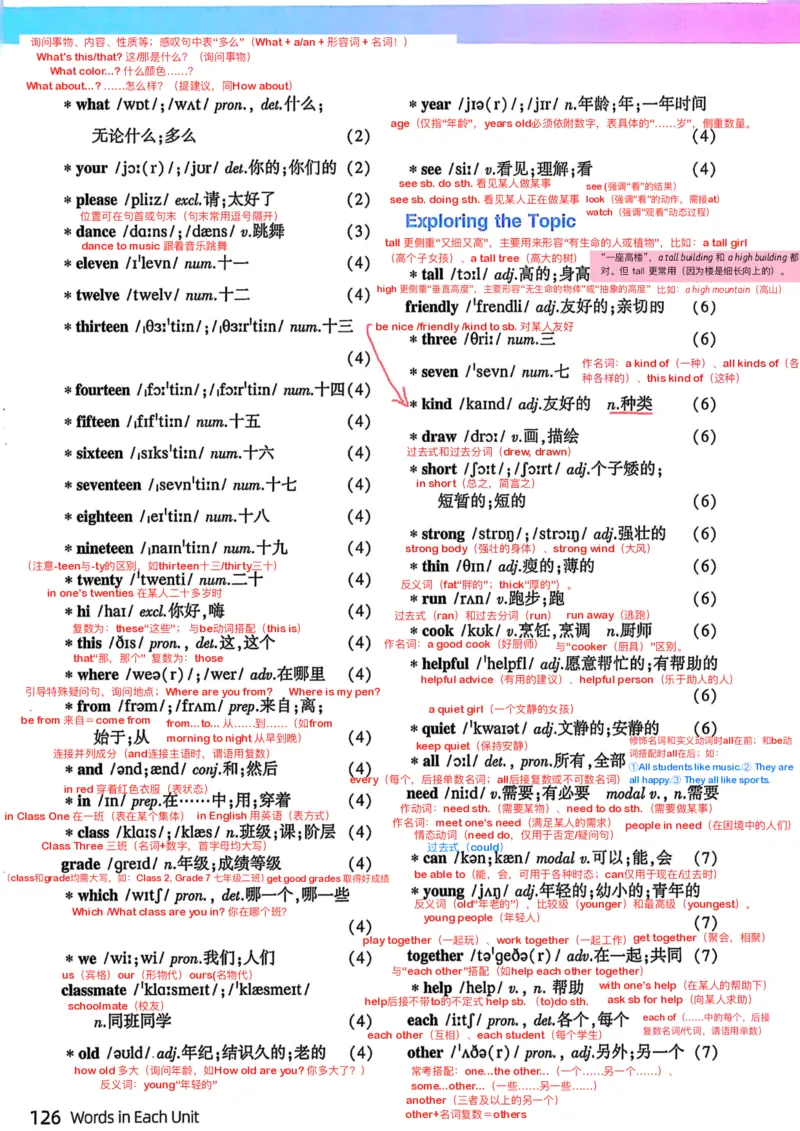
询问事物、内容、性质等;感叹句中表“多么”(What + a/an + 形容词 + 名词!)
What's this/that? 这/那是什么?(询问事物)
What color...? 什么颜⾊……?
What about...? ……怎么样?(提建议,同How about)
位置可在句⾸或句末(句末常⽤逗号隔开)
dance to music 跟着⾳乐跳舞
in one's twenties 在某⼈⼆⼗多岁时
(注意-teen与-ty的区别,如thirteen⼗三/thirty三⼗)
that“那,那个”  复数为:those
复数为:these“这些”; 与be动词搭配(this is)
引导特殊疑问句,询问地点;Where are you from?
Where is my pen?
be from 来⾃=come from
from...to... 从……到……(如from
morning to night 从早到晚)
连接并列成分(and连接主语时,谓语⽤复数)
in Class One 在⼀班(表在某个集体)in English ⽤英语(表⽅式)
in red 穿着红⾊⾐服(表状态)
Class Three 三班(名词+数字,⾸字⺟均⼤写)
(class和grade均需⼤写,如:Class 2, Grade 7 七年级⼆班)get good grades 取得好成绩
Which /What class are you in? 你在哪个班?
us(宾格)our(形物代)ours(名物代)
schoolmate(校友)
how old 多⼤(询问年龄,如How old are you? 你多⼤了?)
反义词:young“年轻的”
age(仅指“年龄”,years old必须依附数字,表具体的“……岁”,侧重数量。
see sb. do sth. 看⻅某⼈做某事
see sb. doing sth. 看⻅某⼈正在做某事
see (强调“看”的结果)
look(强调“看”的动作,需接at)
watch(强调“观看”动态过程)
tall 更侧重“⼜细⼜⾼”,主要⽤来形容“有⽣命的⼈或植物”,⽐如:a tall girl
(⾼个⼦⼥孩)、a tall tree(⾼⼤的树)
⽐如:a high mountain(⾼⼭)
high 更侧重“垂直⾼度”,主要形容“⽆⽣命的物体”或“抽象的⾼度”
“⼀座⾼楼”,a tall building 和 a high building 都
对。但 tall 更常⽤(因为楼是细⻓向上的)。
be nice /friendly /kind to sb. 对某⼈友好
作名词:a kind of(⼀种)、all kinds of(各
种各样的)、this kind of(这种)
过去式和过去分词(drew, drawn)
in short(总之,简⾔之)
strong body(强壮的身体)、strong wind(⼤⻛)
反义词(fat“胖的”;thick“厚的”)。
过去式(ran)和过去分词(run)
run away(逃跑)
作名词:a good cook(好厨师)
与“cooker(厨具)”区别。
helpful advice(有⽤的建议)、helpful person(乐于助⼈的⼈)
keep quiet(保持安静)
a quiet girl(⼀个⽂静的⼥孩)
every(每个,后接单数名词;all后接复数或不可数名词)

修饰名词和实义动词时all在前;和be动
词搭配时all在后;如:
①All students like music.② They are
all happy.③ They all like sports.
作动词:need sth.(需要某物)、need to do sth.(需要做某事)
作名词:meet one’s need(满⾜某⼈的需求)people in need(在困境中的⼈们)
情态动词(need do,仅⽤于否定/疑问句)
be able to(能,会,可⽤于各种时态;can仅⽤于现在/过去时)
过去式(could)
young people(年轻⼈)
反义词(old“年⽼的”),⽐较级(younger)和最⾼级(youngest)。
play together(⼀起玩)、work together(⼀起⼯作)get together(聚会,相聚)
与“each other”搭配(如help each other together)
help后接不带to的不定式 help sb. (to)do sth.

with one’s help(在某⼈的帮助下)
ask sb for help(向某⼈求助)
each other(互相)、each student(每个学⽣)
each of(……中的每个,后接
复数名词/代词,谓语⽤单数)
常考搭配:one...the other...(⼀个……另⼀个……)、
some...other...(⼀些……另⼀些……)
another(三者及以上的另⼀个)
other+名词复数=others
“⼀座⾼楼”,a tall building 和 a high building 都
对。但 tall 更常⽤(因为楼是细⻓向上的)。
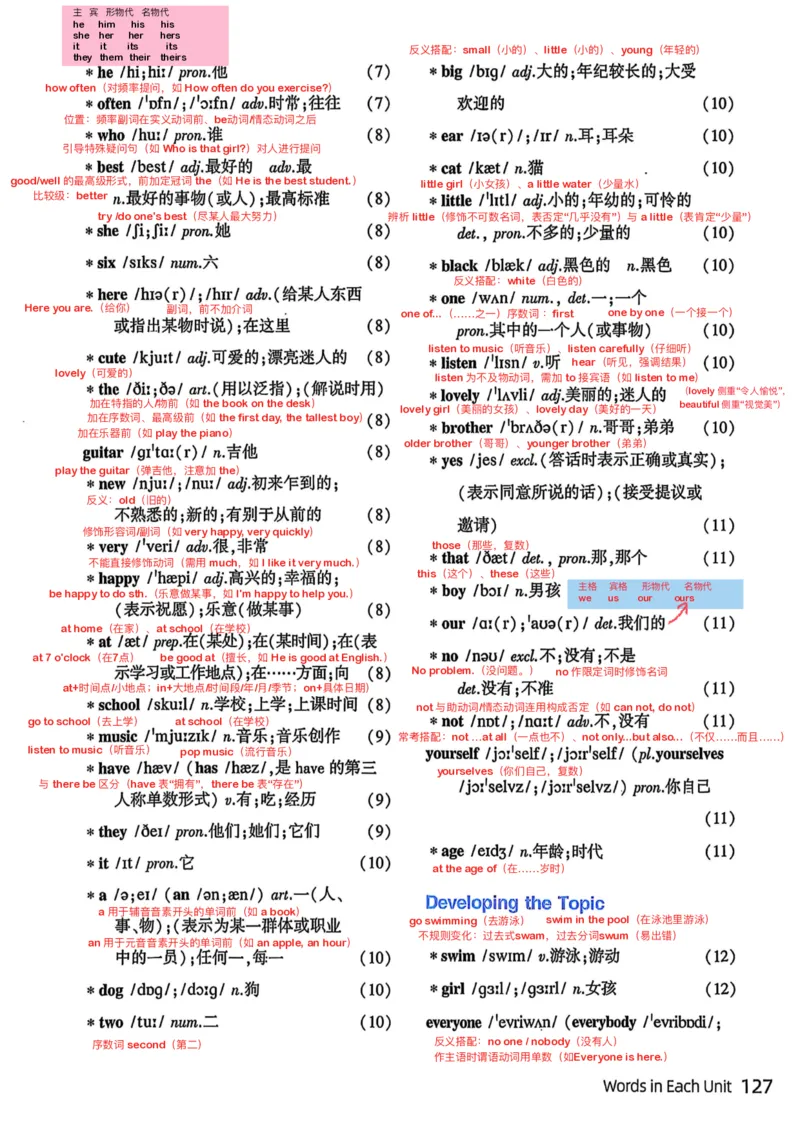
how often(对频率提问,如 How often do you exercise?)
主   宾   形物代   名物代
he      him       his       his
she    her      her       hers
it         it         its            its
they   them   their    theirs
位置:频率副词在实义动词前、be动词/情态动词之后
引导特殊疑问句(如 Who is that girl?)对⼈进⾏提问
try /do one's best(尽某⼈最⼤努⼒)
good/well 的最⾼级形式,前加定冠词 the(如 He is the best student.)
⽐较级:better
Here you are.(给你)
副词,前不加介词
lovely(可爱的)
加在特指的⼈/物前(如 the book on the desk)
加在序数词、最⾼级前(如 the first day, the tallest boy)
加在乐器前(如 play the piano)
play the guitar(弹吉他,注意加 the)
反义:old(旧的)
修饰形容词/副词(如 very happy, very quickly)
不能直接修饰动词(需⽤ much,如 I like it very much.)
be happy to do sth.(乐意做某事,如 I'm happy to help you.)
at home(在家)、at school(在学校)
at 7 o'clock(在7点)
be good at(擅⻓,如 He is good at English.)
at+时间点/⼩地点;in+⼤地点/时间段/年/⽉/季节;on+具体⽇期)
go to school(去上学)
at school(在学校)
listen to music(听⾳乐)
pop music(流⾏⾳乐)
与 there be 区分(have 表“拥有”,there be 表“存在”)
a ⽤于辅⾳⾳素开头的单词前(如 a book)
an ⽤于元⾳⾳素开头的单词前(如 an apple, an hour)
序数词 second(第⼆)
反义搭配:small(⼩的)、little(⼩的)、young(年轻的)
little girl(⼩⼥孩)、a little water(少量⽔)
辨析 little(修饰不可数名词,表否定“⼏乎没有”)与 a little(表肯定“少量”)
反义搭配:white(⽩⾊的)
one of...(……之⼀)序数词 :first
one by one(⼀个接⼀个)
listen to music(听⾳乐)、listen carefully(仔细听)
hear(听⻅,强调结果)
listen 为不及物动词,需加 to 接宾语(如 listen to me)
lovely girl(美丽的⼥孩)、lovely day(美好的⼀天)
(lovely 侧重“令⼈愉悦”,
beautiful 侧重“视觉美”)
older brother(哥哥)、younger brother(弟弟)
those(那些,复数)
this(这个)、these(这些)
主格     宾格      形物代      名物代
we       us        our         ours
No problem.(没问题。)
no 作限定词时修饰名词
not 与助动词/情态动词连⽤构成否定(如 can not, do not)
常考搭配:not …at all(⼀点也不)、not only...but also...(不仅……⽽且……)
yourselves(你们⾃⼰,复数)
at the age of(在……岁时)
go swimming(去游泳)
不规则变化:过去式swam,过去分词swum(易出错)
swim in the pool(在泳池⾥游泳)
反义搭配:no one / nobody(没有⼈)
作主语时谓语动词⽤单数(如Everyone is here.)
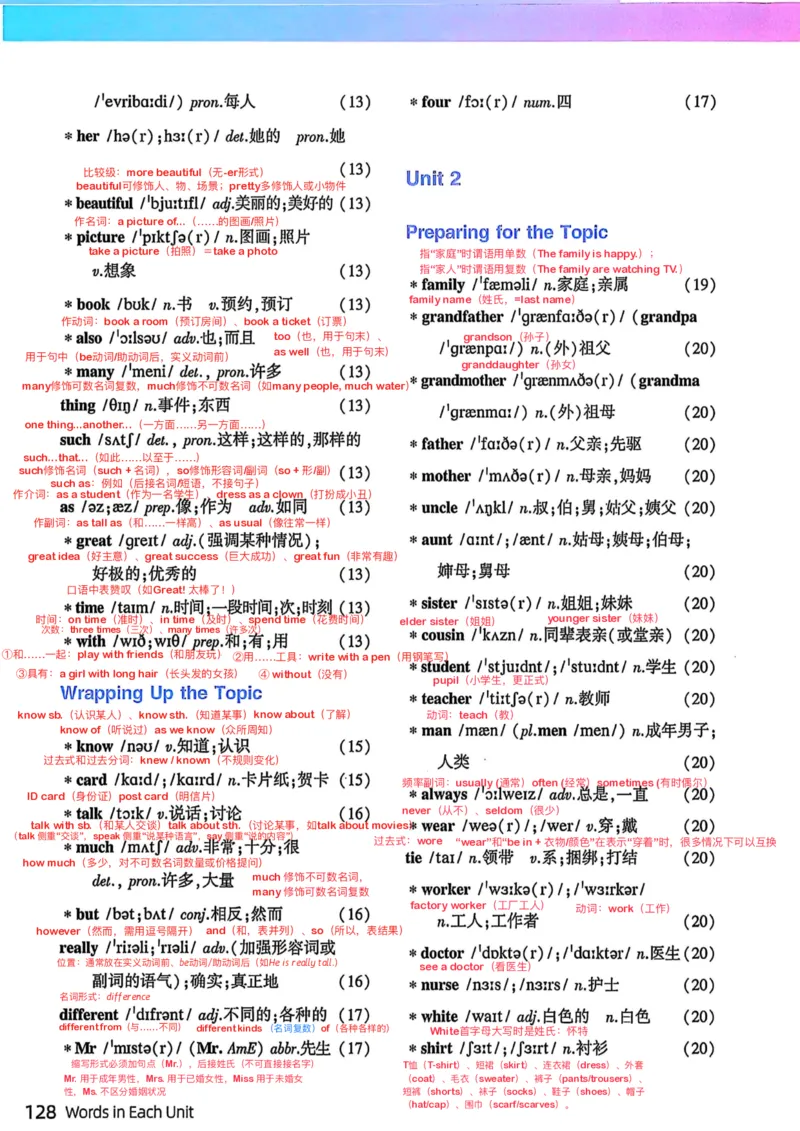
beautiful可修饰⼈、物、场景;pretty多修饰⼈或⼩物件
⽐较级:more beautiful(⽆-er形式)
作名词:a picture of...(……的图画/照⽚)
take a picture(拍照)=take a photo
作动词:book a room(预订房间)、book a ticket(订票)
⽤于句中(be动词/助动词后,实义动词前)
too(也,⽤于句末)、
as well(也,⽤于句末)
many修饰可数名词复数,much修饰不可数名词(如many people, much water)
one thing...another...(⼀⽅⾯……另⼀⽅⾯……)
such...that...(如此……以⾄于……)
such修饰名词(such + 名词),so修饰形容词/副词(so + 形/副)
such as:例如(后接名词/短语,不接句⼦)
作介词:as a student(作为⼀名学⽣)、dress as a clown(打扮成⼩丑)
作副词:as tall as(和……⼀样⾼)、as usual(像往常⼀样)
⼝语中表赞叹(如Great! 太棒了!)
great idea(好主意)、great success(巨⼤成功)、great fun(⾮常有趣)
时间:on time(准时)、in time(及时)、spend time(花费时间)
次数:three times(三次)、many times(许多次)
①和……⼀起:play with friends(和朋友玩)
③具有:a girl with long hair(⻓头发的⼥孩)
②⽤……⼯具:write with a pen(⽤钢笔写)
④ without(没有)
know about(了解)
know sb.(认识某⼈)、know sth.(知道某事)
know of(听说过)as we know(众所周知)
过去式和过去分词:knew / known(不规则变化)
ID card(身份证)post card(明信⽚)
talk with sb.(和某⼈交谈)talk about sth.(讨论某事,如talk about movies)
(talk 侧重“交谈”,speak 侧重“说某种语⾔”,say 侧重“说的内容”)
how much(多少,对不可数名词数量或价格提问)
much 修饰不可数名词,
many 修饰可数名词复数
however(然⽽,需⽤逗号隔开)and(和,表并列)、so(所以,表结果)
位置:通常放在实义动词前、be动词/助动词后(如He is really tall.)
名词形式:difference
different from(与……不同)
different kinds (名词复数)of(各种各样的)
缩写形式必须加句点(Mr.),后接姓⽒(不可直接接名字)
Mr. ⽤于成年男性,Mrs. ⽤于已婚⼥性,Miss ⽤于未婚⼥
性,Ms. 不区分婚姻状况
指“家庭”时谓语⽤单数(The family is happy.);
指“家⼈”时谓语⽤复数(The family are watching TV.)
grandson(孙⼦)
granddaughter(孙⼥)
pupil(⼩学⽣,更正式)
频率副词:usually (通常)often (经常)sometimes (有时偶尔)
never(从不)、seldom(很少)
“wear”和“be in + ⾐物/颜⾊”在表示“穿着”时,很多情况下可以互换
elder sister(姐姐)
younger sister(妹妹)
动词:teach(教)
family name(姓⽒,=last name)
过去式:wore
factory worker(⼯⼚⼯⼈)
动词:work(⼯作)
see a doctor(看医⽣)
White⾸字⺟⼤写时是姓⽒:怀特
T恤(T-shirt)、短裙(skirt)、连⾐裙(dress)、外套
(coat)、⽑⾐(sweater)、裤⼦(pants/trousers)、
短裤(shorts)、袜⼦(socks)、鞋⼦(shoes)、帽⼦
(hat/cap)、围⼱(scarf/scarves)。
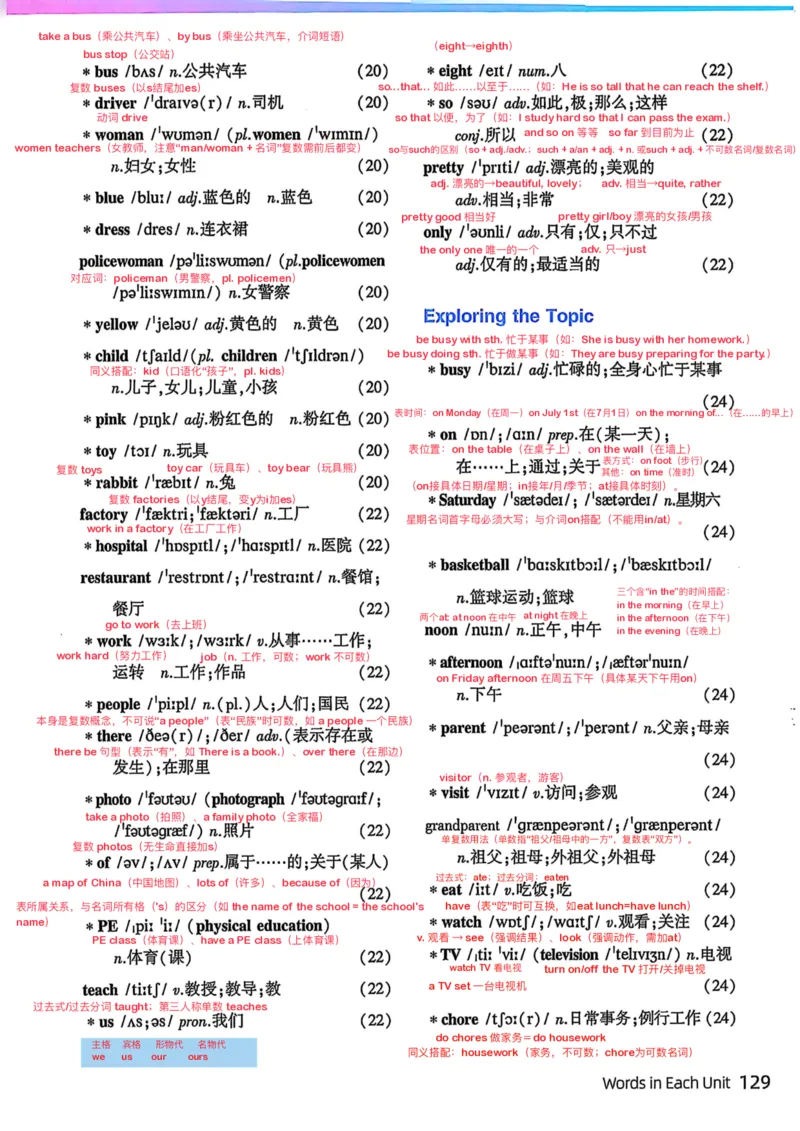
take a bus(乘公共汽⻋)、by bus(乘坐公共汽⻋,介词短语)
复数 buses(以s结尾加es)
bus stop(公交站)
动词 drive
women teachers(⼥教师,注意“man/woman + 名词”复数需前后都变)
对应词:policeman(男警察,pl. policemen)
同义搭配:kid(⼝语化“孩⼦”,pl. kids)
复数 toys
toy car(玩具⻋)、toy bear(玩具熊)
work in a factory(在⼯⼚⼯作)
复数 factories(以y结尾,变y为i加es)
go to work(去上班)
work hard(努⼒⼯作)
job(n. ⼯作,可数;work 不可数)
本身是复数概念,不可说“a people”(表“⺠族”时可数,如 a people ⼀个⺠族)
there be 句型(表示“有”,如 There is a book.)、over there(在那边)
take a photo(拍照)、a family photo(全家福)
复数 photos(⽆⽣命直接加s)
a map of China(中国地图)、lots of(许多)、because of(因为)
表所属关系,与名词所有格('s)的区分(如 the name of the school = the school's
name)
PE class(体育课)、have a PE class(上体育课)
过去式/过去分词 taught;第三⼈称单数 teaches
主格     宾格      形物代      名物代
we       us        our         ours
(eight→eighth)
so...that... 如此……以⾄于……(如:He is so tall that he can reach the shelf.)
so that 以便,为了(如:I study hard so that I can pass the exam.)
and so on 等等
so far 到⽬前为⽌
so与such的区别(so + adj./adv.;such + a/an + adj. + n. 或such + adj. + 不可数名词/复数名词)
adj. 漂亮的→beautiful, lovely;     adv. 相当→quite, rather
pretty good 相当好
pretty girl/boy 漂亮的⼥孩/男孩
the only one 唯⼀的⼀个
adv. 只→just
be busy with sth. 忙于某事(如:She is busy with her homework.)
be busy doing sth. 忙于做某事(如:They are busy preparing for the party.)
表时间:on Monday(在周⼀)on July 1st(在7⽉1⽇)on the morning of...(在……的早上)
表位置:on the table(在桌⼦上)、on the wall(在墙上)
表⽅式:on foot(步⾏)
其他:on time(准时)
(on接具体⽇期/星期;in接年/⽉/季节;at接具体时刻)。
星期名词⾸字⺟必须⼤写;与介词on搭配(不能⽤in/at)。
两个at: at noon 在中午
on Friday afternoon 在周五下午(具体某天下午⽤on)
at night 在晚上
三个含“in the”的时间搭配:
in the morning(在早上)
in the afternoon(在下午)
in the evening(在晚上)
visitor(n. 参观者,游客)
单复数⽤法(单数指“祖⽗/祖⺟中的⼀⽅”,复数表“双⽅”)。
have(表“吃”时可互换,如eat lunch=have lunch)
过去式:ate;过去分词:eaten
v. 观看 → see(强调结果)、look(强调动作,需加at)
a TV set ⼀台电视机
watch TV 看电视
turn on/off the TV 打开/关掉电视
do chores 做家务=do housework
同义搭配:housework(家务,不可数;chore为可数名词)
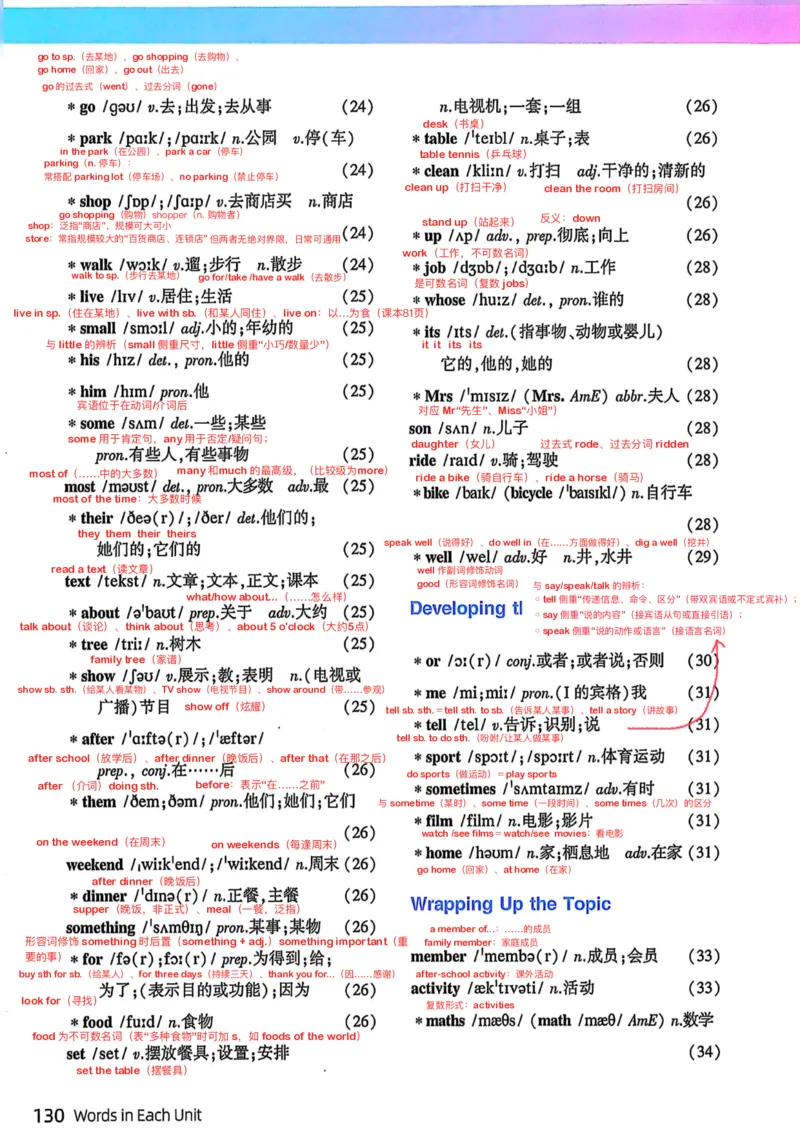
go to sp.(去某地)、go shopping(去购物)、
go home(回家)、go out(出去)
go 的过去式(went)、过去分词(gone)
in the park(在公园)、park a car(停⻋)
parking(n. 停⻋):
常搭配 parking lot(停⻋场)、no parking(禁⽌停⻋)
go shopping(购物)shopper(n. 购物者)
shop:泛指“商店”,规模可⼤可⼩
store:常指规模较⼤的“百货商店、连锁店” 但两者⽆绝对界限,⽇常可通⽤
walk to sp.(步⾏去某地)
go for/take /have a walk(去散步)
live in sp.(住在某地)、live with sb.(和某⼈同住)、live on:以…为⻝(课本81⻚)
与 little 的辨析(small 侧重尺⼨,little 侧重“⼩巧/数量少”)
宾语位于在动词/介词后
some ⽤于肯定句,any ⽤于否定/疑问句;
most of(……中的⼤多数)
many 和much 的最⾼级,(⽐较级为more)
most of the time:⼤多数时候
they  them  their  theirs
read a text(读⽂章)
talk about(谈论)、think about(思考)、about 5 o'clock(⼤约5点)
what/how about...(……怎么样)
family tree(家谱)
show sb. sth.(给某⼈看某物)、TV show(电视节⽬)、show around(带……参观)
show off(炫耀)
after school(放学后)、after dinner(晚饭后)、after that(在那之后)
after (介词)doing sth.
before:表示“在……之前”
on the weekend(在周末)
on weekends(每逢周末)
after dinner(晚饭后)
supper(晚饭,⾮正式)、meal(⼀餐,泛指)
形容词修饰 something 时后置(something + adj.)something important(重
要的事)
buy sth for sb.(给某⼈)、for three days(持续三天)、thank you for...(因……感谢)
look for(寻找)
food 为不可数名词(表“多种⻝物”时可加 s,如 foods of the world)
set the table(摆餐具)
desk(书桌)
table tennis(乒乓球)
clean up(打扫⼲净)
clean the room(打扫房间)
stand up(站起来)
反义:down
work(⼯作,不可数名词)
是可数名词(复数 jobs)
it  it   its   its
对应 Mr“先⽣”、Miss“⼩姐”)
daughter(⼥⼉)
ride a bike(骑⾃⾏⻋)、ride a horse(骑⻢)
过去式 rode、过去分词 ridden
speak well(说得好)、do well in(在……⽅⾯做得好)、dig a well(挖井)
well 作副词修饰动词
good(形容词修饰名词)
tell sb. sth.=tell sth. to sb.(告诉某⼈某事)、tell a story(讲故事)
tell sb. to do sth.(吩咐/让某⼈做某事)
与 say/speak/talk 的辨析:
◦tell 侧重“传递信息、命令、区分”(带双宾语或不定式宾补);
◦say 侧重“说的内容”(接宾语从句或直接引语);
◦speak 侧重“说的动作或语⾔”(接语⾔名词)
do sports(做运动)=play sports
与 sometime(某时)、some time(⼀段时间)、some times(⼏次)的区分
go home(回家)、at home(在家)
watch /see films=watch/see  movies:看电影
a member of...:……的成员
family member:家庭成员
after-school activity:课外活动
复数形式:activities
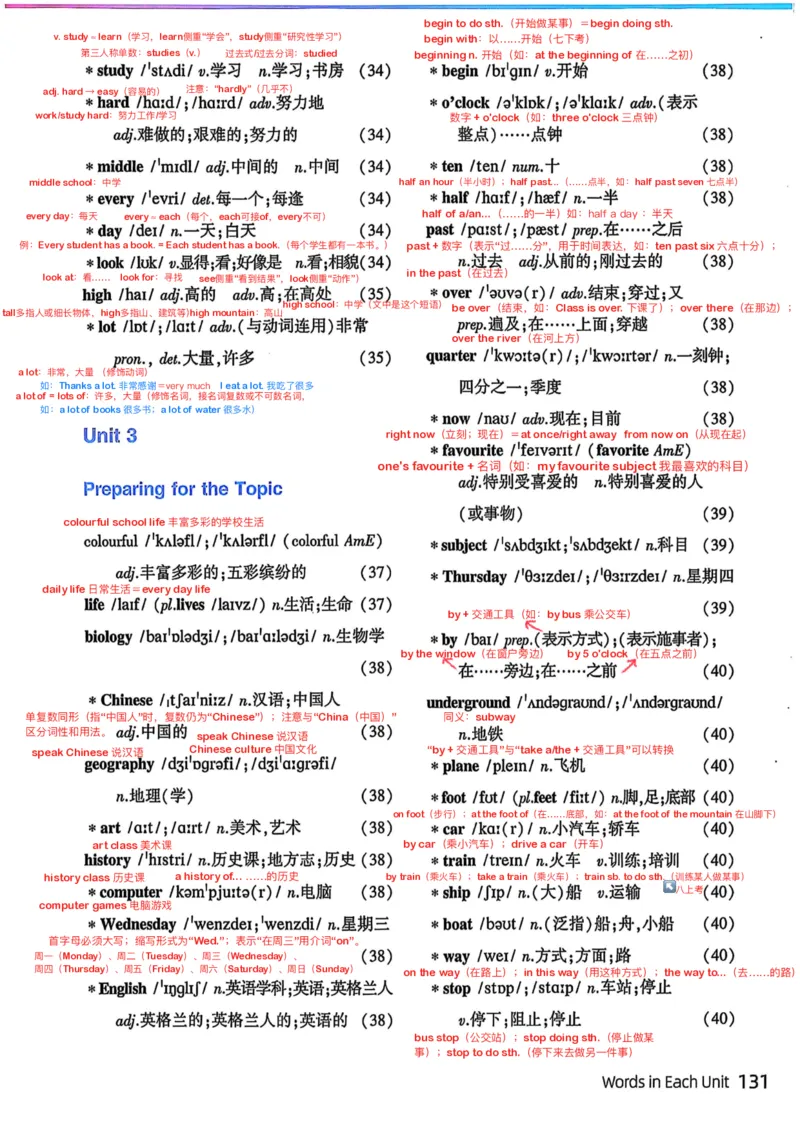
v. study ≈ learn(学习,learn侧重“学会”,study侧重“研究性学习”)
第三⼈称单数:studies(v.)
过去式/过去分词:studied
work/study hard:努⼒⼯作/学习
adj. hard → easy(容易的)
注意:“hardly”(⼏乎不)
middle school:中学
every day:每天
every ≈ each(每个,each可接of,every不可)
例:Every student has a book. = Each student has a book.(每个学⽣都有⼀本书。)
look at:看……    look for:寻找
see侧重“看到结果”,look侧重“动作”)
tall多指⼈或细⻓物体,high多指⼭、建筑等)high mountain:⾼⼭
high school:中学(⽂中是这个短语)
a lot:⾮常,⼤量 (修饰动词)
       如:Thanks a lot. ⾮常感谢=very much   I eat a lot. 我吃了很多
a lot of = lots of:许多,⼤量(修饰名词,接名词复数或不可数名词,
        如:a lot of books 很多书;a lot of water 很多⽔)
colourful school life 丰富多彩的学校⽣活
daily life ⽇常⽣活=every day life
单复数同形(指“中国⼈”时,复数仍为“Chinese”);注意与“China(中国)”
区分词性和⽤法。
speak Chinese 说汉语
Chinese culture 中国⽂化
speak Chinese 说汉语
art class 美术课
history class 历史课
a history of... ……的历史
computer games 电脑游戏
⾸字⺟必须⼤写;缩写形式为“Wed.”;表示“在周三”⽤介词“on”。
周⼀(Monday)、周⼆(Tuesday)、周三(Wednesday)、
周四(Thursday)、周五(Friday)、周六(Saturday)、周⽇(Sunday)
begin to do sth.(开始做某事)=begin doing sth.
begin with:以……开始(七下考)
beginning n. 开始(如:at the beginning of 在……之初)
数字 + o'clock(如:three o'clock 三点钟)

half an hour(半⼩时);half past...(……点半,如:half past seven 七点半)
half of a/an...(……的⼀半)如:half a day :半天
past + 数字(表示“过……分”,⽤于时间表达,如:ten past six 六点⼗分);
in the past(在过去)
be over(结束,如:Class is over. 下课了);over there(在那边);
over the river(在河上⽅)
right now(⽴刻;现在)=at once/right away   from now on(从现在起)
one's favourite + 名词(如:my favourite subject 我最喜欢的科⽬)
by + 交通⼯具(如:by bus 乘公交⻋)
by the window(在窗户旁边)
by 5 o'clock(在五点之前)
同义:subway
“by + 交通⼯具”与“take a/the + 交通⼯具”可以转换
on foot(步⾏);at the foot of(在……底部,如:at the foot of the mountain 在⼭脚下)
by car(乘⼩汽⻋);drive a car(开⻋)
by train(乘⽕⻋);take a train(乘⽕⻋);train sb. to do sth.(训练某⼈做某事)
⼋上考
↖
on the way(在路上);in this way(⽤这种⽅式);the way to...(去……的路)
bus stop(公交站);stop doing sth.(停⽌做某
事);stop to do sth.(停下来去做另⼀件事)
频率副词从⼤到⼩为:always(总是)、usually(通常)、often(经
常)、sometimes(有时)、seldom(很少)、never(从不)。
位置:在句中多位于实义动词前、be动词/助动词/情态动词后
come from(来⾃)=be from
come to...(来到某地,如:come to school 来学校)
反义词:go(去)
反义词:always(总是)
far from(离……远,如:My home is far from school. 我家离学校远)
本身表否定,句中⽆需再加“not”
take + a/the 交通⼯具(乘坐,如:take a bus 乘公交⻋)take photos(拍照)
close to(靠近,⽐near更强调“距离近”)
next to:强调“紧挨着、紧邻”,距离最近,⼏乎没有间隔。
in the library(在图书馆)
teaching building(教学楼)build v. 建造(过去式/过去分词:built)
on the first floor(在⼀楼)
sweep the floor(扫地)
on the playground(在操场上)
close to(靠近)
next week(下周)
注意与floor的发⾳区分
tidy up(整理,收拾)
sports club(运动俱乐部)reading club(阅读俱乐部)
close v. 关闭
a.m.(上午,午后的对应词)
dining hall(餐厅)
sing a song(唱歌)
put on(穿上;放映,上演)
put away(收起来)
put up(举起;张贴)
作名词:drink water(喝⽔)
作动词:water the flowers(浇花)
play a game / play games(玩游戏)
have fun(玩得开⼼)
raise one’s hand(举⼿);raise money(筹钱);
raise a child(抚养孩⼦)
national flag(国旗)
raise the national flag :升国旗
作动词:start to do/doing sth.(开始做某事)
作名词:at the start / beginning of :在……的开始
the first time(第⼀次);first of all(⾸先);at first(起初)
first of all 侧重“顺序上的第   at first 侧重“时间上的起初”。
make friends(交朋友);make sb. do sth.(使某⼈做某事)
作“帮助”:give a hand(帮忙)=help sb
作名词:the answer to...(……的答案)
作动词:answer a question(回答问题);answer the phone(接电话)
复数:boxes
f/fe→v加es
作“玻璃杯”:a glass of water(⼀杯⽔)
作“眼镜”:a pair of glasses(⼀副眼镜,复数)
不可数
作“菜肴”:a delicious dish(⼀道美味的
作“餐具”:wash the dishes(洗碗)
复数:tomatoes(有⽣命加es,⽆⽣命加s)photo→photos
复数:countries
America n. 美国
during the day(在⽩天期间);during the holiday(在假期期间)
make→made(过去式)
take part in=join in (参加,侧重参与活动)
a bottle of(⼀瓶……,如a bottle of juice ⼀瓶果汁)
a part of...(……的⼀部分)
⽤于否定句/疑问句:(否定句:I don’t have any books)
⽤于肯定句(表“任⼀”):Any student can join(任何学⽣都能参加)
some(⼀些,⽤于肯定句,与any对应)
table(桌⼦,侧重“餐桌/⼯作台”)
rule v. 统治;规定(n. 规则)常考搭配:follow the rules(遵守规则)
table tennis(乒乓球,英式常⽤)
过去式/过去分词:found
look for 侧重“寻找”的动作和过程,find 侧重“找到”的结果
lost and found(失物招领)
lose  v. 丢失;失去(过去式/过去分词:lost)
loss 名词:表示“丢失;损失”
colourful adj. ⾊彩丰富的
end with(以……结束)
at the end of...(在……末端/结尾);in the end(最后,终于)
learn from(向……学习)learn to do sth.(学习做某事)study(学习,侧重“研
究”,learn侧重“学会”)
interest n. 兴趣;v. 使感兴趣
interested  (修饰⼈) adj. 感兴趣的(be interested in 对……感兴趣)
interesting(修饰物)
join:加⼊(组织,成为⼀员)
join in/take part in:加⼊(活动或⽐赛)
web page(⽹⻚)
website n. ⽹站
主席
复数:cities         town(城镇,规模⼩于city)
countryside(乡村)
welcome to+地点:欢迎到某地
You're welcome(不客⽓)
go out(出去)
look out(⼩⼼)  find out (搞清楚,弄明⽩,找出)
more为much/many的⽐较级     most 为最⾼级(最多)
more than(多于,超过)
want to do sth.(想要做某事=would like to do sth.)want sth.(想要某物)
(英语中because和so不可同时出现在句中) because of+短语    because+句⼦
living room(客厅)
bedroom(卧室)
write v. 写(过去式/过去分词:wrote/written)
ask a question(问问题)
ask sb. for sth.(向某⼈要某物→ask sb for help 向某⼈求助)
tell / ask sb. to do sth.(让某⼈做某事)
sunny  adj. 阳光充⾜的
in the sun 在阳光下(注意:不是“under the sun”,后者指“全世界”)
同义词:fall
in年(in 2024)、⽉(in June)、季节(in summer)、
外加三个早午晚(in the morning / afternoon / evening)
反义词:cold(寒冷的)
反义词:warm(温暖的)
snowy   /ˈsnəʊi/     adj. 下雪的
make a snowman 堆雪⼈
复数形式:snowmen
由 sun(n.)+ -y 构成形容词
have a picnic(去野餐)
=go on a picnic
=go for a picnic
不可数名词
What’s the weather like……?=How is the weather…?
four seasons(四季);favourite season(最喜欢的季节)
回答⽤ because 引导原因状语从句
词汇变形:rainy(adj. 下⾬的)
反义词:wet(潮湿的)
play badminton(打⽻⽑球,球类运动前不加“the”)
mobile phone(⼿机)smartphone(智能⼿机)telephone(电话,泛指)
a pair of shoes(⼀双鞋)
be sorry for sth.(为某事抱歉)
be sorry to do sth.(做某事很遗憾,如:I’m sorry to hear that.)
do homework(做作业)
不可数名词,⽆复数形式
hope to do sth.(希望做某事
hopeful(adj. 有希望的)
all year long “⼀整年;全年”
as long as(只要;和……⼀样⻓)
cloud   n. 云
反义词:indoors(在室内)
outdoor adj. 户外的(常考:outdoor activities 户外活动)
indoor   adj. 室内的
表示“锻炼”时不可数(do exercise);表示“练习题”时可数(do exercises)
healthy   adj. 健康的
healthy food 健康⻝物;keep healthy 保持健康)
tips for...(……的窍⻔)
on the right(在右边)
同义:正确的:correct(正确的,更正式)
右边的:left(左边的)
是集体名词,⽆单数形式,不能直接⽤数词修饰
(如“two clothes”错误,应为“two pieces of
clothes”)。
play an important role(扮演重要⻆⾊)
名词:importance(重要性),常考搭配“the importance of...”(……的重要性)
反义词:after(在……之后)
a football team(⾜球队)
give up(放弃)
过去式:gave;过去分词:given
give sth. to sb. = give sb. sth. 给某⼈某物
pass the exam 考试及格  反义词:fail(失败;不及格)
pass sb. sth. = pass sth. to sb. 把某物递给某⼈
反义词:lose(输掉)
won(过去式/过去分词)
best wishes 最美好的祝愿
wish to do sth. 希望做某事
   wish 与 hope 的区别:
hope 后接真实愿望,
wish 后接虚拟语⽓(不
可能实现的愿望)。
feel + 形容词(系表结构)
felt(过去式/过去分词)feeling n. 感觉
use sth. to do sth. ⽤某物做某事
make use of 利⽤(如 make good use of
time 充分利⽤时间)
be used to do sth. 被⽤来做某事(被动语态)
    used to do sth. 过去常常做某事
与 be used to doing sth. 习惯于做某事 区分
     (⼋年级学到)
fast 强调速度快(如 run fast)
quickly 强调动作敏捷(如 answer quickly)
反义词:slow(adj. 慢的)、slowly(adv. 慢地)
feed on 以……为⻝(如 Sheep feed on grass. ⽺以草为⻝。)
in red 穿红⾊⾐服
by the lake 在湖边
pond(池塘,⽐ lake ⼩)
作连词时:while(强调
同时进⾏,后接延续性
动词)⽽when 均可
go skiing 去滑雪
ski  v. 滑雪(运动)
return to one’s hometown 回到家乡
travel to… 去……旅⾏
journey(侧重⻓途旅⾏,尤指陆路)、trip
(侧重短途旅⾏)、tour(侧重观光旅⾏)
climb a mountain 爬⼭
turn on(打开)、turn off(关闭)、turn up(调⼤;出现)、turn
down(调⼩;拒绝)turn around(转身)、turn into(变成)
take turns to do sth.(轮流做某事)
It's one's turn to do sth.(轮到某⼈做某事)
move  to...(移到……)
a survey of...(关于……的调查)
last week(上周);next week(下周)
weekday(⼯作⽇);weekend(周末)
an hour(⼀⼩时);half an hour(半⼩时)
the result of...(……的结果)
a pair of(⼀双/⼀对……)
a pair of shorts(⼀条短裤);wear shorts(穿短裤)
本身为复数,搭配 a pair of 使⽤
go to the zoo(去动物园);at the zoo(在动物园)
a strong wind(⼤⻛)
windy(adj. 有⻛的)
a running race(跑步⽐赛)
write to sb.(给某⼈写信)
writing(n. 写作;⽂字)
writer(n. 作家)
sit down(坐下);lie down(躺下);write down(写下)
prep.:walk down the street(沿着街道⾛);go down the stairs(下楼梯)
“walk down(步⾏)”和“go down”:“沿着……⾛”
natural(adj. ⾃然的)
ocean(海洋,指更⼴阔的⽔域)
land(n. 陆地)
forest:森林
反义词:dry(adj. ⼲燥的)
grow(v. 种植,同义)
planter(n. 种植者)
wild animals(野⽣动物)
fall down(跌倒)
fall off(从……掉下)
fall in love(爱上)
fell(过去式)、fallen(过去分词);fall(n. 秋天 = autumn)
mountain(⼭,指更⾼⼤的⼭)
fresh air(新鲜空⽓)
by air(乘⻜机)
on the top of:指“在某物的顶部表⾯上”(是两个独⽴物体,有接触)
at the top of:指“在某物⾃身的顶端”
take place(发⽣)
询问⽓候:What's the climate like there?/How's the climate in [place]?
home(n. 家,更强调情感
open/close the window(开/关窗)
get up(起床)get to(到达)got(过去式/过去分词)
fly to…(⻜往…)fly a kite / fly kites(放⻛筝)
flew(过去式)、flown(过去分词)
take an active part in…  意为“积极参与……”
activity(n. 活动)
at night(在夜⾥)
day and night(⽇⽇夜夜)
bamboo forest(⽵林)
v.  bear pain(忍受痛苦)
living places 居住地;⽣活场所(80⻚)
in the forest(在森林⾥)
North America(北美洲)in the north of(在……的北部)
go fishing(去钓⻥)
作“⻥”讲时,单复数同形(a fish, two fish)
为不可数名词
think of(想起;认为);think about(考虑)
反义词为those(那些)
grow up(⻓⼤;成⻓);grow vegetables(种蔬菜)
⽉份⾸字⺟⼤写
plenty of(⼤量的,修饰可数/不可数名词)
a few(⼀些,表肯定);few(⼏乎没有,表否定)
修饰可数名词复数;
wonderful(adj. 极好的;奇妙的)
main idea(主旨)
main differences:主要区别make a difference(有影响;起作⽤)
different(adj. 不同的)
ride a horse(骑⻢)
drank(过去式);drunk(过去分词)
on the earth(在地球上)
in the sky(在天空中)
an  egg(⼀个鸡蛋)
a map of China(中国地图)read a map(看地图)
wind(n. ⻛)
fly a kite / fly kites(放⻛筝)
an orange:⼀个橙⼦(讲了很多次,考试还是会有⼈错)
形容词:sharp(锋利的)
climb a mountain  / climb the mountains(爬⼭)
butter:意为“⻩油、奶油”
fly:意为“苍蝇”(此处指昆⾍
roast duck(烤鸭)
call sb. /call sb up(给某⼈打电话)
call sb. + 名词(称呼某⼈为……)call on:呼吁,号召(考试遇到过)
过去式/过去分词为 understood
wild animals(野⽣动物)
n.:have a rest(休息⼀下)the rest of...(……的其余部分)
两个意思都考
反义:over(在……上⾯)
bring sb. sth. = bring sth. to sb.(给某⼈带来某物)
反义:take(带⾛,v.)
the importance of...(……的重要性)
important adj. 重要的
fresh air(新鲜空⽓);fresh food(新鲜⻝物);fresh water(淡⽔)
everyday life(⽇常⽣活)=daily life
区分every day
in the south(在南⽅);south China(中国南⽅)
反义:north(北⽅)
will do sth.(将要做某事,⽤于⼀般将来时)
will 与 be going to 的辨析(will 表临时决定或客观将来;be going to 表计划或有迹象发⽣)
willing adj. 愿意的 be willing to do sth. 愿意做某事)
all over the world /around the world / throughout the world(全世界)
keep / stay healthy(保持健康)
health n. 健康
unhealthy adj. 不健康的(反义)
make a fire(⽣⽕)
v.:fire sb.(解雇某⼈)
(常⽤复数 noodles)
make dumplings(包饺⼦)
stream(⼩溪)lake :湖
a bowl of rice(⼀碗⽶饭);fried rice(炒饭)
fresh vegetables(新鲜蔬菜);green vegetables(绿⾊蔬菜)
Celebrate the Big Days :庆祝⼤⽇⼦
celebration n. 庆祝;庆典
反义词:single(单⼀的,adj.)
序数词前常加 the,对应的基数词是 nine 如:the ninth day(第九天)
Double Ninth Festival:重阳节
Spring Festival(春节)
Tomb -sweeping Day(清明节)
sweep the tombs of “给……扫墓”
sweep the floor(扫地)
swept(过去式/过去分词)
Dragon Boat Festival(端午节)
dragon boat(⻰⾈)
lantern show(灯展);Lantern Festival(元宵节)lantern riddles(灯谜)
“lunar month” :农历⽉(⽂中)
lunar August :农历⼋⽉
中秋节(Mid-Autumn Festival)
full moon(满⽉)
be lucky to do sth.(幸运地做某事)
luck n. 运⽓(如:good luck 好运)
unlucky adj. 不幸的(反义词)
lucky money(压岁钱)
around the world(全世界);around 8 o'clock(⼤约8点)
相当于about
“late family members” :“已故的家⼈”(⽂中)
be late for(迟到)如:Don't be late for school.
lunar month(农历⽉)
the fifth day of the fifth lunar month(农历五⽉初五,端午节)
Labour Day(劳动节)
on holiday(度假);summer holiday(暑假)
同义:vacation(美式)
bought(过去式/过去分词)
buy sb. sth.=buy sth. for sb.:“给某⼈买某物”。
remember doing sth.(记得做过某事)
remember to do sth.(记得要做某事)
反义词:forget(忘记)
thank sb. for sth./doing sth.(因某事感谢某⼈)
thanks to(幸亏;由于)
on Christmas Day(在圣诞节当天)
at Christmas(在圣诞节期间)
Christmas Eve“平安夜”)
turn on the light(开灯)
不可数名词(“⼀张纸”需⽤a piece of)
from then on(从那时起);just then(正在那时)
a birthday present(⽣⽇礼物);at present(⽬前;现在)
a great thinker(伟⼤的思想家)
think(v. 思考);thought(n. 思想,⼜是think过去式)
in a word(总之)
words(n. 话语,常⽤复数)
(other后接复数名词,another接单数可数名词)
三者以上
两者:the other
should do sth.(应该做某事)
Spring Festival couplets(春联)
last week(上周);the last one(最后⼀个);last for+时间段(持续…)
celebrate(v. 庆祝)
hold a celebration(举⾏庆祝活动)
in the kitchen(在厨房⾥)
同义:tasty, yummy(yummy更⼝语化)
have a meal(吃⼀顿饭);three meals a day(⼀⽇三餐)
dish(菜肴,侧重“⼀道菜”)
(at last强调“经过努⼒”,finally强调“顺序最后”)
excite(v. 使兴奋);exciting(adj. 令⼈兴奋的,修饰物)
 修饰⼈
spend time/money on sth.(在某物上花费时间/⾦钱);spend a holiday(度假)
spend time/money (in) doing sth.(花费时间/⾦钱做某事)
writer(更通⽤,author侧重“书籍作者”)
birthday party(⽣⽇派对);birthday present/gift(⽣⽇礼物);
on one's birthday(在某⼈的⽣⽇那天)
基数词→序数词顺⼝溜:
基变序,有规律,后⾯th加上去
1,2,3单独记 ,后⾯字⺟t,d,d:first second third
8去t,9去e     :eight~eighth   nine~ninth
字⺟ve ,f替 :five ~fifth
整数中y变ie,后加th,莫迟疑。:  twenty ~twentieth
若是碰上⼏⼗⼏,只变个位就可以。:twenty-one ~twenty-first
one hundred(⼀百);two hundred(两百,注意hundred后不加s);
hundreds of(成百上千的,后接可数名词复数)
the second time(第⼆次);the second floor(⼆楼)
序数词前加“the”
the third place(第三名)
拼写(注意是“forty”,不是“fourty”)
five  :五      fifteen: ⼗五      fiftieth:第五⼗
4是four,14是fourteen,
9是nine,19是nineteen,90是ninety,第90是ninetieth。
enjoy themselves(玩得开⼼)单数 themself
hang up(挂断电话;悬挂);hang on(坚持;不挂断);
hang...on the wall(把……挂在墙上)
what's the date?(今天⼏号?);the date of birth(出⽣⽇期)
名词:Tiananmen Square(天安⻔⼴场);a red square(⼀个红⾊的正⽅形)
形容词:a square table(⼀张正⽅形的桌⼦)
(street指城市街道,两侧多有建筑;road侧重“道路”,可指乡村道路)
on / in the street(在街上);street corner(街⻆)
prepare for…(为……做准备);
prepare sth.(准备某物);
prepare to do sth.(准备做某事)
guess what(猜猜看,⼝语常⽤)
lantern riddles(灯谜)
⽤于句⾸表顺序,如“Lastly, we need to check the details.”
(最后,我们需要检查细节)
lastly 侧重“顺序最后”,finally 兼顾“顺序”和“最终发⽣”,
in the end 侧重“最终结果”。
a movie poster(电影海报);put up a poster(张贴海报)
traditional culture(传统⽂化);traditional food(传统⻝物)
tradition(n. 传统)
缩写为Feb.
缩写为Mar.
the People's Republic of China(中华⼈⺠共和国)
on Sunday(在周⽇);last Sunday(上周⽇)
星期⾸字⺟⼤写
a birthday cake(⽣⽇蛋糕);cut the cake(切蛋糕)
lunar calendar 指的是“农历;阴历”
“阳历;公历”,英⽂是 solar calendar
a wonderful trip(⼀次精彩的旅⾏)
缩写为Dec.
at midnight(在午夜);midnight snack(夜宵)
say sth. to sb.(对某⼈说某事);say goodbye(说再⻅)
said(过去式/过去分词);saying(n. 谚语,如old sayings“⽼话”)
good luck(好运);bad luck(坏运⽓)
lucky(adj. 幸运的)
unlucky(adj. 不幸的)
have an idea(有个主意);good idea(好主意);