第1 页(共5 页)
2016 年全国统一高考英语试卷(新课标Ⅲ)
第二部分 阅读理解(共两节,满分40 分)
第一节(共15 小题;每小题2 分,满分30 分)
阅读下列短文,从每题所给的四个选项(A、B、C 和D)中,选出最佳选项,并在答题卡上
将该项涂黑。
A
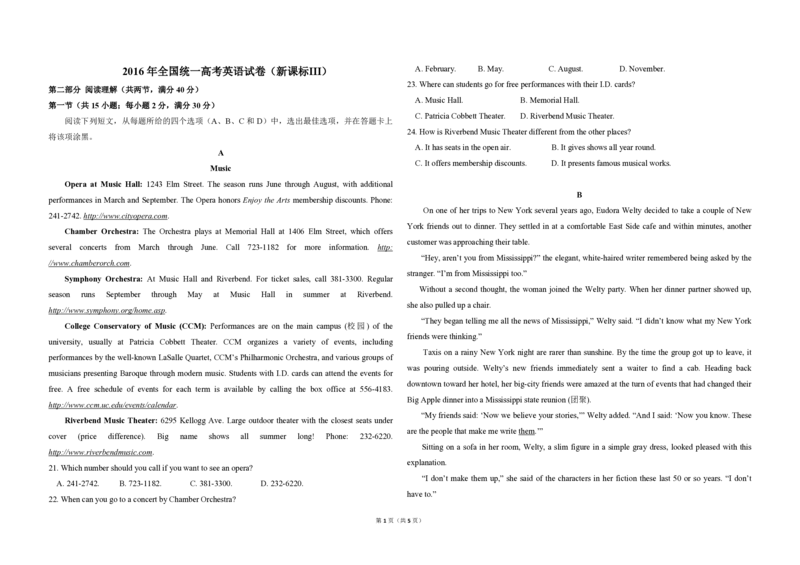
Music
Opera at Music Hall: 1243 Elm Street. The season runs June through August, with additional
performances in March and September. The Opera honors Enjoy the Arts membership discounts. Phone:
241-2742. http://www.cityopera.com.
Chamber Orchestra: The Orchestra plays at Memorial Hall at 1406 Elm Street, which offers
several concerts from March through June. Call 723-1182 for more information. http:
//www.chamberorch.com.
Symphony Orchestra: At Music Hall and Riverbend. For ticket sales, call 381-3300. Regular
season
runs
September
through
May
at
Music
Hall
in
summer
at
Riverbend.
http://www.symphony.org/home.asp.
College Conservatory of Music (CCM): Performances are on the main campus (校园) of the
university, usually at Patricia Cobbett Theater. CCM organizes a variety of events, including
performances by the well-known LaSalle Quartet, CCM’s Philharmonic Orchestra, and various groups of
musicians presenting Baroque through modern music. Students with I.D. cards can attend the events for
free. A free schedule of events for each term is available by calling the box office at 556-4183.
http://www.ccm.uc.edu/events/calendar.
Riverbend Music Theater: 6295 Kellogg Ave. Large outdoor theater with the closest seats under
cover
(price
difference).
Big
name
shows
all
summer
long!
Phone:
232-6220.
http://www.riverbendmusic.com.
21. Which number should you call if you want to see an opera?
  A. 241-2742.
 B. 723-1182.
C. 381-3300.

D. 232-6220.
22. When can you go to a concert by Chamber Orchestra?
A. February.
 B. May.


C. August.

D. November.
23. Where can students go for free performances with their I.D. cards?
A. Music Hall.


B. Memorial Hall.

C. Patricia Cobbett Theater.
D. Riverbend Music Theater.
24. How is Riverbend Music Theater different from the other places?
A. It has seats in the open air.
B. It gives shows all year round.
C. It offers membership discounts.
D. It presents famous musical works.

B
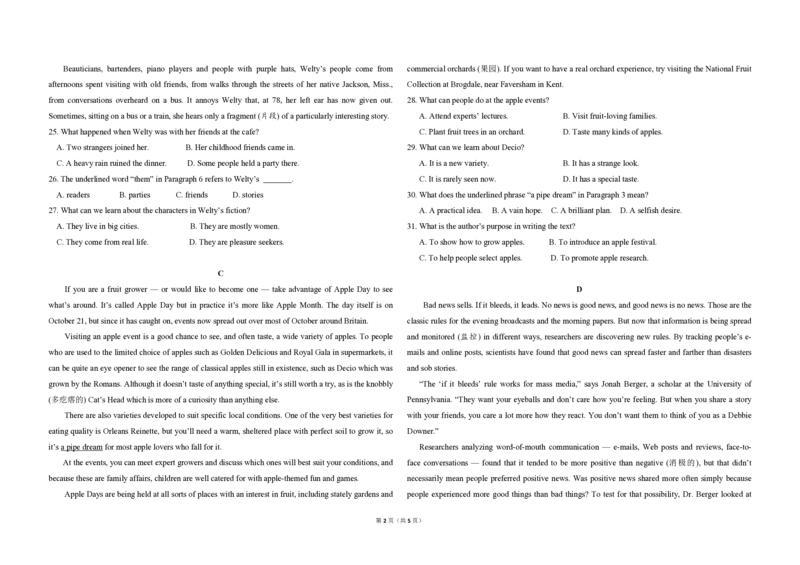
On one of her trips to New York several years ago, Eudora Welty decided to take a couple of New
York friends out to dinner. They settled in at a comfortable East Side cafe and within minutes, another
customer was approaching their table.
“Hey, aren’t you from Mississippi?” the elegant, white-haired writer remembered being asked by the
stranger. “I’m from Mississippi too.”
   Without a second thought, the woman joined the Welty party. When her dinner partner showed up,
she also pulled up a chair.
“They began telling me all the news of Mississippi,” Welty said. “I didn’t know what my New York
friends were thinking.”

Taxis on a rainy New York night are rarer than sunshine. By the time the group got up to leave, it
was pouring outside. Welty’s new friends immediately sent a waiter to find a cab. Heading back
downtown toward her hotel, her big-city friends were amazed at the turn of events that had changed their
Big Apple dinner into a Mississippi state reunion (团聚).
“My friends said: ‘Now we believe your stories,’” Welty added. “And I said: ‘Now you know. These
are the people that make me write them.’”
Sitting on a sofa in her room, Welty, a slim figure in a simple gray dress, looked pleased with this
explanation.
“I don’t make them up,” she said of the characters in her fiction these last 50 or so years. “I don’t
have to.”
第2 页(共5 页)
Beauticians, bartenders, piano players and people with purple hats, Welty’s people come from
afternoons spent visiting with old friends, from walks through the streets of her native Jackson, Miss.,
from conversations overheard on a bus. It annoys Welty that, at 78, her left ear has now given out.
Sometimes, sitting on a bus or a train, she hears only a fragment (片段) of a particularly interesting story.
25. What happened when Welty was with her friends at the cafe?
A. Two strangers joined her.
B. Her childhood friends came in.
  C. A heavy rain ruined the dinner.
D. Some people held a party there.
26. The underlined word “them” in Paragraph 6 refers to Welty’s
.
A. readers

B. parties
 C. friends
D. stories
27. What can we learn about the characters in Welty’s fiction?
  A. They live in big cities.
 B. They are mostly women.
  C. They come from real life.
D. They are pleasure seekers.

C
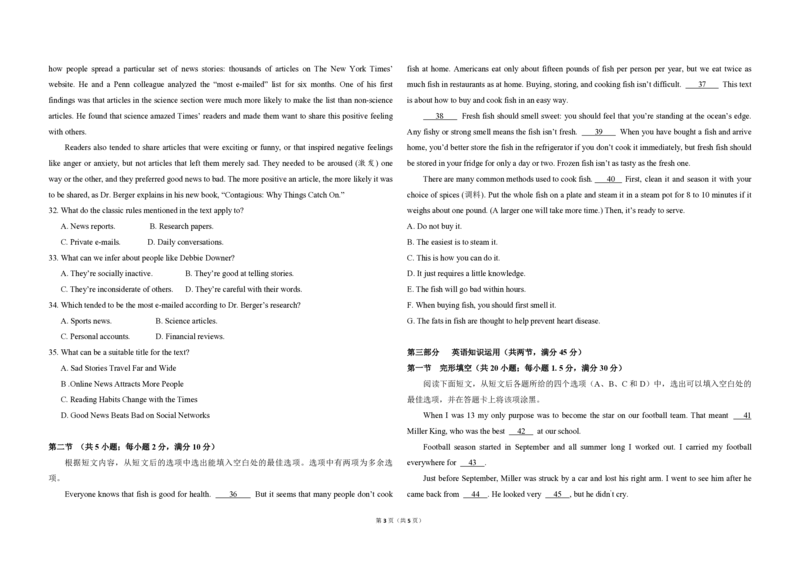
If you are a fruit grower — or would like to become one — take advantage of Apple Day to see
what’s around. It’s called Apple Day but in practice it’s more like Apple Month. The day itself is on
October 21, but since it has caught on, events now spread out over most of October around Britain.
Visiting an apple event is a good chance to see, and often taste, a wide variety of apples. To people
who are used to the limited choice of apples such as Golden Delicious and Royal Gala in supermarkets, it
can be quite an eye opener to see the range of classical apples still in existence, such as Decio which was
grown by the Romans. Although it doesn’t taste of anything special, it’s still worth a try, as is the knobbly
(多疙瘩的) Cat’s Head which is more of a curiosity than anything else.
There are also varieties developed to suit specific local conditions. One of the very best varieties for
eating quality is Orleans Reinette, but you’ll need a warm, sheltered place with perfect soil to grow it, so
it’s a pipe dream for most apple lovers who fall for it.
At the events, you can meet expert growers and discuss which ones will best suit your conditions, and
because these are family affairs, children are well catered for with apple-themed fun and games.
Apple Days are being held at all sorts of places with an interest in fruit, including stately gardens and
commercial orchards (果园). If you want to have a real orchard experience, try visiting the National Fruit
Collection at Brogdale, near Faversham in Kent.
28. What can people do at the apple events?
A. Attend experts’ lectures.
 B. Visit fruit-loving families.
C. Plant fruit trees in an orchard.

D. Taste many kinds of apples.
29. What can we learn about Decio?
A. It is a new variety.

B. It has a strange look.
C. It is rarely seen now.
 D. It has a special taste.
30. What does the underlined phrase “a pipe dream” in Paragraph 3 mean?
A. A practical idea.   B. A vain hope.  C. A brilliant plan.  D. A selfish desire.
31. What is the author’s purpose in writing the text?
A. To show how to grow apples.
B. To introduce an apple festival.
C. To help people select apples.
D. To promote apple research.

D
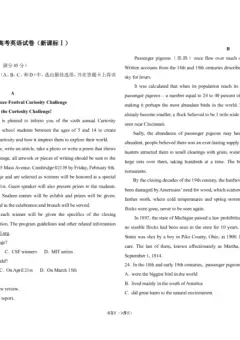
Bad news sells. If it bleeds, it leads. No news is good news, and good news is no news. Those are the
classic rules for the evening broadcasts and the morning papers. But now that information is being spread
and monitored (监控) in different ways, researchers are discovering new rules. By tracking people’s e-
mails and online posts, scientists have found that good news can spread faster and farther than disasters
and sob stories.
   “The ‘if it bleeds’ rule works for mass media,” says Jonah Berger, a scholar at the University of
Pennsylvania. “They want your eyeballs and don’t care how you’re feeling. But when you share a story
with your friends, you care a lot more how they react. You don’t want them to think of you as a Debbie
Downer.”
   Researchers analyzing word-of-mouth communication — e-mails, Web posts and reviews, face-to-
face conversations — found that it tended to be more positive than negative (消极的), but that didn’t
necessarily mean people preferred positive news. Was positive news shared more often simply because
people experienced more good things than bad things? To test for that possibility, Dr. Berger looked at
第3 页(共5 页)
how people spread a particular set of news stories: thousands of articles on The New York Times’
website. He and a Penn colleague analyzed the “most e-mailed” list for six months. One of his first
findings was that articles in the science section were much more likely to make the list than non-science
articles. He found that science amazed Times’ readers and made them want to share this positive feeling
with others.
Readers also tended to share articles that were exciting or funny, or that inspired negative feelings
like anger or anxiety, but not articles that left them merely sad. They needed to be aroused (激发) one
way or the other, and they preferred good news to bad. The more positive an article, the more likely it was
to be shared, as Dr. Berger explains in his new book, “Contagious: Why Things Catch On.”
32. What do the classic rules mentioned in the text apply to?
A. News reports.

B. Research papers.


C. Private e-mails.

D. Daily conversations.
33. What can we infer about people like Debbie Downer?
A. They’re socially inactive.
 B. They’re good at telling stories.
C. They’re inconsiderate of others.   D. They’re careful with their words.
34. Which tended to be the most e-mailed according to Dr. Berger’s research?
A. Sports news.

  B. Science articles.


C. Personal accounts.
  D. Financial reviews.
35. What can be a suitable title for the text?
A. Sad Stories Travel Far and Wide

B .Online News Attracts More People
C. Reading Habits Change with the Times

D. Good News Beats Bad on Social Networks

第二节 (共5 小题;每小题2 分,满分10 分)
根据短文内容,从短文后的选项中选出能填入空白处的最佳选项。选项中有两项为多余选
项。
Everyone knows that fish is good for health.    36    But it seems that many people don’t cook
fish at home. Americans eat only about fifteen pounds of fish per person per year, but we eat twice as
much fish in restaurants as at home. Buying, storing, and cooking fish isn’t difficult.    37    This text
is about how to buy and cook fish in an easy way.
   38    Fresh fish should smell sweet: you should feel that you’re standing at the ocean’s edge.
Any fishy or strong smell means the fish isn’t fresh.    39    When you have bought a fish and arrive
home, you’d better store the fish in the refrigerator if you don’t cook it immediately, but fresh fish should
be stored in your fridge for only a day or two. Frozen fish isn’t as tasty as the fresh one.
There are many common methods used to cook fish.    40    First, clean it and season it with your
choice of spices (调料). Put the whole fish on a plate and steam it in a steam pot for 8 to 10 minutes if it
weighs about one pound. (A larger one will take more time.) Then, it’s ready to serve.
A. Do not buy it.
B. The easiest is to steam it.
C. This is how you can do it.
D. It just requires a little knowledge.
E. The fish will go bad within hours.
F. When buying fish, you should first smell it.
G. The fats in fish are thought to help prevent heart disease.

第三部分   英语知识运用(共两节,满分45 分)
第一节  完形填空(共20 小题;每小题1. 5 分,满分30 分)
阅读下面短文,从短文后各题所给的四个选项(A、B、C 和D)中,选出可以填入空白处的
最佳选项,并在答题卡上将该项涂黑。
When I was 13 my only purpose was to become the star on our football team. That meant   41
Miller King, who was the best   42   at our school.
Football season started in September and all summer long I worked out. I carried my football
everywhere for   43  .
Just before September, Miller was struck by a car and lost his right arm. I went to see him after he
came back from   44  . He looked very   45  , but he didn’t cry.
第4 页(共5 页)
That season, I   46   all of Miller’s records while he   47   the home games from the bench.
We went 10-1 and I was named most valuable player,   48   I often had crazy dreams in which I was to
blame for Miller’s   49  .
One afternoon, I was crossing the field to go home and saw Miller   50   going over a fence—
which wasn’t   51   to climb if you had both arms. I’m sure I was the last person in the world he
wanted to accept   52   from. But even that challenge he accepted. I   53   him move slowly over
the fence. When we were finally   54   on the other side, he said to me, “You know, I didn’t tell you
this during the season, but you did   55  . Thank you for filling in for   56  .”
His words freed me from my bad   57  . I thought to myself, how even without an arm he was
more of a leader. Damaged but not defeated, he was   58   ahead of me. I was right to have   59
him. From that day on,I grew   60   and a little more real.
41. A. cheering for   B. beating out
 C. relying on
 D. staying with
42. A. coach
B. student
C. teacher
 D. player
43. A. practice
B. show
C. comfort
 D. pleasure
44. A. school
B. vacation
 C. hospital
 D. training
45. A. pale
 B. calm
 C. relaxed
 D. ashamed
46. A. held
 B. broke
 C. set
 D. tried
47. A. reported
 B. judged
 C. organized
 D. watched
48. A. and
 B. then
 C. but
 D. thus
49. A. decision
 B. mistake
 C. accident
D. sacrifice
50. A. stuck
 B. hurt
C. tired
 D. lost
51. A. steady
 B. hard
 C. fun
D. fit
52. A. praise
 B. advice
C. assistance
D. apology
53. A. let
 B. helped
C. had
D. noticed
54. A. dropped
 B. ready
C. trapped
D. safe
55. A. fine
 B. wrong
 C. quickly
D. normally
56. A. us
 B. yourself
C. me
D. them
57. A. memories
 B. ideas
 C. attitudes
D. dreams
58. A. still
 B. also
 C. yet
D. just
59. A. challenged    B. cured
 C. invited
D. admired
60. A. healthier
 B. bigger
 C. cleverer
D. cooler

第二节(共10 小题;每小题1.5 分,满分15 分)

阅读下面材料,在空白处填入适当的内容(1 个单词)或括号内单词的正确形式。
In much of Asia, especially the so-called “rice bowl” cultures of China, Japan, Korea,    61
Vietnam, food is usually eaten with chopsticks.
Chopsticks are usually two long, thin pieces of wood or bamboo. They can also be made of plastic,
animal bone or metal. Sometimes chopsticks are quite artistic. Truly elegant chopsticks might    62
(make) of gold and silver with Chinese characters. Skilled workers also combine various hardwoods and
metal    63    (create) special designs.
The Chinese have used chopsticks for five thousand years. People probably cooked their food in
large pots,    64    (use) twigs (树枝) to remove it. Over time,    65    the population grew, people
began cutting food into small pieces so it would cook more quickly. Food in small pieces could be eaten
easily with twigs which    66    (gradual) turned into chopsticks.
Some people think that the great Chinese scholar Confucius,    67    lived from roughly 551 to
479 B.C., influenced the    68    (develop) of chopsticks. Confucius believed knives would remind
people of killings and    69    (be) too violent for use at the table.
Chopsticks are not used everywhere in Asia. In India, for example, most people traditionally eat
70    their hands.
第四部分  写作(共两节,满分35 分)
第一节  短文改错(共10 小题;每小题1 分,满分10 分)
假定英语课上老师要求同桌之间交换修改作文,请你修改你同桌写的以下作文。文中共有10
处语言错误,每句中最多有两处。每处错误仅涉及一个单词的增加、删除或修改。
增加:在缺词处加一个漏字符号(∧),并在其下面写出该加的词。
删除:把多余的词用斜线(\)划掉。
修改:在错的词下划一横线,并在该词下面写出修改后的词。
第5 页(共5 页)
注意:1.每处错误及其修改均仅限一词;
2.只允许修改10 处,多者(从第11 处起)不计分。
The teenage year from 13 to 19 were the most difficult time for me. They were also the best and
worse years in my life. At the first, I thought I knew everything and could make decisions by yourself.
However, my parents didn’t seem to think such. They always tell me what to do and how to do it. At one
time, I even felt my parents couldn’t understand me so I hoped I could be freely from them. I showed
them I was independent by wear strange clothes. Now I am leaving home to college. At last, I will be on
my own, but I still want to have my parents to turn to whenever need help.

第二节
书面表达(满分25 分)
假定你是李华,与留学生朋友Bob 约好一起去书店,因故不能赴约。请给他写封邮件,内容
包括:
1.表示歉意;
2.说明原因;
3.另约时间。
注意:
1.词数100 左右;
2.可以适当增加细节,以使行文连贯。