成都市2022 级高中毕业班第三次诊断性检测
阅读下面材料,根据其内容和所给段落开头语续写两段,使之构成一篇完整的
短文。
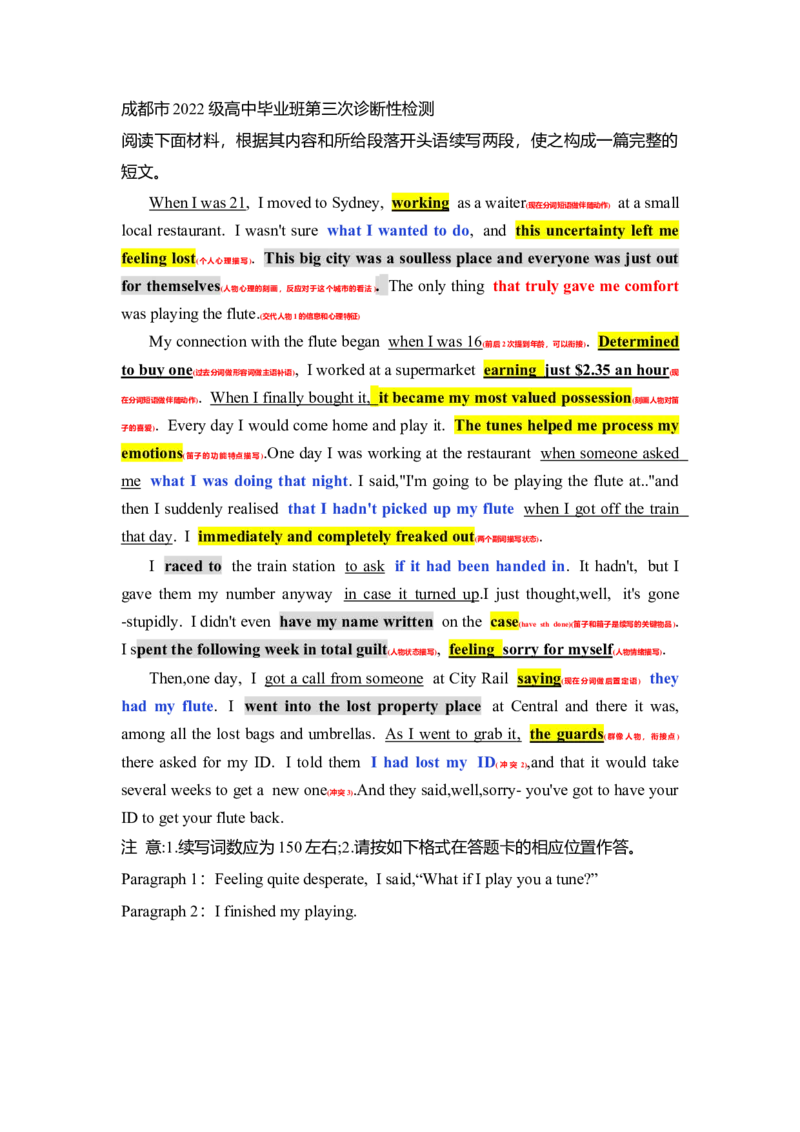
When I was 21, I moved to Sydney, working as a waiter(现在分词短语做伴随动作) at a small
local restaurant. I wasn't sure what I wanted to do, and this uncertainty left me
feeling lost(个人心理描写). This big city was a soulless place and everyone was just out
for themselves(人物心理的刻画,反应对于这个城市的看法). The only thing that truly gave me comfort
was playing the flute.(交代人物1 的信息和心理特征)
My connection with the flute began when I was 16(前后2 次提到年龄,可以衔接). Determined
to buy one(过去分词做形容词做主语补语), I worked at a supermarket earning
just $2.35 an hour
(现
在分词短语做伴随动作). When I finally bought it
, it became my most valued possession(刻画人物对笛
子的喜爱). Every day I would come home and play it. The tunes helped me process my
emotions(笛子的功能特点描写).One day I was working at the restaurant when someone asked
me what I was doing that night. I said,"I'm going to be playing the flute at.."and
then I suddenly realised that I hadn't picked up my flute when I got off the train
that day. I immediately and completely freaked out(两个副词描写状态).
I raced to the train station to ask if it had been handed in. It hadn't, but I
gave them my number anyway in case it turned up.I just thought,well, it's gone
-stupidly. I didn't even have my name written on the case(have sth done)(笛子和箱子是续写的关键物品).
I spent the following week in total guilt(人物状态描写), feeling
sorry for myself
(人物情绪描写).
Then,one day, I got a call from someone at City Rail saying(现在分词做后置定语) they
had my flute. I went into the lost property place at Central and there it was,
among all the lost bags and umbrellas. As I went to grab it
, the guards( 群像人物,衔接点)
there asked for my ID. I told them I had lost my ID( 冲突2),and that it would take
several weeks to get a new one(冲突3).And they said,well,sorry- you've got to have your
ID to get your flute back.
注 意:1.续写词数应为150 左右;2.请按如下格式在答题卡的相应位置作答。
Paragraph 1:Feeling quite desperate, I said,“What if I play you a tune?”
Paragraph 2:I finished my playing.
成都市2022 级高中毕业班第三次诊断性检测
阅读下面材料,根据其内容和所给段落开头语续写两段,使之构成一篇完整的短文。
When I was 21,I moved to Sydney,working as a waiter at a small local
restaurant.I wasn't sure what I wanted to do,and this uncertainty left me feeling
lost.This big city was a soulless place and everyone was just out for themselves.The
only thing that truly gave me comfort was playing the flute(笛子).
My connection with the flute began when I was 16.Determined to buy one,I
worked at a supermarket earning just $2.35 an hour. When I finally bought itit became
my most valued possession.Every day I would come home and play it.The tunes
helped me process my emotions.One day I was working at the restaurant when
someone asked me what I was doing that night. I said,"I'm going to be playing the
flute at.."and then I suddenly realised that I hadn't picked up my flute when I got off
the train that day.I immediately and completely freaked out (六神无主).
I raced to the train station to ask if it had been handed in.It hadn't,but I gave them
my number anyway in case it turned up.I just thought,well.it's gone -stupidly,I didn't
even have my name written on the case.I spent the following week in total
guilt,feeling sorry for myself.
Then,one day,I got a call from someone at City Rail saying they had my flute.I
went into the lost property place at Central and there it was,among all the lost bags
and umbrellas.As I went to grab it.the guards there asked for my ID.I told them I had
lost my D,and that it would take several weeks to get anew one.And they
said,well,sorry- you've got to have your ID to get your flute back
注 意:1.续写词数应为150 左右;2.请按如下格式在答题卡的相应位置作答。
Paragraph 1:Feeling quite desperate,I said,“What if I play you a tune?”
Paragraph 2:I finished my playing.
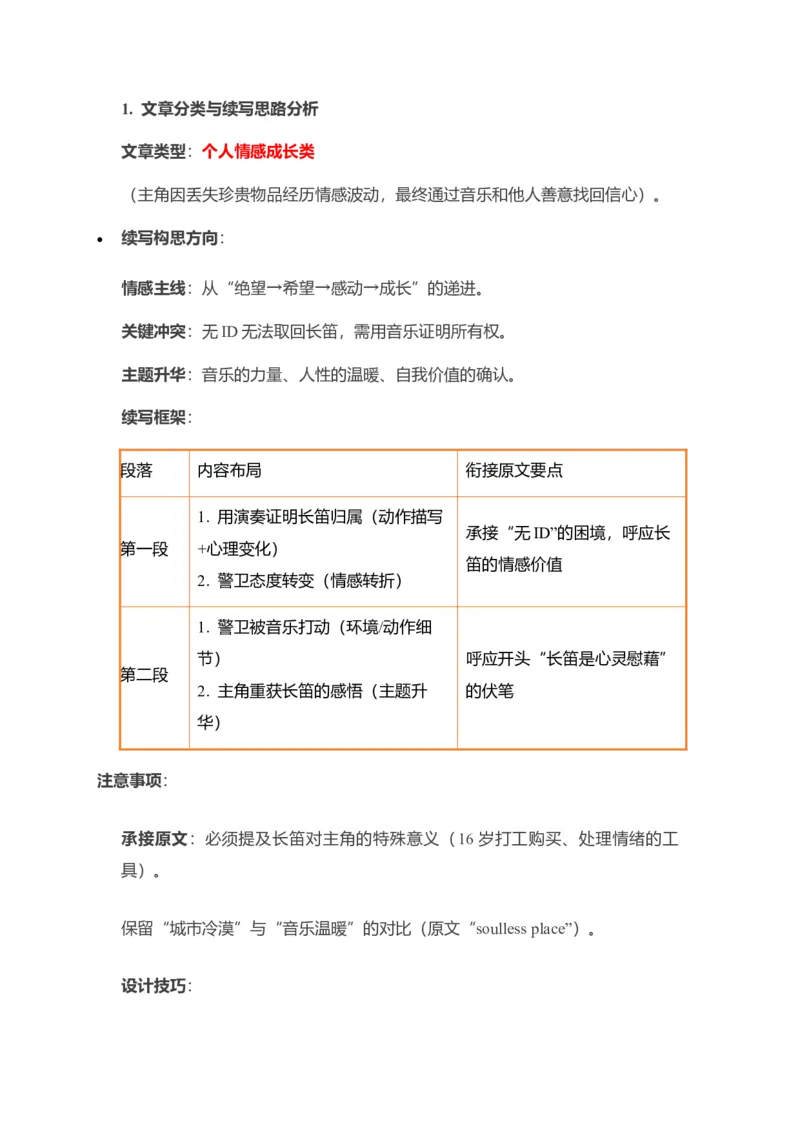
1. 文章分类与续写思路分析
文章类型:个人情感成长类
(主角因丢失珍贵物品经历情感波动,最终通过音乐和他人善意找回信心)。
续写构思方向:
情感主线:从“绝望→希望→感动→成长”的递进。
关键冲突:无ID 无法取回长笛,需用音乐证明所有权。
主题升华:音乐的力量、人性的温暖、自我价值的确认。
续写框架:
段落
内容布局
衔接原文要点
第一段
1. 用演奏证明长笛归属(动作描写
+心理变化)
2. 警卫态度转变(情感转折)
承接“无ID”的困境,呼应长
笛的情感价值
第二段
1. 警卫被音乐打动(环境/动作细
节)
2. 主角重获长笛的感悟(主题升
华)
呼应开头“长笛是心灵慰藉”
的伏笔
注意事项:
承接原文:必须提及长笛对主角的特殊意义(16 岁打工购买、处理情绪的工
具)。
保留“城市冷漠”与“音乐温暖”的对比(原文“soulless place”)。
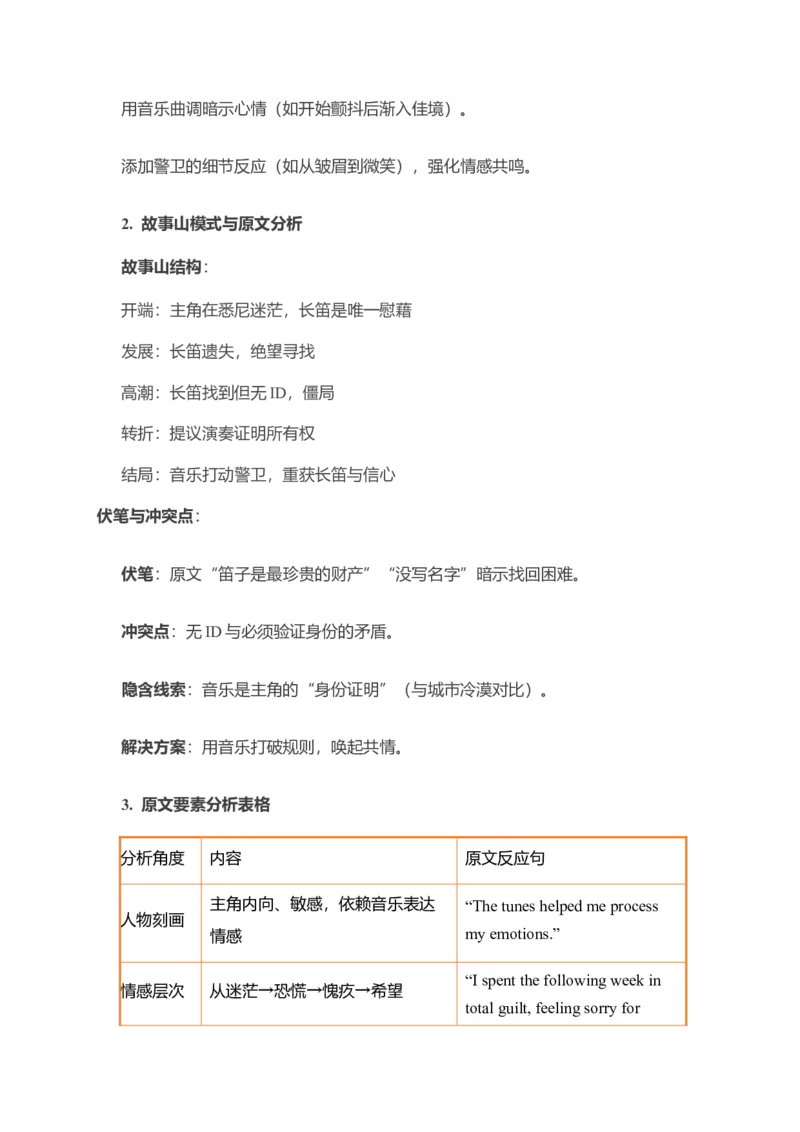
设计技巧:
用音乐曲调暗示心情(如开始颤抖后渐入佳境)。
添加警卫的细节反应(如从皱眉到微笑),强化情感共鸣。
2. 故事山模式与原文分析
故事山结构:
开端:主角在悉尼迷茫,长笛是唯一慰藉
发展:长笛遗失,绝望寻找
高潮:长笛找到但无ID,僵局
转折:提议演奏证明所有权
结局:音乐打动警卫,重获长笛与信心
伏笔与冲突点:
伏笔:原文“笛子是最珍贵的财产”“没写名字”暗示找回困难。
冲突点:无ID 与必须验证身份的矛盾。
隐含线索:音乐是主角的“身份证明”(与城市冷漠对比)。
解决方案:用音乐打破规则,唤起共情。
3. 原文要素分析表格
分析角度
内容
原文反应句
人物刻画
主角内向、敏感,依赖音乐表达
情感
“The tunes helped me process
my emotions.”
情感层次
从迷茫→恐慌→愧疚→希望
“I spent the following week in
total guilt, feeling sorry for
分析角度
内容
原文反应句
myself.”
关键情节
点
长笛遗失、找回但需ID
“you’ve got to have your ID to
get your flute back”
语言特色
简洁叙事,多用短句表达紧张情
绪
“I immediately and completely
freaked out.”
关键词分
析
“soulless”“comfort”“valued
possession”突出孤独与音乐的治愈
“this big city was a soulless
place”
心理描写
通过动作反映内心(如“raced”表
急切)
“I raced to the train station”
动作描写
快速动作推进危机感
“went to grab it”
环境描写
城市冷漠 vs 长笛温暖(对比)
“among all the lost bags and
umbrellas”(强调长笛的独特
性)
隐含主题
艺术超越规则,连接人性
无直接表述,需从长笛意义推
断
情感转折
从自责到重燃希望
“I got a call from someone at
City Rail...”
空间转换
餐厅→车站→失物招领处
“I went into the lost property
place at Central”
时间过渡
一周的时间跨度(通过
“following week”暗示)
“I spent the following week in
total guilt”
3. 动作、心理、环境描写的推荐英文例句及翻译
动作描写(Action Descriptions)
1. His fingers trembled as he lifted the flute to his lips.
(他的手指颤抖着将笛子举到唇边。)
2. She raced through the crowded streets, her heart pounding.
(她冲过拥挤的街道,心跳加速。)
3. He clutched the flute tightly, as if it might vanish again.
(他紧紧抓住笛子,仿佛它会再次消失。)
4. The guard’s stern expression softened as the music filled the room.
(警卫严厉的表情随着音乐在房间里回荡而柔和下来。)
5. She fumbled with her bag, desperately searching for her lost ID.
(她手忙脚乱地翻找包,拼命寻找丢失的身份证。)
6. His shoulders slumped in defeat as he turned away.
(他肩膀耷拉着,沮丧地转身离开。)
7. The man hesitated before finally nodding in approval.
(那人犹豫了一下,最终点头同意。)
8. She let out a shaky breath, trying to steady her nerves.
(她颤抖着呼出一口气,努力让自己镇定下来。)
9. He reached out slowly, afraid the flute might disappear.
(他缓缓伸出手,害怕笛子会再次消失。)
10. The crowd parted as she walked forward, flute in hand.
(人群分开,她手持笛子向前走去。)
心理描写(Psychological Descriptions)
1. A wave of guilt washed over him as he realized his mistake.
(当他意识到自己的错误时,一阵内疚感袭来。)
2. His mind raced with desperate thoughts—what if it was truly gone?
(他的脑海里闪过绝望的念头——如果它真的丢了怎么办?)
3. For the first time in weeks, a flicker of hope ignited in his chest.
(几周以来,他的心中第一次燃起一丝希望。)
4. She felt a knot of anxiety tighten in her stomach.
(她感到一阵焦虑在胃里拧紧。)
5. The weight of his loss pressed down on him like a physical burden.
(失去的痛苦像一块巨石压在他身上。)
6. A strange calm settled over him as he began to play.
(当他开始演奏时,一种奇怪的平静笼罩着他。)
7. Doubt gnawed at him—would they really believe him?
(怀疑啃噬着他——他们真的会相信他吗?)
8. Relief flooded through him when he saw the familiar case.
(当他看到熟悉的盒子时,一阵宽慰涌上心头。)
9. He couldn’t shake the feeling that he didn’t belong here.
(他无法摆脱一种格格不入的感觉。)
10. A surge of determination pushed him to try one last time.
(一股决心促使他再试最后一次。)
环境描写(Environmental Descriptions)
The train station buzzed with the noise of hurried travelers.
(火车站里充斥着匆忙旅客的嘈杂声。)
The lost property room smelled of dust and forgotten belongings.
(失物招领处弥漫着灰尘和被遗忘物品的气味。)
The city stretched out before him, cold and impersonal.
(城市在他面前延伸,冷漠而疏离。)
The dim lighting cast long shadows across the cluttered room.
(昏暗的灯光在杂乱的房间里投下长长的阴影。)
Rain tapped against the windows, adding to his melancholy.
(雨水敲打着窗户,增添了他的忧郁。)
The hum of distant traffic was the only sound in the empty street.
(远处车辆的嗡鸣是空荡街道上唯一的声音。)
The air in the subway was thick with the scent of sweat and metal.
(地铁里的空气弥漫着汗水和金属的味道。)
A single streetlamp flickered, barely illuminating the alley.
(一盏路灯闪烁,勉强照亮小巷。)
The café was warm, a stark contrast to the chilly evening outside.
(咖啡馆里很温暖,与外面寒冷的夜晚形成鲜明对比。)
The sound of his flute echoed through the silent room.
(他的笛声在寂静的房间里回荡。)
4. 高级替换词 & 常见搭配分析
高级替换词(场景分类)
基础词
高级替换词
适用场景
happy
elated, overjoyed, euphoric
强烈喜悦
sad
despondent, melancholy, crestfallen
深度悲伤
run
dash, sprint, bolt
快速奔跑
say
murmur, whisper, exclaim
不同语气
look
gaze, peer, scrutinize
不同方式看
常见搭配 & 词法解析
Freak out (phrasal v.) – 惊慌失措
近义词:panic, lose one’s cool
反义词:calm down, compose oneself
例句:She completely freaked out when she lost her passport.
He tried not to freak out in front of the police.
Turn up (phrasal v.) – 出现,被发现
近义词:appear, be found
反义词:disappear, vanish
例句:My lost keys finally turned up in the sofa.
We waited, but the missing file never turned up.
Clutch tightly (v. + adv.) – 紧紧抓住
近义词:grip firmly, hold onto
反义词:release, let go
例句:She clutched the railing tightly as the boat rocked.
He clutched the letter, afraid to lose it again.
Stern expression (adj. + n.) – 严厉的表情
近义词:harsh look, grim face
反义词:gentle smile, warm expression
例句:The teacher’s stern expression silenced the class.
His stern expression softened when he heard the music.
Flicker of hope (n. phrase) – 一丝希望
近义词:glimmer of hope, spark of optimism
反义词:hopelessness, despair
例句:A flicker of hope remained despite the bad news.
She felt a flicker of hope when she saw the rescue team.
5. 可积累的语料 & 生词短语
单词/短语
词性
词义
近义词
反义词
例句
Desperate
adj.
绝望
的
hopeless
hopeful
He made a desperate
attempt to find his lost
phone.
Melancholy
n./adj.
忧郁
sadness
joy
The music carried a deep
sense of melancholy.
Euphoric
adj.
狂喜
的
ecstatic
miserable
Winning the award left her
feeling euphoric.
Fumble
v.
笨拙
地摸
索
grope
handle
smoothly
He fumbled with the keys in
the dark.
Scrutinize
v.
仔细
检查
examine
glance
The guard scrutinized his
ID carefully.
6. Possible Versions(4)
Version 1
Paragraph 1:
Feeling quite desperate, I said, “What if I play you a tune?” The guards
exchanged glances(次要人物的反应较好的处理方式,衔接原文), clearly unsure
how to respond
(adj 做伴随动作).
One of them raised an eyebrow and said, “Alright, let’s hear it then.” I opened the
flute case with trembling hands(人物状态描写), the familiar weight of the instrument
both comforting and heartbreaking(独立主格刻画人物的心理). I hadn’t touched it in over a
week(衔接原文), and my fingers felt stiff. But as soon as I
put the flute to my lips
(情景动作描
写), the first clear notes floated through the air(无灵主语句), cutting through the bustle
of the station like sunlight through fog(现在分词短语做后置定语). I played a soft, melancholic
melody — the same tune I had practiced endlessly as a teenager. The Guards
began to gather(环境描写), some even
enjoying
the
tone
(独立主格刻画人物). For a moment,
everything around me disappeared — the stress, the
guilt
for
losing
my
companion, even
the city
(名词并列刻画人物心理) — and it was just me and my music, as it
had always been.
Paragraph 2:
I finished my playing. The final note lingered in the air(无灵主句句,刻画环境), and for a
few seconds, there was silence. Then, one of the guards gave a soft laugh and
said, “Alright, kid — that flute's definitely yours.” He slid the case over to me
with a small nod. Gratitude welled up in my chest(无灵主句刻画人物心理) as I carefully
packed the instrument away, whispering
a repetitive
thank-you
s . On the train
home, I held the flute close, feeling
like a missing piece of me had returned
(现在分成
做伴随动作). That small performance reminded me who I was — not just a lost 21-
year-old in a big city, but someone(递进描写) with something real to hold on to. And
maybe, just maybe, that was enough to begin figuring out the rest.
Version 2
Paragraph 1:
Feeling quite desperate, I said, “What if I play you a tune?” The guards
exchanged skeptical glances(群像刻画), but the older one shrugged. “Go ahead,” he
muttered. My heart pounded(人物刻画心理描写) as I lifted the flute to my lips, playing
the
same folk tune I’d practiced in my tiny apartment(衔接原文). The notes, though
shaky at first(adj 做主语补语), steadied as memories flooded back—saving every dollar at
the supermarket(衔接原文). The guards’ rigid postures relaxed, and the younger one
even tapped his foot slightly(人物刻画). When I finished, the senior guard sighed.
“Fine,” he said gruffly, pushing
the case toward me
(现在分词做伴随动作). “But don’t lose it
again.”
Paragraph 2:
I finished my playing. The room was silent for a moment before the younger
guard chuckled. “Not bad, mate.” Relief washed over me(人物情绪描写) as I took the
flute, gripping it like a lifeline(现在分词做伴随动作). Outside, the city’s usual chaos felt
different(无灵主语句)—less oppressive, more alive. On the subway home, I played softly,
and a few passengers smiled instead of ignoring me. Maybe Sydney wasn’t just a
cold, soulless place(衔接原文). Maybe, like my flute, it just needed the right tune to
come alive.
亮点词汇 & 替换词
原文词汇
升级替换
例句
Desperate
Frantic, Hopeless
He felt frantic when he couldn’t find his
wallet.
Skeptical
Doubtful, Unconvinced
She gave him a doubtful look.
Shrugged
Nodded reluctantly,
Yielded
He yielded with a sigh.
Gruffly
Curtly, Brusquely
“Hurry up,” he said brusquely.
Oppressive
Suffocating,
Overwhelming
The heat was suffocating.
Version 2
Paragraph 1:
Feeling quite desperate, I said, “What if I play you a tune?” The guards
hesitated, but the taller one finally nodded. My hands trembled(人物神态描写) as I
played the melody I’d composed during my loneliest nights in Sydney(衔接原文). The
music, raw and unfiltered(adj 做主语补语), carried all my longing for home(无灵主语句). The
guards’ stern faces softened(无灵主语句), and the younger one even leaned in slightly(人物
刻画). When the last note
faded
(无灵主语句,语境描写), the older guard rubbed his chin.
“Alright,” he grunted, sliding
the flute case across the counter.
(现在分词做伴随动作) “But
next time, write your name on it.(衔接原文)”
Paragraph 2:
I finished my playing. The silence stretched(无灵主语句) until the younger guard
broke it with a quiet, “That was beautiful.” My throat tightened(人物状态刻画) as I took
the flute, its familiar weight a comfort(独立主格刻画人物). Walking
back to the train
(现在分词短语
做伴随动作), I played softly, and this time, strangers didn’t avert their eyes—they
listened. The city’s noise,
once
deafening,
now
felt like a backdrop to my
music(对比描写). Sydney wasn’t heartless; it had just been waiting for me to speak its
language.
亮点词汇 & 替换词
原文词汇
升级替换
例句
Desperate
Panicked, Distraught
She sounded distraught on the phone.
Hesitated
Paused, Wavered
He wavered before answering.
Raw
Unpolished, Gritty
His voice was gritty with emotion.
Grunted
Muttered, Snapped
“Fine,” he muttered.
Avert
Avoid, Ignore
She avoided his gaze.