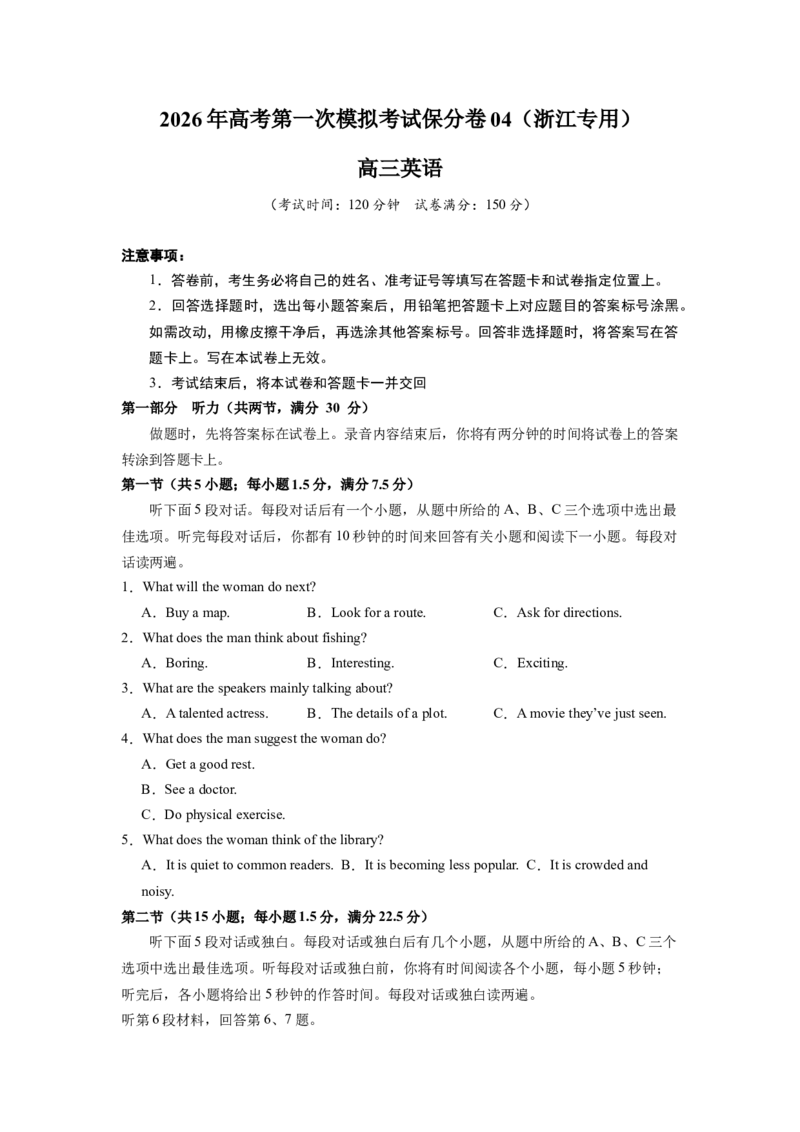
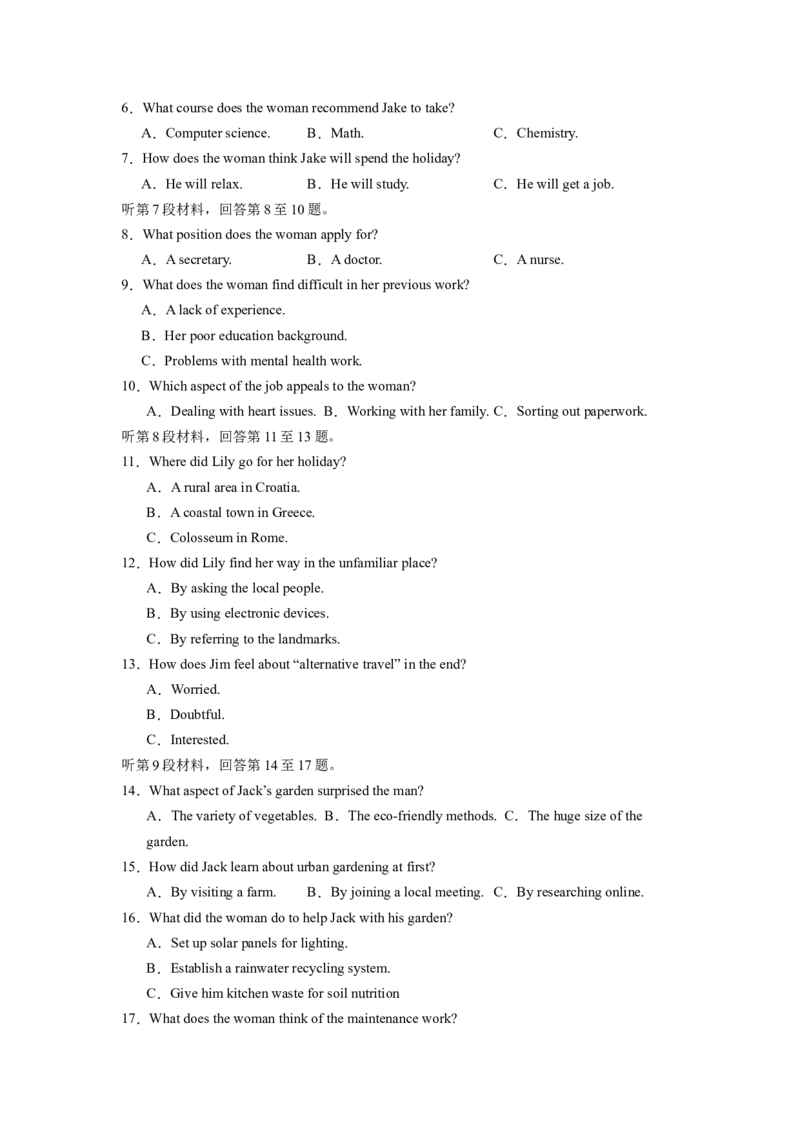
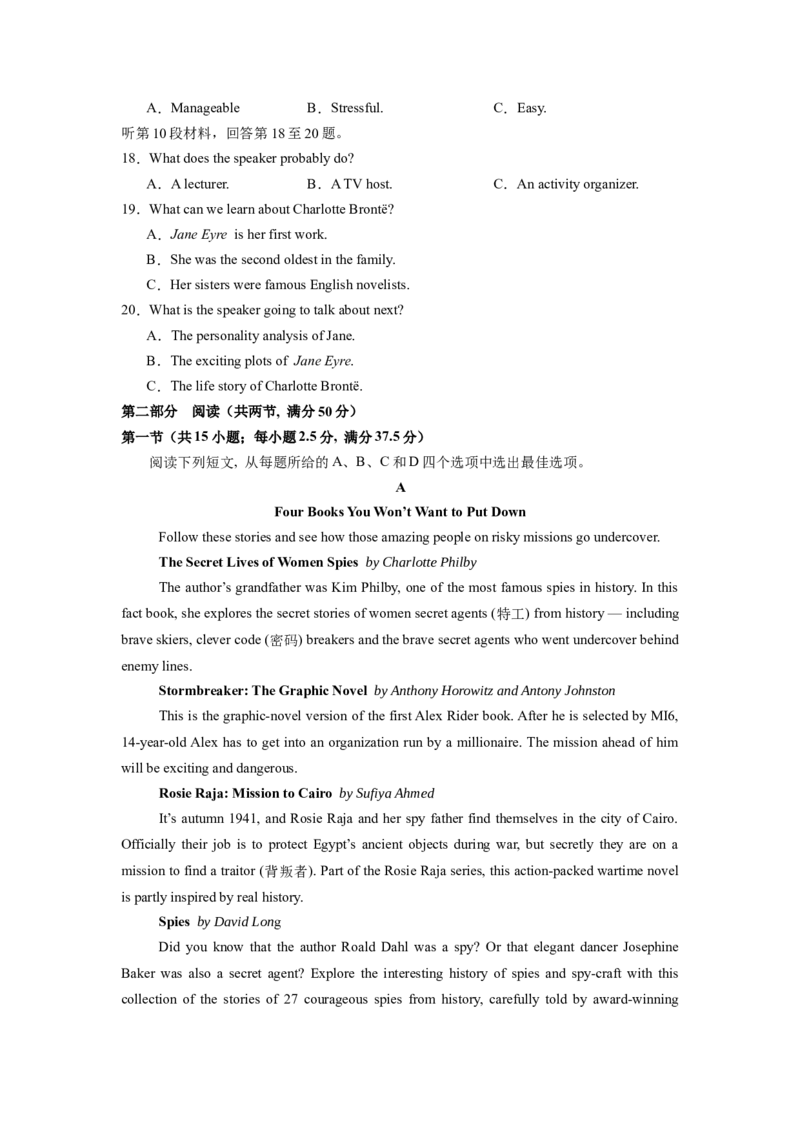
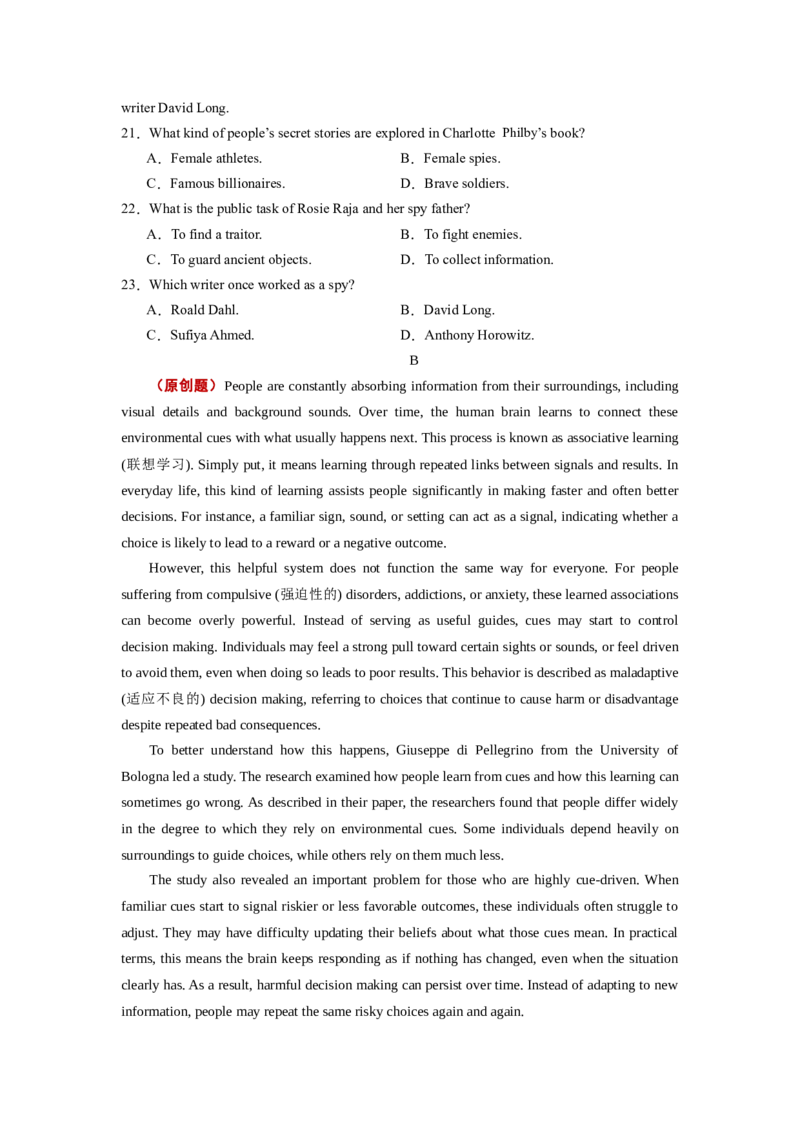
2026 年高考第一次模拟考试保分卷04(浙江专用)
高三英语
(考试时间:120 分钟  试卷满分:150 分)
注意事项:
1.答卷前,考生务必将自己的姓名、准考证号等填写在答题卡和试卷指定位置上。
2.回答选择题时,选出每小题答案后,用铅笔把答题卡上对应题目的答案标号涂黑。
如需改动,用橡皮擦干净后,再选涂其他答案标号。回答非选择题时,将答案写在答
题卡上。写在本试卷上无效。
3.考试结束后,将本试卷和答题卡一并交回
第一部分  听力(共两节,满分 30 分)
做题时,先将答案标在试卷上。录音内容结束后,你将有两分钟的时间将试卷上的答案
转涂到答题卡上。
第一节(共5 小题;每小题1.5 分,满分7.5 分)
听下面5 段对话。每段对话后有一个小题,从题中所给的A、B、C 三个选项中选出最
佳选项。听完每段对话后,你都有10 秒钟的时间来回答有关小题和阅读下一小题。每段对
话读两遍。
1.What will the woman do next?
A.Buy a map.
B.Look for a route.
C.Ask for directions.
2.What does the man think about fishing?
A.Boring.
B.Interesting.
C.Exciting.
3.What are the speakers mainly talking about?
A.A talented actress.
B.The details of a plot.
C.A movie they’ve just seen.
4.What does the man suggest the woman do?
A.Get a good rest.
B.See a doctor.
C.Do physical exercise.
5.What does the woman think of the library?
A.It is quiet to common readers. B.It is becoming less popular. C.It is crowded and
noisy.
第二节(共15 小题;每小题1.5 分,满分22.5 分)
听下面5 段对话或独白。每段对话或独白后有几个小题,从题中所给的A、B、C 三个
选项中选出最佳选项。听每段对话或独白前,你将有时间阅读各个小题,每小题5 秒钟;
听完后,各小题将给出5 秒钟的作答时间。每段对话或独白读两遍。
听第6 段材料,回答第6、7 题。
6.What course does the woman recommend Jake to take?
A.Computer science.
B.Math.
C.Chemistry.
7.How does the woman think Jake will spend the holiday?
A.He will relax.
B.He will study.
C.He will get a job.
听第7 段材料,回答第8 至10 题。
8.What position does the woman apply for?
A.A secretary.
B.A doctor.
C.A nurse.
9.What does the woman find difficult in her previous work?
A.A lack of experience.
B.Her poor education background.
C.Problems with mental health work.
10.Which aspect of the job appeals to the woman?
A.Dealing with heart issues. B.Working with her family. C.Sorting out paperwork.
听第8 段材料,回答第11 至13 题。
11.Where did Lily go for her holiday?
A.A rural area in Croatia.
B.A coastal town in Greece.
C.Colosseum in Rome.
12.How did Lily find her way in the unfamiliar place?
A.By asking the local people.
B.By using electronic devices.
C.By referring to the landmarks.
13.How does Jim feel about “alternative travel” in the end?
A.Worried.
B.Doubtful.
C.Interested.
听第9 段材料,回答第14 至17 题。
14.What aspect of Jack’s garden surprised the man?
A.The variety of vegetables. B.The eco-friendly methods. C.The huge size of the
garden.
15.How did Jack learn about urban gardening at first?
A.By visiting a farm.
B.By joining a local meeting. C.By researching online.
16.What did the woman do to help Jack with his garden?
A.Set up solar panels for lighting.
B.Establish a rainwater recycling system.
C.Give him kitchen waste for soil nutrition
17.What does the woman think of the maintenance work?
A.Manageable
B.Stressful.
C.Easy.
听第10 段材料,回答第18 至20 题。
18.What does the speaker probably do?
A.A lecturer.
B.A TV host.
C.An activity organizer.
19.What can we learn about Charlotte Brontë?
A.Jane Eyre is her first work.
B.She was the second oldest in the family.
C.Her sisters were famous English novelists.
20.What is the speaker going to talk about next?
A.The personality analysis of Jane.
B.The exciting plots of Jane Eyre.
C.The life story of Charlotte Brontë.
第二部分  阅读(共两节, 满分50 分)
第一节(共15 小题;每小题2.5 分, 满分37.5 分)
阅读下列短文, 从每题所给的A、B、C 和D 四个选项中选出最佳选项。
A
Four Books You Won’t Want to Put Down
Follow these stories and see how those amazing people on risky missions go undercover.
The Secret Lives of Women Spies by Charlotte Philby
The author’s grandfather was Kim Philby, one of the most famous spies in history. In this
fact book, she explores the secret stories of women secret agents (特工) from history — including
brave skiers, clever code (密码) breakers and the brave secret agents who went undercover behind
enemy lines.
Stormbreaker: The Graphic Novel by Anthony Horowitz and Antony Johnston
This is the graphic-novel version of the first Alex Rider book. After he is selected by MI6,
14-year-old Alex has to get into an organization run by a millionaire. The mission ahead of him
will be exciting and dangerous.
Rosie Raja: Mission to Cairo by Sufiya Ahmed
It’s autumn 1941, and Rosie Raja and her spy father find themselves in the city of Cairo.
Officially their job is to protect Egypt’s ancient objects during war, but secretly they are on a
mission to find a traitor (背叛者). Part of the Rosie Raja series, this action-packed wartime novel
is partly inspired by real history.
Spies by David Long
Did you know that the author Roald Dahl was a spy? Or that elegant dancer Josephine
Baker was also a secret agent? Explore the interesting history of spies and spy-craft with this
collection of the stories of 27 courageous spies from history, carefully told by award-winning
writer David Long.
21.What kind of people’s secret stories are explored in Charlotte Philby’s book?
A.Female athletes.
B.Female spies.
C.Famous billionaires.
D.Brave soldiers.
22.What is the public task of Rosie Raja and her spy father?
A.To find a traitor.
B.To fight enemies.
C.To guard ancient objects.
D.To collect information.
23.Which writer once worked as a spy?
A.Roald Dahl.
B.David Long.
C.Sufiya Ahmed.
D.Anthony Horowitz.
B
(原创题)People are constantly absorbing information from their surroundings, including
visual details and background sounds. Over time, the human brain learns to connect these
environmental cues with what usually happens next. This process is known as associative learning
(联想学习). Simply put, it means learning through repeated links between signals and results. In
everyday life, this kind of learning assists people significantly in making faster and often better
decisions. For instance, a familiar sign, sound, or setting can act as a signal, indicating whether a
choice is likely to lead to a reward or a negative outcome.
However, this helpful system does not function the same way for everyone. For people
suffering from compulsive (强迫性的) disorders, addictions, or anxiety, these learned associations
can become overly powerful. Instead of serving as useful guides, cues may start to control
decision making. Individuals may feel a strong pull toward certain sights or sounds, or feel driven
to avoid them, even when doing so leads to poor results. This behavior is described as maladaptive
(适应不良的) decision making, referring to choices that continue to cause harm or disadvantage
despite repeated bad consequences.
To better understand how this happens, Giuseppe di Pellegrino from the University of
Bologna led a study. The research examined how people learn from cues and how this learning can
sometimes go wrong. As described in their paper, the researchers found that people differ widely
in the degree to which they rely on environmental cues. Some individuals depend heavily on
surroundings to guide choices, while others rely on them much less.
The study also revealed an important problem for those who are highly cue-driven. When
familiar cues start to signal riskier or less favorable outcomes, these individuals often struggle to
adjust. They may have difficulty updating their beliefs about what those cues mean. In practical
terms, this means the brain keeps responding as if nothing has changed, even when the situation
clearly has. As a result, harmful decision making can persist over time. Instead of adapting to new
information, people may repeat the same risky choices again and again.
According to the researchers, these findings suggest that some people have stronger cue
sensitivity than others, combined with a reduced ability to revise what they have learned. This
combination helps explain why certain decision patterns are so hard to break. The research team
plans to continue studying this in patient populations to better understand the harmful patterns that
characterize addictions and anxiety.
24.What is associative learning defined as in the text?
A. A method to ignore surroundings.
B. A process to control decision making.
C. Learning by linking signals with results.
D. A way to avoid negative outcomes completely.
25.What problem do people with compulsive disorders face?
A. They adapt quickly to new situations.
B. They struggle to connect cues with results.
C. They ignore negative outcomes completely.
D. They are dominated by learned associations.
26.Why do cue-driven people often fail to adapt to changes?
A. Their brains ignore familiar signals.
B. They are too sensitive to rewards.
C. They cannot update old beliefs easily.
D. They dislike relying on surroundings.
27.What do the findings help to explain according to the text?
A. Why associative learning varies.
B. Why bad habits are difficult to change.
C. How visual cues affect the brain.
D. How addiction damages decision making.
C
(原创题)According to a recent study by the University of Michigan, using substances to
aid sleep has become a common habit among young adults aged 19 to 30. The data shows that
nearly 22% of Americans in this group have used medical analgesics(止痛剂) or alcohol to
help themselves fall asleep. Medical analgesics are used much more frequently than alcohol for
this specific purpose. While many young people turn to these methods hoping for a quick fix to
their tiredness, researchers are raising serious alarms about the potential consequences.
Experts warn that relying on drugs for sleep can backfire significantly. Megan Patrick, a
research professor involved in the study, points out that these substances may interfere with the
ability to stay asleep and reduce the overall quality of rest. Long-term use is particularly
dangerous. Instead of curing insomnia (失眠), it may lead to worse sleep problems. Regular use
can cause the body to develop "tolerance," meaning a person needs to consume more of the
substance to get the same effect. This pattern creates a vicious(凶险的) cycle of increasing use and
worsening health.
Furthermore, the study highlights notable differences in usage based on gender and race.
Women are almost twice as likely as men to use medical analgesics to help them sleep.
Additionally, Black young adults are three times more likely than white young adults to use
alcohol as a sleep aid. These findings suggest that specific groups may be at higher risk and need
targeted attention to prevent the development of a substance use disorder.
There is also a dangerous misconception among young adults. Many believe that using
medical analgesics or alcohol is helpful for sleep problems. However, evidence suggests that this
belief is false. Doing so can actually make sleep problems even worse over time. Since high-
quality sleep is critical for mental health and mood regulation, relying on harmful substances can
severely damage a young person's well-being.
Finally, because sleep problems and substance use often happen together, health care
providers should be alert. Doctors are advised to screen for both issues and offer coordinated
support when necessary. Young adults who are trying to manage sleep problems should talk to
their doctors instead of self-medicating. They need to understand the potential risks and seek
professional help to find safer treatments that do not involve dangerous substances.
28.Why does the author mention "tolerance" in Paragraph 2?
A. To explain a side effect.
B. To introduce a new drug.
C. To prove the benefit of analgesics.
D. To compare alcohol with drugs.
29.What can be inferred from Paragraph 3?
A. Men are less likely to use drugs.
B. White adults prefer alcohol most.
C. Gender affects choice of sleep aids.
D. Women suffer more from sleeplessness.
30.What is a common misunderstanding among young adults?
A. Sleep problems are rare to see.
B. Doctors ignore their health issues.
C. Substances improve sleep quality.
D. Analgesics are good for mental health.
31.What is the text mainly about?
A. A survey on sleep aids.
B. The harm of alcohol use.
C. Ways to cure insomnia.
D. Mental health of youth.
D
(原创题)A recent large study investigated how the pattern of daily walking affects long-
term health, focusing particularly on adults who are generally not very active. Interestingly, the
research suggests that regardless of the total number of steps taken, one long walk may be better
than many short ones. Published in the Annals of Internal Medicine, the findings highlight that
longer, uninterrupted walking sessions are linked to lower risks of death and cardiovascular (心血
管的)  disease compared to scattered short walks.
To reach these conclusions, researchers analyzed data from 33,560 UK adults who averaged
fewer than 8,000 steps daily. Participants were grouped into four categories based on their typical
walking duration: less than 5 minutes, 5 to 10 minutes, 10 to 15 minutes, and 15 minutes or longer.
The results showed that 43% of participants mostly walked in sessions shorter than 5 minutes,
while only 8% regularly walked for at least 15 minutes.
Over a follow-up period of 9.5 years, the study recorded clear health outcomes. The longer
participants walked at a time, the lower their risk of all-cause mortality ( 死亡率) became.
Compared to those who mostly took short walks under 5 minutes, people who regularly walked in
sessions of 15 minutes or more faced a much lower risk of death. This indicates that taking longer
walks provides a stronger protective effect against early death.
The benefits were even more significant for heart health. Those who primarily took short
walks under 5 minutes accumulated the highest risk of cardiovascular disease. In contrast, the
group walking in sessions of 15 minutes or longer had the lowest risk. The evidence suggests that
continuous walking is specifically beneficial for heart health compared to interrupted walking.
These findings have important implications for those who take fewer than 5,000 steps a day,
or those who are sedentary (久坐的). Experts suggest that for less active individuals, focusing on
longer, more intentional walking sessions, rather than just increasing total steps, could be a highly
effective method to improve health outcomes.
32. What is the main finding of the study mentioned in the text?
A. Total steps determine health completely.
B. Short walks are beneficial for the heart.
C. Inactive people need 8,000 steps daily.
D. Longer walking sessions lower health risks.
33. How does walking duration influence health risks according to the text?
A. It requires more walking time daily.
B. It reduces the chance of early death.
C. It has no clear effect on the results.
D. It increases the chance of heart problems.
34. Who is the study mainly targeting according to the text?
A. Highly active professional athletes.       B. Young people who like jogging.
C. Those who do not move much.           D. Patients with heart diseases.
35. What are inactive people advised to do to improve health?
A. Increase their total steps to 8,000.        B. Combine short walks into longer ones.
C. Avoid walking for cardiovascular health.  D. Walk continuously for 9.5 years.
第二节(共5 小题;每小题2. 5 分, 满分12. 5 分)
阅读下面短文, 从短文后的选项中选出可以填入空白处的最佳选项。选项中有两项为
多余选项。
Breaking Age Bias in the Workplace
Ageism in the workplace is a harsh reality, yet it is often overlooked. While people voice
strong objections to other forms of discrimination like sexism and racism, they turn a blind eye to
ageism and sweep it under the carpet.
   36    We live in a youth-centered society, and the hype around “out with the old, in
with the new” must end. Experience cannot be found on Google. A person’s age does not reduce
their ability to work hard or make valuable contributions to an organization or society. Reaching
35+ does not mean someone is incompetent and should be declined. Myths such as “They can’t
learn.” They lack creativity.” They are less productive than younger employees.” and “They can’t
work overtime.” are all based on false premises.    37
In the past, age was admired and honored.    38    This shift in attitude toward age hurts
many career paths. Being over 40 is only acceptable in certain senior roles — for example; in
management and politics, where people trust those with decades of experience. Many people over
40 are stuck in their current jobs because opportunities are limited.    39    Undoubtedly, it will
give rise to serious social issues sooner or later.
So, it’s high time to end age-based discrimination. We should not fear or feel embarrassed
to state our age. Age brings wisdom, experience, knowledge, resilience, and more. Age and
experience deserve rewards, not bias.    40    After all, we all grow old eventually.
A.Experience is a treasure gained only through time.
B.Thus, we should value age instead of seeing it as a weakness.
C.Ageism is thus more hidden than other kinds of discrimination.
D.Today, however, it is often viewed with disrespect.
E.And limited chances make their professional lives unpromising.
F.Such wrong ideas ignore the real value of older workers.
G.This disregard worsens due to society’s wrong focus on youth.
第三部分 语言运用(共两节,满分30 分)
第一节(共15 小题,每小题1 分,满分15 分)
阅读下面短文, 从每题所给的A、B、C 和D 四个选项中选出可以填入空白处的最佳选
项。
Marcus was the type of person who never raised his hand, rarely made eye contact, and left
the room the second the bell rang. Naturally, I assumed he was     41     or even rude since I
was always sure that I had a good     42     on people.
But everything began to change the day we were     43     up for a group project. When
the teacher announced our     44     together, he looked over and gave me a small     45
. No smile, no greeting, just that. I     46     my eyes, with no expectation to co-work well
with him. To my     47    , Marcus came to our first meeting prepared: he had notes, questions
and even    48    for how we could divide the work fairly. I couldn’t help asking. “Are you
always this     49     ?” He shrugged (耸肩) and said, “Only when I care,” At that moment, I
realized words weren’t     50     he often used, but when he did, they     51     .
Over the next two weeks, we worked side by side. He wasn’t the person I thought he was.
He didn’t avoid people; he just didn’t know how to     52     . He didn’t look down on others;
he was just shy. The day we presented our project, he spoke     53     and with surprising
humor. After class, when our teacher praised us, I turned to Marcus and said, “I’m glad we got
paired up.” He looked down, smiled slightly and replied, “Me too.”
That day I realized how easy it is to misunderstand someone when you don’t     54

to look deeper. Since then, I’ve tried to listen more closely,     55     more slowly, and give
people the space to show me who they are.
41.A.gentle
B.tolerant
C.distant
D.selfish
42.A.impact
B.read
C.hold
D.impression
43.A.paired
B.locked
C.tied
D.fed
44.A.addresses
B.names
C.jobs
D.wishes
45.A.gift
B.book
C.shake
D.nod
46.A.rolled
B.shaded
C.widened
D.opened
47.A.excitement
B.surprise
C.relief
D.regret
48.A.contributions
B.opportunities
C.suggestions
D.possessions
49.A.talented
B.impressed
C.determined
D.organized
50.A.chains
B.toys
C.tools
D.weapons
51.A.replied
B.emerged
C.declined
D.mattered
52.A.show off
B.reach out
C.carry on
D.give in
53.A.angrily
B.rapidly
C.delicately
D.confidently
54.A.forget
B.fail
C.bother
D.hesitate
55.A.judge
B.behave
C.explain
D.investigate
第二节(共10 小题;每小题1.5 分 ,满分15 分)
阅读下面短文,在空白处填入1 个适当的单词或括号内单词的正确形式。
What if centuries-old relics (文物) could come to life as modern Chinese beauties? This
56     (innovate) idea has become a reality thanks to Maodou, a young Chinese vlogger, who
transforms ancient artifacts (古器物) into living characters through creative makeup videos.
Maodou     57     (fascinate) by traditional Chinese culture since childhood and treats
cultural relics as living beings, believing that every artifact has     58     (it) own story to tell.
She sees her “relic makeup” as the perfect way     59     (integrate) her artistic skills with her
passion for culture. Her unique approach has captured online attention and her videos     60

(feature) national treasures have attracted over 90 million views.
    61     average, it takes Maodou about two weeks to complete a single makeup video.
Drawing     62     (inspire) from the appearance of a selected artifact, she first forms a rough
idea and then conducts further research to polish the details. She also visits museums to observe
the relics firsthand,     63     shapes her concept for filming and deepens her connection with
the artifacts. “These objects, once touched by     64     warmth of ancient hands, are now
admired by our eyes and might even hear our conversations,” she said.
Her goal is to     65     (masterful) portray artifacts with both historical depth and
cultural continuity, making tradition feel dynamic and relevant to contemporary audiences.
第四部分 写作(共两节, 满分40 分)
第一节(满分15 分)
    英国一所友好学校的师生将到你校访问,你将作为学生代表在欢迎晚会上致辞,并给
对方赠送自制的国风文创礼物(souvenir)。请你用英语写一篇欢迎辞,内容包括:
1.表示欢迎;
2.介绍礼物及其设计理念。
注意:1.词数80 左右;
2.可适当增加细节使行文流畅。
Good evening, dear friends!
_______________________________________________________________________________
_______________________________________________________________________________
_______________________________________________________________________________
_______________________________________________________________________________
_______________________________________________________________________________
____________________________________________________________
第二节(满分25 分)
阅读下面材料,根据其内容和所给段落开头语续写两段,使之构成一篇完整的短文。
Eight years ago, Sun Jia, born and raised in Shanghai, married Miguel, a Brazilian. Moving
with him to South America, she settled in Campinas, whose name means “green fields” in
Portuguese (葡萄牙语) , northwest of Sāo Paulo. “The weather is perfect and there is light traffic,
” Sun Jia recalled. In autumn, when the sky turned deep blue and leaves gold and red, she still sat
in parks, missing Shanghai food and her parents.
To fit in faster, Sun Jia hunted online for jobs. Armed with a master’s degree and rich
experience, she polished her résumé (简历) and sent out dozens, only to be met with silence. One
tech company interview failed because of her poor Portuguese. As three anxious months passed,
she began to doubt herself. Miguel, noticing the change, rewrote her résumé line by line and
practiced the language with her every night, never letting her give up.
A turning point arrived at last; an e-mail saying she had passed two tests and was invited to
the final talk. Excited yet nervous, she practiced at home with Miguel, whose funny faces sent her
into laughter that swept the fear away. The next morning, she won an offer from a well-known
children’s English center.
After four months, Sun Jia, aware of her responsibility, tailored lessons for each child.
Adopting lively games and exaggerated gestures, she aimed for three laughter bursts per class,
believing that laughter equaled success. Checking exercises after class, she soon won parents’
delight with kids’ progress. Rediscovering her outgoing self amid laughter, she embraced teaching
wholeheartedly.
Amazed by her expertise in Chinese art and music, Mr. Carlos Wizard Martins, a local
entrepreneur and parent of her student, urgently sought a Mandarin tutor to explore the Chinese
market. Luckily, Sun Jia secured the post and she helped him a lot. Months later, Shanghai saw the
opening of his first branch, urging her to establish a Chinese center in Campinas. So important
was his advice that it marked another turning point in her new life.
注意:
1. 续写词数应为150 个左右;
2. 请按如下格式在答题卡的相应位置作答。
Guided by Martin’s advice, Sun Jia decided to open her own Chinese Language Center.
_______________________________________________________________________________
_______________________________________________________________________________
_______________________________________________________________________________
_______________________________________________________________________________
_______________________________________________________________________________
_____________________________________________________________
Six months later, more cultural events were held in her center every week.
_______________________________________________________________________________
_______________________________________________________________________________
_______________________________________________________________________________
_______________________________________________________________________________
_______________________________________________________________________________
_____________________________________________________________