文档文本内容
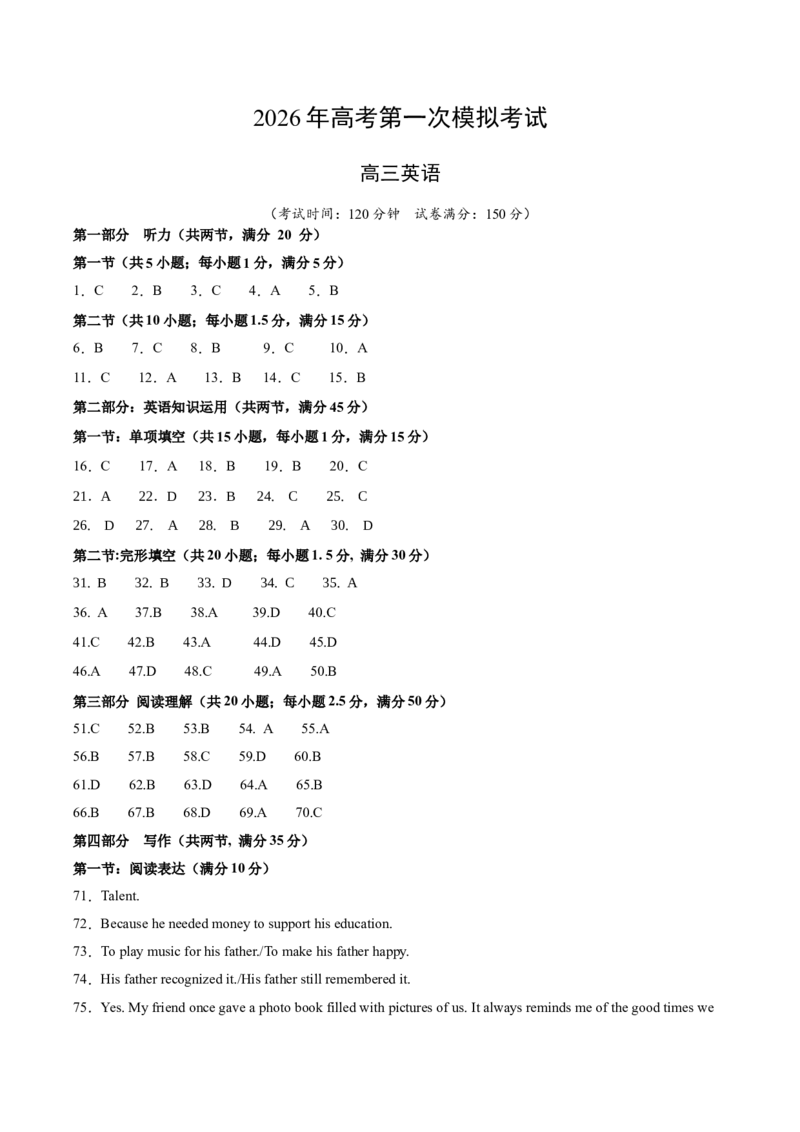
2026 年高考第一次模拟考试
高三英语
(考试时间:120 分钟  试卷满分:150 分)
第一部分  听力(共两节,满分 20 分)
第一节(共5 小题;每小题1 分,满分5 分)
1.C    2.B    3.C    4.A    5.B
第二节(共10 小题;每小题1.5 分,满分15 分)
6.B    7.C    8.B      9.C     10.A
11.C    12.A    13.B   14.C    15.B
第二部分:英语知识运用(共两节,满分45 分)
第一节:单项填空(共15 小题,每小题1 分,满分15 分)
16.C    17.A   18.B    19.B    20.C
21.A    22.D   23.B   24.  C    25.  C
26.  D   27.  A   28.  B    29.  A   30.  D
第二节:完形填空(共20 小题;每小题1. 5 分, 满分30 分)
31. B    32. B    33. D    34. C    35. A
36. A    37.B    38.A     39.D    40.C
41.C    42.B    43.A      44.D    45.D
46.A    47.D    48.C      49.A    50.B
第三部分 阅读理解(共20 小题;每小题2.5 分,满分50 分)
51.C    52.B    53.B    54. A    55.A
56.B    57.B    58.C    59.D    60.B
61.D    62.B    63.D    64.A    65.B
66.B    67.B    68.D    69.A    70.C
第四部分  写作(共两节, 满分35 分)
第一节:阅读表达(满分10 分)
71.Talent.
72.Because he needed money to support his education.
73.To play music for his father./To make his father happy.
74.His father recognized it./His father still remembered it.
75.Yes. My friend once gave a photo book filled with pictures of us. It always reminds me of the good times we
spent together.
第二节:书面表达 (满分25 分)
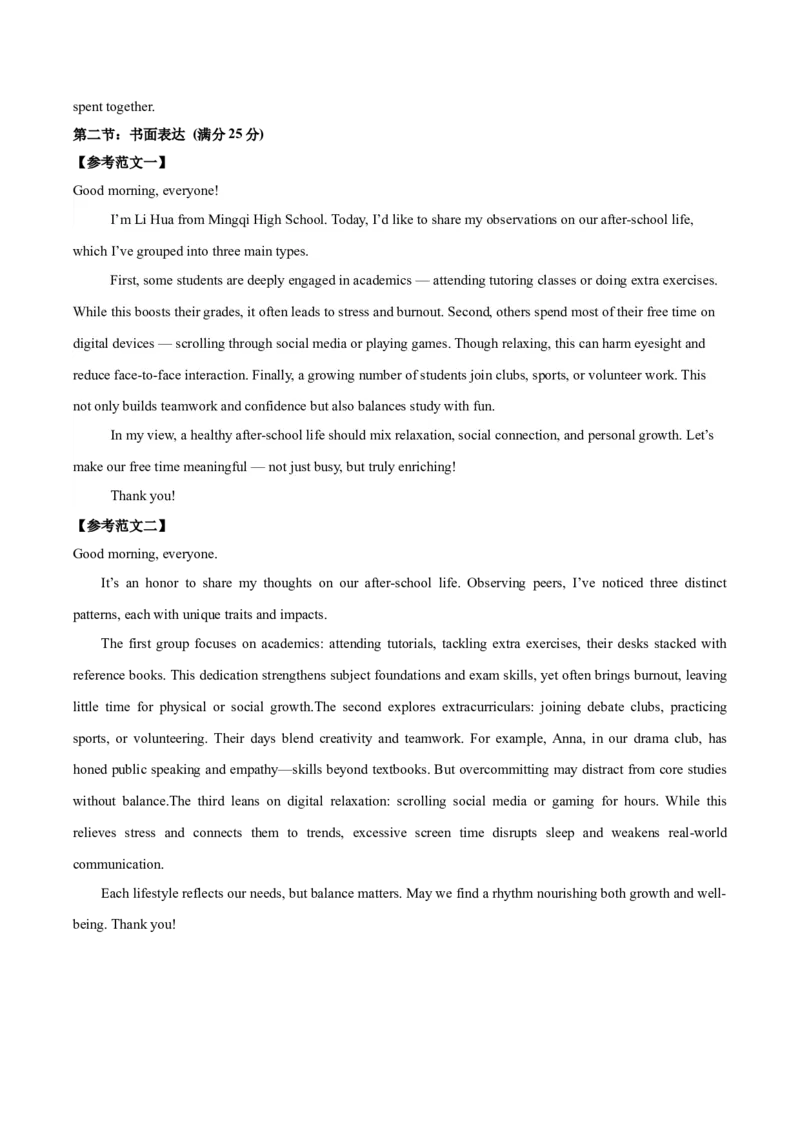
【参考范文一】
Good morning, everyone!
I’m Li Hua from Mingqi High School. Today, I’d like to share my observations on our after-school life,
which I’ve grouped into three main types.
First, some students are deeply engaged in academics — attending tutoring classes or doing extra exercises.
While this boosts their grades, it often leads to stress and burnout. Second, others spend most of their free time on
digital devices — scrolling through social media or playing games. Though relaxing, this can harm eyesight and
reduce face-to-face interaction. Finally, a growing number of students join clubs, sports, or volunteer work. This
not only builds teamwork and confidence but also balances study with fun.
In my view, a healthy after-school life should mix relaxation, social connection, and personal growth. Let’s
make our free time meaningful — not just busy, but truly enriching!
Thank you!
【参考范文二】
Good morning, everyone.
It’s an honor to share my thoughts on our after-school life. Observing peers, I’ve noticed three distinct
patterns, each with unique traits and impacts.

The first group focuses on academics: attending tutorials, tackling extra exercises, their desks stacked with
reference books. This dedication strengthens subject foundations and exam skills, yet often brings burnout, leaving
little time for physical or social growth.The second explores extracurriculars: joining debate clubs, practicing
sports, or volunteering. Their days blend creativity and teamwork. For example, Anna, in our drama club, has
honed public speaking and empathy—skills beyond textbooks. But overcommitting may distract from core studies
without balance.The third leans on digital relaxation: scrolling social media or gaming for hours. While this
relieves stress and connects them to trends, excessive screen time disrupts sleep and weakens real-world
communication.

Each lifestyle reflects our needs, but balance matters. May we find a rhythm nourishing both growth and well-
being. Thank you!