2025 年高考押题预测卷(天津卷 01)
英语·全解全析
(考试时间:100分钟 试卷满分:130分)
注意事项:
1.答卷前,考生务必将自己的姓名、考生号等填写在答题卡和试卷指定位置上。
2.回答选择题时,选出每小题答案后,用铅笔把答题卡对应题目的答案标号涂黑。如需改动,用橡
皮擦干净后,再选涂其他答案标号。回答非选择题时,将答案写在答题卡上。写在本试卷上无效。
3.考试结束后,将本试卷和答题卡一并交回。
第一部分:英语知识运用(共两节,满分45分)
第一节:单项填空(共15小题;每小题1分,满分15分)
从A、B、C、D四个选项中,选出可以填入空白处的最佳选项。
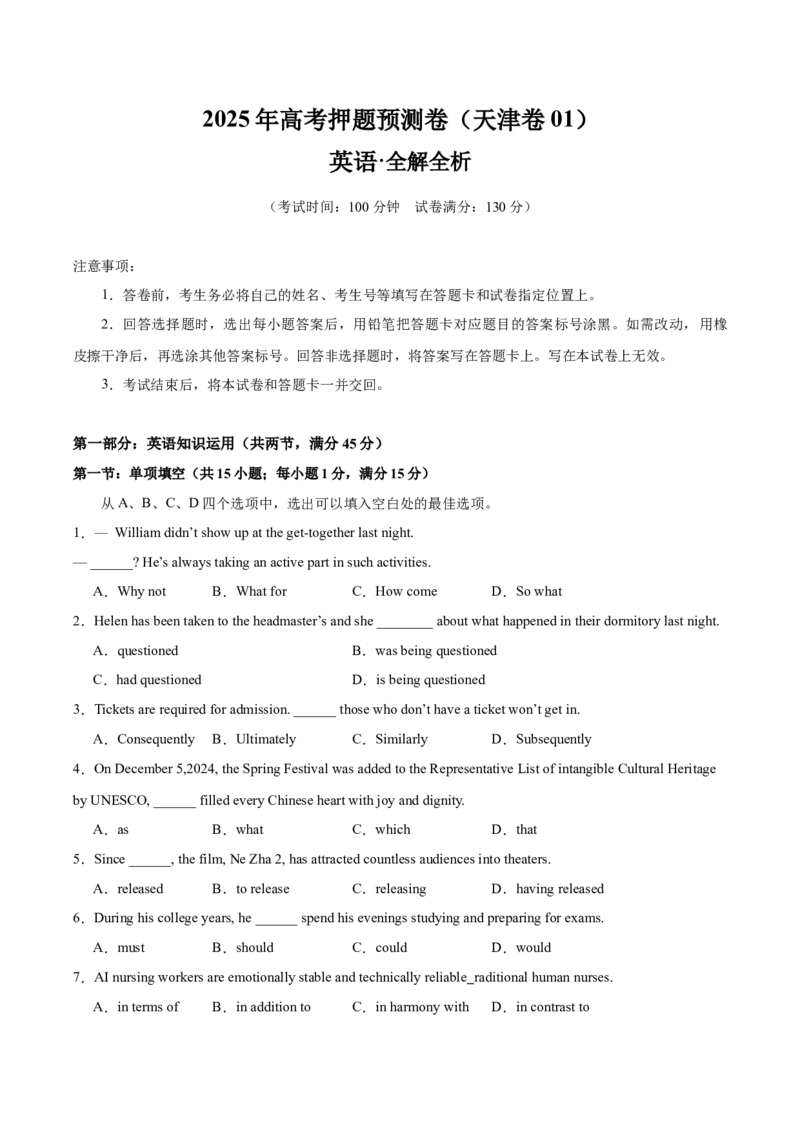
1.— William didn’t show up at the get-together last night.
— ______? He’s always taking an active part in such activities.
A.Why not B.What for C.How come D.So what
2.Helen has been taken to the headmaster’s and she ________ about what happened in their dormitory last night.
A.questioned B.was being questioned
C.had questioned D.is being questioned
3.Tickets are required for admission. ______ those who don’t have a ticket won’t get in.
A.Consequently B.Ultimately C.Similarly D.Subsequently
4.On December 5,2024, the Spring Festival was added to the Representative List of intangible Cultural Heritage
by UNESCO, ______ filled every Chinese heart with joy and dignity.
A.as B.what C.which D.that
5.Since ______, the film, Ne Zha 2, has attracted countless audiences into theaters.
A.released B.to release C.releasing D.having released
6.During his college years, he ______ spend his evenings studying and preparing for exams.
A.must B.should C.could D.would
7.AI nursing workers are emotionally stable and technically reliable raditional human nurses.
A.in terms of B.in addition to C.in harmony with D.in contrast to8.—The project deadline has been extended by a week.
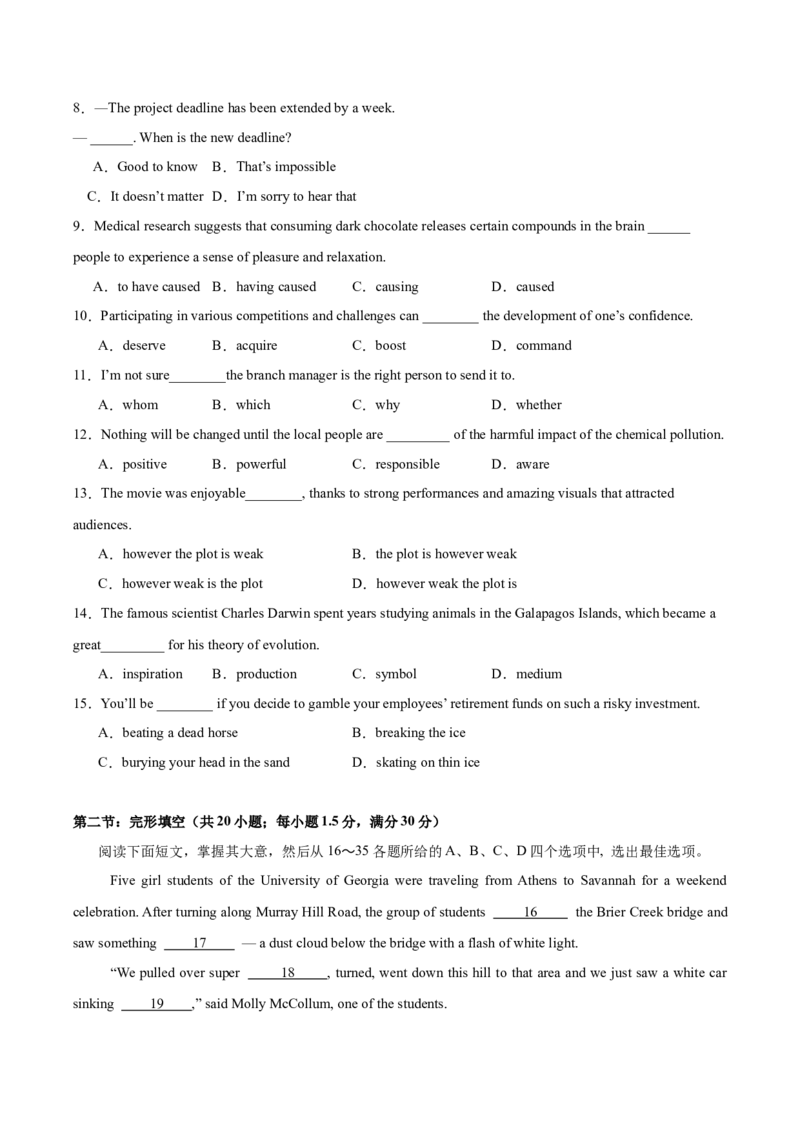
— ______. When is the new deadline?
A.Good to know B.That’s impossible
C.It doesn’t matter D.I’m sorry to hear that
9.Medical research suggests that consuming dark chocolate releases certain compounds in the brain ______
people to experience a sense of pleasure and relaxation.
A.to have caused B.having caused C.causing D.caused
10.Participating in various competitions and challenges can ________ the development of one’s confidence.
A.deserve B.acquire C.boost D.command
11.I’m not sure________the branch manager is the right person to send it to.
A.whom B.which C.why D.whether
12.Nothing will be changed until the local people are _________ of the harmful impact of the chemical pollution.
A.positive B.powerful C.responsible D.aware
13.The movie was enjoyable________, thanks to strong performances and amazing visuals that attracted
audiences.
A.however the plot is weak B.the plot is however weak
C.however weak is the plot D.however weak the plot is
14.The famous scientist Charles Darwin spent years studying animals in the Galapagos Islands, which became a
great_________ for his theory of evolution.
A.inspiration B.production C.symbol D.medium
15.You’ll be ________ if you decide to gamble your employees’ retirement funds on such a risky investment.
A.beating a dead horse B.breaking the ice
C.burying your head in the sand D.skating on thin ice
第二节:完形填空(共20小题;每小题1.5分,满分30分)
阅读下面短文,掌握其大意,然后从16〜35各题所给的A、B、C、D四个选项中, 选出最佳选项。
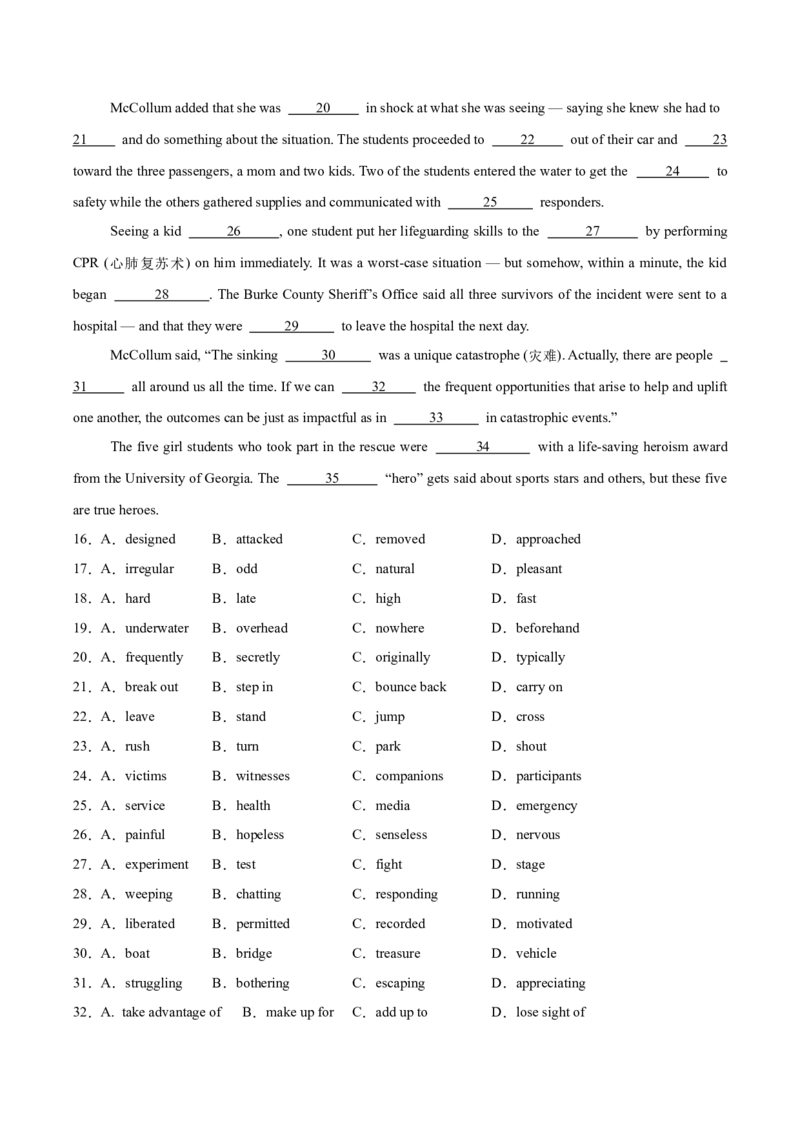
Five girl students of the University of Georgia were traveling from Athens to Savannah for a weekend
celebration. After turning along Murray Hill Road, the group of students 16 the Brier Creek bridge and
saw something 17 — a dust cloud below the bridge with a flash of white light.
“We pulled over super 18 , turned, went down this hill to that area and we just saw a white car
sinking 19 ,” said Molly McCollum, one of the students.McCollum added that she was 20 in shock at what she was seeing — saying she knew she had to
21 and do something about the situation. The students proceeded to 22 out of their car and 23
toward the three passengers, a mom and two kids. Two of the students entered the water to get the 24 to
safety while the others gathered supplies and communicated with 25 responders.
Seeing a kid 26 , one student put her lifeguarding skills to the 27 by performing
CPR (心肺复苏术) on him immediately. It was a worst-case situation — but somehow, within a minute, the kid
began 28 . The Burke County Sheriff’s Office said all three survivors of the incident were sent to a
hospital — and that they were 29 to leave the hospital the next day.
McCollum said, “The sinking 30 was a unique catastrophe (灾难). Actually, there are people
31 all around us all the time. If we can 32 the frequent opportunities that arise to help and uplift
one another, the outcomes can be just as impactful as in 33 in catastrophic events.”
The five girl students who took part in the rescue were 34 with a life-saving heroism award
from the University of Georgia. The 35 “hero” gets said about sports stars and others, but these five
are true heroes.
16.A.designed B.attacked C.removed D.approached
17.A.irregular B.odd C.natural D.pleasant
18.A.hard B.late C.high D.fast
19.A.underwater B.overhead C.nowhere D.beforehand
20.A.frequently B.secretly C.originally D.typically
21.A.break out B.step in C.bounce back D.carry on
22.A.leave B.stand C.jump D.cross
23.A.rush B.turn C.park D.shout
24.A.victims B.witnesses C.companions D.participants
25.A.service B.health C.media D.emergency
26.A.painful B.hopeless C.senseless D.nervous
27.A.experiment B.test C.fight D.stage
28.A.weeping B.chatting C.responding D.running
29.A.liberated B.permitted C.recorded D.motivated
30.A.boat B.bridge C.treasure D.vehicle
31.A.struggling B.bothering C.escaping D.appreciating
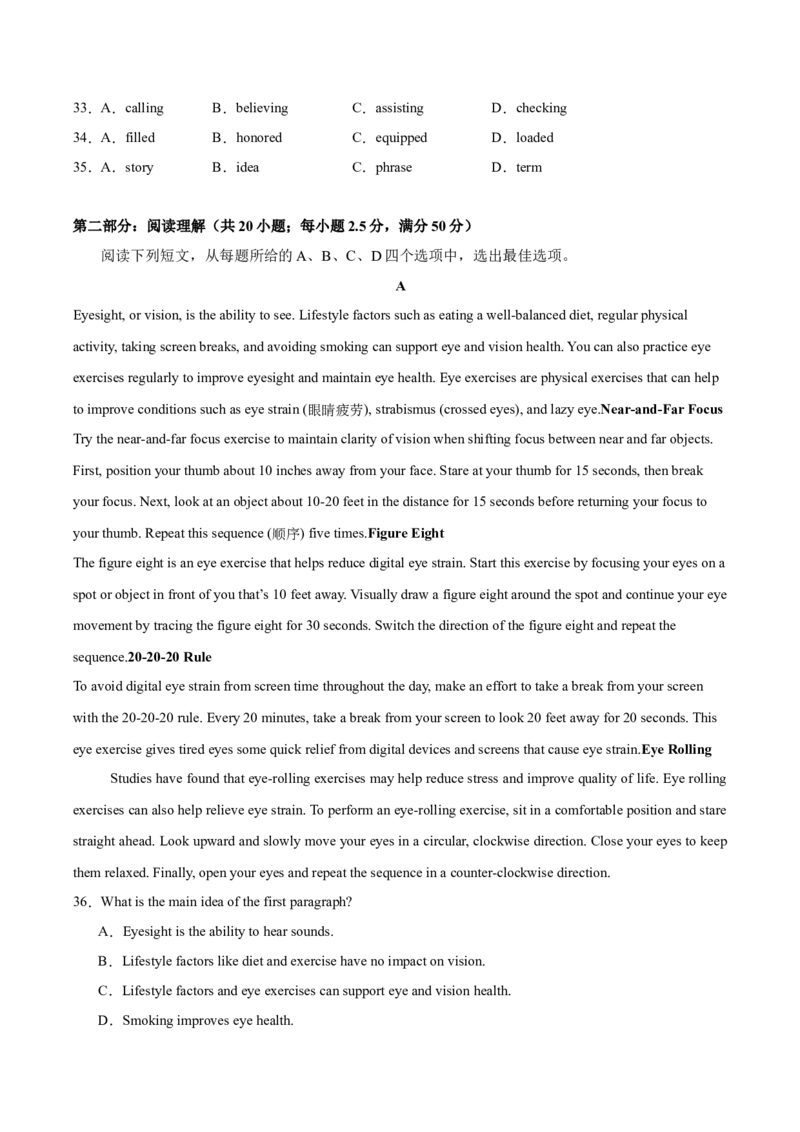
32.A. take advantage of B.make up for C.add up to D.lose sight of33.A.calling B.believing C.assisting D.checking
34.A.filled B.honored C.equipped D.loaded
35.A.story B.idea C.phrase D.term
第二部分:阅读理解(共20小题;每小题2.5分,满分50分)
阅读下列短文,从每题所给的A、B、C、D四个选项中,选出最佳选项。
A
Eyesight, or vision, is the ability to see. Lifestyle factors such as eating a well-balanced diet, regular physical
activity, taking screen breaks, and avoiding smoking can support eye and vision health. You can also practice eye
exercises regularly to improve eyesight and maintain eye health. Eye exercises are physical exercises that can help
to improve conditions such as eye strain (眼睛疲劳), strabismus (crossed eyes), and lazy eye.Near-and-Far Focus
Try the near-and-far focus exercise to maintain clarity of vision when shifting focus between near and far objects.
First, position your thumb about 10 inches away from your face. Stare at your thumb for 15 seconds, then break
your focus. Next, look at an object about 10-20 feet in the distance for 15 seconds before returning your focus to
your thumb. Repeat this sequence (顺序) five times.Figure Eight
The figure eight is an eye exercise that helps reduce digital eye strain. Start this exercise by focusing your eyes on a
spot or object in front of you that’s 10 feet away. Visually draw a figure eight around the spot and continue your eye
movement by tracing the figure eight for 30 seconds. Switch the direction of the figure eight and repeat the
sequence.20-20-20 Rule
To avoid digital eye strain from screen time throughout the day, make an effort to take a break from your screen
with the 20-20-20 rule. Every 20 minutes, take a break from your screen to look 20 feet away for 20 seconds. This
eye exercise gives tired eyes some quick relief from digital devices and screens that cause eye strain.Eye Rolling
Studies have found that eye-rolling exercises may help reduce stress and improve quality of life. Eye rolling
exercises can also help relieve eye strain. To perform an eye-rolling exercise, sit in a comfortable position and stare
straight ahead. Look upward and slowly move your eyes in a circular, clockwise direction. Close your eyes to keep
them relaxed. Finally, open your eyes and repeat the sequence in a counter-clockwise direction.
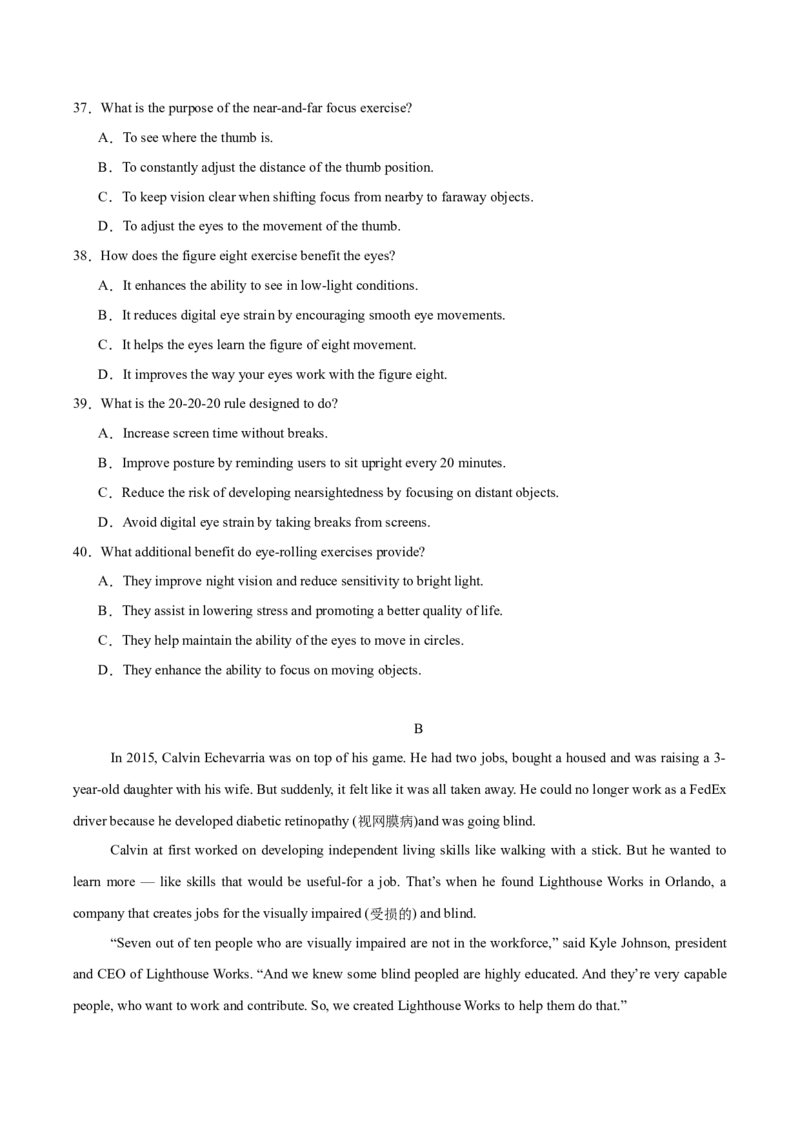
36.What is the main idea of the first paragraph?
A.Eyesight is the ability to hear sounds.
B.Lifestyle factors like diet and exercise have no impact on vision.
C.Lifestyle factors and eye exercises can support eye and vision health.
D.Smoking improves eye health.37.What is the purpose of the near-and-far focus exercise?
A.To see where the thumb is.
B.To constantly adjust the distance of the thumb position.
C.To keep vision clear when shifting focus from nearby to faraway objects.
D.To adjust the eyes to the movement of the thumb.
38.How does the figure eight exercise benefit the eyes?
A.It enhances the ability to see in low-light conditions.
B.It reduces digital eye strain by encouraging smooth eye movements.
C.It helps the eyes learn the figure of eight movement.
D.It improves the way your eyes work with the figure eight.
39.What is the 20-20-20 rule designed to do?
A.Increase screen time without breaks.
B.Improve posture by reminding users to sit upright every 20 minutes.
C.Reduce the risk of developing nearsightedness by focusing on distant objects.
D.Avoid digital eye strain by taking breaks from screens.
40.What additional benefit do eye-rolling exercises provide?
A.They improve night vision and reduce sensitivity to bright light.
B.They assist in lowering stress and promoting a better quality of life.
C.They help maintain the ability of the eyes to move in circles.
D.They enhance the ability to focus on moving objects.
B
In 2015, Calvin Echevarria was on top of his game. He had two jobs, bought a housed and was raising a 3-
year-old daughter with his wife. But suddenly, it felt like it was all taken away. He could no longer work as a FedEx
driver because he developed diabetic retinopathy (视网膜病)and was going blind.
Calvin at first worked on developing independent living skills like walking with a stick. But he wanted to
learn more — like skills that would be useful-for a job. That’s when he found Lighthouse Works in Orlando, a
company that creates jobs for the visually impaired (受损的) and blind.
“Seven out of ten people who are visually impaired are not in the workforce,” said Kyle Johnson, president
and CEO of Lighthouse Works. “And we knew some blind peopled are highly educated. And they’re very capable
people, who want to work and contribute. So, we created Lighthouse Works to help them do that.”Calvin works in the call center, where Lighthouse Works has contracts with several clients, including the
Florida Department of Economic Opportunity. In his job, Calvin uses a system called JAWS to“hear”the computer
he uses. The system reads the computer screen to Calvir in one ear as he listens to a customer call in his other ear.
He said what makes his call center job fun is that the person on the other end of the phone doesn’t even
know he’s blind. And he said working in a fully accessible office space, with other visually impaired people who
can relate to him, is an added benefit.
“It gives me a purpose. It makes me feel better because I can actually be proud of myself, saying, ‘I provide
for my family,’” he said.
41.What can be learned about Echevarria before he got diabetic retinopathy?
A.He was the best worker in his company.
B.He was gifted at playing games.
C.He had to work hard to support his family.
D.He was satisfied with his life.
42.What is the purpose of Lighthouse Works?
A.To make more profits.
B.To do research on retinopathy.
C.To ad the visually impaired.
D.To educate the visually impaired.
43.What is the function of JAWS in Calvin’s job?
A.Making him “see” the computer screen.
B.Helping him hear the customer better.
C.Enabling him to locate customers easily.
D.Teaching him how to answer a customer.
44.What does Calvin think of working in the call center at Lighthouse Works?
A.It’s too challenging for him.
B.It makes him feel fulfilled and proud.
C.It’s difficult to get along with his colleagues.
D.It’s a temporary job to make ends meet
45.Which of the following can best sum up Calvin’s story?
A.It’s never too old to learn.
B.When God closes a door, he opens a window.C.A journey of one thousand miles begins with one step.
D.A thousand miles of walking is better than ten years of reading.
C
Economists tend to be big fans of education. Alfred Marshall, writing in 1873, hoped that education would
help erase the “distinction between working men and gentlemen”. Gary Becker of the University of Chicago
reimagined education as an investment in “human capital” that would produce returns in the market similar to other
assets.
But economics can also be severely critical of schooling. In The Social Limits to Growth, a book published
in 1976, Fred Hirsch pointed out that education is often “positional” in nature. What matters is not only how much
you have, but whether you have more than the next person. An unhappy consequence is that one family’s expenses
of schooling raise the bar for everyone else. Families are drawn, often unconsciously, into educational arms
races. They spend money and time on after-school tutoring or extra-curricular activities in the expectation that it
will improve their child’s position in the queue for advancement. But they quickly discover that everyone else is
doing the same, leaving them in the same position as before. “If everyone stands on tiptoe, no one sees better,”
Hirsch noted.
These arms races are often particularly intense in East Asia. The government of South Korea has tried to ease
the races. For example, it imposed a 10 p.m. curfew (宵禁) on cramming schools (补习学校). Inspectors would
look for schools with their lights on. Will these measures work? It is almost impossible to stop families hiring
private tutors to teach their children in their own homes.
The arms race is notably less intense in parts of Europe. In Norway and Sweden parents show little demand
for tutoring-the wealthy even less than others, according to Steve Enrich of the University of Potsdam. And
overeducation is less common in Germany and other countries that sort children early into academic or vocational
(职业的) schools, with little mobility between the two. For better or worse, that removes large numbers of students
from the race for more academic honors.
Germany’s practice of placing children on different tracks at an early age also invites an interesting thought
experiment. What if college entrance tests were held earlier in a pupil’s career? If these exams truly test the
knowledge required for university, they must be held just before university starts. But if such tests mostly serve as
filters, selecting better students from worse, they need not be held so late. An earlier test would save families a year
or two of costly cramming, shortening “the obstacle journey”, as Hirsch put it, without much changing the results.46.What viewpoint is Gary Becker likely to agree with according to Paragraph 1?
A.Education generates financial returns in the market.
B.Education leads to the widening of class difference.
C.Education plays a vital role in a person’s growth.
D.Education promotes progress toward social equality.
47.Why do we say that one family’s expenses of schooling raise the bar for everyone else?
A.Because it improves standards, making others follow suit.
B.Because it sets up barriers, making it harder for others to reach the same level.
C.Because it provides a model, forcing others to spend even more.
D.Because it limits the range of educational resources, forcing others to give up.
48.Why does the author mention East Asia and parts of Europe?
A.To assess educational competitiveness across regions.
B.To highlight the impact of private tutoring on education.
C.To contrast educational arms races in different areas.
D.To analyze strategies for lessening academic pressure.
49.What is the purpose of writing the article?
A.To introduce economic concepts to offer insights into educational problems.
B.To discuss the economic impact on education among different countries.
C.To explore the nature and consequences of education competition.
D.To compare educational practices between East Asia and Europe.
50.What can be inferred about the author’s attitude towards the overeducation issue?
A.The author believes that overeducation does not greatly change the results.
B.The author believes that examinations are the cause of overeducation.
C.The author advocates that we should learn from the European countries.
D.The author suggests removing large numbers of students from the race.
D
Although it has been revealed in recent years that plants are capable of seeing, hearing and smelling, they are
still usually thought of as silent. But now, for the first time, they have been recorded making ultrasonic (超声的)
cries when stressed, which researchers say could open up a new field of precision agriculture where farmers listen
for water-starved crops.Itzhak Khait and his colleagues at Tel Aviv University in Israel found that tomato and tobacco plants made
cries at frequencies humans cannot hear when stressed by a lack of water or when their stem is cut.
Microphones placed 10 centimetres from the plants picked up sounds in the ultrasonic range of 20 to 100
kilohertz, which the team says insects and some mammals would be capable of hearing and responding to from as
far as 5 metres away. A moth may decide against laying eggs on a plant that sounds water-stressed, the researchers
suggest. Plants could even hear that other plants are short of water and react accordingly, they speculate (推断).
On average, drought-stressed tomato plants made 35 sounds an hour, while tobacco plants made 11. When
plant stems were cut, tomato plants made an average of 25 sounds in the following hour, and tobacco plants 15.
Unstressed plants produced fewer than one sound per hour, on average.
It is even possible to distinguish between the sounds to know what the stress is. The researchers trained a
machine-learning model to recognize between the plants’ sounds and the wind, rain and other noises of the
greenhouse, correctly identifying in most cases whether the stress was caused by dryness or a cut, based on the
sound’s intensity and frequency. Water-hungry tobacco appears to make louder sounds than cut tobacco, for
example.
Enabling farmers to listen for water-stressed plants could “open a new direction in the field of precision
agriculture”, the researchers suggest. They add that such an ability will be increasingly important as climate change
exposes more areas to drought.
“The suggestion that the sounds that drought-stressed plants make could be used in precision agriculture
seems feasible (可行的) if it is not too costly to set up the recording in a field situation,” says Anne Visscher at the
royal Botanic Gardens, Kew, in the UK.
She warns that the results can’t yet be broadened out to other stresses, such as salt or temperature, because
these may not lead to sounds. In addition, there have been no experiments to show whether moths or any other
animal can hear and respond to the sounds the plants make, so that idea remains based on guesses for now, she
says.
51.The experiment by researchers at Tel Aviv University shows that ______.
A.tomato plants cry more often than tobacco when hurt
B.plant sounds can be heard by plants quite far away
C.humans can hear water-hungry plants crying
D.moths like laying eggs on stressed plant
52.Which one of the followings may make the most sounds according to the research?
A.Water-hungry tobacco. B.Stem-cut tobacco.C.Drought-stressed tomato. D.Stem-cut tomato.
53.What is Anne Visscher’s attitude towards the finding of the experiment?
A.Disappointed B.Cautious.
C.Appreciative. D.Optimistic.
54.Taking advantage of the new research finding, farmers can ______.
A.harvest crops in time
B.reduce greenhouse effects
C.diagnose plant condition faster
D.detect and remove insects easily
55.Which of the following would be the best title for the passage?
A.Plants get stressed Just Like Us.
B.Sounds of Plants Detected Far Away.
C.Cries of plants break Farmers’ Hearts
D.Plants scream in the presence of stress
第三部分:写作
第一节:阅读表达(共5小题;每小题2分,满分10分)
阅读短文,按照题目要求用英语回答问题。
When I got my first research project to work as an undergraduate, I was so excited that I could hardly think.
My excitement, though, was soon cut short when my professor asked me to write a research paper on the project.
My body tensed. Writing was the last thing I wanted to do.
I hated writing in high school. It felt like wondering in a chaotic jungle, unsure where to reach next. My
teachers would return my papers littered with red.
In college, I studied engineering. I took comfort there, knowing objective truth could be found. The
professor assigned me a project to improve the efficiency of an inductor(感应器). I spent weeks setting up a test for
a new design. The results weren’t good. I kept trying new designs, using the results to brainstorm ideas with
researchers. Finally, we had one. I was overjoyed—until my professor told me to write that research paper.
I knew I would need to spend time penning papers. In a panic, I asked a graduate student for help. We
defined a goal, and I carefully wrote an outline. But when I asked him for feedback, I soon found the paper covered
in red marks. The graduate student explained that red didn’t mean I was a bad writer. Writing isn’t a one-and done
thing. It requires revising your work, often several times. Suddenly it occurred to me, “Hadn’t I done the samething when I was searching for an efficient inductor design?” I kept refining the outline, eventually turning it into
sentences and paragraphs guided by feedback from others. My initial draft wasn’t perfect. But with help. I was
finally making my way through the jungle.
From then on writing became one of my favorite parts of research, and it still is today. It’s a future I never
could have imagined during my early struggles with English classes. But I came around. All it took was some trial
and error.
56.Why was the author’s excitement cut short when he had to write a research paper?(no more than 5 words)
57.What does the underlined phrase “wondering in a chaotic jungle” mean in Paragraph 2?(no more than 2
words)
58.How did the author improve the inductor design?(no more than 10 words)
59.What made writing become the author’s favorite part of research?(no more than 10 words)
60.What do you think of “red marks” in your life? Please explain in your own words.(no more than 20 words)
第二节:书面表达(满分25分)
假如你是晨光中学的李津。你校3月25日举行了主题为“非遗进校园(Intangible Cultural Heritage in
Campus)”的文化活动。请你根据以下提示,写一篇英文报道,向校园网投稿,内容包括:
1.活动的时间、目的;
2.活动的主要内容(民间艺术家讲座、非遗创作与展示等);
3.活动的反响。
注意:
(1)不少于100词;
(2)可以适当增加细节,以使行文连贯;
参考词汇:民间艺术家 folk artist
Intangible Cultural Heritage in Campus
____________________________________________________________________________________________
________________________________________________________________________________________________________________________________________________________________________________________
____________________________________________________________________________________________
____________________________________________________________________________________________
____________________________________________________________________________________________
___________________________________________________________________________________________
____________________________________________________________________________________________
___________________________________________________________________________________________