《2024年高考英语新课标卷真题深度解析与考后提升》
专题13 阅读理解B篇(新课标II卷)原卷版
(答案解析+专家评价+三年真题+词汇变式+满分策略+话题变式)
目录
一、原题呈现 P1
二、答案解析 P2
三、专家评价 P2
四、题源网站 P3
五、词汇变式 P4
(一)考纲词汇词形转换 P4
(二)考纲词汇识词知意 P4
(三)高频短语积少成多 P4
(四)核心考点单句填空 P4
(五)长难句分析 P5
(六)全文翻译 P5
六、三年真题 P6
(一)2023 年新课标 II 卷阅读理解 B 篇 P6
(二)2022 年新课标 II 卷阅读理解 B 篇 P7
(三)2021 年新课标 II 卷阅读理解 B 篇 P8
七、满分策略 P9
八、话题变式 P11
新闻报道类阅读理解高考真题 3 篇 P11
新闻报道类阅读理解名校好题 8 篇 P14
一、原题呈现
阅读理解A篇关键词: 新闻报道;人与社会;湾区捷运系统;自动售货亭;创新手法吸引游客
Do you ever get to the train station and realize you forgot to bring something to read? Yes, we all have our
phones, but many of us still like to go old school and read something printed.
Well, there’s a kiosk (小亭) for that. In the San Francisco Bay Area, at least.
“You enter the fare gates (检票口) and you’ll see a kiosk that is lit up and it tells you can get a one-minute, a
three-minute, or a five-minute story,” says Alicia Trost, the chief communications officer for the San Francisco Bay
Area Rapid Transit — known as BART. “You choose which length you want and it gives you a receipt-like
short story.”
It’s that simple. Riders have printed nearly 20,000 short stories and poems since the program was launchedlast March. Some are classic short stories, and some are new original works.
Trost also wants to introduce local writers to local riders. “We wanted to do something where we do a call to
artists in the Bay Area to submit stories for a contest,” Trost says. “And as of right now, we’ve received about 120
submissions. The winning stories would go into our kiosk and then you would be a published artist.”
Ridership on transit (交通) systems across the country has been down the past half century, so could short
stories save transit?
Trost thinks so.
“At the end of the day all transit agencies right now are doing everything they can to improve the rider
experience. So I absolutely think we will get more riders just because of short stories,” she says.
And you’ll never be without something to read.
24. Why did BART start the kiosk program?
A. To promote the local culture. B. To discourage phone use.
C. To meet passengers’ needs. D. To reduce its running costs.
25. How are the stories categorized in the kiosk?
A. By popularity. B. By length.
C. By theme. D. By language.
26. What has Trost been doing recently?
A. Organizing a story contest. B. Doing a survey of customers.
C. Choosing a print publisher. D. Conducting interviews with artists.
27. What is Trost’s opinion about BART’s future?
A. It will close down. B. Its profits will decline.
C. It will expand nationwide. D. Its ridership will increase.
二、答案解析
三、专家评价
坚持提倡五育并举,引导学生德智体美劳全面发展
高考英语命题通过选取有关体育、美育和劳动教育的语篇,引导学生坚持五育并举,
实现身心健康成长和德智体美劳全面发展。试卷阅读 A 篇介绍了卡洛秋季徒步节的健身
徒步活动,引导学生走近大自然,开展体育运动,文中提及多项注意事项,于潜移默化
之中强调了运动安全的重要性。阅读 B 篇介绍了旧金山湾区快速交通系统(BART)为
了提升乘客体验而推出的一个短篇小说打印亭项目,引导学生在电子设备盛行的当今不
要忘记还有纸质阅读这一阅读方式可供选择,也强调了利用零散时间来进行阅读和学习
的好习惯。阅读 C 篇讲述巴比伦微型农场通过室内自动化种植系统极大地缩短了农产品
从农场到餐桌的距离,并实现了自动化管理和零排放的环保种植,而阅读 D 篇介绍了
Catriona Campbell 的 新 书 《 AI by Design: A Plan for Living with Artificial
Intelligence》,引导学生思考人类与人工智能共存的未来,强调了全球监管人工智能研究和使用的重要性问题。这两篇难度较大的文章都从科技发展视角引导学生思考科技如
何更好地服务于人类以及人类理性使用科技的问题。在美育方面,试题的写作第一节应
用文写作任务中,设置情境为在公园上的一节美术课,引导学生回归自然之美,到自然
中寻求人类艺术创作不竭的灵感源泉。这些文本都释放了强烈的信号,引导学生实现德
智体美劳全面发展。 【中国考试·教育部教育考试院】
四、题源网站
【原文链接】
选自全国公共广播电台(NPR)2022 年6 月9 日
https://www.npr.org/2022/06/09/1103884811/san-francisco-transit-dispenses-short-stories-to-commuters
五、词汇变式
一、考纲词汇词形转换
1. long adj.长的 → n 长度2. origin n. 来源→ ad j [熟词生义] 原创的
3. submit v 提交 → n 提交物
4. absolute adj. 绝对的→ ad v 完全地
5. popular adj. 普及的→ n 受欢迎
6. publish vt 出版 → n 出版商
7. category n. 种类→ v 将……分类
二、考纲词汇识词知意
1. old-school adj
2. chief adj
3. launch v
4. classic adj
5. call n
6. ridership n
7. agency n
8. discourage v
9. theme n
10. profit n
11. decline v
12. expand v
13. nationwide adv
三、高频短语积少成多
1. forget to do
2. at least
3. light up
4. as of
5. meet a need
6. conduct an interview
7. close down
running costs n
四、核心考点单句填空
1. Do you ever get to the train station and realize you forgot ___________(bring) something to read?
2. Yes, we all have our phones, __________ many of us still like to go old school and read something
___________(print).
3. Well, there’s a kiosk (小亭) for that. In the San Francisco Bay Area, at ___________(little).
4.“You enter the fare gates (检票口) and you’ll see a kiosk that ___________(light) up and it tells you can get a
one-minute, a three-minute, or a five-minute story,” says Alicia Trost, the chief communications officer for the San
Francisco Bay Area Rapid Transit — known ___________ BART.
5. “You choose ___________ length you want and it ___________(give) you a receipt-like short story.”
6. It’s that simple. Riders ___________(print) nearly 20,000 short stories and poems since the program___________(launch) last March.
7. Some are classic short stories, and some are new ___________(origin) works.
8. Trost also wants to introduce local writers ___________ local riders.
9. “We wanted to do something where we do a call to artists in the Bay Area ___________(submit) stories for a
contest,” Trost says. “And as of right now, we’ve received about 120 ___________(submission). ”
10. “The ___________(win) stories would go into our kiosk and then you would be a ___________(publish)
artist.”
11. Ridership on transit (交通) systems across the country has been down the past half century, so could short
stories save transit? Trost thinks __________.
12. “At the end of the day all transit agencies right now are doing everything they can ___________(improve) the
rider experience.
13. So I ___________(absolute) think we will get more riders just because ___________ short stories,” she says.
14. And you’ll never be without something ___________(read).
五、长难句分析
1. “You enter the fare gates (检票口) and you’ll see a kiosk that is lit up and it tells you can get a one-minute, a
three-minute, or a five-minute story,” says Alicia Trost, the chief communications officer for the San Francisco Bay
Area Rapid Transit — known as BART.
【翻译】旧金山湾区快速交通系统的首席通信官艾丽西亚·特罗斯特说:“你进入检票口,就会看到一个亮
着灯的小亭子,它告诉你可以得到一个一分钟、三分钟或五分钟的故事。”
【分析】the chief communications officer for the San Francisco Bay Area Rapid Transitshi是主语Alicia Trost的
同位语,— known as BART对the San Francisco Bay Area Rapid Transitshi起解释作用。直接引语部分that is
lit up是定语从句,修饰先行词kiosk。
2. We wanted to do something where we do a call to artists in the Bay Area to submit stories for a
contest.
【翻译】句意为:我们想要做一些事情,即向湾区的艺术家发起呼吁,让他们提交故事参加比赛。
【分析】本句为主从复合句,句子主干是:We wanted to do something;where 引导定语从句,修饰先行词
something,说明其具体内容,即发起一个呼吁。不定式短语 to submit stories for a contest 作目的状语,说
明发起呼吁的目的,即让艺术家提交故事参加比赛。
六、全文翻译
你是否曾经到达火车站却发现忘记带东西阅读?是的,我们都有手机,但许多人仍然喜欢回归传统,
阅读一些印刷品。
旧金山湾区就有一个这样的小亭子。旧金山湾区快速交通系统的首席通信官艾丽西亚·特罗斯特说:
“你进入检票口,就会看到一个亮着灯的小亭子,它告诉你可以得到一个一分钟、三分钟或五分钟的故
事。”“你选择你想要的长度,它会给出一张收据式的短故事。”
就这么简单。自从去年三月启动这个项目以来,乘客已经打印了近 2万篇短故事和诗歌。其中一些是
经典短篇故事,还有一些是新的原创作品。
特罗斯特还希望向当地乘客介绍当地作家。“我们想做的是呼吁湾区的艺术家提交故事参加比赛,”
特罗斯特说。“到目前为止,我们已经收到了大约120份投稿。获胜的故事将会进入我们的小亭子,然后
你将成为一个发表作品的艺术家。”过去半个世纪以来,全国交通系统的乘客量一直在下降,那么短故事能否拯救交通呢? 特罗斯特认
为可以。 “在一天结束时,所有交通机构现在都在尽一切努力改善乘客体验。所以我绝对认为我们会因
为短故事而吸引更多乘客,”她说。
你将永远不会没有东西可读。
六、三年真题
【2023年新课标II卷阅读理解B篇】
Turning soil, pulling weeds, and harvesting cabbage sound like tough work for middle and high school kids.
And at first it is, says Abby Jaramillo, who with another teacher started Urban Sprouts, a school garden program at
four low-income schools. The program aims to help students develop science skills, environmental awareness, and
healthy lifestyles.
Jaramillo’s students live in neighborhoods where fresh food and green space are not easy to find and fast food
restaurants outnumber grocery stores. “The kids literally come to school with bags of snacks and large bottles of
soft drinks,” she says. “They come to us thinking vegetables are awful, dirt is awful, insects are awful.” Though
some are initially scared of the insects and turned off by the dirt, most are eager to try something new.
Urban Sprouts’ classes, at two middle schools and two high schools, include hands-on experiments such as soil
testing, flower-and-seed dissection, tastings of fresh or dried produce, and work in the garden. Several times a year,
students cook the vegetables they grow, and they occasionally make salads for their entire schools.
Program evaluations show that kids eat more vegetables as a result of the classes. “We have students who say
they went home and talked to their parents and now they’re eating differently,” Jaramillo says.
She adds that the program’s benefits go beyond nutrition. Some students get so interested in gardening that
they bring home seeds to start their own vegetable gardens. Besides, working in the garden seems to have a calming
effect on Jaramillo’s special education students, many of whom have emotional control issues. “They get outside,”
she says, “and they feel successful.”
24. What do we know about Abby Jaramillo?
A. She used to be a health worker.
B. She grew up in a low-income family.
C. She owns a fast food restaurant.
D. She is an initiator of Urban Sprouts.
25. What was a problem facing Jaramillo at the start of the program?
A. The kids’ parents distrusted her.
B. Students had little time for her classes.
C. Some kids disliked garden work.
D. There was no space for school gardens.
26. Which of the following best describes the impact of the program?
A. Far-reaching. B. Predictable.
C. Short-lived. D. Unidentifiable.
27. What can be a suitable title for the text?
A. Rescuing School GardensB. Experiencing Country Life
C. Growing Vegetable Lovers
D. Changing Local Landscape
【2022年新课标II卷阅读理解B篇】
We journalists live in a new age of storytelling, with many new multimedia tools. Many young people don’t
even realize it’s new. For them, it’s just normal.
This hit home for me as I was sitting with my 2-year-old grandson on a sofa over the Spring Festival holiday.
I had brought a children’s book to read. It had simple words and colorful pictures — a perfect match for his age.
Picture this: my grandson sitting on my lap as I hold the book in front so he can see the pictures. As I read, he
reaches out and pokes (戳) the page with his finger.
What’s up with that? He just likes the pictures, I thought. Then I turned the page and continued. He poked the
page even harder. I nearly dropped the book. I was confused: Is there something wrong with this kid?
Then I realized what was happening. He was actually a stranger to books. His father frequently amused the
boy with a tablet computer which was loaded with colorful pictures that come alive when you poke them. He
thought my storybook was like that.
Sorry, kid. This book is not part of your high-tech world. It’s an outdated, lifeless thing. An antique, like your
grandfather. Well, I may be old, but I’m not hopelessly challenged, digitally speaking. I edit video and produce
audio. I use mobile payment. I’ve even built websites.
There’s one notable gap in my new-media experience, however: I’ve spent little time in front of a camera,
since I have a face made for radio. But that didn’t stop China Daily from asking me last week to share a personal
story for a video project about the integration of Beijing, Tianjin and Hebei province.
Anyway, grandpa is now an internet star — two minutes of fame! I promise not to let it go to my head. But I
will make sure my 2-year-old grandson sees it on his tablet.
24. What do the underlined words “hit home for me” mean in paragraph 2?
A. Provided shelter for me.
B. Became very clear to me.
C. Took the pressure off me.
D. Worked quite well on me.
25. Why did the kid poke the storybook?
A. He took it for a tablet computer.
B. He disliked the colorful pictures.
C. He was angry with his grandpa.
D. He wanted to read it by himself.
26. What does the author think of himself?
A. Socially ambitious. B. Physically attractive.
C. Financially independent. D. Digitally competent.
27. What can we learn about the author as a journalist?
A. He lacks experience in his job.
B. He seldom appears on television.
C. He manages a video department.D. He often interviews internet stars.
【2021年新课标II卷阅读理解B篇】
I have worked as a keeper at the National Zoo, Paris for 11 years. Spot and Stripe are the first tiger cubs that
have ever been born here. Globally, a third of Sumatran cubs in zoos don't make it to adulthood, so I decided to
give them round-the-clock care at home.
I've got two children—the younger one, Kynan, was extremely happy about the tigers arriving - but all of us
really looked forward to being part of their lives and watching them grow. I wasn't worried about bringing them
into my home with my wife and kids. These were cubs. They weighed about 2.5 kg and were so small that there
was absolutely no risk.
As they grew more mobile, we let them move freely around the house during the day, but when we were
asleep we had to contain them in a large room, otherwise they'd get up to mischief. We'd come down in the
morning to find they'd turned the room upside down, and left it looking like a zoo.
Things quickly got very intense due to the huge amount of energy required to look after them. There were
some tough times and I just felt extremely tired. I was grateful that my family was there to help. We had to have a
bit of a production line going, making up “tiger milk”, washing baby bottles, and cleaning the floors.
When Spot and Stripe were four months old, they were learning how to open doors and jump fences, and we
knew it really was time for them to go. It was hard for us to finally part with them. For the first few days, Kynan
was always a bit disappointed that the cubs weren't there.
I'm not sad about it. I'm hands-on with them every day at the zoo, and I do look back very fondly on the time
that we had them.
24. Why did the author bring the tiger cubs home?
A. To ensure their survival.
B. To observe their differences.
C. To teach them life skills.
D. To let them play with his kids.
25. What do the underlined words “get up to mischief” mean in paragraph 3?
A. Behave badly. B. Lose their way. C. Sleep soundly. D. Miss their mom.
26. What did the author think of raising the tiger cubs at home?
A. Boring. B. Tiring. C. Costly. D. Risky.
27. Why did the author decide to send Spot and Stripe back to the zoo?
A. They frightened the children.
B. They became difficult to contain.
C. They annoyed the neighbours.
D. They started fighting each other.
七、满分策略
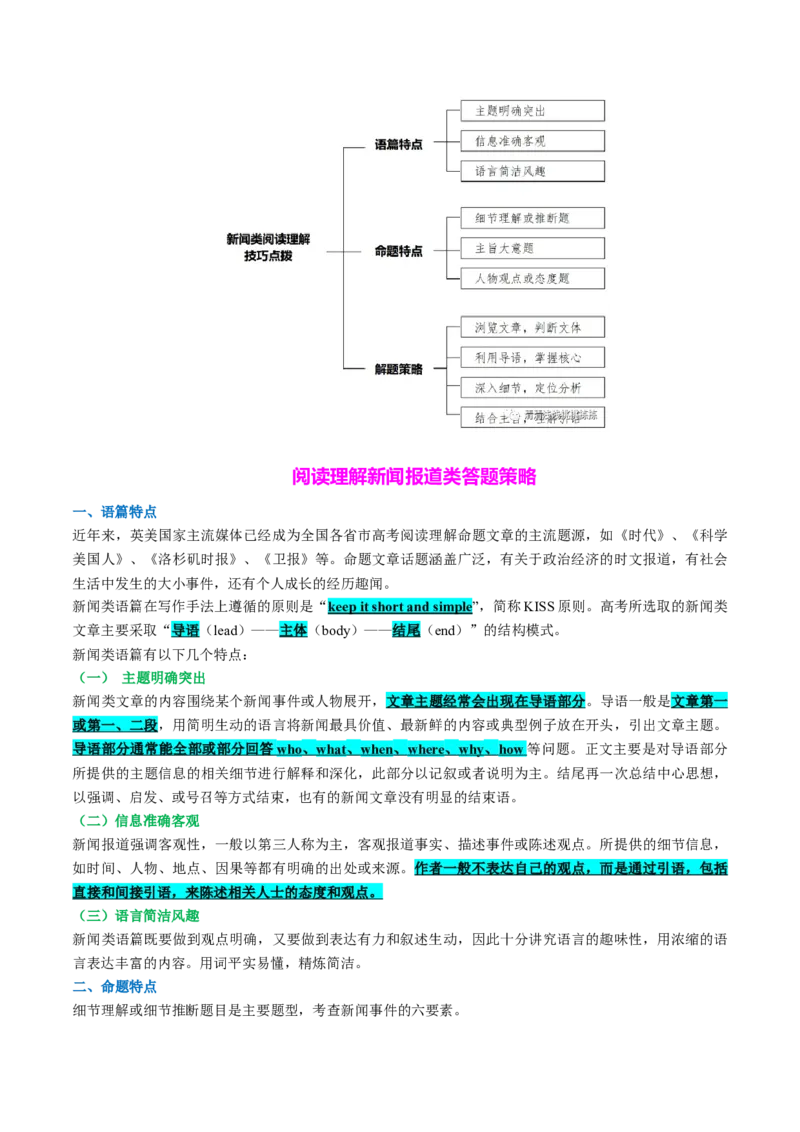
阅读理解新闻报道满分策略阅读理解新闻报道类答题策略
一、语篇特点
近年来,英美国家主流媒体已经成为全国各省市高考阅读理解命题文章的主流题源,如《时代》、《科学
美国人》、《洛杉矶时报》、《卫报》等。命题文章话题涵盖广泛,有关于政治经济的时文报道,有社会
生活中发生的大小事件,还有个人成长的经历趣闻。
新闻类语篇在写作手法上遵循的原则是“keep it short and simple”,简称KISS原则。高考所选取的新闻类
文章主要采取“导语(lead)——主体(body)——结尾(end)”的结构模式。
新闻类语篇有以下几个特点:
(一) 主题明确突出
新闻类文章的内容围绕某个新闻事件或人物展开,文章主题经常会出现在导语部分。导语一般是文章第一
或第一、二段,用简明生动的语言将新闻最具价值、最新鲜的内容或典型例子放在开头,引出文章主题。
导语部分通常能全部或部分回答 who 、 wha t 、 when 、 wher e 、 why 、 how 等问题。正文主要是对导语部分
所提供的主题信息的相关细节进行解释和深化,此部分以记叙或者说明为主。结尾再一次总结中心思想,
以强调、启发、或号召等方式结束,也有的新闻文章没有明显的结束语。
(二)信息准确客观
新闻报道强调客观性,一般以第三人称为主,客观报道事实、描述事件或陈述观点。所提供的细节信息,
如时间、人物、地点、因果等都有明确的出处或来源。作者一般不表达自己的观点,而是通过引语,包括
直接和间接引语,来陈述相关人士的态度和观点。
(三)语言简洁风趣
新闻类语篇既要做到观点明确,又要做到表达有力和叙述生动,因此十分讲究语言的趣味性,用浓缩的语
言表达丰富的内容。用词平实易懂,精炼简洁。
二、命题特点
细节理解或细节推断题目是主要题型,考查新闻事件的六要素。细节理解或者细节推断一般侧重文章导语和主体部分的考查,考题涉及的考点一般与段落顺序对应。主旨
归纳和观点推断类题目是难点和热点。主旨大意题考查学生对文章的概括能力,有助于培养学生的思维品
质。
主旨大意题包括文章主旨题、段落大意题和标题归纳题。近年来高考新闻类文章一般不含标题,而在设题
时要求考生结合新闻事件,选取一个能概括新闻事件主要内容且夺人眼球的最佳标题。
主旨大意题需要考生对导语提供的信息充分理解,有时候还需要将导语和主体部分提供的故事信息或者事
件描述结合起来归纳总结。
由于新闻类文章通常会通过直接引语或者间接引语来阐述相关人士的观点,高考命题时会要求学生在阅读
时区分事实和观点,学会总结和概括人们对新闻事件的观点和态度,这也符合核心素养培养框架的要求,
有利于学生文化品格的提升。这类题型因为涉及阐述人们的观点以及支撑细节,有时可能跨越几个段落,
所以难度较大。
三、解题策略
(一)浏览文章,判断文体
考生在做阅读理解题时一定要有“文体意识”,即结合文章体裁的文体特征,紧扣主旨理解文章。具体到
新闻类文体,首先通过新闻独有的语篇特征,如导语、信息源等,判断是否是新闻类语篇。然后,根据文
章结构特点和题型特点可以去文章相应部分寻找答案,这样可以节约时间、有的放矢。例如:文章主旨、
写作意图题一般对应文章导语部分。
(二)利用导语,掌握核心
导语往往包括了新闻最具价值的内容,与主旨密切相关,是对新闻事件本质、新闻人物的突出特点和社会
现象背后的原因等最凝练的概括,是写作意图题、主旨大意题的重要判断依据。例如:2020全国高考III
卷C篇,探讨了英国社会中由于多方压力,一家人几代同堂的现状。第 31题“What is the text mainly
about?”就是导语的侧面考查。通过结合下文的例子和数据分析,我们知道这种选择多是同住一室的家庭越
来越多,因此全文讲述的是人们居住方式的一种新的趋势。
(三)深入细节,定位分析
细节判断题是新闻类语篇的主要考查题型,做题时考生要有“题目意识”,即由题干关键词把握命题意图
和答题要点,解题时多使用“同义转换”或者“综合归纳”两种方法。多数情况下,选项会对原文信息进
行同义转换,即原文信息的另外一种表达。相反,选项中如果出现了原文出现过的词句,应当引起警觉,
谨防受到“偷梁换柱”的迷惑干扰。有时候细节散落在多个句子,或者在不同段落中都有提到,考生应该
分析事件之间的关联、人物与事件的关联、社会现象背后的原因和结果的关联等等,进行综合归纳。如果
是以记叙为主,则需要抓住“何人、何时、何为、何因、何果”几要素,这几大要素也是题目的着眼点。
(四) 结合主旨,理解引语
引语是新闻类文章中的点睛之笔,用来体现作者或者文中相关方面的态度、观点,用来佐证支撑主旨。在
答题时要有“语境意识”,即联系文章主旨和上下文语境分析判断作者的写作意图或者说话人的情感态度。
八、话题变式
变式一:新闻报道类阅读理解高考真题
【2023浙江1月卷】
A machine can now not only beat you at chess, it can also outperform you in debate. Last week, in a publicdebate in San Francisco, a software program called Project Debater beat its human opponents, including Noa
Ovadia, Israel’s former national debating champion.
Brilliant though it is, Project Debater has some weaknesses. It takes sentences from its library of documents
and prebuilt arguments and strings them together. This can lead to the kinds of errors no human would make. Such
wrinkles will no doubt be ironed out, yet they also point to a fundamental problem. As Kristian Hammond,
professor of electrical engineering and computer science at Northwestern University, put it: “There’s never a stage
at which the system knows what it’s talking about.”
What Hammond is referring to is the question of meaning, and meaning is central to what distinguishes the
least intelligent of humans from the most intelligent of machines. A computer works with symbols. Its program
specifies a set of rules to transform one string of symbols into another. But it does not specify what those symbols
mean. Indeed, to a computer, meaning is irrelevant. Humans, in thinking, talking, reading and writing, also work
with symbols. But for humans, meaning is everything. When we communicate, we communicate meaning. What
matters is not just the outside of a string of symbols, but the inside too, not just how they are arranged but what they
mean.
Meaning emerges through a process of social interaction, not of computation, interaction that shapes the
content of the symbols in our heads. The rules that assign meaning lie not just inside our heads, but also outside, in
society, in social memory, social conventions and social relations. It is this that distinguishes humans from
machines. And that’s why, however astonishing Project Debater may seem, the tradition that began with Socrates
and Confucius will not end with artificial intelligence.
28. Why does the author mention Noa Ovadia in the first paragraph?
A. To explain the use of a software program.
B. To show the cleverness of Project Debater.
C. To introduce the designer of Project Debater.
D. To emphasize the fairness of the competition.
29. What does the underlined word “wrinkles” in paragraph 2 refer to?
A. Arguments. B. Doubts. C. Errors. D. Differences.
30. What is Project Debater unable to do according to Hammond?
A. Create rules. B. Comprehend meaning.
C. Talk fluently. D. Identify difficult words.
31. What can we learn from the last paragraph?
A. Social interaction is key to understanding symbols.
B. The human brain has potential yet to be developed.
C. Ancient philosophers set good examples for debaters.
D. Artificial intelligence ensures humans a bright future.
【2020全国III卷】
When "Rise of the Planet of the Apes" was first shown to the public last month, a group of excited animal
activists gathered on Hollywood Boulevard. But they weren’t there to throw red paint on fur-coat-wearing film
stars. Instead, one activist, dressed in a full-body monkey suit, had arrived with a sign praising the
filmmakers: "Thanks for not using real apes (猿)!"The creative team behind "Apes" used motion-capture (动作捕捉) technology to create digitalized
animals, spending tens of millions of dollars on technology that I records an actor’s performance and later
processes it with computer graphics to create a final image (图像). In this case, one of a realistic-looking
ape.
Yet "Apes" is more exception than the rule. In fact, Hollywood has been hot on live animals lately. One
nonprofit organization, which monitors the treatment or animals in filmed entertainment, is keeping tabs on more
than 2,000 productions this year. Already, a number of films, including "Water for Elephants," "The Hangover Part
Ⅱ" and "Zookeeper," have drawn the anger of activists who say the creatures acting in them haven’t been
treated properly.
In some cases, it’s not so much the treatment of the animals on set in the studio that has activists worried; it’s
the off-set training and living conditions that are raising concerns. And there are questions about the films made
outside the States, which sometimes are not monitored as closely as productions filmed in the Sates.
24. Why did the animal activists gather on Hollywood Boulevard?
A. To see famous film stars.
B. To oppose wearing fur coats.
C. To raise money for animal protection.
D. To express thanks to some filmmakers.
25. What does paragraph 2 mainly talk about?
A. The cost of making "Apes."
B. The creation of digitalized apes.
C. The publicity about “Apes."
D. The performance of real apes.
26. What does the underlined phrase "keeping tabs on" in paragraph 3 probably mean?
A. Listing completely.
B. Directing professionally.
C. Promoting successfully.
D. Watching carefully.
27. What can we infer from the last paragraph about animal actors?
A. They may be badly treated.
B. They should take further training.
C. They could be traded illegally.
D. They would lose popularity.
【2020全国III卷】
With the young unable to afford to leave home and the old at risk of isolation(孤独), more families
are choosing to live together.
The doorway to peace and quiet, for Nick Bright at least, leads straight to his mother-in-law, she
lives on the ground floor, while he lives upstairs with his wife and their two daughters.
Four years ago they all moved into a three-storey Victorian house in Bristol — one of a growingnumber of multigenerational families in the UK living together under the same roof. They share a front
door and a washing machine, but Rita Whitehead has her own kitchen, bathroom, bedroom and living
room on the ground floor.
“We floated the idea to my mum of sharing at a house,” says Kathryn Whitehead. Rita cuts in: “We
spoke more with Nick because I think it’s a big thing for Nick to live with his mother-in-law.”
And what does Nick think? “From my standpoint, it all seems to work very well. Would I
recommend it? Yes, I think I would.”
It’s hard to tell exactly how many people agree with him, but research indicates that the numbers
have been rising for some time. Official reports suggest that the number of households with three
generations living together had risen from 325,000 in 2002 to 419,000 in 2013.
Other varieties of multigenerational family are more common. Some people live with their elderly
parents; many more adult children are returning to the family home, if they ever left. It is said that about
20% of 25-34-year-olds live with their parents, compared with 16% in 1991.The total number of all
multigenerational households in Britain is thought to be about 1.8 million.
Stories like that are more common in parts of the world where multigenerational living is more
firmly rooted. In India, particularly outside cities, young women are expected to move in with their
husband’s family when they get married.
28. Who mainly uses the ground floor in the Victorian house in Bristol?
A. Nick. B. Rita. C. Kathryn D. The daughters.
29. What is Nick’s attitude towards sharing the house with his mother-in -law?
A. Positive. B. Carefree. C. Tolerant. D. Unwilling.
30. What is the author’s statement about multigenerational family based on?
A. Family traditions. B. Financial reports.
C. Published statistics.
D. Public opinions.
31. What is the text mainly about?
A. Lifestyles in different countries. B. Conflicts between generations.
C. A housing problem in Britain. D. A rising trend of living in the UK.
变式二:新闻报道类阅读理解名校好题
01(2024·河北·模拟预测)
Standing on the South Pole at the start of the year with the wind blowing across the Antarctic, travel blogger
Johnny Ward felt a wave of relief.
Just a week before, in early January 2024, he’d struggled through snow and ice to climb to the top of the
Vinson Massif, Antarctica’s highest peak. Years before, in 2017, he’d become the first Irish person to visit every
country in the world.
Now, after decades of traveling and mountaineering, Ward could claim another world first — the Ultimate
Explorer’s Grand Slam (大满贯), which involves reaching the highest peak on every continent, and visiting both
the North and South Poles in addition to visiting every country.“I feel relieved,” Ward recalled as he slowly made his way back to his home in Thailand after climbing to the
top of the Vinson Massif and then setting foot on the South Pole. “But also I’m aware I’m a normal guy, not a
world-class athlete, so I guess it was more about resilience and determination more than any ability. Although I
met with lots of barriers, I overcame them one by one.”
Ward had previously devoted a decade of his life, between 2007 and 2017, to visiting every country in the
world. The incredible journey saw him hitchhike (搭便车) a ride on a container ship from Oman to Socotra in
Yemen, travel overland from Cairo to Cape Town and travel from South Korea to Australia by bus and boat.
“It had been a huge life goal, over a decade of my life, and then when I finished that I was aimless and had
no idea what to do next,” he said. “I started eating badly, drinking too much, putting on weight and I ignored my
business.”
Ward decided that the best way to overcome this was to challenge himself again. He began running
ultramarathons (超级马拉松) and climbing mountains, and soon found that with extreme purpose and direction, he
was back to loving life again.
So where will Ward go next? Space? The bottom of the Mariana Trench, the deepest point of the ocean? “All
good things come after suffering, and I want to share that with people. So that’s the next plan,” he said.
1. What did Johnny Ward achieve in early January 2024?
A. He climbed to the highest peak in Antarctica.
B. He set a new record for traveling in Antarctica.
C. He became the first person to visit the South Pole.
D. He became the first Irish person to visit every country.
2. What does the underlined word “resilience” in Paragraph 4 refer to?
A. The ability to bounce back from difficulties.
B. The quality of being strong and honest.
C. The skill of achieving goals quickly.
D. The power to control one’ s emotions.
3. How did Johnny Ward feel after achieving his life goal in 2017?
A. Relaxed. B. Satisfied. C. Lost. D. Excited.
4. Which of the following can best describe Johnny Ward?
A. Helpful and motivated. B. Athletic and generous.
C. Proud and self-centered. D. Determined and strong-willed.
02(2024·安徽合肥·三模)
As young children went back to school across Sweden last month, many of their teachers were putting a new
emphasis on printed books, quiet reading time and handwriting practice and devoting less time to tablets,
independent online research and keyboarding skills.
The return to more traditional ways of learning is a response to experts’ doubt on the country’s over-
digitalized approach to education, which has even introduced tablets into kindergartens. They are worried that it has
already led to a decline in basic skills.
The rapid adoption of digital learning tools has also drawn concern from a United Nations’ education agency.
In a report published last month, the agency issued an urgent call for appropriate use of technology in education.The report urges countries to speed up Internet connections at schools, but at the same time warns that technology
in education should be used in a way so that it never replaces in-person, teacher-led instruction and supports the
shared objective of quality education for all.
However, online instruction is a hotly debated subject across Europe and other parts of the West. Germany
has been famously slow in moving information of all kinds online, including education. Many students can
complete their schooling without any kind of required digital instruction, such as coding. Most parents worry their
children may not be able to compete in the job market with technologically better-trained young people from other
countries. “If we don’t manage to make education digital, then we will no longer be a competitive country in 20
years,” said Sascha Lobo, one of the parents interviewed last year.
However, not all teachers are convinced that Sweden’s back-to-basics push is in the best interest for students.
“Technology is just one part of a really complex network of factors in education,” said Catarina Branelius, a third
grade teacher in the Swedish capital, Stockholm. “I use tablets in math, but I don’t use tablets for writing text.
Students under age 10 need time and practice and exercise in handwriting… before you introduce them to write on
a tablet.”
5. What did Sweden stress before this new school year?
A. Printed books. B. Handwriting practice.
C. Quiet reading time. D. Independent online research.
6. Which can best describe the approach suggested by the United Nations’ agency?
A. Textbook-centered. B. Balanced.
C. Over-digitalized. D. Traditional.
7. What can be known from paragraph 4?
A. Students in Germany do not heavily rely on computers.
B. The German government is pushing for online instruction.
C. German parents are happy with their children’s education.
D. Teachers in Germany are ready to make education digital.
8. What is Catarina Branelius’s attitude to the new policy?
A. Favorable. B. Unclear. C. Doubtful. D. Unconcerned.
03(2024·四川雅安·三模)
Josefa Marin went to New York from Mexico in 1987, supporting her daughter back home with the $140 a
week she earned at a sweater factory. With that small income, she had to collect recyclables, trading in cans for five
cents each.
When the clothing factory closed down in the late 2000s, she became a full-time recycler, picking up cans
and bottles to make ends meet.
Marin’s story is not unique. Millions around the world make a living from picking through waste and
reselling it — a vital role that keeps waste manageable. In New York City, the administrative department collects
only about 28 percent of the cans that could be recycled. Rubbish collectors keep millions of additional recyclables
out of landfills every year.
Yet collectors are ruled out by government policies. The United States Supreme Court in 1988 stated that
household garbage is public property once it’s on the street. That enables police to search rubbish for evidence, butthat protection hasn’t always been extended to recyclers. And in places like New York City, which is testing city-
owned locked containers to hide garbage from rats, containers are made clearly inaccessible for collectors.
“There’s value in the waste, and we feel that value should belong to the people, not the city or the
corporations”, says Ryan Castalia, director of a nonprofit recycling and community center in Brooklyn.
Recognized or not, waste pickers have long been treated with disrespect. Marin recalls an occasion when
someone living next to a building where she was collecting cans threw water at her. “It doesn’t mean I am less of a
person than anyone else because I recycle”, she says.
Some governments are starting to realize that protecting the environment and humanity go hand in hand. The
United Nation’s 2030 Agenda for Sustainable Development, for example, calls for an end to poverty and all the
risks it brings.
9. Why does the author start the passage with Marin’s story?
A. To suggest waste collectors’ importance.
B. To reflect laid-off workers’ hardship.
C. To praise her devotion to her daughter.
D. To show the seriousness of unemployment.
10. What can we learn about the waste mentioned in Paragraph 4?
A. It is always available on the street for collectors.
B. It is public property no matter where it is.
C. It is actually only accessible for certain groups.
D. It is hidden in containers for rats.
11. What would Marin agree with?
A. Business is business.
B. No job is noble or humble.
C. The early bird catches worms.
D. One good turn deserves another.
12. What’s the writing purpose of this passage?
A. To argue how important it is to get rid of poverty.
B. To call on governments to work hand in hand to protect the environment.
C. To prove that unemployed people can make a living by collecting recyclables.
D. To tell that environmental protection is closely related to preserving humanity.
04(2024·河北保定·二模)
Since the African Union first launched Great Green Wall in 2007, the initiative has struggled to make
headway. Made up of local efforts across 11 countries, it has reached just 16% of its overall goal. But last month,
the project, which analysts estimate will cost at least $30 billion, got a major boost: a total of $14 billion in funding
over the next 5 years from a union of international development banks and governments.
Environmental restoration and community development specialists welcomed the news. But many are also
apprehensive. In recent years, research by ecologists and social scientists has shown that many forestry projects in
Africa have failed because they didn’t adequately address fundamental social and ecological issues.
The project leaders often planted species in places where they didn’t belong, and did little to help the youngtrees survive. “Tree planting is often viewed as the simple act of digging a hole,” forest scientist Karen Holl said.
“But this short-term view has resulted in large quantities of money being spent on efforts that have failed almost
entirely.”
In Africa, the adoption of one approach called Farmer-Managed Natural Regeneration (FMNR), is credited
with regreening a notable portion of the Sahel. The low-cost restoration technique took off in Niger in the 1980s
and has since spread to other nations. It relies on farmers to protect and nurture trees that grow from existing root
systems and seeds in the soil. Over decades, FMNR has led to greater tree cover and other ecological benefits, such
as higher soil carbon content, researchers have found.
But many efforts, particularly those not led by local communities, stumble (蹒跚而行). Newly planted trees
can die of neglect when planners don’t engage communities from the start in discussions about which species to
plant, as well as whether residents are willing and able to provide the water, fertilizer, and protection from grazing
animals that trees need. “The farmers are often busy and have their own priorities; they will not manage trees that
they do not value,” forest specialist Abayneh Derero wrote in a study.
13. What is the good news for Great Green Wall?
A. It will get more funds. B. It will be completed soon.
C. More countries will build it. D. More scientists will study it.
14. What should the forestry project leaders do to get success?
A. Address their own issues properly.
B. Help young African people survive.
C. Act according to the local conditions.
D. Learn how to dig holes and plant trees.
15. Why is FMNR mentioned in the text?
A. To analyse a different reason
B. To offer a practicable solution.
C. To present a social background.
D. To explain a similar phenomenon.
16. What does the last paragraph stress about the forestry project?
A. It’s vital to protect trees from animals.
B. The farmers have their own priorities.
C. The residents’ abilities need developing.
D. Local people’s involvement is important.
05(2024·湖北·模拟预测)
Orange chicken, sweet and sour pork, fried rice… Max Burns lists several typical Western-style of Chinese
dishes that disappoint him. For a 21-year-old native British young man who spent his first thirteen years in China,
those cuisines are far from authentic, but rather a category which is invented to cater to Western preferences.
What also upsets Burns is that the view of Chinese food has been subsequently skewed (扭曲). Quite a few
Westerners recognize that particular type of fa re as the whole of Chinese cuisine.
“They almost have no clue about the extent of Chinese cuisine, about how it varies because people forget
how big China is. It is a country that has deserts from one side, jungles and sea from the other side. Each area hasits unique style of cooking.” he says.
Burns tries to showcase the richness of delicious Chinese dishes by vlogging (拍摄并上传) about making
Chinese dishes at home. “Food is probably the most accessible way for everyone to learn an alien culture.” he says.
Sometimes, his British friends would join to help. “And quite often, they were shocked by the diversity of
Chinese cuisine. They’ve had a long time to figure out that Chinese food is just a lot more complex.” The food
adventure has helped Burns grow into an influencer with more than three million of subscribers worldwide today.
“So, I can definitely say that I’ve changed some people’s ideas about Chinese food.”
Interestingly, when Burns first started vlogging in 2016 directly after moving back to Brighton, England
from Beijing, copying Chinese food at home was a then “stupid idea”, as he puts it, because he was never super into
cooking. At the time, the videos centered more on explaining aspects of Chinese culture, including movies, snacks,
restaurants and more.
Looking ahead, Burns has some plans in mind. “I would love to do a travel food show throughout China on
TV. Also, I would love to have my. own restaurant in the future. That’s definitely going to happen.”
17. When did Max Burns return to Brighton, England according to the text?
A. Aged 13. B. Aged 14. C. Aged 16. D. Aged 21.
18. How does Max Burns change people’s wrong attitude to the Chinese cuisines?
A. Treat them to Chinese dishes.
B. Write reports on Chinese cuisines.
C. Cook Chinese dishes for them in person.
D. Display authentic Chinese cuisines on.
19. What is paragraph 5 of the text mainly about?
A. Burns’s ambitions.
B. Burns’s achievements.
C. Burns’s adventures.
D. Burns’s subscribers.
20. Which of the following is a suitable title for the text?
A. Influencer Develops a Taste for Chinese Cuisine.
B. Influencer Has Done What He Can to Change.
C. Chinese Cuisines Have to Cater to Westerners.
D. Chinese Cuisines Have Been Around the World.
06(2024·江西·二模)
Disagreements have arisen in Northern France after many ancient standing stones were damaged to make way
for a new hardware chain (五金连锁店).
About 39 stones, dating back at least 7,000 years, were removed from the site, which sits on one of Europe’s
most famous prehistoric attractions, Agence France-Presse (AFP) reported. “The site has been damaged,” local
archaeologist Christian Obeltz told AFP.
Carnac, often described as “French Stonehenge”, is famous for its spreading fields of large tall stones. The
stones are arranged in long, straight lines and, according to the Carnac Tourist Office, it is the largest collection of
this type of standing stone in the world. The two main sites alone, at Menec and Kermarjo, house nearly 3,000standing monuments covering over 4 miles.
The purpose of this ancient curiosity is still unknown. Many believe it may have had something to do with
religion, while others think it could have served as a farming calendar. One idea even suggests that the stones are
connected to a sad event that happened to a Roman army.
The Regional Office of Cultural Affairs for Brittany, which is responsible for protecting the cultural
monument, made a statement on disagreements over building the store on Wednesday. “Given the uncertain and
non-major character of the remains, damage to a site of historical value has not been established,” the statement
said. However, Obeltz mentioned that there hasn’t been enough research in the area to decide whether the stones
were historically important.
News of building the store has caused a storm of angry comments on social media, with many expressing
their thoughts on the loss of the ancient stones. “Poor Carnac! The commodification (商品化) of the world prepares
the man without memories,” said Philippe de Villiers, France’s former Secretary of State for Culture.
“In Carnac,39 standing stone monuments survived Julius Caesar, World War I and World War II. But not Mr.
DIY!” the Twitter account Dom Revolution wrote.
21. What happened to the 39 stones?
A. They were sold to a store.
B. They were worn with time.
C. They were moved away.
D. They were used to build a building.
22. What makes Carnac stand out as a site of stone monuments?
A. Its unique shape. B. Its large size.
C. Its long rich history. D. Its connection with an army.
23. What may the Regional Office agree with?
A. The site has low historical value.
B. The site needs government protection.
C. The site is not very well-known.
D. The site should have been studied more.
24. Why does the author mention opinions on the Internet?
A. To share people’s last memories of Carnac.
B. To stress the importance of protecting Carnac.
C. To show public anger at Carnac’s situation.
D. To give more information about Carnac’s history.
07(2024·安徽·三模)
College professors these days face an ever-higher bar to get the attention of their students, forced to compete
with smartphones and laptops in large lecture halls. But when your professor is a social media star, it’s a little bit
easier.
Tatiana Erukhimova, who teaches physics at Texas A&M University, has managed to get her students,
as well as future generations, excited about the science. Known as “Dr. Tatiana” to her students and online fan base,
the professor performs physics tricks with boundless energy and enthusiasm. In the kid-friendly videos,Erukhimova uses a range of everyday objects in her experiments, from pingpong balls and toilet paper. Her
department’s YouTube page has about 2.5 million followers. She got famous on YouTube.
It’s clear she knows what it takes to get young people excited about a hard science. But it wasn’t always that
way. When she first started teaching college freshman classes almost two decades ago, she struggled to grab the
attention of her younger students. She was used to teaching juniors, as she had for a few years prior to that. By
junior year, students enrolled in physics are committed to learn, she says. With them, she could walk through the
syllabus (教学大纲) on day one, and still command the room. But when it comes to teaching a large lecture hall of
100-plus first-year students, first impressions are make or break.
By the second semester, she found her footing, adjusting her approach to get her students engaged. “Talk to
your students before and after class, walk up and down the stairs when you teach your class rather than stay on the
stage. And don’t just lecture, talk to them — make it interactive.” She says. And, of course, add showy
demonstrations to help students to connect these abstract concepts with real life.
She’s earned more than just recognition on social media. In October, she was honored with a national award
for science outreach “for leadership in bringing the excitement of physics through innovative education programs.”
25. What does the author intend to do in the first paragraph?
A. To introduce the topic. B. To present a challenge.
C. To analyze. D. To provide some backgrounds.
26. What challenge do college freshman courses pose to Tatiana?
A. Introducing the syllabus to her students.
B. Preventing her students’ absent-mindedness.
C. Creating a lasting impression on her students.
D. Finding a lecture hall large enough for her students.
27. How did Tatiana find her footing in her teaching?
A. By lecturing students more.
B. By bonding with her freshmen.
C. By becoming a social medium star.
D. By answering all her students’ questions.
28. Which best describes Tatiana Erukhimova?
A. Rigid. B. Humorous. C. Demanding. D. Flexible.
08(2024·陕西榆林·模拟预测)
On Nov 7, 52-year-old French author Jean-Baptiste Andrea secured the famed Goncourt Prize for his novel
Watch Over Her. With a history of 120 years, the Goncourt Prize stands as one of the most important literary
awards in France.
Described as “extremely refreshing”, the book offers readers a break from a sad new cycle, according to
Didier Lecoin, the jury (评委会) president of the Goncourt Prize. Philippe Claudel, another member, said it was
“high-quality popular literature”. “And that is what the Goncourt is about,” he added.
Watch Over Her develops as a love story between a young poor sculptor and a local noble young woman in
20th -century Italy, during the rise of fascism (法西斯主义). The account skillfully combines their story of love
with explorations of Italian history and political structures.Andrea mentioned that he crafted the story of Watch Over Her because he desired to reconnect with Italy,
“the country of my ancestors”, and because he firmly believed in the power of popular fiction.
Andrea, a former screenwriter and director who turned to novel writing in his 40s, expressed that writing
novels allowed him to rediscover the joy of writing lost in filmmaking. For him , writing is a means of taking
control of his life, representing a return to his childhood passion for storytelling.
While some critics suggested that Watch Over Her might challenge the traditionally elite (精英) image of
the Goncourt Prize, Andrea thought differently in an interview with France Inter, stating, “I feel that today we’ve
left the privilege of telling stories to cinema... as if telling a story excluded depth. But I think we can be popular and
at the same time deep, and give different levels of reading to different types of readers and generations.”
29. What is the purpose of the first paragraph?
A. To lead into the topic of the passage.
B. To introduce a new literary award.
C. To present one of the major views of the society.
D. To draw readers’ attention to writing.
30. What do people think of Watch Over Her?
A. It is highly thought of by all.
B. It offers an escape from sorrow.
C. It elevates high-quality literature.
D. It provides access to science fiction.
31. Why did Andrea return to novel writing?
A. He is interested in exploring storytelling methods.
B. He hopes to find a sense of inner peace.
C. He needs to seek further inspiration for filmmaking.
D. He wants to fulfill his childhood dream.
32. What do we know about Watch Over Her?
A. It is a short story set in 19th-century Italy.
B. It is a historical exploration of French politics.
C. It represents Andrea’s way of revisiting his roots.
D. It involves a young sculptor and a poor woman.