《2024年高考英语新课标卷真题深度解析与考后提升》
专题14 阅读理解C篇(新课标II卷)原卷版
(答案解析+专家评价+三年真题+词汇变式+满分策略+话题变式)
目录
一、原题呈现 P 1
二、答案解析 P2
三、专家评价 P 2
四、题源网站 P 3
五、词汇变式 P 5
(一)考纲词汇词形转换 P 5
(二)考纲词汇识词知意 P 5
(三)高频短语厚积薄发 P 5
(四)核心考点单句填空 P6
(五)难点突破 P 6
(六)长难句分析 P 7
六、三年真题 P 7
(一)2023 年新课标 II 卷阅读理解 C 篇 P 7
(二)2022 年新课标 II 卷阅读理解 C 篇 P 8
(三)2021 年新课标 II 卷阅读理解 C 篇 P 9
七、满分策略 P1 0
八、话题变式 P1 2
变式一:高考阅读理解健康食品话题真题 6 篇 P1 2
变式二:环保种植有机食品话题名校好题 8 篇 P 18
一、原题呈现
阅读理解C篇关键词: 说明文;人与自然;巴比伦微农场;有机环保食品;环保意识;环保种植
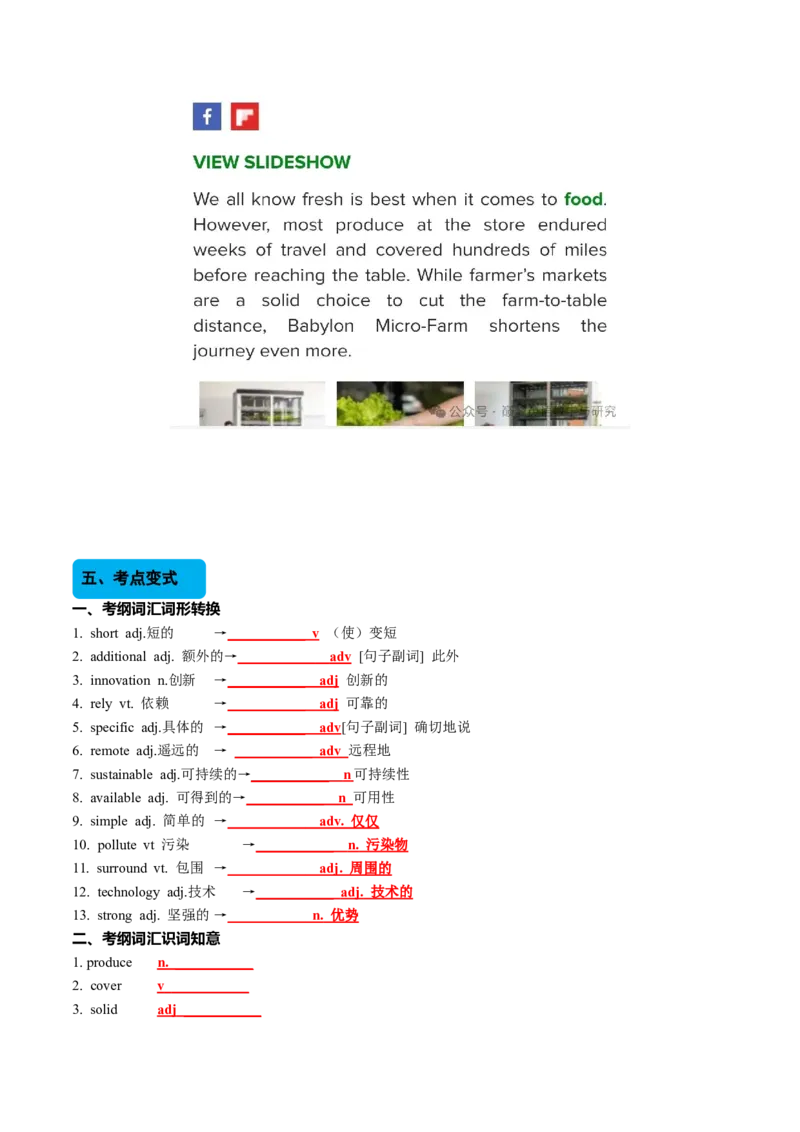
We all know fresh is best when it comes to food. However, most produce at the store went through weeks
of travel and covered hundreds of miles before reaching the table. While farmer’s markets are a solid choice to
reduce the journey, Babylon Micro-Farm (BMF) shortens it even more.
BMF is an indoor garden system. It can be set up for a family. Additionally, it could serve a larger audience
such as a hospital, restaurant or school. The innovative design requires little effort to achieve a reliable weekly
supply of fresh greens.Specifically, it’s a farm that relies on new technology. By connecting through the Cloud, BMF is remotely
monitored. Also, there is a convenient app that provides growing data in real time. Because the system is
automated, it significantly reduces the amount of water needed to grow plants. Rather than watering rows of soil,
the system provides just the right amount to each plant. After harvest, users simply replace the plants with a new
pre-seeded pod (容器) to get the next growth cycle started.
Moreover, having a system in the same building where it’s eaten means zero emissions (排放) from
transporting plants from soil to salad. In addition, there’s no need for pesticides and other chemicals that pollute
traditional farms and the surrounding environment.
BMF employees live out sustainability in their everyday lives. About half of them walk or bike to work.
Inside the office, they encourage recycling and waste reduction by limiting garbage cans and avoiding single-use
plastic. “We are passionate about reducing waste, carbon and chemicals in our environment,” said a BMF
employee.
28. What can be learned about BMF from paragraph 1?
A. It guarantees the variety of food. B. It requires day-to-day care.
C. It cuts the farm-to-table distance. D. It relies on farmer’s markets.
29. What information does the convenient app offer?
A. Real-time weather changes. B. Current condition of the plants.
C. Chemical pollutants in the soil. D. Availability of pre-seeded pods.
30. What can be concluded about BMF employees?
A. They have a great passion for sports.
B. They are devoted to community service.
C. They are fond of sharing daily experiences.
D They have a strong environmental awareness.
31. What does the text mainly talk about?
A. BMF’s major strengths. B. BMF’s general management.
C. BMF’s global influence. D. BMF’s technical standards.
二、答案解析
三、专家评价
坚持提倡五育并举,引导学生德智体美劳全面发展
高考英语命题通过选取有关体育、美育和劳动教育的语篇,引导学生坚持五育并举,实现身心健
康成长和德智体美劳全面发展。试卷阅读A篇介绍了卡洛秋季徒步节的健身徒步活动,引导学生走近
大自然,开展体育运动,文中提及多项注意事项,于潜移默化之中强调了运动安全的重要性。阅读 B
篇介绍了旧金山湾区快速交通系统(BART)为了提升乘客体验而推出的一个短篇小说打印亭项目,
引导学生在电子设备盛行的当今不要忘记还有纸质阅读这一阅读方式可供选择,也强调了利用零散时
间来进行阅读和学习的好习惯。阅读C篇讲述巴比伦微型农场通过室内自动化种植系统极大地缩短了
农产品从农场到餐桌的距离,并实现了自动化管理和零排放的环保种植。阅读D篇介绍了CatrionaCampbell的新书《AI by Design: A Plan for Living with Artificial Intelligence》,引导学
生思考人类与人工智能共存的未来,强调了全球监管人工智能研究和使用的重要性问题。这两篇难度
较大的文章都从科技发展视角引导学生思考科技如何更好地服务于人类以及人类理性使用科技的问题。
在美育方面,试题的写作第一节应用文写作任务中,设置情境为在公园上的一节美术课,引导学生回
归自然之美,到自然中寻求人类艺术创作不竭的灵感源泉。这些文本都释放了强烈的信号,引导学生
实现德智体美劳全面发展。 【中国考试·教育部教育考试
院】
四、题源网站
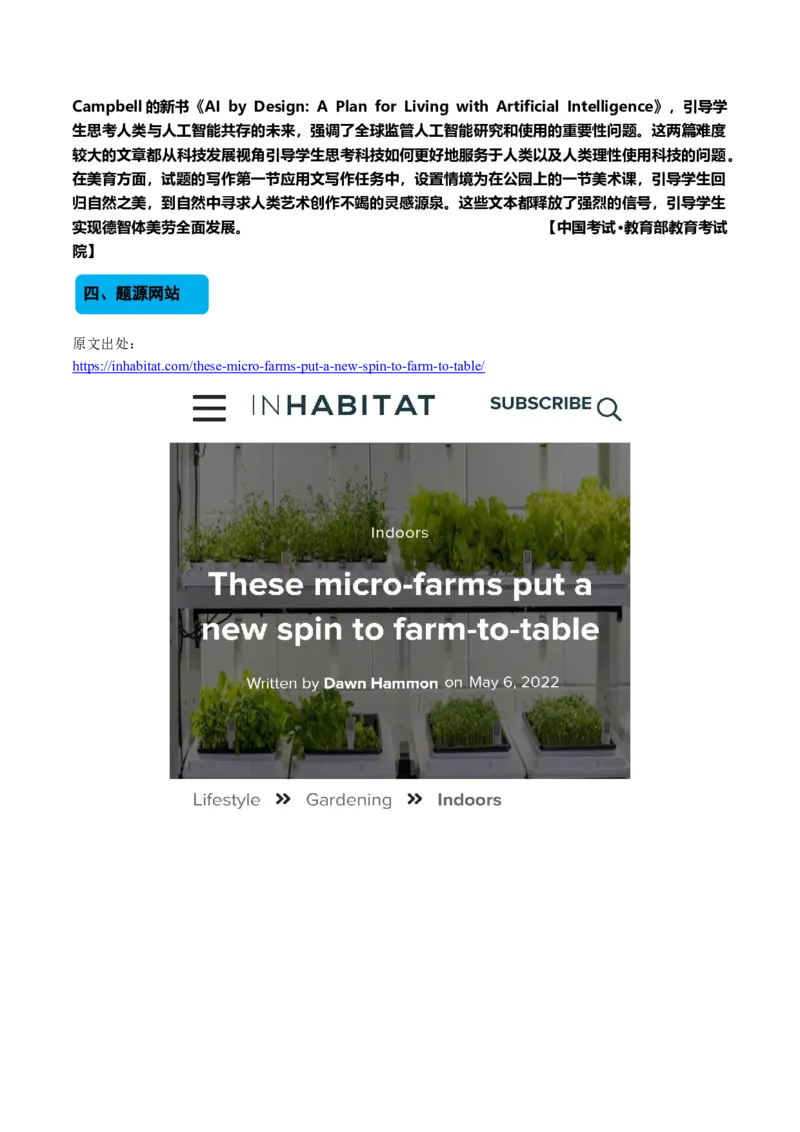
原文出处:
https://inhabitat.com/these-micro-farms-put-a-new-spin-to-farm-to-table/五、考点变式
一、考纲词汇词形转换
1. short adj.短的 → ___________ v (使)变短
2. additional adj. 额外的→ ___________ adv [句子副词] 此外
3. innovation n.创新 → ___________ adj 创新的
4. rely vt. 依赖 → ___________ adj 可靠的
5. specific adj.具体的 → ___________ adv [句子副词] 确切地说
6. remote adj.遥远的 → ___________ adv 远程地
7. sustainable adj.可持续的→ ___________ n 可持续性
8. available adj. 可得到的→ ___________ n 可用性
9. simple adj. 简单的 → ___________ adv . 仅仅
10. pollute vt 污染 → ___________ n . 污染物
11. surround vt. 包围 → ___________ adj . 周围的
12. technology adj.技术 → ___________ adj . 技术的
13. strong adj. 坚强的→ ___________ n . 优势
二、考纲词汇识词知意
1. produce n . ___________
2. cover v ___________
3. solid adj ___________4. pre-seeded adj . ___________
5. monitor v ___________
6. real-time n ___________
7. automated adj ___________
8. moreover adv ___________
9. single-use adj ___________
10. day-to-day adj . __________ _
11. guarantee vt . ___________
三、高频短语厚积薄发
1. when it comes to___________
2. go through ___________
3. zero emissions ___________
4. in addition ___________
5. There is no need for sb to do sth. ___________
6. fresh greens ___________
7. live out ___________
8. be passionate about ___________
9. be fond of ___________
10. be devoted to ___________
四、核心考点单句填空
1. We all know fresh is best when it comes __________ food.
2.__________, most produce at the store went through weeks of travel and __________(cover)
__________(hundred) of miles before reaching the table.
3. While farmer’s markets are a solid choice __________(reduce) the journey, Babylon Micro-Farm (BMF)
__________(shorten) it even more.
4. BMF is __________ indoor garden system. It can __________(set) up for a family.
5. __________(additional), it could serve a larger audience such as a hospital, restaurant or school.
6. The __________(innovation) design requires little effort to achieve a __________(rely) weekly supply of
fresh greens.
7. __________(specific), it’s a farm __________ relies on new technology.
8. By connecting through the Cloud, BMF is __________(remote) monitored.
9. Also, there is a convenient app that __________(provide) growing data in real time.
10. Because the system is automated, it __________(significant) reduces the amount of water __________(need)
to grow plants.
11. Rather than watering __________(row) of soil, the system provides just the right amount to each plant.
12. After harvest, users __________(simple) replace the plants with a new pre-seeded pod (容器) to get the next
growth cycle __________(start).
13. Moreover, having a system in the same building __________ it’s eaten means zero emissions (排放) from
transporting plants __________ soil to salad.14. In addition, there’s no need for pesticides and other chemicals __________ pollute traditional farms and the
__________(surround) environment.
15. BMF employees live out __________(sustainable) in their everyday lives. About half of them walk or bike to
work.
16. Inside the office, they encourage recycling and waste __________(reduce) by limiting garbage cans and
__________(avoid) single-use plastic.
17. “We are __________(passion) about reducing waste, carbon and chemicals in our environment,” said a BMF
__________(employ).
五、长难句分析
Moreover, having a system in the same building where it’s eaten means zero emissions from transporting plants
from soil to salad.
【翻译】
【分析】此外,在同一楼内的这一系统(从 种植到食用)意味着蔬菜从土壤到沙拉过程中的零排放。
having a system in the same building 为动名词短语作主语,where it’s eaten 引导定语从句,修饰先行词
building,means 为句子谓语。
六、全文翻译
我们都知道食物新鲜是最好的。然而,商店里的大多数产品在到达餐桌之前都要经过数周的旅行和数
百英里的运输。尽管农民市场是减少这种旅行的可靠选择,但巴比伦微型农场(BMF)进一步缩短了这个
距离。
BMF是一种室内花园系统。它可以为家庭设置。此外,它还可以为更大的受众服务,如医院、餐馆或
学校。这种创新的设计几乎不需要什么努力就能实现可靠的每周新鲜绿叶蔬菜供应。 具体来说,它是一
个依赖新技术的农场。通过云连接,BMF可以远程监控。此外,还有一个方便的应用程序,提供实时生长
数据。由于系统是自动化的,它显著减少了种植植物所需的水量。系统不是灌溉整排土壤,而是为每株植
物提供恰到好处的水量。收获后,用户只需用新的预播种容器替换植物,就可以开始下一个生长周期。
此外,在食用植物的同一建筑内拥有系统意味着从土壤到沙拉的运输过程中零排放。
此外,也不需要使用农药和其他污染传统农场及其周围环境的化学物质。
BMF的员工在日常生活中实践可持续性。大约一半的人步行或骑自行车上班。在办公室内,他们通过
限制垃圾桶数量和避免使用一次性塑料来鼓励回收和减少废物。"我们热衷于减少我们环境中的废物、碳和
化学物质,"一位BMF员工说。
六、三年真题
【2023年新课标II卷阅读理解C篇】
Reading Art: Art for Book Lovers is a celebration of an everyday object — the book, represented here in
almost three hundred artworks from museums around the world. The image of the reader appears throughout
history, in art made long before books as we now know them came into being. In artists’ representations of books
and reading, we see moments of shared humanity that go beyond culture and time.
In this “book of books,” artworks are selected and arranged in a way that emphasizes these connections
between different eras and cultures. We see scenes of children learning to read at home or at school, with the book
as a focus for relations between the generations. Adults are portrayed (描绘) alone in many settings and poses —absorbed in a volume, deep in thought or lost in a moment of leisure. These scenes may have been painted hundreds
of years ago, but they record moments we can all relate to.
Books themselves may be used symbolically in paintings to demonstrate the intellect (才智), wealth or faith of
the subject. Before the wide use of the printing press, books were treasured objects and could be works of art in
their own right. More recently, as books have become inexpensive or even throwaway, artists have used them as the
raw material for artworks — transforming covers, pages or even complete volumes into paintings and sculptures.
Continued developments in communication technologies were once believed to make the printed page
outdated. From a 21st-century point of view, the printed book is certainly ancient, but it remains as interactive as
any battery-powered e-reader. To serve its function, a book must be activated by a user: the cover opened, the pages
parted, the contents reviewed, perhaps notes written down or words underlined. And in contrast to our increasingly
networked lives where the information we consume is monitored and tracked, a printed book still offers the chance
of a wholly private, “off-line” activity.
8. Where is the text most probably taken from?
A. An introduction to a book.
B. An essay on the art of writing.
C. A guidebook to a museum.
D. A review of modern paintings.
9. What are the selected artworks about?
A. Wealth and intellect. B. Home and school.
C. Books and reading. D. Work and leisure.
10. What do the underlined words “relate to” in paragraph 2 mean?
A. Understand. B. Paint.
C. Seize. D. Transform.
11. What does the author want to say by mentioning the e-reader?
A. The printed book is not totally out of date.
B. Technology has changed the way we read.
C. Our lives in the 21st century are networked.
D. People now rarely have the patience to read.
【2022年新课标II卷阅读理解C篇】
Over the last seven years, most states have banned texting by drivers, and public service campaigns have tried
a wide range of methods to persuade people to put down their phones when they are behind the wheel.
Yet the problem, by just about any measure, appears to be getting worse. Americans are still texting while
driving, as well as using social networks and taking photos. Road accidents, which had fallen for years, are now
rising sharply.
That is partly because people are driving more, but Mark Rosekind, the chief of the National Highway Traffic
Safety Administration, said distracted(分心)driving was "only increasing, unfortunately."
"Big change requires big ideas." he said in a speech last month, referring broadly to the need to improve road
safety. So to try to change a distinctly modern behavior, lawmakers and public health experts are reaching back to
an old approach: They want to treat distracted driving like drunk driving.An idea from lawmakers in New York is to give police officers a new device called the Textalyzer. It would
work like this: An officer arriving at the scene of a crash could ask for the phones of the drivers and use the
Textalyzer to check in the operating system for recent activity. The technology could determine whether a driver
had just texted, emailed or done anything else that is not allowed under New York's hands-free driving laws.
"We need something on the books that can change people's behavior,” said Félix W. Ortiz, who pushed for the
state's 2001 ban on hand-held devices by drivers. If the Textalyzer bill becomes law, he said, "people are going to
be more afraid to put their hands on the cell phone."
28. Which of the following best describes the ban on drivers' texting in the US?
A. Ineffective. B. Unnecessary.
C. Inconsistent. D. Unfair.
29. What can the Textalyzer help a police officer find out?
A. Where a driver came from.
B. Whether a driver used their phone.
C. How fast a driver was going.
D. When a driver arrived at the scene.
30. What does the underlined word "something" in the last paragraph refer to?
A. Advice. B. Data. C. Tests. D. Laws.
31. What is a suitable title for the text?
A. To Drive or Not to Drive? Think Before You Start
B. Texting and Driving? Watch Out for the Textalyzer
C. New York Banning Hand-Held Devices by Drivers.
D. The Next Generation Cell Phone: The Textalyzer.
【2021年新课标II卷阅读理解C篇】
A British woman who won a S1 million prize after she was named the World's Best Teacher will use the cash
to bring inspirational figures into UK schools.
Andria Zafirakou, a north London secondary school teacher, said she wanted to bring about a classroom
revolution (变革). “We are going to make a change, ”she said.“I’ve started a project to promote the teaching of the
arts in our schools.”
The project results from the difficulties many schools have in getting artists of any sort - whether an up-and-
coming local musician or a major movie star - into schools to work with and inspire children.
Zafirakou began the project at Alperton Community School her place of work for the past twelve years. “I've
seen those magic moments when children are talking to someone they are inspired by - their eyes are shining and
their faces light up,” she said. “We need artists . more than ever in our schools."
Artist Michael Craig-Martin said: “Andria's brilliant project to bring artists from all fields into direct contact
with children is particularly welcome at a time when the arts are being downgraded in schools." It was a mistake to
see the arts as unnecessary, he added.
Historian Sir Simon Schama is also a supporter of the project. He said that arts education in schools was not
just an add-on. “It is absolutely necessary. The future depends on creativity and creativity depends on the young.
What will remain of us when artificial intelligence takes over will be our creativity, and it is our creative spirit, ourvisionary sense of freshness,that has been our strength for centuries."
28. What will Zafirakou do with her prize money?
A. Make a movie. B. Build new schools.
C. Run a project. D. Help local musicians.
29. What does Craig-Martin think of the teaching of the arts in UK schools?
A. It is particularly difficult. B. It increases artists' income.
C. It opens children's mind. D. It deserves greater attention.
30. What should be stressed in school education according to Schama?
A. Moral principles. B. Interpersonal skills.
C. Creative abilities. D. Positive worldviews.
31. Which of the following is a suitable title for the text?
A. Bring Artists to Schools B. When Historians Meet Artists
C. Arts Education in Britain D. The World's Best Arts Teacher
七、满分策略
阅读理解说明文满分策略
一、细读文章重点
关注文章结构;文章主题句;各段首末句;体现作者观点态度的词句。
二、明确说明对象
通读全文,明确作者是针对哪一个说明对象从不同的角度和侧面对其加以说明的。在阅读过程中要概
括、总结每一段说明的侧重点,理清各段之间的逻辑联系,加深对说明对象的理解。
三、弄清说明顺序
在说明的过程中作者会选择合理的说明顺序对说明对象进行有条不紊的解说。把握了说明顺序,就能
准确把握文章的脉络,加深对整篇文章的理解。
四、把握作者态度
说明文的首段一般借用生活中的某个场景事件引入说明的事物。一般穿插人们对被说明事物的看法和
观点,要仔细体会观点的倾向性和情感色彩,来对比作者态度和写作情感。
五、吃透长难句子
学会运用括号法分析长难句,把影响考生理解的各种从句、非谓语动词短语以及复杂介词短语括起来,
从而达到“去枝叶,留主干”的目的,进而准确理解句子含义。
六、学会适当放弃
无关大局的生僻词汇阅读中经常会遇到一些生词,如果这些生词对理解全文没有影响或影响不大就可
略过。较长的人名、地名有许多较长的表示人名、地名等的专有名词,阅读时可一扫而过或干脆用其首字
母代替,不必试图把整个专有名词读出来。
说明文阅读试题的特点有哪些?
1.话题较陌生。
这些文章从专业的角度解释说明一个现象或一项研究结果,和考生的实际生活有一定的距离。
2.专业术语多。
高考说明文含有一定量的专业术语。2019 年北京高考卷 D 篇就包含多个专业术语:marine
microorganism , concentration , give off oxygen , nutrients , make conditions riper , food chain ,phytoplankton,carbon dioxide,regulate,climate model,food web,statistically。这些和生物、环境等相关
的词汇,如海底微生物、浓度、释放氧气、营养物质、食物链等,都是日常生活交流中不常涉及的。
3.长难句子多。
因为文章直接取材于期刊文章或者研究报告,所以说明文的另外一个特点是长难句子多。如2017年北
京高考卷C篇的句子:This is called “herd immunity”, which protects the people who get hurt easily, including
those who can’t be vaccinated for medical reasons, babies too young to get vaccinated and people on whom the
vaccine doesn’t work. 这句话主干是一个简短的主系表结构,但后边附加了which引导的非限定性定语从句,
而这个从句中又包含一个who引导的限定性定语从句,后面的介词短语中也包含了who引导的限定性定语
从句。在有限的考试时间内,复杂的句子结构给考生准确理解句意带来了困难。
4.词汇有新义。
每一篇说明文中都会包含一些考生熟悉的词汇,但在新的语境中它们变换了含义。2019年北京高考卷
有句话中包含一个简单的词语 project:Stephanie Dutkiewicz, a scientist in MIT’s Center for Global Change
Science, built a climate model that projects changes to the oceans throughout the century. project 被大家熟知的意
思是“项目”,但在这句话中变成了动词,表示“预测,推想”。如果考生对project的理解还停留在“项
目”上,就不能很好地理解句意了。
阅读理解说明文答题策略
1.把握介绍或阐述的主体。
通过文章第一段迅速找出说明文介绍或阐述的事物。英语文章,尤其是说明文和议论文,最大的特点
就是开门见山,作者会在文章开篇就把要介绍的事物或表达的观点铺平直叙出来。
2. 关注每一段的段首句。
关注每一段的段首句,确认段落的主旨大意。就像文章的开篇段落告诉读者文章的主旨大意一样,第
一段落的第一句话通常也起到同样的作用。
3.关注每一段的段尾句。
前两项策略已经被大多数考生广泛应用在阅读中。但除了关注篇首段落和段首句子之外,也不能忽视
段尾句。一个段落由三个部分组成:topic sentence(主旨句),supporting details (支撑细节),和
concluding sentence(总结句)。在段落结尾,作者会用不同的表达方式重申主旨句,但从篇章整体来看,
在每个段落结尾出现的句子还起到承上启下的作用,作者会借助这个句子引出下文。
4.关注文章中出现的问题。
说明文的本质是对一个事物进行阐述,但在平铺直叙的语言中,还会有问句出现。这些问句不仅仅是
简单的疑问句,而是作者有意为之,答案就出现在后文。
阅读说明文体裁的文章时应首先抓住下面的重要信息:
A. 说明的对象
B. 说明对象的特征
C. 说明的方法(例证法;定义法;分类法;因果关系法;比较对照法;过程分析法)
①例证法
这是用具体例子来说明人或事物的特征、本质及其规律的方法,所用例子必须有代表性、典型性,能体
现人或事物的本质特征。这是用特殊来说明一般的方法。通常在主题句后,用 For example 或 For instance
等短语引导出具体的例子。②定义法
下定义就是给说明对象一个明确概念。这是科学而严密的说明方法。它既能揭示事物的本质特征,勾勒
其大概,描绘其轮廓,同时也能确定事物的范围和界限。下定义是多方面的,可以给人、事物、思想等下定义。
③分类法:
分类法是对同属不同类或同类而不同种的人或事物,根据不同性质进行分门别类地说明的方法。分类是
人类认识客观世界的重要手段之一。分类必须遵守分类规则,使分类对象具有统一属性,依据同一分类标准,
并使分类的子项相互排斥,不互相包蕴。
④因果关系法
事物变化的原因和结果是紧密相关的。如果某个现象的存在必然引起另一个现象的发生,那么,这两个
现象之间就具有因果关系。因果关系包括由果推因(由结果去推测原因)和由因推果(由原因去推测结果)两种
情况。因果关系符合人们的日常思维逻辑,因而在写作中得到广泛应用,常用 because, as, since, so, now
that, if...then, the reason is that...等表示因果关系。
⑤比较对照法:
有意识地把两种相反、相对的事物或同一事物相反、相对的两个方面放在一起,用比较的方法加以描述
或说明,指出其相同点,这种写法叫做比较;指出其不同点,叫做对照。比较和对照各有不同的侧重,但两种方法
经常结合使用。
⑥过程分析法
过程分析法就是把事物发展过程分为若干步骤,然后逐一加以分析说明。这种写法在说明文中使用得相
当广泛。过程分析与叙事和因果关系等写法有密切关系,但彼此又有明显区别:叙事研究的对象是What
happens;因果关系研究的对象是Why it happens,而过程分析研究的对象是How it happens。
八、话题变式
变式一:高考阅读理解健康食品话题真题
(2023·全国·高考真题)
A growing body of research suggests that the gut microbiome (消化道菌群) could play a major role in a rising
chronic disease that makes us physically weaker. The illness, which is commonly called chronic fatigue syndrome
(CFS), is characterized by intense fatigue, gastrointestinal (胃肠道的) issues, muscle pain, and cognitive challenges
such as headaches and difficulty concentrating, among other symptoms. It often follows a viral infection which can
lead to a “disruption” in a balanced gut ecosystem. Actually, an increasing number of Americans have been the
sufferers since the outbreak of COVID-19.
Two recent studies published in Cell Host &Microbe point to changes in the microbiome as a possible
cause of CFS. Research groups at Columbia University and the Jackson Laboratory performed detailed analyses of
the microbes in stool (粪便) samples from patients with CFS and compared them to healthy controls.
The two groups found similar bacteria species were less present in CFS patients compared to control patients.
They focused on bacteria that produce butyrate, a fatty acid involved in regulating metabolism and the immune
system. “Butyrate plays several roles in directing the body’s response to infections, while also protecting the barrier
between the intestine (肠) and the circulatory system, regulating genetic changes in cells, and more,” says Brent
Williams, lead author on the Columbia study. Williams and his colleagues extensively analyzed the role of butyratein CFS patients’ guts, even identifying a correlation between low levels of bacteria that produce this acid and more
severe symptoms.
Parallel findings from the Jackson Laboratory team suggest the bacteria that produce butyrate could be used to
diagnose CFS. Previous research has identified microbiome issues in CFS patients, but the new findings help
clarify which microbes could be related to the illness.
More research on butyrate-producing bacteria and other species identified in the studies is necessary to
investigate these potential biomarkers of CFS, the authors say. If the findings are replicated, specific gut bacteria
could be used to diagnose the illness, which is currently identified based on symptoms alone.
The findings additionally point toward possible treatments, such as probiotics or microbiome-focused diet
adjustments—though patients who have been sick for long periods may require drugs that alleviate the damage
done to their metabolism or immune system.
1. What do we know about CFS?
A. It is caused by COVID-19 only.
B. It is an illness with systemic symptoms.
C. It breaks the balance of the gut ecosystem.
D. The number of the infected is on the decrease.
2. How did the researcher carry out the recent studies?
A. By controlling data. B. By identifying genes.
C. By analyzing samples. D. By comparing symptoms.
3. Which of the following is NOT the significance of the recent researches?
A. Butyrate’s multiple functions are promoted.
B. Targeted gut microbes may be used to diagnose CFS.
C. Certain microbes responsible for CFS are narrowed down.
D. Probiotics supplement with drugs can be a treatment for CFS.
4. What is the text mainly about?
A. Gut microbiome may be the key to CFS.
B. Microbes help digest food and aid absorption.
C. Man’s gut is a rich, diverse tropical rainforest.
D. New method for diagnosing CFS are provided.
(2023·全国·高考真题)
On the day he almost died, Kimbal Musk had food on the brain. The Internet startup talent and restaurateur
had just arrived in Jackson Hole from a conference where chef Jamie Oliver had spoken about the benefits of
healthy eating. This was something Musk thought about a lot- how he might make a difference to the food industry
—but beyond expanding his farm-to-table movement along with his restaurant, Musk hadn’t yet broken the code.
Then he went sailing down a snowy slope (坡) and fell over, breaking his neck. The left side of his body was
paralyzed.
Musk eventually made a full recovery, but it involved spending two months on his back, which gave him
plenty of time to come up with a plan. Since then, he has launched an initiative to put “learning gardens” in public
schools across America; attracted Generation Z to the farming profession by changing shipping containers intohigh-tech, data-driven, year-round farms; and this year, is kicking off a new campaign to create one million at-home
gardens.
Aimed at reaching low- income families, the Million Gardens Movement was inspired by the pandemic, as
both a desire to feel more connected to nature and food insecurity have been at the forefront of so many people’s
lives. “We were getting a lot of inquiries about gardening from people that had never gardened before,” says Musk.
“People were looking to garden for a bunch of reasons: to supplement their budget, to improve the nutritional
quality of their diets, or just to cure the boredom that came with the lockdown.”
The program offers free garden kits that can be grown indoors or outdoors, and will be distributed through
schools that Musk's non-profit, Big Green, has already partnered with. It also offers free courses on how to get the
garden growing and fresh seeds and materials for the changing growing seasons. “I grew up in the projects when I
was young, in what we now call food deserts,” says EVE, one of the many celebrities who have teamed up with the
organization to encourage people to pick up a free garden. “What I love about this is that it's not difficult. We are all
able to grow something.”
5. What inspired Musk to be devoted to food industry?
A. An accident. B. Jamie Oliver’s speech.
C. The pandemic. D. The farm-to-table movement.
6. What can we learn about the Million Gardens Movement?
A. It has mainly attracted young generations.
B. It has just accomplished its target.
C. It may be stimulated by a lack of food security.
D. It increases economic burdens for the poor.
7. Which of the following best describes Musk?
A. Charitable. B. Honest. C. Flexible. D. Strict.
8. Why is EVE taken as an example?
A. To demonstrate the program to be non-profit.
B. To share his experience in a food desert.
C. To encourage people to start a free garden.
D. To clarify the reason why he loves a garden.
(2023·全国·高考真题)
Turning soil, pulling weeds, and harvesting cabbage sound like tough work for middle and high school kids.
And at first it is, says Abby Jaramillo, who with another teacher started Urban Sprouts, a school garden program at
four low-income schools. The program aims to help students develop science skills, environmental awareness, and
healthy lifestyles.
Jaramillo’s students live in neighborhoods where fresh food and green space are not easy to find and fast
food restaurants outnumber grocery stores. “The kids literally come to school with bags of snacks and large bottles
of soft drinks,” she says. “They come to us thinking vegetables are awful, dirt is awful, insects are awful.” Though
some are initially scared of the insects and turned off by the dirt, most are eager to try something new.
Urban Sprouts’ classes, at two middle schools and two high schools, include hands-on experiments such as
soil testing, flower-and-seed dissection, tastings of fresh or dried produce, and work in the garden. Several times ayear, students cook the vegetables they grow, and they occasionally make salads for their entire schools.
Program evaluations show that kids eat more vegetables as a result of the classes. “We have students who say
they went home and talked to their parents and now they’re eating differently,” Jaramillo says.
She adds that the program’s benefits go beyond nutrition. Some students get so interested in gardening that
they bring home seeds to start their own vegetable gardens. Besides, working in the garden seems to have a calming
effect on Jaramillo’s special education students, many of whom have emotional control issues. “They get outside,”
she says, “and they feel successful.”
9. What do we know about Abby Jaramillo?
A. She used to be a health worker. B. She grew up in a low-income family.
C. She owns a fast food restaurant. D. She is an initiator of Urban Sprouts.
10. What was a problem facing Jaramillo at the start of the program?
A. The kids’ parents distrusted her. B. Students had little time for her classes.
C. Some kids disliked garden work. D. There was no space for school gardens.
11. Which of the following best describes the impact of the program?
A. Far-reaching. B. Predictable.
C. Short-lived. D. Unidentifiable.
12. What can be a suitable title for the text?
A. Rescuing School Gardens B. Experiencing Country Life
C. Growing Vegetable Lovers D. Changing Local Landscape
04(2023·全国·高考真题)
What comes into your mind when you think of British food? Probably fish and chips, or a Sunday dinner of
meat and two vegetables. But is British food really so uninteresting? Even though Britain has a reputation for less-
than-impressive cuisine, it is producing more top class chefs who appear frequently on our television screens and
whose recipe books frequently top the best seller lists.
It’s thanks to these TV chefs rather than any advertising campaign that Britons are turning away from meat-
and-two-veg and ready-made meals and becoming more adventurous in their cooking habits. It is recently reported
that the number of those sticking to a traditional diet is slowly declining and around half of Britain’s consumers
would like to change or improve their cooking in some way. There has been a rise in the number of students
applying for food courses at UK universities and colleges. It seems that TV programmes have helped change what
people think about cooking.
According to a new study from market analysts, 1 in 5 Britons say that watching cookery programmes on TV
has encouraged them to try different food. Almost one third say they now use a wider variety of ingredients (配料)
than they used to, and just under 1 in 4 say they now buy better quality ingredients than before. One in four adults
say that TV chefs have made them much more confident about expanding their cookery knowledge and skills, and
young people are also getting more interested in cooking. The UK’s obsession (痴迷) with food is reflected through
television scheduling. Cookery shows and documentaries about food are broadcast more often than before. With an
increasing number of male chefs on TV, it’s no longer “uncool” for boys to like cooking.
13. What do people usually think of British food?
A. It is simple and plain. B. It is rich in nutrition.C. It lacks authentic tastes. D. It deserves a high reputation.
14. Which best describes cookery programme on British TV?
A. Authoritative. B. Creative. C. Profitable. D. Influential.
15. Which is the percentage of the people using more diverse ingredients now?
A. 20%. B. 24%. C. 25%. D. 33%.
16. What might the author continue talking about?
A. The art of cooking in other countries. B. Male chefs on TV programmes.
C. Table manners in the UK. D. Studies of big eaters.
05(2022·全国·高考真题)
Like most of us, I try to be mindful of food that goes to waste. The arugula (芝麻菜)was to make a nice green
salad, rounding out a roast chicken dinner. But I ended up working late. Then friends called with a dinner
invitation. I stuck the chicken in the freezer. But as days passed, the arugula went bad. Even worse, I had
unthinkingly bought way too much; I could have made six salads with what I threw out.
In a world where nearly 800 million people a year go hungry, “food waste goes against the moral grain,” as
Elizabeth Royte writes in this month’s cover story. It’s jaw-dropping how much perfectly good food is thrown away
— from “ugly” (but quite eatable) vegetables rejected by grocers to large amounts of uneaten dishes thrown into
restaurant garbage cans.
Producing food that no one eats wastes the water, fuel, and other resources used to grow it. That makes food
waste an environmental problem. In fact, Royte writes, “if food waste were a country, it would be the third largest
producer of greenhouse gases in the world.”
If that’s hard to understand, let’s keep it as simple as the arugula at the back of my refrigerator. Mike Curtin
sees my arugula story all the time — but for him, it's more like 12 bones of donated strawberries nearing their last
days. Curtin is CEO of DC Central Kitchen in Washington, D. C. , which recovers food and turns it into healthy
meals. Last year it recovered more than 807,500 pounds of food by taking donations and collecting blemished (有
瑕疵的) produce that otherwise would have rotted in fields. And the strawberries? Volunteers will wash, cut, and
freeze or dry them for use in meals down the road.
Such methods seem obvious, yet so often we just don’t think. “Everyone can play a part in reducing waste,
whether by not purchasing more food than necessary in your weekly shopping or by asking restaurants to not
include the side dish you won’t eat,” Curtin says.
17. What does the author want to show by telling the arugula story?
A. We pay little attention to food waste. B. We waste food unintentionally at times.
C. We waste more vegetables than meat. D. We have good reasons for wasting food.
18. What is a consequence of food waste according to the test?
A. Moral decline. B. Environmental harm.
C. Energy shortage. D. Worldwide starvation.
19. What does Curtin’s company do?
A. It produces kitchen equipment. B. It turns rotten arugula into clean fuel.
C. It helps local farmers grow fruits. D. It makes meals out of unwanted food.
20. What does Curtin suggest people do?A. Buy only what is needed. B. Reduce food consumption.
C. Go shopping once a week. D. Eat in restaurants less often.
06(2020·全国·高考真题)
According to a recent study in the Journal of Consumer Research, both the size and consumption habits of
our eating companions can influence our food intake. And contrary to existing research that says you should avoid
eating with heavier people who order large portions(份), it's the beanpoles with big appetites you really need to
avoid.
To test the effect of social influence on eating habits, the researchers conducted two experiments. In the first,
95 undergraduate women were individually invited into a lab to ostensibly(表面上)participate in a study about
movie viewership. Before the film began, each woman was asked to help herself to a snack. An actor hired by the
researchers grabbed her food first. In her natural state, the actor weighed 105 pounds. But in half the cases she wore
a specially designed fat suit which increased her weight to 180 pounds.
Both the fat and thin versions of the actor took a large amount of food. The participants followed suit, taking
more food than they normally would have. However, they took significantly more when the actor was thin.
For the second test, in one case the thin actor took two pieces of candy from the snack bowls. In the other
case, she took 30 pieces. The results were similar to the first test: the participants followed suit but took
significantly more candy when the thin actor took 30 pieces.
The tests show that the social environment is extremely influential when we're making decisions. If this
fellow participant is going to eat more, so will I. Call it the “I’ll have what she's having” effect. However, we'll
adjust the influence. If an overweight person is having a large portion, I'll hold back a bit because I see the results
of his eating habits. But if a thin person eats a lot, I'll follow suit. If he can eat much and keep slim, why can't I?
21. What is the recent study mainly about?
A. Food safety. B. Movie viewership.
C. Consumer demand. D. Eating behavior.
22. What does the underlined word “beanpoles” in paragraph 1 refer to?
A. Big eaters. B. Overweight persons.
C. Picky eaters. D. Tall thin persons.
23. Why did the researchers hire the actor?
A. To see how she would affect the participants.
B. To test if the participants could recognize her.
C. To find out what she would do in the two tests.
D. To study why she could keep her weight down.
24. On what basis do we “adjust the influence” according to the last paragraph?
A. How hungry we are.
B. How slim we want to be.
C. How we perceive others.
D. How we feel about the food.
变式二:环保种植有机食品话题名校好题
01(2024·重庆·三模)Urban agriculture, the practice of farming within the limits of a city, is becoming increasingly popular
worldwide and is considered a way to make cities and urban food systems more sustainable. Despite strong
evidence of the social and nutritional benefits of urban agriculture, its carbon footprint remains understudied.
Most previously published studies have focused on high-tech, energy-intensive forms of urban agriculture —
such as vertical (垂直的) farms and rooftop greenhouses. The new study aimed to fill some of the knowledge gaps
by comparing the carbon footprints of food produced at low-tech urban agriculture sites to conventional crops.
The researchers calculated the greenhouse gas emissions (排放) associated with on-farm materials and
activities over the lifetime of the farm. The emissions, expressed in kilograms of carbon dioxide equivalents per
serving of food, were then compared to foods raised by conventional methods.
Farmers and gardeners at urban agriculture sites across the world were employed to use daily diary entries to
take down inputs—the materials used to construct farms and cultivate crops—and harvests from their food-growing
sites throughout the 2019 season.
“By assessing actual inputs and outputs on urban agriculture sites, we were able to determine climate change
impacts to each serving of produce,” says study co-lead author Benjamin Goldstein, assistant professor in the
School for Environment and Sustainability. On average, food produced through urban agriculture released 0.42
kilograms of carbon dioxide equivalents per serving, six times higher than the 0.07 kg CO e per serving of
2
conventionally grow n produce.
It’s also found that most of the climate impacts at urban farms are driven by the infrastructure (基础设施),
such as the raised beds in which food is grown, or pathways between plots. “These farms typically only operate for
a few years, so the greenhouse gases used to produce those materials are not used effectively. Conventional
agriculture, instead, is very efficient and hard to compete with”, Goldstein says. For example, conventional farms
often grow a single crop with the help of pesticides and fertilizers, resulting in larger harvests and a reduced carbon
footprint when compared to urban farms, he says.
1. What is a benefit of urban agriculture?
A. Sustainable food supply. B. High food output.
C. Effective energy conservation. D. Low carbon footprint.
2. How is the research data collected?
A. By accessing online database. B. By examining previous studies.
C. By conducting personal interviews. D. By recording information every day.
3. What could be done to reduce carbon footprint according to Goldstein?
A. Increase varieties of crops. B. Extend infrastructure lifetimes.
C. Promote rooftop greenhouses. D. Use modern agriculture facilities.
4. What is the passage mainly about?
A. The benefits of traditional crops.
B. The popularity of urban agriculture.
C. The strategies to fight global warming.
D. The carbon footprint of urban farm produce.
02(2024·江西·二模)
As home gardeners in the US page through seed catalogs (目录册) and pick out their favorite plants this week,there’s a new seed that has never been available to them before: a purple tomato. It is the first genetically
engineered food crop to be directly marketed to home gardeners and the seeds went on sale Saturday.
The lending scientist behind the tomato is Cathie Martin. About 20 years ago, she set out to create a
transgenic (转基因的) tomato, using DNA from a purple snapdragon, which is an unrelated eatable flower. Her
goal was to develop a tomato with high levels of anthocyanins, chemicals that give blueberries, blackberries,
eggplant and purple cabbage their color. Research has shown that anthocyanins also have anti-cancer and anti-aging
effects.
“It’s normal for tomatoes to make these healthy chemicals. But they typically don’t make them very much in
the fruit,” Martin told reporters in an interview. “They normally appear in the leaves and stems.”
So she started with, separating the DNA in the snapdragon flower that turns on and off the purple color.
Next, she used a basic technique that was figured out by scientists in the 1980s to introduce it into a certain bacteria
so that the tomato could then take in the foreign genetic material and express this new gene.
The result? In a paper published in Nature, Martin found that the purple tomato had, per weight, as much
anthocyanin as a blueberry or eggplant, and that the mice who ate a diet mixed with purple tomatoes lived 30%
longer than those who didn’t.
“Americans eat more tomatoes annually, so it makes the nutritional benefits more accessible,” Martin said.
Of course, some people have raised health concerns about eating genetically engineered foods. But these
foods were introduced three decades ago and studies have not shown any harm.
“The purple potato is another great example of how the outcomes and applications of such biotechnologies
can improve our life,” Martin said.
5. What can be inferred from the second paragraph?
A. Tomatoes usually do not produce anthocyanins.
B. The wild purple snapdragon might be poisonous.
C. Many purple fruits may postpone the aging process.
D. The purple tomato was widely available 20 years ago.
6. What can we know about the technique used to produce the purple tomato?
A. It is a relatively old method. B. It was invented by Cathie Martin.
C. It puts the DNA directly into the potato. D. It was used to separate the DNA in the flower.
7. What does Cathie Martin think of the genetically engineered foods?
A. Unprofitable. B. Safe. C. Expensive. D. Unreliable.
8. From which is the text probably taken?
A. An advertisement. B. A handbook. C. A short story. D. A science report.
03(23-24高三下·四川内江·阶段练习)
It’s breathtaking to watch the delicate spring wildflowers come out from their blanket of leaves, bloom,
develop and disperse (传播) fruit, all in a matter of a few short days or weeks.
Although they look fragile, these are tough little plants, each focusing its efforts on spreading its species.
They have evolved to have a wide range of flower structures and colors, some with fragrances, attracting many
different insect species to assist them in pollination (授粉).
There is one strategy that a surprising number of spring blooming native plants have evolved in common:seed dispersal by ants. As many as thirty percent of the spring flowering plant species in the forests of eastern North
America have evolved to take advantage of this situation to benefit themselves. These species have evolved to
provide food attached to their seeds to encourage ants to disperse those seeds. This food, called an elaiosome (油质
体), is a specialized fat body whose chemical composition more closely matches that of the insects that ants prefer
than it does that of a seed.
When a fruit opens to disperse its seeds, the elaiosomes are an instant attraction for ants. They take the seed
with its attached elaiosome back to their nests for consumption there, but they just eat the elaiosome, their preferred
food, and dispose of the seed on their trash pile. This tends to be an environment that is rich in nutrients, and will
benefit the growth of the new plant. Just to make sure the ants don’t eat the seeds in addition to the elaiosome, some
plant species have hard seed coatings that ants can’t really bite through.
This evolutionary adaptation is somewhat similar to the strategy of plants that have evolved to surround their
seeds with fleshy fruits to attract birds to assist them with seed dispersal. Given the fact that there are fewer birds
available in early spring to help with seed dispersal, it makes sense that the early blooming plants evolved to
partner instead with the ants for this service.
Did you ever wonder how your Spring Beauty managed to pop up in new locations in your lawn or garden?
Thank an ant!
9. What’s the ultimate purpose of the evolution of wildflowers according to the text?
A. To attract insects. B. To progress blooming.
C. To produce elaiosome. D. To spread their species.
10. What can be inferred about elaiosome?
A. It’s hard to digest. B. It’s impossible for ants to resist.
C. It makes the earth rich in nutrients. D. It’s often thrown into the trash pile.
11. Why do the early wildflowers prefer ants to birds to disperse according to the text?
A. Ants are creative and hardworking.
B. Ants are better at dispersing than birds.
C. The birds in the early spring are not enough.
D. The birds are not interested in their fleshy fruits.
12. What can the best title of the text?
A. Thank Ants for Wildflowers
B. Wildflowers Discover Their Treasures
C. New Species of Wildflowers are Found
D. Ants Are Superheroes Protecting Environment
04(2024·黑龙江哈尔滨·模拟预测)
Unknown to most of us laymen (门外汉), there is quite a lot of interest in developing edible tags for our food.
These could perform the same role as today’s food labels but would also form a tasty snack after use — which
would also do away with the information contained on the label.
Now, Japanese researchers have developed an approach to produce one such kind of unobtrusive (不阻塞的),
edible tag, which can be safely embedded (嵌入) inside edible products. So far, the team has been experimenting
with tags that are baked into cookies. Known as “interiQR”, such tags can be read using a device without alteringthe food or its packaging and don’t have any impact on the taste of the product.
One enormous drawback of our labels as they are today is that, cumulatively (渐增地), they lead to mounds
and mounds of extra material used for packaging—which translates to increased waste and pollution. Using a QR
cookie as a tag would help cut down on packaging waste while not altering the items in any way.
The information is contained in 3D-printed “infills”, around which the cookies are baked. Such a “label”
would also allow producers, retailers, or customers to read the information using a QR code reader or a backlight at
any point in a product’s life.
“Our 3D printing method is a great example of the digital transformation of foods, which we hope will
improve food traceability and safety,” says senior author of the study, Kosuke Sato. “This technology can also be
used to provide novel food experiences through augmented (提高的) reality, which is an exciting new field in the
food industry.”
The team is confident that their cookie tags could prove to be a great help in reducing packaging waste
worldwide once they’re adopted on a wide scale. Needless to say, suddenly having a cookie available to munch on
with every purchase is incentive (刺激) enough to adopt the use of these interiQR cookies.
13. What can be inferred about the edible tag after it is read?
A. It must be removed from the snack. B. It’ll damage the packaging of the snack.
C. It’ll become part of the snack. D. It’ll update the information on the snack.
14. How does the writer explain the advantage of the edible tag in Para.3?
A. By giving examples. B. By describing the process.
C. By giving definitions. D. By making a comparison.
15. What can we learn about the 3D printing method according to Kosuke Sato?
A. It sets a good example of tasty food.
B. It is expected to be used to locate food sources.
C. It enables customers to read a novel while eating.
D. It makes information accessible to customers anytime.
16. Which can be the best title for the passage?
A. Novel Food Experiences from QR Cookie
B. Future Food Label in a QR Cookie
C. 3D Printing and Environment
D. Edible Tags Making Cookies Tastier
05(2024·湖南怀化·二模)
In recent years, there has been a growing focus on the environment and human health. Though chemical
farming is used by over 90 per cent of the world’s farmers, the wide range of damage it has caused to the
environment and human health makes it a bad choice. Organic farming, on the other hand, aims to improve food
quality, reduce farming’s environmental impact and promote consumers’ health. It is therefore the option that
farmers may choose.
Organic food is very popular. It is also expensive. Some organic food costs twice as much as non-organic
food, but new parents and pet owners are willing to pay up to 200% more for organic food. However, there are
people who think it is a waste of money.There is one main difference between organic and non-organic food. Organic farms do not use agricultural
chemicals, such as pesticides. In many countries organic foods have special labels. These guarantee that the
products are natural.
Some people think organic means locally grown. Originally this was true. Over time organic farming became
more difficult. The demand for organic food grew larger than the supply. Small companies had to sell out to large
companies. There weren’t enough organic ingredients, such as grain and cattle. This made it difficult for many
organic companies to stay in business. Today, many large-companies have an organic line of products.
Is organic food more nutritious? This is part of the debate. Many farmers and consumers believe it is. They
think agricultural chemicals cause health problems, such as cancer. Many health professionals disagree. Few studies
prove that organic foods prevent health problems. Health specialists worry more about bacteria, such as E. coli and
salmonella. These can get into contact with organic and non-organic food. Doctors recommend washing produce
very carefully. Handling meat carefully is important too.
Most people agree that naturally grown food tastes better. Is tastier food worth the extra money? This is a
matter of opinion. Whether it is healthier or not may require more research. However, organic consumers argue it is
better to be safe than sorry.
17. What phenomenon does the author describe at the beginning of the passage?
A. Chemical farming is a wise choice now.
B. The environment and human health draw no attention.
C. Organic farming has taken the place of Chemical farming.
D. The positive effects of organic farming contribute to farmers’ favor.
18. What can we know from the passage?
A. Some organic food costs much more than non-organic food.
B. Organic farms consume quantities of agricultural chemicals.
C. It’s never hard for all organic companies to stay in business.
D. Health specialists pay no attention to E. coli and salmonella.
19. How does the author mainly develop Paragraph 5?
A. By following time order. B. By providing some examples.
C. By showing cause and effect. D. By comparing opinions.
20. What is consumers’ major concern about the organic food?
A. Price. B. Safety. C. Freshness. D. Nutrition.
06(2024·山东菏泽·二模)
Several times a month, you can find Doctor Daniel Nadeau in the Ralph’s market in Huntington Beach,
California, wearing a white coat and helping people learn about food. He notices the pre-made macaroni (通心粉)
and cheese boxes in am other’s shopping cart and suggests she switch to wholegrain macaroni and real cheese.
Nadeau says sugar and processed foods are big contributors to the rising diabetes (糖尿病) rates among
children. “In America, over 50 percent of our food is processed food,” Nadeau tells her. “And only 5 percent of our
food is plant-based food. I think we should try to reverse that.” This mother agrees to try more fruit juices for the
kids and to make real macaroni and cheese. Score one point for the doctor, zero for diabetes.
Research findings increasingly show the power of food to treat or reverse diseases, but that does not meanthat diet alone is always the solution, or that every illness can benefit substantially from dietary changes.
Nevertheless, physicians say that they look at the collective data and a clear picture emerges: that the salt, sugar, fat
and processed foods in the American diet contribute to the nation’s high rates of obesity, diabetes and heart disease.
By prescribing (开处方) nutritional changes or launching programs such as “Shop with your Doc”, they are
trying to prevent, limit or even reverse disease by changing what patients eat. The program will offer patients
several bags of food prescribed for their condition, along with intensive training in how to cook it. They believe
teaching people about which foods are healthy and how to prepare them can actually transform a patient’s life. And
beyond that, it might transform the health and lives of that patient’s family.
21. Why does Doctor Nadeau advise buying wholegrain macaroni and real cheese?
A. They’re easy to make. B. They’re plant-based.
C. They’re delicious to eat. D. They’re processed food.
22. What does the underlined word “reverse” in paragraph 2 mean?
A. Try out. B. Pick up. C. Take in. D. Turn around.
23. What is the author’s attitude toward the power of food?
A. Neutral. B. Dismissive. C. Doubtful. D. Positive.
24. What is the text mainly about?
A. A good cure for diabetes.
B. A new attempt on cooking.
C. A food-as-medicine program.
D. A simple tip on doing shopping.
07(2024·四川遂宁·三模)
In recent years, labels have increasingly been used by the food industry. Whether “non-GMO (转基因)” or
“zero trans fat” ,“no added hormones” or “sugar-free”, consumers are demanding more information about what’s in
their food.
A report by Nielsen found that 39 percent of consumers would switch from the brands they currently buy to
others that provide clearer, more accurate product information. Food manufacturers are using the new labels to
meet consumers’ demand, with an eye towards giving their products a leg up over the competition, and their bottom
lines a boost as well.
On its face, the new marketing strategy makes sense. But these so-called “absence claims” labels are harmful
both to the consumers who purchase the products and the industry that supplies them. For example, Hunt’s put a
“non-GMO” label on its tomatoes a few years ago — despite the fact that, at the time, there was no such thing as a
GMO tomato on the market. Over the long term, this strategy will have the opposite effect: by creating fear, we run
the risk of damaging consumers' trust.
Eventually, it becomes a question in consumers' minds: Should I have ever been eating these foods in the
first place? By purchasing and consuming these types of products, have I already done some kind of harm to me?
For food manufacturers, it will damage consumers’ trust, which in turn would lower sales for the whole food
industry. And this isn’t just supposition. A recent study by a group of academics at the University of Delaware
found that “absence claims” labels can stigmatize (污名化) food produced with conventional processes even when
there is no scientific evidence that they cause harm.In addition to the likely negative long-term impact on sales, it sends a message that innovations in farming
and food processing are unwelcome, eventually leading to less efficiency, fewer choices for consumers, and,
ultimately, more costly food products. Therefore, it’s clear that food manufacturers must be careful when using
“absence claims” as a marketing strategy. If we allow this kind of label fear-mongering to continue, the losers will
be all of us.
25. What is food manufacturers’ new marketing strategy?
A. Handing out free samples for consumers to taste.
B. Using creative wrappers to catch customers’ eyes.
C. Attracting consumers by labelling “absence claims”.
D. Offering more detailed goods information to customers.
26. What does the author intend to indicate by mentioning Hunt’s?
A. The Hunt’s takes a lead in the food-marketing strategy.
B. Products without “non-GMO” labels are usually unhealthy.
C. Consumers tend to purchase products with “absence claims” labels.
D. The “absence claims” labels will have negative effects on consumers.
27. What impact does the new marketing strategy have on food manufacturers?
A. It will increase the cost of food processing.
B. It will help remove the stigma of their brand.
C. It will cut down the sales of their food products.
D. It will damage the trust of their cooperative partners.
28. What does the author advise food manufacturers to do?
A. Increase food choices for consumers.
B. Use “absence claims” labels cautiously.
C. Improve the efficiency of food production.
D. Innovate the processing methods of food products.
08(2024·福建漳州·模拟预测)
It is very likely that you eat three meals a day. Modern life is designed around this way of eating. However, is
this the healthiest way to eat? Before considering how frequently we should eat, scientists urge us to consider when
we shouldn’t.
Intermittent fasting (间歇性断食), where you restrict your food intake to an eight-hour window, has become
a popular area of research. “It allows our digestive system to rest,” says Emily Manoogian at the Salk Institute for
Biological Studies. Rozalyn Anderson at the University of Wisconsin explains, “Fasting puts the body in a different
state, where it’s more ready to clear misfolded proteins.” Misfolded proteins are faulty versions of ordinary
proteins, which have been associated with a number of diseases.
But if intermittent fasting is a healthy way to eat, how many meals does this leave room for? Some experts
argue that it is best to have one meal a day. Manoogian does not recommend doing this, since it can increase the
level of glucose (葡萄糖) in our blood when we are not eating. Keeping blood glucose levels down requires eating
more regularly than once a day, as this prevents the body from thinking that it is starving and releasing more
glucose when you do eventually eat in response. Instead, she says, two to three meals a day is best — with most ofyour calories consumed earlier in the day.“ So, your body can use the energy you feed it throughout the day, rather
than it being stored in your system as fat.” But eating too early in the morning should be avoided, as this would not
give you sufficient time to fast. This does not mean we should skip breakfast altogether, either, but some evidence
suggests we should wait an hour or two after waking up before cracking open the eggs.
Is intermittent fasting realistic? Manoogian thinks that it is best not to specify the best time to eat, as this can
be difficult for people with responsibilities and irregular time commitments, such as those working night shifts. But
whatever changes you make, researchers agree that consistency is crucial.
29. What can we know about intermittent fasting?
A. It focuses on what to eat.
B. It cures a number of diseases.
C. It keeps the digestive system clean.
D. It limits food intake to a fixed duration.
30. What does Manoogian agree with?
A. Calories can be hardly consumed in the evening.
B. Frequent meals bring about steady blood glucose.
C. Two to three meals in the day reduces storage of fat.
D. Early eating is recommended for intermittent fasting.
31. What does Paragraph 3 mainly talk about?
A. How intermittent fasting is tested.
B. Whether intermittent fasting is safe.
C. How intermittent fasting is practiced.
D. When people eat during intermittent fasting.
32. What’s the basic principle of intermittent fasting?
A. Sticking to a routine.
B. Defining a best meal time.
C. Having regular working hours.
D. Maintaining consistent menus.