专题 02 阅读理解之记叙文
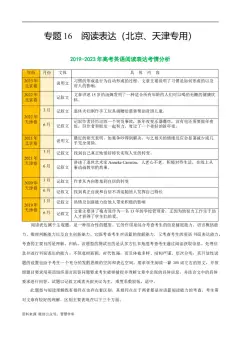
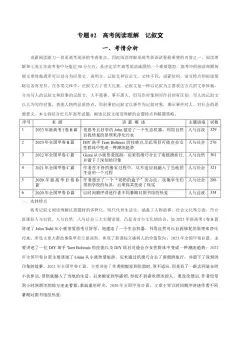
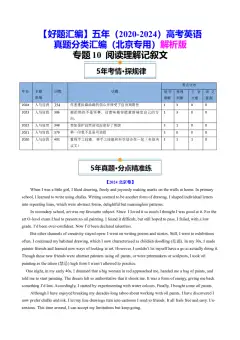
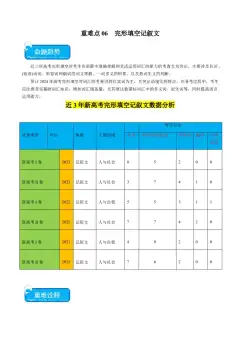
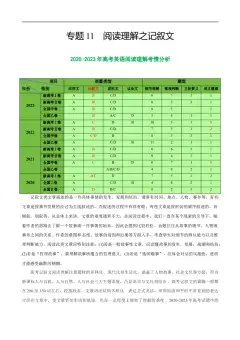
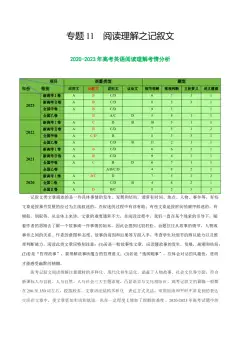
年份 卷别 主题 话题
2024新课标I卷 人与自然 中医针灸治疗动物
2024
2024新课标II卷 人与社会 创新打印吸引顾客
2023新课标I卷 人与自然 利用自然自我修复原理净化污水
2023 2023新课标II卷 人与自我 学校科学项目
2023全国甲卷 人与社会 DIY成为女性新宠
2022新课标Ⅱ卷 人与自我 记者生活趣事
2022
2022全国甲卷 人与社会 悉尼发展遇到的问题
人与自我 逆境完成学业树榜样
2020全国I卷
人与社会 书评
2020 2020全国II卷 人与社会 宣传图书馆
影视作品使用动物
2020全国III卷 人与社会
英国多世同堂现象
【题型解读】
记叙文类文章描述的是一件具体事情的发生、发展和结局,通常有时间、地点、人物、事件等。有些
文章是按事件发展的经过为主线叙述的,在叙述的过程中有详有略;有些文章是按时间的顺序叙述的,有
顺叙、倒叙等。从总体上来讲,文章的难度通常不大,在阅读过程中,我们一直在某个线索的引导下,随
着作者的思路去了解一个故事或一件事情的始末,因此会感到比较轻松。命题往往从故事的情节、人物或
事件之间的关系、作者的意图和态度、故事的前因和后果等方面入手,考查学生对细节的辨认能力以及推
理判断能力。阅读此类文章应特别注意:(1)若是一般故事性文章,应读懂故事的发生、发展、高潮和
结局;(2)若是"哲理故事",要理解故事所蕴含的哲理意义;(3)若是 "逸闻趣事",应体会对话
的风趣性,进而才能感受幽默的精髓。
【语篇特点】
内容上,记叙文应该包括六要素,即:时间、地点、人物、起因、经过和结果。可以按事件发生的时
间顺序写,也可以按事件发生的先后写。
命题上,主要集中在多个事件的先后顺序与人物的情感态度上。
选材上,新颖、生动、真实、典型的素材描写,让读者有身临其境的感觉。
形式上,顺叙、倒叙、插叙。
语言上,一般过去时为主,各种时态为辅,合理使用丰富多彩的谓语动词时态是英语记叙文首要的语
言特征;多用动词,尤其是动态强的行为动词是英语记叙文又一个明显的语言特征。
【写作意图】
1.讲述故事 ( tell / narrate / relate a story)
2.分享经验 (share an experience)3.纪念人物 (remember a person)
4.阐明道理 (communicate an idea / convey a message)
【解题策略】
1.关注细节
记叙文中有大量的事件发展过程中的细节,包括记叙文的 5W(what, who, when, where, why)要素。
因此我们作答细节题的时候,就没有那么复杂,一般只需要由前到后,从上到下,一题一题地做就可以了。
2.注重联系
在做题过程中,我们大都不能在文中找到与题干一字不差的词语或句子。这时我们需要认真研究问题,
抓住题干中的关键词语,然后到文中准确地找到与之相关的语句,或是疑似语句的位置,接着去左顾,或
右盼,在前句或后句寻找线索。
3.读懂表象
如前所述,主旨大意题或推理判断、作者意图题等实际上是同一类型的问题,或者说是可用同种方法
解答的题型。在解答此类题目的时候,不可被题干的表象所迷惑,要像剥洋葱一样,一层一层地剥;在四
个可选项中,一个一个地去证实,去排除。特别是解答推论或暗指类的题目,比如“What can be inferred
from …?”或是What does the author imply in…?”之类的题目,文中所陈述的往往不是答案。我们要在
文前文后去查找,在字里行间里去寻觅。有时还少不了借助自己的生活经验和常理来体会这言外之意。
4.挖掘意义
每年的高考阅读题中,特别是记叙文的阅读题,都会出现一至两道词义猜测题。而这些词汇往往是你
素昧平生的,或者和你有点头之交,在文中却另有新意的,总之,猜的是那些在高考词汇表要求之外的词
汇。小小的一个词,一个短语,考核的不是你的语法的熟练程度,也不是你的记忆力,而是你对文章通篇
或者一个段落的整体把握和变通能力。
【考法归纳】
1.细节理解题:考查对关键词汇、短语和句子的理解能力。要求回答what, why等信息。用到的能力有理
解和语义复现。
2.分析判断题/推理判断题:考查考生理解文本特定义群的引申含义的能力。要求回答 what ... know
about...等信息。用到的能力有分析和判断。
3.词义猜测题:考查根据语境猜测词义的能力。猜测对象有代词、名词、动词、形容词或短语。用到的能
力有猜测和合理推断。
4.主旨概括题:考查根据主题语境来概括文章主旨或标题的能力。要用到的能力有分析和概括。
5观点态度题及写作意图。设身处地地根据文章内容揣摩作者的态度和意图,根据情节展开想象,这样的
话即使是深层理解题也可迎刃而解。
记叙文主旨概括题的破题方法:
(1)首段法:首段主旨句;转折词后;破折号后
(2)核心名词法:
核心名词在文章中高频出现。可是“原词”或“同义词”不断曝光。
(3)合并法:整合各段落大意,整合各段落首段信息(4)首位呼应法:整合首段和尾端信息
记叙文细节理解题的破题方法:
(1)划出题干,选项关键词;
(2)回忆文章结构,定位具体段落;
(3)理解细节内容,最后找出答案;
注意:记叙文细节理解题正确选项的特征一定是:
①核心词,原词复现/同义词、近义词替换;②语言简化
1.考查角度:
从命题上看,记叙文阅读理解以细节理解题和推理判断题为主,以观点态度题、写作意图题、词义猜测题
和代词指代题为辅,总体上属于中等难度。记叙文阅读理解题要求考生能理清记叙文的顺序与所讲故事的
情节,能准确把握任务的情感态度和作者的写作目的。
2.文体特点与阅读策略:
(1)文体和结构特点:
英语记叙文以描写叙述为主,主要描写人物、事件、地点或过程。其特点是:主题往往隐藏在字里行间,
没有直接地表达出来;文章主旨要通过任务事件来提炼。文章大多数按照时间顺序、空间顺序、事情发展
顺序来展开。
(2)阅读策略:
A.首先要通读全文,弄清六要素和记叙的顺序,特别要注意文章中所提到的多个事件、地点和人物,理清
事件的起因、经过和结果;
B.然后阅读题干,在文章中查找相关的信息;
C.最后根据查找到的相关信息做出正确的选择。如果文中所涉及的人物较多,还要弄清人物之间的关系。
【2024新课标I卷】
“I am not crazy,” says Dr. William Farber, shortly after performing acupuncture (针灸) on a rabbit. “I am
ahead of my time.” If he seems a little defensive, it might be because even some of his coworkers occasionally
laugh at his unusual methods. But Farber is certain he’ll have the last laugh. He’s one of a small but growing
number of American veterinarians (兽医) now practicing “holistic” medicine-combining traditional Western
treatments with acupuncture, chiropractic (按摩疗法) and herbal medicine.
Farber, a graduate of Colorado State University, started out as a more conventional veterinarian. He became
interested in alternative treatments 20 years ago when he suffered from terrible back pain. He tried muscle-relaxing
drugs but found little relief. Then he tried acupuncture, an ancient Chinese practice, and was amazed that he
improved after two or three treatments. What worked on a veterinarian seemed likely to work on his patients. So,
after studying the techniques for a couple of years, he began offering them to pets.
Leigh Tindale’s dog Charlie had a serious heart condition. After Charlie had a heart attack, Tindale says, shewas prepared to put him to sleep, but Farber’s treatments eased her dog’s suffering so much that she was able to
keep him alive for an additional five months. And Priscilla Dewing reports that her horse, Nappy, “moves more
easily and rides more comfortably” after a chiropractic adjustment.
Farber is certain that the holistic approach will grow more popular with time, and if the past is any indication,
he may be right: Since 1982, membership in the American Holistic Veterinary Medical Association has grown from
30 to over 700. “Sometimes it surprises me that it works so well,” he says. “I will do anything to help an animal.
That’s my job.”
24. What do some of Farber’s coworkers think of him?
A. He’s odd. B. He’s strict. C. He’s brave. D. He’s rude.
25. Why did Farber decide to try acupuncture on pets?
A. He was trained in it at university. B. He was inspired by another veterinarian.
C. He benefited from it as a patient. D. He wanted to save money for pet owners.
26. What does paragraph 3 mainly talk about?
A. Steps of a chiropractic treatment. B. The complexity of veterinarians’ work.
C. Examples of rare animal diseases. D. The effectiveness of holistic medicine.
27. Why does the author mention the American Holistic Veterinary Medical Association?
A. To prove Farber’s point. B. To emphasize its importance.
C. To praise veterinarians. D. To advocate animal protection.
【2024新课标II卷】
Do you ever get to the train station and realize you forgot to bring something to read? Yes, we all have our
phones, but many of us still like to go old school and read something printed.
Well, there’s a kiosk (小亭) for that. In the San Francisco Bay Area, at least.
“You enter the fare gates (检票口) and you’ll see a kiosk that is lit up and it tells you can get a one-minute, a
three-minute, or a five-minute story,” says Alicia Trost, the chief communications officer for the San Francisco Bay
Area Rapid Transit — known as BART. “You choose which length you want and it gives you a receipt-like short
story.”
It’s that simple. Riders have printed nearly 20,000 short stories and poems since the program was launched last
March. Some are classic short stories, and some are new original works.
Trost also wants to introduce local writers to local riders. “We wanted to do something where we do a call to
artists in the Bay Area to submit stories for a contest,” Trost says. “And as of right now, we’ve received about 120
submissions. The winning stories would go into our kiosk and then you would be a published artist.”
Ridership on transit (交通) systems across the country has been down the past half century, so could short
stories save transit?
Trost thinks so.
“At the end of the day all transit agencies right now are doing everything they can to improve the rider
experience. So I absolutely think we will get more riders just because of short stories,” she says.
And you’ll never be without something to read.
24. Why did BART start the kiosk program?A. To promote the local culture.
B. To discourage phone use.
C. To meet passengers’ needs.
D. To reduce its running costs.
25. How are the stories categorized in the kiosk?
A. By popularity. B. By length.
C. By theme. D. By language.
26. What has Trost been doing recently?
A. Organizing a story contest. B. Doing a survey of customers.
C. Choosing a print publisher. D. Conducting interviews with artists.
27. What is Trost’s opinion about BART’s future?
A. It will close down. B. Its profits will decline.
C. It will expand nationwide. D. Its ridership will increase.
【2023新课标I卷】
When John Todd was a child, he loved to explore the woods around his house, observing how nature solved
problems. A dirty stream, for example, often became clear after flowing through plants and along rocks where tiny
creatures lived. When he got older, John started to wonder if this process could be used to clean up the messes
people were making.
After studying agriculture, medicine, and fisheries in college, John went back to observing nature and asking
questions. Why can certain plants trap harmful bacteria (细菌)? Which kinds of fish can eat cancer-causing
chemicals? With the right combination of animals and plants, he figured, maybe he could clean up waste the way
nature did. He decided to build what he would later call an eco-machine.
The task John set for himself was to remove harmful substances from some sludge ( 污泥). First, he
constructed a series of clear fiberglass tanks connected to each other. Then he went around to local ponds and
streams and brought back some plants and animals. He placed them in the tanks and waited. Little by little, these
different kinds of life got used to one another and formed their own ecosystem. After a few weeks, John added the
sludge.
He was amazed at the results. The plants and animals in the eco-machine took the sludge as food and began to
eat it! Within weeks, it had all been digested, and all that was left was pure water.
Over the years, John has taken on many big jobs. He developed a greenhouse — like facility that treated
sewage (污水) from 1,600 homes in South Burlington. He also designed an eco-machine to clean canal water in
Fuzhou, a city in southeast China.
“Ecological design” is the name John gives to what he does. “Life on Earth is kind of a box of spare parts for
the inventor,” he says. “You put organisms in new relationships and observe what’s happening. Then you let these
new systems develop their own ways to self-repair.”
4. What can we learn about John from the first two paragraphs?
A. He was fond of traveling. B. He enjoyed being alone.
C. He had an inquiring mind. D. He longed to be a doctor.5. Why did John put the sludge into the tanks?
A. To feed the animals. B. To build an ecosystem.
C. To protect the plants. D. To test the eco-machine.
6. What is the author’s purpose in mentioning Fuzhou?
A. To review John’s research plans. B. To show an application of John’s idea.
C. To compare John’s different jobs. D. To erase doubts about John’s invention.
7. What is the basis for John’s work?
A. Nature can repair itself. B. Organisms need water to survive.
C. Life on Earth is diverse. D. Most tiny creatures live in groups.
【2023新课标II卷】
Turning soil, pulling weeds, and harvesting cabbage sound like tough work for middle and high school kids.
And at first it is, says Abby Jaramillo, who with another teacher started Urban Sprouts, a school garden program at
four low-income schools. The program aims to help students develop science skills, environmental awareness, and
healthy lifestyles.
Jaramillo’s students live in neighborhoods where fresh food and green space are not easy to find and fast food
restaurants outnumber grocery stores. “The kids literally come to school with bags of snacks and large bottles of
soft drinks,” she says. “They come to us thinking vegetables are awful, dirt is awful, insects are awful.” Though
some are initially scared of the insects and turned off by the dirt, most are eager to try something new.
Urban Sprouts’ classes, at two middle schools and two high schools, include hands-on experiments such as soil
testing, flower-and-seed dissection, tastings of fresh or dried produce, and work in the garden. Several times a year,
students cook the vegetables they grow, and they occasionally make salads for their entire schools.
Program evaluations show that kids eat more vegetables as a result of the classes. “We have students who say
they went home and talked to their parents and now they’re eating differently,” Jaramillo says.
She adds that the program’s benefits go beyond nutrition. Some students get so interested in gardening that
they bring home seeds to start their own vegetable gardens. Besides, working in the garden seems to have a calming
effect on Jaramillo’s special education students, many of whom have emotional control issues. “They get outside,”
she says, “and they feel successful.”
4. What do we know about Abby Jaramillo?
A. She used to be a health worker. B. She grew up in a low-income family.
C. She owns a fast food restaurant. D. She is an initiator of Urban Sprouts.
5. What was a problem facing Jaramillo at the start of the program?
A. The kids’ parents distrusted her. B. Students had little time for her classes.
C. Some kids disliked garden work. D. There was no space for school gardens.
6. Which of the following best describes the impact of the program?
A. Far-reaching. B. Predictable.
C. Short-lived. D. Unidentifiable.
7. What can be a suitable title for the text?
A. Rescuing School Gardens B. Experiencing Country LifeC. Growing Vegetable Lovers D. Changing Local Landscape
【2023全国甲卷】
Terri Bolton is a dab hand when it comes to DIY (do-it-yourself). Skilled at putting up shelves and piecing
together furniture, she never pays someone else to do a job she can do herself.
She credits these skills to her late grandfather and builder Derek Lloyd. From the age of six, Terri, now 26,
accompanied Derek to work during her school holidays. A day’s work was rewarded with £ 5 in pocket money. She
says: “I’m sure I wasn’t much of a help to start with painting the rooms and putting down the flooring throughout
the house. It took weeks and it was backbreaking work, but I know he was proud of my skills.”
Terri, who now rents a house with friends in Wandsworth, South West London, says DIY also saves her from
losing any deposit when a tenancy (租期) comes to an end. She adds: “I’ve moved house many times and I always
like to personalise my room and put up pictures. So, it’s been useful to know how to cover up holes and repaint a
room to avoid any charges when I’ve moved out.”
With millions of people likely to take on DIY projects over that coming weeks, new research shows that more
than half of people are planning to make the most of the long, warm summer days to get jobs done. The average
spend per project will be around £ 823. Two thirds of people aim to improve their comfort while at home. Two fifth
wish to increase the value of their house. Though DIY has traditionally been seen as male hobby, the research
shows it is women now leading the charge.
24. Which is closest in meaning to “a dab hand” in paragraph 1?
A. An artist. B. A winner. C. A specialist. D. A pioneer.
25. Why did Terri’s grandfather give her £ 5 a day?
A. For a birthday gift. B. As a treat for her work.
C. To support her DIY projects. D. To encourage her to take up a hobby.
26. How did Terri avoid losing the deposit on the house she rented?
A. By making it look like before. B. By furnishing it herself.
C. By splitting the rent with a roommate. D. By cancelling the rental agreement.
27. What trend in DIY does the research show?
A. It is becoming more costly. B. It is getting more time-consuming.
C. It is turning into a seasonal industry. D. It is gaining popularity among females.
【2022新课标II卷】
We journalists live in a new age of storytelling, with many new multimedia tools. Many young people don’t
even realize it’s new. For them, it’s just normal.
This hit home for me as I was sitting with my 2-year-old grandson on a sofa over the Spring Festival holiday.
I had brought a children’s book to read. It had simple words and colorful pictures — a perfect match for his age.
Picture this: my grandson sitting on my lap as I hold the book in front so he can see the pictures. As I read, he
reaches out and pokes (戳) the page with his finger.
What’s up with that? He just likes the pictures, I thought. Then I turned the page and continued. He poked the
page even harder. I nearly dropped the book. I was confused: Is there something wrong with this kid?
Then I realized what was happening. He was actually a stranger to books. His father frequently amused theboy with a tablet computer which was loaded with colorful pictures that come alive when you poke them. He
thought my storybook was like that.
Sorry, kid. This book is not part of your high-tech world. It’s an outdated, lifeless thing. An antique, like your
grandfather. Well, I may be old, but I’m not hopelessly challenged, digitally speaking. I edit video and produce
audio. I use mobile payment. I’ve even built websites.
There’s one notable gap in my new-media experience, however: I’ve spent little time in front of a camera,
since I have a face made for radio. But that didn’t stop China Daily from asking me last week to share a personal
story for a video project about the integration of Beijing, Tianjin and Hebei province.
Anyway, grandpa is now an internet star — two minutes of fame! I promise not to let it go to my head. But I
will make sure my 2-year-old grandson sees it on his tablet.
24. What do the underlined words “hit home for me” mean in paragraph 2?
A. Provided shelter for me. B. Became very clear to me.
C. Took the pressure off me. D. Worked quite well on me.
25. Why did the kid poke the storybook?
A. He took it for a tablet computer. B. He disliked the colorful pictures.
C. He was angry with his grandpa. D. He wanted to read it by himself.
26. What does the author think of himself?
A. Socially ambitious. B. Physically attractive.
C. Financially independent. D. Digitally competent.
27. What can we learn about the author as a journalist?
A. He lacks experience in his job. B. He seldom appears on television.
C. He manages a video department. D. He often interviews internet stars.
【2022全国甲卷】
Sometime in the early 1960s, a significant thing happened in Sydney, Australia. The city discovered its harbor.
Then, one after another, Sydney discovered lots of things that were just sort of there — broad parks, superb
beaches, and a culturally diverse population. But it is the harbor that makes the city.
Andrew Reynolds, a cheerful fellow in his early 30s, pilots Sydney ferryboats for a living. I spent the whole
morning shuttling back and forth across the harbor. After our third run Andrew shut down the engine, and we went
our separate ways — he for a lunch break, I to explore the city.
“I’ll miss these old boats,” he said as we parted.
“How do you mean?” I asked.
“Oh, they’re replacing them with catamarans. Catamarans are faster, but they’re not so elegant, and they’re not
fun to pilot. But that’s progress, I guess.”
Everywhere in Sydney these days, change and progress are the watchwords (口号), and traditions are
increasingly rare. Shirley Fitzgerald, the city’s official historian, told me that in its rush to modernity in the 1970s,
Sydney swept aside much of its past, including many of its finest buildings. “Sydney is confused about itself,” she
said. “We can’t seem to make up our minds whether we want a modern city or a traditional one. It’s a conflict that
we aren’t getting any better at resolving (解决).”On the other hand, being young and old at the same time has its attractions. I considered this when I met a
thoughtful young businessman named Anthony. “Many people say that we lack culture in this country,” he told me.
“What people forget is that the Italians, when they came to Australia, brought 2000 years of their culture, the
Greeks some 3000 years, and the Chinese more still. We’ve got a foundation built on ancient cultures but with a
drive and dynamism of a young country. It’s a pretty hard combination to beat.”
He is right, but I can’t help wishing they would keep those old ferries.
32. What is the first paragraph mainly about?
A. Sydney’s striking architecture. B. The cultural diversity of Sydney.
C. The key to Sydney’s development. D. Sydney’s tourist attractions in the 1960s.
33. What can we learn about Andrew Reynolds?
A. He goes to work by boat. B. He looks forward to a new life.
C. He pilots catamarans well. D. He is attached to the old ferries.
34. What does Shirley Fitzgerald think of Sydney?
A. It is losing its traditions. B. It should speed up its progress.
C. It should expand its population. D. It is becoming more international.
35. Which statement will the author probably agree with?
A. A city can be young and old at the same time.
B. A city built on ancient cultures is more dynamic.
C. modernity is usually achieved at the cost of elegance.
D. Compromise should be made between the local and the foreign.
【2020全国I卷】
Jenifer Mauer has needed more willpower than the typical college student to pursue her goal of earning a
nursing degree. That willpower bore fruit when Jennifer graduated from University of Wisconsin-Eau Claire and
became the first in her large family to earn a bachelor's degree.
Mauer, of Edgar, Wisconsin, grew up on a farm in a family of 10 children. Her dad worked at a job away from
the farm, and her mother ran the farm with the kids. After high school, Jennifer attended a local technical college,
working to pay her tuition(学费), because there was no extra money set aside for a college education. After
graduation, she worked to help her sisters and brothers pay for their schooling.
Jennifer now is married and has three children of her own. She decided to go back to college to advance her
career and to be able to better support her family while doing something she loves: nursing. She chose the UW-Eau
Claire program at Ministry Saint Joseph's Hospital in Marshfield because she was able to pursue her four-year
degree close to home. She could drive to class and be home in the evening to help with her kids. Jenifer received
great support from her family as she worked to earn her degree: Her husband worked two jobs to cover the bills,
and her 68-year-old mother helped take care of the children at times.
Through it all, she remained in good academic standing and graduated with honors. Jennifer sacrificed(牺牲)to
achieve her goal, giving up many nights with her kids and missing important events to study. ''Some nights my
heart was breaking to have to pick between my kids and studying for exams or papers,'' she says. However, her
children have learned an important lesson witnessing their mother earn her degree. Jennifer is a first-generationgraduate and an inspiration to her family-and that's pretty powerful.
24. What did Jennifer do after high school?
A. She helped her dad with his work.
B. She ran the family farm on her own.
C. She supported herself through college.
D. She taught her sisters and brothers at home.
25. Why did Jennifer choose the program at Ministry Saint Joseph's Hospital in Marshfield?
A. To take care of her kids easily.
B. To learn from the best nurses.
C. To save money for her parents.
D. To find a well-paid job there.
26. What did Jennifer sacrifice to achieve her goal?
A. Her health.
B. Her time with family.
C. Her reputation.
D. Her chance of promotion.
27. What can we learn from Jenifer's story?
A. Time is money.
B. Love breaks down barriers.
C. Hard work pays off.
D. Education is the key to success.
In the mid-1990s, Tom Bissell taught English as a volunteer in Uzbekistan. He left after seven months,
physically broken and having lost his mind. A few years later, still attracted to the country, he returned to
Uzbekistan to write an article about the disappearance of the Aral Sea.
His visit, however, ended up involving a lot more than that. Hence this book, Chasing the Sea: Lost Among
the Ghosts of Empire in Central Asia, which talks about a road trip from Tashkent to Karakalpakstan, where
millions of lives have been destroyed by the slow drying up of the sea. It is the story of an American travelling to a
strange land, and of the people he meets on his way: Rustam, his translator, a lovely 24-year-old who picked up his
colorful English in California, Oleg and Natasha, his hosts in Tashkent, and a string of foreign aid workers.
This is a quick look at life in Uzbekistan, made of friendliness and warmth, but also its darker side of society.
In Samarkand, Mr Bissell admires the architectural wonders, while on his way to Bukhara he gets a taste of police
methods when suspected of drug dealing. In Ferghana, he attends a mountain funeral(葬礼)followed by a strange
drinking party. And in Karakalpakstan, he is saddened by the dust storms, diseases and fishing boats stuck miles
from the sea.
Mr Bissell skillfully organizes historical insights and cultural references, making his tale a well-rounded
picture of Uzbekistan, seen from Western eyes. His judgment and references are decidedly American, as well as his
delicate stomach. As the author explains, this is neither a travel nor a history book, or even a piece of reportage.Whatever it is, the result is a fine and vivid description of the purest of Central Asian traditions.
28. What made Mr Bissell return to Uzbekistan?
A. His friends' invitation. B. His interest in the country.
C. His love for teaching. D. His desire to regain health.
29. What does the underlined word “that” in paragraph 2 refer to?
A. Developing a serious mental disease.
B. Taking a guided tour in Central Asia.
C. Working as a volunteer in Uzbekistan.
D. Writing an article about the Aral Sea.
30. Which of the following best describes Mr Bissell's road trip in Uzbekistan?
A. Romantic. B. Eventful. C. Pleasant. D. Dangerous.
31. What is the purpose of this text?
A. To introduce a book. B. To explain a cultural phenomenon.
C. To remember a writer. D. To recommend a travel destination.
【2020全国II卷】
I have a special place in my heart for libraries. I have for as long as I can remember. I was always an
enthusiastic reader, sometimes reading up to three books a day as a child. Stories were like air to me and while
other kids played ball or went to parties. I lived out adventures through the books I checked out from the library.
My first job was working at the Ukiah Library when I was 16 years old. It was a dream job and I did everything
from shelving books to reading to the children for story time.
As I grew older and became a mother, the library took on a new place and an added meaning in my life. I had
several children and books were our main source(来源) of entertainment. It was a big deal for us to load up and go
to the local library, where my kids could pick out books to read or books they wanted me to read to them.
I always read, using different voices, as though I were acting out the stories with my voice and they loved it! It
was a special time to bond with my children and it filled them with the wonderment of books.
Now, I see my children taking their children to the library and I love that the excitement of going to the library
lives on from generation to generation.
As a novelist, I’ve found a new relationship with libraries. I encourage readers to go to their local library when
they can’t afford to purchase a book. I see libraries as a safe haven(避风港) for readers and writers, a bridge that
helps put together a reader with a book. Libraries, in their own way, help fight book piracy(盗版行为) and I think
all writers should support libraries in a significant way when they can. Encourage readers to use the library. Share
library announcements on your social media. Frequent them and talk about them when you can.
32. Which word best describes the author’s relationship with books as a child?
A. Cooperative. B. Uneasy. C. Inseparable. D. Casual.
33. What does the underlined phrase “an added meaning” in paragraph 3 refer to?
A. Pleasure from working in the library.
B. Joy of reading passed on in the family.
C. Wonderment from acting out the stories.D. A closer bond developed with the readers.
34. What does the author call on other writers to do?
A. Sponsor book fairs. B. Write for social media. C. Support libraries. D. Purchase her novels.
35. Which can be a suitable title for the text?
A. Reading: A Source of Knowledge
B. My Idea about writing
C. Library: A Haven for the Young
D. My Love of the Library
【2020全国III卷】
When "Rise of the Planet of the Apes" was first shown to the public last month, a group of excited animal
activists gathered on Hollywood Boulevard. But they weren’t there to throw red paint on fur-coat-wearing film
stars. Instead, one activist, dressed in a full-body monkey suit, had arrived with a sign praising the
filmmakers: "Thanks for not using real apes (猿)!"
The creative team behind "Apes" used motion-capture (动作捕捉) technology to create digitalized
animals, spending tens of millions of dollars on technology that I records an actor’s performance and later
processes it with computer graphics to create a final image (图像). In this case, one of a realistic-looking
ape.
Yet "Apes" is more exception than the rule. In fact, Hollywood has been hot on live animals lately. One
nonprofit organization, which monitors the treatment or animals in filmed entertainment, is keeping tabs on more
than 2,000 productions this year. Already, a number of films, including "Water for Elephants," "The Hangover Part
Ⅱ" and "Zookeeper," have drawn the anger of activists who say the creatures acting in them haven’t been
treated properly.
In some cases, it’s not so much the treatment of the animals on set in the studio that has activists worried; it’s
the off-set training and living conditions that are raising concerns. And there are questions about the films made
outside the States, which sometimes are not monitored as closely as productions filmed in the Sates.
24. Why did the animal activists gather on Hollywood Boulevard?
A. To see famous film stars.
B. To oppose wearing fur coats.
C. To raise money for animal protection.
D. To express thanks to some filmmakers.
25. What does paragraph 2 mainly talk about?
A. The cost of making "Apes."
B. The creation of digitalized apes.
C. The publicity about “Apes."
D. The performance of real apes.
26. What does the underlined phrase "keeping tabs on" in paragraph 3 probably mean?
A. Listing completely.
B. Directing professionally.C. Promoting successfully.
D. Watching carefully.
27. What can we infer from the last paragraph about animal actors?
A. They may be badly treated.
B. They should take further training.
C. They could be traded illegally.
D. They would lose popularity.
With the young unable to afford to leave home and the old at risk of isolation(孤独), more families
are choosing to live together.
The doorway to peace and quiet, for Nick Bright at least, leads straight to his mother-in-law, she
lives on the ground floor, while he lives upstairs with his wife and their two daughters.
Four years ago they all moved into a three-storey Victorian house in Bristol — one of a growing
number of multigenerational families in the UK living together under the same roof. They share a front
door and a washing machine, but Rita Whitehead has her own kitchen, bathroom, bedroom and living
room on the ground floor.
“We floated the idea to my mum of sharing at a house,” says Kathryn Whitehead. Rita cuts in: “We
spoke more with Nick because I think it’s a big thing for Nick to live with his mother-in-law.”
And what does Nick think? “From my standpoint, it all seems to work very well. Would I
recommend it? Yes, I think I would.”
It’s hard to tell exactly how many people agree with him, but research indicates that the numbers
have been rising for some time. Official reports suggest that the number of households with three
generations living together had risen from 325,000 in 2002 to 419,000 in 2013.
Other varieties of multigenerational family are more common. Some people live with their elderly
parents; many more adult children are returning to the family home, if they ever left. It is said that about
20% of 25-34-year-olds live with their parents, compared with 16% in 1991.The total number of all
multigenerational households in Britain is thought to be about 1.8 million.
Stories like that are more common in parts of the world where multigenerational living is more
firmly rooted. In India, particularly outside cities, young women are expected to move in with their
husband’s family when they get married.
28. Who mainly uses the ground floor in the Victorian house in Bristol?
A. Nick. B. Rita. C. Kathryn D. The daughters.
29. What is Nick’s attitude towards sharing the house with his mother-in -law?
A. Positive. B. Carefree. C. Tolerant. D. Unwilling.
30. What is the author’s statement about multigenerational family based on?
A. Family traditions. B. Financial reports.
C. Published statistics.
D. Public opinions.31. What is the text mainly about?
A. Lifestyles in different countries. B. Conflicts between generations.
C. A housing problem in Britain. D. A rising trend of living in the UK.