【好题汇编】五年(2020-2024)高考英语
真题分类汇编(北京专用)解析版
专题 13 阅读表达
年份 主题 体裁 词数 话题 考点分布
语境 细节 推断 主 旨 猜 词
表达 表达 表达 表达
2024 人与自我 记叙文 268 追求科学研究的独立过程中成长的故事 3 0 0 0
2023 人与社会 记叙文 280 习惯是如何形成的以及对人的影响。 3 0 0 0
2022 人与社会 记叙文 286 发明一种适合所有年龄的人们可以喝的无糖的健康饮料 3 0 0 0
2021 人与社会 说明文 322 解决争执减情绪负担 3 0 0 0
【2024北京卷】
Growing up, I idealised independence. I always wanted my own efforts to be enough. When I decided to
pursue a postgraduate degree, I wanted to develop a novel research programme and quickly establish myself as an
independent scientist. But I was unrealistically optimistic about what I could achieve.
As I began designing experiments, my committee members warned me about the challenges I would face. But
my need for independence drove me to push forward with my research plan. As a result, the first four years of my
postgraduate career were defined by a series of failures.
During my second year, I failed my comprehensive exam because my proposal was unclear. During my third
year, I discovered that after treating thousands of seeds, I obtained just one plant I could use for experiments. By
my fourth year, my desperation to succeed overshadowed my desire for independence.
My adviser and I devised (想出) a somewhat unusual solution: I would spend three months in a collaborating
(合作的) lab to obtain specialised training. I worked extensively with other students, constantly asked questions,
and helped with ongoing projects to learn everything I could. Finally, I conducted an elegant experiment that would
not have been possible without the help of the members in the lab.
My adviser saw this experience as a groundbreaking success, emphasising the collaborating skills I acquired.
A few months later, when I repeated the experiment in my home lab, I produced more publishable data. By learning
when to ask for help, I eventually found myself on the way to becoming an independent scientist.
40. In the beginning, what drove the author to push forward with the research plan?
____________________________________________________________________________________________
___41. What was the solution by the adviser and the author after those repeated failures?
____________________________________________________________________________________________
___
42. Please decide which part is false in the following statement, then underline it and explain why.
> The adviser considered the author’s experience in the lab a groundbreaking success because publishable data
had been produced.
____________________________________________________________________________________________
___
43. From this story, what can you learn about “independence”? (In about 40 words)
____________________________________________________________________________________________
___
【2023北京卷】
Habit formation is the process by which behaviours become automatic. People develop countless habits as
they explore the world, whether they are aware of them or not. Understanding how habits take shape may be
helpful in changing bad habits.
Habits are built through learning and repetition. A person is thought to develop a habit in the course of
pursuing goals by beginning to associate certain cues(刺激) with behavioural responses that help meet the goal.
Over time, thoughts of the behaviour and ultimately the behaviour itself are likely to be triggered(触发) by these
cues.
A “habit loop(环)” is a way of describing several related elements that produce habits. These elements are
called the cue, the routine, and the reward. For example, stress could serve as a cue that one responds to by eating,
which produces the reward﹣the reduction of stress. While a routine involves repeated behaviour, it’s not
necessarily performed in response to a deep﹣rooted urge, as a habit is.
Old habits can be difficult to shake, and healthy habits are often harder to develop. But through repetition,
it’s possible to form new habits. The amount of time needed to build a habit will depend on multiple factors,
including the individual and the intended behaviour. While you are able to pickup a new habit in a few weeks, it
takes many months to build a healthy habit. Take some time to think about what leads to bad habits and re﹣
evaluate what you get out of them (or don’t). Consider and keep in mind why you want to make a change, including
how the change reflects your values.
40.How are habits built?
41.In what way is a routine different from a habit?
42.Please decide which part is false in the following statement, then underline it and explain why.
Picking up a new habit takes a few week, while building a healthy habit takes a shorter time.
43.What benefit(s) have you got from one of your good habits?(In about 40 words)【2022北京卷】
Tom, a 15-year-old inventor and entrepreneur ( 创业者), witnessed at his own school the widespread
consumption of sugary drinks by kids. He knew there had to be a better portable drink solution and decided to
innovate from something he saw in his own home: fruit infused (浸泡) water.
Tom watched his mum make healthy fruit infusions but then struggle for a take-along option. From observing
his mum and from his desire to give kids better drink options, he came up with his original model for the Fun
Bottle. “I wanted to come up with a healthy, natural way for people to drink when on the go. A big part of my
mission is to get people of all ages off sugary drinks,” Tom explains.
The bottle is made with a strainer (滤网) that allows the great tastes and natural sugars of the various fruits and
vegetables you choose to come through the water, without any of the seeds or skins flowing through.
Tom is proud of his design and excited to be selling the Fun Bottle on his website and in stores, but this 15-
year-old is most proud of the opportunities that Fun Bottle presents to others. It helps to provide healthy
alternatives to sugary drinks; and also Tom donates part of the profits to the Organisation for a Healthier Generation
(OHG).
Tom has been awarded several prizes, but this teenage innovator remains humble. When asked what advice
he’d give other entrepreneurial youth, he says, “Prepare and have your family’s support. It is important to know
from the beginning that there are a lot of highs and lows, and there is no such thing as overnight success.”
40. What did Tom witness at his own school?
41. Where did Tom get the idea for the original model for the Fun Bottle?
,
42. Please decide which part is false in the following statement then underline it and explain why.
Tom is most proud of the opportunities that Fun Bottle presents to others because he not only provides healthy
alternatives to sugary drinks but also donates all the profits to the OHG.
43. Among Tom’s qualities, which one(s) do you think will be important for us? Why?(In about 40 words)
【2021北京卷】
Recent research suggests that if an argument gets resolved,the emotional response tied to it is significantly
reduced or almost completely erased.Thus,it may be worth bringing up issues with your friends, family
members,or classmates rather than holding them back.
There is a difference between arguing and fighting.Arguing is that you and your opponent present your
concerns and discuss the feelings and issues related to those concerns.You can engage in an argument respectfully
without stirring up(激起) anger.Fighting,however,usually involves personal attacks,raising of voices,
and storming out.Discussing your issues and resolving them instead of stuffing them down can improve your
emotional health.In a study,2.000 people were asked to record their feelings and experiences for eight days in a
row.When people had an argument that they considered resolved, they had half the reactivity (情绪反应)
of those who avoided an argument.Reactivity is an increase in negative emotions or a decrease in positive
emotions.In other words,resolving an argument cuts your negative feelings by half.One day later, people
who had a resolved argument reported no increase of negative emotions compared with those who avoided an
argument. This means that resolving an argument can feel like you have reached a state of resolution——andyou are less likely to be annoyed.
Moreover,the older you are,the more likely you will come to a resolution after an argument.This may be
because more life experience usually leads to more defined priorities.You are more likely to distinguish between
what matters and what does not.
It is easier to avoid a discussion,but risking talking about it may eventually lead to a better outcome.
40. According to this passage,what is arguing?
41. Why is it that“the older you are, the more likely you will come to a resolution after an argument”?
42. Please decide which part is false in the following statement,then underline it and explain why.
Resolving arguments can improve your emotional health,because it increases your reactivity and reduces the
chance of you getting angry.
43. In addition to improving emotional health,what do you think are some other benefits of resolving an
argument? (In about 40 words)
Writing 01
【2024年北京市海淀区高三一模】As a kid, I dreamed of becoming a marine biologist and I lived out this
fantasy by setting up aquariums(鱼缸) at home. Then, at 20, I was introduced to photographer David Liittschwager,
who hired me to help him with a magazine assignment on marine life.
David’s assignment was to document the amazing biodiversity found in the ocean. My role was to collect
species for him to photograph. Every night, I would cast a floating lamp. Like moths drawn to a flame, mysterious
creatures would emerge from the depths in search of this light. I’d then set up aquariums to house them as they
waited for David to take their shot.
Those evenings made me feel as if I were on another planet. I had never imagined such strange life-forms
could exist in our oceans. But I didn’t grasp the true magic of what was in front of me until I saw the photographs
David took.
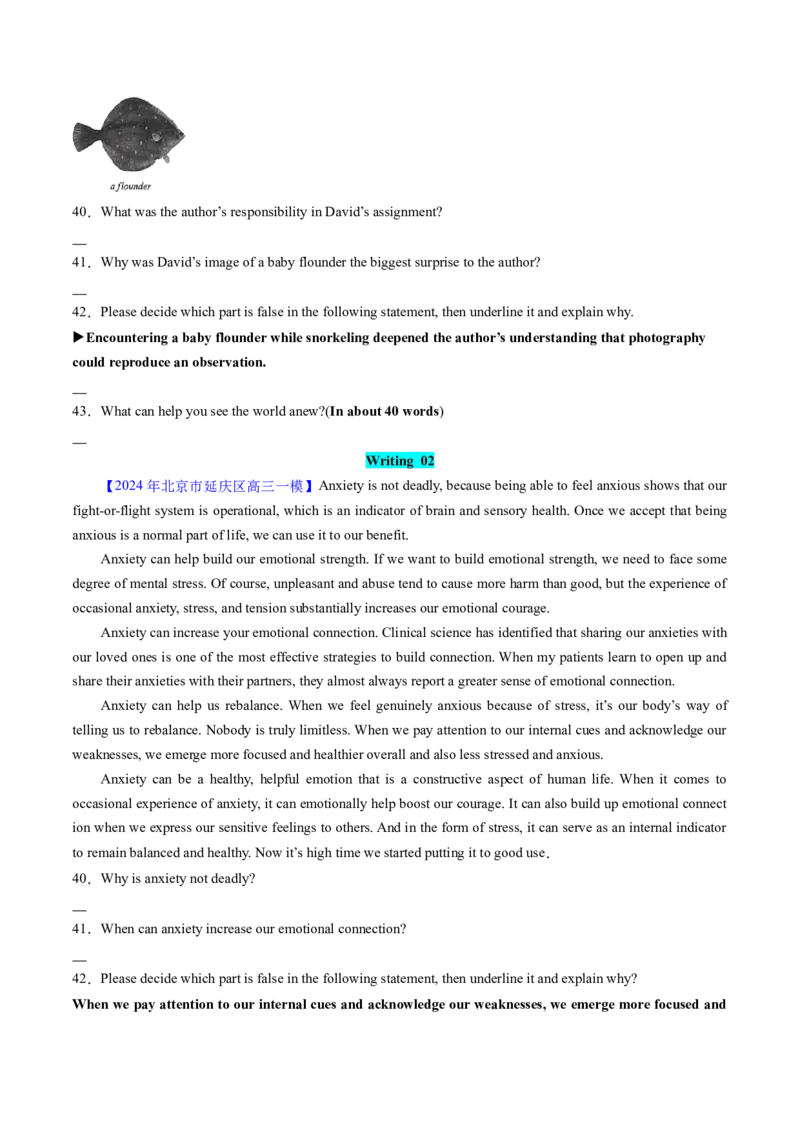
The biggest surprise was his image of a baby flounder. I caught this fish by accident. Only later did I notice its
two tiny eyeballs staring back at me. But David’s photograph of this flounder revealed a universe of detail that even
my eager eyes had missed. His macro lens magnified its ribs. The lightning-fast exposure froze its motion. A
precisely aimed light released the rainbow hidden in its skin. And the black background removed all distractions to
focus our attention on the quiet beauty at hand.
Years after that project, I was snorkeling(潜水) on a shallow reef. Out of the darkness, another baby flounder
emerged and settled on my mask. This time I knew what to look for. Before working for David, I had assumed the
goal of photography was simply to reproduce an observation so that others could share the same experience. It had
never occurred to me that photography could expand our visual perception and therefore teach us to see the world
anew.40.What was the author’s responsibility in David’s assignment?
41.Why was David’s image of a baby flounder the biggest surprise to the author?
42.Please decide which part is false in the following statement, then underline it and explain why.
▶Encountering a baby flounder while snorkeling deepened the author’s understanding that photography
could reproduce an observation.
43.What can help you see the world anew?(In about 40 words)
Writing 02
【2024年北京市延庆区高三一模】Anxiety is not deadly, because being able to feel anxious shows that our
fight-or-flight system is operational, which is an indicator of brain and sensory health. Once we accept that being
anxious is a normal part of life, we can use it to our benefit.
Anxiety can help build our emotional strength. If we want to build emotional strength, we need to face some
degree of mental stress. Of course, unpleasant and abuse tend to cause more harm than good, but the experience of
occasional anxiety, stress, and tension substantially increases our emotional courage.
Anxiety can increase your emotional connection. Clinical science has identified that sharing our anxieties with
our loved ones is one of the most effective strategies to build connection. When my patients learn to open up and
share their anxieties with their partners, they almost always report a greater sense of emotional connection.
Anxiety can help us rebalance. When we feel genuinely anxious because of stress, it’s our body’s way of
telling us to rebalance. Nobody is truly limitless. When we pay attention to our internal cues and acknowledge our
weaknesses, we emerge more focused and healthier overall and also less stressed and anxious.
Anxiety can be a healthy, helpful emotion that is a constructive aspect of human life. When it comes to
occasional experience of anxiety, it can emotionally help boost our courage. It can also build up emotional connect
ion when we express our sensitive feelings to others. And in the form of stress, it can serve as an internal indicator
to remain balanced and healthy. Now it’s high time we started putting it to good use.
40.Why is anxiety not deadly?
41.When can anxiety increase our emotional connection?
42.Please decide which part is false in the following statement, then underline it and explain why?
When we pay attention to our internal cues and acknowledge our weaknesses, we emerge more focused andhealthier overall and also more stressed and anxious.
43.As a student, how do you make use of test anxiety to help you be better prepared for exams? (In about 40
words)
Writing 03
【2024 年北京市东城区高三一模】If you are a psychology enthusiast, you have probably heard of the
famous marshmallow test (棉花糖实验). In this task, kids are given a marshmallow, and are told that they can eat
that marshmallow now, or wait a little while, and have two marshmallows instead. Some kids eat the marshmallow
immediately, but most try their best to wait for two.
When the researchers followed up with those kids later in life, children who waited longer had better life
outcomes: more academic success, better social behavior, and even markers of better health. They believe those
children who keep waiting are the ones with the most self-control-a key factor in success, and that’s why they are
so successful later.
But what if the behavior in the marshmallow test has more to do with cultural norms than self-control?
A 2022 study tested the idea that children may decide how long to wait for rewards based on what they are
accustomed to waiting for in their culture. For example, in the United States, there is no widespread mealtime
custom of waiting until everyone is served. In Japan, however, there is.
Because of this difference in norms, the researchers hypothesized that Japanese children would wait longer in
the marshmallow test than the American children. This is exactly what they found later in experiments.
But this isn’t conclusive evidence; after all, maybe Japanese children actually have better self-control, or
maybe they differ from American children in other ways that could explain the result.
In the U. S., gifts are usually given on special occasions and children usually have to wait before they can
unwrap their presents. In Japan, however, gift-giving happens more often, and children usually open presents
immediately.
Given these cultural differences, scientists expected that if they ran the test with gifts instead of
marshmallows, American kids would wait longer. Once again, their hypothesis was correct.
This is a powerful result because it demonstrates the importance of culture and habit in shaping behavior. If a
child waits only few minutes before giving up on two marshmallows but much longer to unwrap a gift, can we
really say that child lacks self-control? I don’t think so. I think it just means that they are adjusting well to their
social settings.
40.According to the researchers, why do children who wait longer have better life outcomes?
41.What was the purpose of the 2022 study?
42.Please decide which part is false in the following statement, then underline it and explain why.
When scientists ran the test with gifts, American kids behaved the same as they did in the test with marshmallows.43.Besides the cases mentioned in the passage, please give one or two examples to show how culture shapes your
behavior. (In about 40 words)
Writing 04
【2024年北京市房山区高三一模】As the saying goes, “time waits for no man”. Time is always against us,
and we just can’t stop it. Maybe that’s why some of us are always running late for appointments. But if timekeeping
is not what you’re good at, don’t stress. There might be a good reason for your lack of punctuality.
People’s attitudes to being on time vary. Some clock-watch and make sure they’re bang on time for a meeting.
It is, after all, rude to be late, and if you can make it on time, why can’t everyone else? But if, like me, you want to
make every second count, you might try to squeeze as much as you can into the time you have available. However,
when your schedule doesn’t run to plan, your punctuality inevitably slips.
People who lack promptness have been described as “time benders”. Author Grace Pacie told the BBC that
“they’re the people who don’t want to be late, but they have a strange resistance to being early, and they don’t allow
enough time.” They assume their journey to an appointment will always go smoothly, and the train will always be
on time!
Perceptions of unpunctual people are almost always negative — even if sometimes wrong. Experts say: Being
consistently late might not be your fault. It could be your type. The punctually-challenged often share personality
characteristics, such as optimism, low levels of self-control, anxiety, or a penchant for thrill-seeking. It is also
possible people are late so not to be conspicuous and to avoid the anxious wait for others to turn up.
Maybe we latecomers should make more of an effort and follow the advice I heard to not “try” to be on time
but “decide” to be on time.
40.What does “time benders” refer to?
41.What are the personality characteristics of time benders?
42.Please decide which part is false in the following statement, then underline it and explain why.
According to Grace Pacie, time benders don’t care about being late so they don’t allow enough time.
43.What do you usually do to be on time? (In about 40 words)
Writing 05
【2024年北京市朝阳区高三一模】Gestures refer to the communication where visible bodily actions are
used to communicate important messages. They include movement of hands, face, or other parts of the body.
Gestures benefit our lives a lot. Take language learning.
In some languages, certain syllables (音节) within words are pronounced with markedly more weight than
others, called lexical stress. Languages such as English commonly feature lexical stress. For example, the word
“accent” involves more emphasis on the first syllable, “ac”, than the second, “cent”. Native speakers of Chinese,
however, don’t use lexical stress and therefore find it difficult to learn languages that feature it.Making any hand gesture could help learners recognize lexical stress, which has been proved by Xing Tian’s
team. They selected 124 native Chinese speakers, who watched videos of people performing hand movements that
were synced(同步的) to recordings of the same English words. In addition, they also found when more pronounced
gestures matched the stressed syllable, the participants were particularly good at identifying it.
The research involved several experiments, which makes it difficult to combine the results. Nevertheless, Tian
estimates that the use of gestures helped identify lexical stress between 10 and 15 percent more accurately
compared with no gestures at all, and how much help depends on the nature of gestures.
A follow-up study conducted by another team exposed the same Chinese speakers to Russian words and got
similar results. “Our findings highlight the functional role of gestures in enhancing speech learning, suggesting
practical strategies for language teaching and learning,” the researchers write in their paper.
The benefits of gestures extend far beyond teaching and learning. Since gestures are deeply integrated into our
daily lives, they deserve more of our attention.
40.What do gestures mean?
41.What did Xing Tian’s team find in their study?
42.Please decide which part is false in the following statement, then underline it and explain why.
Gestures help learn lexical stress, but the degree to which they help depends on the complexity of the lexical stress.
43.Besides what is mentioned in the passage, how do gestures benefit you in your life? (In about 40words)
Writing 06
【2024年北京交通大学附中高三三模】Fashion’s Melt Down
Throwaway culture is trashing the planet—but one young chemical engineer has her own way to turn it over.
Fast fashion has changed the way we dress. We buy more clothes, more often–but we wear them less. Alina
Bassi, founder of Kleiderly, wants to give our clothing waste another chance at a useful life.
Bassi has always cared about the threat of climate change, but she actually started her career in the oil
industry. After a few years, she landed at bio-bean, a startup that turned waste coffee grounds into products that
could be burnt for heat and fuel. After a year, Bassi was keen to branch out—used coffee grounds are not the
biggest threat facing the planet. Instead, she poured her efforts into tackling a much bigger global polluter: the
fashion industry.
According to the Ellen MacArthur Foundation, we produce 100 billion items of clothing per year, and this is
set to double by 2050. But they don’t last long enough to offset(抵消) the carbon cost of producing the material,
creating the clothes, and then shipping them to customers. “It makes no sense that we have such a high carbon
footprint for something so short-lived.” Bassi says.
Using the principles of a circular economy, Bassi has developed a low-energy, multi-stage process to turn
clothing fibres into an alternative to oil-based plastic. This new plastic can then be used by manufacturers in their
existing machines, so that your old T-shirts and jeans will become different products instead of clothes, such asclothing hangers, or even furniture.
Fashion companies have some other ways to reduce fashion waste, from creating clothes designed to last, to
recycling the fabric to make more clothing. But “a problem this big needs multiple solutions,” Bassi says. “We
think about the multiple lives of a product and how we can keep reusing it instead of letting it fall into landfills or
incinerators (焚化炉),” she says.
40.Why did Bassi switch her focus to the fashion industry?
41.How did she tackle the problems caused by the fashion industry?
42.Please decide which part is false in the following statement, then underline it and explain why.
● Kleiderly can change old jackets and trousers into a new material, which can be used to make more
clothing.
43.Please briefly present your own solution(s) to the throwaway problem in daily life. (about 40 words)
Writing 07
【2024年人大附中高三三模】For millions of Facebook users, choosing which photo to use for an online
profile is an important decision. According to a study by researchers at the UT Dallas Center, the photos we select
may reflect individual preferences, but they also appear to reflect more deeply rooted, unconscious cultural
differences. Previous research has shown that culture can affect not only language and custom, but also how we
experience the world and process information. Western cultures, for example, condition people to think of
themselves as highly independent entities (实体), whereas East Asian cultures stress collectivism and
interdependence.
Dr. Denise Park, co-director of the Center at UT Dallas, and former graduate student Dr. Chih-Mao Huang of
the University of Illinois, were curious about whether these patterns of cultural influence extend to cyberspace. In a
paper published in the International Journal of Psychology, they examined the profile photographs of more than 500
active Facebook users from the United States and East Asia. Overall, they found that profile photos of Americans
are more likely to focus on the individual's face, while the profiles of East Asians tend to less emphasize the face
and include more background features. Americans also show greater smile intensity compared to East Asian
Facebook users.
The findings show marked cultural differences in the focus of attention among East Asian and American
Facebook users. Moreover, they echo previous research on cultural influences on visual perception(感知),
attention, and reasoning in the offline world.
"We believe these findings relate to a cultural bias to be more individualistic and independent in the US and
more communal and interdependent in Asia," said Park.
The research also found that cultural influences over our self-presentation online can shift over time and
from place to place. In one of the study samples, Americans studying in Japan and Japanese studying in the United
States both showed a tendency to adjust their profile photos to the general preferences of their host country."Facebook constitutes an extended social context in which personal profiles mirror various individual
characteristics, private thoughts, and social behaviors," noted Huang. "As such, the study presents a new approach
to investigate cognition and behaviors across cultures by using Facebook as a data collection platform."
40.What may an online profile photo reflect?
41.According to the research, how are American and East Asian Facebook users different in choosing their profile
photos?
42.Please decide which part is false in the following statement, then underline it and explain why.
In one of the study samples, Americans studying in Japan showed a tendency to adjust their profile photos to the
general preferences of their host country because they want to maintain a good relationship with their Japanese
friends.
43.Describe the profile photo you use for your social media such as WeChat or Weibo. Why do you choose it?
Writing 08
(2024·北京海淀·二模)阅读下面短文,根据题目要求用英文回答问题。
How Gratitude Makes You Happier
Choosing to be thankful may well be an easy and accessible way to boost your happiness. We usually think
of happiness as a subjective sense of well-being, a feeling of joy and satisfaction. But more than just an emotion or
fleeting (短暂的) feeling, happiness also includes a deep sense of meaning, worth and purpose in life. Gratitude
supports happiness in ways related to all of these.
Research has shown gratitude has far-reaching effects on our physical health. When people are thankful,
they’re more likely to exercise, eat better, and take care of their health. Much evidence points to lower stress,
reduced pain and improved immune systems as a result of being thankful. Even better blood pressure and positive
effects on the heart have been linked to gratitude.
Gratitude has a strong positive impact on mental health as well. It increases self-esteem, enhances positive
emotions and makes us more optimistic since experiencing gratitude activates neurotransmitters like dopamine,
which we associate with pleasure, and serotonin, which regulates our mood. It also promotes feelings like trust and
generosity, which are induced by oxytocin, a hormone released by the brain.
Just like a muscle, thankfulness is something we need to exercise more often. One way is to learn from the
Scandinavians, who, the UN’s World Happiness Report suggests, are the happiest people in the world. It’s worth
pausing to think about why. Scandinavians themselves are determining their levels of happiness. They are
appreciative of a functioning society where they have economic security and where social institutions support
everyone. Yet, there is something else. They value “moderation”, a just enough-ness. They don’t chase happiness or
work overtime for months at a time. They remain grateful for a healthy work-life balance. As a result of this
satisfaction and contentment, they feel their lives have value.
So, take some time to be thankful. It can impact your happiness and enhance many aspects of your life.
40.What does happiness include besides what we usually think?
41.On what does gratitude have a positive influence?42.Please decide which part is false in the following statement, then underline it and explain why.
Scandinavians don’t work overtime for months at a time because they feel their lives have value.
43.How can you exercise being grateful? (In about 40 words)