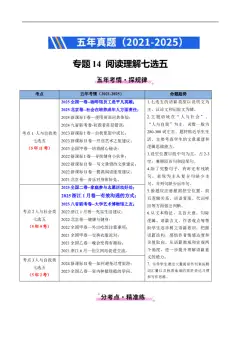
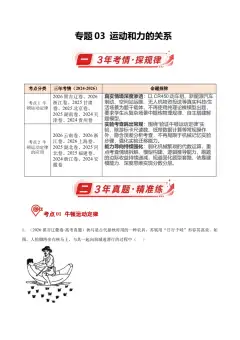
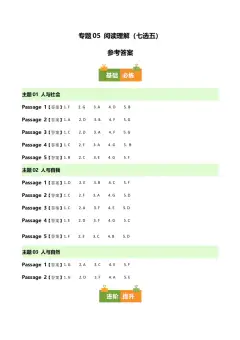
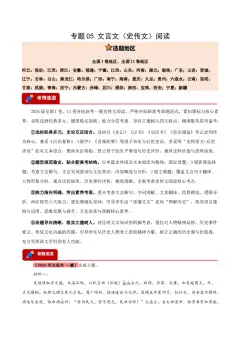
专题13 阅读理解七选五、六选四、阅读表达
(全国通用)
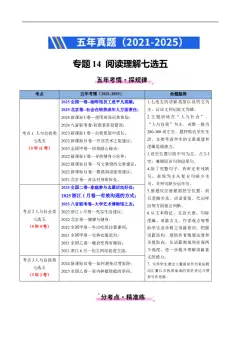
考点分类
五年考情(2024-2026)
命题趋势
考点1
人与自我类
(5 年7
考)
2026 年全国二卷--从小培养孩子劳动品
质;
2026 浙江1 月卷--克服阅读回读坏习惯;
2025 全国一卷--咖啡馆员工是平凡英雄;
2025 北京卷--社会在培养成年人方面责
任;
2024 新课标I 卷—使用英语词典体验;
2024 九省联考卷-初跑者常犯错误;
2024 北京卷--线上课程学习建议。
1.七选五的语篇类型以说明文为主,议论
文和记叙文为辅。
2.主题语境在“人与社会”、“人与自
我”为主。词数一般为280-300 词左右。
题材贴近学生生活,主要考查学生的文意
重建和逻辑思维能力。
3.设空位置以段中句为主,占2-3 空;兼
顾段首句和段尾句。
4.做题应注意根据挖空位置、前后逻辑关
系、词语复现、代词呼应等方面做出判
断。
5.从文本特征、主旨大意、句际逻辑、语
篇含义、作者观点等帮助学生逐步树立语
篇意识,把握语篇结构,感悟作者情感态
度和价值取向。从语篇微观和宏观两个角
度,进一步提升理解语篇意义的能力。
考点2
人与社会类
(5 年4
考)
2026 年全国一卷--AI 重塑博物馆体验;
2025 全国二卷--家庭参与志愿活动好处;
2025 浙江1 月卷—有效沟通的方式;
2025 八省联考卷--大学艺术博物馆之友。
考点3
人与自然类
(5 年1)
2024 新课标II 卷—如何避免过度旅游。
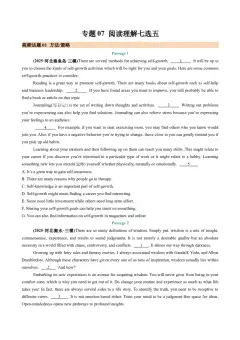
Passage 1
(2026·全国一卷)阅读下面短文,从短文后的选项中迭出可以填入空白处的最佳选项。选项中有两项
为多余选项。
Museums, once quiet places filled with history, are now full of digital excitement. By using machine learning
and advanced algorithms(算法), these institutions are creating personalized visitor journeys, protecting delicate
collections, and revealing hidden stories.      36
AI transforms a standard museum trip into a personalized and interactive adventure. Smart
recommendation engines analyze data such as exhibit popularity and visitors' past behavior to suggest
specific exhibits and events, making each visit unique and surprising.    37      These digital assistants
engage visitors in dynamic conversations and offer context-sensitive insights that deepen understanding and satisfy
curiosity.
Beyond visitor interaction, AI plays a crucial role in preserving priceless artworks.  Since the  exhibits in
museums sustain natural decay(破损)over time, early detection is vital. AI can help identify the slightest signs of
decay, such as cracks or discoloration, which are often invisible to the human eye.       38       Moreover, by
predicting future decay patterns, AI helps museums take preventive measures and improve preservation strategies.
AI  also  significantly  enhances  the  educational  value  of museums,  particularly  for  children
and  families.       39        For instance, interactive exhibits powered by AI can adjust their content and
difficulty level based on the user's preferences and responses. This adaptability ensures that complex
historical concepts become accessible and
engaging for young minds.
Looking ahead, the rapid advancement of AI promises both exciting possibilities and ethical(伦理
的) challenges. Museums are working together with AI ethicists to develop fair algorithms.      40

Strict policies should be established to protect visitors' information.
A. This capability allows for timely restoration.
B. Visitor data collection also raises privacy issues.
C. In short, AI is redefining the museum in all respects.
D. It tailors learning experiences to different age groups and learning styles.
E. Museums are not only places to store artworks, but also spaces for learning.
F. Furthermore, AI-powered virtual guides are replacing traditional tour guides.
G. AI is changing this by using image recognition technology to analyze exhibits.
Passage 2
(2026·全国一卷)阅读下面短文,从短文后的选项中选出可以填入空白处的最佳选项。选项中有两项
为多余选项。
Ways to Teach Kids Work Ethic Early
Ever watched your child try to get out of doing housework by making excuses? If only the effort they put into
avoiding responsibility could be redirected into, well, actual responsibility. In fact, building work ethic (道德) in
kids doesn’t require military-style drills. Here are four simple and practical ways.
●Make housework part of the family routine.
Involve your child in the daily running of the house: tidying toys, feeding the dog, watering the plants.    36
When the tasks become as routine as brushing teeth, kids internalise that helping with housework is simply part of
life.
●   37
You can’t expect your child to tackle their tasks with enthusiasm while you’re complaining about loading the
dishwasher. If your child sees you enjoying your work and taking pride in a job well done, they’re far more likely
to do the same.
●Build determination through goals.
   38    Sometimes you have to help them find their “thing.” Set small, achievable goals together with them
and celebrate progress, not perfection. The trick is to let them struggle a bit — resist the urge to help fix things the
moment they experience a setback.
●Treat mistakes as opportunities.
Few things strike fear into a child’s heart like the prospect of failing. The best way is to normalise mistakes as
a natural part of learning. When kids mess up, don’t jump in with a rescue mission.    39
Teaching kids work ethic is to gently and consistently push them toward responsibility, determination, and
pride in their efforts.    40    No worry. Those habits you’re building now are setting your child up for a lifetime
of resilience (韧性) and satisfaction.
A. The key is consistency.
B. Help kids develop analytical skills.
C. Model the work ethic you want to see.
D. Instead, encourage them to do differently next time.
E. Sometimes, a cleaner living room is the best reward.
F. Progress can be slow, and you’ll wonder if it’s all sinking in.
G. Not every child is born with the willpower of a marathon runner.
Passage 3
(2026·浙江1 月卷)阅读下面短文,从短文后的选项中选出可以填入空白处的最佳选项。选项中有两
项为多余选项。
During your initial reading of material, do you ever go back and reread sentences or paragraphs? Is it because
the material is too difficult to comprehend on the first reading or because you are asleep?    36    You are
napping (打盹) or daydreaming. Halfway down the page you realize that you have no idea what you have read.
37    Thus, you go back and reread, not because you did not understand, but because you were not paying
attention. This type of rereading is called regression.
Napping and daydreaming are habits caused by lack of involvement with the material. Be demanding on
yourself and expect 100 percent attention to the task. Engage your mind. Visualize the incoming ideas, and relate
the new material to what you already know.    38    If your mind is truly occupied with the text, you will not be
able to think about Friday night or where to go on Saturday.
Regression is a crutch (拐杖) that allows you to make up for wasted time. First of all, become aware of when
and why you are regressing.    39    Say, “OK. I missed that paragraph because I was thinking of something
else, but I’m going to keep on going and start paying close attention.”
   40    Good readers who monitor their own comprehension use it in the reading process. However,
regressing because your mind was asleep is a waste of time.
A. Both are to blame.
B. Probably the latter is true.
C. Don’t just read the words; think the ideas.
D. Spend a few minutes reading the material aloud.
E. Your eyes were engaged, but your mind was not.
F. Then, start denying yourself the right in order to break the habit.
G. Rereading because you did not understand is a reasonable fix-up strategy.
Passage 1
(2025·全国一卷)阅读下面短文,从短文后的选项中选出可以填入空白处的最佳选项。选项中有
两项为多余选项。
An Unsung Hero
Need a break between classes or just a quick pick-me-up in the morning? The College Cafe has just that, and
more.

 36

Catherine Murphy, a cafe worker in a green shirt and black hat, makes sure that each customer gets exactly
what they order. She goes back and forth between machines to make the drinks.

 37


 As the customer grabs
the drink from her hand, she smiles and says, “Hello, how is your day?” Even when the line is getting longer, she
doesn’t let it get in the way of her genuine conversations.
Murphy gets up at a quarter to five and drives thirty minutes every day to get to work on time.

 38

“I do so because I like to make coffee for the students. I know they need it in the morning,” Murphy said. Being a
mother and wife has helped her become the woman she is. She believes she is here to serve.
One thing Murphy may not know is that her smile is contagious (有感染力) and can be the difference in a
student having a much better day than they were having before seeing her. Joanna Wright, a senior political science
major, loves coffee and goes to the cafe at least six days a week.

 39


  “Catherine always has a huge
smile on her face, which always puts me in a cheerful mood,” Wright said.
“I enjoy working in the cafe,” Murphy said.

 40


  She has every intention of staying and continuing
doing what she loves.
A. The cafe closes at 9 pm every day.
B. She has two children aged eight and four.
C. Sometimes she arrives early to serve the students early.
D. After finishing an order, she calls out the name on the cup.
E. Not only does this cafe serve up drinks, it also serves up smiles.
F. Going to the cafe starts her day off good and gets her ready for class.
G. She has served here for 17 years and can’t imagine working anywhere else.
Passage 2
(2025·全国二卷)阅读下面短文,从短文后的选项中选出可以填入空白处的最佳选项。选项中有
两项为多余选项。
Unexpected Benefits of Volunteering as a Family
Are you looking for a way to bring your family together? Hoping to find a hobby that can be shared by both
the little ones and adults?

 36


 You may know the “feel-good” emotions that come with helping others, but
there are even more unexpected ways volunteering will positively affect the whole family.
●You’ll feel like you have more time.
People often feel they are too busy to volunteer. Yet, research has found that giving your time to community
causes actually makes you feel like you have more of it.

 37

●You can live longer if you volunteer regularly.


 38


  Washington University found that adults 55 and older who volunteered had better memory and
maintained overall health longer than others their age. Volunteers are also more likely to look after their own health
and are more focused on adding physical activity into their lives.
●

 39

Volunteering during teenage years has been linked to some major positive effects such as improved grades and
increased self-confidence. These effects aren’t just short-term but have been proved to affect a teen’s well-being in
the years to come.
●You’ll have more time with family.
Families who volunteer together have the unique experience of working toward a common goal.

 40

Everyone brings something unique to the table and can connect with each other in a new way. And, there are tasks
for every age and ability, so all your children can feel proud of their work.
A. Helping the community lowers rates of depression.
B. Volunteering as a family may be just the thing you need.
C. Volunteering has a lifelong effect on kids and teenagers.
D. Volunteering can be the first step in breaking down prejudice.
E. For adults, volunteering can provide significant physical health benefits.
F. You may even learn that your kid has a talent you didn’t know about before.
G. Volunteering makes you feel capable and inspires you to make the most of each day.
Passage 3
(2026·浙江1 月卷)阅读下面短文,从短文后的选项中选出可以填入空白处的最佳选项。选项中
有两项为多余选项。
One of the most common mistakes in communication is trying to do too much.    36    There’s no value in
delivering any kind of communication, whether written, spoken, formal, or informal, if the message doesn’t come
across clearly. Being clear and brief – while maintaining interest and including everything your listeners need to
know – is a high-level communication skill.
Here are some tips worth following in order to communicate more effectively.
●Keep your audience in mind.
Your audience will naturally be more interested and engaged when you tailor your communications to their
interests.    37    This will engage their desire to understand and interact with the information.
●Don’t use ten words when one will do.
Even the most engaged and committed audience will eventually get bored. Keeping your message simple and
clear will make it easier for people to understand.    38    However, they’re hearing it for the first time. Keep it
simple.
●   39
If you’ve ever worked as an instructor, manager, trainer or coach, you’ll know that there are few better ways to
learn new information than to teach it. Ask the audience to contribute their ideas or to take a role in explaining new
concepts and policies to others. Allow them to lead discussions and meetings to develop their communication skills.
●Consider the best method to deliver your message.
If the information you’re communicating isn’t urgent, consider sending an email. Written communication will
give your audience more time to review it, think it over, and follow up with questions.    40
Building effective communication skills takes time, but the effects are worth the effort.
A. Be patient.
B. Get the audience involved.
C. The best messages are often simple.
D. Speak directly to what matters to them.
E. You may be surprised by what your listeners offer.
F. It will also give them a handy record to refer back to.
G. As the speaker, you already know what you’re going to say.
Passage 4
(2026·北京卷)根据短文内容, 从短文后的七个选项中选出能填入空白处的最佳选项, 并在答题卡
上将该项涂黑。选项中有两项为多余选项。
What is adulthood? Societies all over the world view the concept of an adult as self-supporting and self-
directed, because it identifies a point in the life cycle.
As Alice Black points out, today’s parents’ fear of letting kids do more housework has added to their inability
to feel competent and, thus, confident in themselves. Psychologist Robert Turner wrote about this in his book, The
Life Cycle, mentioning a stage when kids learn self-direction and mastery.
  35

But Turner’s other cycles are just as important.
  36


  If these life cycles are delayed, interrupted, or
denied, you feel incapable of accessing your states of self, controlling unpleasant feelings, and manipulating (操控)
the energy that puts together the fabric of your inner world.
Turner wisely said that “doing well” psychologically is being able to roll with the flow of emotions, manage
them, communicate clearly and well with others, and master various skills. This requires an internal locus (核心) of
control, which implies self-control of your thoughts, feelings, and actions.
  37


 You’re self-directed and not
reliant on the world to tell you who you are. And you know who you are within all this.
So, being an adult isn’t just holding a job. Being an adult is about having a rooted sense of self while being
capable of identifying and managing your emotions and actions.

 38


  We are a social species, so this is
important.
While raising an adult is a parent’s job, it’s also our responsibility as a society to ensure that we support
schools that nurture (培养) emotional and identity development.
  39

A. It’s also our job to support adults who need help repairing incomplete life cycles.
B. They talk about someone’s inability to support themselves through work.
C. It’s being able to show understanding when communicating with others.
D. In other words, you’re playing the game of life — life isn’t playing you.
E. They teach emotional awareness and management as well as identity.
F. You feel like an 18-year old, especially when playing 80s music.
G. When this stage is denied it creates a sense of insecurity.

Passage 1
(2024·新课标I 卷)阅读下面短文,从短文后的选项中选出可以填入空白处的最佳选项。选项中
有两项为多余选项。
Not all great writers are great spellers. If you want to be published, it’s vital to submit a perfect,
professionally presented manuscript (原稿).
  36

   No editor is likely to tolerate a writer who does not
take the trouble to spell words correctly.
I keep two reference books close-by on my desk: dictionary and thesaurus (同义词词典). I don’t trust my
laptop’s spellchecker.
  3 7
   Of course, these days there are plenty of online dictionaries and thesauruses,
but I’m old-fashioned enough to prefer a hard cover and pages I can leaf through with my fingers. I use the
Concise Oxford Dictionary and the Collins Thesaurus.

  3 8
   It should give you a precise definition of each word, thus differentiating it from other words
whose meanings are similar, but not identical. It will also usually show how the word is pronounced.
In addition, I have an old two-volume copy of the Shorter Oxford Dictionary, picked up a few years ago
in a bookshop sale for just 99 pence. Of course, with its 2,672 pages, it’s not exactly short. It contains around
163,000 words, plus word combinations and idiomatic phrases.
  3 9
   However, if I need to check the
origin of a word or to look up examples of its usage, there’s nothing better.
For well over a hundred years the most influential English dictionary was Samuel Johnson’s Dictionary
of the English Language published in 1755. “To make dictionaries is dull (乏味) work,” wrote Johnson,
illustrating one definition of “dull”.
  40

   A few minutes spent casting your eye over a page or two
can be a rewarding experience.
A. I don’t often use this dictionary.
B. It takes no account of the context.
C. But I still don’t want to replace them.
D. But a dictionary can be a pleasure to read.
E. Of course, a dictionary is not only for spelling.
F. That means good grammar and no spelling mistakes.
G. Dictionaries don’t always give you enough information.
Passage 2
(2024·新课标II 卷)阅读下面短文, 从短文后的选项中选出可以填入空白处的最佳选项。选项中有两
项为多余选项。
Overtourism Is For Real: How Can You Help?
Travel promotes understanding, expands our minds, makes us better people, and boosts local economies and
communities, but the rapid growth of travel has led to overtourism in certain regions and destinations.     36

Certainly not. The loss of what travel offers would be unacceptable in today’s world. Here are some tips on making
wise decisions to minimize pressure on the places we visit and improve our experience.
●Choose mindfully. Overvisited destinations are that way for a reason: they’re special. With so many online
posts featuring the same places, it’s easy to feel like you’re missing out. Go somewhere only when the landscape,
culture or food deeply draws you.     37
●Get creative. The best way to ease pressure on over-touristed destinations is to go somewhere else. Though
overtourism is described as a problem affecting the entire world, it’s actually concentrated to a small number of
extremely popular spots. That means you have tons of less-visited options to choose from.     38        Why
not try a regional alternative or check out a popular destination’s lesser-known sights?
●     39        Minimize impact and maximize experience by skipping major holidays or rush hour.
You’ll compete with fewer tourists, save money, experience a different side of a popular place, and boost the
economy when tourism is traditionally slower.
Visiting a place that others call home is a privilege(荣幸). Do your part to preserve what makes a destination
special in the first place.     40       You may be amazed how much closer you’ll feel to the people there.
A. Visit during off-peak times.
B. So, should we stop traveling?
C. Travel for you and no one else.
D. Can overtourism be avoided then?
E. You can still find relatively undiscovered places.
F. You’ll find yourself virtually alone, or close to it.
G. Consider giving back to the communities you’re visiting.
Passage 3
(2024·浙江1 月卷)根据短文内容, 从短文后的选项中选出能填入空白处的最佳选项。选项中有两项
为多余选项。
In the past few years, online learning has become a significant part of the university and college experience.
36


 But are all online courses created equal? How can you be sure that digital learning is right for you?

 37

We interviewed students and professors to get their advice about online courses, The most obvious advantage
of online learning is that you can study anywhere and anytime.

 38

   “I think a point that many people lose
sight of is how easy it can be to fall behind schedule,” says graduate student Amanda Bindman. Before choosing to
study online, consider whether you’re a self-motivated learner and if the material seems interesting enough to keep
you going.
The tip that comes up most often is simple: build online courses into your weekly schedule, just like what you
would do with in person courses.

 39

   He noted that his online students usually end up with lower grades. It
is so easy to let an online course slide, but your grades will suffer as a result. Be sure to schedule set times to watch
your lectures, read materials and contribute to online discussion boards.


 40


  A social connection is often a big part of learning. There are things you can do to ease this
problem. Jessica Pink, an undergraduate student, suggests taking online courses with a friend, so you can motivate
each other to stay on track. You can also find students on the class discussion board to organize a study group, or
schedule in-person meetings with your professor to discuss course concepts.
A. But that doesn’t mean there aren’t deadlines.
B. Your motivation should be your main concern.
C. Do you know that online courses are also part of your education?
D. Professor Alex Davidson teaches the same course in person and online.
E. The chief complain t about online courses is that they lack human interaction.
F. If you take an online course, what can you do to ensure the best possible grade?
G. A survey found that 29 percent of college students registered for online courses.
Passage 4
(2024·全国甲卷)根据短文内容, 从短文后的选项中选出能填入空白处的最佳选项。选项中有两项为
多余选项。
What is moderation (适度)? Basically, it means eating only as much food as your body needs. You should feel
satisfied at the end of a meal, but not too full.

 36

  But it doesn't mean saying goodbye to the foods you love.
Take your time. It's important to slow down and think about food as something nutritious rather than just
something to eat in between meetings.

 37

   It actually takes a few minutes for your brain to tell your body
that it has had enough food, so eat slowly and stop eating before you feel full.
Eat with others whenever possible. Eating alone, “specially in front of the TV or computer, often leads to
mindless overeating. And be careful about the foods you keep at hand. It's more challenging to eat in moderation if
you have unhealthy snacks at the ready, like cookies.

 38

Control emotional (情绪的) eating.

 39

  Many of us also turn to food to deal with unpleasant emotions
such as sadness, loneliness, or boredom. But by learning healthier ways to manage emotions, you can regain
control over the food you eat and your feelings.


 40

  A healthy breakfast can start your metabolism (新陈代谢), while eating small, healthy meals keeps
your energy up all day. Avoid eating late at night. Try to eat dinner earlier and fast for 14 — 16 hours until
breakfast the next morning. Studies suggest that eating only when you're most active and giving your digestive
system a long break each day may help to regulate weight.
A. Eat properly throughout the day.
B. We don't always eat just to satisfy hunger.
C. Don't swallow a meal on the way to work.
D. Most of us need to double the amount we eat.
E. Instead, surround yourself with healthy choices.
F. For many of us, moderation means eating less than we do now.
G. That won't lead to cheating or giving up on your new eating plan.
Passage 4
(2024·北京卷)根据短文内容, 从短文后的选项中选出能填入空白处的最佳选项。选项中有两项为多
余选项。
In the past few years, online learning has become a significant part of the university and college experience.
36


 But are all online courses created equal? How can you be sure that digital learning is right for you?

 37

We interviewed students and professors to get their advice about online courses, The most obvious advantage
of online learning is that you can study anywhere and anytime.

 38

   “I think a point that many people lose
sight of is how easy it can be to fall behind schedule,” says graduate student Amanda Bindman. Before choosing to
study online, consider whether you’re a self-motivated learner and if the material seems interesting enough to keep
you going.
The tip that comes up most often is simple: build online courses into your weekly schedule, just like what you
would do with in person courses.

 39

   He noted that his online students usually end up with lower grades. It
is so easy to let an online course slide, but your grades will suffer as a result. Be sure to schedule set times to watch
your lectures, read materials and contribute to online discussion boards.


 40


  A social connection is often a big part of learning. There are things you can do to ease this
problem. Jessica Pink, an undergraduate student, suggests taking online courses with a friend, so you can motivate
each other to stay on track. You can also find students on the class discussion board to organize a study group, or
schedule in-person meetings with your professor to discuss course concepts.
A. But that doesn’t mean there aren’t deadlines.
B. Your motivation should be your main concern.
C. Do you know that online courses are also part of your education?
D. Professor Alex Davidson teaches the same course in person and online.
E. The chief complain t about online courses is that they lack human interaction.
F. If you take an online course, what can you do to ensure the best possible grade?
G. A survey found that 29 percent of college students registered for online courses.
Passage 1
(2026·河南南阳·三模)Within the scientific community, dreams are still something of a mystery. However,
improvements in brain imaging and recent physiological studies have brought us one step closer to answering the
question of why some people remember their dreams more than others.     1
Gender
    2     Researchers arent exactly sure why, but Barrett says it could be a biological or hormonal
difference. Barrett notes that differences between  men and women in regard to dream recall are“modest” and that
there are greater differences within each gender than between the genders.
Age
As we get older, it often gets harder to recall our dreams. Your ability to remember dreams improves in late
childhood and adolescence, and tends to peak in your twenties, Barrett says    3     However, there are
exceptions,and people sometimes experience the opposite.
Amount of sleep
The amount of sleep one gets is one of the most important factors.     4     However, those rapid eye
movement periods get longer throughout the night, meaning that you’re doing the most dreaming toward the
morning generally right before you wake up.
Brain activity
Thanks to brain imaging, scientists now have a better idea of which parts of the brain are associated with
dreaming. A part of the brain that processes information and emotions is more active in people who remember their
dreams more often.     5     In turn, this may promote something called intrasleep (睡眠期间) wakefulness.
If you don’t remember anything, Barrett says it's still helpful to assess how you feel when you first awaken.
“Sometimes if you just stay with whatever emotion you woke up with,” she says, “a dream will come rushing
back.”
A.Dr. Deirdre Barrett shared a few of the factors.
B.Women, on average, recall more dreams than men.
C.So what can you do to help you remember your dreams?
D.This region may help people pay more attention to external cues.
E.Similarly, the “high recallers” tend to exhibit more brain activity.
F.After that point, people often experience a gradual drop-off in dream recall.
G.People dream every 90 minutes during the rapid eye movement sleep cycle.
Passage 2
(2026·江苏泰州·模拟预测)A privacy wall, as the name implies, is a barrier designed to provide privacy
for a residence or business. The aim of a privacy wall is privacy, not necessarily security or others. Any barrier that
meets the purpose can be loosely called a privacy wall.     6
People with close neighbors often use privacy walls, because conflicts sometimes arise when your neighbors
accidentally have a better view of your private life than you realize.     7     Besides, they can also act as a
sound baffle (隔音板).
Traditional fences from wood, metal, stone or concrete can all be used as privacy walls. One advantage of
fences is that they secure animals and keep children safe. Of course, some people probably do not want to look at a
fence.     8     The decorated fence is also a beautiful sight.
    9     Shrubs (灌木), trees and weeds can be planted to make a privacy wall. People can also mix
fencing with plantings to create a privacy wall which will be visually interesting. Over time, a thick living wall can
become as unclimbable as a more traditional wall, meeting security needs as well as helping address privacy
concerns.
While people are not required to consult their neighbors about whether to install a privacy wall, it is
advisable to do so.     10     This could lead to future interpersonal problems. By asking a neighbor, people can
reach a mutually satisfactory decision about a privacy wall and the neighbor may even be willing to assist with the
costs of building such a wall.
A.People hate strangers knowing their secrets.
B.A living fence can be in the form of plant life.
C.So there is a great deal of flexibility in its design.
D.Then they can do some gardening around it to soften the view.
E.There are some points to consider when you replace a privacy wall.
F.Neighbors may be upset about a privacy wall built without consultation.
G.They can both shelter your activities and screen the neighbors from view.
Passage 3
(2026·安徽·模拟预测)A lot of people tend to focus on how many hours of sleep they’re getting but
ignore the quality of their sleep, which can be even more important than sleep time.
“    11    . They affect both the type of sleep and the quality of sleep that we’re getting. They are our
sleep pressure and circadian (昼夜节律的) rhythms,” said Cunningham, an assistant professor of psychology at
Harvard Medical School.
Sleep pressure builds up the longer you’re awake and decreases while you’re asleep.     12    . To get a
good night’s worth of sleep, you just get into bed when you’ve built up a lot of sleep pressure.
Your circadian rhythm is your body’s internal clock.     13    . Although the pattern that your body
follows is guided by your brain, external factors, such as light, can affect your circadian rhythm.
For higher sleep quality, sleep pressure and your circadian rhythm should be working together.     14    .
This disturbance ultimately lowers your sleep quality.
“One way to improve sleep quality is to wake up at the same time every day, as it can be a little bit more
impactful than going to bed at the same time every day.     15    ,” Cunningham said.
Once you have a general sleep schedule or routine, then your body will naturally start to seek out its optimal
sleep time.
A.Don’t let the term fool you, though
B.Two distinct things in our body govern our sleep
C.It’s better to engage in some low-arousing activities
D.You’re concerned about the amount of sleep you’re getting
E.An irregular sleep schedule or sudden changes can disrupt your sleep
F.Forcing yourself to go to bed when you aren’t yet sleepy isn’t always a good idea
G.It’s what causes you to start feeling tired after being awake for an extended period
Passage 4
(2026·重庆·模拟预测)Recently, a leisurely walking trend known as ColorWalk, also referred to as
ColorHunting overseas, has gained immense popularity among young people on social media in China and around
the world.
   16    The rules are simple: before heading out, choose a color to focus on, then walk through the streets
with the sole aim of spotting and capturing everything in that color. This simple act initiates a relaxing and healing
journey.
Many people find that this type of “purposeful walking” helps them temporarily escape mental conflicts and
rediscover the small, beautiful moments in daily life. Ms. Kang, a participant, had long been troubled by anxiety
due to overtime work. On her first ColorWalk, she chose green. During the 20-minute walk, she focused solely on
finding green, and the tightness in her chest gradually faded.    17    When overwhelmed by studying, she went
out in search of bright yellow and discovered sunsets, winter jasmine flowers, and warm yellow signs. She realized
how many overlooked beauties were hidden on campus, and her mood immediately lifted.
This simple task activates areas of the brain’s prefrontal cortex ( 前额叶) responsible for attention control
and self-regulation.    18    In a world that is flooded with broken bits of information, mental exhaustion is
common. ColorWalk offers overworked brains and emotions a brief opportunity to reset and recover.
Observing colors is also a vital part of the healing process. Different colors, with their unique light
wavelengths, arouse varied feelings in the nervous system.    19    That is why they are often used in hospitals
and counseling rooms. Bright colors such as yellow and orange are energetic and help lift low moods.
The goal is not to pick the “right” color but to slow down through walking and searching, noticing the beauty
often missed. In busy, nonstop days, give yourself 20 minutes. Let go of all your troubles and focus solely on how
you feel and the colors around you.    20
A.This, in itself, is a precious form of self-healing.
B.Soft tones like blue and green quickly calm people.
C.Other participants view it as an effective emotional outlet.
D.The more colors you discover, the healthier you will be.
E.ColorWalk requires no complicated preparation or specific destination.
F.A college student used ColorWalk to deal with the stress of finals week.
G.By actively choosing where to focus, people can step back from repetitive worries and stress.
Passage 5
(26-27 高二·全国·暑假作业)Being a camp counselor (辅导员) is an exciting and important job! You
help campers have a lot of fun, learn new things, and feel safe. To be great at it, you need the right skills and a
positive attitude. These five tips will show you how to lead, listen, and create amazing memories for everyone at
camp!
Be enthusiastic in every activity.     21     Show enthusiasm to motivate the group, whether it’s an
exciting outdoor activity or a quieter indoor craft session. Even during activities that can seem less exciting, like
rainy-day games, your enthusiasm can transform the experience.
Listen actively to your campers. Being a good listener is one of the most important features of a great camp
counselor.     22     When they share their thoughts or feelings, give them your full attention, and respond
thoughtfully. This builds trust and shows you care about them.
Be open to trying new things. Campers often look up to their counselors as role models.     23     Be
willing to try new activities, even if they’re outside your usual interests. Whether it’s attempting a climbing wall or
joining a dance-off, your willingness inspires your campers to do the same.
    24     Campers often come up with creative ideas or suggestions for activities. Instead of dismissing
these ideas, take them seriously. Even when an idea doesn’t work out perfectly, the camper will feel valued
knowing their input matters.
Use positive language. The way you communicate with campers matters. Instead of focusing on what they
mustn’t do, guide them with positive instructions. For example, instead of saying, “Don’t run,” say, “Please walk.”
25
A.Encourage camper ideas.
B.Always be patient when resolving conflicts.
C.Campers want to feel heard and understood.
D.By doing so, your instructions are easier to remember.
E.This slight change makes them more likely to cooperate.
F.Your energy and excitement set the tone for your campers.
G.To encourage them to step out of their comfort zones, you need to do the same.
Passage 6
(26-27 高二·全国·暑假作业)Louv, the author of the bestsellers Last Child in the Woods (2005) and The
Nature Principle (2011), coined the term “nature-deficit disorder” to describe the loss of connection children
increasingly feel with the natural world.     26     It is merely a descriptive expression reflecting a loss of
communication with other living things. Nevertheless, he argues, nature-deficit disorder affects “health, spiritual
well-being and community life.”
A growing body of research supports Louv’s view.     27     They also score higher on tests of creativity
and problem-solving. “Nature is not a luxury,” Louv says. “It’s a necessity.”
    28     Many children today grow up in neighborhoods without safe green spaces, and screen time has
replaced unstructured outdoor play. “We’re raising a generation that’s more familiar with virtual worlds than real
forests,” Louv says.
The consequences extend beyond individual health. Children who lack exposure to nature are less likely to
develop environmental awareness or adopt sustainable habits as adults.     29
Transforming the trend requires collective action.     30     “The solution is simple,” Louv says. “Get
kids outside.”
A.This disconnection threatens future conservation efforts.
B.It refers to the physical illness caused by lack of exposure to nature.
C.The concept does not belong to formal medical diagnostic illnesses.
D.Urbanization and digital media are the primary drivers of this disconnection.
E.Children with higher creativity tend to spend more time outdoors voluntarily.
F.Children spending more time outdoors have lower rates of obesity, depression and attention disorders.
G.Schools, families and cities can cooperate to prioritize outdoor time and create accessible natural spaces.
Passage 7
(2026·湖南长沙·三模)The advent of high-tech era is still based on the development of human ability to
use tools.
    31    . The positive aspects of these abilities were dug out by human survival instinct, while the
negative ones were ignored because they were insignificant.
When organized civilization began to appear on the earth, people began to make vehicles.     32    . On
the contrary, they made the burden of slaves heavier and increased the possibility of civilian uprising.
During the alternation period between the Middle Ages and the modern world from the 17th to the 19th
centuries, when the industrial revolution was flourishing, there were many great inventions in the hands of human
beings, such as the steam engine and many factories.     33    . The positive side provided a solid foundation
for scientific exploration, greatly enhanced the power, and greatly enhanced the carrying capacity. The negative
side is that the environmental pollution is greatly aggravated.
In the 20th century, mankind began to use nuclear energy, and the advantages gained from the 17th to 19th
centuries continued to grow substantially.     34    . But at the same time, the negative effects were also
increasing secretly. The leakage of nuclear energy makes the economy of some countries face collapse (such as
Japan), and as long as a terrorist has mastered the code for launching a nuclear bomb, human life in the world will
be at stake.
In the 21st century, the positive and negative aspects brought about by nuclear deterrence have stabilized and
stopped growing.     35    . But the disadvantages are inevitable. For example, the Internet makes many
netizens addicted to the Internet, the network crime is rampant, and the development of artificial intelligence to a
certain extent may produce self-consciousness, and it is possible to resist human beings with its high intelligence.
As for the follow-up, we can only see how human beings decide their own direction.
A.From ancient times, human beings began to learn to use stone axes to cut down trees and drill wood for fire.
B.In addition, nuclear deterrence stabilized the world situation, especially with the coming of the next World War.
C.The positive and negative aspects increased in proportion.
D.On the positive side, they mainly enhanced the carrying capacity and had more functions.
E.We should treat the rapid development of science and technology with correct eyes.
F.However, the Internet, artificial intelligence, new energy development and other emerging fields have greatly
benefited mankind.
G.So we should resist the bad factors to promote the further development of science and technology.
Passage 8
(2026 高三·全国·专题练习)The Brain Perceives Unexpected Pain More Strongly
Pain perception (感知) can vary significantly between individuals and even within the same person across
different situations. In some cases, an injury or physical illness may lead to stronger pain than expected, while
similar injuries at other times may result in much milder pain. This difference suggests that pain perception is not
entirely determined by the physical injury itself.     36
To explain this phenomenon, a new study has introduced two main assumptions. One is the Estimate
Hypothesis (假说), which suggests that the brain estimates the intensity of pain based on predictions it makes about
the injury. The other is the Surprise Hypothesis, which argues that the brain feels pain as the difference between
what it expects and what actually occurred. This difference, also known as the prediction gap, plays a key role in
shaping how pain is experienced.     37     Healthy participants were subjected to painful hot-based stimuli
(刺激), while observing visual signals in a virtual reality setting. These signals were either associated with painful
or non-painful experiences. Participants were then asked to report their pain intensity.
    38     This phenomenon occurs when the actual pain is much stronger than the brain’s expectations.
Their findings suggest that the brain strengthens pain perception when there is a substantial difference between
anticipated and actual pain levels.     39     It provides a more accurate framework for understanding how the
brain processes pain. The study supported the idea that the difference between expectation and reality causes pain
to feel worse.
Individuals with persistent pain often experience uncertain fears and anxieties about their condition. This
mismatch between their expectations and the actual experience of pain can further strengthen how strongly they
perceive the pain.     40     Gaining deeper insights into how the brain processes pain could also contribute to
the development of more effective treatments, ultimately improving recovery from persistent pain.
A.This evidence supports the Surprise Hypothesis.
B.It is also strongly influenced by individual expectations.
C.In this study, how the brain perceives pain was examined.
D.In contrast, the gap will determine the intensity of the pain one feels.
E.Researchers found pain perception becomes more intense as the prediction gap widens.
F.The findings highlight the importance of psychological factors in pain management.
G.Narrowing this gap between expectation and reality may play a key role in reducing pain.
Passage 9
(26-27 高二·全国·暑假作业)Every living thing depends on the ocean. So when we hear the ocean is in
trouble from the effects of overfishing, climate change, and pollution, it’s easy to feel powerless.     41     But
there are plenty of measures you can take that will make a big difference to the ocean.
    42
The more you learn about the ocean, the better prepared you’ll be to inspire change and help others do the
same. Thankfully, there are many ways to educate yourself about the ocean and the challenges it faces, from books
and documentaries to websites, museums, art exhibits, and more.
Check the label.
Help keep fisheries healthy by choosing sustainable seafood when you go to the grocery store or dine out.
43     Look for the Marine Stewardship Council (MSC) and Aquaculture Stewardship Council (ASC) labels.
Their blue and green fish logos on your seafood ensure your fish can be traced back to sustainably-managed
fisheries and farms.
Reduce your carbon emissions.
    44     That can lead to warmer waters, which can affect where fish swim, bleach (漂白) coral reefs,
speed up the sea-level rise, and change weather events on land. Decrease the effects of climate change on the ocean
by cutting your carbon footprint at home: turn off lights when you’re not using them, walk or ride your bike to
work, and demand renewable energy options in your community.
Travel smarter.
Consider booking your next trip through a responsible travel company that’s committed to protecting
wildlife and using guides who are aware of rules and best practices. Once you arrive at your destination, be
respectful of marine life and habitats. And be careful about your purchases.     45
A.Increase your ocean IQ.
B.Skip the single-use plastics.
C.What should be done to travel responsibly?
D.What’s the easiest way to make sure your seafood is sustainable?
E.Many of these issues will require leadership from governments and businesses.
F.In the last decades, the ocean has absorbed 90% of the extra heat created by burning fossil fuels.
G.Purchasing items like shark products damages delicate ecosystems and threatens endangered species.
Passage 10
(2026·陕西渭南·三模)Foraging (觅食), or looking in nature for wild food sources, never went away
completely. Nowadays, it can be a fun hobby. Edible (可食用的) plants grow in surprising abundance around you.
However, you cannot simply walk into the place, grab a handful of greens, and start eating.    46
If you are interested in foraging, the most important rule above all others is to find an experienced forager
who can guide you.    47    These include wild onion, wild garlic, brambles and the list goes on. You will also
learn the following rules that even the most experienced foragers are sure to follow.
   48    Public lands, such as parks or forests, are normally fine. If the place is privately owned, you need
to get permission first to forage there. Also, be sure to avoid places where chemicals are sprayed to kill pests or
weeds.
Don’t damage the landscape. When you do find a patch of edible plants, be sure to take only what you need.
If you gather everything, then the plant will not have a chance to grow back.
Know which plants are poisonous. Although the number of plants that are poisonous enough to be fatal is
small, it takes only one mistake. Many foraging field guides are available.    49   : You will also want to bring a
basket or other container, tools for cutting or digging, and a well-stocked first aid kit.
Once a forager gets home with his or her bounty, it’s time to prepare the meal.    50    Some wild edibles
taste best raw, while others should be cooked. Cookbooks that focus on recipes for wild foods are a great place to
start.
A.Respect the wild places you visit.
B.Again, experience makes a difference.
C.Modern-day foragers know how risky that can be.
D.Foraging is the primary way for one to get the meal.
E.Make sure you are allowed to forage wherever it is you choose to go.
F.Bringing one with you when you head into the wild can help clarify any doubts.
G.They will help you identify some of the most common edible plants you will discover on an outing.