专题05 阅读理解(七选五)
主题01 人与社会
Passage 1
(2026·广东大湾区·一模)
A Cleaner-Artist: Working to Live, Creating to Thrive
At 5 am, 59-year-old Wang Liyun has already begun her morning reading. At 6 am, she is at work, cleaning
office buildings. ____

 1  ____

  Within the daily routine of wiping windows and polishing stairs, she has created works
such as “Broom and Starry Sky” and written poems like “The Weight of Dust.”
____

 2  ____

  Even as she bends low to sweep away dust, she tries to show-through her words and paintings-what
it means to live with courage, optimism, and burning passion. “Every corner I clean holds my dignity,” she said,
“while creating brings me great joy.”
Born into a Hunan farming family, Wang left high school early and hold various jobs. In 2017, after her daughter
graduated, Wang followed her inner calling. ____

 3  ____

  Then in early 2020, carrying all her savings, she arrived in
Beijing and became a cleaner in an office building. She carefully cleaned her assigned areas on weekdays, and then
withdrew to a tiny tool room during breaks to read and paint. “Reading makes me energetic,” she noted.
Two years later, a video of her painting in that tool room went viral, bringing her into the public eye.
____

 4  ____

  Despite the attention, Wang still remains calm and clear-headed, committing herself to a simple life and
continuing her creation. Since 2023, Wang has published three nonfiction collections and her first full-length novel.
“I never separate dreams from day or night. I walk and dream, head held high. Painting to me is colored poetry;
writing is even freer, full of imagination,” Wang shared. ____

 5  ____

  Apart from her essential cleaning work, reading,
writing and painting are the focal points of her schedule. For her, cleaning sustains her body but art lifts her soul.
A. She traveled to Fujian alone to learn painting.
B. This philosophy is reflected in her daily routine.
C. However, her true passion always lay in creative expression.
D. As a result, she became known online as the"cleaner-artist".
E. She believes that hard work is the key to achieving one’s goals.
F. During her lunch break, she uses every spare moment to draw or write.
G. Wang proves how one can live a fulfilling life within an ordinary routine.
Passage 2
(2026·广东汕尾·一模)
Recently, Lavonne Schaafsma spent a few hours in Millennium Park, people watching. On the way back to her
car, as she reached for her keys, she realized her purse was missing. ____1____. Her purse held her ID, credit cards
and hundreds of dollars in cash. Lavonne returned to the park and looked around for 20 minutes, without any luck.
____

 2  ____

 . She didn’t know why, but she decided to walk in and just see if someone had turned in her purse.
“I went up to the shopping assistant and asked if anyone had brought in a black purse. The woman’s eyes
widened and she said someone had,” Lavonne recalled.
The shopping assistant said that a few minutes ago, two women came into the gift shop with a black purse.
____

 3  ____

 . They waited for a few minutes there to see if the owner would return. But no one appeared, so they left
the purse with a security guard at the door of the shop.
“____

 4  ____

 ,” Schaafsm a said gratefully. “You know, it takes weeks to cancel and apply for the ID and credit
cards.”
Holding the purse in hand, Schaafsma asked herself how she would have acted in that situation. “____

 5  ____

 ?”
she wondered. “Before this accident, I didn’t know the answer. But now, I am sure what I will do!”
A. She started to panic
B. They said they had spotted it on a chair in the park
C. The women hurried to the gift shop and went inside
D. Then she stopped in front of a gift shop close to the park
E. If she noticed something that wasn’t right, would she try to help
F. These women who I don’t know rescued me from massive anxiety
G. What act of kindness am I willing to do on behalf of someone I don’t know
Passage 3
(2026·福建泉州·一模)
Whether you visit regularly or you’re new to using libraries, you might be surprised to learn how much they can
do for you — beyond letting you borrow amazing books for free. ____1____ Here are some of the many things the
library has to offer.
Research and recommendations.
Librarians can help you research a school project or paper, show you how to do an Internet search, and guide
you to reliable sources of correct information. They can also help you find a book you’re looking for, even if you
can’t remember the exact title. ____

 2  ___

  Tell them what books you have enjoyed, as well as subjects that interest
and inspire you. They can recommend your next read.
____

 3  ____


Besides books, you or an adult in your family can also borrow and stream movies, music, and TV shows with
the help of library apps like Hoopla and Kanopy — find out which app your library uses. There are also computers
to use for free and quiet zones where you can do homework without distractions (分心的事). You may also find free
or discounted printing and photocopying.
Fun clubs and classes.
Many libraries host free events for young people. You can ask a librarian or check the library’s website for a
schedule of upcoming activities and sign up with your card. These can include teen book clubs, gaming clubs, art
workshops, makerspaces, and classes like chess and crafting (手工). ____

 4  ____


Volunteer opportunities.
Many libraries welcome volunteer help from kids. You can learn valuable skills, such as managing responsibility
and communicating with others. ____

 5  ____

  Others need kids to volunteer to read advance reader copies of books.
A. A multimedia center.
B. An essential library card.
C. Library is more than a collection of books.
D. Besides, librarians can make great book suggestions.
E. Librarians also help people with online benefits applications.
F. These activities provide entertainment and offer opportunities for socializing.
G. Some libraries ask kids to write book reviews to help other kids decide what to read.
Passage 4
(2026·河北沧州·一模)
Travel journals have long been treasured by adventurers, from the detailed logs of ancient explorers navigating
uncharted lands to the digital notes of modern travelers documenting global journeys. ___1___ However, they are
precious accounts that capture the essence of your journey — places explored, people encountered, and moments
lived.
Keeping a travel journal offers a wealth of benefits. It preserves fleeting intangible details, like the fresh smells
on a Parisian street corner or the rhythmic crash of waves breaking on a distant shore. ___

 2  ___

  By reflecting on
your experiences in writing, you’re strengthening those memories and making them easier to recall later. More than
that, journaling becomes a path to self-discovery, as the reflection allows them to process emotions stirred by new
horizons. In addition, it serves as a creative outlet, a canvas for creativity, where stories, drawings, and dreams are
woven together.
Technology has recently transformed this age-old practice into something more dynamic and accessible.
___

 3  ___

  Apps like the Penzu empower travelers to document their adventures instantly, with features like photo
uploads, text entries and voice recordings, all available from a smartphone. These digital platforms often work without
internet, perfect for remote adventures like wilderness hikes. Some even offer guided cues to spark inspiration, easing
the challenge of starting anew each day. ___

 4  ___


Digital journals shine as roadmaps for future adventures and bridges to others. They enable travelers to save
itineraries, tips, and recommendations, simplifying next trip planning. ___

 5  ___

  By connecting users online, journals
build global networks of shared experiences. So, whether you’re hiking through mountains or strolling city streets, a
travel journal, especially a digital one is a companion worth bringing along.
A. Digital apps simplify capturing moments on the go.
B. Sharing your travel tales also tends to ignite wanderlust in others.
C. It’s true that keeping track of what you do when you travel is hard.
D. Journals help professional photographers plan their next big shoot.
E. Writing things down helps encode them in your long-term memory.
F. Combine pictures with your first-hand accounts of what they represent.
G. For instance, questions like “What’s your favourite local dish?” encourage users to reflect and write.
Passage 5
(2026·重庆巴蜀中学·一模)
Move House Without the Waste
If you’ve got a house move coming up, then you’ll know that it can be a stressful experience. With everything
going on, reducing the environmental impact of moving may not be high on your list of priorities. ____1____.
Thankfully, there are a few clever ways to green your move and save some money.
Firstly, it’s always best to declutter (清理) before you even start thinking about packing. Getting rid of stuff you
don’t need means you need fewer boxes and fewer packaging materials. ____

 2  ____

 , saving money and reducing
pollution.
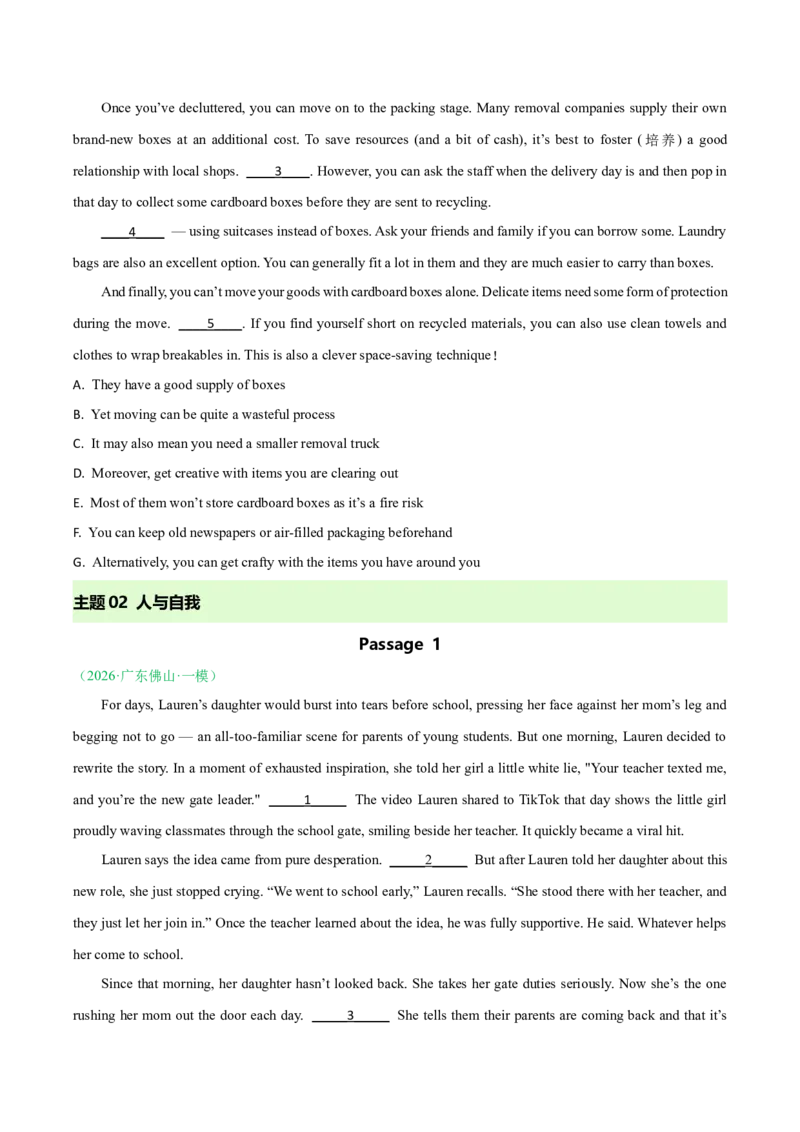
Once you’ve decluttered, you can move on to the packing stage. Many removal companies supply their own
brand-new boxes at an additional cost. To save resources (and a bit of cash), it’s best to foster ( 培养) a good
relationship with local shops. ____

 3  ____

 . However, you can ask the staff when the delivery day is and then pop in
that day to collect some cardboard boxes before they are sent to recycling.
____

 4  ____

  — using suitcases instead of boxes. Ask your friends and family if you can borrow some. Laundry
bags are also an excellent option. You can generally fit a lot in them and they are much easier to carry than boxes.
And finally, you can’t move your goods with cardboard boxes alone. Delicate items need some form of protection
during the move. ____

 5  ____

 . If you find yourself short on recycled materials, you can also use clean towels and
clothes to wrap breakables in. This is also a clever space-saving technique!
A. They have a good supply of boxes
B. Yet moving can be quite a wasteful process
C. It may also mean you need a smaller removal truck
D. Moreover, get creative with items you are clearing out
E. Most of them won’t store cardboard boxes as it’s a fire risk
F. You can keep old newspapers or air-filled packaging beforehand
G. Alternatively, you can get crafty with the items you have around you
主题02 人与自我
Passage 1
(2026·广东佛山·一模)
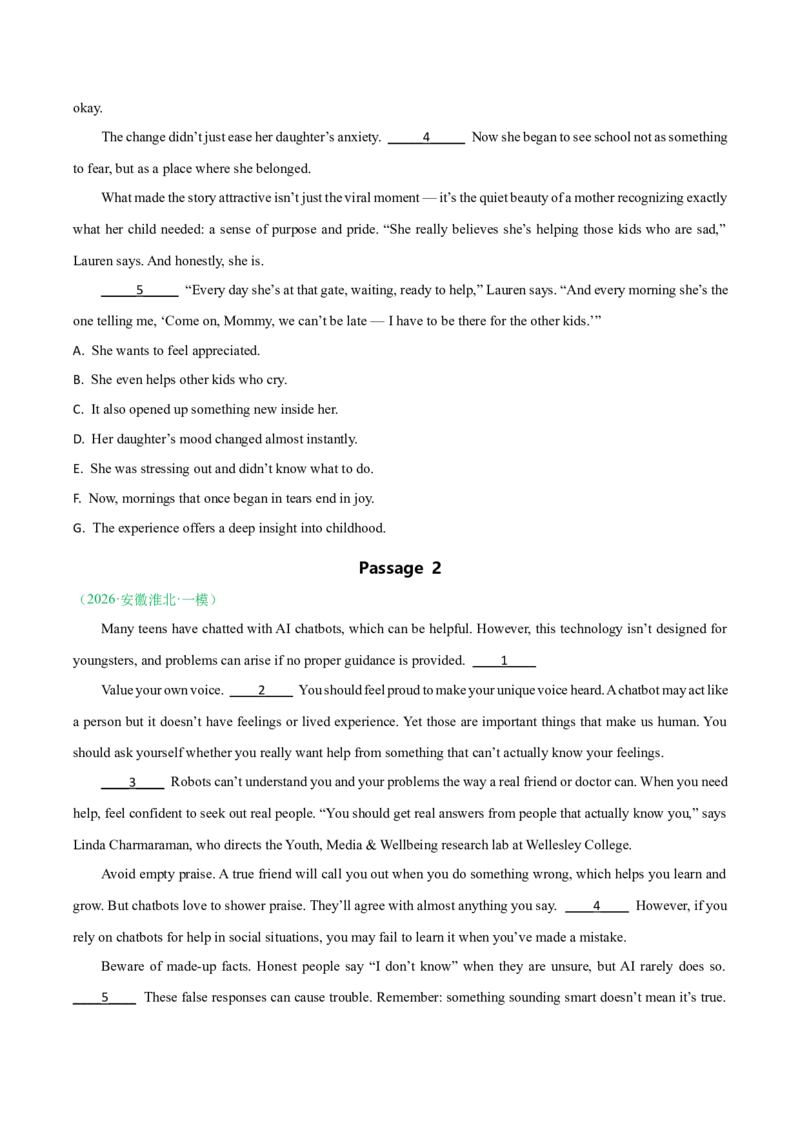
For days, Lauren’s daughter would burst into tears before school, pressing her face against her mom’s leg and
begging not to go — an all-too-familiar scene for parents of young students. But one morning, Lauren decided to
rewrite the story. In a moment of exhausted inspiration, she told her girl a little white lie, "Your teacher texted me,
and you’re the new gate leader." _____1_____ The video Lauren shared to TikTok that day shows the little girl
proudly waving classmates through the school gate, smiling beside her teacher. It quickly became a viral hit.
Lauren says the idea came from pure desperation. _____

 2  _____

  But after Lauren told her daughter about this
new role, she just stopped crying. “We went to school early,” Lauren recalls. “She stood there with her teacher, and
they just let her join in.” Once the teacher learned about the idea, he was fully supportive. He said. Whatever helps
her come to school.
Since that morning, her daughter hasn’t looked back. She takes her gate duties seriously. Now she’s the one
rushing her mom out the door each day. _____

 3  _____

  She tells them their parents are coming back and that it’s
okay.
The change didn’t just ease her daughter’s anxiety. _____

 4  _____

  Now she began to see school not as something
to fear, but as a place where she belonged.
What made the story attractive isn’t just the viral moment — it’s the quiet beauty of a mother recognizing exactly
what her child needed: a sense of purpose and pride. “She really believes she’s helping those kids who are sad,”
Lauren says. And honestly, she is.
_____

 5  _____

  “Every day she’s at that gate, waiting, ready to help,” Lauren says. “And every morning she’s the
one telling me, ‘Come on, Mommy, we can’t be late — I have to be there for the other kids.’”
A. She wants to feel appreciated.
B. She even helps other kids who cry.
C. It also opened up something new inside her.
D. Her daughter’s mood changed almost instantly.
E. She was stressing out and didn’t know what to do.
F. Now, mornings that once began in tears end in joy.
G. The experience offers a deep insight into childhood.
Passage 2
(2026·安徽淮北·一模)
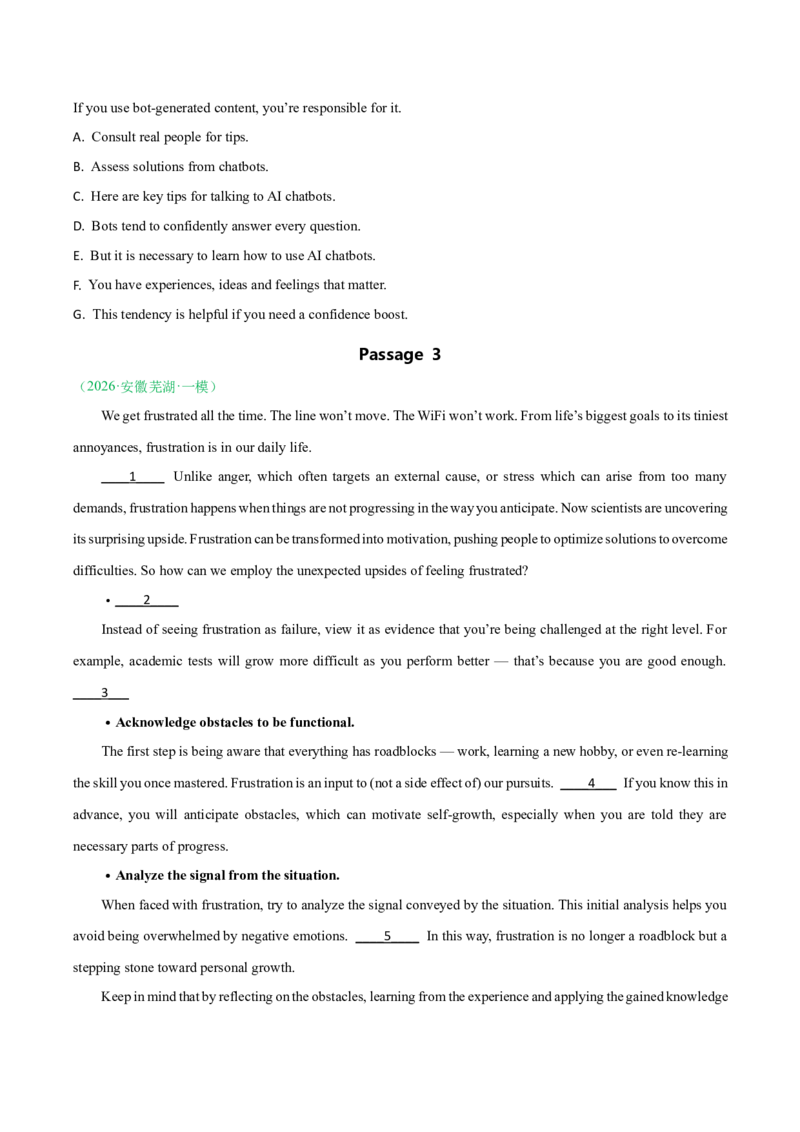
Many teens have chatted with AI chatbots, which can be helpful. However, this technology isn’t designed for
youngsters, and problems can arise if no proper guidance is provided. ____1____
Value your own voice. ____

 2  ____

  You should feel proud to make your unique voice heard. A chatbot may act like
a person but it doesn’t have feelings or lived experience. Yet those are important things that make us human. You
should ask yourself whether you really want help from something that can’t actually know your feelings.
____

 3  ____

  Robots can’t understand you and your problems the way a real friend or doctor can. When you need
help, feel confident to seek out real people. “You should get real answers from people that actually know you,” says
Linda Charmaraman, who directs the Youth, Media & Wellbeing research lab at Wellesley College.
Avoid empty praise. A true friend will call you out when you do something wrong, which helps you learn and
grow. But chatbots love to shower praise. They’ll agree with almost anything you say. ____

 4  ____

  However, if you
rely on chatbots for help in social situations, you may fail to learn it when you’ve made a mistake.
Beware of made-up facts. Honest people say “I don’t know” when they are unsure, but AI rarely does so.
____

 5  ____

  These false responses can cause trouble. Remember: something sounding smart doesn’t mean it’s true.
If you use bot-generated content, you’re responsible for it.
A. Consult real people for tips.
B. Assess solutions from chatbots.
C. Here are key tips for talking to AI chatbots.
D. Bots tend to confidently answer every question.
E. But it is necessary to learn how to use AI chatbots.
F. You have experiences, ideas and feelings that matter.
G. This tendency is helpful if you need a confidence boost.
Passage 3
(2026·安徽芜湖·一模)
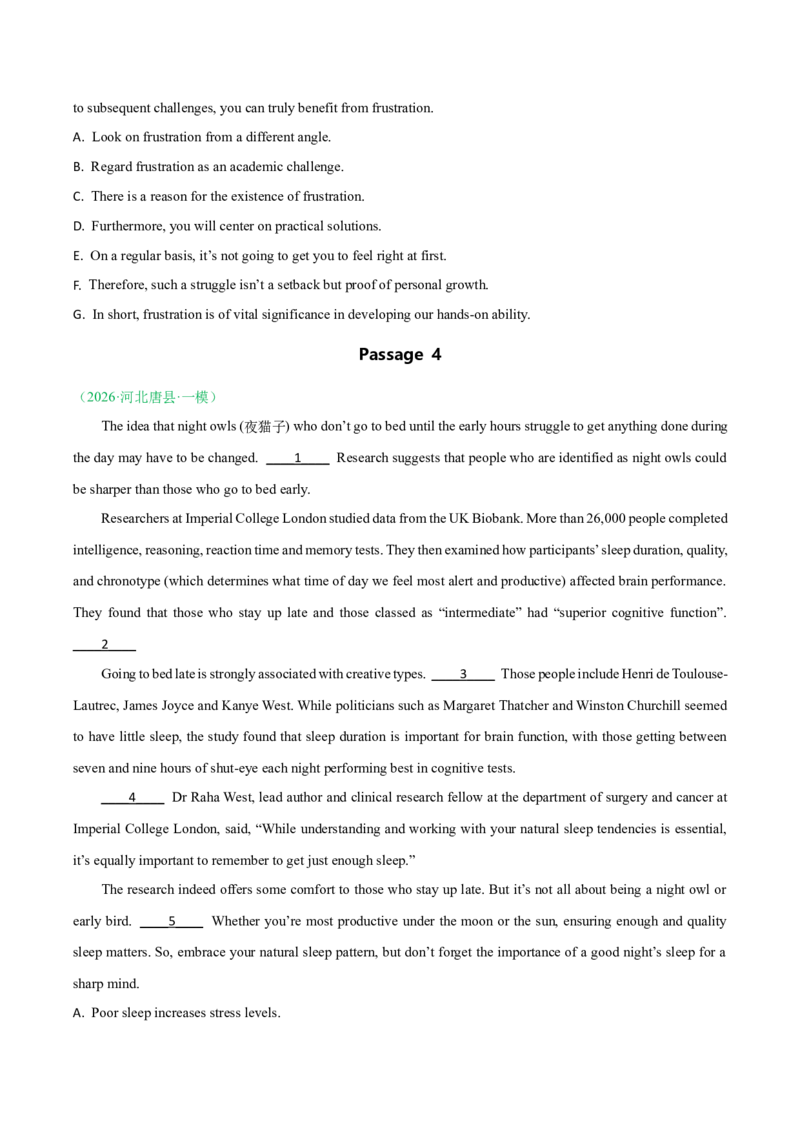
We get frustrated all the time. The line won’t move. The WiFi won’t work. From life’s biggest goals to its tiniest
annoyances, frustration is in our daily life.
____1____ Unlike anger, which often targets an external cause, or stress which can arise from too many
demands, frustration happens when things are not progressing in the way you anticipate. Now scientists are uncovering
its surprising upside. Frustration can be transformed into motivation, pushing people to optimize solutions to overcome
difficulties. So how can we employ the unexpected upsides of feeling frustrated?
·____

 2  ____


Instead of seeing frustration as failure, view it as evidence that you’re being challenged at the right level. For
example, academic tests will grow more difficult as you perform better — that’s because you are good enough.
____

 3  ___


·Acknowledge obstacles to be functional.
The first step is being aware that everything has roadblocks — work, learning a new hobby, or even re-learning
the skill you once mastered. Frustration is an input to (not a side effect of) our pursuits. ____

 4  ___

  If you know this in
advance, you will anticipate obstacles, which can motivate self-growth, especially when you are told they are
necessary parts of progress.
·Analyze the signal from the situation.
When faced with frustration, try to analyze the signal conveyed by the situation. This initial analysis helps you
avoid being overwhelmed by negative emotions. ____

 5  ____

  In this way, frustration is no longer a roadblock but a
stepping stone toward personal growth.
Keep in mind that by reflecting on the obstacles, learning from the experience and applying the gained knowledge
to subsequent challenges, you can truly benefit from frustration.
A. Look on frustration from a different angle.
B. Regard frustration as an academic challenge.
C. There is a reason for the existence of frustration.
D. Furthermore, you will center on practical solutions.
E. On a regular basis, it’s not going to get you to feel right at first.
F. Therefore, such a struggle isn’t a setback but proof of personal growth.
G. In short, frustration is of vital significance in developing our hands-on ability.
Passage 4
(2026·河北唐县·一模)
The idea that night owls (夜猫子) who don’t go to bed until the early hours struggle to get anything done during
the day may have to be changed. ____

 1  ____

  Research suggests that people who are identified as night owls could
be sharper than those who go to bed early.
Researchers at Imperial College London studied data from the UK Biobank. More than 26,000 people completed
intelligence, reasoning, reaction time and memory tests. They then examined how participants’ sleep duration, quality,
and chronotype (which determines what time of day we feel most alert and productive) affected brain performance.
They found that those who stay up late and those classed as “intermediate” had “superior cognitive function”.
____

 2  ____


Going to bed late is strongly associated with creative types. ____

 3  ____

  Those people include Henri de Toulouse-
Lautrec, James Joyce and Kanye West. While politicians such as Margaret Thatcher and Winston Churchill seemed
to have little sleep, the study found that sleep duration is important for brain function, with those getting between
seven and nine hours of shut-eye each night performing best in cognitive tests.
____

 4  ____

  Dr Raha West, lead author and clinical research fellow at the department of surgery and cancer at
Imperial College London, said, “While understanding and working with your natural sleep tendencies is essential,
it’s equally important to remember to get just enough sleep.”
The research indeed offers some comfort to those who stay up late. But it’s not all about being a night owl or
early bird. ____

 5  ____

  Whether you’re most productive under the moon or the sun, ensuring enough and quality
sleep matters. So, embrace your natural sleep pattern, but don’t forget the importance of a good night’s sleep for a
sharp mind.
A. Poor sleep increases stress levels.
B. Staying up late could hurt brain power.
C. It’s about identifying your personal sleep pattern.
D. However, early birds had the lowest scores.
E. Staying up late could be good for our brain power.
F. There are artists, authors and musicians known to be night owls.
G. Sleep duration is crucial for keeping your brain functioning at its best.
Passage 5
(2026·湖北八校·一模)
To figure out how to choose a career, start by taking a good look at yourself. Your talents, your passions and
your mission are like the small wires. ____

 1  ____

  From there, you’ll narrow the field further by looking at the
specifics of different career options you’re most suited for.
List your skills and talents. No matter who you are, there are plenty of things you’re good at. You might know
what those talents are already, but go ahead and make a list of every one that comes to mind. ____

 2  ____

  Don’t leave
out any of them, even if you don’t think it qualifies as a career skill.
Identify your passions and mission. If you’re going to find a meaningful career, passion isn’t just a pipe dream
but a must. It means the work will fulfill you. ____3____ To sustain commitment over the long stretch, you also
need a deeper purpose. This purpose defines your mission: the contribution you want to make and the results you try
to see.
____

 4  ____

  Matters like how much money you want to make and where you want to live are important too.
Think about these questions to narrow down your options: How much money do you need to make? Do you want
flexibility in your job? What kind of benefits are important to you? What kind of environment do you excel in?
If you’ve managed to get through everything above and have a clear answer for what you’re wired to do,
congratulations! If you’re still unsure, that’s okay. ____

 5  ____

  There’s only so much career shopping you can do
before you have to just go for it.
A. Consider your financial goals first.
B. Think about practical parts of a job.
C. However, passion alone isn’t enough.
D. You don’t have to have this figured out by dinnertime.
E. These are all clues that tell you what your strengths are.
F. They combine to form a picture of what you’re wired to do.
G. Your mission will follow if you’re passionate about your work.
主题03 人与自然
Passage 1
(2026·南京二十九中·一模)
Could Viewing Art Be the Next Public Health prescription (处方药)?
In an era characterized by burnout and scrolling, a therapeutic (疗愈性的) alternative is hanging on a gallery
wall. When volunteers at London’s Courtauld Gallery stood before masterpieces, their stress and inflammation (炎
症) levels dropped compared with those of volunteers viewing reproductions. ____1____
That art can lift spirits is well known. ____

 2  ____

  A study by King’s College London asked participants to look
at masterworks by 19th-century post-impressionists while wearing sensors. Half the group saw the originals in the
gallery, half viewed copies in a lab. The results were clear: going to art galleries is good for your physical health —
relieving stress and cutting heart disease risk, as well as boosting the immune system.
____

 3  ____

  Earlier this summer, a team of Cambridge psychologists conducted a similar project to show how
appreciating artistic beauty helps escape the “mental trappings of daily life.” Besides, a Nature Magazine’s review
suggests that art can play a role in public health. And for the first time in its long history, The Lancet recently ran a
photo essay showcasing how art can enhance lives.
“When you experience an artwork, you don’t just see it, but you feel it,” the art historian Katy Hessel writes.
“The best thing we can do is take time with it.” Time, of course, is what we are lacking in today’s fast-paced world.
____

 4  ____

  Galleries are quiet, thoughtful places. We stop scrolling and start really looking. Deeply engaging with
a work of art creates “psychological distancing” and enables us to see and take pleasure what is not ourselves.
Today we are advised to exercise and eat healthily. ____

 5  ____

  After all, science has spoken for this.
A. But that it calms the body is novel.
B. So we should make art more accessible to all.
C. There’s growing evidence to support that opinion.
D. Galleries bring us face to face with human genius.
E. But this seems to be key to art’s therapeutic powers.
F. Will doctors soon be prescribing a visit to a local gallery?
G. Science suggests that original art is a medicine that one can view rather than swallow.
Passage 2
(2026·广东高州·一模)
At its most basic level, laughter affects our physical body. It enables us to take in more oxygenated air and
stimulate our lungs. ____1____ This leads to several benefits.
Increases Heart Health
As we laugh at funny events, our cardiac (心脏的) health improves. Laughter provides this benefit by increasing
our heart rate and lowering our blood pressure. ____

 2  ____

  One study found that people who rarely or never laughed
were 1.21 times more likely to have heart disease than those who laughed daily. This helps reinforce ( 加强) the
benefits of humour on heart health.
Reduces Physical Pain
Let’s say we have a severe headache but are watching an extremely funny show. As we watch and laugh, we
may become at least somewhat distracted (使分心) from the headache and discomfort. ____

 3  ____


Established mechanisms are operating internally to enhance our ability to resist pain. Naturally occurring
hormones called endorphins, for example, get to work. Because we’re laughing up a storm, our body produces these
natural painkillers.
____

 4  ____


Laughing offers another physical benefit: it can help us sleep better. In one small-scale study, residents at a long-
term care hospital engaged in 40-minute laughter therapy sessions twice a week for four weeks. Their sleep quality
improved during this time, as did their feelings of depression.
Combining laughter with yoga, called laughing yoga, has also been found to improve sleep quality and help us
fall asleep faster. This form of yoga involves movements that make us want to laugh.
Boosts Immunity (免疫力)
Overall, extensive laughter supports the immune system, which makes us more resistant to disease. By laughing,
we increase antibody-producing cells and enhance the effectiveness of T cells in our body. ____

 5  ____

  Physicians
and mental health professionals can use laughter to help patients achieve positive health outcomes.
A. Improves sleep.
B. Gets good relationships.
C. You may find it hard to stay humorous.
D. This is much like how our body responds to exercise.
E. These tiny things act like a defense army to fight illness
F. But the distraction alone isn’t what reduces our pain perception.
G. Moments of loud laughter also relieve tension in our muscles.
主题01 人与社会
Passage 1
(2026·湖南株洲·一模)
The first writing was invented in Babylon more than 5,000 years ago. ___1___ Soon after, people cut reeds
(芦苇) to make dip-pens to use with ink.
Around 2,500 years ago, people started using the feather for writing. No one knows exactly who first had the
idea. ___

 2  ___

  They were the main writing tool until metal pens appeared.
In fact, the word “pen” comes from the Latin penna, meaning “feather”. ___

 3  ___

  A writing feather has to be
specially prepared. So how do feathers become pens?
The first step is to collect a hard feather. Then take a sharp knife and cut the feathery part off, leaving just a bare
tube. Slice the end off at an angle. At the same time, use a wire or long needle to clear the stuff inside the stick of the
feather. ___

 4  ___

  You still need to cut a small flat end across the pointed tip and cut a short slit (狭缝) in the end.
As you press the pointed tip down on the paper, the slit opens slightly to let ink run down. Finally, curve the sides of
the cut end and cut the end to a sharp point. A fresh feather pen is, therefore, ready for words. But users have to cut
the pen many times a day, as the tip wears down during writing.
___

 5  ___

  They don’t mind — they naturally drop their feathers, and grow new ones if any are pulled out to
make pens.
A. You can’t just take a feather and dip it in ink.
B. It takes many years to develop a feather into a pen.
C. The feather is naturally empty inside for holding ink.
D. But feather pens became especially popular in Europe.
E. The last step is to decide where you collect the feathers.
F. People there used a little stick to press shapes into soft clay.
G. Most feather pens are made from the large flight feathers of birds.
Passage 2
(2026·河南开封·一模)
Could Viewing Art Be the Next Public Health prescription (处方药)?
In an era characterized by burnout and scrolling, a therapeutic (疗愈性的) alternative is hanging on a gallery
wall. When volunteers at London’s Courtauld Gallery stood before masterpieces, their stress and inflammation (炎
症) levels dropped compared with those of volunteers viewing reproductions. ____

 1  ____


That art can lift spirits is well known. ____

 2  ____

  A study by King’s College London asked participants to look
at masterworks by 19th-century post-impressionists while wearing sensors. Half the group saw the originals in the
gallery, half viewed copies in a lab. The results were clear: going to art galleries is good for your physical health —
relieving stress and cutting heart disease risk, as well as boosting the immune system.
____

 3  ____

  Earlier this summer, a team of Cambridge psychologists conducted a similar project to show how
appreciating artistic beauty helps escape the “mental trappings of daily life.” Besides, a Nature Magazine’s review
suggests that art can play a role in public health. And for the first time in its long history, The Lancet recently ran a
photo essay showcasing how art can enhance lives.
“When you experience an artwork, you don’t just see it, but you feel it,” the art historian Katy Hessel writes.
“The best thing we can do is take time with it.” Time, of course, is what we are lacking in today’s fast-paced world.
____

 4  ____

  Galleries are quiet, thoughtful places. We stop scrolling and start really looking. Deeply engaging with
a work of art creates “psychological distancing” and enables us to see and take pleasure what is not ourselves.
Today we are advised to exercise and eat healthily. ____

 5  ____

  After all, science has spoken for this.
A. But that it calms the body is novel.
B. So we should make art more accessible to all.
C. There’s growing evidence to support that opinion.
D. Galleries bring us face to face with human genius.
E. But this seems to be key to art’s therapeutic powers.
F. Will doctors soon be prescribing a visit to a local gallery?
G. Science suggests that original art is a medicine that one can view rather than swallow.
Passage 3
(2026·广东顺德区·一模)
As a well-known weather presenter, there are times when I’m walking around a supermarket, and a shopper will
approach me with a complaint: “I hosted my son’s wedding on Saturday, and you told me it was going to rain, but it
didn’t. Why did you get it wrong?”
Over my career, forecasting has improved almost beyond recognition. Liz Bentley, a professor of meteorology
at Reading University, notes that a one-day forecast is now correct more than 90% of the time. ___

 1  ___

  A YouGov
survey last summer found that 37% of British adults didn’t trust the weather forecast “very much” or “at all”.
So why, with all our wealth of knowledge and powerful forecasting technology, do some people still perceive
the weather forecasts as incorrect? ___

 2  ___

  In today’s world, we have access to instant information. We can adjust the
temperature of our fridges or diagnose problems with our cars using our smartphones in seconds. So why can’t we
find out whether it’s going to rain on our street at 2 pm on Sunday with 100% accuracy?
___

 3  ___

  Meteorology (气象学) produces an overwhelming amount of data; it’s difficult to turn it into a brief,
attention-grabbing prediction for TV or digital app. It means that even when we are technically correct, some viewers
might still be confused.
The real challenge lies in the tricky nature of meteorology. ___

 4  ___

  A slight error — even as small as 0.01°C
— in the initial data can produce a drastically different result. It’s important to remember that forecasting is about
predicting.
The future of weather forecasting may soon be transformed by Artificial Intelligence (AI). As AI is more flexible,
users will soon have access to frequently-changing forecasts. But there are upsides too. The advances in AI and
forecasting offer exciting possibilities, including the prospect of much longer-term, more accurate forecasts. Perhaps
one day, I’ll meet a mother who asks me to predict weather at her son’s wedding six months from now. ___

 5  ___


A. It’s a delicate science.
B. Viewers are no longer interested.
C. However, there are still gaps in public trust.
D. Part of the answer is in our rising expectations.
E. And then I might be able to give a better answer.
F. We will make sure technology bugs never happen.
G. Another reason is how the information is communicated.
主题02 人与自我
Passage 1
(2026·山东济南·一模)
Time management is often described as the way you use time to get more done and achieve desired results.
____1____ It is impossible to manage time. Each day offers everyone the same 24 hours, so what you can truly
manage is yourself.
____

 2  ____

  By developing productive habits, you automatically direct your focus toward high-impact tasks,
ensuring that efforts are not merely spent on doing more, but on doing the right things well. Therefore, shifting from
being merely busy to being genuinely productive requires forming a set of essential habits.
You may begin by tracking your time for a week to gain an honest, data-driven picture of your current habits.
____

 3  ____

  It helps force you to clarify priorities and allocate (分配) specific blocks of time for focused work.
Equally critical is protecting your focus. Schedule demanding tasks for your peak productivity hours and defend these
blocks using visual signals(e.g. “Do not disturb” signs). to minimize interruptions.
However, a common misconception is that multitasking enhances productivity. In reality, what we call
multitasking is often rapid task-switching, which divides attention, reduces focus, and ultimately leads to lower-
quality results. ____

 4  ____

  It’s important to recognize that the primary barriers to effective self-management are
rarely a lack of time: Rather, they typically arise from a lack of clear priorities or unexamined habits.
Time, much like money, is a valuable and limited resource. It demands wise allocation and investment in what
truly matters. Mastering self-management is key to unlocking enhanced productivity and achieving goals. ____

 5  ____


A. However, the phrase is misleading.
B. Achieving your goals is never that easy.
C. Anyway, good habits are usually formed by force.
D. With this insight structure your day by creating a schedule.
E. Instead, concentrated effort on one task produces far superior outcomes.
F. A huge part of our day, from morning routine to work processes, runs on habits.
G. By managing yourself effectively, you ensure your time is invested, not just spent.
Passage 2
(2026·湖北襄阳·一模)
Gratitude is a positive emotion that recognizes the good that others have brought to our lives, and is important
both for our interpersonal relationships and physical well-being. ____1____. A pioneering meta-analysis spanning
15 countries confirmed a significant inverse correlation-higher gratitude correlates with lower loneliness-highlighting
gratitude’s potential to ease the global loneliness epidemic.
Psychologist James Hittner notes loneliness results from unmet social relationship expectations, a psychological
gap that often leads to emotional isolation and depression if left unaddressed. Hittner and Calvin Widholm analyzed
26 studies involving over 10,000 participants across diverse age groups and cultural backgrounds, finding a moderate
inverse relationship between gratitude and loneliness. Those scoring above average in gratitude had a 62.4%
chance of below-average loneliness, a statistic that held consistent even after controlling for factors like socioeconomic
status. Neuroscientist Glenn Fox, who published the first direct study of gratitude in the brain in 2015, was not
shocked by the result. ____

 2  ____

 . The research found gratitude boosts medial prefrontal cortex activity, a region
tied to social bonding and the experience of joy, which further explains the emotional and neurological link between
gratitude and reduced social disconnection.
Bartlett, a professor at Gonzaga University in Spokane, Washington, studies how our emotions have evolved to
serve an adaptive social purposes____

 3  ____

 . Bartlett and her colleagues evaluated the long-term effect of gratitude
on loneliness and health in older adults in a 2019 study. Over the course of 20 days, participants were asked to write
down their daily grateful moments, specifying not just what they were thankful for but also why the experience
mattered to them. This simple practice was reported to contribute to a sustained decrease in loneliness and a
marked increase in physical and mental well-being in the participants.
Some research has even shown the positive impact of gratitude-letter writing, which takes the reflective practice a
step further with tangible expression. Bartlett often suggests gratitude-letter writing to her students as an exercise in
emotional awareness. She asked her students to write to a person who they have never thanked, or someone have not
expressed gratitude to for a long time. ____

 4  ____

 .
To build a sustainable gratitude practice against chronic loneliness, Bartlett offers actionable, science-backed
tips that go beyond basic daily reflection. First, record three good things and their specific contributors every day,
rather than vague positive events. Second, write a physical gratitude letter to someone underappreciated and deliver
it in person if possible, a gesture that requires vulnerability but often leads to deeply moving conversations. ____

 5  ___

 _  .
Unlike texts or digital messages, hand-delivered letters foster authentic, deep interpersonal connection, directly easing
loneliness.
A. She focused on older adults in research
B. Such practice strengthens interpersonal connections
C. His brain study backed the finding
D. Gradually, this cultivates a consistent gratitude routine
E. It has also been linked to decreased loneliness.
F. Gratitude lights the “social bonding” circuit
G. She questions whether gratitude works in long-term studies
Passage 3
(2026·湖北荆州·一模)
Social anxiety is more than just occasional shyness — it is a persistent and intense fear of being judged or
criticized in social situations. ___1___ While it is normal to feel nervous before a speech, social anxiety can make
daily activities — such as speaking in class, or attending gatherings — extremely upsetting.
Researchers are learning that anxiety disorders run in families, and that they have a biological basis. Anxiety
disorders typically develop from a complex set of risk factors, including genetics, brain chemistry, personality, and
life experiences. Although social anxiety is highly treatable, only about one-third of those affected seek help. ___

 2  ___


There are practical ways to cope with social anxiety. One effective approach is to face fears gradually. Start with
less challenging social tasks — such as greeting a classmate — and slowly progress to more difficult ones, like
giving a short presentation. ___

 3  ___

  They can shift attention away from yourself and keep the conversation flowing
smoothly.
___

 4  ___

  But the truth is that those opinions of others have no reflection on your worth or talents. Social anxiety
treatment includes learning to be flawed (有缺陷的), while at the same time rejecting the need for approval from
external sources. Consistently overestimating how much and how badly others think of you only causes you to be
more depressed.
Rather than criticizing yourself after each social interaction, reward yourself instead. ___

 5  ___

  You deserve the
praise, and you will be more motivated to do it again if there are some self-high-fives or frozen yogurts on the back
end.
A. Positive self-talk is another helpful tool.
B. Social anxiety is tied to feelings of being judged.
C. Left unaddressed, it may lead to loneliness or depression.
D. To prepare some open-ended questions also makes sense.
E. Being a perfectionist is fine in rocket science, but not in real life.
F. Individuals with this condition often imagine things going wrong in interactions.
G. Whether you attended a party or started a conversation, acknowledge your effort.
Passage 4
(2026·河南郑州·一模)
Rejection creates an emotional roller coaster (过山车). We feel the sadness, anger, and loss of the person who
rejects us. ___

 1  ___

  This is why getting over a rejection is challenging. While there is no quick fix, the following
suggestions can help us overcome the confusion and ease the pain of rejection.
Use the power of breath. ___

 2  ___

  And each one affects the others. Deep breaths help us absorb the feelings
and restore a sense of calm. Mindful breathing is one of the most powerful and accessible resources for self-regulation,
relaxation, and overall well-being. We can also use breath to move our attention from disturbing thoughts back to
ourselves.
Note it down in a journal. Journaling provides a safe place without fear of misunderstanding. In moments of
sadness and loss, the weight of emotions can be very great. ___

 3  ___

  It allows us to explore our thoughts, feelings,
and memories, process our experiences and find relief in pain.
Learn to give to others. The acts of serving and giving to others are powerful and helpful. When we support
others, especially during difficult times, something within also starts to heal (愈合) and grow. ___

 4  ___

  When we
connect with people who are less fortunate, we start to realize that our pain is less significant. Giving to others also
empowers us. It gives us a sense of self-worth and moves us away from the hurt.
Getting over a rejection is hard. However, your pain won’t last forever. It is there to make you grow. Everyone
heals from rejection at their own pace in their own way. We are all suffering in one way or another at one time or
another. We must have pity for ourselves and accept that reality. It’s important to take your time to deal with rejection
and to use the practices suggested to heal and move on to the new opportunities life presents us. ___

 5  ___


A. Our self-respect is hurt as well.
B. It is necessary to offer and accept.
C. It won’t be easy, but it will be worth it.
D. Accepting others’ offer makes us feel hopeful.
E. It is connected to the body, emotions and thoughts.
F. Writing serves as a powerful tool to unburden our inner selves.
G. Helping others provides us with a sense of purpose and deep satisfaction.
主题03 人与自然
Passage 1
(2026·湖南湘潭一中·一模)
The Last Living Monet
Every winter, the head gardener at Claude Monet’s garden in the tiny French village of Giverny sits down to a
pile of seed lists’ for disappointment. Avisard knows he must grow at least 520,000 plants to recreate these historic
grounds. But each year at least 10 seed varieties he selected the previous season will disappear.____

 1  ____

  When
Monet moved to Giverny in 1883, nurseries (苗圃) were covered with Victorian flowers. Many of his favored varieties
have since gone extinct or been completely changed as people prefer both harder (耐寒的) plants and flowers with
ever-increasing blooms.
This season, Avisard is crazy about growing a taller pelargonium (天竺葵), a clumped-flower (簇状花) cousin
to the geranium (老鹳草) that Monet famously planted in several red and pink beds in front of his pink house.
“____

 2  ____

 ” Avisard says. “To bring them back would be a resurrection (起死回生).”
Head gardener since 2016, Avisard now leads a dozen gardeners, twice as many as Monet enlisted.
____3____ Wetter winters followed by hot, dry summers lead to earlier crowds of pests. In addition, the management
of tourists poses a significant challenge. ____

 4  ___


“It’s complicated.” says Avisard, “____

 5  ____

 ” He and Giverny’s gardeners seek to please a man they’ve never
met by creating a space so identifiable that it reminds strangers of paintings they see hanging in museums the world
over.
As seeds disappear, the task only gets harder. “We want people to look out like Monet and see what he saw.”
A. You can’t buy them anywhere.
B. As with fashion, people’s tastes in flowers change.
C. The tourists have to feel like they are in Monet’s paintings.
D. These gardeners struggle with a wildly changing ecosystem.
E. Monet’s garden symbolizes impressionist art and natural beauty.
F. His work includes planting, researching and sourcing rare seeds.
G. Nearly 800,000 visitors flock to the area every year between April and October.
Passage 2
(2026·湖北十堰·一模)
Though positivity isn’t what everyone is born with, we can grow more positive with practice. Here are practical
ways to help you do so.
Learn to reframe negative experiences. One of the mistakes people make is trying to avoid or ignore negative
experiences. ____

 1  ____

 . However, trying to avoid or ignore these experiences actually damages your ability to deal
with them. Instead, consider how you can reframe these experiences. Try to learn from them or view them
differently.
____

 2  ____

 . Your body and your mind are connected. If you’re struggling to feel positive, it could be because
your body is working against you. Social psychologist Amy Cuddy has shown that your posture can affect the levels of
stress hormones in your body. Try standing up straight. Hold your shoulders back and your chest forward. Hold your
gaze in front of you. ____

 3  ____

 .
Show compassion to others. Compassion is doing something kind for someone else, especially if that person is
less fortunate than you are. It can really boost your positivity. ____

 4  ____

 , whether it’s on an individual level or in
your community, and practice showing compassion. Not only is it good for others, it’s even good for your health!
See a therapist (治疗师). A common misperception is that people only need to see a therapist when there’s
something wrong. ____

 5  ____

 . Similarly, seeing a therapist can also be a helpful preventive technique. And if you
want to learn how to think and behave more positively, a therapist can help you identify unhelpful patterns in your
thinking and develop new positive strategies.
A. Use your body
B. Do exercise to keep physically fit
C. Learn from positive people around you
D. Think of ways that you can serve others
E. This makes sense, on some level, because they’re painful
F. These “power poses” can help you feel more confident and optimistic
G. Actually, you go to the doctor for annual checkups even if you’re not sick