@小红书:苏苏老师精品资料——原创制作
2026 秋新人教PEP 版六年级上册英语同步讲义
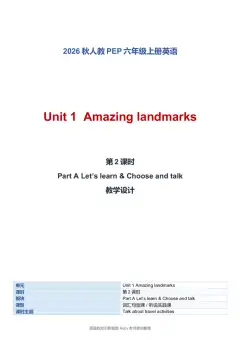
Unit 1 Amazing landmarks 同步讲义
第一部分 知识清单
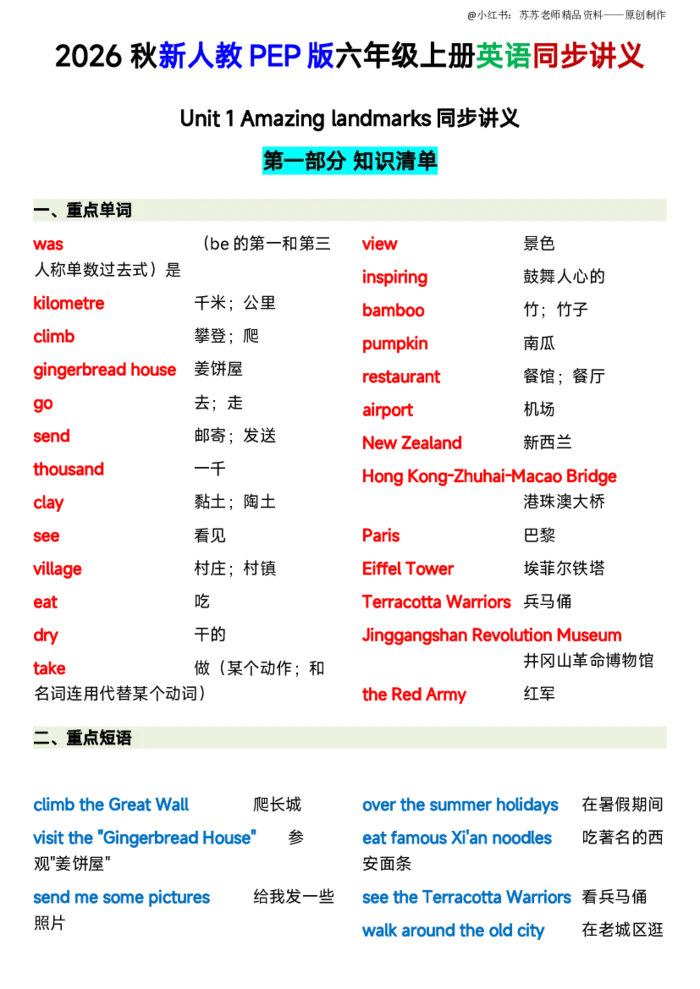
一、重点单词
was
(be 的第一和第三
人称单数过去式)是
kilometre
千米;公里
climb
攀登;爬
gingerbread house
姜饼屋
go
去;走
send
邮寄;发送
thousand
一千
clay
黏土;陶土
see
看见
village
村庄;村镇
eat
吃
dry
干的
take
做(某个动作;和
名词连用代替某个动词)
view
景色
inspiring
鼓舞人心的
bamboo
竹;竹子
pumpkin
南瓜
restaurant
餐馆;餐厅
airport
机场
New Zealand
新西兰
Hong Kong-Zhuhai-Macao Bridge
港珠澳大桥
Paris
巴黎
Eiffel Tower
埃菲尔铁塔
Terracotta Warriors 兵马俑
Jinggangshan Revolution Museum
井冈山革命博物馆
the Red Army
红军
二、重点短语
climb the Great Wall
爬长城
visit the "Gingerbread House"
参
观"姜饼屋"
send me some pictures
给我发一些
照片
over the summer holidays
在暑假期间
eat famous Xi'an noodles
吃著名的西
安面条
see the Terracotta Warriors 看兵马俑
walk around the old city
在老城区逛
@小红书:苏苏老师精品资料——原创制作
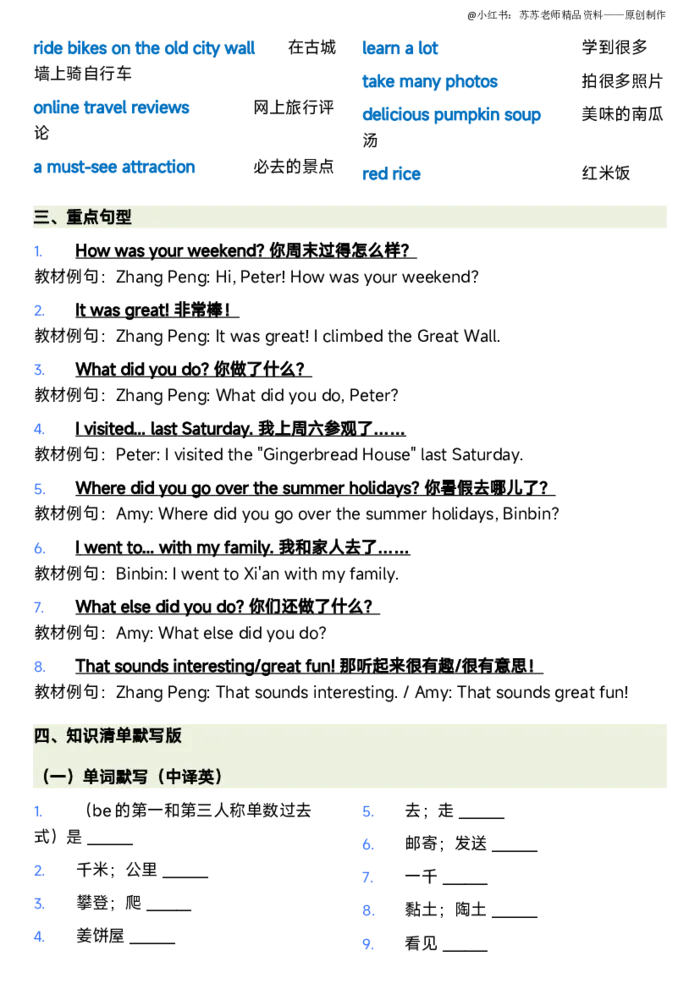
ride bikes on the old city wall
在古城
墙上骑自行车
online travel reviews
网上旅行评
论
a must-see attraction
必去的景点
learn a lot
学到很多
take many photos
拍很多照片
delicious pumpkin soup
美味的南瓜
汤
red rice
红米饭
三、重点句型
1.
How

  was

  your

  weekend?

  你周末过得怎么样?


教材例句:Zhang Peng: Hi, Peter! How was your weekend?
2.
It   was

  great!

  非常棒!


教材例句:Zhang Peng: It was great! I climbed the Great Wall.
3.
What

  did

  you

  do?

  你做了什么?


教材例句:Zhang Peng: What did you do, Peter?
4.
I  visited...

  last

  Saturday.

  我上周六参观了……


教材例句:Peter: I visited the "Gingerbread House" last Saturday.
5.
Where

  did

  you

  go
   over

  the

  summer

  holidays?

  你暑假去哪儿了?


教材例句:Amy: Where did you go over the summer holidays, Binbin?
6.
I  went

  to...

  with

  my

  family.

  我和家人去了……


教材例句:Binbin: I went to Xi'an with my family.
7.
What

  else

  did

  you

  do?

  你们还做了什么?


教材例句:Amy: What else did you do?
8.
That

  sounds

  interesting/great

  fun!

  那听起来很有趣

 /  很有意思!


教材例句:Zhang Peng: That sounds interesting. / Amy: That sounds great fun!
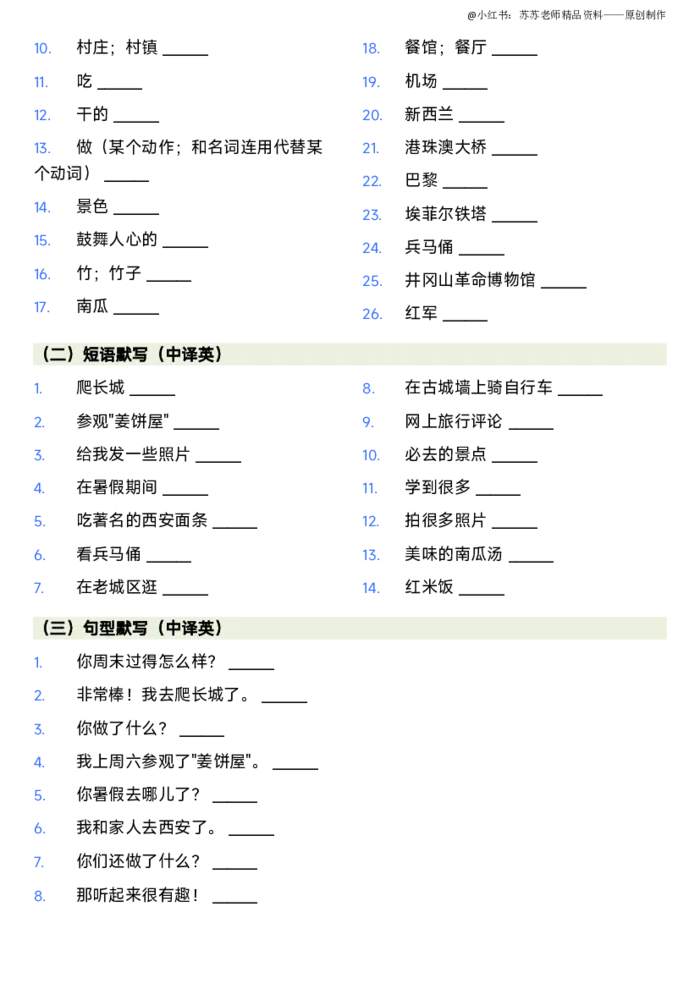
四、知识清单默写版
(一)单词默写(中译英)
1.
(be 的第一和第三人称单数过去
式)是 ______
2.
千米;公里 ______
3.
攀登;爬 ______
4.
姜饼屋 ______
5.
去;走 ______
6.
邮寄;发送 ______
7.
一千 ______
8.
黏土;陶土 ______
9.
看见 ______
@小红书:苏苏老师精品资料——原创制作
10.
村庄;村镇 ______
11.
吃 ______
12.
干的 ______
13.
做(某个动作;和名词连用代替某
个动词) ______
14.
景色 ______
15.
鼓舞人心的 ______
16.
竹;竹子 ______
17.
南瓜 ______
18.
餐馆;餐厅 ______
19.
机场 ______
20.
新西兰 ______
21.
港珠澳大桥 ______
22.
巴黎 ______
23.
埃菲尔铁塔 ______
24.
兵马俑 ______
25.
井冈山革命博物馆 ______
26.
红军 ______
(二)短语默写(中译英)
1.
爬长城 ______
2.
参观"姜饼屋" ______
3.
给我发一些照片 ______
4.
在暑假期间 ______
5.
吃著名的西安面条 ______
6.
看兵马俑 ______
7.
在老城区逛 ______
8.
在古城墙上骑自行车 ______
9.
网上旅行评论 ______
10.
必去的景点 ______
11.
学到很多 ______
12.
拍很多照片 ______
13.
美味的南瓜汤 ______
14.
红米饭 ______
(三)句型默写(中译英)
1.
你周末过得怎么样? ______
2.
非常棒!我去爬长城了。 ______
3.
你做了什么? ______
4.
我上周六参观了"姜饼屋"。 ______
5.
你暑假去哪儿了? ______
6.
我和家人去西安了。 ______
7.
你们还做了什么? ______
8.
那听起来很有趣! ______
@小红书:苏苏老师精品资料——原创制作
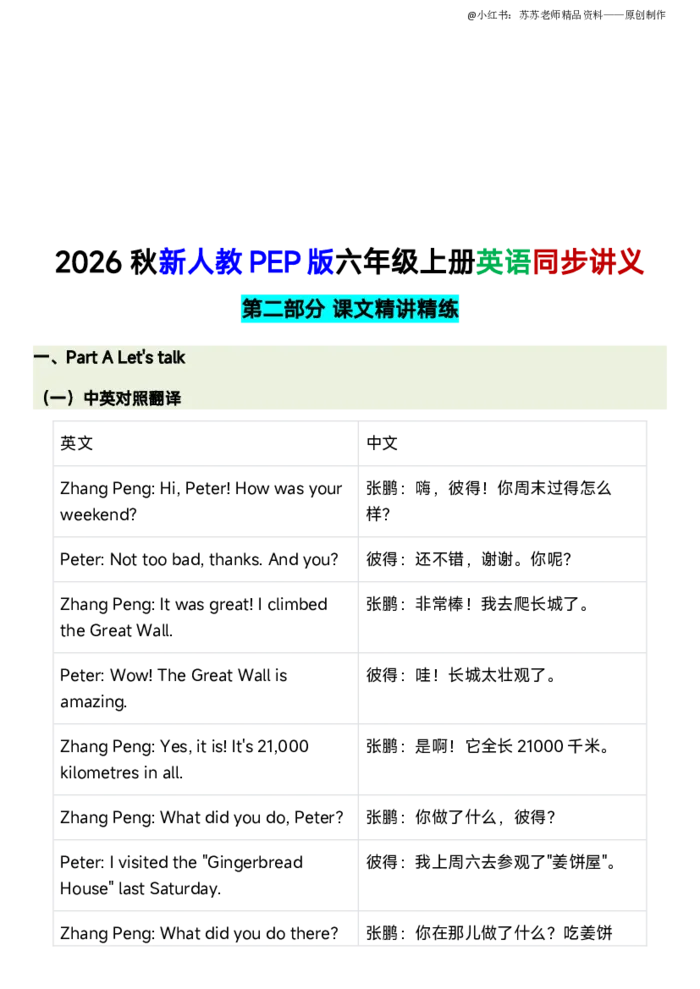
2026 秋新人教PEP 版六年级上册英语同步讲义
第二部分 课文精讲精练
一、Part A Let's talk
(一)中英对照翻译
英文
中文
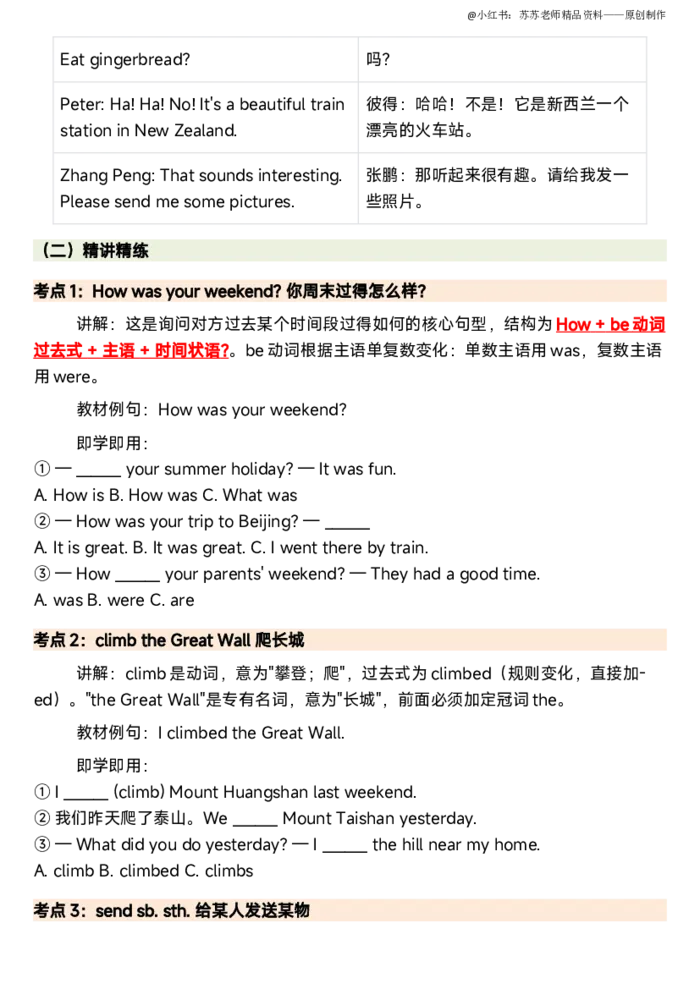
Zhang Peng: Hi, Peter! How was your
weekend?
张鹏:嗨,彼得!你周末过得怎么
样?
Peter: Not too bad, thanks. And you?
彼得:还不错,谢谢。你呢?
Zhang Peng: It was great! I climbed
the Great Wall.
张鹏:非常棒!我去爬长城了。
Peter: Wow! The Great Wall is
amazing.
彼得:哇!长城太壮观了。
Zhang Peng: Yes, it is! It's 21,000
kilometres in all.
张鹏:是啊!它全长21000 千米。
Zhang Peng: What did you do, Peter?
张鹏:你做了什么,彼得?
Peter: I visited the "Gingerbread
House" last Saturday.
彼得:我上周六去参观了"姜饼屋"。
Zhang Peng: What did you do there?
张鹏:你在那儿做了什么?吃姜饼
@小红书:苏苏老师精品资料——原创制作
Eat gingerbread?
吗?
Peter: Ha! Ha! No! It's a beautiful train
station in New Zealand.
彼得:哈哈!不是!它是新西兰一个
漂亮的火车站。
Zhang Peng: That sounds interesting.
Please send me some pictures.
张鹏:那听起来很有趣。请给我发一
些照片。
(二)精讲精练
考点1:How was your weekend? 你周末过得怎么样?
•
讲解:这是询问对方过去某个时间段过得如何的核心句型,结构为How

  +   be
  动词


过去式

 +   主语

 +   时间状语

 ?  。be 动词根据主语单复数变化:单数主语用was,复数主语
用were。
•
教材例句:How was your weekend?
•
即学即用:
① — ______ your summer holiday? — It was fun.
A. How is B. How was C. What was
② — How was your trip to Beijing? — ______
A. It is great. B. It was great. C. I went there by train.
③ — How ______ your parents' weekend? — They had a good time.
A. was B. were C. are
考点2:climb the Great Wall 爬长城
•
讲解:climb 是动词,意为"攀登;爬",过去式为climbed(规则变化,直接加-
ed)。"the Great Wall"是专有名词,意为"长城",前面必须加定冠词the。
•
教材例句:I climbed the Great Wall.
•
即学即用:
① I ______ (climb) Mount Huangshan last weekend.
② 我们昨天爬了泰山。We ______ Mount Taishan yesterday.
③ — What did you do yesterday? — I ______ the hill near my home.
A. climb B. climbed C. climbs
考点3:send sb. sth. 给某人发送某物
@小红书:苏苏老师精品资料——原创制作
•
讲解:send 是动词,意为"邮寄;发送",过去式为sent(不规则变化)。常用搭
配send

  sb.
   sth.

  =   send

  sth.

  to
   sb.
  ,意为"给某人发送/邮寄某物"。
•
教材例句:Please send me some pictures.
•
即学即用:
① He ______ (send) me a postcard from New York last week.
② 请给我发一封电子邮件。Please ______ an email ______ me.
③ My friend often ______ me funny videos.
A. send B. sends C. sent
二、Part B Let's talk
(一)中英对照翻译
(二)精讲精练
英文
中文
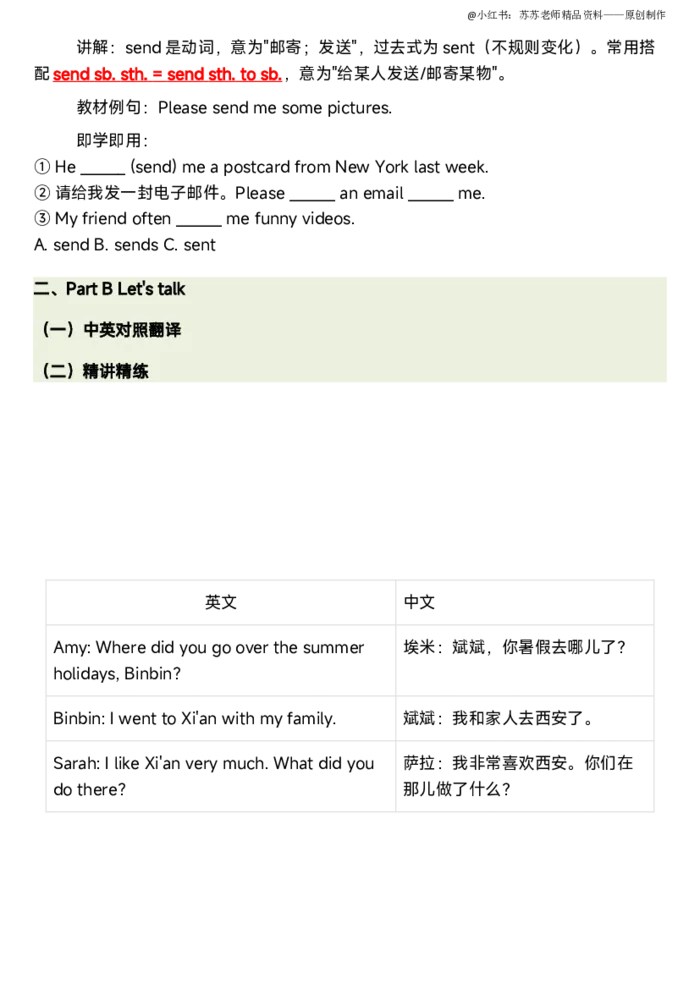
Amy: Where did you go over the summer
holidays, Binbin?
埃米:斌斌,你暑假去哪儿了?
Binbin: I went to Xi'an with my family.
斌斌:我和家人去西安了。
Sarah: I like Xi'an very much. What did you
do there?
萨拉:我非常喜欢西安。你们在
那儿做了什么?
@小红书:苏苏老师精品资料——原创制作
(二)精讲精练
考点1:over the summer holidays 在暑假期间
•
讲解:over 在这里是介词,意为"在……期间",相当于during。"summer
holidays"意为"暑假",常用复数形式。
•
教材例句:Where did you go over the summer holidays, Binbin?
•
即学即用:
① What did you do ______ the winter holidays?
A. over B. on C. at
② 我在国庆期间去了上海。I went to Shanghai ______ the National Day holiday.
③ — Where did you go ______ the Labour Day holiday? — I went to Tianjin.
A. in B. over C. for
考点2:What else did you do? 你们还做了什么?
•
讲解:else 是副词,意为"其他;另外",必须放在疑问词(what, who, where
等)后面,表示"还有什么/谁/哪里"。
•
教材例句:What else did you do?
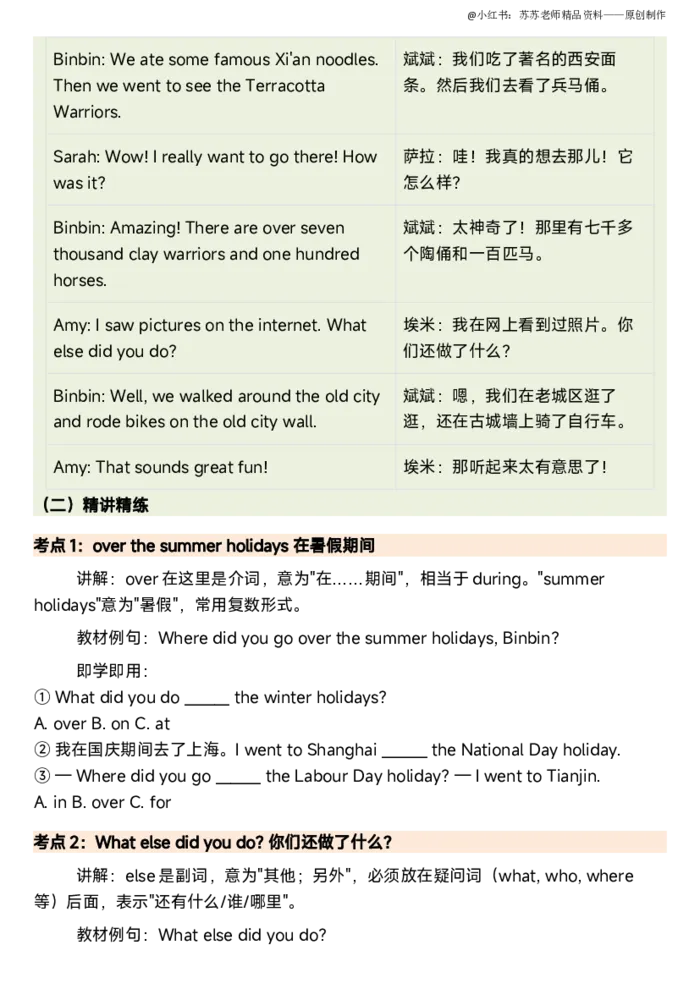
Binbin: We ate some famous Xi'an noodles.
Then we went to see the Terracotta
Warriors.
斌斌:我们吃了著名的西安面
条。然后我们去看了兵马俑。
Sarah: Wow! I really want to go there! How
was it?
萨拉:哇!我真的想去那儿!它
怎么样?
Binbin: Amazing! There are over seven
thousand clay warriors and one hundred
horses.
斌斌:太神奇了!那里有七千多
个陶俑和一百匹马。
Amy: I saw pictures on the internet. What
else did you do?
埃米:我在网上看到过照片。你
们还做了什么?
Binbin: Well, we walked around the old city
and rode bikes on the old city wall.
斌斌:嗯,我们在老城区逛了
逛,还在古城墙上骑了自行车。
Amy: That sounds great fun!
埃米:那听起来太有意思了!
@小红书:苏苏老师精品资料——原创制作
•
即学即用:
① — What else ______ you ______ (do) yesterday? — I watched a movie.
② 你还想去哪里?______ do you want to go?
③ — Who else ______ (come) to your party last night? — Lily and Lucy.
A. come B. came C. comes
考点3:That sounds great fun! 那听起来太有意思了!
•
讲解:sound 是系动词,意为"听起来",后面接形容词或名词作表语。great fun
意为"非常有趣",fun 在这里是不可数名词。
•
教材例句:That sounds great fun!
•
即学即用:
① The story ______ (sound) interesting.
② 那听起来很棒!That ______ great!
③ — Let's go to the park this weekend. — ______
A. That sounds good. B. That sound good. C. That is sound good.
三、Read and write
(一)中英对照翻译
英文
中文
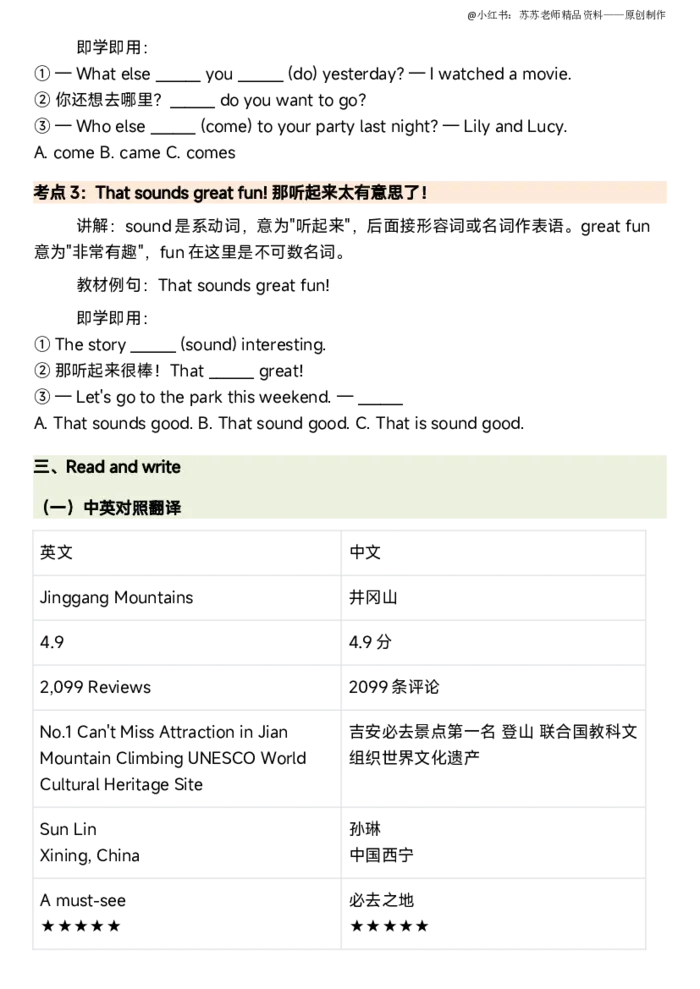
Jinggang Mountains
井冈山
4.9
4.9 分
2,099 Reviews
2099 条评论
No.1 Can't Miss Attraction in Jian
Mountain Climbing UNESCO World
Cultural Heritage Site
吉安必去景点第一名 登山 联合国教科文
组织世界文化遗产
Sun Lin
Xining, China
孙琳
中国西宁
A must-see
★★★★★
必去之地
★★★★★
@小红书:苏苏老师精品资料——原创制作
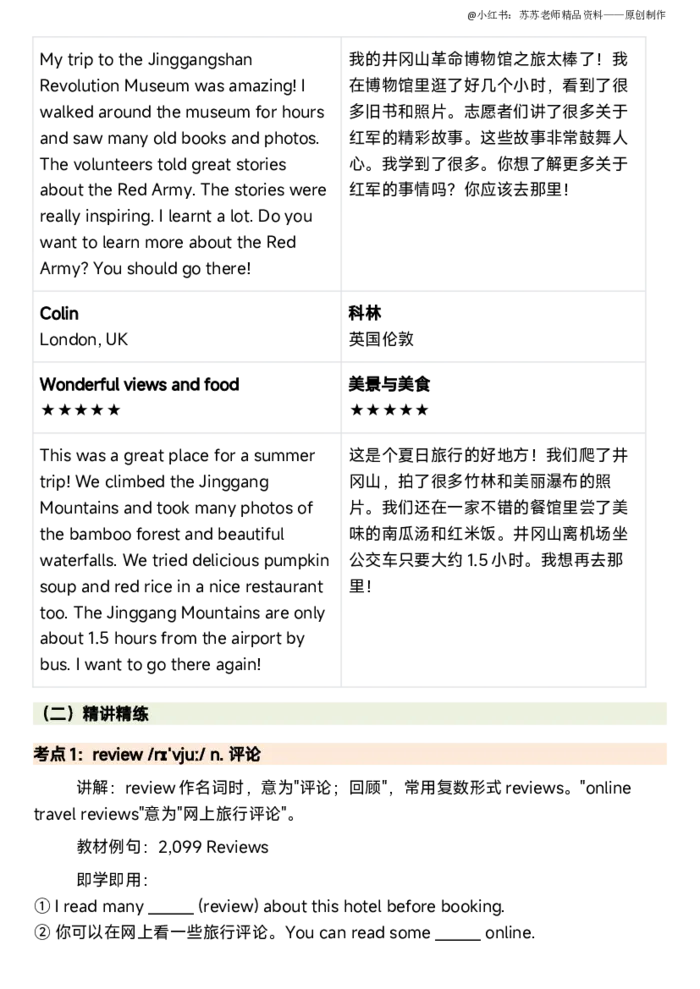
My trip to the Jinggangshan
Revolution Museum was amazing! I
walked around the museum for hours
and saw many old books and photos.
The volunteers told great stories
about the Red Army. The stories were
really inspiring. I learnt a lot. Do you
want to learn more about the Red
Army? You should go there!
我的井冈山革命博物馆之旅太棒了!我
在博物馆里逛了好几个小时,看到了很
多旧书和照片。志愿者们讲了很多关于
红军的精彩故事。这些故事非常鼓舞人
心。我学到了很多。你想了解更多关于
红军的事情吗?你应该去那里!
Colin
London, UK
科林
英国伦敦
Wonderful views and food
★★★★★
美景与美食
★★★★★
This was a great place for a summer
trip! We climbed the Jinggang
Mountains and took many photos of
the bamboo forest and beautiful
waterfalls. We tried delicious pumpkin
soup and red rice in a nice restaurant
too. The Jinggang Mountains are only
about 1.5 hours from the airport by
bus. I want to go there again!
这是个夏日旅行的好地方!我们爬了井
冈山,拍了很多竹林和美丽瀑布的照
片。我们还在一家不错的餐馆里尝了美
味的南瓜汤和红米饭。井冈山离机场坐
公交车只要大约1.5 小时。我想再去那
里!
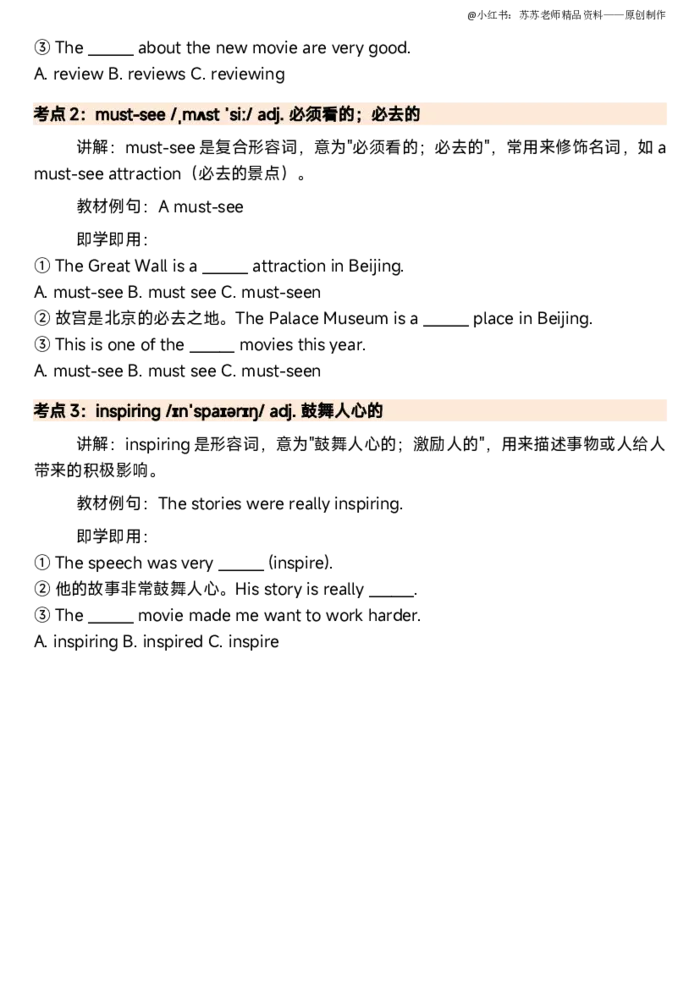
(二)精讲精练
考点1:review /r vju /
ɪˈ
ː n. 评论
•
讲解:review 作名词时,意为"评论;回顾",常用复数形式reviews。"online
travel reviews"意为"网上旅行评论"。
•
教材例句:2,099 Reviews
•
即学即用:
① I read many ______ (review) about this hotel before booking.
② 你可以在网上看一些旅行评论。You can read some ______ online.
@小红书:苏苏老师精品资料——原创制作
③ The ______ about the new movie are very good.
A. review B. reviews C. reviewing
考点2:must-see / m st
ˌ
ʌ
 si /
ˈ ː adj. 必须看的;必去的
•
讲解:must-see 是复合形容词,意为"必须看的;必去的",常用来修饰名词,如a
must-see attraction(必去的景点)。
•
教材例句:A must-see
•
即学即用:
① The Great Wall is a ______ attraction in Beijing.
A. must-see B. must see C. must-seen
② 故宫是北京的必去之地。The Palace Museum is a ______ place in Beijing.
③ This is one of the ______ movies this year.
A. must-see B. must see C. must-seen
考点3:inspiring / n spa ər ŋ/
ɪ ˈ
ɪ
ɪ
 adj. 鼓舞人心的
•
讲解:inspiring 是形容词,意为"鼓舞人心的;激励人的",用来描述事物或人给人
带来的积极影响。
•
教材例句:The stories were really inspiring.
•
即学即用:
① The speech was very ______ (inspire).
② 他的故事非常鼓舞人心。His story is really ______.
③ The ______ movie made me want to work harder.
A. inspiring B. inspired C. inspire
@小红书:苏苏老师精品资料——原创制作
2026 秋新人教PEP 版六年级上册英语同步讲义
第三部分 语法讲解
一、语法点:一般过去时
(一)定义
一般过去时表示过去某个时间发生的动作或存在的状态,常和表示过去的时间状语连用,
如:yesterday(昨天), last weekend(上周末), last Saturday(上周六), over the
summer holidays(在暑假期间), just now(刚才)等。
(二)动词过去式的变化规则
1.
规则变化


变化规则
动词原形
过去式
一般情况直接加-ed
climb, walk, talk
climbed, walked,
talked
以不发音的e 结尾,
直接加-d
live, use, dance
lived, used, danced
以"辅音字母+y"结
尾,变y 为i 加-ed
study, worry
studied, worried
重读闭音节结尾,末
尾只有一个辅音字
母,双写辅音字母
加-ed
stop, plan
stopped, planned
2.
本单元不规则动词过去式


动词原形
过去式
教材例句
be (am/is)
was
It was great!
be (are)
were
The stories were
@小红书:苏苏老师精品资料——原创制作
really inspiring.
go
went
I went to Xi'an with
my family.
see
saw
I saw many old
books and photos.
eat
ate
We ate some
famous Xi'an
noodles.
take
took
I took many
photos.
send
sent
Please send me
some pictures.
do
did
What did you do?
(三)基本句式结构
1.
肯定句


○表示过去的状态:主语

 +   was/were

  +   其他

 .
教材例句:It was great! / The Great Wall is amazing.
○表示过去的动作:主语

 +   动词过去式

 +   其他

 .
教材例句:I climbed the Great Wall. / I visited the "Gingerbread House" last
Saturday.
2.
否定句


○状态否定:主语

 +   was/were

  +   not

  +   其他

 .
缩写:wasn't = was not, weren't = were not
例句:It wasn't bad. / They weren't at home yesterday.
○动作否定:主语

 +   did

  not

  +   动词原形

 +   其他

 .
缩写:didn't = did not
例句:I didn't go to the park last weekend.
@小红书:苏苏老师精品资料——原创制作
3.
一般疑问句


○状态疑问:Was/Were

  +   主语

 +   其他

 ?
肯定回答:Yes, 主语 + was/were.
否定回答:No, 主语 + wasn't/weren't.
例句:— Was your weekend great? — Yes, it was. / No, it wasn't.
○动作疑问:Did

  +   主语

 +   动词原形

 +   其他

 ?
肯定回答:Yes, 主语 + did.
否定回答:No, 主语 + didn't.
例句:— Did you climb the Great Wall? — Yes, I did. / No, I didn't.
4.
特殊疑问句


○结构:疑问词

 +   一般疑问句

 ?
○教材例句:
▪
How was your weekend? It was great!
▪
What did you do? I visited the "Gingerbread House" last Saturday.
▪
Where did you go over the summer holidays? I went to Xi'an with my
family.
(四)易错点辨析
1.
不规则动词过去式拼写错误


○错误:I goed to Beijing last week.
○正确:I went to Beijing last week.
○提示:本单元重点记忆go-went, see-saw, eat-ate, take-took, send-sent 这几个
不规则变化。
2.
否定句

 /  疑问句中动词未还原


○错误:I didn't climbed the mountain.
○正确:I didn't climb the mountain.
○提示:助动词did/didn't 后面必须接动词原形。
3.
be
  动词和实义动词同时使用


○错误:I was went to school yesterday.
○正确:I went to school yesterday.
@小红书:苏苏老师精品资料——原创制作
○提示:一个简单句中不能同时出现be 动词和实义动词的过去式作谓语。
二、单元语法专项练习
(一)单项选择(10 道)
1.
— ______ was your weekend? — It was fun.
A. What B. How C. Where
2.
I ______ the Great Wall last month.
A. climb B. climbed C. climbs
3.
— Did you ______ any pictures? — Yes, I did.
A. take B. took C. takes
4.
She ______ to Paris with her family last summer.
A. go B. goes C. went
5.
— Where ______ you go yesterday? — I went to the park.
A. do B. did C. were
6.
The food ______ delicious yesterday.
A. is B. was C. were
7.
We ______ many photos of the bamboo forest last week.
A. take B. took C. taking
8.
— Did Peter visit the "Gingerbread House"? — ______
A. Yes, he did. B. Yes, he was. C. No, he don't.
9.
My mother ______ me a postcard from New Zealand last week.
A. send B. sends C. sent
10.
They ______ in Xi'an for three days last summer.
A. stay B. stayed C. stays
(二)用所给单词的适当形式填空(5 道)
1.
I ______ (see) the Terracotta Warriors last year.
2.
We ______ (eat) hot dry noodles in Wuhan yesterday.
3.
How ______ (be) your trip to Shanghai?
4.
She ______ (not go) to the museum last weekend.
5.
What ______ you ______ (do) last Saturday?
@小红书:苏苏老师精品资料——原创制作
(三)根据中文提示写出英文(5 道)
1.
我上周六爬了泰山。I ______ Mount Taishan last Saturday.
2.
你暑假去哪儿了?Where did you go ______?
3.
那听起来很有趣。That ______ interesting.
4.
请给我发一些照片。Please ______ some pictures.
5.
我们在老城区逛了逛。We ______ the old city.
(四)选词填空(5 道)
climbed, went, saw, ate, sent
1.
I ______ to the Jinggang Mountains last summer.
2.
He ______ many beautiful waterfalls there.
3.
We ______ delicious pumpkin soup in the restaurant.
4.
My friend ______ me a lot of photos from his trip.
5.
They ______ the mountain early in the morning.
(五)完形填空(10 道)
Last summer, I went to Beijing 1 ______my family. We 2______ there by train. On the
first day, we 3______ the Great Wall. It was very long and amazing. I 4 ______many
photos there. On the second day, we went to the Palace Museum. We 5______
around the museum for hours and 6______ many old things. On the third day, we 7
______Beijing Roast Duck. It was very delicious. We also 8______ some gifts for our
friends. We 9______ a great time in Beijing. I want to go there 10______.
1.
A. with B. and C. for
2.
A. go B. went C. goes
3.
A. climb B. climbed C. climbs
4.
A. take B. took C. takes
5.
A. walk B. walked C. walks
6.
A. see B. saw C. sees
7.
A. eat B. ate C. eats
8.
A. buy B. bought C. buys
@小红书:苏苏老师精品资料——原创制作
9.
A. have B. had C. has
10.
A. again B. too C. also
2026 秋新人教PEP 版六年级上册英语同步讲义
第四部分 作文讲义
一、单元主题作文介绍
本单元作文主题是写一篇简短的旅行评论(A short travel review),要求介绍一次你
去过的地方的旅行经历,分享你的感受和体验。这是小学英语写作中最常见的记叙文类
型之一,重点考查一般过去时的正确使用和内容的完整性。
二、作文审题
•
主题

 :介绍一次难忘的旅行经历
•
人称

 :第一人称(I)
@小红书:苏苏老师精品资料——原创制作
•
时态

 :主要使用一般过去时(描述过去发生的动作和状态)
•
结构

 :
a. 标题:My trip to...(我去……的旅行)
b. 开头:点明旅行的时间、地点和同行的人,给出总体评价
c. 中间:具体描述在那里做了什么、看到了什么、吃了什么
d. 结尾:总结你的感受,推荐别人去这个地方
三、主题词汇句型积累
(一)常用单词
trip 旅行, place 地方, amazing 令人惊奇的, beautiful 美丽的, delicious 美味的,
interesting 有趣的, fun 有趣的, great 棒的, wonderful 极好的, climb 爬, visit 参观, eat
吃, take 拍;拿, walk 走, see 看见
(二)常用短语
go to... with my family 和我的家人去……, climb the mountain 爬山, visit the
museum 参观博物馆, take many photos 拍很多照片, eat delicious food 吃美味的食物,
 walk around the old city 在老城区逛, have a great time 玩得开心, a must-see place
一个必去的地方
(三)常用句型
My trip to... was great/amazing/wonderful. 我去……的旅行很棒/令人惊奇/极好。
I went there with... 我和……一起去的那里。
We climbed/visited/ate... 我们爬了/参观了/吃了……
I took many photos of... 我拍了很多……的照片。
The food was delicious. 食物很美味。
You should visit there! 你应该去那里参观!
四、作文技巧全解析
1.
结构清晰

 :严格按照"标题-开头-中间-结尾"的结构写作,让读者一目了然。
2.
时态正确

 :全文90%以上的句子使用一般过去时,只有结尾的推荐句可以用一般
现在时。
3.
内容具体

 :不要只说"很好玩",要写出具体的活动,比如"我爬了黄山,看了日出"。
@小红书:苏苏老师精品资料——原创制作
4.
用词丰富

 :使用不同的形容词描述感受,避免重复使用good。
(一)开头句型(带翻译)
1.
My

  trip

  to
   Sanya

  was

  wonderful.

  我去三亚的旅行太棒了。


2.
Last

  summer,

  I  went

  to
   Hangzhou

  with

  my

  parents.

  去年夏天,我和父母去了杭


州。
3.
I  had

  a   great

  trip

  to
   Xi'an

  last

  month.

  上个月我去西安旅行,玩得很开心。


(二)中间句型(带翻译)
1.
We

  climbed

  the

  West

  Mountain

  and

  took

  many

  photos

  of
   the

  beautiful

  views.


我们爬了西山,拍了很多美丽风景的照片。
2.
We

  visited

  the

  West

  Lake

  and

  went

  boating

  on
   the

  lake.

  我们参观了西湖,还


在湖上划船。
3.
We

  ate

  delicious

  local

  food,

  like

  hot

  dry

  noodles

  and

  tanghulu.

  我们吃了美味的


当地食物,比如热干面和糖葫芦。
4.
The

  people

  there

  were

  very

  friendly.

  那里的人非常友好。


(三)结尾句型(带翻译)
1.
I  had

  a   wonderful

  time

  there.

  我在那里玩得很开心。


2.
It   was

  a   great

  trip

  and

  I  want

  to
   go
   there

  again.

  这是一次很棒的旅行,我想再


去那里。
3.
You

  should

  visit

  there

  if   you

  have

  time!

  如果你有时间,你应该去那里参观!


(四)好句积累
1.
The view from the top of the mountain was amazing. 山顶的景色太壮观了。
2.
I learnt a lot about Chinese history in the museum. 我在博物馆里学到了很多关
于中国历史的知识。
3.
The food there was so delicious that I ate a lot. 那里的食物太美味了,我吃了很
多。
五、优秀范文(带翻译与解析)
(一)范文
@小红书:苏苏老师精品资料——原创制作
My trip to Guilin
My trip to Guilin was amazing. I went there with my family last summer.
We took a boat trip on the Li River. The mountains and water there were very
beautiful. I took many photos. We also ate delicious rice noodles. They were so
tasty.
I had a great time in Guilin. It is a beautiful place. You should visit there!
(二)翻译
我的桂林之旅
我的桂林之旅太棒了。去年夏天我和家人去了那里。
我们在漓江上乘船游览。那里的山水非常美丽。我拍了很多照片。我们还吃了美味的米
粉。它们太好吃了。
我在桂林玩得很开心。那是一个美丽的地方。你应该去那里参观!
(三)名师解析
•
结构

 :完全符合"标题-开头-中间-结尾"的要求,逻辑清晰。
•
时态

 :全文正确使用一般过去时描述过去的旅行经历,结尾推荐句用一般现在时,
时态准确。
•
内容

 :具体写了乘船游漓江、拍照片、吃米粉三个活动,内容充实。
•
好词

 :amazing, beautiful, delicious, tasty, great
•
好句

 :We took a boat trip on the Li River.(我们在漓江上乘船游览。)/ It is a
beautiful place. You should visit there!(那是一个美丽的地方。你应该去那里参
观!)
六、单元作文练习
(一)题目
请以"My trip to ______"为题,写一篇60 词左右的旅行评论,介绍一次你去过的地方的
旅行经历。要求:内容完整,语句通顺,时态正确。
@小红书:苏苏老师精品资料——原创制作
2026 秋新人教PEP 版六年级上册英语同步讲义
第五部分 单元综合练习
一、单项选择(10 道)
1.
— How ______ your weekend? — It was great.
A. is B. was C. were
2.
I ______ the Eiffel Tower in Paris last year.
A. visit B. visits C. visited
3.
— Did you ______ any photos in Beijing? — Yes, I did.
A. take B. took C. takes
@小红书:苏苏老师精品资料——原创制作
4.
She ______ to New Zealand with her cousin last month.
A. go B. went C. goes
5.
— What ______ you do yesterday? — I watched a movie.
A. do B. did C. were
6.
The Terracotta Warriors ______ amazing.
A. is B. was C. were
7.
We ______ many old books in the Jinggangshan Revolution Museum.
A. see B. saw C. sees
8.
— Did Amy go to Hainan? — ______
A. Yes, she did. B. Yes, she was. C. No, she don't.
9.
My brother ______ me a gift from Shanghai last week.
A. send B. sends C. sent
10.
They ______ in the old city for two hours yesterday.
A. walk B. walked C. walks
二、根据首字母提示完成单词(5 道)
1.
The Great Wall is about 21,000 k______ long.
2.
I v______ the Palace Museum last summer.
3.
Please s______ me some pictures of your trip.
4.
We ate d______ pumpkin soup in the restaurant.
5.
The stories about the Red Army are very i______.
三、选出不同类的一项(5 道)
1.
A. climb B. visit C. photo
2.
A. was B. go C. were
3.
A. Beijing B. Paris C. country
4.
A. noodles B. pumpkin C. rice
5.
A. weekend B. summer C. holiday
四、用所给单词的适当形式填空(5 道)
1.
I ______ (eat) Xi'an noodles last week.
@小红书:苏苏老师精品资料——原创制作
2.
We ______ (take) many photos of the bamboo forest.
3.
How ______ (be) your trip to the Jinggang Mountains?
4.
He ______ (not go) to the Sydney Opera House last year.
5.
What ______ you ______ (do) last Labour Day holiday?
五、根据描述选单词(5 道)
A. airport B. restaurant C. museum D. village E. landmark
1.
It is a place where you can eat food. ______
2.
It is a famous place that many people visit. ______
3.
It is a place where planes take off and land. ______
4.
It is a small place in the countryside. ______
5.
It is a place where you can see old things and learn about history. ______
六、选词填空(5 道)
climbed, went, saw, ate, sent
1.
I ______ to Mount Taishan last weekend.
2.
We ______ the sunrise at the top of the mountain.
3.
They ______ delicious red rice in the village.
4.
My friend ______ me a postcard from Xi'an.
5.
We ______ the mountain early in the morning.
七、完形填空(10 道)
Last weekend, I went to the Great Wall 1______  my parents. We 2 ______ there by
bus. It 3______ sunny that day. The Great Wall is very long and old. We 4 ______ it
for about two hours. I 5 ______ many photos of the beautiful views. We 6______
some local food for lunch. It was delicious. We 7 ______ a lot of people there. They
were from different countries. We 8______  to some of them. We 9 ______ a great
time. I want to go to the Great Wall 10______  when I grow up.
1.
A. with B. and C. for
2.
A. go B. went C. goes
3.
A. is B. was C. were
@小红书:苏苏老师精品资料——原创制作
4.
A. climb B. climbed C. climbs
5.
A. take B. took C. takes
6.
A. eat B. ate C. eats
7.
A. see B. saw C. sees
8.
A. talk B. talked C. talks
9.
A. have B. had C. has
10.
A. again B. too C. also
八、补全对话(选择合适的句子补全对话)
A: Hi, Lily! 1. ______
B: It was great! I went to Hangzhou with my family.
A: 2. ______
B: We went to the West Lake and went boating.
A: 3. ______
B: Yes, I did. I took many beautiful photos.
A: 4. ______
B: We ate delicious Longjing shrimp and Dongpo pork.
A: That sounds great! 5. ______
B: Yes, I want to go there again.
A. What did you do there?
B. Did you take any photos?
C. How was your weekend?
D. What food did you eat?
E. Do you want to go there again?
九、阅读理解
(一)阅读短文,选择正确答案
Last summer, I went to Jinggang Mountains with my family. We went there by
train. It took us about 1.5 hours from the airport to the mountains by bus.
On the first day, we visited the Jinggangshan Revolution Museum. We saw many
old books and photos. The volunteers told us stories about the Red Army. The
stories were very inspiring. I learnt a lot.
@小红书:苏苏老师精品资料——原创制作
On the second day, we climbed the Jinggang Mountains. We saw beautiful bamboo
forests and waterfalls. We took many photos. We ate pumpkin soup and red rice in
a small restaurant. The food was delicious.
We had a great time in Jinggang Mountains. I want to go there again.
1.
How did they go to Jinggang Mountains?
A. By plane. B. By train. C. By bus.
2.
What did they do on the first day?
A. They climbed the mountains.
B. They visited the museum.
C. They ate delicious food.
3.
What did they see in the museum?
A. Bamboo forests and waterfalls.
B. Old books and photos.
C. Pumpkin soup and red rice.
4.
How long did it take them to get to the mountains from the airport by bus?
A. About 1 hour. B. About 1.5 hours. C. About 2 hours.
5.
Did they have a good time?
A. Yes, they did. B. No, they didn't. C. We don't know.
(二)阅读短文,判断正(T)误(F)
Peter is my friend. He is from New Zealand. Last weekend, he went to the
"Gingerbread House" with his cousin. The "Gingerbread House" is a beautiful train
station. It looks like a gingerbread house.
They took many photos there. They also saw many trains. They had a great time.
Peter sent me some photos of the "Gingerbread House". They were very beautiful. I
want to visit the "Gingerbread House" one day.
1.
Peter is from China. ( )
2.
Peter went to the "Gingerbread House" last weekend. ( )
3.
The "Gingerbread House" is a big house. ( )
4.
Peter took many photos there. ( )
5.
I don't want to visit the "Gingerbread House". ( )
十、书面表达
@小红书:苏苏老师精品资料——原创制作
请以"My trip to the Great Wall"为题,写一篇60 词左右的短文,介绍你去长城的旅行
经历。要求:内容完整,语句通顺,时态正确。
@小红书:苏苏老师精品资料——原创制作,更多精品资料关注小红书