预习手册
针对初三目标精讲直播班
2020-寒假
学员姓名:(          )
Lecture 1-7
Lecture 1
2
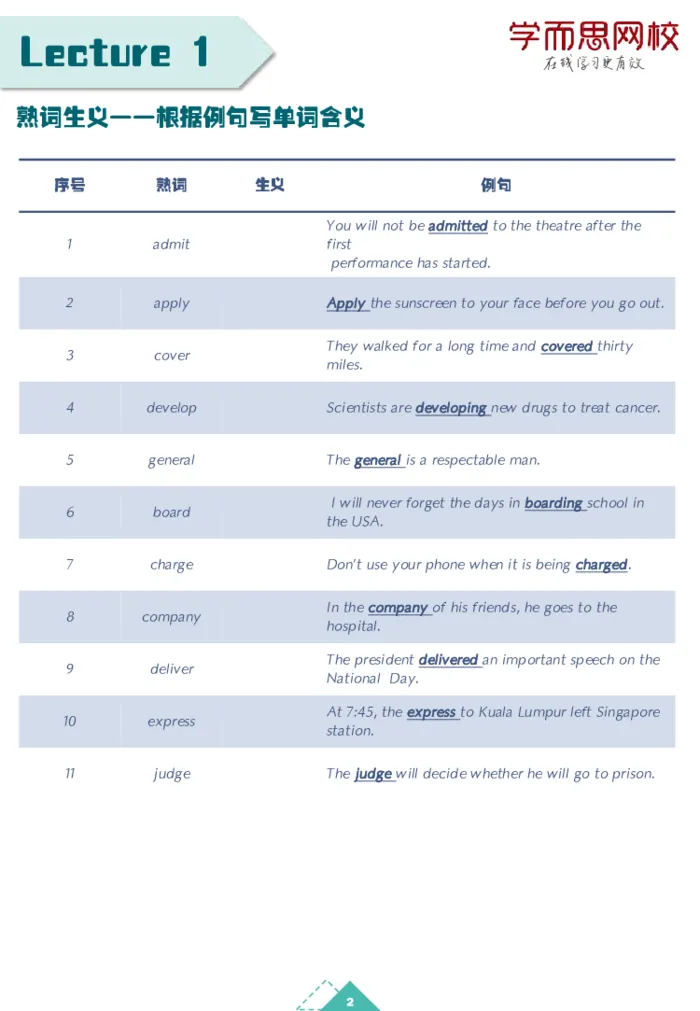
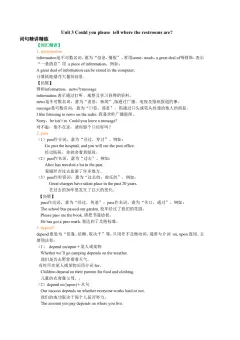
熟词生义——根据例句写单词含义
序号
熟词
生义
例句
1
admit
You will not be admitted to the theatre after the
first
 performance has started.
2
apply
Apply the sunscreen to your face before you go out.
3
cover
They walked for a long time and covered thirty
miles.
4
develop
Scientists are developing new drugs to treat cancer.
5
general
The general is a respectable man.
6
board
 I will never forget the days in boarding school in
the USA.
7
charge
Don't use your phone when it is being charged.
8
company
In the company of his friends, he goes to the
hospital.
9
deliver
The president delivered an important speech on the
National  Day.
10
express
At 7:45, the express to Kuala Lumpur left Singapore
station.
11
judge
The judge will decide whether he will go to prison.
3
Lecture 1
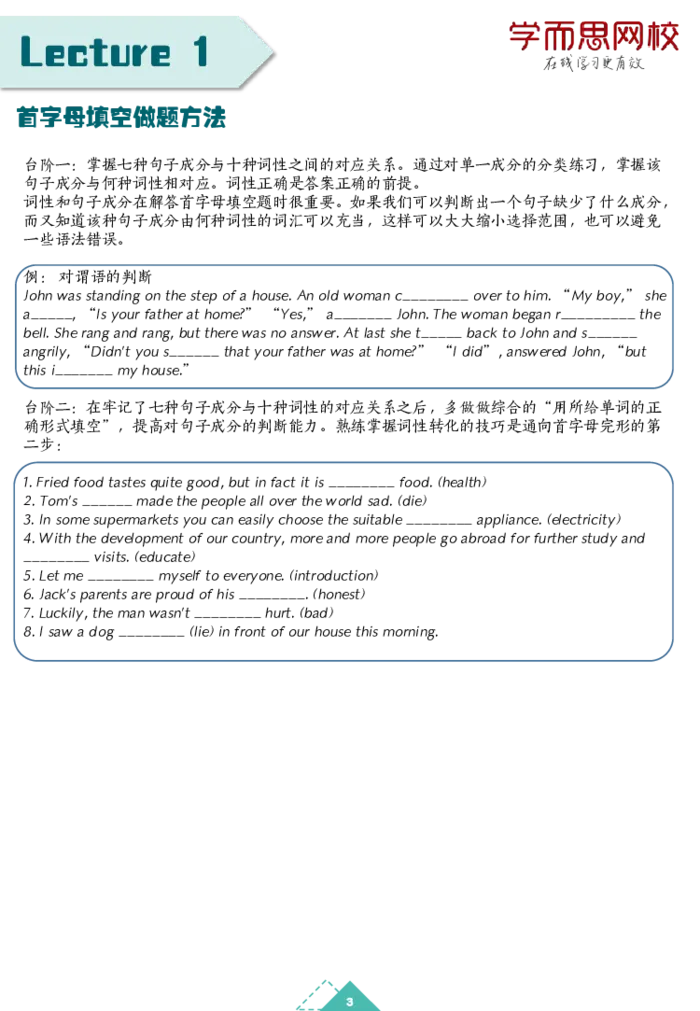
首字母填空做题方法
台阶一:掌握七种句子成分与十种词性之间的对应关系。通过对单一成分的分类练习,掌握该
句子成分与何种词性相对应。词性正确是答案正确的前提。
词性和句子成分在解答首字母填空题时很重要。如果我们可以判断出一个句子缺少了什么成分,
而又知道该种句子成分由何种词性的词汇可以充当,这样可以大大缩小选择范围,也可以避免
一些语法错误。
例: 对谓语的判断
John was standing on the step of a house. An old woman c________ over to him. “My boy,” she
a_____, “Is your father at home?” “Yes,” a_______ John. The woman began r_________ the
bell. She rang and rang, but there was no answer. At last she t_____ back to John and s______
angrily, “Didn't you s______ that your father was at home?” “I did”, answered John, “but
this i_______ my house.”
台阶二:在牢记了七种句子成分与十种词性的对应关系之后,多做做综合的“用所给单词的正
确形式填空”,提高对句子成分的判断能力。熟练掌握词性转化的技巧是通向首字母完形的第
二步:
1. Fried food tastes quite good, but in fact it is ________ food. (health)
2. Tom's ______ made the people all over the world sad. (die)
3. In some supermarkets you can easily choose the suitable ________ appliance. (electricity)
4. With the development of our country, more and more people go abroad for further study and
________ visits. (educate)
5. Let me ________ myself to everyone. (introduction)
6. Jack's parents are proud of his ________. (honest)
7. Luckily, the man wasn't ________ hurt. (bad)
8. I saw a dog ________ (lie) in front of our house this morning.
Lecture 2
4
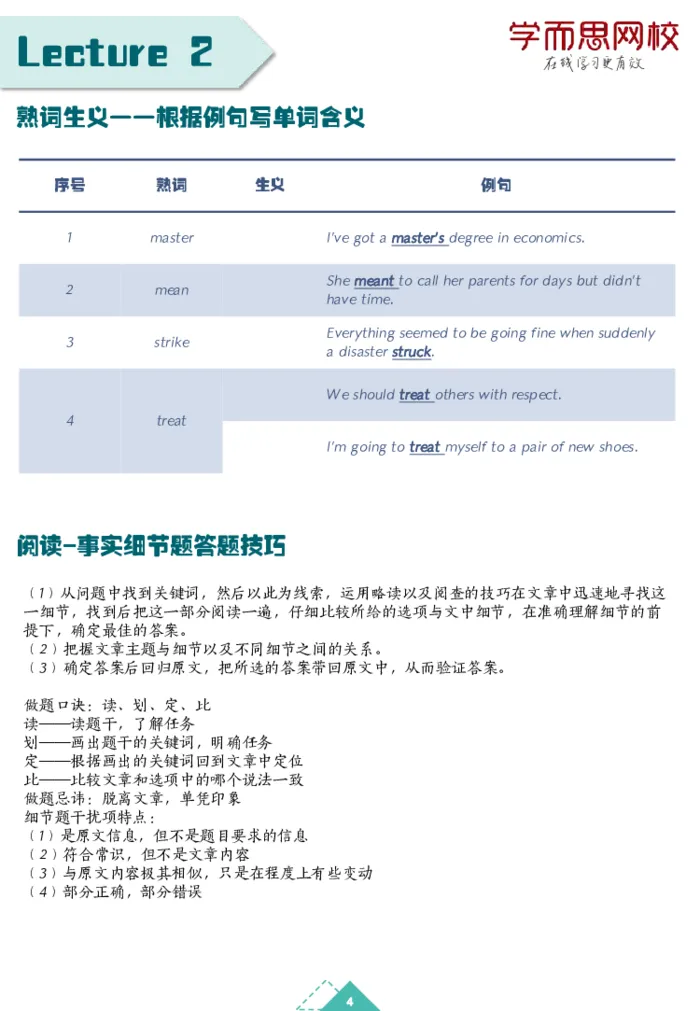
熟词生义——根据例句写单词含义
序号
熟词
生义
例句
1
master
I've got a master's degree in economics.
2
mean
She meant to call her parents for days but didn't
have time.
3
strike
Everything seemed to be going fine when suddenly
a disaster struck.
4
treat
We should treat others with respect.
I'm going to treat myself to a pair of new shoes.
阅读-事实细节题答题技巧
(1)从问题中找到关键词,然后以此为线索,运用略读以及阅查的技巧在文章中迅速地寻找这
一细节,找到后把这一部分阅读一遍,仔细比较所给的选项与文中细节,在准确理解细节的前
提下,确定最佳的答案。
(2)把握文章主题与细节以及不同细节之间的关系。
(3)确定答案后回归原文,把所选的答案带回原文中,从而验证答案。
做题口诀:读、划、定、比
读——读题干,了解任务
划——画出题干的关键词,明确任务
定——根据画出的关键词回到文章中定位
比——比较文章和选项中的哪个说法一致
做题忌讳:脱离文章,单凭印象
细节题干扰项特点:
(1)是原文信息,但不是题目要求的信息
(2)符合常识,但不是文章内容
(3)与原文内容极其相似,只是在程度上有些变动
(4)部分正确,部分错误
Lecture 2
5
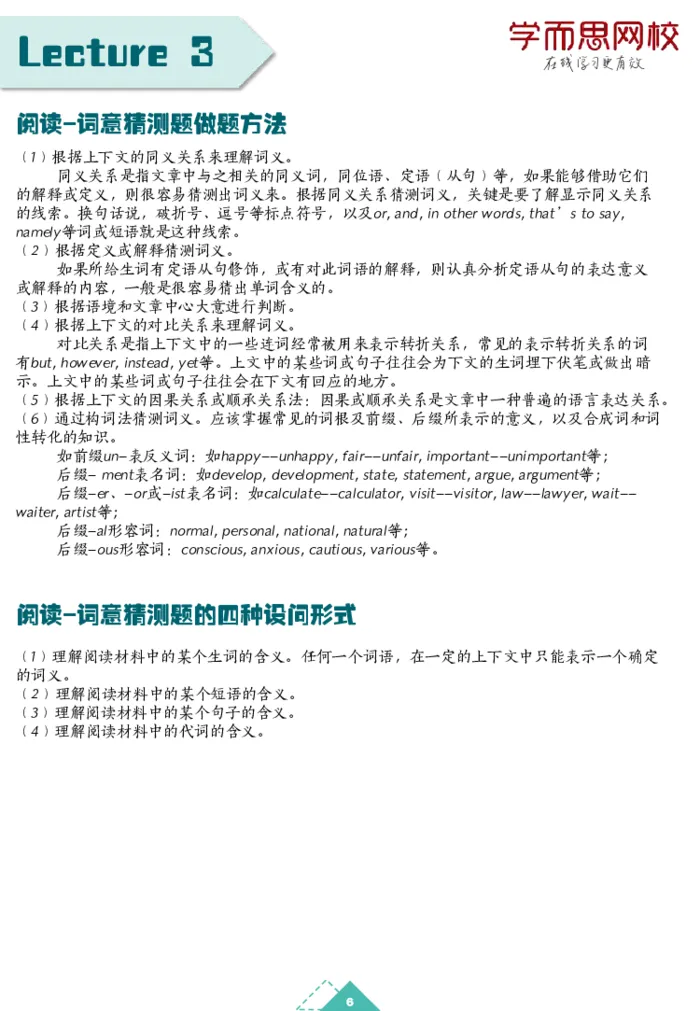
Nine-year-old Antonio "Dan Boy" Fernandez Jr was playing with his younger brothers Ken and Billie in
their yard after lunch one day last June when he noticed smoke coming from the roof of their house.
Realizing his three-year-old brother, Nathaniel, was sleeping in the house, Antonio protected his head
with his hands and rushed inside the wooden house.
"I was so afraid to see the flames (火焰) on the roof, but when I heard my brother crying, I just
closed my eyes and rushed in," says Dan Boy, who stopped schooling two years ago to look after his
younger brothers.
He found his brother sitting in the corner of the room, shaking and crying. Nathaniel was disoriented
(迷惑的) from the smoke, so Dan Boy caught him with his right hand. "Don't worry, kuya (big
brother) is here," Dan Boy said as he protected Nathaniel from the flames with his own body.
Just as they reached the front door, Nathaniel stopped. A nail (钉子) had caught his shorts. Flames
reached the upper part of the door as Antonio tried to get his brother free. With one last, hard pulling,
they ran into the yard as the house was finished.
For what he had done, Antonio received a special prize from the government and a university in the
city offered to help him go back to school. "I would have done the same if Nathaniel were not my
brother," says Dan Boy.
1、When did the fire break out?
A.In the morning.
B.In the afternoon.
C.In the evening.
D.In the night.
2、Who is the oldest child in the family?
A.Antonio.
B.Ken.
C.Billie.
D.Nathaniel.
3、How was Nathaniel after the accident?
A.Badly hurt.
B.A little hurt.
C.All right.
D.Very well.
4、Which of the following is the best to describe what Dan Boy did?
A.A good luck.
B.A hard try.
C.A quick run.
D.A heroic act.
例题:
本文主要讲述了一个小男孩奋不顾身去救弟弟的感人事迹。生活中有很多美丽的瞬间,只是我们
不太注意,每个人都有自己的生活方式和生活态度;有些事只有亲身经历过,才能明白其中的蕴
涵,对于姐妹之间,兄妹之间的那份亲情虽然平凡但却实实在在,有时回想幼时的种种,总会从
噩梦中惊醒,但瞬间那种关爱的眼神又会给我们一点力量,有勇气继续走自己该走的路。所以一
定好好珍惜我们身边的亲人。
文章点评:
Realizing his three-year-old brother, Nathaniel, was sleeping in the house, Antonio protected his
head with his hands and rushed inside the wooden house.
在此句子中,Realizing his three-year-old brother是现在分词做状语的成分,three-year-old
brother与Nathaniel是同位语。
长难句分析:
Lecture 3
6
阅读-词意猜测题做题方法
(1)根据上下文的同义关系来理解词义。
         同义关系是指文章中与之相关的同义词,同位语、定语(从句)等,如果能够借助它们
的解释或定义,则很容易猜测出词义来。根据同义关系猜测词义,关键是要了解显示同义关系
的线索。换句话说,破折号、逗号等标点符号,以及or, and, in other words, that’s to say,
namely等词或短语就是这种线索。
(2)根据定义或解释猜测词义。
         如果所给生词有定语从句修饰,或有对此词语的解释,则认真分析定语从句的表达意义
或解释的内容,一般是很容易猜出单词含义的。
(3)根据语境和文章中心大意进行判断。
(4)根据上下文的对比关系来理解词义。
         对比关系是指上下文中的一些连词经常被用来表示转折关系,常见的表示转折关系的词
有but, however, instead, yet等。上文中的某些词或句子往往会为下文的生词埋下伏笔或做出暗
示。上文中的某些词或句子往往会在下文有回应的地方。
(5)根据上下文的因果关系或顺承关系法:因果或顺承关系是文章中一种普遍的语言表达关系。
(6)通过构词法猜测词义。应该掌握常见的词根及前缀、后缀所表示的意义,以及合成词和词
性转化的知识。
         如前缀un-表反义词:如happy--unhappy, fair--unfair, important--unimportant等;
         后缀- ment表名词:如develop, development, state, statement, argue, argument等;
         后缀-er、-or或-ist表名词:如calculate--calculator, visit--visitor, law--lawyer, wait--
waiter, artist等;
         后缀-al形容词:normal, personal, national, natural等;
         后缀-ous形容词:conscious, anxious, cautious, various等。
(1)理解阅读材料中的某个生词的含义。任何一个词语,在一定的上下文中只能表示一个确定
的词义。
(2)理解阅读材料中的某个短语的含义。
(3)理解阅读材料中的某个句子的含义。
(4)理解阅读材料中的代词的含义。
阅读-词意猜测题的四种设问形式
Lecture 3
7
阅读-词意猜测题例题精讲
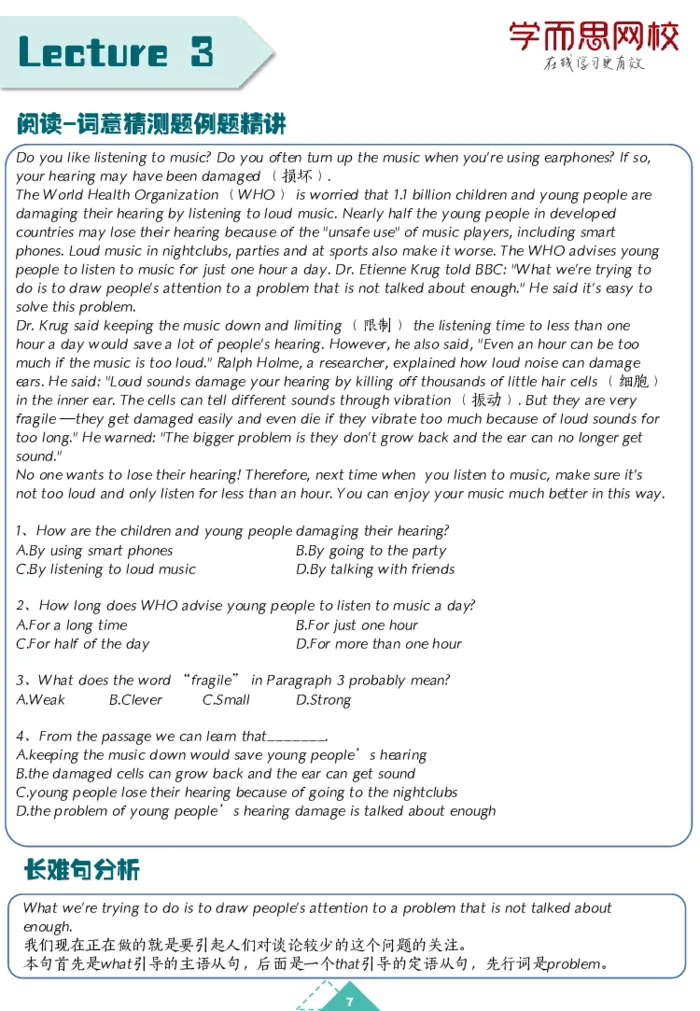
Do you like listening to music? Do you often turn up the music when you're using earphones? If so,
your hearing may have been damaged (损坏).
The World Health Organization (WHO) is worried that 1.1 billion children and young people are
damaging their hearing by listening to loud music. Nearly half the young people in developed
countries may lose their hearing because of the "unsafe use" of music players, including smart
phones. Loud music in nightclubs, parties and at sports also make it worse. The WHO advises young
people to listen to music for just one hour a day. Dr. Etienne Krug told BBC: "What we're trying to
do is to draw people's attention to a problem that is not talked about enough." He said it's easy to
solve this problem.
Dr. Krug said keeping the music down and limiting (限制) the listening time to less than one
hour a day would save a lot of people's hearing. However, he also said, "Even an hour can be too
much if the music is too loud." Ralph Holme, a researcher, explained how loud noise can damage
ears. He said: "Loud sounds damage your hearing by killing off thousands of little hair cells (细胞)
in the inner ear. The cells can tell different sounds through vibration (振动). But they are very
fragile —they get damaged easily and even die if they vibrate too much because of loud sounds for
too long." He warned: "The bigger problem is they don't grow back and the ear can no longer get
sound."
No one wants to lose their hearing! Therefore, next time when  you listen to music, make sure it's
not too loud and only listen for less than an hour. You can enjoy your music much better in this way.
1、How are the children and young people damaging their hearing?
A.By using smart phones
B.By going to the party
C.By listening to loud music
D.By talking with friends
2、How long does WHO advise young people to listen to music a day?
A.For a long time
B.For just one hour
C.For half of the day
D.For more than one hour
3、What does the word “fragile” in Paragraph 3 probably mean?
A.Weak
B.Clever
C.Small
D.Strong
4、From the passage we can learn that_______.
A.keeping the music down would save young people’s hearing
B.the damaged cells can grow back and the ear can get sound
C.young people lose their hearing because of going to the nightclubs
D.the problem of young people’s hearing damage is talked about enough
What we're trying to do is to draw people's attention to a problem that is not talked about
enough.
我们现在正在做的就是要引起人们对谈论较少的这个问题的关注。
本句首先是what引导的主语从句,后面是一个that引导的定语从句,先行词是problem。
长难句分析
Lecture 4
8
阅读-词意猜测题做题方法
(1)根据上下文的同义关系来理解词义。
         同义关系是指文章中与之相关的同义词,同位语、定语(从句)等,如果能够借助它们
的解释或定义,则很容易猜测出词义来。根据同义关系猜测词义,关键是要了解显示同义关系
的线索。换句话说,破折号、逗号等标点符号,以及or, and, in other words, that’s to say,
namely等词或短语就是这种线索。
(2)根据定义或解释猜测词义。
         如果所给生词有定语从句修饰,或有对此词语的解释,则认真分析定语从句的表达意义
或解释的内容,一般是很容易猜出单词含义的。
(3)根据语境和文章中心大意进行判断。
(4)根据上下文的对比关系来理解词义。
         对比关系是指上下文中的一些连词经常被用来表示转折关系,常见的表示转折关系的词
有but, however, instead, yet等。上文中的某些词或句子往往会为下文的生词埋下伏笔或做出暗
示。上文中的某些词或句子往往会在下文有回应的地方。
(5)根据上下文的因果关系或顺承关系法:因果或顺承关系是文章中一种普遍的语言表达关系。
(6)通过构词法猜测词义。应该掌握常见的词根及前缀、后缀所表示的意义,以及合成词和词
性转化的知识。
         如前缀un-表反义词:如happy--unhappy, fair--unfair, important--unimportant等;
         后缀- ment表名词:如develop, development, state, statement, argue, argument等;
         后缀-er、-or或-ist表名词:如calculate--calculator, visit--visitor, law--lawyer, wait--
waiter, artist等;
         后缀-al形容词:normal, personal, national, natural等;
         后缀-ous形容词:conscious, anxious, cautious, various等。
(1)理解阅读材料中的某个生词的含义。任何一个词语,在一定的上下文中只能表示一个确定
的词义。
(2)理解阅读材料中的某个短语的含义。
(3)理解阅读材料中的某个句子的含义。
(4)理解阅读材料中的代词的含义。
阅读-词意猜测题的四种设问形式
Lecture 4
9
阅读-词意猜测题例题精讲
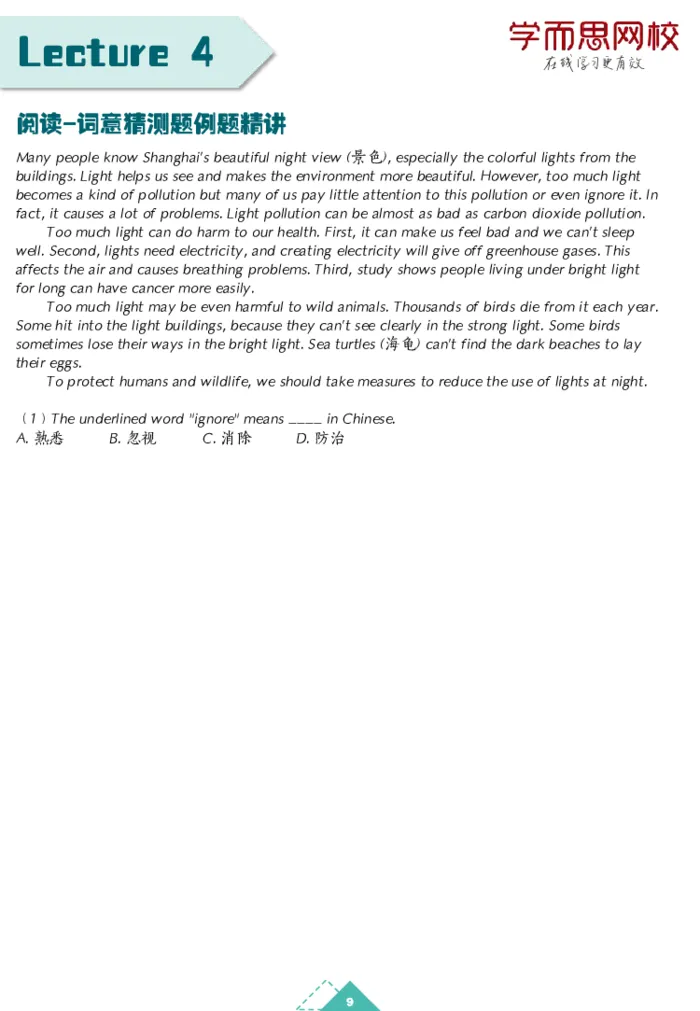
Many people know Shanghai's beautiful night view (景色), especially the colorful lights from the
buildings. Light helps us see and makes the environment more beautiful. However, too much light
becomes a kind of pollution but many of us pay little attention to this pollution or even ignore it. In
fact, it causes a lot of problems. Light pollution can be almost as bad as carbon dioxide pollution.
  Too much light can do harm to our health. First, it can make us feel bad and we can't sleep
well. Second, lights need electricity, and creating electricity will give off greenhouse gases. This
affects the air and causes breathing problems. Third, study shows people living under bright light
for long can have cancer more easily.
  Too much light may be even harmful to wild animals. Thousands of birds die from it each year.
Some hit into the light buildings, because they can't see clearly in the strong light. Some birds
sometimes lose their ways in the bright light. Sea turtles (海龟) can't find the dark beaches to lay
their eggs.
  To protect humans and wildlife, we should take measures to reduce the use of lights at night.
(1)The underlined word "ignore" means ____ in Chinese.
A. 熟悉
B. 忽视
C. 消除
D. 防治
Lecture 5
10
阅读-主旨大意题做题方法
主旨大意题
1.题型特点
要求在阅读和理解全文的基础上对文章进行归纳、概括或评价。解答这种题时,不能只凭文中
的只言片语而断章取义。比如涉及文章的标题(title)、主题(main idea)、结论(conclusion)、
结局(end)等有关问题时,都需要在细读全文的基础上,结合所学语言知识、背景知识、生活
常识、科学知识等进行推理和判断,从而获取文章中内隐的信息。
2.解题技巧
主旨大意题的解题技巧主要有:
(1)留心关键词,抓住文章主旨。所谓关键词,即文章中反复出现的、与主题有关的诸如名词、
动词等实词。冠词或介词等虚词均不在关键词之列。需要注意的是,为了避免同一词的过多重
复,文章中有时会使用这个词的同义词、近义词,或用代词指代。
(2)注意段落主题句,归纳文章大意。我们知道,文章的每一个段落都是为中心思想服务的,所以
找出阐明段落大意的主题句是解读文章中心思想的关键。
(3)串联主要细节,推断文章中心思想。我们知道,并不是所有文章都包含明确的主题句,比如
大多数记叙文。记叙文的中心思想多隐藏在具体的细节中,作者通过众多的事实细节对一个中
心点进行论述。因此,我们必须善于串联主要细节,从中归纳文章的中心思想。
(1) The + ~er + S + V, ~~~ the + ~er + S + V ~~~
     The + more + Adj. + S + V,~~~ the + more + Adj. + S + V ~~~(愈……愈……)
翻译:你愈努力,你愈进步。
           The harder you work, the more progress you will make.
(2) By +Ving,~~ can ~~ (通过……,……能够……)
翻译:通过做运动,我们能够始终保持健康。
           By taking exercise, we can always stay healthy.
(3) ~~~ enable + Object(受词)+ to + V (……使……能够..)
翻译:听音乐使我们能够感觉轻松。
           Listening to music enables us to feel relaxed.
(4) On no account can we + V ~~~ (我们绝对不能……)
翻译:我们绝对不能忽略知识的价值。
           On no account can we ignore the value of knowledge.
写作-必备句型积累
Lecture 5
11
阅读-主旨大意题例题精讲
The world's first subway was built in London in 1863. At the time, the government was looking for a
way to reduce traffic problems in the city of London. The poor areas of the city were so crowded
with people that it was almost impossible for horse carriages (the taxis of those days) to get
around. The city officials were interested in trying to make it possible for workers to live outside of
London and travel easily to work each day. If people had a cheap and convenient way that they
could depend on to get to and from work, they would move their homes outside of the city. This
would help solve the problem of too many people living in the poor parts of London. From these
problems, the idea of the London Underground, the first subway system, was born.
The plans for building the Underground met with several problems and delays, but the first track
was opened in January 1863. A steam train pulled the cars along the first underground track which
was six kilometers (3.7miles) long. About 30, 000 people got on the subway the first day. Riders
were treated to comfortable seats (standing up while the train was moving was not allowed) and
pleasant decorations inside each of the cars. However, the smoke from the engine soon filled the air
in the tunnels with ash and soot, as well as chemical gases. Fans had to be put in the tunnels later to
keep the air clean enough for people to breathe. Even with its problems, riding the Underground did
become popular. It carried nine million riders in its first year.
Modern subways have come a long way since the early days of the London Underground. Today
there are 94 large underground rapid transit systems around the world. The busiest of these subway
systems is the Tokyo Metro which opened in 1927. This efficient subway has two billion riders per
year, and "pushers" work on the platforms (站台) during busy traffic hours to help push riders
onto trains. At times, subway cars have been packed with up to 300 people!  Shopping malls built
in high traffic stations where riders move from one train to another have also helped the popularity
of subways in Tokyo. Stations like the famous Ginza Sugo Eki Ginza Consolidated Station include
underground department store, supermarkets, restaurants, and specialty shops. Shoppers never have
to go above ground!
1、What problems led the British government to build the London Underground?
A.Pollution and overcrowding.
B.traffic jams and pollution.
C.Overcrowding and traffic jams.
D.The subway problems.
2、The last paragraph is mainly about            .
A.the London Underground today
B.the Tokyo subway
C.subways around the world
D.problems with subways
3、Which of the following is the best title for this passage?
A.The nowadays subway.
B.The popularity of the subway.
C.The first subway.
D.Subway then and now.
If people had a cheap and convenient way that they could depend on to get to and from work,
they would move their homes outside of the city. 如果人们有一个便宜而且靠谱的上下班的
乘车方式,他们会搬到城市外面去。在这个句子中,使用了定语从句以及if引导的虚拟语气。
长难句分析
Lecture 6
12
固定搭配——写出下列词组的含义
序号
词组
含义
例句
1
run out
The gas is running out.
2
apply
carry out
3
set out
The captain and crews set out this morning.
4
figure out
It took them about one week to figure out how to
start the machine.
5
consist of
The students’ union consists of ten members.
6
regardless of
The club welcomes all new members regardless of
age.
7
opposite to
Do you accept opinions opposite to yours?
8
access to
People now have better access to medical care after
the reform.
9
turn to
You can turn to page 65 for more information.
10
get down to
If we get down to work, we must be paid off sooner
or later.
11
take up
Old books take up much space in the office.
Lecture 6
13
阅读-推理判断题做题方法
推理判断题主要考查学生对文章言外之意的理解。这种题目有一定难度,往往不能直接从文中
找到答案,而必须通过分析上下文及其相互间的关系或对整篇文章进行深层理解后,才能找到
答案。有时甚至还得联系作者的意图、态度等弦外之音、文外之意加以推理,获取作者在文章
中没有直接表达出来的态度、观点等。这种类型的题主要有三种形式:语意推理题、结论推理题
和出处推理题。语意推理题要求学生根据文章、段落或句子的表层信息推断出深层含义,比如
推断文章或段落的中心思想、句子的言外之意等;结论推理题和出处推理题要求学生根据文章中
所列举的事实推断出符合逻辑的结论或文章的出处。
中考的阅读理解不仅要求考生读懂短文中的每个句子,而且还要求能理解这些句子之间的内在联
系。有的试题要求根据中学生必须具有的常识,对所读的短文进行一定程度的推断;有的试题还
要求了解其内在的逻辑关系,从而对所读的内容形成较深层的理解。一般来说,这类问题都不
可能直接从原文中找到答案,必须根据原文提供的有关信息,进行合理的推断才能回答。完成
推理判断题,通常应注意以下两点:
(1)特别留心特定细节
所谓“特定细节”,就是问题所涉及的范围和对象中的细节事实3它一般包括事实根据、名字
(人物或地点)、数字(日期或统计数字)、关键词语的其他表达方法(同义词、近义词、反
义词)等。
(2)注意作者的语气和态度
作者的语气和态度通常体现在短文的措辞和所用句式上。要特别注意感情色彩比较浓重的形容
词和副词,特别留心短文句子的长度和结构。从措辞上,我们可以推断出作者对所讨论话题的态
度(肯定或否定,赞成或反对,褒扬或讽刺,喜好或厌恶等等);从句式的长短和结构可以判
断出作者讨论问题的语气(郑重其事还是轻松活泼,实事求是还是夸大其词,真挚热诚还是冷
嘲热讽等等)。
解题妙招
①通读全篇,确定短文寓意
②多角度排除法排除原文复述、非推论、与原文不符因果倒置、偷换概念 、推理过头、引申过
度等选项。
③抓细节,正向或逆向推理抓事实根据、人名、数字、关键词的其他表述方式同义词、近义词、
反义词。
④找题干关键词,推断答案如:infer、imply、conclude等。
⑤措辞、结论推态度短文最后结论、感情色彩浓重的形容词、副词、褒义词和贬义词等。
⑥弄懂上下句语句间的联系通过句子本身或上下句揣摩作者的语气、思路、意图等。
⑦短文内容或形式定出处广告会有电话号码、费用,邀请函会有时间、地点等。
⑧寻找选项关系三对易错,两个或两个以上推理成立则选推理最少且与原文内容最接近的答案。
⑨注意文中所使用人称用人称代词推测作者写作对象及目的。
Lecture 6
14
阅读-推理判断题例题精讲
Short-term memory is the ability to remember events in the recent past, for example, the name of
someone you met at a party last night. Short-term memory is often challenged by stress, illness,
and aging. Many of us have, or have had, grandparents who are able to remember events from their
childhood, but are unable to remember what happened yesterday. Most people can only remember
seven items in order. This is why telephone numbers, for example, are seven digits (digits: 0-9 )
long.
What can you infer from this paragraph?
A.Nine digits are used for telephone numbers.
B.People can remember more than seven items in order.
C.Telephone numbers will still keep seven digits long.
D.Stress affects short-term memory less than illness.
Lecture 7
15
固定搭配——写出下列词组的含义
序号
词组
含义
例句
1
in case
Take the umbrella with you in case it rains.
2
in return
I wish I can do something for you in return.
3
in memory of
The temple was built in memory of one of our
ancestors.
4
in contrast
In contrast with Japan, education of the USA has
taken on special modes.
5
in place of
We can use plastic in place of wood or metal in
industry.
6
in spite of
In spite of the heavy rain, people still gathered
together to celebrate new year.
7
be content
with
True happiness comes when we learn to be content
with what we have.
8
be associated
with
I haven't been associated with the project over the
last year.
9
be equipped
with
All ambulance should be equipped with GPS system.
10
be familiar
with/to
I am still familiar with the school after ten years.The
old house is familiar to us because we had great  fun
there.
Lecture 7
16
完形-上下文推理
上下文语境指的是根据上下文有关提示或暗语,抓住关键词语或情节,进行简单推理的方法
做题口诀:
抓住首句,跳过空格,通读全文,掌握大意;
理解词义,瞻前顾后,先易后难,逐个突破;
重读全文,个个审核,验证答案,战胜自我。
完形-上下文推理例题精讲
There were so many people on the bus that there were       1       empty seats. When a young man got
on, an old man near him wanted to       2      , but the young man pushed him back to his seat.
"Thank you, " he said, "but please don't do that, I can stand."
1.A.many
B.some
C.enough
D.no
2.A.sit down
B.get on
C.set out
D.stand up
答案解析
17
Lecture 1
单词含义:1:v. 准许进入;2:v. 涂抹;3:v.
行走(一段路程);4:v. 研制;形成;5:n.
将军;6:v./n.寄宿;7:v. 充电;8:n. 陪伴,
伴侣;9:v. 发表演讲;10:n. 快车;11:n. 评
委;法官
首字母填空答案:
台阶一:Keys: 1. came 2. asked 3.answered 4.
Keys: 1. came 2. asked 3.answered 4. ringing 5.
turned 6. said 7. say 8. isinging 5. turned 6. said 7.
台阶二is
Keys: 1.unhealthy 2.death 3.electric 4.educational
5.introduce 6.honesty 7.badly 8.lyingeys: 1. came
2. asked 3.answered 4. ringing 5. turned 6. said 7.
Lecture 2
单词含义:1:n. 硕士;2:v. 打算;3:v. 侵袭;
4:v. 对待;看待;5,v. / n. 款待say 8. is
阅读理解答案:
1B;2A;3C;4D
详解:
1:根据 "Nine-year-old Antonio "Dan Boy"
Fernandez Jr was playing with his younger
brothers Ken and Billie in their yard after lunch
one day last June" 可知是午饭后,即下午,故
答案选B。
2:根据 "Nine-year-old Antonio "Dan Boy"
Fernandez Jr was playing with his younger
brothers Ken and Billie" 可知Antonio最大。故答
案选A。1C;2B;3A;4A
Lecture 3  阅读
1C;2B;3A;4A
解析
1细节题,根据文章第二段第一句“The World
Health Organization (WHO) is worried that 1.1
billion children and young people are damaging
their hearing by listening to loud music.”可知答
案为C。
2细节题,根据文章第二段第四句“The WHO
advises young people to listen to music for just
one hour a day.”可知答案为B。
3根据后句they get damaged easily可知他们是非
常脆弱的,故答案为A。
4结合文章,根据文章三段最后一句 "The bigger
problem is they don't grow back and the ear can
no longer get sound." 可知B选项错误;根据文章
第二段第二句 "Nearly half the young people in
developed countries may lose their hearing
because of the “unsafe use" of music players,
including smart phones.”可知C选项错误;结合
第二段倒数第二句 "What we're trying to do is
to draw people's attention to a problem that is
not talked about enough." 可知D选项错误;故答
案为A。
Lecture 4  阅读
(1)【答案】B  【解析】词意猜测题。根据第
一段第三句句意“然而,太多的光成为一种污
染,但很多人不注意这个污染或 ____ 它”。
由后一句In fact, it causes a lot of problems事实
上,这会导致很多问题。可知,应该是“忽
视”。选B。
Lecture 5  阅读
1C;2B;3D
解析:1细节理解题。根据第一段的第2句,以
及这一段的倒数第2句话可知,英国政府修建地
铁的2个原因是过度拥挤和交通堵塞。因此,C
项正确。2细节理解题。文章第3段的第3句话一
直到倒数第3段,都是在介绍东京的地铁,因此,
这段主要讲解的有关东京的地铁,因此B项正确。
3主旨题。这篇文章主要讲解的是地铁的起源,
以及发展过程。因此D项正确。
Lecture 6
词组含义:1,用完;耗尽;2,实施;执行
;3,出发;开始;4,想出;理解;5,由……
组成;6,不管;不顾;7,在……对面;
与……相反;8,接触到;有权使用;9,翻到;
调到;10,开始认真做;11,占据
阅读:
答案C;解析:根据Most people can only
remember seven items in order. This is why
telephone numbers, for example, are seven digits
(digits: 0-9 ) long.故选C
Lecture 7
词组含义:1,万一;假如;2,作为报答;3,
纪念;4,与……相反;比较起来;5,代替;6,
尽管;不管;不顾;7,对……感到满意;8,
与……有关;9,配备有;装备有;10,对……
熟悉;11,占据///完形答案:答案1D;2D
解析1 :第1小题所给的选项是四个限定词,单
就语法来看它们均可和后面的 empty seats 搭配。
但根据上文的 "There were so many people on
the bus .…" 来判断,不可能有许多(many)、
一些(some)、足够的(enough) "空位" 。因
此,该题的正确答案应为 D。2 :第2小题所给
的选项是四个动词短语,根据下文的 "pushed
him back to his seat" 和 "I can stand" 来看,年
轻人误认为老人要给他让座,而实际上老人是
想站起来下车。所以,该题的正确答案是 D。