学科网(北京)股份有限公司
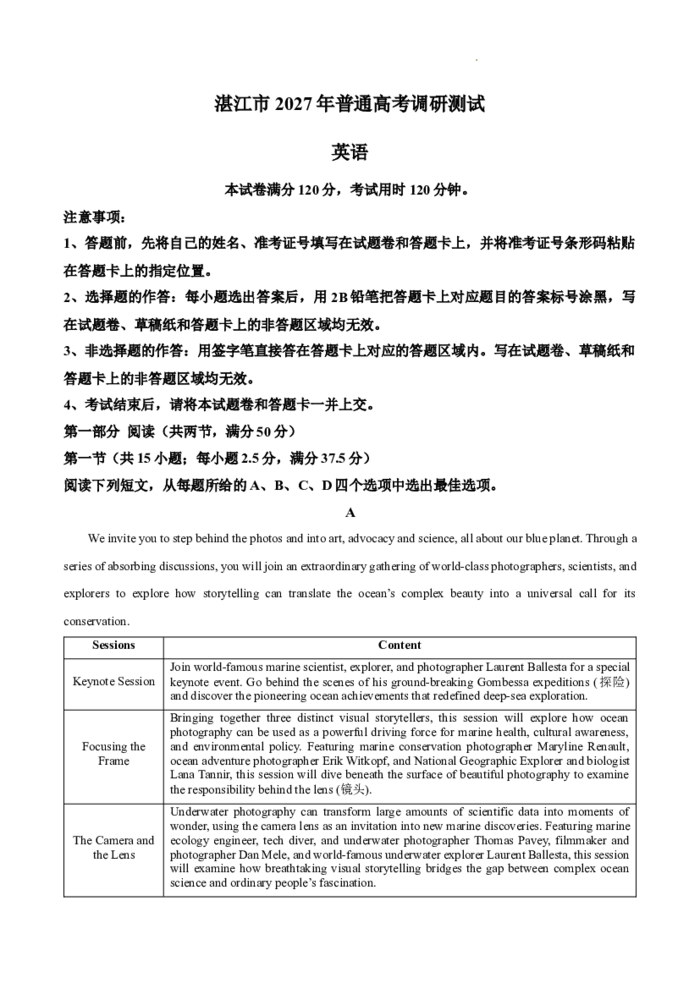
湛江市2027 年普通高考调研测试
英语
本试卷满分120 分,考试用时120 分钟。
注意事项:
1、答题前,先将自己的姓名、准考证号填写在试题卷和答题卡上,并将准考证号条形码粘贴
在答题卡上的指定位置。
2、选择题的作答:每小题选出答案后,用2B 铅笔把答题卡上对应题目的答案标号涂黑,写
在试题卷、草稿纸和答题卡上的非答题区域均无效。
3、非选择题的作答:用签字笔直接答在答题卡上对应的答题区域内。写在试题卷、草稿纸和
答题卡上的非答题区域均无效。
4、考试结束后,请将本试题卷和答题卡一并上交。
第一部分 阅读(共两节,满分50 分)
第一节(共15 小题;每小题2.5 分,满分37.5 分)
阅读下列短文,从每题所给的A、B、C、D 四个选项中选出最佳选项。
A
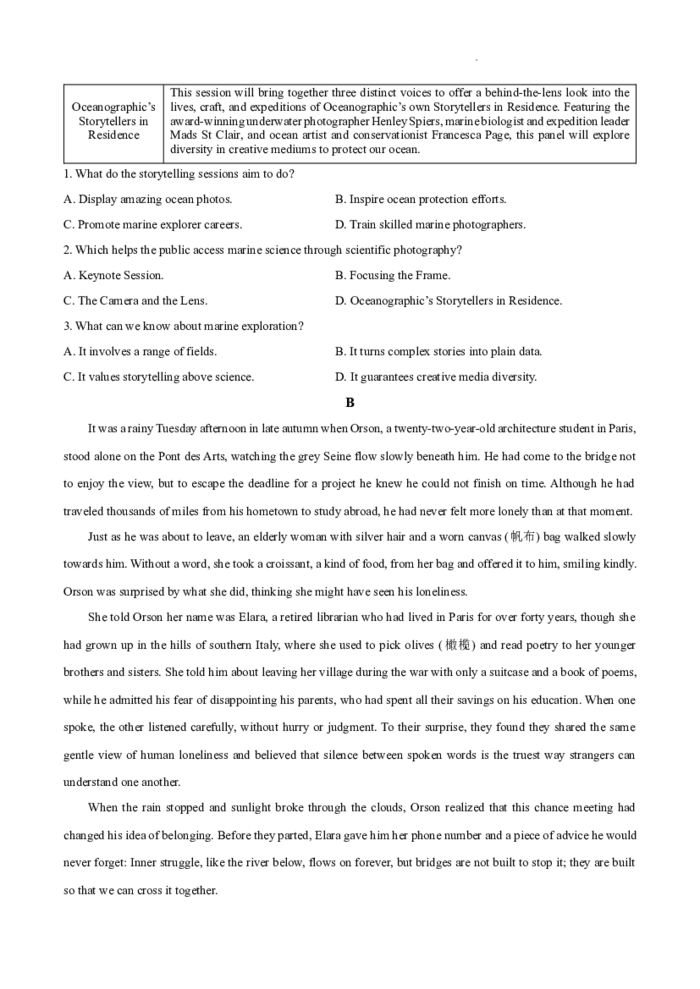
We invite you to step behind the photos and into art, advocacy and science, all about our blue planet. Through a
series of absorbing discussions, you will join an extraordinary gathering of world-class photographers, scientists, and
explorers to explore how storytelling can translate the ocean’s complex beauty into a universal call for its
conservation.
Sessions
Content
Keynote Session
Join world-famous marine scientist, explorer, and photographer Laurent Ballesta for a special
keynote event. Go behind the scenes of his ground-breaking Gombessa expeditions (探险)
and discover the pioneering ocean achievements that redefined deep-sea exploration.
Focusing the
Frame
Bringing together three distinct visual storytellers, this session will explore how ocean
photography can be used as a powerful driving force for marine health, cultural awareness,
and environmental policy. Featuring marine conservation photographer Maryline Renault,
ocean adventure photographer Erik Witkopf, and National Geographic Explorer and biologist
Lana Tannir, this session will dive beneath the surface of beautiful photography to examine
the responsibility behind the lens (镜头).
The Camera and
the Lens
Underwater photography can transform large amounts of scientific data into moments of
wonder, using the camera lens as an invitation into new marine discoveries. Featuring marine
ecology engineer, tech diver, and underwater photographer Thomas Pavey, filmmaker and
photographer Dan Mele, and world-famous underwater explorer Laurent Ballesta, this session
will examine how breathtaking visual storytelling bridges the gap between complex ocean
science and ordinary people’s fascination.
学科网(北京)股份有限公司
Oceanographic’s
Storytellers in
Residence
This session will bring together three distinct voices to offer a behind-the-lens look into the
lives, craft, and expeditions of Oceanographic’s own Storytellers in Residence. Featuring the
award-winning underwater photographer Henley Spiers, marine biologist and expedition leader
Mads St Clair, and ocean artist and conservationist Francesca Page, this panel will explore
diversity in creative mediums to protect our ocean.
1. What do the storytelling sessions aim to do?
A. Display amazing ocean photos.
B. Inspire ocean protection efforts.
C. Promote marine explorer careers.
D. Train skilled marine photographers.
2. Which helps the public access marine science through scientific photography?
A. Keynote Session.
B. Focusing the Frame.
C. The Camera and the Lens.
D. Oceanographic’s Storytellers in Residence.
3. What can we know about marine exploration?
A. It involves a range of fields.
B. It turns complex stories into plain data.
C. It values storytelling above science.
D. It guarantees creative media diversity.
B
It was a rainy Tuesday afternoon in late autumn when Orson, a twenty-two-year-old architecture student in Paris,
stood alone on the Pont des Arts, watching the grey Seine flow slowly beneath him. He had come to the bridge not
to enjoy the view, but to escape the deadline for a project he knew he could not finish on time. Although he had
traveled thousands of miles from his hometown to study abroad, he had never felt more lonely than at that moment.
Just as he was about to leave, an elderly woman with silver hair and a worn canvas (帆布) bag walked slowly
towards him. Without a word, she took a croissant, a kind of food, from her bag and offered it to him, smiling kindly.
Orson was surprised by what she did, thinking she might have seen his loneliness.
She told Orson her name was Elara, a retired librarian who had lived in Paris for over forty years, though she
had grown up in the hills of southern Italy, where she used to pick olives ( 橄榄) and read poetry to her younger
brothers and sisters. She told him about leaving her village during the war with only a suitcase and a book of poems,
while he admitted his fear of disappointing his parents, who had spent all their savings on his education. When one
spoke, the other listened carefully, without hurry or judgment. To their surprise, they found they shared the same
gentle view of human loneliness and believed that silence between spoken words is the truest way strangers can
understand one another.
When the rain stopped and sunlight broke through the clouds, Orson realized that this chance meeting had
changed his idea of belonging. Before they parted, Elara gave him her phone number and a piece of advice he would
never forget: Inner struggle, like the river below, flows on forever, but bridges are not built to stop it; they are built
so that we can cross it together.
学科网(北京)股份有限公司
4. Why did Orson go to the bridge that afternoon?
A. To avoid academic pressure.
B. To admire the river scenery.
C. To ease homesick feelings.
D. To meet a stranger on purpose.
5. Which word can best describe Elara?
A. Ambitious.
B. Humorous.
C. Warm-hearted.
D. Narrow-minded.
6. What can be learnt about Orson and Elara from paragraph 3?
A. They suffered from the same pains.
B. They communicated with sincerity.
C. They preferred silence to conversation.
D. They shared wartime memories together.
7. What message does the story mainly convey?
A. Hardships shape one’s growth.
B. Chance meetings change lives.
C. People face loneliness constantly.
D. Human bonds relieve emotional suffering.
C
My first thought upon seeing the Halloween-candy display at my local CVS last week was: Ooh, new treats!
Then a second thought came to mind suddenly: These new treats seemed awfully light on the chocolate.
Candy producers keep rolling out new versions of their classic sweets, but the release of the candies with less
chocolate carries striking implications: They’ve all hit the market within the past two years, as the world supply of
cocoa beans, the core raw material for making chocolate, has fallen, causing prices to skyrocket. Making cheap
chocolate treats is no longer a cheap task — unless they contain less chocolate.
Young consumers have been the most candy-hungry group in recent years. This group seeks out taste combinations,
unexpected mouthfeel, and flavor “experiences”, said Carly Schildhaus, the communications director of the National
Confectioners Association. Actually, even before the cocoa crisis, plenty of mass-market chocolate candies contained
add-ins. Mixing in more, or different ones, gives the impression of inventiveness, not cost-cutting. So new ideas are
core to the candy business.
But candy-industry insiders know that the pressures on companies are twofold. Less chocolaty candies are
“certainly a response to cocoa prices,” Nicko Debenham, a cocoa-industry expert, said. Since 2023, West Africa,
where most of the world’s cocoa is grown, has had consecutive ( 连续的) below-average harvests, owing to bad
weather, crop disease, and illegal gold mining on farmland. A global shortage followed, and the price of cocoa
changed wildly, reaching a record high of more than $12,000 a ton last December (in recent history, prices had stayed
below $4,000 a ton).
Cocoa prices have become so unstable that banking on chocolate-based products is now a huge risk for candy
makers. Companies are being forced to acknowledge that the cocoa crisis is a long-term threat, said Ignacio Canals
学科网(北京)股份有限公司
Polo, a chocolate-industry analyst with Bloomberg Intelligence. “Three weeks of bad weather can completely change
the dynamics of the market. If you’re a chocolate producer, you have to adjust your range of products,” he added.
8. Why do candy companies launch candies with less chocolate?
A. To satisfy new taste demands.
B. To expand overseas markets.
C. To reduce sugar in candies.
D. To cut production costs.
9. What can be inferred about the candy business from paragraph 3?
A. Extra additions lower production costs.
B. Young consumers influence flavor creation.
C. Traditional sweets reject added ingredients.
D. The young prefer treats containing less sugar.
10. What does the underlined word “twofold” refer to?
A. Weather changes and illegal mining.
B. Innovation demand and cocoa costs.
C. Short-term risks and product ranges.
D. Lower harvests and stable gold prices.
11. What is Polo’s attitude towards producing chocolate-based products now?
A. Disapproving.
B. Optimistic.
C. Uncaring.
D. Enthusiastic.
D
A long-running study in New Zealand followed more than 1,000 people born in the early 1970s. When participants
reached age 45, researchers measured their walking speed, physical health, brain structure and cognitive (认知的)
abilities.
The results were striking. People who walked more slowly tended to show signs of faster biological aging. They
were also more likely to have weaker hand strength, poorer balance and worse coordination ( 协调). Brain scans
revealed that slower walkers tended to have smaller brain volumes and other features associated with poorer brain
health. But one finding attracted particular attention. Among the 45-year-olds, those with slower walking speeds
tended to score lower on IQ tests. The researchers found an average difference of about 16 IQ points between the
slowest and fastest groups of walkers. Slower walkers also performed worse across several areas of cognitive ability,
including processing speed, working memory, perceptual reasoning and verbal comprehension.
Walking requires much more than strong legs. To move efficiently, the brain has to coordinate the nervous
system, muscles, vision, balance, and the heart and blood system. Walking also requires the brain to constantly process
information about the environment and control movement. As a result, gait (步态) speed may act as a kind of “whole-
body indicator”.
The study also found that people who experienced greater cognitive decline between childhood and adulthood
tended to have slower walking speeds at 45. This suggests that gait may mirror a person’s lifelong brain health rather
than simply their physical condition at a particular age. Researchers therefore argue that walking speed should not be
学科网(北京)股份有限公司
viewed only as a measure of aging in elderly people. It may provide a simple window into aging, brain health and
cognitive functioning much earlier in life. The US National Institute on Aging similarly described walking speed as
a potentially useful indicator of how both the body and brain are aging.
Still, there is no reason to panic if you are a slow walker. Intelligence is influenced by many factors, and walking
speed is only one possible marker among them.
12. What did researchers find about walking speed?
A. It improved hand muscles.
B. It was responsible for aging.
C. It balanced brain volumes.
D. It was linked to intelligence.
13. What does gait speed reflect?
A. How well different systems work together.
B. How strong a healthy person’s legs become.
C. How effectively movement controls the brain.
D. How quickly the environment shapes vision.
14. What does the author show by mentioning the US National Institute on Aging?
A. The suggestion for future studies.
B. The possible reasons for the findings.
C. The explanation of the study method.
D. The reliability of the study finding.
15. What is the best title for the text?
A. Brain Aging: Risks of Low Intelligence
B. Walking Technique: Paths to Brain Power
C. Walking Pace: A Mirror of Brain Health
D. Sharp Mind: A Driver Behind Brain Youth
第二节(共5 小题;每小题2.5 分,满分12.5 分)
阅读下面短文,从短文后的选项中选出可以填入空白处的最佳选项。选项中有两项为多余选
项。
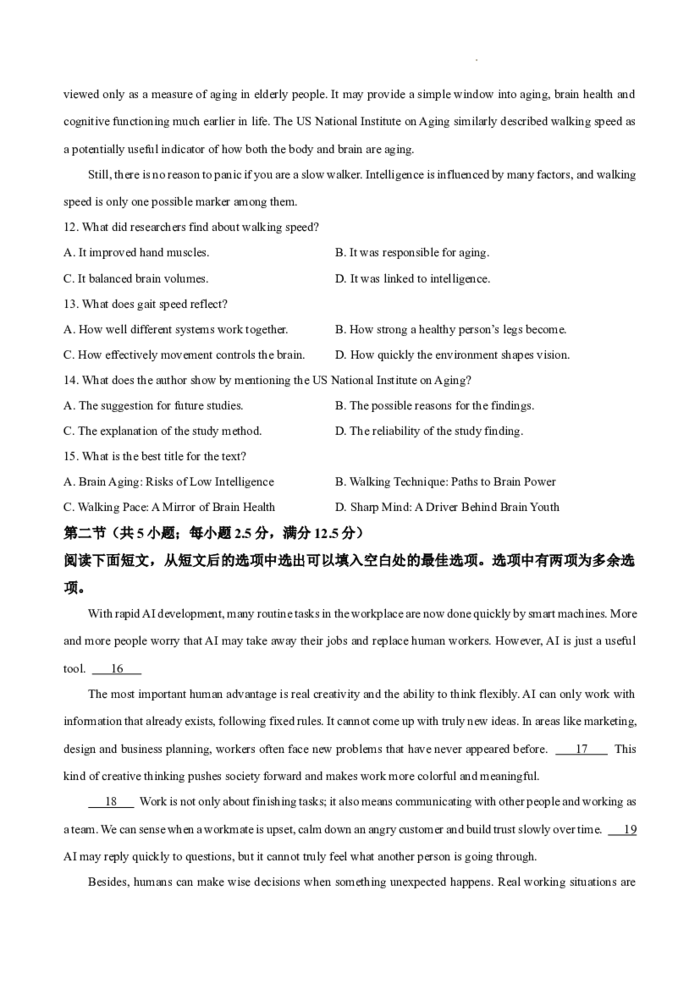
With rapid AI development, many routine tasks in the workplace are now done quickly by smart machines. More
and more people worry that AI may take away their jobs and replace human workers. However, AI is just a useful
tool.    16
The most important human advantage is real creativity and the ability to think flexibly. AI can only work with
information that already exists, following fixed rules. It cannot come up with truly new ideas. In areas like marketing,
design and business planning, workers often face new problems that have never appeared before.    17    This
kind of creative thinking pushes society forward and makes work more colorful and meaningful.
   18    Work is not only about finishing tasks; it also means communicating with other people and working as
a team. We can sense when a workmate is upset, calm down an angry customer and build trust slowly over time.    19
AI may reply quickly to questions, but it cannot truly feel what another person is going through.
Besides, humans can make wise decisions when something unexpected happens. Real working situations are
学科网(北京)股份有限公司
often complex and full of surprises. AI follows its programmed rules.    20    When a crisis appears, a human
worker can stop, think and choose the proper way to deal with it. This sense of responsibility is something no machine
can ever have.
Instead of fearing AI, we should welcome it as a partner. When we put AI’s speed together with our own human
strengths, we can achieve far more than either one alone.
A. These strengths will keep us improving AI.
B. This keeps collaboration easy and agreeable.
C. In contrast, humans can tell right from wrong.
D. But humans can always get along well with AI.
E. They need to invent fresh solutions to deal with them.
F. Humans still have special strengths that no machine can copy.
G. Humans also understand feelings in a way machines never can.
第二部分 语言运用(共两节,满分30 分)
第一节(共15 小题;每小题1 分,满分15 分)
阅读下面短文,从每题所给的A、B、C、D 四个选项中选出可以填入空白处的最佳选项。
In Liverpool, football is a way of life. Six-year-old Isaac stood out as a devoted    21    of Liverpool Football
Club. Born with a rare disease that made walking and speaking difficult, he never let his condition    22    him
— attending school daily, singing the team’s songs, and practicing the guitar.
One morning, the school    23    two special guests would arrive. Certain the    24    had nothing to do with
him, Isaac buried his head in his book. The classroom erupted as Mohamed Salah and Virgil van Dijk, the club’s two
most celebrated stars,    25   .
Virgil’s voice cut through the    26   : “We’re looking for a big Liverpool fan who loves playing the guitar.
I think his name is Isaac?” Shaking with    27   , Isaac slowly raised his hand, eyes shining with tears as he
realized the    28    was for him. The players invited him to be their special guest at an Anfield match.
On match day, fear almost    29    him. It seemed that the tunnel was    30   , the cheers like thunder.
Sensing his worry, Virgil held his hand and    31   , “Just walk with me.” Encouraged and hand in hand with
Virgil, he walked out onto the field    32   . The crowd cheered not because he was    33   , but because he
was there.
The game was    34   , but inspired by their special guest, Liverpool claimed a remarkable 2-0 victory.
“This    35    Isaac,” the players said. For Isaac, the unforgettable day would remain in his heart forever.
21. A. supporter
B. judge
C. player
D. donor
学科网(北京)股份有限公司
22. A. identify
B. define
C. select
D. accompany
23. A. predicted
B. agreed
C. announced
D. responded
24. A. task
B. success
C. visit
D. connection
25. A. crossed
B. won
C. watched
D. entered
26. A. doubt
B. excitement
C. pride
D. confusion
27. A. anxiety
B. fear
C. disbelief
D. embarrassment
28. A. reflection
B. explanation
C. desire
D. surprise
29. A. declined
B. astonished
C. confirmed
D. defeated
30. A. endless
B. narrow
C. random
D. unique
31. A. repeated
B. whispered
C. exchanged
D. recalled
32. A. hopefully
B. confidently
C. hesitantly
D. nervously
33. A. simple
B. famous
C. different
D. independent
34. A. adventurous
B. risky
C. discouraging
D. intense
35. A. belongs to
B. concentrates on
C. comes across
D. looks after
第二节(共10 小题;每小题1.5 分,满分15 分)
阅读下面短文,在空白处填入1 个适当的单词或括号内单词的正确形式。
Embracing (拥抱) Diversity, an international art dialogue exhibition    36    (hold) by the China National
Academy of Painting, kicked off in the New Zealand capital on August 27th, 2026 in    37    (celebrate) of the
20th anniversary of sister city relations between Wellington and Beijing.
The 39 artworks on display were organized into four sections: Observing the Way with a Clear Mind, Figures in
Myriad Forms, Scenery of the Four Seasons, and Timeless Bronze and Stone Inscriptions,    38    fully reflect
the charm of traditional Chinese fine arts. Together, they showcased the contemporary    39    (create) practices
in Chinese landscape, figure and bird-and-flower painting, alongside calligraphy and seal carving, showing the
evolution of these traditions from classical paradigms (范式) to present-day expressions.
At the opening ceremony, Wellington Mayor Andrew Little noted, “It is important that relationships among
individuals, cities, and communities are conducted    40    all levels.”
Different cultures have    41    (they) own distinct histories and traditions. However, the gap between
people’s emotions for nature, life and beauty can    42    (bridge) through art, said Yan Dongsheng from the
Artistic Committee of the China National Academy of Painting. “Embracing Diversity conveys an open and inclusive
cultural spirit,” he added. “We chose    43    title for the exhibition in the sincere hope that art can bring different
cultures together,    44    (able) mutual learning, and enhance understanding through exchange and dialogue.”
学科网(北京)股份有限公司
Zhang Xinyu, a Chinese government official, said, “Across mountains and seas, we hope this exhibition serves
as a bridge,    45    (channel) the spirit of the Global Civilization Initiative: equality, mutual learning, dialogue,
and inclusiveness.”
第三部分 写作(共两节,满分40 分)
第一节(满分15 分)
你校英语俱乐部准备举行以“国土安全(homeland security)”为主题的英语演讲比赛,请你写一篇演
讲稿,内容包括:
1.你的认识;
2.你的做法。
注意:
1.写作词数应为80 左右;
2.请按如下格式在答题卡的相应位置作答。
Good morning, everyone,
Thank you!
第二节(满分25 分)
阅读下面材料,根据其内容和所给段落开头语续写两段,使之构成一篇完整的短文。
The Oakbridge community library had exactly three months to live. Its roof leaked, its boiler groaned (异响),
and the county council had cut its funding again. Elspeth Hartley, the librarian, had sold old books, organized cake
sales, and even painted the front door herself, but the numbers refused to lie: The library would close before
Christmas.
Then, the first envelope appeared. One Monday morning, she found it pushed through the letterbox: one thousand
pounds in used notes, no name, no note — only a weak smell of pipe tobacco. Every month after that, another
envelope came, always on a Monday. The library breathed again. Books were mended (修补), the boiler was repaired,
and children returned to the reading room.
Elspeth tried hard to discover her secret helper. She asked the bank if the notes could be tracked; once she even
waited until midnight. Nothing. Her only clue was Tobias Fenwick. He was the strangest man in Oakbridge — a
retired school caretaker who lived alone in a small house near the library, and rarely spoke to anyone. His wife
Margaret Fenwick, who had worked as a cleaner for forty years in the library, passed away two years ago. Yet it was
Tobias whom she sometimes caught sight of at dawn, quietly sweeping the leaves from the library steps before anyone
学科网(北京)股份有限公司
woke, and it was his bicycle, she was almost sure, that leaned against the fence on the Mondays when an envelope
arrived.
In December, the county council announced unexpected news: a charitable foundation would double every
donation the library received — on one condition. The donor must stand up at a public meeting and be thanked by
name. Without a named giver, there would be no grant (拨款). But nobody claimed the donation. Elspeth resolved to
track down the donor. That Monday, Elspeth switched off the lamp and waited in the dark. At 6:00 am, a thin figure
bent before the letterbox, an envelope in his gloved hand.
注意:
1.续写词数应为150 左右;
2.请按如下格式在答题卡的相应位置作答。
Elspeth opened the door quickly.
Tobias requested Elspeth say Margaret if the name had to be made public.