学科网(北京)股份有限公司
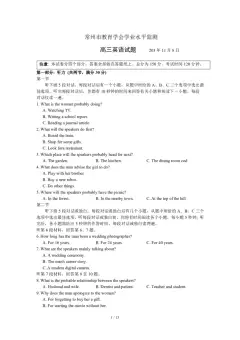
常州市2025-2026 学年第一学期高三期中质量调研
英
语
注意:本试卷分四个部分,答案全部做在答题纸上。总分为150 分。考试时间120 分钟。
第一部分: 听力(共两节,满分30 分)
第一节(共5 小题; 每小题1 分,满分5 分)
听下面5 段对话。每段对话后有一个小题,从题中所给的A、B、C 三个选项中选出最
佳选项,并标在试卷的相应位置。听完每段对话后,你都有10 秒钟的时间来回答有关小题
和阅读下一小题。每段对话仅读一遍。
1. Which kind of information does the woman need?
A. Tourist attractions.
B. Accommodations.
C. Transportation.
2. What will the speakers buy first?
A. A sofa.
B. A chair.
C. A bed.
3. What do we know about the man?
A. He is in law school.
B. He is the middle child.
C. He is living abroad now.
4. Where does the conversation take place?
A. At a store.
B. At home.
C. At an office.
5. What are the speakers mainly talking about?
A. A hand injury.
B. A car accident.
C. A visit to a doctor.
第二节(共15 小题; 每小题1.5 分,满分22.5 分)
听下面5 段对话或独白。每段对话或独白后有几个小题,从题中所给的A、B、C 三个
选项中选出最佳选项。听每段对话或独白前,你将有时间阅读各个小题,每小题5 秒钟: 听
完后,各小题将给出5 秒钟的作答时间。每段对话或独白读两遍。
听第6 段材料,回答第6、7 题。
6. What is the website used for?
A. Studying design.
B. Meeting new people.
C. Learning about study skills.
7. What is the woman’s opinion about the website?
A. Helpful.
B. Useless.
C. Original.
听第7 段材料,回答第8 至10 题。
8. What is Anna going to do?
A. Buy a sports suit.
B. Find a coach.
C. Do sports.
9. How old is the man?
A. 11.
B. 15.
C. 26.
10. What do the speakers decide to do together?
A. Do some shopping.
B. Play a game.
C. Watch a match.
听第8 段材料,回答第11 至13 题。
11. Why didn’t the woman learn driving?
A. She couldn’t spare the time on weekdays.
B. She was afraid of driving in urban areas.
C. She lives far from driving schools.
12. What does the woman think of the man’s driving teacher?
A. Strict.
B. Responsible.
C. Flexible.
13. Who will the woman call later?
公众号:高中试卷君
学科网(北京)股份有限公司
A. The man’s mother.
B. Daniel Smith.
C. Alan Suckliff.
听第9 段材料,回答第14 至17 题。
14. Where is the woman?
A. In Perth.
B. In Sydney.
C. In New York.
15. When can the man’s conference be held?
A. From January 21st to 22nd.
B. From January 28th to 29th.
C. From February 4th to 5th.
16. How many people can the Tesla room hold at most?
A. 50.
B. 60.
C. 100.
17. What does the man request at last?
A. Internet access.
B. A projector.
C. Microphones.
听第10 段材料,回答第18 至20 题。
18. What will the listeners do next week?
A. Visit a museum.
B. Work at a museum.
C. Attend a lecture.
19. Which door leads to Gallery 1?
A. The one behind the reception desk.
B. The one behind a statue of a horse.
C. The one behind a big donation box.
20. How does the speaker suggest having lunch?
A. Take their own lunch. B. Order lunch at the cafe.
C. Make sandwiches in the kitchen.
第二部分阅读(共两节,满分50 分)
第一节(共15 小题; 每小题2.5 分,满分37.5 分)
阅读下列短文,从每题所给的A、B、C、D 四个选项中选出最佳选项。
A
Maintaining a healthy weight involves more than just the numbers on a scale — it’s about
understanding your body’s needs.
Wang Yan, a physician at Raffles Hospital Beijing with over 30 years of experience, noted
that teenagers often receive mixed messages about body image. “Many believe that being thin
means being healthy, but visceral fat (内脏脂肪) can still be present in those who appear slim,”
she explained. Different from subcutaneous fat ( 皮下脂肪) which sits just beneath the skin,
visceral fat surrounds internal organs and is more closely linked to long-term health risks. While
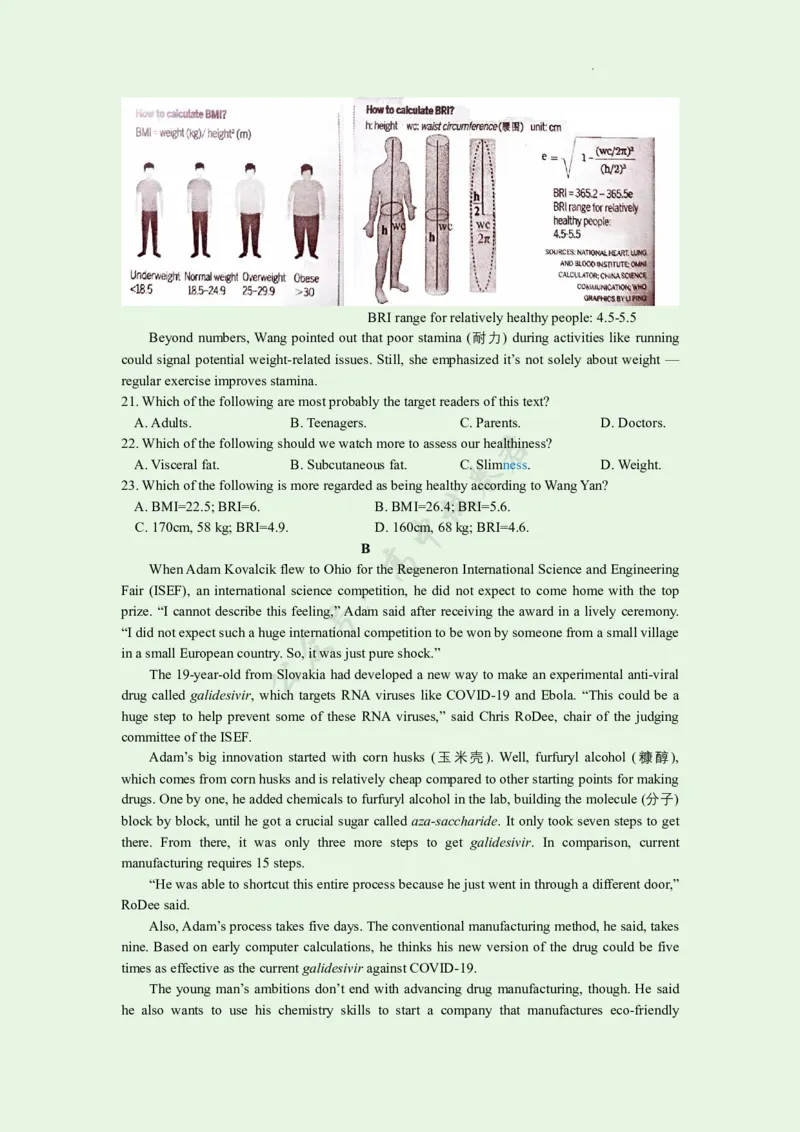
body mass index (BMI) is a handy tool for assessing weight, BMI=weight (in kilograms)/height
(in meters)², Wang advised teenagers to be careful. “It’s best to use growth charts to understand
BMI rather than adult rules,” she said, noting that temporary weight gain often balances out as
height increases. BMI also has its limitations — for instance, a teenager with a normal BMI might
still carry excess body fat. She recommended considering additional indicators, such as the body
roundness index (BRI) for a fuller picture of health.
公众号:高中试卷君
学科网(北京)股份有限公司
BRI range for relatively healthy people: 4.5-5.5
Beyond numbers, Wang pointed out that poor stamina (耐力) during activities like running
could signal potential weight-related issues. Still, she emphasized it’s not solely about weight —
regular exercise improves stamina.
21. Which of the following are most probably the target readers of this text?
A. Adults.
B. Teenagers.
C. Parents.
D. Doctors.
22. Which of the following should we watch more to assess our healthiness?
A. Visceral fat.
B. Subcutaneous fat.
C. Slimness.
D. Weight.
23. Which of the following is more regarded as being healthy according to Wang Yan?
A. BMI=22.5; BRI=6.
B. BMI=26.4; BRI=5.6.
C. 170cm, 58 kg; BRI=4.9.
D. 160cm, 68 kg; BRI=4.6.
B
When Adam Kovalcik flew to Ohio for the Regeneron International Science and Engineering
Fair (ISEF), an international science competition, he did not expect to come home with the top
prize. “I cannot describe this feeling,” Adam said after receiving the award in a lively ceremony.
“I did not expect such a huge international competition to be won by someone from a small village
in a small European country. So, it was just pure shock.”
The 19-year-old from Slovakia had developed a new way to make an experimental anti-viral
drug called galidesivir, which targets RNA viruses like COVID-19 and Ebola. “This could be a
huge step to help prevent some of these RNA viruses,” said Chris RoDee, chair of the judging
committee of the ISEF.
Adam’s big innovation started with corn husks (玉米壳). Well, furfuryl alcohol (糠醇),
which comes from corn husks and is relatively cheap compared to other starting points for making
drugs. One by one, he added chemicals to furfuryl alcohol in the lab, building the molecule (分子)
block by block, until he got a crucial sugar called aza-saccharide. It only took seven steps to get
there. From there, it was only three more steps to get galidesivir. In comparison, current
manufacturing requires 15 steps.
“He was able to shortcut this entire process because he just went in through a different door,”
RoDee said.
Also, Adam’s process takes five days. The conventional manufacturing method, he said, takes
nine. Based on early computer calculations, he thinks his new version of the drug could be five
times as effective as the current galidesivir against COVID-19.
The young man’s ambitions don’t end with advancing drug manufacturing, though. He said
he also wants to use his chemistry skills to start a company that manufactures eco-friendly
公众号:高中试卷君
学科网(北京)股份有限公司
perfumes (香水) from corn. “From the first time I stepped foot into a lab, I knew that I wanted to
do something,” he said.
24. How did Adam feel when he won the top prize?
A. Awkward.
B. Surprised.
C. Dismissive.
D. Grateful.
25. Which of the following is the major advantage of Adam’s new method?
A. Fewer production steps.
B. Eco-friendly way of production.
C. Lower requirements for chemistry skills.
D. Effectiveness in curing viruses of different types.
26. What can we know about Adam from the article?
A. He likes taking part in competitions.
B. He complains about living in a small countryside.
C. He tries new methods in order to avoid repetitive work.
D. He wants to contribute to the society with his knowledge.
27. Which of the following is the best title for the passage?
A. From winning to winning: A Competition Story
B. Corn Husks: The Best Solution to Viruses
C. From Corn to Cure: A Teen’s Breakthrough
D. Galidesivir: A Unique Cure for RNA Viruses
C
It’s not surprising that many people fear the dentist. Replacing a tooth often requires invasive
surgery and implanting a titanium (钛) screw into a patient’s jawbone, then waiting months for
that to strengthen into an artificial root, before attaching a crown or cap on top of it. But research
groups around the world are working to find ways to implant and grow real biological teeth in a
human jaw.
That may be a way off, but at King’s College London, Ana Angelova Volponi has been
experimenting with lab-grown teeth for almost two decades, and was part of a team that in 2013
grew a tooth from human and mouse cells. This year, she led a study that built upon that work and
achieved a breakthrough in the material used to house the growing tooth in the lab, which better
mimics the actual environment where biological teeth grow in the mouth. It’s a key step on the
way to replacing the mouse cells with human cells and stimulating them to form a tooth.
The idea of creating lab-grown teeth dates back to the 1980s, Volponi said, but the one that
she and her colleagues created over a decade ago was the first that used adult human gingival (牙
龈的) cells and combined them with tooth cells taken from a mouse embryo (胚胎) .
“It’s almost like a tripod (三脚架),” she said about the elements that contribute to growing a
tooth in a lab setting. “The two types of cells are engaging in tooth making, in a sort of
conversation, and then we have the environment where this happens.”
Researchers still don’t know exactly how to replace the embryonic mouse cells with adult
human cells, but if that puzzle is solved, Volponi envisions two possible ways to integrate lab-
grown teeth into everyday dentistry: “We either grow a tooth up to a certain stage of development,
and then put it into the tooth socket where a lost tooth was. Or, we fully grow the tooth first and
then implant it surgically. It’s still too early to say which approach will be better.”
28. The author mentions “invasive surgery” in the first paragraph to ______.
A. criticize outdated dental techniques
公众号:高中试卷君
学科网(北京)股份有限公司
B. compare different types of dental surgeries
C. explain the complexity of traditional dental procedures
D. highlight the need for alternative tooth replacement solutions
29. What does the underlined word “mimics” in the second paragraph most probably mean?
A. Imitates.
B. Creates.
C. Displays.
D. Improves.
30. The author implies that the use of adult human cells in lab-grown teeth ______.
A. has already been achieved by Volponi’s team
B. is the biggest remaining challenge in the research
C. is less effective than using mouse embryonic cells
D. will end the need for a supporting environment
31. What is mainly talked about in the passage?
A. Challenges in traditional dental implants.
B. Advances in lab-grown biological teeth research.
C. Problems in implanting real biological teeth.
D. Methods to replace mouse embryos with humans’.
D
What defines a high-quality middle-school teacher in today’s educational landscape? While
academic knowledge remains a foundational requirement — mastery of subject matter allows
teachers to explain complex concepts clearly and answer students’ questions with authority — it
represents just one dimension of excellence.
A truly exceptional teacher goes beyond mere knowledge transmission to become catalyst (催
化剂) for student growth, mixing passion, empathy, and adaptability in equal measure. Take Ms.
Sarah Chen, a 9th-grade biology teacher at Lincoln Middle School, who exemplifies this
multidimensional approach. With a PhD in molecular biology, Ms. Chen certainly possesses deep
academic qualifications, but her students remember her most for transforming boring textbook
chapters into engaging narratives. This ability to connect abstract concepts to real-world relevance
is a sign of inspiring educators, as studies show students are 50% more likely to remember
information when it’s tied to meaningful contexts.
Equally critical is ... __________________________________________________________
_______________________________________________________________________________
_______________________________________________________________________________
Such mentorship (导师制) extends beyond academics; high-quality teachers recognize that
students’ emotional well-being directly impacts their learning. They create inclusive classrooms
where diverse perspectives are valued, whether by incorporating multicultural literature or
adjusting teaching strategies for different students.
In an era of rapid technological change, adaptability is another key quality. Ms. Elena Kim,
who teaches English language arts, easily integrates digital tools like interactive storytelling apps
while still prioritizing face-to-face discussions. She notes, “A great teacher doesn’t just follow the
curriculum — they tailor it to their students’ needs, whether that means using TikTok to analyze
poetry or hosting a debate on social media ethics.” This ability to change ensures that learning
remains relevant and engaging for digital-native students.
Perhaps the last one is the most important to high-quality teachers. All through their lives,
they attend workshops to upgrade their teaching approaches, collaborate with colleagues to refine
practices, and reflect on their teaching through student feedback. As educational researcher Dr.
公众号:高中试卷君
学科网(北京)股份有限公司
Linda Darling-Hammond writes, “The best teachers are those who never stop growing, modeling
the curiosity and strength they hope to instill in their students.”
Ultimately, defining a high-quality teacher isn’t about checking boxes on a list; it’s about
fostering a dynamic environment where students feel challenged, supported, and inspired to reach
their full potential.
32. What makes Ms. Chen so memorable to her students?
A. Her academic knowledge.
B. Her professional enthusiasm.
C. Her PhD educational background.
D. Her contextualized teaching style.
33. What is the missing Paragraph 3 most probably about?
A. The solution to teachers’ emotional problems.
B. The reason for making academic progress.
C. The importance of emotional intelligence.
D. The advantage of the multidimensional method.
34. Which of the following is the most important to Ms. Elena?
A. Technological use.
B. Curriculum requirements.
C. Students’ needs.
D. The ability to Change.
35. What does Dr. Darling-Hammond emphasize?
A. Lifelong learning.
B. Teaching ability.
C. Collaborative spirits.
D. Professional demonstration.
第二节(共5 小题;每小题2.5 分,满分12.5 分)
阅读下面短文,从短文后的选项中选出可以填入空白处的最佳选项。选项中有两项为
多于选项。
Have you ever caught yourself smiling at something small, like solving a tough homework
problem, finishing a good book, or taking a walk after a long day?
36
In our busy world, we often feel pressured to reach big milestones such as entering a high-
ranking university or steadily climbing the ladder of success.
37
True growth often
happens in the quiet spaces in between, like when you manage your time better, help a friend
without being asked, or keep trying after a setback. They may not be grand victories, but they
shape your character and build resilience (韧性).
How many times have you felt overwhelmed with schoolwork or other responsibilities —
your mind so crowded that you can no longer focus, and you just want to give up? But you’re
more resilient than that, so take a short break and re-centre yourself by doing something just for
you. That’s what I do.
38
This may seem mundane (平凡的), but those brief moments of
mindfulness allow me to sort out my thoughts. Then I come back and maybe write just one
paragraph, calmer and proud of myself for not giving up. Progress doesn’t always come with
applause; sometimes it’s just quietly showing up for yourself.
When we approach life as a long journey rather than a race, every small action, whether that’s
waking up early, practising a skill or simply showing kindness, adds another stepping stone to the
path we walk. When we look back, we can see how far we’ve come.
39
Every day, write
one simple thing you accomplished: I finished reading a chapter; I spoke up in class; I took care of
myself today. Over time, these notes become a record of your quiet courage and proof that you’re
growing, even when progress feels slow.
40
So, when you face a challenge, remember that even the smallest act of
perseverance is worth celebrating. You’re growing, slowly, bravely, and beautifully.
公众号:高中试卷君
学科网(北京)股份有限公司
A. Besides, I believe that every effort counts.
B. If it helps to see this clearly, keep a small-achievements journal.
C. As important as these goals are to many, they’re not the whole story.
D. However, we’re all learning to navigate our way forward in this fast way.
E. I make myself a cup of tea or take a moment to listen to the birds in the trees.
F. Moments like these may seem ordinary, but they quietly tell the story of who we are.
G. Life’s depth isn’t built from shining moments but from the steady rhythm of ordinary days.
第三部分
语言运用
(共两节,满分30 分)
第一节(共15 小题; 每小题1 分,满分15 分)
阅读下面短文,从每题所给的A、B、C、D 四个选项中选出可以填入空白处的最佳选
项。
A woman was thinking about asking her boss for a raise in salary and she was struggling for
days. This day she felt nervous and hesitant all day, and finally as the sun set, she gathered her
41
to talk with her employer about this. Ten minutes later, she came out of the manager’s office
with her request met with a(n)
42
.
Upon her return home, she was
43
by a surprising sight: the dining table, set with their
finest china and softly lit by the warm glow of candles, was a(n)
44
to her husband’s
efforts. He had arrived home early, preparing a rich meal
45
her success. She couldn’t help
but wonder if a well-meaning colleague had revealed the news, or if her husband had somehow
known she would not get
46
.
In the kitchen, she shared the exciting news with her husband, their embrace and kiss
47
the moment of victory. As they sat down to the wonderful meal, she discovered a beautifully
scripted note beside her plate, which
48
, “Congratulations, my love! I had
49
in
your success. These things will tell you how much I love you.”
After the meal, as her husband went into the kitchen to tidy up, a second card slipped from
his pocket
50
. Curious, she picked it up and read the words that would forever carve
themselves into her heart: “Don’t worry about it! You
51
the raise anyway! These things
will tell you how much I love you.”
Someone has said that the measure of love is when you love
52
measure. What this
man feels for his wife is total
53
and love, whether she succeeds or fails. His love
celebrates her victories and
54
her pains. He stands with her, no matter what
55
throws in their direction.
41. A. strength
B. courage
C. thoughts
D. patience
42. A. smile
B. laugh
C. nod
D. talk
43. A. greeted
B. waited
C. expected
D. absorbed
44. A. reaction
B. approach
C. access
D. witness
45. A. in search of
B. in anticipation of
C. in favor of
D. in need of
46. A. turned over
B. turned up
C. turned down
D. turned around
47. A. confirming
B. remembering
C. finding
D. exposing
48. A. advised
B. warned
C. read
D. claimed
49. A. prediction
B. faith
C. interest
D. expectation
50. A. unprepared
B. uncollected
C. uncompleted
D. unnoticed
51. A. get
B. request
C. deserve
D. consider
52. A. for
B. under
C. on
D. without
公众号:高中试卷君
学科网(北京)股份有限公司
53. A. tolerance
B. acceptance
C. commitment
D. involvement
54. A. relaxes
B. checks
C. experiences
D. eases
55. A. life
B. boss
C. work
D. love
第二节(共10 小题; 每小题1.5 分,满分15 分)
阅读下面短文,在空白处填入1 个适当的单词或括号内单词的正确形式。
On Xiaohongshu, a Chinese lifestyle-sharing platform, over 100,000 posts are about the
fashion crazes among China’s youth: the “Mint Mambo” style and “Tyndall” style.
The so-called Mint Mambo Style is simply
56
(dress) in shades of fresh green. “Mint”
in “Mint Mambo” represents the color mint green, while “mambo” comes from a popular dance in
South America, a dance full of energy and
57
(free), creating a passionate atmosphere.
The mint mambo style centers around its signature mint color palette, and combining
individual pieces, it creates
58
fresh and lively visual effect. Meanwhile, it also arouses a
sense of the mambo dance,
59
(give) people an impression that the wearer is energetic and
dynamic, as if ready to dance at any moment. This fashion trend combines the freshness of mint
green with the energy of the Mambo, creating a look
60
brings relaxation and cheerfulness.
Chinese netizens are also embracing another trend — Tyndall style.
61
the dopamine
(多巴胺) dressing trend of 2023, where people dressed themselves in bright and vivid colors
62
(express) joy, Tyndall represents a much more complicated approach to matching outfits.
63
(science) explained, the Tyndall effect refers to the phenomenon where light, upon
passing through a colloidal solution (胶状溶液),
64
(spread) by the colloidal particles,
thereby making the light path visible. Notably, the spreading effectiveness varies among different
types of light. This explains why the sky appears blue during the day and becomes redder at dusks,
65
the Tyndall dressing trend draws inspiration from sky gradients (渐变) to create a visually
appealing outfit, showing nature’s fascinating color transitions.
第四部分写作
(共两节,满分40 分)
第一节(满分15 分)
假定你是李华,你校将与英国友好学校联合举办“数学学习方法”讨论会,话题是“强化
刷题训练”和“深化概念理解”两种方法哪一种更好,请你写一段发言稿,内容包括:
1. 你选择的方法(A 或B);
2. 支持该方法的核心理由。
注意:
1. 词数80 左右;
2. 请在答题卡的相应位置作答。
Ladies and gentlemen,
___________________________________________________________________________
_______________________________________________________________________________
第二节(满分25 分)
阅读下面材料,根据其内容和所给段落开头语续写两段,使之构成一篇完整的短文。
Thanksgiving Day was nearly here, and the small town smelled of warm cinnamon. For Mrs
Henderson’s Year One class, that meant a special task: “Draw something you’re thankful for.”
When she wrote it on the whiteboard, the children’s eyes lit up with excitement.
Many families in the class didn’t have much money. Fancy dinners and new toys were scarce,
yet the children still loved Thanksgiving. They chatted about Mum’s roast turkey, sweet cranberry
公众号:高中试卷君
学科网(北京)股份有限公司
sauce, and Granny’s pies that made kitchens smell wonderful. Mrs Henderson smiled, guessing
she would see lots of colourful pictures of good foods. By break time, indeed, most desks were
covered with orange and brown crayon drawings of turkeys and pies.
However, Douglas was different. His clothes were too large, and his shoes were torn. During
break, he never played with the other children. Instead, he stood beside Mrs Henderson, shoulders
hunched, hands in hers, eyes full of sadness well beyond his six years. She tried talking to him, but
he only mumbled (叽咕) or nodded, then looked away.
When the break ended, Mrs Henderson walked around the classroom, praising each child’s
work — bright suns and funny-looking turkeys — until she reached Douglas’s desk. On his paper
was just one thing: a simple pencil drawing of a hand, with no colour or detail. Mrs Henderson felt
puzzled but said nothing, realising Douglas must have a reason for his choice.
At the end of the lesson, several children gathered around Douglas’s desk.
“Is it a farmer’s hand? They raise turkeys!” Mia asked excitedly.
“No, it must be a police officer’s hand. They keep us safe,” Jake said.
“Maybe it’s God’s hand, because God looks after everyone,” Lila suggested.
They chattered until Mrs Henderson asked them to pack away. The children left with laughter
and smiles, but Douglas slipped out silently.
When the classroom emptied, Mrs Henderson sat by Douglas’s desk, looking at the lonely
hand on the page. Then she heard a small cough. Douglas had come back, backpack hanging from
one shoulder, eyes cast down.
注意:
1. 续写词数应为150 个左右;
2. 请在答题卡的相应位置作答。
“Whose hand did you draw?” Mrs Henderson asked softly. ___________________________
_______________________________________________________________________________
“Thank you,” she said, voice warm, “This is the best gift I’ve ever received.” ____________
_______________________________________________________________________________
公众号:高中试卷君
学科网(北京)股份有限公司
参考答案
听力
1-5BCBBA 6-10CBCCB
11-15ABCBC 16-20CABCA
阅读
21-23 BAC
24-27 BADC
28-31 DABB
32-35 DCCA
36-40 FCEBG
完形填空
41-45 BCADB 46-50 CACBD 51-56 CDBDA
语法填空
56.dressing/being dressed
57. freedom
58. a
59. giving
60. that/which
61. Unlike
62. to express
63. Scientifically
64. is spread
65. and
写作第一节
Ladies and gentlemen, my proposition firmly advocates Option B: deepening conceptual
understanding as the superior approach to mastering mathematics.
Firstly, genuine comprehension of core concepts empowers learners to solve problems
flexibly without relying on rote memorization—this is the foundation of mathematical literacy.
Secondly, logical reasoning cultivates a strong knowledge framework that adapts to novel
challenges, unlike rigid mechanical repetition. While some may argue Option A boosts speed,
excessive drilling merely trains mechanical responses, destroying the creative thinking essential
for solving complex, non-routine problems. True mathematical proficiency lies not in how many
questions you solve, but in how deeply you understand why solutions work.
第二节读后续写
“Whose hand did you draw?” Mrs Henderson asked softly. Douglas nudged the floor with
his toe, then muttered something she couldn’t hear. Leaning in, she heard him whisper, “It’s yours,
teacher.” Mrs Henderson’s heart fluttered as she remembered all the times she’d held Douglas’s
hand: when he was too shy to go out to the playground, when she guided his fingers around a
pencil, and when she walked him to the bus, chatting about the clouds. She felt tears in her eyes.
“Thank you,” she said, voice warm, “This is the best gift I’ve ever received.” She gently
took his hand in hers. Douglas didn’t smile, but his shoulders loosened, and he didn’t pull away.
They stood together in the golden sunlight shining through windows, hand in hand. Later, Mrs
Henderson taped Douglas’s picture to her desk. Each time she saw it, she remembered that small
acts of kindness—like offering a hand or a caring word—can matter more than we know. For
children like Douglas, it means they’re seen and loved, which is far sweeter than any turkey or pie.
公众号:高中试卷君