1 / 10
2024 年全国硕士研究生入学统一考试英语(二)
Section I Use of English
Directions:
Read the following text. Choose the best word(s) for each numbered blank and mark A, B, C or D
on the ANSWER SHEET. (10 points)
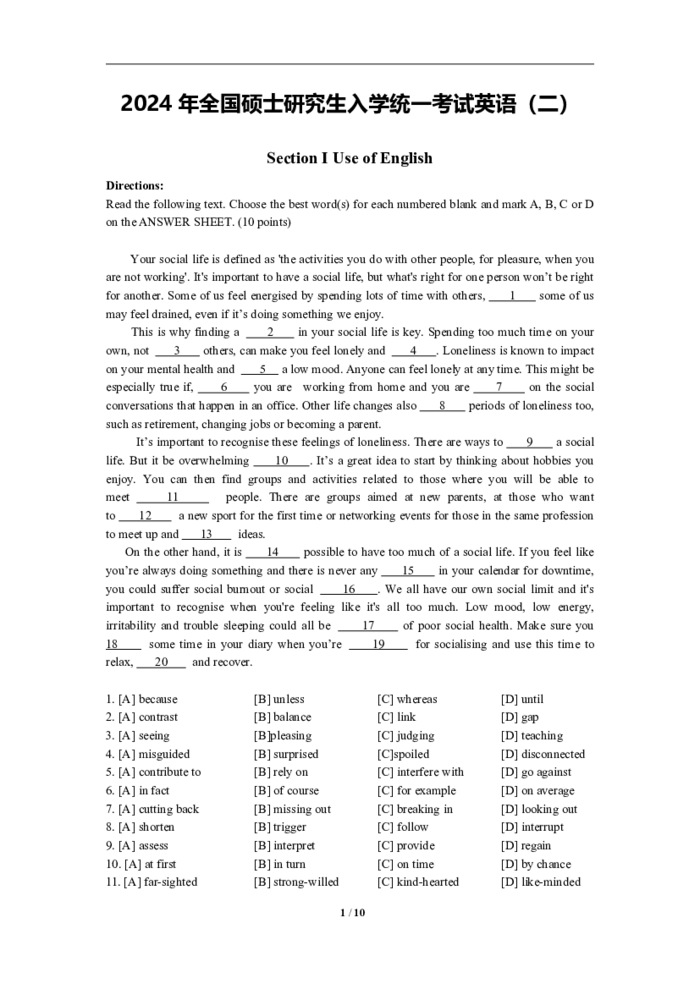
Your social life is defined as 'the activities you do with other people, for pleasure, when you
are not working'. It's important to have a social life, but what's right for one person won’t be right
for another. Some of us feel energised by spending lots of time with others,
1
some of us
may feel drained, even if it’s doing something we enjoy.
This is why finding a
2
in your social life is key. Spending too much time on your
own, not
3
others, can make you feel lonely and
4
. Loneliness is known to impact
on your mental health and
5
a low mood. Anyone can feel lonely at any time. This might be
especially true if,
6
you are
working from home and you are
7
on the social
conversations that happen in an office. Other life changes also
8
periods of loneliness too,
such as retirement, changing jobs or becoming a parent.
It’s important to recognise these feelings of loneliness. There are ways to
9
a social
life. But it be overwhelming
10
. It’s a great idea to start by thinking about hobbies you
enjoy. You can then find groups and activities related to those where you will be able to
meet
11
people. There are groups aimed at new parents, at those who want
to
12
a new sport for the first time or networking events for those in the same profession
to meet up and
13
ideas.
On the other hand, it is
14
possible to have too much of a social life. If you feel like
you’re always doing something and there is never any
15
in your calendar for downtime,
you could suffer social burnout or social
16
. We all have our own social limit and it's
important to recognise when you're feeling like it's all too much. Low mood, low energy,
irritability and trouble sleeping could all be
17
of poor social health. Make sure you
18
some time in your diary when you’re
19
for socialising and use this time to
relax,
20
and recover.
1. [A] because
[B] unless
[C] whereas
[D] until
2. [A] contrast
[B] balance
[C] link
[D] gap
3. [A] seeing
[B]pleasing
[C] judging
[D] teaching
4. [A] misguided
[B] surprised
[C]spoiled
[D] disconnected
5. [A] contribute to
[B] rely on
[C] interfere with
[D] go against
6. [A] in fact
[B] of course
[C] for example
[D] on average
7. [A] cutting back
[B] missing out
[C] breaking in
[D] looking out
8. [A] shorten
[B] trigger
[C] follow
[D] interrupt
9. [A] assess
[B] interpret
[C] provide
[D] regain
10. [A] at first
[B] in turn
[C] on time
[D] by chance
11. [A] far-sighted
[B] strong-willed
[C] kind-hearted
[D] like-minded
2 / 10
12. [A] try
[B] promote
[C] watch
[D] describe
13. [A] test
[B] share
[C] accept
[D] revise
14. [A] already
[B] thus
[C] also
[D] only
15. [A] visit
[B] order
[C] space
[D] boundary
16. [A] fatigue
[B] criticism
[C] injustice
[D] dilemma
17. [A] sources
[B] standards
[C] signs
[D] scores
18. [A] take over
[B] wipe off
[C] add up
[D] mark out
19. [A] ungrateful
[B] unavailable
[C] responsible
[D] regretful
20. [A] react
[B] repeat
[C] return
[D] rest
Section II Reading Comprehension
Part A
Directions:
Read the following four texts. Answer the questions after each text by choosing A, B, C or D.
Mark your answers on the ANSWER SHEET. (40 points)
Text 1
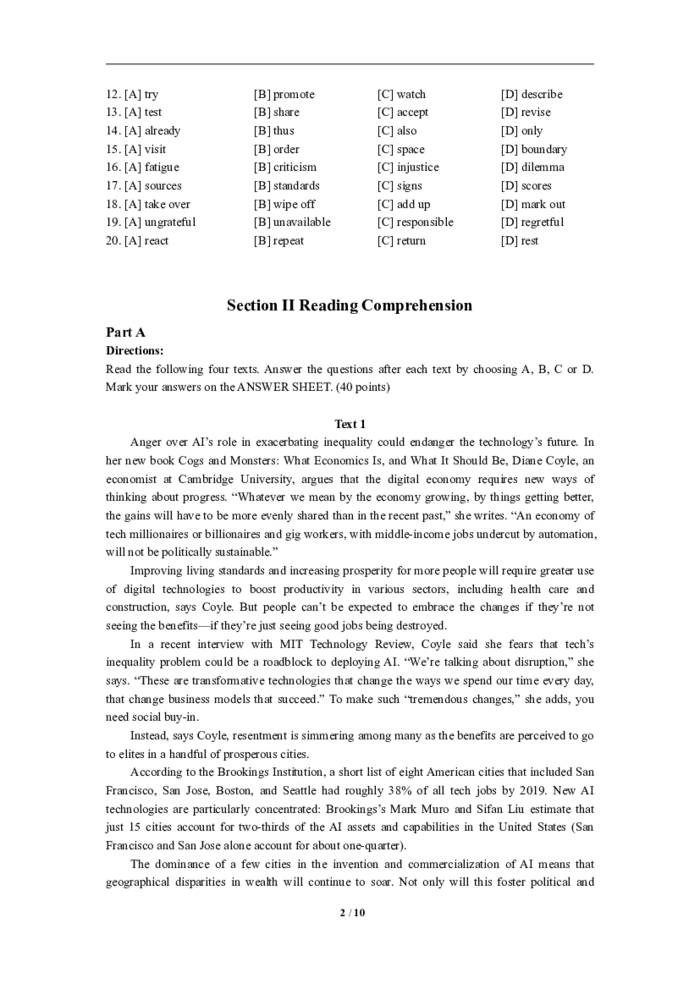
Anger over AI’s role in exacerbating inequality could endanger the technology’s future. In
her new book Cogs and Monsters: What Economics Is, and What It Should Be, Diane Coyle, an
economist at Cambridge University, argues that the digital economy requires new ways of
thinking about progress. “Whatever we mean by the economy growing, by things getting better,
the gains will have to be more evenly shared than in the recent past,” she writes. “An economy of
tech millionaires or billionaires and gig workers, with middle-income jobs undercut by automation,
will not be politically sustainable.”
Improving living standards and increasing prosperity for more people will require greater use
of digital technologies to boost productivity in various sectors, including health care and
construction, says Coyle. But people can’t be expected to embrace the changes if they’re not
seeing the benefits—if they’re just seeing good jobs being destroyed.
In a recent interview with MIT Technology Review, Coyle said she fears that tech’s
inequality problem could be a roadblock to deploying AI. “We’re talking about disruption,” she
says. “These are transformative technologies that change the ways we spend our time every day,
that change business models that succeed.” To make such “tremendous changes,” she adds, you
need social buy-in.
Instead, says Coyle, resentment is simmering among many as the benefits are perceived to go
to elites in a handful of prosperous cities.
According to the Brookings Institution, a short list of eight American cities that included San
Francisco, San Jose, Boston, and Seattle had roughly 38% of all tech jobs by 2019. New AI
technologies are particularly concentrated: Brookings’s Mark Muro and Sifan Liu estimate that
just 15 cities account for two-thirds of the AI assets and capabilities in the United States (San
Francisco and San Jose alone account for about one-quarter).
The dominance of a few cities in the invention and commercialization of AI means that
geographical disparities in wealth will continue to soar. Not only will this foster political and
3 / 10
social unrest, but it could, as Coyle suggests, hold back the sorts of AI technologies needed for
regional economies to grow.
Part of the solution could lie in somehow loosening the stranglehold that Big Tech has on
defining the AI agenda. That will likely take increased federal funding for research independent of
the tech giants. Muro and others have suggested hefty federal funding to help create US regional
innovation centers, for example.
A more immediate response is to broaden our digital imaginations to conceive of AI
technologies that don’t simply replace jobs but expand opportunities in the sectors that different
parts of the country care most about, like health care, education, and manufacturing.
21.Coyle argues in her new book that economic growth should _______.
[A] give rise to innovation
[B] diversify career choices
[C] benefit people equally
[D] be promoted forcefully
22. According to paragraph 2, digital technology should be useful to______.
[A] bring about instant prosperity
[B] reduce people's workload
[C] raise overall work efficiency
[D] enhance cross-sector cooperation
23. What does Coyle fear about transformative technology?
[A] They may affect work-life balance.
[B] They may be impractical to deploy.
[C] They may incur huge expenditure.
[D] They may be unwelcome to the public.
24. Several American cities are mentioned to show______.
[A] the uneven distribution of AI technologies in the US
[B] the disappointing prospect of tech jobs in the US
[C] the fast progress of US regional economies
[D] the increasing significance of US AI assets
25. With regard to Coyle concern, the author suggests______.
[A] raising funds to start new AI projects
[B] encouraging collaboration in AI research
[C] guarding against the side effects of AI
[D] redefining the role of AI technologies
Text 2
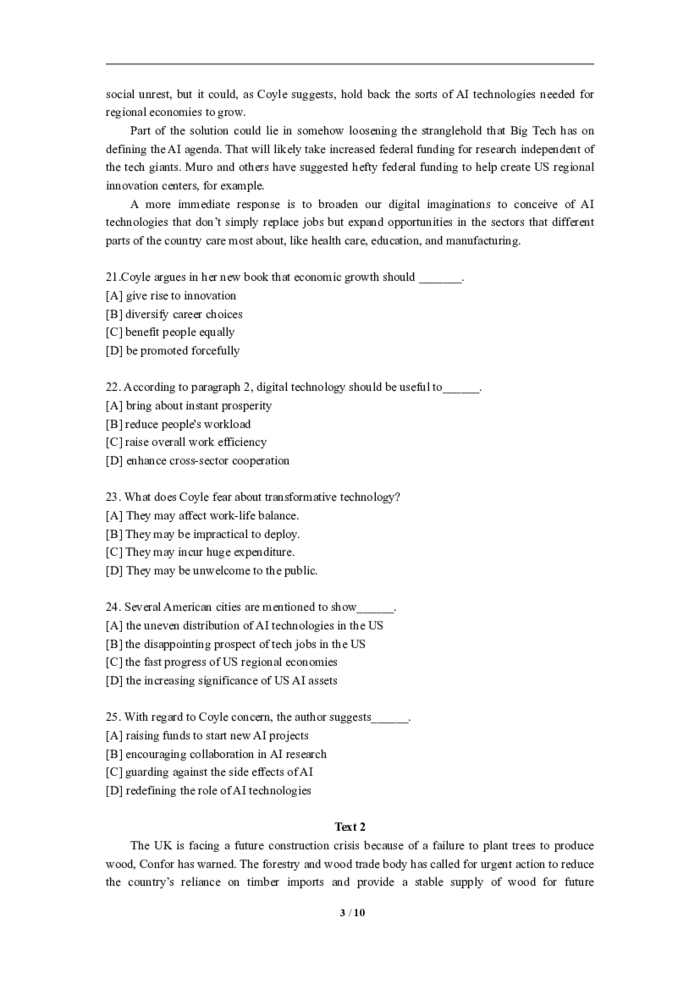
The UK is facing a future construction crisis because of a failure to plant trees to produce
wood, Confor has warned. The forestry and wood trade body has called for urgent action to reduce
the country’s reliance on timber imports and provide a stable supply of wood for future
4 / 10
generations. Currently only 20 percent of the UK’s wood requirement is home-grown while it
remains the second-largest net importer of timber in the world.
Coming at a time of fresh incentives from the UK government for landowners to grow more
trees, the trade body says these don’t go far enough and fail to promote the benefits of planting
them to boost timber supplies. “Not only are we facing a carbon crisis now, but we will also be
facing a future construction crisis because of failure to plant trees to produce wood.” said Stuart
Goodall, chief executive of Confor. "For decades we have not taken responsibility for investing in
our domestic wood supply, leaving us exposed to fluctuating prices and fighting for future
supplies of wood as global demand rises and our own supplies fall."
The UK has ideal conditions for growing wood to build low-carbon homes and is a global
leader in certifying that its forests are sustainably managed, Confor says. While around three
quarters of Scottish homes are built from Scottish timber, the use of home-grown wood in England
is only around 25 percent.
While productive tree planting can deliver real financial benefits to rural economies and
contribute to the UK's net-zero strategy, the focus of government support continues to be on food
production and the rewinding and planting of native woodland solely for biodiversity. Goodall add:
“ While food production and biodiversity are clearly of critical importance, we need our land to
also provide secure supplies of wood for construction, manufacturing and contribute to net zero.
“While the UK government has stated its ambition for more tree planting, there has been
little action on the ground." Confor is now calling for much greater impetus behind those
aspirations to ensure we have enough wood to meet increasing demand."
26. It can be learned from paragraph 1 that the UK needs to _______.
[A] increase its domestic wood supply
[B] reduce its demand for timber
[C] lower its wood production costs
[D] lift its control on timber imports
27. According to Confor, the UK government’s fresh incentives _____.
[A] can hardly address construction crisis
[B] are believed to come at the wrong time
[C] seem to be misleading for landowners
[D] will be costly to put into practice
28. The UK’s exposure to fluctuational wood prices is a result of _____.
[A] government’s inaction on timber imports
[B] inadequate investment in growing wood
[C] competition of timber traders at home
[D] wood products motive to maximise profits
29. Which of the following causes the shortage of wood supply in UK?
[A] excessive timber consumption in construction
[B] unfavorable conditions for growing trees
[C] outdated technology for wood production
5 / 10
[D] farmers’ unwillingness to plant trees
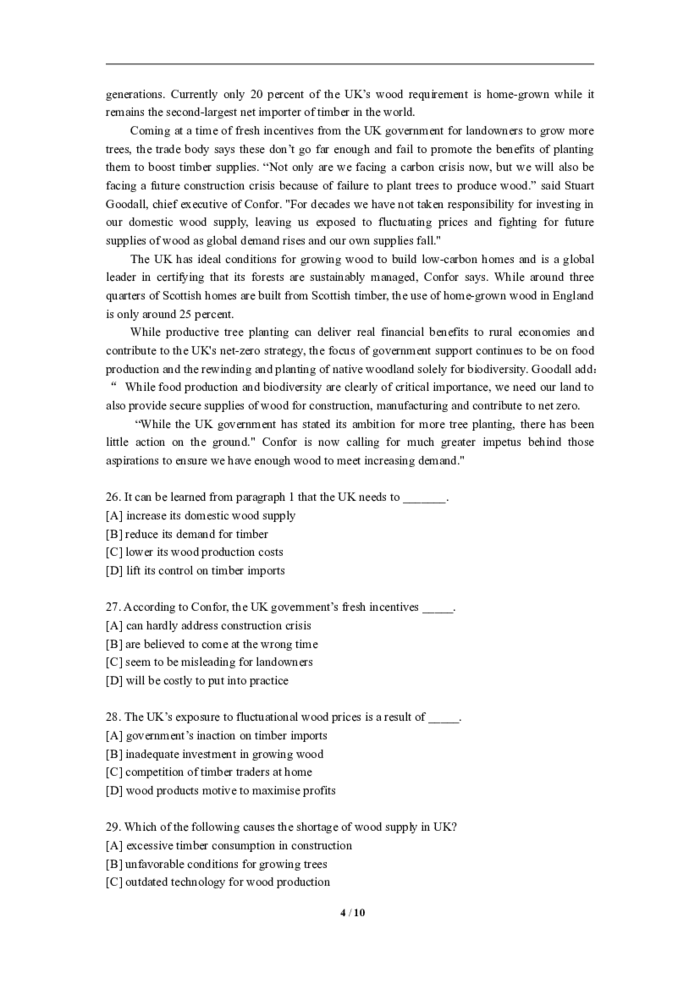
30. What does Goodall think UK government should do?
[A] Subsidise the building of low-carbon homes.
[B] Pay attention to rural economy.
[C] Provide more support for tree planting.
[D] Give priority to pursue net-zero strategy.
Text 3
One big challenge in keeping unsafe aging drivers off the road is convincing them that it is
time to turn over the key. It is a complete life-changer when someone stops—or is forced to
stop—driving, said former risk manager Anne M. Menke.
The American Medical Association advises physicians that in situation where clear evidence
of substantial driving impairment implies a strong threat to patient and public safety, and where
the physician’s advice to discontinue driving privileges is ignored, it is desirable and ethical to
notify the Department of Motor Vehicles, Menke wrote. “Some states require physicians to report,
others allow but do not mandate reports, while a few consider a report breach of confidentiality.
There could be liability and penalties if a physician does not act in accordance with state laws on
reporting and confidentiality ” she counseled.
Part of the problem in keeping older drivers safe is that the difficulties are addressed
piecemeal by different professions with different focuses, including gerontologists, highway
administration officials, automotive engineers and others, said gerontologist Elizabeth Dugan.
“There’s not a National Institute of Older Driver Studies,” she said. “We need better evidence on
what makes drivers unsafe” and what can help, said Dugan.
One thing that does seem to work is requiring drivers to report in person for license renewal.
Mandatory in-person renewal was associated with a 31 percent reduction in fatal crashes involving
drivers 85 or older, according to one study. Passing vision tests also produced a similar decline in
fatal crashes for those drivers, although there appeared to be no benefit from combining the two.
Many old drivers don't see eye doctors or can't afford to. Primary care providers have their
hands full and may not be able to follow through with patients who have trouble driving because
they can't turn their heads or remember where they are going—or have gotten shorter and haven't
changed their seat settings sufficiently to reach car pedals easily,
As long as there are other cars on the roads, self-driving cars won't solve the problems of
crashes, said Dugan. Avoiding dangers posed by all those human drivers would require to many
algorithms, she said. But we need to do more to improve safety, said Dugan. “If we're going to
have 100-year lives, we need cars that a 90-year-old can drive comfortably.”
31. According to Paragraph1, keeping unsafe aging drivers off the road _________.
[A] is a new safety measure
[B] has become a disputed issue
[C] can be a tough task to complete
[D] will be beneficial to their health
32.The American medical associations advice _________.
6 / 10
[A] has won support from drivers
[B] is generally considered unrealistic
[C] is wide dismissed as unnecessary
[D] has met with different responses
33.According to Dugan, efforts to keep older drivers safe ______.
[A] have brought about big changes
[B] need to be well coordinated
[C] have gained public concern
[D] call for relevant legal support
34. Some older drivers have trouble driving because they tend to
.
[A] stick with bad driving habits
[B] have a weakened memory
[C] suffer from chronic pains
[D] neglect car maintenance
35. Dugan thinks that the solution to the problems of crashes may lie in
.
[A] upgrading self-driving vehicle
[B] developing senior-friendly cars
[C] renovating transport facilities
[D] adjusting the age limit for drivers
Text 4
If you look at the apps on your phone, chances are you have at least one related to your
health—and probably several. Whether it is a mental health app, a fitness tracker, a connected
health device or something else, many of us are taking advantage of this technology to keep better
track of our health in some shape or form. Recent research from the Organization for the Review
of Care and Health Applications found that 350,000 health apps were available on the market,
90,000 of which launched in 2020 alone.
While these apps have a great deal to offer, it is not always clear how the personal
information we input is collected, safeguarded and shared online. Existing health privacy law,
such as the Health Insurance Portability and Accountability Act, is primarily focused on
the way hospitals, doctors’ offices, clinics and insurance companies store health records online.
The health information these apps and health data tracking wearables are collecting typically does
not receive the same legal protections.
Without
additional
protections
in
place,
companies
may
share
(and
potentially
monetize) personal health information in a way consumers may not have authorized or anticipated.
In 2021, Flo Health faced a Federal Trade Commission(FTC)investigation. The FTC alleged in
a complaint that "despite express privacy claims, the company took control of users'
sensitivity fertility data and shared it with third parties.” Flo Health and the FTC settled the matter
with a Consent Order requiring the company to get app users' express affirmative consent
before sharing their health information as well as to instruct the third parties to delete the data they
had obtained.
7 / 10
Section 5 of the FTC Act empowers the FTC to initiate enforcement action against unfair or
deceptive acts, meaning the FTC can only act after the fact if a company's privacy practices are
misleading or cause unjustified consumer harm. While the FTC is doing what it can to ensure apps
are keeping their promises to consumers around the handling of their sensitive health information,
the rate at which these health apps are hitting the market demonstrates just how immense of a
challenge this is.
As to the prospects for federal legislation, commentators suggest that comprehensive federal
privacy legislation seems unlikely in the short term. States have begun implementing their own
solutions to shore up protections for consumer-generated health data. California has been at the
forefront of state privacy efforts with the California Consumer Privacy Act of 2018. Virginia,
Colorado and Utah have also recently passed state consumer data privacy legislation.
36. The research findings are cited in Paragraph 1 to show _______.
[A] the prevalence of health apps
[B] the public concern over health
[C] the popularity of smartphones
[D] the advancement of technology
37. What dose the author imply about existing health privacy law?
[A] Its coverage needs to be extended.
[B] Its enforcement needs strengthening.
[C] It has discouraged medical misconduct.
[D] It has disappointed insurance companies.
38. Before sharing its users' health information, Flo Health is required to
.
[A] seek the approval of the FTC
[B] find qualified third parties
[C] remove irrelevant personal data
[D] obtain their explicit permission
39. What challenges is the FTC currently faced with?
[A] The complexity of health information.
[B] The rapid increase in new health apps.
[C] The subtle deceptiveness of health apps.
[D] The difficulty in assessing consumer harm.
40. It can be learned from the last paragraph that health data protection
.
[A] has been embraced by health app developers
[B] has been a focus of federal policy-making
[C] has encountered opposition in California
[D] has gained legislative support in some states
Part B
Directions:
8 / 10
Read the following text and choose the best answer from the right column to complete each of the
unfinished statements in the left column. Mark your answers on the ANSWER SHEET. (10 points)
High school students eager to stand out in the college application process often participate in
a litany of extracurricular activities hoping to bolster their chances of admission a selective
undergraduate institution.
However, college
admissions
experts
say
that
the
quality
of
a
college
hopeful's
extracurricular activities matter more than the number of activities he or she participates in.
Sue Rexford, the director of college guidance at the Charles. E. Smith Jewish Day School ,
says it is not necessary for a student,filling out the Common Application to list 10 activities in the
application
“No” college will expect that a student has a huge laundry list of extracurricular that they
have been passionately involved in each for an tended period of time, " Rexford wrote in an email.
Experts say it is tougher to distinguish oneself in a school-affiliated extracurricular activity
that is common among high school students than it is to stand out while doing an uncommon
activity.
“The competition to stand out and make an impact is going to be much stiffer, and so if
they’re going to do a popular activity, I’d say, be the best at it.” says Sara Harherson, a college
admission consultant.
High school students who have an impressive personal project they are working on
independently often impress colleges, experts say.
“For example, a student with an interest in entrepreneurship could demonstrate skills and
potential by starting a profitable small business.” Olivia Valdes, the founder of Zen
Admissions consulting firm, wrote in an email.
Joseph Adegboyega-Edun, a Maryland High school guidance counselor, says unconventional,
extracurricular activities can help students, impress college admissions offices, assuming they
demonstrated, serious commitment. “Again, since one of the big questions high school seniors
must consider is ‘What makes you unique?’ having an uncommon, extracurricular activity, a
conventional one is an advantage,” he wrote in an email.
Experts say demonstrating talent in at least one extracurricular activity can help in the college
admissions process, especially at top-tier undergraduate institutions.
“Distinguishing yourself in one focused type of extracurricular activity can be a positive in
the admissions process, especially for highly selective institutions, where having top grades and
test scores is not enough,” Katie Kelley admissions counselor at Ivy Wise admissions consultancy,
wrote in an email. “Students need to have that quality or hook that will appeal to admissions
officers and allow them to visualize how the student might come and enrich their campus
community.”
Extracurricular activities related to the college major declared on a college application are
beneficial, experts suggest. “If you already know your major, having an extracurricular that fits
into that major can be a big plus,” says Mayghin Levine, the manager of educational opportunities
with The Cabbage Patch Settlement House, a Louisville, Kentucky, nonprofit community center.
High school students who have had a strong positive influence on their community through
an extracurricular activity may impress a college and win a scholarship, says Erica Gwyn, a
9 / 10
former math and science magnet program assistant at a public high school who is now executive
director of the Kaleidoscope Careers Academy in Atlanta, a nonprofit organization.
A. Students who stand out in a specific extracurricular activity will be
favored by top-tier institutions.
41. Sue Rexford
B. Students whose extracurricular activity has benefited their community
are likely to win a scholarship.
42. Sara Harberson
C. Undertaking too many extracurricular activities will hardly be seen as a
plus by colleges.
43. Katie Kelley
D. Student who exhibits activity in doing business can impress colleges.
44. Mayghin Levine
E. High school students participating in popular activity should excel in it.
45. Erica Gwyn
F.
Engaging
in
uncommon
activity
can
demonstrate
Students’
determination and dedication.
G. It is advisable for students to choose an extracurricular activity that is
related to their future study at college.
Section III Translation
46. Directions:
Translate the following text into Chinese. Write your translation on the ANSWER SHEET. (15
points)
With the smell of coffee and fresh bread floating in the air, stalls bursting with colorful
vegetables and tempting cheeses, and the buzz of friendly chats, farmers’ markets are a feast for
the senses. They also provide an opportunity to talk to the people responsible for growing or
raising your food, support your local economy and pick up fresh seasonal produce — all at the
same time.
Farmers’ markets are usually weekly or monthly events, most often with outdoor stalls,
which allow farmers or producers to sell their food directly to customers. The size or regularity of
markets can vary from season to season, depending on the area's agricultural calendar, and you’re
likely to find different produce on sale at different times of the year. By cutting out the middlemen,
the farmers secure more profit for their produce. Shoppers also benefit from seeing exactly where
— and to who — their money is going.
Section IV Writing
Part A
47. Directions:
Suppose you and Jack are going to do a survey on the protection of old houses in an
ancient town. Write him an email to
1) put forward your plan, and
10 / 10
2) ask for his opinion.
Write your answer in about l00 words on the ANSWER SHEET.
Do not use your own name in your email, use “Li Ming” instead. (10 points)
Part B
48. Directions:
Write an essay based on the chart blow. In your writing, you should
1) interpret the chart, and
2) give your comments.
You should write about 150 words on the ANSWER SHEET. (15 points)