须知:
word 版只保证内容无误,考虑到每个人的用途不同,未统一排版
PDF 版为精美排版,一键打印可搜索可复制可查找,导入pad 做
笔记很方便。
部分年份第一页有插入页,打印时其中完型、阅读的原文与题目
选项分开。
英语二试题
2010年全国硕士研究生招生考试
英语二试题Section I Use of English
Direction:
Read the following text. Choose the best word(s) for each numbered blank and mark A, B, C or D
on ANSWER SHEET. (10 points)
①The outbreak of swine flu that was first detected in Mexico was declared a global epidemic
on June 11, 2009. ②It is the first worldwide epidemic 1 by the World Health Organization in
41 years.
①The heightened alert 2 an emergency meeting with flu experts in Geneva that
assembled after a sharp rise in cases in Australia, and rising 3 in Britain, Japan, Chile and
elsewhere.
①But the epidemic is “ 4 ” in severity, according to Margaret Chan, the organization’s
director general, 5 the overwhelming majority of patients experiencing only mild symptoms
and a full recovery, often in the 6 of any medical treatment.
①The outbreak came to global 7 in late April 2009, when Mexican authorities noted an
unusually large number of hospitalizations and deaths 8 healthy adults. ②As much of Mexico
City shut down at the height of a panic, cases began to 9 in New York City, the southwestern
United States and around the world.
①In the United States, new cases seemed to fade 10 warmer weather arrived. ② But in
late September 2009, officials reported there was 11 flu activity in almost every state and that
virtually all the 12 tested are the new swine flu, also known as (A) H1N1, not seasonal flu.
③In the U.S., it has 13 more than one million people, and caused more than 600 deaths and
more than 6,000 hospitalizations.
①Federal health officials 14 Tamiflu for children from the national stockpile and
began 15 orders from the states for the new swine flu vaccine. ②The new vaccine, which is
different from the annual flu vaccine, is 16 ahead of expectations. ③More than three million
doses were to be made available in early October 2009, though most of those 17 doses were of
the Flu Mist nasal spray type, which is not 18 for pregnant women, people over 50 or those
with breathing difficulties, heart disease or several other 19 . ④But it was still possible to
vaccinate people in other high-risk group: health care workers, people 20 infants and healthy
young people.
1. [A] criticized [B] appointed [C] commented [D] designated
2. [A] proceeded [B] activated [C] followed [D] prompted
3. [A] digits [B] numbers [C] amounts [D] sums
4. [A] moderate [B] normal [C] unusual [D] extreme
5. [A] with [B] in [C] from [D] by
6. [A] progress [B] absence [C] presence [D] favor
7. [A] reality [B] phenomenon [C] concept [D] notice
8. [A] over [B] for [C] among [D] to
9. [A] stay up [B] crop up [C] fill up [D] cover up
10. [A] as [B] if [C] unless [D] until
11. [A] excessive [B] enormous [C] significant [D] magnificent
12. [A] categories [B] examples [C] patterns [D] samples13. [A] imparted [B] immerse [C] injected [D] infected
14. [A] released [B] relayed [C] relieved [D] remained
15. [A] placing [B] delivering [C] taking [D] giving
16. [A] feasible [B] available [C] reliable [D] applicable
17. [A] prevalent [B] principal [C] innovative [D] initial
18. [A] presented [B] restricted [C] recommended [D] introduced
19. [A] problems [B] issues [C] agonies [D] sufferings
20. [A] involved in [B] caring for [C] concerned with [D] warding off
Section II Reading Comprehension
Part A
Directions:
Read the following four texts. Answer the questions blow each text by choosing A, B, C, or D.
Mark your answers on the ANSWER SHEET. (40 points)
Text 1
①The longest bull run in a century of art-market history ended on a dramatic note with a sale
of 56 works by Damien Hirst, Beautiful Inside My Head Forever, at Sotheby’s in London on
September 15th 2008. ②All but two pieces sold, fetching more than £70 million, a record for a
sale by a single artist. ③It was a last victory. ④As the auctioneer called out bids, in New York one
of the oldest banks on Wall Street, Lehman Brothers, filed for bankruptcy.
①The world art market had already been losing momentum for a while after rising
bewilderingly since 2003. ②At its peak in 2007 it was worth some $65 billion, reckons Clare
McAndrew, founder of Arts Economics, a research firm—double the figure five years earlier.
③Since then it may have come down to $50 billion. ④But the market generates interest far
beyond its size because it brings together great wealth, enormous egos, greed, passion and
controversy in a way matched by few other industries.
①In the weeks and months that followed Mr. Hirst’s sale, spending of any sort became
deeply unfashionable. ②In the art world that meant collectors stayed away from galleries and
salerooms. ③Sales of contemporary art fell by two-thirds, and in the most overheated sector, they
were down by nearly 90% in the year to November 2008. ④Within weeks the world’s two biggest
auction houses, Sotheby’s and Christie’s, had to pay out nearly $200 million in guarantees to
clients who had placed works for sale with them.
①The current downturn in the art market is the worst since the Japanese stopped buying
Impressionists at the end of 1989. ②This time experts reckon that prices are about 40% down on
their peak on average, though some have been far more fluctuant. ③But Edward Dolman,
Christie’s chief executive, says: “I’m pretty confident we’re at the bottom.”
①What makes this slump different from the last, he says, is that there are still buyers in the
market. ②Almost everyone who was interviewed for this special report said that the biggest
problem at the moment is not a lack of demand but a lack of good work to sell. ③The three Ds—
death, debt and divorce—still deliver works of art to the market. ④But anyone who does not have
to sell is keeping away, waiting for confidence to return.
21. In the first paragraph, Damien Hirst’s sale was referred to as “a last victory” because_______.[A]the art market had witnessed a succession of victories
[B]the auctioneer finally got the two pieces at the highest bids
[C]Beautiful Inside My Head Forever won over all masterpieces
[D]it was successfully made just before the world financial crisis
22. By saying “spending of any sort became deeply unfashionable” (Line 1~2, Para. 3), the
author suggests that_______.
[A]collectors were no longer actively involved in art-market auctions
[B]people stopped every kind of spending and stayed away from galleries
[C]art collection as a fashion had lost its appeal to a great extent
[D]works of art in general had gone out of fashion so they were not worth buying
23. Which of the following statements is NOT true?
[A]Sales of contemporary art fell dramatically from 2007 to 2008.
[B]The art market surpassed many other industries in momentum.
[C]The art market generally went downward in various ways.
[D]Some art dealers were awaiting better chances to come.
24. The three Ds mentioned in the last paragraph are_______.
[A]auction houses’ favorites [B]contemporary trends
[C]factors promoting artwork circulation [D]styles representing Impressionists
25. The most appropriate title for this text could be_______.
[A]Fluctuation of Art Prices [B]Up-to-date Art Auctions
[C]Art Market in Decline [D]Shifted Interest in Arts
Text 2
①I was addressing a small gathering in a suburban Virginia living room—a women’s group
that had invited men to join them. ②Throughout the evening, one man had been particularly
talkative, frequently offering ideas and anecdotes, while his wife sat silently beside him on the
couch. ③Toward the end of the evening, I commented that women frequently complain that their
husbands don’t talk to them. ④This man quickly nodded in agreement. ⑤He gestured toward his
wife and said, “She’s the talker in our family.” ⑥The room burst into laughter; the man looked
puzzled and hurt. ⑦“It’s true,” he explained. ⑧“When I come home from work I have nothing to
say. ⑨If she didn’t keep the conversation going, we’d spend the whole evening in silence.”
①This episode crystallizes the irony that although American men tend to talk more than
women in public situations, they often talk less at home. ②And this pattern is wreaking havoc
with marriage.
①The pattern was observed by political scientist Andrew Hacker in the late 1970s.
②Sociologist Catherine Kohler Riessman reports in her new book Divorce Talk that most of the
women she interviewed—but only a few of the men—gave lack of communication as the reason
for their divorces. ③Given the current divorce rate of nearly 50 percent, that amounts to millions
of cases in the United States every year—a virtual epidemic of failed conversation.
①In my own research, complaints from women about their husbands most often focused not
on tangible inequities such as having given up the chance for a career to accompany a husband to
his, or doing far more than their share of daily life-support work like cleaning, cooking, social
arrangements. ②Instead, they focused on communication: “He doesn’t listen to me,” “He doesn’t
talk to me.” ③I found, as Hacker observed years before, that most wives want their husbands tobe, first and foremost, conversational partners, but few husbands share this expectation of their
wives.
①In short, the image that best represents the current crisis is the stereotypical cartoon scene
of a man sitting at the breakfast table with a newspaper held up in front of his face, while a woman
glares at the back of it, wanting to talk.
26. What is most wives’ main expectation of their husbands?
[A]Talking to them. [B]Trusting them.
[C]Supporting their careers. [D]Sharing housework.
27. Judging from the context, the phrase “wreaking havoc” (Line 2, Para. 2) most probably
means_______.
[A]generating motivation [B]exerting influence
[C]causing damage [D]creating pressure
28. All of the following are true EXCEPT_______.
[A]men tend to talk more in public than women
[B]nearly 50 percent of recent divorces are caused by failed conversation
[C]women attach much importance to communication between couples
[D]a female tends to be more talkative at home than her spouse
29. Which of the following can best summarize the main idea of this text?
[A]The moral decaying deserves more research by sociologists.
[B]Marriage break-up stems from sex inequalities.
[C]Husband and wife have different expectations from their marriage.
[D]Conversational patterns between man and wife are different.
30. In the following part immediately after this text, the author will most probably focus on
_______.
[A]a vivid account of the new book Divorce Talk
[B]a detailed description of the stereotypical cartoon
[C]other possible reasons for a high divorce rate in the U.S.
[D]a brief introduction to the political scientist Andrew Hacker
Text 3
①Over the past decade, many companies had perfected the art of creating automatic
behaviors—habits—among consumers. ②These habits have helped companies earn billions of
dollars when customers eat snacks or wipe counters almost without thinking, often in response to a
carefully designed set of daily cues.
①“There are fundamental public health problems, like dirty hands instead of a soap habit,
that remain killers only because we can’t figure out how to change people’s habits,” said Dr.
Curtis, the director of the Hygiene Center at the London School of Hygiene & Tropical Medicine.
②“We wanted to learn from private industry how to create new behaviors that happen
automatically.”
①The companies that Dr. Curtis turned to—Procter & Gamble, Colgate-Palmolive and
Unilever—had invested hundreds of millions of dollars finding the subtle cues in consumers’ lives
that corporations could use to introduce new routines.
①If you look hard enough, you’ll find that many of the products we use every day—chewing
gums, skin moisturizers, disinfecting wipes, air fresheners, water purifiers, health snacks, teethwhiteners, fabric softeners, vitamins—are results of manufactured habits. ②A century ago, few
people regularly brushed their teeth multiple times a day. ③Today, because of shrewd advertising
and public health campaigns, many Americans habitually give their pearly whites a cavity-
preventing scrub twice a day, often with Colgate, Crest or one of the other brands.
①A few decades ago, many people didn’t drink water outside of a meal. ②Then beverage
companies started bottling the production of far-off springs, and now office workers unthinkingly
sip bottled water all day long. ③Chewing gum, once bought primarily by adolescent boys, is now
featured in commercials as a breath freshener and teeth cleanser for use after a meal. ④Skin
moisturizers are advertised as part of morning beauty rituals, slipped in between hair brushing and
putting on makeup.
①“Our products succeed when they become part of daily or weekly patterns,” said Carol
Berning, a consumer psychologist who recently retired from Procter & Gamble, the company that
sold $76 billion of Tide, Crest and other products last year. ②“Creating positive habits is a huge
part of improving our consumers’ lives, and it’s essential to making new products commercially
viable.”
①Through experiments and observation, social scientists like Dr. Berning have learned that
there is power in tying certain behaviors to habitual cues through ruthless advertising. ②As this
new science of habit has emerged, controversies have erupted when the tactics have been used to
sell questionable beauty creams or unhealthy foods.
31. According to Dr. Curtis, habits like hand washing with soap_______.
[A]should be further cultivated [B]should be changed gradually
[C]are deeply rooted in history [D]are basically private concerns
32. Bottled water, chewing gum and skin moisturizers are mentioned in Paragraph 5 so as
to_______.
[A]reveal their impact on people’s habits
[B]show the urgent need of daily necessities
[C]indicate their effect on people’s buying power
[D]manifest the significant role of good habits
33. Which of the following does NOT belong to products that help create people’s habits?
[A]Tide. [B]Crest. [C]Colgate. [D]Unilever.
34. From the text we know that some of consumer’s habits are developed due to_______.
[A]perfected art of products [B]automatic behavior creation
[C]commercial promotions [D]scientific experiments
35. The author’s attitude toward the influence of advertisement on people’s habits is_______.
[A]indifferent [B]negative [C]positive [D]biased
Text 4
①Many Americans regard the jury system as a concrete expression of crucial democratic
values, including the principles that all citizens who meet minimal qualifications of age and
literacy are equally competent to serve on juries; that jurors should be selected randomly from a
representative cross section of the community; that no citizen should be denied the right to serve
on a jury on account of race, religion, sex, or national origin; that defendants are entitled to trial by
their peers; and that verdicts should represent the conscience of the community and not just the
letter of the law. ②The jury is also said to be the best surviving example of direct rather thanrepresentative orient. ③In a direct democracy, citizens take turns governing themselves, rather
than electing representatives to govern for them.
①But as recently as in 1968, jury selection procedures conflicted with these democratic
ideals. ②In some states, for example, jury duty was limited to persons of supposedly superior
intelligence, education, and moral character. ③Although the Supreme Court of the United States
had prohibited intentional racial discrimination in jury selection as early as the 1880 case of
Strauder v. West Virginia, the practice of selecting so-called elite or blue-ribbon juries provided a
convenient way around this and other anti-discrimination laws.
①The system also failed to regularly include women on juries until the mid-20th century.
②Although women first served on state juries in Utah in 1898, it was not until the 1940s that a
majority of states made women eligible for jury duty. ③Even then several states automatically
exempted women from jury duty unless they personally asked to have their names included on the
jury list. ④This practice was justified by the claim that women were needed at home, and it kept
juries unrepresentative of women through the 1960s.
①In 1968, the Congress of the United States passed the Jury Selection and Service Act,
ushering in a new era of democratic reforms for the jury. ②This law abolished special educational
requirements for federal jurors and required them to be selected at random from a cross section of
the entire community. ③In the landmark 1975 decision Taylor v. Louisiana, the Supreme Court
extended the requirement that juries be representative of all parts of the community to the state
level. ④The Taylor decision also declared sex discrimination in jury selection to be
unconstitutional and ordered states to use the same procedures for selecting male and female
jurors.
36. From the principles of the US jury system, we learn that_______.
[A]both literate and illiterate people can serve on juries
[B]defendants are immune from trial by their peers
[C]no age limit should be imposed for jury service
[D]judgment should consider the opinion of the public
37. The practice of selecting so-called elite jurors prior to 1968 showed_______.
[A]the inadequacy of anti-discrimination laws
[B]the prevalent discrimination against certain races
[C]the conflicting ideals in jury selection procedures
[D]the arrogance common among the Supreme Court judges
38. Even in the 1960s, women were seldom on the jury list in some states because_______.
[A]they were automatically banned by state laws
[B]they fell far short of the required qualifications
[C]they were supposed to perform domestic duties
[D]they tended to evade public engagement
39. After the Jury Selection and Service Act was passed, _______.
[A]sex discrimination in jury selection was unconstitutional and had to be abolished
[B]educational requirements became less rigid in the selection of federal jurors
[C]jurors at the state level ought to be representative of the entire community
[D]states ought to conform to the federal court in reforming the jury system
40. In discussing the U.S. jury system, the text centers on_______.
[A]its nature and problems [B]its characteristics and tradition[C]its problems and their solutions [D]its tradition and development
Part B
Read the following text and decide whether each of the statements is true or false. Choose T if the
statement is true or F if the statement is not true. Mark your answers on ANSWER SHEET. (10
points)
Copying Birds May Save Aircraft Fuel
Both Boeing and Airbus have trumpeted the efficiency of their newest aircraft, the 787 and
A350 respectively. Their clever designs and lightweight composites certainly make a difference.
But a group of researchers at Stanford University, led by Ilan Kroo, has suggested that airlines
could take a more naturalistic approach to cutting jet-fuel use, and it would not require them to
buy new aircraft.
The answer, says Dr Kroo, lies with birds. Since 1914, scientists have known that birds flying
in formation—a V-shape—expend less energy. The air flowing over a bird’s wings curls upwards
behind the wingtips, a phenomenon known as upwash. Other birds flying in the upwash
experience reduced drag, and spend less energy propelling themselves. Peter Lissaman, an
aeronautics expert who was formerly at Caltech and the University of Southern California, has
suggested that a formation of 25 birds might enjoy a range increase of 71%.
When applied to aircraft, the principles are not substantially different. Dr Kroo and his team
modeled what would happen if three passenger jets departing from Los Angeles, San Francisco
and Las Vegas were to assemble over Utah, assume an inverted V-formation, occasionally change
places so all could have a turn in the most favourable positions, and proceed to London. They
found that the aircraft consumed as much as 15% less fuel (coupled with a reduction in carbon-
dioxide output). Nitrogen-oxide emissions during the cruising portions of the flight fell by around
a quarter.
There are, of course, knots to be worked out. One consideration is safety, or at least the
perception of it. Would passengers feel comfortable travelling in companion? Dr Kroo points out
that the aircraft could be separated by several nautical miles, and would not be in the intimate
groupings favoured by display teams like the Red Arrows. A passenger peering out of the window
might not even see the other planes. Whether the separation distances involved would satisfy air-
traffic-control regulations is another matter, although a working group at the International Civil
Aviation Organisation has included the possibility of formation flying in a blueprint for new
operational guidelines.
It remains to be seen how weather conditions affect the air flows that make formation flight
more efficient. In zones of increased turbulence, the planes’ wakes will decay more quickly and
the effect will diminish. Dr Kroo says this is one of the areas his team will investigate further. It
might also be hard for airlines to coordinate the departure times and destinations of passenger
aircraft in a way that would allow them to gain from formation flight. Cargo aircraft, in contrast,
might be easier to reschedule, as might routine military flight.
As it happens, America’s armed forces are on the case already. Earlier this year the country’s
Defence Advanced Research Projects Agency announced plans to pay Boeing to investigate
formation flight, though the programme has yet to begin. There are reports that some military
aircraft flew in formation when they were low on fuel during the Second World War, but DrLissaman says they are unsubstantiated. “My father was an RAF pilot and my cousin the skipper
of a Lancaster lost over Berlin,” he adds. So he should know.
41. Findings of the Stanford University researchers will promote the sales of new Boeing and
Airbus aircraft.
42. The upwash experience may save propelling energy as well as reducing resistance.
43. Formation flight is more comfortable because passengers cannot see the other planes.
44. The role that weather plays in formation flight has not yet been clearly defined.
45. It has been documented that during World War II, America’s armed forces once tried formation
flight to save fuel.
Section Ⅲ Translation
46. Directions:
Translate the following text from English into Chinese. Write your translation on the ANSWER
SHEET. (15 points)
"Sustainability" has become a popular word these days, but to Ted Ning, the concept will
always have personal meaning. Having endured a painful period of unsustainability in his own life
made it clear to him that sustainability-oriented values must be expressed through everyday action
and choice.
Ning recalls spending a confusing year in the late 1990s selling insurance. He'd been through
the dot-com boom and burst and, desperate for a job, signed on with a Boulder agency.
It didn't go well. “It was a really bad move because that's not my passion,” says Ning, whose
dilemma about the job translated, predictably, into a lack of sales. “I was miserable, I had so much
anxiety that I would wake up in the middle of the night and stare at the ceiling. I had no money
and needed the job. Everyone said, ‘Just wait, you'll turn the corner, give it some time.’ ”
Section IV Writing
Part A
47. Directions
You have just come back from the U.S. as a member of a Sino-American cultural exchange
program. Write a letter to your American colleague to
1) express your thanks for his/her warm reception;
2) welcome him/her to visit China in due course.
You should write about 100 words on the ANSWER SHEET.
Do not sign your own name at the end of the letter. Use “Zhang Wei” instead.
Do not write your address. (10 points)
Part B
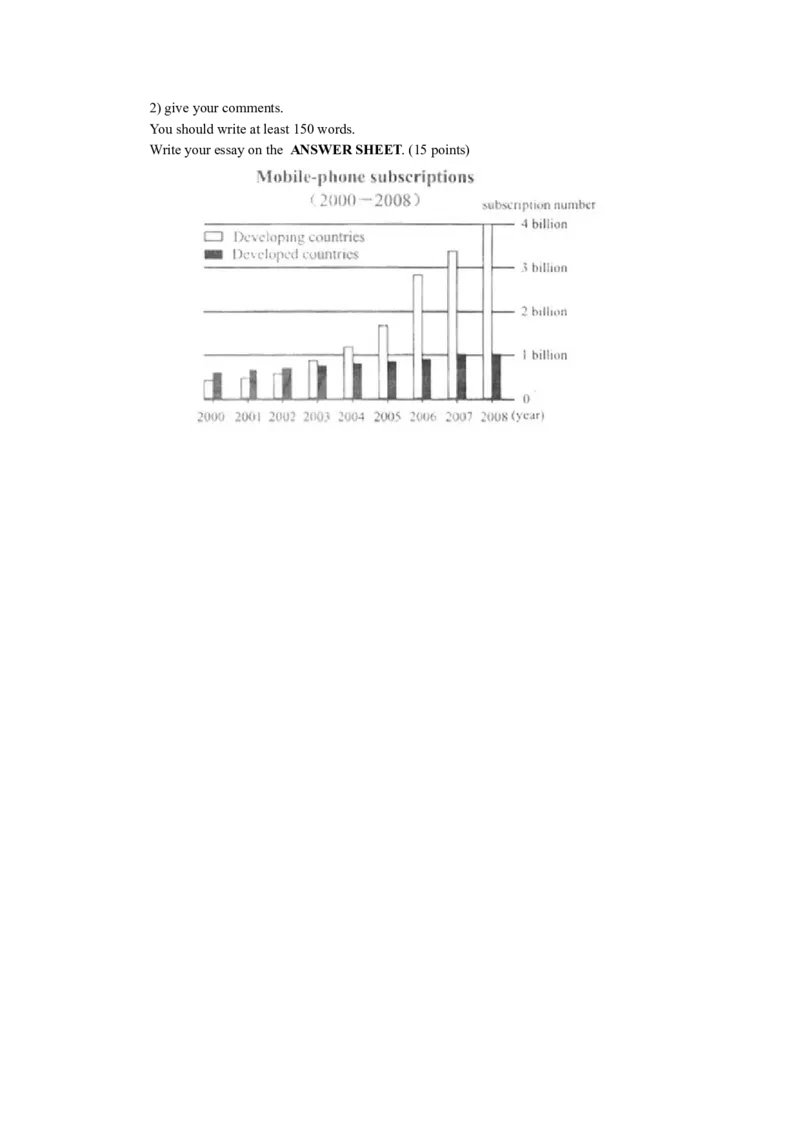
48. Directions
In this section, you are asked to write an essay based on the following chart. In your writing,
you should
1) interpret the chart and2) give your comments.
You should write at least 150 words.
Write your essay on the ANSWER SHEET. (15 points)2011年全国硕士研究生招生考试
英语二试题
Section I Use of English
Direction:
Read the following text. Choose the best word(s) for each numbered blank and mark A, B, C or D
on ANSWER SHEET 1. (10 points)
①The Internet affords anonymity to its users, a blessing to privacy and freedom of speech. ②But
that very anonymity is also behind the explosion of cyber-crime that has 1 across the Web.
①Can privacy be preserved 2 bringing safety and security to a world that seems
increasingly 3 ?
①Last month, Howard Schmidt, the nation’s cyber-czar, offered the federal government
a 4 to make the Web a safer place—a “voluntary trusted identity” system that would be the
high-tech 5 of a physical key, a fingerprint and a photo ID card, all rolled 6 one. ②The
system might use a smart identity card, or a digital credential 7 to a specific computer, and
would authenticate users at a range of online services.
①The idea is to 8 a federation of private online identity systems. ②Users could 9
which system to join, and only registered users whose identities have been authenticated could
navigate those systems. ③The approach contrasts with one that would require an Internet driver’s
license 10 by the government.
①Google and Microsoft are among companies that already have these “single sign-on”
systems that make it possible for users to 11 just once but use many different services.
① 12 , the approach would create a “walled garden” in cyberspace, with safe
“neighborhoods” and bright “streetlights” to establish a sense of a 13 community.
①Mr. Schmidt described it as a “voluntary ecosystem” in which “individuals and
organizations can complete online transactions with 14 , trusting the identities of each other
and the identities of the infrastructure 15 which the transaction runs.”
①Still, the administration’s plan has 16 privacy rights activists. ②Some applaud the
approach; others are concerned. ③It seems clear that such a scheme is an initiative push toward
what would 17 be a compulsory Internet “driver’s license” mentality.
①The plan has also been greeted with 18 by some computer security experts, who worry
that the “voluntary ecosystem” envisioned by Mr. Schmidt would still leave much of the
Internet 19 . ②They argue that all Internet users should be 20 to register and identify
themselves, in the same way that drivers must be licensed to drive on public roads.
1. [A] swept [B] skipped [C] walked [D] ridden
2. [A] for [B] within [C] while [D] though
3. [A] careless [B] lawless [C] pointless [D] helpless
4. [A] reason [B] reminder [C] compromise [D] proposal
5. [A] information [B] interference [C] entertainment [D] equivalent6. [A] by [B] into [C] from [D] over
7. [A] linked [B] directed [C] chained [D] compared
8. [A] dismiss [B] discover [C] create [D] improve
9. [A] recall [B] suggest [C] select [D] realize
10.[A] released [B] issued [C] distributed [D] delivered
11.[A] carry on [B] linger on [C] set in [D] log in
12.[A] In vain [B] In effect [C] In return [D] In contrast
13.[A] trusted [B] modernized [C] thriving [D] competing
14.[A] caution [B] delight [C] confidence [D] patience
15.[A] on [B] after [C] beyond [D] across
16.[A] divided [B] disappointed [C] protected [D] united
17.[A] frequently [B] incidentally [C] occasionally [D] eventually
18.[A] skepticism [B] tolerance [C] indifference [D] enthusiasm
19.[A] manageable [B] defendable [C] vulnerable [D] invisible
20.[A] invited [B] appointed [C] allowed [D] forced
Section Ⅱ Reading Comprehension
Part A
Directions:
Read the following four texts. Answer the questions after each text by choosing A, B, C, or D.
Mark your answers on ANSWER SHEET 1. (40 points)
Text 1
①Ruth Simmons joined Goldman Sachs’s board as an outside director in January 2000; a
year later she became president of Brown University. ②For the rest of the decade she apparently
managed both roles without attracting much criticism. ③But by the end of 2009 Ms. Simmons
was under fire for having sat on Goldman’s compensation committee; how could she have let
those enormous bonus payouts pass unremarked? ④By February the next year Ms. Simmons had
left the board. ⑤The position was just taking up too much time, she said.
①Outside directors are supposed to serve as helpful, yet less biased, advisers on a firm’s
board. ②Having made their wealth and their reputations elsewhere, they presumably have enough
independence to disagree with the chief executive’s proposals. ③If the sky, and the share price, is
falling, outside directors should be able to give advice based on having weathered their own
crises.
①The researchers from Ohio University used a database that covered more than 10,000 firms
and more than 64,000 different directors between 1989 and 2004. ②Then they simply checked
which directors stayed from one proxy statement to the next. ③The most likely reason for
departing a board was age, so the researchers concentrated on those “surprise” disappearances by
directors under the age of 70. ④They found that after a surprise departure, the probability that the
company will subsequently have to restate earnings increases by nearly 20%. ⑤The likelihood of
being named in a federal class-action lawsuit also increases, and the stock is likely to perform
worse. ⑥The effect tended to be larger for larger firms. ⑦Although a correlation between them
leaving and subsequent bad performance at the firm is suggestive, it does not mean that suchdirectors are always jumping off a sinking ship. ⑧Often they “trade up,” leaving riskier, smaller
firms for larger and more stable firms.
①But the researchers believe that outside directors have an easier time of avoiding a blow to
their reputations if they leave a firm before bad news breaks, even if a review of history shows
that they were on the board at the time any wrongdoing occurred. ②Firms who want to keep their
outside directors through tough times may have to create incentives. ③Otherwise outside directors
will follow the example of Ms. Simmons, once again very popular on campus.
21. According to Paragraph 1, Ms. Simmons was criticized for .
[A] gaining excessive profits [B] failing to fulfill her duty
[C] refusing to make compromises [D] leaving the board in tough times
22. We learn from Paragraph 2 that outside directors are supposed to be .
[A] generous investors [B] unbiased executives
[C] share price forecasters [D] independent advisers
23. According to the researchers from Ohio University, after an outside director’s surprise
departure, the firm is likely to .
[A] become more stable [B] report increased earnings
[C] do less well in the stock market [D] perform worse in lawsuits
24. It can be inferred from the last paragraph that outside directors .
[A] may stay for the attractive offers from the firm
[B] have often had records of wrongdoings in the firm
[C] are accustomed to stress-free work in the firm
[D] will decline incentives from the firm
25. The author’s attitude toward the role of outside directors is .
[A] permissive [B] positive [C] scornful [D] critical
Text 2
①Whatever happened to the death of newspapers? ②A year ago the end seemed near. ③ The
recession threatened to remove the advertising and readers that had not already fled to the internet.
④ Newspapers like the San Francisco Chronicle were chronicling their own doom . ⑤ America’s
Federal Trade Commission launched a round of talks about how to save newspapers. ⑥ Should
they become charitable corporations? ⑦Should the state subsidize them? ⑧It will hold another
meeting soon. ⑨But the discussions now seem out of date.
①In much of the world there is little sign of crisis. ②German and Brazilian papers have
shrugged off the recession. ③Even American newspapers, which inhabit the most troubled corner
of the global industry, have not only survived but often returned to profit. ④Not the 20% profit
margins that were routine a few years ago, but profit all the same.
①It has not been much fun. ②Many papers stayed afloat by pushing journalists overboard.
③The American Society of News Editors reckons that 13,500 newsroom jobs have gone since
2007. ④Readers are paying more for slimmer products. ⑤Some papers even had the nerve to
refuse delivery to distant suburbs. ⑥Yet these desperate measures have proved the right ones and,
sadly for many journalists, they can be pushed further.
①Newspapers are becoming more balanced businesses, with a healthier mix of revenues
from readers and advertisers. ②American papers have long been highly unusual in their reliance
on ads. ③Fully 87% of their revenues came from advertising in 2008, according to the
Organization for Economic Cooperation & Development (OECD). ④In Japan the proportion is35%. ⑤Not surprisingly, Japanese newspapers are much more stable.
①The whirlwind that swept through newsrooms harmed everybody, but much of the damage
has been concentrated in areas where newspapers are least distinctive. ②Car and film reviewers
have gone. ③So have science and general business reporters. ④Foreign bureaus have been
savagely cut off. ⑤Newspapers are less complete as a result. ⑥But completeness is no longer a
virtue in the newspaper business.
26. By saying “Newspapers like...their own doom” (Para. 1), the author indicates that newspapers
.
[A] neglected the sign of crisis [B] failed to get state subsidies
[C] were not charitable corporations [D] were in a desperate situation
27. Some newspapers refused delivery to distant suburbs probably because .
[A] readers threatened to pay less
[B] newspapers wanted to reduce costs
[C] journalists reported little about these areas
[D] subscribers complained about slimmer products
28. Compared with their American counterparts, Japanese newspapers are much more stable
because they .
[A] have more sources of revenue [B] have more balanced newsrooms
[C] are less dependent on advertising [D] are less affected by readership
29. What can be inferred from the last paragraph about the current newspaper business?
[A] Distinctiveness is an essential feature of newspapers.
[B] Completeness is to blame for the failure of newspapers.
[C] Foreign bureaus play a crucial role in the newspaper business.
[D] Readers have lost their interest in car and film reviews.
30. The most appropriate title for this text would be .
[A] American Newspapers: Struggling for Survival
[B] American Newspapers: Gone with the Wind
[C] American Newspapers: A Thriving Business
[D] American Newspapers: A Hopeless Story
Text 3
①We tend to think of the decades immediately following World War II as a time of prosperity
and growth, with soldiers returning home by the millions, going off to college on the G. I. Bill and
lining up at the marriage bureaus.
①But when it came to their houses, it was a time of common sense and a belief that less
could truly be more. ②During the Depression and the war, Americans had learned to live with
less, and that restraint, in combination with the postwar confidence in the future, made small,
efficient housing positively stylish.
①Economic condition was only a stimulus for the trend toward efficient living. ②The phrase
“less is more” was actually first popularized by a German, the architect Ludwig Mies van der
Rohe, who like other people associated with the Bauhaus, a school of design, emigrated to the
United States before World War II and took up posts at American architecture schools. ③These
designers came to exert enormous influence on the course of American architecture, but none
more so than Mies.
①Mies’s signature phrase means that less decoration, properly organized, has more impactthan a lot. ②Elegance, he believed, did not derive from abundance. ③Like other modern
architects, he employed metal, glass and laminated wood—materials that we take for granted
today but that in the 1940s symbolized the future. ④Mies’s sophisticated presentation masked the
fact that the spaces he designed were small and efficient, rather than big and often empty.
①The apartments in the elegant towers Mies built on Chicago’s Lake Shore Drive, for
example, were smaller—two-bedroom units under 1,000 square feet—than those in their older
neighbors along the city’s Gold Coast. ②But they were popular because of their airy glass walls,
the views they afforded and the elegance of the buildings’ details and proportions, the architectural
equivalent of the abstract art so popular at the time.
①The trend toward “less” was not entirely foreign. ②In the 1930s Frank Lloyd Wright
started building more modest and efficient houses—usually around 1,200 square feet—than the
spreading two-story ones he had designed in the 1890s and the early 20th century.
①The “Case Study Houses” commissioned from talented modern architects by California
Arts & Architecture magazine between 1945 and 1962 were yet another homegrown influence on
the “less is more” trend. ②Aesthetic effect came from the landscape, new materials and forthright
detailing. ③In his Case Study House, Ralph Rapson may have mispredicted just how the
mechanical revolution would impact everyday life—few American families acquired helicopters,
though most eventually got clothes dryers—but his belief that self-sufficiency was both desirable
and inevitable was widely shared.
31. The postwar American housing style largely reflected the Americans’ .
[A] prosperity and growth [B] efficiency and practicality
[C] restraint and confidence [D] pride and faithfulness
32. Which of the following can be inferred from Paragraph 3 about the Bauhaus?
[A] It was founded by Ludwig Mies van der Rohe.
[B] Its designing concept was affected by World War II.
[C] Most American architects used to be associated with it.
[D] It had a great influence upon American architecture.
33. Mies held that elegance of architectural design .
[A] was related to large space
[B] was identified with emptiness
[C] was not reliant on abundant decoration
[D] was not associated with efficiency
34. What is true about the apartments Mies built on Chicago’s Lake Shore Drive?
[A] They ignored details and proportions.
[B] They were built with materials popular at that time.
[C] They were more spacious than neighboring buildings.
[D] They shared some characteristics of abstract art.
35. What can we learn about the design of the “Case Study Houses”?
[A] Mechanical devices were widely used.
[B] Natural scenes were taken into consideration.
[C] Details were sacrificed for the overall effect.
[D] Eco-friendly materials were employed.
Text 4
①Will the European Union make it? ②The question would have sounded strange not longago. ③Now even the project’s greatest cheerleaders talk of a continent facing a “Bermuda
triangle” of debt, population decline and lower growth.
①As well as those chronic problems, the EU faces an acute crisis in its economic core, the 16
countries that use the single currency. ②Markets have lost faith that the euro zone’s economies,
weaker or stronger, will one day converge thanks to the discipline of sharing a single currency,
which denies uncompetitive members the quick fix of devaluation.
①Yet the debate about how to save Europe’s single currency from disintegration is stuck. ②
It is stuck because the euro zone’s dominant powers, France and Germany, agree on the need for
greater harmonisation within the euro zone, but disagree about what to harmonise.
①Germany thinks the euro must be saved by stricter rules on borrowing, spending and
competitiveness, backed by quasi-automatic sanctions for governments that do not obey. ② These
might include threats to freeze EU funds for poorer regions and EU mega-projects, and even the
suspension of a country’s voting rights in EU ministerial councils. ③It insists that economic co-
ordination should involve all 27 members of the EU club, among whom there is a small majority
for free-market liberalism and economic rigour; in the inner core alone, Germany fears, a small
majority favour French interference.
①A “southern” camp headed by France wants something different: “European economic
government” within an inner core of euro-zone members. ②Translated, that means politicians
intervening in monetary policy and a system of redistribution from richer to poorer members, via
cheaper borrowing for governments through common Eurobonds or complete fiscal transfers. ③
Finally, figures close to the French government have murmured, euro-zone members should agree
to some fiscal and social harmonisation: e.g., curbing competition in corporate-tax rates or labour
costs.
①It is too soon to write off the EU. ②It remains the world’s largest trading block. ③At its
best, the European project is remarkably liberal: built around a single market of 27 rich and poor
countries, its internal borders are far more open to goods, capital and labour than any comparable
trading area. ④It is an ambitious attempt to blunt the sharpest edges of globalisation, and make
capitalism benign.
36. The EU is faced with so many problems that .
[A] it has more or less lost faith in markets
[B] even its supporters begin to feel concerned
[C] some of its member countries plan to abandon euro
[D] it intends to deny the possibility of devaluation
37. The debate over the EU’s single currency is stuck because the dominant powers
.
[A] are competing for the leading position
[B] are busy handling their own crises
[C] fail to reach an agreement on harmonisation
[D] disagree on the steps towards disintegration
38. To solve the euro problem, Germany proposed that .
[A] EU funds for poor regions be increased
[B] stricter regulations be imposed
[C] only core members be involved in economic co-ordination
[D] voting rights of the EU members be guaranteed39. The French proposal of handling the crisis implies that .
[A] poor countries are more likely to get funds
[B] strict monetary policy will be applied to poor countries
[C] loans will be readily available to rich countries
[D] rich countries will basically control Eurobonds
40. Regarding the future of the EU, the author seems to feel .
[A] pessimistic [B] desperate [C] conceited [D] hopeful
Part B
Directions:
Read the following text and answer the questions by finding information from the right
column that corresponds to each of the marked details given in the left column. There are
two extra choices in the right column. Mark your answers on ANSWER SHEET 1. (10 points)
Leading doctors today weigh in on the debate over the government’s role in promoting public
health by demanding that ministers impose “fat taxes” on unhealthy food and introduce cigarette-
style warnings to children about the dangers of a poor diet.
The demands follow comments made last week by the health secretary, Andrew Lansley, who
insisted the government could not force people to make healthy choices and promised to free
businesses from public health regulations.
But senior medical figures want to stop fast-food outlets opening near schools, restrict
advertising of products high in fat, salt or sugar, and limit sponsorship of sports events by fast-
food producers such as McDonald’s.
They argue that government action is necessary to curb Britain’s addiction to unhealthy food
and help halt spiraling rates of obesity, diabetes and heart disease. Professor Terence Stephenson,
president of the Royal College of Paediatrics and Child Health, said that the consumption of
unhealthy food should be seen to be just as damaging as smoking or excessive drinking.
“Thirty years ago, it would have been inconceivable to have imagined a ban on smoking in
the workplace or in pubs, and yet that is what we have now. Are we willing to be just as
courageous in respect of obesity? I would suggest that we should be,” said the leader of the UK’s
children’s doctors.
Lansley has alarmed health campaigners by suggesting he wants industry rather than
government to take the lead. He said that manufacturers of crisps and candies could play a central
role in the Change4Life campaign, the centrepiece of government efforts to boost healthy eating
and fitness. He has also criticised the celebrity chef Jamie Oliver’s high-profile attempt to improve
school lunches in England as an example of how “lecturing” people was not the best way to
change their behaviour.
Stephenson suggested potential restrictions could include banning TV advertisements for
foods high in fat, salt or sugar before 9 pm and limiting them on billboards or in cinemas. “If we
were really bold, we might even begin to think of high-calorie fast food in the same way as
cigarettes—by setting strict limits on advertising, product placement and sponsorship of sports
events,” he said.
Such a move could affect firms such as McDonald’s, which sponsors the youth coaching
scheme run by the Football Association. Fast-food chains should also stop offering “inducements”
such as toys, cute animals and mobile phone credit to lure young customers, Stephenson said.Professor Dinesh Bhugra, president of the Royal College of Psychiatrists, said: “If children
are taught about the impact that food has on their growth, and that some things can harm, at least
information is available up front.”
He also urged councils to impose “fast-food-free zones” around schools and hospitals—areas
within which takeaways cannot open.
A Department of Health spokesperson said: “We need to create a new vision for public health
where all of society works together to get healthy and live longer. This includes creating a new
‘responsibility deal’ with business, built on social responsibility, not state regulation. Later this
year, we will publish a white paper setting out exactly how we will achieve this.”
The food industry will be alarmed that such senior doctors back such radical moves,
especially the call to use some of the tough tactics that have been deployed against smoking over
the last decade.
[A] “fat taxes” should be imposed on fast-food
producers such as McDonald’s.
41. Andrew Lansley held that [B] the government should ban fast-food outlets in the
neighborhood of schools.
42. Terence Stephenson agreed that [C] “lecturing” was an effective way to improve school
lunches in England.
43. Jamie Oliver seemed to believe that [D] cigarette-style warnings should be introduced to
children about the dangers of a poor diet.
44. Dinesh Bhugra suggested that [E] the producers of crisps and candies could
contribute significantly to the Change4Life
campaign.
45. A Department of Health spokesperson [F] parents should set good examples for their children
proposed that by keeping a healthy diet at home.
[G] the government should strengthen the sense of
responsibility among businesses.
Section Ⅲ Translation
46. Directions:
In this section there is a text in English. Translate it into Chinese. Write your translation
on ANSWER SHEET 2. (15 points)
Who would have thought that, globally, the IT industry produces about the same volume of
greenhouse gases as the world’s airlines do — roughly 2 percent of all CO₂ emissions?
Many everyday tasks take a surprising toll on the environment. A Google search can leak
between 0.2 and 7.0 grams of CO₂, depending on how many attempts are needed to get the “right”
answer. To deliver results to its users quickly, then, Google has to maintain vast data centres
around the world, packed with powerful computers. While producing large quantities of CO₂,
these computers emit a great deal of heat, so the centres need to be well air-conditioned, whichuses even more energy.
However, Google and other big tech providers monitor their efficiency closely and make
improvements. Monitoring is the first step on the road to reduction, but there is much more to be
done, and not just by big companies.
Section IV Writing
Part A
47. Directions
Suppose your cousin Li Ming has just been admitted to a university. Write him/her a letter to
1) congratulate him/her, and
2) give him/her suggestions on how to get prepared for university life.
You should write about 100 words on ANSWER SHEET 2.
Do not sign your own name at the end of the letter. Use “Zhang Wei” instead.
Do not write the address. (10 points)
Part B
48. Directions
Write an essay based on the following chart. In your writing, you should
1) interpret the chart and
2) give your comments
You should write at least 150 words.
Write your essay on ANSWER SHEET 2. (15points)2012年全国硕士研究生招生考试
英语二试题
Section I Use of English
Directions:
Read the following text. Choose the best word(s) for each numbered blank and mark A,B,C or D
on ANSWER SHEET 1. (10 points)
①Millions of Americans and foreigners see G.I. Joe as a mindless war toy, the symbol of
American military adventurism, but that’s not how it used to be. ②To the men and women
who 1 in World War Ⅱ and the people they liberated, the G.I. was the 2 man grown into
hero, the poor farm kid torn away from his home, the guy who 3 all the burdens of battle, who
slept in cold foxholes, who went without the 4 of food and shelter, who stuck it out and
drove back the Nazi reign of murder. ③This was not a volunteer soldier, not someone well paid,
5 an average guy, up 6 the best trained, best equipped, fiercest, most brutal enemies seen in
centuries.
①His name isn’t much. G.I. is just a military abbreviation 7 Government Issue, and
it was on all of the articles 8 to soldiers. ②And Joe? ③A common name for a guy who
never 9 it to the top. ④Joe Blow, Joe Palooka, Joe Magrac... a working class name. ⑤The
United States has 10 had a president or vice-president or secretary of state Joe.
①G.I. Joe had a 11 career fighting German, Japanese, and Korean troops. ②He appears
as a character, or a 12 of American personalities, in the 1945 movie The Story of G.I. Joe,
based on the last days of war correspondent Ernie Pyle. ③Some of the soldiers Pyle 13
portrayed themselves in the film. ④Pyle was famous for covering the 14 side of the war,
writing about the dirt-snow-and-mud soldiers, not how many miles were 15 or what towns
were captured or liberated. ⑤His reports 16 the “Willie” cartoons of famed Stars and Stripes
artist Bill Maulden. ⑥Both men 17 the dirt and exhaustion of war, the 18 of civilization
that the soldiers shared with each other and the civilians: coffee, tobacco, whiskey, shelter, sleep.
⑦ 19 Egypt, France, and a dozen more countries, G.I. Joe was any American soldier, 20
the most important person in their lives.
1. [A] served [B] performed [C] rebelled [D] betrayed
2. [A] actual [B] common [C] special [D] normal
3. [A] loaded [B] eased [C] removed [D] bore
4. [A] necessities [B] facilities [C] commodities [D] properties
5. [A] and [B] nor [C] but [D] hence
6. [A] for [B] into [C] from [D] against
7. [A] implying [B] meaning [C] symbolizing [D] claiming
8. [A] handed out [B] turned over [C] brought back [D] passed down
9. [A] pushed [B] got [C] made [D] managed
10.[A] ever [B] never [C] either [D] neither11.[A] disguised [B] disturbed [C] disputed [D] distinguished
12.[A] company [B] community [C] collection [D] colony
13 [A] employed [B] appointed [C] interviewed [D] questioned
14.[A] human [B] military [C] political [D] ethical
15.[A] ruined [B] commuted [C] patrolled [D] gained
16.[A] paralleled [B] counteracted [C] duplicated [D] contradicted
17.[A] neglected [B] emphasized [C] avoided [D] admired
18.[A] stages [B] illusions [C] fragments [D] advances
19.[A] With [B] To [C] Among [D] Beyond
20.[A] on the contrary [B] by this means [C] from the outset [D] at that point
Section Ⅱ Reading Comprehension
Part A
Directions:
Read the following four texts. Answer the questions after each text by choosing A, B, C or D.
Mark your answers on ANSWER SHEET 1. (40 points)
Text 1
①Homework has never been terribly popular with students and even many parents, but in
recent years it has been particularly scorned. ②School districts across the country, most recently
Los Angeles Unified, are revising their thinking on this educational ritual. ③Unfortunately, L.A.
Unified has produced an inflexible policy which mandates that with the exception of some
advanced courses, homework may no longer count for more than 10% of a student’s academic
grade.
①This rule is meant to address the difficulty that students from impoverished or chaotic
homes might have in completing their homework. ②But the policy is unclear and contradictory.
③Certainly, no homework should be assigned that students cannot complete on their own or that
they cannot do without expensive equipment. ④But if the district is essentially giving a pass to
students who do not do their homework because of complicated family lives, it is going riskily
close to the implication that standards need to be lowered for poor children.
①District administrators say that homework will still be a part of schooling; teachers are
allowed to assign as much of it as they want. ②But with homework counting for no more than
10% of their grades, students can easily skip half their homework and see very little difference on
their report cards. ③Some students might do well on state tests without completing their
homework, but what about the students who performed well on the tests and did their homework?
④It is quite possible that the homework helped. ⑤Yet rather than empowering teachers to find
what works best for their students, the policy imposes a flat, across-the-board rule.
①At the same time, the policy addresses none of the truly thorny questions about homework.
②If the district finds homework to be unimportant to its students’ academic achievement, it should
move to reduce or eliminate the assignments, not make them count for almost nothing.
③Conversely, if homework matters, it should account for a significant portion of the grade.
④Meanwhile, this policy does nothing to ensure that the homework students receive is meaningfulor appropriate to their age and the subject, or that teachers are not assigning more than they are
willing to review and correct.
①The homework rules should be put on hold while the school board, which is responsible for
setting educational policy, looks into the matter and conducts public hearings. ②It is not too late
for L.A. Unified to do homework right.
21. It is implied in Paragraph 1 that nowadays homework .
[A] is receiving more criticism [B] is gaining more preferences
[C] is no longer an educational ritual [D] is not required for advanced
courses
22. L.A. Unified has made the rule about homework mainly because poor students .
[A] tend to have moderate expectations for their education
[B] have asked for a different educational standard
[C] may have problems finishing their homework
[D] have voiced their complaints about homework
23. According to Paragraph 3, one problem with the policy is that it may .
[A] result in students’ indifference to their report cards
[B] undermine the authority of state tests
[C] restrict teachers’ power in education
[D] discourage students from doing homework
24. As mentioned in Paragraph 4, a key question unanswered about homework is whether .
[A] it should be eliminated [B] it counts much in schooling
[C] it places extra burdens on teachers [D] it is important for grades
25. A suitable title for this text could be .
[A] A Faulty Approach to Homework
[B] A Welcomed Policy for Poor Students
[C] Thorny Questions about Homework
[D] Wrong Interpretations of an Educational Policy
Text 2
①Pretty in pink: adult women do not remember being so obsessed with the colour, yet it is
pervasive in our young girls’ lives. ②It is not that pink is intrinsically bad, but it is such a tiny
slice of the rainbow and, though it may celebrate girlhood in one way, it also repeatedly and firmly
fuses girls’ identity to appearance. ③Then it presents that connection, even among two-year-olds,
between girls as not only innocent but as evidence of innocence. ④Looking around, I despaired at
the singular lack of imagination about girls’ lives and interests.
①Girls’ attraction to pink may seem unavoidable, somehow encoded in their DNA, but
according to Jo Paoletti, an associate professor of American Studies, it is not. ②Children were not
colour-coded at all until the early 20th century: in the era before domestic washing machines all
babies wore white as a practical matter, since the only way of getting clothes clean was to boil
them. ③What’s more, both boys and girls wore what were thought of as gender-neutral dresses.
④When nursery colours were introduced, pink was actually considered the more masculine
colour, a pastel version of red, which was associated with strength. ⑤Blue, with its intimations of
the Virgin Mary, constancy and faithfulness, symbolised femininity. ⑥It was not until the
mid-1980s, when amplifying age and sex differences became a dominant children’s marketing
strategy, that pink fully came into its own, when it began to seem inherently attractive to girls, partof what defined them as female, at least for the first few critical years.
①I had not realised how profoundly marketing trends dictated our perception of what is
natural to kids, including our core beliefs about their psychological development. ②Take the
toddler. ③I assumed that phase was something experts developed after years of research into
children’s behaviour: wrong. ④Turns out, according to Daniel Cook, a historian of childhood
consumerism, it was popularised as a marketing trick by clothing manufacturers in the 1930s.
①Trade publications counselled department stores that, in order to increase sales, they should
create a “third stepping stone” between infant wear and older kids’ clothes. ②It was only after
“toddler” became a common shoppers’ term that it evolved into a broadly accepted developmental
stage. ③Splitting kids, or adults, into ever-tinier categories has proved a sure-fire way to boost
profits. ④And one of the easiest ways to segment a market is to magnify gender differences—or
invent them where they did not previously exist.
26. By saying “it is...the rainbow” (Para.1), the author means pink .
[A] cannot explain girls’ lack of imagination
[B] should not be associated with girls’ innocence
[C] should not be the sole representation of girlhood
[D] cannot influence girls’ lives and interests
27. According to Paragraph 2, which of the following is true of colours?
[A] Colours are encoded in girls’ DNA.
[B] Blue used to be regarded as the colour for girls.
[C] White is preferred by babies.
[D] Pink used to be a neutral colour in symbolising genders.
28. The author suggests that our perception of children’s psychological development was
much influenced by .
[A] the observation of children’s nature
[B] the marketing of products for children
[C] researches into children’s behaviour
[D] studies of childhood consumption
29. We may learn from Paragraph 4 that department stores were advised to .
[A] classify consumers into smaller groups
[B] attach equal importance to different genders
[C] focus on infant wear and older kids’ clothes
[D] create some common shoppers’ terms
30. It can be concluded that girls’ attraction to pink seems to be .
[A] fully understood by clothing manufacturers
[B] clearly explained by their inborn tendency
[C] mainly imposed by profit-driven businessmen
[D] well interpreted by psychological experts
Text 3
①In 2010, a federal judge shook America’s biotech industry to its core. ②Companies had
won patents for isolated DNA for decades—by 2005 some 20% of human genes were patented.
③But in March 2010 a judge ruled that genes were unpatentable. ④Executives were violently
agitated. ⑤The Biotechnology Industry Organisation (BIO), a trade group, assured members that
this was just a “preliminary step” in a longer battle.①On July 29th they were relieved, at least temporarily. ②A federal appeals court overturned
the prior decision, ruling that Myriad Genetics could indeed hold patents to two genes that help
forecast a woman’s risk of breast cancer. ③The chief executive of Myriad, a company in Utah,
said the ruling was a blessing to firms and patients alike.
①But as companies continue their attempts at personalised medicine, the courts will remain
rather busy. ②The Myriad case itself is probably not over. ③Critics make three main arguments
against gene patents: a gene is a product of nature, so it may not be patented; gene patents
suppress innovation rather than reward it; and patents’ monopolies restrict access to genetic tests
such as Myriad’s. ④A growing number seem to agree. ⑤Last year a federal task-force urged
reform for patents related to genetic tests. ⑥In October the Department of Justice filed a brief in
the Myriad case, arguing that an isolated DNA molecule “is no less a product of nature... than are
cotton fibres that have been separated from cotton seeds”.
①Despite the appeals court’s decision, big questions remain unanswered. ②For example, it is
unclear whether the sequencing of a whole genome violates the patents of individual genes within
it. ③The case may yet reach the Supreme Court.
①As the industry advances, however, other suits may have an even greater impact.
②Companies are unlikely to file many more patents for human DNA molecules—most are already
patented or in the public domain. ③Firms are now studying how genes interact, looking for
correlations that might be used to determine the causes of disease or predict a drug’s efficacy.
④Companies are eager to win patents for “connecting the dots”, explains Hans Sauer, a lawyer for
the BIO.
①Their success may be determined by a suit related to this issue, brought by the Mayo
Clinic, which the Supreme Court will hear in its next term. ②The BIO recently held a convention
which included sessions to coach lawyers on the shifting landscape for patents. ③Each meeting
was packed.
31. It can be learned from Paragraph 1 that the biotech companies would like .
[A] genes to be patentable [B] the BIO to issue a warning
[C] their executives to be active [D] judges to rule out gene patenting
32. Those who are against gene patents believe that .
[A] genetic tests are not reliable
[B] only man-made products are patentable
[C] patents on genes depend much on innovation
[D] courts should restrict access to genetic tests
33. According to Hans Sauer, companies are eager to win patents for .
[A] discovering gene interactions [B] establishing disease correlations
[C] drawing pictures of genes [D] identifying human DNA
34. By saying “Each meeting was packed” (Para. 6), the author means that .
[A] the supreme court was authoritative
[B] the BIO was a powerful organisation
[C] gene patenting was a great concern
[D] lawyers were keen to attend conventions
35. Generally speaking, the author’s attitude toward gene patenting is .
[A] critical [B] supportive
[C] scornful [D] objectiveText 4
①The great recession may be over, but this era of high joblessness is probably beginning.
②Before it ends, it will likely change the life course and character of a generation of young adults.
③And ultimately, it is likely to reshape our politics, our culture, and the character of our society
for years.
①No one tries harder than the jobless to find silver linings in this national economic disaster.
②Many said that unemployment, while extremely painful, had improved them in some ways: they
had become less materialistic and more financially prudent; they were more aware of the struggles
of others. ③In limited respects, perhaps the recession will leave society better off. ④At the very
least, it has awoken us from our national fever dream of easy riches and bigger houses, and put a
necessary end to an era of reckless personal spending.
①But for the most part, these benefits seem thin, uncertain, and far off. ②In The Moral
Consequences of Economic Growth, the economic historian Benjamin Friedman argues that both
inside and outside the U.S., lengthy periods of economic stagnation or decline have almost always
left society more mean-spirited and less inclusive, and have usually stopped or reversed the
advance of rights and freedoms. ③Anti-immigrant sentiment typically increases, as does conflict
between races and classes.
①Income inequality usually falls during a recession, but it has not shrunk in this one.
②Indeed, this period of economic weakness may reinforce class divides, and decrease
opportunities to cross them—especially for young people. ③The research of Till Von Wachter, the
economist at Columbia University, suggests that not all people graduating into a recession see
their life chances dimmed: those with degrees from elite universities catch up fairly quickly to
where they otherwise would have been if they had graduated in better times; it is the masses
beneath them that are left behind.
①In the Internet age, it is particularly easy to see the resentment that has always been hidden
within American society. ②More difficult, in the moment, is discerning precisely how these lean
times are affecting society’s character. ③In many respects, the U.S. was more socially tolerant
entering this recession than at any time in its history, and a variety of national polls on social
conflict since then have shown mixed results. ④We will have to wait and see exactly how these
hard times will reshape our social fabric. ⑤But they certainly will reshape it, and all the more so
the longer they extend.
36. By saying “to find silver linings”(Para.2)the author suggests that the jobless try to
.
[A] seek subsidies from the government
[B] make profits from the troubled economy
[C] explore reasons for the unemployment
[D] look on the bright side of the recession
37. According to Paragraph 2, the recession has made people .
[A] struggle against each other [B] realize the national dream
[C] challenge their prudence [D] reconsider their lifestyle
38. Benjamin Friedman believes that economic recessions may .
[A] impose a heavier burden on immigrants
[B] bring out more evils of human nature
[C] promote the advance of rights and freedoms[D] ease conflicts between races and classes
39. The research of Till Von Wachter suggests that in the recession graduates from elite
universities tend to .
[A] lag behind the others due to decreased opportunities
[B] catch up quickly with experienced employees
[C] see their life chances as dimmed as the others’
[D] recover more quickly than the others
40. The author thinks that the influence of hard times on society is .
[A] trivial [B] positive
[C] certain [D] destructive
Part B
Directions:
Read the following text and answer the questions by finding information from the left column that
corresponds to each of the marked details given in the right column. There are two extra choices in
the right column. Mark your answers on ANSWER SHEET 1. (10 points)
“Universal history, the history of what man has accomplished in this world, is at bottom the
History of the Great Men who have worked here,” wrote the Victorian sage Thomas Carlyle. Well,
not any more it is not.
Suddenly, Britain looks to have fallen out with its favourite historical form. This could be no
more than a passing literary craze, but it also points to a broader truth about how we now approach
the past: less concerned with learning from our forefathers and more interested in feeling their
pain. Today, we want empathy, not inspiration.
From the earliest days of the Renaissance, the writing of history meant recounting the
exemplary lives of great men. In 1337, Petrarch began work on his rambling writing De Viris
Illustribus—On Famous Men, highlighting the virtus (or virtue) of classical heroes. Petrarch
celebrated their greatness in conquering fortune and rising to the top. This was the biographical
tradition which Niccolò Machiavelli turned on its head. In The Prince, he championed cunning,
ruthlessness, and boldness, rather than virtue, mercy and justice, as the skills of successful leaders.
Over time, the attributes of greatness shifted. The Romantics commemorated the leading
painters and authors of their day, stressing the uniqueness of the artist’s personal experience rather
than public glory. By contrast, the Victorian author Samuel Smiles wrote Self-Help as a catalogue
of the worthy lives of engineers, industrialists and explorers. “The valuable examples which they
furnish of the power of self-help, of patient purpose, resolute working, and steadfast integrity,
issuing in the formation of truly noble and manly character, exhibit,” wrote Smiles, “what it is
in the power of each to accomplish for himself.” His biographies of James Watt, Richard
Arkwright and Josiah Wedgwood were held up as beacons to guide the working man through his
difficult life.
This was all a bit bourgeois for Thomas Carlyle, who focused his biographies on the truly
heroic lives of Martin Luther, Oliver Cromwell and Napoleon Bonaparte. These epochal figures
represented lives hard to imitate, but to be acknowledged as possessing higher authority than mere
mortals.
Not everyone was convinced by such bombast. “The history of all hitherto existing society is
the history of class struggles,” wrote Marx and Engels in The Communist Manifesto. For them,history did nothing, it possessed no immense wealth nor waged battles: “It is man, real, living man
who does all that.” And history should be the story of the masses and their record of struggle. As
such, it needed to appreciate the economic realities, the social contexts and power relations in
which each epoch stood. For: “Men make their own history, but they do not make it just as they
please; they do not make it under circumstances chosen by themselves, but under circumstances
directly found, given and transmitted from the past.”
This was the tradition which revolutionised our appreciation of the past. In place of Thomas
Carlyle, Britain nurtured Christopher Hill, EP Thompson and Eric Hobsbawm. History from
below stood alongside biographies of great men. Whole new realms of understanding—from
gender to race to cultural studies—were opened up as scholars unpicked the multiplicity of lost
societies. And it transformed public history too: downstairs became just as fascinating as upstairs.
[A] emphasized the virtue of classical heroes.
41. Petrarch [B] highlighted the public glory of the leading artists.
42. Niccolò Machiavelli [C] focused on epochal figures whose lives were hard to imitate.
43. Samuel Smiles [D] opened up new realms of understanding the great men in history.
[E] held that history should be the story of the masses and their record
44. Thomas Carlyle
of struggle.
45. Marx and Engels [F] dismissed virtue as unnecessary for successful leaders.
[G] depicted the worthy lives of engineers, industrialists and explorers.
Section Ⅲ Translation
46. Directions:
Translate the following text from English into Chinese. Write your translation on ANSWER
SHEET 2. (15 points)
When people in developing countries worry about migration, they are usually concerned at
the prospect of their best and brightest departure to Silicon Valley or to hospitals and universities
in the developed world. These are the kind of workers that countries like Britain, Canada and
Australia try to attract by using immigration rules that privilege college graduates.
Lots of studies have found that well-educated people from developing countries are
particularly likely to emigrate. A big survey of Indian households in 2004 found that nearly 40%
of emigrants had more than a high-school education, compared with around 3.3% of all Indians
over the age of 25. This “brain drain” has long bothered policymakers in poor countries. They fear
that it hurts their economies, depriving them of much-needed skilled workers who could have
taught at their universities, worked in their hospitals and come up with clever new products for
their factories to make.
Section IV Writing
Part A
47. DirectionsSuppose you have found something wrong with the electronic dictionary that you bought
from an online store the other day. Write an email to the customer service center to
1) make a complaint, and
2) demand a prompt solution.
You should write about 100 words on ANSERE SHEET 2.
Do not sign your own name at the end of the letter, Use “Zhang Wei” instead.
Do not write the address. (10 points)
Part B
48. Directions
Write an essay based on the following table. In your writing, you should
1) describe the table, and
2) give your comments.
You should write at least 150 words.
Write your essay on ANSERE SHEET 2. (15 points)
某公司员工工作满意度调查
满意
度 满意 不清楚 不满意
年龄组
≤40岁 16.7% 50.0% 33.3%
41~50岁 0.0% 36.0% 64.0%
>50岁 40.0% 50.0% 10.0%2013年全国硕士研究生招生考试
英语(二)试题
Section I Use of English
Directions:
Read the following text. Choose the best word(s) for each numbered blank and mark A, B, C or D
on the ANSWER SHEET. (10 points)
①Given the advantages of electronic money, you might think that we would move quickly to
the cashless society in which all payments are made electronically. ② 1 , a true cashless society
is probably not around the corner. ③Indeed, predictions have been 2 for two decades but have
not yet come to fruition. ④For example, Business Week predicted in 1975 that electronic means of
payment would soon “revolutionize the very 3 of money itself,” only to 4 itself several
years later. ⑤Why has the movement to a cashless society been so 5 in coming?
①Although electronic means of payment may be more efficient than a payments system
based on paper, several factors work 6 the disappearance of the paper system. ②First, it is
very 7 to set up the computer, card reader, and telecommunications networks necessary to
make electronic money the 8 form of payment. ③Second, paper checks have the advantage
that they 9 receipts, something that many consumers are unwilling to 10 . ④Third, the use
of paper checks gives consumers several days of “float”—it takes several days 11 a check is
cashed and funds are 12 from the issuer’s account, which means that the writer of the check
can earn interest on the funds in the meantime. ⑤ 13 electronic payments are immediate, they
eliminate the float for the consumer.
①Fourth, electronic means of payment may 14 security and privacy concerns. ②We
often hear media reports that an unauthorized hacker has been able to access a computer database
and to alter information 15 there. ③The fact that this is not an 16 occurrence means that
dishonest persons might be able to access bank accounts in electronic payments systems and 17
from someone else’s accounts. ④The 18 of this type of fraud is no easy task, and a new field
of computer science is developing to 19 security issues. ⑤A further concern is that the use of
electronic means of payment leaves an electronic 20 that contains a large amount of personal
data. ⑥ There are concerns that government, employers, and marketers might be able to access
these data, thereby violating our privacy.
1. [A] Moreover [B] However [C] Therefore [D] Otherwise
2. [A] off [B] back [C] over [D] around
3. [A] power [B] concept [C] history [D] role
4. [A] reverse [B] resist [C] resume [D] reward
5. [A] silent [B] sudden [C] slow [D] steady
6. [A] for [B] against [C] with [D] on
7. [A] expensive [B] imaginative [C] sensitive [D] productive
8. [A] similar [B] original [C] temporary [D] dominant9. [A] collect [B] copy [C] provide [D] print
10. [A] give up [B] take over [C] bring back [D] pass down
11. [A] before [B] after [C] since [D] when
12. [A] kept [B] borrowed [C] withdrawn [D] released
13. [A] Unless [B] Because [C] Until [D] Though
14. [A] hide [B] express [C] ease [D] raise
15. [A] analyzed [B] shared [C] stored [D] displayed
16. [A] unsafe [B] unnatural [C] unclear [D] uncommon
17. [A] steal [B] choose [C] benefit [D] return
18. [A] consideration [B] prevention [C] manipulation [D] justification
19. [A] call for [B] fight against [C] adapt to [D] cope with
20. [A] chunk [B] chip [C] trail [D] path
Section II Reading Comprehension
Part A
Directions:
Read the following four texts. Answer the questions after each text by choosing A, B, C or [D]
Mark your answers on the ANSWER SHEET. (40 points)
Text 1
① In an essay entitled “Making It in America,” the author Adam Davidson relates a joke
from cotton country about just how much a modern textile mill has been automated: The average
mill has only two employees today, “a man and a dog. ②The man is there to feed the dog, and the
dog is there to keep the man away from the machines.”
① Davidson’s article is one of a number of pieces that have recently appeared making the
point that the reason we have such stubbornly high unemployment and declining middle-class
incomes today is largely because of the big drop in demand because of the Great Recession, but it
is also because of the advances in both globalization and the information technology revolution,
which are more rapidly than ever replacing labor with machines or foreign workers.
① In the past, workers with average skills, doing an average job, could earn an average
lifestyle. ② But, today, average is officially over. ③ Being average just won’t earn you what it
used to. ④It can’t when so many more employers have so much more access to so much
more above average cheap foreign labor, cheap robotics, cheap software, cheap automation
and cheap genius. ⑤ Therefore, everyone needs to find their extra—their unique value
contribution that makes them stand out in whatever is their field of employment.
① Yes, new technology has been eating jobs forever, and always will. ② But there’s been
an acceleration. ③As Davidson notes, “In the 10 years ending in 2009, [U.S.] factories shed
workers so fast that they erased almost all the gains of the previous 70 years; roughly one out of
every three manufacturing jobs—about 6 million in total—disappeared.”
①There will always be change—new jobs, new products, new services. ②But the one thing
we know for sure is that with each advance in globalization and the I. T. revolution, the best jobs
will require workers to have more and better education to make themselves above average.
①In a world where average is officially over, there are many things we need to do to supportemployment, but nothing would be more important than passing some kind of G. I. Bill for the
21st century that ensures that every American has access to post-high school education.
21. The joke in Paragraph 1 is used to illustrate .
[A] the impact of technological advances
[B] the alleviation of job pressure
[C] the shrinkage of textile mills
[D] the decline of middle-class incomes
22. According to Paragraph 3, to be a successful employee, one has to .
[A] adopt an average lifestyle
[B] work on cheap software
[C] ask for a moderate salary
[D] contribute something unique
23. The quotation in Paragraph 4 explains that .
[A] gains of technology have been erased
[B] job opportunities are disappearing at a high speed
[C] factories are making much less money than before
[D] new jobs and services have been offered
24. According to the author, to reduce unemployment, the most important is .
[A] to accelerate the I. T. revolution
[B] to advance economic globalization
[C] to ensure more education for people
[D] to pass more bills in the 21st century
25. Which of the following would be the most appropriate title for the text?
[A] Technology Goes Cheap.
[B] New Law Takes Effect.
[C] Recession Is Bad.
[D] Average Is Over.
Text 2
① A century ago, the immigrants from across the Atlantic included settlers and
sojourners. ② Along with the many folks looking to make a permanent home in the
United States came those who had no intention to stay, and who would make some
money and then go home. ③ Between 1908 and 1915, about 7 million people arrived
while about 2 million departed. ④About a quarter of all Italian immigrants, for example,
eventually returned to Italy for good. ⑤They even had an affectionate nickname, “uccelli
di passaggio,” birds of passage.
① Today, we are much more rigid about immigrants. ② We divide newcomers into
two categories: legal or illegal, good or bad. ③ We hail them as Americans in the
making, or brand them as aliens to be kicked out. ④ That framework has contributed
mightily to our broken immigration system and the long political paralysis over how to
fix it. ⑤We don’t need more categories, but we need to change the way we think about
categories. ⑥ We need to look beyond strict definitions of legal and illegal. ⑦ To start,
we can recognize the new birds of passage, those living and thriving in the gray areas.
⑧We might then begin to solve our immigration challenges.
①Crop pickers, violinists, construction workers, entrepreneurs, engineers, home health-care aides and physicists are among today’s birds of passage. ② They are energetic
participants in a global economy driven by the flow of work, money and ideas. ③They
prefer to come and go as opportunity calls them. ④They can manage to have a job in
one place and a family in another.
① With or without permission, they straddle laws, jurisdictions and identities with
ease. ② We need them to imagine the United States as a place where they can be
productive for a while without committing themselves to staying forever. ③We need them
to feel that home can be both here and there and that they can belong to two nations honorably.
①Accommodating this new world of people in motion will require new attitudes on
both sides of the immigration battle. ②Looking beyond the culture war logic of right or
wrong means opening up the middle ground and understanding that managing immigration
today requires multiple paths and multiple outcomes, including some that are not easy to
accomplish legally in the existing system.
26. “Birds of passage” refers to those who .
[A] stay in a foreign country temporarily
[B] leave their home countries for good
[C] immigrate across the Atlantic
[D] find permanent jobs overseas
27. It is implied in Paragraph 2 that the current immigration system in the US .
[A] needs new immigrant categories
[B] has loosened control over immigrants
[C] should be adapted to meet challenges
[D] has been fixed via political means
28. According to the author, today’s birds of passage want .
[A] financial incentives
[B] a global recognition
[C] the freedom to stay and leave
[D] opportunities to get regular jobs
29. The author suggests that the birds of passage today should be treated .
[A] as faithful partners
[B] with legal tolerance
[C] with economic favors
[D] as mighty rivals
30. The most appropriate title for this text would be .
[A] Come and Go: Big Mistake
[B] Living and Thriving: Great Risk
[C] With or Without: Great Risk
[D] Legal or Illegal: Big mistake
Text 3
①Scientists have found that although we are prone to snap overreactions, if we take
a moment and think about how we are likely to react, we can reduce or even eliminate
the negative effects of our quick, hard-wired responses.
① Snap decisions can be important defense mechanisms; if we are judging whether
someone is dangerous, our brains and bodies are hard-wired to react very quickly, withinmilliseconds. ② But we need more time to assess other factors. ③ To accurately tell
whether someone is sociable, studies show, we need at least a minute, preferably five.
④ It takes a while to judge complex aspects of personality, like neuroticism or open-
mindedness.
①But snap decisions in reaction to rapid stimuli aren’t exclusive to the interpersonal
realm. ② Psychologists at the University of Toronto found that viewing a fast-food logo
for just a few milliseconds primes us to read 20 percent faster, even though reading has
little to do with eating. ③ We unconsciously associate fast food with speed and
impatience and carry those impulses into whatever else we’re doing. ④ Subjects exposed
to fast-food flashes also tend to think a musical piece lasts too long.
①Yet we can reverse such influences. ②If we know we will overreact to consumer
products or housing options when we see a happy face (one reason good sales
representatives and real estate agents are always smiling), we can take a moment before
buying. ③If we know female job screeners are more likely to reject attractive female applicants,
we can help screeners understand their biases—or hire outside screeners.
① John Gottman, the marriage expert, explains that we quickly “ thin slice”
information reliably only after we ground such snap reactions in “thick sliced” long-term
study. ②When Dr. Gottman really wants to assess whether a couple will stay together, he
invites them to his island retreat for a much longer evaluation: two days, not two seconds.
① Our ability to mute our hard-wired reactions by pausing is what differentiates us
from animals: dogs can think about the future only intermittently or for a few minutes. ②
But historically we have spent about 12 percent of our days contemplating the longer
term. ③ Although technology might change the way we react, it hasn’t changed our
nature. ④We still have the imaginative capacity to rise above temptation and reverse the
high-speed trend.
31. The time needed in making decisions may .
[A] predetermine the accuracy of our judgment
[B] prove the complexity of our brain reaction
[C] depend on the importance of the assessment
[D] vary according to the urgency of the situation
32. Our reaction to a fast-food logo shows that snap decisions .
[A] can be associative
[B] are not unconscious
[C] can be dangerous
[D] are not impulsive
33. To reverse the negative influences of snap decisions, we should .
[A] trust our first impression
[B] think before we act
[C] do as people usually do
[D] ask for expert advice
34. John Gottman says that reliable snap reactions are based on .
[A] critical assessment
[B] “thin sliced” study
[C] adequate information[D] sensible explanation
35. The author’s attitude toward reversing the high-speed trend is .
[A] tolerant
[B] optimistic
[C] uncertain
[D] doubtful
Text 4
① Europe is not a gender-equality heaven. ② In particular, the corporate workplace
will never be completely family-friendly until women are part of senior management
decisions, and Europe’s top corporate-governance positions remain overwhelmingly male.
③Indeed, women hold only 14 per cent of positions on European corporate boards.
①The European Union is now considering legislation to compel corporate boards to
maintain a certain proportion of women—up to 60 per cent. ②This proposed mandate was
born of frustration. ③ Last year, European Commission Vice President Viviane Reding
issued a call to voluntary action. ④ Reding invited corporations to sign up for gender
balance goals of 40 per cent female board membership. ⑤But her appeal was considered
a failure: only 24 companies took it up.
① Do we need quotas to ensure that women can continue to climb the corporate
ladder fairly as they balance work and family?
①“Personally, I don’t like quotas,” Reding said recently. ②“But I like what the
quotas do.” ③Quotas get action: they “open the way to equality and they break through
the glass ceiling,” according to Reding, a result seen in France and other countries with
legally binding provisions on placing women in top business positions.
①I understand Reding’s reluctance—and her frustration. ②I don’t like quotas either;
they run counter to my belief in meritocracy, governance by the capable. ③ But, when
one considers the obstacles to achieving the meritocratic ideal, it does look as if a fairer
world must be temporarily ordered.
①After all, four decades of evidence has now shown that corporations in Europe as
well as the US are evading the meritocratic hiring and promotion of women to top
positions—no matter how much “soft pressure” is put upon them. ② When women do
break through to the summit of corporate power—as, for example, Sheryl Sandberg recently did
at Facebook—they attract massive attention precisely because they remain the exception to the
rule.
①If appropriate pubic policies were in place to help all women—whether CEOs or
their children’s caregivers—and all families, Sandberg would be no more newsworthy than
any other highly capable person living in a more just society.
36. In the European corporate workplace, generally .
[A] women take the lead
[B] men have the final say
[C] corporate governance is overwhelmed
[D] senior management is family-friendly
37. The European Union’s intended legislation is .
[A] a reflection of gender balance
[B] a response to Reding’s call[C] a reluctant choice
[D] a voluntary action
38. According to Reding, quotas may help women .
[A] get top business positions
[B] see through the glass ceiling
[C] balance work and family
[D] anticipate legal results
39. The author’s attitude toward Reding’s appeal is one of .
[A] skepticism
[B] objectiveness
[C] indifference
[D] approval
40. Women entering top management become headlines due to the lack of .
[A] more social justice
[B] massive media attention
[C] suitable public policies
[D] greater “soft pressure”
Part B
Directions:
Read the following text and answer the questions by choosing the most suitable subtitle from
the list A-G for each numbered paragraph (41-45). There are two extra subtitles which you do
not need to use. Mark your answers on the ANSWER SHEET. (10 points)
[A] Shopkeepers are your friends
[B] Remember to treat yourself
[C] Stick to what you need
[D] Live like a peasant
[E] Balance your diet
[F] Planning is everything
[G] Waste not, want not
The hugely popular blog the Skint Foodie chronicles how Tony balances his love of good
food with living on benefits. After bills, Tony has £60 a week to spend, £40 of which goes on
food, but 10 years ago he was earning £130, 000 a year working in corporate communications and
eating at London’s best restaurants at least twice a week. Then his marriage failed, his career
burned out and his drinking became serious. “The community mental health team saved my life.
And I felt like that again, to a certain degree, when people responded to the blog so well. It gave
me the validation and confidence that I’d lost. But it’s still a day-by-day thing.” Now he’s living in
a council flat and fielding offers from literary agents. He’s feeling positive, but he’ll carry on
blogging—not about eating as cheaply as you can—“there are so many people in a much worse
state, with barely any money to spend on food”—but eating well on a budget. Here’s his advice
for economical foodies.
41.
Impulsive spending isn’t an option, so plan your week’s menu in advance, making shopping
lists for your ingredients in their exact quantities. I have an Excel template for a week of breakfast,lunch and dinner. Stop laughing: it’s not just cost effective but helps you balance your diet. It’s
also a good idea to shop daily instead of weekly, because, being human, you’ll sometimes change
your mind about what you fancy.
42.
This is where supermarkets and their anonymity come in handy. With them, there’s not the
same embarrassment as when buying one carrot in a little greengrocer. And if you plan properly,
you’ll know that you only need, say, 350g of shin of beef and six rashers of bacon, not whatever
weight is pre-packed in the supermarket chiller.
43.
You may proudly claim to only have frozen peas in the freezer—that’s not good enough.
Mine is filled with leftovers, bread, stock, meat and fish. Planning ahead should eliminate
wastage, but if you have surplus vegetables you’ll do a vegetable soup, and all fruits threatening to
“go off” will be cooked or juiced.
44.
Everyone says this, but it really is a top tip for frugal eaters. Shop at butchers, delis and fish-
sellers regularly, even for small things, and be super friendly. Soon you’ll feel comfortable asking
if they’ve any knuckles of ham for soups and stews, or beef bones, chicken carcasses and fish
heads for stock which, more often than not, they’ll let you have for free.
45.
You won’t be eating out a lot, but save your pennies and once every few months treat
yourself to a set lunch at a good restaurant—£1.75 a week for three months gives you £21—more
than enough for a three-course lunch at Michelin-starred Arbutus. It’s £16.95 there—or £12.99 for
a large pizza from Domino’s: I know which I’d rather eat.
Section III Translation
46. Directions:
Translate the following text into Chinese. Write your translation on the ANSWER SHEET. (15
points)
I can pick a date from the past 53 years and know instantly where I was, what happened in
the news and even the day of the week. I’ve been able to do this since I was four.
I never feel overwhelmed with the amount of information my brain absorbs. My mind seems
to be able to cope and the information is stored away neatly. When I think of a sad memory, I do
what everybody does—try to put it to one side. I don’t think it’s harder for me just because my
memory is clearer. Powerful memory doesn’t make my emotions any more acute or vivid. I can
recall the day my grandfather died and the sadness I felt when we went to the hospital the day
before. I also remember that the musical play Hair opened on Broadway on the same day—they
both just pop into my mind in the same way.
Section IV Writing
Part A
47. Directions:Suppose your class is to hold a charity sale for kids in need of help. Write your classmates an
email to
1) inform them about the details, and
2) encourage them to participate.
You should write about 100 words on the ANSWER SHEET.
Do not use your own name. Use “Li Ming” instead.
Do not write your address. (10 points)
Part B
48. Directions:
Write an essay based on the following chart. In your writing, you should
1) interpret the chart, and
2) give your comments.
You should write about 150 words on the ANSWER SHEET. (15 points)2014年全国硕士研究生招生考试
英语(二)试题
Section I Use of English
Directions:
Read the following text. Choose the best word (s) for each numbered blank and mark A, B, C or
D on the ANSWER SHEET. (10 points)
①Thinner isn’t always better. ②A number of studies have 1 that normal-weight people
are in fact at higher risk of some diseases compared to those who are overweight. ③And there are
health conditions for which being overweight is actually 2 . ④ For example, heavier women are
less likely to develop calcium deficiency than thin women. ⑤ 3 , among the elderly, being
somewhat overweight is often an 4 of good health.
①Of even greater 5 is the fact that obesity turns out to be very difficult to define. ②It is
often defined 6 body mass index, or BMI. ③BMI 7 body mass divided by the square of
height. ④An adult with a BMI of 18 to 25 is often considered to be normal weight. ⑤Between 25
and 30 is overweight. ⑥And over 30 is considered obese. ⑦Obesity, 8 , can be divided into
moderately obese, severely obese, and very severely obese.
①While such numerical standards seem 9 , they are not. ②Obesity is probably less a
matter of weight than body fat. ③Some people with a high BMI are in fact extremely fit, 10
others with a low BMI may be in poor 11 . ④For example, many collegiate and professional
football players 12 as obese, though their percentage body fat is low. ⑤Conversely, someone
with a small frame may have high body fat but a 13 BMI.
①Today we have a(n) 14 to label obesity as a disgrace. ②The overweight are
sometimes 15 in the media with their faces covered. ③Stereotypes 16 with obesity include
laziness, lack of will power, and lower prospects for success. ④Teachers, employers, and health
professionals have been shown to harbor biases against the obese. ⑤ 17 very young children
tend to look down on the overweight, and teasing about body build has long been a problem in
schools.
①Negative attitudes toward obesity, 18 in health concerns, have stimulated a number of
anti-obesity 19 . ②My own hospital system has banned sugary drinks from its facilities.
③Many employers have instituted weight loss and fitness initiatives. ④Michelle Obama has
launched a high-visibility campaign 20 childhood obesity, even claiming that it represents our
greatest national security threat.
1. [A] denied [B] concluded [C] doubted [D] ensured
2. [A] protective [B] dangerous [C] sufficient [D] troublesome
3. [A] Instead [B] However [C] Likewise [D] Therefore
4. [A] indicator [B] objective [C] origin [D] example
5. [A] impact [B] relevance [C] assistance [D] concern
6. [A] in terms of [B] in case of [C] in favor of [D] in respects of7. [A] measures [B] determines [C] equals [D] modifies
8. [A] in essence [B] in contrast [C] in turn [D] in part
9. [A] complicated [B] conservative [C] variable [D] straightforward
10. [A] so [B] while [C] since [D] unless
11. [A] shape [B] spirit [C] balance [D] taste
12. [A] start [B] qualify [C] retire [D] stay
13. [A] strange [B] changeable [C] normal [D] constant
14. [A] option [B] reason [C] opportunity [D] tendency
15. [A] employed [B] pictured [C] imitated [D] monitored
16. [A] compared [B] combined [C] settled [D] associated
17. [A] Even [B] Still [C] Yet [D] Only
18. [A] despised [B] corrected [C] ignored [D] grounded
19. [A] discussions [B] businesses [C] policies [D] studies
20. [A] for [B] against [C] with [D] without
Section Ⅱ Reading Comprehension
Part A
Directions:
Read the following four texts. Answer the questions after each text by choosing A, B, C
or D. Mark your answers on the ANSWER SHEET. (40 points)
Text 1
①What would you do with $590m? ②This is now a question for Gloria MacKenzie, an 84-
year-old widow who recently emerged from her small, tin-roofed house in Florida to collect the
biggest undivided lottery jackpot in history. ③If she hopes her new-found fortune will yield
lasting feelings of fulfilment, she could do worse than read Happy Money by Elizabeth Dunn and
Michael Norton.
①These two academics use an array of behavioral research to show that the most rewarding
ways to spend money can be counterintuitive. ②Fantasies of great wealth often involve visions of
fancy cars and extravagant homes. ③Yet satisfaction with these material purchases wears off
fairly quickly. ④What was once exciting and new becomes old-hat; regret creeps in. ⑤It is far
better to spend money on experiences, say Ms Dunn and Mr Norton, like interesting trips, unique
meals or even going to the cinema. ⑥These purchases often become more valuable with time—as
stories or memories—particularly if they involve feeling more connected to others.
①This slim volume is packed with tips to help wage slaves as well as lottery winners get the
most “happiness bang for your buck.” ②It seems most people would be better off if they could
shorten their commutes to work, spend more time with friends and family and less of it watching
television (something the average American spends a whopping two months a year doing, and is
hardly jollier for it). ③Buying gifts or giving to charity is often more pleasurable than purchasing
things for oneself, and luxuries are most enjoyable when they are consumed sparingly. ④This is
apparently the reason McDonald’s restricts the availability of its popular McRib—a marketing
trick that has turned the pork sandwich into an object of obsession.
①Readers of Happy Money are clearly a privileged lot, anxious about fulfilment, not hunger.②Money may not quite buy happiness, but people in wealthier countries are generally happier
than those in poor ones. ③Yet the link between feeling good and spending money on others can be
seen among rich and poor people around the world, and scarcity enhances the pleasure of most
things for most people. ④Not everyone will agree with the authors’ policy ideas, which range
from mandating more holiday time to reducing tax incentives for American homebuyers. ⑤But
most people will come away from this book believing it was money well spent.
21. According to Dunn and Norton, which of the following is the most rewarding purchase?
[A] A big house. [B] A special tour. [C] A stylish car. [D] A rich meal.
22. The author’s attitude toward Americans’ watching TV is_____.
[A] critical [B] supportive [C] sympathetic [D] ambiguous
23. McRib is mentioned in Paragraph 3 to show that_____.
[A] consumers are sometimes irrational
[B] popularity usually comes after quality
[C] marketing tricks are often effective
[D] rarity generally increases pleasure
24. According to the last paragraph, Happy Money_____.
[A] has left much room for readers’ criticism
[B] may prove to be a worthwhile purchase
[C] has predicted a wider income gap in the US
[D] may give its readers a sense of achievement
25. This text mainly discusses how to____.
[A] balance feeling good and spending money
[B] spend large sums of money won in lotteries
[C] obtain lasting satisfaction from money spent
[D] become more reasonable in spending on luxuries
Text 2
①An article in Scientific America has pointed out that empirical research says that, actually,
you think you’re more beautiful than you are. ②We have a deep-seated need to feel good about
ourselves and we naturally employ a number of self-enhancing strategies to achieve this. ③Social
psychologists have amassed oceans of research into what they call the “above average effect,” or
“illusory superiority,” and shown that, for example, 70% of us rate ourselves as above average in
leadership, 93% in driving and 85% at getting on well with others—all obviously statistical
impossibilities.
①We rose-tint our memories and put ourselves into self-affirming situations. ②We become
defensive when criticised, and apply negative stereotypes to others to boost our own esteem. ③We
stalk around thinking we’re hot stuff.
①Psychologist and behavioural scientist Nicholas Epley oversaw a key study into self-
enhancement and attractiveness. ②Rather than have people simply rate their beauty compared
with others, he asked them to identify an original photograph of themselves from a lineup
including versions that had been altered to appear more and less attractive. ③Visual recognition,
reads the study, is “an automatic psychological process, occurring rapidly and intuitively with
little or no apparent conscious deliberation.” ④If the subjects quickly chose a falsely flattering
image—which most did—they genuinely believed it was really how they looked.
①Epley found no significant gender difference in responses. ②Nor was there any evidencethat those who self-enhanced the most (that is, the participants who thought the most positively
doctored pictures were real) were doing so to make up for profound insecurities. ③In fact, those
who thought that the images higher up the attractiveness scale were real directly corresponded
with those who showed other markers for having higher self-esteem. ④“I don’t think the findings
that we have are any evidence of personal delusion,” says Epley. “It’s a reflection simply of people
generally thinking well of themselves.” ⑤If you are depressed, you won’t be self-enhancing.
①Knowing the results of Epley’s study, it makes sense that many people hate photographs of
themselves viscerally—on one level, they don’t even recognise the person in the picture as
themselves. ②Facebook, therefore, is a self-enhancer’s paradise, where people can share only the
most flattering photos, the cream of their wit, style, beauty, intellect and lifestyles. ③It’s not that
people’s profiles are dishonest, says Catalina Toma of Wisconsin-Madison University, “but they
portray an idealised version of themselves. ”
26. According to the first paragraph, social psychologists have found that ____.
[A] our self-ratings are unrealistically high
[B] illusory superiority is a baseless effect
[C] our need for leadership is unnatural
[D] self-enhancing strategies are ineffective
27. Visual recognition is believed to be people’s_____.
[A] rapid matching [B] conscious choice
[C] intuitive response [D] automatic self-defence
28. Epley found that people with higher self-esteem tended to_____.
[A] underestimate their insecurities [B] believe in their attractiveness
[C] cover up their depressions [D] oversimplify their illusions
29. The word “viscerally” (Para. 5) is closest in meaning to_____.
[A] instinctively [B] occasionally [C] particularly [D] aggressively
30. It can be inferred that Facebook is a self-enhancer’s paradise because people can_____.
[A] present their dishonest profiles [B] define their traditional lifestyles
[C] share their intellectual pursuits [D] withhold their unflattering sides
Text 3
①The concept of man versus machine is at least as old as the industrial revolution, but this
phenomenon tends to be most acutely felt during economic downturns and fragile recoveries.
②And yet, it would be a mistake to think we are right now simply experiencing the painful side of
a boom and bust cycle. ③Certain jobs have gone away for good, outmoded by machines. ④Since
technology has such an insatiable appetite for eating up human jobs, this phenomenon will
continue to restructure our economy in ways we cannot immediately foresee.
①When there is rapid improvement in the price and performance of technology, jobs that
were once thought to be immune from automation suddenly become threatened. ②This argument
has attracted a lot of attention, via the success of the book Race Against the Machine, by Erik
Brynjolfsson and Andrew McAfee, who both hail from MIT’s Center for Digital Business.
①This is a powerful argument, and a scary one. ②And yet, John Hagel, author of The Power
of Pull and other books, says Brynjolfsson and McAfee miss the reason why these jobs are so
vulnerable to technology in the first place.
①Hagel says we have designed jobs in the U.S. that tend to be “tightly scripted” and “highly
standardized” ones that leave no room for “individual initiative or creativity.” ②In short, these arethe types of jobs that machines can perform much better at than human beings. ③That is how we
have put a giant target sign on the backs of American workers, Hagel says.
①It’s time to reinvent the formula for how work is conducted, since we are still relying on a
very 20th century notion of work, Hagel says. ②In our rapidly changing economy, we more than
ever need people in the workplace who can take initiative and exercise their imagination “to
respond to unexpected events.” ③That is not something machines are good at. ④They are
designed to perform very predictable activities.
①As Hagel notes, Brynjolfsson and McAfee indeed touched on this point in their book. ②We
need to reframe race against the machine as race with the machine. ③In other words, we need to
look at the ways in which machines can augment human labor rather than replace it. ④So then the
problem is not really about technology, but rather, “how do we innovate our institutions and our
work practices?”
31. According to the first paragraph, economic downturns would_____.
[A] ease the competition of man vs. machine
[B] highlight machines’ threat to human jobs
[C] provoke a painful technological revolution
[D] outmode our current economic structure
32. The authors of Race Against the Machine argue that_____.
[A] technology is diminishing man’s job opportunities
[B] automation is accelerating technological development
[C] certain jobs will remain intact after automation
[D] man will finally win the race against machine
33. Hagel argues that jobs in the U.S. are often_____.
[A] performed by innovative minds
[B] scripted with an individual style
[C] standardized without a clear target
[D] designed against human creativity
34. According to the last paragraph, Brynjolfsson and McAfee discussed_____.
[A] the predictability of machine behavior in practice
[B] the formula for how work is conducted efficiently
[C] the ways machines replace human labor in modern times
[D] the necessity of human involvement in the workplace
35. Which of the following could be the most appropriate title for the text?
[A] How to Innovate Our Work Practices?
[B] Machines Will Replace Human Labor
[C] Can We Win the Race Against Machines?
[D] Economic Downturns Stimulate Innovations
Text 4
①When the government talks about infrastructure contributing to the economy the focus is
usually on roads, railways, broadband and energy. ②Housing is seldom mentioned.
①Why is that? ②To some extent the housing sector must shoulder the blame. ③We have not
been good at communicating the real value that housing can contribute to economic growth.
④Then there is the scale of the typical housing project. ⑤It is hard to shove for attention among
multibillion-pound infrastructure projects, so it is inevitable that the attention is focusedelsewhere. ⑥But perhaps the most significant reason is that the issue has always been so
politically charged.
①Nevertheless, the affordable housing situation is desperate. ②Waiting lists increase all the
time and we are simply not building enough new homes.
①The comprehensive spending review offers an opportunity for the government to help
rectify this. ②It needs to put historical prejudices to one side and take some steps to address our
urgent housing need.
①There are some indications that it is preparing to do just that. ②The communities minister,
Don Foster, has hinted that George Osborne, Chancellor of the Exchequer, may introduce more
flexibility to the current cap on the amount that local authorities can borrow against their housing
stock debt. ③Evidence shows that 60,000 extra new homes could be built over the next five years
if the cap were lifted, increasing GDP by 0.6%.
①Ministers should also look at creating greater certainty in the rental environment, which
would have a significant impact on the ability of registered providers to fund new developments
from revenues.
①But it is not just down to the government. ②While these measures would be welcome in
the short term, we must face up to the fact that the existing £4.5bn programme of grants to fund
new affordable housing, set to expire in 2015, is unlikely to be extended beyond then. ③The
Labour party has recently announced that it will retain a large part of the coalition’s spending
plans if it returns to power. ④The housing sector needs to accept that we are very unlikely to ever
return to the era of large-scale public grants. ⑤We need to adjust to this changing climate.
①While the government’s commitment to long-term funding may have changed, the very
pressing need for more affordable housing is real and is not going away.
36. The author believes that the housing sector_____.
[A] has attracted much attention
[B] has lost its real value in economy
[C] shoulders too much responsibility
[D] involves certain political factors
37. It can be learned that affordable housing has_____.
[A] suffered government biases
[B] increased its home supply
[C] offered spending opportunities
[D] disappointed the government
38. According to Paragraph 5, George Osborne may_____.
[A] prepare to reduce housing stock debt
[B] release a lifted GDP growth forecast
[C] allow greater government debt for housing
[D] stop local authorities from building homes
39. It can be inferred that a stable rental environment would_____.
[A] lower the costs of registered providers
[B] relieve the ministers of responsibilities
[C] contribute to funding new developments
[D] lessen the impact of government interference
40. The author believes that after 2015, the government may_____.[A] implement more policies to support housing
[B] stop generous funding to the housing sector
[C] renew the affordable housing grants programme
[D] review the need for large-scale public grants
Part B
Directions:
Read the following text and match each of the numbered items in the left column to its
corresponding information in the right column. There are two extra choices in the right column,
Mark your answers on the ANSWER SHEET. (10 points)
Emerging in the late Sixties and reaching a peak in the Seventies, Land Art was one of a
range of new forms, including Body Art, Performance Art, Action Art and Installation Art, which
pushed art beyond the traditional confines of the studio and gallery. Rather than portraying
landscape, land artists used the physical substance of the land itself as their medium.
The British land art, typified by Richard Long’s piece, was not only more domestically
scaled, but a lot quirkier than its American counterpart. Indeed, while you might assume that an
exhibition of Land Art would consist only of records of works rather than the works themselves,
Long’s photograph of his work is the work. Since his “action” is in the past, the photograph is its
sole embodiment.
That might seem rather an obscure point, but it sets the tone for an exhibition that contains a
lot of black-and-white photographs and relatively few natural objects.
Long is Britain’s best-known Land Artist and his Stone Circle, a perfect ring of purplish
rocks from Portishead beach laid out on the gallery floor, represents the elegant, rarefied side of
the form. The Boyle Family, on the other hand, stand for its dirty, urban aspect. Comprising artists
Mark Boyle and Joan Hills and their children, they recreated random sections of the British
landscape on gallery walls. Their Olaf Street Study, a square of brick-strewn waste ground, is one
of the few works here to embrace the commonplaceness that characterises most of our experience
of the landscape most of the time.
Parks feature, particularly in the earlier works, such as John Hilliard’s very funny Across the
Park, in which a long-haired stroller is variously smiled at by a pretty girl and unwittingly
assaulted in a sequence of images that turn out to be different parts of the same photograph.
Generally however British land artists preferred to get away from towns, gravitating towards
landscapes that are traditionally considered beautiful such as the Lake District or the Wiltshire
Downs. While it probably wasn’t apparent at the time, much of this work is permeated by a spirit
of romantic escapism that the likes of Wordsworth would have readily understood. Derek Jarman’s
yellow-tinted film Towards Avebury, a collection of long, mostly still shots of the Wiltshire
landscape, evokes a tradition of English landscape painting stretching from Samuel Palmer to Paul
Nash.
In the case of Hamish Fulton, you can’t help feeling that the Scottish artist has simply found
a way of making his love of walking pay. A typical work, such as Seven Days, consists of a single
beautiful black-and-white photograph taken on an epic walk, with the mileage and number of days
taken listed beneath. British Land Art as shown in this well selected, but relatively modestly
scaled exhibition wasn’t about imposing on the landscape, more a kind of landscape-orientated
light conceptual art created passing through. It had its origins in the great outdoors, but the resultswere as gallery-bound as the paintings of Turner and Constable.
[A] originates from a long walk that the artist took.
41. Stone Circle [B] illustrates a kind of landscape-orientated light conceptual art.
42. Olaf Street Study [C] reminds people of the English landscape painting tradition.
43. Across the Park [D] represents the elegance of the British land art.
44. Towards Avebury [E] depicts the ordinary side of the British land art.
45. Seven days [F] embodies a romantic escape into the Scottish outdoors.
[G] contains images from different parts of the same photograph.
Section III Translation
46. Directions:
Translate the following text into Chinese. Write your translation on ANSWER SHEET . (15
points)
Most people would define optimism as being endlessly happy, with a glass that’s perpetually
half full. But that’s exactly the kind of false cheerfulness that positive psychologists wouldn’t
recommend. “Healthy optimism means being in touch with reality,” says Tal Ben-Shahar, a
Harvard professor. According to Ben-Shahar, realistic optimists are those who make the best of
things that happen, but not those who believe everything happens for the best.
Ben-Shahar uses three optimistic exercises. When he feels down—say, after giving a bad
lecture—he grants himself permission to be human. He reminds himself that not every lecture can
be a Nobel winner; some will be less effective than others. Next is reconstruction. He analyzes the
weak lecture, learning lessons for the future about what works and what doesn’t. Finally, there is
perspective, which involves acknowledging that in the grand scheme of life, one lecture really
doesn’t matter.
Section IV Writing
Part A
47. Directions:
Suppose you are going to study abroad and share an apartment with John, a local student.
Write him an email to
1) tell him about your living habits, and
2) ask for advice about living there.
You should write about 100 words on the ANSWER SHEET.
Do not use your own name. Use “Li Ming” instead.
Do not write your address. (10 points)Part B
48.Directions:
Write an essay based on the following chart. In your writing, you should
1) interpret the chart, and
2) give your comments.
You should write about 150 words on the ANSWER SHEET. (15 points)2015年全国硕士研究生招生考试
英语(二)试题
Section Ⅰ Use of English
Directions:
Read the following text. Choose the best word(s) for each numbered blank and mark A, B, C or
D on the ANSWER SHEET.(10 points)
①In our contemporary culture, the prospect of communicating with—or even looking at—a
stranger is virtually unbearable. ②Everyone around us seems to agree by the way they cling to their
phones, even without a 1 on a subway.
①It’s a sad reality—our desire to avoid interacting with other human beings—because
there’s 2 to be gained from talking to the stranger standing by you. ② But you wouldn’t
know it, 3 into your phone. ③This universal protection sends the 4 : “Please don’t approach
me.”
①What is it that makes us feel we need to hide 5 our screens?
①One answer is fear, according to Jon Wortmann, an executive mental coach. ② We fear
rejection, or that our innocent social advances will be 6 as “weird.” ③We fear we’ll be 7 .
④We fear we’ll be disruptive.
①Strangers are inherently 8 to us, so we are more likely to feel 9 when communicating
with them compared with our friends and acquaintances. ② To avoid this uneasiness, we 10 to our
phones. ③“Phones become our security blanket,” Wortmann says. ④“They are our happy glasses that
protect us from what we perceive is going to be more 11 .”
①But once we rip off the band-aid, tuck our smartphones in our pockets and look up, it
doesn’t 12 so bad. ② In one 2011 experiment, behavioral scientists Nicholas Epley and Juliana
Schroeder asked commuters to do the unthinkable: Start a 13 . ③They had Chicago train
commuters talk to their fellow 14 . ④“ When Dr. Epley and Ms. Schroeder asked other people in
the same train station to 15 how they would feel after talking to a stranger, the commuters
thought their 16 would be more pleasant if they sat on their own,” The New York Times
summarizes. ⑤Though the participants didn’t expect a positive experience, after they 17 with the
experiment, “not a single person reported having been embarrassed.”
① 18 , these commutes were reportedly more enjoyable compared with those without
communication, which makes absolute sense, 19 human beings thrive off of social connections.
②It’s that 20 : Talking to strangers can make you feel connected.
1. [A] signal [B] permit [C] ticket [D] record
2. [A] nothing [B] little [C] another [D] much
3. [A] beaten [B] plugged [C] guided [D] brought
4. [A] message [B] code [C] notice [D] sign
5. [A] under [B] beyond [C] behind [D] from
6. [A] misapplied [B] misinterpreted [C] misadjusted [D] mismatched7. [A] judged [B] fired [C] replaced [D] delayed
8. [A] unreasonable [B] ungrateful [C] unconventional [D] unfamiliar
9. [A] comfortable [B] confident [C] anxious [D] angry
10.[A] attend [B] turn [C] take [D] point
11.[A] dangerous [B] mysterious [C] violent [D] boring
12.[A] bend [B] resist [C] hurt [D] decay
13.[A] lecture [B] debate [C] conversation [D] negotiation
14.[A] trainees [B] employees [C] researchers [D] passengers
15.[A] reveal [B] choose [C] predict [D] design
16.[A] voyage [B] flight [C] walk [D] ride
17.[A] went through [B] did away [C] caught up [D] put up
18.[A] In turn [B] In fact [C] In particular [D] In consequence
19.[A] unless [B] whereas [C] if [D] since
20.[A] funny [B] simple [C] logical [D] rare
Section II Reading Comprehension
Part A
Directions:
Read the following four texts. Answer the questions below each text by choosing A, B, C or D.
Mark your answers on the ANSWER SHEET. (40 points)
Text 1
①A new study suggests that contrary to most surveys, people are actually more stressed at
home than at work. ②Researchers measured people’s cortisol, which is stress marker, while they
were at work and while they were at home and found it higher at what is supposed to be a place of
refuge.
①“Further contradicting conventional wisdom, we found that women as well as men have
lower levels of stress at work than at home,” writes one of the researchers, Sarah Damaske. ②In
fact women even say they feel better at work, she notes, “It is men, not women, who report being
happier at home than at work.” ③Another surprise is that the findings hold true for both those
with children and without, but more so for nonparents. ④This is why people who work outside the
home have better health.
①What the study doesn’t measure is whether people are still doing work when they’re at
home, whether it is household work or work brought home from the office. ②For many men, the
end of the workday is a time to kick back. ③For women who stay home, they never get to leave
the office. ④And for women who work outside the home, they often are playing catch-up-with-
household tasks. ⑤With the blurring of roles, and the fact that the home front lags well behind the
workplace in making adjustments for working women, it’s not surprising that women are more
stressed at home.
①But it’s not just a gender thing. ②At work, people pretty much know what they’re
supposed to be doing: working, making money, doing the tasks they have to do in order to draw an
income. ③The bargain is very pure: Employee puts in hours of physical or mental labor and
employee draws out life-sustaining moola.①On the home front, however, people have no such clarity. ②Rare is the household in which
the division of labor is so clinically and methodically laid out. ③There are a lot of tasks to be
done, there are inadequate rewards for most of them. ④Your home colleagues—your family—
have no clear rewards for their labor; they need to be talked into it, or if they’re teenagers,
threatened with complete removal of all electronic devices. ⑤Plus, they’re your family. ⑥You
cannot fire your family. ⑦You never really get to go home from home.
①So it’s not surprising that people are more stressed at home. ②Not only are the tasks
apparently infinite, the co-workers are much harder to motivate.
21. According to Paragraph 1, most previous surveys found that home .
[A] offered greater relaxation than the workplace.
[B] was an ideal place for stress measurement.
[C] generated more stress than the workplace.
[D] was an unrealistic place for relaxation.
22. According to Damaske, who are likely to be the happiest at home?
[A] Working mothers. [B] Childless husbands.
[C] Working fathers. [D] Childless wives.
23. The blurring of working women’s roles refers to the fact that .
[A] their home is also a place for kicking back
[B] they are both bread winners and housewives
[C] there is often much housework left behind
[D] it is difficult for them to leave their office
24. The word “moola” (Para. 4) most probably means .
[A]skills [B]energy
[C]earnings [D]nutrition
25. The home front differs from the workplace in that .
[A]family labor is often adequately rewarded
[B]home is hardly a cozier working environment
[C]household tasks are generally more motivating
[D]division of labor at home is seldom clear-cut
Text 2
①For years, studies have found that first-generation college students—those who do not have
a parent with a college degree—lag other students on a range of education achievement factors.
②Their grades are lower and their dropout rates are higher. ③But since such students are most
likely to advance economically if they succeed in higher education, colleges and universities have
pushed for decades to recruit more of them. ④This has created “a paradox” in that recruiting first-
generation students, but then watching many of them fail, means that higher education has
“continued to reproduce and widen, rather than close” an achievement gap based on social class,
according to the depressing beginning of a paper forthcoming in the journal Psychological
Science.
①But the article is actually quite optimistic, as it outlines a potential solution to this problem,
suggesting that an approach (which involves a one-hour, next-to-no-cost program) can close 63
percent of the achievement gap (measured by such factors as grades) between first-generation and
other students.
①The authors of the paper are from different universities, and their findings are based on astudy involving 147 students (who completed the project) at an unnamed private university.
②First generation was defined as not having a parent with a four-year college degree. ③Most of
the first-generation students (59.1 percent) were recipients of Pell Grants, a federal grant for
undergraduates with financial need, while this was true only for 8.6 percent of the students with at
least one parent with a four-year degree.
①Their thesis—that a relatively modest intervention could have a big impact—was based on
the view that first-generation students may be most lacking not in potential but in practical
knowledge about how to deal with the issues that face most college students. ②They cite past
research by several authors to show that this is the gap that must be narrowed to close the
achievement gap.
①Many first-generation students “struggle to navigate the middle-class culture of higher
education, learn the ‘rules of the game,’ and take advantage of college resources,” they write.
②And this becomes more of a problem when colleges don’t talk about the class advantages and
disadvantages of different groups of students. ③”Because US colleges and universities seldom
acknowledge how social class can affect students’ educational experiences, many first-generation
students lack insight about why they are struggling and do not understand how students ‘like
them’ can improve.”
26. Recruiting more first-generation students has .
[A] reduced their dropout rates [B] narrowed the achievement gap
[C] missed its original purpose [D] depressed college students
27. The authors of the research article are optimistic because .
[A] their findings appeal to students [B] the recruiting rate has increased
[C] the problem is solvable [D] their approach is costless
28. The study suggests that most first-generation students .
[A] are from single-parent families [B] study at private universities
[C] are in need of financial support [D] have failed their collage
29. The authors of the paper believe that first-generation students .
[A] may lack opportunities to apply for research projects
[B] are inexperienced in handling their issues at college
[C] can have a potential influence on other students
[D] are actually indifferent to the achievement gap
30. We may infer from the last paragraph that .
[A] universities often reject the culture of the middle-class
[B] students are usually to blame for their lack of resources
[C] social class greatly helps enrich educational experiences
[D] colleges are partly responsible for the problem in question
Text 3
①Even in traditional offices, “the lingua franca of corporate America has gotten much more
emotional and much more right-brained than it was 20 years ago,” said Harvard Business School
professor Nancy Koehn. ②She started spinning off examples. ③“If you and I parachuted back to
Fortune 500 companies in 1990, we would see much less frequent use of terms like journey,
mission, passion. ④There were goals, there were strategies, there were objectives, but we didn’t
talk about energy; we didn’t talk about passion.”
①Koehn pointed out that this new era of corporate vocabulary is very “team”- oriented—andnot by coincidence. ②“Let’s not forget sports—in male-dominated corporate America, it’s still a
big deal. ③ It’s not explicitly conscious; it’s the idea that I’m a coach, and you’re my team, and
we’re in this together. ④There are lots and lots of CEOs in very different companies, but most
think of themselves as coaches and this is their team and they want to win.”
①These terms are also intended to infuse work with meaning—and, as Rakesh Khurana,
another professor, points out, increase allegiance to the firm. ②“You have the importation of
terminology that historically used to be associated with non-profit organizations and religious
organizations: terms like vision, values, passion, and purpose,” said Khurana.
①This new focus on personal fulfillment can help keep employees motivated amid
increasingly loud debates over work-life balance. ②The “mommy wars” of the 1990s are still
going on today, prompting arguments about why women still can’t have it all and books like
Sheryl Sandberg’s Lean In, whose title has become a buzzword in its own right. ③Terms like
unplug, offline, life-hack, bandwidth, and capacity are all about setting boundaries between the
office and the home. ④But if your work is your “passion”, you’ll be more likely to devote
yourself to it, even if that means going home for dinner and then working long after the kids are in
bed.
①But this seems to be the irony of office speak: Everyone makes fun of it, but managers love
it, companies depend on it, and regular people willingly absorb it. ②As a linguist once said, “You
can get people to think it’s nonsense at the same time that you buy into it.” ③ In a workplace
that’s fundamentally indifferent to your life and its meaning, office speak can help you figure out
how you relate to your work—and how your work defines who you are.
31. According to Nancy Koehn, office language has become .
[A] less strategic [B] less energetic
[C] more objective [D] more emotional
32. “Team”-oriented corporate vocabulary is closely related to .
[A] sports culture [B] gender difference
[C] historical incidents [D] athletic executives
33. Khurana believes that the importation of terminology aims to .
[A] revive historical terms [B] promote company image
[C] foster corporate cooperation[D] strengthen employee loyalty
34. It can be inferred that Lean In .
[A] voices for working women
[B] appeals to passionate workaholics
[C] triggers debates among mommies
[D] praises motivated employees
35. Which of the following statements is true about office speak?
[A] Linguists believe it to be nonsense.
[B] Regular people mock it but accept it.
[C] Companies find it to be fundamental.
[D] Managers admire it but avoid it.
Text 4
①Many people talked of the 288,000 new jobs the Labor Department reported for June,
along with the drop in the unemployment rate to 6.1 percent, as good news. And they were right.
②For now it appears the economy is creating jobs at a decent pace. ③We still have a long way to
go to get back to full employment, but at least we are now finally moving forward at a faster pace.
①However, there is another important part of the jobs picture that was largely overlooked.②There was a big jump in the number of people who report voluntarily working part-time. ③This
figure is now 830,000 (4.4 percent) above its year ago level.
①Before explaining the connection to the Obamacare, it is worth making an important
distinction. ②Many people who work part-time jobs actually want full-time jobs. ③They take
part-time work because this is all they can get. ④An increase in involuntary part-time work is
evidence of weakness in the labor market and it means that many people will be having a very
hard time making ends meet.
①There was an increase in involuntary part-time in June, but the general direction has been
down. ②Involuntary part-time employment is still far higher than before the recession, but it is
down by 640,000 (7.9 percent) from its year ago level.
①We know the difference between voluntary and involuntary part-time employment because
people tell us. ②The survey used by the Labor Department asks people if they worked less than 35
hours in the reference week. ③If the answer is “yes,” they are classified as working part-time.
④The survey then asks whether they worked less than 35 hours in that week because they wanted
to work less than full time or because they had no choice. ⑤They are only classified as voluntary
part-time workers if they tell the survey taker they chose to work less than 35 hours a week.
①The issue of voluntary part-time relates to Obamacare because one of the main purposes
was to allow people to get insurance outside of employment. ②For many people, especially those
with serious health conditions or family members with serious health conditions, before
Obamacare the only way to get insurance was through a job that provided health insurance.
①However, Obamacare has allowed more than 12 million people to either get insurance
through Medicaid or the exchanges. ②These are people who may previously have felt the need to
get a full-time job that provided insurance in order to cover themselves and their families. ③With
Obamacare there is no longer a link between employment and insurance.
36. Which part of the jobs picture was neglected?
[A] The prospect of a thriving job market.
[B] The increase of voluntary part-time jobs.
[C] The possibility of full employment.
[D] The acceleration of job creation.
37. Many people work part-time because they .
[A] prefer part-time jobs to full-time jobs
[B] feel that is enough to make ends meet
[C] cannot get their hands on full-time jobs
[D] haven’t seen the weakness of the market
38. Involuntary part-time employment in the US .
[A] shows a general tendency of decline
[B] is harder to acquire than one year ago
[C] satisfies the real need of the jobless
[D] is lower than before the recession
39. It can be learned that with Obamacare, .
[A] it is no longer easy for part-timers to get insurance
[B] full-time employment is still essential for insurance
[C] it is still challenging to get insurance for family members
[D] employment is no longer a precondition to get insurance
40. The text mainly discusses .[A] employment in the US [B] part-timer classification
[C] insurance through Medicaid [D] Obamacare’s trouble
Part B
Directions:
Read the following text and answer the questions by choosing the most suitable subheading from
the list A-G for each numbered paragraph (41-45). There are two extra subheadings which you do
not need to use. Mark your answers on the ANSWER SHEET. (10 points)
[A]You are not alone
[B]Experience helps you grow
[C]Pave your own unique path
[D]Most of your fears are unreal
[E]Think about the present moment
[F]Don’t fear responsibility for your life
[G]There are many things to be grateful for
Some Old Truths to Help You Overcome Tough Times
Unfortunately, life is not a bed of roses. We are going through life facing sad experiences.
Moreover, we are grieving various kinds of loss: a friendship, a romantic relationship or a house.
Hard times may hold you down at what usually seems like the most inopportune time, but you
should remember that they won’t last forever.
When our time of mourning is over, we press forward, stronger with a greater understanding
and respect for life. Furthermore, these losses make us mature and eventually move us toward
future opportunities for growth and happiness. I want to share these old truths I’ve learned along
the way.
41.
Fear is both useful and harmful. This normal human reaction is used to protect us by
signaling danger and preparing us to deal with it. Unfortunately, people create inner barriers with a
help of exaggerating fears. My favorite actor Will Smith once said, “Fear is not real. It is a product
of thoughts you create. Do not misunderstand me. Danger is very real. But fear is a choice. ” I do
completely agree that fears are just the product of our luxuriant imagination.
42.
If you are surrounded by problems and cannot stop thinking about the past, try to focus on the
present moment. Many of us are weighed down by the past or anxious about the future. You mayfeel guilt over your past, but you are poisoning the present with the things and circumstances you
cannot change. Value the present moment and remember how fortunate you are to be alive. Enjoy
the beauty of the world around and keep the eyes open to see the possibilities before you.
Happiness is not a point of future and not a moment from the past, but a mindset that can be
designed into the present.
43.
Sometimes it is easy to feel bad because you are going through tough times. You can be
easily caught up by life problems that you forget to pause and appreciate the things you have.
Only strong people prefer to smile and value their life instead of crying and complaining about
something.
44.
No matter how isolated you might feel and how serious the situation is, you should always
remember that you are not alone. Try to keep in mind that almost everyone respects and wants to
help you if you are trying to make a good change in your life, especially your dearest and nearest
people. You may have a circle of friends who provide constant good humor, help and
companionship. If you have no friends or relatives, try to participate in several online
communities, full of people who are always willing to share advice and encouragement.
45.
Today many people find it difficult to trust their own opinion and seek balance by gaining
objectivity from external sources. This way you devalue your opinion and show that you are
incapable of managing your own life. When you are struggling to achieve something important
you should believe in yourself and be sure that your decision is the best. You live in your skin,
think your own thoughts, have your own values and make your own choices.
Section III Translation
46. Directions:
Translate the following text into Chinese. Write your translation on the ANSWER SHEET. (15
points)
Think about driving a route that’s very familiar. It could be your commute to work, a trip
into town or the way home. Whichever it is, you know every twist and turn like the back of your
hand. On these sorts of trips it’s easy to lose concentration on the driving and pay little attention
to the passing scenery. The consequence is that you perceive that the trip has taken less time thanit actually has.
This is the well-travelled road effect: People tend to underestimate the time it takes to travel
a familiar route.
The effect is caused by the way we allocate our attention. When we travel down a well-
known route, because we don’t have to concentrate much, time seems to flow more quickly. And
afterwards, when we come to think back on it, we can’t remember the journey well because we
didn’t pay much attention to it. So we assume it was shorter.
Section IV Writing
Part A
47. Directions:
Suppose your university is going to host a summer camp for high school students. Write a
notice to
1) briefly introduce the camp activities, and
2) call for volunteers.
You should write about 100 words on the ANSWER SHEET.
Do not use your own name. Use “Li Ming” instead.
Do not write your address. (10 points)
Part B
48. Directions:
Write an essay based on the following chart. In your writing, your should
1) interpret the chart, and
2) give your comments.
You should write about 150 words on the ANSWER SHEET. (15 points)2016年全国硕士研究生招生考试
英语(二)试题
Section I Use of English
Directions:
Read the following text. Choose the best word(s) for each numbered blank and mark A, B, C or D
on the ANSWER SHEET. (10 points)
①Happy people work differently. They’re more productive, more creative, and willing to take
greater risks. ②And new research suggests that happiness might influence 1 firms work, too.
①Companies located in places with happier people invest more, according to a recent research
paper. 2 , firms in happy places spend more on R&D (research and development). ②That’s because
happiness is linked to the kind of longer-term thinking 3 for making investments for the future.
①The researchers wanted to know if the 4 and inclination for risk-taking that come with
happiness would 5 the way companies invested. ② So they compared U.S. cities’ average happiness 6
by Gallup polling with the investment activity of publicly traded firms in those areas.
① 7 enough, firms’ investment and R&D intensity were correlated with the happiness of the
area in which they were 8 . ②But is it really happiness that’s linked to investment, or could
something else about happier cities 9 why firms there spend more on R&D? ③To find out, the
researchers controlled for various 10 that might make firms more likely to invest—like size,
industry, and sales—and for indicators that a place was 11 to live in, like growth in wages or
population. ④The link between happiness and investment generally 12 even after accounting for
these things.
①The correlation between happiness and investment was particularly strong for younger firms,
which the authors 13 to “less codified decision making process” and the possible presence of
“younger and less 14 managers who are more likely to be influenced by sentiment.” ②The
relationship was 15 stronger in places where happiness was spread more 16 . ③Firms seem to
invest more in places where most people are relatively happy, rather than in places with happiness
inequality.
① 17 this doesn’t prove that happiness causes firms to invest more or to take a longer-term
view, the authors believe it at least 18 at that possibility. ②It’s not hard to imagine that local culture
and sentiment would help 19 how executives think about the future. ③“It surely seems plausible
that happy people would be more forward-thinking and creative and 20 R&D more than the
average,” said one researcher.
1. [A] why [B] how [C] where [D] when
2. [A] In return [B] In particular [C] In contrast [D] In conclusion
3. [A] necessary [B] famous [C] perfect [D] sufficient
4. [A] individualism [B] realism [C] optimism [D] modernism
5. [A] miss [B] echo [C] spoil [D] change6. [A] imagined [B] measured [C] assumed [D] invented
7. [A] Sure [B] Odd [C] Unfortunate [D] Often
8. [A] divided [B] advertised [C] overtaxed [D] headquartered
9. [A] summarize [B] overstate [C] explain [D] emphasize
10. [A] factors [B] stages [C] levels [D] methods
11. [A] desirable [B] sociable [C] reliable [D] reputable
12. [A] resumed [B] emerged [C] held [D] broke
13. [A] assign [B] attribute [C] transfer [D] compare
14. [A] serious [B] civilized [C] ambitious [D] experienced
15. [A] instead [B] thus [C] also [D] never
16. [A] rapidly [B] directly [C] regularly [D] equally
17. [A] While [B] Until [C] After [D] Since
18. [A] arrives [B] jumps [C] hints [D] strikes
19. [A] share [B] rediscover [C] simplify [D] shape
20. [A] pray for [B] lean towards [C] send out [D] give away
Section Ⅱ Reading Comprehension
Part A
Directions:
Read the following four texts. Answer the questions after each text by choosing A, B, C
or D. Mark your answers on the ANSWER SHEET. (40 points)
Text 1
①It’s true that high-school coding classes aren’t essential for learning computer science in
college. ②Students without experience can catch up after a few introductory courses, said Tom
Cortina, the assistant dean at Carnegie Mellon’s School of Computer Science.
①However, Cortina said, early exposure is beneficial. ②When younger kids learn computer
science, they learn that it’s not just a confusing, endless string of letters and numbers—but a tool
to build apps, or create artwork, or test hypotheses. ③It’s not as hard for them to transform their
thought processes as it is for older students. ④Breaking down problems into bite-sized chunks and
using code to solve them becomes normal. ⑤Giving more children this training could increase the
number of people interested in the field and help fill the jobs gap, Cortina said.
①Students also benefit from learning something about coding before they get to college,
where introductory computer-science classes are packed to the brim, which can drive the less-
experienced or -determined students away.
①The Flatiron School, where people pay to learn programming, started as one of the many
coding bootcamps that’s become popular for adults looking for a career change. ①The high-
schoolers get the same curriculum, but “we try to gear lessons toward things they’re interested in,”
said Victoria Friedman, an instructor. ③For instance, one of the apps the students are developing
suggests movies based on your mood.①The students in the Flatiron class probably won’t drop out of high school and build the next
Facebook. ②Programming languages have a quick turnover, so the “Ruby on Rails” language they
learned may not even be relevant by the time they enter the job market. ③But the skills they learn
—how to think logically through a problem and organize the results—apply to any coding
language, said Deborah Seehorn, an education consultant for the state of North Carolina.
①Indeed, the Flatiron students might not go into IT at all. ②But creating a future army of
coders is not the sole purpose of the classes. ③These kids are going to be surrounded by
computers—in their pockets, in their offices, in their homes—for the rest of their lives. ④The
younger they learn how computers think, how to coax the machine into producing what they want
—the earlier they learn that they have the power to do that—the better.
21. Cortina holds that early exposure to computer science makes it easier to____.
A. complete future job training
B. remodel the way of thinking
C. formulate logical hypotheses
D. perfect artwork production
22. In delivering lessons for high-schoolers, Flatiron has considered their____.
A. experience
B. interest
C. career prospects
D. academic backgrounds
23. Deborah Seehorn believes that the skills learned at Flatiron will____.
A. help students learn other computer languages
B. have to be upgraded when new technologies come
C. need improving when students look for jobs
D. enable students to make big quick money
24. According to the last paragraph, Flatiron students are expected to____.
A. bring forth innovative computer technologies
B. stay longer in the information technology industry
C. become better prepared for the digitalized world
D. compete with a future army of programmers
25. The word “coax” (Para.6) is closest in meaning to____.
A. persuade
B. frighten
C. misguide
D. challenge
Text 2
①Biologists estimate that as many as 2 million lesser prairie chickens—a kind of bird living
on stretching grasslands—once lent red to the often grey landscape of the midwestern and
southwestern United States. ②But just some 22,000 birds remain today, occupying about 16% of
the species’ historic range.
①The crash was a major reason the U.S. Fish and Wildlife Service (USFWS) decided to
formally list the bird as threatened. ②“The lesser prairie chicken is in a desperate situation,” saidUSFWS Director Daniel Ashe. ③Some environmentalists, however, were disappointed. ④They
had pushed the agency to designate the bird as “endangered,” a status that gives federal officials
greater regulatory power to crack down on threats. ⑤But Ashe and others argued that the
“threatened” tag gave the federal government flexibility to try out new, potentially less
confrontational conservation approaches. ⑥In particular, they called for forging closer
collaborations with western state governments, which are often uneasy with federal action, and
with the private landowners who control an estimated 95% of the prairie chicken’s habitat.
①Under the plan, for example, the agency said it would not prosecute landowners or
businesses that unintentionally kill, harm, or disturb the bird, as long as they had signed a range-
wide management plan to restore prairie chicken habitat. ②Negotiated by USFWS and the states,
the plan requires individuals and businesses that damage habitat as part of their operations to pay
into a fund to replace every acre destroyed with 2 new acres of suitable habitat. ③The fund will
also be used to compensate landowners who set aside habitat. ④USFWS also set an interim goal
of restoring prairie chicken populations to an annual average of 67,000 birds over the next 10
years. ⑤And it gives the Western Association of Fish and Wildlife Agencies (WAFWA), a
coalition of state agencies, the job of monitoring progress. ⑥Overall, the idea is to let “states”
remain in the driver’s seat for managing the species,” Ashe said.
①Not everyone buys the win-win rhetoric. ②Some Congress members are trying to block the
plan, and at least a dozen industry groups, four states, and three environmental groups are
challenging it in federal court. ③Not surprisingly, industry groups and states generally argue it
goes too far; environmentalists say it doesn’t go far enough “The federal government is giving
responsibility for managing the bird to the same industries that are pushing it to extinction,” says
biologist Jay Lininger.
26. The major reason for listing the lesser prairie chicken as threatened is____.
A. its drastically decreased population
B. the underestimate of the grassland acreage
C. a desperate appeal from some biologists
D. the insistence of private landowners
27. The “threatened” tag disappointed some environmentalists in that it_____.
A. was a give-in to governmental pressure
B. would involve fewer agencies in action
C. granted less federal regulatory power
D. went against conservation policies
28. It can be learned from Paragraph 3 that unintentional harm-doers will not be prosecuted if
they_____.
A. agree to pay a sum for compensation
B. volunteer to set up an equally big habitat
C. offer to support the WAFWA monitoring job
D. promise to raise funds for USFWS operations
29. According to Ashe, the leading role in managing the species is______.
A. the federal government
B. the wildlife agencies
C. the landowners
D. the states30. Jay Lininger would most likely support_______.
A. industry groups
B. the win-win rhetoric
C. environmental groups
D. the plan under challenge
Text 3
①That everyone’s too busy these days is a cliché. ②But one specific complaint is made
especially mournfully: There’s never any time to read.
①What makes the problem thornier is that the usual time-management techniques don’t seem
sufficient. ②The web’s full of articles offering tips on making time to read: “Give up TV” or
“Carry a book with you at all times.” ③But in my experience, using such methods to free up the
odd 30 minutes doesn’t work. ④Sit down to read and the flywheel of work-related thoughts keeps
spinning—or else you’re so exhausted that a challenging book’s the last thing you need. ⑤The
modern mind, Tim Parks, a novelist and critic, writes, “is overwhelmingly inclined toward
communication… ⑥It is not simply that one is interrupted; it is that one is actually inclined to
interruption.” ⑦Deep reading requires not just time, but a special kind of time which can’t be
obtained merely by becoming more efficient.
①In fact, “becoming more efficient” is part of the problem. ②Thinking of time as a resource
to be maximised means you approach it instrumentally, judging any given moment as well spent
only in so far as it advances progress toward some goal. ③Immersive reading, by contrast,
depends on being willing to risk inefficiency, goallessness, even time-wasting. ④Try to slot it in as
a to-do list item and you’ll manage only goal-focused reading—useful, sometimes, but not the
most fulfilling kind. ⑤“The future comes at us like empty bottles along an unstoppable and nearly
infinite conveyor belt,” writes Gary Eberle in his book Sacred Time, and “we feel a pressure to fill
these different-sized bottles (days, hours, minutes)as they pass, for if they get by without being
filled, we will have wasted them.” ⑥No mind-set could be worse for losing yourself in a book.
①So what does work? ②Perhaps surprisingly, scheduling regular times for reading. ③You’d
think this might fuel the efficiency mind-set, but in fact, Eberle notes, such ritualistic behaviour
helps us “step outside time’s flow” into “soul time.” ④You could limit distractions by reading
only physical books, or on single-purpose e-readers. ⑤“Carry a book with you at all times” can
actually work, too—providing you dip in often enough, so that reading becomes the default state
from which you temporarily surface to take care of business, before dropping back down. ⑥On a
really good day, it no longer feels as if you’re “making time to read,” but just reading, and making
time for everything else.
31. The usual time-management techniques don’t work because ___.
A. what they can offer does not ease the modern mind
B. what challenging books demand is repetitive reading
C. what people often forget is carrying a book with them
D. what deep reading requires cannot be guaranteed
32. The “empty bottles” metaphor illustrates that people feel a pressure to ___.
A. update their to-do lists
B. make passing time fulfillingC. carry their plans through
D. pursue carefree reading
33. Eberle would agree that scheduling regular times for reading helps ___.
A. encourage the efficiency mind-set
B. develop online reading habits
C. promote ritualistic reading
D. achieve immersive reading
34. “Carry a book with you at all times” can work if ___.
A. reading becomes your primary business of the day
B. all the daily business has been promptly dealt with
C. you are able to drop back to business after reading
D. time can be evenly split for reading and business
35. The best title for this text could be ___.
A. How to Enjoy Easy Reading
B. How to Find Time to Read
C. How to Set Reading Goals
D. How to Read Extensively
Text 4
①Against a backdrop of drastic changes in economy and population structure, younger
Americans are drawing a new 21st-century road map to success, a latest poll has found.
①Across generational lines, Americans continue to prize many of the same traditional
milestones of a successful life, including getting married, having children, owning a home, and
retiring in their sixties. ②But while young and old mostly agree on what constitutes the finish line
of a fulfilling life, they offer strikingly different paths for reaching it.
①Young people who are still getting started in life were more likely than older adults to
prioritize personal fulfillment in their work, to believe they will advance their careers most by
regularly changing jobs, to favor communities with more public services and a faster pace of life,
to agree that couples should be financially secure before getting married or having children, and to
maintain that children are best served by two parents working outside the home, the survey found.
①From career to community and family, these contrasts suggest that in the aftermath of the
searing Great Recession, those just starting out in life are defining priorities and expectations that
will increasingly spread through virtually all aspects of American life, from consumer preferences
to housing patterns to politics.
①Young and old converge on one key point: Overwhelming majorities of both groups said
they believe it is harder for young people today to get started in life than it was for earlier
generations. ②While younger people are somewhat more optimistic than their elders about the
prospects for those starting out today, big majorities in both groups believe those “just getting
started in life” face a tougher climb than earlier generations in reaching such signpost
achievements as securing a good-paying job, starting a family, managing debt, and finding
affordable housing.
①Pete Schneider considers the climb tougher today. ②Schneider, a 27-year-old autotechnician from the Chicago suburbs, says he struggled to find a job after graduating from college.
③Even now that he is working steadily, he said, “I can’t afford to pay my monthly mortgage
payments on my own, so I have to rent rooms out to people to make that happen.” ④Looking
back, he is struck that his parents could provide a comfortable life for their children even though
neither had completed college when he was young. ⑤“I still grew up in an upper middle-class
home with parents who didn’t have college degrees,” Schneider said. “I don’t think people are
capable of that anymore.”
36. One cross-generation mark of a successful life is_____.
A. trying out different lifestyles
B. having a family with children
C. working beyond retirement age
D. setting up a profitable business
37. It can be learned from Paragraph 3 that young people tend to ____.
A. favor a slower life pace
B. hold an occupation longer
C. attach importance to pre-marital finance
D. give priority to childcare outside the home
38. The priorities and expectations defined by the young will ____.
A. become increasingly clear
B. focus on materialistic issues
C. depend largely on political preferences
D. reach almost all aspects of American life
39. Both young and old agree that ____.
A. good-paying jobs are less available
B. the old made more life achievements
C. housing loans today are easy to obtain
D. getting established is harder for the young
40. Which of the following is true about Schneider?
A. He found a dream job after graduating from college.
B. His parents believe working steadily is a must for success.
C. His parents’ good life has little to do with a college degree.
D. He thinks his job as a technician quite challenging.
Part B
Directions:
Read the following text and answer the questions by choosing the most suitable subheading from
the list A-G for each of the numbered paragraphs(41-45).There are two extra subheadings which
you do not need to use. Mark your answers on the ANSWER SHEET. (10 points)
[A] Be silly
[B] Have fun
[C] Ask for help[D] Express your emotions
[E] Don’t overthink it
[F] Be easily pleased
[G] Notice things
Act Your Shoe Size, Not Your Age
As adults, it seems that we are constantly pursuing happiness, often with mixed results. Yet
children appear to have it down to an art—and for the most part they don't need self-help books or
therapy. Instead, they look after their wellbeing instinctively, and usually more effectively than we
do as grownups. Perhaps it's time to learn a few lessons from them.
41.______________
What does a child do when he's sad? He cries. When he's angry? He shouts. Scared?
Probably a bit of both. As we grow up, we learn to control our emotions so they are manageable
and don't dictate our behaviours, which is in many ways a good thing. But too often we take this
process too far and end up suppressing emotions, especially negative ones. That's about as
effective as brushing dirt under a carpet and can even make us ill. What we need to do is find a
way to acknowledge and express what we feel appropriately, and then—again, like children—
move on.
42.____________
A couple of Christmases ago, my youngest stepdaughter, who was nine years old at the time,
got a Superman T-shirt for Christmas. It cost less than a fiver but she was overjoyed, and couldn't
stop talking about it. Too often we believe that a new job, bigger house or better car will be the
magic silver bullet that will allow us to finally be content, but the reality is these things have very
little lasting impact on our happiness levels. Instead, being grateful for small things every day is a
much better way to improve wellbeing.
43.______________________
Have you ever noticed how much children laugh? If we adults could indulge in a bit of
silliness and giggling, we would reduce the stress hormones in our bodies, increase good
hormones like endorphins, improve blood flow to our hearts and even have a greater chance of
fighting off infection. All of which would, of course, have a positive effect on our happiness
levels.
44.__________________
The problem with being a grownup is that there's an awful lot of serious stuff to deal with—
work, mortgage payments, figuring out what to cook for dinner. But as adults we also have the
luxury of being able to control our own diaries and it's important that we schedule in time to enjoy
the things we love. Those things might be social, sporting, creative or completely random
(dancing around the living room, anyone?)—it doesn't matter, so long as they're enjoyable, and not
likely to have negative side effects, such as drinking too much alcohol or going on a wild spending
spree if you're on a tight budget.
45.___________________
Having said all of the above, it's important to add that we shouldn't try too hard to be happy.
Scientists tell us this can backfire and actually have a negative impact on our wellbeing. As the
Chinese philosopher Chuang Tzu is reported to have said: “Happiness is the absence of strivingfor happiness.” And in that, once more, we need to look to the example of our children, to whom
happiness is not a goal but a natural byproduct of the way they live.
Section III Translation
46. Directions:
Translate the following text into Chinese. Write your translation on the ANSWER SHEET. (15
points)
The supermarket is designed to lure customers into spending as much time as possible within
its doors. The reason for this is simple: The longer you stay in the store, the more stuff you’ll see,
and the more stuff you see, the more you’ll buy. And supermarkets contain a lot of stuff. The
average supermarket, according to the Food Marketing Institute, carries some 44,000 different
items, and many carry tens of thousands more. The sheer volume of available choice is enough to
send shoppers into a state of information overload. According to brain-scan experiments, the
demands of so much decision-making quickly become too much for us. After about 40 minutes of
shopping, most people stop struggling to be rationally selective, and instead begin shopping
emotionally—which is the point at which we accumulate the 50 percent of stuff in our cart that we
never intended buying.
Section IV Writing
Part A
47. Directions:
Suppose you won a translation contest and your friend, Jack, wrote an email to congratulate
you and ask for advice on translation. Write him a reply to
1) thank him, and
2) give your advice.
You should write about 100 words on the ANWSER SHEET.
Do not use you own name. Use “Li Ming” instead.
Do not write your address. (10 point)
Part B48.Directions:
Write an essay based on the chart below. In your writing, you should
1) interpret the chart, and
2) give your comments.
You should write about 150 words on the ANSWER SHEET. (15 points).2017年全国硕士研究生招生考试
英语二试题
Section Ⅰ Use of English
Directions:
Read the following text. Choose the best word(s) for each numbered blank and mark A, B, C or
D on the ANSWER SHEET. (10 points)
①People have speculated for centuries about a future without work. ②Today is no different,
with academics, writers, and activists once again 1 that technology is replacing human
workers. ③Some imagine that the coming work-free world will be defined by 2 : ④A few
wealthy people will own all the capital, and the masses will struggle in an impoverished
wasteland.
①A different and not mutually exclusive 3 holds that the future will be a wasteland of a
different sort, one 4 by purposelessness:Without jobs to give their lives 5 , people will
simply become lazy and depressed. ② 6 , today’s unemployed don’t seem to be having a
great time. ③One Gallup poll found that 20 percent of Americans who have been unemployed for
at least a year report having depression, double the rate for 7 Americans. ④Also, some
research suggests that the 8 for rising rates of mortality, mental-health problems, and addiction
9 poorly-educated, middle-aged people is a shortage of well-paid jobs. ⑤Perhaps this is why
many 10 the agonizing dullness of a jobless future.
①But it doesn’t 11 follow from findings like these that a world without work would be
filled with unease. ②Such visions are based on the 12 of being unemployed in a society built
on the concept of employment. ③In the 13 of work, a society designed with other ends in
mind could 14 strikingly different circumstances for the future of labor and leisure. ④Today,
the 15 of work may be a bit overblown. ⑤ “Many jobs are boring, degrading, unhealthy,
and a waste of human potential,” says John Danaher, a lecturer at the National University of
Ireland in Galway.
①These days, because leisure time is relatively 16 for most workers, people use their
free time to counterbalance the intellectual and emotional 17 of their jobs. ② “When I come
home from a hard day’s work, I often feel 18 ,” Danaher says, adding, “In a world in which I
don’t have to work, I might feel rather different”—perhaps different enough to throw himself 19
a hobby or a passion project with the intensity usually reserved for 20 matters.
1. [A] boasting [B] denying [C] warning [D] ensuring
2. [A] inequality [B] instability [C] unreliability [D] uncertainty
3. [A] policy [B]guideline [C] resolution [D] prediction
4. [A] characterized [B]divided [C] balanced [D]measured
5. [A] wisdom [B] meaning [C] glory [D] freedom
6. [A] Instead [B] Indeed [C] Thus [D] Nevertheless
7. [A] rich [B] urban [C]working [D] educated8. [A] explanation [B] requirement [C] compensation [D] substitute
9. [A] under [B] beyond [C] alongside [D] among
10. [A] leave behind [B] make up [C] worry about [D] set aside
11. [A] statistically [B] occasionally [C] necessarily [D] economically
12. [A] chances [B] downsides [C] benefits [D] principles
13. [A] absence [B] height [C] face [D] course
14. [A] disturb [B] restore [C] exclude [D] yield
15. [A] model [B] practice [C] virtue [D] hardship
16. [A] tricky [B] lengthy [C] mysterious [D] scarce
17. [A] demands [B] standards [C] qualities [D] threats
18. [A] ignored [B] tired [C] confused [D] starved
19. [A] off [B] against [C] behind [D] into
20. [A] technological [B] professional[C] educational [D] interpersonal
Section Ⅱ Reading Comprehension
Part A
Directions:
Read the following four texts. Answer the questions after each text by choosing A, B, C or D.
Mark your answers on the ANSWER SHEET. (40 points)
Text 1
①Every Saturday morning, at 9 am, more than 50,000 runners set off to run 5km around their
local park. ②The Parkrun phenomenon began with a dozen friends and has inspired 400 events in
the UK and more abroad. ③Events are free, staffed by thousands of volunteers. ④Runners range
from four years old to grandparents; their times range from Andrew Baddeley’s world record 13
minutes 48 seconds up to an hour.
①Parkrun is succeeding where London’s Olympic “legacy” is failing. ②Ten years ago on
Monday, it was announced that the Games of the 30th Olympiad would be in London. ③Planning
documents pledged that the great legacy of the Games would be to lever a nation of sport lovers
away from their couches. ④The population would be fitter, healthier and produce more winners.
⑤It has not happened. ⑥The number of adults doing weekly sport did rise, by nearly 2 million in
the run-up to 2012—but the general population was growing faster. ⑦Worse, the numbers are now
falling at an accelerating rate. ⑧The opposition claims primary school pupils doing at least two
hours of sport a week have nearly halved. ⑨Obesity has risen among adults and children.
⑩Official retrospections continue as to why London 2012 failed to “inspire a generation.” ⑪The
success of Parkrun offers answers.
①Parkrun is not a race but a time trial: Your only competitor is the clock. ②The ethos
welcomes anybody. ③There is as much joy over a puffed-out first-timer being clapped over the
line as there is about top talent shining. ④The Olympic bidders, by contrast, wanted to get more
people doing sport and to produce more elite athletes. ⑤The dual aim was mixed up: The stress on
success over taking part was intimidating for newcomers.
①Indeed, there is something a little absurd in the state getting involved in the planning of
such a fundamentally “grassroots” concept as community sports associations. ②If there is a rolefor government, it should really be getting involved in providing common goods—making sure
there is space for playing fields and the money to pave tennis and netball courts, and encouraging
the provision of all these activities in schools. ③But successive governments have presided over
selling green spaces, squeezing money from local authorities and declining attention on sport in
education. ④Instead of wordy, worthy strategies, future governments need to do more to provide
the conditions for sport to thrive. ⑤Or at least not make them worse.
21. According to Paragraph1, Parkrun has__________.
[A] created many jobs
[B] gained great popularity
[C] become an official festival
[D] strengthened community ties
22. The author believes that London's Olympic "legacy" has failed to_________.
[A] boost population growth
[B] improve the city's image
[C] increase sport hours in schools
[D] promote sport participation
23. Parkrun is different from Olympic games in that it_______.
[A] aims at discovering talents
[B] focuses on mass competition
[C] does not emphasize elitism
[D] does not attract first-timers
24. With regard to mass sports, the author holds that governments should_______.
[A] increase funds for sports clubs
[B] invest in public sports facilities
[C] organize "grassroots" sports events
[D] supervise local sports associations
25. The author's attitude to what UK governments have done for sports is_______.
[A] critical
[B] tolerant
[C] uncertain
[D] sympathetic
Text 2
①With so much focus on children’s use of screens, it’s easy for parents to forget about their
own screen use. ②“Tech is designed to really suck you in,” says Jenny Radesky in her study of
digital play, “and digital products are there to promote maximal engagement. ③It makes it hard to
disengage, and leads to a lot of bleed-over into the family routine.”
①Radesky has studied the use of mobile phones and tablets at mealtimes by giving
mother–child pairs a food-testing exercise. ②She found that mothers who used devices during the
exercise started 20 per cent fewer verbal and 39 per cent fewer nonverbal interactions with their
children. ③During a separate observation, she saw that phones became a source of tension in the
family. ④Parents would be looking at their emails while the children would be making excited
bids for their attention.
①Infants are wired to look at parents’ faces to try to understand their world, and if those
faces are blank and unresponsive—as they often are when absorbed in a device—it can beextremely disconcerting for the children. ②Radesky cites the “still face experiment” devised by
developmental psychologist Ed Tronick in the 1970s. ③In it, a mother is asked to interact with her
child in a normal way before putting on a blank expression and not giving them any visual social
feedback: The child becomes increasingly distressed as she tries to capture her mother’s
attention. ④“Parents don’t have to be exquisitely present at all times, but there needs to be a
balance and parents need to be responsive and sensitive to a child’s verbal or nonverbal
expressions of an emotional need,” says Radesky.
①On the other hand, Tronick himself is concerned that the worries about kids’ use of screens
are born out of an “oppressive ideology that demands that parents should always be interacting”
with their children: “It’s based on a somewhat fantasised, very white, very upper-middle-
class ideology that says if you’re failing to expose your child to 30,000 words you are neglecting
them.” ②Tronick believes that just because a child isn’t learning from the screen doesn’t mean
there’s no value to it—particularly if it gives parents time to have a shower, do housework or
simply have a break from their child. ③Parents, he says, can get a lot out of using their devices to
speak to a friend or get some work out of the way. ④This can make them feel happier, which lets
them be more available to their child the rest of the time.
26. According to Jenny Radesky, digital products are designed to_______.
[A] absorb user attention
[B] increase work efficiency
[C] simplify routine matters
[D] better interpersonal relations
27. Radesky’s food-testing exercise shows that mothers’ use of devices_______.
[A] takes away babies’ appetite
[B] distracts children’s attention
[C] slows down babies’ verbal development
[D] reduces mother-child communication
28. Radesky cites the “still face experiment” to show that_______.
[A] it is easy for children to get used to blank expressions
[B] verbal expressions are unnecessary for emotional exchange
[C] parents need to respond to children’s emotional needs
[D] children are insensitive to changes in their parents’ mood
29. The oppressive ideology mentioned by Tronick requires parents to_______.
[A] protect kids from exposure to wild fantasies
[B] teach their kids at least 30,000 words a year
[C] remain concerned about kids’ use of screens
[D] ensure constant interaction with their children
30. According to Tronick, kids’ use of screens may_______.
[A] make their parents more creative
[B] give their parents some free time
[C] help them with their homework
[D] help them become more attentive
Text 3
①Today, widespread social pressure to immediately go to college in conjunction with
increasingly high expectations in a fast-moving world often causes students to completelyoverlook the possibility of taking a gap year. ②After all, if everyone you know is going to college
in the fall, it seems silly to stay back a year, doesn’t it? ③And after going to school for 12 years, it
doesn’t feel natural to spend a year doing something that isn’t academic.
①But while this may be true, it’s not a good enough reason to condemn gap years. ②There’s
always a constant fear of falling behind everyone else on the socially perpetuated “race to the
finish line,” whether that be toward graduate school, medical school or a lucrative career. ③But
despite common misconceptions, a gap year does not hinder the success of academic pursuits—in
fact, it probably enhances it.
①Studies from the United States and Australia show that students who take a gap year are
generally better prepared for and perform better in college than those who do not. ②Rather than
pulling students back, a gap year pushes them ahead by preparing them for independence, new
responsibilities and environmental changes—all things that first-year students often struggle with
the most. ③Gap year experiences can lessen the blow when it comes to adjusting to college and
being thrown into a brand new environment, making it easier to focus on academics and activities
rather than acclimation blunders.
①If you’re not convinced of the inherent value in taking a year off to explore interests, then
consider its financial impact on future academic choices. ②According to the National Center for
Education Statistics, nearly 80 percent of college students end up changing their majors at least
once. ③This isn’t surprising, considering the basic mandatory high school curriculum leaves
students with a poor understanding of the vast academic possibilities that await them in college.
④Many students find themselves listing one major on their college applications, but switching to
another after taking college classes. ⑤It’s not necessarily a bad thing, but depending on the
school, it can be costly to make up credits after switching too late in the game. ⑥At Boston
College, for example, you would have to complete an extra year were you to switch to the nursing
school from another department. ⑦Taking a gap year to figure things out initially can help prevent
stress and save money later on.
31. One of the reasons for high-school graduates not taking a gap year is that_______.
[A] they think it academically misleading
[B] they have a lot of fun to expect in college
[C] it feels strange to do differently from others
[D] it seems worthless to take off-campus courses
32. Studies from the US and Australia imply that taking a gap year helps_______.
[A] relieve freshmen of pressures
[B] lower risks in choosing careers
[C] ease freshmen's financial burdens
[D] keep students from being unrealistic
33. The word “acclimation” (Para. 3) is closest in meaning to _______.
[A] motivation
[B] application
[C] competition
[D] adaptation
34. A gap year may save money for students by helping them_______.
[A] switch to another college
[B] decide on the right major[C] avoid academic failures
[D] establish long-term goals
35. The most suitable title for this text would be_______.
[A] In Favor of the Gap Year
[B] The ABCs of the Gap Year
[C] The Gap Year Comes Back
[D] The Gap Year: A Dilemma
Text 4
①Though often viewed as a problem for western states, the growing frequency of wildfires is
a national concern because of its impact on federal tax dollars, says Professor Max Moritz, a
specialist in fire ecology and management.
①In 2015, the US Forest Service for the first time spent more than half of its $5.5 billion
annual budget fighting fires—nearly double the percentage it spent on such efforts 20 years ago.
②In effect, fewer federal funds today are going towards the agency’s other work—such as forest
conservation, watershed and cultural resources management, and infrastructure upkeep—that
affect the lives of all Americans.
①Another nationwide concern is whether public funds from other agencies are going into
construction in fire-prone districts. ②As Moritz puts it, how often are federal dollars building
homes that are likely to be lost to a wildfire?
①“It’s already a huge problem from a public expenditure perspective for the whole country,”
he says. ②“We need to take a magnifying glass to that. ③Like, ‘Wait a minute, is this OK?’ ④Do
we want instead to redirect those funds to concentrate on lower-hazard parts of the landscape?”
①Such a view would require a corresponding shift in the way US society today views fire,
researchers say.
①For one thing, conversations about wildfires need to be more inclusive. ②Over the past
decade, the focus has been on climate change—how the warming of the Earth from greenhouse
gases is leading to conditions that worsen fires.
①While climate is a key element, Moritz says, it shouldn’t come at the expense of the rest of
the equation.
①“The human systems and the landscapes we live on are linked, and the interactions go both
ways,” he says. ②Failing to recognize that, he notes, leads to “an overly simplified view of what
the solutions might be. ③Our perception of the problem and of what the solution is becomes very
limited.”
①At the same time, people continue to treat fire as an event that needs to be wholly
controlled and unleashed only out of necessity, says Professor Balch at the University of Colorado.
②But acknowledging fire’s inevitable presence in human life is an attitude crucial to developing
the laws, policies, and practices that make it as safe as possible, she says.
①“We’ve disconnected ourselves from living with fire,” Balch says. ②“It is really important
to understand and try and tease out what is the human connection with fire today.”
36. More frequent wildfires have become a national concern because in 2015 they_______.
[A] consumed a record-high percentage of budget
[B] severely damaged the ecology of western states
[C] caused a huge rise of infrastructure expenditure
[D] exhausted unprecedented management efforts37. Moritz calls for the use of "a magnifying glass" to_______.
[A] avoid the redirection of federal money
[B] find wildfire-free parts of the landscape
[C] raise more funds for fire-prone areas
[D] guarantee safer spending of public funds
38. While admitting that climate is a key element, Moritz notes that_______.
[A] public debates have not settled yet
[B] a shift in the view of fire has taken place
[C] other factors should not be overlooked
[D] fire-fighting conditions are improving
39. The overly simplified view Moritz mentions is a result of failing to_______.
[A] discover the fundamental makeup of nature
[B] explore the mechanism of the human systems
[C] understand the interrelations of man and nature
[D] maximize the role of landscape in human life
40. Professor Balch points out that fire is something man should_______.
[A] do away with
[B] come to terms with
[C] pay a price for
[D] keep away from
Part B
Directions:
Read the following text and match each of the numbered items in the left column to its
corresponding information in the right column. There are two extra choices in the right column.
Mark your answers on the ANSWER SHEET. (10 points)
The decline in American manufacturing is a common refrain, particularly from Donald
Trump. “We don’t make anything anymore,” he told Fox News, while defending his own made-in-
Mexico clothing line.
Without question, manufacturing has taken a significant hit during recent decades, and
further trade deals raise questions about whether new shocks could hit manufacturing.
But there is also a different way to look at the data.
Across the country, factory owners are now grappling with a new challenge: Instead of
having too many workers, they may end up with too few. Despite trade competition and
outsourcing, American manufacturing still needs to replace tens of thousands of retiring boomers
every year. Millennials may not be that interested in taking their place. Other industries are
recruiting them with similar or better pay.
For factory owners, it all adds up to stiff competition for workers – and upward pressure on
wages. “They’re harder to find and they have job offers,” says Jay Dunwell, president of
Wolverine Coil Spring, a family-owned firm. “They may be coming [into the workforce], butthey’ve been plucked by other industries that are also doing as well as manufacturing,” Mr.
Dunwell has begun bringing high school juniors to the factory so they can get exposed to its
culture.
At RoMan Manufacturing, a maker of electrical transformers and welding equipment that his
father cofounded in 1980, Robert Roth keeps a close eye on the age of his nearly 200 workers.
Five are retiring this year. Mr. Roth has three community-college students enrolled in a work-
placement program, with a starting wage of $13 an hour that rises to $17 after two years.
At a worktable inside the transformer plant, young Jason Stenquist looks flustered by the
copper coils he’s trying to assemble and the arrival of two visitors. It’s his first week on the job.
Asked about his choice of career, he says at high school he considered medical school before
switching to electrical engineering. “I love working with tools. I love creating,” he says.
But to win over these young workers, manufacturers have to clear another major hurdle:
parents, who lived through the worst US economic downturn since the Great Depression, telling
them to avoid the factory. Millennials “remember their father and mother both were laid off. They
blame it on the manufacturing recession,” says Birgit Klohs, chief executive of The Right Place, a
business development agency for western Michigan.
These concerns aren’t misplaced: Employment in manufacturing has fallen from 17 million
in 1970 to 12 million in 2015. When the recovery began, worker shortages first appeared in the
high-skilled trades. Now shortages are appearing at the mid-skill levels.
“The gap is between the jobs that take no skills and those that require a lot of skill,” says Rob
Spohr, a business professor at Montcalm Community College. “There’re enough people to fill the
jobs at McDonalds and other places where you don’t need to have much skill. It’s that gap in
between, and that’s where the problem is.”
Julie Parks of Grand Rapids Community College points to another key to luring Millennials
into manufacturing: a work/life balance. While their parents were content to work long hours,
young people value flexibility. “Overtime is not attractive to this generation. They really want to
live their lives,” she says.
[A] says that he switched to electrical engineering because
he loves working with tools.
41. Jay Dunwell [B] points out that there are enough people to fill the jobs
that don’t need much skill.
42. Jason Stenquist [C] points out that the US doesn’t manufacture anything
anymore.
43. Birgit Klohs [D] believes that it is important to keep a close eye on the
age of his workers.
44. Rob Spohr [E] says that for factory owners, workers are harder to find
because of stiff competition.
45. Julie Parks [F] points out that a work / life balance can attract young
people into manufacturing.
[G] says that the manufacturing recession is to blame for
the lay-off of the young people’s parents.Section III Translation
46. Directions:
Translate the following text into Chinese. Write your translation on the ANSWER SHEET.
(15 points)
My dream has always been to work somewhere in an area between fashion and publishing.
Two years before graduating from secondary school, I took a sewing and design course thinking
that I would move on to a fashion design course. However, during that course I realised I was not
good enough in this area to compete with other creative personalities in the future, so I decided
that it was not the right path for me. Before applying for university I told everyone that I would
study journalism, because writing was, and still is, one of my favourite activities. But, to be
honest, I said it, because I thought that fashion and me together was just a dream—I knew that no
one could imagine me in the fashion industry at all! So I decided to look for some fashion-related
courses that included writing. This is when I noticed the course “Fashion Media & Promotion.”
Section IV Writing
Part A
47. Directions:
Suppose you are invited by Professor Williams to give a presentation about Chinese culture to a
group of international students. Write a reply to
1) accept the invitation, and
2) introduce the key points of your presentation.
You should write about 100 words on the ANSWER SHEET.
Do not use your own name. Use “Li Ming” instead.
Do not write your address. (10 points)
Part B
48. Directions:
Write an essay based on the chart below. In your writing, you should
1) interpret the chart, and
2) give your comments.
You should write about 150 words on the ANSWER SHEET. (15 points)2018年全国硕士研究生招生考试
英语二试题
Section I Use of English
Directions:
Read the following text. Choose the best word(s) for each numbered blank and mark A, B, C or D
on the ANSWER SHEET. (10 points)
①Why do people read negative Internet comments and do other things that will obviously be
painful? ②Because humans have an inherent need to 1 uncertainty, according to a recent
study in Psychological Science. ③The new research reveals that the need to know is so strong that
people will 2 to satisfy their curiosity even when it is clear the answer will 3 .
①In a series of four experiments, behavioral scientists at the University Of Chicago and the
Wisconsin School of Business tested students’ willingness to 4 themselves to unpleasant
stimuli in an effort to satisfy curiosity. ②For one 5 , each participant was shown a pile of pens
that the researcher claimed were from a previous experiment. ③ The twist? ④ Half of the pens
would 6 an electric shock when clicked.
①Twenty-seven students were told which pens were electrified; another twenty-seven were
told only that some were electrified. ② 7 left alone in the room, the students who did not
know which ones would shock them clicked more pens and incurred more shocks than the
students who knew what would 8 . ③Subsequent experiments reproduced this effect with
other stimuli, 9 the sound of fingernails on a chalkboard and photographs of disgusting
insects.
①The drive to 10 is deeply rooted in humans, much the same as the basic drives for
11 or shelter, says Christopher Hsee of the University of Chicago.②Curiosity is often
considered a good instinct—it can 12 new scientific advances, for instance—but sometimes
such 1 3 can backfire. ③The insight that curiosity can drive you to do 14 things is a
profound one.
①Unhealthy curiosity is possible to 15 , however. ②In a final experiment, participants
who were encouraged to 16 how they would feel after viewing an unpleasant picture were
less likely to 17 to see such an image. ③These results suggest that imagining the 18
of following through on one's curiosity ahead of time can help determine 19 it is worth the
endeavor. ④“Thinking about long-term 20 is key to reducing the possible negative effects
of curiosity,” Hsee says. ⑤ In other words, don't read online comments.
1. [A] ignore [B] protect [C] resolve [D] discuss
2. [A] seek [B] refuse [C] wait [D] regret
3. [A] rise [B] hurt [C] last [D] mislead
4. [A] expose [B] alert [C] tie [D] treat
5. [A] concept [B] message [C] review [D] trial
6. [A] deliver [B] remove [C] weaken [D] interrupt7. [A] Unless [B] When [C] If [D] Though
8. [A] change [B] continue [C] happen [D] disappear
9. [A] owing to [B] rather than [C] regardless of [D] such as
10. [A] disagree [B] discover [C] forgive [D] forget
11. [A] food [B] pay [C] marriage [D] schooling
12. [A] begin with [B] lead to [C] rest on [D] learn from
13. [A] diligence [B] withdrawal [C] persistence [D] inquiry
14. [A] self-deceptive [B] self-reliant [C] self-destructive [D] self-evident
15. [A] trace [B] define [C] resist [D] replace
16. [A] conceal [B] overlook [C] predict [D] design
17. [A] pretend [B] remember [C] promise [D] choose
18. [A] outcome [B] relief [C] plan [D] duty
19. [A] where [B] why [C] whether [D] how
20. [A] limitations [B] consequences [C] investments [D] strategies
Section Ⅱ Reading Comprehension
Part A
Directions:
Read the following four texts. Answer the questions after each text by choosing A, B, C or D.
Mark your answers on the ANSWER SHEET. (40 points)
Text 1
①It is curious that Stephen Koziatek feels almost as though he has to justify his efforts to
give his students a better future.
①Mr. Koziatek is part of something pioneering. ②He is a teacher at a New Hampshire high
school where learning is not something of books and tests and mechanical memorization, but
practical. ③When did it become accepted wisdom that students should be able to name the 13th
president of the United States but be utterly overwhelmed by a broken bike chain?
①As Koziatek knows, there is learning in just about everything. ②Nothing is necessarily
gained by forcing students to learn geometry at a graffitied desk stuck with generations of
discarded chewing gum. ③They can also learn geometry by assembling a bicycle.
①But he’s also found a kind of insidious prejudice. ②Working with your hands is seen as
almost a mark of inferiority. ③Schools in the family of vocational education “have that
stereotype ... that it’s for kids who can’t make it academically,” he says.
①On one hand, that viewpoint is a logical product of America’s evolution. ②Manufacturing
is not the economic engine that it once was. ③The job security that the US economy once offered
to high school graduates has largely evaporated. ④More education is the new principle. ⑤We
want more for our kids, and rightfully so.
①But the headlong push into bachelor’s degrees for all—and the subtle devaluing of
anything less—misses an important point: That’s not the only thing the American economy needs.
②Yes, a bachelor's degree opens more doors. ③But even now, 54 percent of the jobs in the
country are middle-skill jobs, such as construction and high-skill manufacturing. ④But only 44
percent of workers are adequately trained.①In other words, at a time when the working class has turned the country on its political
head, frustrated that the opportunity that once defined America is vanishing, one obvious solution
is staring us in the face. ②There is a gap in working-class jobs, but the workers who need those
jobs most aren't equipped to do them. ③Koziatek’s Manchester School of Technology High
School is trying to fill that gap.
①Koziatek's school is a wake-up call. ②When education becomes one-size-fits-all, it risks
overlooking a nation's diversity of gifts.
21. A broken bike chain is mentioned to show students’ lack of______.
[A] practical ability
[B] academic training
[C] pioneering spirit
[D] mechanical memorization
22. There exists the prejudice that vocational education is for kids who______.
[A] have a stereotyped mind
[B] have no career motivation
[C] are not academically successful
[D] are financially disadvantaged
23. We can infer from Paragraph 5 that high school graduates______.
[A] used to have big financial concerns
[B] used to have more job opportunities
[C] are reluctant to work in manufacturing
[D] are entitled to more educational privileges
24. The headlong push into bachelor’s degrees for all______.
[A] helps create a lot of middle-skill jobs
[B] may narrow the gap in working-class jobs
[C] is expected to yield a better-trained workforce
[D] indicates the overvaluing of higher education
25. The author’s attitude toward Koziatek’s school can be described as______.
[A] supportive
[B] tolerant
[C] disappointed
[D] cautious
Text 2
①While fossil fuels—coal, oil, gas—still generate roughly 85 percent of the world’s energy
supply, it’s clearer than ever that the future belongs to renewable sources such as wind and solar.
②The move to renewables is picking up momentum around the world: They now account for
more than half of new power sources going on line.
①Some growth stems from a commitment by governments and farsighted businesses to fund
cleaner energy sources. ②But increasingly the story is about the plummeting prices of renewables,
especially wind and solar. ③The cost of solar panels has dropped by 80 percent and the cost of
wind turbines by close to one-third in the past eight years.
①In many parts of the world renewable energy is already a principal energy source. ②In
Scotland, for example, wind turbines provide enough electricity to power 95 percent of homes.
③While the rest of the world takes the lead, notably China and Europe, the United States is alsoseeing a remarkable shift. ④In March, for the first time, wind and solar power accounted for more
than 10 percent of the power generated in the US, reported the US Energy Information
Administration.
①President Trump has underlined fossil fuels—especially coal—as the path to economic
growth. ②In a recent speech in Iowa, he dismissed wind power as an unreliable energy source.
③But that message did not play well with many in Iowa, where wind turbines dot the fields and
provide 36 percent of the state’s electricity generation—and where tech giants like Microsoft are
being attracted by the availability of clean energy to power their data centers.
①The question “what happens when the wind doesn’t blow or the sun doesn’t shine?” has
provided a quick put-down for skeptics. ②But a boost in the storage capacity of batteries is
making their ability to keep power flowing around the clock more likely.
①The advance is driven in part by vehicle manufacturers, who are placing big bets on
battery-powered electric vehicles. ②Although electric cars are still a rarity on roads now, this
massive investment could change the picture rapidly in coming years.
①While there’s a long way to go, the trend lines for renewables are spiking. ②The pace of
change in energy sources appears to be speeding up—perhaps just in time to have a meaningful
effect in slowing climate change. ③What Washington does—or doesn’t do—to promote
alternative energy may mean less and less at a time of a global shift in thought.
26. The word “plummeting” (Para.2) is closest in meaning to______.
[A] rising
[B] falling
[C] changing
[D] stabilizing
27. According to Paragraph 3, the use of renewable energy in America_____.
[A] is as extensive as in Europe
[B] is progressing notably
[C] has proved to be impractical
[D] faces many challenges
28. It can be learned that in Iowa, ____.
[A] wind energy has replaced fossil fuels
[B] there is a shortage of clean energy supply
[C] tech giants are investing in clean energy
[D] wind is a widely used energy source
29. Which of the following is true about clean energy according to Paragraphs 5 & 6?
[A] Its application has boosted battery storage.
[B] It is commonly used in car manufacturing.
[C] Its continuous supply is becoming a reality.
[D] Its sustainable exploitation will remain difficult.
30. It can be inferred from the last paragraph that renewable energy____.
[A] is not really encouraged by the US government
[B] is not competitive enough with regard to its cost
[C] will bring the US closer to other countries
[D] will accelerate global environmental change
Text 3①The power and ambition of the giants of the digital economy is astonishing—Amazon has
just announced the purchase of the upmarket grocery chain Whole Foods for $13.5bn, but two
years ago Facebook paid even more than that to acquire the WhatsApp messaging service, which
doesn’t have any physical product at all. ②What WhatsApp offered Facebook was an intricate and
finely detailed web of its users’ friendships and social lives.
①Facebook promised the European commission then that it would not link phone numbers to
Facebook identities, but it broke the promise almost as soon as the deal went through. ②Even
without knowing what was in the messages, the knowledge of who sent them and to whom was
enormously revealing and still could be. ③What political journalist, what party whip, would not
want to know the makeup of the WhatsApp groups in which Theresa May’s enemies are currently
plotting? ④It may be that the value of Whole Foods to Amazon is not so much the 460 shops it
owns, but the records of which customers have purchased what.
①Competition law appears to be the only way to address these imbalances of power. But it is
clumsy. ②For one thing, it is very slow compared to the pace of change within the digital
economy. ③By the time a problem has been addressed and remedied it may have vanished in the
marketplace, to be replaced by new abuses of power. ④But there is a deeper conceptual problem,
too. ⑤Competition law as presently interpreted deals with financial disadvantage to consumers
and this is not obvious when the users of these services don’t pay for them. ⑥The users of their
services are not their customers. ⑦That would be the people who buy advertising from them—and
Facebook and Google, the two virtual giants, dominate digital advertising to the disadvantage of
all other media and entertainment companies.
①The product they’re selling is data, and we, the users, convert our lives to data for the
benefit of the digital giants. ②Just as some ants farm the bugs called aphids for the honeydew they
produce when they feed, so Google farms us for the data that our digital lives yield. Ants keep
predatory insects away from where their aphids feed; Gmail keeps the spammers out of our
inboxes. ③It doesn’t feel like a human or democratic relationship, even if both sides benefit.
31. According to Paragraph1, Facebook acquired WhatsApp for its______.
[A] digital products
[B] quality service
[C] physical assets
[D] user information
32. Linking phone numbers to Facebook identities may ______.
[A] pose a risk to Facebook users
[B] mislead the European commission
[C] worsen political disputes
[D] mess up customer records
33. According to the author, competition law ______.
[A] should serve the new market powers
[B] may worsen the economic imbalance
[C] cannot keep pace with the changing market
[D] should not provide just one legal solution
34. Competition law as presently interpreted can hardly protect Facebook users because ______.
[A] they are not financially reliable
[B] they are not defined as customers[C] the services are generally digital
[D] the services are paid for by advertisers
35. The ants analogy is used to illustrate ______.
[A] a typical competition pattern among digital giants
[B] a win-win business model between digital giants
[C] the benefits provided for digital giants’ customers
[D] the relationship between digital giants and their users
Text 4
①To combat the trap of putting a premium on being busy, Cal Newport, author of Deep
Work: Rules for Focused Success in a Distracted World, recommends building a habit of “deep
work”—the ability to focus without distraction.
①There are a number of approaches to mastering the art of deep work—be it lengthy retreats
dedicated to a specific task; developing a daily ritual; or taking a “journalistic” approach to seizing
moments of deep work when you can throughout the day. ②Whichever approach, the key is to
determine your length of focus time and stick to it.
①Newport also recommends “deep scheduling” to combat constant interruptions and get
more done in less time. ②“At any given point, I should have deep work scheduled for roughly the
next month. ③Once on the calendar, I protect this time like I would a doctor’s appointment or
important meeting,” he writes.
①Another approach to getting more done in less time is to rethink how you prioritise your
day—in particular how we craft our to-do lists. ②Tim Harford, author of Messy: The Power of
Disorder to Transform Our Lives, points to a study in the early 1980s that divided undergraduates
into two groups: some were advised to set out monthly goals and study activities; others were told
to plan activities and golds in much more detail, day by day.
①While the researchers assumed that the well-structured daily plans would be most effective
when it came to the execution of tasks, they were wrong: the detailed daily plans demotivated
students. ②Harford argues that inevitable distractions often render the daily to-do list ineffective,
while leaving room for improvisation in such a list can reap the best results.
①In order to make the most of our focus and energy, we also need to embrace downtime, or
as Newport suggests, “be lazy.”
①“Idleness is not just a vacation, an indulgence or a vice; it is as indispensable to the brain as
vitamin D is to the body… [ idleness] is, paradoxically, necessary to getting any work done, ” he
argues.
①Srini Pillay, an assistant professor of psychiatry at Harvard Medical School, believes this
counterintuitive link between downtime and productivity may be due to the way our brains
operate. ②When our brains switch between being focused and unfocused on a task, they tend to be
more efficient.
①“What people don’t realise is that in order to complete these tasks they need to use both the
focus and unfocus circuits in their brain,” says Pillay.
36. The key to mastering the art of deep work is to____.
[A] list your immediate tasks
[B] make specific daily plans
[C] keep to your focus time
[D] seize every minute to work37. The study in the early 1980s cited by Harford shows that____.
[A] daily schedules are indispensable to studying
[B] students are hardly motivated by monthly goals
[C] detailed plans may not be as fruitful as expected
[D] distractions may actually increase efficiency
38. According to Newport, idleness is ____.
[A] an essential factor in accomplishing any work.
[B] an effective way to save time and energy
[C] a major contributor to physical health
[D] a desirable mental state for busy people
39. Pillay believes that our brains’ shift between being focused and unfocused______.
[A] can result in psychological well-being
[B] can bring about greater efficiency
[C] is aimed at better balance in work
[D] is driven by task urgency
40. This text is mainly about______.
[A] the key to eliminating distractions
[B] the cause of the lack of focus time
[C] ways to relieve the tension of busy life
[D] approaches to getting more done in less time
Part B
Directions:
Read the following text and answer the questions by choosing the most suitable subheading from
the list A-G for each of the numbered paragraphs (41-45). There are two extra subheadings
which you do not need to use. Mark your answers on the ANSWER SHEET. (10 points)
A. Just say it
B. Be present
C. Skip the small talk
D. Ask for an opinion
E. Find the “me too” s
F. Name, places, things
G. Pay a unique compliment
Five ways to make conversation with anyone
Conversations are links, which means when you have a conversation with a new person a link
gets formed and every conversation you have after that moment will strengthen the link.
You meet new people every day: the grocery worker, the cab driver, new people at work or
the security guard at the door. Simply starting a conversation with them will form a link.
Here are five simple ways that you can make the first move and start a conversation with
strangers.
41.___________________
Suppose you are in a room with someone you don't know and something within you says “Iwant to talk with this person”—this is something that mostly happens with all of us. You wanted
to say something—the first word—but it just won't come out, it feels like it is stuck somewhere. I
know the feeling and here is my advice: just get it out.
Just think: what is the worst that could happen? They won't talk with you? Well, they are not
talking with you now!
I truly believe that once you get that first word out everything else will just flow. So keep it
simple: “Hi”, “Hey” or “Hello”—do the best you can to gather all of the enthusiasm and energy
you can, put on a big smile and say “Hi”.
42.____________________
It’s a problem all of us face; you have limited time with the person that you want to talk with
and you want to make this talk memorable.
Honestly, if we got stuck in the rut of “hi”, “hello”, “how are you?” and “what's going on?”,
you will fail to give the initial jolt to the conversation that can make it so memorable.
So don't be afraid to ask more personal questions. Trust me, you’ll be surprised to see how
much people are willing to share if you just ask.
43.____________________
When you meet a person for the first time, make an effort to find the things which you and
that person have in common so that you can build the conversation from that point. When you
start conversation from there and then move outwards, you’ll find all of a sudden that the
conversation becomes a lot easier.
44.____________________
Imagine you are pouring your heart out to someone and they are just busy on their phone, and
if you ask for their attention you get the response “I can multitask”.
So when someone tries to communicate with you, just be in that communication
wholeheartedly. Make eye contact. Trust me, eye contact is where all the magic happens. When
you make eye contact, you can feel the conversation.
45.____________________
You all came into a conversation where you first met the person, but after some time you may
have met again and have forgotten their name. Isn't that awkward!
So, remember the little details of the people you met or you talked with; perhaps the places
they have been to, the places they want to go, the things they like, the things they hate—whatever
you talk about.
When you remember such things you can automatically become investor in their wellbeing.
So they feel a responsibility to you to keep that relationship going.
That's it. Five amazing ways that you can make conversation with almost anyone. Every
person is a really good book to read, or to have a conversation with!
Section Ⅲ Translation
46. Directions:
Translate the following text into Chinese. Write your translation on the ANSWER SHEET. (15
points)
A fifth grader gets a homework assignment to select his future career path from a list of
occupations. He ticks “astronaut” but quickly adds “scientist” to the list and selects it as well. Theboy is convinced that if he reads enough, he can explore as many career paths as he likes. And so
he reads—everything from encyclopedias to science fiction novels. He reads so passionately that
his parents have to institute a “no reading policy” at the dinner table.
That boy was Bill Gates, and he hasn’t stopped reading yet—not even after becoming one of
the most successful people on the planet. Nowadays, his reading material has changed from
science fiction and reference books: recently, he revealed that he reads at least 50 nonfiction books
a year. Gates chooses nonfiction titles because they explain how the world works. “Each book
opens up new avenues of knowledge,” Gates says.
Section IV Writing
Part A
47. Directions:
Suppose you have to cancel your travel plan and will not be able to visit Professor Smith.
Write him an email to
1) apologize and explain the situation, and
2) suggest a future meeting.
You should write about 100 words on the ANSWER SHEET.
Do not use your own name. Use “Li Ming” instead.
Do not write your address. (10 points)
Part B
48. Directions:
Write an essay based on the chart below. In your writing, you should
1) interpret the chart, and
2) give your comments.
You should write about 150 words on the ANSWER SHEET. (15 points)