Tiger Times
01
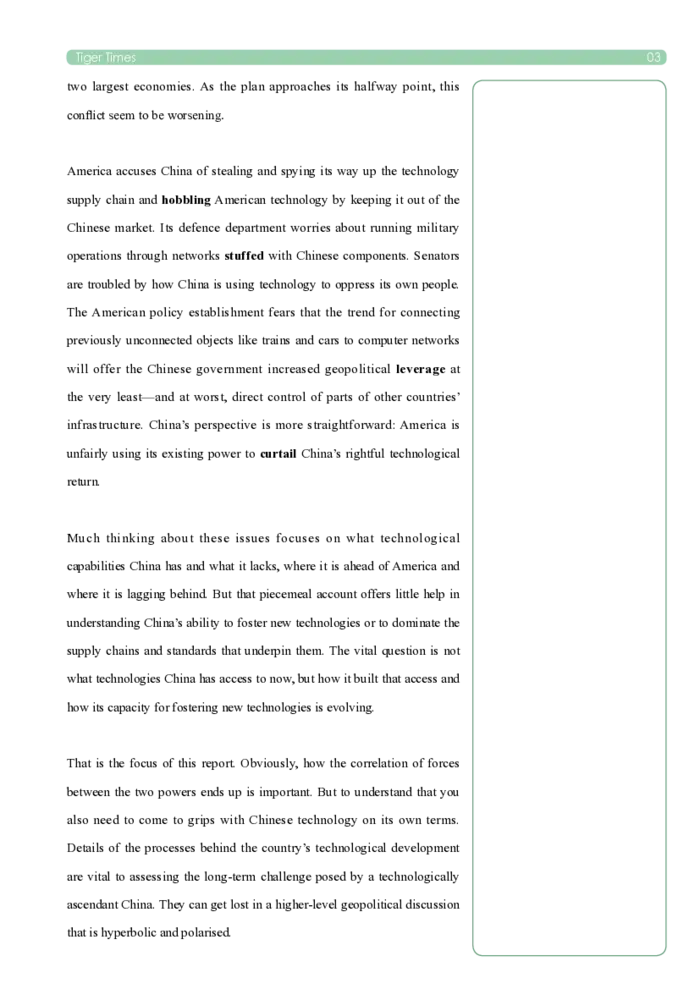
 经济学人:有中国特色的国家主义科技发展道路(上)
讲师丨查克
来源丨The Economist
日期丨2020. 01.10  Fri.
课程导读
▶   铸铁最早源于哪个国家?
▶   在作者看来,阻碍中国科技水平持续领先的原因有哪些?
▶   “粗制滥造”用英文怎么说?
▶   如何用诗意的英文表达“驾着祥云而来”?
扫码听课
听课笔记
Tiger Times
02
Chinese technology
With the state’s help, Chinese technology is
booming
But it will not be a smooth road to global dominance, says Hal Hodson
For most of human history, China was the world’s most advanced
technological power. The blast furnace originated there, and thus so,
too, did cast iron. Other breakthroughs included porcelain and paper. Its
gunpowder propelled the first military rockets farther than javelin or arrow
could fly; its compasses magically revealed magnetic north when the stars
were hidden.
Only in the Middle Ages did Europe began to match Chinese ingenuity and
capacity in these fields, doing so largely through imitation. Only with the
growth of European mechanical industries and overseas empires in the 18th
century did the Westerners become its rivals. In the centuries that followed,
hampered by its own stifling education system, China was defeated in the
opium wars, then suffered terrible civil unrest and a disastrous revolution
that reduced the country to a technological bystander and “Made in China”
to a byword for gimcrackery.
Now China is back, trailing clouds of smartphones, high-speed trains,
stealthy aircraft, bitcoin mines and other appurtenances of high-tech flair.
The parts of the world that overtook it are worried. In 2015 its leaders
announced a ten-year, $300bn plan, “Made in China 2025”, designed
to make its semiconductor, electric-vehicle and artificial-intelligence
industries (and many others) as good as any in the world, if not better. This
declaration that China was no longer content with being a factory for
American high-tech products created a new tension between the world’s
讲解正文
Tiger Times
03
two largest economies. As the plan approaches its halfway point, this
conflict seem to be worsening.
America accuses China of stealing and spying its way up the technology
supply chain and hobbling American technology by keeping it out of the
Chinese market. Its defence department worries about running military
operations through networks stuffed with Chinese components. Senators
are troubled by how China is using technology to oppress its own people.
The American policy establishment fears that the trend for connecting
previously unconnected objects like trains and cars to computer networks
will offer the Chinese government increased geopolitical leverage at
the very least—and at worst, direct control of parts of other countries’
infrastructure. China’s perspective is more straightforward: America is
unfairly using its existing power to curtail China’s rightful technological
return.
Much thinking about these issues focuses on what technological
capabilities China has and what it lacks, where it is ahead of America and
where it is lagging behind. But that piecemeal account offers little help in
understanding China’s ability to foster new technologies or to dominate the
supply chains and standards that underpin them. The vital question is not
what technologies China has access to now, but how it built that access and
how its capacity for fostering new technologies is evolving.
That is the focus of this report. Obviously, how the correlation of forces
between the two powers ends up is important. But to understand that you
also need to come to grips with Chinese technology on its own terms.
Details of the processes behind the country’s technological development
are vital to assessing the long-term challenge posed by a technologically
ascendant China. They can get lost in a higher-level geopolitical discussion
that is hyperbolic and polarised.
Tiger Times
04
The process of gaining that understanding starts with looking at older
technologies, such as high-speed trains and nuclear-power plants. The work
of indigenising these technologies is almost complete, and the Chinese
firms and state-owned enterprises behind them are poised to export to the
world. As such, they represent a model of successful state-led development
that has used the state’s repressive power over its citizenry and the sway it
holds over the economy to deploy technology on a massive scale.
Tiger Times
05
blast /blɑːst/ n. 爆炸;一阵;噪声 vi. 猛攻;爆炸;批评;
损害
 ○ consisting of fire or burning strongly and brightly
 ○ a sudden strong movement of wind or air
 ○ e.g. A blast of cold air swept through the hut.
an explosion, or the very strong movement of air that it
causes
 ○ e.g. A bomb blast completely destroyed the building.
a sudden very loud noise, especially one made by a whistle or
horn
 ○ e.g. a long trumpet blast
 ○ to damage or destroy something, or to injure or kill
someone, using a gun or a bomb
 ○ blast sb with sth
 ○ e.g. The plane was blasted out of the sky by a terrorist
bomb.
 ○ to break something into pieces using explosives, especially
in order to build something such as a road
 ○ e.g. Railway workers had blasted through the mountains.
 ○ to criticize someone or something very strongly – used
especially in news reports
 ○ e.g. Union leaders blasted the government for failing to
tackle the jobs crisis.
furnace /ˈfɜːnɪs/ n. 火炉,熔炉
 ○ a large container for a very hot fire, used to produce power,
heat, or liquid metal
 ○ e.g. It’s hot, just  like a furnace.
propel /prəˈpel/ v.  推动;驱使
 ○ to move, drive, or push sth forward
 ○ e.g. a boat propelled by a small motor
propel yourself along/through
 ○ e.g. She used the sticks to propel herself along.
propel sb to/into sth
 ○ e.g. Company directors were propelled into action.
javelin /ˈdʒævlɪn/ n. 标枪,投枪
 ○ a long stick  with a pointed end, thrown as a sport
 ○ e.g. Dana won the gold medal in the javelin.
ingenuity /ˌɪndʒəˈnjuːəti/ n. 心灵手巧,独创性,足智多谋;
精巧的装置
 ○ skill at inventing things and thinking of new ideas
 ○ e.g. We must never underestimate the power of human
ingenuity.
imitation /ˌɪmɪˈteɪʃn/ n. 模仿;仿制品
 ○ when you copy someone else’s actions
 ○ e.g. Many people think that children learn language by
imitation.
 ○ a copy of sth
 ○ e.g. She wore an imitation of a sailor’s hat.
 ○ imitate /ˈɪmɪteɪt/ vt. 模仿;仿造
 ○ to copy the way someone behaves, speaks, moves etc.,
especially in order to make people laugh
 ○ e.g. She was a splendid mimic and loved to imitate people
around.
 ○ to copy sth because you think it is good
 ○ e.g. When someone imitates a pure copy of the product, we
have to protect ourselves.
stifling /ˈstaɪflɪŋ/ adj. 令人窒息的;沉闷的
 ○ a room or weather that is stifling is very hot and
uncomfortable, so that it seems difficult to breathe
 ○ e.g. the stifling heat of the tropics
 ○ a situation that is stifling stops you from developing your
own ideas and character
 ○ e.g. an emotionally stifling relationship
stifle /ˈstaɪfl/ v. 扼杀;使窒息
 ○ to stop sth from happening or developing
 ○ e.g. rules and regulations that stifle innovation
 ○ to stop a feeling from being expressed
 ○ e.g. I tried to stifle my laughter.
 ○ if you are stifled by something, it stops you breathing
comfortably
 ○ = suffocate
 ○ e.g. He was almost stifled by the fumes.
bystander /ˈbaɪstændə(r)/ n. 旁观者
 ○ someone who watches what is happening without taking
part
 ○ e.g. Two innocent bystanders were injured in the shooting.
byword /ˈbaɪwɜːd/ n. 谚语;格言
 ○ a word, phrase, or saying that is very well known
 ○ be a byword for sth
 ○ e.g. Caution should be a byword for investors.
gimcrackery /ˈdʒɪmˌkrækərɪ/ n. 虚华不实之物或装饰;粗
制滥造的物品
 ○ showy but cheap and useless decoration, effects, etc.
 ○ e.g. Yiwu is famous for its large amounts of gimcrackery.
trailing /ˈtreɪlɪŋ/ adj. 蔓生的
 ○ e.g. a trailing plant grows along the ground or hangs down
trail /treɪl/ v. 拖,拉;追踪;落后 n. 足迹;踪迹;排成的
长队
 ○ to pull sth behind you, especially along the ground, or to
be pulled in this way
 ○ e.g. A jeep trailing a cloud of dust was speeding in my
direction. 一辆吉普车拖着一股扬尘,朝我疾驰而来。
 ○ to walk slowly, especially behind other people because you
are tired or bored
 ○ e.g. Susie trailed along behind her parents.
 ○ to be losing in a game, competition or election
 ○ e.g. Manchester United were trailing by two goals to one.
 ○ someone by looking for signs that they have gone in a
particular direction
 ○ e.g. Police trailed the gang for several days.
 ○ a rough path across countryside or through a forest
 ○ e.g. This trail leads to the nearest town.
 ○ a long line or a series of marks that have been left by
someone or something
 ○ e.g. a trail of wet footprints
 ○ a sign that a person or animal has been in a place, used for
词汇
Tiger Times
06
finding or catching them
 ○ e.g. The dogs followed the trail of the dying animal.
stealthy /ˈstelθi/ adj. 鬼鬼祟祟的;秘密的
 ○ moving or doing something quietly and secretly
 ○ e.g. the stealthy approach of the soldiers
appurtenance /əˈpɜːtɪnəns/ n. 附属物;配件
 ○ a part of something more important
 ○ e.g. Safety guardrail is an important appurtenance to ensure
traffic safety.
flair /fleə(r)/ n. 天资;鉴别力
 ○ a naturally ability to do something very well
 ○ e.g. Joe has a flair for languages.
 ○ e.g. Irwin has real entrepreneurial flair.
overtake /ˌəʊvəˈteɪk/ v. 赶上;压倒;突然来袭
 ○ to go past a moving vehicle or person because you are
going faster than them and want to get in front of them
 ○ e.g. Police overtook and captured the fleeing suspect.
 ○ to develop or increase more quickly than someone or
something else and become more successful, more important,
or more advanced than them
 ○ e.g. Mary has now overtaken Sue in the world rankings.
 ○ if something bad, especially a feeling, overtakes you, it
happens to you suddenly and has a strong effect on you
 ○ = overcome
 ○ e.g. She was overtaken by emotion and started to cry.
declaration /ˌdekləˈreɪʃn/ n. 申报;宣布;公告
 ○ an important official statement about a particular situation
or plan, or the act of making this statement
 ○ e.g. the declaration of war 宣战
 ○ an official or serious statement of what someone believes
 ○ e.g. declarations of undying love 爱的宣言
 ○ a statement in which you officially give information about
yourself
 ○ e.g. a declaration of taxable earnings 申报纳税
content /kənˈtent/ n. 内容,目录;满足;容量 adj. 满意的 v.
使满足
 ○ the amount of a substance that is contained in something,
especially food or drink
 ○ e.g. the fat content of cheese
 ○ the ideas, facts or opinions that are contained in a speech,
piece of writing, film, programme
 ○ e.g. The content of the media course includes scripting,
editing, and camera work.
 ○ the information contained in a website, considered
separately from the software that makes the website work
 ○ e.g. The graphics are brilliant. It’s just a shame the content
is so poor.
 ○ happy and satisfied
 ○ e.g. The baby sat on its mother’s lap, perfectly content.
 ○ to make someone feel happy and satisfied
 ○ e.g. I was no longer satisfied with the life that had
contented me.
hobble /ˈhɒbl/ v. 蹒跚,跛行;阻止,妨碍
 ○ to walk with difficulty, especially because your legs or feet
hurt
 ○ e.g. He hobbled into the room on crutches.
 ○ to deliberately make sure that a plan, system etc. cannot
work successfully
 ○ e.g. Many start-ups are hobbled by a lack of sufficient
capital.
stuff /stʌf/ n. 东西;材料;填充物;素材资料 v. 塞满;吃
得过多
 ○ (informal) used when you are talking about things such
as substance, materials or groups of objects when you do
not know what they are called, or it is not important to say
exactly what they are
 ○ e.g. How do you think you’re going to fit all that stuff into
the car?
 ○ (informal) used when talking about different activities,
subjects or ideas, when you do not say exactly what these are
 ○ e.g. What kind of stuff do you like to read?
 ○ (informal) used when you are talking about what someone
has done or made, for example writing, music or art
 ○ e.g. He did some great stuff in his early films.
 ○ to push or put something into a small space, especially in a
quick careless way
 ○ e.g. She stuffed two more sweaters into her bag.
 ○ to fill something until it is full
 ○ e.g. a pillow stuffed with feathers
leverage /ˈliːvərɪdʒ/ n. 影响力;杠杆作用 v. 利用;举债经
营
 ○ influence that you can use to make people do what you
want
 ○ e.g. diplomatic leverage by the US
 ○ the action, power, or use of a lever
 ○ to make money avaliable to someone in order to invest or
to buy something such as a company
 ○ e.g. the use of public funds to leverage private investment
 ○ to spread or use resources (=money, skills, buildings etc.
that an organization has available), ideas etc again in several
different ways or in different parts of a company, system etc.
leverage something across something
 ○ e.g. He might feel that leveraging the company at a time
when he sees tremendous growth opportunities would be a
mistake.
curtail /kɜːˈteɪl/ v. 缩减;剪短;剥夺… 特权
 ○ to reduce or limit something
 ○ e.g. Investment plans may be curtailed by high interest
rates.
Tiger Times
07
今日习题
1. 根据英文释义写出文中出现的对应单词
______: showy but cheap and useless decoration, effects, etc.
______: moving or doing something quietly and secretly
2. 一词多义
Which of the following underlined word is closest in meaning to the one in the sentence "The parts of the
world that overtook it are worried." ?  ____
A. Police overtook and captured the fleeing suspect.
B. She was overtaken by emotion and started to cry.
C. Mary has now overtaken Sue in the world rankings.
D. The climbers were overtaken by bad weather.
3. 翻译:根据给定中文回译英文
在随后的几个世纪中,中国受到自己令人窒息的教育体系的阻碍,在鸦片战争中被打败,然后遭
受了可怕的内乱和灾难性的革命,使该国沦为技术旁观者,“ 中国制造” 成为了粗制滥造(商品)
的代名词。
_____________________________________________________________________________________
________________________________________________
Tiger Times
08
习题答案
1. gimcrackery; stealthy
2. C
3. In the centuries that followed, hampered by its own stifling education system, China was defeated
in the opium wars, then suffered terrible civil unrest and a disastrous revolution that reduced the
country to a technological bystander and “Made in China” to a byword for gimcrackery.
编辑丨菠萝
剪辑丨点点
美编丨凤阙龙城
责编 | Anchor