文档文本内容
听力基础卷08 新能源汽车(全国通用)

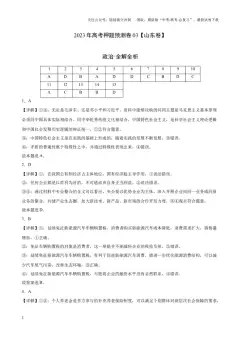
参考答案
题号
1
2
3
4
5
6
7
8
9
10
答案
B
A
C
B
B
B
C
A
B
C
题号
11
12
13
14
15
16
17
18
19
 20
答案
B
C
C
C
A
C
C
A
B
 A
录音稿
Text 1
W: I never thought I’d see you driving an electric car to work.
M: They are the future. You know, a Chinese company has made an electric racing car that can travel at 250 kph. It’s
almost as fast as the train.
W: Amazing. But I prefer public transportation.
Text 2
W: I heard you bought an electric car.
M: Yeah, the government offers financial support, which is nice. But the main reason is that charging is cheaper than
buying gas.
W: And it’s quiet and environmentally friendly too.
M: That’s a bonus.
Text 3
M: I see more electric cars on the road every day now.
W: Yes, and the city has set up many new charging stations in public parking lots.
M: That’s convenient.
Text 4
M: Are you going to buy a new energy car recently?
W: I’m considering it. It costs much less to charge than to fill up petrol.
M: But you’d better think about the charging stations on long trips.
Text 5
M: Many people choose new energy vehicles these days.
W: Yes. They help cut down air pollution in cities.
M: However, their battery life will shorten as time passes.
Text 6
W: Jake, what do you think about electric cars?
M: Oh? Is there something wrong with your current car?
W: Not exactly. I’m seriously considering an electric car to reduce my carbon footprint. But I’m just a bit worried
about the cost.
M: I see. Electric cars do have higher early costs, but you’ll save money on gas in the long run. Plus, there may also
be tax benefits.
W: That’s a good point. I’ll have to look into the long-term advantages further.
Text 7
M: Good afternoon, ma’am. We’re doing some market research, and I hope you could answer some questions. It only
takes a few minutes.
W: I guess so.
M: Great. First, do you own a robot that can help you sweep the floor?
W: No. I think I’ll never need one.
M: Well, what about a coffee maker?
W: Of course, I have one of those.
M: When do you use your coffee maker?
W: I use it every morning, and sometimes in the evening if I have guests.
M: Would you ever consider a one-cup coffee maker?
W: No. I’m afraid I won’t consider it.
M: OK. So, what kind of car do you drive?
W: An old VW Jetta, but I’m thinking of buying a Honda.
M: Honda. OK. And what are the chances you would buy an electric car?
W: Well, I live in an apartment in a tall building, so I wouldn’t have a way to charge it.
M: Thanks for answering my questions today.
Text 8
W: Tom, have you decided which electric car to buy? The government’s new subsidy policy ends next month.
M: Not yet. I’m considering between a Tesla and a BYD. The BYD is cheaper, but Tesla’s battery life is longer.
W: What about charging stations? I read that charging points in our city have doubled this year.
M: True, but I often drive to rural areas for work. Some villages still lack facilities.
W: Then maybe a plug-in hybrid? It can switch to fuel when needed.
M: Good idea! Let’s check the latest models online tonight.
Text 9
M: Yesterday I read about electric energy for cars replacing gas.
W: Does electric energy mean it’s more environmentally-friendly and cheaper?
M: It is always less polluting. In the future, companies will improve technology to make it cheaper and more
convenient as well.
W: Which places use the most electric cars?
M: Right now, it is China.
W: Don’t you think we will just use buses and trains instead of cars in the future?
M: I think people will only drive electric cars by 2050 because of advanced technology from China, Germany, Japan,
and the US.
W: I think people will use more bicycles as well and the air in big cities will become cleaner!
Text 10
W: A growing number of Americans are turning gas-powered cars into electric ones. Such changes are
becoming more popular as battery technology gets better and the world turns towards cleaner energy sources. At the
end of 2019, Kevin Erickson began a year-and-a-half-long project to change the car into an electric car. He said
changing classic cars into electric cars was definitely a trend. Jonathan Klinger is a president of car culture for Hagerty
Insurance. In May, the Michigan-based company did a web-based study of about 25,000 automobile lovers in the
United States, Canada and the UK. About one percent had at least partly changed an older model car into some form
of electric power. The top three reasons for changing the vehicles in order were for better performance, for a fun
project, and because of environmental concerns. The change requires special knowledge to complete. It also involves
safety concerns and parts that are sometimes hard to find.