选择性必修
第二册
英语
第二册
选择性必修
普
通
高
中
教
科
书
英语
·北京·
ENGLISH
人民教育出版社 课程教材研究所
英语课程教材研究开发中心
圣
智
学
习
集
团
(中国)
(美国)
编著
主 编:刘道义 郑旺全
副 主 编:吴 欣 张献臣
编写人员: Patrick Wallace Sarah H. Miller Tim Gibbs Jacqueline Eu
马晓蕾 张琳琳 葛炳芳 贵丽萍
责任编辑:马晓蕾 张琳琳
美术编辑:胡白珂
普通高中教科书 英语 选择性必修 第二册
(中国)
人民教育出版社 课程教材研究所
英语课程教材研究开发中心 编著
(美国)圣
智
学
习
集
团
出 版
(北京市海淀区中关村南大街17 号院1 号楼 邮编:100081)
网 址 http://www.pep.com.cn
版权所有·未经许可不得采用任何方式擅自复制或使用本产品任何部分·违者必究
如发现内容质量问题,请登录中小学教材意见反馈平台:jcyjfk.pep.com.cn
《普通高中教科书 英语》是为了适应新时代的发展需要,依据《普通高中英语课程标
准(2017年版)》的精神,充分征求广大师生的反馈意见,在《普通高中课程标准实验教科
书 英语》的基础上精心修订而成。此次教材修订的主要目的是:全面落实立德树人根本任
务,培育社会主义核心价值观,弘扬中华优秀文化,充分体现英语课程工具性和人文性的统
一,发展学生的语言能力、文化意识、思维品质和学习能力等英语学科核心素养,充分体现
英语学科特殊的育人价值,培养具有中国情怀、国际视野和跨文化沟通能力的社会主义建设
者和接班人。
修订后的教材主要具有以下特点:
注重思想引领 教材融入了社会主义核心价值观的基本内容和要求,注重培养学生良好
的政治素质、道德品质和健全人格,弘扬中华优秀文化,增强文化自信,引导学生形成正确
的世界观、人生观和价值观。
反映时代要求 教材充分反映当代社会发展新变化、科技进步新成果,展示新时代中国
特色社会主义新成就,将先进的教育思想和理念融入教材之中,同时紧密结合学生的学习和
生活实际,关注信息化环境下学生的发展需求。
强调语言实践 教材以英语学习活动观为指导,以主题为引领,以语篇为依托,通过板
块式设计将语言知识与听、说、读、看、写等技能有机整合,强调学习过程和学习策略,突
出活动目标,让学生用语言做事情,在实践中培养语言运用能力和创新思维。
突出文化意识 教材通过展示多姿多彩的中外文化来培养学生对中华文化的认同和传承,
加深对人类优秀文化的学习和鉴赏;通过让学生分析中外文化异同,发展其多元思维和批判
性思维,增强学生跨文化理解和跨文化沟通能力,构建人类命运共同体意识。
激发学习动机 教材以真实性、趣味性、规范性和经典性作为内容选编原则,主题覆盖
面广,语篇题材和体裁丰富,活动呈现形式多样,版式设计生动活泼且富有美感,力求激发
学生的学习兴趣和动机,引发他们积极思考、主动参与语言实践活动,提升英语学习效率。
满足不同需求 教材编排内容和活动设计既充分考虑学生的共同基础,又兼顾学生不同
的能力水平和学习需求,提供了拓展性的教学内容,为教师灵活使用教材进行教学提供了便
利,也切实促进学生的个性发展。
本套教材为高中英语教学提供了丰富的教学资源。希望教材能够帮助同学们打下坚实的
语言基础,提高英语水平,获得全面发展;同时也希望老师们能够充分利用教材,在实践中
不断完善教学,取得良好的教学效果。
前 言
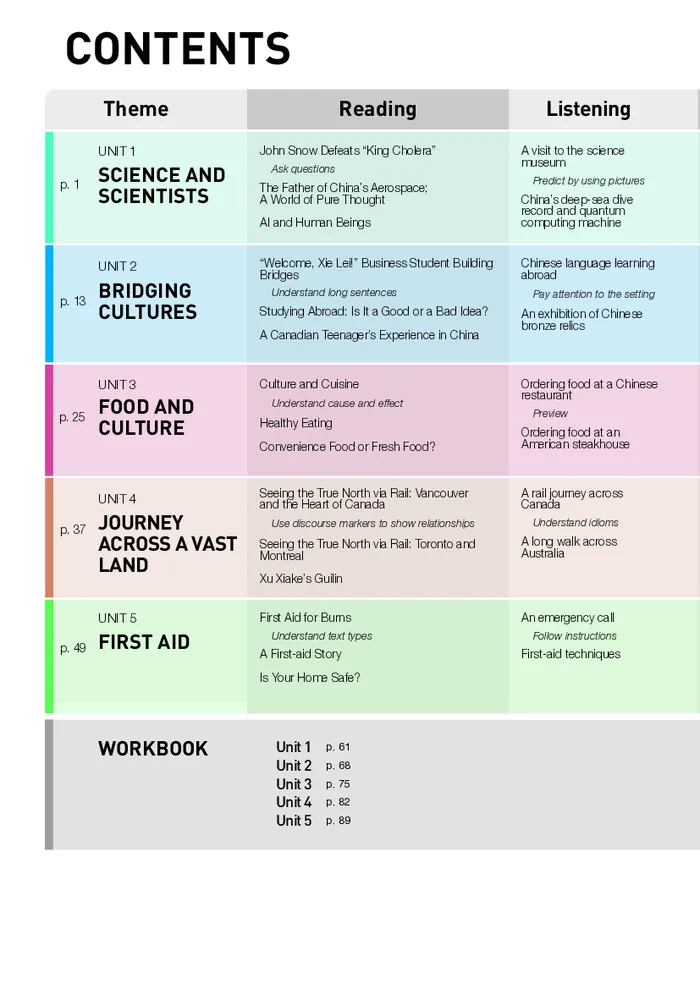
CONTENTS
Reading
Listening
Unit 1 p. 61
Unit 2 p. 68
Unit 3 p. 75
Unit 4 p. 82
Unit 5 p. 89
John Snow Defeats “King Cholera”
Ask questions
The Father of China’s Aerospace;
A World of Pure Thought
AI and Human Beings
“Welcome, Xie Lei!” Business Student Building
Bridges
Understand long sentences
Studying Abroad: Is It a Good or a Bad Idea?
A Canadian Teenager’s Experience in China
Seeing the True North via Rail: Vancouver
and the Heart of Canada
Use discourse markers to show relationships
Seeing the True North via Rail: Toronto and
Montreal
Xu Xiake’s Guilin
First Aid for Burns
Understand text types
A First-aid Story
Is Your Home Safe?
Culture and Cuisine
Understand cause and effect
Healthy Eating
Convenience Food or Fresh Food?
A visit to the science
museum
Predict by using pictures
China’s deep-sea dive
record and quantum
computing machine
Chinese language learning
abroad
Pay attention to the setting
An exhibition of Chinese
bronze relics
Ordering food at a Chinese
restaurant
Preview
Ordering food at an
American steakhouse
A rail journey across
Canada
Understand idioms
A long walk across
Australia
An emergency call
Follow instructions
First-aid techniques
p. 1
p. 13
p. 25
p. 37
p. 49
Theme
WORKBOOK
UNIT 1
SCIENCE AND
SCIENTISTS
UNIT 2
BRIDGING
CULTURES
UNIT 3
FOOD AND
CULTURE
UNIT 4
JOURNEY
ACROSS A VAST
LAND
UNIT 5
FIRST AID
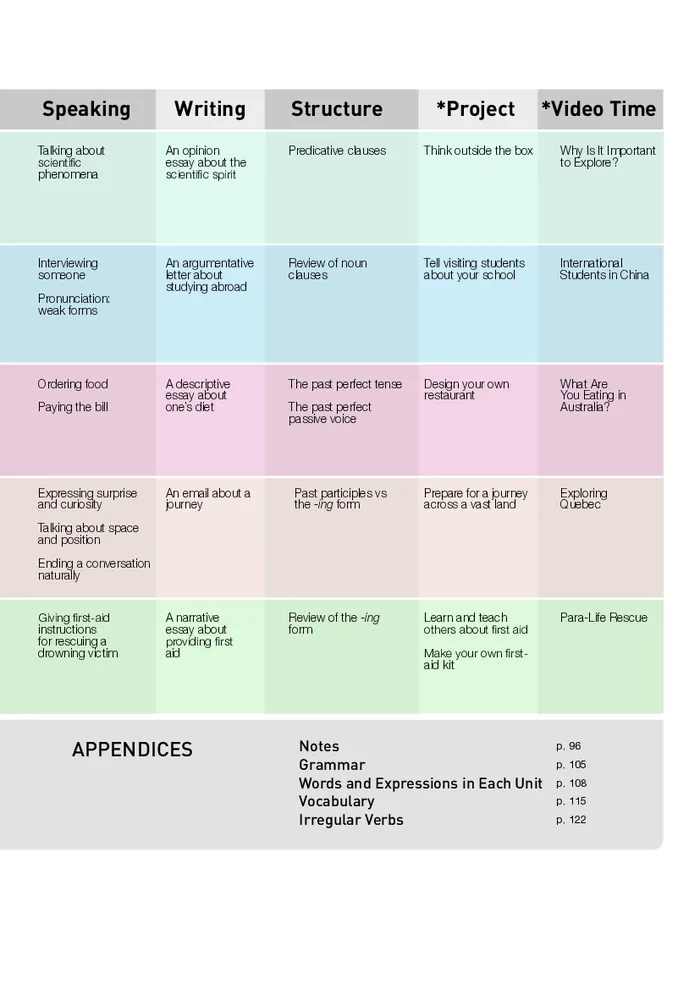
Speaking
Writing
Structure
APPENDICES
Notes
p. 96
Grammar
p. 105
Words and Expressions in Each Unit p. 108
Vocabulary
p. 115
Irregular Verbs
p. 122
Predicative clauses
Review of noun
clauses
Review of the -ing
form
Past participles vs
the -ing form
The past perfect tense
The past perfect
passive voice
*Project
Think outside the box
Tell visiting students
about your school
Design your own
restaurant
Prepare for a journey
across a vast land
Learn and teach
others about first aid
Make your own first-
aid kit
*Video Time
International
Students in China
Why Is It Important
to Explore?
What Are
You Eating in
Australia?
Exploring
Quebec
Para-Life Rescue
An opinion
essay about the
scientific spirit
An argumentative
letter about
studying abroad
A descriptive
essay about
one’s diet
An email about a
journey
A narrative
essay about
providing first
aid
Talking about
scientific
phenomena
Interviewing
someone
Pronunciation:
weak forms
Ordering food
Paying the bill
Expressing surprise
and curiosity
Talking about space
and position
Ending a conversation
naturally
Giving first-aid
instructions
for rescuing a
drowning victim
UNIT 1 PEOPLE OF ACHIEVEMENT
To raise new questions, new possibilities,
to regard old problems from a new
angle, requires creative imagination and
marks real advance in science.
—Albert Einstein & Leopold Infeld
In this unit, you will
1 read about how John Snow defeated “King
Cholera”.
2 listen to and talk about interesting
experiences related to science.
3 write about what makes a great scientist.
4 explore the relationship between science
and art.
SCIENCE AND
SCIENTISTS
UNIT 1
Look and discuss
1 Where do you think this photo was taken?
What are the students doing in the photo?
2 Have you ever been to a place like this?
What was it like?
3 Would you like to work in such a field in the
future? Why or why not?
1
Understand the questioning mind
Reading and Thinking
1 Discuss the following stages of scientific research in groups. What order
would you put them in?
2 Skim the passage to see if the order you decided in Activity 1 was correct.
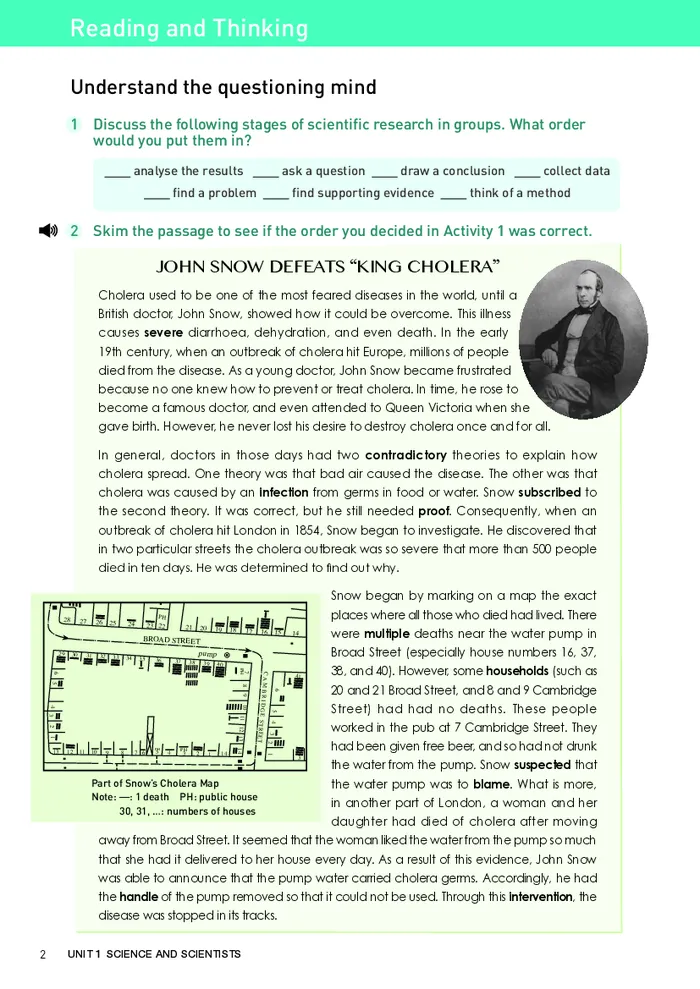
JOHN SNOW DEFEATS “KING CHOLERA”
Cholera used to be one of the most feared diseases in the world, until a
British doctor, John Snow, showed how it could be overcome. This illness
causes severe diarrhoea, dehydration, and even death. In the early
19th century, when an outbreak of cholera hit Europe, millions of people
died from the disease. As a young doctor, John Snow became frustrated
because no one knew how to prevent or treat cholera. In time, he rose to
become a famous doctor, and even attended to Queen Victoria when she
gave birth. However, he never lost his desire to destroy cholera once and for all.
In general, doctors in those days had two contradictory theories to explain how
cholera spread. One theory was that bad air caused the disease. The other was that
cholera was caused by an infection from germs in food or water. Snow subscribed to
the second theory. It was correct, but he still needed proof. Consequently, when an
outbreak of cholera hit London in 1854, Snow began to investigate. He discovered that
in two particular streets the cholera outbreak was so severe that more than 500 people
died in ten days. He was determined to find out why.
Snow began by marking on a map the exact
places where all those who died had lived. There
were multiple deaths near the water pump in
Broad Street (especially house numbers 16, 37,
38, and 40). However, some households (such as
20 and 21 Broad Street, and 8 and 9 Cambridge
Street) had had no deaths. These people
worked in the pub at 7 Cambridge Street. They
had been given free beer, and so had not drunk
the water from the pump. Snow suspected that
the water pump was to blame. What is more,
in another part of London, a woman and her
daughter had died of cholera after moving
away from Broad Street. It seemed that the woman liked the water from the pump so much
that she had it delivered to her house every day. As a result of this evidence, John Snow
was able to announce that the pump water carried cholera germs. Accordingly, he had
the handle of the pump removed so that it could not be used. Through this intervention, the
disease was stopped in its tracks.
analyse the results
ask a question
draw a conclusion
collect data
find a problem
find supporting evidence
think of a method
28
27
26
25
24
23
22
PH
21
20
19
18
17
16
15
14
BROAD STREET
pump
29
30
31
32
33
34
35
36
37
38
39
40
1
2
3
4
5
6
13
12
11
10
9
8
7 6
5
4
3
2
1
PH
PH
14
7
14
13
12
11
10
9
8
PH
C A M B R I DGE STREET
6
5
4
3
2
1
41
3
Part of Snow’s Cholera Map
Note: —: 1 death PH: public house
30, 31, …: numbers of houses
2
UNIT 1 SCIENCE AND SCIENTISTS
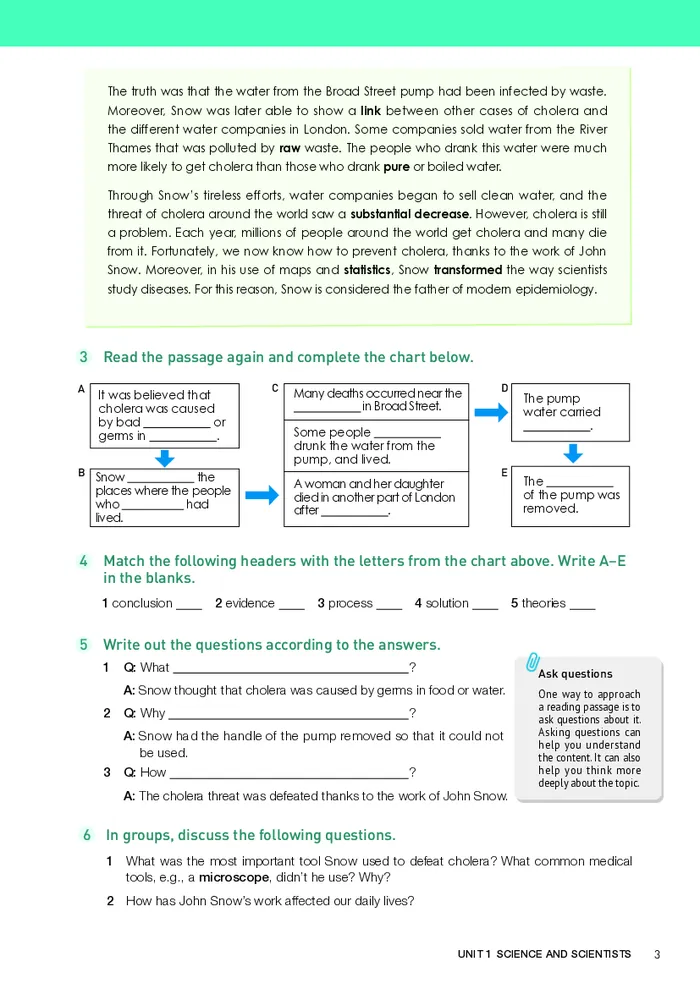
3 Read the passage again and complete the chart below.
4 Match the following headers with the letters from the chart above. Write A–E
in the blanks.
The truth was that the water from the Broad Street pump had been infected by waste.
Moreover, Snow was later able to show a link between other cases of cholera and
the different water companies in London. Some companies sold water from the River
Thames that was polluted by raw waste. The people who drank this water were much
more likely to get cholera than those who drank pure or boiled water.
Through Snow’s tireless efforts, water companies began to sell clean water, and the
threat of cholera around the world saw a substantial decrease. However, cholera is still
a problem. Each year, millions of people around the world get cholera and many die
from it. Fortunately, we now know how to prevent cholera, thanks to the work of John
Snow. Moreover, in his use of maps and statistics, Snow transformed the way scientists
study diseases. For this reason, Snow is considered the father of modern epidemiology.
1 conclusion
2 evidence
3 process
4 solution
5 theories
It was believed that
cholera was caused
by bad
or
germs in
.
Snow
the
places where the people
who
had
lived.
The pump
water carried
.
The
of the pump was
removed.
Many deaths occurred near the
in Broad Street.
Some people
drunk the water from the
pump, and lived.
A woman and her daughter
died in another part of London
after
.
A
B
C
D
E
5 Write out the questions according to the answers.
6 In groups, discuss the following questions.
1 Q: What
?
A: Snow thought that cholera was caused by germs in food or water.
2 Q: Why
?
A: Snow had the handle of the pump removed so that it could not
be used.
3 Q: How
?
A: The cholera threat was defeated thanks to the work of John Snow.
1 What was the most important tool Snow used to defeat cholera? What common medical
tools, e.g., a microscope, didn’t he use? Why?
2 How has John Snow’s work affected our daily lives?
Ask questions
One way to approach
a reading passage is to
ask questions about it.
Asking questions can
help you understand
the content. It can also
help you think more
deeply about the topic.
UNIT 1 SCIENCE AND SCIENTISTS
3
Learning About Language
Build up your vocabulary
1 Find the words from the previous pages with the following prefixes or suffixes.
Then add two words for each prefix or suffix, and explain their meanings.
3 Replace the underlined parts with suitable words from the box.
raw a household name substantial statistics handle
2 Make phrases by combining the words in the left box with those on the right.
Then complete the sentences using these phrases.
1 Many scientists
the view that it is human activity that has caused global warming.
2 He was to
the accident because he drove on the wrong side of the road.
3 The man
being behind the robbery was seen crossing the street.
4 Since heart disease is often
our lifestyle choices, we need to make healthy
living an important part of our lives.
subscribe suspect blame link
to of for
4 Read this passage about medical science. Complete it using the words below.
British scientists believe they may have found a way to fight the common cold. It blocks a
key protein in the body’s cells that is to
for the spread of cold-causing virus.
Targeting the host rather than the
was a bit non-traditional but made sense
because it was tricky to target the virus. Cold-causing viruses are not only of
kinds, but they also
rapidly, meaning they can quickly develop resistance to
medicine. Researchers are working on making a form of medicine that can be taken directly
into one’s lungs, to
the chance of side effects. Though these scientists have
made
advances in their research, further
is needed to make
sure such drugs are not so
that they harm the body.
infection multiple decrease severe transform proof blame substantial
1 It is not unusual for an athlete to be well-known while he is active, and quickly forgotten
when his athletic career is over.
2 I’m sure she’ll deal with the changes very well because she’s very adaptable.
3 He was ready to serve dinner to his friends when he realised that he had forgotten to turn
on the oven and the meat was not cooked yet.
4 He used his great influence to change the thinking of the scientific community on this issue.
5 Scientists have collected more data than expected to prove the theory.
4
UNIT 1 SCIENCE AND SCIENTISTS
Prefix
Words
Prefix
Words
Suffix
Words
Suffix
Words
re-
micro-
-ory
-ial
dis-
trans-
-ion
-ology
Discover useful structures
1 Underline all the examples in the reading passage where noun clauses are
used as the predicative. Then state their meaning and functions.
2 Answer the following questions using the information from the reading
passage as well as the predicative clauses.
3 David is talking to Maria about their scientific research project. First complete
David’s lines (A–E), using the words in the box. Then put David’s lines in the
correct order and practise the conversation.
A Absolutely. You may not believe it, but that was
happened at the initial stage
of our group’s research on developing a vaccine for malaria.
B Yes, it is. And it seemed
all the theories were useful, but the fact was
we couldn’t persuade one another that one theory was better than another.
C Exactly. The problem was not about
all our theories were equally good, but in
deciding
theory to depend upon.
D We realised that what we cared about was not
aspect we needed to develop
a theory in, but rather
we can reduce the cost of a vaccine without reducing its
effect!
E You’re right. At last, we became focused on the key issue, which was
we had
to carry out the research in the first place.
Maria: This mix of theory and data is one of the key characteristics of what we call science.
David:
Maria: With your theoretical framework?
David:
Maria: Deciding on a theory is definitely of critical importance.
David:
Maria: This was when you should have calmed down and got down to doing some solid work.
David:
Maria: So what happened in the end?
David:
What was it that John Snow showed to the world?
What John Snow showed to the world was how cholera could be overcome.
1 What was Snow’s discovery in two particular streets in London?
Snow’s discovery in two particular streets in London was that
.
2 What was Snow determined to find out during the 1854 outbreak of cholera in London?
What Snow was determined to find out was why
.
3 What were the exact places Snow marked on the map?
The exact places Snow marked on the map were where
.
4 What was the finding that Snow announced?
Snow’s finding was that
.
EXAMPLE
as if that what who when how why whose which whether
A
UNIT 1 SCIENCE AND SCIENTISTS
5
Using Language
1 Look at the photos below, and discuss in groups what these activities have to do
with science.
2 The photos above are related to the
conversation you will hear. Using the photos,
try to predict the answers to the following
questions.
3 Listen to the conversation and see if your answers for Activity 2 are correct.
Then write down the letters (A–E) for the photos in the order that you hear them
described.
4 Listen again and complete the descriptions of the photos above.
Talk about scientific experiences
1 Where are the people in the conversation
going to go?
2 What kind of place is it, and what does it
focus on?
3 What kinds of things can you do there?
1
2
3
4
5
Predict by using pictures
One way to get more out of your
listening is to predict what you will
hear. Using the pictures provided and
the knowledge you already have, you
can guess the kinds of information you
should listen for. At times, you may even
be able to guess exactly what will be
talked about. This will help you focus
better when listening, making your
listening more effective.
A
B
C
E
D
Photo A: A giant dish; when you speak into it, it
the sound back and
. You can use it to speak in a
to
someone 17 metres away.
Photo B: A giant
that you can use your feet to play. Instead of playing
the sounds of a piano, it plays the voices of
.
Photo C: You look at a blue screen for a while, and then suddenly you can see
moving around on it. These are our
.
Photo D: A
where you can see yourself reflected thousands of times.
Photo E: You stand in front of
, and it casts different shadows of
you, in
the rainbow.
6
UNIT 1 SCIENCE AND SCIENTISTS
Listening and Speaking
5 Discuss the following questions in groups.
6 In groups, choose one of the museum activities on the previous page or
brainstorm another scientific research or experiment that you are interested in.
7 Make a short presentation to the class about your choice. Use the example and useful
phrases below to help you.
… can/cannot exist in the form of a solid/gas and a liquid/plasma …
… is both a … and a … at the same time …
how light/sound is reflected …
... the existence of other ...
This occurs when …
If you …, it will become …
That demonstrates …
This experiment/research shows …
Through this, we know that …
We can prove that …
This evidence proves …
Talking about scientific phenomena
EXAMPLE
Today, I want to talk to you about a very strange phenomenon called a non-Newtonian
fluid. You can make it easily using equal parts of water and cornflour, like I have here. A
non-Newtonian fluid is strange because you can pour
pour it like a liquid, but if you put any
pressure on it, it suddenly becomes hard as concrete
concrete. In fact, it becomes hard enough to
stand on. Then, as soon as you take the pressure off, it becomes a liquid again. This shows
that it is possible that something can exist as a liquid and a solid at the same time.
1 The conversation is about the City of Science and Industry, a museum in Paris. Would you
like to go to this museum? Why or why not?
2 Are there any museums like this in China? What other interesting museums are there?
1 Read the texts and decide if the statements are true (T) or false (F).
Write about what makes a great scientist
UNIT 1 SCIENCE AND SCIENTISTS
7
THE FATHER OF CHINA’S AEROSPACE
Perhaps no other scientist has had a greater impact
on China’s aerospace science than Qian Xuesen.
Described by the authors of the Story of Qian
Xuesen as a man with “great scientific thought and
scientific spirit” who was patriotic and served his
homeland with effort, achievement, and devotion,
Qian was an extremely well-respected man.
Born in Shanghai in 1911, Qian attended schools
in Beijing and then entered Shanghai Jiao
Tong University to study Railway Mechanical
Engineering. However, after the Songhu Battle
broke out in 1932, Qian made the decision to
switch his major to aviation because he realised
that China needed its own powerful air force to
protect and defend the country.
Qian went to the United States in 1935 to
pursue his graduate studies. Over the course of
the 1930s and 1940s, Qian became a pioneer
in American jet and rocket technology. As a
graduate assistant at the California Institute
of Technology during the 1930s, Qian helped
conduct important research into rocket propulsion,
Using Language
8
UNIT 1 SCIENCE AND SCIENTISTS
8
A WORLD OF PURE THOUGHT
Stephen Hawking was one of the most famous
and gifted scientists in physics. Most people are
familiar with images of him in his wheelchair,
unable to move and using a computer to talk.
Since he came down with a disease which caused
him to lose the use of most of his muscles, his
world became one of abstract thought.
Hawking first achieved fame when he was still
healthy enough to walk, as a graduate student
in physics at Cambridge University in 1964. In
general, there were two main theories on the
origin of the universe. The first was the steady
state theory, which holds that the universe has
no beginning or end. The other was the big bang
theory, which holds that the universe began at
a single point in time and space. The biggest
champion of the steady state concept was Fred
and in the 1940s, he and several other people
founded the Jet Propulsion Laboratory, now one
of NASA’s leading space-exploration centres.
After overcoming some difficulties during his
final few years in the US, Qian returned to China
in 1955. He received a hero’s welcome from
his homeland and was put in charge of not only
developing China’s rocket science but also its
space and missile programme. At that time, China
was poor and its rocket science was undeveloped.
No institute or university in China offered rocket
science as a major, and there were no talents or
experts in this field in China. Nevertheless, Qian
did not let that discourage him from taking on
the challenge. When he was asked “Can we
Chinese possibly make missiles?”, his reply was
a determined “Why not? We Chinese are able to
make the same things that other people make.”
Under Qian’s leadership, China developed
the Dongfeng missiles, followed by the first
generation of Long March rockets. In 1970,
China successfully launched its first man-made
satellite, Dong Fang Hong I, from a Long March
rocket. Because much of the technology behind
the Shenzhou spacecraft can also be traced back
to Qian’s research, Qian earned the name of “the
father of China’s aerospace”.
Qian read a lot and was extremely knowledgeable,
especially in the area of frontier science research.
However, what might have made him such an
outstanding and creative scientist was probably
his strong interest in other things, such as music
and drawing. His deep appreciation for art often
gave him inspiration in his scientific research.
On 31 October 2009, the whole country was
saddened by Qian’s death, and people honoured
and remembered him in different ways.
Hoyle, a professor at Cambridge. During the
question and answer period after one of Hoyle’s
lectures, Hawking stood up and pointed out that
Hoyle had made a mistake in his maths. Once
UNIT 1 SCIENCE AND SCIENTISTS
9
1
Qian changed his major because of a shift in personal interest.
T
F
2
Qian’s strong interest in art has a positive impact on a scientist’s development.
T
F
3 When Hawking was young, almost everyone believed that the universe
began with a big bang.
T
F
4 Because Hawking was determined, he was able to succeed even though
he was ill.
T
F
2 Answer the questions below using the information from the texts.
3 Study the language and structure.
4 Write an essay about the scientific spirit.
5 Exchange your draft with a partner. Use this checklist to help you revise the draft.
Then take your draft back and revise it using your partner’s comments.
6 Put up your essay in the classroom or read it to your class.
Does the writer explain clearly the personal qualities that make up the scientific spirit?
Does the writer give examples from the lives of the scientist(s) to illustrate the points?
Does the writer describe the personality of a great scientist?
Does the writer use appropriate linking words and phrases to tie the ideas together?
Does the writer use separate paragraphs, each with its own function?
1 Why is Qian called “the father of China’s aerospace”?
2 How was Hawking’s own theory proven correct?
1 Underline the linking words and phrases in the passages, and describe their function.
2 What is the function of each paragraph in the passages?
3 Find words that describe the personalities of the scientists. How do the stories about the
scientists help illustrate these personalities?
1 In groups, discuss some stories about great scientists.
2 Using these stories as a basis, discuss the following questions:
• Apart from being clever, what are the most important personal qualities a scientist must
have to be successful?
• How do these stories illustrate the scientific spirit?
3 Now work by yourself to write an essay about the scientific spirit.
the maths was corrected, it showed that the big
bang theory—and not the steady state theory—
was true. Hawking’s own work on the big bang
theory was soon proven by astronomers with
telescopes. A star was born.
So, what made Stephen Hawking a genius?
Besides being brilliant, he was brave, though
sometimes careless in what he said or did. He
was willing to say what others were afraid to
say, and to dream of what others were afraid
to dream about. Furthermore, he was quite
determined. This had helped him as a scientist,
and had helped him even more in his fight against
his disease. Above all, Hawking was willing
to admit his faults. This odd combination of
characteristics had made him one of the greatest
thinkers of the 20th and 21st centuries.
2 Fill in each blank with a word or expression that introduces a predicative clause.
What new ideas did you learn about science and scientists from this unit?
What new vocabulary and structures did you learn in this unit? How well can you
use them? Did you use any of them in your language activities?
Do you think the “asking questions” strategy was useful in understanding the texts?
What problems did you or your friends have with this unit? How did you solve the
problems? What advice did you give each other?
Overall, I thought this unit was
inspiring
interesting
so-so
difficult.
REFLECTING
Science is simply
you can do. And doing science makes you a scientist! So,
what do scientists do? Actually, what matters is not only
they observe in the
world around them and what questions they ask, but also
they use evidence
or data to answer the questions. They identify useful data and take new measurements.
Some of the key issues that scientists face are
calculations they do and
they analyse their data to draw conclusions about the questions they ask.
The final issue, which many believe to be the most important, is
they need
to communicate their results. This is
they want everyone to benefit from their
work! It seems
science is all around us. You see, by doing science, scientists
get a better understanding of the world around them and share that understanding with the
whole world.
Assessing Your Progress
1 Complete the passage with the correct forms of the words below.
brilliant solid microscope finding contradictory gift astronomer theory
The scientist’s main task is to discover how things work in the universe. But few scientists have
placed themselves under the
. So even though the
scientific method,
which mainly includes hypotheses, data collection, and statistical analysis, is written down, the
method by which scientists come to
conclusions is hard to identify. Two of the
essential qualities a scientist needs to have seem to be curiosity and creativity. People who are
curious usually have a mixture of seemingly
desires: They are looking for originality
and yet they also want everything in its proper place. To settle the conflict between statistics and
, scientists often have to be creative, and think outside the box—approach the problem
from different directions. They must have a vivid imagination and a strong intuition in order for new
to be made. It echoes something the
Carl Sagan once said. He believes
that every child “starts out as a scientist” and every child is
with the “sense of wonder
and awe”.
10
UNIT 1 SCIENCE AND SCIENTISTS
1 Discuss these questions in groups.
• What is the purpose of each invention?
• Why is the invention unusual?
2 Choose one of the inventions, and brainstorm as many reasons as you can to explain
how and why the invention is useful.
3 Divide the following tasks within your group:
• write down ideas for the invention
• serve as the presenter for the product/invention
• make props and pictures for the invention
*Project: Think outside the box
In this project, you are going to create an unusual invention.
4 Create your product and present it to your class.
5 As a class, vote on the best product/invention.
EXAMPLE
Presenter: Does your goldfish suffer from low self-confidence? Is he afraid to go out into deep
water? Do female goldfish refuse to return his calls? Then you can buy him our new
Goldfish Shark-Fin! For just 999 yuan, you can turn your goldfish into a real go-
getter!
Woman: Since I bought the Goldfish Shark-Fin for my Henry, he has turned into a new fish!
Now he swims with the big fish! I’m so proud of him!
Presenter: You too can change the life of your fish! For just 999 yuan! Hurry! Buy it today!
UNIT 1 SCIENCE AND SCIENTISTS
11
Most great scientists have the ability to see the world in ways that other people do not, and
to come up with new ideas that other people have never thought of. In many cases, this has
caused other people to think that they are crazy at first. However, that thinking ability is
important to their creative process.
BEFORE YOU WATCH
What do you think you will see in the video? Tick the items that you think will
be mentioned.
□ airplane
□ butterfly
□ city
□ computer
□ diver
□ frog
□ horse
□ polar bear
□ ship
□ submarine
□ volcano
□ whale
WHILE YOU WATCH
1 Check your answers from Before You Watch.
2 Complete these quotes with the words you hear in the video.
1 Emily Ainsworth: “It’s part of human nature to
and to
about the world.”
2 Juan Martinez: “It’s where you find
, where you find new things,
.”
3 Lee Berger: “We think we know
, but we don’t. We think we know
, but we don’t. We think we understand
, but we don’t.”
4 Catherine Workman: “
what’s out there,
what’s out there.”
5 Cory Richards: “And if we have more to care about, then we engage more fully
and more fully
, and we act—you know—
.”
3 Match the descriptions on the left with the words on the right.
1 a first flight
A fish
2 used to explore an inaccessible place
B frog
3 a new species
C polar bear
4 eight new species
D butterfly with a tag
5 a natural alarm clock
E drone
AFTER YOU WATCH
Discuss the following questions in groups.
1 Of the explorations in the video, which seems the most important? Which seems the most
interesting? Why?
2 Why is it important to explore, in your opinion?
3 How would you like to explore our world? Why?
Why Is It Important to Explore?
Some scientists, researchers, and explorers were
asked the question, “Why is it important to explore?”
This video gives their answers.
* Video Time
12
UNIT 1 SCIENCE AND SCIENTISTS
UNIT 1 PEOPLE OF ACHIEVEMENT
I am not the same, having
seen the moon shine on the
other side of the world.
—Mary Anne Radmacher
In this unit, you will
1 read about Xie Lei’s experience on an
exchange programme in London.
2 listen to and talk about Chinese language
learning abroad.
3 write about your opinions on studying
abroad.
4 learn about one of the first Chinese
students who studied abroad.
Look and discuss
1 Where do you think the girl on the left is
from?
2 Where do you think she is studying now?
3 How do you think her life differs from
that in her home country?
BRIDGING
CULTURES
UNIT 2
13
Reading and Thinking
14
UNIT 2 BRIDGING CULTURES
2 Read the article and work
with a partner to analyse
the structures in the
underlined sentences.
Use the tip for help.
Read about Xie Lei’s experience on an exchange programme
1 Before you read, look at the title and picture below. Where do you think this
article is from? What do you think the article is about?
Understand long sentences
English structures are different from those in Chinese, but you
can figure out what a long sentence means by following a few
simple steps.
1 Decide if the sentence is compound (look for and, but, or,
etc.) or complex (look for who, when, where, etc.).
2 Find the main clause if it is a complex sentence.
3 Look for modifiers.
Six months ago, 19-year-old Xie Lei said goodbye
to her family and friends and boarded a plane for
London. It was the first time that she had left China.
“I was very excited but also quite nervous. I didn’t
know what to expect,” Xie Lei recalled.
Xie Lei is studying for a business qualification at a
university in China and has come to our university
on a year-long exchange programme. “I chose the
exchange programme because I wanted to learn
about global business and improve my English.
My ambition is to set up a business in China after
graduation,” she explained.
At first, Xie Lei had to adapt to life in a different
country. “You have to get used to a whole new
life,” she said. “I had to learn how to use public
transport and how to ask for things I didn’t know
the English names for. When I got lost, I had to ask
passers-by for help, but people here speak fast
and use words I’m not familiar with. I ask them to
repeat themselves a lot!”
Although some foreign students live in campus
accommodation, Xie Lei chose to live with a host
family, who can help with her adaptation to the
new culture. “When I miss home, I feel comforted
to have a second family,” Xie Lei said. “When
there’s something I don’t know or understand, I
can ask them. They are also keen to learn about
China. Laura, the daughter of my host family, wants
to study in China in the future. We take turns to
cook each evening. They really love my stir-fried
tomatoes and eggs! Laura says she always feels
hungry when she smells it, so I taught her how to
cook it, too.”
Another challenge for Xie Lei is the academic
requirements. The first time that she had to write
an essay, her tutor explained that she must
acknowledge what other people had said if she
cited their ideas, but that he mainly wanted to know
what she thought! Xie Lei was confused because
she thought she knew less than other people. Her
tutor advised her to read lots of information in order
to form a wise opinion of her own.
BUSINESS
STUDENT
BUILDING
BRIDGES
“WELCOME,
XIE LEI!”
excited nervous comforted confused surprised confident feel at home
UNIT 2 BRIDGING CULTURES
15
3 Why did Xie Lei have the following feelings during her year studying abroad?
Make sentences using “Xie Lei felt/feels … because …” according to the
article.
4 Take notes on what you read in the article by filling in the table.
5 Discuss the following questions in groups.
Challenges
What Xie Lei did
Daily life
adaptation to a whole new life
learnt to
;
learnt to
;
asked for
loneliness
lived with
Academic
requirements
writing an essay
got help from
;
a lot to prepare
participating in
and giving
gave a presentation on
1 Why did Xie Lei choose the exchange programme?
2 Why has Xie Lei got involved in social activities?
3 How has Xie Lei helped to build bridges between China and the UK?
4 What other challenges do you think students studying abroad might face? How can
students prepare to handle these challenges before going abroad?
Xie Lei also found many courses included
students’ participation in class as part of the final
result. Students need to generate ideas, offer
examples, apply concepts, and raise questions,
as well as give presentations. At first, Xie Lei had
no idea what she should say, but what surprised
her was that she found herself speaking up in
class after just a few weeks. “My presentation
on traditional Chinese art was a great success,
which boosted my confidence,” she said. “I’ll use
these skills back home for presentations. They’ll
help me build a strong business in the future.”
Now halfway through her exchange year, Xie Lei
feels much more at home in the UK. What seemed
strange before now appears quite normal to her.
“Engaging in British culture has helped,” she said.
“As well as studying hard, I’ve been involved
in social activities. British people are fascinated
by our culture and eager to learn more about it,
so I’m keen to share my culture with them. While
I’m learning about business, I’m also acting as a
cultural messenger building a bridge between us.”
We will follow Xie Lei’s progress in later editions,
but for now, we wish her all the best.
Learning About Language
Build up your vocabulary
1 Think of a word that best fits
each definition and complete the
crossword puzzle.
2 Complete the sentences with the correct forms of the words from the unit.
The first letter of each word is given.
3 Complete the passage with the correct forms of the words in the box. How
did the student’s life change when studying abroad for the first time?
ambitious recall qualification accommodation feel at home
1 to remember sth
2 to accept, admit, or recognise sth or the
truth/existence of sth
3 the process of changing sth or yourself
to suit a new situation
4 to make sb feel less worried or unhappy
5 a strong desire to achieve sth
6 an exam you have passed or a course
you have successfully completed
7 to mention sth as an example
8 containing many different parts and often
difficult to understand
9 to be actively involved with sth
1 Despite his poor living conditions, he remained actively e
in his scientific
research.
2 As an outgoing girl, she was always ready to p
in the activities her college
offered.
3 Actively getting i
in various social activities is the best way to overcome
culture shock.
4 “I used to study in this university twenty years ago, and there were not many international
students then,” my tutor r
.
5 A
to a new culture can be difficult. However, you need to step out of your
comfort zone. Remember: When in Rome, do as the Romans do.
A year ago, I came to the University of Birmingham to obtain a business
. Since
then I’ve been living in university
with other international students, which allows
me to meet people from diverse cultural backgrounds.
The first few weeks there were absolutely overwhelming because everything was so different
compared to things back home. I felt confused and lost. I also suffered from homesickness,
all sorts of things back home—from my mother’s cooking to the neighbour’s dog
I used to walk.
Gradually, I adapted to my new life as an international student. I got familiar with the place—the
local shops, clubs, and parks. I made friends and became more confident in my studies day by
day. I started
in this new environment. I became more motivated, and I’m also a
lot more
now! I feel that coming here was the best decision I have ever made.
1
5
3
2
6
7
4
8
9
16
UNIT 2 BRIDGING CULTURES
Discover useful structures
1 Study the sentences below and mark the noun clauses. What is the function
of each noun clause in the sentences?
1 What seemed strange before now appears quite normal to Xie Lei.
2 What surprised Xie Lei was that she found herself speaking up in class after just a few
weeks.
3 It’s important that Xie Lei keeps a balance between her studies and her social life.
2 Combine each pair of sentences using the words in brackets.
1 The advisor talked about maintaining reasonable expectations when studying abroad. His
words were quite helpful to May. (what)
2 Students have to write countless research papers as part of their coursework. This was not
something that Chen Hao was ready for. (that)
3 Who will be the successful applicant for the summer job at the law firm? This is the
question. (who)
4 Exposure to another culture and its people can give exchange students great insights into
the world. This is an advantage of studying abroad. (that)
5 Schools in the States are quite multicultural, with students and teachers from many different
ethnic backgrounds. This impressed Liu Yang. (It … that)
6 Should she stick to her own way of life or follow the American way? This is her confusion.
(whether)
3 Complete the passage with A–D from the box. What other things do you think
might attract international students to China?
After just a few months in China, Leon, an exchange student from
Germany, says that he has fallen in love with Chinese culture.
was the Chinese food. He couldn’t believe
how many different kinds of Chinese food there are! Something
else he found impressive was
. Then there’s
China’s colourful culture, from art to music, and from calligraphy
to literature.
remains an important goal
for him, as he is truly fascinated by it. Leon is also amazed by the
convenience of cashless payments in China. He can go outside
without any need for cash—all he needs is his mobile phone! The biggest reason why he loves
China, however, is
. He has made great friends here—friends that he
will still remember long after his departure.
4 Work in pairs and take turns to talk about Xie Lei’s experience by completing
the following sentences with your own words.
1 That … made Xie Lei confused at first.
2 It surprised Xie Lei that …
3 What Xie Lei’s tutor wanted to say was that …
4 The motivation for Xie Lei to study abroad was that …
A that he enjoys being with Chinese people
B How he can learn to appreciate it more deeply
C What impressed him first
D that people can eat almost everything with chopsticks
UNIT 2 BRIDGING CULTURES
17
Using Language
1 Before you listen, talk with your partner.
1
What do you know about Chinese language learning abroad?
2
How do people from other countries find out about Chinese culture?
2 Listen to the conversation and answer the
following questions.
4 Answer the questions according to what you remember of the conversation.
5 Imagine you’re interviewing a student at a Confucius Institute in another
country about his or her experience. Work with a partner to brainstorm what
the interviewer might ask and how the student might answer. Then role-play
the interview. Use the phrases and questions in the box to help you.
3 Listen again and take notes by filling in the poster below.
Talk about Chinese language learning abroad
When you listen, always ask yourself,
“Where is this probably happening?”
Understanding the setting will help
you understand the type and content
of the communication more clearly.
Pay attention to the setting
1
Where does this conversation take place?
2
Who are the people speaking?
3
What are they talking about?
1
What made Aisha feel like she was part of Ms Hu’s family?
2
Why did Aisha want to become a teacher?
3
Why do students learning Chinese see it as beneficial to their future?
We are pleased to welcome …
Thanks for joining us.
Tell us more about …
Thanks for your time.
It was a pleasure talking with you.
What was your biggest challenge?
How did you overcome it?
What are you keen on?
What is the key to your success?
What do you feel is your biggest achievement?
Interviewing someone
Welcome to the Confucius Institute.
Learn to
and all about
!
Our institute has grown! We started with
but now we have many more.
It is a centre for
. You can learn and practise fascinating Chinese traditions.
Knowledge of the Chinese language and culture is important because of increasing
. Many students go on to great jobs in
.
Join us today to help break down language and
, and bring the world
together!
18
UNIT 2 BRIDGING CULTURES
Listening and Speaking
2 Listen to the conversation above and underline the weak forms the speakers
used. Then practise the conversation with your partner.
EXAMPLE
A: Hi, Jane. Welcome to the show!
B: Thanks for inviting me.
A: Tell us, what was your biggest challenge in
learning Chinese at the beginning?
B: Well, I suppose it was difficult to grasp
grasp the tones
at first.
A: I bet! Did joining the Confucius Institute help
overcome this problem?
B: Absolutely! Getting involved with Chinese
cultural activities there definitely helped a lot …
Pronunciation
1 Read the conversation and answer the questions: What problem is Lu Yao
having? What may be the cause of the problem? How can he solve his problem?
Lu Yao:
Excuse me, Miss Conner. I’m having a problem with this English listening
task. Some words are pronounced really fast and sound different.
Miss Conner: Oh, let me listen ... Yes, that’s probably because the words are not being
stressed. You see, English is a stress-based language.
Lu Yao:
So does this mean I need to know which words are stressed and which are
not?
Miss Conner: Yes, I’m afraid so. English words have a strong form and a weak form.
Words like pronouns, articles, prepositions, and so on are often not
stressed. So we usually use the weak form for them when we speak.
Lu Yao:
Oh no. When I speak, I worry people won’t understand me, so I always try
to pronounce all my words really clearly. No wonder my classmates say I
sound like a robot!
Miss Conner: Oh dear! Well, I suggest you pay more attention to the weak forms. For
example, in the sentence “Are you studying hard?”, the words “are” and
“you” are pronounced as /ə/ and /jə/.
Lu Yao:
Oh, I get it. Thanks, Miss Conner.
Miss Conner: You’re welcome. I also suggest you watch some movies and study how
the weak forms are used.
Lu Yao:
That’s great advice, Miss Conner! I’m going to watch a movie right now.
Thanks again! Bye!
UNIT 2 BRIDGING CULTURES
19
Using Language
1 A local newspaper has invited parents to share their opinions about studying
abroad. Read these two letters and underline each writer’s main points. Then
mark the reasons for their opinions.
Express your opinions on studying abroad
20
UNIT 2 BRIDGING CULTURES
Dear Editor,
In the past few decades, there has been a dramatic
increase in the number of people studying abroad.
Although studying abroad can bring great benefits, I
think the disadvantages for young people are greater.
To begin with, many students who study abroad face
great economic pressure. That means studying abroad
is just not possible for everyone. Tuition fees and living
expenses are much higher than at home and could end
up costing most families an arm and a leg. Studying
in China is much more convenient and can help save
money.
Another important factor to consider is the
tremendous pressure that comes with studying
abroad. Students must learn how to live in an
unfamiliar environment with limited language skills.
Some may struggle and suffer from culture shock
when learning how to behave in new surroundings.
Other students are not mature enough to handle
the challenges by themselves and may become
depressed. Some students might even encounter
problems with personal safety. In addition, different
approaches to teaching and learning may come as a
shock to many students.
A final point to consider is that while studying
abroad does have potential benefits, young people
who study in China also have a great future to look
forward to! As China has boomed, the educational
environment has improved significantly, with many
great universities now available. They have great
facilities and outstanding professors, helping to educate
young people who will contribute to the economy and
further strengthen our country.
To sum up, one cannot deny the fact that studying
abroad has its disadvantages, so when you think about
studying abroad, you should consider these many
factors.
Kind regards,
Wang Li (mother of twin girls)
Dear Editor,
Is studying abroad a good idea or not? There
are certainly disadvantages, but in my opinion, the
advantages are much greater. As I always tell my son,
there are no great difficulties for a person who is brave,
optimistic, and willing to work hard!
The first advantage of studying abroad is personal
growth. The education you gain and the experiences
you have will change you for the better. For example,
you will certainly become more independent because
you will have to deal with all kinds of difficulties by
yourself. Studying abroad also helps you to gain a global
perspective and improve your general competence.
Another advantage is the increased chance for cultural
exchange. Chinese students can be seen as cultural envoys
promoting friendship between nations. International
students in China also bring their colourful cultures
here. Cooperating with people from diverse cultural
backgrounds helps us view the world from different angles
and thus gives us more insight into our own culture.
Finally, studying abroad provides a great opportunity
to contribute to the development of our motherland.
China’s global outlook, with projects such as the Belt
and Road Initiative, has helped us make connections
across the world. Therefore, China needs more talented
young people with a global perspective who are
highly competent with languages, have leadership and
organisational skills, and have strong cultural awareness.
Students who study abroad will develop such skills and
abilities, and these in turn will provide them with better
career opportunities.
All in all, studying abroad helps to build character
and increase people’s understanding of cultural diversity
while strengthening China and building a shared future
for all. I think this life-changing experience is certainly
worthwhile, and I hope my child will study abroad in the
future.
Sincerely yours,
Zhang Yi (father of one boy)
STUDYING ABROAD: IS IT A GOOD OR A BAD IDEA?
2 Read the letters again and then use the connectors in the box to rewrite the
sentences below.
3 Discuss the following questions with your partner.
4 Analyse the argumentative letters.
5 Write a letter to the editor expressing your own opinions about studying abroad.
When you write an
argumentative piece, use
connecting phrases to lead
readers through your process
of reasoning. Good logical
connectors will help your
audience understand your point
of view, whether they agree
with you or not!
Use connectors
Point of view:
in my opinion as far as I know
as far as I am concerned
personally (speaking)
Summary:
in short to sum up all in all
in conclusion/summary
generally speaking
Restating:
in other words that is to say
that means
Connectors expressing opinion
Listing:
to begin with what is more
besides moreover
in addition
Cause & effect:
because as so thus
therefore as a result
Giving examples:
for example for instance
such as
Connectors expressing
reasons or evidence
1
Students who want to study abroad must consider their parents’ budget. They should think
about whether they can afford the costs of studying overseas.
2
Studying abroad can put great pressure on young people. They may feel lonely and miss their
families.
3
Studying abroad will give students a good education. It also helps them to gain a global
perspective.
4
Global development strategies help to make connections between China and the rest of the
world. Young people with language skills and strong cultural awareness are needed.
1
What are some other advantages or disadvantages of studying abroad that were not mentioned
in the letters?
2
Which parent would you probably side with? Why?
1
Mark the parts of the argument in the letters.
A Start with a question or a fact.
B State an opinion.
C Give reasons and evidence to support an opinion.
D State a conclusion.
2
Underline the connectors in the letters. Then study the words in the boxes below.
as a result besides for instance that is to say
UNIT 2 BRIDGING CULTURES
21
1 Rewrite the sentences with the correct forms of the words or phrases in brackets.
1 He is still too young to know how to act and talk on such occasions. (mature, behave)
2 I have to admit that I spent too much time on social activities. (deny, take up)
3 If you care for others sincerely, they will come to trust you, and your relationship will grow
stronger. (strengthen, gradually)
4 She considered the current situation in a reasonable way and decided to be positive about
the outcome. (logically, optimistic)
5 Most of the people who had applied for this position were turned down, but he stood out
because he was good at working with others. (applicant, cooperate)
6 The mother worried about her daughter who was studying abroad in a totally new
environment, but she felt less anxious because of the fact that people there were friendly and
helpful. (surroundings, take comfort in)
2 Match the phrases or clauses below to make complete sentences.
Assessing Your Progress
What have you learnt in this unit about the benefits of cultural exchange?
What do you think are some of the differences between studying in your own country
and studying abroad?
If there are overseas students visiting your school, can you use what you have learnt
to communicate with them?
Overall, I thought this unit was
cool
helpful
so-so
difficult.
REFLECTING
1 My suggestion for avoiding any cultural
misunderstanding is …
2 No matter which country you go to, you will
end up feeling like an outsider. That …
3 What he said about the school was …
4 Taking a year off from school to travel
abroad is …
5 What I saw when I arrived was …
6 That he was forgetting his mother tongue …
7 Why the school denied his application is …
8 Perhaps the most obvious challenge of
studying abroad is …
9 I’m afraid …
10 It remains to be seen …
A beyond description.
B perfectly true.
C that you have to overcome the language
barrier.
D still unknown.
E that I don’t know how to acknowledge
all the sources in my research paper
correctly.
F that you should observe what others do
and how they do it.
G what’s generally called a gap year.
H is probably why many people do not want
to live abroad.
I
whether my research paper will be well
received.
J worried him a bit.
22
UNIT 2 BRIDGING CULTURES
UNIT 2 BRIDGING CULTURES
23
1 Brainstorm what the visiting students might need to know about your school.
2 Divide up the work among your group members so that one or two students are
responsible for each topic. Make a page for each topic and include photos or
pictures. If possible, include a map of your school to show how to get around.
3 Decide on a good order for the information and then put the pages together.
Improve the design of the booklet if necessary.
4 Make an attractive cover page for your booklet by including a few descriptive
sentences and a good picture or two.
Location of school
History of school
School motto
School rules
Special events
Compulsory courses
and elective courses
Clubs
Other
NO. 5
HIGH SCHOOL
AN INTRODUCTION
TO OUR SCHOOL
SCHOOL MOTTO
SPORTS MEET
The best preparation for tomorrow is
doing your best today.
ART
FESTIVAL
CLUBS
*Project: Tell visiting students about your school
Suppose a group of exchange students are coming from Australia to study in your school for a
year. Work in groups and help your headmaster to design a booklet about your school.
BEFORE YOU WATCH
What do you think the foreign students in the video enjoy most about China?
Tick the items that you think will be mentioned.
□ calligraphy
□ fast delivery service
□ food
□ history
□ language
□ music
□ online shopping
□ kung fu
□ poems
□ scenic spots
□ folk art
□ Peking Opera
WHILE YOU WATCH
1 Fill in the table with information about each person.
Student
Country
What impressed him/her
Karim
Kathy
Stella
Anthony
2 Complete these quotes with the words you hear in the video.
1 I think calligraphy is a wonderful expression of
and
.
2 I especially like
. You can figure out every character’s personality
and status through
and
!
3 I’ve found that almost everything in Chinese culture is connected to
.
When I do tai chi, I feel
come over me.
4 They told me that in China, people won’t
without these noodles,
because long noodles represent
.
AFTER YOU WATCH
Discuss the following questions in groups.
1
Imagine that your family is hosting an international student. What would you want to share
with him/her about China?
2
If you had a chance to go overseas as an international student, which country would you
go to? Why?
International Students in China
In this video, we talk to four international
students, Karim, Kathy, Stella, and Anthony,
about their time in China.
* Video Time
24
UNIT 2 BRIDGING CULTURES
UNIT 1 PEOPLE OF ACHIEVEMENT
3
UNIT
FOOD AND
CULTURE
Food brings people together on many
different levels. It’s nourishment of the
soul and body; it’s truly love.
—Giada De Laurentiis
In this unit, you will
1 read about the culture and cuisine in China.
2 listen to and talk about how to order food in
Chinese and American restaurants.
3 write about one’s own diet.
4 explore the farm-to-table trend.
Look and discuss
1 Where do you think this photo was taken?
What is happening in this photo?
2 Have you ever visited this place or a place
like it? What was it like?
3 What kind of lives do these people lead?
How are their lives similar to or different
from that of your own?
25
25
Reading and Thinking
1 Before you read, discuss these questions in groups.
Understand the link between food and culture
2 The first paragraph has a quote: “You are what you eat.” In pairs, discuss what
you think this saying means. Then read the article to see if you share the same
ideas as the author.
1 How many kinds of Chinese cuisine are there, and how can these cuisines be described?
2 What, if anything, do these cuisines tell you about the people who eat them?
26
UNIT 3 FOOD AND CULTURE
CULTURE AND CUISINE
The French author Jean Anthelme Brillat-Savarin once wrote, “Tell me what you eat, and I will tell
you what you are.” Put more simply, this means “You are what you eat.” Most people today relate this
saying to healthy eating. However, Brillat-Savarin was actually referring to our personality, character,
and culture.
Certainly, in many ways this seems to be true. Chinese cuisine is a case in point.
Prior to coming to China, my only experience with Chinese cooking was in
America, with Chinese food that had been changed to suit American tastes.
For example, America’s most popular Chinese dish is General Tso’s chicken,
which consists of fried chicken covered in a sweet sauce, flavoured with hot red
peppers. This is probably not an authentic Chinese recipe, however, so it cannot
tell us much about the Chinese. On the other hand, it does tell us a lot about
Americans. It tells us, for example, that Americans love bold, simple flavours. And, since the dish was also
invented recently, it tells us that Americans are not afraid to try new foods.
Later, I had a chance to experience authentic Chinese food by coming to China. When my family and I
had just arrived in China, we went looking for a good place to eat in Beijing. A Sichuan restaurant had
been recommended to us by a friend, and finally, we found it. Tired, hungry, and not knowing a word of
Chinese, we had no idea how to order, so the chef just began filling our table with the best food we had
ever eaten. With this, we had the pleasure of experiencing an entirely new taste: Sichuan peppercorns.
The food was wonderful and different, but what was even more important was the friendship that was
offered to us.
We soon moved to Shandong Province in the eastern part of North China. My favourite dish there was
boiled dumplings served with vinegar. I observed that family is important to the people there. It has
become a favourite traditional dish of the people in North China, where making dumplings has always
been a family affair with everyone—from the youngest to the oldest—joining in to help. Later, I learnt
that the most famous food in Shandong is pancake rolls stuffed with sliced Chinese green onions.
Then we moved to northern Xinjiang. Some of our friends were Kazak and Inner Mongolian. These
groups traditionally wandered the open range on horses. As a result, their traditional foods are what you
can cook over an open fire—usually boiled or roasted meat, such as lamb kebab.
3 Use the information from the text to complete the table below.
4 Match the
causes to the
effects below.
Then find more
examples from
the text.
5 Discuss the following questions in groups.
Place
Kind of Chinese food
Typical dish
People or culture
America
Beijing
Shandong
Northwest China
South China
Central China
Understand cause and effect
Sometimes two ideas are related to each other by cause and effect. That is, one thing
causes something else to happen. Cause-and-effect relationships can be direct. For
example, “It was raining, so I took my umbrella.” However, some cause-and-effect
relationships are not direct, and some may also have more than one cause or effect.
1 Do you think “culture and cuisine go hand in hand”? Give your reasons.
2 Imagine that it is true that people’s personalities are closely linked to the foods they eat.
What does eating the following foods tell you about a person?
spicy food vegetarian food junk food seafood sweets chocolate rice noodles
onion garlic bacon ham sausage cabbage mushroom bean curd
Cause
1 The flavour preferences of Americans
often differ from those of the Chinese.
2 We had no idea how to order food.
3 These groups traditionally wandered
the open range on horses.
Effect
A The chef just began filling our table
with the best food we had ever eaten.
B Their traditional foods are what you
can cook over an open fire.
C Chinese food in America is changed to
suit American tastes.
UNIT 3 FOOD AND CULTURE
27
Our travels then took us to South China, and then on to central China. In each place we went, we
experienced wonderful local dishes, from Guangdong’s elegant dim sum—small servings of food in
bamboo steamers—to the exceptional stewed noodles in Henan. Everywhere, the food was as varied
as the people. However, one thing is always true: Through food, Chinese people everywhere show
friendship and kindness.
At a minimum, the kinds of food local people consume tell us what they grow in their region, what
kinds of lives they lead, and what they like and do not like. Could we also say, for example, that those
who like bold flavours are bold themselves? Or, that those who like spicy food tend to have a hot
temper? Maybe. Maybe not. What we can say, however, is that culture and cuisine go hand in hand, and
if you do not experience one, you can never really know the other.
Learning About Language
1 Find words from the reading passage which have similar meaning to the words
in italics.
2 Learn more about foods around the world by matching the first and second
halves of the following sentences.
3 Familiarise yourself with some food idioms by matching the meaning on the
right with the coloured words on the left.
Build up your vocabulary
A a piece of sausage for her dinner.
B an appetiser, a main course, soup, and
dessert.
C which have all contributed to centuries of
cuisine development.
A completely flat
B something that is very easy
to do
C an issue that is hard to deal
with
D to include large numbers of
something
E to earn one’s living to
support a family
F wealthy
G to rapidly increase in
number
H an actor who performs
badly, especially by
overemphasising emotions
1 Italy, Greece, and Spain are famous
for their olives, figs, and other
ingredients,
2 She sliced off
3 A traditional Western dinner can
consist of
1 Public concern for the health of farm animals has
mushroomed in the UK.
2 Anderson may be young but he’s certainly rolling
in dough!
3 George is a popular lecturer. He often peppers his
speech with jokes.
4 As the person to bring home the bacon, he needs
to find a stable job.
5 He is often regarded as a ham actor for his
overemphasised facial expressions.
6 The media reported that these companies had
treated pollution as a hot potato.
7 Don’t worry about the test tomorrow. It’s going to
be a piece of cake!
8 It’s best to fold the swimming ring when it is as flat
as a pancake.
1 We’ll need ten months at least to have the restaurant decorated.
2 Some traditional Chinese dishes from before the Ming Dynasty are still popular today.
3 My grandpa’s breakfast mainly includes wholegrain biscuits and a glass of milk.
4 People in this area would eat nearly a kilo of cheese per week.
5 We enjoyed a special dinner in a fancy restaurant where the waiters all wore attractive suits.
6 He prefers this brand of coffee which, as he said, has an unusually good flavour.
28
UNIT 3 FOOD AND CULTURE
3 Work in pairs. Choose one of these three situations, and make as many
sentences as you can using the past perfect tense and the past perfect passive
voice. Then make a conversation using these sentences.
1 Look at the two pairs of sentences, paying attention to the meaning and use of the
past perfect tense and the past perfect passive voice.
1 The chef had set up a farm-to-table restaurant before his new cookbook was published.
A new farm-to-table restaurant had been set up by the chef before his new cookbook was
published.
2 They had finished their dinner by the time Sam joined them.
Their dinner had been finished by the time Sam joined them.
Find more sentences using the past perfect tense or the past perfect passive voice
from this unit.
2 Complete the two conversations with the correct forms of the words in the box
using the past perfect tense or the past perfect passive voice.
cancel eat finish get taste tell
Discover useful structures
1 Carol:
you ever
any Scottish food before your trip to St
Andrews last year?
Paul: No, not really. But I
about haggis many times before we went there.
Carol: Oh … Did you try it?
Paul: Oh, yes! You know what? We arrived late for supper that day, and so we just ate
whatever was left in the university canteen. We
our meal before we
learnt we
just
haggis!
Carol: My goodness!
Paul: Well, it was not bad. I have to say …
2 Carol: When I got to the teahouse yesterday, I found nobody there.
it
?
Paul: Oh, I’m so sorry that I forgot to tell you! The get-together was cancelled yesterday
morning because Sally, the hostess,
into a car accident.
Carol: Oh, I’m sorry to hear that. Hope Sally recovers soon!
EXAMPLE
1 When I set off for the
cafeteria …
2 Before he went into the
chocolate factory …
3 By the time I arrived at
the “insect” party …
… I had just finished my
homework.
… I had ordered a taxi online.
… the windows had been closed.
… the light had been switched off.
UNIT 3 FOOD AND CULTURE
29
Using Language
Order food together with a foreign friend
1 Match the dishes below to their English names. Then in groups, discuss what you
know about these dishes, including what they contain and how they are made.
Preview
Listening is often combined with some sort of
picture or text. If you preview the picture or
text before you listen, it will help you better
understand what you hear.
A hand-torn cabbage
B bridge tofu
C dry pot duck with golden buns
D steamed fish head covered with chillies
1
3
4
2
2 In groups, discuss the menu below.
1 What kind of restaurant is it and what kinds of food are served?
2 Which dishes would you recommend to a foreigner? Why?
Pearl meatballs
珍珠丸子
26 元
Hand-torn cabbage
手撕包菜
18 元
Bridge tofu
过桥豆腐
18 元
Mushroom soup
菌菇汤
22 元
Vegetable soup
蔬菜汤
18 元
Red braised pork
红烧肉
42 元
Dry pot chicken
干锅鸡
32 元
Dry pot duck with golden
buns
干锅炒鸭金黄杂粮包
38 元
Steamed fish head
covered with chillies
剁椒鱼头
48 元
Steamed preserved meat
腊味合蒸
38 元
MENU
菜单
6
7
30
UNIT 3 FOOD AND CULTURE
Can I help you?
Are you ready to order, sir/madam?
I’ll take your order in a minute.
What would you like ...?
What should I order?
What would you suggest/recommend?
Why don’t you order ...?
You could order ...
Do you have ...?
You might like …
How about ordering ...?
Why not ...?
You should have/try ...
You’ll like it because ...
This restaurant has the best ...
Right now, ... is in season.
It will cool you down/warm you up.
I’d like .../I’ll have ...
Anything else, please?
Enjoy your meal!
Can I have the bill, please?
Here’s your bill./Here you are.
How will you pay?
Do you accept credit cards?
I’ll pay in cash/through my mobile phone/by credit card.
Here’s your change. Thank you for your coming. Goodbye.
3 Tingting, Anna, and Lisa are at the Hunan Restaurant. Listen to their conversation
and tick the dishes that they order in the menu above.
4 Listen again and answer the questions.
5 In groups of three, discuss what types of restaurant you would like to take a foreign
visitor to, and why. Then take turns role-playing taking your foreign guest to the
restaurant you have chosen. One of you should act as the foreign guest, one as the
Chinese host, and one as the waiter or waitress. You may start like this:
1 How is Hunan cuisine somewhat different from Sichuan cuisine?
2 What are the reasons why Hunan people like spicy food?
3 Why do so many people love steamed fish head covered with chillies?
4 Why does Tingting recommend bridge tofu instead of dry pot duck with golden buns?
5 Why is red braised pork the most famous dish?
EXAMPLE
A: I really love spicy food, so what dish
would you recommend?
B: I suggest Mapo tofu.
A: Really? What’s that?
…
B: Waiter!
C: May I take your order?
Ordering food
Paying the bill
UNIT 3 FOOD AND CULTURE
31
WORKBOOK
Using Language
1 Read the passage and then match the subheadings with the paragraphs.
There is much debate nowadays as to what makes up a healthy diet. For example, scientists have
insisted for years that a big enemy of health is fatty food. However, there is increasing evidence
that the real driver of poor health is not so much fatty food, as it is sugar. Heart disease is the
number one killer of Americans. And in America, people who receive 25% of their daily calories
or more through sugar are twice as likely to die from heart disease than people who receive less
than 10% a day (Journal of the American Medical Association, 2014). This is true regardless of
how healthy the rest of their diet might be. Put more simply, while people continue to argue over
whether or not fatty food is dangerous, we already know that sugar is a killer.
Much of this extra sugar comes from sweets and sweet drinks. The average American gets 1/3
of his or her sugar through sweet drinks alone. The American Heart Association recommends
that we limit ourselves to less than 100–150 calories a day from sugar, which is less than what is
usually contained in one can of sweet drink or in a single candy bar. In other words, if you want
to be healthy, you have to cut down on desserts, and cut out sweet drinks altogether.
Beyond this, you can keep healthy by consuming different categories of fresh foods, especially
fruit and vegetables, which are full of vitamins and fibre, rather than processed foods. Processed
foods often contain less nutrition, and have higher quantities of sugar, salt, and fat than fresh
ingredients. Besides this, it is also important to have some meat, beans, or dairy products in
your diet, as they provide the necessary protein for strong bones and muscle growth. As with
everything in life, moderation is key. The ideal diet is a balanced one, without too much or too
little of any one thing.
Finally, a fundamental key to healthy eating is to eat slowly. It takes about twenty minutes from
the time you start eating for your brain to tell your body that you are full. What this means is that
people who chew too quickly end up eating too much food because they still feel hungry. Eating
slowly also allows your body to digest your food better, and will allow you to enjoy your food
more. In addition, studies show that consistent eating habits, for example, taking three meals a
day at the same time each day, are better for our health. It is also better to eat a modest amount of
food each time, rather than to eat a lot in one meal, and then a little in the next.
There is no one trick to healthy eating. Rather, healthy eating starts with having a healthy attitude
towards food. One question you can ask yourself is, “Do I eat to live, or live to eat?” If you are
using food mostly for nutrition, then you are on the right track with your diet. However, if food has
become the centre of your life, you might be on the road to bad health. It is up to you to decide how
you want to live, and to make the right decisions about your diet.
Write about a healthy diet
32
4 Exchange your draft with a partner. Use this checklist to help you revise the draft.
Then take your draft back and revise it using your partner’s comments.
Does the writer use details to support each point?
Does the writer use proper linking words to tie the essay together?
Has the writer really thought about his or her diet carefully?
Does the writer use vivid words to add stress to his or her points?
5 Put up your essay in the classroom or read it to your class.
Paragraph 1
A Slow Eating is Good
Paragraph 2
B Reducing Sweets is Key
Paragraph 3
C The Real Killer is Sugar
Paragraph 4
D The Way You Look at Food is Most Important
Paragraph 5
E Keep It Fresh and Balanced
2 Study the language and structure.
1 What are the key details that support each point?
A The real driver of poor health is not so much fatty food, as it is sugar.
Detail(s):
B Much of this extra sugar comes from sweets and sweet drinks.
Detail(s):
C You can keep healthy by consuming different categories of fresh foods … rather than
processed foods.
Detail(s):
D A fundamental key to healthy eating is to eat slowly.
Detail(s):
2 Underline the linking words in the passage that introduce another way of saying what was
already mentioned in the previous sentence.
3 Circle the linking words in the passage which show that contrasting ideas are being introduced.
3 Use what you have learnt to write an essay about your own diet.
1 Write down everything you ate and drank over the last three days.
2 Compare what you have had over the last three days with the advice written in the article,
and any facts about diet and nutrition that you know to be true. Make two lists:
• A list of your good eating habits
• A list of your bad eating habits
3 If you have bad eating habits, make a list of things you can do to get rid of them.
4 Use your notes to write your essay. You can start like this:
Overall, I think I have healthy/unhealthy eating habits. As for the things that I am doing
right, … Still, I should improve my eating habits by …
UNIT 3 FOOD AND CULTURE
33
Assessing Your Progress
1 Choose the suitable words to complete the conversations.
2 Read the conversations which take place in restaurants. Then complete them
using the correct forms of the words in brackets.
minimum elegant fibre desserts recipe exceptional chef prior to
REFLECTING
What cuisine and/or culture in this unit impressed you most? Why?
What useful vocabulary or structures did you learn in this unit?
Do you think “understanding cause and effect” was a useful strategy?
Could you talk with your friends about foods, restaurants, and/or cultures after doing
this unit?
What aspect of food and culture would you like to learn more about?
Overall, I thought this unit was
interesting
practical
so-so
difficult.
1 A: Why do you eat so many bananas?
B: Because bananas offer an excellent source of
and vitamins.
2 A: How do you manage to stay so slim and fit?
B: I have brought my consumption of sweets and
down to the bare
.
3 A: How do you like your new cooking classes?
B: They’re
! The teacher used to be a famous
in a big hotel.
4 A: What is Jessie busy with in the kitchen?
B: She is trying a new
for pumpkin pie.
5 A: Why did they refuse the dinner invitation?
B: They had to refuse the dinner invitation because of an engagement made
it.
6 A: How did you find the restaurant you visited yesterday?
B: It was beautiful and
! We’ve never been to such an attractive restaurant
before.
1 A: Could you tell that she _________? (cry)
B: Sure. Her eyes were very red. Maybe she had just had a quarrel with her brother.
A: But I thought it was because she _________ red curry. (eat)
B: Oh, maybe you’re right.
2 A: I wish you _________ me earlier. I know a buffet restaurant nearby which is really
nice. You could have taken your parents there. (tell)
B: What a pity! But I _________ that they were coming for the weekend. They said they
wanted to surprise me. Anyway, it’s very nice of you to offer. (not inform)
34
UNIT 3 FOOD AND CULTURE
*Project: Design your own restaurant
1 In groups, discuss these questions.
What kind of restaurant will it be, e.g., fine dining, casual family, or fast food?
What kind of cuisine will you serve?
Who will be your customers?
How much will you charge?
Where will the restaurant be located?
…
2 Divide the following tasks within your group:
decide on the dishes to be served and the chef to be employed
design the menu in both English and Chinese
design the kitchen
design the dining area and decorations
give the restaurant a name and design advertising materials for it
work as a manager to help everyone coordinate their ideas and activities
In this project, you are going to make a plan for a new restaurant in your city.
3 Now pull everything together to make a presentation to the class, where the
key aspects of the restaurant will be explained by the different members of
the group.
4 As a class, vote on the best restaurant.
比萨/PIZZA 9’’ 12’’
炒面比萨
Fried Noodles 48 92
烤鸭比萨
Roast Duck 60 118
有机蔬菜比萨
Organic Vegetable 70 130
低卡路里比萨
Low Calorie Special 65 125
小吃/SNACK
北京灌肠
Beijing Fried Sausage 20
UNIT 3 FOOD AND CULTURE
35
* Video Time
What Are You Eating in Australia?
Australians love new and exotic food. Watch
this video to see a new cuisine that has
become popular with some diners there.
BEFORE YOU WATCH
Complete the sentences with the words from the box.
WHILE YOU WATCH
1 Choose the best words to complete the sentences.
1 Insects are
in protein, cheaper, and
sustainable than beef.
A lower, less
B higher, more
C equal, just as
2 More than
people worldwide eat insects as a part of their diets.
A two billion
B two million
C a few billion
3 Insects are a common part of people’s diets in parts of Asia,
America, and Africa.
A North
B Central
C Latin
4 Bugs
a regular feature on Aussie dinner tables.
A are not yet
B are already
C will soon be
2 Complete these quotes with the words you hear in the video.
1 Nowshad Alam Rasel, Chef: “… they’re asking
. Yeah, it’s very
.”
2 Skye Blackburn, Entomologist: “… some of them will try edible
and
some of them won’t, but they’ll go away and talk about
…”
3 Guy McEwan: “So I’m going to go
gob ... Yeah,
!”
4 Danny Stagnitta: “Sometimes
the packet, it looks like
.”
AFTER YOU WATCH
Discuss the following questions in groups.
1 Has anyone in your group ever eaten an insect? What was it like?
2 Would you ever eat an insect? Why or why not?
3 What is the strangest thing you have ever eaten? Why was it strange?
What makes a food strange?
challenging crawling onto flying out of proving starting to
1 There’s an unfamiliar cuisine
menus.
2 It’s
the bravest of diners.
3 A twist of lime and a dash of salt has these crickets
the kitchen.
4 Insects remain a hard sell, but bug by bug, that could be
change.
5 The unique treat is
popular at farmer’s markets and trendy eateries.
36
UNIT 3 FOOD AND CULTURE
UNIT 1 PEOPLE OF ACHIEVEMENT
Travel far enough, you meet
yourself.
—David Mitchell
In this unit, you will
1 read about a rail journey across Canada.
2 hear and talk about journeys across vast
lands.
3 write an email about a journey.
4 learn about a journey through Jack London’s
literature.
Look and discuss
1 When and where was this photo taken?
2 If you took a rail journey like this, what do
you think you would see and experience?
3 Have you ever taken a long rail journey?
What was it like? How might the rail
journey in the photo be different or similar?
JOURNEY
ACROSS A
VAST LAND
UNIT 4
37
Learn about a rail journey across Canada
Reading and Thinking
1 Before you read, discuss these
questions with your partner.
2 Read the article and underline the discourse markers.
Discourse markers are also known as “linking words”.
They are used to show relationships between ideas.
Relationships can range from adding something (e.g., also,
besides, additionally), to showing contrast (e.g., however, on
the other hand), to explaining a reason (e.g., because, since),
or to showing a result (e.g., therefore, as a result). Without
discourse markers, the connections between sentences
and paragraphs would be less obvious.
Use discourse markers to show relationships
1 What do you know about rail
journeys?
2 What do you think you will see if
you go on a rail journey across
Canada?
Li Daiyu and her cousin Liu Qian went to Canada to visit
their cousins in Halifax on the Atlantic coast. Rather than
travel by commercial airline all the way, they decided to fly
to Vancouver and then take the train. For both of them, the
thought of crossing the whole country by rail was exciting.
Before starting out, they spent a couple of days in
Vancouver, seeing the sights. During their first day, as is
typical of Vancouver, it rained. Despite the weather, they
were able to take a boat ride out into the bay, and later
visit an island that had wonderful shops selling crafts and
antiques. The next day was clear and mild, and they were
pleased to see the beautiful mountains looking out over
the city. Later, they took a pleasant hike in a forest just a
short distance away.
The next morning, the two girls arose early to take the
train to Lake Louise, passing through the Canadian
Rockies. Seen from the train window, the mountains
and forests of Canada looked massive. When the train
arrived at the station, they took a taxi to Lake Louise,
where the blue water literally took their breath away
with its exceptional beauty. They spent the night, and then took a coach bound north through the
Canadian Rockies to Jasper. Looking at the beautiful scenery, they both agreed that it was the
most awesome journey they had ever taken. In addition to seeing spectacular mountain peaks
and forests, one highlight of their trip was being able to see many different creatures, including
deer, mountain goats, and even a grizzly bear and an eagle.
From Jasper, they caught the train towards Toronto. One of the train’s first stops was in
Edmonton, the provincial capital of Alberta, the centre of Canada’s huge oil and gas drilling
industry. Edmonton is freezing cold in winter, with daily temperatures averaging -10˚C. Since it
can be too cold to go outdoors, Edmonton is home to many shopping malls. In fact, one of the
largest shopping malls in North America is in Edmonton.
SEEING THE TRUE
NORTH VIA RAIL:
VANCOUVER AND THE
HEART OF CANADA
38
UNIT 4 JOURNEY ACROSS A VAST LAND
4 Read the article again. Match each of these discourse markers with the
correct purpose.
5 Discuss the questions in groups.
3 Complete the table below with information from the article.
From Edmonton, the train headed southeast across the great Canadian Prairie. At school, Daiyu
and Liu Qian had learnt that Canada’s population is only slightly over thirty-seven million. However,
they did not anticipate seeing such an open country, and were truly amazed. They went through
two wheat-growing provinces, where they saw a bunch of farms that covered a very large area.
After another day on the train, eventually they were back in an urban area, the city of Winnipeg.
From there, they travelled through the night, and woke up in Ontario—a land of forests and
lakes. The train thundered on, through the rolling hills. The bushes and maple trees outside
their windows were red, gold, and orange, and there was frost on the ground, confirming that
autumn had arrived in Canada. Night came again, and the train turned south towards Toronto.
When they woke up the next morning and pulled back the curtains, they could see the wide
stretch of Lake Huron—one of the four Great Lakes on Ontario’s southern border. It was not
until 9:30 a.m. that they finally reached the capital of Ontario, Toronto. All in all, their trip from
Vancouver to Toronto had taken a duration of four days.
1 however
A to add something
2 since
B to show contrast
3 when
C to explain a reason
4 in addition to
D to show an end point in time
5 in fact
E
to show time
6 later
F
to emphasise
7 eventually
G to describe the order of events
Place
Information
often rains; a harbour; beautiful mountains looking out over the
city; a forest just a short distance away
the Canadian Rockies
centre of Canada’s huge oil and gas industry; cold in winter, with
daily temperatures averaging -10˚C; home to one of the largest
shopping malls in North America
the Canadian Prairie
a land of forests, lakes, and rolling hills; four Great Lakes on its
southern border; capital is Toronto
1 Would you be interested in taking the same trip as Li Daiyu and Liu Qian? Why or why not?
2 How is a rail journey different from other forms of travel, such as by plane or car?
UNIT 4 JOURNEY ACROSS A VAST LAND
39
Learning About Language
Build up your vocabulary
1 Complete the sentences using suitable nouns in their correct forms and
circle the words which collocate with them.
2 Complete Samuel’s story with the correct phrases.
3 Suppose you were talking to your friend Jane. Choose the suitable adjectives
to comment on the situations.
curtain antique breath bay creature
highlight airline beauty peak duration frost
bound for commercial world a massive amount of money urban areas
awesome mild pleasant
1 After arising in the morning, the first thing he does is to draw the
.
2 He was impressed by her
and charm.
3 The visitors were admiring the
dating back to the 17th century.
4 We all remember the
of the trip—visiting the Huangguoshu Waterfall.
5 Protect the
which are unique to Australia and their natural habitats.
6 What
did you fly?
7 It is one of the most difficult
to climb in the Rocky Mountains.
8 The beauty of Qinghai Lake took the visitors’
away.
9 In freezing cold winter, windows are often covered with
.
10 We sailed into a beautiful
in the southwest of Canada.
11 Judy enrolled in a programme of study that was eight months in
, but she
completed it in only six months.
1 In Canada,
has been spent on preserving the forest, and the
country’s deforestation rate is among the world’s lowest.
2 A growing number of woodworkers have decided to move to the
for
better jobs.
3 Aboard the plane
Toronto, Samuel, a young woodworker, began
imagining a whole new life in the big city.
4 However, he also had some worries. Ideally, he wanted to make a living in the arts, but he also
knew well that it was somewhat a
.
1 Jane: The welcome party at the University of Oxford helped many students to make new
friends.
You: They must have spent a(n)
evening together.
2 Jane: We’re surprised to find that it is warmer than usual this winter in London.
You: You’re so lucky to have a(n)
winter here.
3 Jane: We visited a famous tourist site in Scotland: the beautiful coastline and breathtaking
landscape of St Andrews.
You: How wonderful! You must have had a(n)
experience.
40
UNIT 4 JOURNEY ACROSS A VAST LAND
Discover useful structures
1 Fill in each blank with the correct form of a verb from the box. Find the
difference between each pair of sentences, paying attention to the -ed and
-ing forms. Then translate the sentences into Chinese.
1 The girls were
to see such an open country.
The farms covered a very large area, which was
.
2 Going into the wilderness alone can be
.
Do you feel
when going into the wilderness alone?
3
from the top of the mountain, the scenery was really fascinating.
the scenery from the top of the mountain, I was fascinated by the autumn
colours.
4
eastwards, you will pass the Canadian Rockies.
Finally, the company—
by its new manager—started to make a profit.
3 Rewrite the sentences. Add information as necessary.
bore excite tire satisfy
see frighten head amaze
1 We became
when thinking about those beautiful locations in Finland. We
expected to experience a lot of
things there.
2 We went to bed as soon as we arrived at the hotel because we were so
. The
eight-hour train ride was quite
.
3 I was not
with the hotel. It was not as clean as I had expected. But we had a
meal at the hotel’s restaurant, so I felt a bit better later on.
4 It was raining hard the next day, so we just stayed in the hotel and watched TV. Sadly, the
TV programmes that day were really
. As we had nothing else to do, we felt
pretty
.
EXAMPLE
When people asked the man what the trip meant to him, he said it was “an experience of a
lifetime”.
When asked what the trip meant to him, the man said it was “an experience of a lifetime”.
1 Butchart Gardens was transformed from a quarry. It has now become a famous destination
for travellers.
2 If you compare Quebec City with other cities in Canada, it seems more like a charming
European village.
3 They did not know where to start their sightseeing in Luoyang, so they went to the Tourist
Information Centre.
4 When they heard that the Sea-to-Sky Highway was Canada’s most scenic drive, they made
West Vancouver their first destination.
2 Complete the sentences with the correct forms of the words in the box.
Then translate the sentences into Chinese, paying attention to the different
meanings of the -ed and -ing forms.
UNIT 4 JOURNEY ACROSS A VAST LAND
41
Using Language
1 On the train, Li Daiyu and Liu Qian start talking with a local passenger, a young
woman named Anna. Before you listen, look at the pictures below and guess what
they will be talking about.
2 Listen to the conversation and answer the following questions.
3 Listen again. Match the following idioms and similes with their meanings.
Talk about scenery and culture along a journey
Idioms are often used in the English
language. The meanings of some idioms
can be guessed. However, many others
need to be studied and remembered.
Understand idioms
1
What do people do when Lake Louise freezes
over in winter?
2
What does Anna say about Canadian summers?
3
How far is it from Edmonton to Winnipeg?
4
What kinds of things do people do in Winnipeg?
5
What other long rail journey have Li Daiyu and
Liu Qian taken?
1
words fail me
2
as hot as an oven
3
as flat as a pancake
4
as far as the eye can see
5
dead centre
6
kill time
7
you name it
A
with no mountains or hills
B
all kinds of things
C
for a long distance
D
I’m surprised
E
spend time
F
very warm
G
the exact middle of something
42
UNIT 4 JOURNEY ACROSS A VAST LAND
Listening and Speaking
4 In groups of three, continue the conversation about Canada and China based on
your own travel experiences or the information you heard or read in this unit. End
the conversation naturally.
EXAMPLE
Anna:
I thought China would be very crowded, given its large population.
Daiyu:
Well, contrary
contrary to what many people believe, there are a lot of vast and empty
spaces in China, actually.
Anna:
That’s great! There must be amazing scenery to see in China then!
…
Anna:
Anyhow
Anyhow, the next station is my stop! Take care and enjoy the rest of your trip!
Daiyu:
Thanks, Anna!
Liu Qian: It was really great to meet you!
Anna:
And it was nice talking to you!
Expressing surprise and curiosity
Ending a conversation naturally
1
What did the girls see when they went up the CN Tower?
2
Why was it possible to get all kinds of good Chinese food in Toronto?
3
What did Jean-Philippe tell the girls about Montreal and the people there?
1 Read the passage and answer the questions.
Write about a rail journey across Canada
Talking about space and position
It’s about ... kilometres northeast of ...
... is close to ...
in/on/to the north/south/west/east of ...
across the continent/lake
alongside the coast/river
go eastwards/westwards/northwards/
southwards
I have to run. Good talking to you.
I’ll catch you later.
It was good/nice meeting you.
I’m sure you want to relax a bit. I’ll let you go.
Sorry, I can’t talk longer. I’m actually on my
way to …
Well, I have to go. I’ll talk to you later.
Oh, my goodness!/Good heavens!
Oh no! Really?
You’re kidding!
What a surprise!
Are you kidding?
I think it’s fantastic!
Are you serious?
Wow! How interesting/amazing!
It can’t be true!
What was it like?
UNIT 4 JOURNEY ACROSS A VAST LAND
43
After Li Daiyu and her cousin arrived in Toronto, the largest and wealthiest city in Canada, they only
had a few hours to kill before they had to proceed to the next leg of their trip to Montreal, so they
went on a tour of the city. They went up the CN Tower and looked across the shores of Lake Ontario.
Standing in the distance, they were astonished to see misty clouds rising from the great Niagara
Falls, which is on the south side of the lake. Water from the lakes flows into the Niagara River and
over the falls on its way to the sea.
The girls saw hundreds of skyscrapers of glass and steel, and old-fashioned cars rolling by. As they
walked north from the harbour area, Li Daiyu said, “Lin Fei, one of my mother’s old schoolmates, lives
here. I should phone her and see if she’s available for dinner.”
They met Lin Fei around dusk over dinner at a restaurant in downtown Chinatown. The cousins
chatted with Lin Fei, who had moved to Canada many years earlier.
“This is the largest Chinatown in Toronto. We have a few more in the
Greater Toronto Area, so you can guess that there are a lot of Chinese
people in Canada! Chinese people have been coming here for more than
a hundred years. Therefore, we can get all kinds of great food here from all
over China,” Lin Fei told them.
The train left late that night and arrived in Montreal early the next morning.
At the station, in contrast to Toronto, they heard people talking in French.
They were surprised to see that all the signs and advertisements were in
French and many people spoke English with an accent.
“We don’t leave until this evening,” said Liu Qian. “Let’s go downtown. Old
Montreal is close to the water.”
They spent the afternoon in lovely shops and visiting artists in their
workplaces along St Paul Street. As they sat in a restaurant alongside the
broad St Lawrence River, a young man sat down with them.
“Hello, my name is Jean-Philippe. I’m a photographer,” he said, “and I was wondering where you
are from.”
The girls told him they were from China and were on a train trip across Canada. When they told him
they had only one day in Montreal, he said, “That’s too bad. You owe it to yourselves to stay longer.
Overall, Montreal is a city with wonderful sights and sounds. Most of us speak both English and
French, and the city has unique Quebec culture and traditions. There are fantastic restaurants and
clubs around, too. Here, we love good coffee, toast, and cheese. And good music, of course!”
Using Language
SEEING THE TRUE NORTH VIA RAIL:
TORONTO AND MONTREAL
44
UNIT 4 JOURNEY ACROSS A VAST LAND
3 Imagine that you are Li Daiyu. Using the map and your notes, write an email to your
parents telling them about your trip.
4 Exchange your draft with a partner. Use this checklist to help you assess your
partner’s draft. Then take your draft back and revise it according to your partner’s
comments.
Does the writer start the email with an appropriate greeting?
Is the email well-organised and coherent?
Does the writer make use of discourse markers to express different relationships
between ideas?
Are the descriptions of people and places interesting?
Does the writer end the email in a natural way?
5 Put up your email in the classroom or read it to your class.
That night the train was speeding along the St Lawrence River
towards the Gulf of St Lawrence and down to the distant east
coast towards the province of Nova Scotia and its largest city,
Halifax. The cousins dreamt happily of the beautiful cobblestone
streets, old brick buildings, and the red maple leaves of Montreal.
2 Draw on the map a simple route of the girls’ trip across
Canada and make notes about what the girls did at each place.
Québec
Whitehorse
Toronto
Jasper
Winnipeg
Vancouver
Yellowknife
Regina
Halifax
Edmonton
Ottawa
Lake Louise
Calgary
Fredericton
Victoria
Montreal
Saint John's
Charlottetown
P A C I F I C O C E A N
A T L A N T I C O C E A N
A R C T I C O C E A N
Hudson Bay
Baffin Bay
Gulf of
St. Lawrence
Davis Strait
L. Huron
St. Lawrence
River
L. Superior
L. Michigan
L. Erie
L. Ontario
R o c k y M t s .
Baffin Island
Prince Edward Island
C
A
N
A
D
A
ONTARIO
NOVA SCOTIA
NUNAVUT
The Great Canadian Prairie
YUKON
Mt.Robson
UNIT 4 JOURNEY ACROSS A VAST LAND
45
1 Use the words in their correct forms in different contexts. Then work in pairs to
discuss their meaning and usage.
2 Learn about the novel Anne of Green Gables by L. M. Montgomery by completing
the conversation with the correct forms of the words in brackets.
Assessing Your Progress
What did you learn about the journey across Canada?
What else do you want to learn about journeys across vast lands?
What was the most interesting thing that you learnt in this unit?
What problem did you have in learning this unit?
Overall, I thought this unit was
interesting
useful
so-so
difficult.
REFLECTING
freeze
1
We set off at seven for Nunavut—a
land far from big cities.
2
It’s
cold in winter in Nunavut, since the average winter temperature
is 35 degrees below the
point.
3
Seeing the huge creature, we stood
with terror.
arise
1
Were there any other matters
from the meeting yesterday?
2
Should the opportunity
, I’d love to go to Canada.
3
Some confusion has
with the application of the new software.
astonish
1
Linda was
at her sister’s courage.
2
Henry was eating his food with
speed.
3
“Are you really leaving?” asked Sam in
.
proceed
1
Grandpa stared at the mountaineering boots and
to tell me his
stories of mountain climbing forty years ago.
2
After returning to the base camp for a rest, they decided to
to the
next objective: Mount Robson.
Mr Clark: Morning, everyone! Did you finish reading the novel over the weekend? Did you note
down anything that impressed you? Nancy, would you like to say something?
Nancy:
Yes, Mr Clark. I’m halfway through the story. I think Matthew and Marilla are very
(interest) characters. They are quiet, a bit timid, and kind-hearted. Here
I wrote down two sentences: “Matthew,
(dress up) with a white collar
and driving in a buggy, was something that didn’t happen often.” I also like the vivid
description of Marilla’s hair, and I paraphrased it a bit: “
(twist up) in a hard
little knot behind with two hairpins
(stick) aggressively through it, Marilla’s
hair showed some gray streaks …”
Mr Clark: That’s marvellous! Thank you, Nancy. How about you, Sue?
Sue:
Well, after
(read) the first four chapters, I like Anne very much. I’m
curious why she’s so talkative … I wrote down a few words about her
(wait) for Matthew at the train station. I rewrote it a little: “
(wear) an old
brown sailor hat, Anne waited at the station anxiously,
(worry) nobody
would ever come for her at all.”
Mr Clark: Well done, Sue. Thank you. Next, …
46
UNIT 4 JOURNEY ACROSS A VAST LAND
*Project: Prepare for a journey across a vast land
It is said that a person who travels far knows more. Therefore, you and your friends want to
plan a summer holiday journey across some vast land in order to learn more about the history,
culture, and traditions about the country and the world.
1 In groups, discuss these questions.
2 In groups, assign people to research the following:
3 Now give a presentation to the class, where the key aspects of your adventure
will be explained by the members of the group responsible for each part.
4 The class should then vote on the most interesting and exciting idea.
• What vast land would you like to travel across?
• How can you make such a trip?
• by rail • on foot • by air • by boat • on a bicycle • other?
• Which kind of transport would you like to use? Why?
• one or more possible routes across the vast land, and the places you could visit
• how much time the journey will take
• the supplies and equipment you will need for the trip
• what history, culture, customs, traditions, etc. you would like to learn about along the way
• fun activities that you could do on the way, such as mountain climbing, parasailing, or
learning about some ethnic food
• the difficulties and challenges you may come across and how you could overcome them
• how you can record your trip so you can share your adventure with others
Some useful tips for
a long-distance cycling trip
Come with us on an amazing
eight-month bicycle journey
across South America, sleeping
under the stars and using the
sun as our guide!
• Countries: Colombia, Peru,
Bolivia, Chile, and Argentina
• Start: Cordoba, Colombia
• End: Tierra del Fuego,
Argentina
• Distance: almost 10,000
kilometres
• Highlights: jungles, deserts,
high mountain ranges, wide
open plains, and the most
wonderful people in the world
• What you need: a strong
bike, a good backpack, lots
of energy, and a spirit of
adventure
EXPLORING SOUTH
AMERICA BY BIKE
• Choose a route that has
little or no traffic.
• Wear cycling clothes
that are suitable for the
weather.
• Always wear your bicycle
helmet.
• Prepare enough food and
water for meals and quick
snacks.
• Ensure you have a basic
repair and maintenance kit.
• Wear bright clothing so that
cars can see you.
• Never ride at night.
UNIT 4 JOURNEY ACROSS A VAST LAND
47
BEFORE YOU WATCH
1 Discuss these questions with your partner.
1 Would you like to stop for an in-depth tour of a place during your journey across a vast
land? Why or why not?
2 If yes, what kind of place would you choose to tour?
2 Choose the right description for each photo from the video.
WHILE YOU WATCH
1 Answer the following questions using the information from the video.
1 What activities do you see in the video?
□ having a barbecue
□ building a fire
□ climbing
□ camping
□ eating and drinking
□ going to the beach
□ bike riding
□ hiking
□ listening to music
□ paddleboarding
□ playing tennis
□ water skiing
2 What does Quebec City “bring to mind”?
2 Complete these quotes with the words you hear in the video.
1 This city is old,
, actually.
2 After the long, cold winters, summer is
.
3 Even in this old city, we were down to try something new … Maybe not
.
4 We ate some strange things, but it was
.
AFTER YOU WATCH
Discuss the following questions in groups.
1 If you were taking a journey across Canada, would you stop to explore Quebec? Why or why not?
2 Are there any places in China like Quebec? In what way are they similar? How are they different?
Exploring Quebec
In this video, filmmakers Andy Maser and
Tahria Sheather stop by Quebec during their
trip across the vast country of Canada.
the culinary scene
Quebec City
St Lawrence River
wilderness
* Video Time
1
2
3
4
48
UNIT 4 JOURNEY ACROSS A VAST LAND
UNIT 1 PEOPLE OF ACHIEVEMENT
It’s a great honour
to save a life.
— Leigh Bardugo
FIRST AID
UNIT 5
In this unit, you will
1 read about the first aid for burns and a
story about an emergency situation.
2 listen to an emergency call and make a
similar call for help.
3 write a story about first aid.
4 learn about how the Red Cross was
founded and what it does.
Look and discuss
1 What is the girl on the right doing in the
photo?
2 Have you seen this technique used before?
Do you know how to do it?
3 Do you think it’s important for the students
to learn this? Why?
49
Learn about first aid for burns
Reading and Thinking
1 Before you read, discuss these questions in groups.
1 What first-aid techniques do you know of?
2 If someone you know suffered a burn, what would you do?
Different kinds of texts can be identified by their style
of writing and language features. By understanding
the text type of a piece of writing, you can better
understand its purpose. You can also better understand
where to find information in the text, and what kind of
information it is likely to contain.
Understand text types
advertisement
blog post
hospital leaflet
email
newspaper article
short story
2 Look through the text and identify its
style and language features. Then tick
its text type from the list below.
CHARACTERISTICS OF BURNS
First-degree burns
• dry, red, and mildly swollen
• mildly painful
• turn white when pressed
Second-degree burns
• red and swollen; blisters; watery surface
• extremely painful
Third-degree burns
• black and white
• swollen; the tissue underneath can often be
seen
• little or no pain if nerves are damaged; may
be painful around the edges of the burn
The skin is an essential part of your body and is its largest organ. Your skin
acts as a barrier against disease, toxins, and the sun’s rays. It also helps
control your body temperature, prevents your body from losing too much
water, warns you when things are too hot or cold, and gives you your
sense of touch. As you can imagine, getting burnt can lead to very serious
injuries. The first and most important step in the treatment of burns is giving
first aid.
CAUSES OF BURNS
You can get burnt by a variety of things: hot liquids, steam, fire, radiation,
the sun, electricity, acids, or other chemicals.
TYPES OF BURNS
Burns are divided into three types, depending on the depth of skin damage.
• First-degree burns These affect only the top few millimetres of the skin. These burns are not serious.
Examples include mild sunburn and burns caused by other minor household incidents.
• Second-degree burns These go below the top layer of the skin. They are serious and take a few
weeks to get better. Examples include burns caused by hot liquids.
• Third-degree burns These affect every layer of the skin, and sometimes the tissue under it. Examples
include burns caused by electric shocks, burning clothes, or petrol fires. These burns cause very
severe internal injuries and the victim must go to the hospital at once.
FIRST AID FOR BURNS
50
UNIT 5 FIRST AID
3 Read again and decide if the following statements are true (T) or false (F).
1 Your skin gives you protection from many dangerous things.
T
F
2 A first-degree burn has this name because it is the most serious.
T
F
3 Second-degree burns can be the most painful kind of burn.
T
F
4 It is important to use cool water to stop the heat from remaining in the
wound regardless of the degree of the burn.
T
F
5 Putting butter or oil on burns helps because it may reduce swelling and
ease discomfort.
T
F
4 Complete the table to summarise the information about first aid for burns.
FIRST-AID TREATMENT
1 Place burns under cool running water, especially within the first
ten minutes. The cool water stops the burning process and
reduces the pain and swelling.
2 Dry the burnt area gently with a clean cloth.
3 Remove any clothes using scissors if necessary, unless you see
the fabric sticking to the burnt skin.
4 Cover the burnt area with a loose clean cloth. Applying oil to
the injured areas is a bad idea, as it will keep the heat in the
wounds and may cause infection.
5 If burns are on the face, make sure the victim can still breathe.
6 If the victim is suffering from second or third-degree burns,
there is an urgent need to take him/her to the hospital at once.
Details
Types
First-degree burns
Second-degree burns
Third-degree burns
Depth
of the
skin
of the
skin
of the
skin and sometimes
underneath
Characteristics
dry, red, and mildly
; mildly
; turn
when
pressed
red and swollen;
;
surface; extremely
black and white; swollen;
can often
be seen; little or no pain if
are
damaged
Treatment
place under
within the first ten minutes
the burnt area
clothes
the burn
burn on the face: make sure the victim can
second or
third-degree burn: take the victim to
5 In groups, discuss the following questions.
1 How are people most likely to get burnt?
2 What steps can be taken to help prevent these burns?
3 What other advice do you know of about first aid for burns?
Is it good advice or bad advice? Why?
UNIT 5 FIRST AID
51
WORKBOOK
Learning About Language
Build up your vocabulary
1 Write a word you have learnt in this unit before each definition.
2 Choose the right word(s) from A–C to complete each short conversation.
3 Read the passage about chemical burns and fill in the blanks with the correct
forms of the words in the box.
incident loose urgent organ acid victim
1
a part of the body that has a particular purpose, such as the heart or the brain
2
a chemical, usually a liquid, that has a pH of less than seven
3
one thousandth of a metre
4
energy sent out in waves
5
material used for making cloth, curtains, etc.
6
a person who has been attacked, injured, or killed
1 A: The price for this car? Fifteen thousand dollars out the door! What a deal!
B: Well, if the car hadn’t been in an accident, that would be a good price, but it has a
few
problems.
A slight
B minor
C tiny
2 A: Ouch! My leg really hurts!
B: Why don’t you take some medicine to
the pain?
A reduce
B relax
C ease
3 A: Have you treated any real emergencies in your first-aid course at the Red Cross?
B: Well, they let us ride along with some paramedics. Once, we gave first aid to
a
of a traffic accident before rushing him to the hospital.
A victim
B patient
C sufferer
4 A: Did you hear that three people died in a fire last night?
B: What a terrible
! How did it happen?
A accident
B incident
C occasion
5 A: Can I see you for a moment?
B: Is it a matter of
?
A urgency
B emergency
C seriousness
A chemical burn occurs when your skin or eyes come into contact with an
or other chemicals. Such
can be very dangerous and require
attention. Chemical burns can even affect your internal
if the chemicals
are swallowed. First aid should be given to chemical burns immediately. For example,
wrap the burnt area
with a clean cloth if possible. It is important to send
the
to the hospital right away if he or she is severely burnt.
52
Discover useful structures
1 What is the function of the -ing form in each sentence below? Can you
express the same ideas without using the -ing form?
2 Replace each underlined part with a suitable -ing form and rewrite the
sentence as necessary. Work with a partner and summarise the different
structures of the -ing form. When is each one used?
3 Complete the passage with the correct forms of the given words. What
happened to Mrs Taylor?
4 Work in pairs and discuss the following questions.
1 As you can imagine, getting burnt can lead to very serious injuries.
2 The first and most important step in the treatment of burns is giving first aid.
3 It is best to place burns under cool running water, especially within the first ten minutes.
4 Remove any clothes using scissors if necessary, unless you see the fabric sticking to the
burnt skin.
5 You can protect the burnt area by covering it with a loose clean cloth.
Mrs Taylor was an elderly woman
(live) alone. One day, she was in her living room
cleaning the windows, when suddenly she could no longer feel the right side of her body.
(try) to walk to her sofa to sit down, she fell over onto the carpet. Then she realised that she could not
get up, and that she was having trouble
(breathe). Fortunately, she had her mobile phone
with her, and she was able to reach it with her left hand while
(lie) on the floor. Her mobile
phone
(already, set up) to call an emergency number at the push of a button, so it was
easy to call for help. While attempting to talk to the operator, Mrs Taylor discovered that she could
not speak.
(not, hear) an answer, the operator knew that Mrs Taylor must be in trouble.
Telling Mrs Taylor that everything would be OK, she immediately sent an ambulance. After
(arrive), the ambulance team quickly found Mrs Taylor and without delay gave her oxygen, put in
an IV needle, and checked her vital signs.
(take) to the hospital and treated immediately,
Mrs Taylor was no longer in great danger, though she had to stay in the hospital ward. After a week,
her
(frighten) experience was over, and she was allowed to go home.
1 What should people do when facing a frightening experience like Mrs Taylor’s?
2 What are some risks that elderly people may encounter when living alone?
3 What can we do to help prevent elderly people from taking unnecessary risks?
1 When he got out of the bathtub, he slipped and fell on the floor.
2 Is there any reason why we are not going to have the first-aid training this week?
3 She had been told about the risk of electric shocks and this made her very careful while
using hairdryers.
4 Because the child was not watched carefully by his parents, he touched a hot iron and
burnt his finger.
5 After she had been bitten by mosquitoes, she applied some medicine to her skin.
UNIT 5 FIRST AID
53
Using Language
1 In groups, try to match the countries with the emergency numbers.
2 Match the pictures below to the medical emergencies, and then discuss the
questions in groups.
3 Listen to a 999 call in England and answer the questions.
Learn to call emergency services
119
112
120
111
000
911
999
heart attack
drowning
sprained ankle
poisoning
bad cut/bleeding
Australia
Canada
China
Japan
Most European countries
New Zealand
South Korea
the UK
the US
1 Have you ever called 120? If so, what happened?
2 Would you call 120 for the medical emergencies above? How would you describe the
situations?
3 What are some other medical emergencies that you would call 120 for?
1 Why did the boy call 999?
2 Who else was in the room with the boy and his grandfather?
3 How did the boy describe the old man’s condition?
4 Among the medical emergencies in Activity 2, which do you think the boy’s grandfather
suffered from?
1
3
4
5
2
54
UNIT 5 FIRST AID
Listening and Speaking
Giving first-aid instructions for rescuing a drowning victim
lay the victim on his back
pat his shoulders
check for a response
check to see if he is breathing
call for an ambulance
lift up his chin
remove any grass or sand from his mouth
perform CPR
perform mouth-to-mouth rescue breathing
cover his mouth
blow air in
push down on the centre of his chest
5 In groups, discuss the following questions.
6 The pictures below show what to do to rescue someone from drowning. In groups,
discuss what is going on in each picture. Use the words given below.
7 In pairs, role-play an emergency call. One of you will be the friend of a drowning
victim, and the other will be a telephone operator giving first-aid instructions.
Use the pictures and useful expressions above to help you.
4 Listen again. Number the following instructions
the operator gave.
Press down, twice a second.
Check to see if there is food in his mouth.
If your mother needs a break, change places.
Put him on his back.
Remove any pillows.
Tell your mum to put her hand in the middle of
his chest.
When giving commands, people
usually use the imperative. It’s
simple and clear. To help the
listeners follow what to do next,
they use words such as first,
next, then, after that, and finally.
When listening to instructions in
English, you should
• listen carefully and don’t
panic.
• follow the order of the
instructions given to you.
• answer any questions simply
and directly when asked.
Follow instructions
1 How did the operator keep the boy calm?
2 What did the operator do to make this call a success?
3 What do you think happened after the ambulance arrived?
2
5
3
6
1
4
UNIT 5 FIRST AID
55
Using Language
Share your story about providing first aid
1 Read the article and then put A–E in the correct places in the text.
Chen Wei, a high school student in Beijing, had his dinner
interrupted when he heard someone screaming from another
table. A fellow diner at the restaurant, Zhang Tao, was choking
on some steak. He was now holding his throat with his face
turning red, while his desperate friends were slapping him on the
back.
. He got up and ran
to Zhang’s table at once. With the help of Zhang’s friends, he was
able to help Zhang to his feet. Then, standing behind Zhang, Chen
did the Heimlich manoeuvre. The food was instantly forced out, and
Zhang began to breathe again. Ten minutes later, an ambulance
arrived. The doctors checked Zhang and made sure that he was fine.
They suggested he eat more slowly and take smaller bites before
they left.
, leaving no time
for an ambulance to arrive. To solve this problem, in 1974, an
American doctor, Henry Heimlich, created the Heimlich manoeuvre,
saving thousands of lives around the world. Doing the Heimlich
manoeuvre is quick, practical, and easy. It is so easy, in fact, that
almost anyone can learn how.
. Then, make sure
that the victim is really choking: A choking person cannot speak.
Slapping the victim’s back will often force out the obstruction. If this
does not work, you can perform the Heimlich manoeuvre by standing
behind him and wrapping your arms around his waist. Make a fist
with one hand and place it in the upper part of his stomach. Grabbing
your fist with your other hand tightly, push up and into his stomach in
one motion. Continue doing this until the obstruction is forced out.
, as you may hurt
him. Instead, lay the child face down on your lap with the head
lower than the rest of his body, and then give firm slaps to his
upper back until he can breathe again.
. You cannot just
stand by and do nothing. Luckily, Chen had learnt how to give first
aid in school. Seeing Zhang choking, he remained calm and reacted immediately. Chen later said about
the incident, “How could I justify sitting there and doing nothing? We are all humans and we all have a
responsibility to look after one another’s welfare.”
Zhang Tao’s friend slapping
him on the back
Chen Wei performing the
Heimlich manoeuvre
How to help a choking child
(under 1 year old)
56
UNIT 5 FIRST AID
A
Choking victims usually have only about four minutes before they collapse and
sometimes die
B
If you see someone choking, first call the emergency services
C
Chen wasted no time
D
With choking victims, every minute counts
E
Doing the Heimlich manoeuvre on a small child is not recommended
2 Read the article again and choose the correct words to complete the sentences.
3 Reread the article, and then answer the questions below.
4 Use what you have learnt to write a narrative essay that shares a story about
providing first aid.
5 Exchange your draft with your partner. Use this checklist to help you revise the
draft. Then take back your draft and revise it using your partner’s comments.
6 Put up your narrative essay in the classroom or read it to your class.
1 Chen Wei was a friend/complete stranger to Zhang Tao.
2 When Chen Wei reached Zhang Tao, Zhang Tao was sitting on the chair/standing.
3 The Heimlich manoeuvre is quite easy/difficult to do.
4 You will know that the victim is choking if he cannot speak/stops breathing.
5 To help a small child who is choking, you need to lay the child face up/down on your lap
and slap his upper back.
6 Chen Wei was able to save Zhang Tao because he learnt the Heimlich manoeuvre
at school/from a first-aid manual.
1 Part 1:
• Who were the people involved?
• What happened?
• Where did it happen?
2 Part 2: What did Chen Wei do?
3 Part 3: How does the story end?
4 What purpose does the quote at the
end of the essay serve?
A narrative essay tells a story. Like all
good stories, it has three parts: the set-up,
the conflict, and the conclusion. The set-
up tells you about who, what, and where.
The conflict always involves a challenge
or difficulty that the characters face. The
conclusion is the end of the story, where
the problem in Part 2 has been solved.
Write a narrative essay
1 Work in pairs. Discuss your experiences of giving first aid in an emergency. If neither of you
have any experiences, discuss stories you have read or heard about, or think up a situation.
2 Write an outline of the three parts in your story. Then think of a good quote to sum things up.
3 Write your narrative essay.
Is the narrative essay clear?
Does it have three parts?
Does the first part tell you about who, what, and where?
Does the second part show a conflict?
Does the third part give the conclusion?
Is there a good quote to sum things up?
Are the details of the story easy to understand?
UNIT 5 FIRST AID
57
Assessing Your Progress
What did you learn about first aid that you didn’t know before?
What do you think we should be like if we want to work as a first-aid doctor or
volunteer?
What could we do to warn people of various dangers and to prepare them for
different emergencies?
Has the unit encouraged you in any way to want to look after the welfare of others?
Overall, I thought this unit was
interesting
useful
so-so
difficult.
REFLECTING
1 Circle the correct word in each sentence.
2 Complete the passage with the correct forms of the verbs in the box. Why did the
accident occur? How should we try to avoid accidents in life?
1 The cloth/fabric of this bag is soft and light. What is it made of?
2 The Red Cross is looking for volunteers who are concerned about the welfare/happiness of
their fellow men.
3 When Lisa noticed the fire, she rushed to grab/grasp the fire extinguisher outside the door
of the flat.
4 These trousers are too loose/lose—I’m having trouble keeping them up.
5 After the theft, the police were called to investigate the accident/incident.
6 I heard desperate/serious cries for help when I walked past that old building. I reacted
quickly by rushing into the building.
7 John’s alarm didn’t go off, so he slept in and was awoken by the radiations/rays of sunlight
coming in through his window.
get return ride sit slow throw try turn walk want
for long hours every day in an office for several years, Nancy Jones felt that she was
getting out of shape and decided that she needed to get some exercise. So, instead of going to
and from work every day by bus, she started riding a bike because
was an enjoyable
activity for her. One night she had to work till late and it was foggy outside when she left the
office. Her bike did not have a light, so
home by bike would be dangerous.
(not) to risk having her bike stolen, however, she decided to ride it home anyway. The first few
kilometres had plenty of street lights, but
onto a side road in the suburbs she found
herself in the dark.
down, she tried to see in front of her, but it was impossible. Then
without warning, her bike hit a rock,
her to the ground.
to get up, she
discovered that her ankle was broken. Unable to stand or walk, she found herself in alarming
pain. Fortunately, she was able to call an ambulance with her mobile phone, and they took her to
a hospital. However, it was several months before her ankle recovered and she found
easy again.
a gym membership near her office, Nancy decided that there were other
ways of keeping fit.
58
UNIT 5 FIRST AID
*Project 2: Make your own first-aid kit
2 Research how to perform first aid for that medical emergency.
3 Make an instruction leaflet for giving first aid for that emergency. Include
illustrations for any points that are not clear.
4 Combine all the leaflets to make a first-aid manual for your class.
1 With a partner, research what should be included in a
first-aid kit, how the items in the first-aid kit should be
used, and in which emergencies they should be used.
2 Collect the items and put them in a box or container that
is easy to store and find. In most cases, the items for a
first-aid kit can be bought cheaply at a pharmacy.
3 Draw up an information sheet to go in the first-aid kit. It should include emergency
phone numbers, a list of the items, and an explanation of how to use the items.
Use the table below to help you.
Emergency phone numbers
Items
When to use
How to use
1
2
3
*Project 1: Learn and teach others about first aid
1 In groups, choose one of the medical emergencies in the photos below.
4 Present your first-aid kit to the class. Introduce and explain the use of each item.
sprained ankle
heart
attack
bleeding
burn
choking
broken
arm
nosebleed
sunstroke
UNIT 5 FIRST AID
59
BEFORE YOU WATCH
Complete the sentences with the correct words.
WHILE YOU WATCH
1 Decide if the following statements are true (T) or false (F).
1 Marra has a staff of twenty people working for him.
T
F
2 Marra’s company has saved the lives of more than eighty people.
T
F
3 Marra did not need government approval to set up his company.
T
F
4 Marra communicates with the paramotor pilots through two-way radios.
T
F
5 A rip current is a dangerous flow of water that moves away from the beach.
T
F
2 Number the following steps in the correct order.
The pilot calls the lifeguards.
The pilot manoeuvres close enough to drop the life preserver to the swimmer.
The pilot sees a victim.
Para-Life pilots strap themselves into the paramotor.
The pilot then continues to fly above the victim until the lifeguards arrive.
The pilot flies against the wind to reduce flight speed.
AFTER YOU WATCH
Discuss the following questions in groups.
1 What are some advantages of paramotors over traditional forms of water rescue? What are
some disadvantages?
2 As a business, how might the Para-Life rescue service make money? Is it right to charge
victims for rescue? If so, how much should they be charged? What if they cannot pay?
3 What other interesting or new kinds of rescue are there? How do they work?
Para-Life Rescue
The paramotor was originally invented for
sports and leisure, but these days it is saving
lives. In this video, Ruy Marra tells about his
rescue experience using a paramotor and his
beach safety business.
* Video Time
A paramotor A life preserver Copacabana Beach Ruy Marra
1
is a type of aircraft with a lightweight engine and a large propeller strapped to the pilot.
2
is in Brazil.
3
is a man who started the Para-Life rescue service business in 1995.
4
is something that can be worn in the water to prevent you from sinking.
60
UNIT 5 FIRST AID
UNIT 1 SCIENCE AND SCIENTISTS
1 Complete the crossword puzzle
according to the clues given.
1 having a natural ability to do sth well
2 to deal with
3 hard or firm
4 to throw sb/sth somewhere with force
5 a person who helps sb else in his/her job
6 to think that sb is responsible for sth bad
7 to become less in number or amount
8 a weapon that travels through the air and
explodes when it reaches its target
9 not mixed with anything
10 to change the form of sth
2 What do you think a great scientist
needs most? Rank the following in
order of importance and compare
your list with your partner’s.
theoretical background
professional knowledge
Using Words and Expressions
UNIT 1
WORKBOOK
3 Complete the passage with the
correct forms of the words below.
Edwin Powell Hubble, born in 1889 in
Marshfield, Missouri, spent his early years in
the state of Kentucky. Afterwards, he moved
with his family to Chicago and attended
the University of Chicago, where he studied
mathematics and astronomy and soon
proved to be
in these subjects.
At the Mount Wilson Observatory, Hubble
studied objects within our own galaxy using
a telescope with a mirror of one hundred
and fifty-two centimetres in diameter. His
discovery was the finding of a
Cepheid variable star (造父变星) in the outer
area of a nebula(星云). He
that
nebulae were galaxies themselves, and thus,
astronomers now
to the view
that distant galaxies do exist. He then made
more observations of forty-six galaxies that
were travelling away from Earth with speeds
that were
directly to the galaxies’
distance from Earth. Hubble discovered the
scientific rule—now called “Hubble’s Law”—
that the farther away a galaxy is, the greater
its speed. As one of the most important
, he devoted himself to galaxies,
which led to many
discoveries
in the fields of extragalactic astronomy and
observational cosmology. Hubble’s efforts led
to a(n)
in the understanding of
how our universe works and develops.
SCIENCE AND SCIENTISTS
leadership
talent
imagination
devotion
determination
creativity
logical reasoning
inspiration
research methods statistical ability
initial prove link shift gifted
astronomer subscribe outstanding
1
2
3
4
5
7
8
10
9
6
61
WORKBOOK
Using Structures
1 Complete the following ideas by
famous scientists with a word
or expression that introduces a
predicative clause.
1 Research is
I’m doing when
I don’t know what I’m doing.
(Werner von Braun)
2 The saddest aspect of life right now is
science gathers knowledge
faster than society gathers wisdom.
(Isaac Asimov)
3 An expert can be
has made
all the mistakes that can be made in a very
narrow field.
(Niels Bohr)
4 … when different experiments give you
the same result, it is no longer subject to
your opinion. That’s the good thing about
science: It’s true whether or not you believe
in it. That’s
it works.
(Neil deGrasse Tyson)
5 This applied science, which saves work and
makes life easier, brings us little happiness.
That is
we have not yet
learnt to make sensible use of it!
(Albert Einstein)
6 There are only two ways to live your life. One
is
nothing is a miracle.
The other is
everything is
a miracle.
(Albert Einstein)
2 Complete the conversations using
noun clauses as the predicative.
1 A: Papermaking, printing, gunpowder,
and the compass are the four great
inventions of ancient China. They are
significant contributions of the Chinese
nation to the world.
as though
because
that
what
whoever
why
B: Sure, they are. What I want to know
though is
.
2 A: The ancient Chinese were the first to
invent paper and printing. Then they
went on to invent books and had
opened bookshops in many cities.
B: What I’m curious about is
.
3 A: The compass is a special invention of
ancient China, dating back to as early as
the Warring States Period.
B: Yes. It seems
.
4 A: Gunpowder was originally used for
making fireworks.
B: But what surprises me is
.
5 A: After the discovery of medicine,
acupuncture was invented in China.
Acupuncture is a treatment which
doesn’t involve any drugs. Very thin
needles are put in certain parts of a
person’s body.
B: Really? What puzzles me is
.
6 A: High-speed trains, mobile payments,
the bike-sharing system, and online
shopping are considered by some as the
new “four inventions” of China.
B: Is that so? I feel/It seems
.
62
UNIT 1 SCIENCE AND SCIENTISTS
Listening and Speaking
1 Discuss what you know about the following two topics.
2 Listen to two news reports and check your answers to the questions in Activity 1.
3 Listen again and complete the news articles according to what you hear.
4 In groups, make a short summary of each news story. Use the questions below
to help you.
1 What information must you include in each summary?
2 What information can you leave out?
3 How can you explain difficult ideas in a simple way so that others can understand?
5 Brainstorm other important scientific or technological achievements that
China has made recently.
6 In pairs, practise summarising one or two of these achievements. Imagine
that you are telling readers from other countries about them.
1 Why are these two achievements important?
2 When did these achievements occur? What records were set?
27 June 2012 China became the
to send a
manned submarine into the deep sea when its ship, the Jiaolong,
reached a depth of
in the Pacific Ocean’s
Mariana Trench. Three men,
, Liu Kaizhou,
and Yang Bo, took part in this
mission. They
spent
on the ocean floor. While there, they
and conducted research. Only two other
submarines have succeeded in diving deeper into the ocean. In the future, this
submarine will be used for a
of the Pacific, Atlantic, and Indian Oceans.
3 May 2017 Chinese researchers
and his
colleagues announced that they had created the world’s first
quantum computing machine. Regular computers, at their most
basic level, process data as a series of
, which
limits how fast they can run. The new machine, however, uses
photons ( 光子), which allows it to
24,000
times quicker. The researchers have not been able to
create a
quantum computer yet. Pan believes that this may take another
.
China Sets Record with Deep-Sea Dive
China Creates World’s First Quantum Computing Machine
• China’s Jiaolong submarine
• China’s quantum computing machine
63
WORKBOOK
1 Read the passage and choose the correct answer to complete the statement.
Is it possible to make machines think like humans? This is one
question in research in the field of Artificial Intelligence, or “AI”.
To think like a human, it involves feelings, morality, hopes, and
dreams. Humans are capable of making decisions by themselves
without input from others, and they can learn from experience.
In addition, humans are able to create things from their own
inspiration for their own pleasure. The question is whether
machines can ever really think in all these aspects.
The idea of a computer that is all-powerful and can think and
make decisions for itself terrifies many people. In some films, AI
even decides that all humans must be killed. Many people are also
concerned that AI will be used to replace humans.
Yet others are comforted by the thought
of AI. Maybe with AI, robots can be
made to replace loved ones who have
died. Today, the creation of an all-
powerful computer capable of human thought is still in progress.
We have companion robots, and it is likely that they will grow
more important in our lives as time goes by. However, the need
for such robots does not seem to be as critical as our need for
intelligent machines that can solve problems by learning from their
observations and experience.
For example, AI is already being used with great success in
Internet search engines and as a personal assistant in our
smartphones. It learns from our habits to help us find what we
want and like. AI is also used to diagnose problems and suggest
solutions. Researchers are also experimenting with the use of AI in driverless cars which
can sense their surroundings and decide on the best way to reach a destination. It is also
being used in education, particularly in online courses. Furthermore, industries that use
robots for repetitive or dangerous work often turn to AI to manage these electronic workers.
In addition, virtual assistants are also being used in some homes today. In the near future, it
is likely that AI will be used to manage smart homes and handle an even greater variety of
tasks such as setting out favourite clothes and helping us with our personal grooming.
The AI of today has already proven its superiority to humans in many areas. Do you think
that we can create a robot that thinks like a human or one that is even more intelligent? If
so, is there truly a difference between AI and a human?
Reading and Writing
AI AND HUMAN BEINGS
64
UNIT 1 SCIENCE AND SCIENTISTS
According to the author, we
AI machines that think like humans in every way.
A know that we can make
B don’t know if we can make
C have already made
D will never make
2 Answer the following questions using the information from the passage.
1 Which of the following attributes of human thought does AI have now?
□ creativity □ problem-solving ability
□ feelings
□ hopes
□ learning
□ independent thinking
□ morality
□ dreams
2 Why are many people concerned about AI? What do some people hope AI will be able to
do in the future?
3 Discuss the questions in groups.
1 What do you think AI will be able to do in the future?
2 What possible benefits or problems will AI bring us?
4 Write about how science and technology has influenced your daily life.
1 In groups, talk about your average day from morning until night. Fill in the table below with
your notes.
2 Choose one kind of technology from your discussion and use your notes to write an essay
about its impact on your daily life. You can start your essay like this:
Every day, I use all kinds of technology. I begin my day by using …
What technology do you use every day?
What technology affects you in your daily life,
either in a good way or bad way?
Which of this technology is old (e.g., the
microwave oven), and which is new (e.g., the
smartphone)?
What would your daily life be like without this
technology?
65
WORKBOOK
Everyone is quiet as they enter the narrow room. The crowd ignores the many beautiful paintings
on the walls and pushes to the room’s far end. There, they gaze at a single small painting of a
smiling woman. So many people have crowded in to have a look at the painting that most can only
get a quick look at it. Then they are forced to move on.
This painting is the Mona Lisa created in the early 16th century by the Italian painter Leonardo
da Vinci. It was kept away from the public until 1797, when it was put on display at the Louvre
Museum in Paris. Art critics only first began to notice the painting in the 1850s. Then, in 1911,
the painting was stolen. By the time the painting was finally recovered in 1914, it had become an
international sensation. Many agreed that it was one of the greatest paintings ever made, by one of
the world’s greatest painters.
Even as a young boy, da Vinci showed promise as an artist. When he was fourteen years old,
he was sent to learn art in Florence, Italy. He trained for seven years, and then struck out on his
own, working for wealthy men throughout Italy, and later for the king of France. Even
though Leonardo began his career as a painter, he most
often worked as an engineer. One reason was that he
painted very slowly, and sometimes did not even finish
his work. Another reason was
that Italy was at war, and
people needed engineers
*Expanding Your World
DA VINCI’S
WORLD
66
UNIT 1 SCIENCE AND SCIENTISTS
to help build city defences more than they needed artists. However,
even though da Vinci worked as an engineer, he still found time to
paint, creating some of his greatest artworks during this period.
After da Vinci’s death, it was discovered that he had kept many
notebooks describing and illustrating his work, his inventions,
and his scientific research. While his notebooks were collected
and prized by the kings of Europe, none of them were published
until the late 19th century. Until then, few people had had any
idea what they contained.
As it turned out, his notebooks are an amazing treasure box of drawings
of people, animals, plants, and fantastic inventions, such as airplanes, tanks,
robots, and diving equipment. Then, there are accurate studies of the human
body, showing bones and muscles with such detail that would not be seen elsewhere for four hundred
years. Along with these drawings are notes describing his work. Oddly, many of these notes are written
backwards: You have to hold them up to the mirror in order to read them. Many of these notes are scientific
in nature, involving his research in many different fields. His notebooks show that he was not only the
greatest artist of his time, but the greatest scientist as well.
This raises the question: What was more important to da Vinci, science or art? Da Vinci once said,
“Practice must always be founded on sound theory ... The painter who draws merely by practice
and by eye, without any reason, is like a mirror which copies everything placed in front of it but does
not know those things exist.” Here, “reason” means an understanding of what is being painted. In da
Vinci’s mind, before he could paint something, he had to examine it, take it apart, and even see how
it worked. Thus, his scientific research served his art.
Yet, this is too simple of a picture of the man. Da Vinci was always full of excitement to explore, to
discover, and to create. He saw no division between art, invention, and science—they were all a
part of his wonderful new world of discovery. Thus, some of da Vinci’s paintings were really science
experiments, in that they used new chemicals and processes from his research. At the same time, his
scientific drawings are considered beautiful pieces of art in their own right, and many of them were
created to help him understand what he was painting. Da Vinci’s desire to create and his interest in
the world around him drove both his art and his science.
So what can we learn from this? Few of us will ever be as gifted and intelligent as da Vinci. Yet, all of
us can learn from his spirit. We can produce things of beauty, create new inventions, and increase
our scientific knowledge. Furthermore, we can be creative in solving difficult problems. While none of
us may ever be able to paint something as beautiful as the Mona Lisa, we can all do our small part to
make the world a better place.
67
WORKBOOK
1 受到叔叔的鼓励,他答应在国外努力学习,不辜负
家人的期望。(motivated, expectation)
2 据我所知,这家公司开销远超预算,所以决定
修改方案,提升综合竞争力。(As far as I know,
firm, expense, budget)
3 临别之际,她回想起与朋友一起度过的美好时光,
意识到可能很长时间见不到他们了,因此十分惆
怅。(departure, recall, depressed)
4 一般来说,多接触世界其他地区的事物能够帮
助你从不同角度看问题。(generally speaking,
exposure, angle)
5 上大学不仅意味着抓住继续深造的机会,还意味
着加深对周围世界的感悟。(grasp, insight)
4 Complete the passage with the
correct forms of the words in the
box. Did the writer think it was a
good idea to study abroad? Why?
Studying abroad in Amman, Jordan, was a life
changing experience for me. Every day was an
adventure because life there was
different from that at home. As you know, Jordan is
in the Middle East. There were so many challenges
and cultural norms I had to adapt to, and I needed
to learn how to
in new
and
with people from different
cultural backgrounds. Fortunately, everyone I met
there was understanding and welcoming. I applied
through International Studies Abroad (ISA), and
they were incredibly helpful and made the process
less
and overwhelming. Studying
abroad let me see things from new
and learn more about cultures around me. I
hope everyone gets the opportunity to pursue
further studies abroad and to
an
understanding of different cultures, too. I believe
studying abroad can help you
your
abilities in cross-cultural communication and
improve your general
.
Using Words and Expressions
UNIT 2
gain
cooperation strength
angle
surround
depress
behave competent
dramatic
present
cooperate
qualify
apply
acknowledge
require
depart
expect
motivate
participate
adapt
involve
encourage
expose
1 Change the following verbs to nouns.
What suffixes did you add? Can you
think of other suffixes for nouns?
2 Replace the underlined parts with
suitable phrases you have learnt in
this unit. For each sentence, which
way of expressing the idea do you
prefer?
1 The staff in the hotel did their best to provide
the guests with good service. Everyone
staying there felt comfortable and relaxed.
2 My friend bought medical insurance before
she went to study abroad. She knows that
it is really expensive to see a doctor in a
foreign country.
3 In the school I am studying at now, the
teachers encourage students to express their
opinions openly and make sure their voices
are heard.
4 Don’t think that I was unfair. I only
supported whoever was right.
5 These days he doesn’t have much spare time
because he is busy with preparing for the
final exams.
3 Translate the following sentences
into English using the words and
phrases in brackets.
68
UNIT 2 BRIDGING CULTURES
Using Structures
1 Use the clues to help you make
sentences with noun clauses.
EXAMPLE
major, study, influence, choice of university
What major you want to study will influence
your choice of university.
1 strange to me, students, change classrooms,
each lesson, because, my country, teachers,
move around
It
2 need, J-1 visa, F-1 visa, not known, many
exchange students
Whether
3 host family, has received training, hosting
exchange students, clear, how, support
guests
That
4 advice for exchange students, learn, report,
cases of crimes, police
is that
2 Some people are giving comments
on studying abroad. Correct their
mistakes in using noun clauses.
Then write a short passage to
support one of the ideas you agree
with.
1 One possibility encountered by students
studying abroad is they might get depressed
because of the challenges they face, such as
a heavy workload and the language barrier.
2 This is true that the development of
modern technology has greatly relieved the
loneliness of those who are studying abroad.
Nowadays students can keep in touch with
their family more easily using email, mobile
phones, or other methods.
3 Students have to speak a foreign language
well enough to study in that country is a
challenge for those who hope to get an
overseas degree.
4 In some cultures, people don’t like to make
physical contact of any kind with strangers.
That is how they feel very uncomfortable if
anyone stands too close to them.
5 Now that you have passed the examination
with such a high score, the question being
which school you are going to apply for.
3 Complete the passage about
culture shock with the words from
the box. What are the four stages
of it? How do you think people can
overcome culture shock?
people move to a new
country, they often feel worried and stressed
they don’t know the
customs and traditions of the new place. This
feeling is
is generally
called “culture shock”. Kalervo Oberg was the
one
first used this phrase.
According to Oberg, there are several stages of
culture shock. First there is the honeymoon
period. During this period,
people experience is fresh and exciting to them.
In the next stage, frustration, people notice more
differences between their own culture and the
new one.
people usually do
about these differences is either to change their
behaviour or return to their home country. If
people stay, they come to the third stage which
occurs
they begin to adjust
to the new culture. They begin to become familiar
with the customs, the thinking, and the habits
of the new place. Acceptance is the fourth stage.
People finally begin to fit into the new culture.
Differences no longer trouble them as much, and
they feel
they might actually
belong in the new place.
what
that
who
when
whatever
because
69
WORKBOOK
Listening and Speaking
1 Match the pictures with the words.
3 Listen to the conversation carefully and complete the report in a local
newspaper.
4 Work in groups of four. Imagine two are experts like Li Chen, and the others
are Tania’s students who are visiting the British Museum. Role-play a
conversation.
1 Experts: Brainstorm and research information about the history and culture of Chinese
bronze. You should explain the following clearly and add more details as necessary.
• exchange programme • museum facts/details • history and craft of bronze
2 Students: Brainstorm questions you will ask the experts about the exhibition. You should
express interest and ask good questions.
2 Listen to the conversation and answer the following questions.
1 Where does the conversation take place?
2 How many people are talking? Who are they?
3 What are they talking about?
Expressing interest
Confirming information
Oh, that’s interesting.
That’s fascinating/incredible.
Wow! That’s amazing.
May I ask if/how …?
So did you say that …?
Can you explain that again please?
The National Museum of China
The British Museum
A bronze container
A bronze instrument
Today is the opening of the “Culture and Ceremony: Bronze in Ancient China” exhibition at
. On display are some fantastic relics from the famous
in
Beijing. Many amazing
are on display. According to the bronze expert, Li Chen,
there is an ongoing
between the two museums. The programme began in
with a British Museum exhibition held in Beijing. The aim of the programme is
to
between the two nations. Li Chen also hopes it will encourage people to
in the future. Tania is a teacher visiting with her art students. They are amazed
by
and the level of craftsmanship. The exhibition runs for
.
Tickets are necessary for this special exhibition to
because it is very popular.
3
4
2
1
70
UNIT 2 BRIDGING CULTURES
1 What things do you think would impress a Canadian teenager on a visit to
China?
2 Read through Jim’s email to his aunt and match the main ideas with the
paragraphs.
Reading and Writing
Hi there, Aunt Joan!
How are you? Mum said you asked how I was doing, so let me tell you about my life
here.
As you know, I’ve been in China for around a month now. I want to study in a local
university, which is why I took those after-school Chinese classes. I decided on China
because it’s a fast-developing country with trade links all over the world. Studying
here could be useful in finding a good job in trade or business. What’s more, Chinese
culture is really interesting, so choosing to come here was a no-brainer for me!
Having said that, China isn’t like I thought it might be. I thought it would be quite
old and traditional, but in many ways, the cities are just as modern as back home in
Vancouver, only with lots more people! There’s so much more food to try, too, and it’s
all delicious! Everywhere I go, I see restaurants and snack stalls—it seems to be a big
part of their culture. Food here is very reasonably priced, so it’s great for my budget.
The people I meet are all very welcoming towards me as a foreigner, and I even seem
to be a point of interest! However, hardly anyone speaks English in my area, so it can
be a bit overwhelming at times. But I guess that’s why I’m here—to learn.
Right now, I’m studying every day for my HSK exam (a Chinese language qualification).
But I also get a chance to explore the city. I usually get up extra early each morning to
enjoy a freshly made breakfast on the street, and then I often visit a park. I’m not sure
if you know, but I’m really interested in tai chi, so I spend a lot of time in the city parks
practising with the locals. There’s a lot of traditional culture still alive in China. The parks
are full of people playing traditional instruments, playing Chinese chess, and even
writing calligraphy on the ground with giant paintbrushes!
Paragraph
: Jim’s observations about China
Paragraph
: the reason why Jim came to China
Paragraph
: Jim’s plans for the future
Paragraph
: something Jim is interested in
To:
joan.ford@hs.com
Subject: Life in China
71
WORKBOOK
My long-term plan is to take a degree course here. But it all depends on my
expenses, so I intend to find some work first. I’m staying in a hostel dormitory right
now, but I’ve put an ad online to find a friendly Chinese family for a homestay. That
way, my Chinese will improve much faster, especially my written Chinese, which I find
the most difficult to grasp. I’ll get more exposure to Chinese culture, too. I hope I can
learn some Chinese food recipes from them. I promise
to make everyone a meal when I return!
Well, that’s all for now. I’ve attached a few photos for
you. You would really love it here, so I hope you guys
can visit China some time!
Take care!
Jim
3 Read the email again and answer these questions. Then summarise the
content of Jim’s email with the help of the answers to these questions.
1 How did Jim prepare for his trip to China?
2 How did Jim’s impression of China change after he arrived?
3 Why does Jim like Chinese parks so much?
4 What are Jim’s plans for the future?
5 What kind of photos do you think Jim has attached to the email?
4 In groups, discuss the following questions.
1 What kind of home would be a good choice for Jim’s homestay?
2 What kind of indoor or outdoor activities would Jim really appreciate?
3 In what ways could you help Jim with his plans?
5 Using ideas from your discussion, write a reply in response to Jim’s ad,
inviting him to stay in your home. Be sure to mention special things about
your home, unique activities, and the kind of help you can offer him. Use the
table below to help you sort out your ideas.
EXAMPLE
Hi Jim!
I saw your ad and I think I can help you. My home is the perfect place for you …
Home activities
Outdoor activities
Help Jim!
72
UNIT 2 BRIDGING CULTURES
ZHAN TIANYOU:
THE FATHER OF CHINA’S RAILROAD
In 1872, a 12-year-old Chinese boy boarded a ship heading for the USA. He
would be away from his parents for the next nine years. This young boy was
Zhan Tianyou, who was destined to play a major role in the development of
China’s railroads. Zhan Tianyou was one of the first 30 boys chosen to be
part of the Chinese Educational Mission (CEM), which had been founded
by the Chinese government at the time with the goal of helping China to
develop and strengthen through education.
It was not easy, however, to recruit 30 boys whose parents were willing to
part with their sons for fifteen years, which was the original plan of the CEM.
No one knew what to expect if their children were to be separated from them by
thousands of miles for more than a decade. Few people had any experience travelling to countries
outside China, and many were afraid of foreigners. A friend persuaded Zhan Tianyou’s father to send
his son for the CEM admission test, and eventually Zhan Tianyou joined the small group of boys
sailing across the Pacific to the USA.
After the ship reached the US west coast, Zhan Tianyou and the other students had to travel by train
across America to reach their schools on the east coast. On the way, the young Chinese boy drank
in the amazing natural scenery, the culture and customs, and the developing American industrial
civilisation. Looking back years later, he remembered that he had been especially impressed by the
amazing railroads and trains.
Zhan Tianyou and his fellow students received a warm welcome from the school and their homestay
families when they finally arrived in the state of Connecticut. For the first two years in Connecticut,
Zhan Tianyou attended the Seaside Institute for Boys, where he became very close friends with the
headmaster and his family. The headmaster’s wife, Mrs Martha Northrop, was an especially good
friend and positive influence, encouraging the young Chinese boy to study science and engineering
after he displayed a talent for maths. Many years later, Zhan Tianyou wrote to Mrs Northrop to
express his great gratitude for her kindness and help during those early years.
During his two years at the boys’ school, Zhan Tianyou embraced as many opportunities as he
could to learn about this new world. He took part in all sorts of sports, games, and other activities:
swimming, skating, ball games, fishing, riding bicycles, playing chess, and more. He also became
interested in travel and reading, especially Mark Twain’s novels. When he entered high school, he
continued to participate in many different sports and other activities, even forming a baseball team
with the other Chinese students attending the high school. Their team often competed with teams
from different parts of the USA.
*Expanding Your World
73
WORKBOOK
Zhan Tianyou did not, however, neglect his studies to pursue sports or play games. He greatly
expanded his understanding of science and Western culture, took part in natural and social research,
and eventually graduated first in his class and second in the whole school.
While in high school, Zhan Tianyou became increasingly interested in the rapid development of
modern science and technology. He was impressed by the new American railroad system and
the hard work of the Chinese workers who helped to build it. During a visit to Philadelphia, he was
amazed by the many displays of science and technology at the Centennial Exposition (later renamed
the World Fair). He was also saddened to see that only a few items were displayed by the Chinese
representatives at the exposition: mostly tea, silk, and porcelain.
Those first five years of observation and experience, the great encouragement of his good friend
Mrs Northrop, and his great desire to help his home country led him to a very clear choice of major
in college: civil engineering, with an emphasis on railroad construction. He had seen first-hand how
building railroads had greatly assisted America’s growth, and he felt that China would benefit similarly
from having railroads.
Therefore, at the age of 17, Zhan Tianyou entered Yale University’s Sheffield Scientific School to study
civil engineering. His hard work won him a scholarship and a medal in maths during his time there.
He graduated in 1881 with a Ph.B. degree, ranking first in the graduation exams. Of the 120 Chinese
boys who came to the US through the CEM, only Zhan Tianyou and another student completed
college degrees, as in the summer of 1881, the Qing government decided to recall the CEM students.
Zhan Tianyou returned to China with a great desire to use his education and experience to build up his
country. Seven years later, in 1888, he finally began to realise his dream of building a railroad system in
China. He became particularly famous for his amazing work on the Beijing-Zhangjiakou Railway, a railway
line built across some of the most difficult geographical conditions in China. Zhan Tianyou, now known
as the Father of China’s Railroad, served his country for 31 years, improving life for millions of people.
74
74
UNIT 3 FOOD AND CULTURE
1 Match the noun phrases on the
right with the adjectives that
collocate with them.
1 fundamental A tools to eat noodles with
2 consistent
B colours of the fruit bowls
3 ideal
C environment in the
restaurant
4 vivid
D improvement in cuisine
development
5 overall
E differences between Italian
cuisine and Chinese cuisine
2 Complete the sentences with the
correct forms of the words in the
box.
1 I’m glad that I’m consuming fewer
this week. Hopefully I have lost
some weight.
Using Words and Expressions
pepper pancake lamb garlic bacon ham sausage cabbage mushroom
bean curd onion rice noodles spaghetti bread potato chocolate butter
cream oil nut meat egg cheese milk bean pea cucumber eggplant
apple peach orange lemon
UNIT 3
FOOD AND CULTURE
2 Almonds are full of
, which is
fundamental for body building.
3 Coffee and tea will usually be served with
.
4 It is
wasteful to consume such
vast
of food and drink at a
birthday party.
5 She gave the children some teething biscuits
to
during the long car journey.
6 There are two
of protein�
animal protein and vegetable protein.
7 Alexander is the new
of the
French Cuisine
.
8 Tom prefers roast lamb to roast
,
because it is more tender, in his opinion.
9 What would you like to have for the main
course,
?
10 I usually have lunch in the school
, since it is more convenient and
comfortable.
11 It is now accepted that people should
themselves to only a few cups of
coffee a day for the sake of their health.
3 Put the foods into different categories, and add more to each category. Think
of more food categories and make your own word bank. In pairs, design a
simple menu using the foods in your chart as ingredients, and talk about their
flavours and features.
limit chairman protein category
chew calorie dessert pork
madam somewhat quantity
canteen/cafeteria association
Foods
Energy-giving foods
(which provide energy):
Body-building foods
(which help to strengthen bones and muscles):
Protective foods
(which help to fight diseases):
75
WORKBOOK
1 Complete the sentences with the
correct forms of the given words.
1 Entering the kitchen, I found that the pizza
(just, transfer) into
the oven.
2 The cheesecake the cafeteria offered me
the other day was the best I
(ever have).
3 The chef said that the menu
(adjust) to suit local tastes.
That’s why more and more customers were
coming to the restaurant.
4 The nutritionists claimed that they
(discover) a new
and nutritious type of food.
5 After she
(tell)
about the online shop for vegetarians, she
didn’t go to the supermarket anymore.
2 Read the situations and rewrite the
sentences using the given words.
EXAMPLE
He couldn’t take out his card. He called the
bank about the broken ATM. (swallow)
The ATM had swallowed his card./His card
had been swallowed by the ATM.
1 When my mum got to the supermarket,
there was no grass-fed beef left. (sell out)
2 It was my first time to hear somebody sing the
song, so I knew nothing about it. (hear)
3 I got to the food market, but it was closed.
I didn’t know about the new opening time.
(change)
Using Structures
/
/
/
/
4 Linda has become slimmer since last
summer. She used the vegetarian recipes
from the website. (follow)
3 Read each conversation. If you find
a mistake, put a cross (×) and write
the correct words on the line. If the
sentence is right, put a tick ( √).
EXAMPLE
A: Had you ever eaten durian before you came
to Singapore last year?
B: Yes, I did. I really like durian!
( × )
Yes, I had.
1 A: How much sugar and salt did Lily put?
B: They added into the pot without me
noticing, sorry.
( )
2
A: Do you remember why Mrs Green
scolded you last Christmas?
B: Yes, it was because I had taken her plates
from the cupboard without asking her.
( )
3 A: Did you start to study food nutrition in
2017?
B: Yes, I had studied it for several years and I
am really interested in it.
( )
Work in pairs. Think of an interesting
situation and make up a similar
conversation by yourselves.
76
UNIT 3 FOOD AND CULTURE
1 Discuss these questions in groups.
1 Have you ever eaten in a Western restaurant?
2 In what ways was it different from a Chinese restaurant?
Listening and Speaking
3 Listen again and complete
Paul’s order.
4 Discuss the following questions in groups.
1 What puzzled Lin when he first saw the menu?
2 What is the difference between rare, medium, and well-done steak?
5 In groups, discuss a dining experience that you have had in a different culture
or region. Use the questions below to help you.
1 Where was it and what kind of restaurant was it? What was it like?
2 How was it different from what you are used to?
3 What did this experience teach you about the people of that culture or region?
2 Listen to a conversation at
an American steakhouse
between Paul and Lin Tao,
and then circle the items you
hear on the menu.
Order:
1
Steak (
)
Baked potato
2 Salad (
)
(
)
3 Iced
Soup
• French onion soup
$4.50
• Seafood soup
$7.99
Salad
Dressings: Thousand Island, French, Italian,
and blue cheese
• Chicken salad
$6.99
• Seafood salad
$8.99
Steak
Rare, Medium, Well-done
• Grilled T-bone steak served with French
fries or baked potatoes
$30.99
• Fillet of beef served with peppercorn
sauce
$36.99
MENU
77
WORKBOOK
1 Read the text and complete the statements by circling the correct words or phrases.
Reading and Writing
CONVENIENCE FOOD OR FRESH FOOD?
A new survey indicates that young people in China much prefer making fresh food to buying
prepared food. Mei Lin, for example, is 22 and she is a college graduate from Anhui. Mei Lin
has stopped buying cheap food at the supermarket. “I would much prefer my own bowl of
noodles with fresh vegetables and a few spices to the packaged noodles I can buy in a store.
It’s fresher and healthier, especially since I lead an active life.” Mei Lin often goes jogging in the
evening and plays tennis at the weekend, in addition to swimming and training for a marathon
in Xiamen in the autumn. She believes her fresh food choices help her stay fit and active.
But the trend isn’t one that only women are taking up. Su Bo, a 26-year-old computer
programmer in Shenzhen, says that he has given up eating packaged meals except when
he’s travelling for work. “For me, it’s a matter of wanting to be healthy and having enough
energy. I have a very demanding job, and I need a sharp mind and strong body. It does take
more time to go shopping, but I find my energy levels are higher when I eat fresh food.” Su
Bo used to order many of his meals online, so that he could spend more time working, but
he soon stopped this habit. “I realised it wasn’t good to never take a break from my job,” he
said. “Besides, the food often made me ill.” For Su Bo this meant cooking his own vegetables,
eating less meat, and carrying fruit to work for lunch. “Sometimes I buy one or two baozi from
the food store on the corner, but I usually make and bring my own lunch to work.” Like Mei Lin,
Su Bo insists that eating healthy food helps him with his fitness routine.
Both admit that in times of stress or busy periods at work, they do sometimes give in and eat
fast food or packaged meals. “Sometimes I just have to eat something on the run,” says Mei
Lin. “But I always regret it. I am so used to my diet now that when I eat less healthy food, I feel
tired. I exercise less as a result.” Su Bo insists that he does still sometimes enjoy eating on the
go. “But I almost always eat healthy meals. Because I live at home and my mother prefers to
eat like I do, we often cook together. It’s my father who likes to eat fast food in front of the TV,”
he laughs.
When asked whether their eating habits are common among their age group, both Mei
Lin and Su Bo say they are. Yet, it’s not clear whether this food trend will be adopted by
other young Chinese people. Are Mei Lin and Su Bo unique or are they setting a new
trend? It’s too early to say.
COMMENTS:
@runnerSZ95
I agree with this. Eating healthily is the best thing to do!
78
UNIT 3 FOOD AND CULTURE
@annalee_zhaowow
This is not realistic. It’s hard to cook when you work all the time! How can these two people
speak for everyone?
@jaychoulvrfan
Processed food makes me feel depressed. I love coming home with a shopping bag full
of fresh food!
1 Many young people in China today don’t like/like prepared store-bought food, compared to
fresh food.
2 Mei Lin would rather pay less/more money for fresh food than food from a supermarket.
3 When he goes to work, Su Bo doesn’t eat/eats packaged food.
4 Sometimes Mei Lin eats packaged meals when she is in a hurry/running.
5 Su Bo’s mother likes to eat fast/fresh food.
2 Compare and contrast the habits and characteristics of Mei Lin and Su Bo.
Write M for Mei Lin, S for Su Bo, or B for Both in the blanks.
1 Has/Have higher energy levels after eating fresh food
2 Likes/Like to make noodles with fresh vegetables and a few spices
3 Likes/Like to run
4 Needs/Need to stay alert because of work
5 No longer buys/buy supermarket food
6 Sometimes eats/eat fast food or prepared food
7 Thinks/Think eating healthy food helps with a fitness routine
3 Discuss in pairs the comments you would write in response to this article,
and give your reasons.
4 Write a short essay on whether you prefer fresh food or prepared food.
1
List two or three reasons why you prefer one choice over the other.
Reason 1
Reason 2
Reason 3
2
For each reason, give at least one supporting detail.
Detail 1
Detail 2
Detail 3
3
Now use your notes to write your essay. Remember to include an introduction and a
conclusion. Use the following structures to help you.
For me, simple fresh food is the best kind of food …
The first reason is that … For example, …
…
In conclusion, …
79
WORKBOOK
*Expanding Your World
Imagine sitting in a restaurant in a Western
city and hearing from the waiter that the eggs
you’re about to eat came from a farm 20 miles
outside the city, that the onions came from a
farm just across the road, that the peppers
were grown in the restaurant’s own garden,
and the cheese was made across town. This
is a farm-to-table restaurant.
The phrase “farm-to-table” may not be one
that everyone knows, but it is a common
phrase when talking about a type of restaurant
that some customers in Western countries
prefer. Farm-to-table as a social movement
has its origins in a famous San Francisco
restaurant called Chez Panisse. Chef Alice
Waters worked hard to learn where all of her
ingredients came from, preferring whenever
possible to find local food to serve in her
restaurant. She did this because she preferred
to have relationships with the people who supplied her food. A sense of trust soon
developed between the staff of Chez Panisse and the farmers, and this meant reliable
sources of produce for the restaurant’s customers. Since the food isn’t being shipped to
the other side of the world, it can be picked when it is in season, allowing the plants to
develop fully, resulting in better flavour and nutrition.
Though the farm-to-table trend started in the
restaurant world, customers soon started
demanding that supermarkets label where their
foods come from. If you’ve ever bought blueberries
from Quebec, bananas from Costa Rica, or grapes
from Chile, you have seen first-hand the farm-to-
table movement in action. It’s common in most
supermarkets today in Western countries—and
even in many Asian countries—for products to list
the country of origin. This gives customers an idea
of how fresh the food is likely to be or how far it has come from. This knowledge, people
argue, helps customers make the best choices for themselves and their families.
The farm-to-table movement rides on the crest of the wave with three other movements:
the slow food movement, the movement towards fresh seasonal ingredients, and the
organic food movement. The term “slow food” was chosen to set it apart from “fast food”,
but it really is not “slow” in the sense of eating or cooking food slowly. Rather, the slow
food movement celebrates traditional food made with local ingredients and traditional
cooking techniques. It sees a strong link between food and culture, and wants to protect
FARM-TO-TABLE
80
UNIT 3 FOOD AND CULTURE
local food heritage as a way of protecting local culture. As
such, it heavily depends on local farmers and other food
producers. While not all farm-to-table restaurants are part
of the slow food movement, all slow food restaurants are
essentially farm-to-table.
Prior to modern food processing and storage techniques
and the use of greenhouses, most food was essentially
seasonal in nature. That is, you could only find certain food
ingredients at certain times of the year. As a consequence,
people looked forward to seasons and seasonal
celebrations in large part because of the food available at that time. Modern technology has
made food much more convenient, but with that it has also taken away some of the things
that made food wonderful. Not only is our food often lacking in flavour and nutrition, but we
have lost touch with some of our cultural heritage and the rhythms of nature, and the joy of
anticipation has been lost. As a consequence, many people are embracing seasonal cuisine
by consuming only fresh ingredients that are in season. Farm-to-table goes hand-in-hand with
this new emphasis, as this is one way to ensure that only fresh seasonal ingredients are being
used, rather than ingredients which have been processed, which have been stored for many
months at a time, or which originated in greenhouses.
The idea behind organic food is that food is grown and processed in ways that use as few
chemicals as possible. This is seen as being better for our health, and better for the earth. The
farm-to-table movement believes that food should be grown, shipped, stored, and prepared as
naturally as possible.
Fraud, however, has become a problem in the farm-to-table movement. Investigations have
shown that some supermarkets, for example, have claimed that their apples came from
Washington when they really came from Mexico, and restaurants have claimed that a fish
is one species when it’s a different one. Why does this matter? Because farm-to-table is a
movement about trust: trust that food is grown in healthy and clean environments, and trust
that the people who buy such food have developed personal relationships with the people who
grow it.
Some people do not support the farm-to-table movement. They insist that the nutritional value
of local food is not any greater than mass-produced food shipped from far away. At the same
time, local food can cost a lot more. This has resulted in some saying that farm-to-table is
a movement that meets the desires of people with money, but does not really address any
actual nutritional or environmental concerns. Poor people, in other words, cannot afford to
worry about where their food comes from. It is true that many poor people in the West cannot
afford to buy farm-to-table food from expensive supermarkets. On the other hand, in most
developing countries poor people already have farm-to-table diets because they live on or near
farms and this is the only food available.
Whether farm-to-table is a long-term trend or a passing fad isn’t clear. But people today are more
demanding when it comes to getting information about their food from restaurants and market
owners. This new type of communication between customers and businesses is unlikely to go away
anytime soon.
81
WORKBOOK
2 Learn to use the words anticipate,
owe, and contrary by translating
the Chinese words in brackets into
English.
1 The organisers
( 没有预想到) the huge interest in the horse-
riding event at the Calgary Stampede.
2
( 据预测) that
the repair work at the CN Tower will be
completed in around six months.
3
(我们没有预想到)
that the frost would cause any difficulties in
driving.
4 I think you
(欠自
己)a day off from work.
5 Don’t you think you
(欠
她一个道歉)for the way you’ve behaved?
6 How much
(我们
欠你)for the tickets?
7 We
(欠你很多)
for all your hard work this year.
8 You thought we didn’t like Mr Smith?
(相反地), every
one of us loved him, although he was rather
stubborn and very strict with us.
9
(与我们期待的
相反), it rained a lot during our trip to
the seaside.
1 Familiarise yourself with the idioms
by matching the meanings A–H with
the words in brown.
A to deliberately behave in a stupid way
B to look angry
C the ability to see or notice small details that
are very difficult to see
D to make sb remember or learn sth by
repeating it often
E to end sth
F the best in a group
G used for telling sb that they should not
bother to say sth
H be prevented from taking part in sth
1 Save your breath. He won’t listen.
2 Stop acting/playing the goat! It’s annoying
everyone.
3 We sat down and started the exam under
the eagle eye of the teacher.
4 I like everyone in her family, but Judy is the
best of the bunch.
5 It was drilled into us at an early age never to
tell a lie.
6 Seeing the annoying sight, he had a face like
thunder.
7 He was frozen out of discussions about the
project.
8 They bring down the curtain on their
Canadian tour in the Yukon today.
Using Words and Expressions
UNIT 4
bend bound
duration awesome
alongside anyhow
commercial drill
thunder highlight
airline frost
border pleasant
massive literally
photographer toast
alongside,
duration,
bend (n. & v.),
3 Put the following words into the three categories of word formation. Look them up in
the dictionary if necessary.
Compounding
Derivation
Conversion
82
UNIT 4 JOURNEY ACROSS A VAST LAND
Using Structures
1 Complete the table with as many
words in -ed or -ing form as you
can think of. Then complete the
conversations with suitable words.
Work with a partner to write
similar conversations.
1 A: Are you
in visiting the newly
built museum downtown?
B: Not really. I’d rather go to the new theme
park, which is more
.
2 A: Don’t you think that dog is
?
Better not get close to it.
B: Actually, I think that the dog is just
because there are so many
people around.
2 Choose one or two topics from the
list below and write a paragraph
about your feelings or experience
using some words in their -ed or
-ing forms.
a book you have read
a city you have travelled to
a lecture you have listened to
a restaurant you have been to
a friend you want to talk about
a product or an app you have used
EXAMPLE
“Life on the Road” is the most touching
lecture I have ever listened to. Among the
talks on travel, this is the most inspiring.
I was very impressed by the dangers and
uncertainty the speaker had experienced, as
well as his exploration and discovery …
Share your ideas with your group.
As a group, choose the most
impressive piece of writing to share
with the class.
3 Read this ad about a short story
contest. Correct the mistakes in it
and check your answers with your
partner. Then imagine that you are
entering the contest and write a
short story.
Write a short story about a memorable trip you
have taken, and stand a chance to win a holiday for
two near the Niagara Falls, Canada!
Now’s your chance to put pen to paper and win
a week’s holiday at Oakes Hotel overlooking
the Falls. Locating in front of the Falls, the hotel
provides a front-row view of the Canadian
Horseshoe Falls. Enjoy the best view in the district,
every guest with a Falls View room can just stand
by the window, and experience the beauty of the
Falls right outside! For guests stayed in a River
View or an ordinary room, check out the 14th
floor observation room. If you’re looked for a
closer view, you can walk down the railway, right
to the edge of the Falls!
Setting in the heart of the Fallsview tourist district
and other Niagara Falls attractions, which are
really excited, the Oakes Hotel will be your perfect
choice for shopping, dining, or entertainment.
You will never be bored here.
Your story should be between 200 ‒ 400 words.
Your story must be original and must not have
been published previously, whether in printed
or online. Your story can make us laugh or cry, or
inspiring and encouraging.
Describe feelings
Describe places,
things, or people
interested,
interesting,
5
10
15
20
25
83
WORKBOOK
Listening and Speaking
1 Mary Sullivan has just completed a long walk alone across Australia, and is
now being interviewed on a webcast called Adventure Travel. Listen to the
webcast and tick the things that she talks about.
3 Imagine your partner has just completed a long walk, and you are
interviewing him or her about the journey. Use what you have learnt in this
unit and the questions below to help you.
2 Listen again and take notes on the three main difficulties Mary encountered
on her journey.
You may start the interview like this:
Today, I’m interviewing … who has just walked across …
How long was your journey?
What kind of equipment did you need?
How did you prepare for emergencies?
What kind of difficulties did you face?
Did you encounter any wildlife?
Why did you go on such a journey?
Her three main difficulties
• Hunger: Since she had to carry
, she did not have much room to
, so sometimes she didn’t eat.
•
: On a journey like this, your body can take quite a beating and you can
be in quite
.
• Problems with the
: She avoided walking through
and
always made sure she could see what she was
.
mobile phone
Aborigine
kangaroo
snake
walking shoes
water
cart
desert
84
UNIT 4 JOURNEY ACROSS A VAST LAND
1 What do you know about Xu Xiake and his travels?
Reading and Writing
XU XIAKE’S GUILIN
2 Read the following article and answer this question: How do you think modern
tourism differs from tourism in the Ming Dynasty (1368–1644)?
It is 10 in the morning, and I am travelling by raft down the Li River.
The sun is already burning hot even though it has not yet reached full
strength, but a calm breeze cools my skin. So far the day is wonderful,
but the purpose of my trip is not just to have fun: I am following in the
footsteps of Xu Xiake (1587–1641), the famous Chinese travel writer
and geographer. Though Xu was from Jiangsu, he spent more than
30 years travelling throughout the country, and greatly admired my
destination today—Ox Gorge.
As we flow down the river, we are surrounded by steep hills sticking
up into the sky—karsts. Karsts are rock formations made of
limestone. They have been sculpted by water and millions of years of
erosion into these beautiful natural sculptures. Guangxi is full of karsts,
giving it some of the most interesting—and beautiful—scenery in the
world. Xu was one of the first people to make a careful study of Guilin’s karsts and their related
cave systems. He, like many people today, found them fascinating.
Suddenly, our raft hits some rapids, and I find myself covered in water. I turn to my raftsman
and we share a laugh. The water not only keeps us cool, but it is all part of the adventure.
What made someone like Xu spend years travelling thousands of kilometres away from home?
Perhaps it’s the same reason as mine: to explore the world and to discover new things. As
Xu said, “A great man should in the morning be at the blue sea, and in the evening at Mount
Cangwu.” Why should we restrict ourselves to one corner of the world?
Xu was not alone. Much like today, the late Ming
Dynasty was a golden age of tourism within China.
People travelled hundreds of kilometres to visit
temples, go mountain climbing, or explore scenery.
85
WORKBOOK
Yet, perhaps no one in China travelled farther or longer
than Xu Xiake. At least, if anyone did they did not write
about it.
When our raft reaches Ox Gorge, it proves to be every
bit as beautiful as I expected—a watery heaven on earth.
The raft is tied up, and then I head out to explore. That
afternoon, I find a cave on the river. I wade into it and the
water grows shallower, until finally I am walking on dry
land. Up ahead I see a light and hear laughter echoing
off the cave walls. There is a large pool of mud, and a group of young people are jumping
into it and swimming around. I run and join them. Soon, like my new friends, I am covered
in gray mud from head to toe. After an hour of play, I head back out of the cave and take a
swim in the river to get clean. And I wonder, when Xu Xiake came here nearly five hundred
years ago, did he examine the mud like a scientist? Or did he jump in?
Of course he jumped in. You know he did.
You may use the beginning and ending below to help you in your writing.
My plan is to go hiking in …, as I want to see the beautiful scenery …
...
… It’s true that it might be a little dangerous hiking in such a place, but to be alone under the
open sky will fill me with great peace and allow me to clear my mind and focus on the positive
things in my life. And to challenge myself with the difficulty seems like a wonderful experience …
I think we can learn a great deal from travelling as Xu Xiake did.
3 Read the article again and answer the questions.
1 Why did the author decide to go to Guilin?
2 How are karsts and their related cave systems formed?
3 According to the author, why did Xu Xiake like to travel?
4 What did the author do in the cave?
5 Do you agree with the author that Xu Xiake probably played in the mud? Why or why not?
4 In groups, discuss why Xu Xiake liked to go on long journeys, what difficulties he
probably faced, and what things he enjoyed.
5 Imagine that you are a modern-day Xu Xiake and wish to go on a long journey
somewhere in the world. Write a short essay telling:
• where you intend to visit.
• why you wish to go there.
• what you hope to learn.
• what difficulties you might face.
• what you would enjoy on your journey.
86
UNIT 4 JOURNEY ACROSS A VAST LAND
JOURNEYS BY DOG SLED
About 120 years ago, gold was discovered in the Yukon, in northern Canada,
starting a gold rush as tens of thousands of men—and women—travelled
there from around the world in the hope of making their fortunes. There
were no real roads in that area back then, so it was difficult to travel
overland in summer. However, once the ground was covered in ice and
snow, one could travel long distances quickly by sled. Of course, the
winter weather was too harsh for horses—they would die in the cold.
Dogs, on the other hand, thrived in the cold because of their thick fur,
so then—and even now—dogs were used on long journeys through the
snow carrying people and goods on sleds. As a young man, Jack London
joined the gold rush and journeyed from California to Alaska and the Yukon.
Though, like most miners, he did not get rich looking for gold, he saw first-hand
how dogs were a necessary part of travel in the far north. Some friends he met there had
a large dog, a husky and St Bernard mixed breed. This dog seemed particularly tough and
healthy and served as inspiration for the main dog
character in London’s novel, The Call of the Wild.
London thought of his time in the north as one of
his life’s greatest adventures. When he returned to
California, he was unable to find a job. Those were
difficult times in California, which was still isolated and
cut off from much of the American economy. With
Alaska fresh in his mind, he tried to sell the story of his
journey up north to several publishers and magazines,
but no one seemed interested. Later, London wrote a
short story about a dog in the far north who survives
many adventures and ends up killing his master. But almost immediately after its publication,
London regretted it and felt that he needed to “set the story straight” by showing how noble
and loyal dogs were, especially dogs in the far north, where travel and survival was difficult.
It was this that started him writing his famous novel, The Call of the Wild. The new story was
quickly picked up by a magazine and serialised into four parts. It became extremely popular.
Later, it was published in book format and has never been out of print since.
The hero of London’s novel was Buck, a large family dog owned by a wealthy judge:
“Buck was neither house-dog nor kennel-dog. The whole realm was his … he was king—king
over all creeping, crawling, flying things of Judge Miller’s place, humans included. His father,
Elmo, a huge St Bernard, had been the Judge’s inseparable companion, and Buck bid fair to
follow in the way of his father. He was not so large—he weighed only one hundred and forty
pounds—for his mother, Shep, had been a Scotch shepherd dog. Nevertheless, one hundred
and forty pounds, to which was added the dignity that comes of good living and universal
respect, enabled him to carry himself in right royal fashion. During the four years since his
*Expanding Your World
87
WORKBOOK
puppyhood he had lived the life of a sated aristocrat; he had a fine pride in himself, was even a
trifle egotistical, as country gentlemen sometimes become because of their insular situation. But
he saved himself by not becoming a mere pampered house-dog. Hunting and kindred outdoor
delights had kept down the fat and hardened his muscles; and to him, as to the cold-tubbing
races, the love of water had been a tonic and a health preserver.”
Buck’s life was wonderful and happy, until he was stolen and sold to men who took him to
Canada, where he became a sled dog used for travel in the harsh Yukon winter. The book was
an early example of an adventure tale told from an animal’s point of view, by an animal with
human emotions and ways of seeing the world:
“Close in under the sheltering rock Buck made his nest. So snug and warm was it, that he was
loath to leave it when Francois distributed the fish which he had first thawed over the fire. But
when Buck finished his ration and returned, he found his nest occupied. A warning snarl told him
that the trespasser was Spitz. Till now Buck had avoided trouble with his enemy, but this was too
much. The beast in him roared. He sprang upon Spitz with a fury which surprised them both, and
Spitz particularly, for his whole experience with Buck had gone to teach him that his rival was an
unusually timid dog, who managed to hold his own only because of his great weight and size.”
The excerpt above shows how London created a dog that not only had qualities that humans
recognise in dogs, but also an emotional complexity that humans also recognise in each other.
In this way, London was able to create a character that was both non-human and human. This
made the adventure tale engaging and fascinating, offering urban Americans insight into what
life in the far north was like for dogs and humans.
Just as Buck as a dog is used to pull sleds on long journeys, the story itself is one of a long
inner journey. Buck begins his life in a comfortable, loving home where he must depend upon
his human master for everything. But later he is forced to survive under harsh circumstances in
a difficult environment. There, however, he finds a strength that he did not realise he had, and
becomes an essential part of his owner’s life. Yet, as much as his human owner needs Buck for
survival, Buck discovers that he no longer needs humans. So, when his owner dies, he escapes
into the forest and joins the wolves, finally discovering true freedom and independence.
Sadly, Jack London died young in 1916 at the age of 40. There is debate about how he died
exactly, as London had suffered from several painful diseases in the last years of his life, including
scurvy which had been caused by his travels in the Yukon earlier in life. After his death, interest
in The Call of the Wild, and some of his other works, grew much stronger. Romantic ideas of the
tragic author who passed away when he was still young and handsome made his works even
more popular. Today, The Call of the Wild is considered one of the most important novels of
American literature, and students in high school and college are often required to read it.
88
UNIT 5 FIRST AID
UNIT 5
FIRST AID
3 The elderly man’s speech
( 被观众的掌声打断) from time
to time.
4 In the face of the public’s dissatisfaction
with the new social welfare system,
the government
( 马上做出反应) and tried
to
( 证明该
福利的好处).
5 When news of her son’s death reached her,
she
( 绝望地尖叫一声), refusing to believe it. She
finally
( 瘫坐在地上), wrapping her arms around
herself.
4 Complete the conversations with
the words you learnt in this unit. The
first letter of each word is given.
1 A: Let’s rest in the members’ lounge over
there. The radio said our flight is
d
due to the f
weather.
B: I’m afraid I can’t go with you. I didn’t
apply for m
in the airline club.
A: Oh, don’t worry. I can bring a friend in
with me!
2 A: So, Tony. How was your weekend,
surrounded by nature? Must have
been quite different from living in the
s
.
B: Well, I had a good time fishing by the river.
But there were too many m
.
I got so many bites!
A: Oh no! Did you catch some fish at least?
B: No, I was about to catch one when I
heard someone s
and then I
heard a splash in the water.
A: Was someone d
?
B: Yes, a girl was walking along the bank
when she s
. Luckily, I can
swim, so I jumped in the river and got
her out immediately.
1 Complete the table about different
emergencies. The words in the box
may help you.
2 Choose a word from the box on
the left to complete each phrase
on the right. Then make your own
sentences using the phrases.
3 Translate the Chinese in brackets
into English to complete the
sentences.
1 I shouldn’t have eaten so much steak for
lunch. Now
( 上下颠簸) of the boat going over the waves
is making me sick.
2 In the ward, the nurse
( 扎了一针) in his arm. Then
she withdrew it and placed a pad of cotton
wool over the spot.
Using Words and Expressions
knife swollen slip over something
bandage acid plaster and a sling
bleeding painful special cream blister
broken arm bruise ice pack X-ray
Emergency
Cause
Result
Solution
burn
cut
sprained
ankle
loose
tight
elderly
practical
desperate
foggy
urgent
minor
1 a
day in November
2 a
way of avoiding accidents
3 take a
hold of his hand
4 make a
attempt to escape
5 escape with only
injuries
6 in
need of medical attention
7 tighten the
screw
8 a well-dressed
woman
89
WORKBOOK
Using Structures
1 Make sentences with the following
clues. Then try to form a logical
paragraph by putting some of the
sentences together. Pay attention
to the use of the -ing form.
1 Reacting rapidly in times of emergency …
2 Not hesitating for a single second, …
3 Having called the ambulance, …
4 I stopped his bleeding by …
5 When carrying out rescue breathing, …
6 Being educated on how to respond to life-
threatening situations, …
7 The man was thankful for …
8 It was an inspiring experience and I think in
the future I’ll keep …
9 To learn more first-aid techniques, I’m
considering …
10 When I saw blood flowing out from his arm,
I couldn’t help …
2 Rewrite the sentences to correct
the mistakes in the use of the -ing
form. You may need to add some
information. What mistakes do
these sentences have in common?
How should you avoid making such
mistakes?
1 A man was seen lying on the street, while
waiting at a subway station.
2 While having a bath, water leaked over the
sides of the tub.
3 The hurricane terrified people, being driven
from their homes.
4 Moving fast through the grass, I saw a snake.
5 The old woman fell down just in front of
Kathy, not knowing what to do.
6 Sobbing and wailing, the search team finally
located the survivors.
7 Sitting on the beach, the waves seemed huge
to Martin.
8 After spending two hours in the waiting
room, the nurse finally called his name.
9 Being trained at the first-aid centre, his
confidence in helping people grew stronger.
10 Having been seriously injured in a cycling
accident last year, riding too quickly on a
bike is something that he is now afraid of.
3 Edit the story by correcting any
mistakes regarding the use of the
-ing form. What can you learn from
the story?
Last night there was a big storm, brought
high winds and blowing roofs off houses. By
morning, however, the storm had passed and
the streets were dry. While goes to school,
Peter noticed a young boy lie in the road near
a downed power line. Not moved, the boy
looked dead and his face was turning blue.
Peter was walking over to help the boy, when
he heard a man shouting “Stop! Don’t move!”
Peter turned and saw a man running towards
him with a serious face. “Don’t touch him! You
could get killed!” the man shouted. “Call an
ambulance!” Peter ran to a shop nearby to call
for help. Went back into the street, he saw the
man uses a long piece of wood to move the
power line away from the boy. Having freed
of the power line, the boy was picked up and
carried a safe distance away. “Stop people from
coming near the power line!” the man told
Peter. The man then started doing CPR on the
boy. A crowd began to grow, and Peter tried
his best to keep them away from the power
line. Finally, an ambulance and the fire brigade
arrived. The medics began looking after the
boy while fire fighters took care of the power
line. Unable to see what was happening, Peter
was quite worried about the boy. After twenty
minutes, Peter felt happy when he saw the
medics lifting the boy, now is talking, into the
ambulance.
5
10
15
20
25
30
90
UNIT 5 FIRST AID
Listening and Speaking
1 Listen to the conversation about first-aid techniques. Write in the boxes the
order (1 ‒ 4) in which you hear these situations described.
2 Listen again and complete the sentences below. Then match the advice to the
pictures in Activity 1.
1 She should sit down and bend forwards slightly, so she doesn’t
. Then ask her to
squeeze her nose just below the
until the bleeding stops.
2 Stop him from
, as that makes clothes burn faster. Tell him to
the floor and
with a blanket.
him on the ground until the
fire goes out. Then treat him for
.
3 If he can’t
, ask him to bend forwards and give him
on his
back.
4 Get him to
and put some
on his ankle. Then tell him to
on a chair. Then
his ankle.
3 In groups, discuss these questions.
1 Based on what you have learnt so far, is there anything you would add to the teacher’s advice?
2 What other medical emergencies should be discussed in a first-aid class? What advice would you
give for them?
3 How would you deal with a snakebite?
4 You are going to give a demonstration on first aid. In your groups, choose four
medical emergencies. For each one, assign a member of the group to be a
first-aid instructor, a victim, and a rescuer.
5 Prepare a script for the first-aid instructor, explaining how the first aid is
given for that medical emergency.
Tips
• Remember to use sequence words such as first, next, then, after that, and finally.
• Use simple words to describe the actions. When giving first-aid advice, it is important to
make things clear and easy to understand.
6 Demonstrate your first-aid lesson to the class. The first-aid instructor should
explain what to do, while the victim and the rescuer should act out the steps.
91
WORKBOOK
1 Scan the pages from a home-safety manual below and tick the items that are
included.
bathroom safety
bedroom safety
sports safety
children’s safety
fire safety
food safety
kitchen safety
safety for old people
Reading and Writing
• Buy clothes, curtains, and toys that do not burn easily.
• Use heaters very carefully, as they can set objects on fire.
Place them away from furniture.
• When cooking, do not let oil touch the fire or other sources of heat.
• Check electrical wires a number of times each year to make sure
they are in good condition.
• Switch off your gas and electricity when you will be away from home
for a long time.
• Make sure your home is equipped with fire extinguishers.
Your home can be a dangerous place, but by making it safer you can prevent accidents. The kitchen,
bathroom, and bedroom are where most accidents happen. These can include falls, fires, poisoning,
cuts, hot water burns, and electric shocks.
THE KITCHEN
• People may slip when the floor is wet, so make sure the floor is kept dry.
• Always cut away from your body when you use a knife.
• Follow instructions for all electrical appliances.
• Unplug all appliances after use.
THE BEDROOM
• Never smoke in bed.
• Keep a lamp near the bed.
• Have a telephone near the bed, especially when you’re feeling ill.
• Don’t run electrical wires under carpets.
THE BATHROOM
• Don’t plug in an electrical appliance or use one while standing in water.
• Don’t use a hairdryer near a bath containing water.
• Keep the bathroom floor dry.
• Make sure that your hot water heater is set at a low temperature.
PREVENTING FIRES
Fires can cause terrible damage to your home and terrible injuries to people. If there is a fire, your
first priority is getting everyone out of the house safely, and then calling for help. Never go back into a
burning building to save your things.
IS YOUR HOME SAFE?
92
UNIT 5 FIRST AID
CHILDREN AND HOME SAFETY
2 Read the pages from the home-safety manual again and answer the questions.
1 What are some common accidents around the house?
2 What should we pay attention to when using electrical appliances at home?
3 What are some good ways to prevent fires at home?
4 What kinds of accidents might be common for children?
5 How can we make our home safer for the elderly?
3 In pairs, discuss reasons for the advice given in the home-safety manual.
1 You should make sure that your hot water heater is set at a low temperature because …
2 You shouldn’t run electrical wires under carpets because …
3 You shouldn’t use a hairdryer near a bath containing water because …
…
4 Write an advice leaflet to make your school safer. Follow the steps below.
1 In groups, brainstorm three places in your school where accidents are most likely to
happen.
2 For each place, make up a list of things or conditions that could easily cause accidents to
happen.
3 Come up with a list of advice for each place, using the imperative (Make sure …, Keep …,
Don’t …, etc.).
4 Now write an advice leaflet. Remember to give a short introduction explaining the function
of the leaflet, and use headers followed by a bullet point for each piece of advice.
MAKING YOUR HOME SAFE FOR THE ELDERLY
The elderly present special challenges, as they may have trouble
moving about and can be seriously hurt in falls. If you have an
elderly person in your home, you may need to take some extra
measures to make your home safer.
• Keep matches out of the reach of children.
• Store all cleaning materials in a locked cupboard.
• Never leave a small child alone in the bath.
• Put covers over electrical outlets.
• Keep all medicines out of the reach of children.
• Make sure that passages within the home are kept clear.
• Put non-slip bath mats in and next to the bath and shower.
• Put handrails along passage walls and in the bathroom.
Homes are not always safe places for young children. Being curious, they
may stick their fingers or objects into dangerous places and end up suffering
from electric shocks or getting burnt. In addition, they may try to eat or drink
anything they can find, whether it is food or not. For these reasons, it is
important to make your home safe if you have young children about.
93
WORKBOOK
Some people are born with a vision and desire to help others. For other people,
however, this calling comes unexpectedly, like a lion that attacks its prey by
surprise. This was certainly true of Swiss businessman Henry Dunant. In 1859,
Dunant travelled to Italy wanting to see Napoleon III, the Emperor of France.
At the age of 31, Dunant was already a successful businessman. However,
he needed the help of Napoleon III for one of his business deals. At the time,
France was fighting with the Italian army in a war against Austria. Dunant
knew that Napoleon III would be with his army in northern Italy, so he travelled
to the city of Solferino to look for him.
Dunant arrived on the night of 24 June and found a battlefield filled with 40,000
dead and wounded soldiers. Dunant was horrified by the scene and was filled with
compassion for the wounded men. At once, Dunant forgot all about seeing Napoleon III and began
attending to the wounded men. In the days that followed, he led local people in helping take care of
the wounded and dying. They looked after the soldiers without regard to country or uniform, saying,
“All are brothers!” After all the wounded in Solferino had either died or been taken away, Dunant
went to military hospitals and continued to act as a volunteer, helping as best as he could.
When Dunant returned to Switzerland the following month, he wrote a book about his experience
called A Memory of Solferino. The book ends with a simple question: “Would it not be possible, in
time of peace and quiet, to form relief societies for the purpose of having care given to the wounded
in wartime by zealous, devoted, and thoroughly qualified volunteers?” This
question eventually led to the forming of the International Committee of the
Red Cross in 1863.
The first act of the Red Cross was to organise an international conference
(the Geneva Convention) where countries adopted guidelines and
measures for protecting the wounded and medical workers during and
after battles. In the years since then, the Red Cross has been active in just
*Expanding Your World
HOW ONE MAN MADE A DIFFERENCE
Red Cross Facts
Founded:
In 1863
Type:
Non-government organisation (NGO), non-profit organisation (NPO)
Three parts:
International Committee of the Red Cross (provides international relief),
National Red Cross and Red Crescent Societies (in 190 separate countries),
International Federation of Red Cross and Red Crescent Societies
(coordinates National Red Cross and Red Crescent Societies)
Staff:
16,000 employees, 97 million volunteers
Mission:
To protect the lives and dignity of victims of armed conflict and violence
and to provide them with assistance
94
UNIT 5 FIRST AID
about every war, helping to care for both soldiers and civilians. While
the Red Cross is mostly tasked with helping people in times of war,
it also responds to natural disasters and gives aid to people who
have to leave their homes. For example, the Red Cross provided
aid and relief after the May 2008 Wenchuan Earthquake in Sichuan,
China.
All around the world, the Red Cross continues to help civilians
caught in war, providing medical assistance, feeding the needy,
and offering many other types of aid. To help meet the need for aid, most countries have National Red
Cross and Red Crescent Societies. Not only do these societies provide support to Red Cross efforts in
other countries, but they also help prepare their own communities for disasters, provide medical services,
and teach first-aid and life-saving techniques.
Much of the work done by volunteers and workers in the Red Cross is difficult. They tend to work
in places of crisis, where there is war, conflict, or disaster, and where conditions are quite poor.
However, their work is also both rewarding and important. They provide food, shelter, medical
supplies, and medical care to those in need. They help prepare communities and gather supplies
and materials for future disasters. And, in many cases, they remain at work even after conflicts and
disasters have passed, and lead development efforts.
Sometimes the work is even dangerous. Since 1993, about 40 workers for the International Red
Cross have been killed. However, Red Cross workers think that it is worth it. As one Red Cross
volunteer said, “We are the Red Cross—we will be there. No matter how hard it is, we will be there.”
Most of the people who receive help from the Red Cross are very grateful for the help, and some
even want to return the favour and help others now that they themselves have received help. For
example, Salaymana is now a volunteer with the Italian Red Cross. In 2016, he escaped from
conflict in his home country in Africa by getting on a boat to Italy. Crossing the Mediterranean in a
small boat was very hard, and many of the people who travelled with him died during the journey.
However, when Salaymana arrived in Italy, the first people he met were Red Cross volunteers, who
gave him food, medical attention, a place to stay, and much needed comfort. As Salaymana said
later, “I am very happy now. They are my brothers, and the Red Cross is always in my heart.”
Dunant himself gave up everything he had to help others. His business failed because he was too
busy with his work in the Red Cross. Then Dunant had to leave the Red Cross because of a personal
conflict. Despite this, he continued to work as a
volunteer, helping provide relief to people caught
up in war. In the end, he lost all his money, fell
ill, and had to be taken in by a charity. By this
time, the Red Cross had become famous, but
he was mostly forgotten. In the last years of his
life, though, he was discovered by a newspaper
reporter. From then on, he was celebrated around
the world as the man responsible for saving many
thousands of lives. Though he is long gone, his
spirit continues with us until this day.
95
Appendices
Notes 注释
Unit 1
1 John Snow Defeats “King Cholera” 约翰· 斯诺战胜“霍乱王”
约翰· 斯诺(1813—1858),英国医生,19世纪50年代因其对霍乱病源的研究和贡献享誉世界医
学界,被公认为流行病学奠基人之一。斯诺1836年起接受正规医科教育,1844年毕业于伦敦大学。
1854年伦敦霍乱流行,斯诺通过研究霍乱病死者的日常生活情况,发现了霍乱与饮用不洁水的关系。
在他的呼吁下,政府及时关闭了不洁水源,有效制止了霍乱的流行。虽然斯诺没有发现导致霍乱的病原
体,但他创造性地使用空间统计学查找到传染源,并以此证明了这种方法的价值。今天,绘制地图已成
为医学地理学及传染病学中一种基本的研究方法。“斯诺的霍乱地图”成了一个经典案例。
2 the City of Science and Industry 科学工业城
法国巴黎科学工业城并非一个城市,而是一座巨大的科学博物馆,位于巴黎东北部的维莱特公园
(La Villette Park)内,因此也称作“巴黎维莱特科学工业城”,1986年启用。该博物馆的展览由常设
展览和临时性主题展两大部分组成,以丰富多样的展览内容而著称。法国还曾为该博物馆发行纪念
邮票。
3 Today, I want to talk to you about a very strange phenomenon called a non-
Newtonian fluid. 今天,我想和大家谈谈一个被称作“非牛顿流体”的十分怪异的现象。
非牛顿流体(non-Newtonian fluid)是物理学名词。1687年,英国科学家牛顿发表牛顿黏性实验定
律。后来,人们通过研究发现这一定律对那些低分子量的简单流体适用,而对具有高分子量的流体并不
适用。人们把适用于该定律的流体称作“牛顿流体”,反之称作“非牛顿流体”。非牛顿流体广泛存在
于人体、生活、生产和大自然之中,如:石油、泥浆、牙膏、番茄汁、面团、人体的血液等都属于非牛
顿流体。
non-是形容词、名词和副词前缀,意为“非;否;无”,英国英语拼写多带连字符,也有不带连字
符的情况,美国英语拼写常不带连字符。如:
non-Italian food非意大利食品
non-smoking zone 禁烟区
non-smoker 非吸烟者
nonsense 胡说八道;胡言乱语;一派胡言
【思考】 你还能举出其他以non-为前缀、表示否定的词语吗?
4 Perhaps no other scientist has had a greater impact on China’s aerospace science
than Qian Xuesen. 也许再没有哪一位科学家比钱学森对中国航天科学的影响更大了。
钱学森(1911—2009),享誉海内外的杰出科学家,我国导弹、原子弹和人造卫星研究领域的开拓
者,航天科学的奠基人。1991年国务院、中央军委授予他“国家杰出贡献科学家”荣誉称号和“一级
英雄模范奖章”,以表彰他对我国科技事业作出的杰出贡献。1999年中共中央、国务院、中央军委作出
决定,授予钱学森“两弹一星功勋奖章”。
5 Described by the authors of the Story of Qian Xuesen as a man with“great scientific
thought and scientific spirit”who was patriotic and served his homeland with
effort, achievement, and devotion, Qian was an extremely well-respected man. 钱学
森备受人们的尊敬,《钱学森的故事》一书的作者称他为一位具有“伟大科学思想和科学精神”的人,并
且他热爱祖国、甘于奉献、成就斐然。
Appendices
附录
96
Notes
这个句子虽长,但结构较为明确。它的主句较短,为Qian was an extremely well-respected man,
被一个过去分词短语所修饰,用作状语。该过去分词短语包含一个修饰名词man的定语从句who was
patriotic and served his homeland with effort, achievement, and devotion。此处a man 后面的介词短语
with “great scientific thought and scientific spirit”用作定语,它把定语从句与先行词(man)分开了。
又如:
Do you know much about that lady with long curly blonde hair who gave us a talk two weeks ago?
你对两周前给我们做报告的那位留着长长黄色鬈发的女士了解多吗?
6 the Dongfeng missiles “东风”导弹
“东风”导弹是我国于20世纪50年代后期开始自主研发的一系列近程、中远程和洲际弹道导弹。
此处所提及的“‘东风’导弹”特指由钱学森所负责研发的早期“东风”系列导弹,因此钱学森被誉为
“中国导弹之父”。
7 Stephen Hawking 史蒂芬· 霍金
史蒂芬· 霍金(1942—2018),英国著名物理学家、宇宙学家、数学家。生前曾在英国剑桥大学担任
卢卡斯数学教授(国际数学领域极具声望的教授职衔),被认为是继爱因斯坦之后最杰出的理论物理学家
之一。1963年,21岁的霍金被诊断患有肌肉萎缩性侧索硬化症,即运动神经细胞病,从此,霍金便不断
与疾病斗争、挑战自我、奉献社会,是人类身残志坚的典范。他著有《时间简史》(A Brief History of Time)
等著作,对宇宙黑洞有独到的见地和研究。
Unit 2
1 The first time that she had to write an essay, her tutor explained that she must
acknowledge what other people had said if she cited their ideas, but that he mainly
wanted to know what she thought! 她第一次写论文时,导师跟她解释说,如果引用别人的观点
就一定要注明,不过导师主要是想知道她自己是怎么想的。
这个长句的主干是“主谓宾”结构:her tutor explained that ...。句首的The first time that ...是时
间状语。主句谓语动词explained后面是两个that引导的宾语从句that she must acknowledge ...和but
that he mainly wanted ...。在第一个宾语从句中,谓语动词acknowledge后跟一个宾语从句what other
people had said和一个状语从句if she cited their ideas;在第二个宾语从句中,从句what she thought
作动词不定式to know的宾语。
这里谢蕾的导师提到了科研和论文写作中需要特别注意的两个方面,一是尊重知识产权、注意引用
规范,二是要独立思考,有自己的见解,不可人云亦云。
在正式发表的论文或著作中,通常都会包含专门的“致谢”(acknowledgements)部分。我们之前
还学过acknowledge表示“承认(属实、权威等);(公开)感谢”的用法,见如下例句:
They paid the fine and acknowledged their mistake. 他们交了罚款,并承认了错误。
I gratefully acknowledge financial support from several local businesses. 我对本地几家企业的资助表
示感谢。
2 At first, Xie Lei had no idea what she should say, but what surprised her was that
she found herself speaking up in class after just a few weeks. 刚开始,谢蕾不知道该说
什么。但使她惊奇的是,没过几周,她就能在课堂上大胆发言了。
此句中包含三个从句,第一个从句是what 引导的同位语从句what she should say,说明idea的具
体内容,第二个从句what surprised her 是主语从句,第三个从句that she found herself ... a few weeks
是表语从句。
what引导的从句常在句中作主语或宾语。如:
97
Appendices
What made the teachers happy was not power, money, or fame, but rather the accomplishments of
their students. 让老师感到幸福的不是权力、金钱或名声,而是学生的成就。
I don’t quite understand what you said. 我没太听懂你说的话。
“speak up”意思是“大声讲;畅所欲言;清楚地表明看法”。如:
Please speak up. We can’t hear you at the back. 请大点儿声讲,我们在后面听不见。
If you thought that wasn’t fair, why didn’t you speak up? 如果你认为那不公平,为什么不说出来?
【思考】 up构成的短语很多,如:eat up、cut up、fix up、turn up、set up、cheer up, 你知道它们
的意思吗?你还知道哪些含有up的短语?
3 Now halfway through her exchange year, Xie Lei feels much more at home in the UK. 现在
一年的交流时间已过半,谢蕾感到她在英国的学习和生活自如多了。
此处halfway through的意思是“在……中间;在……中途;到……的一半 ”。如:
They left halfway through the meeting. 他们在会议进行到一半时离场了。
We’re about halfway through the project. 这个项目我们差不多完成了一半。
feel at home意思相当于feel relaxed and comfortable,即“感觉到舒服、自在”,例如:
They made me feel right at home my first day at the new job. 新工作上班的第一天,他们就让我觉
得很自在。
4 While I’m learning about business, I’m also acting as a cultural messenger building a
bridge between us. 我攻读商科的同时也是一个文化使者,在中外文化之间架起了一座桥梁。
句中的while引导时间状语从句,表示“同时;另一方面;而且”,又如:
While the book will be welcomed by scholars, it will make an immediate appeal to the general
reader. 这本书会受到学者的欢迎,同时也会很快引起一般读者的兴趣。
5 Tuition fees and living expenses are much higher than at home and could end up costing
most families an arm and a leg. 学费和生活开销比国内贵多了,多数家庭最终可能会花费一大笔钱。
cost an arm and a leg是英语习语,意思是“(使)花一大笔钱”,即“非常昂贵”,多用于非正式
文体。如:
Travelling does not need to cost an arm and a leg if you know where to look for discounts.如果你知
道哪里能找到折扣,旅行不需要花一大笔钱。
I can hardly think of buying a house because it costs an arm and a leg! 买房子我想都不敢想,因为
房价太贵了!
end up尤指经历一系列意外后“最终处于(某种境地);到头来”,常用于表达不希望或预想不到
的情况。如:
He ended up (living) in a nursing home. 他最终在养老院度过了余生。
My friend came round for a cup of tea and we ended up having a big meal together.我朋友是来喝茶
的,到后来我们却一起吃了顿大餐。
6 Some may struggle and suffer from culture shock when learning how to behave in new
surroundings. 在学习如何在新环境中举止得体时,有些人可能会感到吃力,并承受文化冲击的折磨。
culture shock意为“文化冲击;文化冲突;文化休克”,指一个人初到陌生国家或全新环境后所产
生的某种陌生、困惑或不适感。除了与suffer from搭配,还可以说experience culture shock、encounter
culture shock。如:
Russia is where Jeff first experienced real culture shock. 俄罗斯是让杰夫第一次真正感受到文化冲
98
Notes
击的地方。
After coming to China, Kevin encountered difficult culture shock and didn’t know how to handle it.
来中国后,凯文遇到了棘手的文化冲突,不知道如何应对。
【思考】 你认为来中国学习的外国留学生会遇到什么样的文化冲击?
7 To sum up, one cannot deny the fact that studying abroad has its disadvantages ... 总之,
出国留学有不利的一面,这个事实是不可否认的⋯⋯
to sum up意思是“总之;概括地说”,常用于句子的开头, 后面用逗号与其他成分隔开,表示对前
面所述内容的小结。如:
To sum up, living in the school dormitory is better than living outside the campus. 总之,住在学校宿
舍比住在校园外更好。
在英语中,类似的表达方式还有in closing、in brief、in a word、in short、all in all、in conclusion、
in summary等。
8 Cooperating with people from diverse cultural backgrounds helps us view the world
from different angles and thus gives us more insight into our own culture. 与来自不同文化
背景的人合作有助于我们从不同的视角看待世界,进而让我们对自己的文化有更深入的了解。
本句中动词-ing 短语cooperating with ... 作主语。view在句中是动词,意思是“看,观看;把……
视为,以……看待”,又如:
When the car was first built, the design was viewed as highly original. 这种车刚造出来时,其设计被
认为是独具匠心。
People came from all over the world to view her work. 人们从世界各地赶来观看她的作品。
Unit 3
1 Chinese cuisine 中国菜肴
我国地域辽阔,各地不同的地理气候、食材资源以及人们的饮食习惯,造就了各具特色的地方菜
系。我国民间烹饪有“八大菜系”之说,指鲁菜、川菜、湘菜、苏菜(又称“淮扬菜”)、浙菜、粤菜、
闽菜、徽菜,各有一整套自成体系的烹饪技艺和风味特点。此外,还有一些更加具体化的或按地域划分
的菜系,如“潮州菜”“本帮菜(上海菜)”“东北菜”“客家菜”“陕菜”等。
走遍中国,各地风味名吃不胜枚举,千滋百味的名馔佳肴折射出我国悠久的饮食传统和鲜明的地域
特色。可见,菜肴不仅是饮食,也是一种文化。在国外,尤其是西方,中国菜肴也成为人们了解我国文
化的一个窗口。
2 Jean Anthelme Brillat-Savarin 让· 安泰尔姆· 布里亚-萨瓦兰
让· 安泰尔姆· 布里亚-萨瓦兰(1755—1826),法国律师、政治家。他出身于律师世家,曾在法国
大革命时期的制宪议会任职,革命失败后流亡瑞士和美国。1796年他重新回到自己的祖国,在人生的
最后25年中潜心笔耕,完成经典名著《厨房里的哲学家》。该书以故事的形式讲述美食及其背后的文化
哲理,书中不少语句成为后人争相引用的哲理名言。课文所引“Tell me what you eat, and I will tell you
what you are.” 便是其中之一。
3 You are what you eat. 人如其食。
这是一句西方谚语,是指一个人所吃的食物对其性格和文化涵养有着重要的影响。但现在人们常用
它来谈论饮食健康或就这一方面提出忠告。如:
Gina often looks pale and ill, but you are what you eat and she never bothers to eat a proper meal.
吉娜常常看上去面无血色,病病恹恹,食如其人——她从没好好吃过一顿饭。
99
Appendices
You are what you eat and Jim should give up eating so much fat; he’s already had a minor heart
attack. 你吃什么样的东西就有什么样的结果!吉姆应当戒掉大吃油腻食物(的习惯),他都已经有轻度
心脏病了。
4 General Tso’s chicken 左公鸡;左宗棠甜辣鸡
北美地区的知名中餐菜肴,主料为鸡块,油煎后色泽金黄,配以红色尖椒,味甜略辣,亦有不辣的
做法。菜名中的“General Tso”(左将军;左大人)特指我国历史中的清朝官员左宗棠,但并无证据显
示此菜肴与左宗棠本人有直接的关联。
5 Tired, hungry, and not knowing a word of Chinese, we had no idea how to order, so
the chef just began filling our table with the best food we had ever eaten. 又累又饿,
一个汉字也不认识,我们压根儿不知道如何点餐,于是厨师在我们桌上摆满了食物,那是我们吃过的最
可口的佳肴。
此处Tired, hungry, and not knowing a word of Chinese为we had no idea how to order的状语,表示当
时“我们”所处的状态。同时,前面的部分又和so the chef just began ... 相并列,表达因果关系。
在Tired, hungry, and not knowing a word of Chinese这个短语中,and并列连接了形容词和现在分词短
语。英语中,形容词、分词以及由它们构成的短语常可用作状语。如:
Shocked and frightened, she let the glass fall from her hand. 受到惊吓,她摔掉了手中的杯子。
Busy with his work, he’s got no time for chatting with us. 忙于工作,他没有时间跟我们闲聊。
Practising hard in such a way, my little sister made rapid improvement in her handwriting. 如此刻苦地练
习,我小妹妹的书法进步很快。
6 dim sum 点心
这是由广东话谐音进入英语的典型词语。英语是一门比较开放的语言,广泛地从各种语言中借词丰
富自己。我国海外侨民对汉语词语进入英语起着最为直接和主要的推动作用。英文词典中直接可查到
的源于中文的饮食词汇有chop suey(炒杂烩)、chow mein(炒面)、tofu(豆腐)、lychee/litchi(荔枝)、
wonton (soup)(馄饨)等。
【思考】 英语中还有很多源于中文的词语,你还知道哪些?请举几个例子。
7 haggis (苏格兰)羊杂碎肚;羊肚杂碎包
苏格兰独有的传统风味佳肴,将剁碎的羊心、肺等内脏或搅碎的小牛肉与燕麦、洋葱、香辛料秘制
成馅,用羊肚包成球状,然后煮熟食用。颇受当地居民欢迎,也是游客体验苏格兰美食的首选。
8 However, there is increasing evidence that the real driver of poor health is not so
much fatty food, as it is sugar. 然而,越来越多的证据表明,不良健康的真正推手并非脂肪类食物,
而是糖。
此处driver源于动词drive。该动词有“推动;驱使”的意思。如:
Do you know what has driven him to do such a thing to you? 你知道什么驱使他对你做出这样的事
情吗?
英语后缀-er不仅可以表示“人”,也可表示“事物”。此处driver即为“推手”的意思。在日常生
活中,driver多指“驾驶员;司机”,在信息技术领域,driver指“驱动程序”等。可见,driver在不同
语域下意义相差较大。
as it is是一种语言衔接结构,意为“事实上;实际情况是”,多用来陈述一种原因或状况,尤其是
当该原因或状况与你的预期或期待存在不同时。如:
100
Notes
They hoped to move into the new house by the end of this month, but as it is they’ll probably have
to wait a bit longer. 他们原期望本月底能够搬进新居的,但实际情况是很可能得再稍等一段时间了。
9 This is true regardless of how healthy the rest of their diet might be. 无论他们其他方面
的饮食多么健康,都确实如此。
regardless of是固定短语,意为“不顾;不管;无论;不分”,用作状语。如:
He always does what he wants, regardless of what we say to him. 他总是我行我素,根本不听我们
对他说的话。
Anybody is welcome to have a try, regardless of age and sex. 欢迎大家上前一试,不分年龄和性别。
10 If you are using food mostly for nutrition, then you are on the right track with your
diet. 如果你吃饭主要是为了汲取营养,那么你已经在饮食方面走对了路子。
be on the right/wrong track是固定短语,表示思路或行为方式正确与否。如:
The results of the experiment seem to suggest we’re on the right track. 实验结论似乎表明我们的做
法是对的。
This time you’re on the right track. Keep on, I guess you’ll soon get the answer. 这次你走对了路子。
加油!我看你很快就会得出答案了。
Unit 4
1 When the train arrived at the station, they took a taxi to Lake Louise, where the
blue water literally took their breath away with its exceptional beauty. 火车抵达后,
她们乘坐出租车来到路易斯湖,那里湛蓝的湖水异常美丽,令她们惊叹不已。
take sb’s breath away 字面意思是“令人无法呼吸”,常用来比喻“(美景等)令人非常兴奋或
惊讶”。
literally 本义是“照字面意思”,引申出“确实地”“真正地”等意义,常用于表达强调或夸张的语
气。如:
The word “planet” literally means “wandering body”. “行星”这个词的字面意思是“游荡着的物体”。
The incident literally stopped the traffic. 这个事件的确使交通陷于停顿。
You’re taking his words too literally. 你这样理解他的话,未免太机械了。
2 They spent the night, and then took a coach bound north through the Canadian
Rockies to Jasper. 她们过了一夜,然后乘坐长途汽车,向北穿越加拿大的落基山脉,来到贾斯珀。
句中的bound是形容词,用在名词后面,意思是“准备前往……的;开往……的”。 如:
She was on a plane bound for Moscow when she got sick. 她犯病时正在前往莫斯科的飞机上。
表达这种含义的bound 还常用作复合词后缀。如:
Northbound traffic is moving very slowly because of the accident.由于交通事故,北去的车辆移动
非常缓慢。
The line did not close completely, but inbound and outbound trains had to share one of the two
tracks near the station. 铁路线没有全部关闭,但进站和出站的列车只能共用车站附近两条轨道中的一条。
3 From Edmonton, the train headed southeast across the great Canadian Prairie. 列车
从埃德蒙顿出发,朝东南方向一路驶过加拿大大草原。
head在这里作不及物动词,意为“朝(某方向)行进”。如:
Where are you heading? 你要去哪里?
101
Appendices
He stood up and headed for the door. 他站起来,朝门口走去。
加拿大大草原(the great Canadian Prairie)是北美大草原在加拿大境内的部分,位于加拿大西南
部的草原三省——艾伯塔、萨斯喀彻和马尼托巴(Alberta, Saskatchewan, Manitoba)。从加拿大西部
的埃德蒙顿(Edmonton)出发乘火车去东部的哈利法克斯(Halifax),正好穿过加拿大大草原。
【思考】 你还学过哪些像head这样既可以作名词,也可以作动词的词汇?请举出几个例子。
4 After Li Daiyu and her cousin arrived in Toronto, the largest and wealthiest city in
Canada, they only had a few hours to kill before they had to proceed to the next leg
of their trip to Montreal, so they went on a tour of the city. 李黛予和表妹来到多伦多这个
加拿大最大、最富有的城市后,离出发到下一站蒙特利尔之前只有几个小时的时间,她们就在多伦多逛
了逛。
多伦多,安大略省首府,加拿大第一大城市和主要经济、文化中心,加拿大华人最多的城市。
蒙特利尔,加拿大第二大城市,位于魁北克省(Quebec)南部,是魁北克省的经济、文化中心和
主要港口。由于历史原因,魁北克省居民以法裔为主,半数以上的居民会讲法语和英语,官方语言为法
语,是北美地区的法语文化中心和多文化交融的地区。
5 Standing in the distance, they were astonished to see misty clouds rising from the
great Niagara Falls, which is on the south side of the lake. 她们站在远处眺望,看到湖的
南边从尼亚加拉大瀑布上升腾而起的水雾,感到非常震撼。
尼亚加拉瀑布位于尼亚加拉河上,以河面落差大、水势澎湃而闻名。该瀑布位于美国和加拿大的交
界处,东边美国境内部分称为亚美利亚瀑布,西边加拿大境内部分呈马蹄形,故称为马蹄瀑布,整个瀑
布流面宽约1000米。
6 They met Lin Fei around dusk over dinner at a restaurant in downtown Chinatown.
黄昏时分,她们来到市中心唐人街的一家餐馆跟林菲见面吃饭。
多伦多的唐人街颇具规模,最著名的唐人街位于Spadina和Dundas街一带,街道两边大小商铺中
富有中国特色的商品琳琅满目。人们在这里不仅可以品尝到各种口味地道的中国菜,每逢中国传统节
日,还能体验舞龙舞狮等庆祝活动。
【思考】 在这个句子中,你能划分出几个词块呢?
Unit 5
1 Burns are divided into three types, depending on the depth of skin damage. 根据皮肤损
伤的深度,烧伤或烫伤可分为三种类型。
burn既可用作动词,又可用作名词,表示太阳、热、酸等造成的烧伤、烫伤、灼伤等。如:
Avoid direct sunlight, especially around midday, or you will get burnt. 避免阳光直射,尤其是正午的
时候,否则你会晒伤的。
I burnt myself on the stove. 我被炉子烫了。
The soup is hot. Don’t burn your mouth. 汤很热,当心别烫着嘴。
【思考】 你能用burn作名词造几个句子吗?你能列举更多单词,说明英语中一词多义、一词多词性
的现象吗?
102
Notes
2 understand text types 了解语篇类型
主要的语篇类型包括口头和书面语篇,以及不同的文体形式,如记叙文(个人经历、人物介绍、短
篇小说、童话、传记等)、说明文(地点、事物、产品介绍、现象说明、事理阐释、使用手册等)、议
论文(论说文、评论等)、应用文(日记、信件、简历、宣传册、问卷、工作计划等),还包括新闻报
道、新媒体语篇(博客、知识或科普类网页、电子邮件、手机短信)、访谈或对话等连续性文本,以及
目录或指南、表格与图示、日程表、告示牌、地图和图例、菜单和烹调食谱、天气预报、广告、漫画等
非连续性文本。熟悉不同类型语篇的结构和语言特点不仅有助于加深对语篇意义的理解,而且可以更好
地使用不同类型的语篇进行有效表达和交流。
【思考】 你熟悉哪些语篇类型?你能说说它们的特点吗?
3 learn to call emergency services 学习拨打应急服务电话
急救电话(an emergency call)是危急时刻的生命热线。不同国家的急救电话号码不同,事先了解相
关信息非常必要。在遇到紧急情况拨打急救电话时,我们应该注意以下几点:
• 保持镇定,说话尽量清晰、简练;
• 清晰准确地说明地址(最好能提供交通路线或周边参照物),以及病人性别、年龄、发病时间、主
要症状等。如是车祸、火灾、溺水等灾难,也要具体说明情况;
• 在确认对方已了解所需信息之前,不要急于挂断电话。
4 To solve this problem, in 1974, an American doctor, Henry Heimlich, created the
Heimlich manoeuvre, saving thousands of lives around the world. 为了解决这个问题,美
国医生亨利· 海姆利希于1974年发明了“海姆利希手法”,挽救了世界上成千上万个生命。
这句话的主干是an American doctor, Henry Heimlich, created the Heimlich manoeuvre,不定式短语
to solve this problem,以及动词-ing 短语saving thousands of lives around the world在句中作状语。
海姆利希手法是美国医生亨利· 海姆利希发明的,也称腹部冲击法(abdominal thrusts),是一种利
用肺部残留气体形成的气流,排出气管中异物的急救方法。该急救法在全世界广泛应用,拯救了无数人
的生命,因此被称为“生命的拥抱”。如今,这种方法除用于窒息急救外,还扩展到淹溺等情况的急救。
5 With choking victims, every minute counts. 对于挽救窒息者而言 ,每一分钟都非常要紧。
count在这里的意思是“有价值;很重要;要紧”,如:
Every point in this game counts. 这场比赛每一分都很重要。
I’ve always believed that happiness counts more than money. 我一直认为幸福比金钱更重要。
动词matter的用法和含义与count类似,如:
The children matter more to her than anything else in the world. 对她来说,在这世界上没有比孩子
更重要的了。
As long as you’re happy, that’s all that matters. 你幸福就行了,这才是最重要的。
“Every minute counts. ”是英语口语中的常用表达,意思是 “一刻千金;分秒必争”,多用于紧急
情况或提醒人们珍惜时间的语境。如:
In case of medical emergency, call for an ambulance right away—every minute counts!遇到医疗紧
急情况,立即拨打电话叫救护车,分秒必争!
6 How could I justify sitting there and doing nothing? We are all humans and we all
have a responsibility to look after one another’s welfare. 我有什么理由坐在那儿什么都不做
呢?我们都属于人类大家庭,我们都有责任关心彼此的幸福。
103
Appendices
justify意思是“为……辩护、开脱、找理由;证明……正当、有理、正确”,可构成词块justify sth、
justify doing sth、justify oneself等。如:
Her success had justified the faith her teachers had put in her. 她的成功证明老师对她的信任是正确
的。
How can you justify not doing anything when everyone else is trying to help? 当别人都在帮忙时你什
么都不做,你如何证明这样是正确的?
Surrounded by misunderstanding, he was at a loss for words to justify himself. 面对周围人的误会,
他觉得真是百口莫辩。
welfare在句中的意思相当于health、happiness,可翻译成“幸福;健康;福祉”。如:
Our only concern is the children’s welfare. 我们唯一关心的是孩子们的幸福。
welfare也可以表示“政府给予的福利”或“社会保障金”,如:a social welfare programme 社会福
利计划,to live on welfare 靠社会保障金过活。
104
Grammar 语法
I Review of Noun Clauses 复习名词性从句
主语从句、表语从句和宾语从句等在整个句子中的作用相当于名词,故将它们统称为名词性从句。
名词性从句的引导词包括连词(如that、whether)、连接代词(如who、what、which)、连接副词(如
when、where、how、why)等。
1 用作主语的从句叫主语从句,如:
What seemed strange before now appears quite normal to Xie Lei.
That he was forgetting his mother tongue worried him a bit.
How he can learn to appreciate Chinese culture more deeply remains an important goal for him.
Why the school denied his application is still unknown.
During this period, whatever people experience is fresh and exciting to them.
有时候可用it 作形式主语,而将主语从句置于句末,如:
It’s important that Xie Lei keeps a balance between her studies and her social life.
It remains to be seen whether my research paper will be well received.
2 用作表语的从句叫表语从句,如:
One theory was that bad air caused the disease.
The question is who will be the successful applicant for the summer job at the law firm.
Her confusion is whether she should stick to her own way of life or follow the American way.
What John Snow was determined to find out was why the 1854 outbreak of cholera in London could
have caused over 500 deaths within ten days.
Taking a year off from school to travel abroad is what is generally called a gap year.
3 用作宾语的从句叫宾语从句,相对于另外两种名词性从句,宾语从句用得更普遍。引导宾语从句的that
常常省略,特别是在非正式语体中。如:
Her tutor explained that she was supposed to read lots of information to help form a wise opinion of
her own.
I think (that) this life-changing experience is certainly worthwhile, and I hope (that) my child will study
abroad in the future.
Why don’t you come back next week to tell me how you’re doing?
You can watch some movies and study how people speak.
I only support whoever is right.
I don’t know if you can help me.
I wonder why he asked me to come.
有时候可用it 作形式宾语,而将宾语从句置于句末,如:
He made it quite clear that he preferred to study English.
II Tenses 时态(4)
过去完成时(The Past Perfect Tense)
过去完成时表示在过去某一时间或事件之前已经完成的动作或存在的状态。如:
The media reported that these companies had treated pollution as a hot potato.
The chef had set up a farm-to-table restaurant before his new cookbook was published.
过去完成时的基本结构是“had + 过去分词”:
105
Grammar
Appendices
陈述句
一般疑问句
I
He/She/It
We had (not) changed ...
You
They
I
He/She/It
Had We changed ...?
You
They
过去完成时的被动语态(The Past Perfect Passive Voice)
过去完成时的被动语态的基本结构是“had + been + 过去分词”,如:
After all the wounded had either died or been taken away, Dunant went to military hospitals and
continued to act as a volunteer.
III Past Participles 过去分词(3)
过去分词作表语和状语(与动词-ing 形式的比较)(Past participles as the predicative and the adverbial
versus the -ing form)
1 过去分词和动词 -ing 形式作表语时,过去分词与其逻辑主语之间一般是被动关系,而动词 -ing 形式则表
示主动关系。如:
The girls were amazed to see such an open country.
The farms covered a very large area, which was amazing.
Do you feel frightened when going into the wilderness alone?
Going into the wilderness alone can be frightening.
2 过去分词和动词-ing 形式作状语时,一般在句子中表示时间、原因或伴随状态等。过去分词与其逻辑主
语之间是被动关系,往往含有完成义,而动词 -ing 形式则表示主动关系。如:
Seen from the top of the mountain, the scenery was really fascinating.
Seeing the scenery from the top of the mountain, I was fascinated by the autumn colours.
Finally, the company—headed by its new manager—started to make a profit.
Heading eastwards, you will pass the Canadian Rockies.
IV Review of the -ing Form 复习动词 -ing 形式
高中教材前面的单元已经介绍了动词 -ing 形式作主语、宾语、表语、定语、宾语补足语、状语等成分
的用法。本册小结如下:
As you can imagine, getting burnt can lead to very serious injuries. (作主语)
You can protect the burnt area by covering it with a loose clean cloth. (作宾语)
The first and most important step in the treatment of burns is giving first aid. (作表语)
It is best to place burns under cool running water, especially within the first ten minutes. (作定语)
If you see someone choking, first call the emergency services. (作宾语补足语)
In 1974, an American doctor, Henry Heimlich, created the Heimlich manoeuvre, saving thousands of
lives around the world. (作状语)
关于动词-ing 形式的用法,以下几点需要注意:
1 动词-ing 有如下形式变化:
106
时态
主动
被动
一般式
doing
being done
完成式
having done
having been done
Being driven from their homes, people were terrified by the hurricane.(被动式)
The bridge being built is part of a high-speed railway project.(被动式)
Having been told about the risk of electric shocks, she is very careful while using hairdryers.(完成
式+ 被动式)
此外,动词-ing 形式的否定式是在前面加not 构成,如:
Is there any reason for not having the first-aid training this week?(否定式)
2 动词-ing 形式前面有时可加名词所有格、物主代词或人称代词宾格,如:
Sophia’s having seen them did not surprise us.
I hope you don’t mind my saying that.
He said nothing about us losing the game.
3 动词-ing 形式用作状语时,其逻辑主语应与句子的主语保持一致,如:
(错误)While having a bath, water leaked over the sides of the tub.
(正确)While having a bath, she saw water leaking over the sides of the tub.
4 由before、after、when、while 等引导的状语从句常常可以转换为对应的动词-ing 短语,如:
When he got out of the bathtub, he slipped and fell on the floor. →
When getting out of the bathtub, he slipped and fell on the floor.
After she had been bitten by mosquitoes, she applied some medicine to her skin. →
After having been bitten by mosquitoes, she applied some medicine to her skin.
A minute ago, she fell down while she was trying to open the window. →
A minute ago, she fell down while trying to open the window.
5 动词-ing 形式用作定语时,可以表示被修饰名词所具有的性质特征(此用法几乎等同于形容词),也可
表示正在进行的动作,或说明被修饰名词的用途。如:
a frightening experience(一次可怕的经历)
a swimming girl(一个正在游泳的女孩)
a swimming pool(一个游泳池)
107
Grammar
Appendices
Unit 1
cholera /klr/ n. 霍乱
severe /sv(r)/
adj. 极为恶劣的;十分严重的;严厉的
diarrhoea (NAmE diarrhea)/dar/ n. 腹泻
dehydration /dihadren/ n. 脱水
frustrated /frstretd/
adj. 懊恼的;沮丧的;失意的
attend to关怀;照料;处理
once and for all 最终地;彻底地
contradictory /kntrdktri/
adj. 相互矛盾的;对立的;不一致的
infection /nfekn/ n. 感染;传染
infect /nfekt/ vt. 使感染;传染
germ /dm/ n. 微生物;细菌;病菌
subscribe /sbskrab/
vi. 认购(股份);定期订购;定期交纳(会费)
subscribe to 同意;赞同
proof /pruf/ n. 证据;证明;检验
multiple /mltpl/
adj. 数量多的;多种多样的
pump /pmp/ n. 泵;抽水机;打气筒
water pump 水泵
household /hashld/
n. 一家人;家庭;同住一所(套)房子的人
suspect /sspekt/ vt. & vi. 怀疑;疑有;不信任
/sspekt/ n. 犯罪嫌疑人;可疑对象
blame /blem/
vt. 把……归咎于;责怪;指责
n. 责备;指责
handle /hndl/
n. 把手;拉手;柄
vt. 处理;搬动;操纵(车辆、动物、工具等)
intervention /ntvenn/
n. 介入;出面;干涉
link /lk/ n. 联系;纽带
vt. 把……连接起来;相关联
raw /r/ adj. 未煮的;生的;未经处理的;原始的
pure /pj(r)/ adj. 干净的;纯的;纯粹的
substantial /sbstnl/
adj. 大量的;价值巨大的;重大的
decrease
/dikris/ n. 减少;降低;减少量
/dkris/ vt. & vi.(使大小、数量等)减少;减小;降低
thanks to 幸亏;由于
statistic /sttstk/
n. [pl. -s] 统计数字;统计资料;统计学
transform /trnsfm/
vt. 使改观;使改变形态
vi. 改变;转变
epidemiology /epdimildi/ n. 流行病学
microscope /makrskp/ n. 显微镜
thinking // n. 思想;思维;见解
protein /prtin/ n. 蛋白质
cell /sel/ n. 细胞;小房间;单间牢房
virus /s/ n. 病毒
finding /fand/
n. 发现;调查结果;(法律)判决
initial /nl/ adj. 最初的;开始的;第一的
vaccine /vksin/ n. 疫苗
framework // n. 框架;结构
theoretical framework 理论框架
solid /sld/ adj. 可靠的;固体的;坚实的
n. 固体
cast /kst/ vt. (cast, cast)投射;
向……投以(视线、笑容等);投掷
shadow /d/ n. 阴影;影子;背光处
rainbow /renb/ n. 彩虹
pour /p(r)/ vt. 倒出;倾泻;斟(饮料)
Words and Expressions in Each Unit
各单元生词和习惯用语
注: 黑体部分为课标词和短语;白体部分为非课标词;专有名词在每单元词表后面单独列出。
108
concrete /kkrit/
n. 混凝土
adj. 混凝土制的;确实的;具体的
plasma /plzm/ n. 血浆
aerospace /erspes/ n. 航空航天工业
patriotic /petritk/ adj. 爱国的
mechanical /mknkl/
adj. 机械的;发动机的;机器的
mechanic // n. 机械师;机械修理工
break out
(战争、打斗等不愉快的事情)突然开始;爆发
aviation /evien/
n. 航空制造业;航空;飞行
defend /dfend/ vt. 保卫;防守;辩解
jet // n. 喷气式飞机
assistant /sstnt/ n. 助理;助手
in charge of 主管;掌管
missile /msal/ n. 导弹
leadership /lidp/
n. 领导;领导地位;领导才能
trace /tres/ vt. 追溯;追踪;查出
n. 痕迹;遗迹;踪迹
outstanding /atstnd/
adj. 优秀的;杰出的;明显的
gifted /ftd/
adj. 有天赋的;有天才的;天资聪慧的
come down with 患(病);染上(小病)
abstract /bstrkt/ adj. 抽象的;理论上的
n. (文献等的)摘要
steady /stedi/ adj. 稳定的;平稳的;稳步的
concept /knsept/ n. 概念;观念
astronomer /strnm(r)/ n. 天文学家
astronomy /strnmi/ n. 天文学
besides // prep. 除……之外(还)
adv. 而且;此外
furthermore /(r)/ adv. 此外;再者
above all 最重要的是;尤其是
fault /flt/ n. 弱点;过错
shift /ft/ n. 改变;转换;轮班
vi. & vt. 转移;挪动;转向
vivid /vvd/ adj. 生动的;鲜明的;丰富的
Queen Victoria /ktri/
维多利亚女王(英国女王)
Cambridge /kembrd/ 剑桥(英国城市)
non-Newtonian fluid /nn ni /
非牛顿流体
the Jet Propulsion /prpl/ Laboratory
喷气推进实验室(美国)
Stephen Hawking /stivn hk/
史蒂芬·霍金(英国物理学家)
the big bang theory 大爆炸宇宙论
Fred Hoyle /fred hl/
弗雷德·霍伊尔(英国天文学家)
Unit 2
complex; NAmE
adj. 复杂的;难懂的;(语法)复合的
recallvt. & vi. 记起;回想起
qualification
n.(通过考试或学习课程取得的)资格;学历
qualify /k/
vt. & vi. (使)具备资格;(使)合格
ambition
n. 追求的目标;夙愿;野心;抱负
ambitious
adj. 有野心的;有雄心的
adaptation n. 适应;改编本
comfort
n. 安慰;令人感到安慰的人或事物;舒服;安逸
vt. 安慰;抚慰
tutor /
n.(英国大学中的)助教;导师;家庭教师
cite vt. 引用;引述
participation /n. 参加;参与
participate /vi. 参加;参与
participate in 参加;参与
presentation /
n. 报告;陈述;出示;拿出
speak up 大声点说;明确表态
feel at home 舒服自在;不拘束
engage vi. 参加;参与(活动)
vt. 吸引(注意力、兴趣)
engage in (使)从事;参与
involve
vt. 包含;需要;涉及;影响;(使)参加
get involved in 参与;卷入;与……有关联
messengern. 送信人;信使
editionn.(报纸、杂志)一份; (广播、电视节目)
一期、一辑;版次
109
Words and Expressions in Each Unit
Appendices
culture shock 文化冲击
zone
n.(有别于周围的)地区;地带;区域
comfort zone 舒适区;舒适范围
overwhelming
adj. 无法抗拒的;巨大的;压倒性的
homesickness
n. 思乡病;乡愁
motivatedadj. 积极的;主动的
motivationn. 动力;积极性;动机
motivate
vt. 成为……的动机;激发;激励
advisorn. (also adviser) 顾问
reasonableadj. 有道理的;合情理的
expectation
n. 期望;预期;期待
applicantn. 申请人
firmn. 公司;商行;事务所
adj. 结实的;牢固的;坚定的
exposure
n. 接触;体验;暴露;揭露
expose
vt. 使接触;使体验;显露;使暴露于(险境)
insightn. 洞察力;眼光
departure
n. 离开;启程;出发
setting
n. 环境;背景;(小说等的)情节背景
graspvt. 理解;领会;抓紧
dramatic
adj. 巨大的;突然的;急剧的;戏剧(般)的
expensen. 费用;花费;开销
cost an arm and a leg (使)花一大笔钱
tremendousadj. 巨大的;极大的
behavevi. 表现
vi. & vt. 表现得体;有礼貌
surroundings
n. [pl.] 环境;周围的事物
surrounding
adj. 周围的;附近的
matureadj. 成熟的
depressedadj. 沮丧的;意志消沉的
depressvt. 使沮丧;使忧愁
boomvi. & n. 迅速发展;繁荣
strengthen
vi. & vt. 加强;增强;巩固
denyvt. 否认;否定;拒绝
optimisticadj. 乐观的
gainvt. 获得;赢得;取得;增加
n. 好处;增加
perspective
n. (思考问题的)角度;观点
competencen. 能力;胜任;本领
competentadj. 有能力的;称职的
envoyn. 使者;使节;代表
cooperate
vi. 合作;协作;配合
anglen. 角;角度;立场
outlookn. 前景;可能性;观点
beltn. 腰带;地带
initiativen. 倡议;新方案
sincerelyadv. 真诚地;诚实地
budgetn. 预算
side with 支持;站在……的一边
logical
adj. 合乎逻辑的;合情合理的
as far as I know 据我所知
as far as I am concerned 就我而言;依我看来
in summary总的来说;总之
generally speaking 一般来说
outcomen. 结果;效果
Romer
罗马(意大利首都);(史)罗马城;罗马帝国
Aisha 艾莎
the Belt and Road Initiative“一带一路”倡议
Unit 3
cuisine /kwzin/ n. 菜肴;风味;烹饪
prior /pra(r)/ adj. 先前的;优先的
prior to 在……之前的
consist /knsst/ vi.
consist of 由……组成(或构成)
pepper /pep(r)/ n. 甜椒;灯笼椒;胡椒粉
recipe /respi/ n. 烹饪法;食谱
bold // adj. 大胆自信的;敢于冒险的
chef /ef/ n. 厨师;主厨
peppercorn /pepkn/ n. 胡椒粒
vinegar /vn(r)/ n. 醋
stuffvt. 填满;把……塞进
n. 东西;物品
110
slice /slas/ n.(切下的食物)薄片
vt. 把……切成薄片
slice ... off 切下
onion /njn/ n. 洋葱;葱头
lamb /lm/ n. 羊羔肉;羔羊
lamb kebab /kbb/ 烤羊肉串
elegant /elnt/
adj. 精美的;讲究的;文雅的
dim sum /dm sm/ n. 点心(中国食品)
exceptional /ksepnl/
adj. 特别的;罕见的
minimum /mnmm/
n. 最小值;最少量
adj. 最低(限度)的;最小的
consume /knsjum/ vt. 吃;喝;饮;消耗
temper // n. 脾气;火气
vegetarian /vedterin/ n. 素食者
junk /dk/ n. 无用的东西
junk food 垃圾食品
garlic /lk/ n. 蒜
bacon /bekn/ n. 熏猪肉;咸肉
ham // n. 火腿
sausage /ssd/ n. 香肠;腊肠
cabbage /kbd/ n. 甘蓝;卷心菜;洋白菜
bean curd /bin kd/
n. (=tofu /tfu/) 豆腐
brand /brnd/ n. 品牌
olive // n. 油橄榄;橄榄树
fig // n. 无花果
ingredient /nridint/
n.(尤指烹饪)材料;成分
dessert /dzt/ n.(饭后)甜点
dough /d/ n. 生面团
stable /stebl/ adj. 稳定的;稳重的
haggis /hs/ n.(苏格兰)羊杂碎肚
canteen /kntin/ n. 食堂;餐厅
cafeteria /kftri/
n. 自助餐厅;自助食堂
bun // n. 圆面包;小圆甜饼
chilli (NAmE chili) // n. [pl. -es] 辣椒
pork /pk/ n. 猪肉
red braised /brezd/ pork 红烧肉
pearl /pl/ n. 珍珠
somewhat /smwt/ adv. 有点;稍微
madam /mdm/ n. 夫人;女士
calorie /klri/ n. 卡路里(热量单位)
association /sien/ n. 协会;关联
regardless /rdls/ adv. 不顾;不加理会
regardless of 不管;不顾
category /ktri/ n. 类别;种类
vitamin /vtmn; NAmE vat-/ n. 维生素
fibre (especially US fiber) /fab(r)/
n. 纤维;纤维制品
quantity /kwntti/ n. 数量;数额
dairy // adj. 奶制的;乳品(业)的
n. 乳制品;乳品店;牛奶厂
moderation /mdren/ n. 适度;合理
ideal /adil/
adj. 完美的;理想的;想象的
n. 理想;完美的人(或事物)
fundamental /fndmentl/
adj. 根本的;基础的;基本的
n. 基本规律;根本法则
chew /tu/ vi. & vt. 咀嚼;嚼碎
n. 咀嚼
consistent /knsstnt/ adj. 一致的;连续的
modest /mdst/ adj. 些许的;谦虚的;朴素的
trick // n. 诀窍;计谋;把戏
overall /vrl/ adv. 总体上;大致上
adj. 全面的;综合的
Jean /n/ Anthelme /nlm/
Brillat-Savarin /brl svrn/
让·安泰尔姆·布里亚-萨瓦兰(法国美食家)
Kazak /kzk/ adj. 哈萨克族的
n. 哈萨克族人
St Andrews / / 圣安德鲁斯(英国城市)
Unit 4
airline /elan/ n. 航空公司
bay /be/ n.(海或湖的)湾
craft /krft/ n. 手艺;工艺;技艺
antique /ntik/ n. 古物;古董
adj. 古老的;古董的
pleasant /pleznt/ adj. 令人愉快的;友好的
arise /raz/
vi. (arose, arisen) 起身;出现;由……引起
massive /msv/ adj. 巨大的;非常严重的
literally /ltrli/ adv. 字面上;真正地
breath /bre/ n. 呼吸的空气
take sb’s breath away 令人惊叹
111
Words and Expressions in Each Unit
Appendices
bound /band/
adj. 准备前往(某地);一定会
scenery // n. 风景;景色
awesome /sm/
adj. 令人惊叹的;可怕的;很好的
spectacular /spektkjl(r)/
adj. 壮观的;壮丽的;惊人的
n. 壮丽的场面;精彩的表演
peak /pik / n. 顶峰;山峰;尖形
highlight /halat/ n. 最好或最精彩的部分
vt. 突出;强调;使醒目
goat /t/ n. 山羊
grizzly bear /rzli be(r)/ n. 灰熊
drill /drl/ vi. & vt. 钻(孔);打(眼)
n. 钻(头);训练;演习
freezing /friz/ adj. 极冷的;冰冻的
freezing cold 极冷的;冻僵的
freeze /friz/
vi. & vt. (froze, frozen)结冰;(使)冻住
mall /ml/ n.(also shopping mall)
购物商场;购物广场
prairie /preri/ n. 北美草原
anticipate /ntspet/ vt. 预料;预见;期望
bunch /bnt/ n. 束;串;捆
a bunch of 一束;一串;一群;大量
thunder /nd(r)/
vi. 打雷;轰隆隆地响;轰隆隆地快速移动
n. 雷声;轰隆声
frost /frst/ n. 霜;严寒天气;霜冻
vt. 使蒙上霜 vi. 结霜
curtain /ktn/ n. 窗帘
border /bd(r)/ n. 国界;边界(地区)
duration /djuren/ n. 持续时间;期间
harbour (especially US harbor) /hb(r)/
n.(海)港;港口
enrol (especially US enroll) /nrl/
vi. & vt.(使)加入;注册;登记
quarry /kwri/ n. 采石场
idiom /dim/ n. 习语;成语
contrary /kntrri; NAmE kntreri/
adj. 相反的;相对立的
n. 相反的事实(或事情)
contrary to 相反的;相对立的
anyhow /eniha/
adv. (结束交谈或转换话题时)不过;反正
alongside /lsad/
prep. 在……旁边;与……一起
adv. 在旁边
proceed /prsid/ vi. 行进;继续做
proceed to sth 进而做(参加)
shore /(r)/ n. 岸;滨
astonish /stn/ vt. 使十分惊讶;使吃惊
misty /msti/ adj. 多雾的;模糊的
mist /mst/ n. 薄雾;水汽
steel /stil/ n. 钢;钢铁工业
dusk /dsk/ n. 黄昏;傍晚
advertisement /dvtsmnt; NAmE dvrtaz-/
n. (informal ad)广告;启事
accent /ksent/ n. 口音
photographer /ftrf(r)/ n. 摄影师;拍照者
owe // vt. 欠(账、债、情等)
owe sth to sb 欠(某人情);把……归功于某人
toast /tst/ n. 烤面包片;吐司;干杯
vt. 为……干杯
vt. & vi. 烤(尤指面包)
cobblestone /kblstn/ adj. 铺有鹅卵石的
coherent /khrnt/
adj. 有条理的;清楚易懂的
Halifax /hlfks/ 哈利法克斯(加拿大城市)
Vancouver /vnkuv(r)/ 温哥华(加拿大城市)
Lake Louise /luiz/ 路易斯湖
Jasper /dsp(r)/ 贾斯珀(加拿大城市)
Toronto /trnt/ 多伦多(加拿大城市)
Edmonton /edmntn/ 埃德蒙顿(加拿大城市)
Winnipeg /wnpe/ 温尼伯(加拿大城市)
Ontario /nteri/ 安大略省(加拿大)
Butchart /btt/ Gardens 布查特花园
Lake Huron /hjrn/ 休伦湖
Quebec /kwbek/ City 魁北克市(加拿大城市)
Montreal /mntril/ 蒙特利尔(加拿大城市)
Niagara /nar/ Falls 尼亚加拉瀑布
St Lawrence /lrns/ River 圣劳伦斯河
Jean-Philippe /n flp/ 让-菲利普
Nova Scotia /nv sk/ 新斯科舍省(加拿大)
Unit 5
techniqueeikn. 技能;技术;技艺
leaflet
n. 散页印刷品;传单;小册子
112
organn.(人或动植物的)器官
toxin
n. 毒素(尤指细菌产生的致病物质)
rayn. 光线;光束;(热、电等)射线
sense of touch 触觉
radiationn. 辐射;放射线
acidn. 酸 adj. 酸的;酸性的
millimetre (US millimeter)
n. 毫米;千分之一米
minor
adj. 较小的;次要的;轻微的
layern. 层;表层;层次
electric
adj. 电的;用电的;电动的
electric shock 触电;电击
victimn. 受害者;患者
swollen
adj.(身体部位)肿起的;肿胀的
swellvi. (swelled, swollen) 膨胀;肿胀
blistern.(皮肤上因摩擦、烫伤等引起的)
水疱;(金属等表面的)气泡、水泡
underneath
prep. & adv. 在……底下;隐藏在下面
nerven. 神经
fabric
n. 织物;布料;(社会、机构等的)结构
looseadj. 松的;未系紧的;宽松的
urgent adj. 紧急的;急迫的;急切的
easevi. & vt. (使)宽慰;减轻;缓解
n. 容易;舒适;自在
paramedic
n. 急救医生;护理人员
swallow vt. & vi. 吞下;咽下
wrapvt. 包、裹;(用手臂等)围住
bathtubn. 浴缸;浴盆
bathn. 洗澡
vt.(NAmE bathe)给……洗澡
slipvi. 滑倒;滑落;溜走
n. 滑倒;小错误;纸条
mosquiton. (pl. -oes, -os)蚊子
elderlyadj. 年纪较大的;上了年纪的(婉辞)
carpetn. 地毯
operator
n. 电话接线员;操作员
ambulancen. 救护车
delayvi. & vt. 推迟;延期(做某事)
vt. 耽误;耽搁
n. 延误;耽搁(的时间);推迟
needlen. 针;缝衣针;注射针;指针
IV needle 静脉注射针
vital sign 生命体征
wardn. 病房
drown
vi. & vt.(使)淹死;溺死;浸泡;淹没
sprainvt. 扭伤(关节) n. 扭伤
anklen. 踝;踝关节
bleeding n. 流血;失血
bleed vi. (bled, bled) 流血;失血
panicvi. & vt.(使)惊慌
n. 惊恐;恐慌
interruptvi. & vt. 打断;打扰
vt. 使暂停;使中断
scream
vi. & vt.(因愤怒或恐惧)高声喊;大声叫
n. 尖叫;尖锐刺耳的声音
fellow
adj. 同类的;同事的;同伴的;同情况的
n. 男人;家伙;同事;同辈;同类
dinern.(尤指餐馆的)就餐者
chokevi. & vt.(使)窒息;(使)哽咽
steakn. 牛排;肉排
throatn. 咽喉;喉咙
desperate
adj. 绝望的;孤注一掷的;非常需要的
slap vt. (用手掌)打、拍
n. (用手掌)打、拍;拍击声
help sb to one’s feet 帮助某人站起身来
practical
adj. 切实可行的;实际的;实践的
obstruction
n. 阻碍;堵塞;阻塞物
fistn. 拳;拳头
grabvt. 抓住;攫取
n. 抓取;抢夺
tightlyadv. 紧紧地;牢固地;紧密地
tight
adj. 牢固的;紧身的;绷紧的;严密的
adv. 紧紧地;牢固地
motionn. 运动;移动
face up/down 面朝上(朝下)
113
Words and Expressions in Each Unit
Appendices
justify
vt. 证明……有道理;为……辩护;是……的正当理由
welfare
n. 幸福;福祉;安康;福利
collapse
vi.(突然)倒塌;(因病等)昏倒
manual
n. 使用手册;说明书
adj. 用手的;手工的;体力的;手控的
sleep in 迟起;睡过头;睡懒觉
out of shape 健康状况不好
foggyadj. 有雾的
suburbn. 郊区;城外
membership
n. 会员身份;全体会员;会员人数
Taylor 泰勒
CPR abbr. (cardiopulmonary resuscitation)
心肺复苏(包括人工呼吸和体外心脏按压)
mouth-to-mouth rescue breathing
口对口人工呼吸
Heimlich manoeuvre
海姆利希手法
114
association /sien/ n. 协会;关联
(3)
astonish /stn/ vt. 使十分惊讶;使吃惊
(4)
astronomer /strnm(r)/ n. 天文学家
(1)
astronomy /strnmi/ n. 天文学
(1)
attend to关怀;照料;处理
(1)
aviation /evien/
n. 航空制造业;航空;飞行
(1)
awesome /sm/
adj. 令人惊叹的;可怕的;很好的
(4)
B
bacon /bekn/ n. 熏猪肉;咸肉
(3)
bathn. 洗澡
vt.(NAmE bathe)给……洗澡
(5)
bathtubn. 浴缸;浴盆
(5)
bay /be/ n.(海或湖的)湾
(4)
bean curd /bin kd/
n. (=tofu /tfu/) 豆腐
(3)
behavevi. 表现
vi. & vt. 表现得体;有礼貌
(2)
beltn. 腰带;地带
(2)
besides // prep. 除……之外(还)
adv. 而且;此外
(1)
blame /blem/ vt. 把……归咎于;责怪;指责
n. 责备;指责
(1)
bleed vi. (bled, bled) 流血;失血
(5)
bleeding n. 流血;失血
(5)
blistern.(皮肤上因摩擦、烫伤等
引起的)水疱;(金属等表面的)气泡、水泡
(5)
bold // adj. 大胆自信的;敢于冒险的
(3)
boomvi. & n. 迅速发展;繁荣
(2)
border /bd(r)/ n. 国界;边界(地区)
(4)
bound /band/
adj. 准备前往(某地);一定会
(4)
Vocabulary
词汇表
注:黑体部分为课标词和短语;白体部分为非课标词;带△符号的词汇为专有名词。
A
above all 最重要的是;尤其是
(1)
abstract /bstrkt/ adj. 抽象的;理论上的
n. (文献等的)摘要
(1)
accent /ksent/ n. 口音
(4)
acidn. 酸 adj. 酸的;酸性的
(5)
adaptation n. 适应;改编本
(2)
advertisement /dvtsmnt; NAmE dvrtaz-/
n. (informal ad)广告;启事
(4)
advisorn. (also adviser) 顾问
(2)
aerospace /erspes/ n. 航空航天工业
(1)
airline /elan/ n. 航空公司
(4)
△Aisha 艾莎
(2)
alongside /lsad/
prep. 在……旁边;与……一起
adv. 在旁边
(4)
ambition
n. 追求的目标;夙愿;野心;抱负
(2)
ambitious
adj. 有野心的;有雄心的
(2)
ambulancen. 救护车
(5)
anglen. 角;角度;立场
(2)
anklen. 踝;踝关节
(5)
anticipate /ntspet/ vt. 预料;预见;期望
(4)
antique /ntik/ n. 古物;古董
adj. 古老的;古董的
(4)
anyhow /eniha/
adv. (结束交谈或转换话题时)不过;反正
(4)
applicantn. 申请人
(2)
arise /raz/
vi. (arose, arisen) 起身;出现;由……引起
(4)
as far as I am concerned 就我而言;依我看来 (2)
as far as I know 据我所知
(2)
assistant /sstnt/ n. 助理;助手
(1)
115
Vocabulary
Appendices
brand /brnd/ n. 品牌
(3)
break out
(战争、打斗等不愉快的事情)突然开始;爆发
(1)
breath /bre/ n. 呼吸的空气
(4)
take sb’s breath away 令人惊叹
(4)
budgetn. 预算
(2)
bun // n. 圆面包;小圆甜饼
(3)
bunch /bnt/ n. 束;串;捆
(4)
a bunch of 一束;一串;一群;大量
(4)
△ Butchart /btt/ Gardens 布查特花园
(4)
C
cabbage /kbd/ n. 甘蓝;卷心菜;洋白菜
(3)
cafeteria /kftri/ n. 自助餐厅;自助食堂
(3)
calorie /klri/ n. 卡路里(热量单位)
(3)
△ Cambridge /kembrd/ 剑桥(英国城市)
(1)
canteen /kntin/ n. 食堂;餐厅
(3)
carpetn. 地毯
(5)
cast /kst/ vt. (cast, cast)投射;
向……投以(视线、笑容等);投掷
(1)
category /ktri/ n. 类别;种类
(3)
cell /sel/ n. 细胞;小房间;单间牢房
(1)
chef /ef/ n. 厨师;主厨
(3)
chew /tu/ vi. & vt. 咀嚼;嚼碎
n. 咀嚼
(3)
chilli (NAmE chili) // n. [pl. -es] 辣椒
(3)
chokevi. & vt.(使)窒息;(使)哽咽
(5)
cholera /klr/ n. 霍乱
(1)
cite vt. 引用;引述
(2)
cobblestone /kblstn/ adj. 铺有鹅卵石的
(4)
coherent /khrnt/
adj. 有条理的;清楚易懂的
(4)
collapse
vi.(突然)倒塌;(因病等)昏倒
(5)
come down with 患(病);染上(小病)
(1)
comfort
n. 安慰;令人感到安慰的人或事物;舒服;安逸
vt. 安慰;抚慰
(2)
competence
n. 能力;胜任;本领
(2)
competentadj. 有能力的;称职的 (2)
complex; NAmE
adj. 复杂的;难懂的;(语法)复合的
(2)
concept /knsept/ n. 概念;观念
(1)
concrete /kkrit/
n. 混凝土
adj. 混凝土制的;确实的;具体的
(1)
consist /knsst/ vi.
(3)
consist of 由……组成(或构成)
(3)
consistent /knsstnt/ adj. 一致的;连续的
(3)
consume /knsjum/ vt. 吃;喝;饮;消耗
(3)
contradictory /kntrdktri/
adj. 相互矛盾的;对立的;不一致的
(1)
contrary /kntrri; NAmE kntreri/
adj. 相反的;相对立的
n. 相反的事实(或事情)
(4)
contrary to 相反的;相对立的
(4)
cooperate
vi. 合作;协作;配合
(2)
cost an arm and a leg (使)花一大笔钱
(2)
△ CPR abbr. (cardiopulmonary resuscitation)
心肺复苏(包括人工呼吸和体外心脏按压)
(5)
craft /krft/ n. 手艺;工艺;技艺
(4)
cuisine /kwzin/ n. 菜肴;风味;烹饪
(3)
culture shock 文化冲击
(2)
curtain /ktn/ n. 窗帘
(4)
D
dairy // adj. 奶制的;乳品(业)的
n. 乳制品;乳品店;牛奶厂
(3)
decrease
/dikris/ n. 减少;降低;减少量
/dkris/ vt. & vi.(使大小、数量等)
减少;减小;降低
(1)
defend /dfend/ vt. 保卫;防守;辩解
(1)
dehydration /dihadren/ n. 脱水
(1)
delayvi. & vt. 推迟;延期(做某事)
vt. 耽误;耽搁
n. 延误;耽搁(的时间);推迟
(5)
denyvt. 否认;否定;拒绝
(2)
departuren. 离开;启程;出发
(2)
depressvt. 使沮丧;使忧愁
(2)
depressedadj. 沮丧的;意志消沉的 (2)
desperate
adj. 绝望的;孤注一掷的;非常需要的
(5)
dessert /dzt/ n.(饭后)甜点
(3)
diarrhoea (NAmE diarrhea)/dar/ n. 腹泻 (1)
dim sum /dm sm/ n. 点心(中国食品)
(3)
116
dinern.(尤指餐馆的)就餐者
(5)
dough /d/ n. 生面团
(3)
dramatic
adj. 巨大的;突然的;急剧的;戏剧(般)的
(2)
drill /drl/ vi. & vt. 钻(孔);打(眼)
n. 钻(头);训练;演习
(4)
drown
vi. & vt.(使)淹死;溺死;浸泡;淹没
(5)
duration /djuren/ n. 持续时间;期间
(4)
dusk /dsk/ n. 黄昏;傍晚
(4)
E
easevi. & vt. (使)宽慰;减轻;缓解
n. 容易;舒适;自在
(5)
editionn. (报纸、杂志)一份;
(广播、电视节目)一期、一辑;版次
(2)
△Edmonton /edmntn/ 埃德蒙顿(加拿大城市) (4)
elderlyadj. 年纪较大的;上了年纪的
(婉辞)
(5)
electricadj. 电的;用电的;电动的
(5)
electric shock 触电;电击
(5)
elegant /elnt/ adj. 精美的;讲究的;文雅的 (3)
engage vi. 参加;参与(活动)
vt. 吸引(注意力、兴趣)
(2)
engage in (使)从事;参与
(2)
enrol (especially US enroll) /nrl/
vi. & vt.(使)加入;注册;登记
(4)
envoyn. 使者;使节;代表
(2)
epidemiology /epdimildi/ n. 流行病学
(1)
exceptional /ksepnl/ adj. 特别的;罕见的
(3)
expectation
n. 期望;预期;期待
(2)
expensen. 费用;花费;开销
(2)
expose
vt. 使接触;使体验;显露;使暴露于(险境)
(2)
exposure
n. 接触;体验;暴露;揭露
(2)
F
fabric
n. 织物;布料;(社会、机构等的)结构
(5)
face up/down 面朝上(朝下)
(5)
fault /flt/ n. 弱点;过错
(1)
feel at home 舒服自在;不拘束
(2)
fellow
adj. 同类的;同事的;同伴的;同情况的
n. 男人;家伙;同事;同辈;同类
(5)
fibre (especially US fiber) /fab(r)/
n. 纤维;纤维制品
(3)
fig // n. 无花果
(3)
finding /fand/
n. 发现;调查结果;(法律)判决
(1)
firmn. 公司;商行;事务所
adj. 结实的;牢固的;坚定的
(2)
fistn. 拳;拳头
(5)
foggyadj. 有雾的
(5)
framework // n. 框架;结构
(1)
theoretical framework 理论框架
(1)
△ Fred Hoyle /fred hl/
弗雷德·霍伊尔(英国天文学家)
(1)
freeze /friz/
vi. & vt. (froze, frozen)结冰;(使)冻住
(4)
freezing /friz/ adj. 极冷的;冰冻的
(4)
freezing cold 极冷的;冻僵的
(4)
frost /frst/ n. 霜;严寒天气;霜冻
vt. 使蒙上霜
vi. 结霜
(4)
frustrated /frstretd/
adj. 懊恼的;沮丧的;失意的
(1)
fundamental /fndmentl/
adj. 根本的;基础的;基本的
n. 基本规律;根本法则
(3)
furthermore /(r)/ adv. 此外;再者
(1)
G
gainvt. 获得;赢得;取得;增加
n. 好处;增加
(2)
garlic /lk/ n. 蒜
(3)
generally speaking 一般来说
(2)
germ /dm/ n. 微生物;细菌;病菌
(1)
gifted /ftd/
adj. 有天赋的;有天才的;天资聪慧的
(1)
goat /t/ n. 山羊
(4)
grabvt. 抓住;攫取
n. 抓取;抢夺
(5)
graspvt. 理解;领会;抓紧
(2)
grizzly bear /rzli be(r)/ n. 灰熊
(4)
117
Vocabulary
Appendices
H
haggis /hs/ n.(苏格兰)羊杂碎肚
(3)
△ Halifax /hlfks/ 哈利法克斯(加拿大城市) (4)
ham // n. 火腿
(3)
handle /hndl/
n. 把手;拉手;柄
vt. 处理;搬动;操纵(车辆、动物、工具等)
(1)
harbour (especially US harbor) /hb(r)/
n.(海)港;港口
(4)
△ Heimlich manoeuvre
海姆利希手法
(5)
help sb to one’s feet 帮助某人站起身来
(5)
highlight /halat/ n. 最好或最精彩的部分
vt. 突出;强调;使醒目
(4)
homesickness n. 思乡病;乡愁 (2)
household /hashld/
n. 一家人;家庭;同住一所(套)房子的人
(1)
I
ideal /adil/ adj. 完美的;理想的;想象的
n. 理想;完美的人(或事物)
(3)
idiom /dim/ n. 习语;成语
(4)
in charge of 主管;掌管
(1)
in summary总的来说;总之
(2)
infect /nfekt/ vt. 使感染;传染
(1)
infection /nfekn/ n. 感染;传染
(1)
ingredient /nridint/
n.(尤指烹饪)材料;成分
(3)
initial /nl/ adj. 最初的;开始的;第一的
(1)
initiativen. 倡议;新方案
(2)
insightn. 洞察力;眼光
(2)
interruptvi. & vt. 打断;打扰
vt. 使暂停;使中断
(5)
intervention /ntvenn/ n. 介入;出面;干涉 (1)
involve
vt. 包含;需要;涉及;影响;(使)参加
(2)
get involved in 参与;卷入;与……有关联
(2)
J
△ Jasper /dsp(r)/ 贾斯珀(加拿大城市)
(4)
△ Jean /n/ Anthelme /nlm/
Brillat-Savarin /brl svrn/
让·安泰尔姆·布里亚-萨瓦兰(法国美食家)
(3)
△ Jean-Philippe /n flp/ 让-菲利普
(4)
jet // n. 喷气式飞机
(1)
junk /dk/ n. 无用的东西
(3)
junk food 垃圾食品
(3)
justifyvt. 证明……有道理;
为……辩护;是……的正当理由
(5)
K
△ Kazak /kzk/ adj. 哈萨克族的
n. 哈萨克族人
(3)
L
△ Lake Huron /hjrn/ 休伦湖
(4)
△ Lake Louise /luiz/ 路易斯湖
(4)
lamb /lm/ n. 羊羔肉;羔羊
(3)
lamb kebab /kbb/ 烤羊肉串
(3)
layern. 层;表层;层次
(5)
leadership /lidp/
n. 领导;领导地位;领导才能
(1)
leaflet
n. 散页印刷品;传单;小册子
(5)
link /lk/ n. 联系;纽带
vt. 把……连接起来;相关联
(1)
literally /ltrli/ adv. 字面上;真正地
(4)
logicaladj. 合乎逻辑的;合情合理的
(2)
looseadj. 松的;未系紧的;宽松的
(5)
M
madam /mdm/ n. 夫人;女士
(3)
mall /ml/ n.(also shopping mall)
购物商场;购物广场
(4)
manual
n. 使用手册;说明书
adj. 用手的;手工的;体力的;手控的
(5)
massive /msv/ adj. 巨大的;非常严重的
(4)
matureadj. 成熟的
(2)
mechanic // n. 机械师;机械修理工
(1)
mechanical /mknkl/
adj. 机械的;发动机的;机器的
(1)
membership
n. 会员身份;全体会员;会员人数
(5)
messengern. 送信人;信使
(2)
microscope /makrskp/ n. 显微镜
(1)
118
millimetre (US millimeter)
n. 毫米;千分之一米
(5)
minimum /mnmm/
n. 最小值;最少量
adj. 最低(限度)的;最小的
(3)
minoradj. 较小的;次要的;轻微的 (5)
missile /msal/ n. 导弹
(1)
mist /mst/ n. 薄雾;水汽
(4)
misty /msti/ adj. 多雾的;模糊的
(4)
moderation /mdren/ n. 适度;合理
(3)
modest /mdst/ adj. 些许的;谦虚的;朴素的 (3)
△ Montreal /mntril/ 蒙特利尔(加拿大城市) (4)
mosquiton. (pl. -oes, -os)蚊子 (5)
motionn. 运动;移动
(5)
motivate
vt. 成为……的动机;激发;激励
(2)
motivatedadj. 积极的;主动的 (2)
motivation
n. 动力;积极性;动机
(2)
△ mouth-to-mouth rescue breathing
口对口人工呼吸
(5)
multiple /mltpl/ adj. 数量多的;多种多样的
(1)
N
needlen. 针;缝衣针;注射针;指针
(5)
IV needle 静脉注射针
(5)
nerven. 神经
(5)
△ Niagara /nar/ Falls 尼亚加拉瀑布
(4)
△ non-Newtonian fluid
/nn ni /非牛顿流体
(1)
△ Nova Scotia /nv sk/
新斯科舍省(加拿大)
(4)
O
obstructionn. 阻碍;堵塞;阻塞物 (5)
olive // n. 油橄榄;橄榄树
(3)
once and for all 最终地;彻底地
(1)
onion /njn/ n. 洋葱;葱头
(3)
△ Ontario /nteri/ 安大略省(加拿大)
(4)
operatorn. 电话接线员;操作员
(5)
optimisticadj. 乐观的
(2)
organn.(人或动植物的)器官
(5)
out of shape 健康状况不好
(5)
outcomen. 结果;效果
(2)
outlookn. 前景;可能性;观点
(2)
outstanding /atstnd/
adj. 优秀的;杰出的;明显的
(1)
overall /vrl/ adv. 总体上;大致上
adj. 全面的;综合的
(3)
overwhelming
adj. 无法抗拒的;巨大的;压倒性的
(2)
owe // vt. 欠(账、债、情等)
(4)
owe sth to sb 欠(某人情);
把……归功于某人
(4)
P
panicvi. & vt.(使)惊慌
n. 惊恐;恐慌
(5)
paramedic
n. 急救医生;护理人员
(5)
participate /vi. 参加;参与
(2)
participate in 参加;参与
(2)
participation /n. 参加;参与 (2)
patriotic /petritk/ adj. 爱国的
(1)
peak /pik/ n. 顶峰;山峰;尖形
(4)
pearl /pl/ n. 珍珠
(3)
pepper /pep(r)/ n. 甜椒;灯笼椒;胡椒粉
(3)
peppercorn /pepkn/ n. 胡椒粒
(3)
perspective
n. (思考问题的)角度;观点
(2)
photographer /ftrf(r)/ n. 摄影师;拍照者 (4)
plasma /plzm/ n. 血浆
(1)
pleasant /pleznt/ adj. 令人愉快的;友好的
(4)
pork /pk/ n. 猪肉
(3)
red braised /brez/ pork 红烧肉
(3)
pour /p(r)/ vt. 倒出;倾泻;斟(饮料)
(1)
practical
adj. 切实可行的;实际的;实践的
(5)
prairie /preri/ n. 北美草原
(4)
presentation /
n. 报告;陈述;出示;拿出
(2)
prior /pra(r)/ adj. 先前的;优先的
(3)
prior to 在……之前的
(3)
proceed /prsid/ vi. 行进;继续做
(4)
proceed to sth 进而做(参加)
(4)
proof /pruf/ n. 证据;证明;检验
(1)
protein /prtin/ n. 蛋白质
(1)
pump /pmp/ n. 泵;抽水机;打气筒
(1)
water pump 水泵
(1)
119
Vocabulary
Appendices
pure /pj(r)/ adj. 干净的;纯的;纯粹的
(1)
Q
qualify /k/
vt. & vi. (使)具备资格;(使)合格
(2)
qualification
n.(通过考试或学习课程取得的)资格;学历
(2)
quantity /kwntti/ n. 数量;数额
(3)
quarry /kwri/ n. 采石场
(4)
△ Quebec /kwbek/ City 魁北克市(加拿大城市) (4)
△ Queen Victoria /ktri/
维多利亚女王(英国女王)
(1)
R
radiationn. 辐射;放射线
(5)
rainbow /renb/ n. 彩虹
(1)
raw /r/ adj. 未煮的;生的;未经处理的;原始的 (1)
rayn. 光线;光束;(热、电等)射线
(5)
reasonableadj. 有道理的;合情理的 (2)
recallvt. & vi. 记起;回想起
(2)
recipe /respi/ n. 烹饪法;食谱
(3)
regardless /rdls/ adv. 不顾;不加理会
(3)
regardless of 不管;不顾
(3)
△ Rome
罗马(意大利首都);(史)罗马城;罗马帝国
(2)
S
sausage /ssd/ n. 香肠;腊肠
(3)
scenery // n. 风景;景色
(4)
scream
vi. & vt.(因愤怒或恐惧)高声喊;大声叫
n. 尖叫;尖锐刺耳的声音
(5)
sense of touch 触觉
(5)
setting
n. 环境;背景;(小说等的)情节背景
(2)
severe /sv(r)/
adj. 极为恶劣的;十分严重的;严厉的
(1)
shadow /d/ n. 阴影;影子;背光处
(1)
shift /ft/ n. 改变;转换;轮班
vi. & vt. 转移;挪动;转向
(1)
shore /(r)/ n. 岸;滨
(4)
side with 支持;站在……的一边
(2)
sincerelyadv. 真诚地;诚实地
(2)
slap vt. (用手掌)打、拍
n. (用手掌)打、拍;拍击声
(5)
sleep in 迟起;睡过头;睡懒觉
(5)
slice /slas/ n.(切下的食物)薄片
vt. 把……切成薄片
(3)
slice ... off 切下
(3)
slipvi. 滑倒;滑落;溜走
n. 滑倒;小错误;纸条
(5)
solid /sld/ adj. 可靠的;固体的;坚实的
n. 固体
(1)
somewhat /smwt/ adv. 有点;稍微
(3)
speak up 大声点说;明确表态
(2)
spectacular /spektkjl(r)/
adj. 壮观的;壮丽的;惊人的
n. 壮丽的场面;精彩的表演
(4)
sprainvt. 扭伤(关节) n. 扭伤
(5)
△ St Andrews / /
圣安德鲁斯(英国城市)
(3)
△ St Lawrence /lrns/ River 圣劳伦斯河
(4)
stable /stebl/ adj. 稳定的;稳重的
(3)
statistic /sttstk/
n. [pl. -s] 统计数字;统计资料;统计学
(1)
steady /stedi/ adj. 稳定的;平稳的;稳步的
(1)
steakn. 牛排;肉排
(5)
steel /stil/ n. 钢;钢铁工业
(4)
△ Stephen Hawking /stivn hk/
史蒂芬·霍金(英国物理学家)
(1)
strengthen
vi. & vt. 加强;增强;巩固
(2)
stuffvt. 填满;把……塞进
n. 东西;物品
(3)
subscribe /sbskrab/
vi. 认购(股份);定期订购;定期交纳(会费)
(1)
subscribe to 同意;赞同
(1)
substantial /sbstnl/
adj. 大量的;价值巨大的;重大的
(1)
suburbn. 郊区;城外
(5)
surrounding
adj. 周围的;附近的
(2)
surroundings
n. [pl.] 环境;周围的事物
(2)
suspect /sspekt/ vt. & vi. 怀疑;疑有;不信任
/sspekt/ n. 犯罪嫌疑人;可疑对象
(1)
swallow vt. & vi. 吞下;咽下
(5)
120
swellvi. (swelled, swollen) 膨胀;肿胀
(5)
swollen
adj.(身体部位)肿起的;肿胀的
(5)
T
△ Taylor 泰勒
(5)
techniqueeikn. 技能;技术;技艺
(5)
temper // n. 脾气;火气
(3)
thanks to 幸亏;由于
(1)
△ the Belt and Road Initiative
“一带一路”倡议
(2)
△ the big bang theory 大爆炸宇宙论
(1)
△ the Jet Propulsion /prpl/
Laboratory 喷气推进实验室(美国)
(1)
thinking // n. 思想;思维;见解
(1)
throatn. 咽喉;喉咙
(5)
thunder /nd(r)/
vi. 打雷;轰隆隆地响;轰隆隆地快速移动
n. 雷声;轰隆声
(4)
tight
adj. 牢固的;紧身的;绷紧的;严密的
adv. 紧紧地;牢固地
(5)
tightlyadv. 紧紧地;牢固地;紧密地 (5)
toast /tst/ n. 烤面包片;吐司;干杯
vt. 为……干杯
vt. & vi. 烤(尤指面包)
(4)
△ Toronto /trnt/ 多伦多(加拿大城市)
(4)
toxin
n. 毒素(尤指细菌产生的致病物质)
(5)
trace /tres/ vt. 追溯;追踪;查出
n. 痕迹;遗迹;踪迹
(1)
transform /trnsfm/ vt. 使改观;使改变形态
vi. 改变;转变
(1)
tremendousadj. 巨大的;极大的 (2)
trick // n. 诀窍;计谋;把戏
(3)
tutor /
n. (英国大学中的)助教;导师;家庭教师
(2)
U
underneath
prep. & adv. 在……底下;隐藏在下面
(5)
urgent adj. 紧急的;急迫的;急切的
(5)
V
vaccine /vksin/ n. 疫苗
(1)
△ Vancouver /vnkuv(r)/ 温哥华(加拿大城市) (4)
vegetarian /vedterin/ n. 素食者
(3)
victimn. 受害者;患者
(5)
vinegar /vn(r)/ n. 醋
(3)
virus /s/ n. 病毒
(1)
vital sign 生命体征
(5)
vitamin /vtmn; NAmE vat-/ n. 维生素
(3)
vivid /vvd/ adj. 生动的;鲜明的;丰富的
(1)
W
wardn. 病房
(5)
welfaren. 幸福;福祉;安康;福利 (5)
△ Winnipeg /wnpe/ 温尼伯(加拿大城市)
(4)
wrapvt. 包、裹;(用手臂等)围住
(5)
Z
zone n.(有别于周围的)地区;地带;区域 (2)
comfort zone 舒适区;舒适范围
(2)
121
Vocabulary
Appendices
Irregular Verbs 不规则动词
Verb
Past tense
Past participle
arise
arose
arisen
be (am, is, are) was, were
been
bear
bore
born, borne
beat
beat
beaten
become
became
become
begin
began
begun
bend
bent
bent
bet
bet
bet
bite
bit
bitten
bleed
bled
bled
blow
blew
blown
break
broke
broken
bring
brought
brought
build
built
built
burn
burnt/burned
burnt/burned
buy
bought
bought
cast
cast
cast
catch
caught
caught
choose
chose
chosen
come
came
come
cost
cost
cost
cut
cut
cut
deal
dealt
dealt
dig
dug
dug
do (does)
did
done
draw
drew
drawn
dream
dreamt/dreamed dreamt/dreamed
drink
drank
drunk
drive
drove
driven
eat
ate
eaten
fall
fell
fallen
feed
fed
fed
feel
felt
felt
Verb
Past tense
Past participle
fight
fought
fought
find
found
found
flee
fled
fled
fly
flew
flown
forget
forgot
forgotten
forgive
forgave
forgiven
freeze
froze
frozen
get
got
got/gotten
give
gave
given
go
went
gone
grow
grew
grown
hang ( 悬挂)
hung
hung
have (has)
had
had
hear
heard
heard
hide
hid
hidden
hit
hit
hit
hold
held
held
hurt
hurt
hurt
keep
kept
kept
know
knew
known
lay
laid
laid
lead
led
led
lean
leant/leaned
leant/leaned
leap
leapt/leaped
leapt/leaped
learn
learnt/learned
learnt/learned
leave
left
left
lend
lent
lent
let
let
let
lie ( 躺)
lay
lain
light
lit/lighted
lit/lighted
lose
lost
lost
make
made
made
mean
meant
meant
122
Verb
Past tense
Past participle
meet
met
met
mistake
mistook
mistaken
output
output
output
overcome
overcame
overcome
oversleep
overslept
overslept
pay
paid
paid
put
put
put
quit
quit/quitted
quit/quitted
read /ri:d/
read /red/
read /red/
ride
rode
ridden
ring
rang
rung
rise
rose
risen
run
ran
run
say
said
said
see
saw
seen
seek
sought
sought
sell
sold
sold
send
sent
sent
set
set
set
shake
shook
shaken
shine
shone
shone
shoot
shot
shot
show
showed
shown
shut
shut
shut
sing
sang
sung
sit
sat
sat
sleep
slept
slept
slide
slid
slid
Verb
Past tense
Past participle
smell
smelt/smelled
smelt/smelled
speak
spoke
spoken
speed
sped/speeded
sped/speeded
spell
spelt/spelled
spelt/spelled
spend
spent
spent
spill
spilt/spilled
spilt/spilled
spread
spread
spread
stand
stood
stood
steal
stole
stolen
stick
stuck
stuck
strike
struck
struck/stricken
sweep
swept
swept
swell
swelled
swollen
swim
swam
swum
swing
swung
swung
take
took
taken
teach
taught
taught
tell
told
told
think
thought
thought
throw
threw
thrown
understand
understood
understood
upset
upset
upset
wake
woke
woken
wear
wore
worn
weep
wept
wept
win
won
won
write
wrote
written
123
Irregular Verbs
后 记
本册教科书由人民教育出版社课程教材研究所英语课程教材研究开发中心与美国圣智
学习集团合作,依据教育部《普通高中英语课程标准(2017 年版)》编写。
本册教科书的编写,集中反映了我国十余年来普通高中课程改革的成果,吸取了
2004 年版《普通高中课程标准实验教科书 英语》的编写经验,凝聚了参与课改实验的教
育专家、学科专家、教材编写专家、教研人员和一线教师,以及教材设计装帧专家的集体
智慧。本册教科书的执笔者还有Edward Yoshioka、Simon McCue、Gregory McCormick、
Rayne Ngoi、陈力、熊金霞、郭砚冰、庄力、赵静宜。为本册书绘制插图的是怡彩艺术设计。
我们感谢2004 年版《普通高中课程标准实验教科书 英语》的副主编龚亚夫和编写人
员Dodie Brooks、Maggie Aldhamland、Joanna Karmel、辜翔宇等。我们感谢为本册书提
供专业支持的北京急救中心。我们感谢所有对教科书的编写、出版、试教等提供过帮助与
支持的同仁和社会各界朋友。
本册教科书出版之前,我们通过多种渠道与教科书选用作品(包括照片、画作)的作
者进行了联系,得到了他们的大力支持。对此,我们表示衷心的感谢!
本册教科书投入使用后,我们根据各方意见作了修订,真诚希望广大师生和家长继续
提出宝贵意见!
联系方式
电话:010-58758866
电子邮箱:jcfk@pep.com.cn
人民教育出版社 课程教材研究所
英语课程教材研究开发中心
谨向为本书提供照片的单位和人士致谢
东方IC 图片网(P2 一张图,P63 一张图);
全景网(P30 一张图);
法国巴黎科学工业城(P6 五张图);
Getty Images(P11 一张图,P38 一张图,P50 一张图,P94 两
张图,P95 两张图);
iStock(P11 一张图,P42 一张图,P64 一张图);
北京急救中心 陈志(P49 一张图,P55 六张图)。
YINGYU
PUTONG GAOZHONG JIAOKESHU
®
绿色印刷产品
绿色印刷产品