柴荣老师26 考研英语全年班每日打卡Day 5
阅读精读
2005 Text 3
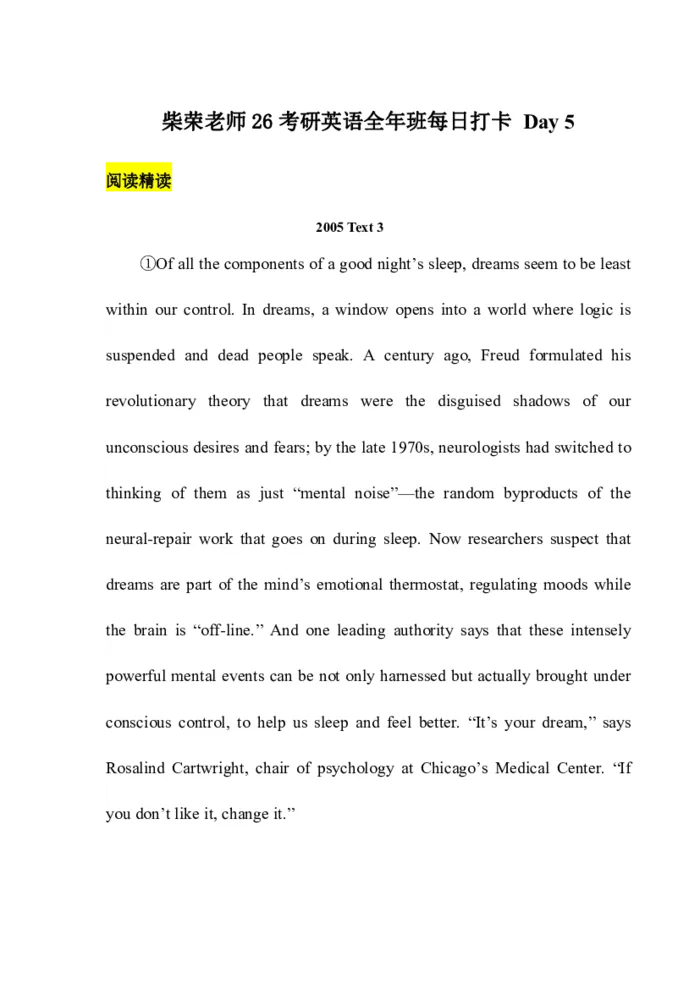
①Of all the components of a good night’s sleep, dreams seem to be least
within our control. In dreams, a window opens into a world where logic is
suspended and dead people speak. A century ago, Freud formulated his
revolutionary theory that dreams were the disguised shadows of our
unconscious desires and fears; by the late 1970s, neurologists had switched to
thinking of them as just “mental noise”—the random byproducts of the
neural-repair work that goes on during sleep. Now researchers suspect that
dreams are part of the mind’s emotional thermostat, regulating moods while
the brain is “off-line.” And one leading authority says that these intensely
powerful mental events can be not only harnessed but actually brought under
conscious control, to help us sleep and feel better. “It’s your dream,” says
Rosalind Cartwright, chair of psychology at Chicago’s Medical Center. “If
you don’t like it, change it.”
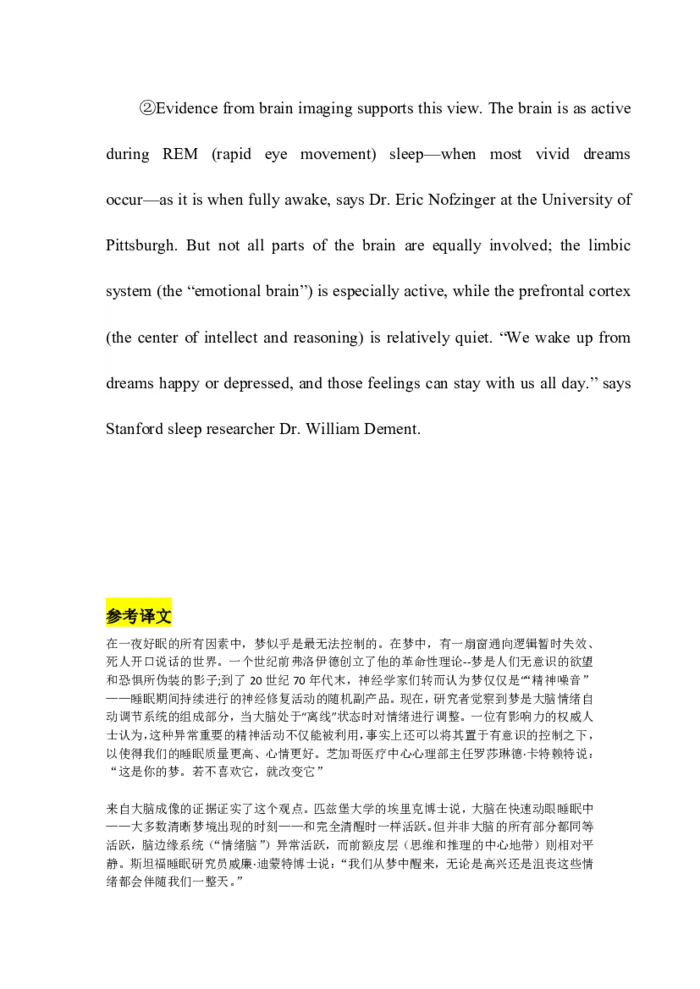
②Evidence from brain imaging supports this view. The brain is as active
during REM (rapid eye
movement) sleep—when most
vivid dreams
occur—as it is when fully awake, says Dr. Eric Nofzinger at the University of
Pittsburgh. But not all parts of the brain are equally involved; the limbic
system (the “emotional brain”) is especially active, while the prefrontal cortex
(the center of intellect and reasoning) is relatively quiet. “We wake up from
dreams happy or depressed, and those feelings can stay with us all day.” says
Stanford sleep researcher Dr. William Dement.
参考译文
在一夜好眠的所有因素中,梦似乎是最无法控制的。在梦中,有一扇窗通向逻辑暂时失效、
死人开口说话的世界。一个世纪前弗洛伊德创立了他的革命性理论--梦是人们无意识的欲望
和恐惧所伪装的影子;到了20 世纪70 年代末,神经学家们转而认为梦仅仅是“ 精神噪音”
——睡眠期间持续进行的神经修复活动的随机副产品。现在,研究者觉察到梦是大脑情绪自
动调节系统的组成部分,当大脑处于“离线”状态时对情绪进行调整。一位有影响力的权威人
士认为,这种异常重要的精神活动不仅能被利用,事实上还可以将其置于有意识的控制之下,
以使得我们的睡眠质量更高、心情更好。芝加哥医疗中心心理部主任罗莎琳德·卡特赖特说:
“这是你的梦。若不喜欢它,就改变它”
来自大脑成像的证据证实了这个观点。匹兹堡大学的埃里克博士说,大脑在快速动眼睡眠中
——大多数清晰梦境出现的时刻——和完全清醒时一样活跃。但并非大脑的所有部分都同等
活跃,脑边缘系统(“情绪脑”)异常活跃,而前额皮层(思维和推理的中心地带)则相对平
静。斯坦福睡眠研究员威廉·迪蒙特博士说:“我们从梦中醒来,无论是高兴还是沮丧这些情
绪都会伴随我们一整天。”
opera
/'ɔpərə/
electricity
/ˌilek'trisəti/
potential
/pəu'tenʃəl/
quilt
/kwilt/
these
/ði:z/
slack
/slæk/
spectrum
/'spektrəm/
serve
/sə:v/
instinct
/'instiŋkt/
unite
/ju:'nait/
sufficient
/sə'fiʃənt/
major
/'meidʒə/
slice
/slais/
satisfactory
/ˌsætis'fæktəri/
kid
/kid/
lunch
/lʌntʃ/
coherent
/kəu'hɪərənt/
thrift
/θrift/
chest
/tʃest/
articulate
/ɑ:'tɪkjuleɪt/
e-mail
/i: meɪl/
brass
/brɑ:s/
acquisition
/ˌækwɪ'zɪʃn/
dial
/'daiəlˌ dail/
eternal
/i'tə:nəl/
historical
/his'tɔrikəl/
lumber
/'lʌmbə/
motion
/'məuʃn/
breed
/bri:d/
organism
/'ɔ:gənizəm/
theirs
/ðεəz/
taste
/teist/
educate
/'edju:keit/
hello
/he'ləu/
accessory
/ək'sesəri/
far
/fɑ:/
dismay
/dis'mei/
evoke
/i'vəuk/
metaphor
/'metəfə/
wit
/wɪt/
story
/'stɔ:ri/
parameter
/pə'ræmitə/
cunning
/'kʌniŋ/
axis
/'æksis/
strive
/straiv/
lamp
/læmp/
envisage
/in'vizidʒ/
第5页,共117页
n.歌剧
n.电,电流;电学
a.潜在的,可能的 n.潜能,潜力
n.被子
pron.&a.[this的复数]这些;这些人(东西)
a.懈怠的,松驰的;萧条的 n.淡季;(pl.)便裤
n.谱,光谱,频谱;范围,幅度,系列
v.服务,尽责;招待,侍候;符合,适用
n.本能,直觉,天性
vi.联合,团结;统一,合并vt.使联合
a.(for)足够的,充分的(比enough拘谨、正式)
a.主要的n.成年人,专业学生,主修课程v.主修
n.薄片,切片;一份;部分切(片)
a.令人满意的,圆满的,良好的,符合要求的
n.小孩,儿童 v.戏弄,取笑
n.午餐,(美)便餐
a.一致的,协调的;(话语等)条理清楚的
n.节约,节俭
n.胸腔,胸膛;箱,柜
a.善于表达的;有关节相连的 v.清楚地讲话
n.(electronic mail)电子信函,电子邮件
n.黄铜,铜器
n.取得,学到,养成(习惯);获得的东西
n.钟(表)面,刻度盘,拨号盘 v.拨号,打电话
n.永久的,永恒的
a.历史的;有关历史的
n.木材,木料
n.运动,动;提议,动议 v.提议,动议
v.(使)繁殖,生殖;产生;教养,抚养 n.品种
n.生物,有机体
pron.[they的物主代词]他(她、它)们的
v.品尝;(of)有…味道;体验 n.滋味;味觉
v.教育,培养,训练
int.英(美)喂,你好(用来打招呼或引起注意)
n.附件,附属品;(为全套衣服增加美感的)服饰
a./ad.远,久远,遥远 ad.到…程度,…得多
n./v.(使)沮丧;(使)惊慌;(使)失望,(使)绝望
vt.唤起(回忆、感情等);引起
n.隐喻,暗喻
n.智力,才智,智慧
n.故事,传说,小说;(=storey)楼层
n.参数,参量
a./n.狡猾(的),狡诈(的)
n.轴,轴线,中心线;坐标轴,基准线
v.奋斗,努力
n.灯
v.想象,设想,展望,正视