柴荣老师B 站26 考研英语全年班
2026
考研英语基础阅读讲义
主讲老师:柴荣
柴荣老师B 站26 考研英语全年班
目录
一、阅读学习规划...................................................1
二、阅读理解大纲...................................................1
三、基础阶段阅读理解技能...................................2
四、阅读历年真题汇总...........................................2
五、精读篇章...........................................................3
六、做题步骤...........................................................3
七、精读要求...........................................................3
八、阅读真题...........................................................4
九、参考答案.........................................................44
柴荣老师B 站26 考研英语全年班
1
基础阅读
一、阅读学习规划:
英语一:2005-2025
英语二:2010-2025
基础阶段(2-5 月)2005-2014
要求:了解大纲;认识题型;逐字逐句精读;分析文章结构
强化阶段(6-8 月)2015-2020
要求:掌握六大题型;熟练做题方法;实践应用
冲刺阶段(9-12 月)2021-2025
要求:限时刷题;总结出题思路;总结错误原因
二、阅读理解大纲:
1.命题形式:
英语一阅读理解由A、B、C 三节组成,考查考生理解书面英语的能力。共
30 小题,每题2 分,共60 分。
A 节(20 小题):考查考生概括主旨要义、理解具体信息,作出判断、推理和引
申等能力。要求考生根据所提供的4 篇文章的内容(总长度为1600~1700 词),
从每题所给的4 个选项中选出最佳选项。
2.选材特点:
考研文章的话题包括科技、经济、教育、社会、历史、文化等,类型包括新闻、
评论、报告、论文、专著等。
实际上,考研阅读理解的文章议论文较多。
常选自以下报刊:
美国:《纽约时报》《大西洋月刊》《基督教科学箴言报》
英国:《经济学人》《卫报》
3.大纲要求:
考生应能读懂多种话题、多种类型的语言较复杂的文字材料。对所读材料,
考生应能:
1)概括主旨要义;
2)理解具体信息;
3)根据上下文推测单词和词组的含义;
4)作出判断、推理和引申;
柴荣老师B 站26 考研英语全年班
2
5)理解作者的意图、观点或态度;
6)理解文章结构和上下文逻辑关系;
7)分析文中使用的修辞手法、论证方法等;
8)比较文中事实、观点、态度等的异同。
三、基础阶段阅读理解技能:
1.原文:
词汇层面
句子层面
篇章层面
2.题干:
六大题型识别:
语义题
细节题
推理题
例证题
态度题
主旨题
四、阅读历年真题汇总
柴荣老师B 站26 考研英语全年班
3
五、精读篇章(40 篇)
2005 Text1 - Text4
2006 Text1 - Text4
2007 Text1 - Text4
2008 Text1 - Text4
2009 Text1 - Text4
2010 Text1 - Text4
2011 Text1 - Text4
2012 Text1 - Text4
2013 Text1 - Text4
2014 Text1 - Text4
六、做题步骤:
七、精读要求:
柴荣老师B 站26 考研英语全年班
4
八、阅读真题
2005 Text 1
Everybody loves a fat pay rise. Yet pleasure at your own can vanish if you learn that a
colleague has been given a bigger one. Indeed, if he has a reputation for slacking, you might
even be outraged. Such behaviour is regarded as “all too human”, with the underlying
assumption that other animals would not be capable of this finely developed sense of
grievance. But a study by Sarah Brosnan and Frans de Waal of Emory University in Atlanta,
Georgia, which has just been published in Nature, suggests that it is all too monkey, as well.
The researchers studied the behaviour of female brown capuchin monkeys. They look
cute. They are good-natured, co-operative creatures, and they share their food readily. Above
all, like their female human counterparts, they tend to pay much closer attention to the value
of “goods and services” than males.
Such characteristics make them perfect candidates for Dr. Brosnan’s and Dr. de Waal’s
study. The researchers spent two years teaching their monkeys to exchange tokens for food.
Normally, the monkeys were happy enough to exchange pieces of rock for slices of cucumber.
However, when two monkeys were placed in separate but adjoining chambers, so that each
could observe what the other was getting in return for its rock, their behaviour became
markedly different.
In the world of capuchins grapes are luxury goods (and much preferable to cucumbers).
So when one monkey was handed a grape in exchange for her token, the second was reluctant
to hand hers over for a mere piece of cucumber. And if one received a grape without having
to provide her token in exchange at all, the other either tossed her own token at the researcher
or out of the chamber, or refused to accept the slice of cucumber. Indeed, the mere presence
of a grape in the other chamber (without an actual monkey to eat it) was enough to induce
resentment in a female capuchin.
The researchers suggest that capuchin monkeys, like humans, are guided by social
emotions. In the wild, they are a co-operative, group-living species. Such co-operation is
likely to be stable only when each animal feels it is not being cheated. Feelings of righteous
indignation, it seems, are not the preserve of people alone. Refusing a lesser reward
柴荣老师B 站26 考研英语全年班
5
completely makes these feelings abundantly clear to other members of the group. However,
whether such a sense of fairness evolved independently in capuchins and humans, or whether
it stems from the common ancestor that the species had 35 million years ago, is, as yet, an
unanswered question.
21.In the opening paragraph, the author introduces his topic by _______.
[A] posing a contrast
[B] justifying an assumption
[C] making a comparison
[D] explaining a phenomenon
22.The statement “it is all too monkey” (Last line, Paragraph 1) implies that _____.
[A] monkeys are also outraged by slack rivals
[B] resenting unfairness is also monkeys’ nature
[C] monkeys, like humans, tend to be jealous of each other
[D] no animals other than monkeys can develop such emotions
23.Female capuchin monkeys were chosen for the research most probably because they
are ______.
[A] more inclined to weigh what they get
[B] attentive to researchers’ instructions
[C] nice in both appearance and temperament
[D] more generous than their male companions
24.Dr. Brosnan and Dr. de Waal have eventually found in their study that the
monkeys ________.
[A] prefer grapes to cucumbers
[B] can be taught to exchange things
[C] will not be co-operative if feeling cheated
[D] are unhappy when separated from others
25.What can we infer from the last paragraph?
[A] Monkeys can be trained to develop social emotions.
[B] Human indignation evolved from an uncertain source.
[C] Animals usually show their feelings openly as humans do.
[D] Cooperation among monkeys remains stable only in the wild.
柴荣老师B 站26 考研英语全年班
6
2005 Text 2
Do you remember all those years when scientists argued that smoking would kill us but
the doubters insisted that we didn’t know for sure? That the evidence was inconclusive, the
science uncertain? That the antismoking lobby was out to destroy our way of life and the
government should stay out of the way? Lots of Americans bought that nonsense, and over
three decades, some 10 million smokers went to early graves.
There are upsetting parallels today, as scientists in one wave after another try to awaken
us to the growing threat of global warming. The latest was a panel from the National
Academy of Sciences, enlisted by the White House, to tell us that the Earth’s atmosphere is
definitely warming and that the problem is largely man-made. The clear message is that we
should get moving to protect ourselves. The president of the National Academy, Bruce
Alberts, added this key point in the preface to the panel’s report: “Science never has all the
answers. But science does provide us with the best available guide to the future, and it is
critical that our nation and the world base important policies on the best judgments that
science can provide concerning the future consequences of present actions.”
Just as on smoking, voices now come from many quarters insisting that the science about
global warming is incomplete, that it’s OK to keep pouring fumes into the air until we know
for sure. This is a dangerous game: by the time 100 percent of the evidence is in, it may be
too late. With the risks obvious and growing, a prudent people would take out an insurance
policy now.
Fortunately, the White House is starting to pay attention. But it’s obvious that a majority
of the president’s advisers still don’t take global warming seriously. Instead of a plan of
action, they continue to press for more research—a classic case of “paralysis by analysis”.
To serve as responsible stewards of the planet, we must press forward on deeper
atmospheric and oceanic research. But research alone is inadequate. If the Administration
won’t take the legislative initiative, Congress should help to begin fashioning conservation
measures. A bill by Democratic Senator Robert Byrd of West Virginia, which would offer
financial incentives for private industry, is a promising start. Many see that the country is
getting ready to build lots of new power plants to meet our energy needs. If we are ever going
柴荣老师B 站26 考研英语全年班
7
to protect the atmosphere, it is crucial that those new plants be environmentally sound.
26. An argument made by supporters of smoking was that _______.
[A] there was no scientific evidence of the correlation between smoking and death
[B] the number of early deaths of smokers in the past decades was insignificant
[C] people had the freedom to choose their own way of life
[D] antismoking people were usually talking nonsense
27. According to Bruce Alberts, science can serve as ________.
[A] a protector
[B] a judge
[C] a critic
[D] a guide
28. What does the author mean by “paralysis by analysis” (Last line, Paragraph 4)?
[A] Endless studies kill action
[B] Careful investigation reveals truth
[C] Prudent planning hinders progress
[D] Extensive research helps decision-making
29. According to the author, what should the Administration do about global warming?
[A] Offer aid to build cleaner power plants
[B] Raise public awareness of conservation
[C] Press for further scientific research
[D] Take some legislative measures
30. The author associates the issue of global warming with that of smoking because ___.
[A] they both suffered from the government’s negligence
[B] a lesson from the latter is applicable to the former
[C] the outcome of the latter aggravates the former
[D] both of them have turned from bad to worse
柴荣老师B 站26 考研英语全年班
8
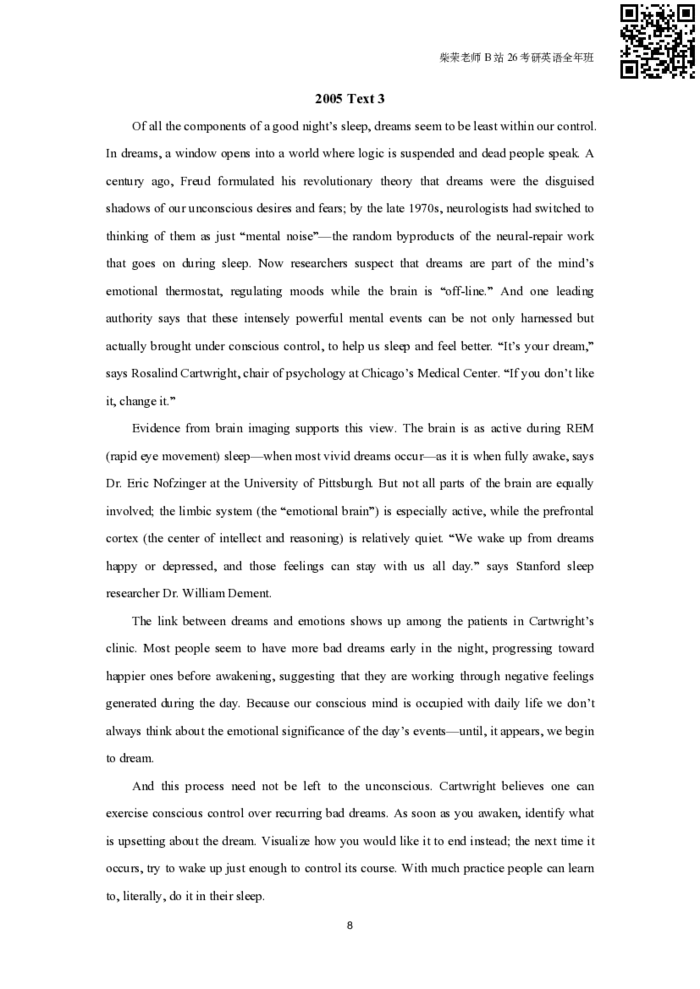
2005 Text 3
Of all the components of a good night’s sleep, dreams seem to be least within our control.
In dreams, a window opens into a world where logic is suspended and dead people speak. A
century ago, Freud formulated his revolutionary theory that dreams were the disguised
shadows of our unconscious desires and fears; by the late 1970s, neurologists had switched to
thinking of them as just “mental noise”—the random byproducts of the neural-repair work
that goes on during sleep. Now researchers suspect that dreams are part of the mind’s
emotional thermostat, regulating moods while the brain is “off-line.” And one leading
authority says that these intensely powerful mental events can be not only harnessed but
actually brought under conscious control, to help us sleep and feel better. “It’s your dream,”
says Rosalind Cartwright, chair of psychology at Chicago’s Medical Center. “If you don’t like
it, change it.”
Evidence from brain imaging supports this view. The brain is as active during REM
(rapid eye movement) sleep—when most vivid dreams occur—as it is when fully awake, says
Dr. Eric Nofzinger at the University of Pittsburgh. But not all parts of the brain are equally
involved; the limbic system (the “emotional brain”) is especially active, while the prefrontal
cortex (the center of intellect and reasoning) is relatively quiet. “We wake up from dreams
happy or depressed, and those feelings can stay with us all day.” says Stanford sleep
researcher Dr. William Dement.
The link between dreams and emotions shows up among the patients in Cartwright’s
clinic. Most people seem to have more bad dreams early in the night, progressing toward
happier ones before awakening, suggesting that they are working through negative feelings
generated during the day. Because our conscious mind is occupied with daily life we don’t
always think about the emotional significance of the day’s events—until, it appears, we begin
to dream.
And this process need not be left to the unconscious. Cartwright believes one can
exercise conscious control over recurring bad dreams. As soon as you awaken, identify what
is upsetting about the dream. Visualize how you would like it to end instead; the next time it
occurs, try to wake up just enough to control its course. With much practice people can learn
to, literally, do it in their sleep.
柴荣老师B 站26 考研英语全年班
9
At the end of the day, there’s probably little reason to pay attention to our dreams at all
unless they keep us from sleeping or “we wake up in a panic,” Cartwright says. Terrorism,
economic uncertainties and general feelings of insecurity have increased people’s anxiety.
Those suffering from persistent nightmares should seek help from a therapist. For the rest of
us, the brain has its ways of working through bad feelings. Sleep—or rather dream—on it and
you’ll feel better in the morning.
31. Researchers have come to believe that dreams ________.
[A] can be modified in their courses
[B] are susceptible to emotional changes
[C] reflect our innermost desires and fears
[D] are a random outcome of neural repairs
32. By referring to the limbic system, the author intends to show _____.
[A] its function in our dreams
[B] the mechanism of REM sleep
[C] the relation of dreams to emotions
[D] its difference from the prefrontal cortex
33. The negative feelings generated during the day tend to ________.
[A] aggravate in our unconscious mind
[B] develop into happy dreams
[C] persist till the time we fall asleep
[D] show up in dreams early at night
34. Cartwright seems to suggest that ________.
[A] waking up in time is essential to the ridding of bad dreams
[B] visualizing bad dreams helps bring them under control
[C] dreams should be left to their natural progression
[D] dreaming may not entirely belong to the unconscious
35. What advice might Cartwright give to those who sometimes have bad dreams?
[A] Lead your life as usual
[B] Seek professional help
[C] Exercise conscious control
[D] Avoid anxiety in the daytime
柴荣老师B 站26 考研英语全年班
10
2005 Text 4
Americans no longer expect public figures, whether in speech or in writing, to command the
English language with skill and gift. Nor do they aspire to such command themselves. In his latest
book, Doing Our Own Thing: The Degradation of language and Music and Why We Should Like,
Care, John McWhorter, a linguist and controversialist of mixed liberal and conservative views,
sees the triumph of 1960s counter-culture as responsible for the decline of formal English.
Blaming the permissive 1960s is nothing new, but this is not yet another criticism against the
decline in education. Mr. McWhorter’s academic speciality is language history and change, and he
sees the gradual disappearance of “whom”, for example, to be natural and no more regrettable than
the loss of the case-endings of Old English.
But the cult of the authentic and the personal, “doing our own thing”, has spelt the death of
formal speech, writing, poetry and music. While even the modestly educated sought an elevated
tone when they put pen to paper before the 1960s, even the most well regarded writing since then
has sought to capture spoken English on the page. Equally, in poetry, the highly personal,
performative genre is the only form that could claim real liveliness. In both oral and written
English, talking is triumphing over speaking, spontaneity over craft.
Illustrated with an entertaining array of examples from both high and low culture, the trend
that Mr. McWhorter documents is unmistakable. But it is less clear, to take the question of his
subtitle, why we should, like, care. As a linguist, he acknowledges that all varieties of human
language, including non-standard ones like Black English, can be powerfully expressive—there
exists no language or dialect in the world that cannot convey complex ideas. He is not arguing, as
many do, that we can no longer think straight because we do not talk proper.
Russians have a deep love for their own language and carry large chunks of memorized poetry
in their heads, while Italian politicians tend to elaborate speech that would seem old-fashioned to
most English-speakers. Mr. McWhorter acknowledges that formal language is not strictly
necessary, and proposes no radical education reforms—he is really grieving over the loss of
something beautiful more than useful. We now take our English “on paper plates instead of china”.
A shame, perhaps, but probably an inevitable one.
柴荣老师B 站26 考研英语全年班
11
36. According to McWhorter, the decline of formal English _______.
[A] is inevitable in radical education reforms
[B] is but all too natural in language development
[C] has caused the controversy over the counter-culture
[D] brought about changes in public attitudes in the 1960s
37. The word “talking” (Line 6, Paragraph 3) denotes ________.
[A] modesty
[B] personality
[C] liveliness
[D] informality
38. To which of the following statements would McWhorter most likely agree?
[A] Logical thinking is not necessarily related to the way we talk.
[B] Black English can be more expressive than standard English.
[C] Non-standard varieties of human language are just as entertaining.
[D] Of all the varieties, standard English can best convey complex ideas.
39. The description of Russians’ love of memorizing poetry shows the author’s ______.
[A] interest in their language
[B] appreciation of their efforts
[C] admiration for their memory
[D] contempt for their old-fashionedness
40. According to the last paragraph, “paper plates” is to “china” as ________.
[A] “temporary” is to “permanent”
[B] “radical” is to “conservative”
[C] “functional” is to “artistic”
[D] “humble” is to “noble”
柴荣老师B 站26 考研英语全年班
12
2006 Text 1
In spite of “endless talk of difference,” American society is an amazing machine
for homogenizing people. There is “the democratizing uniformity of dress and discourse, and
the casualness and absence of deference” characteristic of popular culture. People are
absorbed into “a culture of consumption” launched by the 19th-century department stores that
offered “vast arrays of goods in an elegant atmosphere. Instead of intimate shops catering to a
knowledgeable elite” these were stores “anyone could enter, regardless of class or background.
This turned shopping into a public and democratic act.” The mass media, advertising and
sports are other forces for homogenization.
Immigrants are quickly fitting into this common culture, which may not be altogether
elevating but is hardly poisonous. Writing for the National Immigration Forum, Gregory
Rodriguez reports that today’s immigration is neither at unprecedented levels nor resistant to
assimilation. In 1998 immigrants were 9.8 percent of the population; in 1900, 13.6 percent. In
the 10 years prior to 1990, 3.1 immigrants arrived for every 1,000 residents; in the 10 years
prior to 1890, 9.2 for every 1,000. Now, consider three indices of assimilation—language,
home ownership and intermarriage.
The 1990 Census revealed that “a majority of immigrants from each of the fifteen most
common countries of origin spoke English ‘well’ or ‘very well’ after ten years of residence.”
The children of immigrants tend to be bilingual and proficient in English. “By the third
generation, the original language is lost in the majority of immigrant families.” Hence the
description of America as a “graveyard” for languages. By 1996 foreign-born immigrants
who had arrived before 1970 had a home ownership rate of 75.6 percent, higher than the 69.8
percent rate among native-born Americans.
Foreign-born Asians and Hispanics “have higher rates of intermarriage than do
U.S.-born whites and blacks.” By the third generation, one third of Hispanic women are
married to non-Hispanics, and 41 percent of Asian-American women are married to
non-Asians.
Rodriguez notes that children in remote villages around the world are fans of superstars
like Arnold Schwarzenegger and Garth Brooks, yet “some Americans fear that immigrants
living within the United States remain somehow immune to the nation’s assimilative power.”
柴荣老师B 站26 考研英语全年班
13
Are there divisive issues and pockets of seething anger in America? Indeed. It is big
enough to have a bit of everything. But particularly when viewed against America’s turbulent
past, today’s social indices hardly suggest a dark and deteriorating social environment.
21. The word “homogenizing” (Line 2, Paragraph 1) most probably means ________.
[A] identifying
[B] associating
[C] assimilating
[D] monopolizing
22. According to the author, the department stores of the 19th century ________.
[A] played a role in the spread of popular culture
[B] became intimate shops for common consumers
[C] satisfied the needs of a knowledgeable elite
[D] owed its emergence to the culture of consumption
23. The text suggests that immigrants now in the U.S. ________.
[A] are resistant to homogenization
[B] exert a great influence on American culture
[C] are hardly a threat to the common culture
[D] constitute the majority of the population
24. Why are Arnold Schwarzenegger and Garth Brooks mentioned in Paragraph 5?
[A] To prove their popularity around the world
[B] To reveal the public’s fear of immigrants
[C] To give examples of successful immigrants
[D] To show the powerful influence of American culture
25. In the author’s opinion, the absorption of immigrants into American society is ____.
[A] rewarding
[B] successful
[C] fruitless
[D] harmful
柴荣老师B 站26 考研英语全年班
14
2006 Text 2
Stratford-on-Avon, as we all know, has only one industry --William Shakespeare -- but
there are two distinctly separate and increasingly hostile branches. There is the Royal
Shakespeare Company (RSC), which presents superb productions of the plays at the
Shakespeare Memorial Theatre on the Avon. And there are the townsfolk who largely live
off the tourists who come, not to see the plays, but to look at Anne Hathaway’s Cottage,
Shakespeare’s birthplace and the othersights.
The worthy residents of Stratford doubt that the theater adds a penny to their revenue.
They frankly dislike the RSC’s actors, them with their long hair and beards and sandals and
noisiness. It’s all deliciously ironic when you consider that Shakespeare, who earns their
living, was himself an actor (with a beard) and did his share of noise-making.
The tourist streams are not entirely separate. The sightseers who come by bus -- and
often take in Warwick Castle and Blenheim Palace on the side -- don’t usually see the plays,
and some of them are even surprised to find a theatre in Stratford. However, the playgoers
do manage a little sight-seeing along with their playgoing. It is the playgoers, the RSC
contends, who bring in much of the town’s revenue because they spend the night (some of
them four or five nights) pouring cash into the hotels and restaurants. The sightseers can
take in everything and get out of town by nightfall.
The townsfolk don’t see it this way and the local council does not contribute directly to
the subsidy of the Royal Shakespeare Company. Stratford cries poor traditionally.
Nevertheless every hotel in town seems to be adding a new wing or cocktail lounge. Hilton
is building its own hotel there, which you may be sure will be decorated with Hamlet
Hamburger Bars, the Lear Lounge, the Banquo Banqueting Room, and so forth, and will be
very expensive.
Anyway, the townsfolk can’t understand why the Royal Shakespeare Company needs a
subsidy. (The theatre has broken attendance records for three years in a row. Last year its
1,431 seats were 94 per cent occupied all year long and this year they’ll do better.) The
reason, of course, is that costs have rocketed and ticket prices have stayed low.
It would be a shame to raise prices too much because it would drive away the young
people who are Stratford’s most attractive clientele. They come entirely for the plays, not
柴荣老师B 站26 考研英语全年班
15
the sights. They all seem to look alike (though they come from all over) — lean, pointed,
dedicated faces, wearing jeans and sandals, eating their buns and bedding down for the
night on the flagstones outside the theatre to buy the 20 seats and 80 standing-room tickets
held for the sleepers and sold to them when the box office opens at 10:30 a.m.
26. From the first two paragraphs, we learn that______.
[A] the townsfolk deny the RSC’s contribution to the town’s revenue.
[B] the actors of the RSC imitate Shakespeare on and off stage.
[C] the two branches of the RSC are not on good terms.
[D] the townsfolk earn little from tourism.
27. It can be inferred from Paragraph 3 that_______.
[A] the sightseers cannot visit the Castle and the Palace separately.
[B] the playgoers spend more money than the sightseers.
[C] the sightseers do more shopping than the playgoers.
[D] the playgoers go to no other places in town than the theater.
28.By saying “Stratford cries poor traditionally” (Line 2, Paragraph 4), the author
implies that_______.
[A] Stratford cannot afford the expansion projects.
[B] Stratford has long been in financial difficulties.
[C] the town is not really short of money.
[D] the townsfolk used to be poorly paid.
29.According to the townsfolk, the RSC deserves no subsidy because_______.
[A] ticket prices can be raised to cover the spending.
[B] the company is financially ill-managed.
[C] the behavior of the actors is not socially acceptable.
[D] the theatre attendance is on the rise.
30.From the text we can conclude that the author______.
[A] is supportive of both sides.
[B] favors the townsfolk’s view.
[C] takes a detached attitude.
[D] is sympathetic to the RSC.
柴荣老师B 站26 考研英语全年班
16
2006 Text 3
When prehistoric man arrived in new parts of the world, something strange happened to
the large animals: they suddenly became extinct. Smaller species survived. The large,
slow-growing animals were easy game, and were quickly hunted to extinction. Now
something similar could be happening in the oceans.
That the seas are being overfished has been known for years. What researchers such as
Ransom Myers and Boris Worm have shown is just how fast things are changing. They have
looked at half a century of data from fisheries around the world. Their methods do not attempt
to estimate the actual biomass (the amount of living biological matter) of fish species in
particular parts of the ocean, but rather changes in that biomass over time.According to their
latest paper published in Nature, the biomass of large predators (animals that kill and eat
other animals) in a new fishery is reduced on average by 80% within 15 years of the start of
exploitation. In some long-fished areas, it has halved again since then.
Dr.Worm acknowledges that these figures are conservative. One reason for this is that
fishing technology has improved. Today’s vessels can find their prey using satellites and
sonar, which were not available 50 years ago. That means a higher proportion of what is in
the sea is being caught, so the real difference between present and past is likely to be worse
than the one recorded by changes in catch sizes. In the early days, too, longlines would have
been more saturated with fish. Some individuals would therefore not have been caught, since
no baited hooks would have been available to trap them, leading to an underestimate of fish
stocks in the past.Furthermore, in the early days of longline fishing, a lot of fish were lost to
sharks after they had been hooked.That is no longer a problem, because there are fewer sharks
around now.
Dr.Myers and Dr.Worm argue that their work gives a correct baseline, which future
management efforts must take into account. They believe the data support an idea current
among marine biologists, that of the“shifting baseline”. The notion is that people have failed
to detect the massive changes which have happened in the ocean because they have been
looking back only a relatively short time into the past. That matters because theory suggests
that the maximum sustainable yield that can be cropped from a fishery comes when the
biomass of a target species is about 50% of its original levels. Most fisheries are well below
柴荣老师B 站26 考研英语全年班
17
that, which is a bad way to do business.
31.The extinction of large prehistoric animals is noted to suggest that _______.
[A] large animals were vulnerable to the changing environment
[B] small species survived as large animals disappeared
[C] large sea animals may face the same threat today
[D] slow-growing fish outlive fast-growing ones
32.We can infer from Dr. Myers and Dr. Worm’s paper that _______.
[A] the stock of large predators in some old fisheries has reduced by 90%
[B] there are only half as many fisheries as there were 15 years ago
[C] the catch sizes in new fisheries are only 20% of the original amount
[D] the number of large predators dropped faster in new fisheries than in the old
33.By saying “these figures are conservative” (Line 1, paragraph 3), Dr. Worm means
that_______.
[A] fishing technology has improved rapidly
[B] then catch-sizes are actually smaller thanrecorded
[C] the marine biomass has suffered a greater loss
[D] the data collected so far are out of date
34.Dr. Myers and other researchers hold that ________.
[A] people should look for a baseline that can work for a longer time
[B] fisheries should keep their yields below 50% of the biomass
[C] the ocean biomass should be restored to its original level
[D] people should adjust the fishing baseline to the changing situation
35.The author seems to be mainly concerned with most fisheries’ ______.
[A] management efficiency
[B] biomass level
[C] catch-size limits
[D] technological application
柴荣老师B 站26 考研英语全年班
18
2006 Text 4
Many things make people think artists are weird. But the weirdest may be this: artists’
only job is to explore emotions, and yet they choose to focus on the ones that feel bad.
This wasn’t always so. The earliest forms of art, like painting and music, are those best
suited for expressing joy. But somewhere from the 19th century onward, more artists began
seeing happiness as meaningless, phony or, worst of all, boring, as we went from
Wordsworth’s daffodils to Baudelaire’s flowers of evil.
You could argue that art became more skeptical of happiness because modern times
have seen so much misery. But it’s not as if earlier times didn’t know perpetual war,
disaster and the massacre of innocents. The reason, in fact, may be just the opposite: there is
too much damn happiness in the world today.
After all, what is the one modern form of expression almost completely dedicated to
depicting happiness? Advertising. The rise of anti-happy art almost exactly tracks the
emergence of mass media, and with it, a commercial culture in which happiness is not just
an ideal but an ideology.
People in earlier eras were surrounded by reminders of misery. They worked until
exhausted, lived with few protections and died young. In the West, before mass
communication and literacy, the most powerful mass medium was the church, which
reminded worshippers that their souls were in danger and that they would someday be meat
for worms. Given all this, they did not exactly need their art to be a bummer too.
Today the messages the average Westerner is surrounded with are not religious but
commercial, and forever happy. Fast-food eaters, news anchors, text messengers, all smiling,
smiling, smiling. Our magazines feature beaming celebrities and happy families in perfect
homes. And since these messages have an agenda—to lure us to open our wallets—they
make the very idea of happiness seem unreliable. “Celebrate!” commanded the ads for the
arthritis drug Celebrex, before we found out it could increase the risk of heart attacks.
But what we forget—what our economy depends on us forgetting—is that happiness is
more than pleasure without pain. The things that bring the greatest joy carry the greatest
potential for loss and disappointment. Today, surrounded by promises of easy happiness, we
need art to tell us, as religion once did, Memento mori: remember that you will die, that
柴荣老师B 站26 考研英语全年班
19
everything ends, and that happiness comes not in denying this but in living with it. It’s a
message even more bitter than a clove cigarette, yet, somehow, a breath of fresh air.
36. By citing the examples of poets Wordsworth and Baudelaire, the author intends to
show that ________.
[A] poetry is not as expressive of joy as painting or music
[B] art grows out of both positive and negative feelings
[C] poets today are less skeptical of happiness
[D] artists have changed their focus of interest
37. The word “bummer” (Line 5, paragraph 5) most probably means something _____.
[A] religious
[B] unpleasant
[C] entertaining
[D] commercial
38. In the author’s opinion, advertising ________.
[A] emerges in the wake of the anti-happy art
[B] is a cause of disappointment for the general public
[C] replace the church as a major source of information
[D] creates an illusion of happiness rather than happiness itself
39. We can learn from the last paragraph that the author believes ________.
[A] happiness more often than not ends in sadness
[B] the anti-happy art is distasteful but refreshing
[C] misery should be enjoyed rather than denied
[D] the anti-happy art flourishes when economy booms
40. Which of the following is true of the text?
[A] Religion once functioned as a reminder of misery.
[B] Art provides a balance between expectation and reality.
[C] People feel disappointed at the realities of modern society.
[D] Mass media are inclined to cover disasters and deaths.
柴荣老师B 站26 考研英语全年班
20
2007 Text 1
If you were to examine the birth certificates of every soccer player in 2006’s World
Cup tournament, you would most likely find a noteworthy quirk: elite soccer players are
more likely to have been born in the earlier months of the year than in the late months. If
you then examined the European national youth teams that feed the World Cup and
professional ranks, you would find this strange phenomenon to be ever more pronounced.
What might account for this strange phenomenon? Here are a few guesses: a) certain
astrological signs confer superior soccer skills; b) winter-born babies tend to have higher
oxygen capacity, which increases soccer stamina; c) soccer-mad parents are more likely to
conceive children in springtime, at the annual peak of soccer mania; d) none of the above.
Anders Ericsson, a 58-year-old psychology professor at Florida State University, says
he believes strongly in “none of the above.” Ericsson grew up in Sweden, and studied
nuclear engineering until he realized he would have more opportunity to conduct his own
research if he switched to psychology. His first experiment, nearly 30 years ago, involved
memory: training a person to hear and then repeat a random series of numbers. “With the
first subject, after about 20 hours of training, his digit span had risen from 7 to 20,”
Ericsson recalls. “He kept improving, and after about 200 hours of training he had risen to
over 80 numbers.”
This success, coupled with later research showing that memory itself is not genetically
determined, led Ericsson to conclude that the act of memorizing is more of a cognitive
exercise than an intuitive one. In other words, whatever inborn differences two people may
exhibit in their abilities to memorize, those differences are swamped by how well each
person “encodes” the information. And the best way to learn how to encode information
meaningfully, Ericsson determined, was a process known as deliberate practice. Deliberate
practice entails more than simply repeating a task. Rather, it involves setting specific goals,
obtaining immediate feedback and concentrating as much on technique as on outcome.
Ericsson and his colleagues have thus taken to studying expert performers in a wide
range of pursuits, including soccer. They gather all the data they can, not just performance
statistics and biographical details but also the results of their own laboratory experiments
with high achievers. Their work makes a rather startling assertion: the trait we commonly
柴荣老师B 站26 考研英语全年班
21
call talent is highly overrated. Or, put another way, expert performers—whether in memory
or surgery, ballet or computer programming—are nearly always made, not born.
21. The birthday phenomenon found among soccer players is mentioned to________.
[A] stress the importance of professional training.
[B] spotlight the soccer superstars at the World Cup.
[C] introduce the topic of what makes expert performance.
[D] explain why some soccer teams play better than others.
22. The word “mania” (Line 4, Paragraph 2) most probably means_______.
[A] fun
[B] craze
[C] hysteria
[D] excitement
23. According to Ericsson, good memory_______.
[A] depends on meaningful processing of information.
[B] results from intuitive rather than cognitive exercises.
[C] is determined by genetic rather than psychological factors.
[D] requires immediate feedback and a high degree of concentration.
24. Ericsson and his colleagues believe that_______.
[A] talent is a dominating factor for professional success.
[B] biographical data provide the key to excellent performance.
[C] the role of talent tends to be overlooked.
[D] high achievers owe their success mostly to nurture.
25. Which of the following proverbs is closest to the message the text tries to convey?
[A] “Faith will move mountains.”
[B] “One reaps what one sows.”
[C] “Practice makes perfect.”
[D] “Like father, like son.”
柴荣老师B 站26 考研英语全年班
22
2007 Text 2
For the past several years, the Sunday newspaper supplement Parade has featured a
column called “Ask Marilyn.” People are invited to query Marilyn vos Savant, who at age
10 had tested at a mental level of someone about 23 years old; that gave her an IQ of
228—the highest score ever recorded. IQ tests ask you to complete verbal and visual
analogies, to envision paper after it has been folded and cut, and to deduce numerical
sequences, among other similar tasks. So it is a bit confusing when vos Savant fields such
queries from the average Joe (whose IQ is 100) as, What’s the difference between love and
fondness? Or what is the nature of luck and coincidence? It’s not obvious how the capacity
to visualize objects and to figure out numerical patterns suits one to answer questions that
have eluded some of the best poets and philosophers.
Clearly, intelligence encompasses more than a score on a test. Just what does it mean
to be smart? How much of intelligence can be specified, and how much can we learn about
it from neurology, genetics, computer science and other fields?
The defining term of intelligence in humans still seems to be the IQ score, even though
IQ tests are not given as often as they used to be. The test comes primarily in two forms: the
Stanford-Binet Intelligence Scale and the Wechsler Intelligence Scales (both come in adult
and children’s version). Generally costing several hundred dollars, they are usually given
only by psychologists, although variations of them populate bookstores and the World Wide
Web. Superhigh scores like vos Savant’s are no longer possible, because scoring is now
based on a statistical population distribution among age peers, rather than simply dividing
the mental age by the chronological age and multiplying by 100. Other standardized tests,
such as the Scholastic Assessment Test (SAT) and the Graduate Record Exam (GRE),
capture the main aspects of IQ tests.
Such standardized tests may not assess all the important elements necessary to succeed
in school and in life, argues Robert J. Sternberg. In his article “How Intelligent Is
Intelligence Testing?”, Sternberg notes that traditional tests best assess analytical and verbal
skills but fail to measure creativity and practical knowledge, components also critical to
problem solving and life success. Moreover, IQ tests do not necessarily predict so well once
populations or situations change. Research has found that IQ predicted leadership skills
柴荣老师B 站26 考研英语全年班
23
when the tests were given under low-stress conditions, but under high-stress conditions, IQ
was negatively correlated with leadership—that is, it predicted the opposite. Anyone who
has toiled through SAT will testify that test-taking skill also matters, whether it’s knowing
when to guess or what questions to skip.
26.Which of the following may be required in an intelligence test?
[A] Answering philosophical questions.
[B] Folding or cutting paper into different shapes.
[C] Telling the differences between certain concepts.
[D] Choosing words or graphs similar to the given ones.
27.What can be inferred about intelligence testing from Paragraph3?
[A] People no longer use IQ scores as an indicator of intelligence.
[B] More versions of IQ tests are now available on the Internet.
[C] The test contents and formats for adults and children may be different.
[D] Scientists have defined the important elements of human intelligence.
28.People nowadays can no longer achieve IQ scores as high as vos Savant’s
because________.
[A] the scores are obtained through different computational procedures.
[B] creativity rather than analytical skills is emphasized now.
[C] vos Savant’s case is an extreme one that will not repeat.
[D] the defining characteristic of IQ tests has changed.
29.We can conclude from the last paragraph that_________.
[A] test scores may not be reliable indicators of one’s ability.
[B] IQ scores and SAT results are highly correlated.
[C] testing involves a lot of guesswork.
[D] traditional tests are out of date.
30.What is the author’s attitude towards IQ tests?
[A] supportive
[B] skeptical
[C] impartial
[D] biased
柴荣老师B 站26 考研英语全年班
24
2007 Text 3
During the past generation, the American middle-class family that once could count on
hard work and fair play to keep itself financially secure has been transformed by economic
risk and new realities. Now a pink slip, a bad diagnosis, or a disappearing spouse can reduce a
family from solidly middle class to newly poor in a few months.
In just one generation, millions of mothers have gone to work,transforming basic family
economics. Scholars, policymakers, and critics of all stripes have debated the social
implications of these changes, but few have looked at the side effect: family risk has risen as
well. Today’s families have budgeted to the limits of theirs new two-paycheck status. As a
result, they have lost the parachute they once had in times of financial setback—a back-up
earner (usually Mom) who could go into the workforce if the primary earner got laid off or
fell sick. This “added-worker effect” could support the safety net offered by unemployment
insurance or disability insurance to help families weather bad times. But today, a disruption to
family fortunes can no longer be made up with extra income from an otherwise-stay-at-home
partner.
During the same period, families have been asked to absorb much more risk in their
retirement income. Steelworkers, airline employees, and now those in the auto industry are
joining millions of families who must worry about interest rates, stock market fluctuation, and
the harsh reality that they may outlive their retirement money. For much of the past year,
President Bush campaigned to move Social Security to a savings-account model, with retirees
trading much or all of their guaranteed payments for payments depending on investment
returns. For younger families, the picture is not any better. Both the absolute cost of
healthcare and the share of it borne by families have risen—and newly fashionable
health-savings plans are spreading from legislative halls to Wal-Mart workers, with much
higher deductibles and a large new dose of investment risk for families’ future healthcare.
Even demographics are working against the middle class family, as the odds of having a weak
elderly parent—and all the attendant need for physical and financial assistance—have jumped
eightfold in just one generation.
From the middle-class family perspective, much of this, understandably, looks far less
like an opportunity to exercise more financial responsibility, and a good deal more like a
柴荣老师B 站26 考研英语全年班
25
frightening acceleration of the wholesale shift of financial risk onto their already
overburdened shoulders. The financial fallout has begun, and the political fallout may not be
far behind.
31. Today’s double-income families are at greater financial risk in that_______.
[A] the safety net they used to enjoy has disappeared.
[B] their chances of being laid off have greatly increased.
[C] they are more vulnerable to changes in family economics.
[D] they are deprived of unemployment or disability insurance.
32. As a result of President Bush’s reform, retired people may have________.
[A] a higher sense of security.
[B] less secured payments.
[C] less chance to invest.
[D] a guaranteed future.
33. According to the author, health-savings plans will________.
[A] help reduce the cost of healthcare.
[B] popularize among the middle class.
[C] compensate for the reduced pensions.
[D] increase the families’ investment risk.
34. It can be inferred from the last paragraph that________.
[A] financial risks tend to outweigh political risks.
[B] the middle class may face greater political challenges.
[C] financial problems may bring about political problems.
[D] financial responsibility is an indicator of political status.
35. Which of the following is the best title for this text?
[A] The Middle Class on the Alert
[B] The Middle Class on the Cliff
[C] The Middle Class in Conflict
[D] The Middle Class in Ruins
柴荣老师B 站26 考研英语全年班
26
2007 Text 4
It never rains but it pours. Just as bosses and boards have finally sorted out their worst
accounting and compliance troubles, and improved their feeble corporation governance, a
new problem threatens to earn them—especially in America—the sort of nasty headlines that
inevitably lead to heads rolling in the executive suite: data insecurity. Left, until now, to odd,
low-level IT staff to put right, and seen as a concern only of data-rich industries such as
banking, telecoms and air travel, information protection is now high on the boss’s agenda in
businesses of every variety.
Several massive leakages of customer and employee data this year—from organizations
as diverse as Time Warner, the American defense contractor Science Applications
International Corp and even the University of California, Berkeley—have left managers
hurriedly peering into their intricate IT systems and business processes in search of potential
vulnerabilities.
“Data is becoming an asset which needs to be guarded as much as any other asset,” says
Haim Mendelson of Stanford University’s business school. “The ability to guard customer
data is the key to market value, which the board is responsible for on behalf of shareholders”.
Indeed, just as there is the concept of Generally Accepted Accounting Principles (GAAP),
perhaps it is time for GASP, Generally Accepted Security Practices, suggested Eli Noam of
New York’s Columbia Business School. “Setting the proper investment level for security,
redundancy, and recovery is a management issue, not a technical one,” he says.
The mystery is that this should come as a surprise to any boss. Surely it should be
obvious to the dimmest executive that trust, that most valuable of economic assets, is easily
destroyed and hugely expensive to restore—and that few things are more likely to destroy
trust than a company letting sensitive personal data get into the wrong hands.
The current state of affairs may have been encouraged—though not justified—by the
lack of legal penalty (in America, but not Europe) for data leakage. Until California recently
passed a law, American firms did not have to tell anyone, even the victim, when data went
astray. That may change fast: lots of proposed data-security legislation is now doing the
rounds in Washington, D.C. Meanwhile, the theft of information about some 40 million
credit-card accounts in America, disclosed on June 17th, overshadowed a hugely important
柴荣老师B 站26 考研英语全年班
27
decision a day earlier by America’s Federal Trade Commission (FTC) that puts corporate
America on notice that regulators will act if firms fail to provide adequate data security.
36.The statement “It never rains but it pours” is used to introduce________.
[A] the fierce business competition.
[B] the feeble boss-board relations.
[C] the threat from news reports.
[D] the severity of data leakage.
37.According to Paragraph 2, some organizations check their systems to find out
.
[A] whether there is any weak point.
[B] what sort of data has been stolen.
[C] who is responsible for the leakage.
[D] how the potential spies can be located.
38.In bringing up the concept of GASP the author is making the point that________.
[A] shareholders’ interests should be properly attended to.
[B] information protection should be given due attention.
[C] businesses should enhance their level of accounting security.
[D] the market value of customer data should be emphasized.
39.According to Paragraph 4, what puzzles the author is that some bosses fail to
.
[A] see the link between trust and data protection.
[B] perceive the sensitivity of personal data.
[C] realize the high cost of data restoration.
[D] appreciate the economic value of trust.
40.It can be inferred from Paragraph 5 that_________.
[A] data leakage is more severe in Europe.
[B] FTC’s decision is essential to data security.
[C] California takes the lead in security legislation.
[D] legal penalty is a major solution to data leakage.
柴荣老师B 站26 考研英语全年班
28
2008 Text 1
While still catching-up to men in some spheres of modern life, women appear to be way
ahead in at least one undesirable category. “Women are particularly susceptible to developing
depression and anxiety disorders in response to stress compared to men,” according to Dr.
Yehuda, chief psychiatrist at New York’s Veteran’s Administration Hospital.
Studies of both animals and humans have shown that sex hormones somehow affect the
stress response, causing females under stress to produce more of the trigger chemicals than do
males under the same conditions. In several of the studies, when stressed-out female rats had
their ovaries (the female reproductive organs) removed, their chemical responses became
equal to those of the males.
Adding to a woman’s increased dose of stress chemicals, are her increased
“opportunities” for stress. “It’s not necessarily that women don’t cope as well. It’s just that
they have so much more to cope with,” says Dr. Yehuda. “Their capacity for tolerating stress
may even be greater than men’s,” she observes, “it’s just that they’re dealing with so many
more things that they become worn out from it more visibly and sooner.”
Dr. Yehuda notes another difference between the sexes. “I think that the kinds of things
that women are exposed to tend to be in more of a chronic or repeated nature. Men go to war
and are exposed to combat stress. Men are exposed to more acts of random physical violence.
The kinds of interpersonal violence that women are exposed to tend to be in domestic
situations, by, unfortunately, parents or other family members, and they tend not to be
one-shot deals. The wear-and-tear that comes from these longer relationships can be quite
devastating.”
Adeline Alvarez married at 18 and gave birth to a son, but was determined to finish
college. “I struggled a lot to get the college degree. I was living in so much frustration that
that was my escape, to go to school, and get ahead and do better.” Later, her marriage ended
and she became a single mother. “It’s the hardest thing to take care of a teenager, have a job,
pay the rent, pay the car payment, and pay the debt. I lived from paycheck to paycheck.”
Not everyone experiences the kinds of severe chronic stresses Alvarez describes. But
most women today are coping with a lot of obligations, with few breaks, and feeling the strain.
柴荣老师B 站26 考研英语全年班
29
Alvarez’s experience demonstrates the importance of finding ways to diffuse stress before it
threatens your health and your ability to function.
21.Which of the following is true according to the first two paragraphs?
[A] Women are biologically more vulnerable to stress.
[B] Women are still suffering much stress caused by men.
[C] Women are more experienced than men in coping with stress.
[D] Men and women show different inclinations when faced with stress.
22.Dr. Yehuda’s research suggests that women______.
[A] need extra doses of chemicals to handle stress.
[B] have limited capacity for tolerating stress.
[C] are more capable of avoiding stress.
[D] are exposed to more stress.
23.According to Paragraph 4, the stress women confront tends to be______.
[A] domestic and temporary.
[B] irregular and violent.
[C] durable and frequent.
[D] trivial and random.
24.The sentence “I lived from paycheck to paycheck.” (Line6, Para.5) shows that______.
[A] Alvarez cared about nothing but making money.
[B] Alvarez’s salary barely covered her household expenses.
[C] Alvarez got paychecks from different jobs.
[D] Alvarez paid practically everything by check.
25.Which of the following would be the best title for the text?
[A] Strain of Stress: No Way Out?
[B] Responses to Stress: Gender Difference
[C] Stress Analysis: What Chemicals Say
[D] Gender Inequality: Women Under Stress
柴荣老师B 站26 考研英语全年班
30
2008 Text 2
It used to be so straightforward. A team of researchers working together in the laboratory
would submit the results of their research to a journal. A journal editor would then remove the
author’s names and affiliations from the paper and send it to their peers for review.
Depending on the comments received, the editor would accept the paper for publication or
decline it. Copyright rested with the journal publisher, and researchers seeking knowledge of
the results would have to subscribe to the journal.
No longer. The Internet—and pressure from funding agencies, who are questioning why
commercial publishers are making money from government—funded research by restricting
access to it—is making access to scientific results a reality. The Organization for Economic
Co-operation and Development (OECD) has just issued a report describing the far-reaching
consequences of this. The report, by John Houghton of Victoria University in Australia and
Graham Vickery of the OECD, makes heavy reading for publishers who have, so far, made
handsome profits. But it goes further than that. It signals a change in what has, until now,
been a key element of scientific endeavor.
The value of knowledge and the return on the public investment in research depends, in
part, upon wide distribution and ready access. It is big business. In America, the core
scientific publishing market is estimated at between $7 billion and $11 billion. The
International Association of Scientific, Technical and Medical Publishers says that there are
more than 2,000 publishers worldwide specializing in these subjects. They publish more than
1.2 million articles each year in some 16,000 journals.
This is now changing. According to the OECD report, some 75% of scholarly journals
are now online. Entirely new business models are emerging; three main ones were identified
by the report’s authors. There is the so-called big deal, where institutional subscribers pay for
access to a collection of online journal titles through site-licensing agreements. There is
open-access publishing, typically supported by asking the author (or his employer) to pay for
the paper to be published. Finally, there are open-access archives, where organizations such
as universities or international laboratories support institutional repositories. Other models
exist that are hybrids of these three, such as delayed open-access, where journals allow only
subscribers to read a paper for the first six months, before making it freely available to
柴荣老师B 站26 考研英语全年班
31
everyone who wishes to see it. All this could change the traditional form of the peer-review
process, at least for the publication of papers.
26. In the first paragraph, the author discusses_______.
[A] the background information of journal editing
[B] the publication routine of laboratory reports
[C] the relations of authors with journal publishers
[D] the traditional process of journal publication
27. Which of the following is true of the OECD report?
[A] It criticizes government-funded research
[B] It introduces an effective means of publication
[C] It upsets profit-making journal publishers
[D] It benefits scientific research considerably
28.According to the text, online publication is significant in that____.
[A] it provides an easier access to scientific results
[B] it brings huge profits to scientific researchers
[C] it emphasizes the crucial role of scientific knowledge
[D] it facilitates public investment in scientific research
29.With the open-access publishing model, the author of a paper is required to_____.
[A] cover the cost of its publication
[B] subscribe to the journal publishing it
[C] allow other online journals to use it freely
[D] complete the peer-review before submission
30. Which of the following best summarizes the text?
[A] The Internet is posing a threat to publishers
[B] A new mode of publication is emerging
[C] Authors welcome the new channel for publication
[D] Publication is rendered easily by online service
柴荣老师B 站26 考研英语全年班
32
2008 Text 3
In the early 1960s Wilt Chamberlain was one of the only three players in the National
Basketball Association (NBA) listed at over seven feet. If he had played last season, however,
he would have been one of 42. The bodies playing major professional sports have changed
dramatically over the years, and managers have been more than willing to adjust team
uniforms to fit the growing numbers of bigger, longer frames.
The trend in sports, though, may be obscuring an unrecognized reality: Americans have
generally stopped growing. Though typically about two inches taller now than 140 years ago,
today’s people—especially those born to families who have lived in the U.S. for many
generations—apparently reached their limit in the early 1960s.And they aren’t likely to get
any taller. “In the general population today, at this genetic, environmental level, we’ve pretty
much gone as far as we can go,” says anthropologist William Cameron Chumlea of Wright
State University. In the case of NBA players, their increase in height appears to result from
the increasingly common practice of recruiting players from all over the world.
Growth, which rarely continues beyond the age of 20, demands calories and
nutrients—notably, protein—to feed expanding tissues. At the start of the 20th century,
under-nutrition and childhood infections got in the way. But as diet and health improved,
children and adolescents have, on average, increased in height by about an inch and a half
every 20 years, a pattern known as the secular trend in height. Yet according to the Centers
for Disease Control and Prevention, average height—5’9” for men, 5’4” for women—hasn’t
really changed since 1960.
Genetically speaking, there are advantages to avoiding substantial height. During
childbirth, larger babies have more difficulty passing through the birth canal. Moreover, even
though humans have been upright for millions of years, our feet and back continue to struggle
with bipedal posture and cannot easily withstand repeated strain imposed by oversize limbs.
“There are some real constraints that are set by the genetic architecture of the individual
organism,” says anthropologist William Leonard of Northwestern University.
Genetic maximums can change, but don’t expect this to happen soon. Claire C. Gordon,
senior anthropologist at the Army Research Center in Natick, Mass., ensures that 90 percent
of the uniforms and workstations fit recruits without alteration. She says that, unlike those for
柴荣老师B 站26 考研英语全年班
33
basketball, the length of military uniforms has not changed for some time. And if you need to
predict human height in the near future to design a piece of equipment, Gordon says that by
and large, “you could use today’s data and feel fairly confident.”
31. Wilt Chamberlain is cited as an example to
.
[A] illustrate the change of height of NBA players
[B] show the popularity of NBA players in the U.S.
[C] compare different generations of NBA players
[D] assess the achievements of famous NBA players
32. Which of the following plays a key role in body growth according to the text?
[A] Genetic modification.
[B] Natural environment
[C] Living standards
[D] Daily exercise
33. On which of the following statements would the author most probably agree?
[A] Non-Americans add to the average height of the nation
[B] Human height is conditioned by the upright posture
[C] Americans are the tallest on average in the world
[D] Larger babies tend to become taller in adulthood
34. We learn from the last paragraph that in the near future_______.
[A] the garment industry will reconsider the uniform size
[B] the design of military uniforms will remain unchanged
[C] genetic testing will be employed in selecting sportsmen
[D] the existing data of human height will still be applicable
35. The text intends to tell us that_______.
[A] the change of human height follows a cyclic pattern
[B] human height is becoming even more predictable
[C] Americans have reached their genetic growth limit
[D] the genetic pattern of Americans has altered
柴荣老师B 站26 考研英语全年班
34
2008 Text 4
In 1784, five years before he became president of the United States, George Washington,
52, was nearly toothless. So he hired a dentist to transplant nine teeth into his jaw—having
extracted them from the mouths of his slaves.
That’s a far different image from the cherry-tree-chopping George most people
remember from their history books. But recently, many historians have begun to focus on the
role slavery played in the lives of the founding generation. They have been spurred in part by
DNA evidence made available in 1998, which almost certainly proved Thomas Jefferson had
fathered at least one child with his slave Sally Hemings. And only over the past 30 years have
scholars examined history from the bottom up. Works of several historians reveal the moral
compromises made by the nation’s early leaders and the fragile nature of the country’s
infancy. More significant, they argue that many of the Founding Fathers knew slavery was
wrong—and yet most did little to fight it.
More than anything, the historians say, the founders were hampered by the culture of
their time. While Washington and Jefferson privately expressed distaste for slavery, they also
understood that it was part of the political and economic bedrock of the country they helped
to create.
For one thing, the South could not afford to part with its slaves. Owning slaves was “like
having a large bank account,” says Wiencek, author of An Imperfect God: George
Washington, His Slaves, and the Creation of America. The southern states would not have
signed the Constitution without protections for the “peculiar institution,” including a clause
that counted a slave as three fifths of a man for purposes of congressional representation.
And the statesmen’s political lives depended on slavery. The three-fifths formula handed
Jefferson his narrow victory in the presidential election of 1800 by inflating the votes of the
southern states in the Electoral College. Once in office, Jefferson extended slavery with the
Louisiana Purchase in 1803; the new land was carved into 13 states, including three slave
states.
Still, Jefferson freed Hemings’s children — though not Hemings herself or his
approximately 150 other slaves. Washington, who had begun to believe that all men were
created equal after observing the bravery of the black soldiers during the Revolutionary War,
柴荣老师B 站26 考研英语全年班
35
overcame the strong opposition of his relatives to grant his slaves their freedom in his will.
Only a decade earlier, such an act would have required legislative approval in Virginia.
36.George Washington’s dental surgery is mentioned to_____.
[A] show the primitive medical practice in the past.
[B] demonstrate the cruelty of slavery in his days.
[C] stress the role of slaves in the U.S. history.
[D] reveal some unknown aspect of his life.
37.We may infer from the second paragraph that______.
[A] DNA technology has been widely applied to history research.
[B] in its early days the U.S. was confronted with delicate situations.
[C] historians deliberately made up some stories of Jefferson’s life.
[D] political compromises are easily found throughout the U.S. history.
38.What do we learn about Thomas Jefferson?
[A] His political view changed his attitude towards slavery.
[B] His status as a father made him free the child slaves.
[C] His attitude towards slavery was complex.
[D] His affair with a slave stained his prestige.
39.Which of the following is true according to the text?
[A] Some Founding Fathers benefit politically from slavery.
[B] Slaves in the old days did not have the right to vote.
[C] Slave owners usually had large savings accounts.
[D] Slavery was regarded as a peculiar institution.
40.Washington’s decision to free slaves originated from his______.
[A] moral considerations.
[B] military experience.
[C] financial conditions.
[D] political stand.
柴荣老师B 站26 考研英语全年班
36
2009 Text 1
Habits are a funny thing. We reach for them mindlessly, setting our brains on auto-pilot
and relaxing into the unconscious comfort of familiar routine. “Not choice, but habit rules the
unreflecting herd,” William Wordsworth said in the 19th century. In the ever-changing 21st
century, even the word “habit” carries a negative implication.
So it seems paradoxical to talk about habits in the same context as creativity and
innovation. But brain researchers have discovered that when we consciously develop new
habits, we create parallel paths, and even entirely new brain cells, that can jump our trains of
thought onto new, innovative tracks.
Rather than dismissing ourselves as unchangeable creatures of habit, we can instead
direct our own change by consciously developing new habits. In fact, the more new things we
try — the more we step outside our comfort zone — the more inherently creative we become,
both in the workplace and in our personal lives.
But don’t bother trying to kill off old habits; once those ruts of procedure are worn into
the brain, they’re there to stay. Instead, the new habits we deliberately press into ourselves
create parallel pathways that can bypass those old roads.
“The first thing needed for innovation is a fascination with wonder,” says Dawna
Markova, author of The Open Mind. “But we are taught instead to ‘decide,’ just as our
president calls himself ‘the Decider.’” She adds, however, that “to decide is to kill off all
possibilities but one. A good innovational thinker is always exploring the many other
possibilities.”
All of us work through problems in ways of which we’re unaware, she says. Researchers
in the late 1960s discovered that humans are born with the capacity to approach challenges in
four
primary
ways:
analytically,
procedurally,
relationally
(or
collaboratively)
and
innovatively. At the end of adolescence, however, the brain shuts down half of that capacity,
preserving only those modes of thought that have seemed most valuable during the first
decade or so of life.
The current emphasis on standardized testing highlights analysis and procedure, meaning
that few of us inherently use our innovative and collaborative modes of thought. “This breaks
the major rule in the American belief system — that anyone can do anything,” explains M. J.
柴荣老师B 站26 考研英语全年班
37
Ryan, author of the 2006 book This Year I Will... and Ms. Markova’s business partner.
“That’s a lie that we have perpetuated, and it fosters commonness. Knowing what you’re
good at and doing even more of it creates excellence.” This is where developing new habits
comes in.
21. In Wordsworth’s view, “habits” is characterized by being_____.
[A] casual
[B] familiar
[C] mechanical
[D] changeable
22. Brain researchers have discovered that the formation of habit can be______.
[A] predicted
[B] regulated
[C] traced
[D] guided
23. “ruts”(Line 1, Paragraph 4) is closest in meaning to_______.
[A] tracks
[B] series
[C] characteristics
[D] connections
24. Dawna Markova would most probably agree that_______.
[A] ideas are born of a relaxing mind
[B] innovativeness could be taught
[C] decisiveness derives from fantastic ideas
[D] curiosity activates creative minds
25. Ryan’s comments suggest that the practice of standardized testing_____.
[A] prevents new habits from being formed
[B] no longer emphasizes commonness
[C] maintains the inherent American thinking model
[D] complies with the American belief system
柴荣老师B 站26 考研英语全年班
38
2009 Text 2
It is a wise father that knows his own child, but today a man can boost his paternal
(fatherly) wisdom — or at least confirm that he’s the kid’s dad. All he needs to do is shell out
$30 for paternity testing kit (PTK) at his local drugstore — and another $120 to get the
results.
More than 60,000 people have purchased the PTKs since they first become available
without prescriptions last years, according to Doug Fogg, chief operating officer of Identigene,
which makes the over-the-counter kits. More than two dozen companies sell DNA tests
directly to the public, ranging in price from a few hundred dollars to more than $2500.
Among the most popular: paternity and kinship testing, which adopted children can use
to find their biological relatives and families can use to track down kids put up for adoption.
DNA testing is also the latest rage among passionate genealogists — and supports businesses
that offer to search for a family’s geographic roots .
Most tests require collecting cells by swabbing saliva in the mouth and sending it to the
company for testing. All tests require a potential candidate with whom to compare DNA.
But some observers are skeptical. “There is a kind of false precision being hawked by
people claiming they are doing ancestry testing,” says Troy Duster, a New York University
sociologist. He notes that each individual has many ancestors — numbering in the hundreds
just a few centuries back. Yet most ancestry testing only considers a single lineage, either the
Y chromosome inherited through men in a father’s line or mitochondrial DNA, which is
passed down only from mothers. This DNA can reveal genetic information about only one or
two ancestors, even though, for example, just three generations back people also have six
other great-grandparents or, four generations back, 14 other great-great-grandparents.
Critics also argue that commercial genetic testing is only as good as the reference
collections to which a sample is compared. Databases used by some companies don’t rely on
data collected systematically but rather lump together information from different research
projects. This means that a DNA database may have a lot of data from some regions and not
others, so a person’s test results may differ depending on the company that processes the
results. In addition, the computer programs a company uses to estimate relationships may be
patented and not subject to peer review or outside evaluation.
柴荣老师B 站26 考研英语全年班
39
26. In paragraphs 1 and 2, the text shows PTK’s _________.
[A] easy availability
[B] flexibility in pricing
[C] successful promotion
[D] popularity with households
27. PTK is used to ________.
[A] locate one’s birth place
[B] promote genetic research
[C] identify parent-child kinship
[D] choose children for adoption
28. Skeptical observers believe that ancestry testing fails to________.
[A] trace distant ancestors
[B] rebuild reliable bloodlines
[C] fully use genetic information
[D] achieve the claimed accuracy
29. In the last paragraph, a problem commercial genetic testing faces is ________.
[A] disorganized data collection
[B] overlapping database building
[C] excessive sample comparison
[D] lack of patent evaluation
30. An appropriate title for the text is most likely to be________.
[A] Fors and Againsts of DNA Testing
[B] DNA Testing and Its Problems
[C] DNA Testing Outside the Lab
[D] Lies Behind DNA Testing
柴荣老师B 站26 考研英语全年班
40
2009 Text 3
The relationship between formal education and economic growth in poor countries is
widely misunderstood by economists and politicians alike. Progress in both areas is
undoubtedly necessary for the social, political, and intellectual development of these and all
other societies; however, the conventional view that education should be one of the very
highest priorities for promoting rapid economic development in poor countries is wrong. We
are fortunate that it is, because building new educational systems there and putting enough
people through them to improve economic performance would require two or three
generations. The findings of a research institution have consistently shown that workers in all
countries can be trained on the job to achieve radically higher productivity and, as a result,
radically higher standards of living.
Ironically, the first evidence for this idea appeared in the United States. Not long ago,
with the country entering a recession and Japan at its pre-bubble peak, the U.S. workforce
was derided as poorly educated and one of primary causes of the poor U.S. economic
performance. Japan was, and remains, the global leader in automotive-assembly productivity.
Yet the research revealed that the U.S. factories of Honda, Nissan, and Toyota achieved about
95 percent of the productivity of their Japanese counterparts — a result of the training that
U.S. workers received on the job.
More recently, while examining housing construction, the researchers discovered that
illiterate, non-English-speaking Mexican workers in Houston, Texas, consistently met
best-practice labor productivity standards despite the complexity of the building industry’s
work.
What is the real relationship between education and economic development? We have to
suspect that continuing economic growth promotes the development of education even when
governments don’t force it. After all, that’s how education got started. When our ancestors
were hunters and gatherers 10,000 years ago, they didn’t have time to wonder much about
anything besides finding food. Only when humanity began to get its food in a more
productive way was there time for other things.
As education improved, humanity’s productivity potential increased as well. When the
competitive environment pushed our ancestors to achieve that potential, they could in turn
柴荣老师B 站26 考研英语全年班
41
afford more education. This increasingly high level of education is probably a necessary, but
not a sufficient, condition for the complex political systems required by advanced economic
performance. Thus poor countries might not be able to escape their poverty traps without
political changes that may be possible only with broader formal education. A lack of formal
education, however, doesn’t constrain the ability of the developing world’s workforce to
substantially improve productivity for the foreseeable future. On the contrary, constraints on
improving productivity explain why education isn’t developing more quickly there than it is.
31.The author holds in paragraph 1 that the importance of education in poor
countries
.
[A] is subject to groundless doubts
[B] has fallen victim of bias
[C] is conventionally downgraded
[D] has been overestimated
32.It is stated in paragraph 1 that the construction of a new education system _______.
[A] challenges economists and politicians
[B] takes efforts of generations
[C] demands priority from the government
[D] requires sufficient labor force
33.A major difference between the Japanese and U.S workforces is that _______.
[A] the Japanese workforce is better disciplined
[B] the Japanese workforce is more productive
[C] the U.S workforce has a better education
[D] the U.S workforce is more organize
34.The author quotes the example of our ancestors to show that education emerged
.
[A] when people had enough time
[B] prior to better ways of finding food
[C] when people no longer went hungry
[D] as a result of pressure on government
35.According to the last paragraph, development of education _____.
[A] results directly from competitive environments
[B] does not depend on economic performance
[C] follows improved productivity
[D] cannot afford political changes
柴荣老师B 站26 考研英语全年班
42
2009 Text 4
The most thoroughly studied intellectuals in the history of the new world are the
ministers and political leaders of seventeenth-century New England. According to the
standard history of American philosophy, nowhere else in colonial America was “so much
importance attached to intellectual pursuits.” According to many books and articles, New
England’s leaders established the basic themes and preoccupations of an unfolding, dominant
Puritan tradition in American intellectual life.
To take this approach to the New Englanders normally means to start with the Puritans’
theological innovations and their distinctive ideas about the church—important subjects that
we may not neglect. But in keeping with our examination of southern intellectual life, we may
consider the original Puritans as carriers of European culture, adjusting to New World
circumstances. The New England colonies were the scenes of important episodes in the
pursuit of widely understood ideals of civility and virtuosity.
The early settlers of Massachusetts Bay included men of impressive education and
influence in England. Besides the ninety or so learned ministers who came to Massachusetts
churches in the decade after 1629, there were political leaders like John Winthrop, an
educated gentleman, lawyer, and official of the Crown before he journeyed to Boston. These
men wrote and published extensively, reaching both New World and Old World audiences,
and giving New England an atmosphere of intellectual earnestness.
We should not forget, however, that most New Englanders were less well educated.
While few crafts men or farmers, let alone dependents and servants, left literary compositions
to be analyzed, it is obvious that their views were less fully intellectualized. Their thinking
often had a traditional superstitious quality. A tailor named John Dane, who emigrated in the
late 1630s, left an account of his reasons for leaving England that is filled with signs. Sexual
confusion, economic frustrations, and religious hope—all came together in a decisive moment
when he opened the Bible, told his father that the first line he saw would settle his fate, and
read the magical words: “Come out from among them, touch no unclean thing, and I will be
your God and you shall be my people.” One wonders what Dane thought of the careful
sermons explaining the Bible that he heard in Puritan churches.
Meanwhile, many settles had slighter religious commitments than Dane’s, as one
柴荣老师B 站26 考研英语全年班
43
clergyman learned in confronting folk along the coast who mocked that they had not come to
the New World for religion. “Our main end was to catch fish.”
36.The author notes that in the seventeenth-century New England_________.
[A] Puritan tradition dominated political life
[B] intellectual interests were encouraged
[C] Politics benefited much from intellectual endeavors
[D] intellectual pursuits enjoyed a liberal environment
37.It is suggested in paragraph 2 that New Englanders________.
[A] experienced a comparatively peaceful early history
[B] brought with them the culture of the Old World
[C] paid little attention to southern intellectual life
[D] were obsessed with religious innovations
38.The early ministers and political leaders in Massachusetts Bay________.
[A] were famous in the New World for their writings
[B] gained increasing importance in religious affairs
[C] abandoned high positions before coming to the New World
[D] created a new intellectual atmosphere in New England
39.The story of John Dane shows that less well-educated New Englanders were often
.
[A] influenced by superstitions
[B] troubled with religious beliefs
[C] puzzled by church sermons
[D] frustrated with family earnings
40.The text suggests that early settlers in New England________.
[A] were mostly engaged in political activities
[B] were motivated by an illusory prospect
[C] came from different intellectual backgrounds
[D] left few formal records for later reference
柴荣老师B 站26 考研英语全年班
44
2010 Text 1
Of all the changes that have taken place in English-language newspapers during the past
quarter-century, perhaps the most far-reaching has been the inexorable decline in the scope
and seriousness of their arts coverage.
It is difficult to the point of impossibility for the average reader under the age of forty to
imagine a time when high-quality arts criticism could be found in most big-city newspapers.
Yet a considerable number of the most significant collections of criticism published in the
20th century consisted in large part of newspaper reviews. To read such books today is to
marvel at the fact that their learned contents were once deemed suitable for publication in
general-circulation dailies.
We are even farther removed from the unfocused newspaper reviews published in
England between the turn of the 20th century and the eve of World War II, at a time when
newsprint was dirt-cheap and stylish arts criticism was considered an ornament to the
publications in which it appeared. In those far-off days, it was taken for granted that the
critics of major papers would write in detail and at length about the events they covered.
Theirs was a serious business, and even those reviewers who wore their learning lightly, like
George Bernard Shaw and Ernest Newman, could be trusted to know what they were about.
These men believed in journalism as a calling, and were proud to be published in the daily
press. “So few authors have brains enough or literary gift enough to keep their own end up in
journalism,” Newman wrote, “that I am tempted to define ‘journalism’ as ‘a term of contempt
applied by writers who are not read to writers who are’.”
Unfortunately, these critics are virtually forgotten. Neville Cardus, who wrote for the
Manchester Guardian from 1917 until shortly before his death in 1975, is now known solely
as a writer of essays on the game of cricket. During his lifetime, though, he was also one of
England’s foremost classical-music critics, and a stylist so widely admired that his
Autobiography (1947) became a best-seller. He was knighted in 1967, the first music critic to
be so honored. Yet only one of his books is now in print, and his vast body of writings on
music is unknown save to specialists.
Is there any chance that Cardus’s criticism will enjoy a revival? The prospect seems
remote. Journalistic tastes had changed long before his death, and postmodern readers have
柴荣老师B 站26 考研英语全年班
45
little use for the richly upholstered Vicwardian prose in which he specialized. Moreover, the
amateur tradition in music criticism has been in headlong retreat.
21. It is indicated in Paragraphs 1 and 2 that_______.
[A] arts criticism has disappeared from big-city newspapers
[B] English-language newspapers used to carry more arts reviews
[C] high-quality newspapers retain a large body of readers
[D] young readers doubt the suitability of criticism on dailies
22. Newspaper reviews in England before World War II were characterized by______.
[A] free themes
[B] casual style
[C] elaborate layout
[D] radical viewpoints
23. Which of the following would Shaw and Newman most probably agree on?
[A] It is writers’ duty to fulfill journalistic goals.
[B] It is contemptible for writers to be journalists.
[C] Writers are likely to be tempted into journalism.
[D] Not all writers are capable of journalistic writing.
24. What can be learned about Cardus according to the last two paragraphs?
[A] His music criticism may not appeal to readers today.
[B] His reputation as a music critic has long been in dispute.
[C] His style caters largely to modern specialists.
[D] His writings fail to follow the amateur tradition.
25. What would be the best title for the text?
[A] Newspapers of the Good Old Days
[B] The Lost Horizon in Newspapers
[C] Mournful Decline of Journalism
[D] Prominent Critics in Memory
柴荣老师B 站26 考研英语全年班
46
2010 Text 2
Over the past decade, thousands of patents have been granted for what are called
business methods. Amazon. com received one for its “one-click” online payment system.
Merrill Lynch got legal protection for an asset allocation strategy. One inventor patented a
technique for lifting a box.
Now the nation’s top patent court appears completely ready to scale back on
business-method patents, which have been controversial ever since they were first authorized
10 years ago. In a move that has intellectual-property lawyers abuzz, the U.S. Court of
Appeals for the Federal Circuit said it would use a particular case to conduct a broad review
of business-method patents. In re Bilski, as the case is known, is “a very big deal”, says
Dennis D. Crouch of the University of Missouri School of law. It “has the potential to
eliminate an entire class of patents”.
Curbs on business-method claims would be a dramatic about-face, because it was the
Federal Circuit itself that introduced such patents with its 1998 decision in the so-called State
Street Bank case, approving a patent on a way of pooling mutual-fund assets. That ruling
produced an explosion in business-method patent filings, initially by emerging Internet
companies trying to stake out exclusive rights to specific types of online transactions. Later,
more established companies raced to add such patents to their files, if only as a defensive
move against rivals that might beat them to the punch. In 2005, IBM noted in a court filing
that it had been issued more than 300 business-method patents, despite the fact that it
questioned the legal basis for granting them. Similarly, some Wall Street investment films
armed themselves with patents for financial products, even as they took positions in court
cases opposing the practice.
The Bilski case involves a claimed patent on a method for hedging risk in the energy
market. The Federal circuit issued an unusual order stating that the case would be heard by all
12 of the court’s judges, rather than a typical panel of three, and that one issue it wants to
evaluate is whether it should “reconsider” its State Street Bank ruling.
The Federal Circuit’s action comes in the wake of a series of recent decisions by the
Supreme Court that has narrowed the scope of protections for patent holders. Last April, for
example, the justices signaled that too many patents were being upheld for “inventions” that
柴荣老师B 站26 考研英语全年班
47
are obvious. The judges on the Federal Circuit are “reacting to the anti-patent trend at the
Supreme Court”, says Harold C. Wegner, a patent attorney and professor at George
Washington University Law School.
26. Business-method patents have recently aroused concern because of ____.
[A] their limited value to business
[B] their connection with asset allocation
[C] the possible restriction on their granting
[D] the controversy over their authorization
27. Which of the following is true of the Bilski case?
[A] Its ruling complies with the court decisions.
[B] It involves a very big business transaction.
[C] It has been dismissed by the Federal Circuit.
[D] It may change the legal practices in the U.S..
28. The word “about-face” (Line 1, Para 3) most probably means ______.
[A] loss of goodwill
[B] increase of hostility
[C] change of attitude
[D] enhancement of dignity
29. We learn from the last two paragraphs that business-method patents ____.
[A] are immune to legal challenges
[B] are often unnecessarily issued
[C] lower the esteem for patent holders
[D] increase the incidence of risks
30. Which of the following would be the subject of the text?
[A] A looming threat to business-method patents
[B] Protection for business-method patent holders
[C] A legal case regarding business-method patents
[D] A prevailing trend against business-method patents
柴荣老师B 站26 考研英语全年班
48
2010 Text 3
In his book The Tipping Point, Malcolm Gladwell argues that “social epidemics” are
driven in large part by the actions of a tiny minority of special individuals, often called
influentials, who are unusually informed, persuasive, or well connected. The idea is
intuitively compelling, but it doesn’t explain how ideas actually spread.
The supposed importance of influentials derives from a plausible-sounding but largely
untested theory called the “two-step flow of communication” : Information flows from the
media to the influentials and from them to everyone else. Marketers have embraced the
two-step flow because it suggests that if they can just find and influence the influentials, those
select people will do most of the work for them. The theory also seems to explain the sudden
and unexpected popularity of certain looks, brands, or neighborhoods. In many such cases, a
cursory search for causes finds that some small group of people was wearing, promoting, or
developing whatever it is before anyone else paid attention. Anecdotal evidence of this kind
fits nicely with the idea that only certain special people can drive trends.
In their recent work, however, some researchers have come up with the finding that
influentials have far less impact on social epidemics than is generally supposed. In fact, they
don’t seem to be required at all.
The researchers’ argument stems from a simple observation about social influence: With
the exception of a few celebrities like Oprah Winfrey—whose outsize presence is primarily a
function of media, not interpersonal, influence—even the most influential members of a
population simply don’t interact with that many others. Yet it is precisely these non-celebrity
influentials who, according to the two-step-flow theory, are supposed to drive social
epidemics, by influencing their friends and colleagues directly. For a social epidemic to occur,
however, each person so affected must then influence his or her own acquaintances, who must
in turn influence theirs, and so on; and just how many others pay attention to each of these
people has little to do with the initial influential. If people in the network just two degrees
removed from the initial influential prove resistant, for example, the cascade of change won’t
propagate very far or affect many people.
Building on the basic truth about interpersonal influence, the researchers studied the
dynamics of social influence by conducting thousands of computer simulations of populations,
柴荣老师B 站26 考研英语全年班
49
manipulating a number of variables relating to people’s ability to influence others and their
tendency to be influenced. They found that the principal requirement for what is called
“global cascades” — the widespread propagation of influence through networks — is the
presence not of a few influentials but, rather, of a critical mass of easily influenced people.
31. By citing the book The Tipping Point, the author intends to______.
[A] analyze the consequences of social epidemics.
[B] discuss influentials’ function in spreading ideas.
[C] exemplify people’s intuitive response to social epidemics.
[D] describe the essential characteristics of influentials.
32. The author suggests that the “two-step-flow theory”_______.
[A] serves as a solution to marketing problems.
[B] has helped explain certain prevalent trends.
[C] has won support from influentials.
[D] requires solid evidence for its validity.
33. What the researchers have observed recently shows that_______.
[A] the power of influence goes with social interactions.
[B] interpersonal links can be enhanced through the media.
[C] influentials have more channels to reach the public.
[D] most celebrities enjoy wide media attention.
34. The underlined phrase “these people” in Paragraph 4 refers to the ones who_______.
[A] stay outside the network of social influence.
[B] have little contact with the source of influence.
[C] are influenced and then influence others.
[D] are influenced by the initial influential.
35. What is the essential element in the dynamics of social influence?
[A] The eagerness to be accepted.
[B] The impulse to influence others.
[C] The readiness to be influenced.
[D] The inclination to rely on others.
柴荣老师B 站26 考研英语全年班
50
2010 Text 4
Bankers have been blaming themselves for their troubles in public. Behind the scenes,
they have been taking aim at someone else the accounting standard-setters. Their rules, moan
the banks, have forced them to report enormous losses, and it’s just not fair. These rules say
they must value some assets at the price a third party would pay, not the price managers and
regulators would like them to fetch.
Unfortunately, banks’ lobbying now seems to be working. The details may be
unknowable, but the independence of standard-setters, essential to the proper functioning of
capital markets, is being compromised. And, unless banks carry toxic assets at prices that
attract buyers, reviving the banking system will be difficult.
After a bruising encounter with Congress, America’s Financial Accounting Standards
Board (FASB) rushed through rule changes. These gave banks more freedom to use models to
value illiquid assets and more flexibility in recognizing losses on long-term assets in their
income statements. Bob Herz, the FASB’s chairman, cried out against those who question our
motives. Yet bank shares rose and the changes enhance what one lobby group politely calls
the use of judgment by management.
European ministers instantly demanded that the International Accounting Standards
Board (IASB) do likewise. The IASB says it does not want to act without overall planning,
but the pressure to fold when it completes it reconstruction of rules later this year is strong.
Charlie McCreevy, a European commissioner, warned the IASB that it did not live in a
political vacuum but in the real world and the Europe could yet develop different rules.
It was banks that were on the wrong planet, with accounts that vastly overvalued assets.
Today they argue that market prices overstate losses, because they largely reflect the
temporary illiquidity of markets, not the likely extent of bad debts. The truth will not be
known for years. But banks’ shares trade below their book value, suggesting that investors are
skeptical. And dead markets partly reflect the paralysis of banks which will not sell assets for
fear of booking losses, yet are reluctant to buy all those supposed bargains.
To get the system working again, losses must be recognized and dealt with. America’s
new plan to buy up toxic assets will not work unless banks mark assets to levels which buyers
find attractive. Successful markets require independent and even combative standard-setters.
柴荣老师B 站26 考研英语全年班
51
The FASB and IASB have been exactly that, cleaning up rules on stock options and pensions,
for example, against hostility interests. But by giving in to critics now they are inviting
pressure to make more concessions.
36. Bankers complained that they were forced to_______.
[A] follow unfavorable asset evaluation rules.
[B] collect payments from third parties.
[C] cooperate with the price managers.
[D] re-evaluate some of their assets.
37. According to the author, the rule changes of the FASB may result in______.
[A] the diminishing role of management.
[B] the revival of the banking system.
[C] the banks’ long-term asset losses.
[D] the weakening of its independence.
38. According to Paragraph 4, McCreevy objects to the IASB’s attempt to_______.
[A] keep away from political influences.
[B] evade the pressure from their peers.
[C] act on their own in rule-setting.
[D] take gradual measures in reform.
39. The author thinks the banks were “on the wrong planet” in that they_______.
[A] misinterpreted market price indicators.
[B] exaggerated the real value of their assets.
[C] neglected the likely existence of bad debts.
[D] denied booking losses in their sale of assets.
40. The author’s attitude towards standard-setters is one of_______.
[A] satisfaction.
[B] skepticism.
[C] objectiveness.
[D] sympathy.
柴荣老师B 站26 考研英语全年班
52
2011 Text 1
The decision of the New York Philharmonic to hire Alan Gilbert as its next music
director has been the talk of the classical-music world ever since the sudden announcement of
his appointment in 2009. For the most part, the response has been favorable, to say the least.
“Hooray! At last!” wrote Anthony Tommasini, a sober-sided classical-music critic.
One of the reasons why the appointment came as such a surprise, however, is that Gilbert
is comparatively little known. Even Tommasini, who had advocated Gilbert’s appointment in
the Times, calls him “an unpretentious musician with no air of the formidable conductor
about him.” As a description of the next music director of an orchestra that has hitherto been
led by musicians like Gustav Mahler and Pierre Boulez, that seems likely to have struck at
least some Times readers as faint praise.
For my part, I have no idea whether Gilbert is a great conductor or even a good one. To
be sure, he performs an impressive variety of interesting compositions, but it is not necessary
for me to visit Avery Fisher Hall, or anywhere else, to hear interesting orchestral music. All I
have to do is to go to my CD shelf, or boot up my computer and download still more recorded
music from iTunes.
Devoted concertgoers who reply that recordings are no substitute for live performance
are missing the point. For the time, attention, and money of the art-loving public, classical
instrumentalists must compete not only with opera houses, dance troupes, theater companies,
and museums, but also with the recorded performances of the great classical musicians of the
20th century. These recordings are cheap, available everywhere, and very often much higher
in artistic quality than today’s live performances; moreover, they can be “consumed” at a time
and place of the listener’s choosing. The widespread availability of such recordings has thus
brought about a crisis in the institution of the traditional classical concert.
One possible response is for classical performers to program attractive new music that is
not yet available on record. Gilbert’s own interest in new music has been widely noted: Alex
Ross, a classical-music critic, has described him as a man who is capable of turning the
Philharmonic into “a markedly different, more vibrant organization.” But what will be the
nature of that difference? Merely expanding the orchestra’s repertoire will not be enough. If
Gilbert and the Philharmonic are to succeed, they must first change the relationship between
柴荣老师B 站26 考研英语全年班
53
America’s oldest orchestra and the new audience it hopes to attract.
21.We learn from Paragraph 1 that Gilbert’s appointment has_______.
[A]incurred criticism.
[B]raised suspicion.
[C]received acclaim.
[D]aroused curiosity.
22.Tommasini regards Gilbert as an artist who is _______.
[A]influential.
[B]modest.
[C]respectable.
[D]talented.
23.The author believes that the devoted concertgoers_______.
[A]ignore the expenses of live performances.
[B]reject most kinds of recorded performances.
[C]exaggerate the variety of live performances.
[D]overestimate the value of live performances.
24.According to the text, which of the following is true of recordings?
[A]They are often inferior to live concerts in quality.
[B]They are easily accessible to the general public.
[C]They help improve the quality of music.
[D]They have only covered masterpieces.
25.Regarding Gilbert’s role in revitalizing the Philharmonic, the author feels___.
[A]doubtful.
[B]enthusiastic.
[C]confident.
[D]puzzled.
柴荣老师B 站26 考研英语全年班
54
2011 Text 2
When Liam McGee departed as president of Bank of America in August, his explanation
was surprisingly straight up. Rather than cloaking his exit in the usual vague excuses, he came
right out and said he was leaving “to pursue my goal of running a company.” Broadcasting his
ambition was “very much my decision,” McGee says. Within two weeks, he was talking for
the first time with the board of Hartford Financial Services Group, which named him CEO
and chairman on September 29.
McGee says leaving without a position lined up gave him time to reflect on what kind of
company he wanted to run. It also sent a clear message to the outside world about his
aspirations. And McGee isn’t alone. In recent weeks the No.2 executives at Avon and
American Express quit with the explanation that they were looking for a CEO post. As boards
scrutinize succession plans in response to shareholder pressure, executives who don’t get the
nod also may wish to move on. A turbulent business environment also has senior managers
cautious of letting vague pronouncements cloud their reputations.
As the first signs of recovery begin to take hold, deputy chiefs may be more willing to
make the jump without a net. In the third quarter, CEO turnover was down 23% from a year
ago as nervous boards stuck with the leaders they had, according to Liberum Research. As the
economy picks up, opportunities will abound for aspiring leaders.
The decision to quit a senior position to look for a better one is unconventional. For
years executives and headhunters have adhered to the rule that the most attractive CEO
candidates are the ones who must be poached. Says Korn/Ferry senior partner Dennis Carey:
“I can’t think of a single search I’ve done where a board has not instructed me to look at
sitting CEOs first.”
Those who jumped without a job haven’t always landed in top positions quickly. Ellen
Marram quit as chief of Tropicana a decade ago, saying she wanted to be a CEO. It was a year
before she became head of a tiny Internet-based commodities exchange. Robert Willumstad
left Citigroup in 2005 with ambitions to be a CEO. He finally took that post at a major
financial institution three years later.
Many recruiters say the old disgrace is fading for top performers. The financial crisis has
made it more acceptable to be between jobs or to leave a bad one. “The traditional rule was
柴荣老师B 站26 考研英语全年班
55
it’s safer to stay where you are, but that’s been fundamentally inverted,” says one headhunter.
“The people who’ve been hurt the worst are those who’ve stayed too long.”
26.When McGee announced his departure, his manner can best be described as being__.
[A]arrogant.
[B]frank.
[C]self-centered.
[D]impulsive.
27. According to Paragraph 2, senior executives’ quitting may be spurred by___.
[A]their expectation of better financial status.
[B]their need to reflect on their private life.
[C]their strained relations with the boards.
[D]their pursuit of new career goals.
28. The word “poached” (Paragraph 4) most probably means_______.
[A]approved of.
[B]attended to.
[C]hunted for.
[D]guarded against.
29. It can be inferred from the last paragraph that_______.
[A]top performers used to cling to their posts.
[B]loyalty of top performers is getting out-dated.
[C]top performers care more about reputations.
[D]it’s safer to stick to the traditional rules.
30. Which of the following is the best title for the text?
[A]CEOs: Where to Go?
[B]CEOs: All the Way Up?
[C]Top Managers Jump without a Net
[D]The Only Way Out for Top Performers
柴荣老师B 站26 考研英语全年班
56
2011 Text 3
The rough guide to marketing success used to be that you got what you paid for. No
longer. While traditional “paid” media — such as television commercials and print
advertisements — still play a major role, companies today can exploit many alternative forms
of media. Consumers passionate about a product may create “earned” media by willingly
promoting it to friends, and a company may leverage “owned” media by sending e-mail alerts
about products and sales to customers registered with its Web site. The way consumers now
approach the process of making purchase decisions means that marketing’s impact stems
from a broad range of factors beyond conventional paid media.
Paid and owned media are controlled by marketers promoting their own products. For
earned media, such marketers act as the initiator for users’ responses. But in some cases, one
marketer’s owned media become another marketer’s paid media — for instance, when an
e-commerce retailer sells ad space on its Web site. We define such sold media as owned
media whose traffic is so strong that other organizations place their content or e-commerce
engines within that environment. This trend, which we believe is still in its infancy,
effectively began with retailers and travel providers such as airlines and hotels and will no
doubt go further. Johnson & Johnson, for example, has created BabyCenter, a stand-alone
media property that promotes complementary and even competitive products. Besides
generating income, the presence of other marketers makes the site seem objective, gives
companies opportunities to learn valuable information about the appeal of other companies’
marketing, and may help expand user traffic for all companies concerned.
The same dramatic technological changes that have provided marketers with more (and
more diverse) communications choices have also increased the risk that passionate consumers
will voice their opinions in quicker, more visible, and much more damaging ways. Such
hijacked media are the opposite of earned media: an asset or campaign becomes hostage to
consumers, other stakeholders, or activists who make negative allegations about a brand or
product. Members of social networks, for instance, are learning that they can hijack media to
apply pressure on the businesses that originally created them.
If that happens, passionate consumers would try to persuade others to boycott products,
putting the reputation of the target company at risk. In such a case, the company’s response
柴荣老师B 站26 考研英语全年班
57
may not be sufficiently quick or thoughtful, and the learning curve has been steep. Toyota
Motor, for example, alleviated some of the damage from its recall crisis earlier this year with
a relatively quick and well-orchestrated social-media response campaign, which included
efforts to engage with consumers directly on sites such as Twitter and the social-news site
Digg.
31. Consumers may create “earned” media when they are_____.
[A]obsessed with online shopping at certain Web sites.
[B]inspired by product-promoting e-mails sent to them.
[C]eager to help their friends promote quality products.
[D]enthusiastic about recommending their favorite products.
32. According to Paragraph 2, sold media feature______.
[A]a safe business environment.
[B]random competition.
[C]strong user traffic.
[D]flexibility in organization.
33. The author indicates in Paragraph 3 that earned media______.
[A]invite constant conflicts with passionate consumers.
[B]can be used to produce negative effects in marketing.
[C]may be responsible for fiercer competition.
[D]deserve all the negative comments about them.
34. Toyota Motor’s experience is cited as an example of______.
[A]responding effectively to hijacked media.
[B]persuading customers into boycotting products.
[C]cooperating with supportive consumers.
[D]taking advantage of hijacked media.
35. Which of the following is the text mainly about?
[A]Alternatives to conventional paid media.
[B]Conflict between hijacked and earned media.
[C]Dominance of hijacked media.
[D]Popularity of owned media.
柴荣老师B 站26 考研英语全年班
58
2011 Text 4
It’s no surprise that Jennifer Senior’s insightful, provocative magazine cover story, “I
Love My Children, I Hate My Life,” is arousing much chatter — nothing gets people talking
like the suggestion that child rearing is anything less than a completely fulfilling,
life-enriching experience. Rather than concluding that children make parents either happy or
miserable, Senior suggests we need to redefine happiness: instead of thinking of it as
something that can be measured by moment-to-moment joy, we should consider being happy
as a past-tense condition. Even though the day-to-day experience of raising kids can be
soul-crushingly hard, Senior writes that “the very things that in the moment dampen our
moods can later be sources of intense gratification and delight.”
The magazine cover showing an attractive mother holding a cute baby is hardly the only
Madonna-and-child image on newsstands this week. There are also stories about newly
adoptive — and newly single-mom Sandra Bullock, as well as the usual “Jennifer Aniston is
pregnant” news. Practically every week features at least one celebrity mom, or mom-to-be,
smiling on the newsstands.
In a society that so persistently celebrates procreation, is it any wonder that admitting
you regret having children is equivalent to admitting you support kitten-killing? It doesn’t
seem quite fair, then, to compare the regrets of parents to the regrets of the childless. Unhappy
parents rarely are provoked to wonder if they shouldn’t have had kids, but unhappy childless
folks are bothered with the message that children are the single most important thing in the
world: obviously their misery must be a direct result of the gaping baby-size holes in their
lives.
Of course, the image of parenthood that celebrity magazines like Us Weekly and People
present is hugely unrealistic, especially when the parents are single mothers like Bullock.
According to several studies concluding that parents are less happy than childless couples,
single parents are the least happy of all. No shock there, considering how much work it is to
raise a kid without a partner to lean on; yet to hear Sandra and Britney tell it, raising a kid on
their “own” (read: with round-the-clock help) is a piece of cake.
It’s hard to imagine that many people are dumb enough to want children just because
Reese and Angelina make it look so glamorous: most adults understand that a baby is not a
柴荣老师B 站26 考研英语全年班
59
haircut. But it’s interesting to wonder if the images we see every week of stress-free,
happiness-enhancing parenthood aren’t in some small, subconscious way contributing to our
own dissatisfactions with the actual experience, in the same way that a small part of us hoped
getting “the Rachel” might make us look just a little bit like Jennifer Aniston.
36. Jennifer Senior suggests in her article that raising a child can bring_______.
[A]temporary delight.
[B]enjoyment in progress.
[C]happiness in retrospect.
[D]lasting reward.
37. We learn from Paragraph 2 that______.
[A]celebrity moms are a permanent source for gossip.
[B]single mothers with babies deserve greater attention.
[C]news about pregnant celebrities is entertaining.
[D]having children is highly valued by the public.
38. It is suggested in Paragraph 3 that childless folks______.
[A]are constantly exposed to criticism.
[B]are largely ignored by the media.
[C]fail to fulfill their social responsibilities.
[D]are less likely to be satisfied with their life.
39. According to Paragraph 4, the message conveyed by celebrity magazines is _.
[A]soothing.
[B]ambiguous.
[C]compensatory.
[D]misleading.
40. Which of the following can be inferred from the last paragraph?
[A]Having children contributes little to the glamour of celebrity moms.
[B]Celebrity moms have influenced our attitude towards child rearing.
[C]Having children intensifies our dissatisfaction with life.
[D]We sometimes neglect the happiness from child rearing.
柴荣老师B 站26 考研英语全年班
60
2012 Text 1
Come on—Everybody’s doing it. That whispered message, half invitation and half
forcing, is what most of us think of when we hear the words peer pressure. It usually leads to
no good—drinking, drugs and casual sex. But in her new book Join the Club, Tina Rosenberg
contends that peer pressure can also be a positive force through what she calls the social cure,
in which organizations and officials use the power of group dynamics to help individuals
improve their lives and possibly the world.
Rosenberg, the recipient of a Pulitzer Prize, offers a host of examples of the social cure
in action: In South Carolina, a state-sponsored antismoking program called Rage Against the
Haze sets out to make cigarettes uncool. In South Africa, an HIV-prevention initiative known
as loveLife recruits young people to promote safe sex among their peers.
The idea seems promising, and Rosenberg is a perceptive observer. Her critique of the
lameness of many public-health campaigns is spot-on: they fail to mobilize peer pressure for
healthy habits, and they demonstrate a seriously flawed understanding of psychology. “Dare
to be different, please don’t smoke!” pleads one billboard campaign aimed at reducing
smoking among teenagers—teenagers, who desire nothing more than fitting in. Rosenberg
argues convincingly that public-health advocates ought to take a page from advertisers, so
skilled at applying peer pressure.
But on the general effectiveness of the social cure, Rosenberg is less persuasive. Join the
Club is filled with too much irrelevant detail and not enough exploration of the social and
biological factors that make peer pressure so powerful. The most glaring flaw of the social
cure as it’s presented here is that it doesn’t work very well for very long. Rage Against the
Haze failed once state funding was cut. Evidence that the loveLife program produces lasting
changes is limited and mixed.
There’s no doubt that our peer groups exert enormous influence on our behavior. An
emerging body of research shows that positive health habits—as well as negative
ones—spread through networks of friends via social communication. This is a subtle form of
peer pressure: we unconsciously imitate the behavior we see every day.
Far less certain, however, is how successfully experts and bureaucrats can select our peer
groups and steer their activities in virtuous directions. It’s like the teacher who breaks up the
柴荣老师B 站26 考研英语全年班
61
troublemakers in the back row by pairing them with better-behaved classmates. The tactic
never really works. And that’s the problem with a social cure engineered from the outside: in
the real world, as in school, we insist on choosing our own friends.
21. According to the first paragraph, peer pressure often emerges as ________.
[A] a supplement to the social cure
[B] a stimulus to group dynamics
[C] an obstacle to social progress
[D] a cause of undesirable behaviors
22. Rosenberg holds that public advocates should ________.
[A] recruit professional advertisers
[B] learn from advertisers’ experience
[C] stay away from commercial advertisers
[D] recognize the limitations of advertisements
23. In the author’s view, Rosenberg’s book fails to ________.
[A] adequately probe social and biological factors
[B] effectively evade the flaws of the social cure
[C] illustrate the functions of state funding
[D] produce a long-lasting social effect
24. Paragraph 5 shows that our imitation of behaviors ________.
[A] is harmful to our networks of friends
[B] will mislead behavioral studies
[C] occurs without our realizing it
[D]can produce negative health habits
25. The author suggests in the last paragraph that the effect of peer pressure is _.
[A] harmful
[B] desirable
[C] profound
[D] questionable
柴荣老师B 站26 考研英语全年班
62
2012 Text 2
A deal is a deal—except, apparently, when Entergy is involved. The company, a major
energy supplier in New England, provoked justified outrage in Vermont last week when it
announced it was reneging on a longstanding commitment to abide by the state’s strict
nuclear regulations.
Instead, the company has done precisely what it had long promised it would not:
challenge the constitutionality of Vermont’s rules in the federal court, as part of a desperate
effort to keep its Vermont Yankee nuclear power plant running. It’s a stunning move.
The conflict has been surfacing since 2002, when the corporation bought Vermont’s only
nuclear power plant, an aging reactor in Vernon. As a condition of receiving state approval
for the sale, the company agreed to seek permission from state regulators to operate past 2012.
In 2006, the state went a step further, requiring that any extension of the plant’s license be
subject to the Vermont legislature’s approval. Then, too, the company went along.
Either Entergy never really intended to live by those commitments, or it simply didn’t
foresee what would happen next. A string of accidents, including the partial collapse of a
cooling tower in 2007 and the discovery of an underground pipe system leakage, raised
serious questions about both Vermont Yankee’s safety and Entergy’s management—
especially after the company made misleading statements about the pipe. Enraged by
Entergy’s behavior, the Vermont Senate voted 26 to 4 last year against allowing an extension.
Now the company is suddenly claiming that the 2002 agreement is invalid because of the
2006 legislation, and that only the federal government has regulatory power over nuclear
issues. The legal issues in the case are obscure: whereas the Supreme Court has ruled that
states do have some regulatory authority over nuclear power, legal scholars say the Vermont
case will offer a precedent-setting test of how far those powers extend. Certainly, there are
valid concerns about the patchwork regulations that could result if every state sets its own
rules. But had Entergy kept its word, that debate would be beside the point.
The company seems to have concluded that its reputation in Vermont is already so
damaged that it has nothing left to lose by going to war with the state. But there should be
consequences. Permission to run a nuclear plant is a public trust. Entergy runs 11 other
reactors in the United States, including Pilgrim Nuclear station in Plymouth. Pledging to run
柴荣老师B 站26 考研英语全年班
63
Pilgrim safely, the company has applied for federal permission to keep it open for another 20
years. But as the Nuclear Regulatory Commission (NRC) reviews the company’s application,
it should keep in mind what promises from Entergy are worth.
26. The phrase “reneging on” (Para. 1) is closest in meaning to_____.
[A] condemning.
[B] reaffirming.
[C] dishonoring.
[D] securing.
27. By entering into the 2002 agreement, Entergy intended to_____.
[A] obtain protection from Vermont regulators.
[B] seek favor from the federal legislature.
[C] acquire an extension of its business license.
[D] get permission to purchase a power plant.
28. According to Paragraph 4, Entergy seems to have problems with its______.
[A] managerial practices.
[B] technical innovativeness.
[C] financial goals.
[D] business vision.
29. In the author’s view, the Vermont case will test________.
[A] Entergy’s capacity to fulfill all its promises.
[B] the nature of states’ patchwork regulations.
[C] the federal authority over nuclear issues.
[D] the limits of states’ power over nuclear issues.
30. It can be inferred from the last paragraph that_______.
[A] Entergy’s business elsewhere might be affected.
[B] the authority of the NRC will be defied.
[C] Entergy will withdraw its Plymouth application.
[D] Vermont’s reputation might be damaged.
柴荣老师B 站26 考研英语全年班
64
2012 Text 3
In the idealized version of how science is done, facts about the world are waiting to be
observed and collected by objective researchers who use the scientific method to carry out
their work. But in the everyday practice of science, discovery frequently follows an
ambiguous and complicated route. We aim to be objective, but we cannot escape the context
of our unique life experiences. Prior knowledge and interests influence what we experience,
what we think our experiences mean, and the subsequent actions we take. Opportunities for
misinterpretation, error, and self-deception abound.
Consequently, discovery claims should be thought of as protoscience. Similar to newly
staked mining claims, they are full of potential. But it takes collective scrutiny and acceptance
to transform a discovery claim into a mature discovery. This is the credibility process,
through which the individual researcher’s me, here, now becomes the community’s anyone,
anywhere, anytime. Objective knowledge is the goal, not the starting point.
Once a discovery claim becomes public, the discoverer receives intellectual credit. But,
unlike with mining claims, the community takes control of what happens next. Within the
complex social structure of the scientific community, researchers make discoveries; editors
and reviewers act as gatekeepers by controlling the publication process; other scientists use
the new finding to suit their own purposes; and finally, the public (including other scientists)
receives the new discovery and possibly accompanying technology. As a discovery claim
works its way through the community, the interaction and confrontation between shared and
competing beliefs about the science and the technology involved transforms an individual’s
discovery claim into the community’s credible discovery.
Two paradoxes exist throughout this credibility process. First, scientific work tends to
focus on some aspect of prevailing knowledge that is viewed as incomplete or incorrect. Little
reward accompanies duplication and confirmation of what is already known and believed.
The goal is new-search, not re-search. Not surprisingly, newly published discovery claims and
credible discoveries that appear to be important and convincing will always be open to
challenge and potential modification or refutation by future researchers. Second, novelty itself
frequently provokes disbelief. Nobel Laureate and physiologist Albert Szent-Györgyi once
described discovery as “seeing what everybody has seen and thinking what nobody has
柴荣老师B 站26 考研英语全年班
65
thought.” But thinking what nobody else has thought and telling others what they have missed
may not change their views. Sometimes years are required for truly novel discovery claims to
be accepted and appreciated.
In the end, credibility “happens” to a discovery claim—a process that corresponds to
what philosopher Annette Baier has described as the commons of the mind. “We reason
together, challenge, revise, and complete each other’s reasoning and each other’s conceptions
of reason.”
31. According to the first paragraph, the process of discovery is characterized by its___.
[A] uncertainty and complexity.
[B] misconception and deceptiveness.
[C] logicality and objectivity.
[D] systematicness and regularity.
32. It can be inferred from Paragraph 2 that the credibility process requires_______.
[A] strict inspection.
[B] shared efforts.
[C] individual wisdom.
[D] persistent innovation.
33. Paragraph 3 shows that a discovery claim becomes credible after it______.
[A] has attracted the attention of the general public.
[B] has been examined by the scientific community.
[C] has received recognition from editors and reviewers.
[D] has been frequently quoted by peer scientists.
34. Albert Szent-Györgyi would most likely agree that______.
[A] scientific claims will survive challenges.
[B] discoveries today inspire future research.
[C] efforts to make discoveries are justified.
[D] scientific work calls for a critical mind.
35. Which of the following would be the best title of the text?
[A] Novelty as an Engine of Scientific Development.
[B] Collective Scrutiny in Scientific Discovery.
[C] Evolution of Credibility in Doing Science.
[D] Challenge to Credibility at the Gate to Science.
柴荣老师B 站26 考研英语全年班
66
2012 Text 4
If the trade unionist Jimmy Hoffa were alive today, he would probably represent civil
servants. When Hoffa’s Teamsters were in their prime in 1960, only one in ten American
government workers belonged to a union; now 36% do. In 2009 the number of unionists in
America’s public sector passed that of their fellow members in the private sector. In Britain,
more than half of public-sector workers but only about 15% of private-sector ones are
unionized.
There are three reasons for the public-sector unions’ thriving. First, they can shut things
down without suffering much in the way of consequences. Second, they are mostly bright and
well-educated. A quarter of America’s public-sector workers have a university degree. Third,
they now dominate left-of-centre politics. Some of their ties go back a long way. Britain’s
Labor Party, as its name implies, has long been associated with trade unionism. Its current
leader, Ed Miliband, owes his position to votes from public-sector unions.
At the state level their influence can be even more fearsome. Mark Baldassare of the
Public Policy Institute of California points out that much of the state’s budget is patrolled by
unions. The teachers’ unions keep an eye on schools, the CCPOA on prisons and a variety of
labor groups on health care.
In many rich countries average wages in the state sector are higher than in the private
one. But the real gains come in benefits and work practices. Politicians have repeatedly
“backloaded” public-sector pay deals, keeping the pay increases modest but adding to
holidays and especially pensions that are already generous.
Reform has been vigorously opposed, perhaps most notoriously in education, where
charter schools, academies and merit pay all faced drawn-out battles. Even though there is
plenty of evidence that the quality of the teachers is the most important variable, teachers’
unions have fought against getting rid of bad ones and promoting good ones.
As the cost to everyone else has become clearer, politicians have begun to clamp down.
In Wisconsin the unions have rallied thousands of supporters against Scott Walker, the
hardline Republican governor. But many within the public sector suffer under the current
system, too.
John Donahue at Harvard’s Kennedy School points out that the norms of culture in
柴荣老师B 站26 考研英语全年班
67
Western civil services suit those who want to stay put but is bad for high achievers. The only
American public-sector workers who earn well above $250,000 a year are university sports
coaches and the president of the United States. Bankers’ fat pay packets have attracted much
criticism, but a public-sector system that does not reward high achievers may be a much
bigger problem for America.
36. It can be learned from the first paragraph that_____.
[A] Teamsters still have a large body of members.
[B] Jimmy Hoffa used to work as a civil servant.
[C] unions have enlarged their public-sector membership.
[D] the government has improved its relationship with unionists.
37. Which of the following is true of Paragraph 2?
[A] Public-sector unions are prudent in taking actions.
[B] Education is required for public-sector union membership.
[C] Labor Party has long been fighting against public-sector unions.
[D] Public-sector unions seldom get in trouble for their actions.
38. It can be learned from Paragraph 4 that the income in the state sector is___.
[A] illegally secured.
[B] indirectly augmented.
[C] excessively increased.
[D] fairly adjusted.
39. The example of the unions in Wisconsin shows that unions______.
[A] often run against the current political system.
[B] can change people’s political attitudes.
[C] may be a barrier to public-sector reforms.
[D] are dominant in the government.
40. John Donahue’s attitude towards the public-sector system is one of______.
[A] disapproval.
[B] tolerance.
[C] appreciation.
[D] indifference.
柴荣老师B 站26 考研英语全年班
68
2013 Text 1
In the 2006 film version of The Devil Wears Prada, Miranda Priestly, played by Meryl
Streep, scolds her unattractive assistant for imagining that high fashion doesn’t affect her.
Priestly explains how the deep blue color of the assistant’s sweater descended over the years
from fashion shows to department stores and to the bargain bin in which the poor girl
doubtless found her garment.
This top-down conception of the fashion business couldn’t be more out of date or at odds
with the feverish world described in Overdressed, Elizabeth Cline’s three-year indictment of
“fast fashion”. In the last decade or so, advances in technology have allowed mass-market
labels such as Zara, H&M, and Uniqlo to react to trends more quickly and anticipate demand
more precisely. Quicker turnarounds mean less wasted inventory, more frequent releases, and
more
profit.
These
labels
encourage
style-conscious
consumers
to
see
clothes
as
disposable—meant to last only a wash or two, although they don’t advertise that—and to
renew their wardrobe every few weeks. By offering on-trend items at dirt-cheap prices, Cline
argues, these brands have hijacked fashion cycles, shaking an industry long accustomed to a
seasonal pace.
The victims of this revolution, of course, are not limited to designers. For H&M to offer
a $5.95 knit miniskirt in all its 2,300-plus stores around the world, it must rely on low-wage
overseas labor, order in volumes that strain natural resources, and use massive amounts of
harmful chemicals.
Overdressed is the fashion world’s answer to consumer-activist bestsellers like Michael
Pollan’s The Omnivore’s Dilemma. “Mass-produced clothing, like fast food, fills a hunger
and need, yet is non-durable and wasteful,” Cline argues. Americans, she finds, buy roughly
20 billion garments a year—about 64 items per person—and no matter how much they give
away, this excess leads to waste.
Towards the end of Overdressed, Cline introduced her ideal, a Brooklyn woman named
Sarah Kate Beaumont, who since 2008 has made all of her own clothes—and beautifully. But
as Cline is the first to note, it took Beaumont decades to perfect her craft; her example can’t
be knocked off.
Though several fast-fashion companies have made efforts to curb their impact on labor
柴荣老师B 站26 考研英语全年班
69
and the environment—including H&M, with its green Conscious Collection line—Cline
believes lasting change can only be effected by the customer. She exhibits the idealism
common to many advocates of sustainability, be it in food or in energy. Vanity is a constant;
people will only start shopping more sustainably when they can’t afford not to.
21. Priestly criticizes her assistant for her______.
[A] lack of imagination.
[B] poor bargaining skill.
[C] obsession with high fashion.
[D] insensitivity to fashion.
22. According to Cline, mass-market labels urge consumers to______.
[A] combat unnecessary waste.
[B] shop for their garments more frequently.
[C] resist the influence of advertisements.
[D] shut out the feverish fashion world.
23. The word “indictment” (Para. 2) is closest in meaning to______.
[A] accusation.
[B] enthusiasm.
[C] indifference.
[D] tolerance.
24. Which of the following can be inferred from the last paragraph?
[A] Vanity has more often been found in idealists.
[B] The fast-fashion industry ignores sustainability.
[C] Pricing is vital to environment-friendly purchasing.
[D] People are more interested in unaffordable garments.
25. What is the subject of the text?
[A] Satire on an extravagant lifestyle.
[B] Challenge to a high-fashion myth.
[C] Criticism of the fast-fashion industry.
[D] Exposure of a mass-market secret.
柴荣老师B 站26 考研英语全年班
70
2013 Text 2
An old saying has it that half of all advertising budgets are wasted—the trouble is, no
one knows which half. In the internet age, at least in theory, this fraction can be much reduced.
By watching what people search for, click on and say online, companies can aim
“behavioural” ads at those most likely to buy.
In the past couple of weeks a quarrel has illustrated the value to advertisers of such
fine-grained information: Should advertisers assume that people are happy to be tracked and
sent behavioural ads? Or should they have explicit permission?
In December 2010 America’s Federal Trade Commission (FTC) proposed adding a “do
not track” (DNT) option to internet browsers, so that users could tell advertisers that they did
not want to be followed. Microsoft’s Internet Explorer and Apple’s Safari both offer DNT;
Google’s Chrome is due to do so this year. In February the FTC and Digital Advertising
Alliance (DAA) agreed that the industry would get cracking on responding to DNT requests.
On May 31st Microsoft set off the row. It said that Internet Explorer 10, the version due
to appear with Windows 8, would have DNT as a default.
Advertisers are horrified. Human nature being what it is, most people stick with default
settings. Few switch DNT on now, but if tracking is off it will stay off. Bob Liodice, the chief
executive of the Association of National Advertisers, says consumers will be worse off if the
industry cannot collect information about their preferences. People will not get fewer ads, he
says. “They’ll get less meaningful, less targeted ads.”
It is not yet clear how advertisers will respond. Getting a DNT signal does not oblige
anyone to stop tracking, although some companies have promised to do so. Unable to tell
whether someone really objects to behavioural ads or whether they are sticking with
Microsoft’s default, some may ignore a DNT signal and press on anyway.
Also unclear is why Microsoft has gone it alone. After all, it has an ad business too,
which it says will comply with DNT requests, though it is still working out how. If it is trying
to upset Google, which relies almost wholly on advertising, it has chosen an indirect method:
There is no guarantee that DNT by default will become the norm. DNT does not seem an
obviously huge selling point for Windows 8—though the firm has compared some of its other
products favorably with Google’s on that count before. Brendon Lynch, Microsoft’s chief
柴荣老师B 站26 考研英语全年班
71
privacy officer, blogged: “We believe consumers should have more control.” Could it really
be that simple?
26. It is suggested in Paragraph 1 that “behavioural” ads help advertisers to____.
[A] lower their operational costs.
[B] ease competition among themselves.
[C] avoid complaints from consumers.
[D] provide better online services.
27. “The industry” (Para.3) refers to____.
[A] online advertisers.
[B] e-commerce conductors.
[C] digital information analysts.
[D] internet browser developers.
28. Bob Liodice holds that setting DNT as a default____.
[A] goes against human nature.
[B] fails to affect the ad industry.
[C] will not benefit consumers.
[D] may cut the number of junk ads.
29. Which of the following is true according to Paragraph 6?
[A] Advertisers are willing to implement DNT.
[B] DNT may not serve its intended purpose.
[C] DNT is losing its popularity among consumers.
[D] Advertisers are obliged to offer behavioural ads.
30. The author’s attitude towards what Brendon Lynch said in his blog is one of____.
[A] appreciation.
[B] understanding.
[C] indulgence.
[D] skepticism.
柴荣老师B 站26 考研英语全年班
72
2013 Text 3
Up until a few decades ago, our visions of the future were largely—though by no means
uniformly—glowingly positive. Science and technology would cure all the ills of humanity,
leading to lives of fulfillment and opportunity for all.
Now utopia has grown unfashionable, as we have gained a deeper appreciation of the
range of threats facing us, from asteroid strike to epidemic flu and to climate change. You
might even be tempted to assume that humanity has little future to look forward to.
But such gloominess is misplaced. The fossil record shows that many species have
endured for millions of years—so why shouldn’t we? Take a broader look at our species’
place in the universe, and it becomes clear that we have an excellent chance of surviving for
tens, if not hundreds, of thousands of years. Look up Homo sapiens in the “Red List” of
threatened species of the International Union for the Conversation of Nature (IUCN) and you
will read: “Listed as Least Concern as the species is very widely distributed, adaptable,
currently increasing, and there are no major threats resulting in an overall population decline.”
So what does our deep future hold? A growing number of researchers and organisations
are now thinking seriously about that question. For example, the Long Now Foundation has
as its flagship project a mechanical clock that is designed to still be marking time thousands
of years hence.
Perhaps willfully, it may be easier to think about such lengthy timescales than about the
more immediate future. The potential evolution of today’s technology, and its social
consequences, is dazzlingly complicated, and it’s perhaps best left to science fiction writers
and futurologists to explore the many possibilities we can envisage. That’s one reason why
we have launched Arc, a new publication dedicated to the near future.
But take a longer view and there is a surprising amount that we can say with
considerable assurance. As so often, the past holds the key to the future: we have now
identified enough of the long-term patterns shaping the history of the planet, and our species,
to make evidence-based forecasts about the situations in which our descendants will find
themselves.
This long perspective makes the pessimistic view of our prospects seem more likely to
be a passing fad. To be sure, the future is not all rosy. But we are now knowledgeable enough
柴荣老师B 站26 考研英语全年班
73
to reduce many of the risks that threatened the existence of earlier humans, and to improve the
lot of those to come.
31. Our vision of the future used to be inspired by_____.
[A] our desire for lives of fulfillment.
[B] our faith in science and technology.
[C] our awareness of potential risks.
[D] our belief in equal opportunity.
32. The IUCN’s “Red List” suggests that human beings are_____.
[A] a misplaced race.
[B] a sustained species.
[C] the world’s dominant power.
[D] a threat to the environment.
33. Which of the following is true according to Paragraph 5?
[A] The interest in science fiction is on the rise.
[B] Arc helps limit the scope of futurological studies.
[C] Technology offers solutions to social problems.
[D] Our immediate future is hard to conceive.
34. To ensure the future of mankind, it is crucial to____.
[A] draw on our experience from the past.
[B] adopt an optimistic view of the world.
[C] explore our planet’s abundant resources.
[D] curb our ambition to reshape history.
35. Which of the following would be the best title for the text?
[A] Uncertainty about Our Future
[B] Evolution of the Human Species
[C] The Ever-bright Prospects of Mankind
[D] Science, Technology and Humanity
柴荣老师B 站26 考研英语全年班
74
2013 Text 4
On a five to three vote, the Supreme Court knocked out much of Arizona’s immigration
law Monday—a modest policy victory for the Obama Administration. But on the more
important matter of the Constitution, the decision was an 8-0 defeat for the Administration’s
effort to upset the balance of power between the federal government and the states.
In Arizona v. United States, the majority overturned three of the four contested
provisions of Arizona’s controversial plan to have state and local police enforce federal
immigration law. The Constitutional principles that Washington alone has the power to
“establish a uniform Rule of Naturalization” and that federal laws precede state laws are
noncontroversial. Arizona had attempted to fashion state policies that ran parallel to the
existing federal ones.
Justice Anthony Kennedy, joined by Chief Justice John Roberts and the Court’s liberals,
ruled that the state flew too close to the federal sun. On the overturned provisions the majority
held that Congress had deliberately “occupied the field,” and Arizona had thus intruded on the
federal’s privileged powers.
However, the Justices said that Arizona police would be allowed to verify the legal status
of people who come in contact with law enforcement. That’s because Congress has always
envisioned joint federal-state immigration enforcement and explicitly encourages state
officers to share information and cooperate with federal colleagues.
Two of the three objecting Justices—Samuel Alito and Clarence Thomas—agreed with
this Constitutional logic but disagreed about which Arizona rules conflicted with the federal
statute. The only major objection came from Justice Antonin Scalia, who offered an even
more robust defense of state privileges going back to the Alien and Sedition Acts.
The 8-0 objection to President Obama turns on what Justice Samuel Alito describes in
his objection as “a shocking assertion of federal executive power”. The White House argued
that Arizona’s laws conflicted with its enforcement priorities, even if state laws complied
with federal statutes to the letter. In effect, the White House claimed that it could invalidate
any otherwise legitimate state law that it disagrees with.
Some powers do belong exclusively to the federal government, and control of citizenship
and the borders is among them. But if Congress wanted to prevent states from using their own
柴荣老师B 站26 考研英语全年班
75
resources to check immigration status, it could. It never did so. The Administration was in
essence asserting that because it didn’t want to carry out Congress’s immigration wishes, no
state should be allowed to do so either. Every Justice rightly rejected this remarkable claim.
36. Three provisions of Arizona’s plan were overturned because they____.
[A] overstepped the authority of federal immigration law.
[B] disturbed the power balance between different states.
[C] deprived the federal police of Constitutional powers.
[D] contradicted both the federal and state policies.
37. On which of the following did the Justices agree, according to Paragraph 4?
[A] States’ independence from federal immigration law.
[B] Federal officers’ duty to withhold immigrants’ information.
[C] States’ legitimate role in immigration enforcement.
[D] Congress’s intervention in immigration enforcement.
38. It can be inferred from Paragraph 5 that the Alien and Sedition Acts____.
[A] violated the Constitution.
[B] stood in favor of the states.
[C] supported the federal statute.
[D] undermined the states’ interests.
39. The White House claims that its power of enforcement____.
[A] outweighs that held by the states.
[B] is established by federal statutes.
[C] is dependent on the states’ support.
[D] rarely goes against state laws.
40. What can be learned from the last paragraph?
[A] Immigration issues are usually decided by Congress.
[B] The Administration is dominant over immigration issues.
[C] Justices wanted to strengthen its coordination with Congress.
[D] Justices intended to check the power of the Administration.
柴荣老师B 站26 考研英语全年班
76
2014 Text 1
In order to “change lives for the better” and reduce “dependency,” George Osborne,
Chancellor of the Exchequer, introduced the “upfront work search” scheme. Only if the
jobless arrive at the job centre with a CV, register for online job search, and start looking for
work will they be eligible for benefit—and then they should report weekly rather than
fortnightly. What could be more reasonable?
More apparent reasonableness followed. There will now be a seven-day wait for the
jobseeker’s allowance. “Those first few days should be spent looking for work, not looking to
sign on,” he claimed. “We’re doing these things because we know they help people stay off
benefits and help those on benefits get into work faster.” Help? Really? On first hearing, this
was the socially concerned chancellor, trying to change lives for the better, complete with
“reforms” to an obviously indulgent system that demands too little effort from the newly
unemployed to find work, and subsidises laziness. What motivated him, we were to
understand, was his zeal for “fundamental fairness”—protecting the taxpayer, controlling
spending and ensuring that only the most deserving claimants received their benefits.
Losing a job is hurting: you don’t skip down to the jobcentre with a song in your heart,
delighted at the prospect of doubling your income from the generous state. It is financially
terrifying, psychologically embarrassing and you know that support is minimal and
extraordinarily hard to get. You are now not wanted; you are now excluded from the work
environment that offers purpose and structure in your life. Worse, the crucial income to feed
yourself and your family and pay the bills has disappeared. Ask anyone newly unemployed
what they want and the answer is always: a job.
But in Osborneland, your first instinct is to fall into dependency—permanent
dependency if you can get it—supported by a state only too ready to indulge your falsehood.
It is as though 20 years of ever-tougher reforms of the job search and benefit administration
system never happened. The principle of British welfare is no longer that you can insure
yourself against the risk of unemployment and receive unconditional payments if the disaster
happens. Even the very phrase “jobseeker’s allowance” is about redefining the unemployed as
a “jobseeker” who had no fundamental right to a benefit he or she has earned through making
national insurance contributions. Instead, the claimant receives a time-limited “allowance,”
柴荣老师B 站26 考研英语全年班
77
conditional on actively seeking a job; no entitlement and no insurance, at £71.70 a week,
one of the least generous in the EU.
21. George Osborne’s scheme was intended to_____.
[A] motivate the unemployed to report voluntarily.
[B] provide the unemployed with easier access to benefits.
[C] encourage jobseekers’ active engagement in job seeking.
[D] guarantee jobseekers’ legitimate right to benefits.
22. The phrase “to sign on” (Para. 2) most probably means_____.
[A] to register for an allowance from the government.
[B] to accept the government’s restrictions on the allowance.
[C] to check on the availability of jobs at the jobcentre.
[D] to attend a governmental job-training program.
23. What promoted the chancellor to develop his scheme?
[A] A desire to secure a better life for all.
[B] An eagerness to protect the unemployed.
[C] An urge to be generous to the claimants.
[D] A passion to ensure fairness for taxpayers.
24. According to Paragraph 3, being unemployed makes one feel_____.
[A] insulted.
[B] uneasy.
[C] enraged.
[D] guilty.
25. To which of the following would the author most probably agree?
[A] Unemployment benefits should not be made conditional.
[B] The British welfare system indulges jobseekers’ laziness.
[C] The jobseekers’ allowance has met their actual needs.
[D] Osborne’s reforms will reduce the risk of unemployment.
柴荣老师B 站26 考研英语全年班
78
2014 Text 2
All around the world, lawyers generate more hostility than the members of any other
profession—with the possible exception of journalism. But there are few places where clients
have more grounds for complaint than America.
During the decade before the economic crisis, spending on legal services in America
grew twice as fast as inflation. The best lawyers made skyscrapers-full of money, tempting
ever more students to pile into law schools. But most law graduates never get a big-firm job.
Many of them instead become the kind of nuisance-lawsuit filer that makes the tort system a
costly nightmare.
There are many reasons for this. One is the excessive costs of a legal education. There is
just one path for a lawyer in most American states: a four-year undergraduate degree in some
unrelated subject, then a three-year law degree at one of 200 law schools authorized by the
American Bar Association and an expensive preparation for the bar exam. This leaves today’s
average law-school graduate with $100,000 of debt on top of undergraduate debts.
Law-school debt means that they have to work fearsomely hard.
Reforming the system would help both lawyers and their customers. Sensible ideas have
been around for a long time, but the state-level bodies that govern the profession have been
too conservative to implement them. One idea is to allow people to study law as an
undergraduate degree. Another is to let students sit for the bar after only two years of law
school. If the bar exam is truly a stern enough test for a would-be lawyer, those who can sit it
earlier should be allowed to do so. Students who do not need the extra training could cut their
debt mountain by a third.
The other reason why costs are so high is the restrictive guild-like ownership structure of
the business. Except in the District of Columbia, non-lawyers may not own any share of a law
firm. This keeps fees high and innovation slow. There is pressure for change from within the
profession, but opponents of change among the regulators insist that keeping outsiders out of
a law firm isolates lawyers from the pressure to make money rather than serve clients
ethically.
In fact, allowing non-lawyers to own shares in law firms would reduce costs and
improve services to customers, by encouraging law firms to use technology and to employ
柴荣老师B 站26 考研英语全年班
79
professional managers to focus on improving firms’ efficiency. After all, other countries, such
as Australia and Britain, have started liberalizing their legal professions. America should
follow.
26. A lot of students take up law as their profession due to____.
[A] the growing demand from clients.
[B] the increasing pressure of inflation.
[C] the prospect of working in big firms.
[D] the attraction of financial rewards.
27. Which of the following adds to the costs of legal education in most American states?
[A] Higher tuition fees for undergraduate studies.
[B] Pursuing a bachelor’s degree in another major.
[C] Admissions approval from the bar association.
[D] Receiving training by professional associations.
28. Hindrance to the reform of the legal system originates from____.
[A] non-professionals’ sharp criticism.
[B] lawyers’ and clients’ strong resistance.
[C] the rigid bodies governing the profession.
[D] the stern exam for would-be lawyers.
29. The guild-like ownership structure is considered “restrictive” partly because it____.
[A] prevents lawyers from gaining due profits.
[B] keeps lawyers from holding law-firm shares.
[C] aggravates the ethical situation in the trade.
[D] bans outsiders’ involvement in the profession.
30. In this text, the author mainly discusses____.
[A] flawed ownership of America’s law firms and its causes.
[B] the factors that help make a successful lawyer in America.
[C] a problem in America’s legal profession and solutions to it.
[D] the role of undergraduate studies in America’s legal education.
柴荣老师B 站26 考研英语全年班
80
2014 Text 3
The US $3-million Fundamental Physics Prize is indeed an interesting experiment, as
Alexander Polyakov said when he accepted this year’s award in March. And it is far from the
only one of its type. As a News Feature article in Nature discusses, a string of lucrative
awards for researchers have joined the Nobel Prizes in recent years. Many, like the
Fundamental Physics Prize, are funded from the telephone-number-sized bank accounts of
Internet entrepreneurs. These benefactors have succeeded in their chosen fields, they say, and
they want to use their wealth to draw attention to those who have succeeded in science.
What’s not to like? Quite a lot, according to a handful of scientists quoted in the News
Feature. You cannot buy class, as the old saying goes, and these upstart entrepreneurs cannot
buy their prizes the prestige of the Nobels. The new awards are an exercise in self-promotion
for those behind them, say scientists. They could distort the achievement-based system of
peer-review-led research. They could cement the status quo of peer-reviewed research. They
do not fund peer-reviewed research. They perpetuate the myth of the lone genius.
The goals of the prize-givers seem as scattered as the criticism. Some want to shock,
others to draw people into science, or to better reward those who have made their careers in
research.
As Nature has pointed out before, there are some legitimate concerns about how science
prizes—both new and old—are distributed. The Breakthrough Prize in Life Sciences,
launched this year, takes an unrepresentative view of what the life sciences include. But the
Nobel Foundation’s limit of three recipients per prize, each of whom must still be living, has
long been outgrown by the collaborative nature of modern research—as will be demonstrated
by the inevitable row over who is ignored when it comes to acknowledging the discovery of
the Higgs boson. The Nobels were, of course, themselves set up by a very rich individual who
had decided what he wanted to do with his own money. Time, rather than intention, has given
them legitimacy.
As much as some scientists may complain about the new awards, two things seem clear.
First, most researchers would accept such a prize if they were offered one. Second, it is surely
a good thing that the money and attention come to science rather than go elsewhere. It is fair
to criticize and question the mechanism—that is the culture of research, after all—but it is the
柴荣老师B 站26 考研英语全年班
81
prize-givers’ money to do with as they please. It is wise to take such gifts with gratitude and
grace.
31. The Fundamental Physics Prize is seen as____.
[A] a symbol of the entrepreneurs’ wealth.
[B] a possible replacement of the Nobel Prizes.
[C] a handsome reward for researchers.
[D] an example of bankers’ investments.
32. The critics think that the new awards will most benefit____.
[A] the profit-oriented scientists.
[B] the founders of the awards.
[C] the achievement-based system.
[D] peer-review-led research.
33. The discovery of the Higgs boson is a typical case which involves____.
[A] the joint effort of modern researchers.
[B] controversies over the recipients’ status.
[C] the demonstration of research findings.
[D] legitimate concerns over the new prizes.
34. According to Paragraph 4, which of the following is true of the Nobels?
[A] History has never cast doubt on them.
[B] They are the most representative honor.
[C] Their legitimacy has long been in dispute.
[D] Their endurance has done justice to them.
35. The author believes that the new awards are____.
[A] harmful to the culture of research.
[B] acceptable despite the criticism.
[C] subject to undesirable changes.
[D] unworthy of public attention.
柴荣老师B 站26 考研英语全年班
82
2014 Text 4
“The Heart of the Matter,” the just-released report by the American Academy of Arts
and Sciences (AAAS), deserves praise for affirming the importance of the humanities and
social sciences to the prosperity and security of liberal democracy in America. Regrettably,
however, the report’s failure to address the true nature of the crisis facing liberal education
may cause more harm than good.
In 2010, leading congressional Democrats and Republicans sent letters to the AAAS
asking that it identify actions that could be taken by “federal, state and local governments,
universities, foundations, educators, individual benefactors and others” to “maintain national
excellence in humanities and social scientific scholarship and education.” In response, the
American Academy formed the Commission on the Humanities and Social Sciences. Among
the commission’s 51 members are top-tier-university presidents, scholars, lawyers, judges,
and business executives, as well as prominent figures from diplomacy, filmmaking, music and
journalism.
The goals identified in the report are generally admirable. Because representative
government presupposes an informed citizenry, the report supports full literacy; stresses the
study of history and government, particularly American history and American government;
and encourages the use of new digital technologies. To encourage innovation and competition,
the report calls for increased investment in research, the crafting of coherent curricula that
improve students’ ability to solve problems and communicate effectively in the 21st century,
increased funding for teachers and the encouragement of scholars to bring their learning to
bear on the great challenges of the day. The report also advocates greater study of foreign
languages, international affairs and the expansion of study abroad programs.
Unfortunately, despite 2½ years in the making, “The Heart of the Matter” never gets to
the heart of the matter: the illiberal nature of liberal education at our leading colleges and
universities. The commission ignores that for several decades America’s colleges and
universities have produced graduates who don’t know the content and character of liberal
education and are thus deprived of its benefits. Sadly, the spirit of inquiry once at home on
campus has been replaced by the use of the humanities and social sciences as vehicles for
publicizing “progressive,” or left-liberal propaganda.
柴荣老师B 站26 考研英语全年班
83
Today, professors routinely treat the progressive interpretation of history and progressive
public policy as the proper subject of study while portraying conservative or classical liberal
ideas—such as free markets and self-reliance—as falling outside the boundaries of routine,
and sometimes legitimate, intellectual investigation.
The AAAS displays great enthusiasm for liberal education. Yet its report may well set
back reform by obscuring the depth and breadth of the challenge that Congress asked it to
illuminate.
36. According to Paragraph 1, what is the author’s attitude toward the AAAS’s report?
[A] Critical.
[B] Appreciative.
[C] Contemptuous.
[D] Tolerant.
37. Influential figures in the Congress required that the AAAS report on how to____.
[A] safeguard individuals’ rights to education.
[B] define the government’s role in education.
[C] retain people’s interest in liberal education.
[D] keep a leading position in liberal education.
38. According to Paragraph 3, the report suggests____.
[A] an exclusive study of American history.
[B] a greater emphasis on theoretical subjects.
[C] the application of emerging technologies.
[D] funding for the study of foreign languages.
39. The author implies in Paragraph 5 that professors are____.
[A] supportive of free markets.
[B] biased against classical liberal ideas.
[C] cautious about intellectual investigation.
[D] conservative about public policy.
40. Which of the following would be the best title for the text?
[A] Illiberal Education and “The Heart of the Matter”
[B] The AAAS’s Contribution to Liberal Education
[C] Ways to Grasp “The Heart of the Matter”
[D] Progressive Policy vs. Liberal Education
柴荣老师B 站26 考研英语全年班
84
九、参考答案
2005 Text1 CBACB
2005 Text2 CDADB
2005 Text3 ACDDA
2005 Text4 BDABC
2006 Text1 CACDB
2006 Text2 ABCDD
2006 Text3 CACDB
2006 Text4 DBDBA
2007 Text1 CBADC
2007 Text2 DCAAB
2007 Text3 CBDCB
2007 Text4 DABAD
2008 Text1ADCBD
2008 Text2 DCAAB
2008 Text3 ACBDC
2008 Text4 DBCAB
2009 Text1 CDADA
2009 Text2 ACDAB
2009 Text3 DBBCC
2009 Text4 BBDAC
柴荣老师B 站26 考研英语全年班
85
2010 Text1 BADAB
2010 Text2 CDCBA
2010 Text3 BDACC
2010 Text4 ADCBD
2011 Text1 CBDBA
2011 Text2 BDCAC
2011 Text3 DCBAA
2011 Text4 CDADB
2012 Text1 DBACD
2012 Text2 CDADA
2012 Text3 ABBDC
2012 Text4 CDBCA
2013 Text1 DBACC
2013 Text2 ADCBD
2013 Text3 BBDAC
2013 Text4 ACBAD
2014 Text1 CADBA
2014 Text2 DBCDC
2014 Text3 CBADB
2014 Text4 ADCBA