26考研英语早年真题词句精讲
                           ——2003年
2003-T1
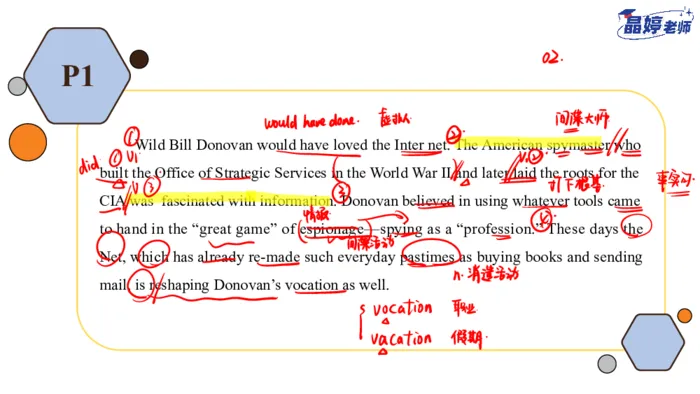
Wild Bill Donovan would have loved the Inter net. The American spymaster who
built the Office of Strategic Services in the World War Ⅱ and later laid the roots for the
CIA was  fascinated with information. Donovan believed in using whatever tools came
to hand in the “great game” of espionage—spying as a “profession.” These days the
Net, which has already re-made such everyday pastimes as buying books and sending
mail, is reshaping Donovan’s vocation as well.
P1
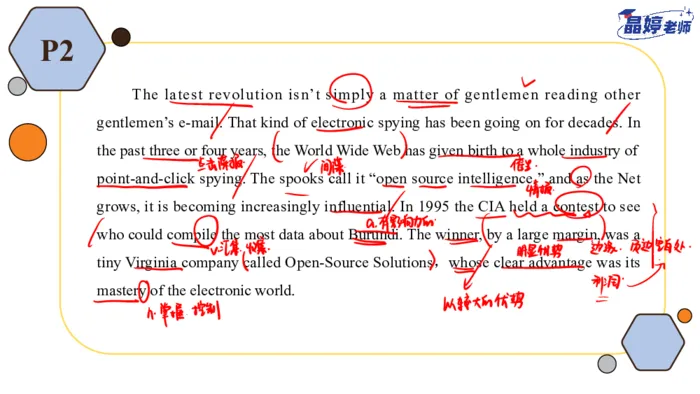
The latest revolution isn’t simply a matter of gentlemen reading other
gentlemen’s e-mail. That kind of electronic spying has been going on for decades. In
the past three or four years, the World Wide Web has given birth to a whole industry of
point-and-click spying. The spooks call it “open source intelligence,” and as the Net
grows, it is becoming increasingly influential. In 1995 the CIA held a contest to see
who could compile the most data about Burundi. The winner, by a large margin, was a
tiny Virginia company called Open-Source Solutions,whose clear advantage was its
mastery of the electronic world.
P2
Among the firms making the biggest splash in the new world is Straitford, Inc., a
private intelligence-analysis firm based in Austin, Texas. Straitford makes money by
selling the results of spying (covering nations from Chile to Russia) to corporations
like energy-services firm McDermott International. Many of its predictions are
available online at .
P3
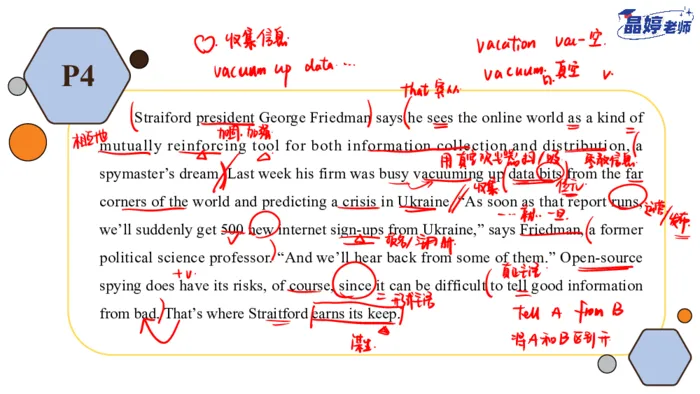
Straiford president George Friedman says he sees the online world as a kind of
mutually reinforcing tool for both information collection and distribution, a
spymaster’s dream. Last week his firm was busy vacuuming up data bits from the far
corners of the world and predicting a crisis in Ukraine. “As soon as that report runs,
we’ll suddenly get 500 new internet sign-ups from Ukraine,” says Friedman, a former
political science professor. “And we’ll hear back from some of them.” Open-source
spying does have its risks, of course, since it can be difficult to tell good information
from bad. That’s where Straitford earns its keep.
P4
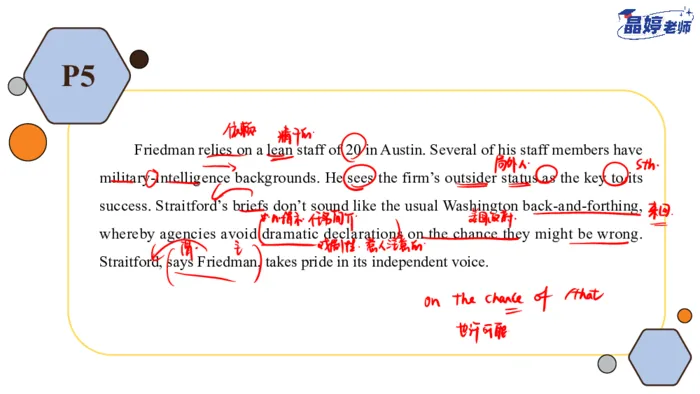
Friedman relies on a lean staff of 20 in Austin. Several of his staff members have
military-intelligence backgrounds. He sees the firm’s outsider status as the key to its
success. Straitford’s briefs don’t sound like the usual Washington back-and-forthing,
whereby agencies avoid dramatic declarations on the chance they might be wrong.
Straitford, says Friedman, takes pride in its independent voice.
P5
2003-T1
行文思路


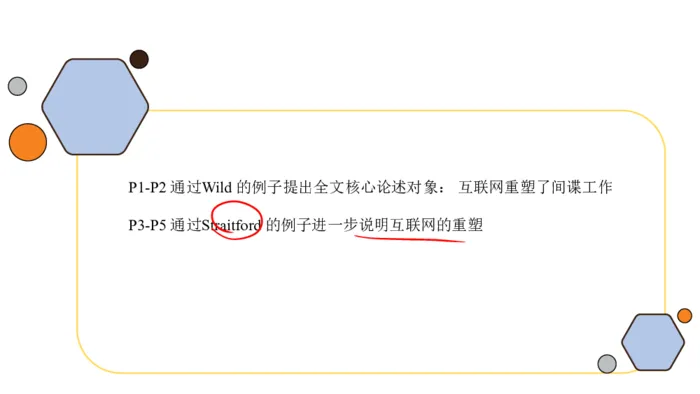
P1-P2 通过Wild 的例子提出全文核心论述对象: 互联网重塑了间谍工作
P3-P5 通过Straitford 的例子进一步说明互联网的重塑
2003-T2
To paraphrase 18th-century statesman Edmund Burke, “all that is needed for the
triumph of a misguided cause is that good people do nothing.” One such cause now seeks
to end biomedical research because of the theory that animals have rights ruling out their
use in research. Scientists need to respond forcefully to animal rights advocates, whose
arguments are confusing the public and thereby threatening advances in health
knowledge and care. Leaders of the animal rights movement target biomedical research
because it depends on public funding, and few people understand the process of health
care research. Hearing allegations of cruelty to animals in research settings, many are
perplexed that anyone would deliberately harm an animal.
P1
For example, a grandmotherly woman staffing an animal rights booth at a recent
street fair was distributing a brochure that encouraged readers not to use anything that
comes from or is tested in animals—no meat, no fur, no medicines. Asked if she
opposed immunizations, she wanted to know if vaccines come from animal research.
When assured that they do, she replied, “Then I would have to say yes.” Asked what
will happen when epidemics return, she said, “Don’t worry, scientists will find some
way of using computers.” Such well-meaning people just don’t understand.
P2
Scientists must communicate their message to the public in a compassionate,
understandable way—in human terms, not in the language of molecular biology. We
need to make clear the connection between animal research and a grandmother’s hip
replacement, a father’s bypass operation, a baby’s vaccinations, and even a pet’s shots.
To those who are unaware that animal research was needed to produce these treatments,
as well as new treatments and vaccines, animal research seems wasteful at best and
cruel at worst.
P3
Much can be done. Scientists could “adopt” middle school classes and present their
own research. They should be quick to respond to letters to the editor, lest animal rights
misinformation go unchallenged and acquire a deceptive appearance of truth. Research
institutions could be opened to tours, to show that laboratory animals receive humane care.
Finally, because the ultimate stakeholders are patients, the health research community
should actively recruit to its cause not only well-known personalities such as Stephen
Cooper, who has made courageous statements about the value of animal research, but all
who receive medical treatment. If good people do nothing, there is a real possibility that
an uninformed citizenry will extinguish the precious embers of medical progress.
P4
2003-T2
行文思路


P1-P2 引出全文核心论述对象: end biomedical research —— 被误导
了的事业
【作者意思: 不应该终止】—— 因为好人不作为
P3-P4 作者的建议
(P3 说科学家应该怎么做;P4 有许多可以做)
2003-T3
In recent years, railroads have been combining with each other, merging into
supersystems, causing heightened concerns about monopoly. As recently as 1995, the
top four railroads accounted for under 70 percent of the total ton-miles moved by rails.
Next year, after a series of mergers is completed, just four railroads will control well
over 90 percent of all the freight moved by major rail carriers.
P1
Supporters of the new supersystems argue that these mergers will allow for
substantial cost reductions and better coordinated service. Any threat of monopoly,
they argue, is removed by fierce competition from trucks. But many shippers complain
that for heavy bulk commodities traveling long distances, such as coal, chemicals, and
grain, trucking is too costly and the railroads therefore have them by the throat.
P2
The vast consolidation within the rail industry means that most shippers are
served by only one rail company. Railroads typically charge such“captive”shippers 20
to 30 percent more than they do when another railroad is competing for the business.
Shippers who feel they are being overcharged have the right to appeal to the federal
government's Surface Transportation Board for rate relief, but the process is expensive,
time consuming, and will work only in truly extreme cases.
P3
Railroads justify rate discrimination against captive shippers on the grounds that
in the long run it reduces everyone's cost. If railroads charged all customers the same
average rate, they argue, shippers who have the option of switching to trucks or other
forms of transportation would do so, leaving remaining customers to shoulder the cost
of keeping up the line. It's theory to which many economists subscribe, but in practice
it often leaves railroads in the position of determining which companies will flourish
and which will fail.“Do we really want railroads to be the arbiters of who wins and
who loses in the marketplace?”asks Martin Bercovici, a Washington lawyer who
frequently represents shipper.
P4
Many captive shippers also worry they will soon be hit with a round of huge rate
increases. The railroad industry as a whole, despite its brightening fortuning fortunes, still
does not earn enough to cover the cost of the capital it must invest to keep up with its
surging traffic. Yet railroads continue to borrow billions to acquire one another, with Wall
Street cheering them on. Consider the $10.2 billion bid by Norfolk Southern and CSX to
acquire Conrail this year. Conrail's net railway operating income in 1996 was just $427
million, less than half of the carrying costs of the transaction. Who's going to pay for the
rest of the bill? Many captive shippers fear that they will, as Norfolk Southern and CSX
increase their grip on the market.
P5
2003-T3
行文思路


P1 开篇提出全文核心论述对象: 铁路公司彼此合并;引起对垄断的极
大的恐慌
P2 叙述合并支持者和反对者的观点
P3-P5  描述“合并”可能带来的现状: 合并已经造成,并将进一步造
成垄断
2003-T4
It is said that in England death is pressing, in Canada inevitable and in California
optional. Small wonder. Americans’ life expectancy has nearly doubled over the past
century. Failing hips can be replaced, clinical depression controlled, cataracts removed
in a 30-minute surgical procedure. Such advances offer the aging population a quality
of life that was unimaginable when I entered medicine 50 years ago. But not even a
great health-care system can cure death—and our failure to confront that reality now
threatens this greatness of ours.
P1
Death is normal; we are genetically programmed to disintegrate and perish, even
under ideal conditions. We all understand that at some level, yet as medical consumers
we treat death as a problem to be solved. Shielded by third-party payers from the cost
of our care, we demand everything that can possibly be done for us, even if it’s useless.
The most obvious example is late-stage cancer care. Physicians—frustrated by their
inability to cure the disease and fearing loss of hope in the patient—too often offer
aggressive treatment far beyond what is scientifically justified.
P2
In 1950, the US spent $12.7 billion on health care. In 2002, the cost will be
$1,540 billion. Anyone can see this trend is unsustainable. Yet few seem willing to try
to reverse it. Some scholars conclude that a government with finite resources should
simply stop paying for medical care that sustains life beyond a certain age—say 83 or
so. Former Colorado governor Richard Lamm has been quoted as saying that the old
and infirm “have a duty to die and get out of the way”, so that younger, healthier
people can realize their potential.
P3
I would not go that far. Energetic people now routinely work through their 60s
and beyond, and remain dazzlingly productive. At 78, Viacom chairman Sumner
Redstone jokingly claims to be 53. Supreme Court Justice Sandra Day O’Connor is in
her 70s, and former surgeon general C. Everett Koop chairs an Internet start-up in his
80s.These leaders are living proof that prevention works and that we can manage the
health problems that come naturally with age. As a mere 68-year-old, I wish to age as
productively as they have.
P4
Yet there are limits to what a society can spend in this pursuit. As a physician, I
know the most costly and dramatic measures may be ineffective and painful. I also know
that people in Japan and Sweden, countries that spend far less on medical care, have
achieved longer, healthier lives than we have. As a nation, we may be overfunding the
quest for unlikely cures while underfunding research on humbler therapies that could
improve people’s lives.
P5
2003-T4
行文思路


P1-P2 提出问题: 伟大的医疗保健体系也无法治疗死亡;我们未能正
视这一点会危及我们医疗体系的伟大+ 医疗护理问题
P3 介绍他人解决方法: 对年龄大的人停止医疗护理,为年轻人让步
P4+P5 评价他人观点(不完全赞同)并提出自己的观点