26考研英语早年真题词句精讲
                           ——2002年
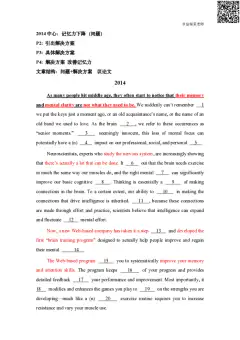
2002-T1
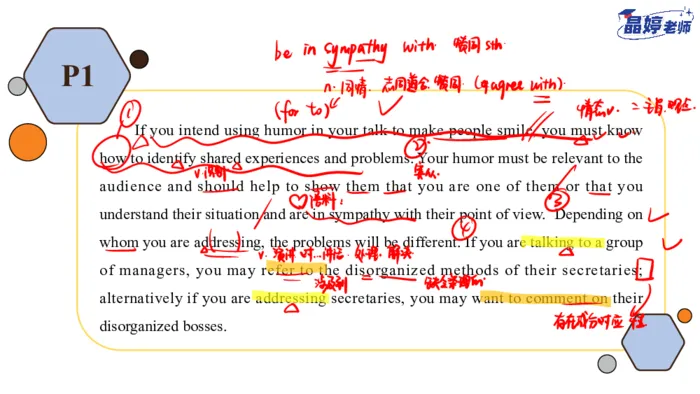
If you intend using humor in your talk to make people smile, you must know
how to identify shared experiences and problems. Your humor must be relevant to the
audience and should help to show them that you are one of them or that you
understand their situation and are in sympathy with their point of view.  Depending on
whom you are addressing, the problems will be different. If you are talking to a group
of managers, you may refer to the disorganized methods of their secretaries;
alternatively if you are addressing secretaries, you may want to comment on their
disorganized bosses.
P1
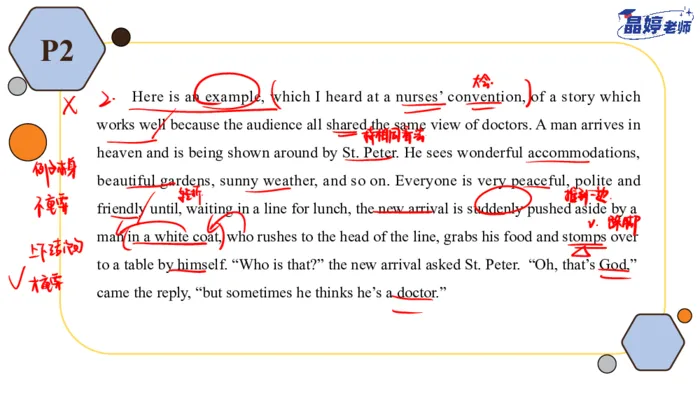
Here is an example, which I heard at a nurses’ convention, of a story which
works well because the audience all shared the same view of doctors. A man arrives in
heaven and is being shown around by St. Peter. He sees wonderful accommodations,
beautiful gardens, sunny weather, and so on. Everyone is very peaceful, polite and
friendly until, waiting in a line for lunch, the new arrival is suddenly pushed aside by a
man in a white coat, who rushes to the head of the line, grabs his food and stomps over
to a table by himself. “Who is that?” the new arrival asked St. Peter.  “Oh, that’s God,”
came the reply, “but sometimes he thinks he’s a doctor.”
P2
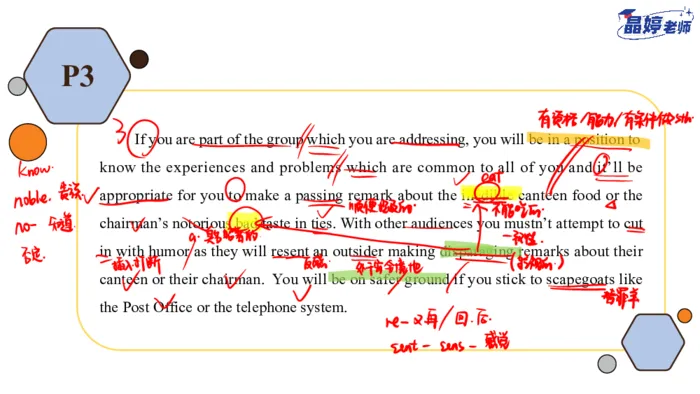
If you are part of the group which you are addressing, you will be in a position to
know the experiences and problems which are common to all of you and it’ll be
appropriate for you to make a passing remark about the inedible canteen food or the
chairman’s notorious bad taste in ties. With other audiences you mustn’t attempt to cut
in with humor as they will resent an outsider making disparaging remarks about their
canteen or their chairman.  You will be on safer ground if you stick to scapegoats like
the Post Office or the telephone system.
P3
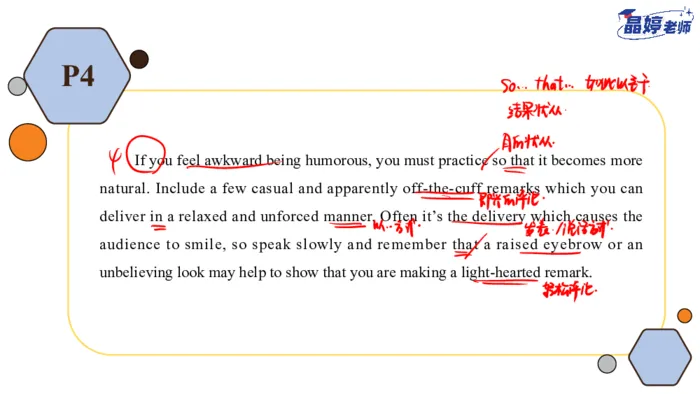
If you feel awkward being humorous, you must practice so that it becomes more
natural. Include a few casual and apparently off-the-cuff remarks which you can
deliver in a relaxed and unforced manner. Often it’s the delivery which causes the
audience to smile, so speak slowly and remember that a raised eyebrow or an
unbelieving look may help to show that you are making a light-hearted remark.
P4
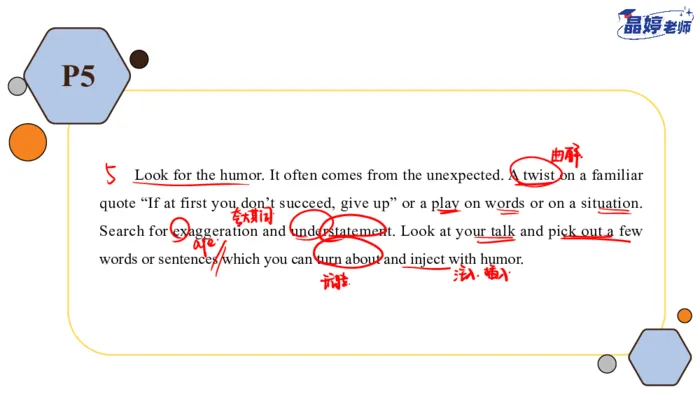
Look for the humor. It often comes from the unexpected. A twist on a familiar
quote “If at first you don’t succeed, give up” or a play on words or on a situation.
Search for exaggeration and understatement. Look at your talk and pick out a few
words or sentences which you can turn about and inject with humor.
P5
2002-T1
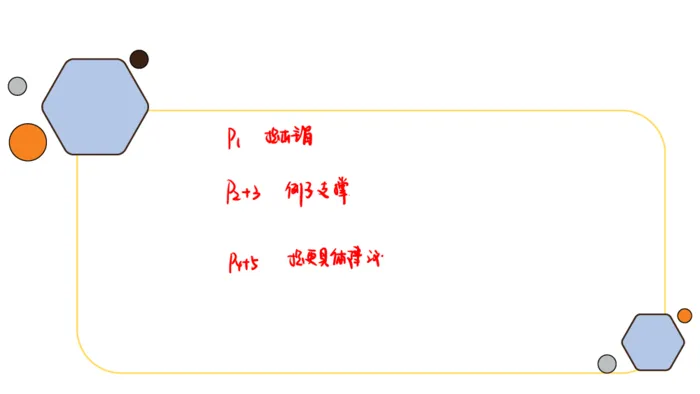
行文思路


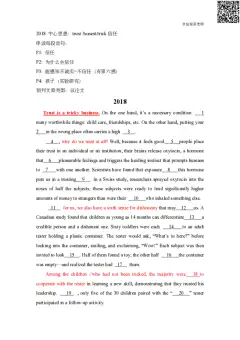
2002-T2
 Since the dawn of human ingenuity, people have devised ever more cunning
tools to cope with work that is dangerous, boring, burdensome, or just plain nasty. That
compulsion has resulted in robotics—the science of conferring various human
capabilities on machines. And if scientists have yet to create the mechanical version of
science fiction, they have begun to come close.
P1
As a result, the modern world is increasingly populated by intelligent gizmos
whose presence we barely notice but whose universal existence has removed much
human labor. Our factories hum to the rhythm of robot assembly arms. Our banking is
done at automated teller terminals that thank us with mechanical politeness for the
transaction. Our subway trains are controlled by tireless robot-drivers. And thanks to
the continual miniaturization of electronics and micro-mechanics, there are already
robot systems that can perform some kinds of brain and bone surgery with
submillimeter accuracy—far greater precision than highly skilled physicians can
achieve with their hands alone.
P2
But if robots are to reach the next stage of laborsaving utility, they will have to
operate with less human supervision and be able to make at least a few decisions for
themselves—goals that pose a real challenge. “While we know how to tell a robot to
handle a specific error," says Dave Lavery, manager of a robotics program at NASA,
“we can't yet give a robot enough ‘common sense’ to reliably interact with a dynamic
world.”
P3
Indeed the quest for true artificial intelligence has produced very mixed results.
Despite a spell of initial optimism in the 1960s and 1970s when it appeared that
transistor circuits and microprocessors might be able to copy the action of the human
brain by the year 2010, researchers lately have begun to extend that forecast by
decades if not centuries.
P4
What they found, in attempting to model thought, is that the human brain's
roughly one hundred billion nerve cells are much more talented—and human
perception far more complicated—than previously imagined. They have built robots
that can recognize the error of a machine panel by a fraction of a millimeter in a
controlled factory environment. But the human mind can glimpse a rapidly changing
scene and immediately disregard the 98 percent that is irrelevant, instantaneously
focusing on the monkey at the side of a winding forest road or the single suspicious
face in a big crowd. The most advanced computer systems on Earth can't approach that
kind of ability, and neuroscientists still don’t know quite how we do it.
P5
2002-T2
行文思路


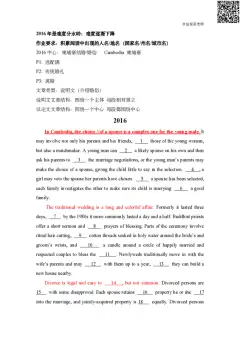
2002-T3
Could the bad old days of economic decline be about to return? Since OPEC
agreed to supply-cuts in March, the price of crude oil has jumped to almost $26 a
barrel, up from less than $10 last December. This near-tripling of oil prices calls up
scary memories of the 1973 oil shock, when prices quadrupled, and 1979-1980, when
they also almost tripled. Both previous shocks resulted in double-digit inflation and
global economic decline. So where are the headlines warning of gloom and doom this
time?
P1
The oil price was given another push up this week when Iraq suspended oil
exports. Strengthening economic growth, at the same time as winter grips the northern
hemisphere, could push the price higher still in the short term.
P2
Yet there are good reasons to expect the economic consequences now to be less
severe than in the 1970s. In most countries the cost of crude oil now accounts for a
smaller share of the price of petrol than it did in the 1970s. In Europe, taxes account
for up to four-fifths of the retail price, so even quite big changes in the price of crude
have a more muted effect on pump prices than in the past.
P3
Rich economies are also less dependent on oil than they were, and so less
sensitive to swings in the oil price. Energy conservation, a shift to other fuels and a
decline in the importance of heavy, energy-intensive industries have reduced oil
consumption. Software, consultancy and mobile telephones use far less oil than steel
or car production. For each dollar of GDP (in constant prices) rich economies now use
nearly 50% less oil than in 1973. The OECD estimates in its latest Economic Outlook
that, if oil prices averaged $22 a barrel for a full year, compared with $13 in 1998, this
would increase the oil import bill in rich economies by only 0.25-0.5% of GDP. That is
less than one-quarter of the income loss in 1974 or 1980. On the other hand, oil-
importing emerging economies—to which heavy industry has shifted—have become
more energy-intensive, and so could be more seriously squeezed.
P4
One more reason not to lose sleep over the rise in oil prices is that, unlike the
rises in the 1970s, it has not occurred against the background of general commodity-
price inflation and global excess demand. A sizable portion of the world is only just
emerging from economic decline. The Economist’s commodity price index is broadly
unchanging from a year ago. In 1973 commodity prices jumped by 70%, and in 1979
by almost 30%.
P5
2002-T3
行文思路


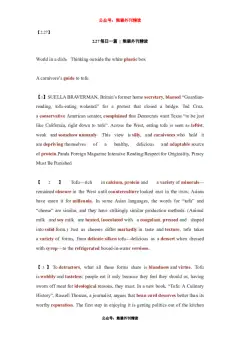
2002-T4
The Supreme Court’s decisions on physician-assisted suicide carry important
implications for how medicine seeks to relieve dying patients of pain and suffering.
P1
Although it ruled that there is no constitutional right to physician-assisted suicide,
the Court in effect supported the medical principle of “double effect”, a centuries-old
moral principle holding that an action having two effects—a good one that is intended
and a harmful one that is foreseen—is permissible if the actor intends only the good
effect.
P2
Doctors have used that principle in recent years to justify using high doses of
morphine to control terminally ill patients’pain, even though increasing dosages will
eventually kill the patient.
P3
Nancy Dubler, director of Montefiore Medical Center, contends that the principle
will shield doctors who “until now have very, very strongly insisted that they could not
give patients sufficient medication to control their pain if that might hasten death”.
P4
George Annas, chair of the health law department at Boston University,
maintains that, as long as a doctor prescribes a drug for a legitimate medical purpose,
the doctor has done nothing illegal even if the patient uses the drug to hasten death.
“It’s like surgery,” he says. “We don’t call those deaths homicides because the doctors
didn’t intend to kill their patients, although they risked their death. If you’re a
physician, you can risk your patient’s suicide as long as you don’t intend their suicide.”
P5
On another level, many in the medical community acknowledge that the assisted-
suicide debate has been fueled in part by the despair of patients for whom modern
medicine has prolonged the physical agony of dying.
P6
Just three weeks before the Court’s ruling on physician-assisted suicide, the
National Academy of Science (NAS) released a two-volume report, Approaching
Death: Improving Care at the End of Life. It identifies the undertreatment of pain and
the aggressive use of “ineffectual and forced medical procedures that may prolong and
even dishonor the period of dying” as the twin problems of end-of-life care.
P7
The profession is taking steps to require young doctors to train in hospices, to
test knowledge of aggressive pain management therapies, to develop a Medicare
billing code for hospital-based care, and to develop new standards for assessing and
treating pain at the end of life.
P8
Annas says lawyers can play a key role in insisting that these well-meaning
medical initiatives translate into better care. “Large numbers of physicians seem
unconcerned with the pain their patients are needlessly and predictably suffering”, to
the extent that it constitutes “systematic patient abuse”. He says medical licensing
boards “must make it clear...that painful deaths are presumptively ones that are
incompetently managed and should result in license suspension”.
P9
2002-T4
行文思路