柴荣老师B 站26 考研英语全年班
2026
考研英语基础阅读讲义
主讲老师:柴荣
柴荣老师B 站26 考研英语全年班
目录
一、阅读学习规划............................................1
二、阅读理解大纲............................................1
三、基础阶段阅读理解技能............................2
四、阅读历年真题汇总....................................2
五、精读篇章....................................................3
六、做题步骤....................................................3
七、精读要求....................................................3
八、阅读真题....................................................4
九、参考答案..................................................54
柴荣老师B 站26 考研英语全年班
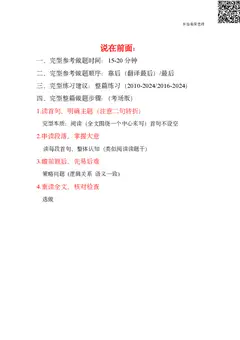
1
基础阅读
一、阅读学习规划:
英语一:2005-2025
英语二:2010-2025
基础阶段(2-5 月)2010-2015
要求:了解大纲;认识题型;逐字逐句精读;分析文章结构
强化阶段(6-8 月)2016-2020
要求:掌握六大题型;熟练做题方法;实践应用
冲刺阶段(9-12 月)2021-2025
要求:限时刷题;总结出题思路;总结错误原因
二、阅读理解大纲:
1.命题形式:
英语二阅读理解由AB 两节组成,考查考生理解书面英语的能力。共25 小题,
每题2 分,共50 分。
A 节(20 小题):考查考生概括主旨要义、理解具体信息,作出判断、推理和引申
等能力。要求考生根据所提供的4 篇文章的内容(总长度为1500 ~1600),从每题
所给的4 个项中选出最佳选项。
2.选材特点:
考研文章的话题包括科技、经济、教育、社会、历史、文化等,类型包括新闻、
评论、报告、论文、专著等。
实际上,考研阅读理解的文章议论文较多。
常选自以下报刊:
美国:《纽约时报》《大西洋月刊》《基督教科学箴言报》
英国:《经济学人》《卫报》
3.大纲要求:
考生应能读懂多种话题、多种类型的语言较复杂的文字材料。对所读材料,
考生应能:
1)概括主旨要义;
2)理解具体信息;
3)根据上下文推测单词和词组的含义;
4)作出判断、推理和引申;
柴荣老师B 站26 考研英语全年班
2
5)理解作者的意图、观点或态度;
6)理解文章结构和上下文逻辑关系;
7)分析文中使用的修辞手法、论证方法等;
8)比较文中事实、观点、态度等的异同。
三、基础阶段阅读理解技能:
1.原文:
词汇层面
句子层面
篇章层面
2.题干:
六大题型识别:
语义题
细节题
推理题
例证题
态度题
主旨题
四、阅读历年真题汇总
柴荣老师B 站26 考研英语全年班
3
五、精读篇章(24 篇)
2010 Text1 - Text4
2011 Text1 - Text4
2012 Text1 - Text4
2013 Text1 - Text4
2014 Text1 - Text4
2015 Text1 - Text4
六、做题步骤:
七、精读要求:
柴荣老师B 站26 考研英语全年班
4
八、阅读真题
2010 Text 1
The longest bull run in a century of art-market history ended on a dramatic note with a
sale of 56 works by Damien Hirst, Beautiful Inside My Head Forever, at Sotheby’s in London
on September 15th, 2008. All but two pieces sold, fetching more than £ 70m, a record for a
sale by a single artist. It was a last victory. As the auctioneer called out bids, in New York one
of the oldest banks on Wall Street, Lehman Brothers, filed for bankruptcy.
The world art market had already been losing momentum for a while after rising
bewilderingly since 2003. At its peak in 2007 it was worth some $ 65 billion, reckons Clare
McAndrew, founder of Arts Economics, a research firm—double the figure five years earlier.
Since then it may have come down to $50 billion. But the market generates interest far
beyond its size because it brings together great wealth, enormous egos, greed, passion and
controversy in a way matched by few other industries.
In the weeks and months that followed Mr. Hirst’s sale, spending of any sort became
deeply unfashionable. In the art world that meant collectors stayed away from galleries and
salerooms. Sales of contemporary art fell by two-thirds, and in the most overheated sector,
they were down by nearly 90% in the year to November 2008. Within weeks the world’s two
biggest auction houses, Sotheby’s and Christie’s, had to pay out nearly $200m in guarantees
to clients who had placed works for sale with them.
The current downturn in the art market is the worst since the Japanese stopped buying
Impressionists at the end of 1989. This time experts reckon that prices are about 40% down
on their peak on average, though some have been far more fluctuant. But Edward Dolman,
Christie’s chief executive, says: “I’m pretty confident we’re at the bottom.”
What makes this slump different from the last, he says, is that there are still buyers in the
market. Almost everyone who was interviewed for this special report said that the biggest
problem at the moment is not a lack of demand but a lack of good work to sell. The three
Ds—death, debt and divorce—still deliver works of art to the market. But anyone who does
not have to sell is keeping away, waiting for confidence to return.
柴荣老师B 站26 考研英语全年班
5
21. In the first paragraph, Damien Hirst’s sale was referred to as “a last victory”
because ________.
[A] the art market had witnessed a succession of victories
[B] the auctioneer finally got the two pieces at the highest bids
[C] Beautiful Inside My Head Forever won over all masterpieces
[D] it was successfully made just before the world financial crisis
22. By saying “spending of any sort became deeply unfashionable” (Para.3), the author
suggests that _________.
[A] collectors were no longer actively involved in art-market auctions
[B] people stopped every kind of spending and stayed away from galleries
[C] art collection as a fashion had lost its appeal to a great extent
[D] works of art in general had gone out of fashion so they were not worth buying
23. Which of the following statements is NOT true?
[A] sales of contemporary art fell dramatically from 2007 to 2008
[B] the art market surpassed many other industries in momentum
[C] the art market generally went downward in various ways
[D] some art dealers were awaiting better chances to come
24. The three Ds mentioned in the last paragraph are _________.
[A] auction houses’ favorites
[B] contemporary trends
[C] factors promoting artwork circulation
[D] styles representing Impressionists
25. The most appropriate title for this text could be _________.
[A] Fluctuation of Art Prices
[B] Up-to-date Art Auctions
[C] Art Market in Decline
[D] Shifted Interest in Arts
柴荣老师B 站26 考研英语全年班
6
2010 Text 2
I was addressing a small gathering in a suburban Virginia living room—a women’s
group that had invited men to join them. Throughout the evening, one man had been
particularly talkative, frequently offering ideas and anecdotes, while his wife sat silently
beside him on the couch. Toward the end of the evening, I commented that women frequently
complain that their husbands don’t talk to them. This man quickly nodded in agreement. He
gestured toward his wife and said, “She’s the talker in our family.” The room burst into
laughter; the man looked puzzled and hurt. “It’s true,” he explained. “When I come home
from work I have nothing to say. If she didn’t keep the conversation going, we’d spend the
whole evening in silence.”
This episode crystallizes the irony that although American men tend to talk more than
women in public situations, they often talk less at home. And this pattern is wreaking havoc
with marriage.
The pattern was observed by political scientist Andrew Hacker in the late 1970s.
Sociologist Catherine Kohler Riessman reports in her new book Divorce Talk that most of the
women she interviewed—but only a few of the men—gave lack of communication as the
reason for their divorces. Given the current divorce rate of nearly 50 percent, that amounts to
millions of cases in the United States every year—a virtual epidemic of failed conversation.
In my own research, complaints from women about their husbands most often focused
not on tangible inequities such as having given up the chance for a career to accompany a
husband to his, or doing far more than their share of daily life-support work like cleaning,
cooking, social arrangements. Instead, they focused on communication: “He doesn’t listen to
me,” “He doesn’t talk to me.” I found, as Hacker observed years before, that most wives want
their husbands to be, first and foremost, conversational partners, but few husbands share this
expectation of their wives.
In short, the image that best represents the current crisis is the stereotypical cartoon
scene of a man sitting at the breakfast table with a newspaper held up in front of his face,
while a woman glares at the back of it, wanting to talk.
柴荣老师B 站26 考研英语全年班
7
26. What is most wives’ main expectation of their husbands?
[A] Talking to them.
[B] Trusting them.
[C] Supporting their careers.
[D] Sharing housework.
27. Judging from the context, the phrase “wreaking havoc” (Line 2, Para. 2) most
probably means_______.
[A] generating motivation
[B] exerting influence
[C] causing damage
[D] creating pressure
28. All of the following are true EXCEPT_______.
[A] men tend to talk more in public than women
[B] nearly 50 percent of recent divorces are caused by failed conversation
[C] women attach much importance to communication between couples
[D] a female tends to be more talkative at home than her spouse
29. Which of the following can best summarize the main idea of this text?
[A] The moral decaying deserves more research by sociologists.
[B] Marriage break-up stems from sex inequalities.
[C] Husband and wife have different expectations from their marriage.
[D] Conversational patterns between man and wife are different.
30. In the following part immediately after this text, the author will most probably focus
on _______.
[A] a vivid account of the new book Divorce Talk
[B] a detailed description of the stereotypical cartoon
[C] other possible reasons for a high divorce rate in the U.S.
[D] a brief introduction to the political scientist Andrew Hacker
柴荣老师B 站26 考研英语全年班
8
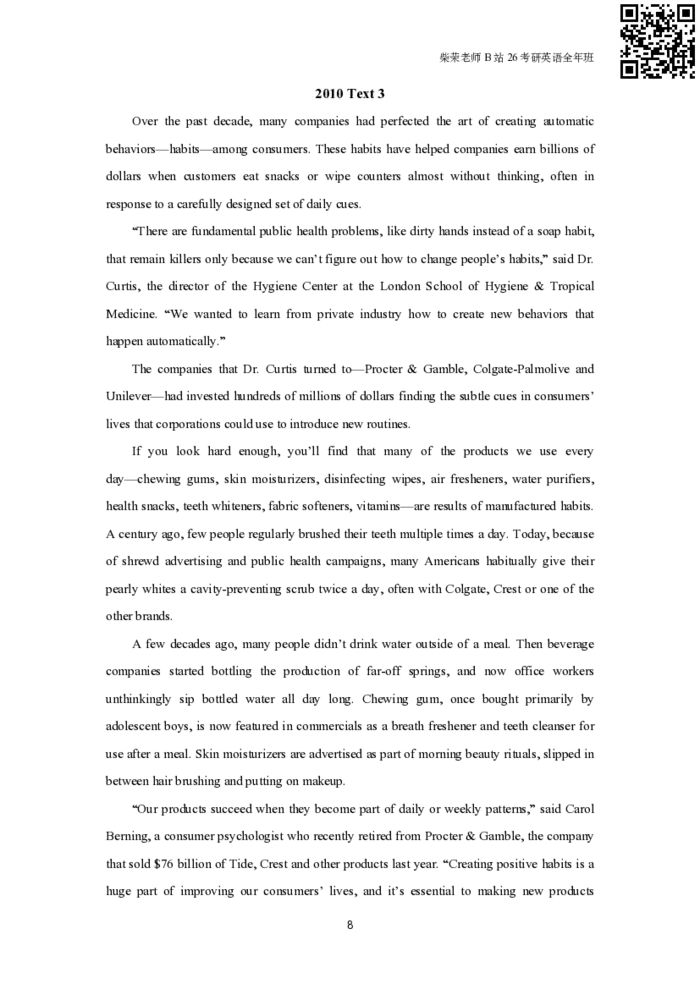
2010 Text 3
Over the past decade, many companies had perfected the art of creating automatic
behaviors—habits—among consumers. These habits have helped companies earn billions of
dollars when customers eat snacks or wipe counters almost without thinking, often in
response to a carefully designed set of daily cues.
“There are fundamental public health problems, like dirty hands instead of a soap habit,
that remain killers only because we can’t figure out how to change people’s habits,” said Dr.
Curtis, the director of the Hygiene Center at the London School of Hygiene & Tropical
Medicine. “We wanted to learn from private industry how to create new behaviors that
happen automatically.”
The companies that Dr. Curtis turned to—Procter & Gamble, Colgate-Palmolive and
Unilever—had invested hundreds of millions of dollars finding the subtle cues in consumers’
lives that corporations could use to introduce new routines.
If you look hard enough, you’ll find that many of the products we use every
day—chewing gums, skin moisturizers, disinfecting wipes, air fresheners, water purifiers,
health snacks, teeth whiteners, fabric softeners, vitamins—are results of manufactured habits.
A century ago, few people regularly brushed their teeth multiple times a day. Today, because
of shrewd advertising and public health campaigns, many Americans habitually give their
pearly whites a cavity-preventing scrub twice a day, often with Colgate, Crest or one of the
other brands.
A few decades ago, many people didn’t drink water outside of a meal. Then beverage
companies started bottling the production of far-off springs, and now office workers
unthinkingly sip bottled water all day long. Chewing gum, once bought primarily by
adolescent boys, is now featured in commercials as a breath freshener and teeth cleanser for
use after a meal. Skin moisturizers are advertised as part of morning beauty rituals, slipped in
between hair brushing and putting on makeup.
“Our products succeed when they become part of daily or weekly patterns,” said Carol
Berning, a consumer psychologist who recently retired from Procter & Gamble, the company
that sold $76 billion of Tide, Crest and other products last year. “Creating positive habits is a
huge part of improving our consumers’ lives, and it’s essential to making new products
柴荣老师B 站26 考研英语全年班
9
commercially viable.”
Through experiments and observation, social scientists like Dr. Berning have learned
that there is power in tying certain behaviors to habitual cues through ruthless advertising. As
this new science of habit has emerged, controversies have erupted when the tactics have been
used to sell questionable beauty creams or unhealthy foods.
31.According to Dr. Curtis, habits like hand washing with soap_______.
[A] should be further cultivated
[B] should be changed gradually
[C] are deeply rooted in history
[D] are basically private concerns
32.Bottled water, chewing gum and skin moisturizers are mentioned in Paragraph 5 so
as to_______.
[A] reveal their impact on people’s habits
[B] show the urgent need of daily necessities
[C] indicate their effect on people’s buying power
[D] manifest the significant role of good habits
33.Which of the following does NOT belong to products that help create people’s habits?
[A] Tide.
[B] Crest.
[C] Colgate.
[D] Unilever.
34.From the text we know that some of consumer’s habits are developed due to______.
[A] perfected art of products
[B] automatic behavior creation
[C] commercial promotions
[D] scientific experiments
35.The author’s attitude toward the influence of advertisement on people’s habits is___.
[A] indifferent
[B] negative
[C] positive
[D] biased
柴荣老师B 站26 考研英语全年班
10
2010 Text 4
Many Americans regard the jury system as a concrete expression of crucial democratic
values, including the principles that all citizens who meet minimal qualifications of age and
literacy are equally competent to serve on juries; that jurors should be selected randomly from
a representative cross section of the community; that no citizen should be denied the right to
serve on a jury on account of race, religion, sex, or national origin; that defendants are entitled
to trial by their peers; and that verdicts should represent the conscience of the community and
not just the letter of the law. The jury is also said to be the best surviving example of direct
rather than representative democracy. In a direct democracy, citizens take turns governing
themselves, rather than electing representatives to govern for them.
But as recently as in 1968, jury selection procedures conflicted with these democratic
ideals. In some states, for example, jury duty was limited to persons of supposedly superior
intelligence, education, and moral character. Although the Supreme Court of the United States
had prohibited intentional racial discrimination in jury selection as early as the 1880 case of
Strauder v. West Virginia, the practice of selecting so-called elite or blue-ribbon juries
provided a convenient way around this and other antidiscrimination laws.
The system also failed to regularly include women on juries until the mid-20th century.
Although women first served on state juries in Utah in 1898, it was not until the 1940s that a
majority of states made women eligible for jury duty. Even then several states automatically
exempted women from jury duty unless they personally asked to have their names included
on the jury list. This practice was justified by the claim that women were needed at home, and
it kept juries unrepresentative of women through the 1960s.
In 1968, the Congress of the United States passed the Jury Selection and Service Act,
ushering in a new era of democratic reforms for the jury. This law abolished special
educational requirements for federal jurors and required them to be selected at random from a
cross section of the entire community. In the landmark 1975 decision Taylor v. Louisiana, the
Supreme Court extended the requirement that juries be representative of all parts of the
community to the state level. The Taylor decision also declared sex discrimination in jury
selection to be unconstitutional and ordered states to use the same procedures for selecting
male and female jurors.
柴荣老师B 站26 考研英语全年班
11
36. From the principles of the US jury system, we learn that ___________.
[A] both literate and illiterate people can serve on juries
[B] defendants are immune from trial by their peers
[C] no age limit should be imposed for jury service
[D] judgment should consider the opinion of the public
37. The practice of selecting so-called elite jurors prior to 1968 showed _________.
[A] the inadequacy of antidiscrimination laws
[B] the prevalent discrimination against certain races
[C] the conflicting ideals in jury selection procedures
[D] the arrogance common among the Supreme Court judges
38. Even in the 1960s, women were seldom on the jury list in some states because _____.
[A] they were automatically banned by state laws
[B] they fell far short of the required qualifications
[C] they were supposed to perform domestic duties
[D] they tended to evade public engagement
39. After the Jury Selection and Service Act was passed, _________.
[A] sex discrimination in jury selection was unconstitutional and had to be abolished
[B] educational requirements became less rigid in the selection of federal jurors
[C] jurors at the state level ought to be representative of the entire community
[D] states ought to conform to the federal court in reforming the jury system
40. In discussing the U.S. jury system, the text centers on _________.
[A] its nature and problems
[B] its characteristics and tradition
[C] its problems and their solutions
[D] its tradition and development
柴荣老师B 站26 考研英语全年班
12
2011 Text 1
Ruth Simmons joined Goldman Sachs’s board as an outside director in January 2000; a
year later she became president of Brown University. For the rest of the decade she
apparently managed both roles without attracting much criticism. But by the end of 2009 Ms.
Simmons was under fire for having sat on Goldman’s compensation committee; how could
she have let those enormous bonus payouts pass unremarked? By February the next year Ms.
Simmons had left the board. The position was just taking up too much time, she said.
Outside directors are supposed to serve as helpful, yet less biased, advisers on a firm’s
board. Having made their wealth and their reputations elsewhere, they presumably have
enough independence to disagree with the chief executive’s proposals. If the sky, and the
share price is falling, outside directors should be able to give advice based on having
weathered their own crises.
The researchers from Ohio University used a database that covered more than 10,000
firms and more than 64,000 different directors between 1989 and 2004. Then they simply
checked which directors stayed from one proxy statement to the next. The most likely reason
for departing a board was age, so the researchers concentrated on those “surprise”
disappearances by directors under the age of 70. They found that after a surprise departure,
the probability that the company will subsequently have to restate earnings increases by
nearly 20%. The likelihood of being named in a federal class-action lawsuit also increases,
and the stock is likely to perform worse. The effect tended to be larger for larger firms.
Although a correlation between them leaving and subsequent bad performance at the firm is
suggestive, it does not mean that such directors are always jumping off a sinking ship. Often
they “trade up,” leaving riskier, smaller firms for larger and more stable firms.
But the researchers believe that outside directors have an easier time of avoiding a blow
to their reputations if they leave a firm before bad news breaks, even if a review of history
shows they were on the board at the time any wrongdoing occurred. Firms who want to keep
their outside directors through tough times may have to create incentives. Otherwise outside
directors will follow the example of Ms. Simmons, once again very popular on campus.
柴荣老师B 站26 考研英语全年班
13
21. According to Paragraph 1, Ms. Simmons was criticized for
.
[A] gaining excessive profits
[B] failing to fulfill her duty
[C] refusing to make compromises
[D] leaving the board in tough times
22. We learn from Paragraph 2 that outside directors are supposed to be
.
[A] generous investors
[B] unbiased executives
[C] share price forecasters
[D] independent advisers
23. According to the researchers from Ohio University, after an outside director’s
surprise departure, the firm is likely to
.
[A] become more stable
[B] report increased earnings
[C] do less well in the stock market
[D] perform worse in lawsuits
24. It can be inferred from the last paragraph that outside directors
.
[A] may stay for the attractive offers from the firm
[B] have often had records of wrongdoings in the firm
[C] are accustomed to stress-free work in the firm
[D] will decline incentives from the firm
25. The author’s attitude toward the role of outsidedirectors is
.
[A] permissive
[B] positive
[C] scornful
[D] critical
柴荣老师B 站26 考研英语全年班
14
2011 Text 2
Whatever happened to the death of newspapers? A year ago the end seemed near. The
recession threatened to remove the advertising and readers that had not already fled to the
Internet. Newspapers like the San Francisco Chronicle were chronicling their own doom.
America’s Federal Trade Commission launched a round of talks about how to save
newspapers. Should they become charitable corporations? Should the state subsidize them? It
will hold another meeting soon. But the discussions now seem out of date.
In much of the world there is the little sign of crisis. German and Brazilian papers have
shrugged off the recession. Even American newspapers, which inhabit the most troubled
corner of the global industry, have not only survived but often returned to profit. Not the 20%
profit margins that were routine a few years ago, but profit all the same.
It has not been much fun. Many papers stayed afloat by pushing journalists overboard.
The American Society of News Editors reckons that 13,500 newsroom jobs have gone since
2007. Readers are paying more for slimmer products. Some papers even had the nerve to
refuse delivery to distant suburbs. Yet these desperate measures have proved the right ones
and, sadly for many journalists, they can be pushed further.
Newspapers are becoming more balanced businesses, with a healthier mix of revenues
from readers and advertisers. American papers have long been highly unusual in their reliance
on ads. Fully 87% of their revenues came from advertising in 2008, according to the
Organization for Economic Cooperation & Development (OECD). In Japan the proportion is
35%. Not surprisingly, Japanese newspapers are much more stable.
The whirlwind that swept through newsrooms harmed everybody, but much of the
damage has been concentrated in areas where newspapers are least distinctive. Car and film
reviewers have gone. So have science and general business reporters. Foreign bureaus have
been savagely cut off. Newspapers are less complete as a result. But completeness is no
longer a virtue in the newspaper business.
柴荣老师B 站26 考研英语全年班
15
26.By saying “Newspapers like … their own doom” (Lines 2-3, Para. 1), the author
indicates that newspapers ___________.
[A] neglected the sign of crisis
[B] failed to get state subsidies
[C] were not charitable corporations
[D] were in a desperate situation
27.Some newspapers refused delivery to distant suburbs probably because ________.
[A] readers threatened to pay less
[B] newspapers wanted to reduce costs
[C] journalists reported little about these areas
[D] subscribers complained about slimmer products
28.Compared with their American counterparts, Japanese newspapers are much more
stable because they _________.
[A] have more sources of revenue
[B] have more balanced newsrooms
[C] are less dependent on advertising
[D] are less affected by readership
29.What can be inferred from the last paragraph about the current newspaper
business?
[A] distinctiveness is an essential feature of newspapers.
[B] completeness is to blame for the failure of newspapers.
[C] foreign bureaus play a crucial role in the newspaper business.
[D] readers have lost their interest in car and film reviews.
30.The most appropriate title for this text would be ___________.
[A] American Newspapers: Struggling for Survival
[B] American Newspapers: Gone with the Wind
[C] American Newspapers: A Thriving Business
[D] American Newspapers: A Hopeless Story
柴荣老师B 站26 考研英语全年班
16
2011 Text 3
We tend to think of the decades immediately following World War II as a time of
prosperity and growth, with soldiers returning home by the millions, going off to college on
the G. I. Bill and lining up at the marriage bureaus.
But when it came to their houses, it was a time of common sense and a belief that less
could truly be more. During the Depression and the war, Americans had learned to live with
less, and that restraint, in combination with the postwar confidence in the future, made small,
efficient housing positively stylish.
Economic condition was only a stimulus for the trend toward efficient living. The phrase
“less is more” was actually first popularized by a German, the architect Ludwig Mies van der
Rohe, who like other people associated with the Bauhaus, a school of design, emigrated to the
United States before World War II and took up posts at American architecture schools. These
designers came to exert enormous influence on the course of American architecture, but none
more so than Mies.
Mies’s signature phrase means that less decoration, properly organized, has more impact
than a lot. Elegance, he believed, did not derive from abundance. Like other modern
architects, he employed metal, glass and laminated wood — materials that we take for granted
today but that in the 1940s symbolized the future. Mies’s sophisticated presentation masked
the fact that the spaces he designed were small and efficient, rather than big and often empty.
The apartments in the elegant towers Mies built on Chicago’s Lake Shore Drive, for
example, were smaller — two-bedroom units under 1,000 square feet — than those in their
older neighbors along the city’s Gold Coast. But they were popular because of their airy glass
walls, the views they afforded and the elegance of the buildings’ details and proportions, the
architectural equivalent of the abstract art so popular at the time.
The trend toward “less” was not entirely foreign. In the 1930s Frank Lloyd Wright
started building more modest and efficient houses — usually around 1,200 square feet — than
the spreading two-story ones he had designed in the 1890s and the early 20th century.
The “Case Study Houses” commissioned from talented modern architects by California
Arts & Architecture magazine between 1945 and 1962 were yet another homegrown influence
on the “less is more” trend. Aesthetic effect came from the landscape, new materials and
柴荣老师B 站26 考研英语全年班
17
forthright detailing. In his Case Study House, Ralph Rapson may have mispredicted just how
the mechanical revolution would impact everyday life — few American families acquired
helicopters, though most eventually got clothes dryers — but his belief that self-sufficiency
was both desirable and inevitable was widely shared.
31. The postwar American housing style largely reflected the Americans’ ______.
[A] prosperity and growth
[B] efficiency and practicality
[C] restraint and confidence
[D] pride and faithfulness
32. Which of the following can be inferred from Paragraph 3 about Bauhaus?
[A] It was founded by Ludwig Mies van der Rohe.
[B] Its designing concept was affected by World War II.
[C] Most American architects used to be associated with it.
[D] It had a great influence upon American architecture.
33. Mies held that elegance of architectural design _________.
[A] was related to large space
[B] was identified with emptiness
[C] was not reliant on abundant decoration
[D] was not associated with efficiency
34. What is true about the apartments Mies built on Chicago’s Lake Shore Drive?
[A] They ignored details and proportions.
[B] They were built with materials popular at that time.
[C] They were more spacious than neighboring buildings.
[D] They shared some characteristics of abstract art.
35. What can we learn about the design of the “Case Study House”?
[A] Mechanical devices were widely used.
[B] Natural scenes were taken into consideration.
[C] Details were sacrificed for the overall effect.
[D] Eco-friendly materials were employed.
柴荣老师B 站26 考研英语全年班
18
2011 Text 4
Will the European Union make it? The question would have sounded strange not long
ago. Now even the project’s greatest cheerleaders talk of a continent facing a “Bermuda
triangle” of debt, population decline and lower growth.
As well as those chronic problems, the EU faces an acute crisis in its economic core, the
16 countries that use the single currency. Markets have lost faith that the euro zone’s
economies, weaker or stronger, will one day converge thanks to the discipline of sharing a
single currency, which denies uncompetitive members the quick fix of devaluation.
Yet the debate about how to save Europe’s single currency from disintegration is stuck.
It is stuck because the euro zone’s dominant powers, France and Germany, agree on the need
for greater harmonization within the euro zone, but disagree about what to harmonize.
Germany thinks the euro must be saved by stricter rules on borrowing, spending and
competitiveness, backed by quasi-automatic sanctions for governments that do not obey.
These might include threats to freeze EU funds for poorer regions and EU mega-projects, and
even the suspension of a country’s voting rights in EU ministerial councils. It insists that
economic co-ordination should involve all 27 members of the EU club, among whom there is
a small majority for free-market liberalism and economic rigour; in the inner core alone,
Germany fears, a small majority favor French interference.
A “southern” camp headed by France wants something different. “European economic
government” within an inner core of euro-zone members. Translated, that means politicians
intervening in monetary policy and a system of redistribution from richer to poorer members,
via cheaper borrowing for governments through common Eurobonds or complete fiscal
transfers. Finally, figures close to the French government have murmured, euro-zone
members should agree to some fiscal and social harmonization: e.g., curbing competition in
corporate-tax rates or labor costs.
It is too soon to write off the EU. It remains the world’s largest trading block. At its best,
the European project is remarkably liberal: built around a single market of 27 rich and poor
countries, its internal borders are far more open to goods, capital and labour than any
comparable trading area. It is an ambitious attempt to blunt the sharpest edges of globalization,
柴荣老师B 站26 考研英语全年班
19
and make capitalism benign.
36. The EU is faced with so many problems that ___________.
[A] it has more or less lost faith in markets
[B] even its supporters begin to feel concerned
[C] some of its member countries plan to abandon euro
[D] it intends to deny the possibility of devaluation
37. The debate over the EU’s single currency is stuck because the dominant powers ___.
[A] are competing for the leading position
[B] are busy handling their own crises
[C] fail to reach an agreement on harmonization
[D] disagree on the steps towards disintegration
38. To solve the euro problem, Germany proposed that ___________.
[A] EU funds for poor regions be increased
[B] stricter regulations be imposed
[C] only core members be involved in economic co-ordination
[D] voting rights of the EU members be guaranteed
39. The French proposal of handling the crisis implies that ___________.
[A] poor countries are more likely to get funds
[B] strict monetary policy will be applied to poor countries
[C] loans will be readily available to rich countries
[D] rich countries will basically control Eurobonds
40. Regarding the future of the EU, the author seems to feel ___________.
[A] pessimistic
[B] desperate
[C] conceited
[D] hopeful
柴荣老师B 站26 考研英语全年班
20
2012 Text 1
Homework has never been terribly popular with students and even many parents, but in
recent years it has been particularly scorned. School districts across the country, most recently
Los Angeles Unified, are revising their thinking on his educational ritual. Unfortunately, L. A.
Unified has produced an inflexible policy which mandates that with the exception of some
advanced courses, homework may no longer count for more than 10% of a student’s academic
grade.
This rule is meant to address the difficulty that students from impoverished or chaotic
homes might have in completing their homework. But the policy is unclear and contradictory.
Certainly, no homework should be assigned that students cannot complete on their own or
that they cannot do without expensive equipment. But if the district is essentially giving a
pass to students who do not do their homework because of complicated family lives, it is
going riskily close to the implication that standards need to be lowered for poor children.
District administrators say that homework will still be a part of schooling: teachers are
allowed to assign as much of it as they want. But with homework counting for no more than
10% of their grades, students can easily skip half their homework and see very little
difference on their report cards. Some students might do well on state tests without
completing their homework, but what about the students who performed well on the tests and
did their homework? It is quite possible that the homework helped. Yet rather than
empowering teachers to find what works best for their students, the policy imposes a flat,
across-the-board rule.
At the same time, the policy addresses none of the truly thorny questions about
homework. If the district finds homework to be unimportant to its students’ academic
achievement, it should move to reduce or eliminate the assignments, not make them count for
almost nothing. Conversely, if homework matters, it should account for a significant portion
of the grade. Meanwhile, this policy does nothing to ensure that the homework students
receive is meaningful or appropriate to their age and the subject, or that teachers are not
assigning more than they are willing to review and correct.
The homework rules should be put on hold while the school board, which is responsible
for setting educational policy, looks into the matter and conducts public hearings. It is not too
柴荣老师B 站26 考研英语全年班
21
late for L.A. Unified to do homework right.
21.It is implied in paragraph 1 that nowadays homework
.
[A] is receiving more criticism
[B] is no longer an educational ritual
[C] is not required for advanced courses
[D] is gaining more preferences
22.L.
A.
Unified
has
made
the
rule
about
homework
mainly
because
poor
students
.
[A] tend to have moderate expectations for their education
[B] have asked for a different educational standard
[C] may have problems finishing their homework
[D] have voiced their complaints about homework
23.According to Paragraph 3, one problem with the policy is that it may
.
[A] discourage students from doing homework
[B] result in students’ indifference to their report cards
[C] undermine the authority of state tests
[D] restrict teachers’ power in education
24.As mentioned in Paragraph 4, a key question unanswered about homework is
whether
.
[A] it should be eliminated
[B] it counts much in schooling
[C] it places extra burdens on teachers
[D] it is important for grades
25.A suitable title for this text could be
.
[A] Wrong Interpretation of an Educational Policy
[B] A Welcomed Policy for Poor Students
[C] Thorny Questions about Homework
[D] A Faulty Approach to Homework
柴荣老师B 站26 考研英语全年班
22
2012 Text 2
Pretty in pink: adult women do not remember being so obsessed with the color, yet it is
pervasive in our young girls’ lives. It is not that pink is intrinsically bad, but it is such a tiny
slice of the rainbow and, though it may celebrate girlhood in one way, it also repeatedly and
firmly fuses girls’ identity to appearance. Then it presents that connection, even among
two-year-olds, between girls as not only innocent but as evidence of innocence. Looking
around, I despaired at the singular lack of imagination about girls’ lives and interests.
Girls’ attraction to pink may seem unavoidable, somehow encoded in their DNA, but
according to Jo Paoletti, an associate professor of American Studies, it is not. Children were
not color-coded at all until the early 20th century: in the era before domestic washing
machines all babies wore white as a practical matter, since the only way of getting clothes
clean was to boil them. What's more, both boys and girls wore what were thought of as
gender-neutral dresses. When nursery colors were introduced, pink was actually considered
the more masculine color, a pastel version of red, which was associated with strength. Blue,
with its intimations of the Virgin Mary, constancy and faithfulness, symbolized femininity. It
was not until the mid-1980s, when amplifying age and sex differences became a dominant
children’s marketing strategy, that pink fully came into its own, when it began to seem
inherently attractive to girls, part of what defined them as female, at least for the first few
critical years.
I had not realized how profoundly marketing trends dictated our perception of what is
natural to kids, including our core beliefs about their psychological development. Take the
toddler. I assumed that phase was something experts developed after years of research into
children's behavior: wrong. Turns out, according to Daniel Cook, a historian of childhood
consumerism, it was popularized as a marketing trick by clothing manufacturers in the 1930s.
Trade publications counseled department stores that, in order to increase sales, they
should create a “third stepping stone” between infant wear and older kids’ clothes. It was only
after “toddler” became a common shopper’ term that it evolved into a broadly accepted
developmental stage. Splitting kids, or adults, into ever-tinier categories has proved a sure-fire
way to boost profits. And one of the easiest ways to segment a market is to magnify gender
differences—or invent them where they did not previously exist.
柴荣老师B 站26 考研英语全年班
23
26.By saying “it is...the rainbow” (Para.1), the author means pink
.
[A] should not be the sole representation of girlhood
[B] should not be associated with girls’ innocence
[C] cannot explain girls’ lack of imagination
[D] cannot influence girls’ lives and interests
27.According to Paragraph 2, which of the following is true of colors?
[A] colors are encoded in girls’ DNA.
[B] blue used to be regarded as the color for girls.
[C] pink used to be a neutral color in symbolizing genders.
[D] white is preferred by babies.
28.The author suggests that our perception of children’s psychological development was
much influenced by
.
[A] the marketing of products for children
[B] the observation of children’s nature
[C] researches into children’s behavior
[D] studies of childhood consumption
29.We may learn from Paragraph 4 that department stores were advised to_________.
[A] focus on infant wear and older kids’ clothes
[B] attach equal importance to different genders
[C] classify consumers into smaller groups
[D] create some common shoppers’ terms
30.It can be concluded that girls’ attraction to pink seems to be
.
[A] clearly explained by their inborn tendency
[B] fully understood by clothing manufacturers
[C] mainly imposed by profit-driven businessmen
[D] well interpreted by psychological experts
柴荣老师B 站26 考研英语全年班
24
2012 Text 3
In 2010, a federal judge shook America’s biotech industry to the core. Companies had
won patents for isolated DNA for decades—by 2005 some 20% of human genes were
patented. But in March 2010 a judge ruled that genes were unpatentable. Executives were
violently agitated. The Biotechnology Industry Organization (BIO), a trade group, assured
members that this was just a “preliminary step” in a longer battle.
On July 29th they were relieved, at least temporarily. A federal appeals court overturned
the prior decision, ruling that Myriad Genetics could indeed hold patents to two genes that
help forecast a woman’s risk of breast cancer. The chief executive of Myriad, a company in
Utah, said the ruling was a blessing to firms and patients alike.
But as companies continue their attempts at personalized medicine, the courts will
remain rather busy. The Myriad case itself is probably not over. Critics make three main
arguments against gene patents: a gene is a product of nature, so it may not be patented; gene
patents suppress innovation rather than reward it; and patents’ monopolies restrict access to
genetic tests such as Myriad’s. A growing number seem to agree. Last year a federal
task-force urged reform for patents related to genetic tests. In October the Department of
Justice filed a brief in the Myriad case, arguing that an isolated DNA molecule “is no less a
product of nature... than are cotton fibres that have been separated from cotton seeds. ”
Despite the appeals court’s decision, big questions remain unanswered. For example, it is
unclear whether the sequencing of a whole genome violates the patents of individual genes
within it. The case may yet reach the Supreme Court.
As the industry advances, however, other suits may have an even greater impact.
Companies are unlikely to file many more patents for human DNA molecules—most are
already patented or in the public domain. Firms are now studying how genes interact, looking
for correlations that might be used to determine the causes of disease or predict a drug’s
efficacy. Companies are eager to win patents for “connecting the dots”, explains Hans Sauer,
a lawyer for the BIO.
Their success may be determined by a suit related to this issue, brought by the Mayo
Clinic, which the Supreme Court will hear in its next term. The BIO recently held a
convention which included sessions to coach lawyers on the shifting landscape for patents.
柴荣老师B 站26 考研英语全年班
25
Each meeting was packed.
31.It can be learned from paragraph 1 that the biotech companies would like______.
[A] their executives to be active
[B] judges to rule out gene patenting
[C] genes to be patentable
[D] the BIO to issue a warning
32.Those who are against gene patents believe that
.
[A] genetic tests are not reliable
[B] only man-made products are patentable
[C] patents on genes depend much on innovation
[D] courts should restrict access to genetic tests
33.According to Hans Sauer, companies are eager to win patents for
.
[A] establishing disease correlations
[B] discovering gene interactions
[C] drawing pictures of genes
[D] identifying human DNA
34.By saying “Each meeting was packed” (Line4, Para. 6), the author means that
.
[A] the supreme court was authoritative
[B] the BIO was a powerful organization
[C] gene patenting was a great concern
[D] lawyers were keen to attend conventions
35.Generally speaking, the author’s attitude toward gene patenting is
.
[A] critical
[B] supportive
[C] scornful
[D] objective
柴荣老师B 站26 考研英语全年班
26
2012 Text 4
The great recession may be over, but this era of high joblessness is probably beginning.
Before it ends, it will likely change the life course and character of a generation of young
adults. And ultimately, it is likely to reshape our politics, our culture, and the character of our
society for years.
No one tries harder than the jobless to find silver linings in this national economic
disaster. Many said that unemployment, while extremely painful, had improved them in some
ways: they had become less materialistic and more financially prudent; they were more aware
of the struggles of others. In limited respects, perhaps the recession will leave society better
off. At the very least, it has awoken us from our national fever dream of easy riches and
bigger houses, and put a necessary end to an era of reckless personal spending.
But for the most part, these benefits seem thin, uncertain, and far off. In The Moral
Consequences of Economic Growth, the economic historian Benjamin Friedman argues that
both inside and outside the U.S., lengthy periods of economic stagnation or decline have
almost always left society more mean-spirited and less inclusive, and have usually stopped or
reversed the advance of rights and freedoms. Anti-immigrant sentiment typically increases, as
does conflict between races and classes.
Income inequality usually falls during a recession, but it has not shrunk in this one.
Indeed, this period of economic weakness may reinforce class divides, and decrease
opportunities to cross them—especially for young people. The research of Till Von Wachter,
the economist at Columbia University, suggests that not all people graduating into a recession
see their life chances dimmed: those with degrees from elite universities catch up fairly
quickly to where they otherwise would have been if they had graduated in better times; it is
the masses beneath them that are left behind.
In the Internet age, it is particularly easy to see the resentment that has always been
hidden within American society. More difficult, in the moment, is discerning precisely how
these lean times are affecting society’s character. In many respects, the U.S. was more
socially tolerant entering this recession than at any time in its history, and a variety of national
polls on social conflict since then have shown mixed results. We will have to wait and see
exactly how these hard times will reshape our social fabric. But they certainly will reshape it,
柴荣老师B 站26 考研英语全年班
27
and all the more so the longer they extend.
36.By saying “to find silver linings” (Line 1, Para. 2) the author suggests that the jobless
try to
.
[A] seek subsidies from the government
[B] make profits from the troubled economy
[C] explore reasons for the unemployment
[D] look on the bright side of the recession
37.According to Paragraph 2, the recession has made people _____.
[A] struggle against each other
[B] realize the national dream
[C] challenge their prudence
D] reconsider their lifestyle
38.Benjamin Friedman believes that economic recessions may _____.
[A] impose a heavier burden on immigrants
[B] bring out more evils of human nature
[C] promote the advance of rights and freedoms
[D] ease conflicts between races and classes
39.The research of Till Von Wachter suggests that in the recession graduates from elite
universities tend to
.
[A] lag behind the others due to decreased opportunities
[B] catch up quickly with experienced employees
[C] see their life chances as dimmed as the others’
[D] recover more quickly than the others
40.The author thinks that the influence of hard times on society is _____.
[A] trivial
[B] positive
[C] certain
[D] destructive
柴荣老师B 站26 考研英语全年班
28
2013 Text 1
In an essay entitled “Making It in America,” the author Adam Davidson relates a joke
from cotton country about just how much a modern textile mill has been automated: The
average mill has only two employees today, “a man and a dog. The man is there to feed the
dog, and the dog is there to keep the man away from the machines.”
Davidson’s article is one of a number of pieces that have recently appeared making the
point that the reason we have such stubbornly high unemployment and declining middle-class
incomes today is largely because of the big drop in demand because of the Great Recession,
but it is also because of the advances in both globalization and the information technology
revolution, which are more rapidly than ever replacing labor with machines or foreign
workers.
In the past, workers with average skills, doing an average job, could earn an average
lifestyle. But, today, average is officially over. Being average just won’t earn you what it
used to. It can’t when so many more employers have so much more
access to so much more
above average cheap foreign labor, cheap robotics, cheap software, cheap automation and
cheap genius. Therefore, everyone needs to find their extra—their unique value contribution
that makes them stand out in whatever is their field of employment.
Yes, new technology has been eating jobs forever, and always will. But there’s been an
acceleration. As Davidson notes, “In the 10 years ending in 2009, [U.S.] factories shed
workers so fast that they erased almost all the gains of the previous 70 years; roughly one out
of every three manufacturing
jobs—about
6
million
in
total—disappeared.”
There will always be change—new jobs, new products, new services. But the one thing
we know for sure is that with each advance in globalization and the I. T. revolution, the best
jobs will require workers to have more and better education to make themselves above
average.
In a world where average is officially over, there are many things we need to do to
support employment, but nothing would be more important than passing some kind of G. I.
Bill for the 21st century that ensures that every American has access to post-high school
education.
柴荣老师B 站26 考研英语全年班
29
21.The joke in Paragraph 1 is used to illustrate
.
[A] the impact of technological advances
[B] the alleviation of job pressure
[C] the shrinkage of textile mills
[D] the decline of middle-class incomes
22.According to Paragraph 3, to be a successful employee, one has to
.
[A] work on cheap software
[B] ask for a moderate salary
[C] adopt an average lifestyle
[D] contribute something unique
23.The quotation in Paragraph 4 explains that
.
[A] gains of technology have been erased
[B] job opportunities are disappearing at a high speed
[C] factories are making much less money than before
[D] new jobs and services have been offered
24.According to the author, to reduce unemployment, the most important is
.
[A] to accelerate the I. T. revolution
[B] to ensure more education for people
[C] to advance economic globalization
[D] to pass more bills in the 21st century
25.Which of the following would be the most appropriate title for the text?
[A] New Law Takes Effect.
[B] Technology Goes Cheap.
[C] Average Is Over.
[D] Recession Is Bad.
柴荣老师B 站26 考研英语全年班
30
2013 Text 2
A century ago, the immigrants from across the Atlantic included settlers and sojourners.
Along with the many folks looking to make a permanent home in the United States came
those who had no intention to stay, and those who would make some money and then go
home. Between 1908 and 1915, about 7 million people arrived while about 2 million departed.
About a quarter of all Italian immigrants, for example, eventually returned to Italy for good.
They even had an affectionate nickname, “uccelli di passaggio”, birds of passage.
Today, we are much more rigid about immigrants. We divide newcomers into
two
categories: legal or illegal, good or bad. We hail them as Americans in the making, or brand
them as aliens to be kicked out. That framework has contributed mightily to our broken
immigration system and the long political paralysis over how to fix it. We don’t need more
categories, but we need to change the way we think about categories. We need to look beyond
strict definitions of legal and illegal. To start, we can recognize the new birds of passage,
those living and thriving in the gray areas. We might then begin to solve our immigration
challenges.
Crop
pickers,
violinists,
construction
workers,
entrepreneurs,
engineers,
home
health-care aides and physicists are among today’s birds of passage. They are energetic
participants in a global economy driven by the flow of work, money and ideas. They prefer to
come and go as opportunity calls them. They can manage to
have a job in one place and a
family in another.
With or without permission, they straddle laws, jurisdictions and identities with ease. We
need them to imagine the United States as a place where they can be productive for a while
without committing themselves to staying forever. We need them to feel that home can be
both here and there and that they can belong to two nations honorably.
Accommodating this new world of people in motion will require new attitudes on both
sides of the immigration battle. Looking beyond the culture war logic of right or wrong means
opening up the middle ground and understanding that managing immigration today requires
multiple paths and multiple outcomes, including some that are not easy to accomplish legally
in the existing system.
柴荣老师B 站26 考研英语全年班
31
26 . “Birds of passage” refers to those who _____.
[A] immigrate across the Atlantic
[B] leave their home countries for good
[C] stay in a foreign country temporarily
[D] find permanent jobs overseas
27. It is implied in paragraph 2 that the current immigration system in the US ______.
[A] needs new immigrant categories
[B] has loosened control over immigrants
[C] should be adapted to meet challenges
[D] has been fixed via political means.
28. According to the author, today’s birds of passage want ______.
[A] financial incentives
[B] a global recognition
[C] opportunities to get regular jobs
[D] the freedom to stay and leave
29. The author suggests that the birds of passage today should be treated ______.
[A] as faithful partners
[B] with economic favors
[C] with legal tolerance
[D] as mighty rivals
30. The most appropriate title for this text would be ______.
[A] Come and Go: Big Mistake
[B] Living and Thriving: Great Risk
[C] With or Without: Great Risk
[D] Legal or Illegal: Big Mistake
柴荣老师B 站26 考研英语全年班
32
2013 Text 3
Scientists have found that although we are prone to snap overreactions, if we take a
moment and think about how we are likely to react, we can reduce or even eliminate the
negative effects of our quick, hard-wired responses.
Snap decisions can be important defense mechanisms; if we are judging whether
someone is dangerous, our brains and bodies are hard-wired to react very quickly, within
milliseconds. But we need more time to assess other factors. To accurately tell whether
someone is sociable, studies show, we need at least a minute, preferably five. It takes a while
to judge complex aspects of personality, like neuroticism or open-mindedness.
But snap decisions in reaction to rapid stimuli aren’t exclusive to the interpersonal realm.
Psychologists at the University of Toronto found that viewing a fast-food logo for just a few
milliseconds primes us to read 20 percent faster, even though reading has little to do with
eating. We unconsciously associate fast food with speed and impatience and carry those
impulses into whatever else we’re doing, Subjects exposed to fast-food flashes also tend to
think a musical piece lasts too long.
Yet we can reverse such influences. If we know we will overreact to consumer products
or housing options when we see a happy face (one reason good sales representatives and real
estate agents are always smiling), we can take a moment before buying. If we know female
job screeners are more likely to reject attractive female applicants, we can help screeners
understand their biases—or hire outside screeners.
John Gottman, the marriage expert, explains that we quickly “thin slice” information
reliably only after we ground such snap reactions in “thick sliced” long-term study. When Dr.
Gottman really wants to assess whether a couple will stay together, he invites them to his
island retreat for a much longer evaluation: two days, not two seconds.
Our ability to mute our hard-wired reactions by pausing is what differentiates us from
animals: dogs can think about the future only intermittently or for a few minutes. But
historically we have spent about 12 percent of our days contemplating the longer term.
Although technology might change the way we react, it hasn’t changed our nature. We still
have the imaginative capacity to rise above temptation and reverse the high-speed trend.
柴荣老师B 站26 考研英语全年班
33
31. The time needed in making decisions may
.
[A] vary according to the urgency of the situation
[B] prove the complexity of our brain reaction
[C] depend on the importance of the assessment
[D] predetermine the accuracy of our judgment
32. Our reaction to a fast-food logo shows that snap decisions______.
[A] can be associative
[B] are not unconscious
[C] can be dangerous
[D] are not impulsive
33. To reverse the negative influences of snap decisions, we should _____.
[A] trust our first impression
[B] do as people usually do
[C] think before we act
[D] ask for expert advice
34. John Gottman says that reliable snap reaction are based on_______.
[A] critical assessment
[B] “thin sliced” study
[C] sensible explanation
[D] adequate information
35. The author’s attitude toward reversing the high-speed trend is______.
[A] tolerant
[B] uncertain
[C] optimistic
[D] doubtful
柴荣老师B 站26 考研英语全年班
34
2013 Text 4
Europe is not a gender-equality heaven. In particular, the corporate workplace will never
be completely family-friendly until women are part of senior management decisions, and
Europe’s top corporate-governance positions remain overwhelmingly male. Indeed, women
hold only 14 percent of positions on Europe corporate boards.
The European Union is now considering legislation to compel corporate boards to
maintain a certain proportion of women—up to 60 percent. This proposed mandate was born
of frustration. Last year, Europe Commission Vice President Viviane Reding issued a call to
voluntary action. Reding invited corporations to sign up for gender balance goal of 40 percent
female board membership. But her appeal was considered a failure: only 24 companies took it
up.
Do we need quotas to ensure that women can continue to climb the corporate ladder
fairly as they balance work and family?
“Personally, I don’t like quotas,” Reding said recently. “But I like what the quotas do.”
Quotas get action: they “open the way to equality and they break through the glass ceiling,”
according to Reding, a result seen in France and other countries with legally binding
provisions on placing women in top business positions.
I understand Reding’s reluctance—and her frustration. I don’t like quotas either; they run
counter to my belief in meritocracy, governance by the capable. But, when one considers the
obstacles to achieving the meritocratic ideal, it does look as if a fairer world must be
temporarily ordered.
After all, four decades of evidence has now shown that corporations in Europe as well as
the US are evading the meritocratic hiring and promotion of women to top positions—no
matter how much “soft pressure” is put upon them. When women do break through to the
summit of corporate power — as, for example, Sheryl Sandberg recently did at Facebook —
they attract massive attention precisely because they remain the exception to the rule.
If appropriate pubic policies were in place to help all women—whether CEOs or their
children’s caregivers—and all families, Sandberg would be no more newsworthy than any
other highly capable person living in a more just society.
柴荣老师B 站26 考研英语全年班
35
36. In the European corporate workplace, generally
.
[A] women take the lead
[B] men have the final say
[C] corporate governance is overwhelmed
[D] senior management is family-friendly
37. The European Union’s intended legislation is
.
[A] a reflection of gender balance
[B] a reluctant choice
[C] a response to Reding’s call
[D] a voluntary action
38. According to Reding, quotas may help women
.
[A] get top business positions
[B] see through the glass ceiling
[C] balance work and family
[D] anticipate legal results
39. The author’s attitude toward Reding’s appeal is one of
.
[A] skepticism
[B] objectiveness
[C] indifference
[D] approval
40. Women entering top management become headlines due to the lack of
.
[A] more social justice
[B] massive media attention
[C] suitable public policies
[D] greater “soft pressure”
柴荣老师B 站26 考研英语全年班
36
2014 Text 1
What would you do with $590m? This is now a question for Gloria Mackenzie, an
84-year-old widow who recently emerged from her small, tin-roofed house in Florida to
collect the biggest undivided lottery jackpot in history. If she hopes her new-found fortune
will yield lasting feelings of fulfillment, she could do worse than read Happy Money by
Elizabeth Dumn and Michael Norton.
These two academics use an array of behavioral research to show that the most
rewarding ways to spend money can be counterintuitive. Fantasies of great wealth often
involve visions of fancy cars and extravagant homes. Yet satisfaction with these material
purchases wears off fairly quickly. What was once exciting and new becomes old-hat; regret
creeps in. It is far better to spend money on experiences, say Ms Dumn and Mr Norton, like
interesting trips, unique meals or even going to the cinema. These purchases often become
more valuable with time—as stories or memories—particularly if they involve feeling more
connected to others.
This slim volume is packed with tips to help wage slaves as well as lottery winners get
the most “happiness bang for your buck.” It seems most people would be better off if they
could shorten their commutes to work, spend more time with friends and family and less of it
watching television (something the average American spends a whopping two months a year
doing, and is hardly jollier for it). Buying gifts or giving money to charity is often more
pleasurable than purchasing things for oneself, and luxuries are most enjoyable when they are
consumed sparingly. This is apparently the reason McDonald’s restricts the availability of its
popular McRib—a marketing trick that has turned the pork sandwich into an object of
obsession.
Readers of Happy Money are clearly a privileged lot, anxious about fulfillment, not
hunger. Money may not quite buy happiness, but people in wealthier countries are generally
happier than those in poor ones. Yet the link between feeling good and spending money on
others can be seen among rich and poor people around the world, and scarcity enhances the
pleasure of most things for most people. Not everyone will agree with the authors’ policy
ideas, which range from mandating more holiday time to reducing tax incentives for
American homebuyers. But most people will come away from this book believing it was
柴荣老师B 站26 考研英语全年班
37
money well spent.
21.According to Dumn and Norton, which of the following is the most rewarding
purchase?
[A] A big house
[B] A special tour
[C] A stylish car
[D] A rich meal
22.The author’s attitude towards Americans’ watchingTV is
.
[A] critical
[B] supportive
[C] sympathetic
[D] ambiguous
23.McRib is mentioned in paragraph 3 to show that
.
[A] consumers are sometimes irrational
[B] popularity usually comes after quality
[C] marketing tricks are often effective
[D] rarity generally increases pleasure
24.According to the last paragraph, Happy Money
.
[A] has left much room for readers’ criticism
[B] may prove to be a worthwhile purchase
[C] has predicted a wider income gap in the US
[D] may give its readers a sense of achievement
25.This text mainly discusses how to
.
[A] balance feeling good and spending money
[B] spend large sums of money won in lotteries
[C] obtain lasting satisfaction from money spent
[D] become more reasonable in spending on luxuries
柴荣老师B 站26 考研英语全年班
38
2014 Text 2
An article in Scientific American has pointed out that empirical research says that,
actually, you think you’re more beautiful than you are. We have a deep-seated need to feel
good about ourselves and we naturally employ a number of self-enhancing strategies to
achieve this. Social psychologists have amassed oceans of research into what they call the
“above average effect”, or “illusory superiority”, and shown that, for example, 70% of us rate
ourselves as above average in leadership, 93% in driving and 85% at getting on well with
others—all obviously statistical impossibilities.
We rose-tint our memories and put ourselves into self-affirming situations. We become
defensive when criticized, and apply negative stereotypes to others to boost our own esteem.
We stalk around thinking we’re hot stuff.
Psychologist and behavioral scientist Nicholas Epley oversaw a key study into
self-enhancement and attractiveness. Rather than have people simply rate their beauty
compared with others, he asked them to identify an original photograph of
themselves from
a lineup including versions that had been altered to appear more and less attractive. Visual
recognition, reads the study, is “an automatic psychological process, occurring rapidly and
intuitively with little or no apparent conscious deliberation”. If the subjects quickly chose a
falsely flattering image—which most did—they genuinely believed it was really how they
looked.
Epley found no significant gender difference in responses. Nor was there any evidence
that those who self-enhanced the most (that is, the participants who thought the most
positively doctored pictures were real) were doing so to make up for profound insecurities. In
fact,those who thought that the images higher up the attractiveness scale were real directly
corresponded with those who showed other markers for having higher self-esteem. “I don’t
think the findings that we have are any evidence of personal delusion,” says Epley. “It’s a
reflection simply of people generally thinking well of themselves”. If you are depressed, you
won’t be self-enhancing.
Knowing the results of Epley’s study, it makes sense that many people hate photographs
of themselves viscerally—on one level, they don’t even recognize the person in the picture as
themselves. Facebook, therefore, is a self-enhancer’s paradise, where people can share only
柴荣老师B 站26 考研英语全年班
39
the most flattering photos, the cream of their wit, style, beauty, intellect and lifestyles. It’s not
that people’s profiles are dishonest, says Catalina Toma of Wisconsin-Madison University,
“but they portray an idealized version of themselves.”
26. According to the first paragraph, social psychologists have found that
.
[A] our self-ratings are unrealistically high
[B ] illusory superiority is a baseless effect
[C] our need for leadership is unnatural
[D] self-enhancing strategies are ineffective
27. Visual recognition is believed to be people’s
.
[A] rapid matching
[B] conscious choice
[C] intuitive response
[D] automatic self-defence
28. Epley found that people with higher self-esteem tended to
.
[A] underestimate their insecurities
[B] believe in their attractiveness
[C] cover up their depressions
[D] oversimplify their illusions
29. The word “viscerally” ( Para.5 ) is closest in meaning to
.
[A] instinctively
[B] occasionally
[C] particularly
[D] aggressively
30. It can be inferred that Facebook is self-enhancer’s paradise because people can
.
[A] present their dishonest profiles
[B] define their traditional lifestyles
[C] share their intellectual pursuits
[D] withhold their unflattering sides
柴荣老师B 站26 考研英语全年班
40
2014 Text 3
The concept of man versus machine is at least as old as the industrial revolution, but this
phenomenon tends to be most acutely felt during economic downturns and fragile recoveries.
And yet, it would be a mistake to think we are right now simply experiencing the painful side
of a boom and bust cycle. Certain jobs have gone away for good, outmoded by machines.
Since technology has such an insatiable appetite for eating up human jobs, this phenomenon
will continue to restructure our economy in ways we cannot immediately foresee.
When there is rapid improvement in the price and performance of technology, jobs that
were once thought to be immune from automation suddenly become threatened. This
argument has attracted a lot of attention, via the success of the book Race Against the
Machine, by Erik Brynjolfsson and Andrew McAfee, who both hail from MIT’s Center for
Digital Business.
This is a powerful argument, and a scary one. And yet, John Hagel, author of The Power
of Pull and other books, says Brynjolfsson and McAfee miss the reason why these jobs are so
vulnerable to technology in the first place.
Hagel says we have designed jobs in the U.S. that tend to be “tightly scripted” and
“highly standardized” ones that leave no room for “individual initiative or creativity”. In short,
these are the types of jobs that machines can perform much better at than human beings. That
is how we have put a giant target sign on the backs of American workers, Hagel says.
It’s time to reinvent the formula for how work is conducted, since we are still relying on
a very 20th century notion of work, Hagel says. In our rapidly changing economy, we more
than ever need people in the workplace who can take initiative and exercise their imagination
“to respond to unexpected events.” That is not something machines are good at. They are
designed to perform very predictable activities.
As Hagel notes, Brynjolfsson and McAfee indeed touched on this point in their book.
We need to reframe race against the machine as race with the machine. In other words, we
need to look at the ways in which machines can augment human labor rather than replace it.
So then the problem is not really about technology, but rather, “how do we innovate our
institutions and our work practices?”
柴荣老师B 站26 考研英语全年班
41
31. According to the first paragraph, economic downturns would_____.
[A] ease the competition of man vs. machine
[B] highlight machines’ threat to human jobs
[C] provoke a painful technological revolution
[D] outmode our current economic structure
32. The authors of Race Against the Machine argue that_____.
[A] technology is diminishing man’s job opportunities
[B] automation is accelerating technological development
[C] certain jobs will remain intact after automation
[D] man will finally win the race against machine
33. Hagel argues that jobs in the U.S are often_____.
[A] performed by innovative minds
[B] scripted with an individual style
[C] standardized without a clear target
[D] designed against human creativity
34. According to the last paragraph, Brynjolfssonan and MacAfee discussed_____.
[A] the predictability of machine behavior in practice
[B] the formula for how work is conducted efficiently
[C] the ways machines replace human labor in modern times
[D] the necessity of human involvement in the workplace
35. Which of the following could be the most appropriate title for the text?
[A] How to Innovate Our Work Practices?
[B] Machines will Replace Human Labor
[C] Can We Win the Race Against Machines?
[D] Economic Downturns Stimulate Innovations
柴荣老师B 站26 考研英语全年班
42
2014 Text 4
When the government talks about infrastructure contributing to the economy the focus is
usually on roads, railways, broadband and energy. Housing is seldom mentioned.
Why is that? To some extent the housing sector must shoulder the blame. We have not
been good at communicating the real value that housing can contribute to economic growth.
Then there is the scale of the typical housing project. It is hard to shove for attention among
multibillion-pound infrastructure project, so it is inevitable that the attention is focused
elsewhere. But perhaps the most significant reason is that the issue has always been so
politically charged.
Nevertheless, the affordable housing situation is desperate. Waiting lists increase all the
time and we are simply not building enough new homes.
The comprehensive spending review offers an opportunity for the government to help
rectify this. It needs to put historical prejudices to one side and take some steps to address our
urgent housing need.
There are some indications that it is preparing to do just that. The communities minister,
Don Foster, has hinted that George Osborne, Chancellor of the Exchequer, may introduce
more flexibility to the current cap on the amount that local authorities can borrow against
their housing stock debt. Evidence shows that 60,000 extra new homes could be built over the
next five years if the cap were lifted, increasing GDP by 0.6%.
Ministers should also look at creating greater certainty in the rental environment, which
would have a significant impact on the ability of registered providers to fund new
developments from revenues.
But it is not just down to the government. While these measures would be welcome in
the short term, we must face up to the fact that the existing £4.5bn programme of grants to
fund new affordable housing, set to expire in 2015, is unlikely to be extended beyond then.
The Labour party has recently announced that it will retain a large part of the coalition’s
spending plans if it returns to power. The housing sector needs to accept that we are very
unlikely to ever return to the era of large-scale public grants. We need to adjust to this
changing climate.
柴荣老师B 站26 考研英语全年班
43
While the government’s commitment to long-term funding may have changed, the very
pressing need for more affordable housing is real and is not going away.
36.The author believes that the housing sector____.
[A] has attracted much attention
[B] involves certain political factors
[C] shoulders too much responsibility
[D] has lost its real value in economy
37.It can be learned that affordable housing has____.
[A] increased its home supply
[B] offered spending opportunities
[C] suffered government biases
[D] disappointed the government
38.According to Paragraph 5, George Osborne may_____.
[A] allow greater government debt for housing
[B] stop local authorities from building homes
[C] prepare to reduce housing stock debt
[D] release a lifted GDP growth forecast
39.It can be inferred that a stable rental environment would_____.
[A] lower the costs of registered providers
[B] lessen the impact of government interference
[C] contribute to funding new developments
[D] relieve the ministers of responsibilities
40.The author believes that after 2015, the government may_____.
[A] implement more policies to support housing
[B] review the need for large-scale public grants
[C] renew the affordable housing grants programme
[D] stop generous funding to the housing sector
柴荣老师B 站26 考研英语全年班
44
2015 Text 1
A new study suggests that contrary to most surveys, people are actually more stressed at
home than at work. Researchers measured people’s cortisol, which is a stress marker, while
they were at work and while they were at home and found it higher at what is supposed to be
a place of refuge.
“Further contradicting conventional wisdom, we found that women as well as men have
lower levels of stress at work than at home”, writes one of the researchers, Sarah Damske. In
fact women even say they feel better at work, she notes. “It is men, not women, who report
being happier at home than at work.” Another surprise is that findings hold true for both those
with children and without, but more so for nonparents. This is why people who work outside
the home have better health.
What the study doesn’t measure is whether people are still doing work when they’re at
home, whether it is household work or work brought home from the office. For many men,
the end of the workday is a time to kick back. For women who stay home, they never get to
leave the office. And for women who work outside the home, they often are playing
catch-up-with-household tasks. With the blurring of roles, and the fact that the home front
lags well behind the workplace in making adjustments for working women, it’s not surprising
that women are more stressed at home.
But it’s not just a gender thing. At work, people pretty much know what they’re
supposed to be doing: working, making money, doing the tasks they have to do in order to
draw an income. The bargain is very pure: Employee puts in hours of physical or mental labor
and employee draws out life-sustaining moola.
On the home front, however, people have no such clarity. Rare is the household in which
the division of labor is so clinically and methodically laid out. There are a lot of tasks to be
done, there are inadequate rewards for most of them. Your home colleagues—your
family—have no clear rewards for their labor; they need to be talked into it, or if they’re
teenagers, threatened with complete removal of all electronic devices. Plus, they’re your
family. You cannot fire your family. You never really get to go home from home.
So it’s not surprising that people are more stressed at home. Not only are the tasks
apparently infinite, the co-workers are much harder to motivate.
柴荣老师B 站26 考研英语全年班
45
21. According to Paragraph 1, most previous surveys found that home ________.
[A] offered greater relaxation than the workplace
[B] was an ideal place for stress measurement
[C] generated more stress than the workplace
[D] was an unrealistic place for relaxation
22. According to Damaske, who are likely to be the happiest at home?
[A] Working mothers
[B] Childless husbands
[C] Working fathers
[D] Childless wives
23. The blurring of working women's roles refers to the fact that _________.
[A] their home is also a place for kicking back
[B] they are both bread winners and housewives
[C] there is often much housework left behind
[D] it is difficult for them to leave their office
24. The word“moola”(Line4, Para4)most probably means _________.
[A] skills
[B] energy
[C] earnings
[D] nutrition
25. The home front differs from the workplace in that _________.
[A] family labor is often adequately rewarded
[B] home is hardly a cozier working environment
[C] household tasks are generally more motivating
[D] division of labor at home is seldom clear-cut
柴荣老师B 站26 考研英语全年班
46
2015 Text 2
For years, studies have found that first-generation college students — those who do not
have a parent with a college degree — lag other students on a range of education achievement
factors. Their grades are lower and their dropout rates are higher. But since such students are
most likely to advance economically if they succeed in higher education, colleges and
universities have pushed for decades to recruit more of them. This has created “a paradox” in
that recruiting first-generation students, but then watching many of them fail, means that
higher education has “continued to reproduce and widen, rather than close” an achievement
gap based on social class, according to the depressing beginning of a paper forthcoming in the
journal Psychological Science.
But the article is actually quite optimistic, as it outlines a potential solution to this
problem, suggesting that an approach (which involves a one-hour, next-to-no-cost program)
can close 63 percent of the achievement gap (measured by such factors as grades) between
first-generation and other students.
The authors of the paper are from different universities, and their findings are based on a
study involving 147 students (who completed the project) at an unnamed private university.
First generation was defined as not having a parent with a four-year college degree. Most of
the first-generation students (59.1 percent) were recipients of Pell Grants, a federal grant for
undergraduates with financial need, while this was true only for 8.6 percent of the students
with at least one parent with a four-year degree.
Their thesis— that a relatively modest intervention could have a big impact— was based
on the view that first-generation students may be most lacking not in potential but in practical
knowledge about how to deal with the issues that face most college students. They cite past
research by several authors to show that this is the gap that must be narrowed to close the
achievement gap.
Many first-generation students “struggle to navigate the middle-class culture of higher
education, learn the ‘rules of the game,’ and take advantage of college resources,” they write.
And this becomes more of a problem when colleges don’t talk about the class advantages and
disadvantages of different groups of students. “Because US colleges and universities seldom
acknowledge
how
social
class
can
affect
students’
educational
experiences,
many
柴荣老师B 站26 考研英语全年班
47
first-generation students lack insight about why they are struggling and do not understand
how students ‘like them’ can improve.”
26. Recruiting more first-generation students has ___________.
[A] reduced their dropout rates
[B] narrowed the achievement gap
[C] missed its original purpose
[D] depressed college students
27. The authors of the research article are optimistic because ___________.
[A] their findings appeal to students
[B] the recruiting rate has increased
[C] the problem is solvable
[D] their approach is costless
28. The study suggests that most first- generation students ___________.
[A] are from single-parent families
[B] study at private universities
[C] are in need of financial support
[D] have failed their college
29. The authors of the paper believe that first-generation students ___________.
[A] may lack opportunities to apply for research projects
[B] are inexperienced in handling their issues at college
[C] can have a potential influence on other students
[D] are actually indifferent to the achievement gap
30. We may infer from the last paragraph that ___________.
[A] universities often reject the culture of the middle-class
[B] students are usually to blame for their lack of resources
[C] social class greatly helps enrich educational experiences
[D] colleges are partly responsible for the problem in question
柴荣老师B 站26 考研英语全年班
48
2015 Text 3
Even in traditional offices, “the lingua franca of corporate America has gotten much
more emotional and much more right-brained than it was 20 years ago,” said Harvard
Business School professor Nancy Koehn. She started spinning off examples. “If you and I
parachuted back to Fortune 500 companies in 1990, we would see much less frequent use of
terms like journey, mission, passion. There were goals, there were strategies, there were
objectives, but we didn’t talk about energy; we didn’t talk about passion.”
Koehn
pointed
out
that
this
new
era
of
corporate
vocabulary
is
very
“team”-oriented—and not by coincidence. “Let’s not forget sports—in male-dominated
corporate America, it’s still a big deal. It’s not explicitly conscious; it’s the idea that I’m a
coach, and you’re my team, and we’re in this together. There are lots and lots of CEOs in very
different companies, but most think of themselves as coaches and this is their team and they
want to win.”
These terms are also intended to infuse work with meaning—and, as Rakesh Khurana,
another professor, points out, increase allegiance to the firm. “You have the importation of
terminology that historically used to be associated with non-profit organizations and religious
organizations: terms like vision, values, passion, and purpose,” said Khurana.
new focus on personal fulfillment can help keep employees motivated amid increasingly
loud debates over work-life balance. The “mommy wars” of the 1990s are still going on today,
prompting arguments about why women still can’t have it all and books like Sheryl
Sandberg’s Lean In, whose title has become a buzzword in its own right. Terms like unplug,
offline, life-hack, bandwidth, and capacity are all about setting boundaries between the office
and the home. But if your work is your “passion,” you’ll be more likely to devote yourself to
it, even if that means going home for dinner and then working long after the kids are in bed.
But this seems to be the irony of office speak: Everyone makes fun of it, but managers
love it, companies depend on it, and regular people willingly absorb it. As a linguist once said,
“You can get people to think it’s nonsense at the same time that you buy into it.” In a
workplace that’s fundamentally indifferent to your life and its meaning, office speak can help
you figure out how you relate to your work—and how your work defines who you are.
柴荣老师B 站26 考研英语全年班
49
31. According to Nancy Koehn, office language has become ___________.
[A] less strategic
[B] less energetic
[C] more objective
[D] more emotional
32. “Team”-oriented corporate vocabulary is closely related to___________.
[A] sports culture
[B] gender difference
[C] historical incidents
[D] athletic executives
33. Khurana believes that the importation of terminology aims to ___________.
[A] revive historical terms
[B] promote company image
[C] foster corporate cooperation
[D] strengthen employee loyalty
34. It can be inferred that Lean In ___________.
[A] voices for working women
[B] appeals to passionate workaholics
[C] triggers debates among mommies
[D] praises motivated employees
35. Which of the following statements is true about office speak?
[A] Linguists believe it to be nonsense.
[B] Regular people mock it but accept it.
[C] Companies find it to be fundamental.
[D] Managers admire it but avoid it.
柴荣老师B 站26 考研英语全年班
50
2015 Text 4
Many people talked of the 288,000 new jobs the Labor Department reported for June,
along with the drop in the unemployment rate to 6.1 percent, as good news. And they were
right. For now it appears the economy is creating jobs at a decent pace. We still have a long
way to go to get back to full employment, but at least we are now finally moving forward at a
faster pace.
However, there is another important part of the jobs picture that was largely overlooked.
There was a big jump in the number of people who report voluntarily working part-time. This
figure is now 830,000 (4.4 percent) above its year ago level.
Before explaining the connection to the Obamacare, it is worth making an important
distinction. Many people who work part-time jobs actually want full-time jobs. They take
part-time work because this is all they can get. An increase in involuntary part-time work is
evidence of weakness in the labor market and it means that many people will be having a very
hard time making ends meet.
There was an increase in involuntary part-time in June, but the general direction has been
down. Involuntary part-time employment is still far higher than before the recession, but it is
down by 640,000 (7.9percent) from its year ago level.
We know the difference between voluntary and involuntary part-time employment
because people tell us. The survey used by the Labor Department asks people if they worked
less than 35 hours in the reference week. If the answer is “yes”, they are classified as working
part-time. The survey then asks whether they worked less than 35 hours in that week because
they wanted to work less than full time or because they had no choice. They are only
classified as voluntary part-time workers if they tell the survey taker they chose to work less
than 35 hours a week.
The issue of voluntary part-time relates to Obamacare because one of the main purposes
was to allow people to get insurance outside of employment. For many people, especially
those with serious health conditions or family members with serious health condition, before
Obamacare the only way to get insurance was through a job that provided health insurance.
柴荣老师B 站26 考研英语全年班
51
However, Obamacare has allowed more than 12 million people to either get insurance
through Medicaid or the exchanges. These are people who may previously have felt the need
to get a full-time job that provided insurance in order to cover themselves and their families.
With Obamacare there is no longer a link between employment and insurance.
36. Which part of the jobs picture was neglected?
[A] The prospect of a thriving job market.
[B] The increase of voluntary part-time jobs.
[C] The possibility of full employment.
[D] The acceleration of job creation.
37. Many people work part-time because they ___________.
[A] prefer part-time jobs to full-time jobs
[B] feel that is enough to make ends meet
[C] cannot get their hands on full-time jobs
[D] haven’t seen the weakness of the market
38. Involuntary part-time employment in the US ___________.
[A] shows a general tendency of decline
[B] is harder to acquire than one year ago
[C] satisfies the real need of the jobless
[D] is lower than before the recession
39. It can be learned that with Obamacare, ___________.
[A] it is no longer easy for part-timers to get insurance
[B] full-time employment is still essential for insurance
[C] it is still challenging to get insurance for family members
[D] employment is no longer a precondition to get insurance
40. The text mainly discusses_________ .
[A] employment in the US
[B] part-timer classification
[C] insurance through Medicaid
[D] Obamacare’s trouble
柴荣老师B 站26 考研英语全年班
52
九、参考答案
2010 Text1 DABCC
2010 Text2 ACBDB
2010 Text3 AADCB
2010 Text4 DACBD
2011 Text1 BDCAB
2011 Text2 DBCAA
2011 Text3 CDCDB
2011 Text4 BCBAD
2012 Text1 ACABD
2012 Text2 ABACC
2012 Text3 CBBCD
2012 Text4 DDBDC
2013 Text1 ADBBC
2013 Text2 CCDCD
2013 Text3 AACDC
2013 Text4 BBADC
2014 Text1 BADBC
2014 Text2 ACBAD
2014 Text3 BADDC
2014 Text4 BCACD
2015 Text1 ABBCD
2015 Text2 CCCBD
2015 Text3 DADAB
2015 Text4 BCADA