柴荣老师B 站26 考研英语全年班
2026
考研英一强化新题型讲义
主讲老师:柴荣
柴荣老师B 站26 考研英语全年班
目录
一、大纲要求..........................................................1
二、题型分类..........................................................1
三、历年真题..........................................................2
四、做题技巧..........................................................3
五、真题演练..........................................................4
A 选择填空.........................................................4
B 段落排序.......................................................15
C 小标题...........................................................26
六、参考答案.........................................................33
柴荣老师B 站26 考研英语全年班
1
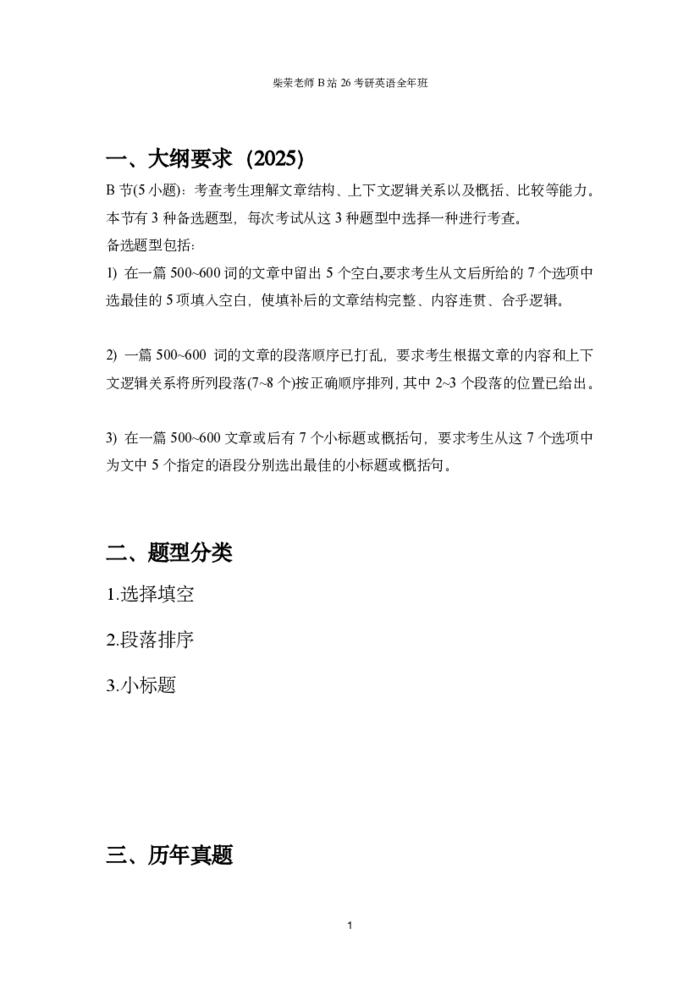
一、大纲要求(2025)
B 节(5 小题):考查考生理解文章结构、上下文逻辑关系以及概括、比较等能力。
本节有3 种备选题型,每次考试从这3 种题型中选择一种进行考查。
备选题型包括:
1) 在一篇500~600 词的文章中留出5 个空白,要求考生从文后所给的7 个选项中
选最佳的5 项填入空白,使填补后的文章结构完整、内容连贯、合乎逻辑。
2) 一篇500~600 词的文章的段落顺序已打乱,要求考生根据文章的内容和上下
文逻辑关系将所列段落(7~8 个)按正确顺序排列,其中2~3 个段落的位置已给出。
3) 在一篇500~600 文章或后有7 个小标题或概括句,要求考生从这7 个选项中
为文中5 个指定的语段分别选出最佳的小标题或概括句。
二、题型分类
1.选择填空
2.段落排序
3.小标题
三、历年真题
柴荣老师B 站26 考研英语全年班
2
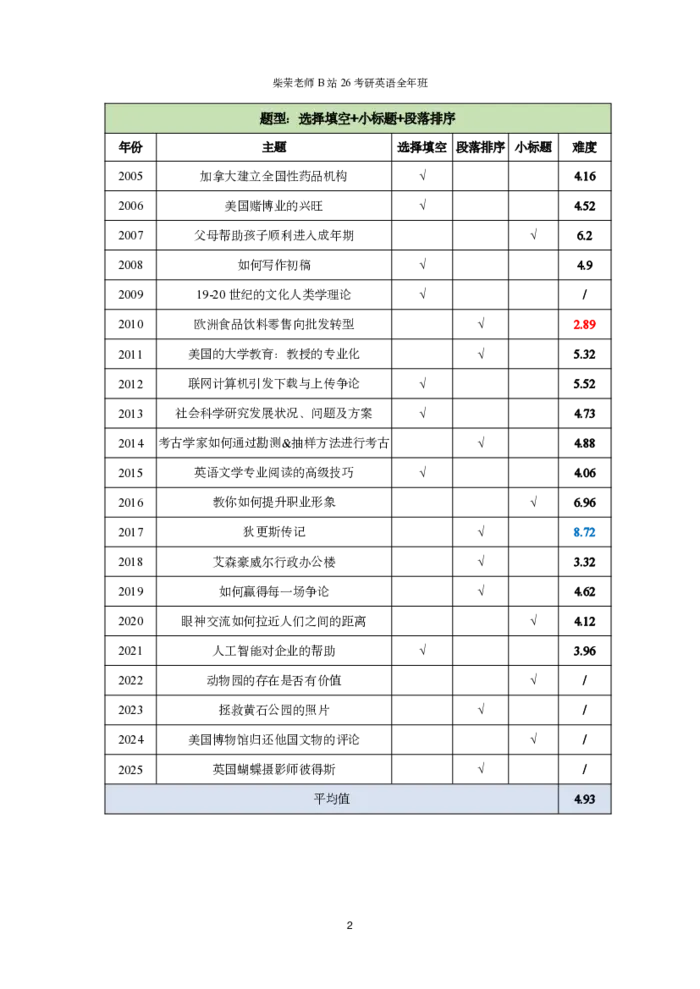
题型:选择填空+小标题+段落排序
年份
主题
选择填空段落排序小标题
难度
2005
加拿大建立全国性药品机构
√
4.16
2006
美国赌博业的兴旺
√
4.52
2007
父母帮助孩子顺利进入成年期
√
6.2
2008
如何写作初稿
√
4.9
2009
19-20 世纪的文化人类学理论
√
/
2010
欧洲食品饮料零售向批发转型
√
2.89
2011
美国的大学教育:教授的专业化
√
5.32
2012
联网计算机引发下载与上传争论
√
5.52
2013
社会科学研究发展状况、问题及方案
√
4.73
2014
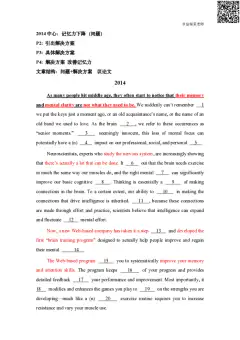
考古学家如何通过勘测&抽样方法进行考古
√
4.88
2015
英语文学专业阅读的高级技巧
√
4.06
2016
教你如何提升职业形象
√
6.96
2017
狄更斯传记
√
8.72
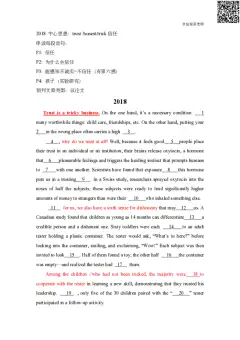
2018
艾森豪威尔行政办公楼
√
3.32
2019
如何赢得每一场争论
√
4.62
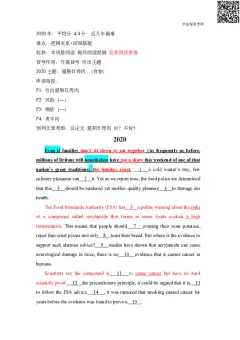
2020
眼神交流如何拉近人们之间的距离
√
4.12
2021
人工智能对企业的帮助
√
3.96
2022
动物园的存在是否有价值
√
/
2023
拯救黄石公园的照片
√
/
2024
美国博物馆归还他国文物的评论
√
/
2025
英国蝴蝶摄影师彼得斯
√
/
平均值
4.93
柴荣老师B 站26 考研英语全年班
3
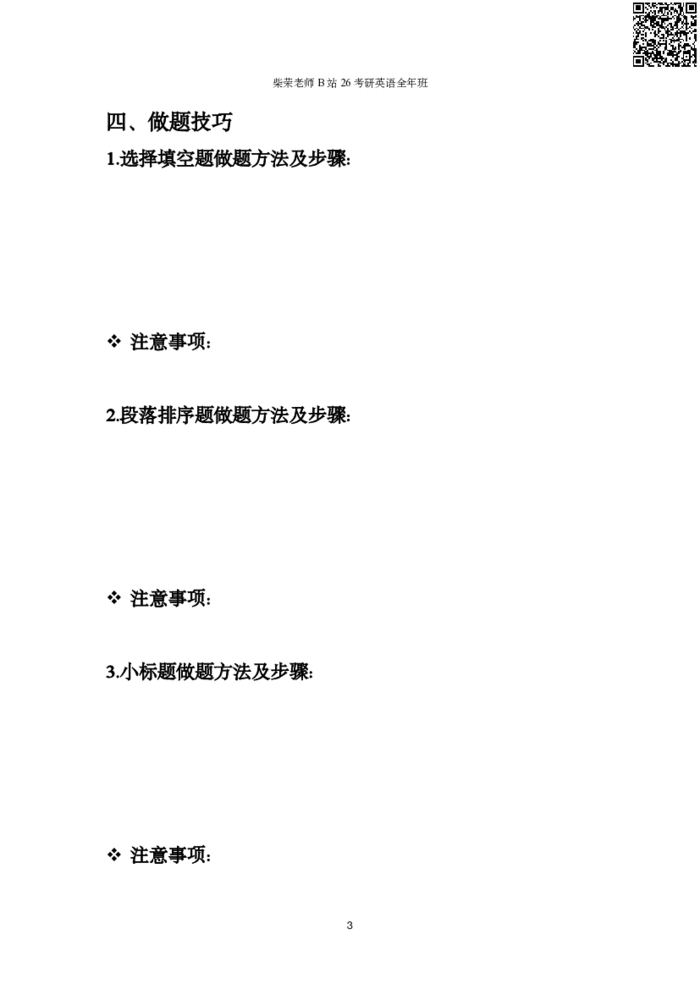
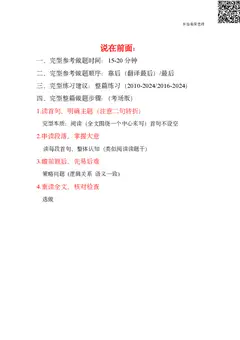
四、做题技巧
1.选择填空题做题方法及步骤:
注意事项:
2.段落排序题做题方法及步骤:
注意事项:
3.小标题做题方法及步骤:
注意事项:
柴荣老师B 站26 考研英语全年班
4
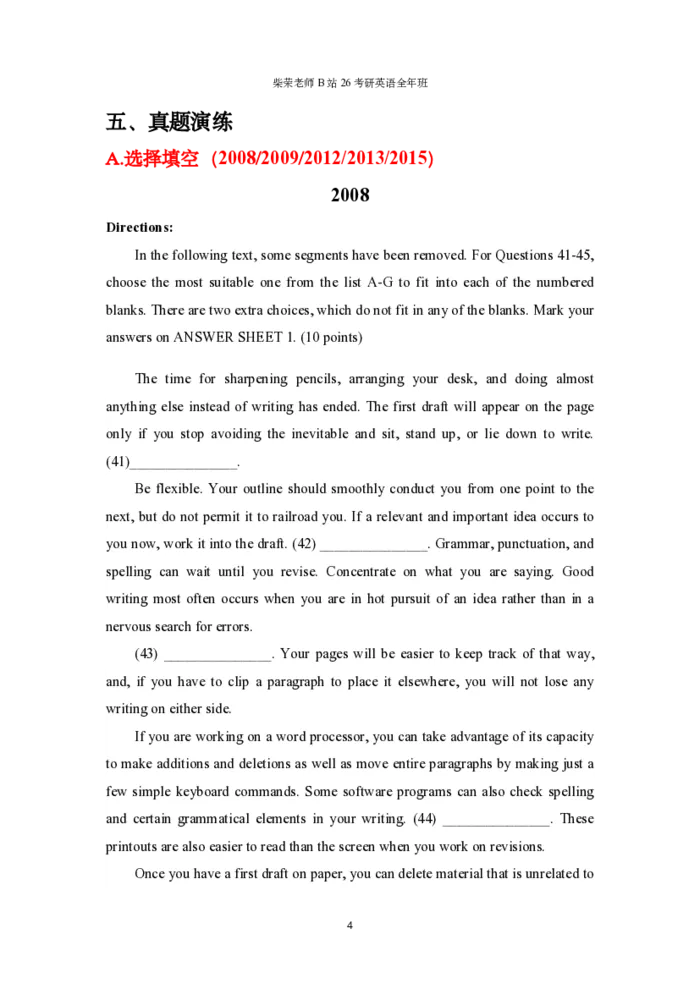
五、真题演练
A.选择填空(2008/2009/2012/2013/2015)
2008
Directions:
In the following text, some segments have been removed. For Questions 41-45,
choose the most suitable one from the list A-G to fit into each of the numbered
blanks. There are two extra choices, which do not fit in any of the blanks. Mark your
answers on ANSWER SHEET 1. (10 points)
The time for sharpening pencils, arranging your desk, and doing almost
anything else instead of writing has ended. The first draft will appear on the page
only if you stop avoiding the inevitable and sit, stand up, or lie down to write.
(41)_______________.
Be flexible. Your outline should smoothly conduct you from one point to the
next, but do not permit it to railroad you. If a relevant and important idea occurs to
you now, work it into the draft. (42) _______________. Grammar, punctuation, and
spelling can wait until you revise. Concentrate on what you are saying. Good
writing most often occurs when you are in hot pursuit of an idea rather than in a
nervous search for errors.
(43) _______________. Your pages will be easier to keep track of that way,
and, if you have to clip a paragraph to place it elsewhere, you will not lose any
writing on either side.
If you are working on a word processor, you can take advantage of its capacity
to make additions and deletions as well as move entire paragraphs by making just a
few simple keyboard commands. Some software programs can also check spelling
and certain grammatical elements in your writing. (44) _______________. These
printouts are also easier to read than the screen when you work on revisions.
Once you have a first draft on paper, you can delete material that is unrelated to
柴荣老师B 站26 考研英语全年班
5
your thesis and add material necessary to illustrate your points and make your paper
convincing. The student who wrote “The A&P as a State of Mind” wisely dropped a
paragraph that questioned whether Sammy displays chauvinistic attitudes toward
women. (45) _______________.
Remember that your initial draft is only that. You should go through the paper
many times— and then again—working to substantiate and clarify your ideas. You
may even end up with several entire versions of the paper. Rewrite. The sentences
within each paragraph should be related to a single topic. Transitions should connect
one paragraph to the next so that there are no abrupt or confusing shifts. Awkward
or wordy phrasing or unclear sentences and paragraphs should be mercilessly poked
and prodded into shape.
[A] To make revising easier, leave wide margins and extra space between lines so
that you can easily add words, sentences and corrections. Write on only one side of
the paper.
[B] After you have already and adequately developed the body of your paper, pay
particular attention to the introductory and concluding paragraphs. It’s probably best
to write the introduction last, after you know precisely what you are introducing.
Concluding paragraphs demand equal attention because they leave the reader with a
final impression.
[C] It’s worth remembering, however, that though a clean copy fresh off a printer
may look terrific, it will read only as well as the thinking and writing that have gone
into it. Many writers prudently store their data on disks and print their pages each
time they finish a draft to avoid losing any material because of power failures or
other problems.
[D] It makes no difference how you write, just so you do. Now that you have
developed a topic into a tentative thesis, you can assemble your notes and begin to
flesh out whatever outline you have made.
柴荣老师B 站26 考研英语全年班
6
[E] Although this is an interesting issue, it has nothing to do with the thesis,
which explains how the setting influences Sammy’s decision to quit his job. Instead
of including that paragraph, she added one that described Lengel’s crabbed response
to the girls so that she could lead up to the A & P “policy” he enforces.
[F] In the final paragraph about the significance of the setting in “A&P” the
student brings together the reasons Sammy quit his job by referring to his refusal to
accept Lengel’s store policies.
[G] By using the first draft as a means of thinking about what you want to say,
you will very likely discover more than your notes originally suggested. Plenty of
good writers don’t use outlines at all but discover ordering principles as they write.
Do not attempt to compose a perfectly correct draft the first time around.
2009
Directions:
In the following text, some segments have been removed. For Questions 41-45,
choose the most suitable one from the list A-G to fit into each of the numbered
blanks. There are two extra choices, which do not fit in any of the blanks. Mark your
answers on ANSWER SHEET 1. (10 points)
Coinciding with the groundbreaking theory of biological evolution proposed by
British naturalist Charles Darwin in the 1860s, British social philosopher Herbert
Spencer put forward his own theory of biological and cultural evolution. Spencer
argued that all worldly phenomena, including human societies, changed over time,
advancing toward perfection. 41) ____________.
American social scientist Lewis Henry Morgan introduced another theory of
cultural evolution in the late 1800s. Morgan helped found modern anthropology—the
scientific study of human societies, customs and beliefs—thus becoming one of the
earliest anthropologists. In his work, he attempted to show how all aspects of culture
柴荣老师B 站26 考研英语全年班
7
changed together in the evolution of societies.42) _____________.
In the early 1900s in North America, German-born American anthropologist
Franz Boasdeveloped a new theory of culture known as historical particularism.
Historical particularism, which emphasized the uniqueness of all cultures, gave new
direction to anthropology. 43) _____________ .
Boas felt that the culture of any society must be understood as the result of a
unique history and not as one of many cultures belonging to a broader evolutionary
stage or type of culture. 44) _______________.
Historical particularism became a dominant approach to the study of culture in
American anthropology, largely through the influence of many students of Boas. But
a number of anthropologists in the early 1900s also rejected the particularist theory of
culture in favor of diffusionism. Some attributed virtually every important cultural
achievement to the inventions of a few, especially gifted peoples that, according to
diffusionists, then spread to other cultures. 45) ________________.
Also in the early 1900s, French sociologist Émile Durkheimdeveloped a theory
of culture that would greatly influence anthropology. Durkheim proposed that
religious beliefs functioned to reinforce social solidarity. An interest in the
relationship between the function of society and culture became a major theme in
European, and especially British, anthropology.
[A] Other anthropologists believed that cultural innovations, such as inventions,
had a single origin and passed from society to society. This theory was known as
diffusionism.
[B] In order to study particular cultures as completely as possible, he became
skilled in linguistics, the study of languages, and in physical anthropology, the study
of human biology and anatomy.
[C] He argued that human evolution was characterized by a struggle he called the
“survival of the fittest,” in which weaker races and societies must eventually be
柴荣老师B 站26 考研英语全年班
8
replaced by stronger, more advanced races and societies.
[D] They also focused on important rituals that appeared to preserve a people’s
social structure, such as initiation ceremonies that formally signify children’s entrance
into adulthood.
[E] Thus, in his view, diverse aspects of culture, such as the structure of families,
forms of marriage, categories of kinship, ownership of property, forms of government,
technology, and systems of food production, all changed as societies evolved.
[F]Supporters of the theory viewed culture as a collection of integrated parts that
work together to keep a society functioning.
[G] For example, British anthropologists Grafton Elliot Smith and W. J. Perry
incorrectly suggested, on the basis of inadequate information, that farming, pottery
making, and metallurgy all originated in ancient Egypt and diffused throughout the
world. In fact, all of these cultural developments occurred separately at different times
in many parts of the world.
2012
Directions:
In the following text, some segments have been removed. For Questions 41-45,
choose the most suitable one from the list A-G to fit into each of the numbered
blanks. There are two extra choices, which do not fit in any of the blanks. Mark your
answers on ANSWER SHEET 1. (10 points)
Think of those fleeting moments when you look out of an aeroplane window and
realise that you are flying, higher than a bird. Now think of your laptop, thinner than a
brown-paper envelope, or your cellphone in the palm of your hand. Take a moment or
two to wonder at those marvels. You are the lucky inheritor of a dream come true.
The second half of the 20th century saw a collection of geniuses, warriors,
柴荣老师B 站26 考研英语全年班
9
entrepreneurs and visionaries labour to create a fabulous machine that could function
as a typewriter and printing press, studio and theatre, paintbrush and gallery, piano
and radio, the mail as well as the mail carrier. (41) __________.
The networked computer is an amazing device, the first media machine that
serves as the mode of production, means of distribution, site of reception, and place of
praise and critique. The computer is the 21st century’s culture machine.
But for all the reasons there are to celebrate the computer, we must also act with
caution. (42) _________ I call it a secret war for two reasons. First, most people do
not realise that there are strong commercial agendas at work to keep them in passive
consumption mode. Second, the majority of people who use networked computers to
upload are not even aware of the significance of what they are doing.
All animals download, but only a few upload. Beavers build dams and birds
make nests. Yet for the most part, the animal kingdom moves through the world
downloading. Humans are unique in their capacity to not only make tools but then
turn around and use them to create superfluous material goods—paintings, sculpture
and architecture—and superfluous experiences—music, literature, religion and
philosophy. (43) _________.
For all the possibilities of our new culture machines, most people are still stuck
in download mode. Even after the advent of widespread social media, a pyramid of
production remains, with a small number of people uploading material, a slightly
larger group commenting on or modifying that content, and a huge percentage
remaining content to just consume. (44) _________.
Television is a one-way tap flowing into our homes. The hardest task that
television asks of anyone is to turn the power off after he has turned it on. (45)
_________.
What counts as meaningful uploading? My definition revolves around the
concept of “stickiness”—creations and experiences to which others adhere.
柴荣老师B 站26 考研英语全年班
10
[A] Of course, it is precisely these superfluous things that define human culture and
ultimately what it is to be human. Downloading and consuming culture requires
great skills, but failing to move beyond downloading is to strip oneself of a
defining constituent of humanity.
[B] Applications like tumblr.com, which allow users to combine pictures, words and
other media in creative ways and then share them, have the potential to add
stickiness by amusing, entertaining and enlightening others.
[C] Not only did they develop such a device but by the turn of the millennium they
had also managed to embed it in a worldwide system accessed by billions of
people every day.
[D] This is because the networked computer has sparked a secret war between
downloading
and
uploading—between
passive
consumption
and
active
creation—whose outcome will shape our collective future in ways we can only
begin to imagine.
[E] The challenge the computer mounts to television thus bears little similarity to one
format being replaced by another in the manner of record players being replaced
by CD players.
[F] One reason for the persistence of this pyramid of production is that for the past
half-century, much of the world’s media culture has been defined by a single
medium—television—and television is defined by downloading.
[G] The networked computer offers the first chance in 50 years to reverse the flow, to
encourage thoughtful downloading and, even more importantly, meaningful
uploading.
2013
Directions:
In the following text, some segments have been removed. For Questions 41-45,
choose the most suitable one from the list A-G to fit into each of the numbered
blanks. There are two extra choices, which do not fit in any of the blanks. Mark your
柴荣老师B 站26 考研英语全年班
11
answers on ANSWER SHEET 1. (10 points)
The social sciences are flourishing. As of 2005, there were almost half a million
professional social scientists from all fields in the world, working both inside and
outside academia. According to the World Social Science Report 2010, the number of
social-science students worldwide has swollen by about 11% every year since 2000.
Yet this enormous resource is not contributing enough to today’s global
challenges, including climate change, security, sustainable development and health.
(41) ________Humanity has the necessary agro-technological tools to eradicate
hunger, from genetically engineered crops to artificial fertilizers. Here, too, the
problems are social: the organization and distribution of food, wealth and prosperity.
(42) ________This is a shame—the community should be grasping the
opportunity to raise its influence in the real world. To paraphrase the great social
scientist Joseph Schumpeter: there is no radical innovation without creative
destruction.
Today, the social sciences are largely focused on disciplinary problems and
internal scholarly debates, rather than on topics with external impact. Analyses reveal
that the number of papers including the keywords “environmental change” or “climate
change” have increased rapidly since 2004. (43) ________
When social scientists do tackle practical issues, their scope is often local:
Belgium is interested mainly in the effects of poverty on Belgium, for example. And
whether the community’s work contributes much to an overall accumulation of
knowledge is doubtful.
The problem is not necessarily the amount of available funding. (44)
________This is an adequate amount so long as it is aimed in the right direction.
Social scientists who complain about a lack of funding should not expect more in
today’s economic climate.
The trick is to direct these funds better. The European Union Framework funding
programs have long had a category specifically targeted at social scientists. This year,
柴荣老师B 站26 考研英语全年班
12
it was proposed that the system be changed: Horizon 2020, a new program to be
enacted in 2014, would not have such a category. This has resulted in protests from
social scientists. But the intention is not to neglect social science; rather, the complete
opposite. (45) ________That should create more collaborative endeavors and help to
develop projects aimed directly at solving global problems.
[A] It could be that we are evolving two communities of social scientists: one that is
discipline-oriented and publishing in highly specialized journals, and one that is
problem-oriented and publishing elsewhere, such as policy briefs.
[B] However, the numbers are still small: in 2010, about 1,600 of the 100,000
social-sciences papers published globally included one of these keywords.
[C] The idea is to force social scientists to integrate their work with other categories,
including health and demographic change; food security; marine research and the
bio-economy; clean, efficient energy; and inclusive, innovative and secure
societies.
[D] The solution is to change the mindset of the academic community, and what it
considers to be its main goal. Global challenges and social innovation ought to
receive much more attention from scientists, especially the young ones.
[E] These issues all have root causes in human behavior: all require behavioral change
and social innovations, as well as technological development. Stemming climate
change, for example, is as much about changing consumption patterns and
promoting tax acceptance as it is about developing clean energy.
[F] Despite these factors, many social scientists seem reluctant to tackle such
problems. And in Europe, some are up in arms over a proposal to drop a specific
funding category for social-science research and to integrate it within
cross-cutting topics of sustainable development.
[G] During the late 1990s, national spending on social sciences and the humanities as
a percentage of all research and development funds — including government,
higher education, non-profit and corporate—varied from around 4% to 25%; in
柴荣老师B 站26 考研英语全年班
13
most European nations, it is about 15%.
2015
Directions:
In the following text, some segments have been removed. For Questions 41-45,
choose the most suitable one from the list A-G to fit into each of the numbered
blanks. There are two extra choices, which do not fit in any of the blanks. Mark your
answers on ANSWER SHEET 1. (10 points)
How does your reading proceed? Clearly you try to comprehend, in the sense of
identifying meanings for individual words and working out relationships between
them, drawing on your implicit knowledge of English grammar. (41) ________ You
begin to infer a context for the text, for instance, by making decisions about what kind
of speech event is involved: Who is making the utterance, to whom, when and where.
The ways of reading indicated here are without doubt kinds of comprehension.
But they show comprehension to consist not just of passive assimilation but of active
engagement in inference and problem-solving. You infer information you feel the
writer has invited you to grasp by presenting you with specific evidence and clues.
(42) ________
Conceived in this way, comprehension will not follow exactly the same track for
each reader. What is in question is not the retrieval of an absolute, fixed or “true”
meaning that can be read off and checked for accuracy, or some timeless relation of
the text to the world. (43) ________
Such background material inevitably reflects who we are. (44) ________This
doesn’t, however, make interpretation merely relative or even pointless. Precisely
because readers from different historical periods, places and social experiences
produce different but overlapping readings of the same words on the page—including
for texts that engage with fundamental human concerns—debates about texts can play
柴荣老师B 站26 考研英语全年班
14
an important role in social discussion of beliefs and values.
How we read a given text also depends to some extent on our particular interest
in reading it. (45) ________ Such dimensions of reading suggest — as others
introduced later in the book will also do — that we bring an implicit (often
unacknowledged) agenda to any act of reading. It doesn’t then necessarily follow that
one kind of reading is fuller, more advanced or more worthwhile than another. Ideally,
different kinds of reading inform each other, and act as useful reference points for and
counterbalances to one another. Together, they make up the reading component of
your overall literacy, or relationship to your surrounding textual environment.
[A] Are we studying that text and trying to respond in a way that fulfils the
requirement of a given course? Reading it simply for pleasure? Skimming it for
information? Ways of reading on a train or in bed are likely to differ
considerably from reading in a seminar room.
[B] Factors such as the place and period in which we are reading, our gender,
ethnicity, age and social class will encourage us towards certain interpretations
but at the same time obscure or even close off others.
[C] If you are unfamiliar with words or idioms, you guess at their meaning, using
clues presented in the context. On the assumption that they will become relevant
later, you make a mental note of discourse entities as well as possible links
between them.
[D] In effect, you try to reconstruct the likely meanings or effects that any given
sentence, image or reference might have had: These might be the ones the author
intended.
[E] You make further inferences, for instance, about how the text may be significant
to you, or about its validity — inferences that form the basis of a personal
response for which the author will inevitably be far less responsible.
[F] In plays, novels and narrative poems, characters speak as constructs created by the
author, not necessarily as mouthpieces for the author’s own thoughts.
柴荣老师B 站26 考研英语全年班
15
[G] Rather, we ascribe meanings to texts on the basis of interaction between what we
might call textual and contextual material: between kinds of organization or
patterning we perceive in a text’s formal structures (so especially its language
structures) and various kinds of background, social knowledge, belief and
attitude that we bring to the text.
B.段落排序题(2010/2011/2014/2017/2018/2019)
2010
Directions:
For questions 41-45, choose the most suitable paragraphs from the list A-G and fill
them into the numbered boxes to form a coherent text. Paragraph E has been
correctly placed. There is one paragraph which does not fit in with the text. Mark your
answers on ANSWER SHEET1. (10 points)
[A] The first and more important is the consumer’s growing preference for eating out;
the consumption of food and drink in places other than homes has risen from
about 32 percent of total consumption in 1995 to 35 percent in 2000 and is
expected to approach 38 percent by 2005. This development is boosting
wholesale demand from the food service segment by 4 to 5 percent a year across
Europe, compared with growth in retail demand of 1 to 2 percent. Meanwhile, as
the recession is looming large, people are getting anxious. They tend to keep a
tighter hold on their purse and consider eating at home a realistic alternative.
[B] Retail sales of food and drink in Europe’s largest markets are at a standstill,
leaving European grocery retailers hungry for opportunities to grow. Most
leading retailers have already tried e-commerce, with limited success, and
expansion abroad. But almost all have ignored the big, profitable opportunity in
their own backyard: the wholesale food and drink trade, which appears to be just
the kind of market retailers need.
柴荣老师B 站26 考研英语全年班
16
[C] Will such variations bring about a change in the overall structure of the food and
drink market? Definitely not. The functioning of the market is based on flexible
trends dominated by potential buyers. In other words, it is up to the buyer, rather
than the seller, to decide what to buy. At any rate, this change will ultimately be
acclaimed by an ever-growing number of both domestic and international
consumers, regardless of how long the current consumer pattern will take hold.
[D] All in all, this clearly seems to be a market in which big retailers could profitably
apply their gigantic scale, existing infrastructure, and proven skills in the
management of product ranges, logistics, and marketing intelligence. Retailers
that master the intricacies of wholesaling in Europe may well expect to rake in
substantial profits thereby. At least, that is how it looks as a whole. Closer
inspection reveals important differences among the biggest national markets,
especially in their customer segments and wholesale structures, as well as the
competitive dynamics of individual food and drink categories. Big retailers must
understand these differences before they can identify the segments of European
wholesaling in which their particular abilities might unseat smaller but
entrenched competitors. New skills and unfamiliar business models are needed
too.
[E] Despite variations in detail, wholesale markets in the countries that have been
closely examined—France, Germany, Italy, and Spain—are made out of the
same building blocks. Demand comes mainly from two sources: independent
mom-and-pop grocery stores which, unlike large retail chains, are too small to
buy straight from producers, and food service operators that cater to consumers
when they don’t eat at home. Such food service operators range from snack
machines to large institutional catering ventures, but most of these businesses are
known in the trade as “horeca”: hotels, restaurants, and cafés. Overall, Europe’s
wholesale market for food and drink is growing at the same sluggish pace as the
retail market, but the figures, when added together, mask two opposing trends.
柴荣老师B 站26 考研英语全年班
17
[F] For example, wholesale food and drink sales came to $268 billion in France,
Germany, Italy, Spain, and the United Kingdom in 2000—more than 40 percent
of retail sales. Moreover, average overall margins are higher in wholesale than in
retail; wholesale demand from the food service sector is growing quickly as more
Europeans eat out more often; and changes in the competitive dynamics of this
fragmented industry are at last making it feasible for wholesalers to consolidate.
[G] However, none of these requirements should deter large retailers (and even some
large food producers and existing wholesalers) from trying their hand, for those
that master the intricacies of wholesaling in Europe stand to reap considerable
gains.
41.
→42.
→43.
→44.
→E
→45.
2011
Directions:
The following paragraphs are given in a wrong order. For questions 41-45, you are
required to reorganize these paragraphs into a coherent text by choosing from the list
A-G and filling them into the numbered boxes. Paragraphs E and G have been
correctly placed. Mark your answers on ANSWER SHEET 1. (10 points)
[A] No disciplines have seized on professionalism with as much enthusiasm as the
humanities. You can, Mr Menand points out, become a lawyer in three years and
a medical doctor in four. But the regular time it takes to get a doctoral degree in
the humanities is nine years. Not surprisingly, up to half of all doctoral students
in English drop out before getting their degrees.
[B] His concern is mainly with the humanities: literature, languages, philosophy and
so on. These are disciplines that are going out of style: 22% of American college
graduates now major in business compared with only 2% in history and 4% in
English.
However,
many
leading
American
universities
want
their
柴荣老师B 站26 考研英语全年班
18
undergraduates to have a grounding in the basic canon of ideas that every
educated person should possess. But most find it difficult to agree on what a
“general education” should look like. At Harvard, Mr Menand notes, “the great
books are read because they have been read”—they form a sort of social glue.
[C] Equally unsurprisingly, only about half end up with professorships for which they
entered graduate school. There are simply too few posts. This is partly because
universities continue to produce ever more PhDs. But fewer students want to
study humanities subjects: English departments awarded more bachelor’s
degrees in 1970-71 than they did 20 years later. Fewer students require fewer
teachers. So, at the end of a decade of thesis-writing, many humanities students
leave the profession to do something for which they have not been trained.
[D] One reason why it is hard to design and teach such courses is that they cut across
the insistence by top American universities that liberal-arts education and
professional education should be kept separate, taught in different schools. Many
students experience both varieties. Although more than half of Harvard
undergraduates end up in law, medicine or business, future doctors and lawyers
must
study
a non-specialist
liberal-arts degree
before
embarking
on
a
professional qualification.
[E] Besides professionalising the professions by this separation, top American
universities have professionalised the professor. The growth in public money for
academic research has speeded the process: federal research grants rose fourfold
between 1960 and 1990, but faculty teaching hours fell by half as research took
its toll. Professionalism has turned the acquisition of a doctoral degree into a
prerequisite for a successful academic career: as late as 1969 a third of American
professors did not possess one. But the key idea behind professionalisation,
argues Mr Menand, is that “the knowledge and skills needed for a particular
specialisation are transmissible but not transferable.” So disciplines acquire a
monopoly not just over the production of knowledge, but also over the
production of the producers of knowledge.
柴荣老师B 站26 考研英语全年班
19
[F] The key to reforming higher education, concludes Mr Menand, is to alter the way
in which “the producers of knowledge are produced”. Otherwise, academics will
continue to think dangerously alike, increasingly detached from the societies
which they study, investigate and criticise. “Academic inquiry, at least in some
fields, may need to become less exclusionary and more holistic.” Yet quite how
that happens, Mr Menand does not say.
[G] The subtle and intelligent little book The Marketplace of Ideas: Reform and
Resistance in the American University should be read by every student thinking
of applying to take a doctoral degree. They may then decide to go elsewhere. For
something curious has been happening in American universities, and Louis
Menand, a professor of English at Harvard University, captured it skillfully.
G →41. _______ →42. _______ →E →43. _______ →44. _______→45. _______
2014
Directions:
The following paragraphs are given in a wrong order. For Questions 41-45, you are
required to reorganize these paragraphs into a coherent text by choosing from the list
A-G and filling them into the numbered boxes. Paragraphs A and E have been
correctly placed. Mark your answers on the ANSWER SHEET. (10 points)
[A] Some archaeological sites have always been easily observable—for example, the
Parthenon in Athens, Greece; the pyramids of Giza in Egypt; and the megaliths
of Stonehenge in southern England. But these sites are exceptions to the norm.
Most archaeological sites have been located by means of careful searching, while
many others have been discovered by accident. Olduvai Gorge, an early hominid
site in Tanzania, was found by a butterfly hunter who literally fell into its deep
valley in 1911. Thousands of Aztec artifacts came to light during the digging of
the Mexico City subway in the 1970s.
[B] In another case, American archaeologists René Million and George Cowgill spent
柴荣老师B 站26 考研英语全年班
20
years systematically mapping the entire city of Teotihuacán in the Valley of
Mexico near what is now Mexico City. At its peak around AD 600, this city was
one of the largest human settlements in the world. The researchers mapped not
only the city’s vast and ornate ceremonial areas, but also hundreds of simpler
apartment complexes where common people lived.
[C] How do archaeologists know where to find what they are looking for when there
is nothing visible on the surface of the ground? Typically, they survey and
sample (make test excavations on) large areas of terrain to determine where
excavation will yield useful information. Surveys and test samples have also
become
important
for
understanding
the
larger
landscapes that
contain
archaeological sites.
[D] Surveys can cover a single large settlement or entire landscapes. In one case,
many researchers working around the ancient Maya city of Copán, Honduras,
have located hundreds of small rural villages and individual dwellings by using
aerial photographs and by making surveys on foot. The resulting settlement maps
show how the distribution and density of the rural population around the city
changed dramatically between AD 500 and 850, when Copán collapsed.
[E] To find their sites, archaeologists today rely heavily on systematic survey methods
and a variety of high-technology tools and techniques. Airborne technologies,
such as different types of radar and photographic equipment carried by airplanes
or spacecraft, allow archaeologists to learn about what lies beneath the ground
without digging. Aerial surveys locate general areas of interest or larger buried
features, such as ancient buildings or fields.
[F] Most archaeological sites, however, are discovered by archaeologists who have set
out to look for them. Such searches can take years. British archaeologist Howard
Carter knew that the tomb of the Egyptian pharaoh Tutankhamun existed from
information found in other sites. Carter sifted through rubble in the Valley of the
Kings for seven years before he located the tomb in 1922. In the late 1800s
British archaeologist Sir Arthur Evans combed antique dealers’ stores in Athens,
柴荣老师B 站26 考研英语全年班
21
Greece. He was searching for tiny engraved seals attributed to the ancient
Mycenaean culture that dominated Greece from the 1400s to 1200s BC. Evans’s
interpretations of these engravings eventually led him to find the Minoan palace
at Knossos (Knosós), on the island of Crete, in 1900.
[G] Ground surveys allow archaeologists to pinpoint the places where digs will be
successful. Most ground surveys involve a lot of walking, looking for surface
clues such as small fragments of pottery. They often include a certain amount of
digging to test for buried materials at selected points across a landscape.
Archaeologists also may locate buried remains by using such technologies as
ground radar, magnetic-field recording, and metal detectors. Archaeologists
commonly use computers to map sites and the landscapes around sites. Two- and
three-dimensional maps are helpful tools in planning excavations, illustrating
how sites look, and presenting the results of archaeological research.
41. ______ →A →42. ______ →E →43. ______ →44. ______ →45. ______
2017
A. The first published sketch, “A Dinner at Poplar Walk” brought tears to Dickens’s
eyes when he discovered it in the pages of The Monthly Magazine. From then on
his sketches, which appeared under the pen name “Boz” in The Evening
Chronicle, earned him a modest reputation.
B. The runaway success of The Pickwick Papers, as it is generally known today,
secured Dickens’s fame. There were Pickwick coats and Pickwick cigars, and the
plump, spectacled hero, Samuel Pickwick, became a national figure.
C. Soon after Sketches by Boz appeared, a publishing firm approached Dickens to
write a story in monthly installments, as a backdrop for a series of woodcuts by
the then-famous artist Robert Seymour, who had originated the idea for the story.
With characteristic confidence, Dickens successfully insisted that Seymour’s
pictures illustrate his own story instead. After the first installment, Dickens wrote
柴荣老师B 站26 考研英语全年班
22
to the artist and asked him to correct a drawing Dickens felt was not faithful
enough to his prose. Seymour made the change, went into his backyard, and
expressed his displeasure by committing suicide. Dickens and his publishers
simply pressed on with a new artist. The comic novel, The Posthumous Papers of
the Pickwick Club, appeared serially in 1836 and 1837 and was first published in
book form in 1837.
D. Charles Dickens is probably the best-known and, to many people, the greatest
English novelist of the 19th century. A moralist, satirist, and social reformer,
Dickens crafted complex plots and striking characters that capture the panorama
of English society.
E. Soon after his father’s release from prison, Dickens got a better job as errand boy
in law offices. He taught himself shorthand to get an even better job later as a
court stenographer and as a reporter in Parliament. At the same time, Dickens,
who had a reporter’s eye for transcribing the life around him, especially anything
comic or odd, submitted short sketches to obscure magazines.
F. Dickens was born in Portsmouth, on England’s southern coast. His father was a
clerk in the British Navy pay office—a respectable position, but with little social
status. His paternal grandparents, a steward and a housekeeper, possessed even
less status, having been servants, and Dickens later concealed their background.
Dicken’s mother supposedly came from a more respectable family. Yet two
years before Dicken’s birth, his mother’s father was caught stealing and fled to
Europe, never to return. The family’s increasing poverty forced Dickens out of
school at age 12 to work in Warren’s Blacking Warehouse, a shoe-polish factory,
where the other working boys mocked him as “the young gentleman.” His father
was then imprisoned for debt. The humiliations of his father’s imprisonment and
his labor in the blacking factory formed Dickens’s greatest wound and became
his deepest secret. He could not confide them even to his wife, although they
provide the unacknowledged foundation of his fiction.
G. After Pickwick, Dickens plunged into a bleaker world. In Oliver Twist, he traces
柴荣老师B 站26 考研英语全年班
23
an orphan’s progress from the workhouse to the criminal slums of London.
Nicholas Nickleby, his next novel, combines the darkness of Oliver Twist with
the sunlight of Pickwick. The popularity of these novels consolidated Dickens’
as a nationally and internationally celebrated man of letters.
D →41. ______→42. ______ →43. ______ →44. _____ →
B
→45. _____
2018
A. In December of 1869, Congress appointed a commission to select a site and
prepare plans and cost estimates for a new State Department Building. The
commission was also to consider possible arrangements for the War and Navy
Departments. To the horror of some who expected a Greek Revival twin of the
Treasury Building to be erected on the other side of the White House, the
elaborate French Second Empire style design by Alfred Mullett was selected, and
construction of a building to house all three departments began in June of 1871.
B. Completed in 1875, the State Department’s south wing was the first to be occupied,
with its elegant four-story library (completed in 1876), Diplomatic Reception
Room, and Secretary’s office decorated with carved wood, Oriental rugs, and
stenciled wall patterns. The Navy Department moved into the east wing in 1879,
where elaborate wall and ceiling stenciling and marquetry floors decorated the
office of the Secretary.
C. The State, War, and Navy Building, as it was originally known, housed the three
Executive Branch Departments most intimately associated with formulating and
conducting the nation’s foreign policy in the last quarter of the nineteenth
century and the first quarter of the twentieth century—the period when the
United States emerged as an international power. The building has housed some
of the nation's most significant diplomats and politicians and has been the scene
of many historic events.
柴荣老师B 站26 考研英语全年班
24
D. Many of the most celebrated national figures have participated in historical events
that have taken place within the EEOB’s granite walls. Theodore and Franklin D.
Roosevelt, William Howard Taft, Dwight D. Eisenhower, Lyndon B. Johnson,
Gerald Ford, and George H. W. Bush all had offices in this building before
becoming President. It has housed 16 Secretaries of the Navy, 21 Secretaries of
War, and 24 Secretaries of State. Winston Churchill once walked its corridors
and Japanese emissaries met here with Secretary of State Cordell Hull after the
bombing of Pearl Harbor.
E. The Eisenhower Executive Office Building (EEOB) commands a unique position
in both the national history and the architectural heritage of the United States.
Designed by Supervising Architect of the Treasury, Alfred B. Mullett, it was
built from 1871 to 1888 to house the growing staffs of the State, War, and Navy
Departments, and is considered one of the best examples of French Second
Empire architecture in the country.
F. Construction took 17 years as the building slowly rose wing by wing. When the
EEOB was finished, it was the largest office building in Washington, with nearly
2 miles of black and white tiled corridors. Almost all of the interior detail is of
cast iron or plaster; the use of wood was minimized to insure fire safety. Eight
monumental curving staircases of granite with over 4,000 individually cast
bronze balusters are capped by four skylight domes and two stained glass
rotundas.
G. The history of the EEOB began long before its foundations were laid. The first
executive offices were constructed between 1799 and 1820. A series of fires
(including those set by the British in 1814) and overcrowded conditions led to
the construction of the existing Treasury Building. In 1866, the construction of
the North Wing of the Treasury Building necessitated the demolition of the State
Department building.
41.______→C →42. ______→43. ______→F →44. ______→45. ______
柴荣老师B 站26 考研英语全年班
25
2019
[A] These tools can help you win every argument — not in the unhelpful sense of
beating your opponents but in the better sense of learning about the issues that
divide people, learning why they disagree with us and learning to talk and work
together with them. If we readjust our view of arguments—from a verbal fight or
tennis game to a reasoned exchange through which we all gain mutual respect and
understanding— then we change the very nature of what it means to “win” an
argument.
[B] In his 1936 work How to Win Friends and Influence People, Dale Carnegie wrote:
“There is only one way... to get the best of an argument—and that is to avoid it.”
This aversion to arguments is common, but it depends on a mistaken view of
arguments that causes profound problems for our personal and social lives—and
in many ways misses the point of arguing in the first place.
[C] None of these will be easy, but you can start even if others refuse to. Next time
you state your position, formulate an argument for what you claim and honestly
ask yourself whether your argument is any good. Next time you talk with someone
who takes a stand, ask them to give you a reason for their view. Spell out their
argument fully and charitably. Assess its strength impartially. Raise objections
and listen carefully to their replies.
[D] Of course, many discussions are not so successful. Still, we need to be careful not
to accuse opponents of bad arguments too quickly. We need to learn how to
evaluate them properly. A large part of evaluation is calling out bad arguments,
but we also need to admit good arguments by opponents and to apply the same
critical standards to ourselves. Humility requires you to recognize weaknesses in
your own arguments and sometimes also to accept reasons on the opposite side.
[E] There is a better way to win arguments. Imagine that you favor increasing the
minimum wage in our state, and I do not. If you yell, “Yes,” and I yell, “No,”
neither of us learns anything. We neither understand nor respect each other, and
we have no basis for compromise or cooperation. In contrast, suppose you give a
柴荣老师B 站26 考研英语全年班
26
reasonable argument: that full-time workers should not have to live in poverty.
Then I counter with another reasonable argument: that a higher minimum wage
will force businesses to employ fewer people for less time. Now we can
understand each other’s positions and recognize our shared values, since we both
care about needy workers.
[F] These views of arguments also undermine reason. If you see a conversation as a
fight or competition, you can win by cheating as long as you don’t get caught.
You will be happy to convince people with bad arguments. You can call their
views stupid, or joke about how ignorant they are. None of these tricks will help
you understand them, their positions or the issues that divide you, but they can
help you win—in one way.
[G] Carnegie would be right if arguments were fights, which is how we often think of
them. Like physical fights, verbal fights can leave both sides bloodied. Even when
you win, you end up no better off. Your prospects would be almost as dismal if
arguments were even just competitions — like, say, tennis games. Pairs of
opponents hit the ball back and forth until one winner emerges from all who
entered. Everybody else loses. This kind of thinking is why so many people try to
avoid arguments, especially about politics and religion.
41.______ 42. ______ →F →43. ______→44. ______ →C →45. ______
C.小标题(2007/2016/2020)
2007
Directions:
You are going to read a list of headings and a text about what parents are
supposed to do to guide their children into adulthood. Choose a heading from the list
A-G that best fits the meaning of each numbered part of the text (41-45). The first
and last paragraphs of the text are not numbered. There are two extra headings that
you do not need to use. Mark your answers on ANSWER SHEET 1. (10 points)
柴荣老师B 站26 考研英语全年班
27
[A] Set a Good Example for Your Kids
[B] Build Your Kids’ Work Skills
[C] Place Time Limits on Leisure Activities
[D] Talk about the Future on a Regular Basis
[E] Help Kids Develop Coping Strategies
[F] Help Your Kids Figure Out Who They Are
[G] Build Your Kids’ Sense of Responsibility
How Can a Parent Help?
Mothers and fathers can do a lot to ensure a safe landing in early adulthood for
their kids. Even if a job’s starting salary seems too small to satisfy an emerging
adult’s need for rapid content, the transition from school to work can be less of a
setback if the start-up adult is ready for the move. Here are a few measures, drawn
from my book Ready or Not, Here Life Comes, that parents can take to prevent what
I call “work-life unreadiness”:
41.
You can start this process when they are 11 or 12. Periodically review their
emerging strengths and weaknesses with them and work together on any
shortcomings, like difficulty in communicating well or collaborating. Also, identify
the kinds of interests they keep coming back to, as these offer clues to the careers
that will fit them best.
42.
Kids need a range of authentic role models—as opposed to members of their
clique, pop stars and vaunted athletes. Have regular dinner-table discussions about
people the family knows and how they got where they are. Discuss the joys and
downsides of your own career and encourage your kids to form some ideas about
their own future. When asked what they want to do, they should be discouraged
from saying “I have no idea.” They can change their minds 200 times, but having
only a foggy view of the future is of little good.
43.
柴荣老师B 站26 考研英语全年班
28
Teachers are responsible for teaching kids how to learn; parents should be
responsible for teaching them how to work. Assign responsibilities around the house
and make sure homework deadlines are met. Encourage teenagers to take a part-time
job. Kids need plenty of practice delaying gratification and deploying effective
organizational skills, such as managing time and setting priorities.
44.
Playing video games encourages immediate content. And hours of watching
TV shows with canned laughter only teaches kids to process information in a
passive way. At the same time, listening through earphones to the same monotonous
beats for long stretches encourages kids to stay inside their bubble instead of
pursuing other endeavors. All these activities can prevent the growth of important
communication and thinking skills and make it difficult for kids to develop the kind
of sustained concentration they will need for most jobs.
45.
They should know how to deal with setbacks, stress and feelings of inadequacy.
They should also learn how to solve problems and resolve conflicts, ways to
brainstorm and think critically. Discussions at home can help kids practice doing
these things and help them apply these skills to everyday life situations.
What about the son or daughter who is grown but seems to be struggling and
wandering aimlessly through early adulthood? Parents still have a major role to play,
but now it is more delicate. They have to be careful not to come across as
disappointed in their child. They should exhibit strong interest and respect for
whatever currently interests their fledging adult (as naive or ill conceived as it may
seem) while becoming a partner in exploring options for the future. Most of all, these
new adults must feel that they are respected and supported by a family that
appreciates them.
2016
柴荣老师B 站26 考研英语全年班
29
Directions:
Read the following text and answer the questions by choosing the most suitable
subheading from the list A-G for each of the numbered paragraphs (41-45). There are
two extra subheadings. Mark your answers on the ANSER SHEET. (10 points)
A. Create a new image of yourself
B. Decide if the time is right
C. Have confidence in yourself
D. Understand the context
E. Work with professionals
F. Make it efficient
G. Know your goals
No matter how formal or informal the work environment, the way you present
yourself has an impact. This is especially true in the first impressions. According to
research from Princeton University, people assess your competence, trustworthiness,
and likeability in just a tenth of a second, solely based on the way you look.
The difference between today’s workplace and the “dress for success” era is that
the range of options is so much broader. Norms have evolved and fragmented. In
some settings, red sneakers or dress T-shirts can convey status; in others not so much.
Plus, whatever image we present is magnified by social-media services like LinkedIn.
Chances are, your headshots are seen much more often now than a decade or two ago.
Millennials, it seems, face the paradox of being the least formal generation yet the
most conscious of style and personal branding. It can be confusing.
So how do we navigate this? How do we know when to invest in an upgrade?
And what’s the best way to pull off one that enhances our goals?
Here are some tips:
41.
As an executive coach, I’ve seen image upgrades be particularly helpful during
transitions—when looking for a new job, stepping into a new or more public role, or
柴荣老师B 站26 考研英语全年班
30
changing work environments. If you’re in a period of change or just feeling stuck and
in a rut, now may be a good time. If you’re not sure, ask for honest feedback from
trusted friends, colleagues and professionals. Look for cues about how others perceive
you. Maybe there’s no need for an upgrade and that’s OK.
42.
Get clear on what impact you’re hoping to have. Are you looking to refresh your
image or pivot it? For one person, the goal may be to be taken more seriously and
enhance their professional image. For another, it may be to be perceived as more
approachable, or more modern and stylish. For someone moving from finance to
advertising, maybe they want to look more “SoHo.” (It’s OK to use characterizations
like that.)
43.
Look at your work environment like an anthropologist. What are the norms of
your environment? What conveys status? Who are your most important audiences?
How do the people you respect and look up to present themselves? The better you
understand the cultural context, the more control you can have over your impact.
44.
Enlist the support of professionals and share with them your goals and context.
Hire a personal stylist, or use the free styling service of a store like J. Crew. Try a hair
stylist instead of a barber. Work with a professional photographer instead of your
spouse or friend. It’s not as expensive as you might think.
45.
The point of a style upgrade isn’t to become more vain or to spend more time
fussing over what to wear. Instead, use it as an opportunity to reduce decision fatigue.
Pick a standard work uniform or a few go-to options. Buy all your clothes at once
with a stylist instead of shopping alone, one article of clothing at a time.
2020
柴荣老师B 站26 考研英语全年班
31
Directions:
Read the following text and answer the questions by choosing the most suitable
subheading form the list A-G for each of the numbered paragraphs(41-45 )There are
two extra subheadings. Mark your answers on the ANSWER SHEET. (10 points)
[A] Eye fixations are brief
[B] Too much eye contact is instinctively felt to rude
[C] Eye contact can be a friendly social signal
[D] Personality can affect how a person reacts to eye contact
[E] Biological factors behind eye contact are being investigated
[F] Most people are not comfortable holding eye contact with strangers
[G] Eye contact can also be aggressive.
In a social situation, eye contact with another person can show that you are
paying attention in a friendly way. But it can also be antagonistic such as when a
political candidate turns toward their competitor during a debate and makes eye
contact that signals hostility. Here’s what hard science reveals about eye contact:
science reveals about eye contact:
41.
We know that a typical infant will instinctively gaze into its mother’s eyes, and
she will look back. This mutual gaze is a major part of the attachment between
mother and child. In adulthood, looking someone else in a pleasant way can be a
complimentary sign of paying attention. It can catch someone’s attention in a
crowded room, “Eye contact and smile” can signal availability and confidence, a
common-sense notion supported in studies by psychologist Monica Moore.
42.
Neuroscientist Bonnie Augeung found that the hormone oxytocin increased the
amount of
eye contact from men toward the interviewer during a brief interview
when the direction of their gaze was recorded. This was also found in
柴荣老师B 站26 考研英语全年班
32
high-functioning men with some autistic spectrum symptoms, who may tend to
avoid eye contact. Specific brain regions that respond during direct gaze are being
explored by other researches, using advanced methods of brain scanning.
43.
With the use of eye-tracking technology, Julia Minson of the Harvard Kennedy
School of Government concluded that eye contact can signal very different kinds of
messages, depending on the situation. While eye contact may be a sign of
connection or trust in friendly situations, it’s more likely to be associated with
dominance or intimidation in adversarial situations. “Whether you’re a politician or
a parent, it might be helpful to keep in mind that trying to maintain eye contact may
backfire if you’re trying to convince someone who has a different set of beliefs than
you,” said Minson.
44.
When we look at a face or a picture, our eyes pause on one spot at a time, often
on the eyes or mouth. These pauses typically occur at about three per second, and
the eyes then jump to another spot, until several important points in the image are
registered like a series of snapshots. How the whole image is then assembled and
perceived is still a mystery although it is the subject of current research.
45.
In people who score high in a test of neuroticism, a personality dimension
associated with self-consciousness and anxiety, eye contact triggered more activity
associated with avoidance, according to the Finnish researcher Jari Hietanen and
colleagues. “Our findings indicate that people do not only feel different when they
are the centre of attention but that their brain reactions also differ.” A more direct
finding is that people who scored high for negative emotions like anxiety looked at
others for shorter periods of time and reported more comfortable feelings when
others did not look directly at them.
柴荣老师B 站26 考研英语全年班
33
六、参考答案
A 选择填空
2008
D G A C E
2009
C E A B G
2012
C D A F G
2013
E F B G C
2015
C E G B A
B 段落排序
2010
B F D G E A
2011
G B D E A C F
2014
C A F E G D B
2017
D F E A C B G
2018
E C G A F B D
2019
B G F E D C A
C 小标题
2007
F D B C E
2016
B G D E F
2020
C E G A D