柴荣老师26 考研英语全年班每日打卡Day 7
阅读精读
2005 Text 4
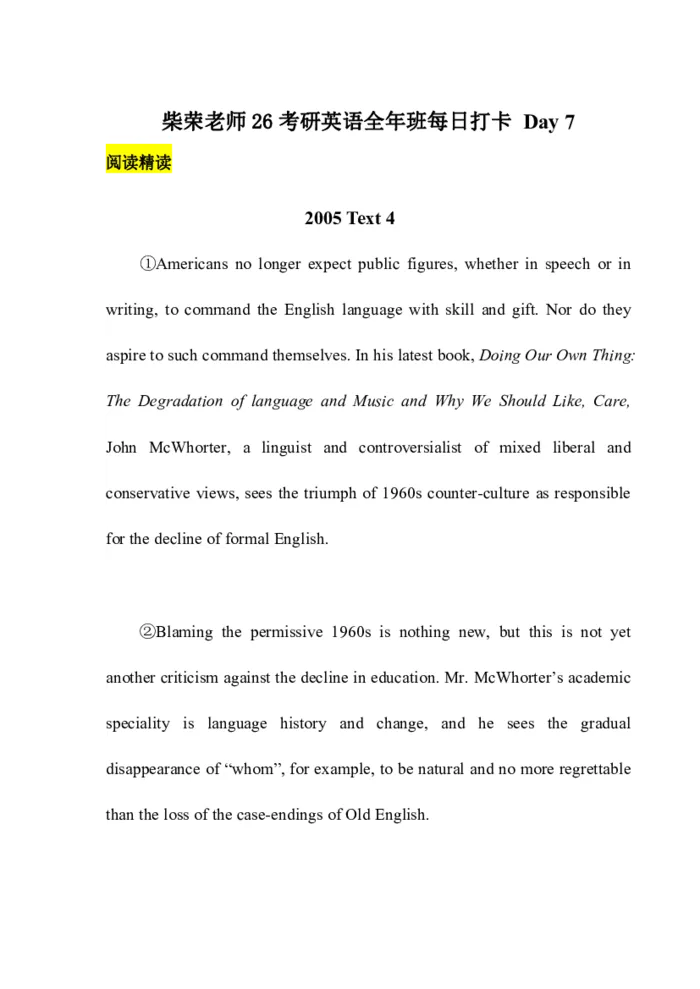
①Americans no longer expect public figures, whether in speech or in
writing, to command the English language with skill and gift. Nor do they
aspire to such command themselves. In his latest book, Doing Our Own Thing:
The Degradation of language and Music and Why We Should Like, Care,
John McWhorter, a linguist and controversialist of mixed liberal and
conservative views, sees the triumph of 1960s counter-culture as responsible
for the decline of formal English.
②Blaming the permissive 1960s is nothing new, but this is not yet
another criticism against the decline in education. Mr. McWhorter’s academic
speciality is language history and change, and he sees the gradual
disappearance of “whom”, for example, to be natural and no more regrettable
than the loss of the case-endings of Old English.
③But the cult of the authentic and the personal, “doing our own thing”,
has spelt the death of formal speech, writing, poetry and music. While even
the modestly educated sought an elevated tone when they put pen to paper
before the 1960s, even the most well regarded writing since then has sought to
capture spoken English on the page. Equally, in poetry, the highly personal,
performative genre is the only form that could claim real liveliness. In both
oral and written English, talking is triumphing over speaking, spontaneity
over craft.
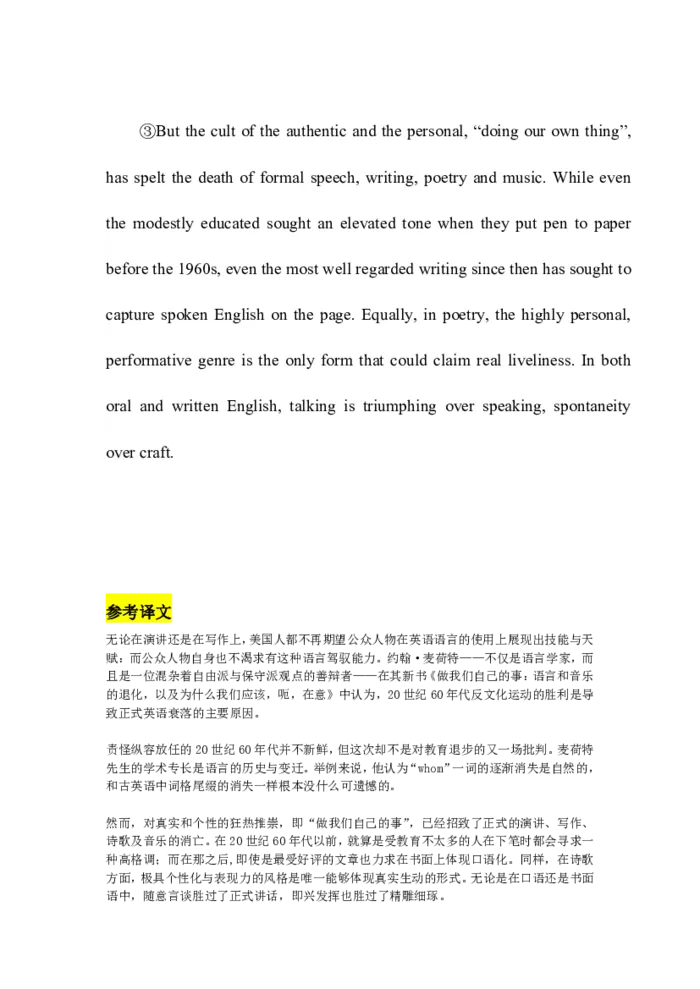
参考译文
无论在演讲还是在写作上,美国人都不再期望公众人物在英语语言的使用上展现出技能与天
赋:而公众人物自身也不渴求有这种语言驾驭能力。约翰·麦荷特——不仅是语言学家,而
且是一位混杂着自由派与保守派观点的善辩者——在其新书《做我们自己的事:语言和音乐
的退化,以及为什么我们应该,呃,在意》中认为,20 世纪60 年代反文化运动的胜利是导
致正式英语衰落的主要原因。
责怪纵容放任的20 世纪60 年代并不新鲜,但这次却不是对教育退步的又一场批判。麦荷特
先生的学术专长是语言的历史与变迁。举例来说,他认为“whom”一词的逐渐消失是自然的,
和古英语中词格尾缀的消失一样根本没什么可遗憾的。
然而,对真实和个性的狂热推崇,即“做我们自己的事”,已经招致了正式的演讲、写作、
诗歌及音乐的消亡。在20 世纪60 年代以前,就算是受教育不太多的人在下笔时都会寻求一
种高格调;而在那之后,即使是最受好评的文章也力求在书面上体现口语化。同样,在诗歌
方面,极具个性化与表现力的风格是唯一能够体现真实生动的形式。无论是在口语还是书面
语中,随意言谈胜过了正式讲话,即兴发挥也胜过了精雕细琢。
salesman
/'seilzmən/
n.售货员,推销员
rise
/raiz/
v.升起;起立;上涨;起义 n.上涨,增高;起源
impact
/'ɪmpækt /
n.冲击,碰撞;影响 v.影响;挤入,压紧
reconcile
/'rekənsail/
v.使和好,调解,使调和;(to,with)使一致
pasture
/'pɑ:stʃə/
n.牧草地,牧场
experimental
/ekˌsperi'mentəl/
a.实验(性)的,试验(性)的
trouble
/'trʌbl/
n.烦恼;动乱;疾病;故障;辛苦v.(使)烦恼
infrastructure
/'infrəˌstrʌktʃə/
n.基础结构,基础设施
admit
/əd'mit/
vt.承认,供认;准许…进入,准许...加入
ignore
/ig'nɔ:/
v.不理,不顾,忽视
alongside
/ə'lɔŋ'said/
ad.在旁边 prep.和...在一起;在...旁边
obedience
/ə'bi:diəns/
n.服从,顺从
genuine
/'dʒenjuin/
a.真正的,名副其实的
somehow
/'sʌmhau/
ad.以某种方式,用某种方法;不知怎么地
bride
/braid/
n.新娘
erosion
/i'rəuʒən/
n.腐蚀,磨损;削弱,减少
context
/'kɔntekst/
n.(文章等)前后关系;(事件等的)背景
solid
/'sɔlid/
a.固体的;结实的,稳固的,可靠的 n.固体
neglect
/ni'glekt/
v./n.忽视;疏忽,漏做,忽略
orientation
/ˌɔ:riən'teɪʃn/
n.方向,方位,定位,倾向性,向东方
interior
/in'tiəriə/
a.内部的,里面的 n.内部,内地
reliance
/ri'laiəns/
n.信任,信心,依靠,依靠的人或物
exciting
/ik'saitiŋ/
a.令人兴奋的,使人激动的
scrap
/skræp/
n.碎片;废料 v.废弃,报废
pirate
/'paɪrɪt/
n./v.海盗,盗版(者)
brave
/breiv/
a.勇敢的 v.勇敢地面对(危险等)
recognize
/'rekəgnaɪz/
v.(recognise)认出,承认,公认,赏识,表扬
flag
/flæg/
n.旗
waiter
/weitə/
n.侍者,服务员
comedy
/'kɒmɪdɪ/
n.喜剧;喜剧性事件
overhear
/ˌəuvə'hiə/
v.偶然听到,从旁听到
sensitive
/'sensətɪv/
a.(to)敏感的,易受伤害的;灵敏的
housework
/'hauswə:k/
n.家务,家事(不可数)
acceptance
/ək'septəns/
n.接受,接收,验收,接纳;承认,认可
sore
/sɔ:/
a.疼痛的;痛心的 n.痛处,疮口
exhibit
/ig'zibit/
v.展出,陈列 n.展览品,陈列品
locate
/ləu'keit/
v.查出,探出,查找…地点,使…坐落于,位于
inform
/in'fɔ:m/
v.(of,about)通知,告诉,报告;告发,告密
princess
/prin'ses/
n.公主,王妃
importance
/im'pɔ:təns/
n.重要,重要性
scheme
/ski:m/
n.计划,方案;阴谋;配置 v.计划,策划;阴谋
try
/trai/
v.尝试,试图;试验,试用;审讯 n.尝试
cruel
/'kru:əl/
a.残忍的,残酷的
outcome
/'autkʌm/
n.结果,成果
regulation
/ˌregju'leiʃən/
n.规则,规章;调节,校准;调整
confident
/'kɔnfidənt/
n.(of,in)确信的,自信的
void
/vɔid/
a.空虚的;没有的;无效的
第7页,共117页