五年级上册译林版英语知识清单
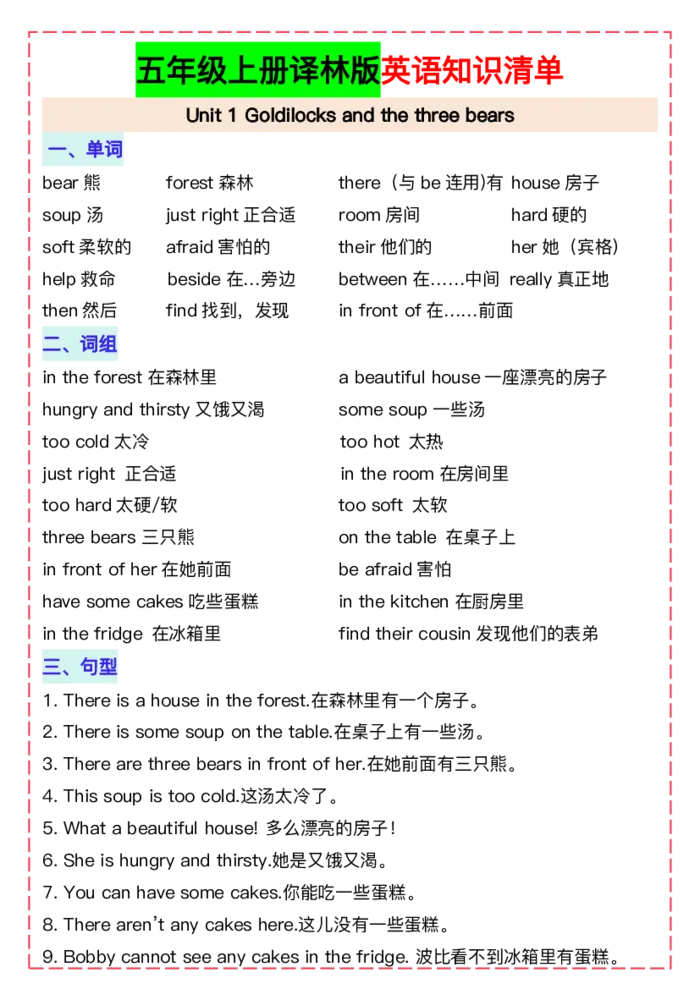
Unit 1 Goldilocks and the three bears
一、单词
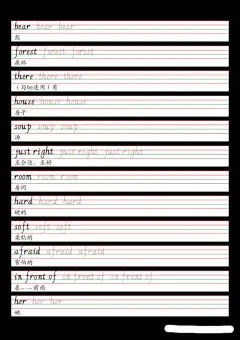
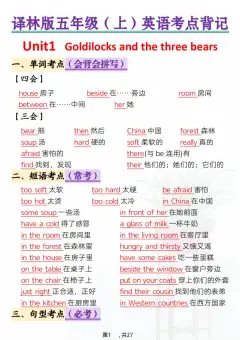
bear 熊
forest 森林
there(与be 连用)有house 房子
soup 汤
just right 正合适
room 房间
hard 硬的
soft 柔软的
afraid 害怕的
their 他们的
her 她(宾格)
help 救命
beside 在…旁边
between 在……中间really 真正地
then 然后
find 找到,发现
in front of 在……前面
二、词组
in the forest 在森林里
a beautiful house 一座漂亮的房子
hungry and thirsty 又饿又渴
some soup 一些汤
too cold 太冷
too hot 太热
just right 正合适
in the room 在房间里
too hard 太硬/软
too soft 太软
three bears 三只熊
on the table 在桌子上
in front of her 在她前面
be afraid 害怕
have some cakes 吃些蛋糕
in the kitchen 在厨房里
in the fridge 在冰箱里
find their cousin 发现他们的表弟
三、句型
1. There is a house in the forest.在森林里有一个房子。
2. There is some soup on the table.在桌子上有一些汤。
3. There are three bears in front of her.在她前面有三只熊。
4. This soup is too cold.这汤太冷了。
5. What a beautiful house! 多么漂亮的房子!
6. She is hungry and thirsty.她是又饿又渴。
7. You can have some cakes.你能吃一些蛋糕。
8. There aren’t any cakes here.这儿没有一些蛋糕。
9. Bobby cannot see any cakes in the fridge. 波比看不到冰箱里有蛋糕。
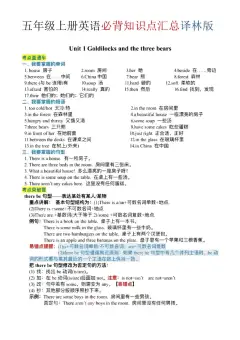
五年级上册译林版英语知识清单
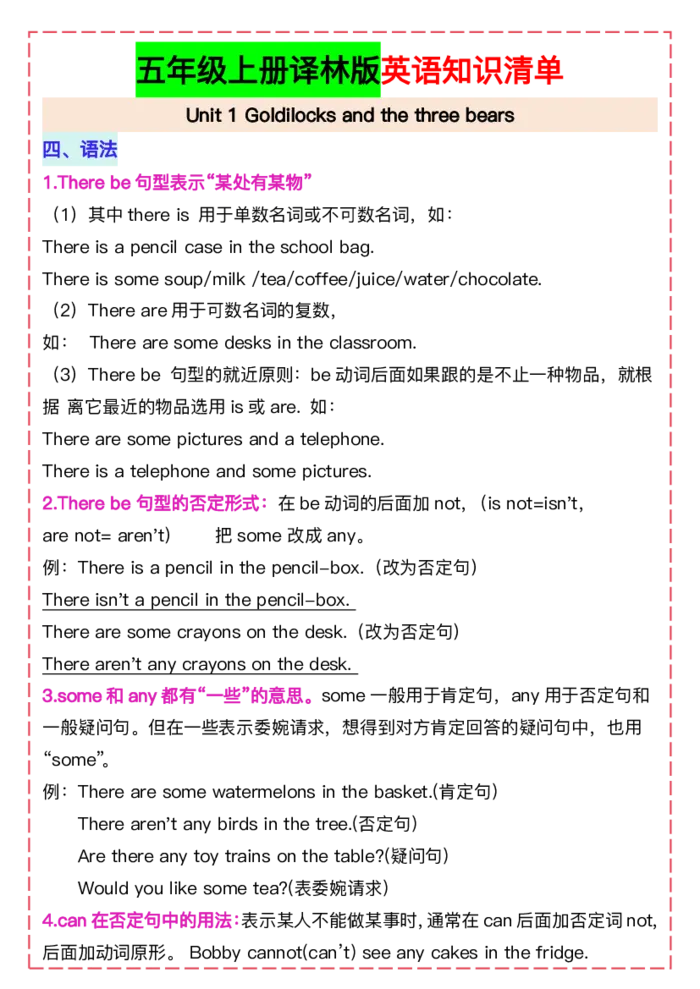
Unit 1 Goldilocks and the three bears
四、语法
1.There be 句型表示“某处有某物”
(1)其中there is 用于单数名词或不可数名词,如:
There is a pencil case in the school bag.
There is some soup/milk /tea/coffee/juice/water/chocolate.
(2)There are 用于可数名词的复数,
如:There are some desks in the classroom.
(3)There be 句型的就近原则:be 动词后面如果跟的是不止一种物品,就根
据离它最近的物品选用is 或are. 如:
There are some pictures and a telephone.
There is a telephone and some pictures.
2.There be 句型的否定形式:在be 动词的后面加not,(is not=isn't,
are not= aren't)
把some 改成any。
例:There is a pencil in the pencil-box.(改为否定句)
There isn't a pencil in the pencil-box.
There are some crayons on the desk.(改为否定句)
There aren't any crayons on the desk.
3.some 和any 都有“一些”的意思。some 一般用于肯定句,any 用于否定句和
一般疑问句。但在一些表示委婉请求,想得到对方肯定回答的疑问句中,也用
“some”。
例:There are some watermelons in the basket.(肯定句)
There aren't any birds in the tree.(否定句)
Are there any toy trains on the table?(疑问句)
Would you like some tea?(表委婉请求)
4.can 在否定句中的用法:表示某人不能做某事时,通常在can 后面加否定词not,
后面加动词原形。Bobby cannot(can’t) see any cakes in the fridge.
五年级上册译林版英语知识清单
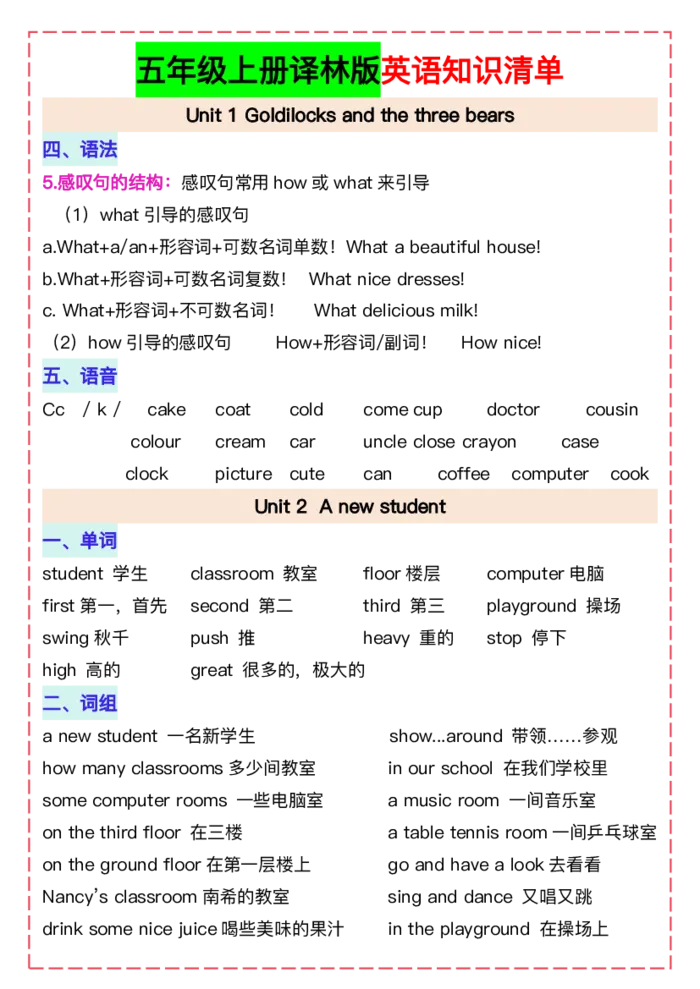
Unit 1 Goldilocks and the three bears
四、语法
5.感叹句的结构:感叹句常用how 或what 来引导
(1)what 引导的感叹句
a.What+a/an+形容词+可数名词单数!What a beautiful house!
b.What+形容词+可数名词复数!What nice dresses!
c. What+形容词+不可数名词!
What delicious milk!
(2)how 引导的感叹句
How+形容词/副词!
How nice!
五、语音
Cc
/ k /
cake
coat
cold
come cup
doctor
cousin
colour
cream
car
uncle close crayon
case
clock
picture
cute
can
coffee
computer
cook
Unit 2 A new student
一、单词
student 学生
classroom 教室
floor 楼层
computer 电脑
first 第一,首先
second 第二
third 第三
playground 操场
swing 秋千
push 推
heavy 重的
stop 停下
high 高的
great 很多的,极大的
二、词组
a new student 一名新学生
show...around 带领……参观
how many classrooms 多少间教室
in our school 在我们学校里
some computer rooms 一些电脑室
a music room 一间音乐室
on the third floor 在三楼
a table tennis room 一间乒乓球室
on the ground floor 在第一层楼上
go and have a look 去看看
Nancy’s classroom 南希的教室
sing and dance 又唱又跳
drink some nice juice 喝些美味的果汁
in the playground 在操场上
五年级上册译林版英语知识清单
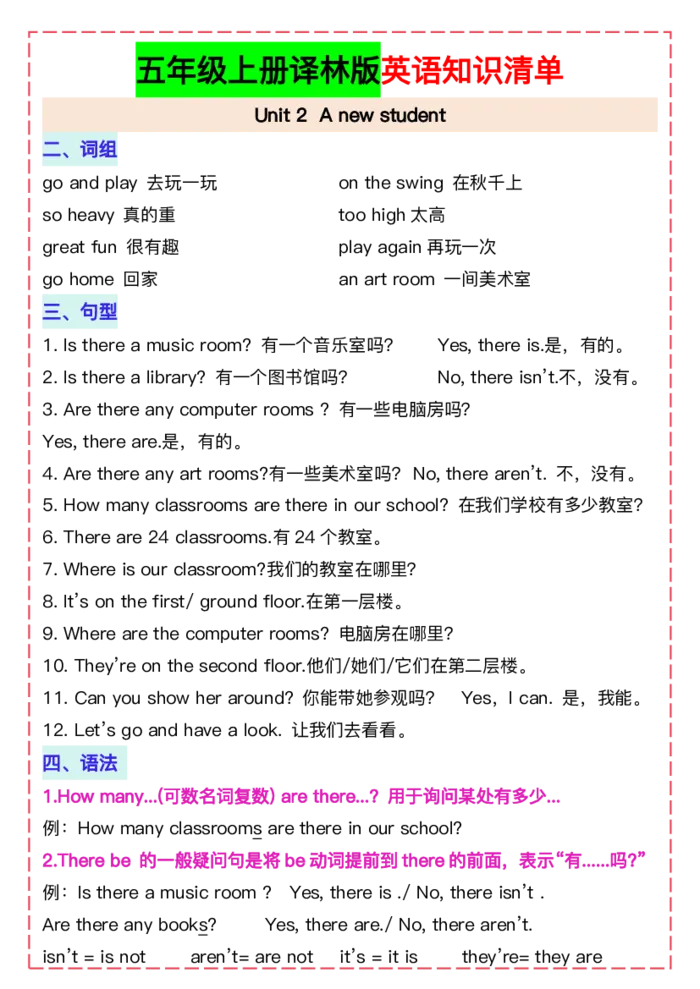
Unit 2 A new student
二、词组
go and play 去玩一玩
on the swing 在秋千上
so heavy 真的重
too high 太高
great fun 很有趣
play again 再玩一次
go home 回家
an art room 一间美术室
三、句型
1. Is there a music room? 有一个音乐室吗?
Yes, there is.是,有的。
2. Is there a library? 有一个图书馆吗?
No, there isn’t.不,没有。
3. Are there any computer rooms ? 有一些电脑房吗?
Yes, there are.是,有的。
4. Are there any art rooms?有一些美术室吗?No, there aren’t. 不,没有。
5. How many classrooms are there in our school? 在我们学校有多少教室?
6. There are 24 classrooms.有24 个教室。
7. Where is our classroom?我们的教室在哪里?
8. It’s on the first/ ground floor.在第一层楼。
9. Where are the computer rooms? 电脑房在哪里?
10. They’re on the second floor.他们/她们/它们在第二层楼。
11. Can you show her around? 你能带她参观吗?
Yes,I can. 是,我能。
12. Let’s go and have a look. 让我们去看看。
四、语法
1.How many...(可数名词复数) are there...? 用于询问某处有多少...
例:How many classrooms are there in our school?
2.There be 的一般疑问句是将be 动词提前到there 的前面,表示“有......吗?”
例:Is there a music room ?
Yes, there is ./ No, there isn’t .
Are there any books?
Yes, there are./ No, there aren’t.
isn’t = is not
aren’t= are not
it’s = it is
they’re= they are
五年级上册译林版英语知识清单
Unit 2 A new student
四、语法
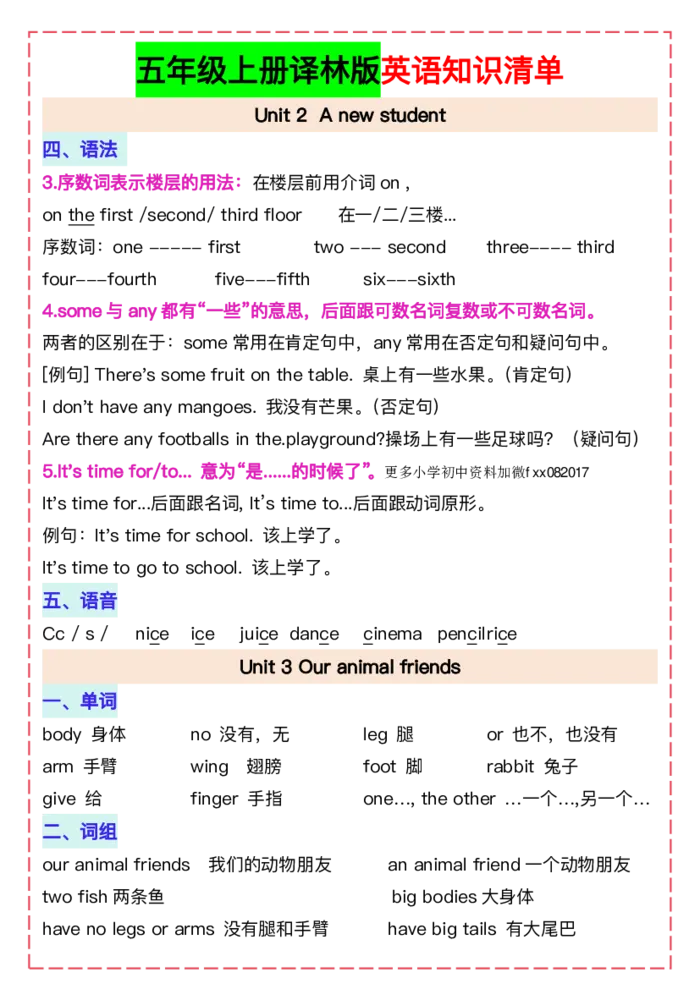
3.序数词表示楼层的用法:在楼层前用介词on ,
on the first /second/ third floor
在一/二/三楼...
序数词:one ----- first
two --- second
three---- third
four---fourth
five---fifth
six---sixth
4.some 与any 都有“一些”的意思,后面跟可数名词复数或不可数名词。
两者的区别在于:some 常用在肯定句中,any 常用在否定句和疑问句中。
[例句] There's some fruit on the table. 桌上有一些水果。(肯定句)
I don't have any mangoes. 我没有芒果。(否定句)
Are there any footballs in the.playground?操场上有一些足球吗?(疑问句)
5.It's time for/to... 意为“是......的时候了”。更多小学初中资料加微fxx082017
It's time for...后面跟名词, It’s time to...后面跟动词原形。
例句:It's time for school. 该上学了。
It's time to go to school. 该上学了。
五、语音
Cc / s /
nice
ice
juice dance
cinema
pencilrice
Unit 3 Our animal friends
一、单词
body 身体
no 没有,无
leg 腿
or 也不,也没有
arm 手臂
wing
翅膀
foot 脚
rabbit 兔子
give 给
finger 手指
one…, the other …一个…,另一个…
二、词组
our animal friends
我们的动物朋友
an animal friend 一个动物朋友
two fish 两条鱼
big bodies 大身体
have no legs or arms 没有腿和手臂
have big tails 有大尾巴
五年级上册译林版英语知识清单
Unit 3 Our animal friends
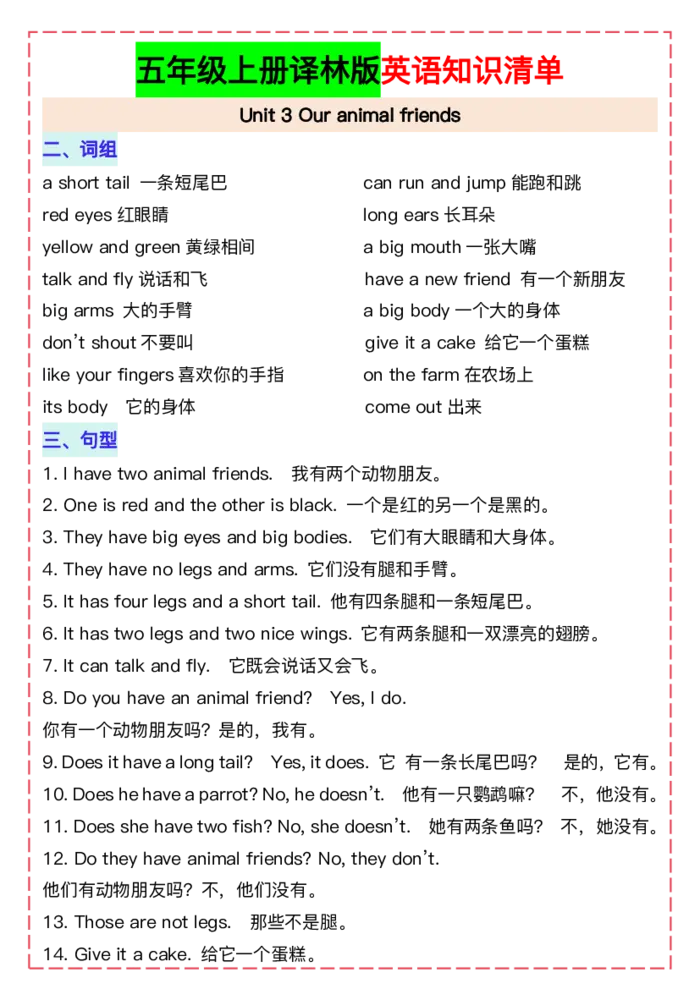
二、词组
a short tail 一条短尾巴
can run and jump 能跑和跳
red eyes 红眼睛
long ears 长耳朵
yellow and green 黄绿相间
a big mouth 一张大嘴
talk and fly 说话和飞
have a new friend 有一个新朋友
big arms 大的手臂
a big body 一个大的身体
don’t shout 不要叫
give it a cake 给它一个蛋糕
like your fingers 喜欢你的手指
on the farm 在农场上
its body
它的身体
come out 出来
三、句型
1. I have two animal friends.
我有两个动物朋友。
2. One is red and the other is black. 一个是红的另一个是黑的。
3. They have big eyes and big bodies.
它们有大眼睛和大身体。
4. They have no legs and arms. 它们没有腿和手臂。
5. It has four legs and a short tail. 他有四条腿和一条短尾巴。
6. It has two legs and two nice wings. 它有两条腿和一双漂亮的翅膀。
7. It can talk and fly.
它既会说话又会飞。
8. Do you have an animal friend?
Yes, I do.
你有一个动物朋友吗?是的,我有。
9. Does it have a long tail?
Yes, it does. 它有一条长尾巴吗?
是的,它有。
10. Does he have a parrot? No, he doesn’t.
他有一只鹦鹉嘛?
不,他没有。
11. Does she have two fish? No, she doesn’t.
她有两条鱼吗?不,她没有。
12. Do they have animal friends? No, they don’t.
他们有动物朋友吗?不,他们没有。
13. Those are not legs.
那些不是腿。
14. Give it a cake. 给它一个蛋糕。
五年级上册译林版英语知识清单
Unit 3 Our animal friends
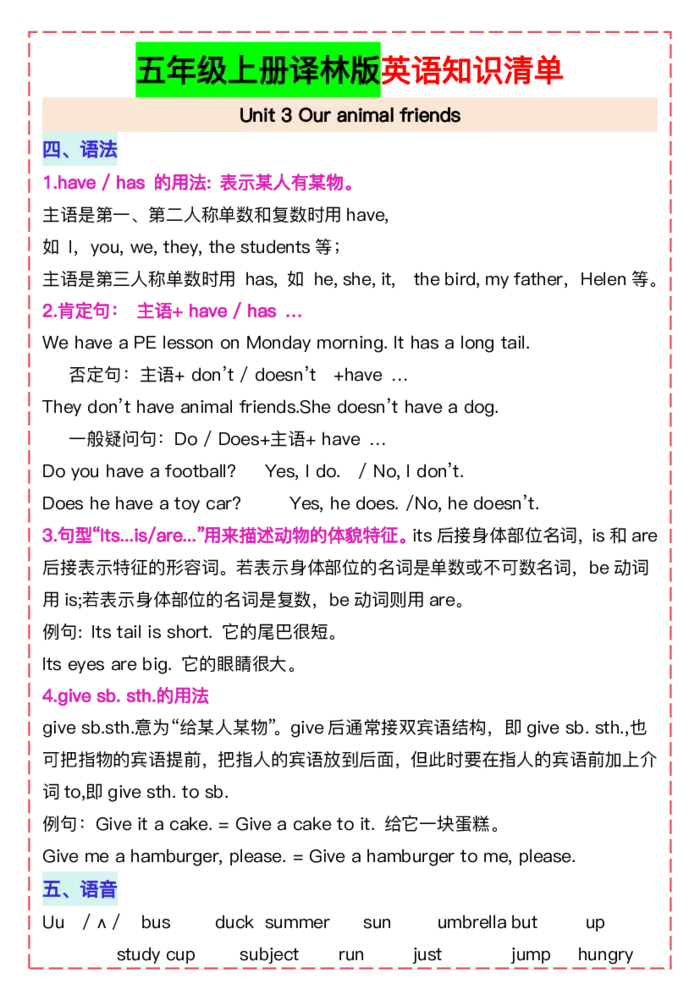
四、语法
1.have / has 的用法: 表示某人有某物。
主语是第一、第二人称单数和复数时用have,
如I,you, we, they, the students 等;
主语是第三人称单数时用has, 如he, she, it,
the bird, my father,Helen 等。
2.肯定句:主语+ have / has …
We have a PE lesson on Monday morning. It has a long tail.
否定句:主语+ don’t / doesn’t
+have …
They don’t have animal friends.She doesn’t have a dog.
一般疑问句:Do / Does+主语+ have …
Do you have a football?
Yes, I do.
/ No, I don’t.
Does he have a toy car?
Yes, he does. /No, he doesn’t.
3.句型“Its...is/are...”用来描述动物的体貌特征。its 后接身体部位名词,is 和are
后接表示特征的形容词。若表示身体部位的名词是单数或不可数名词,be 动词
用is;若表示身体部位的名词是复数,be 动词则用are。
例句: Its tail is short. 它的尾巴很短。
Its eyes are big. 它的眼睛很大。
4.give sb. sth.的用法
give sb.sth.意为“给某人某物”。give 后通常接双宾语结构,即give sb. sth.,也
可把指物的宾语提前,把指人的宾语放到后面,但此时要在指人的宾语前加上介
词to,即give sth. to sb.
例句:Give it a cake. = Give a cake to it. 给它一块蛋糕。
Give me a hamburger, please. = Give a hamburger to me, please.
五、语音
Uu
/ ʌ /
bus
duck summer
sun
umbrella but
up
study cup
subject
run
just
jump
hungry
五年级上册译林版英语知识清单
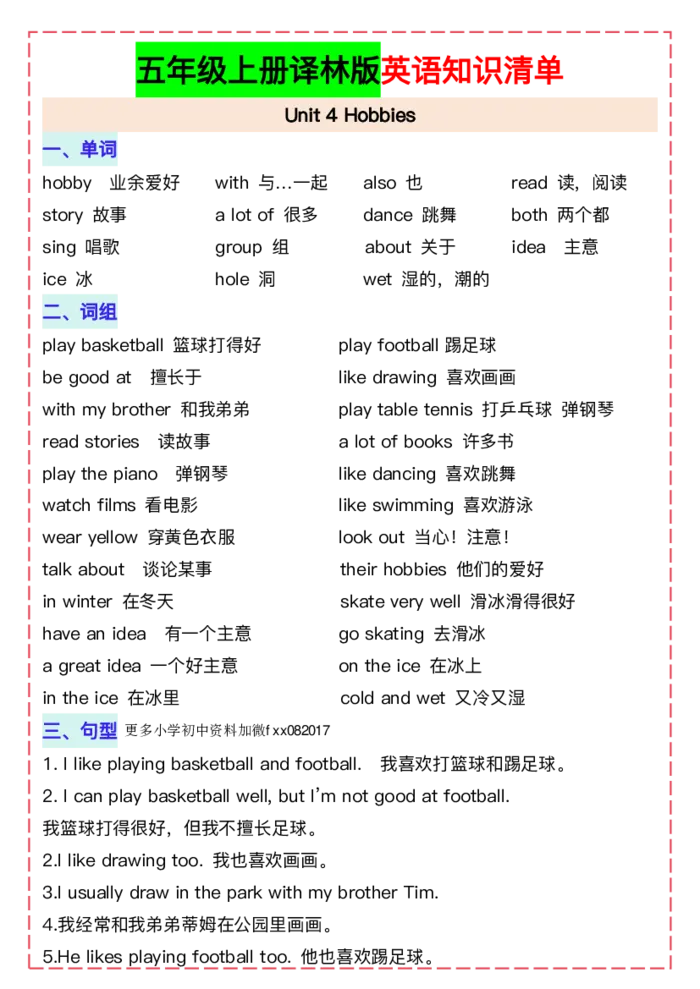
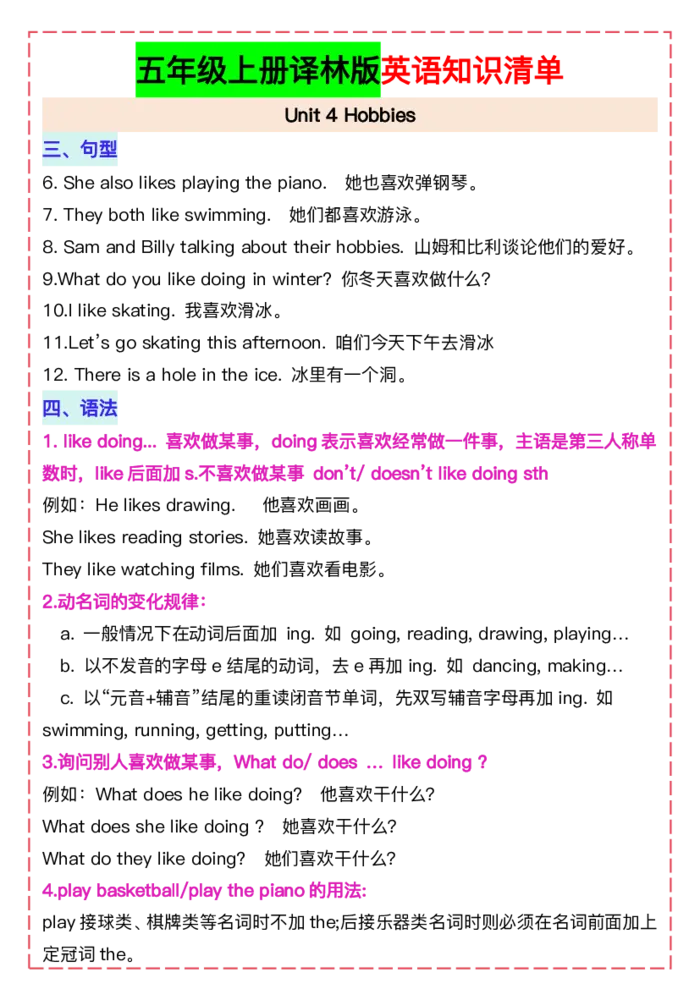
Unit 4 Hobbies
一、单词
hobby
业余爱好
with 与…一起
also 也
read 读,阅读
story 故事
a lot of 很多
dance 跳舞
both 两个都
sing 唱歌
group 组
about 关于
idea
主意
ice 冰
hole 洞
wet 湿的,潮的
二、词组
play basketball 篮球打得好
play football 踢足球
be good at
擅长于
like drawing 喜欢画画
with my brother 和我弟弟
play table tennis 打乒乓球弹钢琴
read stories
读故事
a lot of books 许多书
play the piano
弹钢琴
like dancing 喜欢跳舞
watch films 看电影
like swimming 喜欢游泳
wear yellow 穿黄色衣服
look out 当心!注意!
talk about
谈论某事
their hobbies 他们的爱好
in winter 在冬天
skate very well 滑冰滑得很好
have an idea
有一个主意
go skating 去滑冰
a great idea 一个好主意
on the ice 在冰上
in the ice 在冰里
cold and wet 又冷又湿
三、句型
1. I like playing basketball and football.
我喜欢打篮球和踢足球。
2. I can play basketball well, but I’m not good at football.
我篮球打得很好,但我不擅长足球。
2.I like drawing too. 我也喜欢画画。
3.I usually draw in the park with my brother Tim.
4.我经常和我弟弟蒂姆在公园里画画。
5.He likes playing football too. 他也喜欢踢足球。
更多小学初中资料加微fxx082017
五年级上册译林版英语知识清单
Unit 4 Hobbies
三、句型
6. She also likes playing the piano.
她也喜欢弹钢琴。
7. They both like swimming.
她们都喜欢游泳。
8. Sam and Billy talking about their hobbies. 山姆和比利谈论他们的爱好。
9.What do you like doing in winter? 你冬天喜欢做什么?
10.I like skating. 我喜欢滑冰。
11.Let’s go skating this afternoon. 咱们今天下午去滑冰
12. There is a hole in the ice. 冰里有一个洞。
四、语法
1. like doing... 喜欢做某事,doing 表示喜欢经常做一件事,主语是第三人称单
数时,like 后面加s.不喜欢做某事don’t/ doesn’t like doing sth
例如:He likes drawing.
他喜欢画画。
She likes reading stories. 她喜欢读故事。
They like watching films. 她们喜欢看电影。
2.动名词的变化规律:
a. 一般情况下在动词后面加ing. 如going, reading, drawing, playing…
b. 以不发音的字母e 结尾的动词,去e 再加ing. 如dancing, making…
c. 以“元音+辅音”结尾的重读闭音节单词,先双写辅音字母再加ing. 如
swimming, running, getting, putting…
3.询问别人喜欢做某事,What do/ does … like doing ?
例如:What does he like doing?
他喜欢干什么?
What does she like doing ?
她喜欢干什么?
What do they like doing?
她们喜欢干什么?
4.play basketball/play the piano 的用法:
play 接球类、棋牌类等名词时不加the;后接乐器类名词时则必须在名词前面加上
定冠词the。
五年级上册译林版英语知识清单
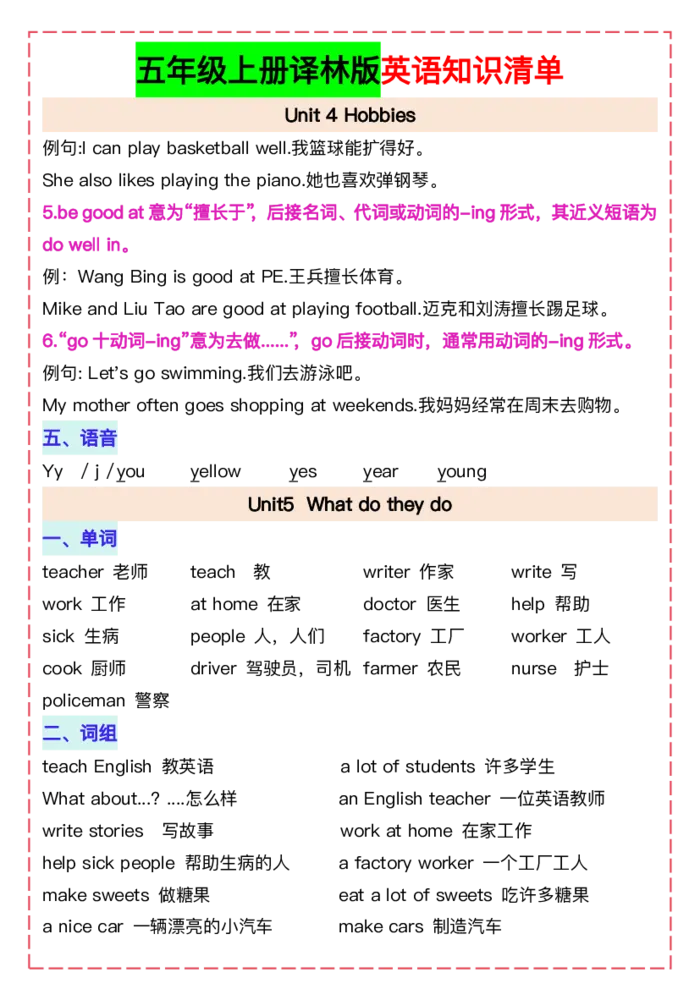
Unit 4 Hobbies
例句:I can play basketball well.我篮球能扩得好。
She also likes playing the piano.她也喜欢弹钢琴。
5.be good at 意为“擅长于”,后接名词、代词或动词的-ing 形式,其近义短语为
do well in。
例:Wang Bing is good at PE.王兵擅长体育。
Mike and Liu Tao are good at playing football.迈克和刘涛擅长踢足球。
6.“go 十动词-ing”意为去做......”,go 后接动词时,通常用动词的-ing 形式。
例句: Let's go swimming.我们去游泳吧。
My mother often goes shopping at weekends.我妈妈经常在周末去购物。
五、语音
Yy
/ j /you
yellow
yes
year
young
Unit5 What do they do
一、单词
teacher 老师
teach
教
writer 作家
write 写
work 工作
at home 在家
doctor 医生
help 帮助
sick 生病
people 人,人们
factory 工厂
worker 工人
cook 厨师
driver 驾驶员,司机farmer 农民
nurse
护士
policeman 警察
二、词组
teach English 教英语
a lot of students 许多学生
What about...? ....怎么样
an English teacher 一位英语教师
write stories
写故事
work at home 在家工作
help sick people 帮助生病的人
a factory worker 一个工厂工人
make sweets 做糖果
eat a lot of sweets 吃许多糖果
a nice car 一辆漂亮的小汽车
make cars 制造汽车
五年级上册译林版英语知识清单
Unit5 What do they do
二、词组
so many cars 这么多汽车
fly in the sky 在空中飞
I wish 我希望
三、句型
1. What does your father do?
你的爸爸做什么的?
2. My father is a teacher. He teaches English.
我的爸爸是个老师。他教英语。
3. He has a lot of students.
他有许多学生。
4. Is she an English teacher too?
她也是个英语老师吗?
5. She writes stories. She works at home.
她写故事。她在家工作。
6. My mother is a factory worker.
我的妈妈是个工厂的工人。
7. My father is a doctor. He helps sick people.
我的爸爸是个医生。他帮助生病的人。
8. She makes sweets.
她做糖果的。
9.Your father has a nice car. 你爸爸有一辆漂亮的汽车。
10. There are so many cars.
有那么多车。
11. Your father can’t go now.
现在你爸爸不能走了。
四、语法
1. 一般现在时:一般现在时表示现在的时间内经常发生的动作或存在的状态。
常与often, usually, never, always, sometimes, every day/ week/ year/
month ... , on Sundays 等连用。
结构为:主语+ 动词原形/动词第三人称单数+其他。
例如:They both like swimming.
He teaches English.
五年级上册译林版英语知识清单
Unit5 What do they do
四、语法
主语为第三人称单数形式,谓语动词的变化规则
规则
例词
一般情况下,直接在动词的词尾加-s。
run - runs
look - looks
see -sees
say -says
以-s, -sh, -ch, -x, -o 结尾的动词,一
般在词尾加-es.
teach-teaches
go-goes
fix-fixes
wash-washes
pass-passes
以辅音字母加y 结尾的动词,先边y 为i,
再加-es.
study-studies
try- tries
以元音字母加y 结尾的动词,直接在词尾
加-s。
play-plays
stay-stays
注意:go(三单)——goes
have(三单)——has
2.如何询问他人的职业
What do/does + 主语+ do? 是用来询问他人职业的句型,do/does 为助动词,
无实义,后面的do 是实义动词,意为“做”。当主语为第三人称单数时,用助动
词does, 其他情况用do。
其答语为:主语+be+a/an+职业名词或者:主语+be+职业名词复数。
例如:What does your father do?
你爸爸做什么的?
He is a doctor.
他是一个医生。
What do they do?
They are doctors.
3.help 作动饲时,意为“帮助”。具体用法如下:
①help 十名词或代词的宾格形式,意为“帮助…”;
②help sb. do sth. , 意为“帮助某人做某事”;
③help sb.with sth. , 意为“在某事上帮助某人”。
例句:He helps sick people. 他帮助病人
更多小学初中资料加微fxx082017
五年级上册译林版英语知识清单
Unit5 What do they do
四、语法
I sometimes help my mother do housework . 我有时帮我妈妈做家务。
Wang Bing always helps her with her English.王兵总是帮她学英语。
4.teach 为及物动词,后可直接接宾语,即teach.sb./sth,也可接双宾语,即teach
sb. sth.
例句: Miss Wang teaches Maths. 王老师教数学。
Miss Li teaches us English. 李老师教我们英语。
五、语音
Yy
/ai/
fly
my
sky
try
why
dry
cry
Unit 6
My e-friend
一、单词
e-friend 网友
send 发出(信件,
邮件等)
email 电子邮件
to 给
live 住,居住
UK 英国
study 学习
Canada 加拿大
Greece 希腊
Russia 俄罗斯
PRC 中华人民共
和国
US 美国
tomorrow 明天
fishing 钓鱼,捕鱼
sit 坐,坐在
by... 在......旁边
wait 等,等待
二、词组
my e-friend
我的网友
in the playground 在操场上
wait a minute
等一会
send this email 发这封电子邮件
live in the UK 住在英国
11 years old
11 岁
speak Chinese
讲中文
have Chinese lessons 有语文课
at school
在学校
study Chinese 学习汉语
after school
放学后
what subjects 什么学科
like Maths and PE 喜欢数学和体育
like swimming 喜欢游泳
swim well 游得好
eat fish
吃鱼
五年级上册译林版英语知识清单
Unit 6
My e-friend
二、词组
at a snack bar 在一家小吃店
go fishing 去钓鱼
be good at fishing 擅长钓鱼
don’t worry 别担心
sit by the river 坐在河旁
many fish 许多鱼
wait and wait 等了又等
tomorrow morning 明天早上
三、句型
1. Let me send this email first. 让我先发送这封电子邮件。
2. Who’s your e-friend? 谁是你的网友?
3. Where does he live? He lives in the UK. 他住在哪里?他住在英国。
4. How old is he? He’s 11 years old.
他几岁了?他11 岁。
5. Can he speak Chinese? Yes, he can.
他会讲汉语吗?
是的,他会。
6. Does he have Chinese lessons? Yes, he does.他有语文课吗?是的,他有。
7. What subjects does he like? He likes Maths and PE.
他喜欢什么学科?他喜欢数学和体育。
8. What does he do after school? He studies Chinese.
放学后他做什么?他学汉语。
9. Let’s go fishing tomorrow.
让我们明天去钓鱼
10. Sam has many fish, but Bobby does not have any.
萨姆有许多鱼,但波比没有鱼。
11. You’re really good at fishing, Sam.
你真的擅长钓鱼,萨姆。
四、语法
1.含有实义动词的一般现在时的一般疑问句用法
含有实义动词的一般现在时的陈述句变为一般疑问句,要借助助动词do / does。
助动词形态由主语的人称决定。主语为第三人称单数,用does,主语不是第三
人称,用do。
其结构为:Do/ Does +主语+动词原形+其他?
五年级上册译林版英语知识清单
Unit 6
My e-friend
四、语法
例如:They live in the UK. (改为一般疑问句)
→Do they live in the UK?
He studies Chinese after school. (改为一般疑问句)
→Does he study Chinese after school?
2.含有实义动词的一般现在时的特殊疑问句用法
结构为:特殊疑问词+do/does+动词原形+其他?
例如:He likes Maths and PE. (对划线部分提问)
What subjects does he like?
They play football in the playground. (对划线部分提问)
Where do they play football?
3.在英话中,表达“说”的单词众多,有speak、talk、say、tell,但如何准确地使
用呢?让我们一起来看一下吧。
单词
用法
例句
speak
表示“讲话、发言、演讲”,也
可以表示说某种具体的语言。
She speaks English very well,
她英语讲得很好。
talk
指一般的谈话或交谈。
My brother is talking to his
friend.
我哥哥正和他的朋友谈话。
say
强调说话的内容。
“I want a toy car,” Tom says.
汤姆说,“我想要一辆玩具汽车。”
tell
“说”给某人听,意为“告知”
Please tell me more about you.
请告诉我更多关于你的情况。
4.live in 意为“住在”,后接地点,如果后面接的地点是here、there 时,则不要
加介词in。
例句:He lives in the UK.他住在英国。They live here.now.他们现在住在这儿.
五年级上册译林版英语知识清单
Unit 6
My e-friend
五、语音
Ww
/ w /
watch
water
week
winter
woman
we
warm
weather
with
work worker
wait
worry
Unit 7 At weekends
一、单词
visit 参观
grandparent 祖父,祖母,外祖父,外祖母
often 经常
chat 聊天
Internet 网络,互联网
always 总是
sometimes 有时
there 那里
二、词组
at weekends 在周末
visit my grandparents 看望我的爷爷奶奶
play with their cat 和他们的猫一起玩have dinner with... 和......一起吃晚饭
live in the UK 住在英国
chat with them 和他们聊天
on the Internet 在网上
have dancing lessons 上舞蹈课
go to the cinema 去电影院
what about... ......怎么样
play football 踢足球
go to the park 去公园
with my family 和我的家人一起
fly a kite 放风筝
have a picnic 野餐
watch TV 看电视
eat a lot 吃很多
play basketball 打篮球
come out 出来
like playing basketball 喜欢打篮球
go swimming 去游泳
like picnics 喜欢野餐
too fat 太胖
get out 出去
very much
非常
三、句型
1.What do you do at weekends ? 你在周末做什么?
2.I usually visit my grandparents at weekends. 我通常看望我的祖父母。
五年级上册译林版英语知识清单
Unit 7 At weekends
三、句型
3.Su Yang and I like playing with their cat very much.
我和苏洋非常喜欢和他们的猫一起玩。
4.I usually chat with them on the Internet. 我通常在网上和他们聊天。
5.What does Helen do at weekends? 海伦在周末做什么?
6.She always has dancing lessons at weekends.她在周末总是上舞蹈课。
7.She sometimes goes to the cinema with her friends. 她有时和她的朋友们
去看电影。
8.I sometimes go to the park with my family. 我有时和我的家人去公园。
9.Billy always watches TV at weekends. 比利经常在周末看电视。
10.Come out and play basketball. 出来打篮球。
11.Let’s go and have a picnic. 让我们去野餐吧。
12. I can’t get out!我出不去了!
四、语法
1. always , usually, often , sometimes 为频率副词,即一定时间内动作重复发
生的次数,常用于一般现在时。
按其频率高低排列为:always > usually > often > sometimes。
2.询问某人在周末做什么的句型:What + do /does + 主语+ do at weekends?
答句: 主语+动词原形/动词三单形式+其他
例如:What do you do at weekends ?
I usually visit my grandparents at weekends.
What does Helen do at weekends?
She always has dancing lessons at weekends.
★注意:do /does 为助动词,由主语的人称数而定.主语是第三人称单数时,用
does,主语不是第三人称时,用do.
更多小学初中资料加微fxx082017
五年级上册译林版英语知识清单
Unit 7 At weekends
四、语法
3.in、on、at 表示时间的用法
①年、月、季节前要用介词in;如in 2022, in July, in winter
②表示泛指的上午、下午用in;如in the morning/ afternoon/ evening
③遇到具体某一天要用介词on;表示具体某一天的上下午,用on; 如on Monday,
on Sunday morning
④在某个时间点或较短时间前用介词at。如at six o’clock, at night
4.a lot 与a lot of 的区别: a1ot 常用于口语,意为“很多”,是副词,常用来修饰
动词。
a lot of 可以修饰可数名词复数,也可以修饰不可数名词。
例句: Don't eat a lot.不要吃太多。
I have a lot of storybooks.我有许多故事书。
五、语音
Ss
/ Z /
visit
rose
always
shows
grows
has
his
music
Unit 8 At Christmas
一、单词
Christmas
圣诞节
buy 买
present 礼物
next 接着,然后
thing 东西,物品
pretty 漂亮的
put 放
look 看起来
stocking 长筒袜
finally 最后
early 早早地
turkey 火鸡,火鸡肉
pudding 布丁
all 全部
card 卡片
children 孩子,儿童
message 信息,消息
song 歌曲
him 他
us 我们
letter 信
storybook 故事书
after 在…以后
五年级上册译林版英语知识清单
Unit 8 At Christmas
三、词组
at Christmas 在圣诞节
have a lot of fun 玩得开心,过得愉快
buy presents for sb. 买礼物给某人
buy a Christmas tree 买一棵圣诞树
go to see Father Christmas
去看圣诞老人
put some pretty things
放一些好看的东西
look great 看起来很棒
Christmas Eve 平安夜
put a stocking on our beds
把一个长筒袜放在床上
wait for presents 等待礼物
Christmas Day 圣诞节
wake up early 早早醒来
have a big lunch 吃一顿丰盛的午
have a good time
玩得开心,过得愉快
sing Christmas songs 唱圣诞歌曲
on Christmas Day 在圣诞节那天
a lot of fun 很有趣
look sad 看起来难过
What’s wrong with ...?......怎么了?
Merry Christmas 圣诞快乐
三、句型
1.We always have a lot of fun at Christmas
在圣诞节我们总是玩得很开心。
2.First,we buy presents for our family and friends.
首先我们给我们的家人和朋友买礼物。
3. Next,we put some pretty things on the Christmas tree.
接着,我们在圣诞树上放些漂亮的东西。
4. Then, Christmas Eve comes. We put a stocking on our beds and wait for
presents.
然后,平安夜来了。我们在床上放一只长筒袜等待礼物。
5. Finally,it is Christmas Day. We wake up early and open our presents.
最后,圣诞节来了。我们早早地醒来打开我们的礼物
6. We eat a turkey and Christmas pudding. 我们吃火鸡和圣诞布丁。
7. We all have a good time. 我们都过得很愉快。
更多小学初中资料加微fxx082017
五年级上册译林版英语知识清单
Unit 8 At Christmas
三、句型
8. I always have a big dinner on Christmas Day. 在圣诞节我总是会吃丰盛的
午餐。
9. What’s wrong with him?
他怎么了?
10.People eat us on Christmas Day! 在圣诞节那天人们都吃要我们。
四、语法
1.first, next, then, finally 是表示时间的副词,用来说明事情发生的先后顺序。
一般放在句首或句末。
2.have 的用法
①表示“有”,如:I have a big Christmas tree.我有一棵大圣诞树。
②表示“吃;喝”,have+食品或饮料。
如:Have some juice, please. 请喝些果汁。
③表示用餐:have+三餐的名称。
如:They have a big dinner at Christmas.他们在圣诞节吃一顿丰盛的晚餐。
④表示:“进行;举行”,have+表示某种活动的名称。
如We sometimes have a picnic at weekends.在周末我们有时举行野餐。
3.buy sth. for sb. 意为“买某物给某人”,也可用buy sb. sth.
My mother buys a lot of books for me.她给我买许多书。
=My mother buys me a lot of books.
4.have a good time 与have a lot of fun 都有“过得愉快,玩得开心”的意思。
例句:We always have a lot of fun at Christmas. 我们在圣诞节总是玩得很开
心。
The children have a good time at the party. 孩子们在聚会上玩得很开心。
5.all 与both 的区别:al1 指三个或三个以上的人或物“都”,both 指两者“都”
例句:All of us like the dog. 我们都喜欢这只狗。
My parents are both teachers.我父母都是老师。
五年级上册译林版英语知识清单
Unit 8 At Christmas
四、语法
6.1ook 意为“看起来”,后面常跟形容词。
例句:Mr Turkey looks sad.火鸡先生看上去难过。
Look at his doll. It looks cool!看他的洋娃娃。它看上去真酷!
7.“What's wrong with...?”是询问某人情况的常用句型,后可接名词或代词宾格
形式。其同义句为“What's the matter with...?”。
例句:
---What's wrong with Yang Ling? 杨玲怎么了?
---She has a bad cough. 她咳嗽得厉害。
---What's wrong with.him?他怎么了?
---He's ill.他病了。
五、语音
Jj
/ dʒ /
jacket
juice
jump
subject
jar
jelly
job
jug