文档文本内容
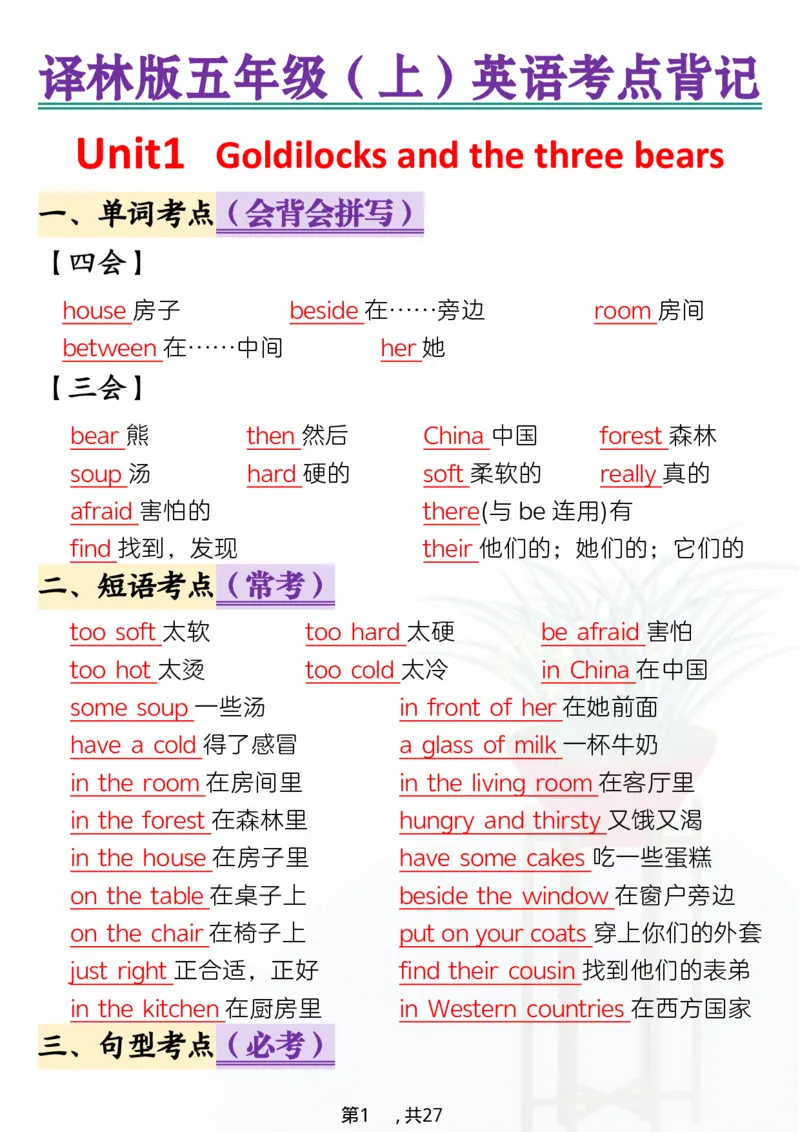
译林版五年级(上)英语考点背记
Unit1 Goldilocks and the three bears
一、单词考点(会背会拼写)
【四会】
house 房子
beside 在……旁边
room 房间
between 在……中间
her 她
【三会】
bear 熊
soup 汤
then 然后
hard 硬的
China 中国
soft 柔软的
forest 森林
really 真的
afraid 害怕的
find 找到,发现
there(与be 连用)有
their 他们的;她们的;它们的
二、短语考点(常考)
too soft 太软
too hot 太烫
too hard 太硬
too cold 太冷
be afraid 害怕
in China 在中国
some soup 一些汤
have a cold 得了感冒
in the room 在房间里
in the forest 在森林里
in the house 在房子里
on the table 在桌子上
on the chair 在椅子上
just right 正合适,正好
in the kitchen 在厨房里
in front of her 在她前面
a glass of milk 一杯牛奶
in the living room 在客厅里
hungry and thirsty 又饿又渴
have some cakes 吃一些蛋糕
beside the window 在窗户旁边
put on your coats 穿上你们的外套
find their cousin 找到他们的表弟
in Western countries 在西方国家
三、句型考点(必考)
1⻚,共27⻚
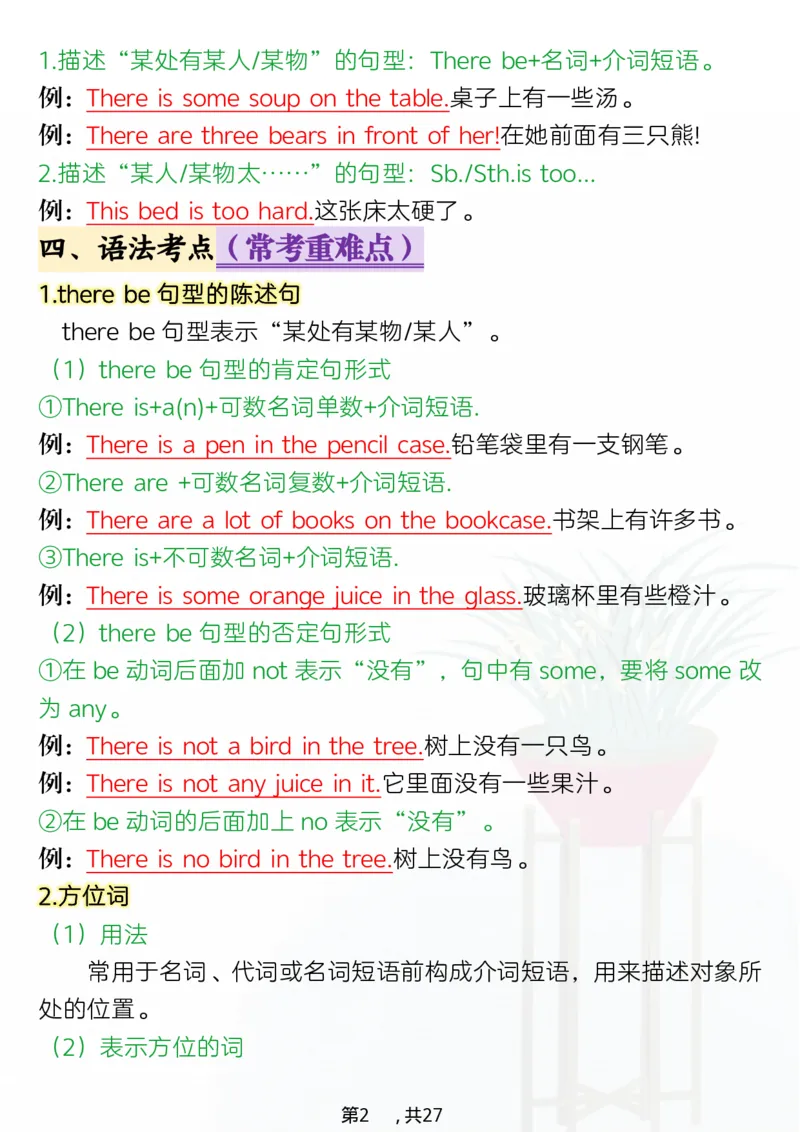
1.描述“某处有某人/某物”的句型:There be+名词+介词短语。
例:There is some soup on the table.桌子上有一些汤。
例:There are three bears in front of her!在她前面有三只熊!
2.描述“某人/某物太……”的句型:Sb./Sth.is too...
例:This bed is too hard.这张床太硬了。
四、语法考点(常考重难点)
there be 句型表示“某处有某物/某人”。
(1)there be 句型的肯定句形式
①There is+a(n)+可数名词单数+介词短语.
例:There is a pen in the pencil case.铅笔袋里有一支钢笔。
②There are +可数名词复数+介词短语.
例:There are a lot of books on the bookcase.书架上有许多书。
③There is+不可数名词+介词短语.
例:There is some orange juice in the glass.玻璃杯里有些橙汁。
(2)there be 句型的否定句形式
①在be 动词后面加not 表示“没有”,句中有some,要将some 改
为any。
例:There is not a bird in the tree.树上没有一只鸟。
例:There is not any juice in it.它里面没有一些果汁。
②在be 动词的后面加上no 表示“没有”。
例:There is no bird in the tree.树上没有鸟。
(1)用法
常用于名词、代词或名词短语前构成介词短语,用来描述对象所
处的位置。
(2)表示方位的词
2⻚,共27⻚
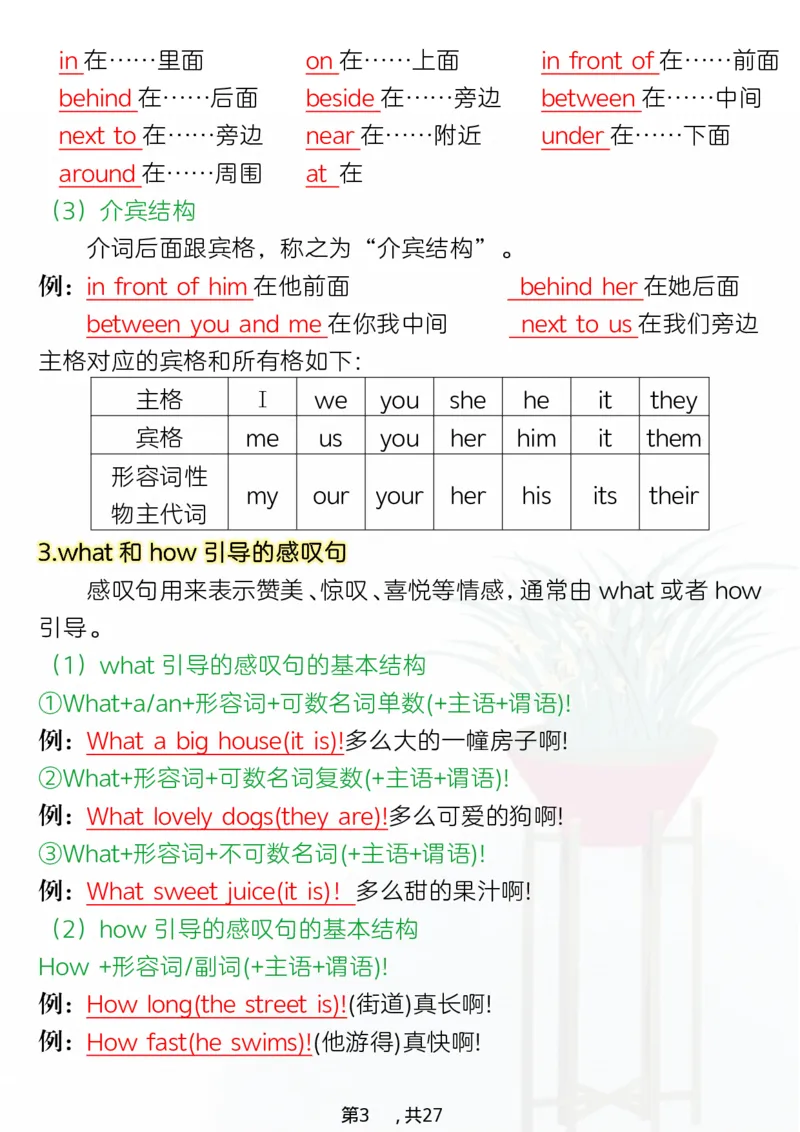
in 在……里面
behind 在……后面
next to 在……旁边
around 在……周围
on 在……上面
beside 在……旁边
near 在……附近
at 在
in front of 在……前面
between 在……中间
under 在……下面
(3)介宾结构
介词后面跟宾格,称之为“介宾结构”。
例:in front of him 在他前面
behind her 在她后面
between you and me 在你我中间
next to us 在我们旁边
主格对应的宾格和所有格如下:
主格
I
we
you
she
he
it
they
宾格
me
us
you
her
him
it
them
形容词性
物主代词
my
our
your
her
his
its
their
感叹句用来表示赞美、惊叹、喜悦等情感,通常由what 或者how
引导。
(1)what 引导的感叹句的基本结构
①What+a/an+形容词+可数名词单数(+主语+谓语)!
例:What a big house(it is)!多么大的一幢房子啊!
②What+形容词+可数名词复数(+主语+谓语)!
例:What lovely dogs(they are)!多么可爱的狗啊!
③What+形容词+不可数名词(+主语+谓语)!
例:What sweet juice(it is)!多么甜的果汁啊!
(2)how 引导的感叹句的基本结构
How +形容词/副词(+主语+谓语)!
例:How long(the street is)!(街道)真长啊!
例:How fast(he swims)!(他游得)真快啊!
3⻚,共27⻚
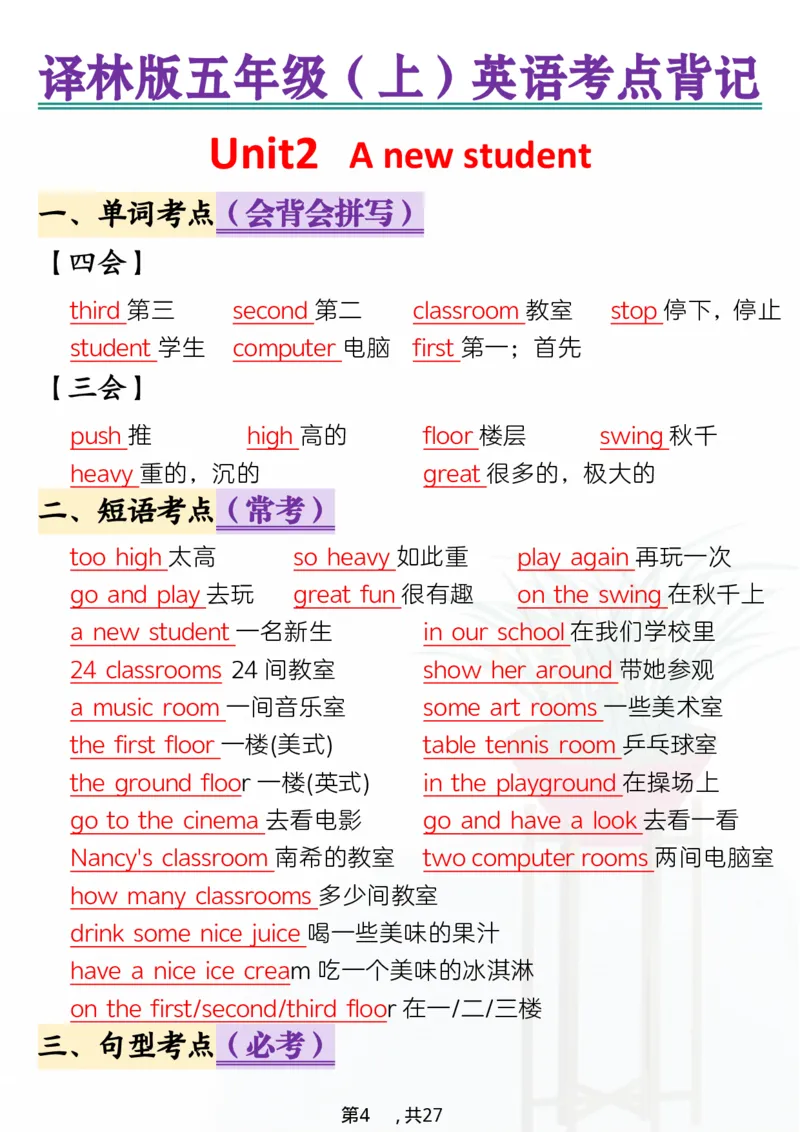
译林版五年级(上)英语考点背记
Unit2 A new student
一、单词考点(会背会拼写)
【四会】
third 第三
student 学生
second 第二
computer 电脑
classroom 教室
first 第一;首先
stop 停下,停止
【三会】
push 推
high 高的
floor 楼层
swing 秋千
heavy 重的,沉的
great 很多的,极大的
二、短语考点(常考)
too high 太高
go and play 去玩
so heavy 如此重
great fun 很有趣
play again 再玩一次
on the swing 在秋千上
a new student 一名新生
24 classrooms 24 间教室
a music room 一间音乐室
the first floor 一楼(美式)
the ground floor 一楼(英式)
go to the cinema 去看电影
Nancy's classroom 南希的教室
in our school 在我们学校里
show her around 带她参观
some art rooms 一些美术室
table tennis room 乒乓球室
in the playground 在操场上
go and have a look 去看一看
two computer rooms 两间电脑室
how many classrooms 多少间教室
drink some nice juice 喝一些美味的果汁
have a nice ice cream 吃一个美味的冰淇淋
on the first/second/third floor 在一/二/三楼
三、句型考点(必考)
4⻚,共27⻚
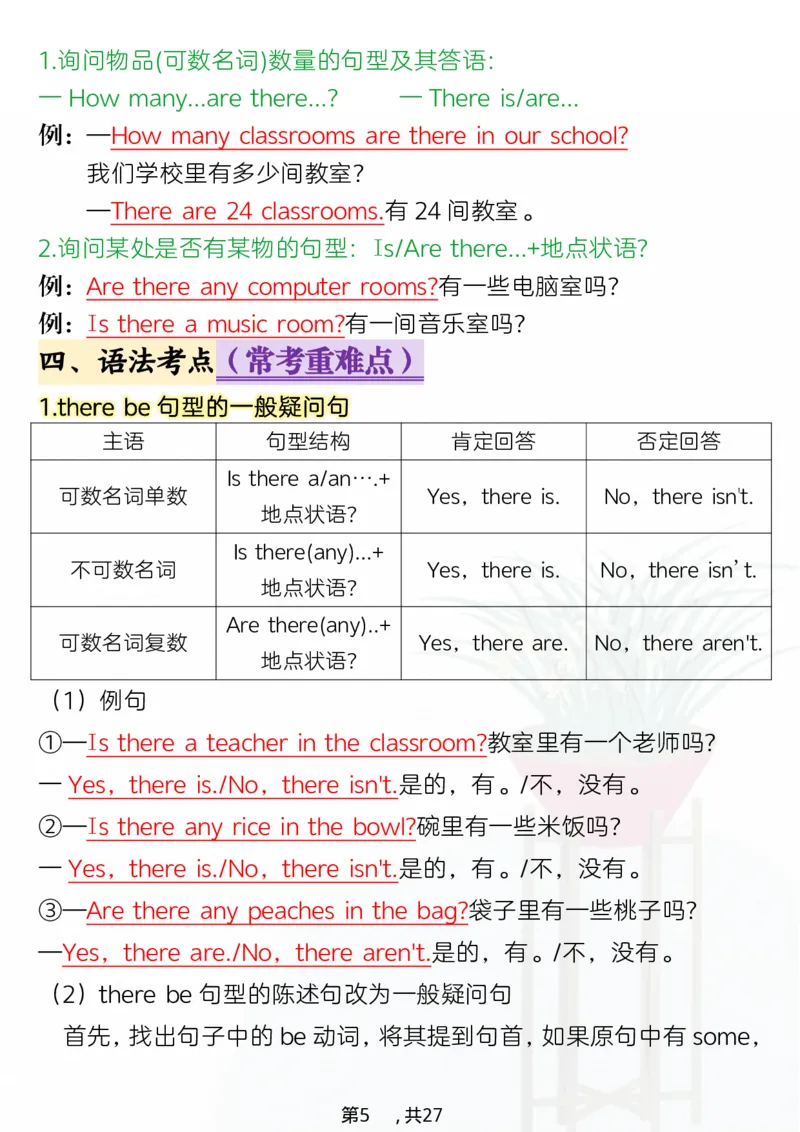
1.询问物品(可数名词)数量的句型及其答语:
一How many...are there...?
一There is/are...
例:—How many classrooms are there in our school?
我们学校里有多少间教室?
—There are 24 classrooms.有24 间教室。
2.询问某处是否有某物的句型:Is/Are there...+地点状语?
例:Are there any computer rooms?有一些电脑室吗?
例:Is there a music room?有一间音乐室吗?
四、语法考点(常考重难点)
主语
句型结构
肯定回答
否定回答
可数名词单数
Is there a/an….+
地点状语?
Yes,there is.
No,there isn't.
不可数名词
Is there(any)...+
地点状语?
Yes,there is.
No,there isn't.
可数名词复数
Are there(any)..+
地点状语?
Yes,there are.
No,there aren't.
(1)例句
①—Is there a teacher in the classroom?教室里有一个老师吗?
一Yes,there is./No,there isn't.是的,有。/不,没有。
②—Is there any rice in the bowl?碗里有一些米饭吗?
一Yes,there is./No,there isn't.是的,有。/不,没有。
③—Are there any peaches in the bag?袋子里有一些桃子吗?
—Yes,there are./No,there aren't.是的,有。/不,没有。
(2)there be 句型的陈述句改为一般疑问句
首先,找出句子中的be 动词,将其提到句首,如果原句中有some,
5⻚,共27⻚
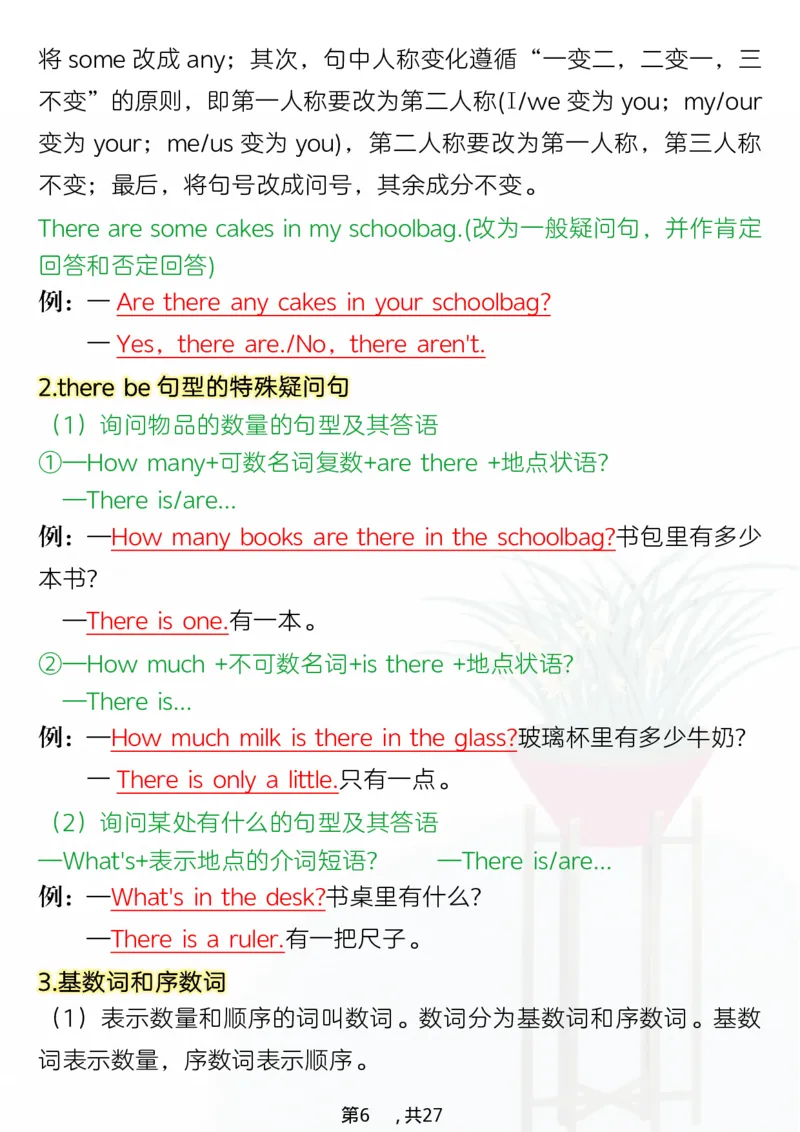
将some 改成any;其次,句中人称变化遵循“一变二,二变一,三
不变”的原则,即第一人称要改为第二人称(I/we 变为you;my/our
变为your;me/us 变为you),第二人称要改为第一人称,第三人称
不变;最后,将句号改成问号,其余成分不变。
There are some cakes in my schoolbag.(改为一般疑问句,并作肯定
回答和否定回答)
例:一Are there any cakes in your schoolbag?
一Yes,there are./No,there aren't.
(1)询问物品的数量的句型及其答语
①—How many+可数名词复数+are there +地点状语?
—There is/are...
例:—How many books are there in the schoolbag?书包里有多少
本书?
—There is one.有一本。
②—How much +不可数名词+is there +地点状语?
—There is...
例:—How much milk is there in the glass?玻璃杯里有多少牛奶?
一There is only a little.只有一点。
(2)询问某处有什么的句型及其答语
—What's+表示地点的介词短语?
—There is/are...
例:—What's in the desk?书桌里有什么?
—There is a ruler.有一把尺子。
(1)表示数量和顺序的词叫数词。数词分为基数词和序数词。基数
词表示数量,序数词表示顺序。
6⻚,共27⻚
(2)基数词后面的名词要注意单复数变化,而序数词前一般要加the,
后面跟名词单数,表示“第几”。
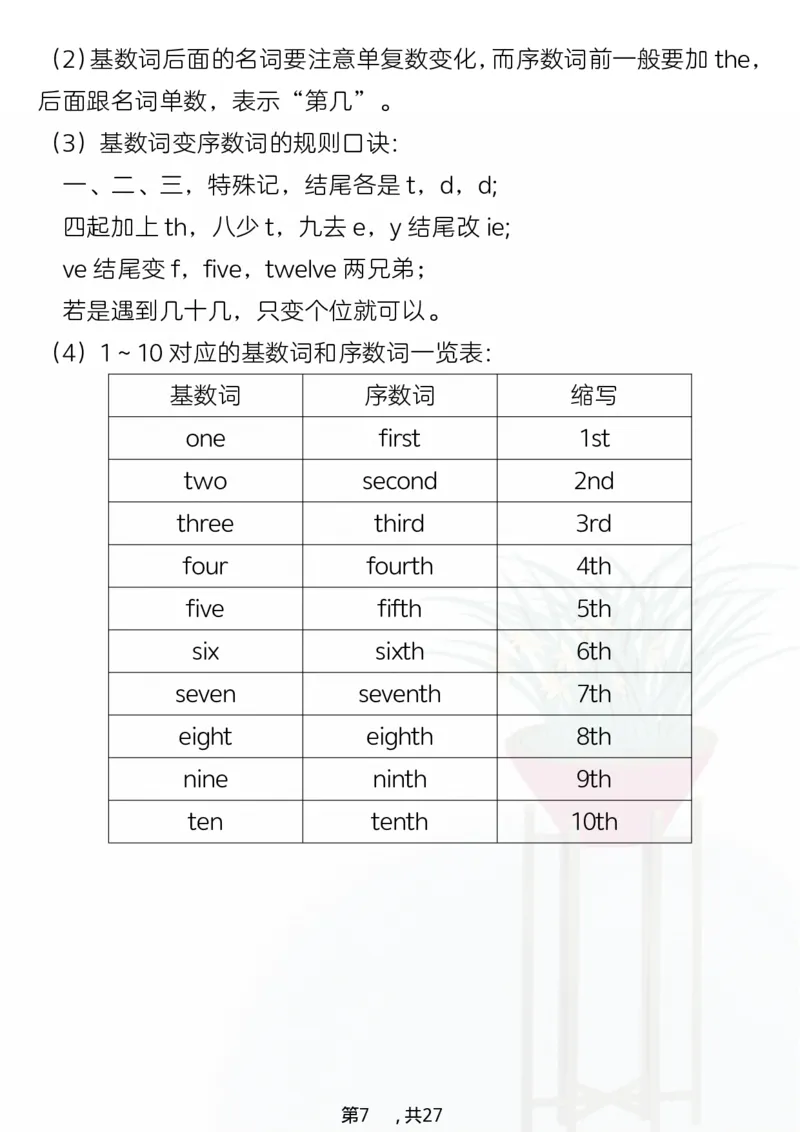
(3)基数词变序数词的规则口诀:
一、二、三,特殊记,结尾各是t,d,d;
四起加上th,八少t,九去e,y 结尾改ie;
ve 结尾变f,five,twelve 两兄弟;
若是遇到几十几,只变个位就可以。
(4)1~10 对应的基数词和序数词一览表:
基数词
序数词
缩写
one
first
1st
two
second
2nd
three
third
3rd
four
fourth
4th
five
fifth
5th
six
sixth
6th
seven
seventh
7th
eight
eighth
8th
nine
ninth
9th
ten
tenth
10th
7⻚,共27⻚
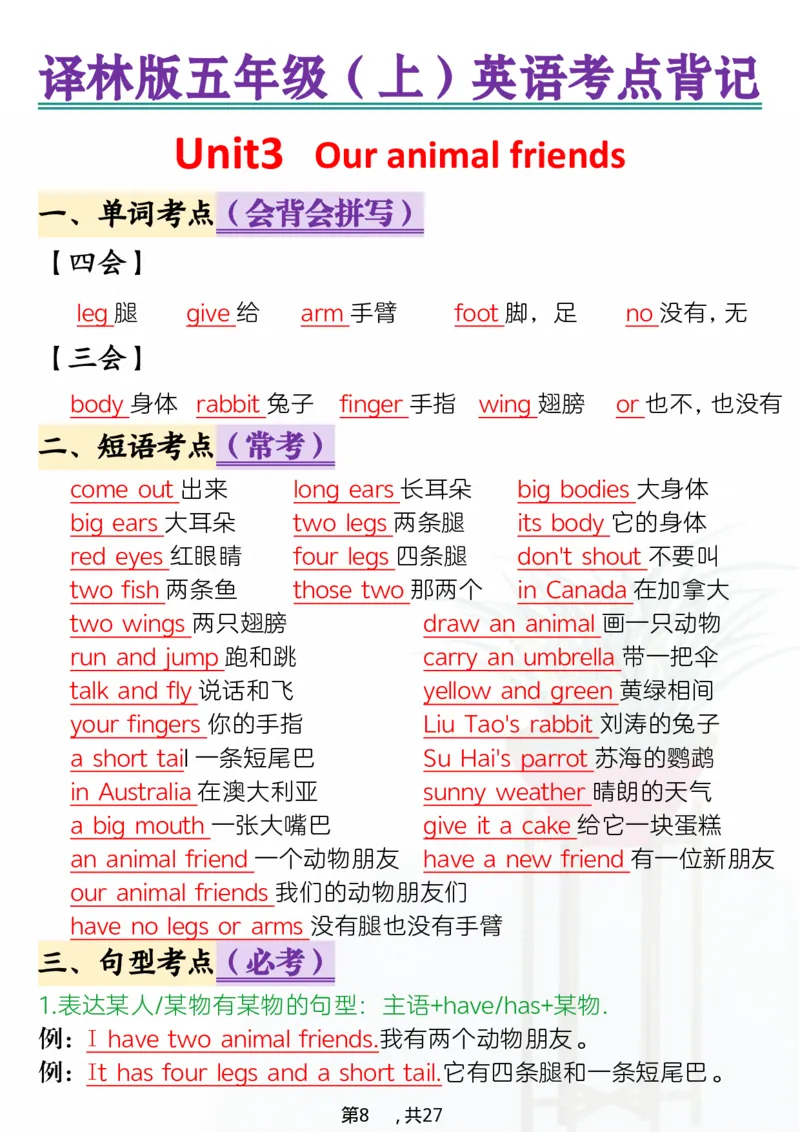
译林版五年级(上)英语考点背记
Unit3 Our animal friends
一、单词考点(会背会拼写)
【四会】
【三会】
body 身体rabbit 兔子
finger 手指
wing 翅膀
or 也不,也没有
二、短语考点(常考)
come out 出来
big ears 大耳朵
red eyes 红眼睛
two fish 两条鱼
long ears 长耳朵
two legs 两条腿
four legs 四条腿
those two 那两个
big bodies 大身体
its body 它的身体
don't shout 不要叫
in Canada 在加拿大
two wings 两只翅膀
run and jump 跑和跳
talk and fly 说话和飞
your fingers 你的手指
a short tail 一条短尾巴
in Australia 在澳大利亚
a big mouth 一张大嘴巴
an animal friend 一个动物朋友
draw an animal 画一只动物
carry an umbrella 带一把伞
yellow and green 黄绿相间
Liu Tao's rabbit 刘涛的兔子
Su Hai's parrot 苏海的鹦鹉
sunny weather 晴朗的天气
give it a cake 给它一块蛋糕
have a new friend 有一位新朋友
our animal friends 我们的动物朋友们
have no legs or arms 没有腿也没有手臂
三、句型考点(必考)
1.表达某人/某物有某物的句型:主语+have/has+某物.
例:I have two animal friends.我有两个动物朋友。
例:It has four legs and a short tail.它有四条腿和一条短尾巴。
leg 腿
give 给
arm 手臂
foot 脚,足
no 没有,无
8⻚,共27⻚
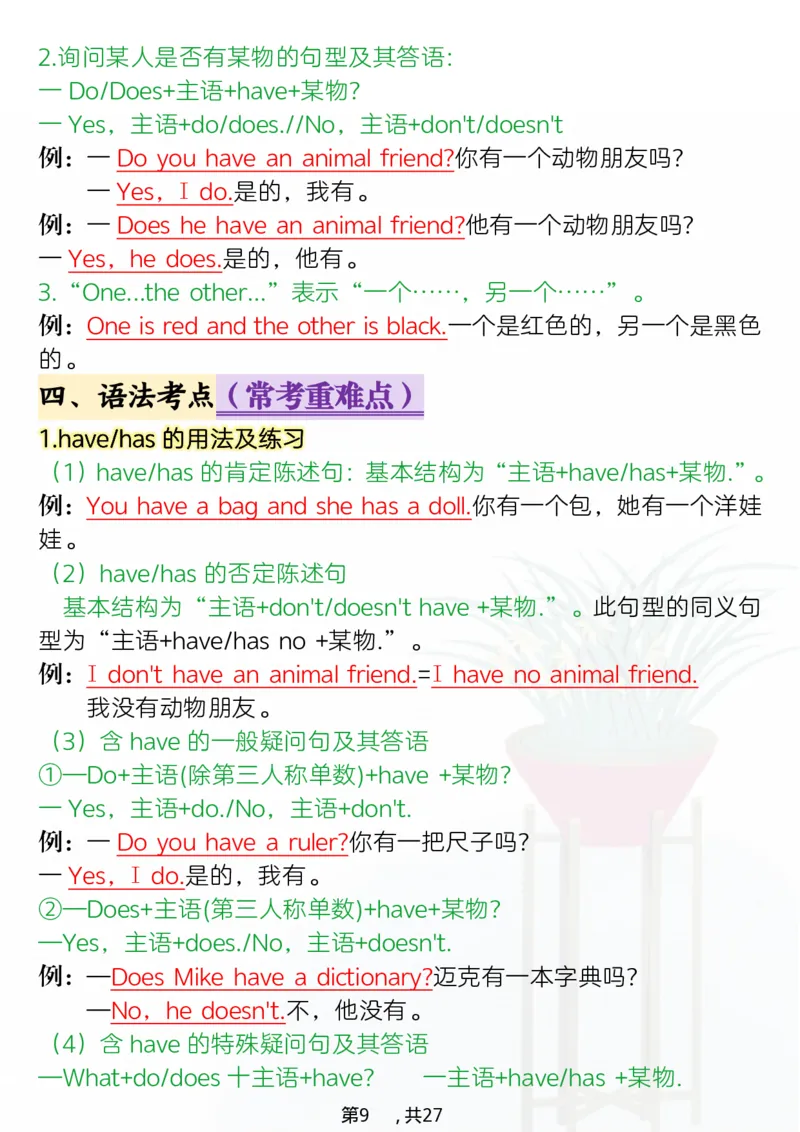
2.询问某人是否有某物的句型及其答语:
一Do/Does+主语+have+某物?
一Yes,主语+do/does.//No,主语+don't/doesn't
例:一Do you have an animal friend?你有一个动物朋友吗?
一Yes,I do.是的,我有。
例:一Does he have an animal friend?他有一个动物朋友吗?
一Yes,he does.是的,他有。
3.“One...the other...”表示“一个……,另一个……”。
例:One is red and the other is black.一个是红色的,另一个是黑色
的。
四、语法考点(常考重难点)
(1)have/has 的肯定陈述句:基本结构为“主语+have/has+某物.”。
例:You have a bag and she has a doll.你有一个包,她有一个洋娃
娃。
(2)have/has 的否定陈述句
基本结构为“主语+don't/doesn't have +某物.”。此句型的同义句
型为“主语+have/has no +某物.”。
例:I don't have an animal friend.=I have no animal friend.
我没有动物朋友。
(3)含have 的一般疑问句及其答语
①—Do+主语(除第三人称单数)+have +某物?
一Yes,主语+do./No,主语+don't.
例:一Do you have a ruler?你有一把尺子吗?
一Yes,I do.是的,我有。
②—Does+主语(第三人称单数)+have+某物?
—Yes,主语+does./No,主语+doesn't.
例:—Does Mike have a dictionary?迈克有一本字典吗?
—No,he doesn't.不,他没有。
(4)含have 的特殊疑问句及其答语
—What+do/does 十主语+have?
一主语+have/has +某物.
9⻚,共27⻚
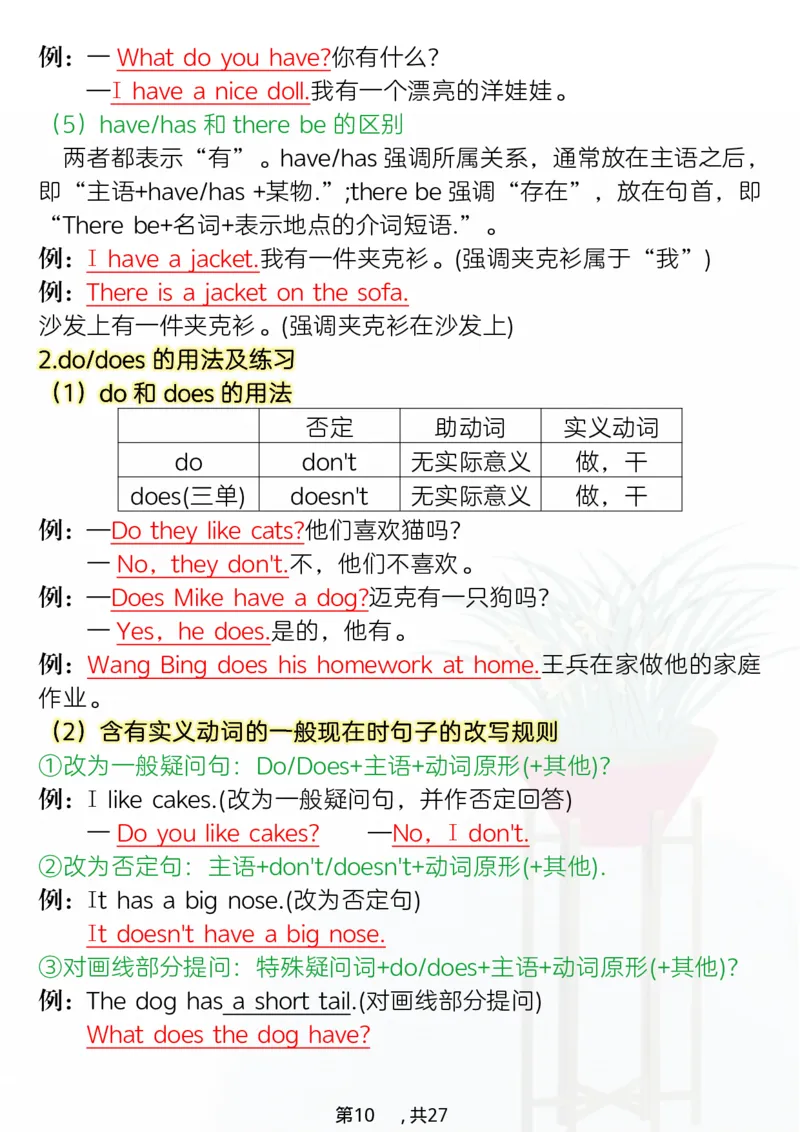
例:一What do you have?你有什么?
—I have a nice doll.我有一个漂亮的洋娃娃。
(5)have/has 和there be 的区别
两者都表示“有”。have/has 强调所属关系,通常放在主语之后,
即“主语+have/has +某物.”;there be 强调“存在”,放在句首,即
“There be+名词+表示地点的介词短语.”。
例:I have a jacket.我有一件夹克衫。(强调夹克衫属于“我”)
例:There is a jacket on the sofa.
沙发上有一件夹克衫。(强调夹克衫在沙发上)
否定
助动词
实义动词
do
don't
无实际意义
做,干
does(三单)
doesn't
无实际意义
做,干
例:—Do they like cats?他们喜欢猫吗?
一No,they don't.不,他们不喜欢。
例:—Does Mike have a dog?迈克有一只狗吗?
一Yes,he does.是的,他有。
例:Wang Bing does his homework at home.王兵在家做他的家庭
作业。
①改为一般疑问句:Do/Does+主语+动词原形(+其他)?
例:I like cakes.(改为一般疑问句,并作否定回答)
一Do you like cakes?
—No,I don't.
②改为否定句:主语+don't/doesn't+动词原形(+其他).
例:It has a big nose.(改为否定句)
It doesn't have a big nose.
③对画线部分提问:特殊疑问词+do/does+主语+动词原形(+其他)?
例:The dog has a short tail.(对画线部分提问)
What does the dog have?
10⻚,共27⻚
译林版五年级(上)英语考点背记
Unit4 Hobbies
一、单词考点(会背会拼写)
【四会】
sing 唱歌
story 故事
dance 跳舞
read 读,阅读
【三会】
ice 冰
hole 洞
also 也
idea 主意
group 组
about 关于
both 两个都
wet 湿的,潮的
hobby 业余爱好
with 与……一起
二、短语考点(常考)
in winter 在冬天
go skating 去溜冰
watch films 看电影
in the ice 在冰里面
on the ice 在冰面上
read stories 读故事
play the piano 弹钢琴
like dancing 喜欢跳舞
cold and wet 又冷又湿
this afternoon 今天下午
behind Billy 在比利后面
a great idea 一个好主意
have an idea 有一个主意
yellow shoes 黄色的鞋子
play table tennis 打乒乓球
a yellow hat 一顶黄色的帽子
be good at footbal 擅长足球
be good at skating 擅长溜冰
have a lot of books 有很多书
like playing football 喜欢踢足球
draw in the park 在公园里画画
both like swimming 都喜欢游泳
skate very well 溜冰溜得非常好
play basketball well 篮球打得好
talk about hobbies 谈论业余爱好
with my brother 与我的弟弟一起
a yellow dress 一条黄色的连衣裙
11⻚,共27⻚
三、句型考点(必考)
1.询问某人喜欢做什么的句型及其答语:
—What do/does+主语+like doing?
一主语+like/likes +动词-ing 形式(+其他).
例:—What do you like doing?你喜欢做什么?
—I like playing basketball.我喜欢打篮球。
例:—What does she like doing?她喜欢做什么?
—She likes reading stories.她喜欢读故事。
2.表达某人擅长(做)某事的句型:主语+be good at(+doing)+其他。
例:You're really good at skating,Billy.比利,你真的很擅长溜冰。
四、语法考点(常考重难点)
(1)一般情况下,直接在动词后面加-ing。如:look→looking play→
playing
(2)以不发音的字母e 结尾的动词,去e 加-ing。如:skate→skating
make→making
(3)以重读闭音节结尾的动词,如果末尾只有一个辅音字母,则先双写
这个辅音字母再加-ing。如:swim→swimming
run→running
一般现在时表示真理或经常性、规律性、习惯性的动作或者状态。
(1)基本用法
①表示经常性或习惯性的动作或存在的状态。
②表示客观真理、客观存在和科学事实。
③表示格言或者警句。
④表示现阶段的状态、能力和性格。
12⻚,共27⻚
⑤在时间和条件状语从句中代表一般将来时。
⑥在某些以here、there 开头的句子中,用一般现在时表示正在发生
的动作。
(2)一般现在时的句型结构
当主语是第三人称单数时,动词用第三人称单数形式;当主语不
是第三人称单数时,动词用原形。
①肯定陈述句:主语+动词第三人称单数形式/动词原形+其他.
例:She eats a lot.她吃很多。
例:They have a good time at the party.他们在聚会上玩得很愉快。
②否定陈述句:主语+don't/doesn't+动词原形+其他.
例:Mike doesn't go to school today.迈克今天不去上学。
例:Su Hai and Su Yang dont like pigs.苏海和苏洋不喜欢猪。
③一般疑问句及其答语:
一Do/Does+主语十动词原形+其他?
—Yes,主语+do/does.//No,主语+don't/doesn't.
例:一Does he have a brother?他有一个弟弟吗?
一Yes,he does.是的,他有。/No,he doesn't.不,他没有。
④特殊疑问句:特殊疑问词+一般疑问句?
例:How do you know that?你是怎么知道那个的?
①like sb./sth.意为“喜欢某人/某物”。
例:Tom likes dogs very much.汤姆非常喜欢狗。
②“like+动词不定式”表示偶尔或具体地喜欢做某事。
例:I like to swim with you.我喜欢和你一起游泳。
③“like+动词-ing”表示经常或习惯性地喜欢做某事,常用于介绍某
13⻚,共27⻚
人的爱好。
例:He likes playing basketball.他喜欢打篮球。
④would like sth.意为“想要某物”;would like todo sth.意为“想要
做某事”。
例:would like some milk 想要一些牛奶
would like to drink some milk 想要喝一些牛奶
can 意为“能,会”时,指脑力或体力方面的“能力”。
①含有can 的肯定句句型为“主语+can+动词原形(+其他).”。
例:She can dance.她会跳舞。
②含有can 的否定句句型为“主语+can't/cannot +动词原形(+其他).”。
例:I can't/cannot sing.我不会唱歌。
③含有can 的一般疑问句句型为“Can+主语+动词原形(+其他)?”,
意为“某人会(做)……吗?”,肯定回答为“Yes,主语+can.”,否定
回答为“No,主语+can't.”。
例:—Can Mike skate?迈克会溜冰吗?
一No,he can't.不,他不会。
④含有can 的特殊疑问句句型:
(1)疑问词+can+主语十动词原形(+其他)?
例:What can you see in the box?你能在盒子里看见什么?
(2)Who+can+动词原形(+其他)?(Who 相当于主语)
例:Who can sing in English in your class?在你班里谁会用英文唱歌?
14⻚,共27⻚
译林版五年级(上)英语考点背记
Unit5 What do they do?
一、单词考点(会背会拼写)
【四会】
teach 教
write 写
help 帮助
nurse 护士
work 工作
doctor 医生
worker 工人
teacher 老师
【三会】
cook 厨师
sick 生病的
writer 作家
farmer 农民
factory 工厂
policeman 警察
people 人;人们
driver 驾驶员,司机
二、短语考点(常考)
can't go 不能走
a cook 一名厨师
a driver 一名司机
a nurse 一名护士
a writer 一位作家
a farmer 一个农民
in the sky 在天空中
write stories 写故事
teach English 教英语
a policeman 一名警察
make sweets 制作糖果
work at home 在家工作
help sick people 帮助病人
a lot of students 很多学生
so many cars 如此多小汽车
see a butterfly 看见一只蝴蝶
a factory worker 一名工厂工人
eat a lot of sweets 吃很多糖果
an English teacher 一名英语老师
have a nice car 有一辆漂亮的小汽车
三、句型考点(必考)
1.询问他人职业的句型及其答语:
—What do/does+主语+do?
一主语+be 动词+a/an+职业名词.
例:—What does your father do,Mike?迈克,你的父亲是做什么的?
15⻚,共27⻚
一My father is a teacher.我的父亲是一名老师。
2.询问某人是谁的句型:Who is/are....?
例:Who's that,Bobby?博比,那是谁?
3.询问某人或某物情况如何的句型:What about..?
例:What about your mother?你的妈妈怎么样?
四、语法考点(常考重难点)
(1)第三人称单数的分类
英语句子的主语一般分为第一人称(I/we)、第二人称(you)和第三
人称(they/he/she/it/.…)。第三人称又分为第三人称复数和第三人称
单数。除了I、we、you 及第三人称复数,其余名词或者代词都属于
第三人称单数。具体如下:
①人称代词he、she、it 是第三人称单数。
②单个的人名、地名或者称呼作主语时,是第三人称单数。
③单数可数名词或“this/that/the +单数可数名词”作主语时,是第
三人称单数。
④不定代词someone、somebody、nobody、every-thing、something
等以及指示代词this 和that 作主语时,是第三人称单数。
⑤不可数名词作主语时,是第三人称单数。
⑥数字或者字母作主语时,是第三人称单数。
(2)在一般现在时的肯定句中,由于主语不同,动词会发生相应的
变化
①主语为第一人称、第二人称和第三人称复数时,动词用原形。
例:I study at this school.我在这所学校学习。
②主语为第三人称单数时,动词用第三人称单数形式。
16⻚,共27⻚
例:He helps sick people.他帮助病人。
(3)在一般现在时中,动词第三人称单数形式的变化规则
规则
例词
一般情况下,直接在动词的词尾加s
write→writes
help→helps
give→gives
以s、x、o、sh、ch 结尾的动词,一般在词尾加es
teach→teaches
wash→washes
do→does
以辅音字母加y 结尾的动词,先变y 为i,再加es
cry→cries
fly→flies
carry→carries
以元音字母加y 结尾的动词,直接在词尾加s
play→plays
say→says
buy→buys
特殊情况
have→has
(1)常见的职业类名词
nurse 护士
actor 演员
cook 厨师
singer 歌手
writer 作家
doctor 医生
farmer 农民
pilot 飞行员
student 学生
teacher 老师
worker 工人
boxer 拳击手
player 运动员
waiter 服务员
buyer 采购员
dancer 舞蹈家
fireman 消防员
actress 女演员
fisherman 渔夫
policeman 警察
hairdresser 理发师
waitress 女服务员
housewife 家庭主妇
policewoman 女警察
driver 驾驶员,司机
17⻚,共27⻚
(2)常用询问职业的句型及其答语
问句
答句
What do/does+主语+do?
主语+be 动词+a/an+职业名词.
What+be 动词+主语?
主语+be 动词+a/an +职业名词.
What's sb.'s job?
主语+be 动词+a/an +职业名词.
例:1.—What does your father do?你爸爸是做什么的?
—He is a teacher.他是一名老师。
2.—What is your aunt?你阿姨是做什么的?
—She's a nurse.她是一名护士。
3.—What's your mother's job?你妈妈是做什么的?
一She's a driver.她是一名司机。
18⻚,共27⻚
译林版五年级(上)英语考点背记
Unit6 My e-friend
一、单词考点(会背会拼写)
【四会】
study 学习
sit 坐,坐在
live 住,居住
e-friend 网友
email 电子邮件
tomorrow 明天
by…在……旁边
【三会】
to 给
US 美国
Greece 希腊
wait 等,等待
Canada 加拿大
fishing 钓鱼,捕鱼
PRC 中华人民共和国
UK 英国Russia 俄罗斯
send 发出(信件、邮件等)
二、短语考点(常考)
eat fish 吃鱼
at school 在学校
go fishing 去钓鱼
in winter 在冬天
after school 放学后
play football 踢足球
speak Chinese 说汉语
my e-friend 我的网友
live in the UK 住在英国
study Chinese 学习汉语
wait a minute 等一会儿
sit by the river 坐在河边
wait and wait 等了又等
what subjects 什么学科
in the playground 在操场上
be good at fishing 擅长钓鱼
have Chinese lessons 上语文课
wear warm clothes 穿暖和的衣服
send this email 发送这封电子邮件
write English addresses 写英文地址
三、句型考点(必考)
1.询问某人是否会讲某种语言的句型及其答语:
例:一Can he speak Chinese?他会讲汉语吗?
19⻚,共27⻚
一Yes,he can.是的,他会。
2.询问某人年龄的句型及其答语:
例:一How old is he?他多大?
—He's 11 years old.他11 岁。
3.询问某人喜欢什么学科的句型及其答语:
例:一What subjects does he like?他喜欢什么学科?
—He likes Maths and PE.他喜欢数学和体育。
四、语法考点(常考重难点)
(1)一般现在时的一般疑问句
一般疑问句是指询问情况是否属实的句子,一般只用yes 或no
来回答。
①be 动词引导的一般疑问句。
句型结构:Be 动词+主语+其他?
例:一Are you a student?你是一名学生吗? —Yes,I am.是的,我
是。
②情态动词(can/would/should/...)引导的一般疑问句。
句型结构:情态动词+主语+动词原形(十其他)?
例:一Can you play football?你会踢足球吗?
一No,I can't.不,我不会。
③助动词do 或does 引导的一般疑问句。
句型结构:助动词+主语+动词原形(+其他)?
例:一Does he skate well?他溜冰溜得好吗?
一No,he doesn't.不,他溜得不好。
(2)一般现在时的否定句
①含有be 动词的句子改为否定句时,在be 动词后面加not,如果有
some 则改为any。
例:There is some juice in the bottle.(改为否定句)
20⻚,共27⻚
There isn't any juice in the bottle.
②含有情态动词(can/would/should/...)的句子改为否定句时,在情态
动词后面加not。
例:I can dance.(改为否定句)
I cannot/can't dance.
③含有行为动词的句子改为否定句时,需要借助don't 或doesn't,然
后在后面接动词原形。如果主语是第三人称单数,否定句结构为“主
语+doesn't+动词原形(+其他).”;如果主语不是第三人称单数,则否定
句结构为“主语+don't +动词原形(+其他).”。
例:She likes English.(改为否定句)
She doesn't like English.
以特殊疑问词开头,对句子中的某一成分提问的句子叫特殊疑问
句。特殊疑问句一般读降调。常用的疑问词有where、who、what、
whose、why、which、when、how 等。特殊疑问句有两种语序:
①如果疑问词作主语或主语的定语,即对主语或主语的定语提问,其
语序是陈述句的语序。
例:—Who is in the classroom?谁在教室里?
—Mike(is).迈克。
—Whose bike is broken?谁的自行车坏了?
—Liu Tao's.刘涛的(自行车)。
②如果疑问词作其他成分,即对其他成分提问,其句型为“特殊疑问
词+be 动词+主语(+其他)?/特殊疑问词+助动词/情态动词+主语+动词
原形(+其他)?”,即“特殊疑问词+一般疑问句?”。
例:What does she like?她喜欢什么?
What class are you in?你在几班?
What time do you get up?你几点起床?
How is the soup?这个汤怎么样?
21⻚,共27⻚
译林版五年级(上)英语考点背记
Unit7 My e-friend
一、单词考点(会背会拼写)
【四会】
there 那里
sometimes 有时
visit 拜访;参观
always 总是,一直
often 经常,常常
【三会】
chat 聊天
Internet 网络,互联网
grandparent 祖父;祖母;外祖父;外祖母
二、短语考点(常考)
too fat 太胖
get out 出来
come out 出来
eat a lot 吃很多
fly a kite 放风筝
very much 非常
watch TV 看电视
be popular 流行的
have a picnic 野餐
at weekends 在周末
like picnics 喜欢野餐
go swimming 去游泳
chat with 和……聊天
go to the park 去公园
live in the UK 住在英国
go to the cinema 去看电影
play with the cat 和猫一起玩
have dancing lessons 上舞蹈课
chat on the Internet 在网上聊天
play football with 和……一起踢足球
all the lovely roses 所有可爱的玫瑰花
visit my grandparents 拜访我的祖父母
have dinner with our grandparents 和我们的祖父母吃晚饭
三、句型考点(必考)
1.询问某人周末活动的句型及其答语:
22⻚,共27⻚
—What do/does+主语+do at weekends?
一主语+always/usually/often/sometimes...
例:—What do you do at weekends,Su Hai?苏海,你周末做什么?
—I usually visit my grandparents.我通常拜访我的祖父母。
2.表达某人不喜欢做某事的句型:
主语+don't/doesn't like+动词-ing 形式(十其他).
例:I don't like playing basketball.我不喜欢打篮球。
四、语法考点(常考重难点)
表示动作频率的副词叫频度副词。常见的频度副词有always、
usually、often、sometimes、seldom(很少,不常)、hardly(几乎不)、
never(从不)等等。其他频度副词有once(一次)、twice(两次)、three
times(三次)、once a week(一周一次)、twice a month(一个月两次)。
(1)频度副词的用法
频度副词通常放在情态动词、be 动词、助动词之后,实义动词之
前;在答句中,频度副词必须放在助动词之前。
例:We are always very happy on New Year's Day.我们在元旦那
天总是很开心。
例:一Do you often go there?你经常去那里吗?
一Yes,I often go there.是的,我经常去那里。
(2)频度副词的位置
①sometimes 可放在句首、句中和句末。在句中时,一般位于be 动
词、情态动词之后,实义动词之前。
例:She is sometimes very busy at weekends.她有时周末很忙。
②often、usually、always 一般放在句中。
注意▶对频度副词提问,用how often。
23⻚,共27⻚
例:Sometimes I write to my father.(对画线部分提问)
How often do you write to your father?
①表示“和……一起”。在句子中,with sb.是作为伴随状语出现的,
不是句子的主语,句子的谓语动词要与真正的主语保持一致。
例:Nancy goes to the park with her friends everyday.
南希和她的朋友们每天去公园。
②表示方式、手段或工具等,意为“以,用”。
例:I eat with chopsticks.我用筷子吃(东西)。
例:We listen with ou ears.我们用我们的耳朵听。
例:I write with a pen.我用钢笔写字。
③表示人或物的特征,意为“带有,具有”。
例:The woman with long hair is my mother.
那位留着长头发的女士是我的妈妈。
例:I like living in a room with two windows.
我喜欢住在带有两扇窗户的房间里。
④表示原因或者理由。
例:John is in bed with a high fever.约翰因发高烧而卧床。
例:He jumped with joy.他因高兴而跳起来。
⑤引出被询问的对象you。
例:What's wrong with you?你怎么了?
注意▶不要受中文意思的影响而用错搭配,如“用英语”,习惯上用
in English,而不是用with English。
24⻚,共27⻚
译林版五年级(上)英语考点背记
Unit8 At Christmas
一、单词考点(会背会拼写)
【四会】
buy 买
put 放
him 他
us 我们
letter 信
song 歌曲
look 看起来
early 早早地
next 接着,然后
after 在……以后
【三会】
all 全都
card 卡片
finally 最后
pudding 布丁
present 礼物
stocking 长简袜
Christmas 圣诞节
thing 物品,东西
storybook 故事书
turkey 火鸡;火鸡肉
children 孩子,儿童
message 信息,消息
pretty 漂亮的,好看的
二、短语考点(常考)
look sad 看上去难过
wake up early 醒得早
look great 看上去很好
draw a picture 画一幅画
Merry Christmas 圣诞快乐
wait for presents 等待礼物
write your name 写你的名字
have a lot of fun 玩得很开心
Christmas Eve 圣诞夜,平安夜
a New Year card 一张新年卡片
write your message 写你的信息
write him a letter 给他写一封信
sing Christmas songs 唱圣诞歌曲
open our presents 打开我们的礼物
have a big lunch 吃一顿丰盛的午餐
some pretty things 一些漂亮的东西
buy a Christmas tree 买一棵圣诞树
have a good time 过得愉快,玩得高兴
at Christmas/on Christmas Day 在圣诞节
go to see Father Christmas 去看圣诞老人
25⻚,共27⻚
三、句型考点(必考)
1.“主语+have/has a lot of fun.”意为“……玩得很开心。”。
例:We always have a lot of fun at Christmas.
我们在圣诞节总是玩得很开心。
2.“主语+buy/buys sth.for sb.”意为“……买某物给某人。”。
例:First,we buy presents for our family and friends.
首先,我们买礼物给我们的家人和朋友们。
3.“What's wrong with.…?”意为“……怎么了?”。
例:What's wrong with him?他怎么了?
四、语法考点(常考重难点)
(1)常见的时间副词有ago、before、after、now、today、tomorrow、
tonight(今晚)、yesterday(昨天)、soon、lately(近来)、later(后来)、
recently(最近)、early(在初期)、just(刚才)、already(已经)等。
例:She is dancing now.她现在正在跳舞。
See you later.回头见。
(2)其他一些表示时间的副词主要有first(首先)、next(接着)、then(然
后)、finally(最后)。这些副词用来说明事情发生的先后顺序,一般放
在句首。
例:First,fold a card.首先,将一张卡片对折。
例:Next,draw a picture.接着,画一幅画。
例:Then,write your message.然后,写你的信息。
例:Finally,write your name.最后,写你的名字。
(3)时间副词在句子中的位置:
①表确定时间的副词,如today、yesterday 等,通常位于句末,有时
也位于句首。
例:He went home yesterday./Yesterday he went
home.
他昨天回家了。
26⻚,共27⻚
②表非确定时间的副词,如soon、recently 等,可位于句首、句中和
句末。在句中时,位于be 动词、情态动词、助动词之后,实义动词
之前。
例:He went to Paris recently./He recently went to Paris./Recently
he went to Paris.最近他去了巴黎。
③still、already、just 等几个表示时间的副词通常位于句中的实义动词
之前,be 动词、情态动词、助动词之后。
at
用于时间点、时刻等前:
at seven ten 在七点十分
at night 在夜里
at midnight 在午夜
at noon 在中午
I get up at six in the morning.
我在早上六点起床。
用于表示岁数的词前:
at the age of ten 在十岁时
Most children in China start school at
seven years old.
中国大多数孩子七岁上小学。
用于比较短暂的一段时间前或某个节
日前:
at New Year 在新年
at present 目前
He goes home at the Spring Festival
every year.
他每年春节回家。
in
用于世纪、朝代、年、月、季节以及
泛指的上午、下午或者傍晚等:
in 2019 在2019 年
in May 在五月
in spring 在春天
in the afternoon 在下午
He likes flying kites in May in spring.
他喜欢在五月的春天放风筝。
用于一段时间前,表示多久之后,常
用于将来时
He will come back in two hours.
他将在两个小时之后回来。
on
用于具体的时日或特定的时间前,如
某日、某节日、星期几等;
on Tree Planting Day 在植树节
on May 4th 在5 月4 日
Children's Day is on June 1st.
儿童节在六月一日。
用于某个特定的上午、下午或晚上前:
on Friday evening 在星期五晚上
He has a swimming lesson on Saturday
afternoon.
他周六下午有一节游泳课。
27⻚,共27⻚