文档文本内容
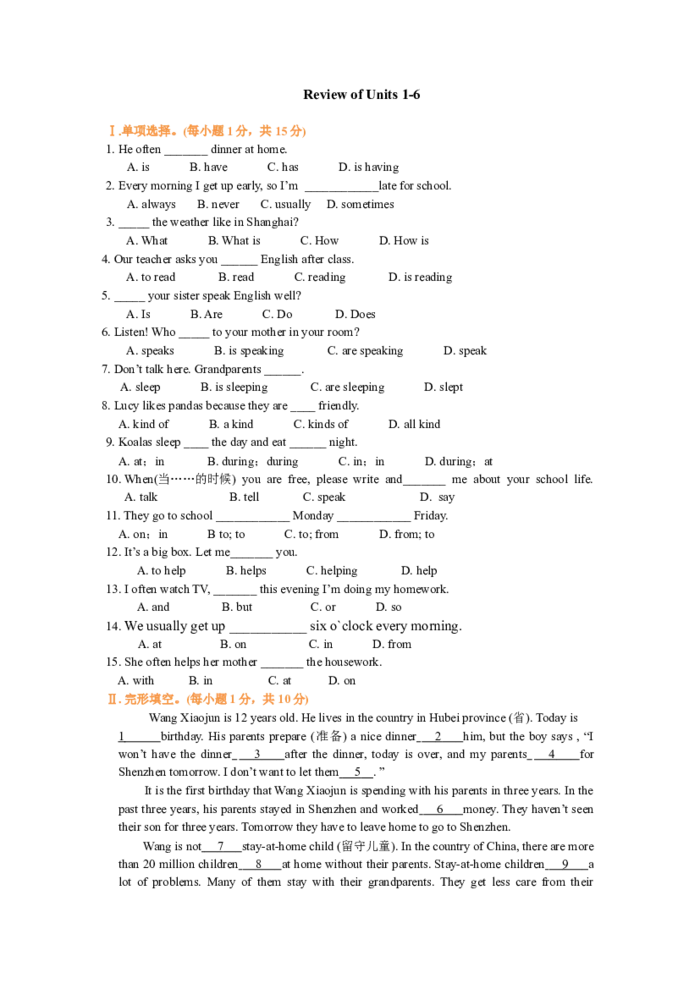
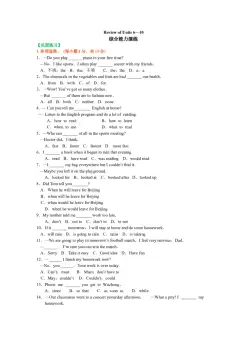
Review of Units 1-6

Ⅰ.单项选择。(每小题1 分,共15 分)
1. He often _______ dinner at home.
 A. is    B. have    C. has    D. is having
2. Every morning I get up early, so I’m  ____________late for school.
A. always    B. never    C. usually    D. sometimes
3. _____ the weather like in Shanghai?
    A. What    B. What is    C. How    D. How is
4. Our teacher asks you ______ English after class.
    A. to read    B. read    C. reading    D. is reading
 5. _____ your sister speak English well?
    A. Is    B. Are    C. Do    D. Does
 6. Listen! Who _____ to your mother in your room?
    A. speaks    B. is speaking    C. are speaking    D. speak
 7. Don’t talk here. Grandparents ______.
   A. sleep    B. is sleeping    C. are sleeping    D. slept
  8. Lucy likes pandas because they are ____ friendly.
 A. kind of    B. a kind    C. kinds of    D. all kind
9. Koalas sleep ____ the day and eat ______ night.
 A. at;in    B. during;during    C. in;in    D. during;at
10. When(当……的时候) you are free, please write and_______ me about your school life.
   A. talk
B. tell
C. speak            D. say
11. They go to school ____________ Monday ____________ Friday.
 A. on;in    B to; to    C. to; from    D. from; to
12. It’s a big box. Let me_______ you.
   A. to help    B. helps    C. helping    D. help
13. I often watch TV, _______ this evening I’m doing my homework.
   A. and       B. but       C. or    D. so
14. We usually get up ___________ six o`clock every morning.
     A. at          B. on          C. in       D. from
15. She often helps her mother _______ the housework.
    A. with       B. in          C. at       D. on
Ⅱ. 完形填空。(每小题1 分,共10 分)
 Wang Xiaojun is 12 years old. He lives in the country in Hubei province (省). Today is
1

 birthday. His parents prepare (准备) a nice dinner
  2
    him, but the boy says , “I
won’t have the dinner
  3
    after the dinner, today is over, and my parents
  4
    for
Shenzhen tomorrow. I don’t want to let them
  5
  . ”
     It is the first birthday that Wang Xiaojun is spending with his parents in three years. In the
past three years, his parents stayed in Shenzhen and worked
  6
    money. They haven’t seen
their son for three years. Tomorrow they have to leave home to go to Shenzhen.
     Wang is not
  7
    stay-at-home child (留守儿童). In the country of China, there are more
than 20 million children
  8
    at home without their parents. Stay-at-home children
  9
    a
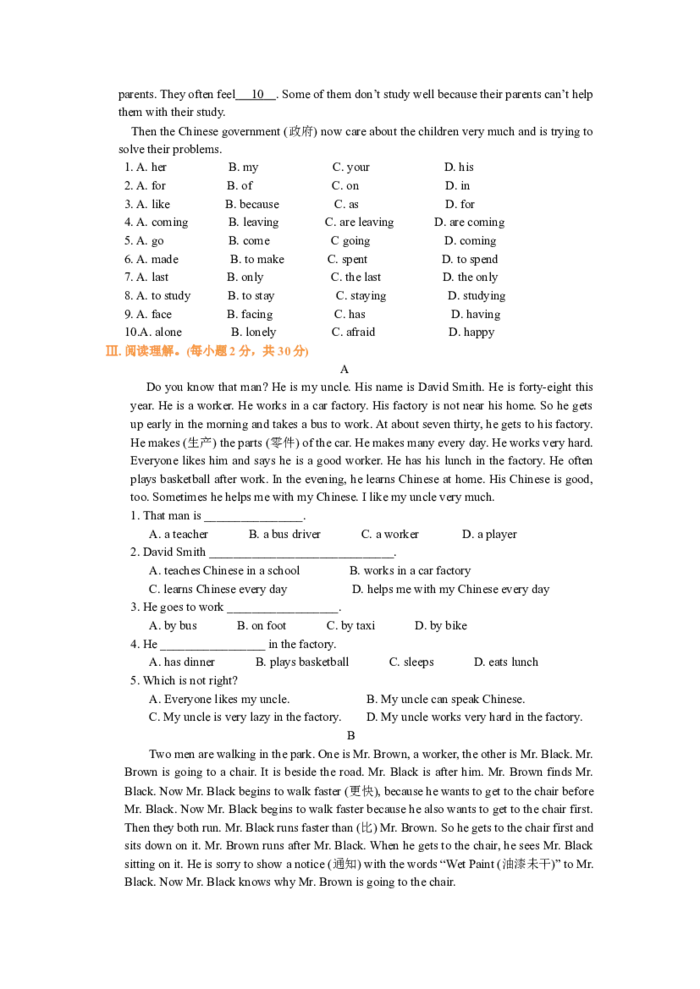
lot of problems. Many of them stay with their grandparents. They get less care from their
parents. They often feel
  10

  . Some of them don’t study well because their parents can’t help
them with their study.
   Then the Chinese government (政府) now care about the children very much and is trying to
solve their problems.
1. A. her     B. my      C. your      D. his
2. A. for     B. of       C. on       D. in
3. A. like     B. because      C. as       D. for
4. A. coming    B. leaving     C. are leaving    D. are coming
5. A. go      B. come     C going       D. coming
6. A. made     B. to make    C. spent       D. to spend
7. A. last      B. only      C. the last     D. the only
8. A. to study    B. to stay       C. staying     D. studying
9. A. face     B. facing      C. has       D. having
10.A. alone    B. lonely     C. afraid       D. happy
Ⅲ. 阅读理解。(每小题2 分,共30 分)
A
    Do you know that man? He is my uncle. His name is David Smith. He is forty-eight this
year. He is a worker. He works in a car factory. His factory is not near his home. So he gets
up early in the morning and takes a bus to work. At about seven thirty, he gets to his factory.
He makes (生产) the parts (零件) of the car. He makes many every day. He works very hard.
Everyone likes him and says he is a good worker. He has his lunch in the factory. He often
plays basketball after work. In the evening, he learns Chinese at home. His Chinese is good,
too. Sometimes he helps me with my Chinese. I like my uncle very much.
1. That man is ________________.
      A. a teacher    B. a bus driver    C. a worker    D. a player
2. David Smith ______________________________.
      A. teaches Chinese in a school    B. works in a car factory
      C. learns Chinese every day      D. helps me with my Chinese every day
3. He goes to work __________________.
      A. by bus    B. on foot    C. by taxi    D. by bike
4. He _________________ in the factory.
      A. has dinner    B. plays basketball    C. sleeps    D. eats lunch
5. Which is not right?
      A. Everyone likes my uncle.        B. My uncle can speak Chinese.
      C. My uncle is very lazy in the factory.  D. My uncle works very hard in the factory.
                                      B
     Two men are walking in the park. One is Mr. Brown, a worker, the other is Mr. Black. Mr.
Brown is going to a chair. It is beside the road. Mr. Black is after him. Mr. Brown finds Mr.
Black. Now Mr. Black begins to walk faster (更快), because he wants to get to the chair before
Mr. Black. Now Mr. Black begins to walk faster because he also wants to get to the chair first.
Then they both run. Mr. Black runs faster than (比) Mr. Brown. So he gets to the chair first and
sits down on it. Mr. Brown runs after Mr. Black. When he gets to the chair, he sees Mr. Black
sitting on it. He is sorry to show a notice (通知) with the words “Wet Paint (油漆未干)” to Mr.
Black. Now Mr. Black knows why Mr. Brown is going to the chair.
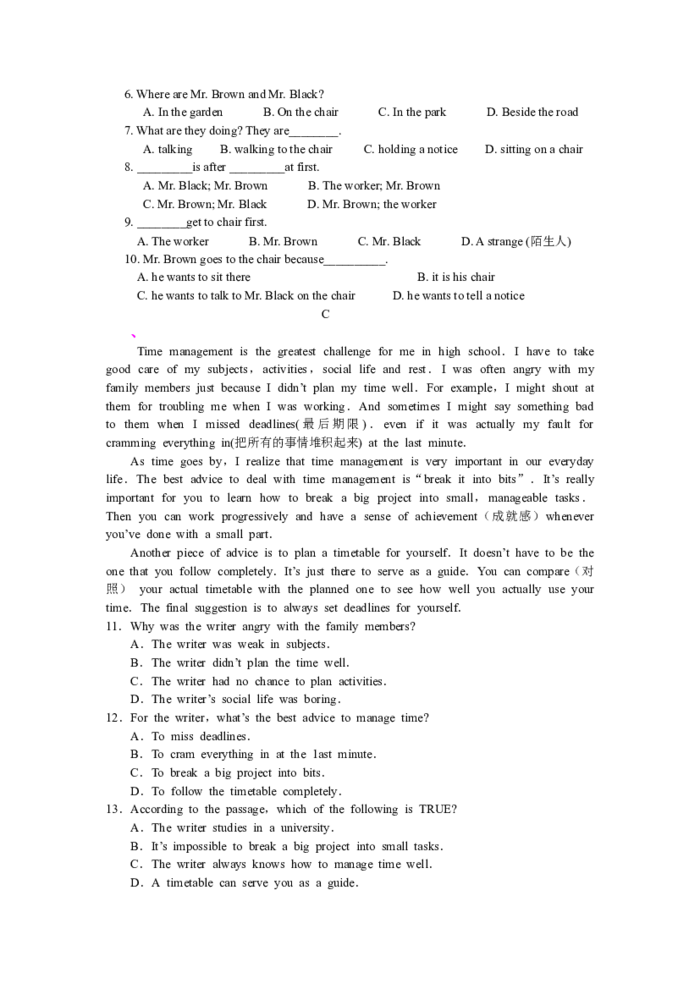
6. Where are Mr. Brown and Mr. Black?
     A. In the garden    B. On the chair    C. In the park    D. Beside the road
7. What are they doing? They are________.
     A. talking   B. walking to the chair   C. holding a notice   D. sitting on a chair
8. _________is after _________at first.
     A. Mr. Black; Mr. Brown    B. The worker; Mr. Brown
     C. Mr. Brown; Mr. Black    D. Mr. Brown; the worker
9. ________get to chair first.
    A. The worker    B. Mr. Brown    C. Mr. Black    D. A strange (陌生人)
10. Mr. Brown goes to the chair because__________.
    A. he wants to sit there              B. it is his chair
    C. he wants to talk to Mr. Black on the chair   D. he wants to tell a notice
C
    、
Time management is the greatest challenge for me in high school.I have to take
good care of my subjects,activities,social life and rest.I was often angry with my
family members just because I didn’t plan my time well.For example,I might shout at
them for troubling me when I was working.And sometimes I might say something bad
to them when I missed deadlines( 最后期限) .even if it was actually my fault for
cramming everything in(把所有的事情堆积起来) at the last minute.
As time goes by,I realize that time management is very important in our everyday
life.The best advice to deal with time management is“break it into bits”.It’s really
important for you to learn how to break a big project into small,manageable tasks.
Then you can work progressively and have a sense of achievement(成就感)whenever
you’ve done with a small part.
Another piece of advice is to plan a timetable for yourself.It doesn’t have to be the
one that you follow completely.It’s just there to serve as a guide.You can compare(对
照) your actual timetable with the planned one to see how well you actually use your
time.The final suggestion is to always set deadlines for yourself.
11.Why was the writer angry with the family members?
    A.The writer was weak in subjects.
    B.The writer didn’t plan the time well.
    C.The writer had no chance to plan activities.
D.The writer’s social life was boring.
12.For the writer,what’s the best advice to manage time?
    A.To miss deadlines.
    B.To cram everything in at the 1ast minute.
    C.To break a big project into bits.
D.To follow the timetable completely.
13.According to the passage,which of the following is TRUE?
    A.The writer studies in a university.
    B.It’s impossible to break a big project into small tasks.
    C.The writer always knows how to manage time well.
D.A timetable can serve you as a guide.
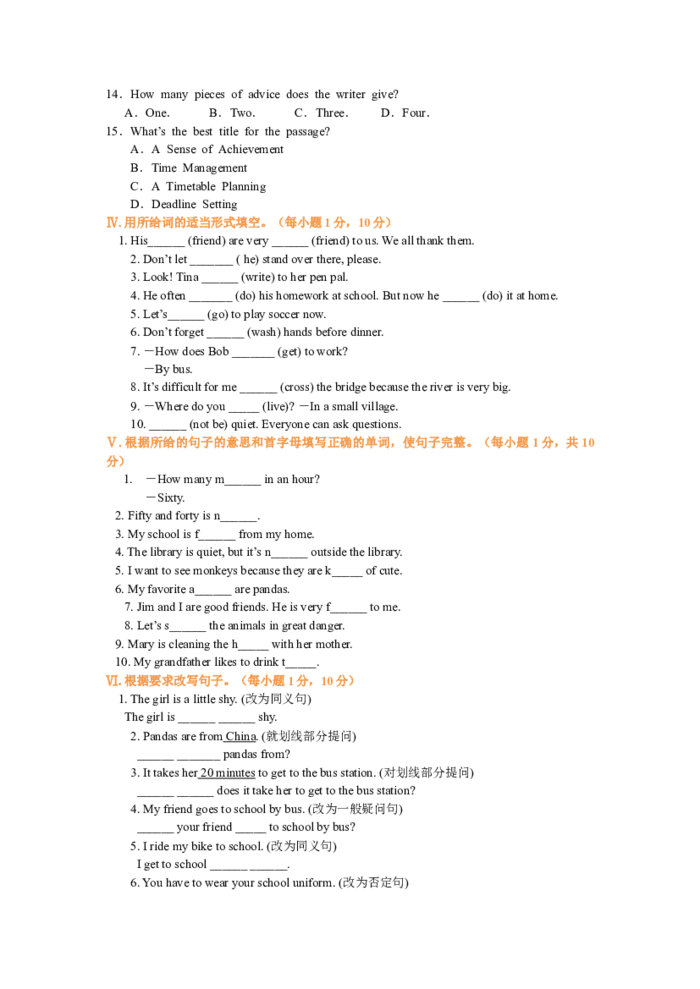
14.How many pieces of advice does the writer give?
A.One.     B.Two.     C.Three.    D.Four.
15.What’s the best title for the passage?
    A.A Sense of Achievement
    B.Time Management
    C.A Timetable Planning
D.Deadline Setting
Ⅳ. 用所给词的适当形式填空。(每小题1 分,10 分)
    1. His______ (friend) are very ______ (friend) to us. We all thank them.
2. Don’t let _______ ( he) stand over there, please.
3. Look! Tina ______ (write) to her pen pal.
4. He often _______ (do) his homework at school. But now he ______ (do) it at home.
5. Let’s______ (go) to play soccer now.
6. Don’t forget ______ (wash) hands before dinner.
7. -How does Bob _______ (get) to work?
-By bus.
8. It’s difficult for me ______ (cross) the bridge because the river is very big.
9. -Where do you _____ (live)? -In a small village.
10. ______ (not be) quiet. Everyone can ask questions.
Ⅴ.根据所给的句子的意思和首字母填写正确的单词,使句子完整。(每小题1 分,共10
分)
1.
-How many m______ in an hour?
-Sixty.
   2. Fifty and forty is n______.
   3. My school is f______ from my home.
   4. The library is quiet, but it’s n______ outside the library.
   5. I want to see monkeys because they are k_____ of cute.
   6. My favorite a______ are pandas.
7. Jim and I are good friends. He is very f______ to me.
8. Let’s s______ the animals in great danger.
   9. Mary is cleaning the h_____ with her mother.
   10. My grandfather likes to drink t_____.
Ⅵ.根据要求改写句子。(每小题1 分,10 分)
    1. The girl is a little shy. (改为同义句)
      The girl is ______ ______ shy.
2. Pandas are from China. (就划线部分提问)
  ______ _______ pandas from?
3. It takes her 20 minutes to get to the bus station. (对划线部分提问)
  ______ ______ does it take her to get to the bus station?
4. My friend goes to school by bus. (改为一般疑问句)
  ______ your friend _____ to school by bus?
5. I ride my bike to school. (改为同义句)
  I get to school ______ ______.
6. You have to wear your school uniform. (改为否定句)
  You ______ _______ _______ _______ school uniform.
7. I have to practice the piano on Sundays. (对划线部分提问)
  ______ ______ you have to practice the piano?
8. Sam likes koalas because they’re interesting. (对划线部分提问)
  ______ ______ Sam _______ koalas?
9. I like koalas very much. (对划线部分提问)
  ______ ______ _____ you like very much?
10. Sam is from Canada. (对划线部分提问)
   ______ ______ Sam ______?
VII. 书面表达。(15 分)
    下面图片是王梅(Wang Mei)的画,描写了她一家的周日的一个生活片段。请根据
这些图片,用现在进行时描述一下王梅家这段生活情景,50 词左右。


内容要点:
  1. 奶奶在读书。
  2. 父亲在做饭。
  3. 妈妈在打扫。
  4. 王梅在写作业。
  5. 弟弟在玩玩具。
  6. 注意运用不同的句式。
_____________________________________________________________________________
_____________________________________________________________________________
_____________________________________________________________________________
____________________________________________________________________________
_____________________________________________________________________________
_____________________________________________________________________________
_____________________________________________________________________________
____________________________________________________________________________
答案与解析
Ⅰ.单项选择。
1. C。从时间状语often 可以判断句子是一般现在时,因主语是第三人称单数形式,所以谓
语用has。
2. B。我每天早上起得很早,所以上学从不迟到。never 副词,表示“从不”。
  3. B。询问天气用固定句型“What’s the weather like?”。
4. A。ask somebody to do something 意为“让某人做某事”,所以ask 后用动词不定式。
5. D。句子的谓语动词是speak,是实义动词,所以用助动词提问;又因为主语是第三人称
单数所以用does。
  6. B。从listen 可以判断后面是现在进行时,who 作主语时后面谓语动词一般用单数形式。
  7. C。从上文的句意“不要在这里说话。”可以推测下文是“grandparents”正在睡觉,因
此
文是现在进行时;又因主语是复数,所以用are sleeping。
8. A。句意“Lucy 喜欢大熊猫,因为它们有几分(比较)友好。”; kind of 意思是“有
几分/
有点”,故选A。
9. D。during the day 相当于in the day 意为“在白天”;“在晚上”用短语at night。
10. B。talk 至少是两个人的交谈,讨论;tell 意为“讲述,告诉”;speak 多指讲某种语
言;say 强调说的具体内容。
11. D。“从星期一到星期五”用介词短语“from… to…”。
12. D。动词短语let somebody do something 意为“让某人做某事”,后面用省略to 的动词
不定式,所以选择D。
13. B。本题是考查连词的用法,前句意为“我经常看电视”,后句意为“今天晚上我在
做作业”,两者是转折关系,连词but 表示转折,所以选择B。
14. A。 at 用在具体某个时刻前;on 用在某一天或某一天的某一时间段;in 用在大的时
间段前,如某年,某月,某季节。from 意为“来自;从……到……”。
15. A。“help sb. with sth.”意为“帮助某人做某事”。
Ⅱ. 完形填空。
1. D。句子开头的主语是he,后面的物主代词应该与前面的人称代词对应,所以用D。
2. A。考查短语prepare something for somebody 给某人准备某物,因此此处应该用介词
for。
3. B。前后句是因果关系故选because。
4. C。由tomorrow 可知本句应该用一般将来时,动词leave 一般用be leaving 表示将来,类
似的动词还有come、go 等。
5. A。动词短语let somebody do something,后面用动词原形,根据短文内容可以判断是他
不
想让他的父母走。所以选择A。
6. B。动词不定式表示目的,文中“work”的目的是为了赚钱,因此后面用动词不定式。
make
money 意思为“赚钱”。
7. D。本空需要从短文的上下意思来理解,本句的意思是“Wang Xiaojun 不是唯一的农村
留
守儿童”, 所以用not the only 表示“不是唯一”,题干上已有not,故选D。
8. C。“there be + 某人+doing”结构表示“某地有某人在做某事”。
9. A。从短文的上下联系和意思判断,留守儿童面临许多问题。这里的face 是动词,表示
“面
对、面临”。因为这是一个一般现在时的句子,主语是复数,所以选动词原形。
10. B。本空需要从全文理解,留守儿童没有父母的关爱,所以感到孤独。alone 是单独地,
lonely 是孤独的。
Ⅲ. 阅读理解。
A 篇
1. C。由“He makes (生产) the parts (零件) of the car.”可知他是一个工人,所以本题选择
C。
2. B。从“He works in a car factory.”可知他在一家小汽车工厂工作,所以本题选择B。选
项D 的时间状语every day 不合题意。文中用的是sometimes。
3. A。从“So he gets up early in the morning and takes a bus to work.”可知他乘坐公共汽车去
上班,所以本题选择A。
4. D。从“He has his lunch in the factory.”可以理解他在工厂吃午饭。
5. C。从短文的内容可以采取逐个淘汰的方法,从“He works very hard. 和Everyone likes
him…”可以判断选项A 和D 是正确的。从“In the evening, he learns Chinese at home. His
Chinese is good, too.”可以判断选项B 是正确的,所以错误的是C。
B 篇
6. C。从“Two men are walking in the park.”可以判断他们是在公园,所以选C。
7. B。从“Mr. Brown is going to a chair. It is beside the road. Mr. Black is after him.”可知他们
正在向椅子方向走去。所以选B。
8. A。从“Mr. Brown is going to a chair. It is beside the road. Mr. Black is after him.”可以理解
him 是Mr. Brown,所以选A。
9. C。从“When he gets to the chair. He sees Mr. Black sitting on it.”可以判断是Mr. Black 先
到达,所以选C。
10. D。从短文后面的内容和情景可以理解Mr. Brown 是工人,他朝椅子方向走去的目的是
贴通知。所以选D。
C 篇
11. B。由第一段第三句“I was often angry with my family members just because I
didn’t plan my time well.”可知,作者经常因为自己没有计划好时间而跟家人生气。故选
B。
12. C。由第二段第二句“The best advice to deal with time management is‘break it into
bits’.”可知,对作者来说,把大项目拆分成小项目是最好的建议。故选C。
13. D。由第三段中的“Another piece of advice is to plan a timetable for yourself...It’s
just there to serve as a guide.”可知,时间表可以作为你的向导。故选D。
14. C 。由文中的“ The best advice...” “ Another piece of advice...” “ The final
suggestion...”可知,作者共提出了三条建议。故选C。
15. B。通读全文可知,文章主要介绍了不能合理安排时间的坏处、合理安排时间的重要性
以及如何合理安排时问。因此,最佳标题为“Time Management”。故选B。
Ⅳ. 用所给词的适当形式填空。
1. friends, friendly  2. him  3. is writing   4. does, is doing   5. go
6. to wash  7. get   8. to cross  9. live  10. Don’t be
Ⅴ. 根据所给的句子的意思和首字母填写正确的单词,使句子完整。
 1. minutes  2. ninety  3. far  4. noisy  5. kind
 6. animals  7. friendly  8. save  9. house  10. tea
Ⅵ.根据要求改写句子。
1.kind of   2. Where are   3. How long    4. Does , go   5. by bike
6. don’t have to wear   7. When do   8. Why does, like   9. What animals do
10. Where is, from
VII. 书面表达。
      Here are some pictures of Wang Mei’s family. It’s five o’clock on Sunday afternoon. Wang
Mei’s grandmother is reading a book. Wang Mei’s father is cooking in the kitchen and Wang Mei’s
mother is busy cleaning the floor. Wang Mei is doing her homework in her room. What’s Wang
Mei’s brother doing? Look! He is playing with his toy on the floor.