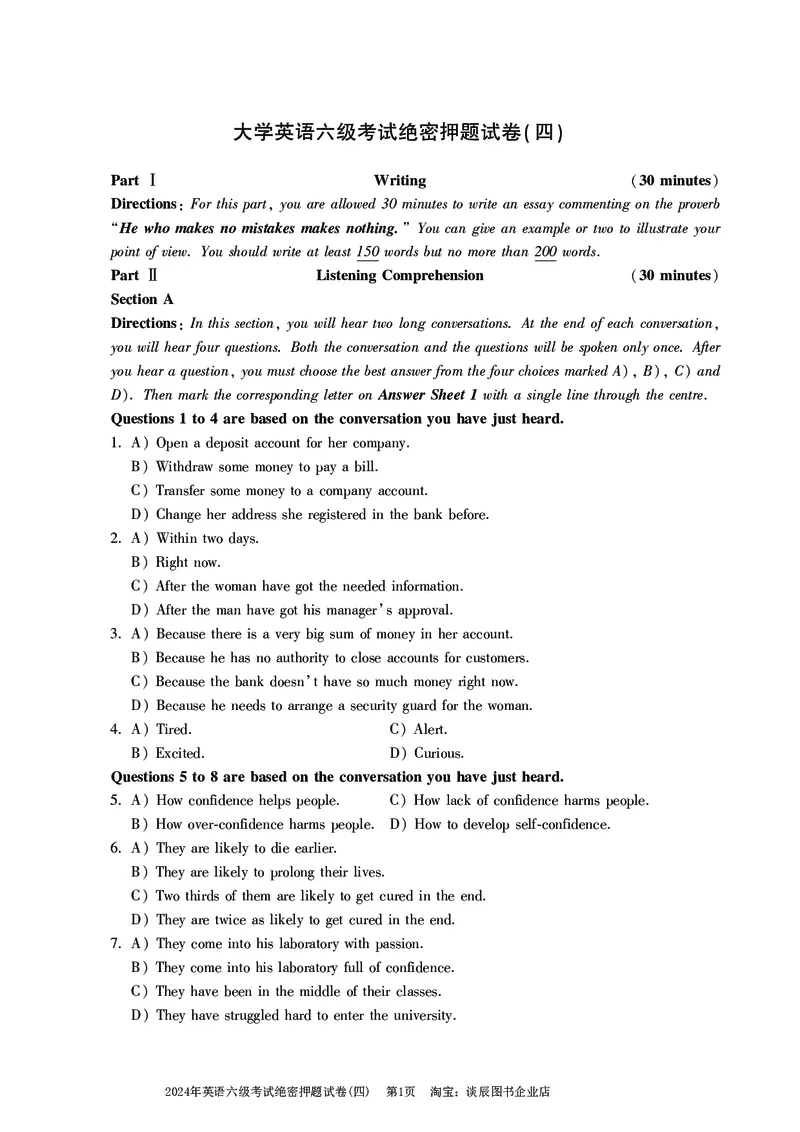
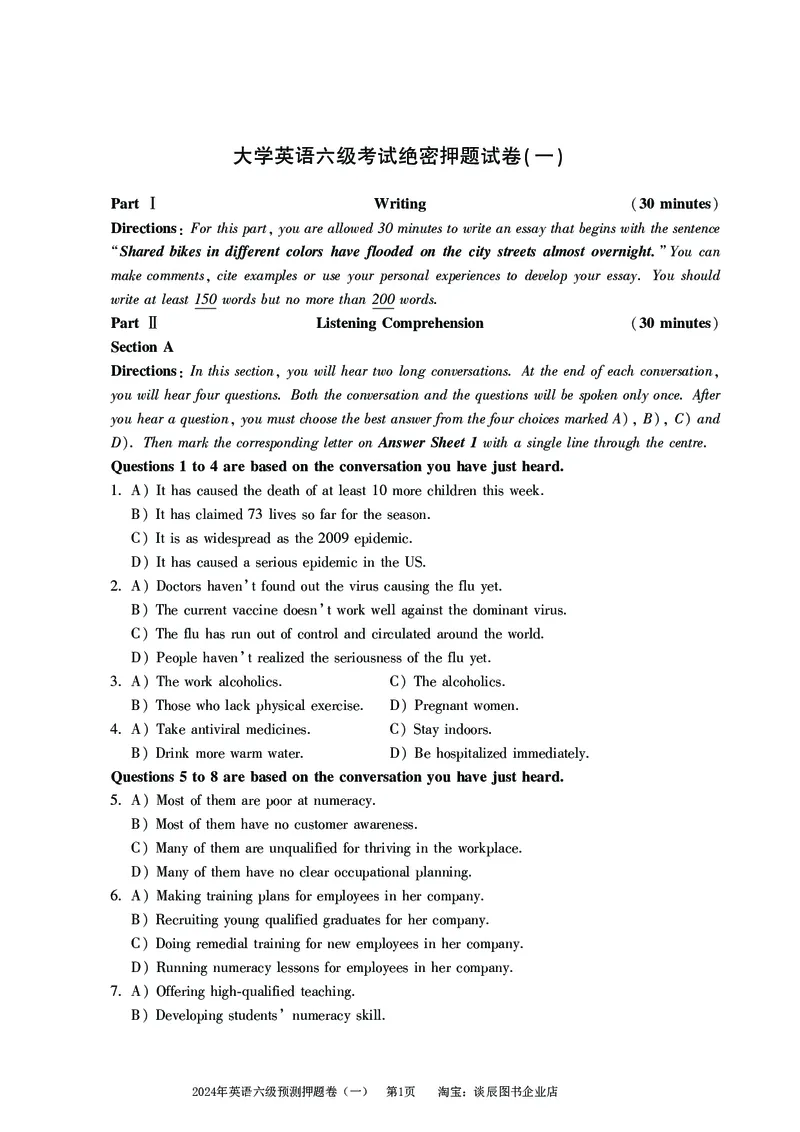
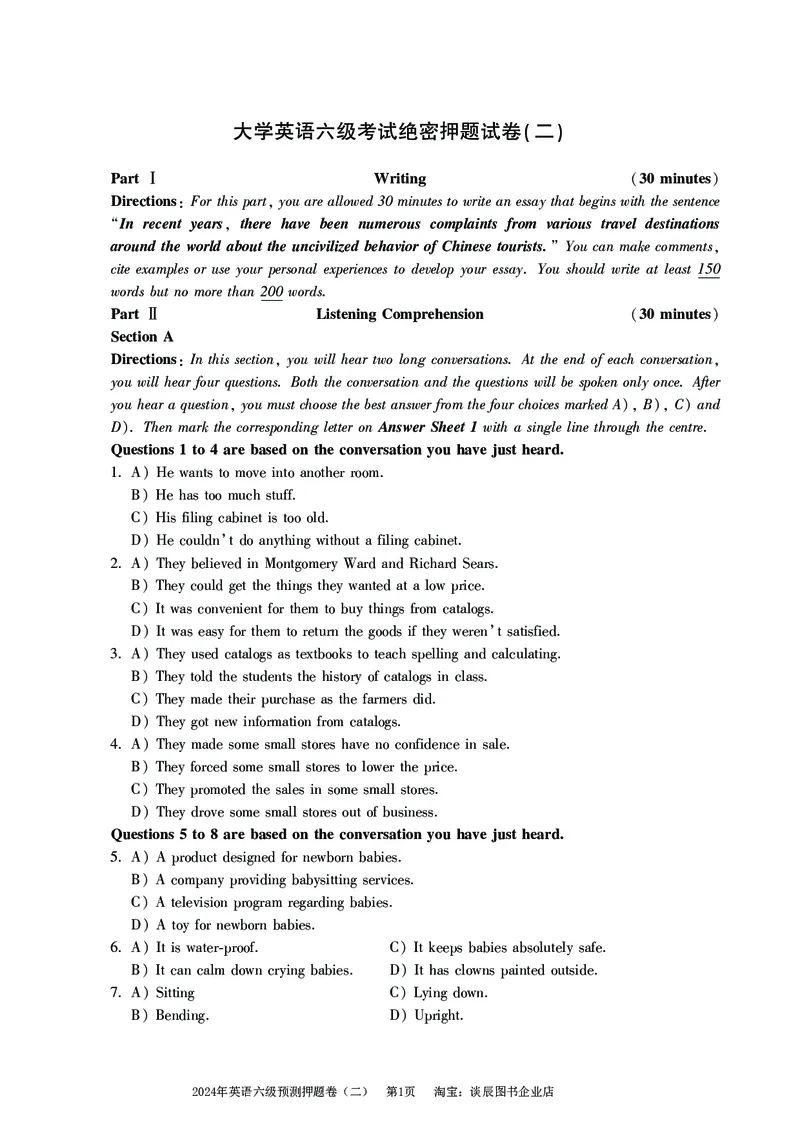
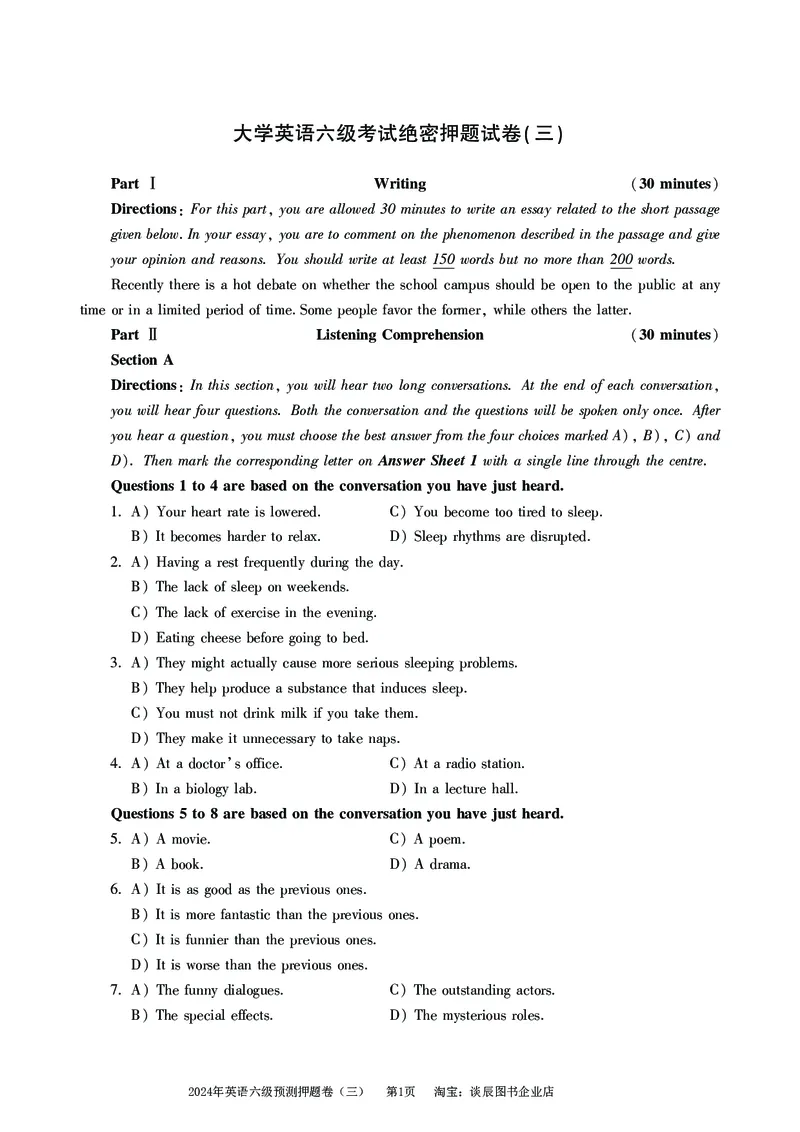
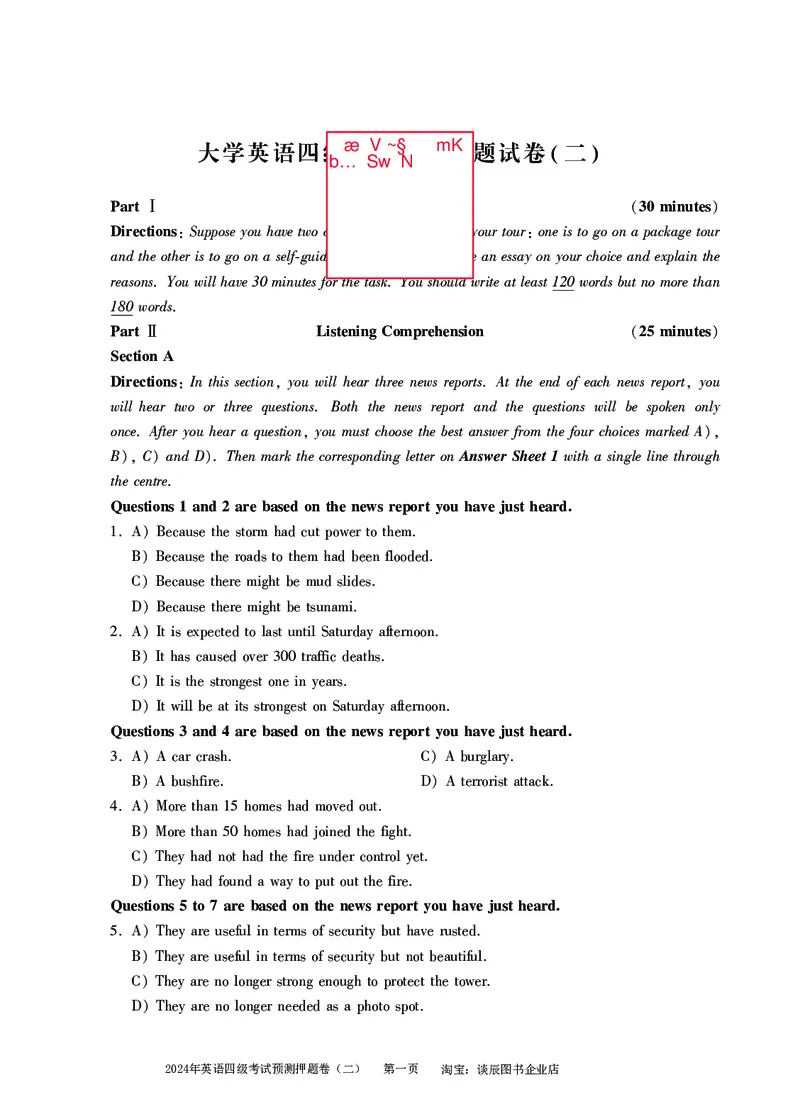
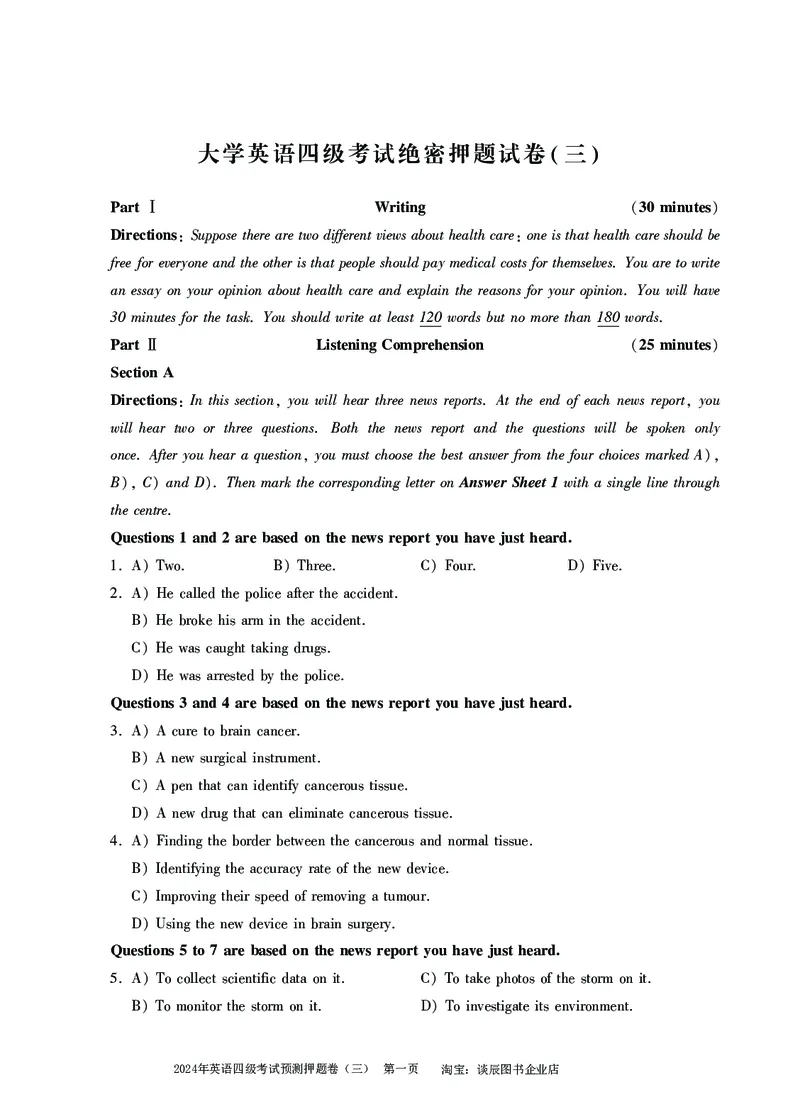
大学英语四级考试绝密押题试卷(
一)
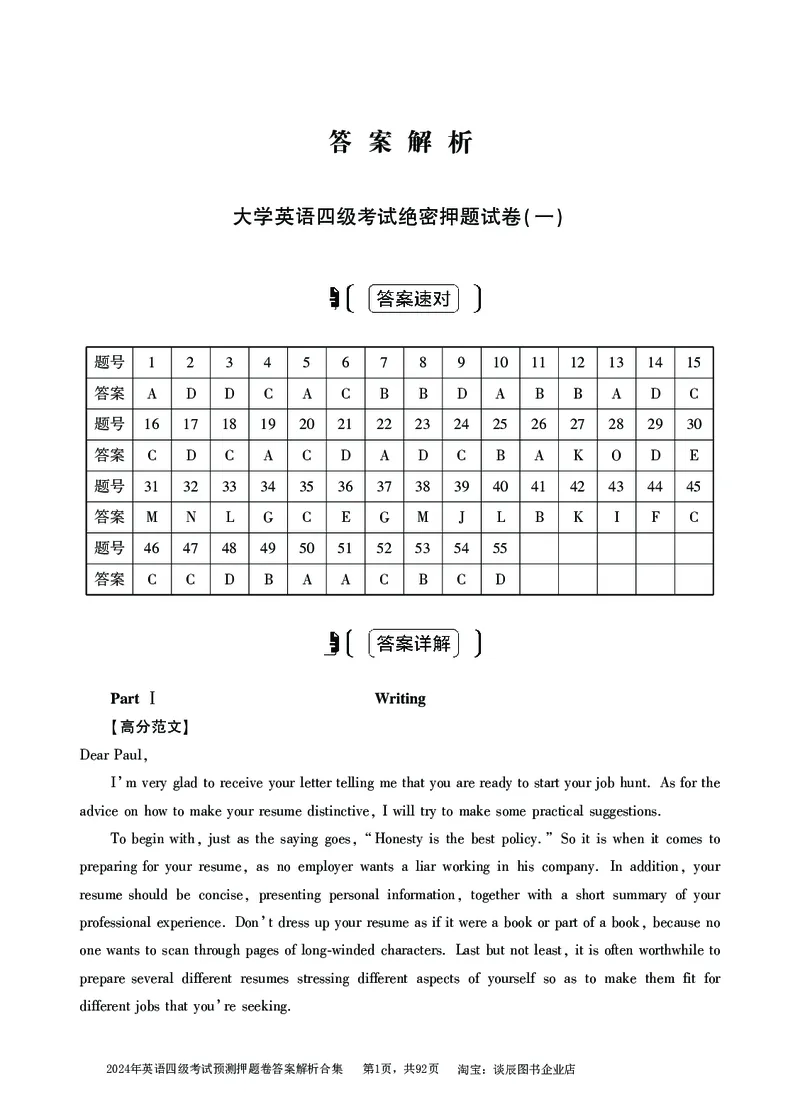
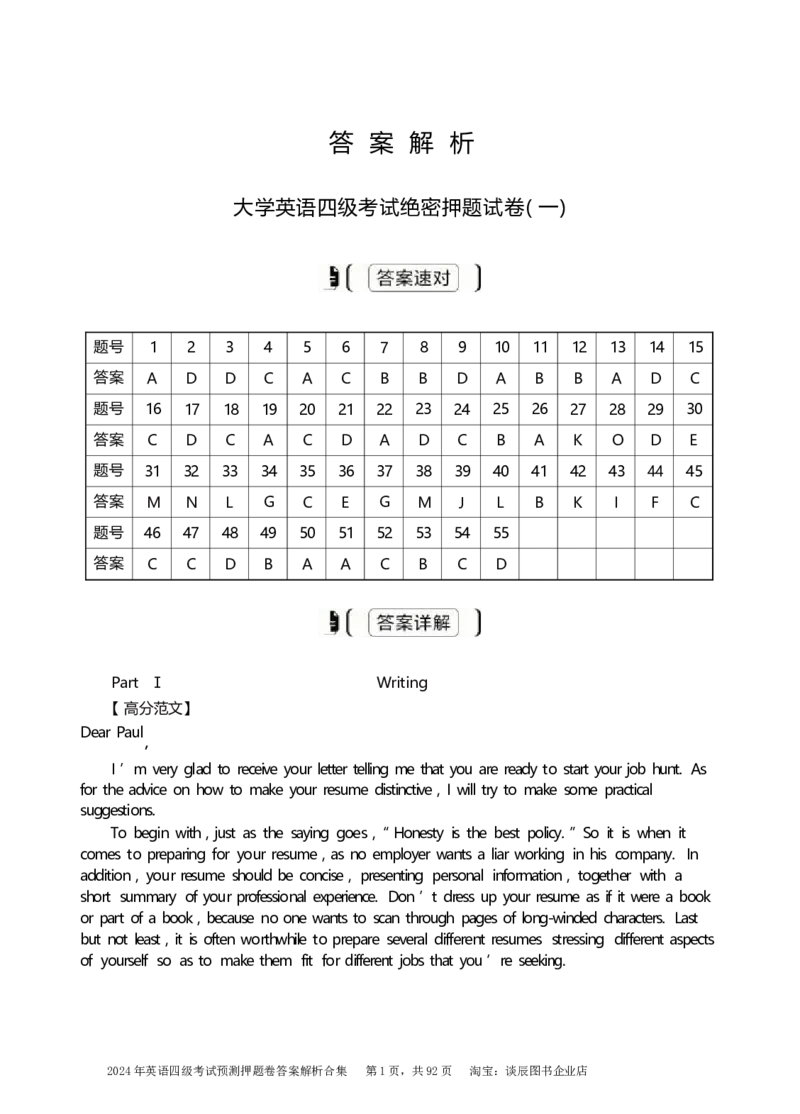
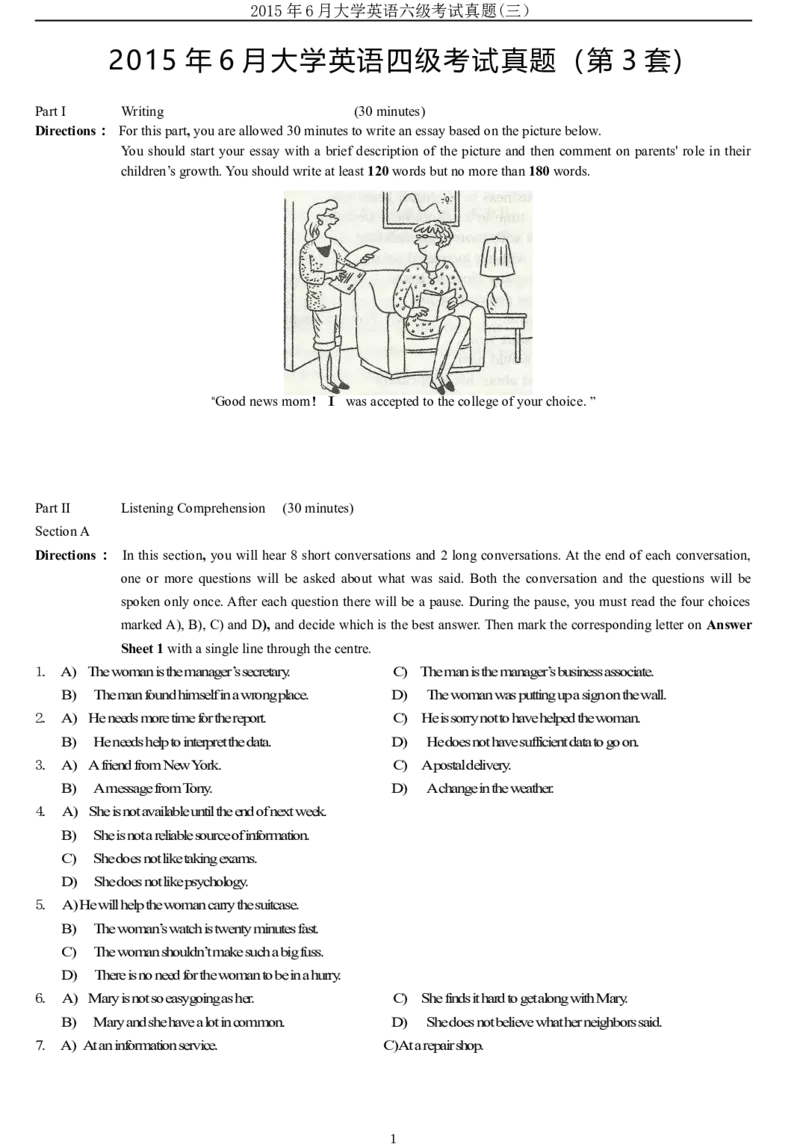
Part Ⅰ Writing (30
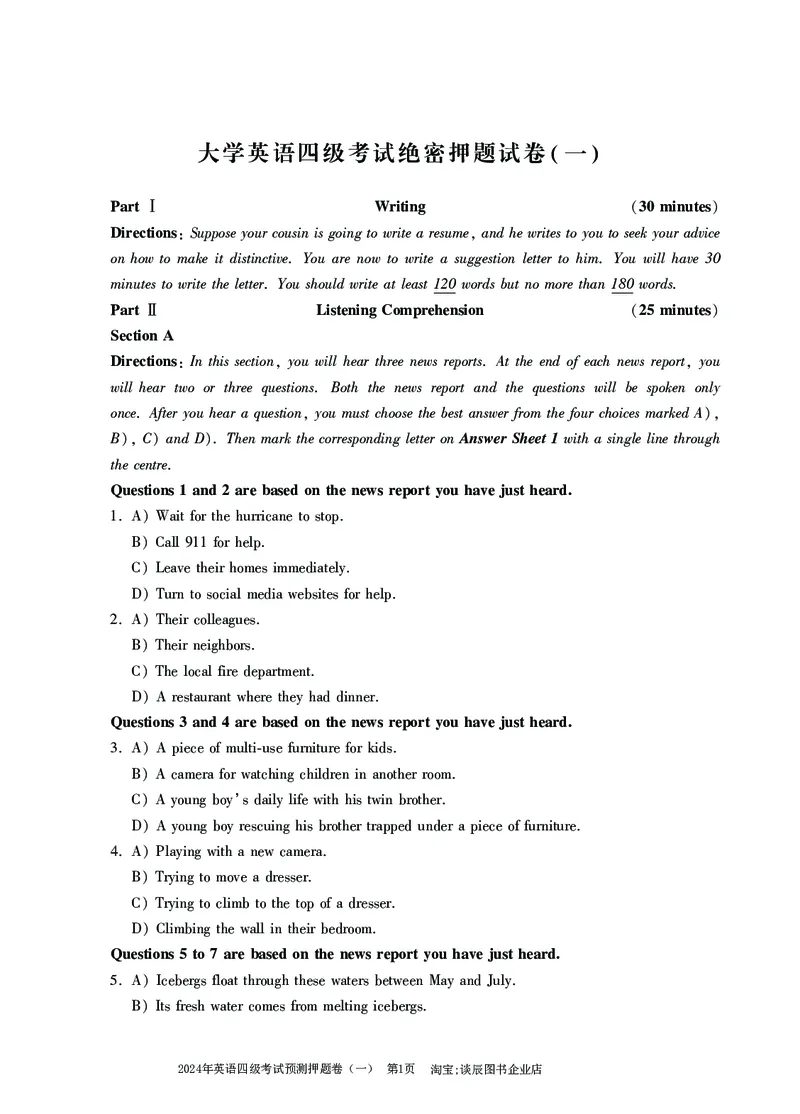
minutes) Directions: Suppose your cousin is going to write a resume, and he
writes to you to seek your advice on how to make it distinctive. You are now to
write a suggestion letter to him. You will have 30 minutes to write the
letter. You should write at least 120 words but no more than 180 words.
Part Ⅱ Listening Comprehension (25
minutes) Section A
Directions: In this section, you will hear three news reports. At
the end of each news report, you will hear two or three questions.
Both the news report and the questions will be spoken only once. After
you hear a question, you must choose the best answer from the four choices
marked A),
B) , C) and D). Then mark the corresponding letter on Answer Sheet 1
with a single line through the centre.
Questions 1 and 2 are based on the news report you have just heard.
1. A) Wait for the hurricane to stop.
B) Call 911 for help.
C) Leave their homes immediately.
D) Turn to social media websites for help.
2. A) Their
colleagues.
B) Their neighbors.
C) The local fire department.
D) A restaurant where they had dinner.
Questions 3 and 4 are based on the news report you have just heard.
3. A) A piece of multi-use furniture for kids.
B) A camera for watching children in another room.
C) A young boy’ s daily life with his twin brother.
D) A young boy rescuing his brother trapped under a piece of furniture.
4. A) Playing with a new camera.
B) Trying to move a dresser.
C) Trying to climb to the top of a dresser.
D) Climbing the wall in their bedroom.
Questions 5 to 7 are based on the news report you have just heard.
5. A) Icebergs float through these waters between May and July.
B) Its fresh water comes from melting icebergs.
2024年英语四级考试预测押题卷(一 第1页 淘宝;谈辰图书企业C) People can see icebergs from the coast.
D) There is a huge iceberg sitting on the coast.
6. A) It has a population of 5,000 people.
B) Its pillar industry is tourism.
C) Its residents are good at fishing.
D) It has only one small inn.
7. A) It will melt within 10 days.
B) It will be pushed into the sea by ocean currents.
C) It will be used as the background of films.
D) It will be pushed into the sea by local residents.
Section B
Directions: In this section, you will hear two long conversations. At
the end of each conversation, you will hear four questions. Both the
conversation and the questions will be spoken only once. After you hear a
question, you must choose the best answer from the four choices marked A),
B), C) and
D). Then mark the corresponding letter on Answer Sheet 1 with a single line
through the centre.
Questions 8 to 11 are based on the conversation you have just heard.
8. A) A single room. C) A family room.
B) A double room. D) A suite.
9. A) He is here on a research mission. C) He is here for
meeting friends.
B) He is here for sightseeing. D) He is here on a business trip.
10. A) Free airport shuttle service.
B) A full continental buffet every evening.
C) Use of the minibar in the room.
D) Room service provided by the hotel.
11. A) In the morning. C) In the
afternoon.
B) At noon. D) Before midnight.
Questions 12 to 15 are based on the conversation you have just heard.
12. A) A lighting cameraman. C) A movie maker.
B) A film and video editor. D) A film director.
13. A) Wonderful. C) Challenging.
B) Frustrating. D) Difficult.
14. A) There are no office hour limits.
B) Employees are reluctant to work overtime.
C) Employees work more than 16 hours a day.
D) Working overtime is very common.
15. A) They are much more effective. C) They are socially great.
B) They are sometimes annoying. D) They are not so common.
2024年英语四级考试预测押题卷(一 第2页 淘宝;谈辰图书企业Section C
Directions: In this section, you will hear three passages. At the end of
each passage, you will hear three or four questions. Both the passage and
the questions will be spoken only once. After you hear a question, you
must choose the best answer from the four choices marked A), B), C) and
D). Then mark the corresponding letter on Answer Sheet 1 with a single
line through the centre.
Questions 16 to 18 are based on the passage you have just heard.
16. A) Cars and iron ore. C) Iron ore and
people.
B) Animals and iron ore. D) People and animals.
17. A) It includes three infrastructure companies.
B) It has 24 operators to run the services.
C) It has no state-owned companies.
D) It is a highly complex system.
18. A) He thinks British trains are the most punctual in the world.
B) He never complains to the Rail Passenger Council.
C) He constantly encounters the poor train service.
D) He often complains about the poor train service.
Questions 19 to 21 are based on the passage you have just heard.
19. A) The trifles of daily life. C) The basics of relationships.
B) The standards of relationships. D) The feelings of romantic
gestures.
20. A) It needs something special. C) It is highly demanding.
B) It is the source of happiness.D) It doesn’ t exist in real life.
21. A) There are many ups and downs in
life.
B) It is hard to find a healthy
relationship.
C) People tend to think highly of themselves.
D) People have easy access to meeting strangers.
Questions 22 to 25 are based on the passage you have just heard.
22. A) They are liable to attack. C) They like to smell people.
B) They are as smart as cats. D) They are independent.
23. A) Strong. C) Quiet.
B) Neat. D) Loyal.
24. A) They can be trained to deliver
things.
B) They can be put to use as guide dogs.
C) They can be used to work as police dogs.
D) They can be trained to help the disabled.
25. A) Evaluating dogs’ reaction to different cancers.
B) Using dogs to discover early-stage cancer.
2024年英语四级考试预测押题卷(一 第3页 淘宝;谈辰图书企业C) Examining dogs’ highly sophisticated sensor.
D) Investigating the functions of dogs’ noses.
Part Ⅲ Reading Comprehension (40
minutes) Section A
Directions: In this section, there is a passage with ten blanks. You
are required to select one word for each blank from a list of choices given
in a word bank following the passage. Read the passage through carefully
before making your choices. Each choice in the bank is identified by a
letter. Please mark the corresponding letter for each item on Answer Sheet 2
with a single line through the centre. You may not use any of the words in
the bank more than once.
Ask a left-wing Briton what he believes about the safety of nuclear
power, and you can guess his answer. Ask a right-wing American about the
risks posed by climate change, and you can also make a
26 guess than if you didn’ t know his political affiliation. Issues like
these feel like they should be
27 by science, not our political tribes, but sadly, that’ s not what
happens.
Psychology has long shown that education and intelligence won’ t stop
your politics from 28 your broader world view, even if those beliefs do
not match the hard evidence. Instead, your ability to weigh up the facts may
depend on a less well-recognised trait— 2 9 .
There is now a mountain of 30 to show that politics doesn’ t just
help predict people’ s views on some scientific issues; it also affects how they
interpret new information. This is why it is a 31 to think that you can somehow “
correct” people’ s views on an issue by giving them more facts, since
study after study has shown that people have a tendency to 32
reject facts that don’ t fit their existing views.
But smarter people shouldn’ t be susceptible to prejudice swaying their
opinions, right? Wrong. Other research shows that people with the most
education, the highest mathematical abilities, and the strongest tendencies to
be reflective about their beliefs are the most 33 to resist information which
should contradict their prejudices. This undermines the simplistic assumption
that prejudices are the result of too much gut instinct and not enough deep
thought. Rather, people who have the 34 for deeper thought about
an issue can use those cognitive powers to justify what they already believe
and find reasons to dismiss apparently 3 5 evidence.
A) better I) flexibility
B) competitively J) identical
C) contrary K) informed
D) curiosity L) likely
E) evidence M) mistake
F) explained N) selectively
G) facility O) shaping
H) fact
2024年英语四级考试预测押题卷(一 第4页 淘宝;谈辰图书企业Section B
Directions: In this section, you are going to read a passage with ten
statements attached to it. Each statement contains information given in one
of the paragraphs. Identify the paragraph from which the information is
derived. You may choose a paragraph more than once. Each paragraph is
marked with a letter. Answer the questions by marking the corresponding
letter on Answer Sheet 2.
How to Fix the Internet
A) We have to fix the internet. After 40 years, it has begun to
corrode, both itself and us. It is still a marvelous and miraculous
invention, but now there are bugs in the foundation, bats in the belfry, and
trolls in the basement.
B) I do not mean this to be one of those technophobic rants insulting the
Internet for rewiring our brains to give us the nervous attention span or
pontificating about how we have to log off and smell the flowers. Those
worries about new technologies have existed ever since Plato was concerned
that the technology of writing would threaten memorization and oratory( 演讲
术). I love the Internet and all of its digital offshoots. What I feel sad
for is its decline.
C) There is a bug in its original design that at first seemed like a
feature but has gradually, and now rapidly, been exploited by hackers and
trolls and malevolent actors: Its packets are encoded with the address of
their destination but not of their authentic origin. With a circuit-
switched network, you can track or trace back the origins of the
information, but that’ s not true with the packet-switched design of the
Internet.
D) Compounding this was the architecture that Tim Berners-Lee and the
inventors of the early browsers created for the World Wide Web. It brilliantly
allowed the whole of the earth’ s computers to be webbed together and
navigated through hyperlinks. But the links were one-way. You knew where the links
took you. But if you had a web page or a piece of content, you didn’
t exactly know who was linking up with you or coming to use your content.
E) All of that protected the potential for anonymity. You could make comments
anonymously. Go to a web page anonymously. Consume content
anonymously. With a little effort, send emails anonymously. And if
you figured out a way to get into someone’ s servers or databases, you could do
it anonymously.
F) For years, the benefits of anonymity on the Net outweighed its
drawbacks. People felt freer to express themselves, which was especially
valuable if they were holding different opinions or hiding a personal
secret. This was celebrated in the famous 1993 New Yorker cartoon, “ On the
Internet, nobody knows you’ re a dog. ”
G) Now the problem is nobody can tell if you’ re a troll, or a hacker, or
a bot. This has poisoned civil discourse, enabled hacking, permitted
cyberbullying, and made email a risk.
2024年英语四级考试预测押题卷(一 第5页 淘宝;谈辰图书企业H) The lack of secure identification and authentication( 身份认证)
inherent in the Internet’ s genetic code had also prevented easy
transactions, obstructed financial inclusion, destroyed the business
2024年英语四级考试预测押题卷(一 第6页 淘宝;谈辰图书企业models of content creators, unleashed the overflow of spam( 垃圾邮件), and
forced us to use passwords and two-factor authentication schemes. The trillions
being spent and the IQ points of computer science talent being allocated to
tackle security issues make it a drag, rather that a spur, to productivity in
some sectors.
I) In Plato’ s Republic, we learn the tale of the Ring of Gyges. Put it
on, and you’ re invisible and anonymous. The question that Plato asks is
whether those who put on the ring will be civil and moral. He thinks not.
The Internet has proven him correct. The Web is no longer a place of
community, no longer a marketplace. Every day more sites are eliminating
comments sections.
J) If we could start from scratch, here’ s what I think we would do:
Create a system that enables content producers to negotiate with aggregators(
信息汇集公司) and search engines to get a royalty whenever their content is
used, like ASCAP has negotiated for public performances and radio airings of
its members’ works. Embed ( 嵌入) a simple digital wallet and currency
for quick and easy small payments for songs, blogs, articles, and whatever
other digital content is for sale. Encode emails with an authenticated return
or originating address. Enforce critical properties and security at the lowest
levels of the system possible, such as in the hardware or in the
programming language, instead of leaving it to programmers to incorporate
security into every line of code they write. Build chips and machines that
update the notion of an Internet packet. For those who want, their
packets could be encoded or tagged with metadata( 元数据) that describe what
they contain and give the rules for how the content can be used.
K) Most Internet engineers think that these reforms are possible,
from Vint Cerf, the original TCP / IP coauthor, to Milo Medin of
Google, to Howard Shrobe, the director of cybersecurity at MIT. “ We
don’ t need to live in cyber hell,” Shrobe has argued. Implementing them is
less a matter of technology than of cost and social will. Some people,
understandably, will resist any reduction of anonymity, which they
sometimes label privacy.
L) So the best approach, I think, would be to try to create a voluntary
system, for those who want to use it, to have verified identification and
authentication. People would not be forced to use such a system. If they
wanted to communicate and surf anonymously, they could. But those of us who
choose, at times, not to be anonymous and not to deal with people who are
anonymous should have that right as well. That’ s the way it works in the real
world.
M) The benefits would be many: easy and secure ways to deal with
your finances and medical records, small payment systems that could
reward valued content rather than the current incentive to concentrate on
clickbait for advertising, less hacking, spamming, cyberbullying, trolling,
and spewing of anonymous hate, and the possibility of a more civil discourse.
36. The one-way hyperlinks enable users to do many things online anonymously.
2024年英语四级考试预测押题卷(一 第7页 淘宝;谈辰图书企业37. Although anonymity can make people conceal their identity online,
now it has poisoned their online life.
2024年英语四级考试预测押题卷(一 第8页 淘宝;谈辰图书企业38. To adopt the voluntary system would be advantageous to our online life in
a number of aspects.
39. There are several ways to reduce anonymity if we can rebuild the Internet
from the very beginning.
40. The author suggested inventing a system to let people go online
anonymously or not as they wish.
41. People’ s concern about new technologies can be traced back a long time
ago.
42. Pubic opposition could become one of the biggest obstacles to carrying
out the reforms.
43. The hazard of anonymity mentioned by Plato has been shown on the
Internet.
44. People used to think that anonymity online did more good than harm.
45. It is the design of the Internet that makes it impossible to find out where
the information comes from.
Section C
Directions: There are 2 passages in this section. Each passage is
followed by some questions or unfinished statements. For each of them
there are four choices marked A), B), C) and D). You should
decide on the best choice and mark the corresponding letter on Answer
Sheet 2 with a single line through the centre.
Passage One
Questions 46 to 50 are based on the following passage.
Teacher burnout and student stress may be linked, according to a study of the
University of British Columbia.
The study is the first of its kind to examine the connection between
teacher burnout and students’ cortisol( 皮 质 醇 ) levels, which are a
biological indicator of stress.
Researchers collected saliva( 唾 液 ) samples from over 400 elementary
schoolchildren and tested their cortisol levels. They found that in classrooms
in which teachers experienced more burnout or feelings of emotional
exhaustion, students’ cortisol levels were elevated. Higher cortisol
levels in elementary schoolchildren have been linked to learning difficulties
as well as mental health problems.
“ This suggests that stress contagion( 传 染 ) might be taking place in the
classroom among students and their teachers,” said Eva Oberle, the study’ s
lead author and newly appointed assistant professor with the Human Early
Learning Partnership ( HELP ) at UBC ’ s school of population and public
health. “ It is unknown what came first—elevated cortisol or teacher burnout. We
consider the connection between student and teacher stress a cyclical problem
in the classroom. ”
Oberle said a stressful classroom climate could be a result of
2024年英语四级考试预测押题卷(一 第9页 淘宝;谈辰图书企业inadequate support for teachers, which may impact teachers’ ability to
effectively manage their students. A poorly managed classroom
2024年英语四级考试预测押题卷(一 第10页 淘宝;谈辰图书企业can contribute to students’ needs not being met and increasing stress.
This could be reflected in elevated cortisol levels in students.
Alternatively, stress could originate from students, who may be more
challenging to teach because of increases in anxiety, behavioral problems,
or special needs. In this situation, teachers could feel overwhelmed
and report higher levels of burnout.
“ Our study is a reminder of the systemic issues facing teachers and educators
as classroom sizes increase and support for teachers is cut,” said Oberle.
“ It is clear from a number of recent research studies that teaching is
one of the most stressful professions, and that teachers need adequate
resources and support in their jobs in order to battle burnout and
alleviate stress in the classroom,” said UBC education professor Kimberly
Schonert-Reichl, the study’ s co-author and director of HELP. “ If we
do not support teachers, we risk the c o llater a l damage of students. ”
46. It can be concluded from the research made by the University of
British Columbia that .
A) cortisol levels were verified to be a reliable indicator of pressure
B) children’ cortisol levels were measured by their saliva
C) students’ cortisol levels were influenced by teacher burnout
D) the rising of cortisol levels was related to psychological problems
47. Which of the following identities belongs to Eva Oberle?
A) Child-education specialist.
B) The sole author of the study.
C) UBS assistant professor.
D) The new director of HELP.
48. According to Eva Oberle, increased cortisol and teacher tiredness
occurred .
A) by chance C) at the same time
B) in a known sequence D) in cycles
49. What did Kimberly Schonert-Reichl suggest providing for teachers who want
to struggle with occupational burnout?
A) The increase in class sizes.
B) Sufficient resources for the work.
C) A long break from teaching.
D) The stress relief in the classroom.
50. The word “ collateral” in the last paragraph most probably means “ ”.
A) indirect C) immediate
B) permanent D) temporary
2024年英语四级考试预测押题卷(一 第11页 淘宝;谈辰图书企业Passage Two
Questions 51 to 55 are based on the following passage.
The old romantic adage( 谚语) is a cute one, but according to
recent studies, opposites don’ t necessarily attract.
Research shows that people tend to seek out relationships with— and
eventually marry—partners who have similar defining characteristics, such
as age, political orientation, religion, education, and income.
“ Generally speaking, when we think about opposites attracting or not, we’
re thinking in terms of personality rather than these big key essential
factors,” says Vinita Mehta, a clinical psychologist and writer based in
Washington, D. C.
One big factor as to why this may be is simply your stage of life; where you
live, what lifestyle you have, and what kind of people you’ re exposed to.
“ If you’ re on a college campus, by and large, you’ re going to find
people who are in your age group,” Mehta says. “ You’ re going to find
people who at least eventually become part of the same general income
strata( 阶层). ”
Researchers from the University of Kansas made a bolder claim. A study
released earlier this year analyzed real-world relationships and asked
couples ( romantic partners, friends and acquaintances) about attitudes,
behavior, values, prejudices, and personality traits that were important
to them. The pairs that had closer and more intimate relationships were not
necessarily more similar than newly formed pairs, and people shared
similarities on almost every personal issue that was measured.
The leading psychologists on this study believe this doesn’ t happen
by chance; it’ s so common and widespread that seeking out like-minded
people may be our psychological default when we make new friends or romantic
partners. We certainly get the most out of these relationships. They make us
more comfortable and trusting of the other person, and that makes it
easier to cooperate and achieve goals.
As far personalities go, connecting on major traits, like levels of
neuroticism( 情绪不稳定性) and conscientiousness, generally lead to happier
couples. But that doesn’ t mean you and your significant other need to
agree on everything. Having different quirks ( 怪 癖 )— less defining
parts of your personality, like your favorite sport or foods—can introduce you
to new activities and ways of thinking, which can make you a more well-
rounded person.
51. What does the phrase “ these big key essential factors”( Line 2, Para.
3) refer to?
A) These similar defining characteristics.
B) These similar psychological characteristics.
C) The different cultural factors.
D) The different geographic factors.
2024年英语四级考试预测押题卷(一 第12页 淘宝;谈辰图书企业52. According to Vinita Mehta, college students tend to make
friends with people of similar .
A) religion B) character C) age D) background
53. Which of the following statements can be inferred from the research
conducted by the University of Kansas?
A) The participants were asked questions about their partners.
B) The similarity between partners may not change with intimacy.
C) The subjects have almost everything in common.
D) The phenomenon takes places accidentally.
54. What is the purpose of citing the studies in the passage?
A) To show what kind of people we should get acquainted with.
B) To find out what stage of life we are in.
C) To prove we are drawn to what is familiar.
D) To introduce the advantages like-minded people can bring to us.
55. What’ s the author’ s attitude towards the similarities between couples?
A) Positive. B) Negative. C) Uninterested. D) Objective.
Part Ⅳ Translation (30
minutes) Directions: For this part, you are allowed 30 minutes to
translate a passage from Chinese into English. You should write your
answer on Answer Sheet 2.
中医( Traditional Chinese Medicine) 有五千多年的历史,是中国古代劳动人民几千年
对抗疾病的经验总结。 中医学运用阴阳理论来解释人体的生理和病理现象。 阴阳和五行是中医的
理论基础。 中医使用中药、针灸( acupuncture) 以及许多其他治疗手段,使人体达到阴阳调
和。 虽然在西方医学和中医之间仍然有很大的鸿沟,但目前传统中医已经遍布世界 160 多个
国家和地区。 有人甚至戏称中医是中国的第五大发明。
2024年英语四级考试预测押题卷(一 第13页 淘宝;谈辰图书企业