大学英语四级考试绝密押题试卷( 二)
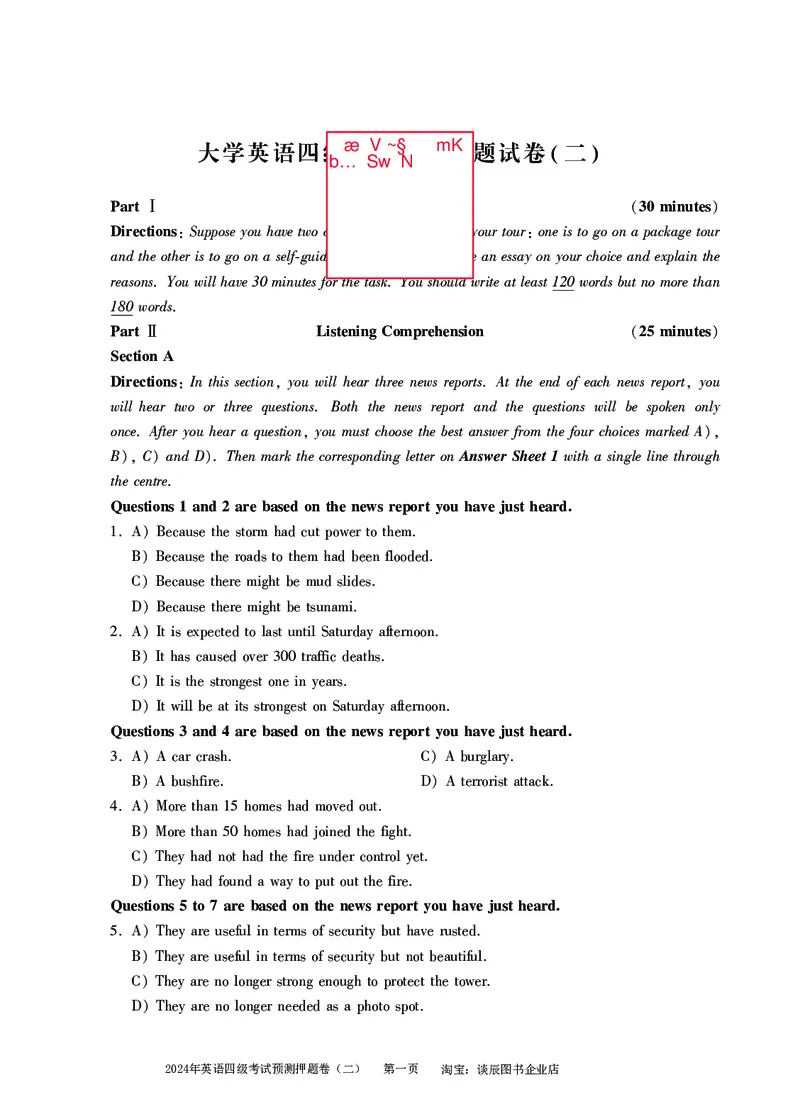
Part Writing 30 minutes
Ⅰ ( )
Directions Suppose you have two options on how to go on your tour one is to go on a package tour
: :
and the other is to go on a self-guided tour. You are to write an essay on your choice and explain the
reasons. You will have 30 minutes for the task. You should write at least 120 words but no more than
180 words.
Part Listening Comprehension 25 minutes
Ⅱ ( )
Section A
Directions In this section you will hear three news reports. At the end of each news report you
: , ,
will hear two or three questions. Both the news report and the questions will be spoken only
once. After you hear a question you must choose the best answer from the four choices marked A
, ),
B C and D . Then mark the corresponding letter on Answer Sheet 1 with a single line through
), ) )
the centre.
Questions 1 and 2 are based on the news report you have just heard.
1. A) Because the storm had cut power to them.
B) Because the roads to them had been flooded.
C) Because there might be mud slides.
D) Because there might be tsunami.
2. A) It is expected to last until Saturday afternoon.
B) It has caused over 300 traffic deaths.
C) It is the strongest one in years.
D) It will be at its strongest on Saturday afternoon.
Questions 3 and 4 are based on the news report you have just heard.
3. A) A car crash. C) A burglary.
B) A bushfire. D) A terrorist attack.
4. A) More than 15 homes had moved out.
B) More than 50 homes had joined the fight.
C) They had not had the fire under control yet.
D) They had found a way to put out the fire.
Questions 5 to 7 are based on the news report you have just heard.
5. A) They are useful in terms of security but have rusted.
B) They are useful in terms of security but not beautiful.
C) They are no longer strong enough to protect the tower.
D) They are no longer needed as a photo spot.
2024年英语四级考试预测押题卷(二) 第一页 淘宝:谈辰图书企业店6. A) It is the most visited monument in the world.
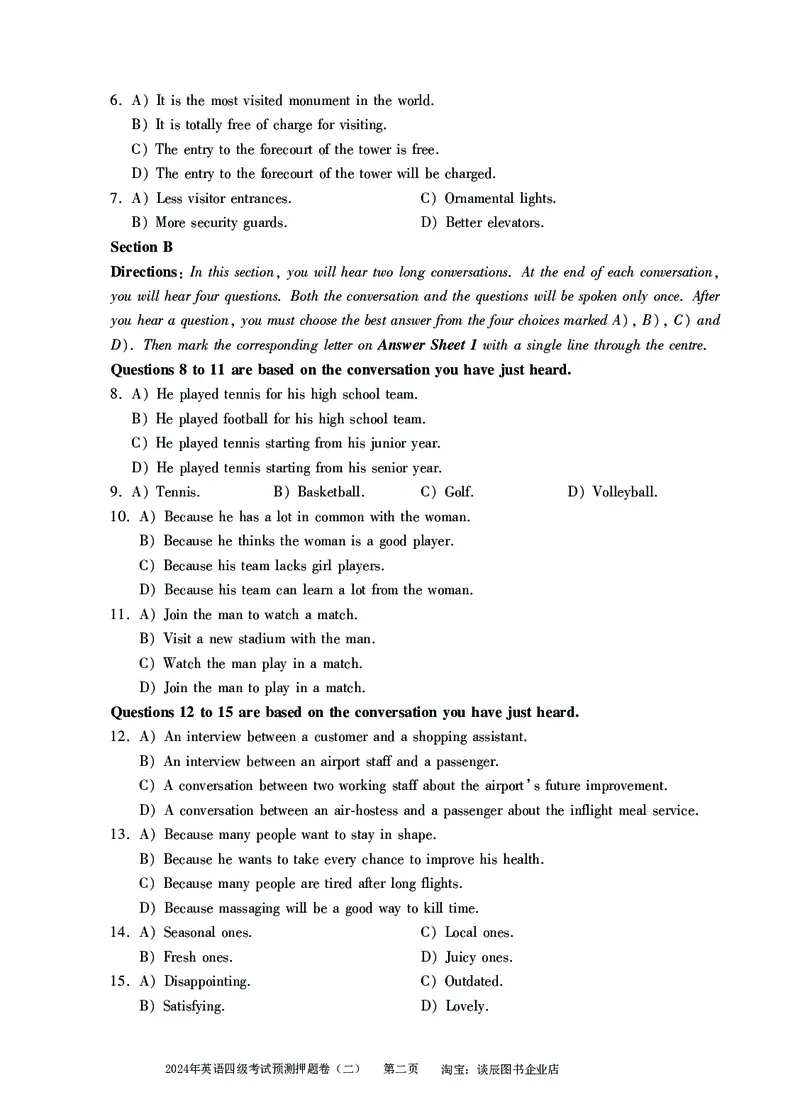
B) It is totally free of charge for visiting.
C) The entry to the forecourt of the tower is free.
D) The entry to the forecourt of the tower will be charged.
7. A) Less visitor entrances. C) Ornamental lights.
B) More security guards. D) Better elevators.
Section B
Directions In this section you will hear two long conversations. At the end of each conversation
: , ,
you will hear four questions. Both the conversation and the questions will be spoken only once. After
you hear a question you must choose the best answer from the four choices marked A B C and
, ), ), )
D . Then mark the corresponding letter on Answer Sheet 1 with a single line through the centre.
)
Questions 8 to 11 are based on the conversation you have just heard.
8. A) He played tennis for his high school team.
B) He played football for his high school team.
C) He played tennis starting from his junior year.
D) He played tennis starting from his senior year.
9. A) Tennis. B) Basketball. C) Golf. D) Volleyball.
10. A) Because he has a lot in common with the woman.
B) Because he thinks the woman is a good player.
C) Because his team lacks girl players.
D) Because his team can learn a lot from the woman.
11. A) Join the man to watch a match.
B) Visit a new stadium with the man.
C) Watch the man play in a match.
D) Join the man to play in a match.
Questions 12 to 15 are based on the conversation you have just heard.
12. A) An interview between a customer and a shopping assistant.
B) An interview between an airport staff and a passenger.
C) A conversation between two working staff about the airport’s future improvement.
D) A conversation between an air-hostess and a passenger about the inflight meal service.
13. A) Because many people want to stay in shape.
B) Because he wants to take every chance to improve his health.
C) Because many people are tired after long flights.
D) Because massaging will be a good way to kill time.
14. A) Seasonal ones. C) Local ones.
B) Fresh ones. D) Juicy ones.
15. A) Disappointing. C) Outdated.
B) Satisfying. D) Lovely.
2024年英语四级考试预测押题卷(二) 第二页 淘宝:谈辰图书企业店Section C
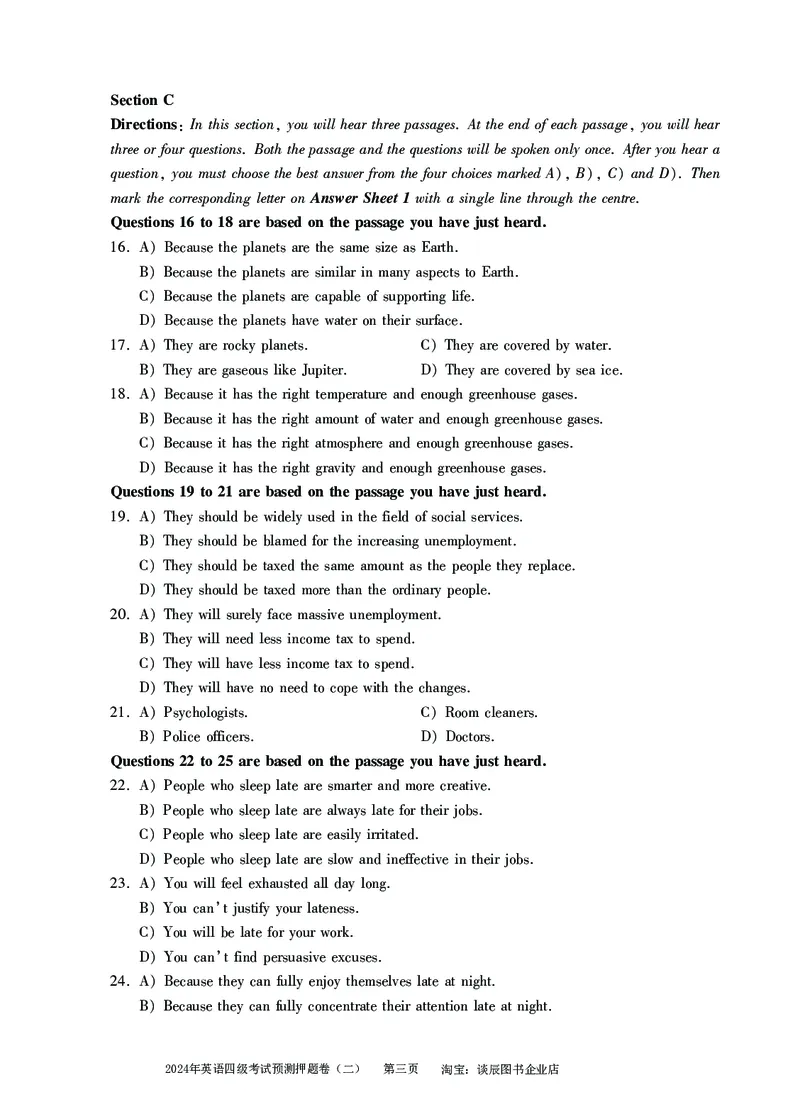
Directions In this section you will hear three passages. At the end of each passage you will hear
: , ,
three or four questions. Both the passage and the questions will be spoken only once. After you hear a
question you must choose the best answer from the four choices marked A B C and D . Then
, ), ), ) )
mark the corresponding letter on Answer Sheet 1 with a single line through the centre.
Questions 16 to 18 are based on the passage you have just heard.
16. A) Because the planets are the same size as Earth.
B) Because the planets are similar in many aspects to Earth.
C) Because the planets are capable of supporting life.
D) Because the planets have water on their surface.
17. A) They are rocky planets. C) They are covered by water.
B) They are gaseous like Jupiter. D) They are covered by sea ice.
18. A) Because it has the right temperature and enough greenhouse gases.
B) Because it has the right amount of water and enough greenhouse gases.
C) Because it has the right atmosphere and enough greenhouse gases.
D) Because it has the right gravity and enough greenhouse gases.
Questions 19 to 21 are based on the passage you have just heard.
19. A) They should be widely used in the field of social services.
B) They should be blamed for the increasing unemployment.
C) They should be taxed the same amount as the people they replace.
D) They should be taxed more than the ordinary people.
20. A) They will surely face massive unemployment.
B) They will need less income tax to spend.
C) They will have less income tax to spend.
D) They will have no need to cope with the changes.
21. A) Psychologists. C) Room cleaners.
B) Police officers. D) Doctors.
Questions 22 to 25 are based on the passage you have just heard.
22. A) People who sleep late are smarter and more creative.
B) People who sleep late are always late for their jobs.
C) People who sleep late are easily irritated.
D) People who sleep late are slow and ineffective in their jobs.
23. A) You will feel exhausted all day long.
B) You can’t justify your lateness.
C) You will be late for your work.
D) You can’t find persuasive excuses.
24. A) Because they can fully enjoy themselves late at night.
B) Because they can fully concentrate their attention late at night.
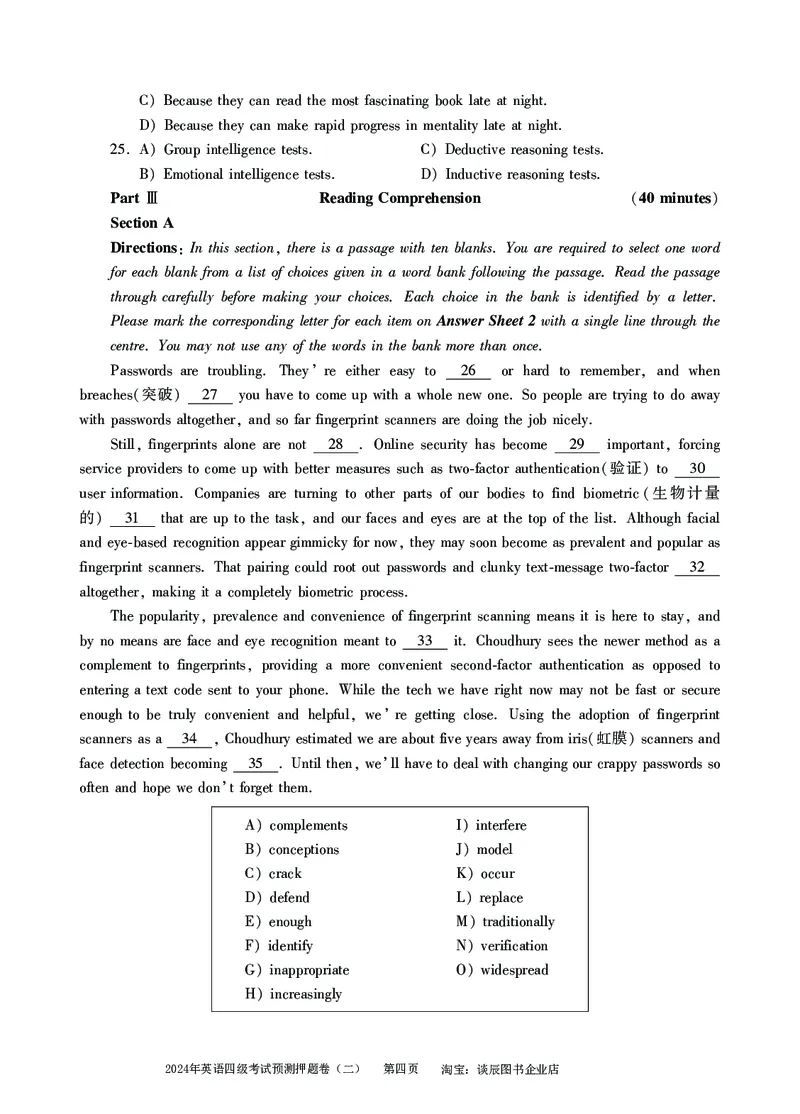
2024年英语四级考试预测押题卷(二) 第三页 淘宝:谈辰图书企业店C) Because they can read the most fascinating book late at night.
D) Because they can make rapid progress in mentality late at night.
25. A) Group intelligence tests. C) Deductive reasoning tests.
B) Emotional intelligence tests. D) Inductive reasoning tests.
Part Reading Comprehension 40 minutes
Ⅲ ( )
Section A
Directions In this section there is a passage with ten blanks. You are required to select one word
: ,
for each blank from a list of choices given in a word bank following the passage. Read the passage
through carefully before making your choices. Each choice in the bank is identified by a letter.
Please mark the corresponding letter for each item on Answer Sheet 2 with a single line through the
centre. You may not use any of the words in the bank more than once.
Passwords are troubling. They’ re either easy to 26 or hard to remember, and when
突破
breaches( ) 27 you have to come up with a whole new one. So people are trying to do away
with passwords altogether, and so far fingerprint scanners are doing the job nicely.
Still, fingerprints alone are not 28 . Online security has become 29 important, forcing
验证
service providers to come up with better measures such as two-factor authentication( ) to 30
生物计量
user information. Companies are turning to other parts of our bodies to find biometric(
的
) 31 that are up to the task, and our faces and eyes are at the top of the list. Although facial
and eye-based recognition appear gimmicky for now, they may soon become as prevalent and popular as
fingerprint scanners. That pairing could root out passwords and clunky text-message two-factor 32
altogether, making it a completely biometric process.
The popularity, prevalence and convenience of fingerprint scanning means it is here to stay, and
by no means are face and eye recognition meant to 33 it. Choudhury sees the newer method as a
complement to fingerprints, providing a more convenient second-factor authentication as opposed to
entering a text code sent to your phone. While the tech we have right now may not be fast or secure
enough to be truly convenient and helpful, we’re getting close. Using the adoption of fingerprint
虹膜
scanners as a 34 , Choudhury estimated we are about five years away from iris( ) scanners and
face detection becoming 35 . Until then, we’ll have to deal with changing our crappy passwords so
often and hope we don’t forget them.
A) complements I) interfere
B) conceptions J) model
C) crack K) occur
D) defend L) replace
E) enough M) traditionally
F) identify N) verification
G) inappropriate O) widespread
H) increasingly
2024年英语四级考试预测押题卷(二) 第四页 淘宝:谈辰图书企业店Section B
Directions In this section you are going to read a passage with ten statements attached to it. Each
: ,
statement contains information given in one of the paragraphs. Identify the paragraph from which the
information is derived. You may choose a paragraph more than once. Each paragraph is marked
with a letter. Answer the questions by marking the corresponding letter on Answer Sheet 2.
Take Naps at Work. Apologize to No One
A) In the past two weeks I’ve taken three naps at work, a total of an hour or so of shut-eye while
on the clock. And I have no shame or uncertainty about doing it. I couldn’t feel better about it, and
my productivity reflects it, too.
B) Sleeping on the job is one of those workplace taboos—like leaving your desk for lunch or taking
an afternoon walk—that we’re taught to look down on. If someone naps at 2 p.m. while the rest of us
偷懒
furiously write memos and respond to emails, surely it must mean they’re slacking off( ). Or so
the assumption goes.
C) Restfulness and recharging can take a back seat to the perception and appearance of
仓鼠
productivity. It’s easier to stay on a virtual hamster( ) wheel of activity by immediately responding
to every email than it is to measure aggregate productivity over a greater period of time. But a growing
field of occupational and psychological research is building the case for restfulness in pursuit of greater
productivity.
D) Companies are suffering from tremendous productivity problems because people are stressed out
and not recovering from the workday, said Josh Bersin, Principal and Founder of Bersin by
Deloitte. “They’re beginning to realize that this is their problem, and they can’t just say to people,
‘Here’s a work-life balance course, go teach yourself how to manage your inbox,’” Mr. Bersin
said. “It’s a way more complicated than that.”
E) To be sure, the ability to nap at work is far from widespread, experts said. Few among us have
the luxury of being able to step away for a half-hour snoozefest. But lunch hours and coffee breaks can
be great times to duck out, and your increased productivity and alertness will be all the evidence you
need to make your case to inquiring bosses.
F) In an ideal world, we’d all solve this problem by unplugging early and getting a good night’s
sleep. Here’s our guide on how to do just that. But the next best thing is stealing away for a quick
power nap when you’re dragging after lunch.
Nature Neuroscience
G) In a study published in , researchers tested subjects on their perceptual
performance four times throughout the day. Performance deteriorated with each test, but subjects who
took a 30-minute nap between tests stopped the deterioration in performance, and those who took a 60-
minute nap even reversed it.
H) “Naps had the same magnitude of benefits as full nights of sleep if they had a quality of nap,”
said Sara Mednick, a co-author of the study and associate professor of psychology at the University of
California, Riverside.
2024年英语四级考试预测押题卷(二) 第五页 淘宝:谈辰图书企业店Take a Nap Change Your Life
I) Dr. Mednick, a sleep researcher and the author of ! , said daytime
napping can have many of the benefits of overnight sleep, and different types of naps offer specific
benefits.
J) For example, Dr. Mednick said a 20- to 60-minute nap might help with memorization and
learning specific bits of information. It’s just long enough to enter stage-two sleep, or non-rapid eye
movement(R.E.M.) sleep.
K) “After 60 minutes, you start getting into R.E.M. sleep, most often associated with that deep,
dreaming state we all enjoy at night. R.E.M. sleep can improve creativity, perceptual processing and
highly associative thinking, which allows you to make connections between disparate ideas,” Dr.
Mednick said. “Beyond that, your best bet is a90-minute nap, which will give you a full sleep cycle.”
L) Any nap, however, can help with alertness and perception and cut through the general fog that
creeps in during the day, experts said.
紧密相连
M) So how did we even arrive at this point where aptitude is inextricably tied( ) to
working long, concentrated hours? Blame technology, but think broader than smartphones and laptops;
the real issue is that tech has enabled us to be available at all times.
N) “We went through a period where people were in denial and business leaders were ignoring
it,” Mr. Bersin said. “They were assuming that if we give people more tools, more emails, more
slack, more chatter, and we’ll just assume they can figure out how to deal with it all. And I think
they’ve woken up to the fact that this is a big problem, and it is affecting productivity, engagement,
health, safety, wellness and all sorts of things.”
午睡
O) It isn’t just office workers who can benefit from an afternoon siesta( ). A 2015 study
Current Biology
published in looked at the sleeping habits of three hunter-gatherer preindustrial societies
in Tanzania, Namibia and Bolivia.
P) “They’re active in the morning, then they get in the shade under the trees and have a sort of
quiet time, but they’ re not generally napping,” said Jerome Siegel, professor of psychiatry and
biobehavioral sciences, and director of the U. C. L. A. Center for Sleep Research, a co-author of the
study. “Then they do some work and go to sleep, and they sleep through the night.”
Q) Still, Mr. Siegel said, “The only genuine way to solve daytime sleepiness and fatigue starts the
night before with a solid night’s sleep.” The real Holy Grail of restfulness is a regular sleep schedule
with ideally seven or eight hours of sleep each night, which experts say is optimal.
R) “Daytime napping certainly does increase alertness,” Mr. Siegel said. “But it’s not as simple
as going to the gas station and filling the tank.” He also advises avoiding caffeine late in the day and
waking around the same time every morning, even if you can’t get to sleep at the same time every
使适应
night. This helps acclimate( ) your body to your regular wake-up time, regardless of how much
sleep you got the night before.
S) So if you’ve made it this far and you’re interested in giving workday naps a try (or just starting
to nod off), here’s a quick guide to the perfect nap: Find a quiet, unoccupied space where you won’t
2024年英语四级考试预测押题卷(二) 第六页 淘宝:谈辰图书企业店be disturbed. Try to make your area as dim as possible (or invest in a sleep mask you can keep in the
office). Earplugs might help, too. Aim for around 20 minutes. Any longer than that and you’re likely
睡眠惰性 头脑昏沉的
to wake up with sleep inertia( ), which will leave you even groggier( ) than
before.
36. Participants’ perceptual performance became better after sleeping one hour between tests in an
Nature Neuroscience
article in .
37. Jerome Siegel found that only by sleeping soundly through the previous night could people
tackle their weariness during the day.
38. Our talent is closely bound to working with concentration for long periods of time because
technology makes us accessible 24/7.
39. Taking a nap at work is normally regarded as laziness that should be held in contempt and
avoided in workplace.
40. Between 20 to 60 minutes, people can get into non-REM sleep which may improve memory
and learning ability according to Dr. Mednick.
41. People can doze off at lunch and coffee breaks and defended themselves by saying their
improved productivity and alertness when bosses investigated their whereabouts.
42. The author’s tips on taking a perfect nap involve sleeping place, environment and duration.
43. The author believes business leaders are aware that availability at any time due to technology
has negative effects on every aspect of people’s life.
44. The optimal length of a nap was an hour and a half so that people could go through a complete
sleep cycle.
45. Josh Bersin mentioned the cause of companies’ big productivity problems and the solution
which needs more that just employees’ efforts.
Section C
Directions There are 2 passages in this section. Each passage is followed by some questions or
:
unfinished statements. For each of them there are four choices marked A B C and D . You
), ), ) )
should decide on the best choice and mark the corresponding letter on Answer Sheet 2 with a single
line through the centre.
Passage One
Questions 46 to 50 are based on the following passage.
Every office worker hates meetings. But it’s a strange sort of hate, similar to the hatred of
Londoners for the Northern Line, or New Yorkers for tourists who walk too slowly: the dislike is real,
yet if the despised thing were to vanish, it’d be like surrendering a piece of your soul.
When researchers probed into why people put up with the strain that meetings place on their time
and sanity, they found something—those who resent and dread meetings the most also defend them as a
“necessary evil”, sometimes with great passion. True, research suggests that meetings take up vastly
2024年英语四级考试预测押题卷(二) 第七页 淘宝:谈辰图书企业店more of the average manager’s time than they used to. True, done badly, they’re associated with lower
幸福
levels of innovation and employee wellbeing( ). But that’s just office life, right? It’s not supposed
to be fun. That’s why they call it work.
引起
Underlying( ) this attitude is an assumption that’s drummed into us not just as workers but as
children, parents and romantic partners; that more communication is always a good thing. So
大量存在
suggestions abound for( ) communicating better in meetings—for example, hold them standing
up, so speakers will come to the point more quickly. But even when some companies consider
abolishing meetings entirely, the principle that more communication is better isn’t questioned. If
anything, it’s reinforced when such firms introduce “flat” management structures, with bosses always
available to everyone, plus plenty of electronic distraction. In fact, constant connectivity is disastrous
for both job satisfaction and the bottom line.
And anyway, once you give it three seconds’ thought, isn’t it clear that more communication
frequently isn’t a good thing? Often, the difference between a successful marriage and a second-rate
one consists of leaving about three or four things a day unsaid. At work, it’s surely many more than
four, though for a different reason: office communication comes precisely at the cost of the kind of focus
that’s essential to good work. Yet we’re so accustomed to seeing talking as a source of solutions—for
resolving conflicts or finding new ideas—that it’s hard to see when it is the problem.
46. What does the author say about meetings?
A) Londoners hate them as well as the Northern Line.
B) They can help to keep workers’ physical and spiritual health.
C) Workers might be reluctant to give up them completely.
D) New Yorkers dislike meetings more than Londoners.
47. What did researchers find about people’s attitude towards meeting?
A) Their attitude and behavior are paradoxical.
B) People who hate meetings the most are senior insane.
C) Those who like meetings might be considered insane.
D) More meetings are regarded as a sign of less innovation.
48. Why do people think that more communication is always a good thing?
A) Because the concept is firmly believed by workers.
B) Because everyone loves to communicate with others.
C) Because the idea has been instilled into people’s mind.
D) Because communication is vital for building relationships.
49. What does the author think of the “flat” management structure?
A) It forces bosses to frequently contact their employees.
B) It helps to soften employees’ bottom line of work.
C) It is definitely a disaster to employees’ job satisfaction.
D) It strengthens people’s deeply-rooted notion of communication.
2024年英语四级考试预测押题卷(二) 第八页 淘宝:谈辰图书企业店50. What is the author’s argument about office communication?
A) It is an effective way to solve office conflicts.
B) It affects work efficiency in a negative way.
C) It should come to a halt at intervals.
D) It is useful for workers to find new ideas.
Passage Two
Questions 51 to 55 are based on the following passage.
The Internet has enabled the spread of information at lightning speed. This information revolution
has created tremendous business opportunities for online publishers, but not all of them maintain proper
quality-control mechanisms to ensure that only good information is being shared. Instead, many
publishers aim simply to make money by whatever means possible, with no regard for the implications
for society at large.
When selfish publishers set up shops online, the primary goal is to publish as much as possible,
often at the cost of quality. In this respect, many publishers start numerous online journals focused on
重叠的
overlapping( ) disciplines—to increase their total number of published papers—and hire young
business managers who do not have any experience in either science or publishing. In some cases,
online publishers even give up peer review, while still presenting themselves as scientific journals—
deception designed to take advantage of scientists who simply want to share their research.
If publishers structure their business to make more revenue, it often does harm to their
products. When publishers start journals with overlapping domains, in combination with the pressure to
publish more studies, this could promote the publication of marginal or even questionable articles.
专
Moreover, publishers with multiple overlapping journals and journals with very narrow specialties(
业
) increase the demands on the time and efforts of willing reviewers. With the fact that reviewers are
generally not compensated for their time and effort, journal editors are often unable to find enough
reviewers to keep up with the increased publication rate.
To improve the situation and increase the trust in scientific community, the pressure to publish
must be reduced. Funding and promotion decisions should not be based on the number of publications,
but on the quality of those publications and a researcher’s long-term productivity and instructions.
掠夺
And that’s just the start. We need additional mechanisms, such as Beall’s list of predatory(
的
) publishers, to alert scientists to fake journals and fake articles. In addition, the price for online
publication must be controlled and a mechanism must be put in place to honor and reward hard-working
reviewers.
51. What does the author think of online publishers?
A) A small proportion of them can guarantee their publishing quality.
B) They have lots of opportunities to renovate their business models.
C) Many of them tend to try every means to make a buck.
D) Social impact is their first priority when publishing books.
2024年英语四级考试预测押题卷(二) 第九页 淘宝:谈辰图书企业店52. It can be inferred from the second paragraph that .
A) peer review generally is a criterion to identify academic journals
B) researchers focus their research on the combination of disciplines
C) scientists care about their publications rather than research
D) young business managers are willing to face new challenges
53. Why can’t publishers find enough reviewers to review papers?
A) Reviewers are pressed for time when reviewing articles.
B) Reviewers’ gains can’t make up for what they have done.
C) Publishers may compel reviewers to accept marginal articles.
D) Publishers urge reviewers to increase publication rate rapidly.
54. What is the author’s suggestion for online publication?
A) More weight should be put on the quantity of publications.
B) It is worthwhile to reward diligent reviewers for their effort.
C) Fake journals should be reported to a regulatory organization.
D) The price of online publication should be lowered greatly.
55. What is the main idea of this passage?
A) Online publishers should take measures to fight against fake scientific journals.
B) Online publishers are pursuing their work efficiency at the cost of quality.
C) Online publishers business models are quite likely to harm their publications.
D) Online publishers are sacrificing the quality of research articles to make money.
Part Translation 30 minutes
Ⅳ ( )
Directions For this part you are allowed 30 minutes to translate a passage from Chinese into
: ,
English. You should write your answer on Answer Sheet 2.
十二生肖 是中国传统文化的重要组成部分 根据中国的十二生
(the twelve Chinese Zodiacs) 。
肖 每一年都与十二种动物中的一种有联系 你也许听说过中国人用十二生肖动物作为纪年的
, 。
周期系统 在西方 中国十二生肖的十二种动物已经越来越为人们所熟悉 十二生肖代表的动
。 , 。
物的性格特点各不相同 每一种动物都代表着与该生肖相关的信仰 寓意和传统智慧 龙是十二
, 、 。
生肖中唯一的神话兽 在龙年出生的人被认为是吉祥的
, 。
2024年英语四级考试预测押题卷(二) 第一十页 淘宝:谈辰图书企业店