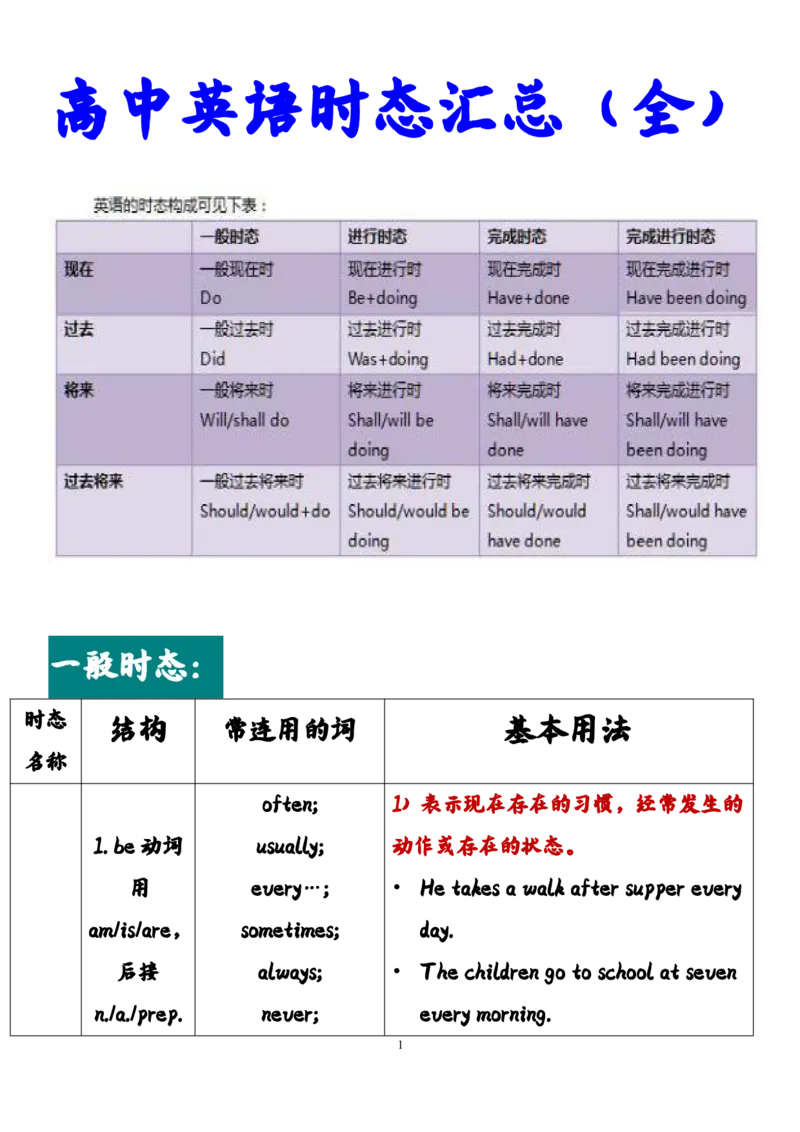
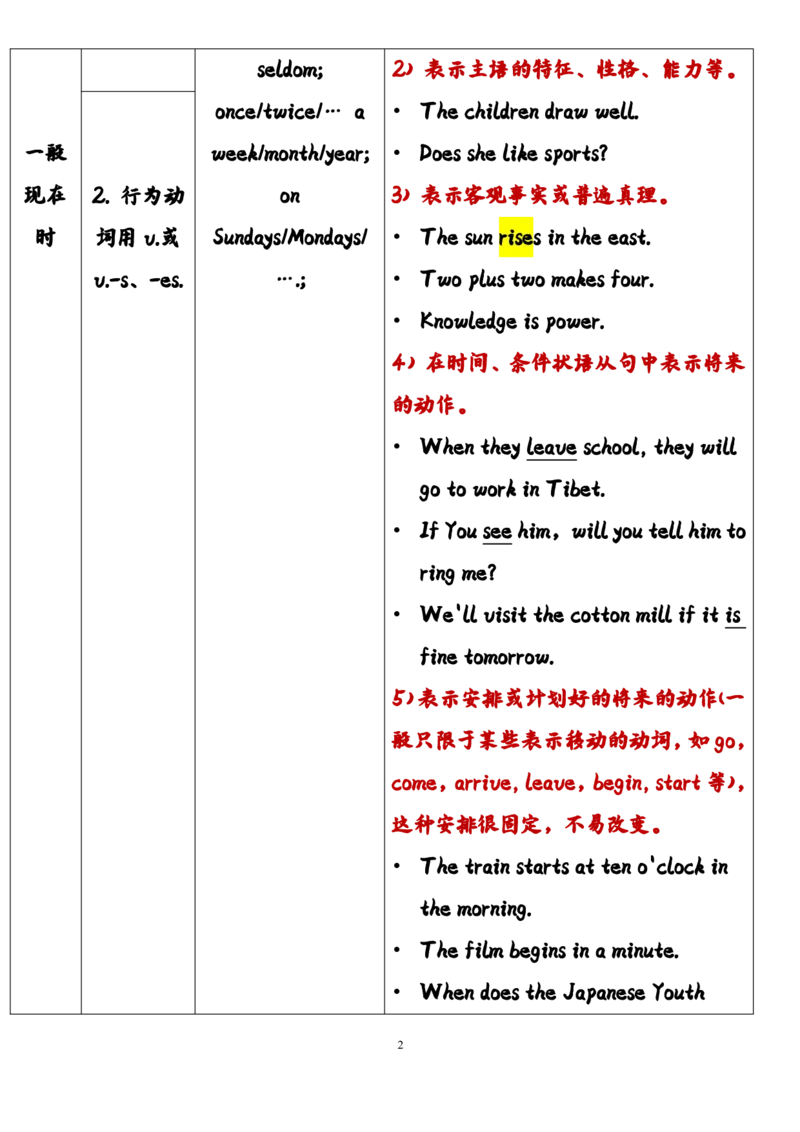
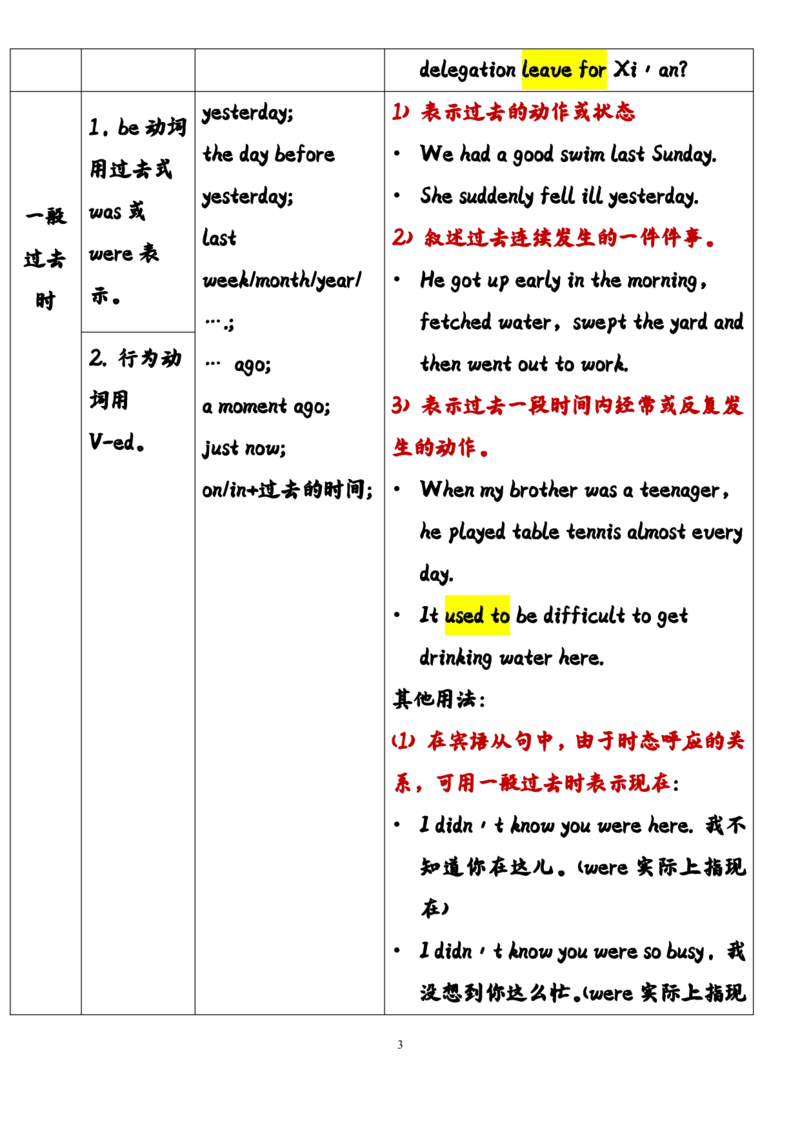
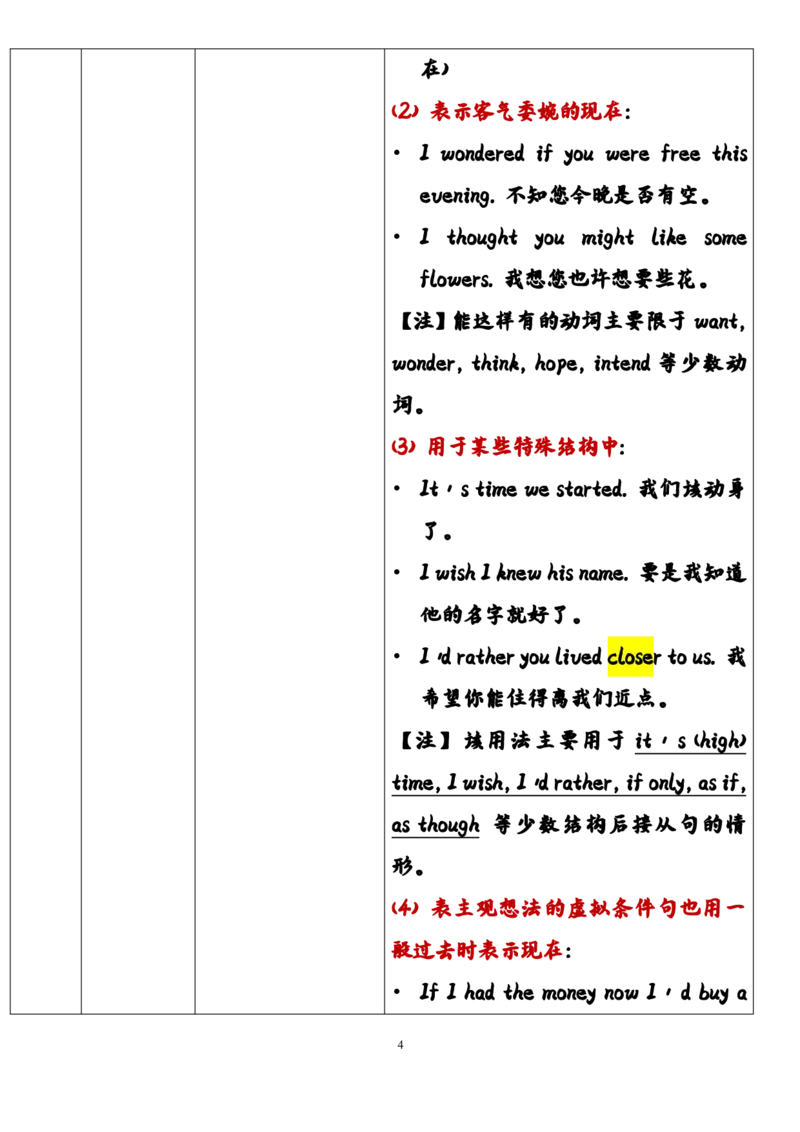
高中英语时态汇总(全)
一般时态:
时态
结构 常连用的词 基本用法
名称
often; 1) 表示现在存在的习惯,经常发生的
1. be 动词 usually; 动作或存在的状态。
用 every…; • He takes a walk after supper every
am/is/are, sometimes; day.
后接 always; • The children go to school at seven
n./a./prep. never; every morning.
1seldom; 2) 表示主语的特征、性格、能力等。
once/twice/… a • The children draw well.
一般 week/month/year; • Does she like sports?
现在 2. 行为动 on 3) 表示客观事实或普遍真理。
时 词用 v.或 Sundays/Mondays/ • The sun rises in the east.
v.-s、-es. ….; • Two plus two makes four.
• Knowledge is power.
4)在时间、条件状语从句中表示将来
的动作。
• When they leave school, they will
go to work in Tibet.
• If You see him,will you tell him to
ring me?
• We'll visit the cotton mill if it is
fine tomorrow.
5)表示安排或计划好的将来的动作(一
般只限于某些表示移动的动词,如 go,
come,arrive, leave,begin, start 等),
这种安排很固定,不易改变。
• The train starts at ten o'clock in
the morning.
• The film begins in a minute.
• When does the Japanese Youth
2delegation leave for Xi’an?
yesterday; 1) 表示过去的动作或状态
1.be 动词
the day before • We had a good swim last Sunday.
用过去式
yesterday; • She suddenly fell ill yesterday.
was 或
一般
last 2) 叙述过去连续发生的一件件事。
were 表
过去
week/month/year/ • He got up early in the morning,
示。
时
….; fetched water,swept the yard and
2. 行为动
… ago; then went out to work.
词用
a moment ago; 3) 表示过去一段时间内经常或反复发
V-ed。
just now; 生的动作。
on/in+过去的时间; • When my brother was a teenager,
he played table tennis almost every
day.
• It used to be difficult to get
drinking water here.
其他用法:
(1) 在宾语从句中,由于时态呼应的关
系,可用一般过去时表示现在:
• I didn’t know you were here. 我不
知道你在这儿。(were 实际上指现
在)
• I didn’t know you were so busy.我
没想到你这么忙。(were 实际上指现
3在)
(2) 表示客气委婉的现在:
• I wondered if you were free this
evening. 不知您今晚是否有空。
• I thought you might like some
flowers. 我想您也许想要些花。
【注】能这样有的动词主要限于 want,
wonder, think, hope, intend 等少数动
词。
(3) 用于某些特殊结构中:
• It’s time we started. 我们该动身
了。
• I wish I knew his name. 要是我知道
他的名字就好了。
• I’d rather you lived closer to us. 我
希望你能住得离我们近点。
【注】该用法主要用于 it’s (high)
time, I wish, I’d rather, if only, as if,
as though 等少数结构后接从句的情
形。
(4) 表主观想法的虚拟条件句也用一
般过去时表示现在:
• If I had the money now I’d buy a
4car. 假若我现在有钱,我就买辆小
汽车。
(5) 当主句中的谓语动词是现在完成
时,since 引导的从句用一般过去时。
• I have lived in the house since I
came to the city.
• Great changes have taken place
since I visited the city.
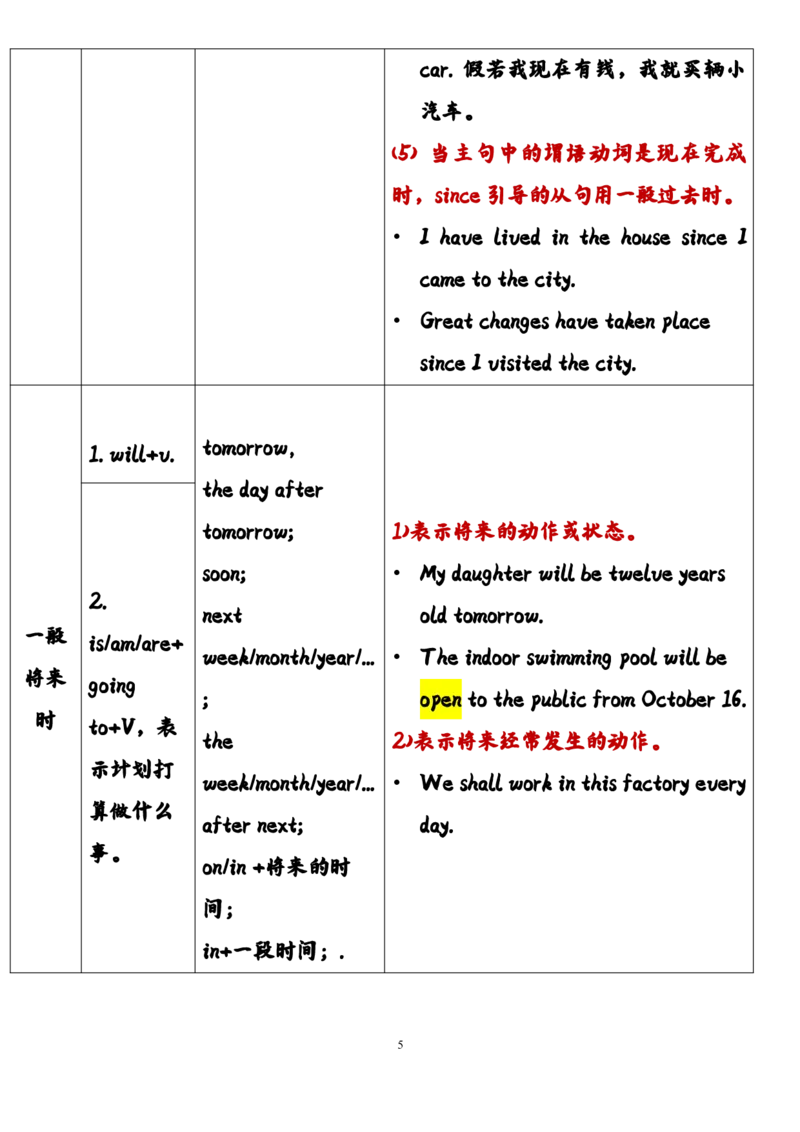
tomorrow,
1. will+v.
the day after
tomorrow; 1)表示将来的动作或状态。
soon; • My daughter will be twelve years
2.
next old tomorrow.
一般
is/am/are+
week/month/year/... • The indoor swimming pool will be
将来
going
; open to the public from October 16.
时
to+V,表
the 2)表示将来经常发生的动作。
示计划打
week/month/year/... • We shall work in this factory every
算做什么
after next; day.
事。
on/in +将来的时
间;
in+一段时间;.
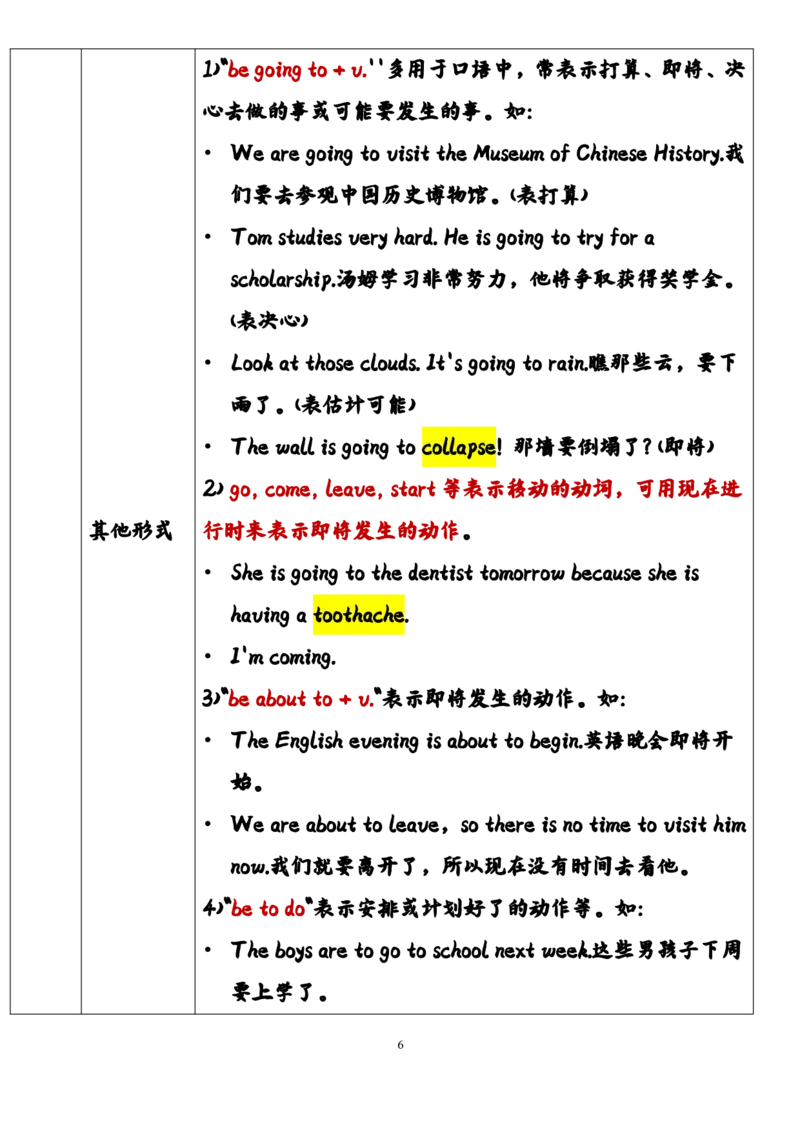
51)"be going to + v.''多用于口语中,常表示打算、即将、决
心去做的事或可能要发生的事。如:
• We are going to visit the Museum of Chinese History.我
们要去参观中国历史博物馆。(表打算)
• Tom studies very hard. He is going to try for a
scholarship.汤姆学习非常努力,他将争取获得奖学金。
(表决心)
• Look at those clouds. It's going to rain.瞧那些云,要下
雨了。(表估计可能)
• The wall is going to collapse! 那墙要倒塌了? (即将)
2) go, come, leave, start 等表示移动的动词,可用现在进
其他形式 行时来表示即将发生的动作。
• She is going to the dentist tomorrow because she is
having a toothache.
• I'm coming.
3)"be about to + v."表示即将发生的动作。如:
• The English evening is about to begin.英语晚会即将开
始。
• We are about to leave,so there is no time to visit him
now.我们就要离开了,所以现在没有时间去看他。
4)"be to do"表示安排或计划好了的动作等。如:
• The boys are to go to school next week.这些男孩子下周
要上学了。
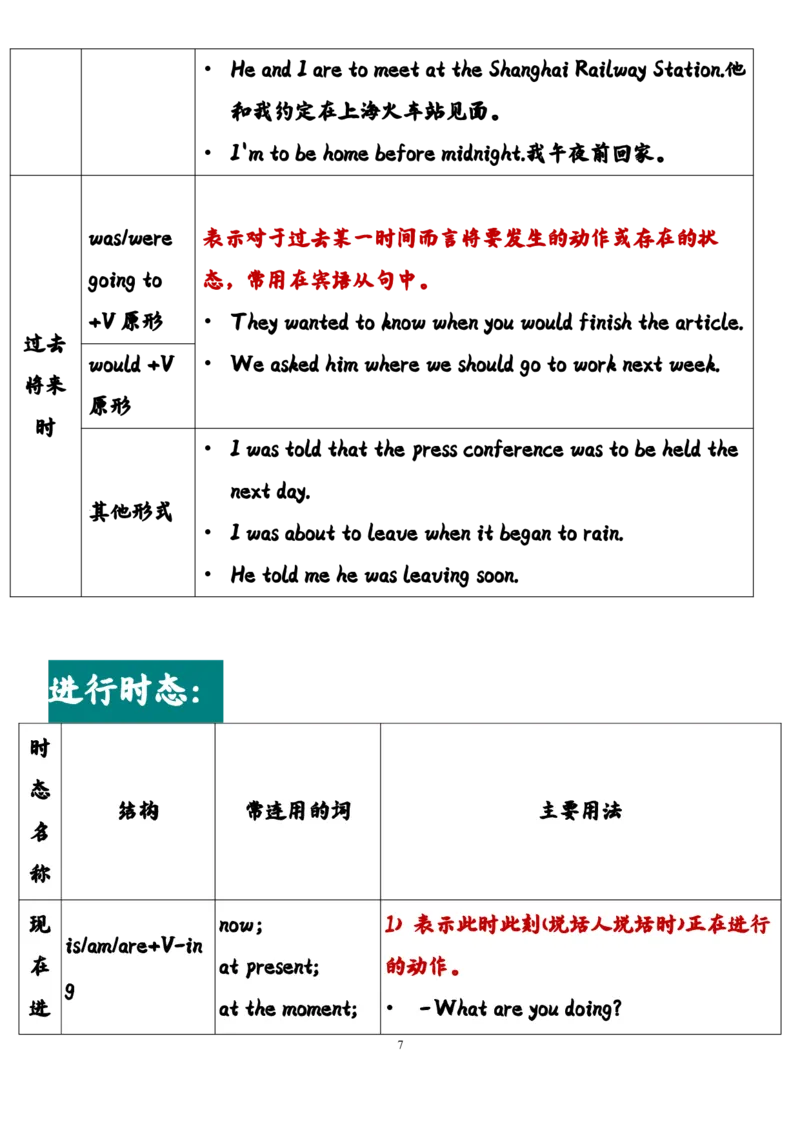
6• He and I are to meet at the Shanghai Railway Station.他
和我约定在上海火车站见面。
• I'm to be home before midnight.我午夜前回家。
was/were 表示对于过去某一时间而言将要发生的动作或存在的状
going to 态,常用在宾语从句中。
+V 原形 • They wanted to know when you would finish the article.
过去
would +V • We asked him where we should go to work next week.
将来
原形
时
• I was told that the press conference was to be held the
next day.
其他形式
• I was about to leave when it began to rain.
• He told me he was leaving soon.
进行时态:
时
态
结构 常连用的词 主要用法
名
称
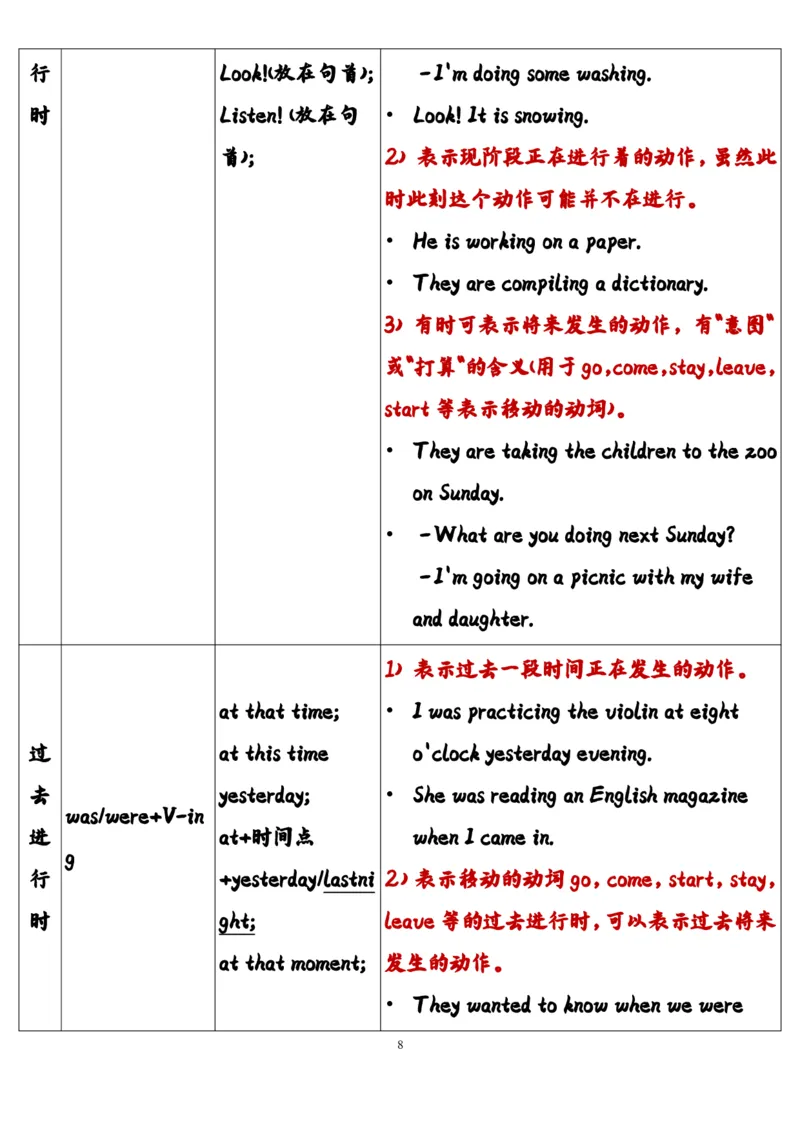
现 now; 1) 表示此时此刻(说话人说话时)正在进行
is/am/are+V-in
在 at present; 的动作。
g
进 at the moment; • -What are you doing?
7行 Look!(放在句首); -I'm doing some washing.
时 Listen! (放在句 • Look! It is snowing.
首); 2) 表示现阶段正在进行着的动作,虽然此
时此刻这个动作可能并不在进行。
• He is working on a paper.
• They are compiling a dictionary.
3) 有时可表示将来发生的动作,有"意图"
或"打算"的含义(用于go,come,stay,leave,
start 等表示移动的动词)。
• They are taking the children to the zoo
on Sunday.
• -What are you doing next Sunday?
-I'm going on a picnic with my wife
and daughter.
1) 表示过去一段时间正在发生的动作。
at that time; • I was practicing the violin at eight
过 at this time o'clock yesterday evening.
去 yesterday; • She was reading an English magazine
was/were+V-in
进 at+时间点 when I came in.
g
行 +yesterday/lastni 2)表示移动的动词 go,come,start,stay,
时 ght; leave 等的过去进行时,可以表示过去将来
at that moment; 发生的动作。
• They wanted to know when we were
8leaving for Shanghai.
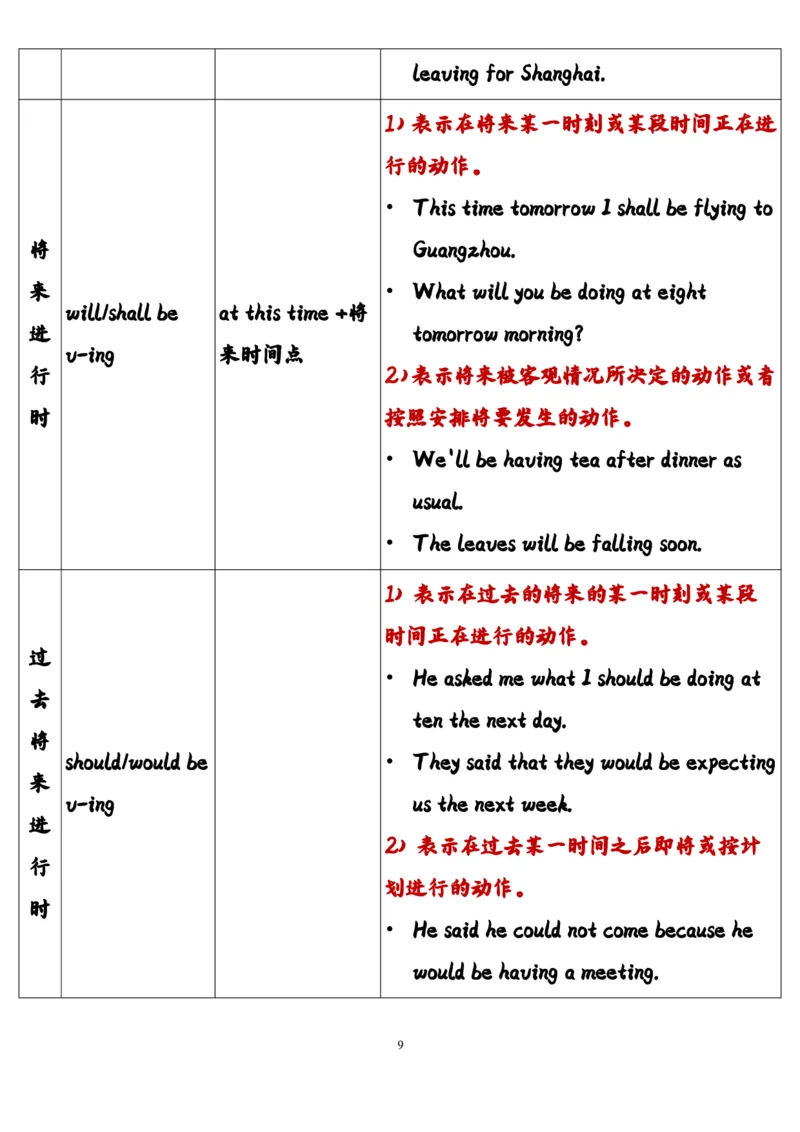
1)表示在将来某一时刻或某段时间正在进
行的动作。
• This time tomorrow I shall be flying to
将 Guangzhou.
来 • What will you be doing at eight
will/shall be at this time +将
进 tomorrow morning?
v-ing 来时间点
行 2)表示将来被客观情况所决定的动作或者
时 按照安排将要发生的动作。
• We'll be having tea after dinner as
usual.
• The leaves will be falling soon.
1) 表示在过去的将来的某一时刻或某段
时间正在进行的动作。
过
• He asked me what I should be doing at
去
ten the next day.
将
should/would be • They said that they would be expecting
来
v-ing us the next week.
进
2) 表示在过去某一时间之后即将或按计
行
划进行的动作。
时
• He said he could not come because he
would be having a meeting.
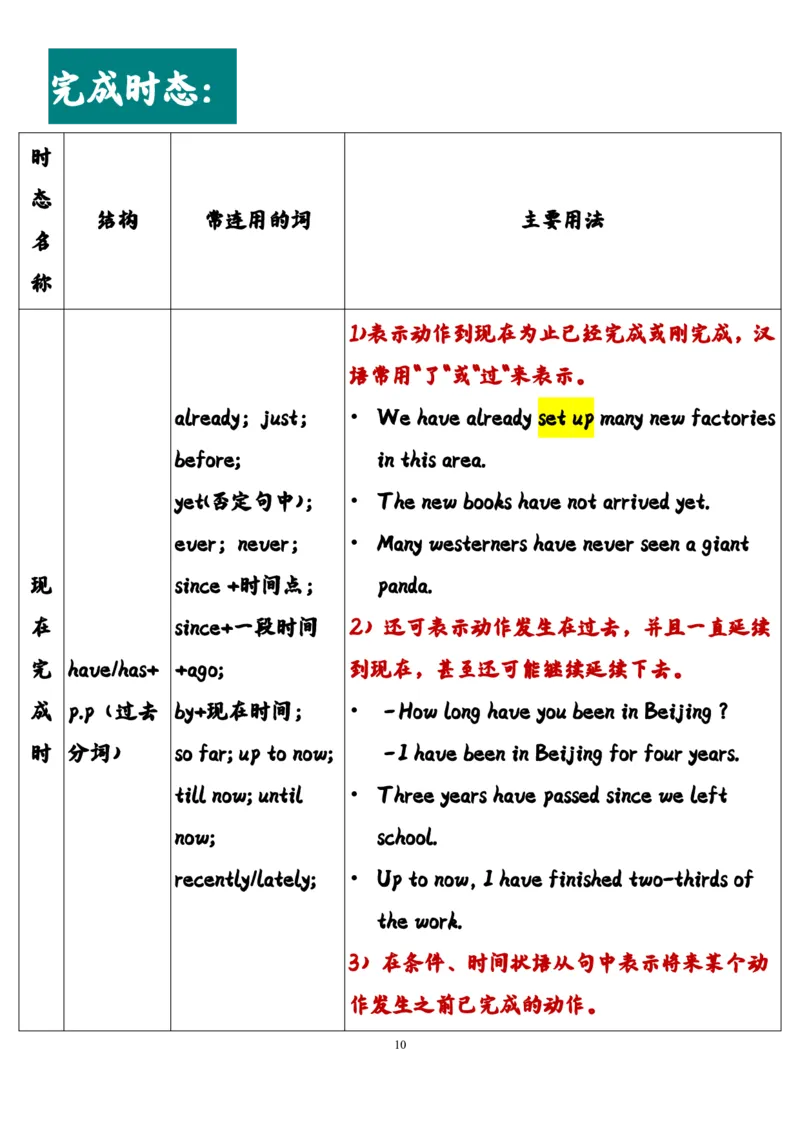
9完成时态:
时
态
结构 常连用的词 主要用法
名
称
1)表示动作到现在为止已经完成或刚完成,汉
语常用"了"或"过"来表示。
already;just; • We have already set up many new factories
before; in this area.
yet(否定句中); • The new books have not arrived yet.
ever;never; • Many westerners have never seen a giant
现 since +时间点; panda.
在 since+一段时间 2)还可表示动作发生在过去,并且一直延续
完 have/has+ +ago; 到现在,甚至还可能继续延续下去。
成 p.p(过去 by+现在时间; • -How long have you been in Beijing ?
时 分词) so far; up to now; -I have been in Beijing for four years.
till now; until • Three years have passed since we left
now; school.
recently/lately; • Up to now, I have finished two-thirds of
the work.
3)在条件、时间状语从句中表示将来某个动
作发生之前已完成的动作。
10• Perhaps I'll know more English after I have
learnt it for two years.
1. This is (It is) the first /second time that …句型中,常用现在
完成时。但在“It was the second time that …”中,也能用过去
完成时。
• This is the second time that I have seen the film.
• That was the third time that I had visited the place.
2. It is (has been) … since 句型中,主句常用现在完成时,从句
用一般现在时。
• It is(has been)three years since I began to work on the state
farm.
3.在完成时中,一个瞬间性动词不能和表示一段时间的状语(for,
特别注意:
since, how long 等)连用,此时必须将该瞬间动词改为延续性动
词或状态动词。
buy have
borrow keep
catch/get a cold have a cold
come / be
arrive/reach/get to
become be
go be
put on wear
11join be in
go to school be a student
die be dead
begin/start be on
leave be away
fall asleep be asleep
open be open
close/shut be closed
end be over
marry be married
• He has come back for three weeks. (×)
• He has been back for three weeks. (√)
• The writer has died for two years. (×)
• The writer has been dead for two years. (√)
• He has left for 6 days. (×)
• He has been away for 6 days. (√)
1)过去完成时表示在过去某一时间或动作以前
过 过去的过去:
业已完成的动作。
去 had + p.p by+过去的时间;
• By the end of last week we had learned ten
完 (过去分 表“过去某动作或
lessons.
成 词) 时间以前”的时间
• In the exhibition he saw many oil paintings
时 状语。
that he had never seen before.
122) 表示由过去某一时间开始,一直延续到过
去另一时间的动作。
• It rained yesterday after it had been dry for
many months.
• He said that great changes had taken place
in his hometown since 1980.
3) 常用语 no sooner … than… 和 hardly
(scarcely) … when …句型的主句中,从句用
一般过去时。(倒装)
• No sooner had he reached home than it
began to rain.他一到家,就开始下雨了。
• He had hardly got on the train when the
train started out. 他刚上火车,火车就开
了。
4)在 would rather, would prefer 等后面的从句
中,如果表示过去的动作或情况,用过去完成
时。
• I’d rather you had been here yesterday.要
是你昨晚在这就好了。
将 表示在将来某一时间以前已经完成的动作。
by +将来时间
来 will/shall • By the end of this week, I shall have
by the time +将来
完 have + p.p finished the book.
时间
成 • The children will have gone to sleep by the
13时 time we get home.
• When you come tonight at eight o'clock,I
shall have written my paper.
表示在过去的将来的某一时间以前已经完成
过
的动作。
去
• He said he would have paid back the money
将 should/wou
by the end of the week.
来 ld have +
• We told him that we should have returned
完 p.p
to the camp by four o'clock.
成
• I hoped she would have finished the work
时
before I got back.
完成进行时
时
态
结构 主要用法
名
称
现 表示动作从过去某一时间开始一直延续到
在 现在。现在这个动作可能已经终止,也可
完 have/has been + 能仍然在进行着。
成 v-ing • I have been waiting for you for two
进 hours.
行 • He has been working on the paper all
14时 day.
• --How long have you been learning
English?
--I have been learning English for two
years.
注意:
有些不能用现在进行时态的动词,如 be,
have,like,love,know,see,hear 等,
同样也不能用现在完成进行时,而只能用
现在完成时。
• She has been ill for a long time.
• I have not seen you for ages.
表示动作在过去某一时间之前开始并延续
过 到过去这个时间,这一动作可能还在进行,
去 也可能已经停止。
完 • The baby had been crying for fifteen
had been
成 minutes when her mother came in.
+V-ing
进 • The teacher had been teaching for
行 forty years by the time he retired.
时 • It seemed to her that the boys had been
shouting for a long time.
15专项练习:
1. ________ a concert next Saturday?
A. There will be B. Will there be C. There can be D. There are
2. It’s good to see you again, Agnes.
— This has been our first chance to visit since from Iran.
A. you return B. you returned C. you have returned D.
returning
3. If it ________ tomorrow, we’ll go roller-skating.
A. isn’t rain B. won’t rain C. doesn’t rain D. doesn’t fine
4. The reporter said that the UFO ___ east to west when he saw it.
A. was traveling B. traveled C. had been traveling D. was to
travel
5. Sorry, I can’t open the door, for I the key to it.
A. lost B. lose C. had lost D. have
lost
6. “ What ' s the matter, Ali? You look sad. ”
“ Oh, nothing much. As a matter of fact, I ___ of my friends back
home. ”
A. just thought B. have just been thinking C. was just thinking D.
have just thought
7. — Did you expect Frank to come to the party? — No, but I had
hoped .
16A. him coming B. him to come C. that he comes D. that he
would come
8. — Bob must be very wealthy. — Yes, he more in one day than I do
in a week.
A. has been earned B. had earned C. earns D. has
earned
9. I first met Lisa three years ago. She ___ at a radio shop at the time.
A. has worked B. was working C. had been working D. had worked
10. She _____her keys in the office so she had to wait until her husband
____home.
A has left; comes B had left; would come C had left; came D left; had
come
11. Zhao Lan ______already ______in this school for two years.
A. was ; studying B. will ; study C. has ; studied D. are ;
studying
12. ---Mr Gorden asked me to remind you of the meeting this afternoon .
Don’t forget it !
---OK. I ______ .
A. won't B. don't C. will D. do
13.When I reached home, my parents __________their supper.
A.are having B.have already had C.have had D. had
already had
14. She __________in this school ________the past ten years.
17A.was teaching, since B. had been teaching, since
C.would teach, for D. has been teaching, for
15.I first met Tom 10 years ago. He ______ in a radio factory at that time.
A. had worked B. has worked C. was working D. has been working
16.--- What ______ when I phoned you?
--- I ______ my work, and I wanted to go out.
A. have you done; finished B. were you doing; have finished
C. did you do; had just finished D. were you doing; had just finished
17.I used to drink a lot of tea but these days I ______ coffee.
A. prefer B. preferred C. had preferred D. am preferring
18.Jim talked for about half an hour yesterday. Never ______ him talk so
much.
A. I heard B. did I hear C. I had heard D. had I heard
19.He ___ articles for our wall-newspaper these three years, and he ____
about forty articles.
A. has been writing; has written B. had been writing; wrote
C. is writing; has been writing D. has written; has written
20. When he was alive, the old scientist used to say that knowledge ______
from practice and he gained his experience by doing a lot of practical
work.
A. was coming B. had come C. comes D. would come
21. --- How are you planning to travel to Shanghai?
--- I ______ yet, but I ______ taking a train.
18A. didn’t decide; am considering B. haven’t decided; consider
C. haven’t decided; am considering D. hadn’t decided; have considered
22. --- Who’s the man over there?
--- It’s Jack.
--- Oh? ______ in Italy.
A. I think he’s B. I’ve thought he’s been
C. I thought he was D. I’d thought he’d been
23. I thought Jim would say something about his school report, but he
______ it.
A. doesn’t mention B. hadn’t mentioned C. didn’t mention D. hasn’
t mentioned
24. —How long ________ each other before they ________ married?
—For about a year.
A.have they known; get B.did they know; get
C.do they know; are going to get D.had they known; got
25. We would like to go and thank him ourselves,but we ________ out his
address yet,
A.haven’t found B.hadn’t found C.didn’t find D.don’
t find
26.Shirley ________ a book about China last year but I don’t know whether
she has finished.
A.has written B.wrote C.had written D.was writing
27. —Do you know when Tom ________ from abroad?
19—Perhaps it will be a long time before he ________ back.
A.will come; will come B.comes; will come
C.will come; comes D.comes; comes
28. The pen I ________ I ________ is on my desk,right under my nose.
A.think; lost B.thought; had lost C.think; had lost
D.thought; lost
29. However hard you ________,you will never succeed in pleasing her.
A.try B.will try C.should try D.would try
30.By this time tomorrow we ________ the machine.
A.have repaired B.shall have repaired C.will repair
D.would repair
31.I ________ the room to be empty but found it occupied.
A.had thought B.have thought C.didn’t think D.was
thinking
20