ARTICLE · 1018613
【精读】人教版高中英语选择性必修一·Unit 2 | Using Language (1) 预见未来:听力与预测实战
▌ Block 1: 看图识词——未来科技词汇 (❖ Activity 1)
课本 P18 的第一题要求我们将方框里的前沿科技词汇与五幅图片进行匹配。这些词汇不仅是听力的核心路标词,更是高考英语作文中极易拿分的“高级词汇”。【Diane's 独家词汇精讲与匹配】
Pic 1 匹配:artificial intelligence (AI) [ˌɑːtɪˈfɪʃl ɪnˈtelɪdʒəns] n. 人工智能。
Artificial [ˌɑːtɪˈfɪʃl] : adj. 人造的;人工的 / made or produced to copy something natural(=man-made/synthetic).
Pic 2 匹配:nanobots [ˈnænoʊbɒts] n. 纳米机器人。
💡 Diane's Note:
Nanobot [ˈnænoʊbɒt] : n. 纳米机器人 / a microscopic robot. 这是一个合成词,由 nano- (纳米) + bot (机器人 robot 的简写) 组成。图中显示它们正在人体血管中工作。
Pic 3 匹配:automation [ˌɔːtəˈmeɪʃn] n. 自动化。
💡 Diane's Note:
Automation [ˌɔːtəˈmeɪʃn] : n. 自动化 / the use of machines and computers that can operate without human control.(拓展:动词形式是 automate,形容词是 automatic 自动的)
Pic 4 匹配:cloning [ˈkloʊnɪŋ] n. 克隆技术。图片展示的是实验室里的克隆猴。
💡 Diane's Note:
Cloning [ˈkloʊnɪŋ] : n. 克隆技术 / the process of creating an exact genetic copy of an animal or plant.
Pic 5 匹配:global warming [ˈɡloʊbl ˈwɔːmɪŋ] n. 全球变暖。图片中冰川融化,北极熊孤立无援。
💡 Diane's Note:
Global warming [ˈɡloʊbl ˈwɔːmɪŋ] : n. 全球变暖。气候变化话题的绝对核心词。
▌ Block 2: 核心听力实战——未来预测访谈录 (❖ Activity 3)
接下来是一段非常精彩的广播访谈 (radio interview)。主持人采访了两位不同领域的专家。请大家先听音频尝试完成课本 P19 的表格填空,然后跟着 Diane 主编进入硬核的“逐句精讲”环节!
🎧 听力磨耳朵 (Listening)
📜 听力原文 (Transcript)
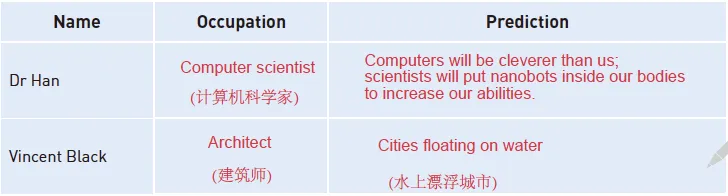
Host: On today's episode of Future Changes,we talk with two experts from different fields, Dr Han and Vincent Black,to hear their predictions about the future. First, Dr Han,could you please tell our audience what you do?
Dr Han: Certainly, I'm a computer scientist.
Host: And could you please tell us your prediction?
Dr Han: Yes. Well, I forecast that computers will be cleverer than us in the future. I think that people will also be programming computers to think like humans.
Host: That's very interesting. But aren't you worried that such computers would be dangerous?
Dr Han: Not at all. This is because we'll be programming them to not think in ways that may harm humans. In fact,we'll also be creating machines to help people internally, for example.I think scientists will put some small, intelligent machines called nanobots inside our bodies to increase our abilities.
Host: Wow, that would make each one of us superhuman. And Vincent, could you please tell us about your job?
Vincent Black: Certainly, I'm an architect. I design buildings.
Host: And what is your prediction about the buildings of the future?
Vincent Black: It's about the cities of the future,actually. I believe that cities floating on water are part of the world's future.
Host: Oh, really? What might make us want to do that?
Vincent Black: Yes. With global warming causing polar ice to melt, the sea level rising by many meters is a very realistic prospect. Instead of moving people away from the sea, I think that people could move into housing in cities that float.
Host: That sounds very innovative.Could you please give us more details?
Vincent Black: Sure. Well, I've developed a plan by designing a city that borrows many ideas from the giant water Lily. A flower that floats on water. Moreover...
🇨🇳 译文 (Translation)
主持人:在今天的《未来之变》节目中,我们与来自不同领域的两位专家韩博士和文森特·布莱克交谈,听听他们对未来的预测。首先,韩博士,能请您告诉我们的听众您是做什么的吗?
韩博士:当然,我是一名计算机科学家。
主持人:那您能告诉我们您的预测吗?
韩博士:好的。嗯,我预测计算机在未来会比我们更聪明。我认为人们也将不断地为计算机编写程序,让它们像人类一样思考。
主持人:这非常有趣。但您不担心这样的计算机会有危险吗?
韩博士:一点也不。这是因为我们将会对它们进行编程,让它们不去以可能伤害人类的方式思考。事实上,我们还将制造能在内部帮助人类的机器。例如,我认为科学家会把一些被称为“纳米机器人”的微小、智能的机器放入我们的体内,以增强我们的能力。
主持人:哇,那将使我们每个人都成为超人。那么,文森特,能请您谈谈您的工作吗?
文森特·布莱克:当然,我是一名建筑师。我设计建筑。
主持人:那您对未来的建筑有什么预测呢?
文森特·布莱克:实际上,是关于未来城市的。我相信漂浮在水面上的城市是世界未来的一部分。
主持人:哦,真的吗?是什么会让我们想要那样做呢?
文森特·布莱克:是的。随着全球变暖导致极地冰川融化,海平面上升数米是一个非常现实的前景。与其把人们从海边移走,我认为人们可以搬进漂浮城市的住宅里。
主持人:听起来非常有创意。能请您提供更多细节吗?
文森特·布莱克:当然。嗯,我已经制定了一个计划,设计了一座借鉴了巨型睡莲许多理念的城市。一种漂浮在水面上的花。此外……
📖 逐句精讲 (Sentence Analysis)
Part 1: 对话 Dr Han —— 计算机与纳米机器人
1.【原文】Host: On today's episode of Future Changes, we talk with two experts from different fields, Dr Han and Vincent Black, to hear their predictions about the future. First, Dr Han, could you please tell our audience what you do? / Dr Han: Certainly, I'm a computer scientist.
【译文】主持人:在今天的《未来之变》节目中,我们与来自不同领域的两位专家韩博士和文森特·布莱克交谈,听听他们对未来的预测。首先,韩博士,能请您告诉我们的听众您是做什么的吗?/ 韩博士:当然,我是一名计算机科学家。
💡 Diane's Note:
Episode ['epɪsəʊd]: n. (广播或电视节目的) 一集/ a single broadcast of a television or radio programme.
Expert ['ekspɜːt]: n. 专家 / a person with special knowledge or ability who performs skillfully (= specialist / professional).
Could you please tell... 极度礼貌的委婉祈使句,在日常英语角或面试中自我介绍环节经常用到。
2.【原文】Host: And could you please tell us your prediction? / Dr Han:
Yes. Well, I forecast that computers will be cleverer than us in the future. I think that people will also be programming computers to think like humans.
【译文】主持人:那您能告诉我们您的预测吗?/ 韩博士:好的。嗯,我预测计算机在未来会比我们更聪明。我认为人们也将不断地为计算机编写程序,让它们像人类一样思考。
💡 Diane's Note:
Forecast ['fɔːkɑːst]: v. 预测;预报/ to say what you think will happen in the future (= predict).
Program ['prəʊɡræm]: v. 为(计算机)编写程序;设定。
语法点拨:Will also be programming: 使用了我们在前面刚学过的将来进行时,强调未来人类会持续进行这项研发工作,画面感极强。
3.【原文】Host: That's very interesting.But aren't you worried that such computers would be dangerous? / Dr Han: Not at all. This is because we'll be programming them to not think in ways that may harm humans.
【译文】主持人:这非常有趣。但您不担心这样的计算机会有危险吗?/ 韩博士:一点也不。这是因为我们将会对它们进行编程,让它们不去以可能伤害人类的方式思考。
Not at all: 常用口语表达,意为“一点也不”。
Harm [hɑːm]: v. & n. 伤害;损害 / to damage or injure physically or mentally.
Internally [ɪn'tɜːnəli]: adv. 在内部;在体内 / inside your body or mind. (反义词:externally 在外部).
Intelligent [ɪn'telɪdʒənt]: adj. 智能的;聪明的/ having or showing the ability to easily learn or understand things (= smart / clever).
Part 2: 对话 Vincent Black —— 水上城市
5. 【原文】Host: Wow, that would make each one of us superhuman. And Vincent, could you please tell us about your job? / Vincent Black: Certainly, I'm an architect. I design buildings.
【译文】主持人:哇,那将使我们每个人都成为超人。那么,文森特,能请您谈谈您的工作吗?/ 文森特·布莱克:当然,我是一名建筑师。我设计建筑。
💡 Diane's Note:
Superhuman [ˌsuːpə'hjuːmən]: adj. 超人的;非凡的。
Architect ['ɑːkɪtekt]: n. 建筑师;设计师。
6.【原文】Host: And what is your prediction about the buildings of the future? / Vincent Black: It's about the cities of the future, actually. I believe that cities floating on water are part of the world's future.
【译文】主持人:那您对未来的建筑有什么预测呢?/ 文森特·布莱克:实际上,是关于未来城市的。我相信漂浮在水面上的城市是世界未来的一部分。
💡Diane's Note:
语法点拨 (非谓语动词作定语):Floating on water 是一个现在分词短语作后置定语,修饰前面的 cities,相当于定语从句 cities that float on water,表示主动和伴随的状态。
7.【原文】Host: Oh, really? What might make us want to do that? / Vincent Black: Yes. With global warming causing polar ice to melt, the sea level rising by many meters is a very realistic prospect.
【译文】主持人:哦,真的吗?是什么会让我们想要那样做呢?/ 文森特·布莱克:是的。随着全球变暖导致极地冰川融化,海平面上升数米是一个非常现实的前景。
💡 Diane's Note:
Melt [melt]: v. 融化;熔化 / to become or make something become liquid as a result of heating (= thaw).
Prospect ['prɒspekt]: n. 前景;可能性;希望 / the possibility that something will happen (= outlook / possibility).
语法高光 (With 复合结构): With + 名词 (global warming) + 现在分词 (causing...)。这个结构在句中作原因状语。因为 global warming 和 cause 之间是主动关系,所以用现在分词 causing。这是高考作文极易拿分的高级句式!
8.【原文】Vincent Black: Instead of moving people away from the sea, I think that people could move into housing in cities that float.
【译文】文森特·布莱克:与其把人们从海边移走,我认为人们可以搬进漂浮城市的住宅里。
💡 Diane's Note:
Instead of: 介词短语,意为“代替;而不是”。后面接动名词 moving。
9.【原文】Host: That sounds very innovative. Could you please give us more details? / Vincent Black: Sure. Well, I've developed a plan by designing a city that borrows many ideas from the giant water Lily. A flower that floats on water. Moreover...
【译文】主持人:听起来非常有创意。能请您提供更多细节吗?/ 文森特·布莱克:当然。嗯,我已经制定了一个计划,那就是设计一座城市,其设计灵感大量借鉴了巨型睡莲。一种漂浮在水面上的花。此外……
💡 Diane's Note:
Innovative ['ɪnəveɪtɪv]: adj. 创新的;革新的 / introducing or using new ideas or methods (= inventive / groundbreaking). (inventive / groundbreaking)。
Giant ['dʒaɪənt]: adj. 巨大的 n. 巨人 / extremely large (= huge / enormous). (huge / enormous)。
▌ Block 3: 观点碰撞与头脑风暴 (Activity 4 & 5)
在听完 Dr Han 和 Vincent Black 的预测后,课本要求我们进行深度思考(Critical Thinking)。
❖ Activity 4: 讨论两位专家的预测是否可能实现?为什么?
为了让大家在课堂讨论时“有话可说”,Diane 为大家准备了两个高频口语模板,可以直接套用:
【1:赞同纳米机器人】
I think Dr Han's prediction is highly possible. With the rapid development of medical technology, nanobots will definitely become a reality to cure serious diseases.
【译文】我认为韩博士的预测是非常有可能的。随着医疗技术的快速发展,纳米机器人肯定会成为治愈严重疾病的现实。
💡 Diane's Note:【高分进阶金句】
"In fact, advanced nanomedicine has entered early clinical trials, successfully shrinking tumors by 90% in preclinical models through targeted drug delivery."
[译文] 事实上,先进的纳米医学已经进入早期人体临床试验阶段,在临床前模型中通过靶向药物递送成功使肿瘤缩小了90%。
💡 核心高频词伙 (Collocations):
early clinical trials : 早期临床试验。
targeted drug delivery : 靶向药物递送 (高考科技类阅读高频词汇)。
shrink tumors : 使肿瘤缩小。shrink [ʃrɪŋk] v. (过去式 shrank 或 shrunk,过去分词 shrunk) (使)缩小,收缩。
preclinical models : 临床前模型。
【2:怀疑水上城市】
I doubt Vincent's prediction about floating cities. Building cities on water sounds too expensive and difficult to maintain. But I agree that global warming is a big challenge.
【译文】我对文森特关于水上城市的预测表示怀疑。在水上建城市听起来太昂贵且难以维护了。但我同意全球变暖是一个巨大的挑战。
❖ Activity 5: 分组头脑风暴,讨论未来的四大维度。
如果高考作文考到“未来科技”的话题,以下 Diane 为你独家整理的【头脑风暴语料库】绝对能让你的文章脱颖而出:
💡 Diane's Note (未来话题万能语料库):
Future events/problems (未来的问题): Extreme weather (极端天气) / Resource depletion (资源枯竭).
Future technologies (未来科技): Commercial space travel (商业太空旅行的普及) / The integration of VR and AI (虚拟现实与人工智能的融合).
Changes in life (生活方式的改变): Work from home (居家办公) / Online education (在线教育).
Challenges & opportunities (挑战与机遇): Privacy issues (隐私泄露问题) / Explore new worlds (探索新世界的机遇).
▌ Block 4: 专家访谈:口语与写作大输出 (❖ Activity 6)
这是本节课的终极任务:假设你是未来的某位专家,与同伴互相采访。课本P19极其贴心地为我们提供了一个 "Making predictions" (做预测) 的高分句型框:
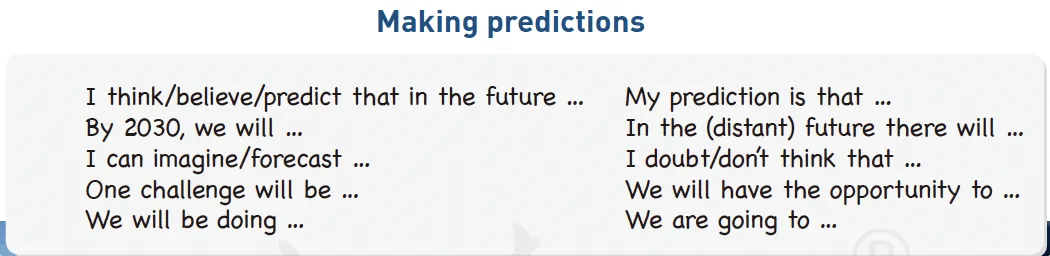
I think / believe / predict that in the future... (我认为/相信/预测在未来……)
By 2030, we will... (到 2030 年,我们将……)
I can imagine / forecast... (我可以想象/预测……)
One challenge will be... (一个挑战将会是……)
We will be doing... (我们将一直在做……)
My prediction is that... (我的预测是……)
In the (distant) future there will... (在遥远的未来将会有……)
I doubt / don't think that... (我怀疑/不认为……)
We will have the opportunity to... (我们将有机会去……)
We are going to... (我们将要……)
为了让大家彻底弄懂怎么用,Diane 结合上面的句型,为大家独家原创了一段《太空工程师访谈》的高分范文。请大声朗读并背诵其中的加粗句型!
【🗣️高分口语访谈范文】
A: Hello! What is your job in the future?
B: I am a space engineer. I design spaceships for ordinary people.
A: That sounds amazing! What are your predictions about space travel?
B: My prediction is that by 2030, we will have space hotels. I believe that in the future, ordinary people will be spending their holidays on the moon.
A: Are there any difficulties?
B: Yes. One challenge will be the cost. Space travel is very expensive. I doubt that everyone can afford it at first. However, we will have the opportunity to explore new worlds.
A: Thank you for your time!
【译文 (Translation)】
A: 你好!你在未来是做什么工作的?
B: 我是一名太空工程师。我为普通人设计宇宙飞船。
A: 听起来太棒了!你对太空旅行有什么预测?
B: 我的预测是,到 2030 年,我们将拥有太空酒店。我相信在未来,普通人将会一直在月球上度过他们的假期。
A: 有什么困难吗?
B: 是的。一个挑战将会是成本问题。太空旅行非常昂贵。我怀疑一开始不是每个人都能负担得起。然而,我们将有机会探索新的世界。
A: 感谢您抽出时间!
💡 Diane's Note:
在这段对话中,我们完美融合了“将来进行时” (will be spending) 和课本给出的高级句式。下次在英语角或口语考试中遇到相关话题,直接把这段搬上去!
✍️ 结语与口语实战 (Conclusion)
从听懂前沿科技词汇(Activity 1-3),到深度思考未来趋势(Activity 4-5),再到流利地用高级句式表达预测(Activity 6),我们今天完成了一个完美的语言学习闭环!
下一期,Diane 将带大家继续探索本单元的读写板块,看看如何将这些“对未来的预测”落笔成一篇满分的英语议论文。干货满满,敬请期待!See you next time!
🌟 今日金句 (Quote of the Day)
"Start where you are. Use what you have. Do what you can."
—— 从你所在的地方开始,用你拥有的资源,做你能做的事。 (Arthur Ashe)
(主编解析:不需要等一切都“准备完美”才开始。不管现在的底子有多薄,哪怕今天只背了一个短语,这也是属于你的扎实进步。)
📚 宝藏精读笔记导航 (Collections)
温故而知新!上篇硬核解析精讲笔记,点击下方链接进行全面复习:
👉【精读】人教版高中英语选择性必修一·Unit 2 | Discover Useful Structures 攻克“将来进行时”
📖 进阶深造:Diane 独家教研大合集
🏷️ [合集] 人教版高中英语选择性必修一·深度精读笔记🔗 来源声明
教材版本:人教版高中英语选择性必修第一册 (2019版)
声明:配套双语讲义及教研解析为「Diane的英语精读笔记」原创首发,仅供学习交流,未经授权谢绝二次搬运或商用。