ARTICLE · 1435605
(可下载)话题押题之王又来了:武汉五调(英语)

 英 语

第二部分 阅读(共两节,满分50分)
第一节(共15小题;每小题2.5分,满分37.5分)
阅读下列短文,从每题所给的A、B、C、D四个选项中选出最佳选项。
A
This trail (路线) guides you on a journey of exploration and discovery around the Museum. On the way you’ll track down some amazing treasures and learn tales of human history. Whichever way you go, and whatever you discover, enjoy yourself! If you ever feel lost, just ask a member of staff for help.
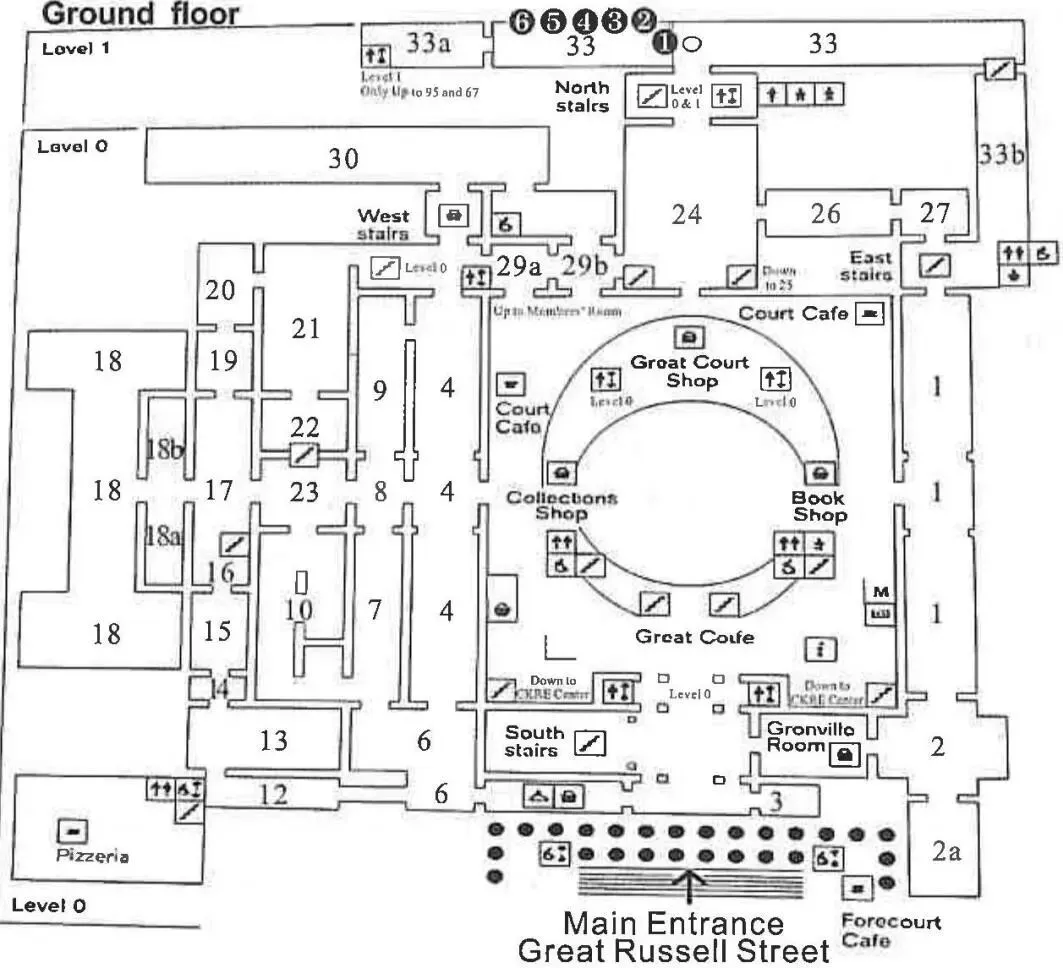
This map shows the locations of the objects in this trail. You can pick up a map of the whole Museum at the Information Desk in the Great Court.
Don’t miss
A The Holy Thorn Reliquary (A medieval masterpiece), Room 2a
B Tang dynasty figures (From the tomb of a general), Room 33②
C Shiva Nataraja (Lord of the Dance, a remarkable bronze sculpture from south India), Room 33①
D Hoa Hakananai’a (A colossal ancestor figure from Rapa Nui/Easter Island), Room 24
E The Rosetta Stone (The key to decoding hieroglyphs (象形文字)), Room 4
F Assyrian Lion Hunt reliefs (An ancient king’s triumph over nature), Room 10
G Parthenon sculptures (Iconic sculpture from ancient Greece), Room 1
Gallery closures
Some galleries will close at short notice due to restoration or unforeseen circumstances. This may impact on step-free access. Please visit the website for the latest information.
* Rooms 7, 9, 10, 19, 20 and 33 are open 11:00-15:00 on Monday, Thursday and Sunday.
* Rooms 17 and 18 are open 11:00-15:00 on Tuesday and Wednesday.
* Rooms 1, 4, and 30 are open 10:00-16:00 on Saturday and Sunday.
Useful information for families
● Accessible toilets and baby changing facilities are available.
● You can leave fold-up pushchairs in the cloakroom (寄存处) free of charge.
● You can find child-friendly food at the cafes. High chairs are available.
● You can use the Ford Centre for Young Visitors to picnic with your family at weekends and during school holidays.
21. What time best suits visitors interested in Chinese culture?
A. 10: 00 on Monday.B. 15: 30 on Wendesday.C. 12: 00 on Sunday.D. 16: 00 on Saturday.
22. Which might be the shortest route to enjoy all the “Don’t miss” from Main Entrance?
A. BCEDFGA.B. AGDCBEF.
C. GADBCFE.D. FEAGDCB.
23. What service is available for families at the museum?
A. Free storage for fold-up pushchairs.
B. Cheap child-friendly food at cafes.
C. Weekday access to picnic areas.
D. Private rooms for baby care.
B
I used to think recipes were promises. If I followed every line, the cake would rise and dinner would turn out well. My grandmother would probably have laughed at that. She cooked from memory and attention. “Stop when it looks right,” she would say. “Add flour until the dough feels soft but not sticky.” To a child who wanted clear answers, this sounded almost unfair.
Years later, I came across a medieval (中世纪的) recipe for sambocade, a kind of cheesecake. It gave no exact measurements. It simply told the cook to make a crust, prepare the curds, add sugar, egg whites and elderflowers, and bake it. At first, I found it nearly useless. How much sugar? How many eggs? How hot should the oven be? Then I understood: the recipe was not meant to teach a beginner from zero. It was more like a reminder, pointing back to knowledge learned by watching, touching, smelling and trying again.
That was how my grandmother cooked. Her own recipes were only lists of ingredients kept in an old shoe box. After she died, my mother threw the box away, thinking it had no value without instructions. I understood her choice. To anyone else, “flour, eggs, milk, sugar” was hardly a recipe. Yet something was lost with that box—not complete knowledge, but traces of a way of knowing.
Today, we often expect recipes to protect us from uncertainty. We want grams, minutes and temperatures. Careful measurement is useful, of course. But cooking is not only measurement. A good cook notices when butter begins to smell nutty, when dough resists the hand, and when a cake is pale enough to leave the oven. Such knowledge cannot be fully written down. It must be practiced into the body.
Now, whenever I bake, I still hear my grandmother’s question: “Is it pale enough yet?” It is not exactly a rule. It is a way of paying attention.
24. Why did the author once find her grandmother’s instructions “almost unfair”?
A. They sounded too old.B. They lacked clear rules.
C. They changed too often.D. They used rare ingredients.
25. Why is the medieval recipe mentioned?
A. To introduce a dessert.B. To question old recipes.
C. To show a similar style.D. To compare two dishes.
26. What does the shoe box mainly represent?
A. Lost family wealth.B. Complete cooking records.
C. A forgotten dessert.D. Knowledge through practice.
27. What is the author’s view on recipes?
A. Accuracy removes uncertainty.B. Practice gives recipes meaning.
C. Old recipes work better.D. Good memory matters most.
C
Have you ever been surfing the Internet only to come across content that seems engineered to make you angry? If so, you may have fallen victim to “rage bait (愤怒诱饵),” a term named as Oxford’s word of the year.
The word “rage bait” saw its usage increased sharply throughout 2025. For social media influencers, posting content intended to annoy people is not wise, yet it often boosts engagement and income. Algorithms (算法)are also used to tailor the content we see to what we are likely to interact with, which isn’t necessarily something pleasant. “If we see a cat, we’re like ‘Oh, that’s cute’ and that’s all,” marketing podcaster Andréa Jones explained, “But if we see someone doing something annoying, we may type in ‘This is terrible,’ and that sort of comment is seen as a high-quality engagement by the algorithm.”
Why is rage bait so effective? For one thing, we tend to pay more attention to a situation that has caused anger than one that has created happiness since action needs to be taken to resolve an issue, while happiness suggests that everything is OK. For another, typically, we used to have some breaks from anything, or anyone, that caused us a feeling of rage. This would give us an opportunity to calm down and reflect on what had happened. However, with the popularity of social media, we can post content and immediately get a reply, non-stop 24 hours a day so that it can feel like we no longer have that escape.
Then, how can we cope with rage bait? An awareness of the motivations behind these posts is a good place to start. Knowing that many posts are designed to drive engagement helps us reclaim our power over those interactions. In addition, we can influence and shape social media through both what we choose to engage with, or not engage with. The more we avoid engaging with any content that causes rage in us, the less it will be presented to us.
28. Which of the following might be “rage bait”?
A. A news report about a local festival.
B. A photo of a snow-capped mountain.
C. A video featuring famous musicians’ performance.
D. A post claiming simple exercises cure all diseases.
29. What can be inferred from Andréa Jones’s remarks?
A. Influencers usually avoid annoying content.
B. Rage bait is replacing all positive content.
C. Positive posts are never interacted with.
D. Algorithms may reward rage bait.
30. What do the underlined words “that escape” in paragraph 3 refer to?
A. The emergence of rage bait.
B. The chance to reply immediately.
C. A break from anger-causing content.
D. Continuous exposure to social media.
31. What is the best title for the text?
A. Happiness: A Forgotten Online Feeling
B. Algorithms: The Hidden Rules of the Internet
C. Rage Bait: Why It Works and How to Resist It
D. Engineered Anger: How Word of the Year Appeared
D
Over the past ten years or so, investigations of ancient DNA have skyrocketed. However, as the pace of ancient DNA research has increased, so, too, have problems with data archiving (归档). Often, only some of the data obtained in any one study are uploaded to publicly available databases. Furthermore, the associated metadata—information on the age of the sample, where it was found, how the DNA was gathered and chemically treated, and so on—are frequently inaccurate or incomplete. Here, we set out the nature of these two problems.
Earlier this year, some experts assessed what data had been uploaded into publicly
accessible databases by the authors of 42 studies of ancient DNA published in the journals Nature, Science and Cell between 2021 and 2023. In about half of the papers, researchers archived only those sequences (基因序列) that they had managed to match a reference genome (参考基因组), leaving no record of the unmatched sequences. This represents a permanent loss of data for more than 3,000 ancient samples analysed in just these studies.
It might seem that any sequence that does not map to the reference genome is irrelevant. But improvements in computational methods and more complete reference genomes could enable researchers to match such sequences in the future. Also, even if some of the unmatched sequences are not from the species of interest, they could be among the most interesting in the data set, especially if they originated from disease-causing microorganisms that infected the host.
The study of ancient microorganisms has become a field in its own right, and is transforming our understanding of the history of many infectious diseases. Until 2015, for instance, historians thought that plague, a disease known for its high infectivity, emerged as a significant human disease only around 1,500 years ago. Analyses of unmatched sequences from ancient human remains have revealed, however, that outbreaks of plague were occurring 5,000 years ago. Researchers have likewise used studies of unmatched sequences gathered from human remains to clarify the evolutionary history of other infectious agents.
32. What problem results from the archiving practice described in paragraph 2?
A. Data loss.B. Chaotic data.
C. Inaccessible databases.D. Insufficient reference genomes.
33. How does the author develop paragraph 3?
A. By describing a process step by step.
B. By challenging a common assumption.
C. By comparing two different methods.
D. By summarizing the main findings.
34. Why are “plague” and other infectious agents mentioned in the passage?
A. To classify deadly diseases in history.
B. To track the evolution of microorganisms.
C. To provide new insights into disease outbreak.
D. To illustrate the value of unmatched sequences.
35. What might be discussed in the following paragraphs?
A. Problems with metadata.B. Sequencing techniques.
C. Examples of matched sequences.D. History of data archiving.
第二节(共5小题;每小题2.5分,满分12.5分)
阅读下面短文,从短文后的选项中选出可以填入空白处的最佳选项。选项中有两项为多余选项。
For many, the idea of “the perfect” commute (通勤) might sound laughable. If we travel to an office, it’s likely to involve either peak-time public transport or stressful traffic. 36 But there are things we can do to make them more enjoyable, productive and healthier.
So where to start? 37 Creating a visual representation of how much commuting takes out of your day gives an accurate picture. It’s not just about how much free time you have left; it’s about seeing how commuting affects other activities in your life.
The point is to get creative about how to maximize your available time. One strategy is to add new habits to your commute, which might mean building fitness into journeys by cycling, or walking part of the way. 38 That adds up to about five hours a week that people who commute every day have to themselves.
39 It offers a structured, regular window to focus on an idea or project. In Cal Newport’s bestseller Deep Work, he suggests using chunks (大块) of time to focus deeply on one topic. “So if you’re stuck on a bus, you could use the time to brainstorm a specific idea, either for work or a personal project,” he says.
This does sound appealing. What if I could reframe my commute as daily creative brainstorming sessions? 40 I have a friend who wrote a novel on his daily commute from Brighton to London. Perhaps the perfect commute isn’t about perfect conditions—it’s about perfecting how we use the time we have.
A. This isn’t just wishful thinking.
B. Begin by blocking it out on a calendar.
C. Commuting holds a hidden opportunity.
D. It is never enjoyable to be stuck in traffic.
E. You wouldn’t think either offers much joy.
F. Or you could use the time to learn a foreign language.
G. It might also mean anything that takes us out of work mode.
第三部分 语言运用(共两节,满分30分)
第一节(共15小题;每小题1分,满分15分)
阅读下面短文,从每题所给的A、B、C、D四个选项中选出可以填入空白处的最佳选项。
Last fall, I studied abroad at Denmark Technical University. My main criterion for choosing a school was that I wanted to live in a country where I could 41 English alone.
I made friends through a board-game club—three Danish students, one German, and two Icelandic students. Most of the time, I focused more on the game than on social 42 . But one evening, while waiting for my turn, I 43 realized that most of the group was speaking English. They were clearly trying to make sure language would not become a 44 between us.
Later, I joined another student club with a similarly 45 group. Once, when I entered the room, several Danish students were chatting in Danish. But the minute I sat down, they immediately 46 to English. I told my friend Augusta that I felt 47 . It must be exhausting to use English all day just because one foreign student was 48 . “Don’t worry. It’s really not a bother,” she 49 me.
Their 50 made me feel welcome, but I also realize something I had long 51 : In those rooms, by unfailingly shifting to English, they had 52 a bridge for me—yet I had never once ventured (冒险) to the other side. I had been so 53 to the gift—and to the debt.
The next day, I asked Augusta to teach me a few Danish phrases. I may never be 54 , but real connection lies not in ease—but in shared 55 , which I had long received without giving back.
41. A. live up toB. break away fromC. get down toD. get by on
42. A. communicationB. competitionC. instructionD. performance
43. A. purposefullyB. suddenlyC. barelyD. usually
44. A. habitB. barrierC. topicD. secret
45. A. fixedB. mixedC. unitedD. divided
46. A. contributedB. returnedC. reactedD. switched
47. A. guiltyB. confusedC. lonelyD. nervous
48. A. absentB. presentC. bossyD. grateful
49. A. warnedB. remindedC. comfortedD. persuaded
50. A. braveryB. intelligenceC. considerationD. discipline
51. A. debatedB. suspectedC. overlookedD. remembered
52. A. establishedB. approachedC. discoveredD. repaired
53. A. sensitiveB. committedC. blindD. familiar
54. A. well-educatedB. open-mindedC. care-freeD. native-like
55. A. effortB. customC. riskD. identity
非选择题部分
注意:将答案写在答题纸上。写在本试卷上无效。
第二节(共10小题:每小题1.5分,满分15分)
阅读下面短文,在空白处填入1个适当的单词或括号内单词的正确形式。
Combining the features of a futuristic tech center and an ecological home, Xiong’an New Area in Hebei Province is a smart city that has been rising in North China since 2017. Built 56 (ease) Beijing’s non-capital functions, the city was planned from scratch and is now powered by digital twin technology, 57 (model) how cities of the future might work.
Here, service robots greet visitors in hotels, cafés, shopping malls and libraries. Self-driving taxis glide (滑行) smoothly through the streets, offering visitors 58 unusual glimpse of future transport, and drones clean high-rise buildings with 59 (precise). It is a place 60 you can deeply engage yourself in China’s cutting-edge technology and feel the speed of innovation firsthand.
61 the city is not all steel and data. Green space runs through its core. Yuerong Park, with nine classical Chinese gardens, connects to a wider network of parks 62 (tailor) for leisure and outdoor sports. Surrounding the smart city 63 (be) Baiyangdian Lake, known as the “Pearl of North China”. The lake’s abundance adds more charm to the city tour. Its clear 64 (water) support many wild birds and in summer, large fields of lotus flowers cover the wetlands.
From its thousands of years of cultural heritage 65 its vision as a smart city of the future, Xiong’an weaves (编织) a beautiful chapter of harmony between tradition and modernity, inviting exploration even as it continues to take shape.
第四部分 写作(共两节,满分40分)
第一节(满分15分)
你校英文报正在开展“Make Our Campus More Beautiful”的征文活动。请你写一篇短文投稿,内容包括:
1.说明你发现的问题;
2.提出改进建议。
注意:
1.写作词数应为80个左右;
2.请按如下格式在答题卡的相应位置作答。
Make Our Campus More Beautiful |
第二节(满分25分)
阅读下面材料,根据其内容和所给段落开头语续写两段,使之构成一篇完整的短文。
Judy tapped “join” on the screen, her only motivation being the extra credits. “If you join the speech contest, you will gain five,” she told her friend Leo, who was lazily leaning against the wall. “Easy points,” Leo laughed, thinking a speech was just a collection of beautiful words.
To save time, Judy fed the topic “My Hero” to an AI tool. Within thirty seconds, a polished text appeared: Newton, Lincoln, Tesla... The stories of virtually any famous person came alive with perfect sentences. She printed it out, feeling satisfied with this neat yet shallow, fancy article. To her, it was a quick way to win without much effort.
However, the rehearsal (彩排) was a total disaster. Under the bright stage lights, she struggled to recall the long, difficult sentences. The words felt like borrowed clothes that didn’t fit. Coach Kim frowned, his eyes full of disappointment. “Good voice, Judy, but where is your heart? These aren’t your heroes.” Judy forced a smile, but the coach’s words stayed in her mind all afternoon.
That night, the familiar rattle (哐当声) of metal wheels woke her up. Looking out of the window, she saw her parents pushing their food cart (小推车) into the cold darkness. Dad whispered, “Fog’s thick. Gloves ready?” Mom answered, “Always.” Watching their fading figures, Judy felt a sharp pang in her heart. Suddenly, the “heroes” in her AI-generated text seemed so far away, while the true heroes were right here in the cold wind.
She sat at her laptop, deleted every word of the AI text, and typed: “My heroes leave at 4 am, so the city can eat at 7 am.” She wrote about the worn-out gloves and the smell of steaming hot dogs. The words were plain, but they breathed with true love.
The contest day finally came. Judy stood behind the curtain, legs shaking. Her parents sat in the third row, still wearing their faded work jackets. Judy pressed her handwritten speech to her chest, felt her heart pounding heavily, and whispered: “Stay calm.”
注意:
1.续写词数应为150左右;
2.请按如下格式在答题卡的相应位置作答。
Then came Judy’s turn. After two seconds’ silence, thunderous applause erupted. |