 夜雨聆风
夜雨聆风01 文章选材
April 11TH-17TH |Business

【Para.1】OpenAI面临普通手段无法解决的公关问题
【Para.2】奥特曼买下一档播客媒体节目
【Para.3】企业老板转向参与更多媒体曝光
【Para.4】自办媒体的风气从硅谷席卷到风投等行业
【Para.5】华尔街金融人士积极入局自媒体
【Para.6】咨询、电信、金融等各行业人士都推出企业创作内容
【Para.7】企业内容创作并不新鲜,老板个人IP比公司更火
【Para.8】传统媒体老板积极吸收新来者的视角
【Para.9】话语+工业的体系虽然创造了丰富内容,但容易适得其反
03 原文音频

 871 words ★★★★☆(难度评级)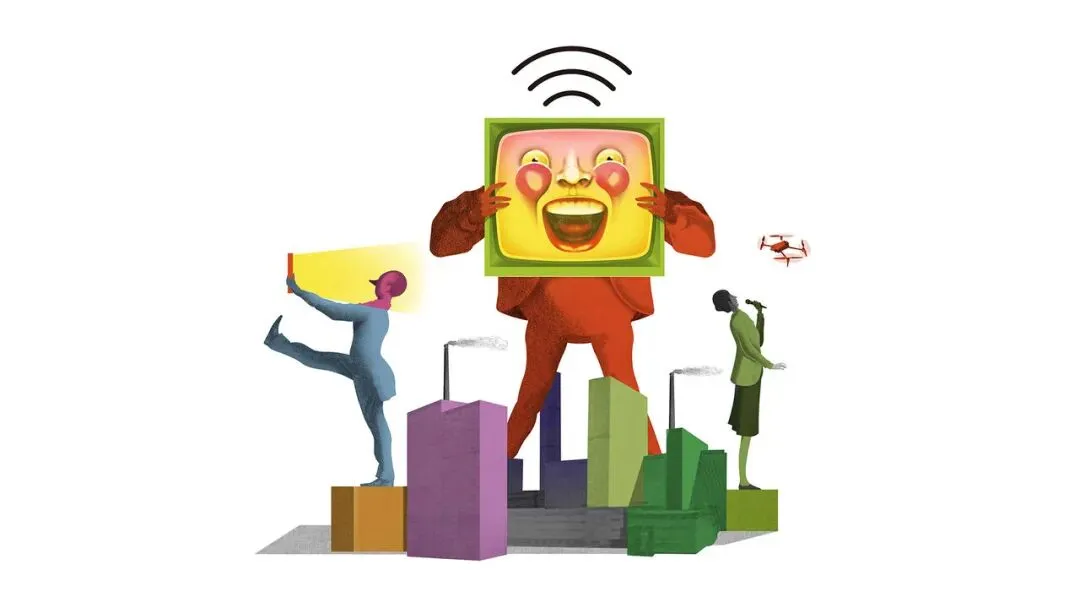
Every company is now a media company—and every boss a star
【Para.1】OpenAI has what the public-relations industry might call an image problem. The maker of ChatGPT must convince investors of its future profitability, and everyone else—the working, voting, rock-throwing public—of its humanity. Both are tricky. So tricky that Sam Altman, OpenAI’s boss, has decided that hiring ordinary corporate spin-doctors simply will not do.
【Para.2】Instead, he has bought a talk-show. According to the Financial Times, OpenAI paid in the “low hundreds of millions” of dollars for TBPN, a zany 18-month-old video-podcast presented by a pair of charming, besuited tech bros.
【Para.3】Mr Altman is hardly unique among America’s business elite, either in wanting to be on camera or to own the show. Gone are the days when chief executives limited their public declarations to acerbic remarks on earnings calls and the occasional quote for hacks who, after all, don’t really know what they’re talking about. Instead the modern boss subjects himself to hours of gentle cross-examination by his peers. The biggest shows, like those hosted by Joe Rogan or Lex Fridman, are Super Bowl events. Many more have small, passionate and mostly male audiences, like third-tier Serbian football fixtures.
【Para.4】The recent urge to print one’s own press seems to have grown out of Silicon Valley. David Sacks, an entrepreneur-turned-podcaster, co-hosts “All In”, a popular techie bro-fest. He is also a top adviser to the White House on AI: an illustration of the three-way merger of American business, celebrity and politics if there ever was one. Andreessen Horowitz, a giant venture firm whose founders have often criticised the way newspapers write about their industry, says it is building a media business. Less brash but even busier is Stripe, a payments company, which runs a publishing house, a print magazine and a show where one of its founders sinks pints of stout with the great and good of American business.
【Para.5】Now Silicon Valley’s media habits are spreading. Wall Street is very online in a way it wasn’t until very recently. Hedge-funders who laboured for decades in self-imposed anonymity now gab openly about their investment strategies on podcasts. One of the best is hosted by Nicolai Tangen, the boss of Norway’s sovereign-wealth fund. Jamie Dimon has talked about getting involved in the media business after he retires as boss of JPMorgan Chase.
【Para.6】Although the corporate content creator is most at home in capitalism’s swankiest offices, he can be found in some of its drabbest ones too. Deloitte, an accounting firm, produces dozens of podcasts. KPMG, a competitor, is just as prodigious. “I like a really decent notepad with nice thick paper,” said Claudia Winkleman, a television presenter, on a podcast about the stationery industry produced by Vodafone, a British telecoms provider. Even relative quietude on the part of bosses now feels quaint. What is the most important enterprise for which the public cannot, within seconds, marshal a video of its boss chatting? Jane Street, perhaps. But even that secretive trading firm has its own mostly unintelligible podcast about computer science.
【Para.7】As is so often the case, bosses are discovering anew something that existed before. The closest analogue is the corporate magazine, a 19th-century invention which reached its zenith in the 20th. As many as 400 were launched in 1937 alone, according to a history of public relations by Roland Marchand. Ronald Reagan became a confident promoter of capitalism while hosting a television show for GE in the 1950s. (Kurt Vonnegut had the opposite reaction while employed in the industrial giant’s publicity department. He left to write “Player Piano”, a novel in which automation renders human work obsolete.) This time, however, the brands of bosses often supplant those of their firms.
【Para.8】Another curious feature of this anarchic landscape is that a growing number of traditional outlets are owned by people who agree with many of the interlopers’ criticisms of legacy media. To Jeff Bezos, founder of Amazon and owner of the Washington Post, and David Ellison, son of the founder of Oracle and owner of just about everything in Hollywood, one might soon add Bill Ackman, a very-online hedge-funder who wants to buy Universal Music, the world’s biggest recording label.
【Para.9】Video killed the earnings-call star
The chatter-industrial complex may still be in its infancy. Yet it has already yielded results ranging from the brilliantly informative to the strikingly odd. There is much to be said for the expertise now available, often free, to anyone in the world. But if the purpose of tech bosses becoming talking heads was to persuade the public that they are in good hands, the opposite has sometimes happened. Peter Thiel’s obsession with the coming “antichrist” lurked for over a decade in his writing, for those who bothered to read it, before he started talking about it on podcasts. Another case is Marc Andreessen, eponymous founder of the venture firm, who has popularised the word “retardmaxxing”, a vague concept of not taking things too seriously. If that is the bounty of his freedom from the free press, it is a shallow victory indeed.
05 检验题
Read the following text carefully and answer the questions below by choosing A, B, C or D.
21. According to Paragraphs 1 and 2, Sam Altman's decision to buy a talk-show was motivated by
A. OpenAI's need to demonstrate its technological superiority over rival AI companies.
B. the difficulty of managing the company's public image through conventional public-relations methods.
C. pressure from investors who demanded more aggressive marketing strategies.
D. a desire to compete with traditional media outlets for audience share and advertising revenue.
22. Which of the following can be inferred about the various corporate media initiatives described in the text?
A. All corporate media ventures share a common strategy of directly attacking and undermining the credibility of traditional journalism.
B. Andreessen Horowitz's media ambitions stem partly from dissatisfaction with how newspapers have portrayed their industry.
C. Wall Street firms adopted podcasting earlier than Silicon Valley companies, setting the trend that others followed.
D. Deloitte and KPMG's podcasting efforts are primarily motivated by regulatory compliance requirements.
23. What role does Paragraph 7 play in the overall argument of the text?
A. It demonstrates that corporate media has been entirely ineffective throughout history and should be abandoned.
B. It provides historical context showing the current trend has precedents, while identifying a crucial difference — that individual bosses now overshadow their companies in branding.
C. It argues that Ronald Reagan's media career proves corporate content creation always leads to political success.
D. It suggests that the 19th-century corporate magazine was a more effective tool for brand building than modern podcasts.
24. The author's discussion of the "chatter-industrial complex" in Paragraph 9 suggests that
A. tech bosses have successfully used their media platforms to build public trust and improve their image.
B. the availability of expert content for free has universally benefited the public with no significant downsides.
C. while the trend has produced some valuable content, it has also exposed the public to the personal eccentricities and troubling views of tech leaders.
D. traditional media outlets should be replaced entirely by corporate-owned media platforms, which are more transparent and informative.
25. The author's overall attitude toward the phenomenon of every company becoming a media company is best described as
A. wholly enthusiastic, celebrating the democratisation of expertise and the liberation of business leaders from media gatekeepers.
B. deeply alarmed, warning that corporate media will inevitably lead to the destruction of independent journalism.
C. cautiously critical, acknowledging certain benefits while highlighting the risks of unmediated executive communication.
D. completely indifferent, treating the trend as a trivial cultural fad with no meaningful consequences.
看更多单词注释,全文翻译,长难句解析,写作积累以及答疑服务;
扫码下方报名训练营获取👇👇👇



注:在线课程报名之后不接受退款,报名之前有疑问请先加助教微信(ttzhujiao888)查看例文免费试学和训练营介绍,考虑清楚再报名

