 夜雨聆风
夜雨聆风
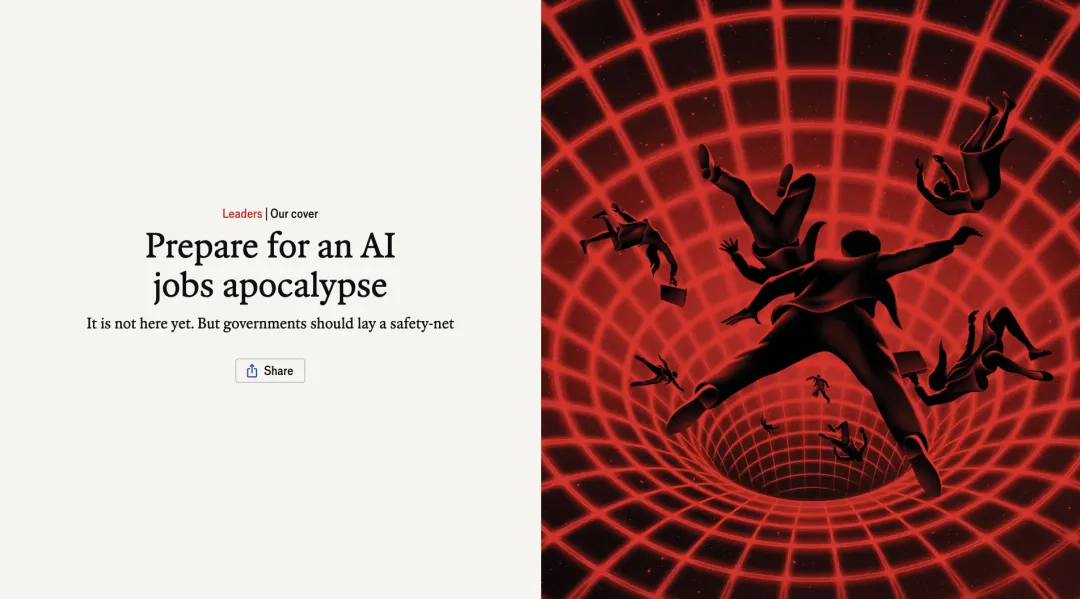
ChatGPT掀起的人工智能浪潮,正在重新塑造全球劳动力市场。从程序员岗位减少,到白领职业面临自动化冲击,「AI会不会夺走人类工作」已成为公众最深的焦虑之一。尽管大规模失业尚未真正出现,但AI技术的快速进化,已让各国政府不得不提前思考:如果未来财富越来越集中于资本与算法,人类应如何维持收入、安全感与社会稳定?《经济学人》这期封面文章指出,与其等到「就业末日」真正降临,不如现在就开始建立新的社会安全网。
Prepare for an AI jobs apocalypse
It is not here yet. But governments should lay a safety-net
The launch of ChatGPT in 2022 ignited the artificial-intelligence boom—and elicited a chorus of warnings from AI bosses of an impending jobs apocalypse. Never mind that they have reason to talk up the disruptiveness of their products, or that rich-world employment is near all-time highs—the dark message has landed. Seven in ten Americans think AI will make it harder for people to find work; nearly a third fear for their own jobs. A dearth of openings for college graduates—especially computer programmers—amplifies the dread.
The past offers some solace for the anxious. Labour markets constantly change. Today’s offices would be unrecognisable to a worker from 50 years ago. Never in modern history has technological progress hurt the overall demand for human labour. Economic historians now play down the magnitude of “Engels’ pause”, the period during the Industrial Revolution in which working-class wages grew more slowly than the wider economy.
Yet history is not always a good guide to the future, as the Industrial Revolution itself showed. The top AI models are awesome. They can tackle much more complex coding tasks than people were predicting a year ago. The number of AI agents has exploded. Spending on AI by businesses is up dramatically. Annualised recurring revenue of Anthropic, a hot model-maker, is set to reach $50bn by the end of June. There is no evidence yet in the labour-market data of AI destroying many jobs. But given how fast it is improving, it would be rash to dismiss fears that it will. Society may be on the verge of a profound reallocation of resources, and political upheaval.
Economists’ prediction that work will stay plentiful is less reassuring than it looks, especially over a long horizon. Though the market will find uses for human labour even as models and robots become more capable, the quality of those jobs and the wages they pay are not guaranteed. Data centres will account for 8.5% of America’s peak power demand in 2027, up from 4.1% in 2025, predicts Goldman Sachs, a bank. As AI firms bid up the price of land and energy, the dollars people earn will go less far. Eventually humans could, like horses in the age of the car, become uneconomical. Income may go mostly or entirely to owners of capital, who then go on to spend it on things that are made by AI and robots using natural resources that they monopolise.
This dystopian possibility is behind Silicon Valley’s admonitions that state intervention, and perhaps a universal basic income, will be necessary. That remains a long way off, if it ever happens. But governments may have to act sooner, for you do not need a cataclysm to stoke popular fury. Perhaps 2m Americans lost their jobs between 1999 and 2011. That is no worse than a typical month’s lay-offs in America’s churning labour market.
The white-collar employees threatened by AI have more political and social clout than factory workers. Even a small number of lay-offs could provoke a backlash against the technology; furious opposition to new data centres is a hint of what may be to come. Severe disruption to the security and status of many people could lead to widespread unrest, even revolution.
What should governments do? One set of ideas involves slowing down change.Prominent economists around the world have proposed higher taxes on capital and lower ones on labour. Some campaigners want levies on data centres. Inhibiting technology is not, however, a wise path to choose. Humanity is likely to reap enormous benefits from AI: not just greater wealth, but progress fighting diseases and solving problems such as climate change and poverty. Had the Luddites stopped the automation of textile mills in early 19th-century England, the world would be far worse off today.
A second category of countermeasures would be better. If employment falls, income that once went to workers is likely to show up as high profits in AI firms, chipmakers, data centres or elsewhere in the supply chain. Clever tax reforms, such as levies on corporate profits that are above a normal return on capital, on land and on natural resources, could capture these rents. The case for inheritance taxes to prevent the entrenchment of a capital-owning elite looks even stronger than before.
At the same time governments could help workers adjust. Public wage-insurance, which smooths out falls in income after job losses, can help workers find better opportunities (and so can eventually pay for itself). Denmark’s active labour-market policies, in which the state helps people find and train for new occupations, have been proved to cut spells in unemployment.
These ideas would make the economy more efficient and fairer regardless of AI. Would they satisfy voters facing disruption and uncertainty? In a populist era technocratic reforms are a hard sell. In an all-AI workforce, humans will need help surviving, not adjusting.
Hence a last set of radical ideas, such as the partial nationalisation of AI firms. This week a South Korean presidential adviser floated a citizens’ “dividend” from AI businesses, sending the local stockmarket down by 5%, before backtracking. In America politicians murmur about giving citizens shares in AI companies via “Trump accounts”. In economic terms there is little difference between a well-designed tax system and a government stake in the private sector—and countries without AI giants will have to rely on taxes rather than seizing shares in foreign companies. But America may find that some public ownership is the best way to make the social upside from the technology transparent.
Concentrations of rent must be confronted early, before the power of rentiers is too great. The jobs apocalypse is not yet here. But if governments wait for conclusive evidence before creating a safety-net, it will be too late. Better to start now. ■
Source:
https://www.economist.com/leaders/2026/05/14/prepare-for-an-ai-jobs-apocalypse