 夜雨聆风
夜雨聆风AI native service companies are changing how founders think about artificial intelligence. Over the last few years, many AI startup ideas have started with software. A tool, a plugin, a copilot, or a platform that helps employees work faster. But the larger shift may not be inside software itself. It may be inside service industries that were historically powered by human labor. Tax, audit, insurance, law, mortgages, healthcare operations, and logistics coordination are not simply waiting for smarter tools. They need someone to deliver completed outcomes. AI native service companies are built around that point. They do not sell AI for customers to use. They put AI inside their own operating system and sell the finished result.
这类公司的核心变化是交付方式。传统软件公司通常卖席位、卖使用量、卖功能。客户购买之后,还要自己组织员工学习、使用、配置、判断和执行。AI 原生服务公司卖的不是工具,而是结果。客户不需要关心背后用了多少模型、多少提示词、多少自动化流程,也不需要重新训练自己的团队。客户关心的是税表是否准确提交,保险索赔是否高效处理,法律文件是否可靠完成,贷款审核是否按时推进。换句话说,这类公司的产品不是屏幕上的界面,而是一套能稳定产出结果的运营机器。
The central change is the delivery model. A traditional software company usually sells seats, usage, and features. After buying it, the customer still needs employees to learn, configure, judge, and execute. An AI native service company does not sell a tool. It sells an outcome. The customer does not need to know how many models, prompts, workflows, or automations were used behind the scenes. The customer cares whether the tax return was filed correctly, the insurance claim was processed efficiently, the legal document was completed reliably, or the mortgage review moved on schedule. In other words, the product is not the interface on the screen. The product is an operating machine that can repeatedly produce trusted results.
这也是为什么 AI 原生服务公司不能简单理解为软件公司的升级版。软件公司的理想状态是边际成本极低,更多客户使用同一套产品,收入增长快于成本增长。服务公司的现实则更复杂。每一项服务都有流程、例外、质量控制、人工判断和客户沟通。AI 原生服务公司的难点就在于,它必须同时像软件公司一样追求自动化杠杆,又像服务公司一样承担交付责任。它既要写代码,也要设计流程。既要理解模型能力,也要理解行业规范。既要提高速度,也要降低结果波动。
That is why AI native service companies should not be understood as a simple upgrade to software companies. The ideal software company has extremely low marginal cost. More customers use the same product, and revenue grows faster than cost. The reality of service companies is more complex. Every service contains workflows, exceptions, quality control, human judgment, and customer communication. The difficulty for AI native service companies is that they must pursue software style automation leverage while also accepting service style delivery responsibility. They must write code and design processes. They must understand model capability and industry rules. They must increase speed and reduce variance.
择市场时,创业者不能只看市场规模。一个行业很大,并不意味着适合 AI 原生服务公司进入。更关键的是客户是否已经习惯外包,是否更关心最终结果而不是执行方式。如果客户原本就会把工作交给律师、会计师、保险服务商、合规顾问或运营外包团队,那么新公司并不是要求客户改变行为,而是替换一个已有供应商。这一点很重要。很多创业失败并不是因为技术不好,而是因为客户需要改变预算、流程和习惯。AI 原生服务公司最好进入那些预算已经存在、痛点已经明确、客户愿意为结果付费的市场。
When choosing a market, founders should not look only at market size. A large industry is not automatically a good fit for an AI native service company. The more important question is whether customers are already comfortable outsourcing the work and whether they care more about the final result than the method of execution. If customers already give work to lawyers, accountants, insurance service providers, compliance consultants, or operations outsourcing teams, the new company is not asking them to change behavior. It is replacing an existing vendor. This matters. Many startups do not fail because the technology is weak. They fail because customers must change budgets, processes, and habits. The best markets for AI native service companies already have budget, pain, and willingness to pay for outcomes.
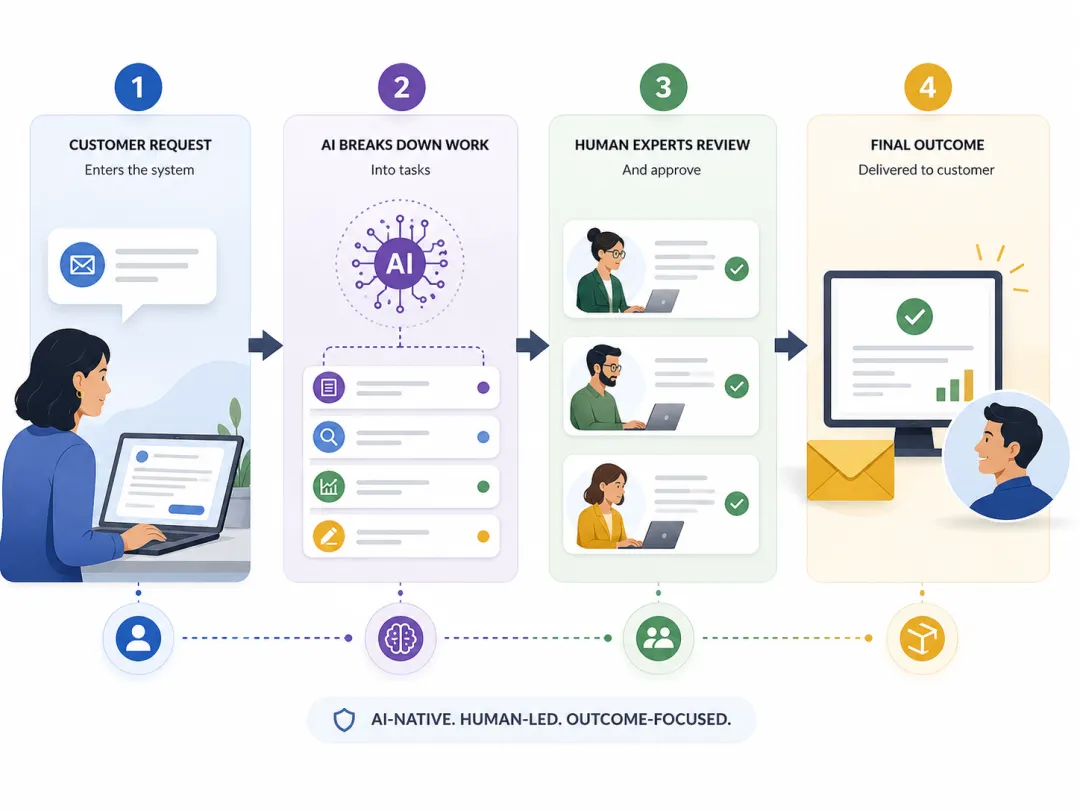
另一个关键判断是任务层面的判断密度。如果每一步都需要资深人员做复杂判断,AI 很难形成足够的杠杆。好的市场通常可以把工作拆成许多步骤,其中大部分步骤可以被模型、规则、检索、工作流和自动化系统处理,少数关键节点由人类专家把关。这样,人不是被完全替代,而是被放到更高价值的位置。人类专家不再重复处理低价值材料,而是负责异常判断、风险确认、客户沟通和最终质量责任。AI 的价值不是让人消失,而是让一个专业团队能处理过去数倍的工作量。
Another key test is judgment density at the task level. If every step requires complex judgment from a senior professional, AI will struggle to create enough leverage. A good market can usually be broken into many steps. Most of those steps can be handled by models, rules, retrieval systems, workflows, and automation. A smaller number of critical points are reviewed by human experts. In this structure, humans are not simply removed. They are moved into higher value positions. Human experts no longer repeat low value document handling. They focus on exceptions, risk confirmation, customer communication, and final quality responsibility. The value of AI is not that humans disappear. The value is that one professional team can handle several times more work than before.
这类公司也很适合进入高门槛行业。表面上看,监管、许可、责任和合规要求会增加创业难度。但在某些市场里,这些要求反而会形成护城河。低门槛工具容易被复制,单纯的自动化脚本也容易被替代。真正难的,是在一个高责任行业中建立稳定、可审计、可解释、可复核的交付体系。客户不只是在买速度,也是在买可信度。特别是在税务、审计、法律、医疗和保险等领域,速度必须和准确性、责任边界、合规记录一起出现,才有商业价值。
These companies can also be strong in high threshold industries. On the surface, regulation, licensing, liability, and compliance make entrepreneurship harder. In some markets, however, these requirements become a moat. Low threshold tools are easy to copy. Simple automation scripts are easy to replace. The hard part is building a stable, auditable, explainable, and reviewable delivery system inside an industry with real responsibility. Customers are not only buying speed. They are buying trust. In tax, audit, law, healthcare, and insurance, speed has commercial value only when it comes with accuracy, liability boundaries, compliance records, and review discipline.
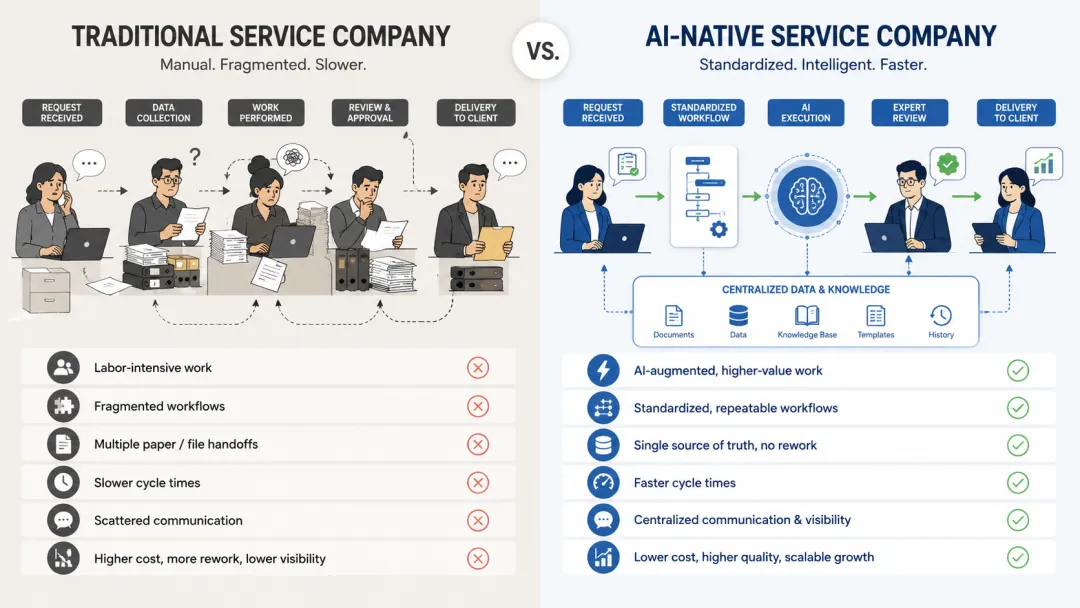
团队配置决定了公司能否真正跑起来。AI 原生服务公司需要三种能力同时存在。第一是行业理解。创始人必须知道客户为什么付费,风险在哪里,常见例外是什么,行业语言怎么说,客户真正害怕什么。第二是模型理解。团队要知道模型现在能做什么,不能做什么,未来能力提升后哪些流程可以被重构。第三是运营能力。很多技术创始人低估了这一点。服务公司的产品不是一个孤立功能,而是吞吐量、周期时间、质量控制、人员排班、任务分配和异常处理共同组成的系统。不会运营,就很难把 AI 变成稳定收入。
Team composition determines whether the company can actually operate. An AI native service company needs three capabilities at the same time. The first is domain fluency. Founders must know why customers pay, where the risks are, what exceptions appear repeatedly, how the industry speaks, and what customers truly fear. The second is model fluency. The team must know what models can do today, what they cannot do, and which workflows can be rebuilt as model capability improves. The third is operational rigor. Many technical founders underestimate this. The product of a service company is not an isolated feature. It is a system made of throughput, cycle time, quality control, staffing, task allocation, and exception handling. Without operational ability, AI will not easily become stable revenue.
产品建设也要换一种思路。传统软件通常从用户界面开始,问客户想点击什么、查看什么、配置什么。AI 原生服务公司往往相反。客户面前的人类服务者仍然是界面,真正的产品藏在内部。产品帮助服务人员把工作拆开、排序、检查、复用和自动化。它可能不是给客户每天登录的仪表盘,而是让内部团队更快完成任务的系统。判断一个功能是否重要,不是看它是否炫目,而是看它是否减少瓶颈,是否降低错误率,是否缩短交付周期,是否让同一个人处理更多高质量工作。
Product building also requires a different mental model. Traditional software often starts with the user interface. What does the customer want to click, view, configure, or manage. AI native service companies often work in the opposite direction. The human service provider may still be the customer facing interface, while the real product sits internally. The product helps service workers break down, sequence, check, reuse, and automate work. It may not be a dashboard that customers log into every day. It may be the internal system that lets the team finish work faster. A feature matters not because it looks impressive, but because it removes a bottleneck, reduces error, shortens delivery time, or allows the same person to complete more high quality work.
这里最危险的问题是结果波动。客户通常可以接受一家服务商稍微慢一点,也可以接受价格比预期高一点,但很难接受结果忽好忽坏。一次文件正确,一次文件错误。一次回复清楚,一次回复混乱。一次流程准时,一次流程失控。这种波动会迅速摧毁信任。AI 原生服务公司必须把一致性当成核心产品指标。它需要标准操作流程、复核机制、异常升级、数据记录和质量抽检。模型能力越强,越不能忽略管理系统。因为规模扩大之后,小波动会被放大成大风险。
The most dangerous issue is variance. Customers can often tolerate a service provider being slightly slower. They can sometimes tolerate a higher price than expected. But they rarely tolerate inconsistent outcomes. One file is correct, another is wrong. One reply is clear, another is confused. One process is on time, another loses control. This kind of variance destroys trust quickly. AI native service companies must treat consistency as a core product metric. They need standard operating procedures, review mechanisms, exception escalation, data records, and quality sampling. The stronger the model becomes, the more important the management system becomes. Once the company scales, small variance can become large risk.
销售方式也会变化。AI 原生服务公司不能像普通 SaaS 那样只强调功能列表。客户买的是结果,所以销售语言也应该围绕结果。比如缩短处理周期、提高完成率、降低返工率、提升合规可见性、让客户不用扩招也能处理更多工作。早期试点客户不能太多。很多创业者一开始容易陷入需求陷阱。市场对 AI 很好奇,客户愿意试,但如果公司签下太多试点,就会被交付压力拖住,无法真正建设可扩展系统。早期应该少量试点,深度学习,快速固化流程,再逐步扩大。
Sales also change. An AI native service company cannot sell like a standard SaaS company by emphasizing a feature list. Customers are buying outcomes, so the sales language should focus on outcomes. Shorter processing cycles, higher completion rates, lower rework, better compliance visibility, and more work handled without additional hiring. Early pilots should not be too numerous. Many founders fall into the demand trap. The market is curious about AI, and customers are willing to test it. But if the company signs too many pilots, delivery pressure consumes the team and prevents it from building a scalable system. Early pilots should be limited, deep, and carefully used to turn learning into repeatable processes.
定价同样不能照搬软件逻辑。按席位收费不一定适合,因为客户并不是在买一个工具给员工使用。更自然的方式可能是按单位结果收费,比如每份申报、每个索赔、每笔贷款、每个项目。也可以按完成结果收费,让客户把价格和价值直接对应起来。需要避免的是成本加成定价。按照人工成本加一点利润来报价,会永久限制公司的上限。AI 原生服务公司的优势来自运营杠杆。如果流程越成熟,单位成本越低,公司就应该分享这部分效率提升带来的价值,而不是只把自己定价成便宜外包。
Pricing cannot simply copy software logic either. Seat based pricing may not fit because the customer is not buying a tool for employees to use. A more natural model may be unit based pricing. Per return, per claim, per loan, or per project. Another option is completion based pricing, which ties price directly to delivered value. The model to avoid is cost plus pricing. If the company prices by adding a small margin on top of labor cost, it permanently limits its upside. The advantage of an AI native service company comes from operating leverage. If better processes reduce unit cost over time, the company should capture part of that efficiency gain instead of pricing itself as cheaper outsourcing.
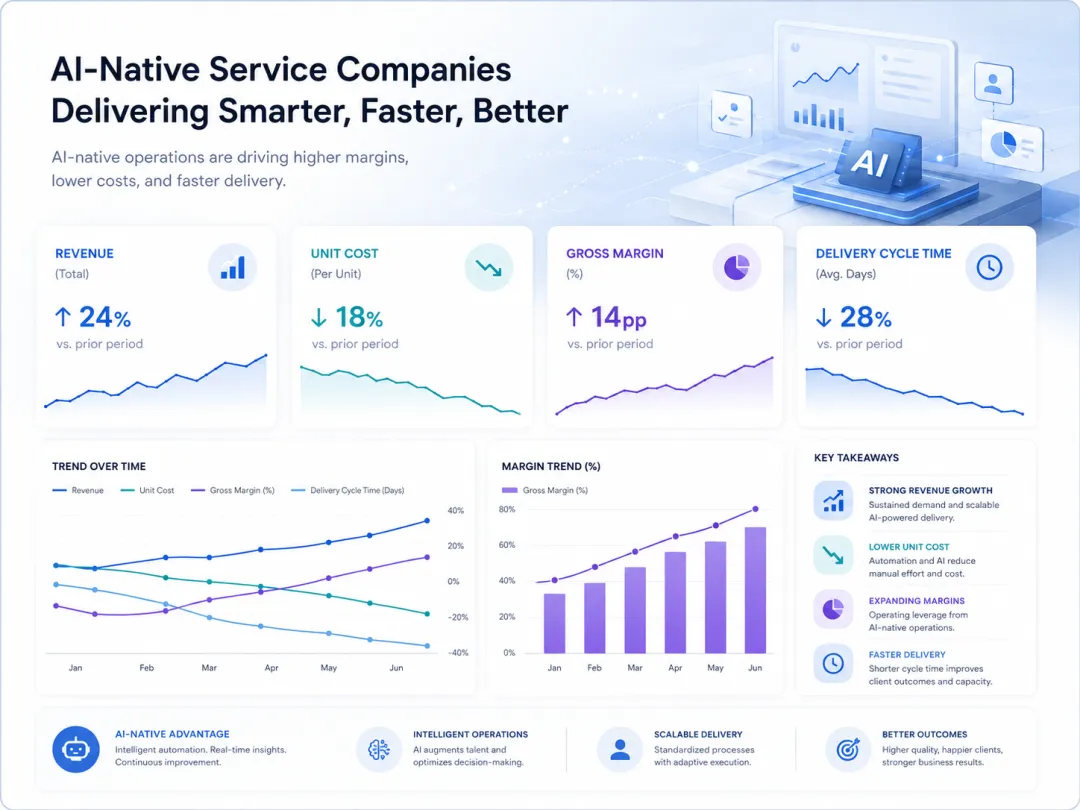
损益表是这类公司的真相。收入增长当然重要,但更重要的是毛利率趋势。成本结构通常包括模型成本、云服务成本和人类专家成本。早期为了学习,可以接受一些低毛利项目,但不能长期沉迷于零利润试点。真正健康的曲线应该是,随着产品和流程成熟,交付同样结果所需要的人工时间下降,错误率下降,返工减少,单位成本下降。这样公司才会接近软件公司的利润结构,而不是停留在传统服务公司的劳动密集模式里。
The profit and loss statement is where the truth appears. Revenue growth matters, but the gross margin trend matters even more. The cost structure usually includes model cost, cloud cost, and human expert cost. In the early stage, some low margin projects may be acceptable for learning, but the company cannot become addicted to zero profit pilots. The healthy curve is clear. As the product and process mature, the human time required to deliver the same outcome should fall, error rates should fall, rework should fall, and unit cost should fall. Only then can the company move toward a software style margin structure instead of remaining a labor intensive traditional service firm.
这也解释了为什么收购一家传统服务公司再加 AI,通常不是捷径。看起来,收购能立刻获得客户、收入、团队和行业许可。但传统服务公司的文化、流程、成本意识、客户预期和绩效标准,往往都围绕旧模式建立。把 AI 放在旧流程上,不等于得到一家 AI 原生公司。真正重要的是从第一天就围绕 AI 和流程重构来设计组织。哪些任务自动化,哪些任务复核,哪些指标每天跟踪,哪些人员结构能随着系统升级而变化。这些东西很难通过收购直接买到。
This also explains why buying a traditional service firm and adding AI is usually not a shortcut. On the surface, an acquisition can immediately provide customers, revenue, staff, and industry licenses. But the culture, workflows, cost discipline, customer expectations, and performance standards of traditional service firms are usually built around the old model. Putting AI on top of an old process does not create an AI native company. The more important work is designing the organization from day one around AI and workflow reconstruction. Which tasks are automated, which tasks are reviewed, which metrics are tracked daily, and which staffing structures can evolve as the system improves. These things are hard to buy through acquisition.
最终,AI 原生服务公司的本质不是把服务行业包装成科技故事,而是重新定义服务行业的生产方式。它把模型能力、行业知识、流程设计、人类判断和财务纪律放在同一张桌子上。它的目标不是做一个让客户多点几下的工具,而是成为客户愿意信任的结果供应商。未来十年,一些重要公司可能不会看起来像传统软件公司。它们可能更像现代化的保险机构、合规顾问、法律服务商、审计团队或医疗运营公司。不同的是,它们的内部不是靠人海战术扩张,而是靠 AI 驱动的运营系统扩张。
Ultimately, the essence of an AI native service company is not packaging service industries into a technology story. It is redefining how service work is produced. It brings model capability, domain knowledge, process design, human judgment, and financial discipline onto the same table. Its goal is not to create another tool that makes customers click more. Its goal is to become an outcome provider that customers trust. Over the next decade, some important companies may not look like traditional software companies. They may look like modern insurance operators, compliance advisors, legal service providers, audit teams, or healthcare operations companies. The difference is that they will not scale through headcount alone. They will scale through AI driven operating systems.
对创业者来说,真正的问题不是能不能把 AI 接入某个行业,而是能不能把一个行业的工作重新拆解、重新组织、重新交付。如果只是做一个工具,客户仍然要自己承担执行成本。如果能直接交付结果,公司就进入了更大的价值层。AI 原生服务公司的机会就在这里。它不是用 AI 替代所有人,也不是用软件覆盖所有流程,而是在复杂服务行业里,建立一种速度更快、质量更稳定、成本曲线更好的新型组织。
For founders, the real question is not whether AI can be connected to an industry. The real question is whether the work of that industry can be decomposed, reorganized, and delivered in a new way. If the company only builds a tool, the customer still carries the execution burden. If the company can deliver the result directly, it moves into a larger value layer. That is where the opportunity of AI native service companies sits. It is not about replacing every human. It is not about covering every workflow with software. It is about building a new kind of organization inside complex service industries, with faster delivery, more consistent quality, and a better cost curve.