夜雨聆风
夜雨聆风READING PASSAGE 1
You should spend about 20 minutes on Questions 1-13, which are based on Reading Passage 1 on pages 2 and 3.
Buried Cities of the Amazon Rainforest
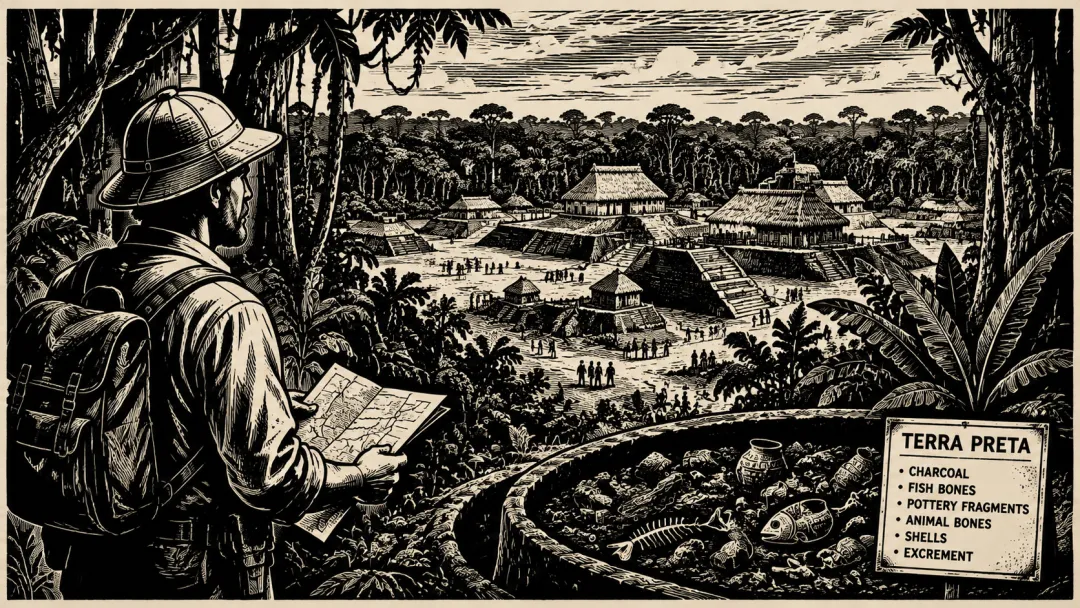
A In a letter to his wife sent on 29 May 1925, Percy Fawcett, an English adventurer, reported that he was about to depart without the assistance of guides on an expedition into previously unexplored areas of the Amazon rainforest in central Brazil. His goal was to find a hidden city that he referred to as 'Z'. It was Fawcett's last contact with the outside world - he disappeared without a trace - and how he died is still unknown.
B Now, more than 80 years later, anthropologist Michael Heckenberger of the University of Florida in the US and his team, in collaboration with local indigenous people called the Kuikuro, Brazilian scholars, and a group of archaeologists, have discovered the remains of 28 settlements in the Upper Xingu region of the Amazon rainforest in Brazil's Mato Grosso state, the same area where Fawcett disappeared. Fawcett may not have been right about the existence of a city, but the recent discovery of these settlements is helping to overturn the long-held theory that the Amazon rainforest is unsuited to human habitation.
C The Amazon rainforest is home to the world's richest plant and animal communities. But paradoxically, the soils here are highly acidic and contain few nutrients. About 10 per cent of the rainforest's nutrients can be found in the soil; the rest are bound up in plants and animals. Only plants that are perfectly adapted to draw their nutrients from decaying plants and animals can survive in the reddish or yellowish earth that dominates this area.
D But researchers have discovered that some parts of the rainforest contain plots of a man-made miracle soil, known as terra preta (literally "black earth" in Portuguese), which contains elevated levels of nutrients and organic matter perfect for agriculture in areas otherwise unsuitable for it. This soil - a result of refuse piles usually including charcoal, fish bones, pottery fragments, animal bones, shells and excrement - may have provided food for tens of thousands of inhabitants and allowed for the development of large towns and villages.
E This fertile soil is as deep as two metres in fields sometimes as large as 200,000 square metres. Researchers estimate that as much as one per cent of the Amazon rainforest is covered with it. The fertile pockets are concentrated near riverbanks, and the present-day inhabitants of the rainforest are still making use of them. In addition, they are much more productive than other soils. One of the many miracles of terra preta is that it does not become depleted, but retains its fertility for many years.
F Most of the plots are between 500 and 2,500 years old, and some researchers suspect that inhabitants of the area created and spread the rich soil intentionally. They theorise that, by exploiting terra preta's extreme fertility, natives were able to put their previous existence as nomads behind them. Instead, they settled in villages, surrounding themselves with orchards providing fruit and fields providing cereals sufficient to feed a large population.
G Eduardo Neves, an archaeologist at the University of São Paulo in Brazil, has been studying these vanished cultures for 17 years, and from his discoveries in the Amazon rainforest, he is convinced that the rainforest was relatively densely populated between 500 and 1,000 years ago. He suggests that at least five to six million people may have lived in the rainforest during that period.
题目:
Questions 1-6
Do the following statements agree with the information given in Reading Passage 1?
In boxes 1-6 on your answer sheet, write
TRUEif the statement agrees with the information
FALSEif the statement contradicts the information
NOT GIVENif there is no information on this
1 The English adventurer Percy Fawcett ignored advice from local guides.................
2 There is now evidence that people lived in settlements in the region where Fawcett went missing.................
3 In the Amazonian rainforest the reddish or yellowish soil contains a considerable proportion of nutrients.................
4 Terra preta is a type of soil that occurs naturally in the Amazonian rainforest.................
5 Terra preta is mostly found close to flowing water.................
6 In recent years, the current inhabitants of the Amazonian rainforest have stopped farming the terra preta soil.................
Questions 7-13
Complete the notes below.
Choose ONE WORD AND/OR A NUMBER from the passage for each answer.
Write your answer in boxes 7-13 on your answer sheet.
Amazonian rainforest study
Agricultural evidence for early human settlements
·terra preta found in region
·terra preta
- is made from human refuse
- its 7............................. lasts a long time