ARTICLE · 944600
外刊真题题源泛读13:植树或加剧纽约空气污染(C篇题源2026年全国一卷高考)
往期链接
外刊真题题源泛读1:交通工具绿色化(A篇题源 2025全国一卷 )
外刊真题题源泛读2:居家绿植治愈风潮(A篇题源 2025 全国二卷 )
外刊真题题源泛读3:专职宠物运输师Merebeth的暖心公路之旅(A篇题源 2022年1月浙江首考全卷)
外刊真题题源泛读4:纸质阅读与数字阅读的学习效果差异(A篇题源 2024年新高考一卷)
外刊真题题源泛读5:永不言弃的人生一课(A篇题源 2021年6月浙江高考 )
外刊真题题源泛读6:场馆指南(A篇题源 2026年高考一卷)
外刊真题题源泛读7:纸质词典与语音查词(B篇题源 2026年高考一卷)
外刊真题题源泛读8:医院里的特殊教师Kathy Ho(B篇题源 2025年全国二卷)
外刊真题题源泛读10:解决食物浪费的良方--少丢弃,多回收(B篇题源 2022年6月新高考一卷)
外刊真题题源泛读11:《无所畏惧》-两位东部淑女的落基山支教岁月(B篇题源2022年全国乙卷)
外刊真题题源泛读12:想让孩子走出家门?远离平板屏幕的办法(B篇题源 2021年6月浙江高考真题)
酌情取舍,仅供参考
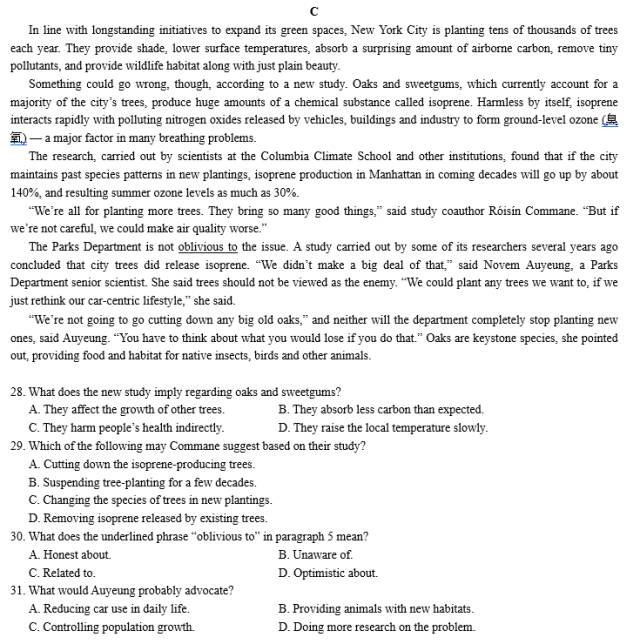
外刊真题题源泛读13:植树或加剧纽约空气污染(C篇题源2026年全国一卷高考真题)
私家英语
一、基础信息表
项目 | 详细内容 |
文章标题 | Planting Some Tree Species May Worsen, Not Improve, NYC Air, Says New Study |
来源 | 国外权威科学科普外刊(环境科学专题) |
体裁 | 科学研究说明文(高考C篇标准题型) |
话题 | 纽约城市植树现状、橡树/枫香树释放异戊二烯、树木污染物与机动车废气反应生成臭氧、空气污染成因、城市植树优化方案、生态利弊权衡 |
难度 | 高中中等偏难(全国一卷C篇阅读难度) |
词数 | 约920词 |
二、主要内容
纽约市常年大规模植树,用以降温、固碳、净化空气、美化城市生态。但最新科研研究颠覆传统认知:纽约占比最高的橡树、枫香树会大量释放异戊二烯,该物质本身无害,却能与机动车、建筑排放的氮氧化物发生反应,生成危害呼吸系统的地面臭氧,加剧夏季空气污染。
研究数据显示,若维持现有树种种植模式,曼哈顿异戊二烯排放量未来数十年将暴涨140%,夏季臭氧浓度升高30%,皇后区排放量甚至会翻四倍。文章阐释树木释放异戊二烯的生理原因,对比不同树种的排放差异,同时明确:臭氧污染的核心元凶是化石燃料燃烧产生的氮氧化物,树木只是催化因素。
目前纽约氮氧化物减排速度极其缓慢,短期内无法解决污染问题。纽约市政已调整植树策略,降低橡树种植比例、丰富树种多样性,规避单一虫害风险与污染隐患。同时强调橡树作为关键物种,生态价值极高,不会大规模砍伐,需通过优化出行方式、控排废气、多元植树实现生态平衡。
三、英文原文(920词)
Planting Some Tree Species May Worsen, Not Improve, NYC Air, Says New Study
New York is planting large numbers of trees in order to improve the city's livability. But emissions from some species interact with tailpipe and building pollutants to form smog.
In line with longstanding initiatives to expand its green spaces, New York City is planting tens of thousands of trees each year. They provide shade, lower surface temperatures by releasing moisture, absorb a surprising amount of airborne carbon, scrub out soot and other floating pollutants, and provide wildlife habitat along with just plain beauty. What could go wrong?
Actually, something could go wrong, according to a new study. Oaks and sweetgums, which currently account for a majority of the city’s trees, produce huge amounts of volatile compounds called isoprenes. Harmless by themselves, isoprenes interact rapidly with polluting nitrogen oxides emitted by vehicles, buildings and industry to form ground-level ozone―a prime factor in many respiratory ailments, especially chronic bronchitis and asthma.
The research, carried out by scientists at the Columbia Climate School’s Lamont-Doherty Earth Observatory and other institutions, found that if the city maintains past species patterns in new plantings, isoprene production in Manhattan in coming decades will go up by about 140%, and resulting summer ozone levels as much as 30%. In Queens, which has the most room of any borough for more trees, isoprene production could quadruple, with corresponding increases in peak ozone; the other boroughs are somewhere in between. The study was just published in the journal Environmental Science & Technology.
More than a fifth of New York City’s surface is covered with trees, and many more are being planted.
“We’re all for planting more trees. They bring so many good things,” said study coauthor Róisín Commane, an atmospheric chemist at Lamont-Doherty. “But if we’re not careful, we could make air quality worse.”
“There is no reason to think that trees don’t play a role in what’s in the air,” said lead author Dandan Wei, who did the research as a postdoctoral scientist at Lamont-Doherty. “We just didn’t have the tools before this to understand this particular aspect.”
The leaves of some tree species emit isoprene as a byproduct of photosynthesis, though no one is quite sure why. With oaks, emissions tend to increase exponentially with heat, at least until air temperatures reach the high 90s. Some scientists think this helps keep leaf tissues from drooping and losing their ability to photosynthesize as it gets hotter. Emissions of these and other volatile compounds by trees may also have something to do with attracting pollinating insects. For whatever reason, oaks and sweetgums are especially prolific; oaks emit some 800 times more isoprene than low emitters like maples or London planes.
New York City is home to some seven million trees, covering 22% of the surface, according to the city Parks Department, which controls planting and maintenance on public property. Parks and forests contain some five million, of which more than half are oaks of various kinds and sweetgums (37% and 17% respectively). On the streets, oaks comprise 18% and sweetgums just a small number. London planes are the most common street trees, comprising a third.
The authors of the new study carried out their research by analyzing newly available satellite imagery showing the city’s tree canopy in 30-by-30-meter grids, and combining it with 2016 and 2018 Parks Department censuses of tree species. They then fed in data from scientists who do lab experiments on tree leaves to measure their isoprene production under different conditions.
They found that emissions from trees play a controlling role in the formation of ozone on hot summer days, when levels routinely exceed the federal safety levels of 70 parts per billion. But isoprene from trees alone is not to blame. Ozone cannot form without one essential precursor chemical: nitrogen oxides, emitted during combustion of fossil fuels by vehicles, boilers and industry.
“If we lowered NOx significantly, trees wouldn’t be a problem,” said Wei. “We don’t want to convey the idea that trees pollute the air. It’s the cars.”
New York has made some headway at reducing nitrogen oxides in recent years, but the pace has been agonizingly slow. The study says that at current rates, it would take 30 to 80 years for the city to reduce emissions greatly.
Meanwhile, the City Council passed a 2023 resolution calling for an increase in tree-canopy coverage from its current 22% to at least 30% by 2035. The Parks Department has already reduced the proportion of oaks it plants in favor of a more diverse mix to avoid ecological risks.
Oak trees are tough and adaptive, providing food and habitat for native creatures, and they can thrive in hot and polluted urban environments, making them irreplaceable urban tree species.
四、生词中英文梳理
英文单词 / 短语 | 中文释义 |
livability n. | 宜居性 |
volatile adj. | 挥发性的 |
isoprene n. | 异戊二烯 |
nitrogen oxide | 氮氧化物 |
ground-level ozone | 地面臭氧 |
respiratory adj. | 呼吸的 |
ailment n. | 小病,不适 |
quadruple v. | 增至四倍 |
exponentially adv. | 成倍地,指数级地 |
photosynthesis n. | 光合作用 |
precursor n. | 前驱物,先导物质 |
combustion n. | 燃烧 |
agonizingly adv. | 极其缓慢地,令人煎熬地 |
canopy n. | 树冠 |
diverse adj. | 多样的 |
五、全文完整翻译
新研究:部分树种或恶化而非改善纽约空气质量
纽约市正大规模植树,旨在提升城市宜居性。但部分树种释放的物质会与尾气、建筑污染物结合,形成雾霾污染。
为推进城市绿地扩建的长期规划,纽约市每年种植数万棵树木。树木能够遮阴、释放水汽降低地表温度、吸收大量空气中的碳、清除烟尘与悬浮污染物,还能营造野生动物栖息地、美化城市环境。这看似百利无一害,然而一项最新研究发现了潜在隐患。
目前纽约市种植最多的橡树与枫香树,会释放大量挥发性化合物——异戊二烯。该物质本身无毒无害,但会快速与车辆、建筑、工业排放的氮氧化物发生反应,生成地面臭氧。臭氧是引发多种呼吸道疾病的主要诱因,尤其会加重慢性支气管炎与哮喘病症。
这项由哥伦比亚大学气候学院等机构科学家开展的研究表明:若纽约持续沿用现有树种种植模式,未来数十年曼哈顿的异戊二烯排放量将上涨约140%,夏季臭氧浓度最高提升30%。皇后区是纽约可供植树空间最大的行政区,其异戊二烯排放量或将翻四倍,臭氧峰值同步上升,其他各区污染增幅介于两者之间。该研究已发表于《环境科学与技术》期刊。
研究合著者、大气化学家罗辛·科曼表示,植树本身益处良多,但树种选择不当,反而会恶化空气质量。研究第一作者魏丹丹指出,此前缺乏科研手段,人们一直忽视了树木影响空气质量的这一特殊维度。
部分树种的叶片会在光合作用中释放异戊二烯,其具体机制尚未被完全探明。橡树的污染物释放量会随气温升高呈指数级增长,高温环境下该特性可保护叶片组织,维持光合作用能力,同时也可能用于吸引传粉昆虫。橡树、枫香树的排放能力极强,其异戊二烯释放量是枫树、伦敦悬铃木等低排放树种的800倍左右。
纽约市现有约700万棵树木,覆盖全市22%的地表面积,其中公园林地的树木超半数为橡树和枫香树。市政部门负责城市树木的种植与养护,近年已调整策略,减少橡树种植比例,丰富树种结构,规避单一树种带来的生态风险。
科研团队通过分析卫星树冠影像、市政树种普查数据,结合实验室树叶排放实验数据,模拟出树木与城市废气的反应机制。研究发现,盛夏高温天气中,树木排放物是臭氧形成的关键影响因素,时常导致臭氧浓度超出联邦安全标准。
研究强调,树木并非污染元凶,臭氧生成的必要前提是化石燃料燃烧产生的氮氧化物。只要大幅降低氮氧化物排放,树木的潜在负面影响便会消失,空气污染的核心根源是机动车与工业废气。
纽约近年虽在推进氮氧化物减排,但进度极其缓慢。按照当前减排速率,需要30至80年才能实现大幅减排目标。纽约市计划2035年将城市树冠覆盖率从22%提升至30%,新增25万棵树木。
市政部门表示不会砍伐成年橡树,也不会彻底停止种植。橡树是城市关键生态物种,耐高温、抗污染、适应性极强,能为本土动植物提供食物与栖息地,在气候变暖背景下拥有极强的生存优势,具备不可替代的生态价值。
六、语法填空
阅读下面短文,在空白处填入 1 个适当的单词或括号内单词的正确形式。
New York City plants tens of thousands of trees yearly 56.____ (improve) urban livability. However, certain tree species may make air quality 57.____ (bad) instead of better. Oaks and sweetgums, 58.____ dominate the city’s green landscape, produce abundant isoprenes.
When heated, these compounds react with pollutants 59.____ (release) by vehicles to form ozone, a major threat to people’s 60.____ (respire) health. A recent study found that ozone levels 61.____ (rise) sharply in the coming decades if current planting patterns remain unchanged.
Isoprene alone is not responsible for air pollution, 62.____ nitrogen oxides are the essential cause. The city has made progress in emission reduction, yet the speed is 63.____ (extreme) slow.
Now the government is promoting 64.____ (diverse) tree species to avoid ecological risks. It is acknowledged that oaks are 65.____ (value) urban trees with unique ecological functions.
【答案】
56. to improve 57. worse 58. which 59. released 60. respiratory 61. will rise 62. while 63. extremely 64. diverse 65. valuable
逐题详细解析
56. to improve 【考点:不定式(有提示词)】
句意:纽约市每年种植数万棵树木,旨在提升城市宜居性。解析:不定式作目的状语,表植树的初衷。
57. worse 【考点:形容词比较级(有提示词)】
句意:但部分树种反而会让空气质量变差。解析:根据后文better可知用比较级,bad的比较级为worse。
58. which 【考点:非限制性定语从句(无提示词)】
句意:主导城市绿化景观的橡树和枫香树,会产生大量异戊二烯。解析:逗号后非限定从句,先行词为树种,指代事物用which。
59. released 【考点:过去分词(有提示词)】
句意:这些化合物会与车辆排放的污染物反应生成臭氧。解析:pollutants与release为被动关系,过去分词作后置定语。
60. respiratory 【考点:名词变形容词(有提示词)】
句意:臭氧严重威胁人们的呼吸健康。解析:修饰名词health,需将名词respire转化为形容词respiratory。
61. will rise 【考点:一般将来时时态(有提示词)】
句意:研究发现,若维持现有种植模式,未来数十年臭氧浓度将大幅上升。解析:in the coming decades为将来时标志,用一般将来时。
62. while 【考点:让步状语从句(无提示词)】
句意:异戊二烯并非空气污染的元凶,而氮氧化物才是核心诱因。解析:while引导让步状语从句,表对比转折。
63. extremely 【考点:副词(有提示词)】
句意:纽约减排取得进展,但速度极其缓慢。解析:修饰形容词slow,形容词extreme转化为副词extremely。
64. diverse 【考点:名词变形容词(有提示词)】
句意:政府推广多样化树种,规避生态风险。解析:修饰名词tree species,名词diversity转化为形容词diverse。
65. valuable 【考点:形容词转化(有提示词)】
句意:公认橡树是具备独特生态功能的珍贵城市树种。解析:修饰名词trees,名词value转化为形容词valuable。
温馨提示:独家首发,版权所有。
独家首发,版权所有。如需引用,请标注出处。
欢迎各位有志之士投稿,共建优质交流平台。
投稿邮箱:carries4182925@126.com
视频音频请在此处下载。
本系列仅供个人参考学习,请勿挪作他用。
如需完整版请前往小程序(第一个二维码),搜索关键词下载。
下载 课件
课件


读后续写系列书籍


你点的在看,是对我们持续分享最大的支持!