 夜雨聆风
夜雨聆风学习主题:VERL 源码精读 03
理解 ppo_trainer.yaml、分组 yaml、dataclass config、命令行 override 和配置校验如何共同决定一次训练。
阅读目标:建立可复述、可定位、可调试的源码理解,不停留在 API 名称层面。
1. 本篇学习范围
理解 ppo_trainer.yaml、分组 yaml、dataclass config、命令行 override 和配置校验如何共同决定一次训练。
这一篇关注的不是“怎么把命令跑起来”,而是读清楚源码中每个对象为什么存在、它和前后模块如何传递数据,以及出问题时应该从哪里开始定位。
2. 源码入口文件
本篇建议按下面顺序阅读:
verl/trainer/config/ppo_trainer.yamlverl/trainer/config/algorithm.pyverl/trainer/config/config.pyverl/workers/config/actor.pyverl/workers/config/critic.pyverl/workers/config/rollout.pyverl/workers/config/engine.pyverl/base_config.py这些文件覆盖了本篇主题的主路径。阅读时不需要一开始就把所有分支展开,先抓主干,再回头看特殊配置、后端差异和异常处理。
3. 核心调用链
本篇主调用链可以压缩为:
`ppo_trainer.yaml` 用 defaults 列表组合 data、actor、critic、ref、reward、algorithm、trainer 等配置块。命令行 override 修改 OmegaConf 中的具体字段,例如 `algorithm.adv_estimator=grpo`。worker 配置在运行时通过 `omega_conf_to_dataclass()` 转成 `ActorConfig`、`CriticConfig`、`RolloutConfig` 等 dataclass。dataclass 的 `validate()` 负责检查 batch size、micro batch、dynamic bsz、GPU 数和策略后端是否匹配。trainer 根据配置决定是否创建 critic、reference policy、reward model 和不同 resource pool。这条链路是读源码时的地图。后续遇到新的类、函数或配置字段,都可以先判断它属于链路中的哪一段。
4. 核心概念
VERL 配置是源码行为的入口,不读配置就无法判断实际代码分支。 actor_rollout_ref是最核心的复合配置,里面同时包含 model、actor、rollout、ref。
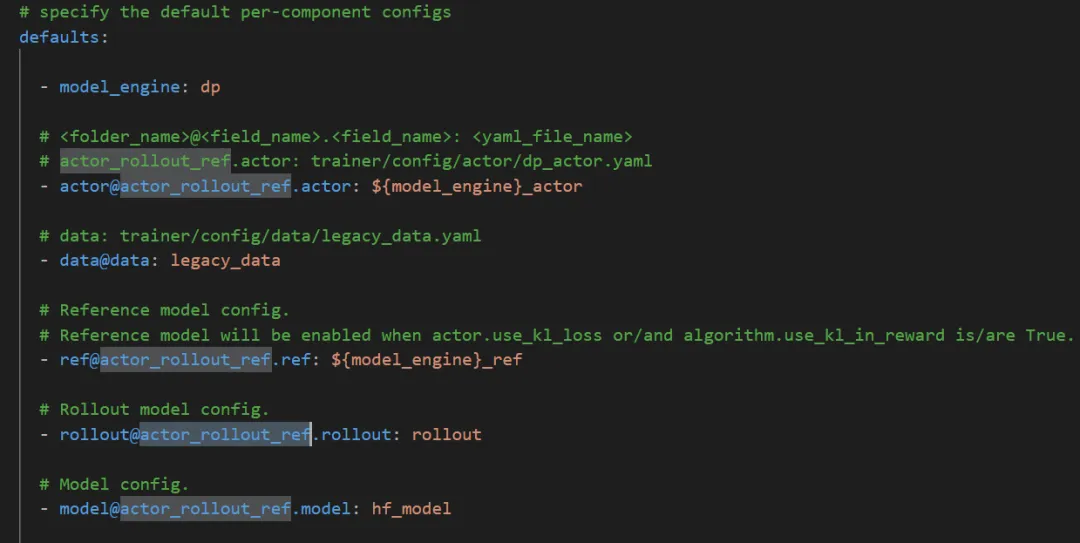
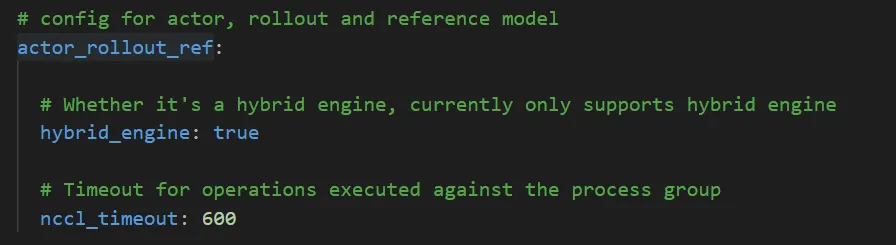
# specify the default per-component configsdefaults:- model_engine: dp# <folder_name>@<field_name>.<field_name>: <yaml_file_name># actor_rollout_ref.actor: trainer/config/actor/dp_actor.yaml- actor@actor_rollout_ref.actor: ${model_engine}_actor# data: trainer/config/data/legacy_data.yaml- data@data: legacy_data# Reference model config.# Reference model will be enabled when actor.use_kl_loss or/and algorithm.use_kl_in_reward is/are True.- ref@actor_rollout_ref.ref: ${model_engine}_ref# Rollout model config.- rollout@actor_rollout_ref.rollout: rollout# Model config.- model@actor_rollout_ref.model: hf_model# Critic model config.- critic@critic: ${model_engine}_critic- model@critic.model: hf_model# legacy reward impl config, for backward compatibility- legacy_reward_impl# Reward config.- reward@reward: reward# Rollout correction config.- algorithm@algorithm.rollout_correction: rollout_correction# distillation config- distillation@distillation: distillation# load the reference default config, then apply the fields in the current yaml# self config override anything above- _self_# config for actor, rollout and reference modelactor_rollout_ref:# Whether it's a hybrid engine, currently only supports hybrid enginehybrid_engine: true# Timeout for operations executed against the process groupnccl_timeout: 600
algorithm决定 advantage estimator、KL 位置、filter group、rollout correction 等算法行为。 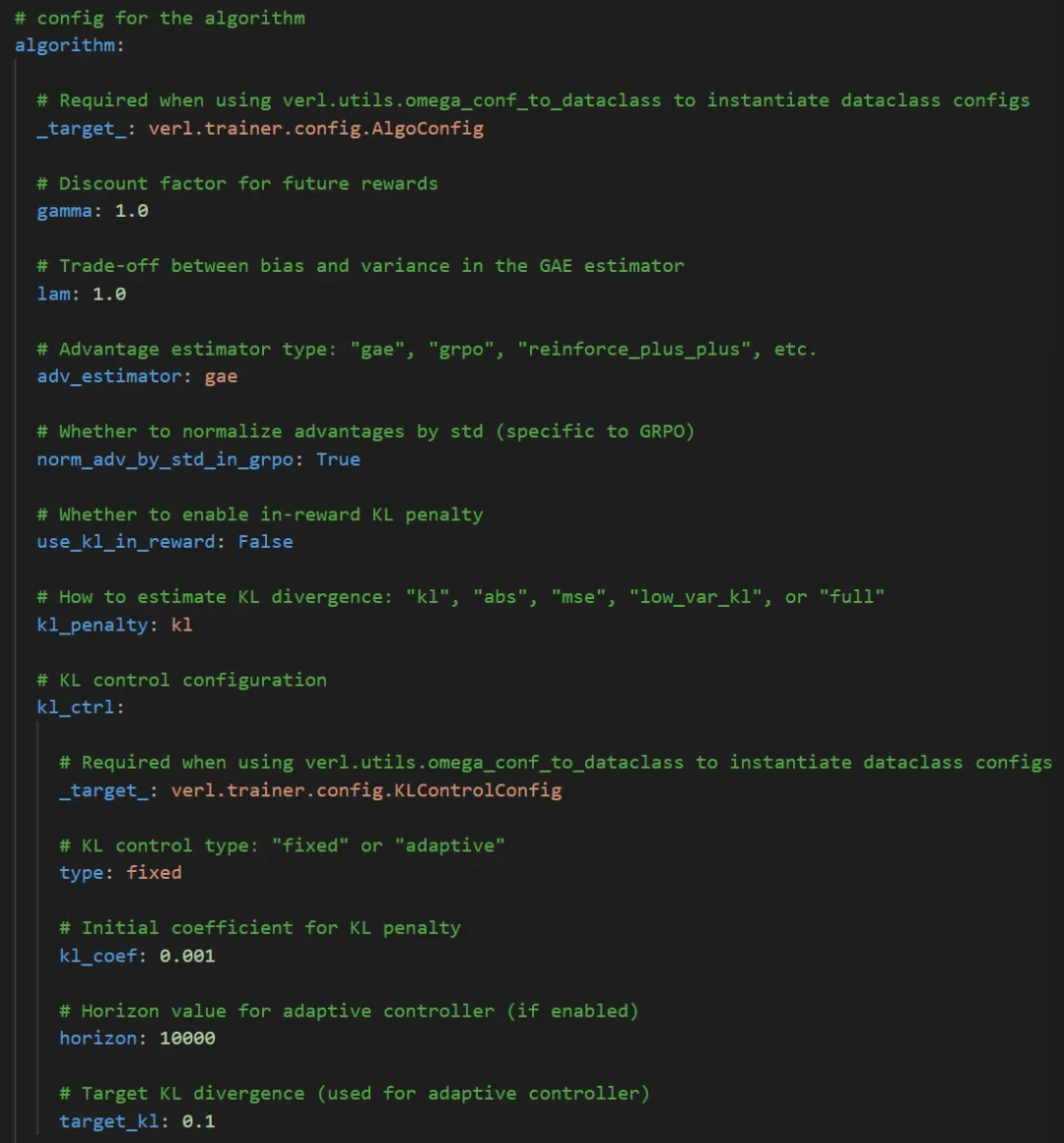
# config for the algorithmalgorithm:# Required when using verl.utils.omega_conf_to_dataclass to instantiate dataclass configs_target_: verl.trainer.config.AlgoConfig# Discount factor for future rewardsgamma: 1.0# Trade-off between bias and variance in the GAE estimatorlam: 1.0# Advantage estimator type: "gae", "grpo", "reinforce_plus_plus", etc.adv_estimator: gae# Whether to normalize advantages by std (specific to GRPO)norm_adv_by_std_in_grpo: True# Whether to enable in-reward KL penaltyuse_kl_in_reward: False# How to estimate KL divergence: "kl", "abs", "mse", "low_var_kl", or "full"kl_penalty: kl# KL control configurationkl_ctrl:# Required when using verl.utils.omega_conf_to_dataclass to instantiate dataclass configs_target_: verl.trainer.config.KLControlConfig# KL control type: "fixed" or "adaptive"type: fixed# Initial coefficient for KL penaltykl_coef: 0.001# Horizon value for adaptive controller (if enabled)horizon: 10000# Target KL divergence (used for adaptive controller)target_kl: 0.1# Whether to enable preference feedback PPOuse_pf_ppo: False# Preference feedback PPO settingspf_ppo:# Method for reweighting samples: "pow", "max_min", or "max_random"reweight_method: pow# Power used for weight scaling in "pow" methodweight_pow: 2.0
trainer决定训练步数、validation、checkpoint、logger、use_v1、资源规模。 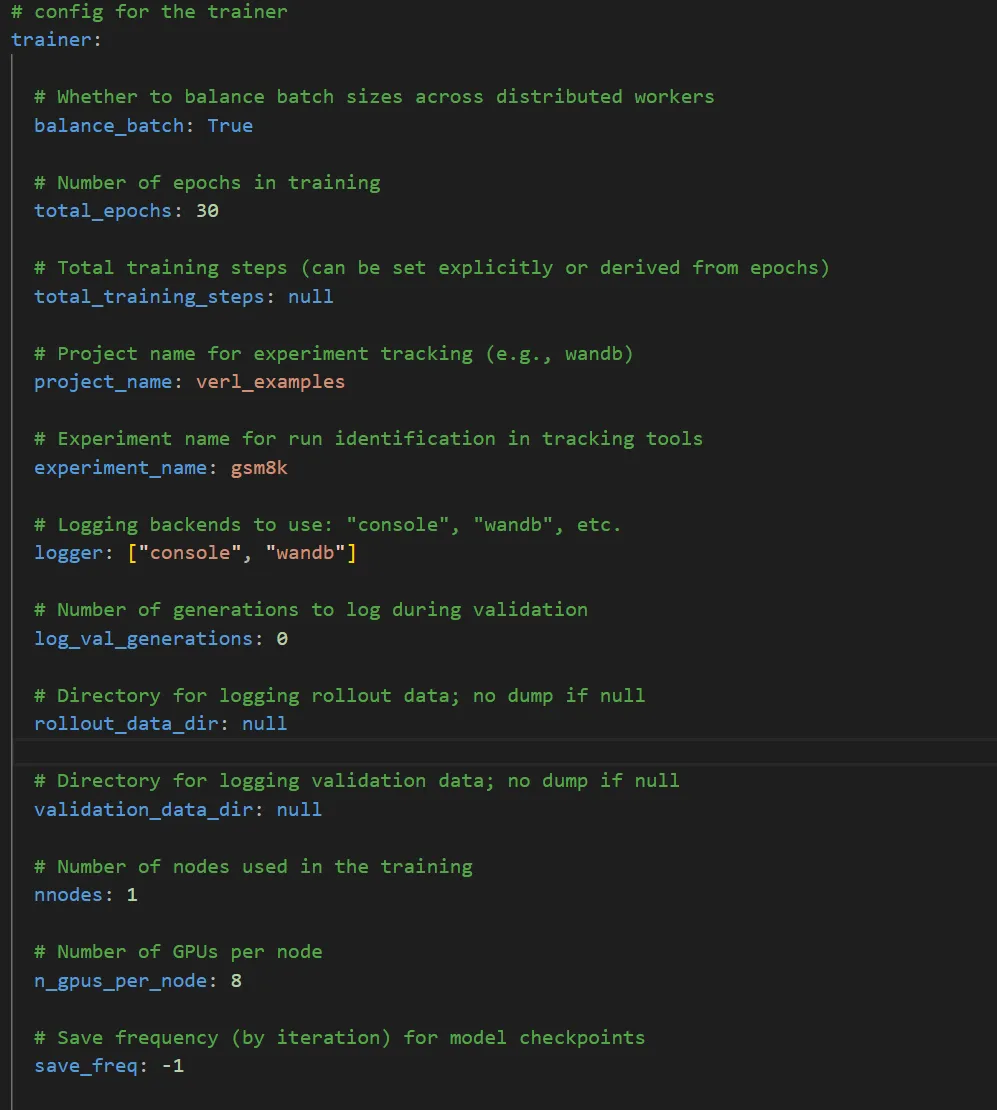
# config for the trainertrainer:# Whether to balance batch sizes across distributed workersbalance_batch: True# Number of epochs in trainingtotal_epochs: 30# Total training steps (can be set explicitly or derived from epochs)total_training_steps: null# Project name for experiment tracking (e.g., wandb)project_name: verl_examples# Experiment name for run identification in tracking toolsexperiment_name: gsm8k# Logging backends to use: "console", "wandb", etc.logger: ["console", "wandb"]# Number of generations to log during validationlog_val_generations: 0# Directory for logging rollout data; no dump if nullrollout_data_dir: null# Directory for logging validation data; no dump if nullvalidation_data_dir: null# Number of nodes used in the trainingnnodes: 1# Number of GPUs per noden_gpus_per_node: 8# Save frequency (by iteration) for model checkpointssave_freq: -1# ESI refers to the elastic server instance used during training, similar to the training plan. For example,# if you purchase 10 hours of computing power, the ESI will automatically shut down after 10 hours of training.# To ensure a checkpoint is saved before ESI shuts down, the system will start saving a checkpoint in advance.# The advance time is calculated as: Advance Time = Longest historical step duration + Checkpoint save duration + esi_redundant_time.# Here, esi_redundant_time is a user-defined value that further extends the advance time for added safety.esi_redundant_time: 0# Resume mode: "auto", "disable", or "resume_path"# "auto": resume from last checkpoint if available# "disable": start from scratch# "resume_path": resume from a user-defined pathresume_mode: auto# Path to resume training from (only used when resume_mode is "resume_path")resume_from_path: null# Whether to run validation before training beginsval_before_train: True# Whether to run validation onlyval_only: False# Validation frequency (in training iterations)test_freq: -1# Number of iterations to warm up the critic before updating policycritic_warmup: 0# Default path to distributed filesystem for saving checkpointsdefault_hdfs_dir: null# Whether to delete local checkpoints after loadingdel_local_ckpt_after_load: False# Default local directory for saving checkpointsdefault_local_dir: checkpoints/${trainer.project_name}/${trainer.experiment_name}# Maximum number of actor checkpoints to keepmax_actor_ckpt_to_keep: null# Maximum number of critic checkpoints to keepmax_critic_ckpt_to_keep: null# Timeout (in seconds) for Ray worker to wait for registrationray_wait_register_center_timeout: 300# Device to run training on (e.g., "cuda", "cpu")device: cuda# Whether to use V1 traineruse_v1: true# V1 trainer mode configsv1:# Trainer mode: "sync", "colocate_async", "separate_async"trainer_mode: sync# Synchronous PPO trainersync: {}# Asynchronous PPO trainer with colocated trainer and rolloutcolocate_async:# Number of warmup batches to add before training loop startsnum_warmup_batches: 1# Asynchronous PPO trainer with separate trainer and rolloutseparate_async:# Number of warmup batches to add before training loop startsnum_warmup_batches: 1# Frequency of parameter synchronization between trainer and rolloutparameter_sync_step: 4# Replay buffer sampling strategysampler:# Maximum number of model versions that trajectory can spanmax_off_policy_threshold: 8# How to handle trajectory that exceeds the maximum number of model versions# drop: drop the trajectory# wait: dropless, wait all trajectories that reach threshold to finishmax_off_policy_strategy: drop# Custom sampler configcustom_sampler:# Path to the custom sampler classpath: null# Name of the custom sampler classname: null# Additional kwargs for the custom samplersampler_kwargs: {}
这些概念共同决定了本篇源码的设计方式。VERL 的一个重要特点是,很多类名看起来像普通工程封装,但背后实际是在解决大模型 RL 的分布式执行问题。
5. 数据在这一层如何流动
在 VERL 中,几乎所有训练阶段都可以用同一套数据流语言描述:
输入 batch-> 按并行度或任务类型拆分-> 分发到本地函数或远程 worker-> 执行高成本计算或轻量控制逻辑-> 收集结果-> 写回 DataProto / TensorDict / TransferQueue-> 进入下一阶段本篇主题对应的数据流重点是:
ppo_trainer.yaml用 defaults 列表组合 data、actor、critic、ref、reward、algorithm、trainer 等配置块。 命令行 override 修改 OmegaConf 中的具体字段,例如 algorithm.adv_estimator=grpo。worker 配置在运行时通过 omega_conf_to_dataclass()转成ActorConfig、CriticConfig、RolloutConfig等 dataclass。dataclass 的 validate()负责检查 batch size、micro batch、dynamic bsz、GPU 数和策略后端是否匹配。trainer 根据配置决定是否创建 critic、reference policy、reward model 和不同 resource pool。
读代码时要始终跟踪字段而不是只跟踪函数名。典型字段包括:
promptsresponsesattention_maskposition_idsold_log_probsref_log_probvaluesrm_scorestoken_level_rewardsadvantagesreturnsmetrics不是每一天都会出现全部字段,但这些字段构成了 VERL PPO/GRPO 训练的共同词汇表。
6. 和前后模块的关系
本篇主题通常不是孤立工作的。它至少会连接三类模块:
上游: 配置、数据、controller 状态、已有 batch 字段。本层: 当前主题负责的调度、计算、转换或封装逻辑。下游: rollout、reward、advantage、loss、metrics、checkpoint 或异步队列。因此读源码时要避免只看单个函数。更稳的方式是:
1. 找到谁调用它。2. 找到它读取哪些字段。3. 找到它写出哪些字段。4. 找到这些字段下一步被谁使用。5. 找到配置项如何改变它的分支。这个五步法适用于 VERL 的大多数文件。
7. 实现细节拆解
本篇源码中最值得关注的细节包括:
ppo_trainer.yaml用 defaults 列表组合 data、actor、critic、ref、reward、algorithm、trainer 等配置块。 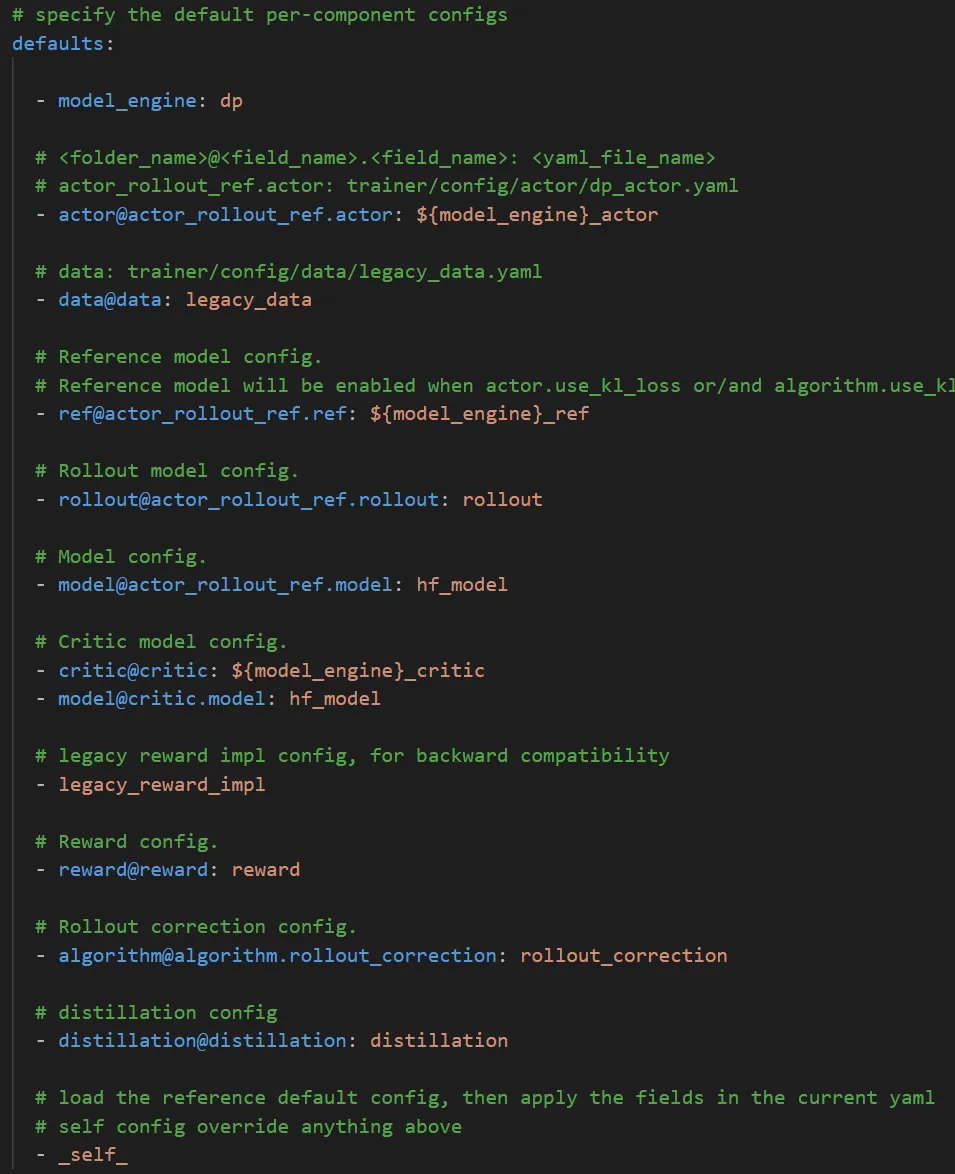
命令行 override 修改 OmegaConf 中的具体字段,例如 algorithm.adv_estimator=grpo。
worker 配置在运行时通过 omega_conf_to_dataclass()转成ActorConfig、CriticConfig、RolloutConfig等 dataclass。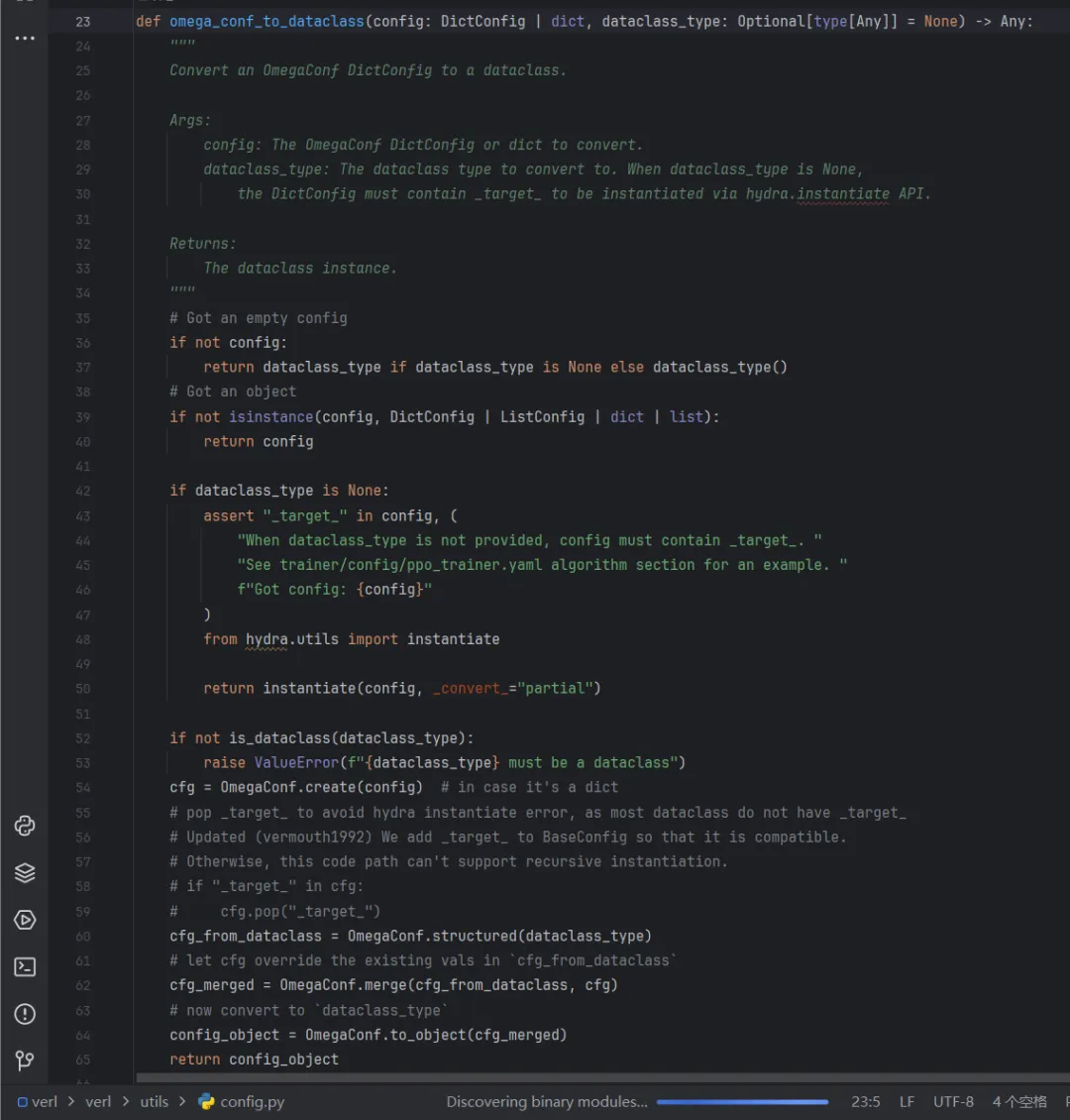
def omega_conf_to_dataclass(config: DictConfig | dict, dataclass_type: Optional[type[Any]] = None) -> Any:"""Convert an OmegaConf DictConfig to a dataclass.Args:config: The OmegaConf DictConfig or dict to convert.dataclass_type: The dataclass type to convert to. When dataclass_type is None,the DictConfig must contain _target_ to be instantiated via hydra.instantiate API.Returns:The dataclass instance."""
validate() 负责检查 batch size、micro batch、dynamic bsz、GPU 数和策略后端是否匹配。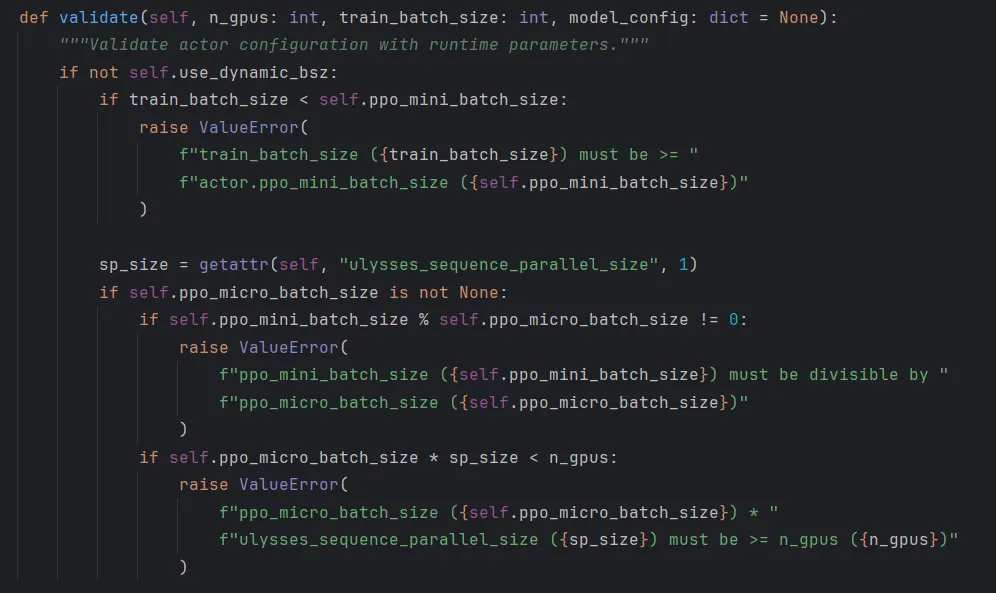
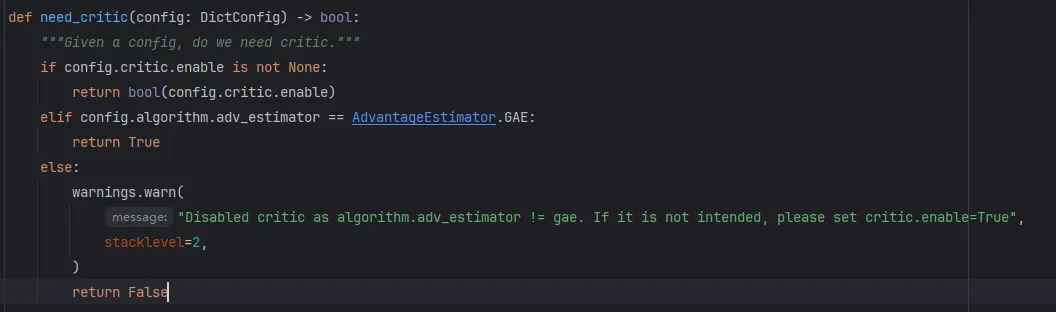
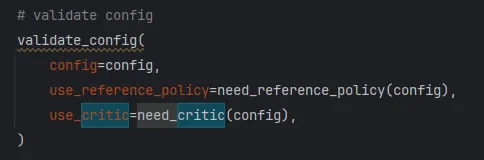

这些步骤背后通常有两类逻辑:
控制逻辑: 判断当前训练需要哪些角色、哪些字段、哪些分支。计算逻辑: 真正执行模型推理、训练、reward、advantage 或 loss。HybridFlow 的设计要求我们把这两类逻辑区分开。控制逻辑更适合在 trainer 或 manager 中读;计算逻辑更适合在 worker、engine 或 core_algos 中读。
8. 配置如何影响本篇路径
VERL 的同一段源码经常会被配置切到不同路径。阅读本篇时尤其要关注这些配置类型:
algorithm: 决定 PPO、GRPO、KL、advantage、rollout correction 等算法行为。actor_rollout_ref: 决定 actor、rollout、reference policy、model path、训练后端和推理后端。critic: 决定是否启用 value model,以及 critic 的训练后端。reward: 决定使用规则 reward、reward model、remote reward 还是 sandbox reward。trainer: 决定训练步数、资源规模、logger、validation、checkpoint 和 V1/V0 模式。读源码前最好先打印 resolved config。否则很容易在一个未启用的分支里浪费时间。
9. 常见误区和调试要点
同一个字段可能在 yaml、dataclass 和运行时 open_dict 修改中出现,最终值以 resolved config 为准。 配置中 critic.enable=None不等于启用 critic,VERL 会根据 advantage estimator 推断是否需要 critic。读报错时要分清是 Hydra 解析失败、配置校验失败,还是 worker 初始化阶段失败。
调试 VERL 时,不建议一上来就改源码。更稳的顺序是:
1. 确认命令行 override 是否真的进入 resolved config。2. 确认当前走 V0 还是 V1 trainer。3. 确认 DataProto / TensorDict 里字段是否存在。4. 确认 batch 维、response 长度、mask 是否一致。5. 确认对应 worker 是否真的被创建。6. 确认 Ray worker 日志里的原始异常。7. 最后再判断是不是算法公式或 loss 本身的问题。这个顺序能避免把配置错误、数据错误、分布式调度错误误判成算法错误。
10. 本篇压缩总结
读懂这一篇后,应该能够回答三个问题:
1. 这一层在 VERL 训练链路中负责什么?2. 它接收哪些字段,又产出哪些字段?3. 它的行为主要由哪些配置项改变?如果这三个问题能答清楚,就说明不是在背目录,而是在按 VERL 的真实执行路径读源码。
11. 下一步阅读
读完本篇后,建议继续沿着训练链路向后走:
入口与配置-> 数据和 DataProto-> WorkerGroup 和 Ray 调度-> Worker 与模型引擎-> Rollout-> Reward-> Advantage-> Actor/Critic loss-> Metrics、Checkpoint、异步扩展VERL 源码量很大,但主线并不乱。只要始终围绕“一个 batch 如何从 prompt 变成 actor update”这条线阅读,就能把分散目录组织成一张完整图。

