义 务 教 育 教 科 书
义
务
教
育
教
科
书
九 年 级 上 册
英
语
九
年
级
上
册义 务 教 育 教 科 书
九 年 级 上 册
主 编:陈 琳 Simon Greenall( 英)
副 主 编: 鲁子问 张连仲出 版 人:徐建忠
项目统筹:王 芳 Charlotte Liu(加)
项目策划:徐秀芝 申 蔷
项目负责:申 蔷 陈海燕 邢印姝
Mary-Jane Newton(德)
责任编辑:黄楷捷
绘制设计:石 蕾 张春玲 王 润
英语 (新标准)
九年级上册 学生用书
主编: 陈 琳 Simon Greenall (英)
基础教育出版分社:
地 址:北京市西三环北路19号 外研社大厦 基础教育出版分社 (100089)
咨询电话:010-88819666 (编辑部)/88819688 (市场部)
传 真:010-88819422 (编辑部)/88819423 (市场部)
电子信箱:
beed@fltrp.com
购书电话:010-88819928/9929/9930 (邮购部)
购书传真:010-88819428 (邮购部)前 言
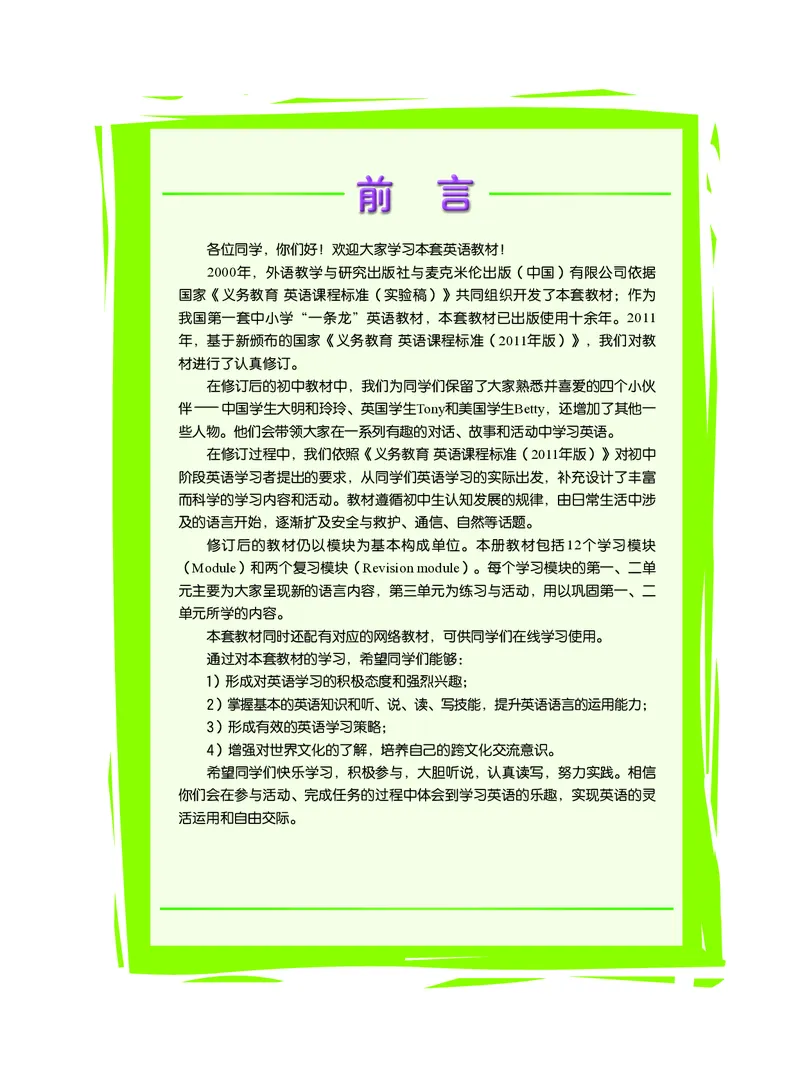
各位同学,你们好!欢迎大家学习本套英语教材!
2000年,外语教学与研究出版社与麦克米伦出版(中国)有限公司依据
国家《义务教育 英语课程标准(实验稿)》共同组织开发了本套教材;作为
我国第一套中小学“一条龙”英语教材,本套教材已出版使用十余年。2011
年,基于新颁布的国家《义务教育 英语课程标准(2011年版)》,我们对教
材进行了认真修订。
在修订后的初中教材中,我们为同学们保留了大家熟悉并喜爱的四个小伙
伴-中国学生大明和玲玲、英国学生Tony和美国学生Betty,还增加了其他一
些人物。他们会带领大家在一系列有趣的对话、故事和活动中学习英语。
在修订过程中,我们依照《义务教育 英语课程标准(2011年版)》对初中
阶段英语学习者提出的要求,从同学们英语学习的实际出发,补充设计了丰富
而科学的学习内容和活动。教材遵循初中生认知发展的规律,由日常生活中涉
及的语言开始,逐渐扩及安全与救护、通信、自然等话题。
修订后的教材仍以模块为基本构成单位。本册教材包括12个学习模块
(Module)和两个复习模块(Revision module)。每个学习模块的第一、二单
元主要为大家呈现新的语言内容,第三单元为练习与活动,用以巩固第一、二
单元所学的内容。
本套教材同时还配有对应的网络教材,可供同学们在线学习使用。
通过对本套教材的学习,希望同学们能够:
1)形成对英语学习的积极态度和强烈兴趣;
2)掌握基本的英语知识和听、说、读、写技能,提升英语语言的运用能力;
3)形成有效的英语学习策略;
4)增强对世界文化的了解,培养自己的跨文化交流意识。
希望同学们快乐学习,积极参与,大胆听说,认真读写,努力实践。相信
你们会在参与活动、完成任务的过程中体会到学习英语的乐趣,实现英语的灵
活运用和自由交际。Scope and sequence
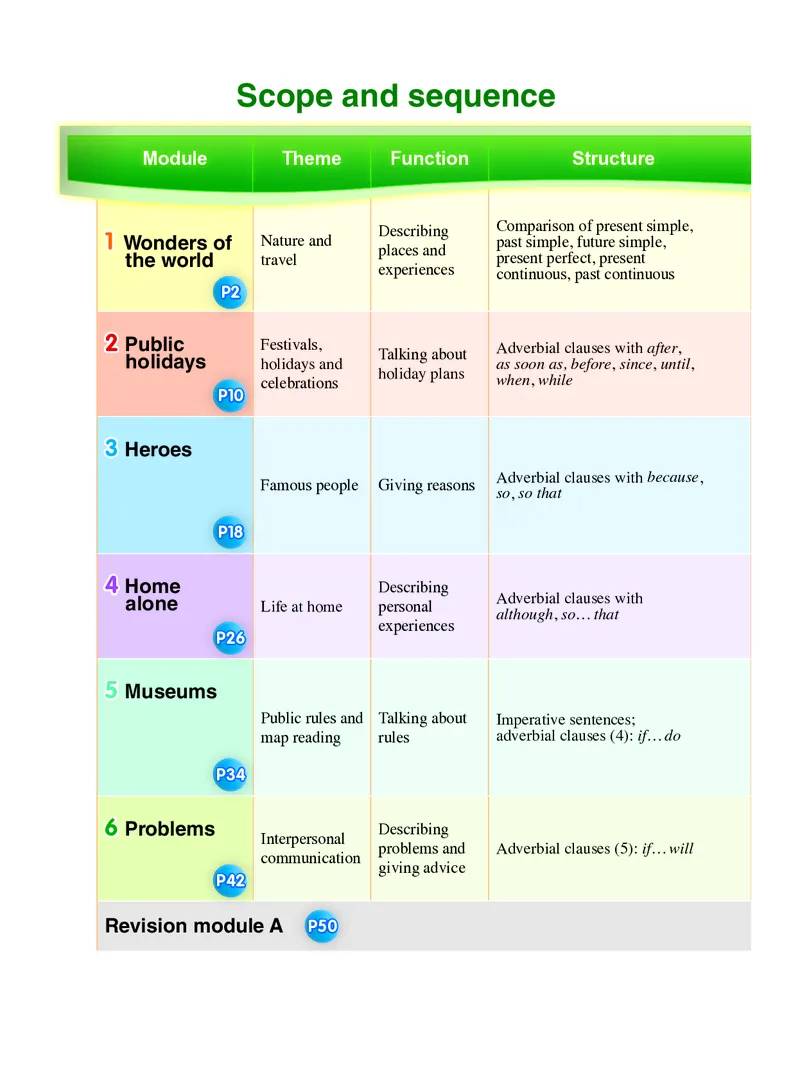
Skills (Listening/Speaking/Reading/ Around the
Module Theme Function Structure Task
Writing) world
Comparison of present simple,
1 Wonders of Nature and Describing past simple, future simple, Listening for specific information; identifying photos Stonehenge: Making a poster
places and Expressing views and opinions a man-made about a wonder
the world travel present perfect, present
experiences Reading and finding specific information wonder of the of the world
continuous, past continuous
world
P2 Describing a wonder of the world
2 Public Listening and recognising dates
Festivals, Adverbial clauses with after, Making a poster
holidays Talking about Talking about familiar topics (Chinese public holidays) Public holidays
holidays and as soon as, before, since, until, about a Chinese
holiday plans Reading and summarising general ideas in the US
celebrations when, while festival
P10 Writing about a festival
3 Heroes Listening for main ideas; inferring
Exchanging information with others
Adverbial clauses with because, Reading and understanding the relations between sentences and A famous Writing about a
Famous people Giving reasons
so, so that the sequence of events British nurse hero
Writing a passage on a given topic and using the conjunctions
P18 because, so, so that to show reasons and results
4 Home Listening and understanding a story
Describing Making a leaflet
alone Adverbial clauses with Describing personal experiences and feelings Home alone
Life at home personal about living
although, so… that Reading and understanding long sentences rules
experiences alone
P26 Writing a passage on a given topic
5 Museums Listening and understanding specific information
Communicating briefly on familiar topics (classroom rules,
Public rules and Talking about Imperative sentences; museums) Planning a guide
The Louvre
map reading rules adverbial clauses (4): if… do Reading for specific information and taking notes to a museum
Describing a museum by using notes and identifying and using
P34 the reference words it, they, there
6 Problems Listening for main ideas and specific information
Describing Writing a
Interpersonal Talking about problems and giving advice Advice
problems and Adverbial clauses (5): if… will problem page for
communication Reading, inferring and summarising problems columns
giving advice a magazine
P42 Writing a problem letter, asking for and giving advice
Revision module A P50Skills (Listening/Speaking/Reading/ Around the
Module Theme Function Structure Task
Writing) world
Comparison of present simple,
1 Wonders of Nature and Describing past simple, future simple, Listening for specific information; identifying photos Stonehenge: Making a poster
places and Expressing views and opinions a man-made about a wonder
the world travel present perfect, present
experiences Reading and finding specific information wonder of the of the world
continuous, past continuous
world
Describing a wonder of the world
2 Public Listening and recognising dates
Festivals, Adverbial clauses with after, Making a poster
holidays Talking about Talking about familiar topics (Chinese public holidays) Public holidays
holidays and as soon as, before, since, until, about a Chinese
holiday plans Reading and summarising general ideas in the US
celebrations when, while festival
Writing about a festival
3 Heroes Listening for main ideas; inferring
Exchanging information with others
Adverbial clauses with because, Reading and understanding the relations between sentences and A famous Writing about a
Famous people Giving reasons
so, so that the sequence of events British nurse hero
Writing a passage on a given topic and using the conjunctions
because, so, so that to show reasons and results
4 Home Listening and understanding a story
Describing Making a leaflet
alone Adverbial clauses with Describing personal experiences and feelings Home alone
Life at home personal about living
although, so… that Reading and understanding long sentences rules
experiences alone
Writing a passage on a given topic
5 Museums Listening and understanding specific information
Communicating briefly on familiar topics (classroom rules,
Public rules and Talking about Imperative sentences; museums) Planning a guide
The Louvre
map reading rules adverbial clauses (4): if… do Reading for specific information and taking notes to a museum
Describing a museum by using notes and identifying and using
the reference words it, they, there
6 Problems Listening for main ideas and specific information
Describing Writing a
Interpersonal Talking about problems and giving advice Advice
problems and Adverbial clauses (5): if… will problem page for
communication Reading, inferring and summarising problems columns
giving advice a magazine
Writing a problem letter, asking for and giving advice
Revision module ASkills (Listening/Speaking/Reading/ Around the
Module Theme Function Structure Task
Writing) world
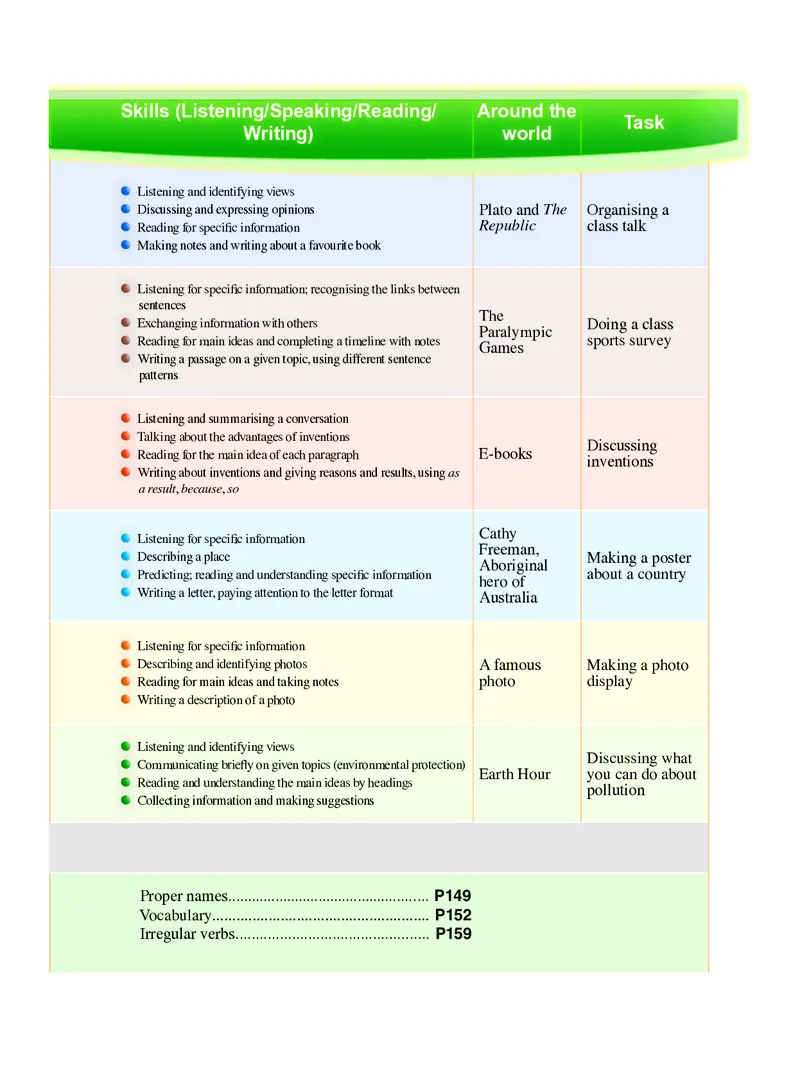
7 Great Stories, poems, Talking about Listening and identifying views
Present simple passive Discussing and expressing opinions Plato and The Organising a
books plays and books and
Reading for specific information Republic class talk
P56 writers writers Making notes and writing about a favourite book
8 Sports life Listening for specific information; recognising the links between
sentences
The
Sports and Talking about Exchanging information with others Doing a class
Past simple passive Paralympic
matches sports Reading for main ideas and completing a timeline with notes sports survey
Games
Writing a passage on a given topic, using different sentence
P64
patterns
9 Great Listening and summarising a conversation
inventions Inventions and Talking about Talking about the advantages of inventions
Discussing
technological inventions and Future simple passive Reading for the main idea of each paragraph E-books
inventions
advances changes Writing about inventions and giving reasons and results, using as
P72 a result, because, so
10 Australia Cathy
Listening for specific information
Freeman,
Countries and Describing a Describing a place Making a poster
Attributive clauses with that Aboriginal
nationalities country Predicting; reading and understanding specific information about a country
hero of
P80 Writing a letter, paying attention to the letter format Australia
11 Photos Describing Listening for specific information
people and Attributive clauses with Describing and identifying photos A famous Making a photo
School life
things; which, who Reading for main ideas and taking notes photo display
P88 measuring Writing a description of a photo
12 Save our Listening and identifying views
Talking Discussing what
world Environmental Word building: compounds, Communicating briefly on given topics (environmental protection)
about the Earth Hour you can do about
protection derivatives, conversion Reading and understanding the main ideas by headings
environment pollution
P96
Collecting information and making suggestions
Revision module B P104
Appendices Language notes.............................................. P110 Proper names................................................... P149
Guide to language use................................... P126 Vocabulary...................................................... P152
Words and expressions.................................. P142 Irregular verbs................................................ P159Skills (Listening/Speaking/Reading/ Around the
Module Theme Function Structure Task
Writing) world
7 Great Stories, poems, Talking about Listening and identifying views
Present simple passive Discussing and expressing opinions Plato and The Organising a
books plays and books and
Reading for specific information Republic class talk
writers writers
Making notes and writing about a favourite book
8 Sports life Listening for specific information; recognising the links between
sentences
The
Sports and Talking about Exchanging information with others Doing a class
Past simple passive Paralympic
matches sports Reading for main ideas and completing a timeline with notes sports survey
Games
Writing a passage on a given topic, using different sentence
patterns
9 Great Listening and summarising a conversation
inventions Inventions and Talking about Talking about the advantages of inventions
Discussing
technological inventions and Future simple passive Reading for the main idea of each paragraph E-books
inventions
advances changes Writing about inventions and giving reasons and results, using as
a result, because, so
10 Australia Cathy
Listening for specific information
Freeman,
Countries and Describing a Describing a place Making a poster
Attributive clauses with that Aboriginal
nationalities country Predicting; reading and understanding specific information about a country
hero of
Writing a letter, paying attention to the letter format
Australia
11 Photos Describing Listening for specific information
people and Attributive clauses with Describing and identifying photos A famous Making a photo
School life
things; which, who Reading for main ideas and taking notes photo display
measuring Writing a description of a photo
12 Save our Listening and identifying views
Talking Discussing what
world Environmental Word building: compounds, Communicating briefly on given topics (environmental protection)
about the Earth Hour you can do about
protection derivatives, conversion Reading and understanding the main ideas by headings
environment pollution
Collecting information and making suggestions
Revision module B
Appendices Language notes.............................................. P110 Proper names................................................... P149
Guide to language use................................... P126 Vocabulary...................................................... P152
Words and expressions.................................. P142 Irregular verbs................................................ P159odu
M l
e
1 Wonders of the world
Module task: Making a poster about a wonder of the world
Unit 1 It’s more than 2,000 years old.
Listening and vocabulary
1 Match the names of the wonders with the
pictures on the right and on the next page.
a) The Terracotta Army 1
b) The Three Gorges Dam
c) The Giant’s Causeway
d) Victoria Falls
2 Look at the pictures and answer the questions.
Use the words in the box to help you.
ancient man-made modern natural wonder
1 Which two are natural wonders?
2 Which two are man-made wonders? 2
3 Which is an ancient wonder?
4 Which is a modern wonder?
Now listen and check.
3 Listen and read.
Let’s call Wonders of the World and join in the discussion. I think natural
Tony:
wonders are more interesting than man-made ones. And I think the
Giant’s Causeway is the most fantastic natural wonder.
Hmm, I’ve never seen it, so I’m not sure I agree with you. Why do you like
Lingling:
it, Tony?
Tony:
Well, I visited the Giant’s Causeway two years ago. It’s huge. There are
about 40,000 rocks, most of them with six sides. It runs for several
hundred metres on the eastern coast of Northern Ireland.
That sounds great, though I think Victoria Falls in Africa is even more
Lingling:
fantastic. It’s about 1,700 metres wide and 100 metres high. You can hear the
loud noise a few kilometres away.
Betty:
Wow, that’s huge! But in my opinion, man-made
wonders are more exciting than natural ones. Look at
the Terracotta Army. It’s more than 2,000 years old. Everyday English
I agree with you, Betty. And I think the Three Gorges
Daming:
I’m not sure…
Dam is fantastic too. It’s about 2,300 metres long, 185
In my opinion, …
metres high and 15 metres wide at the top. It produces
Look at…
electricity for millions of people in China.
Who’d like to…?
Betty:
Now, who’d like to call first?
22Unit 1
3 4
Now check (√) the true sentences.
1 Tony thinks the Giant’s Causeway is the largest natural wonder.
2 Lingling thinks Victoria Falls is more fantastic than the Giant’s Causeway.
3 Betty and Daming are more interested in man-made wonders.
4 For Daming, the Three Gorges Dam is more fantastic than the Terracotta Army.
4 Answer the questions.
1 Where is the Giant’s Causeway? 3 What wonders does Betty think are more exciting?
2 How wide is Victoria Falls? 4 How old is the Terracotta Army?
5 Complete the sentences with the words in the box.
discussion eastern huge opinion though
1 In my , natural wonders are more interesting than man-made ones.
2 Victoria Falls, about 1,700 metres wide and 100 metres high, is .
3 Let’s join in the about the wonders of the world.
4 I think the Giant’s Causeway on the coast of Northern Ireland is a
fantastic natural wonder.
5 To some degree, Lingling agrees with Tony about the Giant’s Causeway,
she thinks Victoria Falls is more fantastic.
Pronunciation and speaking
6 Listen and mark the pauses.
1 I’ve never seen it, so I’m not sure I agree with you.
2 That sounds great, though I think Victoria Falls in Africa is even more fantastic.
3 In my opinion, man-made wonders are more exciting than natural ones.
Now listen again and repeat.
7 Work in pairs. Make a list of wonders of the world. Say which one you would
like to visit and why.
- Which wonder of the world would you like to visit?
- I’d like to visit the Giant’ s Causeway because I love wild places by the sea.
3odu
M l
e
1
Wonders of the world
Unit 2 The Grand Canyon was not just big.
Reading and vocabulary
1 Work in pairs. Talk about a great natural wonder you know. Use the words in
the box to help you.
below deep fantastic high long natural shine sign silent silver
2 Read the passage and complete the table.
A great wonder of the natural world
When I arrived, it was early morning I looked down to the Colorado River, a
and it was raining. I looked to the east - silver stream nearly one mile below me.
the sky was becoming grey. I got out of the If you put the two tallest buildings in the
car, went through a gate and walked along world on top of each other at the bottom of
a dark path. There was nothing to see, but I the canyon, they still would not reach the
knew it was there. top. Then I looked across to the other side
After about a mile, a stranger appeared of the canyon. It was about fifteen miles
beside the path. “Am I going the right away, maybe more. Finally, I looked to my
way?” I asked. He knew where I was going. left and to my right, and on both sides the
“Yes,” he replied, “you’ll get there in five canyon went far away for more than 200
minutes.” Finally, I came to some rocks miles. The Grand Canyon was not just big.
and stopped. I looked over them, but it was It was huge!
silent and there was no sign of it. I remained by the canyon for about half
Suddenly, the rain stopped and the an hour, and I asked myself, “Is the Grand
clouds cleared. The sun rose behind me Canyon the greatest wonder of the natural
and shone on the rocks. Far below me, the world?” I certainly know the answer. What
ground fell away and down to a river. I was do you think?
looking across one of the wonders of the
natural world - the Grand Canyon.
Learning to learn
The Grand Canyon
Some adjectives tell you facts, such
How deep as wide, deep, high and tall; some
adjectives tell you the opinion of
How wide
the author, like wonderful, huge
How long
and great. Learn to use them to talk
about facts and give your opinion.
44Unit 2
3 Choose the correct answer.
1 Where does the passage most probably come from?
a) A magazine. b) A grammar book. c) A dictionary. d) A storybook.
2 Why was there nothing to see?
a) Because there was nothing. c) Because it was raining.
b) Because it was too dark. d) Because it was in the morning.
3 Which direction was the writer facing while he/she was looking over the Grand Canyon?
a) South. b) North. c) East. d) West.
4 What is the writer’s purpose in writing this passage?
a) To give facts about the natural world.
b) To say how he feels about the natural world.
c) To tell an interesting story about the Grand Canyon.
d) To attract people to visit the Grand Canyon.
4 Complete the passage with the words in the box.
below mile remain reply sign silent sky stream through
In the dark, there is no (1) of the Grand Canyon, and it is (2) .
But if you (3) by the Grand Canyon as the (4) gets brighter
and look down about one (5) , you can see the Colorado River (6)
you. It looks like a silver (7) as it passes (8) the rocks at the
bottom of the canyon. If someone asks you whether the Grand Canyon is the greatest wonder
of the natural world, it may be easy to (9) .
Writing
5 Complete the table with facts about a natural or man-made wonder of the world.
Name
Location
Interesting facts
6 Imagine you have just visited one of the natural or man-made wonders. Write
sentences and describe your experience.
● Say when you visited it. ● Say what interesting facts you know.
I just visited the Great Wall last month. It is famous for...
● Say where it is. ● Say what happened when you visited it.
It is in the north of China. It was raining when we were…
● Describe its size. ● Say how you felt.
It is... I thought it was the most wonderful sight.
Now write a passage. Use the sentences you have written to help you.
5odu
M l
e
1
Wonders of the world
Unit 3 Language in use
Language practice
I visited the Giant’s Causeway two years ago.
It produces electricity for millions of people in China.
I’ve never seen it, so I’m not sure I agree with you.
I looked to the east - the sky was becoming grey.
You’ll get there in five minutes.
Am I going the right way?
1 Explain the differences in meaning between Sentences a) and b).
1 a) I often play basketball.
b) I am playing basketball now.
2 a) She has gone to the Great Wall.
b) She has been to the Great Wall.
3 a) They had an English class yesterday.
b) They were having an English class at nine o’clock yesterday morning.
4 a) He is doing an interview.
b) He has done an interview.
5 a) We are drawing a picture of Victoria Falls now.
b) We will draw a picture of Victoria Falls.
2 Complete the sentences with the correct form of the words in the box.
appear finish give rain talk visit walk
1 Listen! It ___________________ outside.
2 The great musician ___________________ a concert in Guangzhou next month.
3 Last summer, my parents ___________________ the Terracotta Army in Xi’an.
4 He ___________________ already ___________________ a new book about travel.
5 Thousands of people ___________________ along the Great Wall every year.
6 A few minutes later, a stranger ___________________ at the end of the street.
7 The students ___________________ about the journey to the Grand Canyon when the
teacher came into the classroom.
6Unit 3
3 Complete the passage with the correct form of the words in brackets.
The sun was going down when we (1) ________________ (arrive) at the ground floor
of the building. I (2) ________________ (be) afraid of going to the top of tall buildings, so
I was a little nervous when I (3) ________________ (walk)
into the lift. The lift (4) ________________ (climb) faster and
faster until we (5) ________________ (reach) the 88th floor. It
(6) ________________ (be) high up there, but I was not afraid
when I stood at the top.
The Jin Mao Tower in Shanghai, one of the tallest buildings
in the world, (7) ________________ (be) 420.5 metres high.
It was built in 1999, and it (8) ________________ (have) a
fantastic view of Pudong District and the centre of Shanghai. I
really like the tower and I am sure I (9) ________________ (visit)
it again.
4 Work in pairs. Talk about the wonders of the world you have or have not visited.
A: Have you ever visited the Great Wall?
B: Yes, I have. / No, I haven’ t.
A: When did you visit it? / When will you visit it?
B: I visited it five years ago. / Maybe I’ll visit it next year.
Now complete the table.
Wonders of the world When did you visit it? When will you visit it?
The Great Wall
5 Complete the sentences with the correct form of the words in the box. There is
one extra word.
ancient high long natural opinion wonder
1 The Changjiang River is about 6,300 kilometres _____________.
2 The Terracotta Army is a famous _____________ wonder in China.
3 For my homework I have to write an article about the _____________ of the world.
4 Mount Qomolangma is the _____________ mountain in the world.
5 In my _____________, the Great Wall is the greatest man-made wonder in the world.
7odu
M l
e
1
Wonders of the world
6 Complete the passage with the expressions in the box.
agree with at the bottom of go through
looking forward to millions of more than
I’m really (1) ___________________ my visit to the Louvre Museum in Paris. It’s the
most visited museum in the world - every year, (2) ___________________ people visit
it. The Louvre is in an old building, but to get inside you must (3) ___________________
a giant glass pyramid that is (4) ___________________ 20 metres tall. The entrance
to the museum is (5) ___________________ the pyramid. Some people do not like the
glass pyramid. They say it looks too new and does not suit the older building. I do not
(6) ___________________ them. I think it looks great!
7 Listen and number the pictures.
b
a c
8 Listen again and complete the table.
The Empire State The Great Pyramid
Mount Qomolangma
Building at Giza
Location Between China and Nepal __________ In Egypt
About __________
Height __________ metres __________ metres
metres now
First people to climb to
Interesting About __________ years
the top: Sir Edmund Hillary
facts __________ floors old
and Tenzing Norgay
8Unit 3
9 Work in pairs. Think about three other wonders of the world and ask and answer
questions about them.
A: Where is...?
B: It’ s...
A: How high is it?
B: It’ s... metres high.
Around the w rld
Stonehenge: a man-made wonder of the world
Stonehenge is an ancient circle of about 200 kilometres away. Some of the
stones in the south of England. It is about stones are missing, but it is still one of
5,000 years old. It was probably a place to the most wonderful sights of the world.
bury dead people or a place to study the It is a wonder also because of this
stars and the sky at night. question: How did ancient people move
There are dozens of stones, and they are these huge stones without machines to
different in height. The stones came from help them? No one knows the answer.
Module task: Making a poster about a wonder of the world
10 Work in groups of four. Make a poster about a wonder of the world.
● Decide on the wonder of the world for your poster.
● Find out as much information as you can in books and on websites. Think about:
1 Why should people visit the wonder?
2 What will people see there?
3 How can people get there?
4 How much does it cost to visit the wonder?
5 When is the best time to visit the wonder?
● Make a poster. Find some pictures showing the wonder.
11 Present your poster to the class.
9odu
M l
e
Public holidays
2
Module task: Making a poster about a Chinese festival
Unit 1 My family always go somewhere interesting
as soon as the holiday begins.
Listening and vocabulary
1 Look at the picture and answer the questions.
1 Which public holiday are people celebrating?
2 When is this holiday in China?
2 Complete the sentences with the dates of the
following holidays in China, the UK and the US.
1 Labour Day in China is on ______________.
2 May Day in the UK is on _______________.
3 Labour Day in the US is on _____________.
Now listen and check.
3 Listen and read.
The First of October is China’s National Day, isn’t it, Lingling?
Tony:
Yes. The People’s Republic of China was founded on 1st October 1949. People
Lingling:
have celebrated the National Day since then. There are flowers and national
flags everywhere, and we have a three-day holiday.
Do you have any plans for the holiday this year?
Tony:
Yes. My parents and I are going to visit some friends in Shandong Province
Lingling:
and we’ll stay there until the end of the holiday. While we’re staying with our
friends, we’re going to spend one day in Qingdao. When is your national day,
Betty?
Our national day is called Independence Day. It’s on 4th July. We’ve celebrated
Betty:
it since 1777. It’s a public holiday, but we only have one day off. On that day,
there are all kinds of holiday activities. It’s the start of the vacation season,
and most people take a vacation sometime in July or August.
And is there anything special on that day?
Lingling:
Well, you can see American flags everywhere. We
Betty:
usually have a picnic somewhere nice. Kids have great
Everyday English
fun. We also watch bands play music in public parks.
Daming: Do you have a national day in the UK, Tony? We only have one day
Tony: No, we don’t - we celebrate Christmas with a two- off.
day holiday. And my family always go somewhere Well, …
interesting as soon as the holiday begins.
10Unit 1
Now complete the table.
China US
Holiday
Date
Duration
Ways of celebration
Year the celebration
started
4 Complete the sentences with the correct form of the words in the box.
activity flag found vacation
1 The Americans celebrate Independence Day on 4th July. It is the start of the ____________
season.
2 On 1st October, you can see the national ____________ everywhere in China.
3 The US was ____________ in 1776.
4 What kinds of ____________ are there on 1st January?
Pronunciation and speaking
5 Listen and repeat.
1st first 5th fifth 9th ninth 13th thirteenth
2nd second 6th sixth 10th tenth 20th twentieth
3rd third 7th seventh
11th eleventh 21st twenty-first
12th twelfth 31st thirty-first
4th fourth 8th eighth
6 Say the dates.
10th September 1st October 4th July 25th December
Now work in pairs. Ask and answer questions about important dates.
- When is your birthday?
- The tenth of September.
7 Work in groups. Ask and answer questions about a Chinese public holiday.
1 When is the holiday?
2 What do your family do during the holiday?
3 What special food do you eat?
4 What special clothes do you wear?
Now present the Chinese public holiday to the whole class.
The Mid-Autumn Festival is usually in September or early October. Family members
usually get together. We eat moon cakes while we are enjoying the full moon…
11odu
M l
e
2
Public holidays
Unit 2 We have celebrated the festival since
the first pioneers arrived in America.
Reading and vocabulary
1 Work in pairs. Talk about the picture.
2 Read the passage and match the headings
with the paragraphs.
a) A special dinner
b) An American festival
c) The history of the festival
d) Things to do during the festival
Thanksgiving
1 Thanksgiving is an American festival. we begin dinner, my father gives thanks
It is celebrated on the fourth Thursday for the food, so we remember why we
in November. It is a time for a special celebrate the festival. We usually eat
dinner among family and friends. People too much, but it is only once a year!
make short speeches and give thanks for We often talk a lot and tell stories
their food. after dinner as well. When it is all over,
2 We have celebrated the festival since everyone helps wash the dishes.
the first pioneers from England arrived 4 The festival is a very busy time for
in America by ship in the seventeenth travel when friends and families come
century. While they were crossing the together to celebrate. During the festival,
Atlantic, many people died, and after there are plenty of other things to see and
they landed, their first winter was worse do. We live in New York City, and we go
than any English winter. The local to watch the Macy’s Thanksgiving Day
people, the Native Americans, taught Parade. The parade goes along several
the pioneers how to grow corn. The streets and finishes at the famous Macy’s
following year they celebrated together store. Thanksgiving is the start of the
by eating a dinner of the new food. Christmas season, and we start shopping
3 We still celebrate Thanksgiving today for presents. Football is also important at
with a traditional dinner. The kitchen is Thanksgiving, with many teams playing
always the most crowded room in our games. Like many Americans, we usually
house because we all help prepare the watch the games on television and enjoy
food. We lay the table, and then before ourselves very much.
12Unit 2
3 Complete the table.
Facts about Thanksgiving
Date ● _________________________
Meaning ● _________________________ for their food
● Have celebrated it since _________________________ from England
arrived in America
History
● Learnt from the Native Americans how to _________________________
and celebrated together by _________________________ of the new food
● Celebrate with _________________________
● _________________________ before dinner
Celebration
● Celebrate by watching _________________________ in New York City
and _________________________ on television
4 Complete the passage with the correct form of the words in the box.
among corn dish lay pioneer plenty
The first (1) _______________ crossed the Atlantic and arrived in America in the
seventeenth century. At the beginning, they did not have enough food. The Native Americans
taught them how to grow (2) _______________. They soon had (3) _______________ to
eat. Today, people living in the US remember the Native Americans and the pioneers at
Thanksgiving. This festival is celebrated with a meal (4) _______________ family and
friends. Everyone helps (5) _______________ the table. After the meal, they help wash the
(6) _______________.
Writing
5 Think about an unforgettable festival you have enjoyed. Answer the questions.
1 What was it?
2 When was it?
3 Who did you spend it with?
Learning to learn
4 How did you spend it?
5 Will you remember it for long? Why? When you write about important
events, such as festivals, you can
6 Write a passage about the festival. Use
write what the festival is, when it
your answers in Activity 5 to help you.
is, why it is important, what you
An unforgettable festival for me was National do, who you spend it with, and
Day last year… what special food you eat.
13odu
M l
e
2
Public holidays
Unit 3 Language in use
Language practice
While we’re staying with our friends, we’re going to spend one day in Qingdao.
Before we begin dinner, my father gives thanks for the food.
When it is all over, everyone helps wash the dishes.
And my family always go somewhere interesting as soon as the holiday begins.
We have celebrated the festival since the first pioneers from England arrived in America.
After they landed, their first winter was worse than any English winter.
1 Complete the sentences with the correct form of the words or expression in the
box. There may be more than one answer.
after as soon as since until while
1 ____________ our friends arrived, we all went to the square.
2 ____________ they were watching TV, we listened to music and sang traditional songs.
3 ____________ it was twelve o’clock, we all shouted “Happy New Year”.
4 We stayed there ____________ she arrived.
5 He has made a lot of progress ____________ he started to learn English last month.
2 Complete the conversation with the clauses in the box.
a) after the food has all gone
b) as soon as you’re ready
c) before there are too many people
d) before we go
e) when we get back
f) while we’re waiting for the New Year
When are we going to the party?
Betty:
We’re waiting for you. We can go (1) ________.
Daming:
OK, let’s go. It’s better to be early and get there (2) ________.
Betty:
Yes, we don’t want to get there (3) ________.
Daming:
Oh, Daming! You always think about eating.
Betty:
Well, it’s something to do (4) ________.
Daming:
Don’t you want to make a wish for the New Year (5) ________?
Betty:
No, it’s OK. I’ll make one (6) ________.
Daming:
14Unit 3
3 Work in pairs. Ask and answer questions about yourself.
1 Do you do your homework before you have dinner?
2 Do you listen to music while you are doing your homework?
3 What do you do after school?
4 Do you get out of bed as soon as you wake up?
5 What do you say when someone gives you a present?
6 How many subjects have you studied since you started school?
4 Complete the passage with the words in the box.
before until When while
Christmas is a happy holiday. (1) ________ it comes, people celebrate it in different
ways. To many people in the world, this time of year is the season for giving and receiving
presents. Children think that Father Christmas waits (2) ________ they are asleep and then
comes in and leaves presents for them. They would like him to come (3) ________ they fall
asleep, so they can see him. They do not know that it is their parents who put the presents at
the end of their beds (4) ________ they are sleeping.
5 Complete the passage with the expressions in the box.
as well get together have a picnic spend some time take a vacation the end of
I always count down the days until (1) ______________ the term, because then
it is the beginning of the holiday. We have several weeks off school and we can
(2) ______________ doing our favourite things. For example, we can (3) ______________
with friends. When the weather is good, we can (4) ______________ in the park and play
games (5) ______________. Sometimes we can (6) ______________ in a different part of
the country. For me, I always like enjoying myself on the beach in the south, but it depends
on the weather. I just hope it will be sunny when it is time for the next holiday. I cannot wait!
6 Complete the conversations with the sentences in the box.
a) Enjoy yourself! b) Good luck! c) Have a nice trip! d) Well done!
1 - We’re going to visit the Grand Canyon with Aunt Li for the holiday.
- ________
2 - I’m going to take a vacation tomorrow.
- Oh, good! ________
3 - I’m taking my driving test next week.
- ________
4 - I’ve just run one thousand metres and beaten everyone!
- ________
15odu
M l
e
2
Public holidays
7 Listen and check (√) the speakers’ holiday plans.
Mike Tom Becky Jane
Go to a new place
Go to a favourite place
Stay at home
Take a friend home
8 Listen again. Work in groups and talk about the speakers’ holiday plans. Whose
plan do you think is the most interesting?
9 Complete the passage with the sentences in the box.
a) There were a lot of local people there as well as some tourists.
b) I had a wonderful day and I will never forget it.
c) During my first year, I went to the beach for the Labour Day holiday.
d) Someone made a circle of flowers for me to wear too.
Many years ago, I lived in Greece, on a
very beautiful island. On 1st May, Greek
people celebrate Labour Day, and it is also
a festival to celebrate the beginning of
summer. (1) ________ The sun was shining
brightly and the sea was clear blue. I went
to a small restaurant by the sea and waited
while they cooked fish over a fire for lunch.
It was delicious. (2) ________ Everyone
celebrated the festival and enjoyed
themselves. All the girls and women wore
flowers in their hair. (3) ________ In the
afternoon, people played traditional Greek
music and danced on the beach. I danced
with them until the evening. (4) ________
16Unit 3
Around the w rld
Public holidays in the US
Apart from Independence Day,
Labour Day and Thanksgiving, the US
has several other important holidays
during the year. Martin Luther
King Day in January celebrates the
birthday of the great civil rights leader.
Columbus Day in October remembers
Christopher Columbus’s arrival in the
Americas in 1492.
Module task: Making a poster about a Chinese festival
10 Work in groups. Choose a Chinese festival and answer the questions.
1 Do people celebrate the festival in other countries or only in China?
2 Do people celebrate the festival at the same time in different areas?
3 Is the festival on the same day or date every year?
4 Do people eat special food during the festival?
5 Do people wear special clothes?
6 Do people usually stay at home or go somewhere to celebrate?
11 Write sentences about the festival. Use your answers in Activity 10 to help you.
Join the sentences with as soon as, until, when, while, etc.
12 Make a poster. Find some pictures showing the festival.
13 Present your poster to the class.
17odu
M l
e
3 Heroes
Module task: Writing about a hero
Unit 1 She trained hard, so she
became a great player later.
Listening and vocabulary
1 Work in pairs. Look at the picture and say who the
person is and why she is famous.
2 Listen and choose the correct answer.
1 Who are the speakers?
Learning to learn
a) A student and a teacher. c) Two students.
b) A person on the radio and a guest. You can use the questions in
2 Where are the speakers? Activity 2 to help you understand
a) At a radio station. c) In a classroom. listening passages. If you can
b) At home. decide who the speakers are,
3 What are they talking about? where they are and who or what
a) A famous person. c) A teacher. they are talking about, you may
b) A friend. understand the main ideas better.
3 Listen and read.
Daming, who is your hero? Who have you chosen to tell us about?
Ms Li:
Deng Yaping! She’s my hero because she’s one of the best table tennis players in
Daming:
the world, and I love playing table tennis.
Tell us about her.
Ms Li:
Well, she started playing table tennis when she was five. She trained hard, so
Daming:
she became a great player later.
And what competitions has she won?
Ms Li:
She’s won many world competitions, including four gold medals in the Olympics.
Daming:
She stopped playing when she was twenty-four.
What did she do after that?
Ms Li:
She began to study at Tsinghua University in Beijing and then attended university
Daming:
abroad. Her English wasn’t good enough when she began. Once again she worked
hard, and seven years later, she completed her doctor’s degree at Cambridge
University. Whatever she does, she never gives up!
That’s amazing!
Ms Li:
Yes. Deng says that she isn’t cleverer than anyone else,
Daming:
Everyday English
but she has a very strong will.
Ms Li: I see. Well, I think she’s a good student as well as a Whatever she does,
good player. she never gives up!
Daming: Yes, and she helped make the Beijing Olympics a That’s amazing!
victory for world sport. She’s simply the best!
She’s a true hero.
Ms Li:
18Unit 1
Now complete the table.
Facts about Deng Yaping
When she was five, she ______________________________________.
When she was twenty-four, she ______________________________________.
After she stopped playing, she began to _______________________ in Beijing.
After seven years’ study abroad, she ______________________________________.
4 Complete the sentences so that they are true for Deng Yaping.
1 She says she is not __________________. 3 She helped _________________________.
2 She has a very _____________________. 4 Whatever she does, she _______________.
5 Complete the passage with the correct form of the words in the box.
abroad attend clever victory will
Deng Yaping is Daming’s hero. At first, she was a table tennis player. Later, she
(1) Tsinghua University and then went to study (2) . She says
she is not (3) than anyone else, but she has a very strong (4) . She
also helped make the Beijing Olympics a(n) (5) for world sport. She is a
true hero.
Pronunciation and speaking
6 Listen and mark the pauses.
1 She’s my hero because she’s one of the best table tennis players in the world.
2 She started playing table tennis when she was five.
3 Whatever she does, she never gives up!
4 Deng says that she isn’t cleverer than anyone else, but she has a very strong will.
Now listen again and repeat.
7 Work in pairs. Talk about your heroes.
A: Who’ s your hero?
B: It’ s Jackie Chan!
A: Why?
B: Because he’ s a great film star. I think his films are fantastic!
Now talk about each other’s heroes with the whole class.
My friend Jim likes Jackie Chan best. Jackie Chan is his hero because he’ s a great film star
and his films are fantastic.
19odu
M l
e
3
Heroes
Unit 2 There were few doctors, so he had
to work very hard on his own.
Reading and vocabulary
1 Work in pairs. Look at the picture in Activity 2 and discuss who the person is
and what he did. Use the words in the box to help you.
Canadian doctor hospital sick soldier treat war wound
2 Read the passage and check your answers to Activity 1.
My hero - Dr Norman Bethune
By Wang Lingling
Norman Bethune is one of the most famous heroes in China. He was a Canadian doctor.
He came to China to help the Chinese people and died for them.
Norman Bethune was born in 1890. He became a doctor in 1916 and went to Spain
in 1936 to treat the wounded soldiers during the war there. He soon realised that many
people were dying because they did not get to hospital quickly enough. Dr Bethune
developed new ways of taking care of the sick. He invented special medical tools to use
outside hospitals and close to the fighting areas so that doctors could treat the wounded
more quickly. His inventions saved many lives.
In 1938, Dr Bethune came to China and helped treat the wounded during the Anti-
Japanese War. At that time, there were few doctors, so he had to work very hard on his
own. His experience of treating people in Spain was useful in China.
He developed training courses for local doctors and nurses, and
wrote books so that they could learn about how he treated the sick.
Dr Bethune often worked very hard without resting or taking care
of himself. Once, he even worked for sixty-nine hours without
stopping and managed to save over a hundred lives. One
day in 1939, he cut his finger during an operation, but he
continued his work without treating it. In the end, he
died of his wound.
Dr Bethune’s work for the Chinese people made
him a hero in China. There are many books and
films about him, and he is still remembered in both
China and Canada today.
20Unit 2
3 Number the events about Norman Bethune in the order they happened.
a) came to China
b) wrote books about ways of treating the sick in China
c ) was born in 1890
d) invented medical tools to use outside hospitals
e) died
f) went to treat the wounded soldiers in Spain
4 Complete the passage with the correct form of the words in the box.
Canadian continue himself invention manage sick tool war wound
Norman Bethune was (1) ______________, but he is one of the most famous heroes in
China. During the (2) ______________ in Spain, he treated the wounded soldiers there. He
invented special (3) ______________ to use outside hospitals. His (4) ______________ saved
many lives. In China, he (5) ______________ to treat (6) ______________ and wounded
soldiers. He often worked without taking a rest and did not look after (7) ______________.
At one point, he (8) ______________ to save over one hundred lives in sixty-nine hours.
During an operation, he cut his finger, and finally died of his (9) ______________. He is still
remembered in both China and Canada.
Writing
5 Look at the facts about Yuan Longping and write a passage about him. Use the
passage in Activity 2 to help you.
Fact box: Yuan Longping
Now Is helping many countries of the world grow more rice than before
2004 Won World Food Prize
1980s Travelled around the world and gave advice about growing rice
1974 Developed a new kind of rice
1964 Made a special study of rice
1950 1953 Studied in Southwest Agricultural College
1 930 Was born in Beijing
● Write when and where he was born.
● Write about his studies.
● Write about the result of his work.
● Write about the things he did and the prize he won.
● Write about what he is doing now.
21odu
M l
e
3
Heroes
Unit 3 Language in use
Language practice
Many people were dying because they did not get to hospital quickly enough.
There were few doctors, so he had to work very hard on his own.
He wrote books so that they could learn about how he treated the sick.
1 Complete the passage with because, so or so that.
Yury Gagarin (1934 1968) was an astronaut of the Soviet Union who became the
first human in space. At school, the teachers liked Gagarin (1) ______________ he was
clever and worked hard. In 1960, Gagarin became one of the twenty astronauts in a space
programme. Gagarin trained hard (2) ______________ he could travel into space.
Gagarin was not tall, (3) ______________ he got the chance to fly the small spaceship,
the Vostok I. On 12th April 1961, Gagarin took off for space. After almost two hours, he
landed safely back on earth. He became famous around the world and travelled a lot to tell
people of his experience in space.
2 Join the sentences with because, so or so that. There may be more than one answer.
1 Norman Bethune wanted to help people. He became a doctor.
2 Norman Bethune invented new tools for operations. He could help the wounded soldiers.
3 We know what life was like in the capital city of the Northern Song Dynasty. Zhang
Zeduan painted a picture about it.
3 Work in pairs. Ask and answer.
Facts Reasons
Norman Bethune went to Spain. He wanted to help the wounded soldiers.
Many people think Shakespeare is Britain’s
People still love reading his works.
greatest writer.
Neil Armstrong and Buzz Aldrin landed on They wanted to learn more about the moon
the moon. and space.
Florence Nightingale made hospitals clean. A lot of people died in dirty hospitals.
- Why did Norman Bethune go to Spain?
- He went to Spain because he wanted to help the wounded soldiers.
22Unit 3
4 Complete the sentences with the correct form of the words in the box.
attend care continue realise sick tool treat
1 He stayed at home to look after his ____________ daughter.
2 The doctor ____________ his illness with some special medicine.
3 He developed medical ____________ to use outside hospitals.
4 Though he was very tired, he ____________ his work.
5 When she won the last game, she ____________ she was the best in the world.
6 Many wounded soldiers are in need of medical ____________.
7 Deng Yaping ____________ university after she stopped playing table tennis.
5 Complete the sentences with the correct form of the expressions in the box.
die of give up in the end on one’s own take care of
1 He did not ever ______________ his dream of winning the game.
2 In 1938, Norman Bethune came to China to ______________ the wounded soldiers in the war.
3 They travelled for several days and ______________ they arrived home.
4 Thousands of people _____________ illnesses in dirty hospitals in the nineteenth century.
5 Although she is very young, she can live ______________.
6 Listen and choose the correct answer.
1 What did Stan Lee write about?
a) Actors in films. b) Brave heroes. c) His own life.
2 Who did Stan Lee think were heroes?
a) His parents. b) His teachers. c) His favourite actors in films.
3 Why did Stan Lee want to write?
a) Because his mother was proud of him.
b) Because his teacher told great stories.
c) Because of the books he read by famous writers.
4 What is Stan Lee’s advice for children about writing?
a) They should read a lot before they write.
b) They should only read their favourite books.
c) They should write like famous writers.
23odu
M l
e
3
Heroes
7 Read the passage and choose the best title.
a) My favourite book
b) Homer’s adventure
c) A great Greek hero - Odysseus
d) A famous journey
My favourite Greek hero is Odysseus. After ten years of fighting and ten more
He is the main character in The Odyssey, years on the way home, Odysseus
a famous story by the Greek storyteller, completes his journey and manages to get
Homer. back to his own country, alone. His wife
Odysseus and his friends go from and son are waiting for him to come back.
Greece to Troy to fight. After ten years, However, he looks so different that they
they win and are very proud of themselves. fail to recognise him. After Odysseus saves
Then they set off for home, but on their his wife and son from some bad men, they
way, there is a great storm. They become finally know who he is. He is happy to be
lost, and that is the start of their great back home again after so many adventures.
adventures. While they are travelling, they I like this story because it is interesting
meet many strange people. Most of them and exciting. I think Odysseus is a true
want to hurt Odysseus and his friends, but hero. He is very clever and has a strong
a few help them. On one island a very big will. I also learn from him that great men
man with only one eye tries to kill them. never give up, no matter what difficulties
During this fight, Odysseus loses many of they face.
his friends, but he manages to get away.
Now number the events in the order they happen.
a) Odysseus gets together with his wife and son.
b) Many of Odysseus’s friends are killed.
c) Odysseus and his friends fight in Troy.
d) Odysseus and his friends go to Troy.
e) There is a great storm on their way home.
24Unit 3
Around the w rld
A famous British nurse
Florence Nightingale was born on 12th May
1820. In 1851, she was trained as a nurse. Three
years later, she went to a British military hospital
so that she could help British soldiers. Before
she arrived, many soldiers died in the hospital
because it was dirty. Florence Nightingale
worked hard to make the hospital clean and save
soldiers’ lives. When she returned to Britain
in 1856, she became a national hero. Florence
Nightingale wrote several books about nursing,
and she also started a school to train nurses. She
died in London on 13th August 1910, when she
was ninety years old.
Module task: Writing about a hero
8 Work in pairs. Make a list of the heroes you can think of.
● Think of heroes from different areas (sport, environmental protection) or different careers
(writer, scientist), etc.
● List your heroes.
9 Choose and research your hero.
● Choose the hero who you both think is the greatest.
● Write down everything you know about your hero.
● Find out more facts about your hero in books, newspapers and on the Internet. You can
also ask your parents or your teacher for more information.
10 Write about your hero.
● Plan a passage with three or four paragraphs like this:
Paragraph 1: Introduce your hero.
Paragraphs 2 and 3: Say what he/she did.
Paragraph 4: Say why you think he/she is the greatest hero.
● Write the passage about your hero. Use the information in Activity 9 to help you.
11 Present your hero to the class.
25odu
M l
e
4 Home alone
Module task: Making a leaflet about living alone
Unit 1 I can look after myself, although it
won’t be easy for me.
Listening and vocabulary
1 Work in pairs. Talk about the picture.
2 Listen and answer the questions.
1 Where are Betty and her parents?
2 Is Betty travelling with her parents?
3 Listen again and complete the sentences.
1 Will you be OK at home _________________?
2 I’ll _________________ you too, and I’ll call
you every day.
3 I’ll keep it tidy so that you’ll _________________ me when you get home.
4 Listen and read.
Now, what’s our train number?
M um:
T27 to Lhasa. It’s leaving from Platform 2.
Dad:
The meeting in Lhasa is very important for us, but I’m sorry you can’t come with
Mum:
us, Betty.
So am I, but I can’t miss two weeks of school.
Betty:
Will you remember everything I’ve told you? Be especially careful with the door.
Mum:
Shut it when you’re in and lock it when you go out.
Yes, Mum. I can look after myself, although it won’t be easy for me.
Betty:
Well, make sure you eat plenty of fresh fruit and vegetables. And I’ve left lots of
Mum:
your favourite biscuits.
Don’t worry. I can cook simple meals.
Betty:
There won’t be anybody to wake you up in the morning.
Dad:
I’ll be fine. My clock rings so loudly that it will certainly wake me up.
Betty:
I’m sure I’ve forgotten something, but I don’t know what it is!
Mum:
We advise all passengers for Train T27 to
(Announcement:
Lhasa to go immediately to Platform 2. Your train is about to leave.
)
Everyday English
That’s your train! Goodbye Mum, goodbye Dad.
Betty:
Mum: I know! I haven’t given you our address in Lhasa! Now, …
Send me a text message. Have a good trip! I’m sorry…
Betty:
Bye, my dear! So am I.
Mum:
Bye! See you in a couple of weeks! Have a good trip!
Betty:
26Unit 1
Now complete the sentences. There may be more than one answer.
1 Betty’s parents are going to _______________________________.
2 Betty’s mum tells her to _______________________________.
3 Betty can ____________________________.
4 Betty’s parents usually _____________________________.
5 Betty’s mum has not _____________________________.
5 Choose the correct answer.
address lock meeting passenger ring shut text message
1 “I haven’t given you our address in Lhasa!” This means you do not know where we are
staying / what we are doing.
2 You see passengers travelling by train / staying at home.
3 When your clock rings, it is quiet / makes a loud noise.
4 You receive a text message on your phone / by email.
5 When the door is shut, it is open / closed.
6 When you lock the door, you keep people out / let people in.
7 At a meeting, you meet people for work / fun.
Pronunciation and speaking
6 Listen and mark the words which the speaker links.
1 Be especially careful with the door. Shut it when you’re in and lock it when you go out.
2 I can look after myself, although it won’t be easy for me.
3 I’m sure I’ve forgotten something, but I don’t know what it is!
Now listen again and repeat.
7 Work in pairs. Imagine you are staying at home by yourself. Ask and answer.
1 Can you look after yourself?
2 How will you make sure you wake up in the morning?
3 What will you eat?
A: Can you look after yourself?
B: Yes, I can. / No, I can’ t.
A: How will you…?
B: I’ll…
27odu
M l
e
4
Home alone
Unit 2 I became so bored with their orders that
I wished they would leave me alone.
Reading and vocabulary
1 Work in pairs. Talk about daily things you do alone and the things your parents
do for you.
● cook dinner ● go shopping ● tidy up ● wash clothes
2 Read the passage and choose the best summary.
My ”perfect holiday“
As a boy, like all other boys, I wanted to was still late. The teacher asked me for my
be a man. But my parents did everything homework, but I could not hand it in. With
for me. Actually, they managed every an empty stomach, I was unable to play
minute of my life. Although they loved basketball with my classmates! I felt tired
me, I felt a bit unhappy with them. “Zheng and sleepy at school all day long.
Chenyu, do your homework!” “Practise the When I got home, I tried to cook some
piano!” “Turn off the TV!” I became so rice, but I burnt it. I even dropped my
bored with their orders that I wished they father’s cup when I was cooking! I found
would leave me alone. myself so bad at simple cooking tasks. I
Well, my wish came true! Although my started to feel lonely. I wanted Mum and
parents were very worried about leaving Dad to come home soon. Mum cooked
me, they had to go away on business such delicious food, and made sure I never
for a few days. Now was my chance! I forgot my homework. Dad always helped
could have some fun at last! As soon as me with any difficult questions, and told
I got home from school the first day, I funny jokes when I was unhappy. Then I
happily threw my schoolbag on the sofa realised being home alone was not always
and ate lots of snacks. Then I enjoyed an perfect.
exciting film on TV, and after that I played When my parents came home, they
computer games. I liked the games so were happy to find that I could cook and
much that I played until midnight. tidy up now. I told them my home alone
The next morning I woke up late. I had story, and we all laughed.
to hurry to school without breakfast, but I
a) Zheng Chenyu found his life more difficult without his parents.
b) Zheng Chenyu depended on his parents to prepare meals for him.
c) Zheng Chenyu had so much homework that he did not have time
to look after himself.
d) Zheng Chenyu should learn to cook.
28Unit 2
3 Complete the sentences. See how Zheng Chenyu’s feelings changed.
1 Zheng Chenyu felt ___________________ with his parents because they did everything
for him and managed every minute of his life.
2 After Zheng Chenyu’s parents went away on business, he felt ___________________
because he could ___________________.
3 Zheng Chenyu felt ___________________ after the first night.
4 Zheng Chenyu felt ___________________ when he found he could not look after
himself well.
5 Zheng Chenyu realised being home alone ___________________.
4 Complete the passage with the correct form of the words in the box.
burn cup empty order simple task
Zheng Chenyu was bored with his parents’ (1) . He was happy when his
parents went away on business, although he soon found that he could not do (2)
things. He forgot his homework. He went to school with a(n) (3) stomach.
He (4) his food and broke his father’s (5) . Zheng Chenyu
had to learn to do (6) like cooking and tidying up. He realised being home
alone was not always perfect.
Writing
5 Write a passage about what you can do and what you cannot do when your
parents are away.
● Make lists of what you can do and cannot do when your parents are away.
I can wake up on time.
I cannot make breakfast.
● Now join the sentences with although, but or
so… that. Learning to learn
I can wake up on time, although I cannot make
When you write your passage, you
breakfast.
can start with a question. Think of
● Write a conclusion to the sentences. your first answer to it, and think
I will miss my parents, but I think I can look of an example. Then think of the
after myself very well. opposite answer, and think of an
● Share your passage with your classmates. example as well. Try to present
both answers and then write a
conclusion.
29odu
M l
e
4
Home alone
Unit 3 Language in use
Language practice
I can look after myself, although it won’t be easy for me.
Although they loved me, I felt a bit unhappy with them.
My clock rings so loudly that it will certainly wake me up.
1 Complete the sentences with the words in the box. There may be more than one
answer.
although but that
1 The teacher was so worried ______________ she told me to stay after school and tell her
what happened.
2 I can cook some dishes, ______________ they are simple.
3 The work was so difficult ______________ he could not finish it on time.
4 ______________ I planned to get home early, I was late.
5 My parents have to leave me alone, ______________ they do not want to.
2 Complete the sentences with your own ideas.
1 Their parents do most things for them, although _______________________.
2 She was so late that _______________________.
3 Travelling by bus takes longer, although _______________________.
4 Although they did not cook anything, _______________________.
5 I was very tired after the trip, although _______________________.
6 My parents are so busy that _______________________.
3 Complete the passage with the correct form of the words in brackets.
Last Sunday, Lucy (1) (say) goodbye to her parents at the station.
She could not (2) (travel) with them because she did not want to
(3) (miss) school. Lucy was sure that she would be fine at home alone.
There (4) (be) so much food in the fridge that she certainly would not
go hungry. She (5) (know) how to cook some simple dishes. Three days
later, when her parents (6) (return), Lucy (7) (be)
very pleased to see them.
30Unit 3
4 Complete the passage with the words and expressions in the box.
empty prepare shut tidy up wake up
I love being at home when my parents go out. It is silly to be
afraid when the house is (1) _______________, because the door
is (2) _______________ and you are quite safe. As you get older, I
think it is important not to depend on your parents for everything,
but to learn to look after yourself. My alarm clock rings so loudly
that I can (3) _______________ in the morning. I know how
to (4) _______________ food and (5) _______________ my
bedroom. When my parents return, the house is clean, just the
way they like it!
5 Complete the sentences with the words in the box.
anybody anything everybody everything
nobody nothing somebody something
1 I can look after myself. I do not depend on ____________ else.
2 Suddenly I realised that I was alone. There was ____________ there to look after me.
3 Some students depend on others so much that their parents do ____________ for them.
4 He never does ____________ to help.
5 I needed ____________ to eat, so I cooked some eggs.
6 Daming has not got a clock, so he needs ____________ to wake him up.
7 Tony was so careful that ____________ went wrong at all.
8 Cooking is an important skill, and ____________ should learn to make some simple dishes.
6 Complete the passage with the expressions in the box.
be away depend on is worried about look after
Your parents are going on holiday without you. You go to the airport and see them off.
Then you go home alone. Your parents will (1) ___________________ for two weeks. Your
mother (2) ___________________ you. You tell her to have a good time, and not to worry.
You say, “It’s fine. I’ll manage.” Is it true? Do you know how to (3) ___________________
yourself ? Or do you (4) ___________________ your parents to cook, wash and tidy up for you?
31odu
M l
e
4
Home alone
7 Listen and match the people with their activities.
a) got some advice about cooking
1 Betty b) could make some simple dishes
c) ate at the student restaurant
d) depends on his/her mother
e) ate all the food his/her mother left
2 Daming f ) went shopping and bought a lot of food
g) is so bad at cooking
8 Read the passage and complete the sentences.
Home Alone
Home Alone is a very funny 1990 at first. His terrible family has gone - his
American film. It tells a story about a boy wish has come true. He watches TV, eats
who is accidentally left alone at home. lots of fast food and plays games. He has
One night before Christmas, the a good time. But later on, he goes out and
McAlister family meet at their home. hears two bad men called Harry and Marv
They are planning to fly to Paris for the planning to steal from his house. He goes
holiday and are busy getting ready. Eight- home and plans some very funny ways to
year-old Kevin is the youngest child and is catch Harry and Marv. Many things in the
fighting with his brothers and sisters and house get broken as Kevin tries to stop
his cousins. When he goes to bed, he is so them. Finally, the police come and the men
angry that he wishes all his family would are taken away.
go away. In the morning, everyone wakes The house is now a mess, so Kevin
up very late. They are all in a hurry to get tidies it up and waits for his parents. They
to the airport, so they forget Kevin and he get back from Paris and are very happy to
is left alone at home by accident. find that Kevin is safe.
Although Kevin is alone, he is very happy
1 The film Home Alone is about ________________________________.
2 Kevin’s family are preparing to ________________________________.
3 Kevin wishes that ________________________________.
4 Kevin is left at home because his parents ________________________________.
5 At first, Kevin ________________________________ to be at home alone.
6 Harry and Marv want to ________________________________.
7 Finally, ________________________________ come and take away Harry and Marv.
8 When Kevin’s parents come home, they find that ________________________________.
32Unit 3
Around the w rld
Home alone rules
In the UK, there are no laws about when it is safe to leave a child alone, although parents
must not put a child in danger. They should remember some basic rules:
● Leave a contact telephone number.
● Talk to the child about keeping safe at home and point out possible dangers.
● Tell the child not to answer the door to strangers.
● Give clear instructions about how to call the police, fire service or hospital.
● Put obvious dangers out of reach of the child, for example, medicines and matches.
● Tell the child when they will come back and make sure they are back on time.
Home
alone
rules
Module task: Making a leaflet about living alone
9 Make a list about how to live alone.
● Managing your time
● Cooking
● Staying safe
10 Work in pairs. Choose a topic from the list and make a leaflet for your topic.
● Managing your time
Make a timetable.
Get up on time.
Don’ t be late for school.
Watch TV for less than one hour every day.
11 Present your leaflet to the class.
12 Put all the leaflets together to make a class booklet.
33M
odu
l
e
5 Museums
Module task: Planning a guide to a museum
Unit 1 Don’t cross that rope!
Listening and vocabulary
1 Match the signs with the rules.
1 Don’t touch. 3 No shouting. a b
2 No smoking. 4 No photos.
Now work in pairs. Tell your partner the rules.
2 Listen and answer the questions.
c d
1 Where did Lingling find the guide?
2 How many people are going to the museum on Saturday?
3 Listen and read.
(Betty, Lingling and Daming are on the There certainly are a lot of rules in
Daming:
second floor of a museum.) this museum. No wonder the place
Betty: What a wonderful museum! is empty!
Lingling: It’s great, isn’t it? Let’s go to the Betty: Daming! Don’t be rude!
Animal Room upstairs. I need Oh, no!
Lingling:
some information for my project. What’s the matter, Lingling?
Betty:
Betty: Me too. Let’s go. Wait, where’s Lingling: My mobile phone! It’s missing! Oh,
Daming? no! What am I going to do?
Lingling: There he is. What’s he doing over Guard: Don’t worry, Miss. Go downstairs
there? to the lost and found office. They
Daming: Hey, Betty! Lingling! Come and might have it.
see the monkey exhibition! That phone is new! I have to find
Lingling:
Guard: No shouting, please! It’s against the it, or Mum will punish me!
rules. I’m sure it will be all right, Lingling.
Betty:
Betty: Oh, no! Daming is in trouble again. Let’s go and see.
Daming: Look at the monkey’s tail! I’ve got Daming: Yes, let’s go downstairs.
to get in here…
Stop! Don’t cross that rope! Can’t
Guard:
you see the sign, kid? “No entry.”
Everyday English
Oh. Why not?
Daming:
Me too.
Because it’s closed.
Guard: No shouting, please!
Yes, Daming. Read the sign!
Lingling: It’s against the rules.
Oh, right. That’s no good! Well, I’ll
Daming: That’s no good!
just take a photo…
No wonder…
Sorry. No photos. See?
Guard: What’s the matter?
34Unit 1
Now check (√) the rules mentioned in the conversation.
a b c
d e f
4 Write down what you cannot do in the museum.
No shouting.
5 Complete the passage with the words in the box.
downstairs exhibition missing punish rope rules tail upstairs
Lingling and Betty needed some information for their projects, so they wanted to go
(1) to the Animal Room, but Daming got into trouble at the monkey
(2) . Daming broke the (3) by shouting and
trying to cross the (4) when he planned to see a monkey with a
long (5) . Then they discovered that Lingling’s mobile phone was
(6) . The guard told them to go (7) to the lost and
found office. Lingling has to find her phone, or her mother will (8) her.
Pronunciation and speaking
6 Listen and underline the words the speaker stresses.
1 No shouting, please! It’s against the rules.
2 Because it’s closed.
3 There certainly are a lot of rules in this museum.
Now listen again and repeat.
7 Work in pairs. Discuss the rules in your classroom.
- Must we keep quiet in the classroom?
- Yes. No shouting in the classroom.
35M
odu
l
e
5
Museums
Unit 2 If you ever go to London, make sure
you visit the Science Museum.
Reading and vocabulary
1
1 Work in pairs. Look at the pictures and
talk about the differences between the
two museums.
2 Read the passage and answer the question.
How is the Science Museum different from
2
other museums?
The Science Museum in London
By Tony Smith
Welcome to the most friendly museum in London. In most museums, there is no
shouting and no running, and you must not touch anything. But the Science Museum
is different… It is noisy! People talk about what they can see and do here, and there
are some very noisy machines as well. If you want answers to all your questions about
science, this is the right place for you.
I like to visit the rooms on the second and third floors. You can learn about
communications and the environment as well as maths, physics and chemistry. For
example, you can find out how people dig coal from the ground and use it to create
energy. And in one room they even explain how X-rays let you see inside your body.
The Launchpad on the third floor is the most popular room, and it is my favourite too
because there are lots of physics experiments. For example, if you want to fill a bag with
sand, you have to control a kind of truck on wheels and move it into the correct place.
You can also find out how people travel into space and back again.
On the fourth and fifth floors, you can learn about what medicine was like in the past.
If you compare the medicine of the past with the medicine of today, you will feel very
lucky next time you visit a doctor!
The Science Museum is interesting for people of all ages. You can always find
something new and have a wonderful time there. The museum is free to enter, so you
can go in for a few minutes or stay all day. It is open daily from 10 am to 6 pm. So if you
ever go to London, make sure you visit the Science Museum. It is my favourite museum
in the whole world!
36Unit 2
3 Complete the Tony’s favourite museum column in the table.
Tony’s favourite museum Your favourite museum
Name
Place
Favourite room
Opening hours
Price
4 Answer the questions. Use the words in the box to help you.
chemistry communications control environment experiment physics X-ray
1 What can you learn about in the rooms on the second and third floors?
2 What allows you to see inside your body?
3 What can you do in the Launchpad?
4 What can you learn about on the fourth and fifth floors?
Writing
5 Decide what the underlined words in the sentences refer to.
1 But the Science Museum is different... It is noisy!
2 People talk about what they can see and do here.
3 You can always find something new and have a wonderful time there.
6 Complete the passage with it, they and there.
There are a lot of museums in London, and one of the most popular is the British
Museum. Thousands of people visit (1) every year. (2) they can see lots
of interesting things from different times and places. The British Museum is very traditional.
Visitors must not make a noise, and (3) must not touch anything or take photos.
Entry to the museum is free, so people can visit (4) as often as they like.
7 Write a passage about your favourite
museum. Pay attention to the words it,
they and there. Learning to learn
● Complete the Your favourite museum column
in the table in Activity 3. When you write, you can use
pronouns such as it, he, her, this,
● Write a passage. Use the table and Activities 2
there... to avoid repetition. But
and 6 to help you. Say:
remember to check whether the
1 Are there many museums in your town?
reference is clear or not.
2 Which one is your favourite?
3 What is special about the museum?
4 What can you see or do there?
37M
odu
l
e
5
Museums
Unit 3 Language in use
Language practice
No shouting, please!
Don’t cross that rope!
Don’t be rude!
If you ever go to London, make sure you visit the Science Museum.
1 Match the signs with the rules.
a d
1 No swimming.
2 No football.
b e
3 No right turn.
4 No parking.
c f
5 No littering.
6 No food and drinks.
2 Look at the signs and write the rules.
1 2 3 4
38Unit 3
3 Complete the sentences with the correct form of the words in brackets.
1 If you ___________ (want) to see old machines, ___________ (go) to the museum.
2 If you ___________ (visit) London, ___________ (take) a boat trip on the river.
3 If the computer does not ___________ (start) immediately, ___________ (wait) for one
minute.
4 If the weather ___________ (get) colder, ___________ (put) on more warm clothes.
5 If any student ___________ (have) a high fever, ___________ (send) him/her to the school
doctor at once.
6 If you ___________ (want) to know how it works, ___________ (read) the book.
4 Complete the sentences with your own ideas.
If you want to join our team, practise more after class.
1 If you do not like the TV programme, __________________________________________.
2 If you want to know where you are, ___________________________________________.
3 If you cannot arrive at the station on time, ______________________________________.
4 If you need to send an email, _________________________________________________.
5 Work in pairs. Ask and answer questions about the museum.
Science and Technology Museum
Opening hours Please note
9:00 17:00 Tuesday Sunday • No shouting.
• No food.
Charge • No smoking.
• No pets.
Free
• No littering.
What is on
Contact us
Ground floor: Ancient Technology
Information desk: 7323 8299
First floor: Modern Technology
Email: information@SATM.com
Second floor: Space Technology
Third floor: Medical Technology
- What can you see at the museum?
- You can see an exhibition about...
Now write some advice for visitors. Use If.
If you want to see ancient technology, go to the ground floor.
39M
odu
l
e
5
Museums
6 Complete the sentences with the words or expression in the box.
at between inside into next to on
1 The Science and Technology Room is ____________ the third floor.
2 Take the lift to the third floor. It is over there, ____________ the stairs.
3 There is a garden ____________ the back of the building.
4 You are not allowed to go ____________ the museum without paying.
5 The shop is ____________ the ticket office and the main door.
6 There must be another way ____________ the room.
7 Complete the passage with the expressions in the box.
as well as well as compare... with... looking forward to make sure pay attention to
Well, here we are at the Science Museum. Today we will be looking at ancient and
modern technology. You can learn about history (1) technology. That’s
because changes in technology have changed the world. Please (2) the
machines or tools invented in ancient China. They are very important in history and have
changed the world forever.
When you write your reports later, (3) that you (4)
ancient technology modern technology. You might include some
information about life in ancient and modern times (5) .
I’m (6) reading the reports of your visit.
8 Listen and label the different parts of the museum.
a) Ancient World
b) A special room
c) Modern World
d) Natural World
e) Restaurant
f) Ticket Office
g) Toilet
40Unit 3
Around the w rld
The Louvre
No visit to Paris is complete without a trip to the Louvre Museum, one of the largest
and most famous art museums in the world. The Louvre is in a beautiful old palace next
to the River Seine, but you enter through a modern glass pyramid that the museum added
in 1989. Inside, there are about 35,000 works of art. You can see objects and paintings
from different centuries.
Probably the most famous painting in the Louvre is the Mona Lisa by Leonardo da
Vinci. He painted it in the early sixteenth century. It shows a young woman smiling.
Everyone who looks at the Mona Lisa wonders what she is thinking about.
Module task: Planning a guide to a museum
9 Work in groups. Prepare a guide to a museum.
● Describe the museum: what kind of museum it is and what you can see there.
● Draw a diagram of the museum: what you can find on each floor.
● Provide more information: how to get to the museum; what the opening hours are; ticket
information, etc.
10 Find or draw pictures for your guide, showing what you can see at the museum.
11 Present your guide to the class.
41M
odu
l
e
6 Problems
Module task: Writing a problem page for a magazine
Unit 1 If I start after dinner, I’ll finish it
before I go to bed.
Listening and vocabulary
1 Listen and decide what Tony’s problem is. Use the words in the box to help you.
deal exam fail guitar instrument
a) Tony is spending too much time playing the guitar, and he may fail his exams.
b) All of Tony’s friends can play musical instruments after class, but he has to study hard.
c) Tony’s parents want to stop him enjoying music, although they have made a deal with him before.
2 Listen again and check (√) the true sentences.
1 Tony’s dad is worried that Tony spends too much time playing the guitar.
2 Tony has failed an exam.
3 Tony’s mum wants Tony to stop playing the guitar.
4 Tony plays music together with his friends.
5 Tony’s mum suggests that Tony should have guitar lessons.
6 Tony’s dad does not agree with Tony’s mum’s suggestion.
3 Listen and read.
Tony, you’re playing the guitar again. Have you done your homework?
Dad:
No, not yet, but I haven’t got much. If I start after dinner, I’ll finish it before I go to
Tony:
bed. Anyway, you wanted me to learn an instrument.
I want you to get into the habit of doing your homework as soon as you come
Dad:
home from school. If you start now, you’ll finish it before dinner.
Yes, but I need a rest from schoolwork. I also want to go to the library to do volunteer work.
Tony:
So you’re not going to do your homework now?
Dad:
No, it isn’t necessary to do it now. I’ll do it later.
Tony:
That’s a shame. I really don’t think you should go to the library so much.
Dad:
Why not? I can work in the library and I’m also able to read books there.
Tony:
No deal, Tony. If you do all these other things instead of your homework, you
Dad:
won’t have time to study.
You mean you don’t want me to help the community and
Tony:
increase my knowledge of the world?
Dad: That’s not the point. You should consider what the most Everyday English
important thing is. I don’t want you to fail your exams.
That’s a shame.
But...
Tony:
No deal.
You can’t do anything before you finish your homework. I’m
Dad:
You mean…
sorry, but that’s my last word.
That’s not the point.
42Unit 1
Now work in groups. Discuss what the problem is between Tony and his father.
Give your advice.
4 Choose the correct answer.
1 Why does Tony say he will do his homework after dinner?
a) Because he wants a rest from schoolwork.
b) Because he can do his homework in the library.
c) Because homework is less important than music.
2 Why does Tony’s dad think Tony should not go to the library so much?
a) Because he wants Tony to learn an instrument.
b) Because working in the library stops Tony from playing the guitar.
c) Because Tony will not have enough time to study.
3 How does Tony feel about the work in the library?
a) It is more interesting than homework and should come first.
b) It is not as important as homework.
c) It is good because he can help the community and read books there at the same time.
5 Complete the passage with the words in the box.
community consider habit instead knowledge shame
Tony wants to go to the library, because he works there to help the (1) ______________.
He can also read books there and increase his (2) ______________. But his father thinks it
is a (3) ______________ that Tony does not (4) ______________ his homework to be more
important. He wants Tony to get into the (5) ______________ of doing his homework first
(6) ______________ of doing other things after school.
Pronunciation and speaking
6 Listen and mark the pauses.
1 If I start after dinner, I’ll finish it before I go to bed.
2 If you start now, you’ll finish it before dinner.
3 If you do all these other things instead of your homework, you won’t have time to study.
Now listen again and repeat.
7 Work in pairs. Talk about the problems you have with:
● your schoolwork ● your parents
Now talk about solutions.
- I failed my maths exam today!
- Don’ t worry. If you work harder, you will do better next time.
43M
odu
l
e
6
Problems
Unit 2 If you tell him the truth now, you
will show that you are honest.
Reading and vocabulary
1 Look at the letter and the reply in Activity 2. Decide where they come from.
a) A report b) A magazine c) A story d) A play
2 Read the letter and the reply. Choose the best summary of Steve’s problem.
Dear Diana
Do you have a problem? Write to Diana at New Standard Magazine and ask for her advice.
Dear Diana,
Last week, my friend David came round with a new computer game and asked to play it on
my dad’s computer. I was worried, because I should ask my dad before I use his computer.
He uses it for his work, and I can only use it for my homework. The reason is that he thinks
something will go wrong if I play games on it.
Well, while my dad was out, we decided to try out David’s game. We copied it to the
computer, and after we finished playing, we took it off the computer. However, when I
started the computer again to check if everything was OK, some of my dad’s documents
were missing. Then, when my dad used the computer last night, he was really angry. He
could no longer find the documents anywhere! They were very important.
I did not tell him about the computer game because I did not want him to be angry with me.
Now I feel terrible. I am not sure whether a computer repair shop can get the documents
back. Should I tell him about the computer game? Should I pay to repair it?
Yours,
Steve
Dear Steve,
Oh, dear! You have made two mistakes. It is bad enough that you used your dad’s computer
to play games when he told you not to. And it is even worse that you did not tell him about
it. If you tell him the truth now, he will be angry with you, but at least you will show that
you are honest.
You should apologise to your father. You should also pay the bill to repair the computer. If
you offer to give up your pocket money, your father will realise that you are very sorry.
Remember, next time, play football with David and not computer games!
Best wishes,
Diana
44Unit 2
Steve’s problem
a) Steve and his friend played a computer game on his father’s computer, though his
father warned him not to do so. Steve’s father was really angry.
b) Steve’s friend cut some documents by mistake from Steve’s father’s computer. His
father was very angry. Steve did not know how to repair it.
c) Steve and his friend played a computer game on his father’s computer. Some important
documents were missing. His father was angry. Steve was worried about what to do.
3 Complete the advice to Steve.
1 Steve should never ______________________ when his father told him not to do so.
2 Steve should tell his father the truth to show ______________________.
3 Steve should ______________________ to his father and pay ______________________.
4 Steve should give up his ______________________ so that his father will realise that
______________________.
4 Complete the passage with the words in the box.
bill honest least reason repair truth
If Steve tells his father the (1) _______________, at (2) _______________ he will show
that he is (3) _______________. If Steve wants to get his father’s documents back, he will
have to ask a computer (4) _______________ shop for help. Steve should use his pocket
money to pay the (5) _______________. The (6) _______________ for this is that it will
show he is sorry.
Learning to learn
Writing
In English, some structures
look similar, such as the “if”
5 Look at the letter by Steve in Activity 2. Find:
structure in this module and
that in Module 5. Comparing
1 sentences that say what Steve did and when
similar structures and making
2 sentences that say what happened next
notes can help you learn the
3 sentences that say what the problem is structures better.
4 Steve’s questions
6 Think of a problem. Write a short letter to Diana about the problem. Use the
steps in Activity 5 to help you.
7 Work in pairs. Read each other’s problem letter. Suppose you are Diana and
write a reply. Give your advice.
45M
odu
l
e
6
Problems
Unit 3 Language in use
Language practice
If I start after dinner, I’ll finish it before I go to bed.
If you do all these other things instead of your homework, you won’t have time to study.
He thinks something will go wrong if I play games on it.
1 Rewrite the sentences with if.
Listen in class, or you will not understand what to do.
If you do not listen in class, you will not understand what to do.
1 Eat your breakfast, or you will get hungry at school.
2 Hurry up! You will be late.
3 Read the book carefully. Then you will not make mistakes.
4 Don’t watch too much TV, or your eyes will hurt.
5 Work harder! You will get higher marks.
2 Think of three problems you have in your schoolwork. Make notes about them
in the Problem boxes.
Schoolwork
Problem
Advice
Now work in pairs. Talk about your problems and give advice to each other.
Complete the table.
- I can’ t speak English well.
- If you practise more outside the classroom, you will make progress.
3 Complete the sentences so that they are true for you.
1 I will be really happy if .
2 I will do well in English if .
3 My parents will be angry if .
4 If it rains next Saturday, I .
46Unit 3
4 Complete the conversation with the correct form of the words and expression
in the box.
honest pocket money problem refuse repair terrible truth wear
What’s up? You look really sad.
May:
Yes, I feel (1) .
Kate:
What’s wrong? Tell me about it. Maybe I can help.
May:
Well, I needed some new shoes to wear to a party. But I didn’t have enough
Kate:
(2) to buy any. So I asked my sister if I could wear her new shoes.
Did she agree?
May:
No, you see, that’s the (3) . She (4) to let
Kate:
me wear them, because she bought them for her sixteenth birthday party. They were
expensive. She saved up a lot of money to buy them. But I took them when she was
out and (5) them to the party. Then on my way home, I fell, and
one of the shoes is broken.
Can you (6) it?
May:
No, I don’t think anyone will be able to do that.
Kate:
Then you must tell her the (7) . If you aren’t (8) ,
May:
she’ll be even angrier with you.
I know you’re right. I’ll do as you say.
Kate:
5 Complete the passages with the correct form of the expressions in the box.
at the end of be angry with be proud of listen to
Dear Diana,
My grades are not very good, and my parents (1) _______________ me. I told them that
I worked hard at school. The problem is, I am just not good at schoolwork. But they think
I spend too much time playing basketball when I should be studying. It is true that I play
a lot of basketball because I think basketball is something great. I am in the school team
and I (2) _______________ that. I want to be in the national team someday. My uncle has
offered to help me train too, but how can I get my parents to agree?
Mary
Dear Mary,
You should also work very hard at school. If your grades are better (3) _______________
this term, your parents will not worry so much. Then you can ask your uncle to talk to them.
Maybe your parents will (4) _______________ him.
Diana
47M
odu
l
e
6
Problems
6 Read the problems and give your advice.
A I want to take part in the school violin competition this year, but I am not sure whether
I should or not. I practise the violin for three hours every day. However, I have never won
a prize, although I have entered the competition several times. I came fourth last year.
That was my best. I feel quite unhappy with the result. I wonder if I should just give up.
Kate
Your advice:
B My best friend Linda and I both love acting and singing. I have just found out that
I have got the biggest part in the school play. Linda has only got a small part. She
is not happy about it. I feel sorry for her. I know she wants me to refuse the big
part. She says that is what a good friend should do. But it is really important to
me. What should I do?
Susan
Your advice:
C My friend Peter finds maths very difficult. He wants me to let him copy my homework.
I want to refuse because I do not think it is honest to do that, but I do not want
Peter to get into trouble with his parents. They have warned him about not working
hard. But he does work hard - it is just that he does not understand the work.
Jack
Your advice:
7 Listen to the conversation and answer the questions.
1 What is the girl’s problem?
2 Is it a common problem among teenagers?
3 What does the doctor advise the girl to do?
4 What does the doctor advise the girl not to do?
48Unit 3
Around the w rld
Advice columns
Advice columns have been used since the eighteenth century. In the past, advice
columns could mainly be found in magazines or newspapers. Readers could send letters
to the columnist to get expert advice. Nowadays, websites and blogs online are much
more popular. People can post their questions or problems online and get answers
quickly. Anyone can start an
advice blog about any topic, like
travel, lifestyle, money, health,
relationships or parenting. Most
of the time, people will not reveal
their names, and will use special
email addresses. This makes
advice blogs very popular, as the
persons seeking advice can ask
embarrassing or difficult questions
without revealing their identity.
Module task: Writing a problem page for a magazine
8 Work in pairs. Write a letter about a problem.
● Choose a problem.
● Write a letter about the problem.
9 Work in groups. Decide on advice for the problems.
● Read each problem.
● Discuss the advice for each problem.
● Write the advice.
10 Make a problem page.
● Design a problem page.
● Display the problem page for other students to read.
4499R
evision module A
Grammar and speaking
1 Complete the sentences with the correct form of the words or expression in
brackets.
1 When she _______________ (be) at school, she _______________ (win) lots of prizes
in sports.
2 The telephone _______________ (ring) while I _______________ (listen to) music.
3 Mr Lane _______________ (keep) working for a month, although he was very tired.
4 When Tony and his mum _______________ (visit) the museum last Sunday, they
_______________ (buy) lots of postcards in the shop.
2 Complete the sentences with the words or expressions in the box.
although because but since so that so... that until
1 Would you please leave us your phone number _______________ we can keep in touch
with you?
2 The little girl was very happy _______________ her new friend gave her a beautiful present.
3 The song Heal the World was _______________ popular in this school _______________
everyone could sing it.
4 He played the match yesterday, _______________ he was ill.
5 Jack’s grandfather is seventy years old, _______________ he still goes swimming every
day.
6 James did not stop playing games in the computer room _______________ his father
found him there.
7 Mr Carlson has worked in a bookshop _______________ he left college in 1999.
3 Complete the passage with the correct form of the words and expression in
the box.
although as soon as until when while
Everybody was dancing (1) ____________ the music was playing. (2) ____________
there was plenty to eat, I ate very little because I was so excited. (3) ____________
the clock showed ten seconds to midnight, people started to join the countdown.
(4) ____________ it struck midnight, we all called out “Happy New Year”. The music
continued (5) ____________ two o’clock. Then we went home.
50i
sion m
o
v d
e u
R A
l
e
4 Complete the passage with the sentences in the box. There is one extra sentence.
a) As soon as the First World War started, Marie Curie gave her Nobel Prize money to
help people.
b) She was so poor that she worked as a teacher in the evenings and studied chemistry,
physics and maths during the day.
c) She could not go to university because the family did not have enough money.
d) The notebooks she used are still too dangerous to touch, so they are kept in a special box.
e) Although the family did not have much money, she studied very hard so that she
could be a scientist.
Marie Curie
Marie Curie is probably the most famous woman scientist in the world. She was the first
person in history to receive two Nobel Prizes. She won the first in 1903 for physics, with her
husband Pierre Curie, and she won the second, for chemistry, in 1911.
Marie Curie was born in 1867 in Poland. (1) In 1891, she went to Paris to live
with one of her sisters and was accepted into Sorbonne University. (2) While Marie
was at the university, she was introduced to another scientist, Pierre Curie. They worked
together and got married in 1895.
Marie Curie cared about knowledge very much. She also cared about people. (3)
X-ray machines were introduced by her to help wounded soldiers. During the First World
War, over one million soldiers were treated with the help of these X-ray machines. She also
produced instruments to keep soldiers’ wounds clean.
Marie Curie died in 1934 of an illness she got because of her dangerous experiments.
(4)
Marie Curie is a great model for women around the world.
5 Complete the sentences with your own ideas.
1 As soon as I got home, __________________________________________.
2 When the bus came, ____________________________________________.
3 When I was talking with Ms Wang, ________________________________.
4 He became a national hero after ___________________________________.
5 What were you doing while ______________________________________?
6 I did not finish the work until _____________________________________.
51R
evision module A
6 Write some rules for the school bus.
School bus rules
1 ____________________________________________________________
2 ____________________________________________________________
3 ____________________________________________________________
4 ____________________________________________________________
5 ____________________________________________________________
Now work in pairs and talk about the rules. Add more rules to your list and
take out the less important ones.
- First, don’ t make phone calls on the school bus.
- I think this one is not very important…
Vocabulary
7 Complete the passage with the words in the box.
habits knowledge manage opinion plenty simply
In my (1) _____________, it is very important for us teenagers to learn how to take
care of ourselves. Also, there is always (2) _____________ of housework to do, but we
(3) _____________ do not help our parents do it. Good (4) _____________, such as tidying
up our rooms every day, can help our parents a lot. With a basic (5) _____________ of
cooking, we can make sure we do not go hungry when our parents are out. It is easy for us to
learn to (6) _____________ things better.
8 Complete the passage with the expressions in the box.
against the rules at least in my opinion look forward to
on our own pay attention to tidy up
Science is the most enjoyable subject, (1) ________________________. I always
(2) ________________________ chemistry lessons because using the lab is fun. But the lab
can be dangerous, so you must always (3) ________________________ the teacher. She
may have something important to tell you about safety. And in every lesson, there is one very
important safety rule: We must always wait for the teacher to arrive before we start work.
It is (4) ________________________ for us to work (5) ________________________. We
must also keep the lab clean, so we (6) ________________________ at the end of each
lesson. It takes (7) ________________________ ten minutes to do this, so we have to stay
longer and spend some time cleaning things after the lesson finishes.
52i
sion m
o
v d
R e A u
l
e
Listening and speaking
9 Listen and number the places according to Daming’s route through the museum.
10 Listen again and write notes to the questions.
1 When did Daming visit the museum?
2 Which room does Tony like best at the museum?
3 Which room has just opened?
4 What information can you find in the new room?
5 Why did Daming buy a book for Tony?
6 What does Daming think about the museum?
Now write full answers to the questions. Use the notes you have written to
help you.
11 Work in pairs. Ask and answer the questions.
1 When did you last visit a museum?
2 What did you see there?
3 Did you like it? Why/Why not?
4 What kinds of things would you like to see in a museum?
5533R
evision module A
Reading and speaking
12 Read the email Tina wrote to three friends in China and do the activities.
Hi,
How are you all?
You know I am going to China soon for a two-week holiday and I am really looking
forward to seeing you all. Of course, I really want to see some of the famous places
there, like the Great Wall. And I know that there are a lot of other ancient buildings and
beautiful places to see. I recently read about the big changes in China over the past few
years. The new cities have grown so quickly and the old cities have changed so much, so I
am sure there will be a lot to see.
Please can you each suggest some places to go so that I can have a perfect holiday?
Lots of love,
Tina
Now read the replies Tina’s friends sent her.
Hi Tina,
For me, the best place to visit is Shenzhen. It is an exciting and fast-moving new city in
the south of China. You can get a very good idea of modern China if you go there. You
can also visit an old city like Nanjing. Nanjing has changed a lot over the past twenty
years. You can see the old and new buildings standing side by side there, and many of
the older buildings now look beautiful because workers have carefully made them look
as good as new.
Looking forward to seeing you soon.
Hongmei
Hi Tina,
It is great to hear you are coming to China. Let’s travel around together and visit some
interesting places. I would really like to go to Xi’an. I have never been there before. If
we go there, we will get the chance to see the Terracotta Army. There are also a lot of
other places of interest in this city because it has a long history. Let me know when you
will arrive and I can plan our trip.
Lots of love,
Fanxing
54i
sion m
o
v d
R e A u
l
e
Hello Tina,
What good news! At last you are coming to visit us here in China.
I know you are really interested in animals, so I suggest that we visit Chengdu, a beautiful
city in Sichuan Province. We can see pandas in the park near Chengdu. We can also visit
Du Fu’s Thatched Cottage (Du Fu Caotang), one of my favourite places there. Du Fu was
one of the most famous poets in Chinese history. He lived there for some years. After he
died, it became a place for people to remember him. It is a traditional Chinese garden as
well as a beautiful and quiet place, excellent for reading and thinking.
I hope you like my suggestions.
Love,
Weiwei
Work in pairs. Discuss places you would suggest for Tina’s visit and give your
reasons.
Writing
13 Choose one of the questions.
1 What is your favourite wonder of the world?
2 What is your favourite festival?
3 Who is your hero?
4 What basic life skills do teenagers need?
5 What is your favourite museum?
6 What is the best time to do homework?
14 Write notes about the question you have chosen in Activity 13.
What is your favourite wonder of the world?
● Say what and where
the mountains along the Li River
● Say why
shapes of the mountains: strange, special
● Say what happened and when
stayed with my uncle and aunt in Guilin, took a boat trip one day
15 Write a passage. Use the notes you have made in Activity 14 to help you.
My favourite natural wonder is the mountains along the Li River. They have strange and
special shapes. My uncle and aunt live in Guilin, so I went there for a holiday last summer.
One day we took a boat trip on the Li River…
55M
odu
l
e
7 Great books
Module task: Organising a class talk
1
Unit 1 We’re still influenced by
Confucius’s ideas.
Listening and vocabulary
1 Work in pairs. Look at the pictures. Say who the people
are and why they are famous.
2
Now listen and check your answers.
2 Listen again and complete the sentences.
1 Confucius is well-known in __________________.
2 Shakespeare wrote __________________.
3 Mark Twain’s stories are set __________________ of the US.
3 Listen and read.
3
Hello, Betty. What’s up?
M r Jackson:
I want to join an Internet group to discuss great books
Betty:
by great writers.
So, who are your great writers?
Mr Jackson:
Well, maybe Confucius and Shakespeare.
Betty:
Really? I accept that they’re great because their works
Mr Jackson:
are still read by many people today. But I think I’d
describe Confucius more as a teacher and thinker than a writer. He was a
very wise man. What do you have to do for the discussion?
Well, each of us reads a favourite book and writes a review for the
Betty:
discussion.
I see. We’re still influenced by Confucius’s ideas, and Shakespeare’s plays
Mr Jackson:
also make a lot of sense to us today. People have always read, and will
always read great books. By the way, what do you think of Mark Twain, the
great American writer in the nineteenth century?
He was important, but I suppose he isn’t as well-
Betty:
known as Confucius or Shakespeare.
Mr Jackson: No, but his books are still popular, and one of his Everyday English
books is my favourite, The Adventures of Tom Sawyer.
What’s up?
Great! Why don’t you join in the discussion and tell
Betty: Well, maybe...
us about it?
I suppose...
Why don’t you...?
56Unit 1
Now match the people with the descriptions.
a) He was a very wise man.
b) He is not as well-known as the other two people, but his
1 Confucius
works are still popular.
2 Shakespeare
c) His plays are read by millions of people.
3 Mark Twain
d) He was more a teacher and thinker than a writer.
e) People are still influenced by his ideas.
4 Complete the passage with the correct form of the words in the box.
accept discuss influence review sense thinker wise
Mr Jackson and Betty are (1) __________ great writers. Betty explains that in her
Internet group, each person reads a favourite book and then writes a(n) (2) ____________
of it. Mr Jackson (3) ____________ that Confucius and Shakespeare are great because
their works are still read by people today, but he thinks Confucius was more a teacher and
(4) ____________ than a writer. He says that Confucius was a very (5) ____________
man. Mr Jackson thinks that we are still (6) ____________ by Confucius’s ideas and that
Shakespeare’s plays still make (7) ____________ to people today.
Pronunciation and speaking
5 Listen and underline the words the speaker stresses.
1 We’re still influenced by Confucius’s ideas.
2 Shakespeare’s plays also make a lot of sense to us today.
3 He was important, but I suppose he isn’t as well-known as Confucius or Shakespeare.
Now listen again and repeat.
6 Work in groups. Do you agree with the following opinions? Give your reasons.
1 Teahouse is one of the greatest plays in China.
2 Everyone should learn some Tang poems.
3 We should only read books by great writers.
I accept...
I agree/don’ t agree with…
I suppose...
I think...
Now report the ideas of your group to the whole class.
Most of us think… We think we learn...
57M
odu
l
e
7
Great books
Unit 2 It is still read and loved.
Reading and vocabulary
1 Work in pairs. Read the first paragraph of the passage in Activity 2 quickly and
try to answer the questions. Use the words and expression in the box to help you.
adventure hero nineteenth century treasure
1 What kind of story is The Adventures of Tom Sawyer?
2 When and where is the story set?
2 Read the passage and check your answers to Activity 1.
A book review of The Adventures of Tom Sawyer
One of my favourite great books is to their funeral in the church. Then, Tom
The Adventures of Tom Sawyer, by Mark and Huck suddenly appear. Everyone is
Twain. The story is set in the town of St surprised to see them at first, but very
Petersburg, Missouri, in the US, in the pleased to find that they are alive.
nineteenth century. It tells some exciting The Adventures of Tom Sawyer is a
stories about a boy who has many great book. It is more than an adventure
adventures. story. Mark Twain wrote it in 1876. It
Tom, the hero of the book, lives with describes people’s lives in the southern
his aunt Polly. He is a lively and clever boy. states of America at that time. It tells how
He does not like people telling him what young people grow, how people love each
to do, so he always gets into trouble. He other and how bad people pay for their
and his best friend, Huck Finn, run away to actions. It is written in everyday English,
an island in the middle of the Mississippi and the dialogues sound especially real.
River. Tom has more trouble because a Today, it is still read and loved by people
bad man named Injun Joe is looking for all over the world, and it is thought to be
him. Later, Tom escapes from a cave with one of the greatest American stories.
another friend, Becky. He also finds Injun
Joe’s treasure box and takes it away.
My favourite part of the book is when Learning to learn
Tom and Huck start their adventures on
the island in the Mississippi River. At Noticing words and expressions
that are similar or repeated will
first, they are happy. But when they hear
help you understand the theme
that everyone thinks they are dead, they of a passage. For example, the
feel very sorry, so they come back home. expressions many adventures,
run away and treasure box in
They hide and watch for a time when they
The Adventures of Tom Sawyer
see their family and neighbours coming
show us that the story will be an
exciting adventure.
58Unit 2
3 Complete the table with the information about The Adventures of Tom Sawyer.
The Adventures of Tom Sawyer Your favourite book
Writer
Place where the story is set
Main characters
Stories the book tells
Theme
Features
4 Complete the passage with the correct form of the words in the box.
dialogue everyday neighbour state
Set in the (1) of Missouri, in the
US, The Adventures of Tom Sawyer is a lively story
full of fun. Tom and his friend Huck have many
adventures. My favourite part is when their family
and (2) go to church because they
think Tom and Huck are dead! The book is also full
of wonderful (3) . The conversations
are written in the (4) English of
nineteenth-century Missouri, and sound especially
real. It is a truly great book!
Writing
5 Work in pairs. Ask and answer. Would you like to read The Adventures of Tom
Sawyer? Why/Why not?
6 Complete the Your favourite book column in the table in Activity 3.
7 Write a passage about your favourite book. Use the passage in Activity 2 and
the information in Activity 6 to help you.
My favourite book is Harry Potter and the Philosopher’s Stone by J. K. Rowling. It is a story
about a boy...
8 Work in pairs. Talk about your favourite book.
59M
odu
l
e
7
Great books
Unit 3 Language in use
Language practice
Their works are still read by many people today.
We’re still influenced by Confucius’s ideas.
It is still read and loved by people all over the world.
1 Work in pairs. Compare the sentences below with the sentences in the grammar
box above.
1 Many people still read their works today.
2 Confucius’s ideas still influence us.
3 People all over the world still read and love it.
Now complete the sentences with the correct form of the words in the box.
You need to use the words more than once.
give influence read write
1 Millions of people ______________ Mark Twain’s stories every year.
Mark Twain’s stories ______________ by millions of people every year.
2 Confucius still ______________ people around the world.
People around the world ______________ still ______________ by Confucius.
3 A famous writer ______________ the advice column in the newspaper every week.
The advice column in the newspaper ______________ by a famous writer every week.
4 The teacher usually ______________ the students a lot of ideas.
The students ______________ usually ______________ a lot of ideas by the teacher.
2 Complete the passage with the correct form of the words and expression in
brackets.
My favourite funny story in The Adventures of Tom Sawyer is when Tom (1) _______________
(tell) by his aunt to paint the gate white. The work is a punishment because he missed school
one day. Of course, he does not want to do any work. At first, Tom (2) ______________
(watch) by his friends and (3) _______________ (laugh at), so he feels quite bad. But soon
he turns the situation round, and he (4) _______________ (help) by his friends instead. Tom
says that he enjoys painting the gate white, and his friends want to try. He asks each friend to
give him something valuable, and in return they (5) _______________ (allow) to do some of
Tom’s work!
60Unit 3
3 Complete the conversation with the correct form of the words in brackets.
Why (1) ________________ popular books ________________ (make) into films?
Tom:
Oh, because the stories (2) ________________ already ________________ (know)
Jack:
by lots of people, so the films will become popular as well.
But why (3) ________________ the stories sometimes ________________ (change)
Tom:
in films?
Because films and books are different. Some people in the book are not included in
Jack:
the film, but others are more important than they are in the book.
But that doesn’t happen in historical films?
Tom:
Yes, it does. Sometimes even the facts about history (4) ________________ (change).
Jack:
But why (5) ________________ facts ________________ (rewrite)?
Tom:
Because films don’t always try to teach history, but to tell a good story!
Jack:
4 Complete the conversation with the words in the box.
accept dialogue discuss influence sense society wise writers
Welcome to Two Talk. Today we will (1) the question: Are
Host:
writers still important? With me for today’s (2) are James
Southern and Penny West. James, what do you think?
I think people who write for a job are not as important as they used to be. There are
James:
many (3) now, but they write on the Internet, for free.
Is that a problem?
Host:
Yes, I think so. Although it’s good that everyone can be a writer and write what
James:
they like on the Internet, they also sometimes write wrong information. So it
isn’t (4) to get all your information from the Internet.
What do you think, Penny?
Host:
I’d (5) what James says. There is a lot of rubbish on the Internet,
Penny:
and it might have too much (6) on some people. Wrong
information is bad for (7) . People need to think about what they
read, and decide whether it makes (8) or not. It’s a pity that not
enough people do that!
6611M
odu
l
e
7
Great books
5 Complete the conversation with the correct form of the expressions in the box.
all over the world be not afraid of get into trouble
grow up in the middle of join in look for run away
Hi Daming. What’s up?
Tony:
Daming: Oh, hi Tony. I’m (1) _______________ this great book - it’s Alex Rider’s adventure
stories. You should read one of them!
Tony: Oh, what are the stories about?
Well, they’re all fantastic stories, full of exciting situations of course. You
Daming:
see, Alex Rider is a hero. He (2) _______________ in London, but now he
travels (3) _______________ and helps the police - they (4) _______________
dangerous, bad people and catch them.
Oh, it sounds great. I love adventure stories. But doesn’t he (5) _______________?
Tony:
Well, of course, that’s what the stories are about. He gets lost in strange places,
Daming:
and he (6) _______________ from danger all the time.
And don’t tell me, he (7) _______________ anything!
Tony:
Daming: Of course not - well… maybe snakes! But he is pretty clever!
Of course he is…
Tony:
Look! We’re going to talk about Alex Rider at the after-school book club. Why don’t
Daming:
you come and (8) _______________?
Great! I’d love to!
Tony:
6 Listen and check (√) the books that Daming likes.
c
b
d
a
An Interesting Trip Visiting China
The Arabian Nights The House That Talked
f
e
My Favourite Babies People and Places
62Unit 3
7 Work in pairs. Talk about the best stories to read.
A: What stories should I read?
B: I think…
A: Do you think I should read The Arabian Nights?
B: Yes, I do. I think… / No, I don’ t. I think…
Around the w rld
Plato and The Republic
Plato lived in ancient Greece. He was a great thinker
and writer, and his ideas helped start Western philosophy.
He wrote down his ideas in the form of many famous
dialogues and letters. The Republic is his most famous
book. In it, Plato discusses politics and what makes a good
city and a good man. The modern world is still influenced
by his writings about life, education, government, art,
maths and science.
Module task: Organising a class talk
8 Work in groups. Prepare a talk.
● Read the statement: We are more influenced by films than books.
● Think of some films or books you have seen or read. How did they influence you?
● Decide on your point of view. Do you agree or disagree with the statement?
● Make notes about why you agree or disagree with the statement.
9 Plan your talk.
● Plan what you want to say.
● Make notes about your ideas.
10 Present your talk to the class. Use your notes to help you.
6633M
odu
l
e
8 Sports life
Module task: Doing a class sports survey
Unit 1 Daming wasn’t chosen
for the team last time.
Listening and vocabulary
1 Work in pairs. Look at the picture and describe it.
2 Listen and complete the sentences.
1 Tony’s basketball matches are held Saturday.
2 If a school team in Beijing wins its match or scores over
points in a match, it can play in the competition.
3 Tony’s team BIG stands for Beijing Giants.
4 BIG’s think they are fantastic.
3 Listen and read.
Hi Tony, you look tired. I’m not sure. Do you think they’ll
Lingling: Betty:
Yes, I’m training for the big match win, Lingling?
Tony:
next week. No way! How many matches have
Lingling:
Who are you playing against? you played against HAS this year?
Betty:
HAS. Well, about three.
Tony: Tony:
What does HAS stand for? And how many have HAS won?
Lingling: Betty:
Haidian All Stars. Er... most of them.
Tony: Tony:
Oh, yes. It’ll be a difficult match. Wrong! All of them! Face the
Betty: Betty:
Didn’t they beat you last time? truth, Tony. You’ve got no chance!
Yes, they did. But... I don’t agree. That’s not fair!
Tony: Tony:
What was the score? (Tony leaves angrily.)
Lingling:
If my memory is correct, HAS 98 Remember to throw the ball, not
Betty: Lingling:
points to BIG 52. kick it, Tony!
But Daming wasn’t chosen for He’s so mad at us that he’ll try
Tony: Betty:
the team last time. That was a harder to win, just to show we’re
bad decision. We can’t play well wrong!
without him. Nice work, Betty! I do hope they
Lingling:
That’s no excuse! win this time. We’ll be there to
Lingling:
But Daming is back now. There’s cheer for them.
Tony:
no difference between the two
teams this season.
Everyday English
When is the match?
Betty:
It’s next Saturday at noon, but if
Tony: That’s no excuse!
you want good seats, you should No way!
come by 11:30. Are you coming? Face the truth.
You’ve got no chance!
Nice work!
64Unit 1
Now complete the table.
Basketball competition
Teams _____________ against ______________
Score of last match ________________ : ________________
Time of next match __________________________________
Lingling’s favourite team to win __________________________________
4 Complete the sentences.
1 Tony looks tired because ___________________.
2 Betty has seen HAS play this season, and she thinks ___________________.
3 Tony hopes BIG will ___________________.
4 Betty and Lingling say that HAS will win because they want Tony to ___________________.
5 Complete the passage with the words in the box.
decision kick mad memory noon seats
If Betty’s (1) is correct, HAS won the last match. BIG did not play very
well because Daming was left out of the team, and it was a bad (2) . The
coming match will start at (3) next Saturday, so if Betty and Lingling want
to watch the match and have good (4) , they had better get there by 11∶30.
Lingling tells Tony he should not (5) the ball, but throw it. Tony is so
(6) at Betty and Lingling that he will try harder to win.
Pronunciation and speaking
6 Listen and decide which words are weak and which words are strong.
1 Yes, I’m training for the big match next week.
2 It’s next Saturday at noon, but if you want good seats, you should come by 11:30.
3 He’s so mad at us that he’ll try harder to win, just to show we’re wrong!
Now listen again and repeat.
7 Work in pairs. Talk about your favourite sports teams or sports stars.
● Who they are
● What sport they do
● Why you like them
-My favourite sports team is... They always try hard to...
-Yes, I agree with you. And I think…
65M
odu
l
e
8
Sports life
Unit 2 He was invited to competitions
around the world.
Reading and vocabulary
1 Look at the picture and the title of the passage in
Activity 2. Say what you know about Liu Xiang and
how he became a sports hero.
2 Read the passage and choose the sentence which best
expresses the main idea.
a) Liu Xiang was helped by his sports school to win a gold medal.
b) Liu Xiang will be a star and not a sports hero.
c) Liu Xiang has trained for many years and won many gold medals.
Liu Xiang — trained to be the best in the world!
For Liu Xiang, life as a sports hero training methods for Liu Xiang.
began in 2004. First, he was invited to In May 2001, Liu Xiang won his first
competitions around the world. Then, international 110m hurdles race in Japan.
he was chosen for the Chinese team at In 2004, he won the first Olympic gold
the Athens Olympic Games and won a medal for China in the 110m hurdles race,
gold medal. and at the same time broke the Olympic
Liu Xiang was not a successful Games record. It was also the first time
sportsman at first. He was born in an Olympic gold medal for hurdling was
Shanghai on 13th July 1983, and started hung round the neck of a sportsperson
training when he was very young. In from an Asian country.
Grade 4, he went to the Sports School Liu Xiang trained very hard. In fact,
of Putuo District of Shanghai. Liu was he trained so hard that he hurt his foot.
encouraged at first to train for the high From 2008 on, he suffered a lot from
jump. his foot problem, but he did not give up.
In 1998, Liu Xiang’s ability in hurdling Though he missed some competitions,
was noticed by Sun Haiping, who later he still returned to first place in the
became his coach. In 2001, a special world 110m hurdles race in 2012.
programme was set up to help young It is a pity that his foot problem
sportsmen and sportswomen. Liu stopped him from completing the 2012
Xiang was among them. His races were London Olympic Games. But he is still a
recorded, and he was compared with the symbol of courage and success, and we
world’s best sports stars. Sun Haiping continue to take great pride in him.
used the information to change his
66Unit 2
3 Match the years with the notes to complete the timeline.
2012 a) won his first international 110m hurdles race
2008 b) hurdling ability noticed
Learning to learn
2004 d c) born in Shanghai
2001 d) won Olympic gold medal Notes usually include only the
most important information
1998 e) started training at a sports school
from a passage. Further details
1993 f) returned to first place and some words are left out as
(Grade 4)
long as the meaning is clear.
1983 g) suffered from foot problem
4 Complete the passage with the correct form of the words in the box.
ability Asian courage method pride race
The Chinese take great (1) in Liu Xiang. At first, he was not very
successful, but his coach noticed his (2) in running and jumping, and
helped him change his training (3) . He won a number of important
(4) and became the first (5) sportsperson to win an
Olympic gold medal for hurdling. However, from 2008 on, he missed some competitions
because of a foot problem. Although he did not complete the 2012 Olympic Games, he is
still a symbol of great (6) and success.
Writing
5 Write the notes in Activity 3 in full sentences.
Liu Xiang was born in Shanghai in 1983.
6 Look at the verb forms in the two sentences.
Sun Haiping noticed Liu Xiang’ s ability in hurdling.
Liu Xiang’ s ability in hurdling was noticed by Sun Haiping.
Now write sentences about table tennis player Zhang Yining. Use the correct
verb form.
Coach Wang Biling noticed Zhang Yining.
Zhang Yining…
Wang Biling asked Zhang Yining to go to Beijing Shichahai Sports School.
Zhang Yining…
Zhang Yining’s training programme took up a lot of her time.
A lot of Zhang Yining’ s time…
Zhang Yining’s mother advised her to study as well as train hard.
Zhang Yining…
7 Write a passage about Zhang Yining. Use the sentences you have written in
Activity 6 to help you.
67M
odu
l
e
8
Sports life
Unit 3 Language in use
Language practice
Daming wasn’t chosen for the team last time.
He was invited to competitions around the world.
1 Complete the conversation with the correct form of the words in the box. You
need to use some words more than once.
choose hold win
Let’s answer these questions about sport in the school magazine. Are you ready?
L ingling:
Sure, I love sport. Go on, ask me the first question.
Betty:
Where (1) the Olympic Games in 2008?
Lingling:
That’s too easy! They (2) in Beijing.
Betty:
And how many gold medals (3) China at the
Lingling:
Beijing Olympics?
Oh, I know. Fifty... no, fifty-one gold medals (4) by China at the
Betty:
Beijing Olympics.
Correct. Next, what competition (5) Liu Xiang
Lingling:
at the 2004 Olympic Games?
Was it the hurdles?
Betty:
Well done! Yes, it was. And one more question. Who (6) for the
Lingling:
school basketball team last week?
Ha ha! I don’t know. Let’s go and find out!
Betty:
2 Complete the passage with the correct form of the words in brackets.
Millions of people across the world (1) (watch) the 2008 Beijing
Olympic Games. The excellent results at the Games were the products of many years of
hard work. Young Olympic players (2) (train) by their coaches. Their
training (3) (record) and (4) (compare) with those
of the world’s best players. The information (5) (use) to make training
methods better. Hard training and proper methods helped many players become successful at
the 2008 Beijing Olympic Games.
6688Unit 3
3 Look at the pictures and tell the story with the help of the words and expressions
under the pictures.
1 2 3
an Italian marathon runner, he / treat / a doctor he / help / across
Dorando Pietri / enter the finishing line
stadium / take / wrong turn /
during the race / he / fall down
4 5
he / give / first place / the after a discussion, the
American, Johnny Hayes / American, Johnny Hayes /
give / second place give / first place
Now work in pairs and find out more about this true event at the Olympics in
London, 1908. Use the words and expressions under each picture to help you.
4 Complete the sentences with the correct form of the words in the box.
ability Asian decision method neck pride race seat
1 What do the sportspersons use to prepare for the Olympic Games?
2 They chose Daming for the team, and this was a good .
3 We waited in our for the to start at noon.
4 Her parents take great in her when they see the Olympic gold medal
round her .
5 Liu Xiang won a gold medal at the Games.
6 His great in running helped him win a gold medal at the Olympic Games.
69M
odu
l
e
8
Sports life
5 Choose the correct answer.
1 The basketball player ________ by his coach to train every day.
a) was compared b) advised c) compared d) was advised
2 The team played well, but they did not ________ the competition.
a) score b) do c) win d) be successful
3 Mr Li ________ to work for the new computer company.
a) was noticed b) was chosen c) set up d) held
4 UN ________ the United Nations.
a) makes b) spells c) stands for d) looks like
5 Our team lost! We ________ by the other team.
a) noticed b) were beaten c) won d) were encouraged
6 Listen and check (√) the true sentences.
1 Betty is reading a book about Chen Zhong.
2 Chen Zhong found her training difficult when she first started doing taekwondo.
3 Chen Zhong did not win a gold medal at the Sydney Olympic Games.
7 Listen again and choose the correct answer.
1 What did Chen Zhong do before she changed to taekwondo?
a) She did a project on the Internet. c) She almost gave up sport.
b) She played basketball.
2 Who encouraged Chen Zhong to continue with her training?
a) Her coach. b) Her friends. c) Her mother.
3 How did Chen Zhong show she was happy after winning a gold medal?
a) She cheered. c) She smiled for a photo.
b) She put her arms round her coach.
8 Put the sentences in the correct order to make a conversation.
a) Well, don’t stop looking. It’s important to find a club that fits you. There’s always a
better one.
b) People say I’ve got no chance of becoming really good at taekwondo in five years.
What do you think? 1
c) I also want to find out whether I am too old to start taekwondo.
d) Of course not! People of all ages can do taekwondo. First of all, you need to find a club.
e) Thank you. I think I’ll be a good player in three years.
f) There’s one near my school, but I don’t think it’s good.
g) Well, it usually takes about five years, but it can be done in about two or three years,
so go for it!
70Unit 3
Around the w rld
The Paralympic Games
In 1948, Sir Ludwig Guttmann, a doctor at a hospital in England, began using sport as
part of his patients’ treatment. He set up a competition with other hospitals at the same
time as the London Olympics in that year. Over the next ten years, the competition grew
bigger and bigger, with more hospitals in England taking part.
In 1960, at the Rome Olympics, Guttmann brought many athletes to compete. The
modern Paralympic Games (or Paralympics) were born.
More and more people take part in the Paralympics, and at the 2008 Paralympics in
China, more than 140 countries took part. Great players, excellent records, crowded
stadiums and enormous media coverage across the world made this the best Paralympics
ever.
Module task: Doing a class sports survey
9 Work in groups. Write questions in the table to find out about the sports that
your classmates like to watch and do.
Questions Student 1 Student 2 Student 3 ...
What sports do you like to do/watch?
How often do you...?
...
10 Go around and ask as many students as you can. Write their answers in the table.
11 Write up the results of your survey. Use words like and, although, but, etc.
71M
odu
l
e
9 Great inventions
Module task: Discussing inventions
1
Unit 1 Will computers be used more
than books in the future?
Listening and vocabulary
1 Work in pairs. Look at the pictures and answer the questions.
1 How have these inventions changed people’s lives?
2 Which one do you think is the most important?
3 What other important inventions can you think of?
2
3
2 Listen and complete the sentences.
1 Lingling loves her mobile phone because she can ________________.
2 All of Daming’s friends’ numbers are ________________ in his phone.
3 Today’s cameras are better than old cameras because they do not
________________ and the photos can ________________.
4 Lingling thinks everything ________________ by computers to some
degree, so the computer is ________________ invention.
3 Listen and read.
Dad, can I borrow your camera?
Tony:
Why?
Dad:
I’d like to take some photos on the school visit to the museum next week. They’ll be
Tony:
put up on the school website. And they can be seen on the Internet by other classes,
even people living in other countries.
Sounds great! When I was at school, we waited for weeks to hear from our pen friends
Dad:
abroad. But today, we can send and receive photos and mails on the Internet, and it’s
really fast.
Yes, the Internet and the computer have changed our lives. We even use online textbooks
Tony:
in our class. I wonder... Will computers be used more than books in the future?
Perhaps. In the past, we mainly got information from paper books. Some were
Dad:
huge ones with thousands of pages. Today, with the invention of the computer and
electronic technology, it’s easy to get information on the Internet. The Internet is
more powerful than books.
Anyway, about the camera...?
Tony:
Oh, yes. Here it is. I haven’t used it since your mum’s birthday. And the memory card
Dad:
may be full.
OK. That can be fixed. I’ve got an empty memory card. Where
Tony:
are the instructions? Everyday English
In the camera bag. It’s a gift from your mum for my birthday, so
Dad:
you must promise that you’ll take good care of it. If you have to I wonder...
lend it to anyone, tell them to use it properly. Perhaps.
Promise!
Tony: Here it is.
Promise!
72Unit 1
Now read the summary of the conversation. Underline the wrong information
and correct it.
Tony wants to borrow his father’s camera and take some photos of the school dance and
the basketball match. The photos will be shown in the school magazine. Tony’s dad lends the
camera. He promises Tony to look after it.
4 Find the sentences in the conversation which mean:
1 Changing the subject, can I get the camera?
2 It is not a problem. I will use another memory card.
3 I will do what you tell me to do.
5 Answer the questions.
electronic fix instruction invention lend mail page website
1 How do you fix a camera if the memory card is full?
2 When do you need to read the instructions?
3 How often do you send messages by mail?
4 How many pages does this book have?
5 Which website do you often go to when you get online?
6 What is an example of electronic technology?
7 When you lend something to someone, what do they have to do later?
8 What do you think is the most important invention in human history?
Pronunciation and speaking
6 Listen and mark the pauses.
1 They’ll be put up on the school website. And they can be seen on the Internet by other
classes, even people living in other countries.
2 You must promise that you’ll take good care of it.
Now listen again and repeat.
7 Work in pairs. Talk about the advantages of these inventions.
email mobile phone TV washing machine
- We can use email to send messages.
- Yes, we can use email to send messages quickly and cheaply.
Now describe how these inventions have influenced your life.
Email has great influence on my life…
73M
odu
l
e
9
Great inventions
Unit 2 Will books be replaced
by the Internet?
Reading and vocabulary
1 Work in pairs. Read the title of the passage
in Activity 2. Discuss and make a list of the
advantages of books and the Internet.
2 Read the passage and match the main ideas with
the paragraphs.
a) The world before printed books
b) The world after the invention of printing d) Technology and books
c) Life with paper and printing e) The future of books
Will books be replaced by the Internet?
1 Every morning, my father buys a the Internet in the twentieth century.
newspaper on his way to work. Every 4 Although the Internet is still young, it
day, I open my books in class and start is growing very fast, and may become
my lessons. Every evening, my mother more powerful than printing. A much
looks through magazines at home. And larger amount of information can be
every night, I look at the photos of David stored in more varied forms on the
Beckham and Yao Ming on my bedroom Internet than in books. Someone with an
wall before I go to sleep. Can we imagine Internet connection can find information
life without paper or printing? much more easily than they can find it in
2 Paper was first created about 2,000 printed forms. And the machines we use
years ago in China. After its invention, to read it are now small and light, often
people started to write on paper to smaller and lighter than a single book.
make books. In those days, books were 5 Computers and the Internet are used
only produced one at a time by hand. in classrooms now, and newspapers
As a result, there were not many books, and magazines are already read online.
and they were expensive. So, few So what direction will traditional
people had the chance to learn to read. printing take in the future? Will books
3 Printing was invented in China during be replaced by the Internet? Let’s wait
the Sui and Tang Dynasties. Later, and see.
developments in printing made it possible
to produce books more quickly and
Learning to learn
cheaply. A trade in books resulted, and
more people learnt to read. Knowledge
To find information in a passage
and ideas spread faster than ever before.
quickly, you can read the heading
In a way, we can compare the invention of
and the first sentence in each
paper and printing to the introduction of
paragraph. This will often tell
you what the passage is about.
74Unit 2
3 Complete the table.
When What
About 2,000 years ago paper created
During the Sui and Tang Dynasties
Today
4 Complete the passage with the words in the box.
developments direction introduction powerful replace spread trade
Books were expensive after paper was invented because they were made by hand,
but (1) in printing made it cheaper and faster to make books. A(n)
(2) in books resulted, and knowledge (3) more
quickly than ever before. The (4) of the Internet has changed the
world in a similar way, and the Internet is much more (5) . With more
and more people using the Internet, the (6) that traditional printing
will take in the future is uncertain, and computers may (7) books one day.
Writing
5 Read the sentences and notice how we give reasons and results.
1 Books were only produced one at a time by hand. As a result, there were not many books.
2 Because there were not many books, few people learnt to read.
3 These machines are smaller and lighter than books, so they are easy to carry.
Now work in pairs. Ask and answer the questions. Write full sentences with as
a result, because or so.
1 Why is it hard to imagine a world without printing?
2 What was the result of few books being produced?
3 What happened after the printing technology developed?
4 What will happen to the books in the future? Why?
- Why is it hard to imagine a world without printing?
- It’ s hard to imagine a world without printing because we have so many printed things now.
6 Write full sentences with the notes in Activity 3.
About 2,000 years ago, paper was first created…
7 Write a passage about traditional printing and its future. Use the sentences you
have written in Activities 5 and 6 to help you.
75M
odu
l
e
9
Great inventions
Unit 3 Language in use
Language practice
They’ll be put up on the school website.
Will computers be used more than books in the future?
Will books be replaced by the Internet?
1 Complete the sentences and conversations with the correct form of the words
and expression in brackets.
1 ________________ books ________________ (replace) by computers in the future?
2 My bike is broken. It ________________ (fix) tomorrow.
3 - Dad, can I use the Internet this evening?
- Yes, but the computer is not on yet. The electricity ________________ (not connect)
until nine o’clock.
4 ________________ the problem ________________ (talk about) at the meeting tomorrow?
5 Who ________________ (invite) to give a report about great inventions next Friday?
6 - When ________________ the work ________________ (finish)?
- In two days.
2 Look at the pictures and describe the new classroom that will be built. Use the
words in the box to help you.
build buy change
A new classroom will be built.
76Unit 3
3 Work in pairs. Ask and answer questions about these great inventions.
b
a
c
1875 1903 1924
America America Britain
Alexander Graham Bell Wright Brothers John Logie Baird
A: When was the telephone invented?
B: It was invented in 1875.
...
A: What kind of telephone do you think will be made in the future?
B: ...
4 Complete the sentences with the words in the box.
direction introduction spread trade
1 Before the ______________ of printing, few people could read.
2 There were more books to sell, so the ______________ in books grew.
3 Because more people could read, ideas ______________ quickly.
4 What ______________ will printing take in the future?
5 Listen and find out where the speaker is.
a) In a school library.
b) In the British Library.
c) In the British Museum.
6 Listen again and answer the questions.
1 Why were so few books produced in ancient times?
2 Why were many old books copied onto a computer?
3 How has the computer helped people read old books in the British Library?
77M
odu
l
e
9
Great inventions
7 Read the passage and choose the best title.
a) The history of the Internet
b) The World Wide Web
c) The Internet and the Web
d) The future of the Internet
The Internet has been around for many Today, the Web has hundreds of millions
years, but it was the invention of the World of users. It has changed the way people live,
Wide Web that made it really useful to work and play. Through the Internet, email
people. Together, the Internet and the World allows us to communicate nearly instantly
Wide Web have changed the world. with people thousands of miles away. People
The Internet was invented by the and businesses use e-commerce and online
US government in the 1960s, for the shopping to buy and sell things across the
army to use. In the 1970s, scientists and world. The Web also makes people’s lives
businesspeople also wanted to use the easier because now many things can be
Internet to send and receive messages. For done from home, twenty-four hours a day.
some years, people could only send very The Web can help you do research for your
simple texts. They could not send photos or homework, so that you do not need to go
documents by the Internet. to the library. You can use Internet banking,
That changed in 1991, when a British instead of going to the bank. And, of course,
scientist named Tim Berners-Lee invented people just “surf the Web” when they want
the World Wide Web. The World Wide to relax.
Web allows people to send various types of Technology changes quickly, and it is hard
files, such as texts, photos and videos by the to imagine what the future of the Internet
Internet, so more and more people started to and the Web will be. But it seems impossible
use it in the 1990s. to imagine life without them.
Now complete the chart.
In 1991
In the 1970s In the 1990s
In the 1960s Today
78Unit 3
Around the w rld
E-books
Just as email has changed the
way we write to each other, e-books
are changing the way we read. We can
easily download new e-books from the
Internet. It is much easier and quicker to
search for passages now, and we can also
write notes in an e-book. What is more, they save a lot of paper. But e-book readers
are still more expensive than paper books, so not all people can afford them. However,
with the rapid development of electronic technology, reading e-books will become
cheaper and cheaper. A lot of people think there will be more e-books than paper books
in the near future.
Module task: Discussing inventions
8 Work in groups. Prepare for your discussion.
● Think of an invention that has changed your life.
● Make notes about the invention:
1 What is it?
2 Why is it useful?
● Research how the invention has been developed and make notes about what you find out.
9 Discuss with your group.
● Tell your group about the invention. Ask them for their ideas.
● Make notes about your discussions.
10 Present your findings to the class.
79M
odu
l
e
Australia
10
Module task: Making a poster about a country
Unit 1 I have some photos that I took in
Australia last year.
1
Listening and vocabulary
1 Answer the questions. Use the pictures on
the right and on the next page to help you.
1 Where were the Olympic Games held in 2000?
2 What is the largest English-speaking country
in the southern part of the world?
3 What famous things can you see there?
Now listen and check.
2 Listen again and complete the sentences.
1 The country that Tony would like to visit is ______________.
2 In Tony’s opinion, Australia is famous for ______________.
3 Ayers Rock is a huge rock in the ______________ of Australia.
4 Australia is ______________ English-speaking country in the southern part of the world.
3 Listen and read.
Dad, I need your help. My teacher asked us to choose a country we want to visit,
T ony:
imagine we were there, and write a letter to our parents back home. I’ve chosen
Australia. How can I do it?
Don’t worry. I have some photos that I took in Australia last year. They may help
Dad:
you. Here we go. This is a rock called Ayers Rock, in central Australia. According to
the local people, it’s a special and magical place.
Oh, it looks huge. What’s its height?
Tony:
348 metres. And this is the Sydney Opera House. It’s like a huge sailing boat with
Dad:
water on three sides. And this one is the Great Barrier Reef.
Does it lie off the northeast coast of Australia?
Tony:
Yes, it’s over 2,600 kilometres long. It’s a great natural wonder. And here are some
Dad:
photos of my Australian friends. They’re sheep farmers. They wear special hats that
keep the flies away. The scissors that they’re holding are used to cut the wool off
the sheep. Do you know that many Australians came from Britain?
Yes, of course! That’s why they speak English. Did you keep a diary while you were there?
Tony:
Yes, and you can read it.
Dad:
That’s great! And what didn’t you like about Australia?
Tony:
I hated the ants that were all over the place. I had to brush Everyday English
Dad:
them off my clothes, especially my trousers!
Ants on your trousers! That’s really funny! Here we go.
Tony:
It wasn’t funny at the time! According to…
Dad:
Yes, of course!
80Unit 1
2
3
Unit 1 I have some photos that I took in
Australia last year.
Now complete the table.
Facts about Australia
Name Sydney Opera House Great Barrier Reef
Location Sydney
Details a special huge rock
4 Answer the questions.
1 What is Tony going to write about? 3 Who are the people in some of the photos?
2 Why does Tony’s dad show his photos 4 Why do many Australians speak English?
of Australia to Tony? 5 What did Tony’s dad not like about Australia?
5 Complete the passage with the correct form of the words and expression in the box.
according to ant brush central diary hat hate height scissors
Tony is going to write a letter about Australia. His dad helps him. He shows Tony
some photos. Tony sees a photo of Ayers Rock in (1) ______________ Australia. Ayers
Rock has a(n) (2) ______________ of 348 metres, and (3) ______________ the local
people, it is a magical place. Tony also sees some photos of sheep farmers with special
(4) ______________ to keep away flies. The farmers use (5) ______________ to cut the
wool off sheep. Tony’s dad says Tony can read his (6) ______________. He also says he
(7) ______________ the (8) ______________ that he had to (9) ______________ off his
clothes!
Pronunciation and speaking
6 Say the sentences aloud.
1 Here we go. 2 Yes, of course! 3 That’s really funny!
Now listen and repeat.
7 Think of a place you have visited. Make notes about the best things you have
seen there.
Now work in pairs. Ask and answer questions about the place. Say:
● what it is called ● where it is ● what is special about it
-What’ s the name of the place that you have visited?
-It’ s called Mount Tai.
81M
odu
l
e
10
Australia
Unit 2 The game that they like 1
most is Australian football.
Reading and vocabulary
1 Look at the pictures and describe them.
Now guess what Tony is going to say in his letter.
2 Read the letter and find out what the pictures show.
2
Dear Mum and Dad,
I am writing this letter to you from the centre of Australia.
At the moment, we are staying near Ayers Rock. On the
first day, we took a plane tour over the rock, and I was
surprised at how big it was: 3.6 kilometres long and 348
metres high! During different periods of the day, the
colours of the rock turn dark blue, purple, yellow and red.
Ayers Rock is a centre of local Aboriginal culture. The
Aborigines are the people that have lived in Australia
from the earliest times, and their ancient stories describe
the spirits that created the world.
The Australians have a close relationship with the British.
Many have British relatives, and they are like us in many
ways. The foods that Australians like most are ham and
beef with lots of salad. They also grow grapes and other
fruits. They love all sports, but the game that they like
most is Australian football. Because most Australians
live near the coast, they also love going to the beach for
swimming and surfing or just lying in the sun.
Although it is December, it is summer over here. The sun is very bright, and near the
coast the countryside is very green. There are lots of sheep in the fields and on the
hills, but the middle of the country has no trees or grass, just rocks and sand… And
kangaroos!
Australians speak English, but in their own way. For example, when they say “G’day”
and “No worries”, they mean “Hello” and “Don’t worry about it. It’s not a problem!”
On the second day, we went horse riding. The horse that I rode was lazy, so I was
left far behind the others. But I enjoyed the slow and relaxing ride.
Later this evening, we are taking the plane back to Sydney and coming home. It has
been a wonderful trip.
Love,
Tony
82Unit 2
3 Read the letter in Activity 2 again and find:
1 five colours: purple, red… 3 four kinds of food:
2 three animals: 4 four sports:
4 Complete the table.
Notes about Australia
Ayers Rock
The Aborigines
Australian way of life
Weather
Language
5 Complete the sentences with the correct form of the words in the box.
grape ham lie period relationship relative salad spirit
1 We can eat ______________ or drink their juice.
2 ______________ is made of cold vegetables that
Learning to learn
you do not need to cook.
3 ______________ is made from pork. Increase your writing vocabulary
by noting down example sentences
4 I have some ______________ in Australia - my
with the words you want to use
mother’s brother and his family live there.
in your compositions. Then try to
5 The Aborigines have many stories about the
write your own sentences after the
______________ that created the world.
examples.
6 The Aborigines lived in Australia for a long
_____________ of time before the Europeans arrived.
7 We were ______________ on the beach in the sun yesterday afternoon.
8 The close ______________ between the two countries has a long history.
Writing
6 Write a letter about a visit to a place in China.
● Choose a place you have visited in China.
● Make a list of things you are going to write about:
1 people 2 food 3 ways of life 4 events during the trip
Now write a letter to a relative or a friend and tell them about your visit. Begin
and end your letter like Tony’s.
83M
odu
l
e
10
Australia
Unit 3 Language in use
Language practice
I have some photos that I took in Australia last year.
They wear special hats that keep the flies away.
The horse that I rode was lazy.
The game that they like most is Australian football.
1 Read the passage and underline all the sentences with that.
Australia has more beaches than any other country - more than 10,000! It has one of the
most famous beaches in the world, called Bondi Beach. Bondi Beach is the most beautiful
beach that I have ever seen. It is a huge, wide beach that is very popular for swimming and
other water sports. It is a great place to visit and to spend some time at. It is easy to get there
by bus or train from the centre of Sydney. The hotel that we stayed in was right on the beach. It
was perfect!
Now work in pairs. Discuss the meaning of the sentences with that.
2 Complete the conversations. Use that.
A: Do you want to see my photos?
B: What photos?
A: The photos that I took in Australia.
1 - What surprised you most in Australia?
- The thing _______________________ most was the weather!
2 - What is the most popular sport in Australia?
- The sport _______________________ in Australia is Australian football.
3 - What do you call that famous Australian animal? The one _______________________.
- Oh, you mean the kangaroo.
4 - What do the ancient Aboriginal stories describe?
- They describe the spirits _______________________.
5 - What is the food like in Australia?
- Oh, great! It is the best food _______________________.
84Unit 3
3 Think of an animal and write some sentences about it, starting with This is an
animal that...
This is an animal
This is an
that is black and
animal that is This is an animal
white.
slow. This is an animal that eats bamboo.
that comes from
China.
Now read your sentences to your partner. How quickly can your partner guess
what it is?
4 Put the words into the correct column.
Australian beef diary farmer grape ham hat horse
kangaroo letter relative salad scissors trousers
Animals Food Things People
5 Complete the conversation with the expressions in the box.
all over at the time brush… off over there
Hi John. Where have you been?
S arah:
I’ve been to Australia.
John:
How long were you (1) _______________?
Sarah:
For a few weeks.
John:
Was the weather nice?
Sarah:
Yeah, the weather was fantastic!
John:
Where did you go in Australia?
Sarah:
I went to the Great Barrier Reef in the northeast, Sydney in the south and Ayers Rock
John:
in the centre - (2) ______________, really.
Was there anything that you didn’t like?
Sarah:
Well, I did get some ants in my clothes when we were camping. I had to
John:
(3) _______________ them _______________ all the time. I can laugh about it now,
but it wasn’t funny (4) _______________.
Poor you. But you did have a wonderful holiday.
Sarah:
That’s true.
John:
85M
odu
l
e
10
Australia
d
6 Listen and number the pictures.
a
c
b
7 Read the passage and check (√) the true sentences.
My family came to live in Australia from it was no good. They got everywhere.
Britain ten years ago. I was only four then, Ants were a problem at the next place
so I do not remember what it was like in that we lived in too. This time it was in
Britain. But my mum says that it rained a lot. central Australia. It was very hot there, and
First, we lived in Sydney. Our garden there were a lot of flies. Also, my mum was
was beautiful. There were lots of trees with always worried about the sun and made us
yellow flowers. I remember the picnics that stay inside a lot.
we had there. We did not stay there very long. I was
My mum made salads with cold beef, ten when we moved back to Sydney, and
and we also ate sweet Australian grapes. we are still here. I like the place that we
The big problem with the picnics was the live in now. Although I do not like ants, I
ants. As soon as we started to eat, they think they are better than flies!
arrived. We all tried to brush them off, but
1 The writer’s family had picnics in their garden.
2 The writer’s family had hot food to eat at their picnics.
3 The ants were a problem in central Australia.
4 The weather was very hot in central Australia.
5 The writer’s mother thinks the sun is bad for the children.
6 The writer likes flies better than ants.
86Unit 3
Around the w rld
Cathy Freeman, Aboriginal hero of Australia
One of the great heroes that competed at the 2000
Sydney Olympic Games was an Aboriginal runner
called Cathy Freeman. She has always been very
proud to be an Aborigine. At the Commonwealth
Games in 1990, she was the first Aboriginal runner to
win a gold medal. When she won the gold medal for
the 400-metre race in the 2000 Olympics, she carried
both an Australian flag and an Aboriginal flag. She
has become a symbol of how different cultures in
Australia can get along.
Module task: Making a poster about a country
8 Work in groups. Talk about what you would like to include in your poster and
how to present it.
● Choose a country you would like to make the poster about.
● Think about the kinds of things you want to include: location, capital, famous places,
famous people, customs and traditions, etc.
● Think about how you would present your information: photos, leaflets, descriptions, maps, etc.
9 Collect and present your information.
● Look up information on the Internet or ask people who have visited the country if they
have any material for you to use.
● Present your information in an interesting way.
10 Present your poster to the class.
87M
odu
l
e
Photos
11
Module task: Making a photo display
Unit 1 He’s the boy who won the photo
competition last year!
Listening and vocabulary
1 Work in pairs. Look at the picture and say what is happening.
2 Listen and complete the sentences.
1 The boy ________________ is the guitar player.
2 The boy ________________ is the singer.
3 The boy ________________ is the drummer.
3 Listen and read.
Are you going to enter the photo competition, Tony?
Daming:
You bet! I want to beat He Zhong this year. He’s
Tony:
not going to win it twice!
Who’s He Zhong?
Daming:
He’s the boy who won the photo competition last year!
Tony:
The one who took photos at the school dance?
Daming:
That’s right. The thing is, he’s really good. And the general standard of the
Tony:
competition is much higher this year.
I have a feeling that we can solve these little difficulties. What are the subjects
Daming:
that they’ve chosen for this year’s competition?
Nature, Home and Away, City and People, and Music.
Tony:
I think He Zhong will choose Music. Why don’t you choose the subject Home
Daming:
and Away, and take photos of Beijing?
But Beijing isn’t my home town. It’s Cambridge.
Tony:
It doesn’t matter. Take some photos of Beijing and add
Daming:
some photos of Cambridge that you took recently.
Tony: That’s a good idea. What about that photo of my Everyday English
cousin flying kites with Chinese kids in the Summer
You bet!
Palace? And the one of him reading a Chinese menu
The thing is, ...
for the first time in Cambridge?
It doesn’t matter.
Daming: Nice photos! I’m sure you’re in with a chance! You’re in with a chance!
88Unit 1
Now answer the questions.
1 What did He Zhong do last year?
2 Which subject does Daming suggest Tony should choose?
3 Where is Tony’s real home town?
4 What does Daming suggest Tony should do?
5 What does Tony think of Daming’s suggestion?
4 Find the words in the box in Activity 3.
add difficulty general standard
Now choose the correct answer.
1 “The general standard of the competition...” means _________.
a) the skills of some people in the competition
b) the level of most people in the competition
2 “... solve these little difficulties.” This means to _________.
a) deal with the problems b) correct the mistakes
3 “... add some photos of Cambridge...” This means to _________.
a) put some photos in b) take some photos away
Pronunciation and speaking
5 Listen and mark the words which the speaker links.
1 Take some photos of Beijing and add some photos of Cambridge that you took recently.
2 What about that photo of my cousin flying kites with Chinese kids in the Summer Palace?
3 And the one of him reading a Chinese menu for the first time in Cambridge?
Now listen again and repeat.
6 Work in pairs. Describe photos and guess.
Student A: Choose a photo in this book and describe it to Student B.
Student B: Listen to Student A’s description of the photo. Guess which photo he/she is
describing.
- There’ s a basketball player who’ s scoring a point.
- Is it in Module 8?
89M
odu
l
e
11
Photos
Unit 2 The photo which we liked best was
taken by Zhao Min.
Reading and vocabulary
1 Look at the picture and the subjects
of the photo competition. Which
subject does this photo belong to?
● City and People ● Music
● Home and Away ● Nature
2 Read the passage and check your
answer to Activity 1. Find out who
took the photo.
Results of the photo competition
Tonight I am more than happy to read who is protecting her books against the
out the winners of the photo competition. showers.
We were very pleased with our competition The best photo in the Music group
this year. Compared with other years, we was taken by He Zhong. His photo of the
received many more photos. Even though group Crazy Feet shows the singer, Becky
all of the photos are excellent, we are Wang, and the band playing at a concert.
sorry to say that we cannot give prizes to He Zhong manages to show how this great
everyone. new band moves and sounds, and the good
The person who won the prize for the time which their fans are having.
subject Nature is fifteen-year-old Li Wei. Li A group of photos which show Beijing
Wei took a photo of the trees in Xiangshan and Cambridge in England has won the
Park. His photo shows the different colours prize for the subject Home and Away. They
on the hill. show some of the experiences of a young
The photo which we liked best in the visitor to our country, and some memories
City and People group was taken by Zhao of his home. The winner is Tony Smith!
Min. Zhao Min is only twelve years old. Congratulations to our winners and thanks
Her photo shows a person rushing across a to everyone who entered the competition.
street on a windy evening. It is a beautiful Now let’s welcome our headmaster to
girl who is wearing a blouse and skirt, and present the prizes to the winners!
90Unit 2
3 Complete the table.
Winner Subject What the photo shows
● the trees in Xiangshan Park
Li Wei Nature
● the different colours on the hill
Zhao Min
He Zhong
Tony Smith
4 Complete the passage with the correct form of the words in the box.
blouse present tonight windy winner
The headmaster (1) the prizes to the (2) of the
photo competition (3) . Li Wei won the prize for the subject Nature. In
the City and People group, Zhao Min won a prize with a photo of a girl who wears a
(4) and skirt rushing across the road, on a (5) evening in
the rain. He Zhong won the prize in the Music group, and Tony Smith won the prize for the
subject Home and Away.
Writing
5 Bring a photo and make a photo display.
6 Choose a photo from the display. Answer the questions.
1 What does it show?
2 Where was it taken?
3 Where are the things and/or people in the photo?
4 Why do you like it?
7 Write a passage about the photo. Use the answers in Activity 6 to help you.
91M
odu
l
e
11
Photos
Unit 3 Language in use
Language practice
He’s the boy who won the photo competition last year!
The photo which we liked best in the City and People group was taken by Zhao Min.
A group of photos which show Beijing and Cambridge in England has won the prize.
1 Complete the poster for the photo competition. Use that, which or who. There may
be more than one answer.
Photo competition
Send us your photos and win a new camera!
● We need photos ____________ show daily life at school.
● Your photos should record interesting things ____________ happen at school, inside the
classroom or outside.
● The photos ____________ you take should be active,
beautiful and true.
● The photos ____________ you send should include Learning to learn
some words about them.
In many English-speaking
● The size of the photos ____________ you take should
countries, two systems of
be 9cm × 13cm.
measurement are used: imperial
● Students ____________ enter the competition should (inch, foot, yard, mile, pound) and
be between 10 and 16 years old. metric (millimetre, centimetre,
● The last date ____________ you should send your metre, kilometre, kilogram). You
photos on is 30th November. also need to recognise their short
● The lucky person ____________ wins the competition forms (in, ft, yd, ml, lb; mm, cm, m,
km, kg).
will receive a new camera.
Get your camera and start taking your photos now!
2 Complete the sentences so that they are true for you.
1 I like the writer who _____________________________________________________.
2 I would like to visit a place that ____________________________________________.
3 I go to a school which ___________________________________________________.
4 My favourite band is the one that __________________________________________.
5 I have never seen a doctor who ____________________________________________.
6 I want to take a photo which ______________________________________________.
7 Our teacher is the man who _______________________________________________.
92Unit 3
3 Work in pairs. Talk about the two photos.
1
2
I like the photo which...
I don’ t like the photo which...
The photo which... is...
Then talk about the people in the photos.
The girl who...
Now ask questions about the photos and write down your answers.
- Which photo...?
- The one...
4 Work in pairs. Look around the class and describe someone or something to
your partner. Can your partner guess who or what you are describing?
She is a girl who has glasses and long hair.
It is something that you use to paint pictures.
5 Complete the conversation with the expressions in the box.
by the way even though far from thousands of try... out
Hi, how are you? I haven’t seen you for a long time... Wow, is that a new camera,
Jerry:
(1) ?
Yes. I dropped my old one, and it was too expensive to repair. So I bought a new
Tina:
one. This one is much better. It’s so much lighter and easier to use than the old one.
I’ve learnt how to work it already, (2) I’ve only had it for a couple of
days. And I don’t have to worry about getting prints of all the photos - I can store
(3) photos on my computer!
Wow, that’s great! I’m thinking of getting a camera too. Do you mind if I
Jerry:
(4) it ?
Of course not. Let’s go to the lake. It’s not (5) here. The lake would
Tina:
make a really good photo.
93M
odu
l
e
11
Photos
6 Read the passage and complete the table.
The early development of photography
In 1827, a Frenchman named Niépce the world. People took pictures of famous
needed pictures for his business. But he buildings, cities and mountains which they
was not good at art. So he invented a could show their families and friends.
camera which was very simple, and put it After 1840, photography developed
in a window in his house. He took a picture further. People could take pictures of
of his garden, and this became the first moving things, although it was not simple.
successful photograph. They had to carry a lot of film and other
The next important development in the kinds of tools. But this did not stop them,
history of photography was in the early especially in the US. In the 1880s, new
1830s. At that time, a new kind of camera inventions began to change photography.
was invented. The man who invented it was Anyone who wanted to take photos could
Daguerre, also French. He took a picture buy film in small boxes, so they did not
of his reading room. In his picture, you have to make the film themselves.
could see everything very clearly, even the Photography became a kind of art by the
smallest things. end of the nineteenth century. Some photos
Soon, other people began to use were not just copies of the real world. They
Daguerre’s method. Travellers brought showed ideas and feelings, just as other
back wonderful photos from all around kinds of art do.
When What happened
In 1827
In the early 1830s
After 1840
In the 1880s
By the end of the
nineteenth century
7 Listen and complete the sentences.
1 The first successful photo was produced in .
2 Because it took a long time to take a photo, people in early photos did not .
3 The first photographers needed to know how to and them.
4 Kodak introduced a camera that could be used by everyone in .
5 Kodak’s camera was and than any of the earlier cameras.
6 Cameras with computer technology were introduced in .
94Unit 3
Around the w rld
A famous photo
Photos can change the way we think about things. This picture of the earth from
space was taken by William Anders on the Apollo 8 trip into space. Even though
now we can see many pictures of the earth from space, at that time, people were not
used to seeing photos of the earth like this. It made people think about how small
and beautiful the earth was, and how we need to take care of it. It has been called
the most important environmental photograph ever taken. What do you think of it?
Module task: Making a photo display
8 Choose your favourite photo and describe it.
● Choose the photo you like best.
● Write a passage or story about it. Say what/who is in the photo, and why it is important
to you.
9 Work in groups. Talk about your photo. Use the passage or story you have written
in Activity 8 to help you.
● Show the group your photo. Tell them why you like it, and why it is important to you.
● Answer questions your group may have.
● Listen to the other members of your group talk about their photos.
10 Show your photos from the group to the whole class and talk about them.
95M
odu
l
e
12 Save our world
Module task: Discussing what you can do about pollution
Unit 1 If everyone starts to do something,
the world will be saved.
1
Listening and vocabulary
1 Work in pairs. Look at the pictures and talk about
them. Use the words in the box to help you.
factory pollute recycle waste
2
2 Listen and complete the sentences.
1 The factory is causing a lot of .
2 There should be some to stop the pollution.
3 We can waste products, such as
and paper in a recycling centre.
3 Listen and read.
After our lesson on the environment, I’m worried about the future. Pollution is
Lingling:
our great enemy, and we have to fight it. If the rivers are polluted, farmers can’t
use the water for their crops.
And in some places, pollution from factories spreads over cities and villages. It
Tony:
makes people ill, and may even kill them. Pollution is a danger to our health.
And there are so many cars on the roads. They use so much oil and cause
Betty:
pollution as well.
But we’re only students. We can’t do anything about factories and cars.
Daming:
It’s no use talking about things we can’t do. We’ve got to think of things we can do!
Betty:
Daming:
Such as…?
Do you think we can make our school a green school?
Lingling:
What’s a green school?
Daming:
At a green school, every class collects waste which can be
Lingling:
recycled or used again. Then the school sells the waste
and uses the money to help students in poor areas.
Nice idea! Everyday English
Daming:
Students at a green school also learn ways to save energy
Betty: It’s no use…
and recycle at home. That means less waste. Such as…?
Tony: That’s a good idea. Though pollution is heavy now, I don’t Nice idea!
think it’s hopeless. If everyone starts to do something, the
world will be saved.
96Unit 1
Now complete the notes.
Pollution problems
1 If the rivers are polluted, .
2 In some places, pollution from factories .
3 The cars on the roads .
What the students can do
4 Support a green school: every class _________________________ which can be
________________________. Then the school _________________________ to
help students ________________________.
5 Students learn ________________________. That means _______________________.
4 Complete the passage with the correct form of the words in the box.
cause enemy factory kill oil pollute spread
Pollution is our great (1) . Pollution from (2) is
a danger to our health, and may even (3) people. Factories sometimes
(4) the rivers, and farmers cannot use the water for their crops. Pollution
(5) over cities and villages, and that (6) even more
danger. Cars use a lot of (7) and cause pollution too.
Pronunciation and speaking
5 Listen and mark the words which the speaker links.
1 After our lesson on the environment, I’m worried about the future.
2 Students at a green school also learn ways to save energy and recycle at home.
Now listen again and repeat.
6 Work in pairs. List the pollution problems in your place. Choose one problem
and say what should be done about it.
- The air pollution in our city is getting worse. What can we do to stop it?
- I think we can ride our bicycles to school more.
97M
odu
l
e
12
Save our world
Unit 2 Repeat these three words daily:
reduce, reuse and recycle.
Reading and vocabulary
1 Look at the pictures on the next page. Say which ways are good for the environment
and why.
2 Look at the title of the passage. What suggestions do you think the passage
will make? Use the words in the box to help you.
china divide necessary plastic policy reuse
It is better to use china cups and bowls because they can be used many times.
3 Read the passage and answer the questions in the first part.
How to be green
By Wang Lingling
How green are you? Answer these because maybe the old one is just as good!
questions and find out. Reuse
● Do you walk or ride a bike to school? Reuse means “use again”. Use things for
● Do you buy new clothes just because as long as possible. Look after them so that
they are modern? they will last. Repair them if possible. Do
● Do you turn off the lights when you not throw them away and buy new ones.
leave the room? Do not use paper cups or paper bags. It
● Do you take your own bag when is better to use china cups and cloth bags
shopping and not ask for a plastic bag? because they can be used many times.
● Do you buy drinks in bottles? And Recycle
what do you do with the bottles when they Recycle means “change things into
are empty? something else to be reused”. Although
● Do you divide the waste into things to it takes energy to change things into
recycle and things to throw away? something else, it is better than throwing
We all need a healthy environment, things away or burning them. We throw
but we produce waste every day, and it tons of rubbish away each year, and we
is harmful to our environment. Repeat have to make a change. Divide your rubbish
these three words daily: reduce, reuse and into plastic, glass, paper and rubber.
recycle. Develop a recycling policy for the whole
Reduce community. Buy products such as recycled
Reduce means “use less”. Do not waste paper to help save trees.
things. It saves money and causes less We cannot hope for rapid change, but
pollution. Do not order more food than you let’s take these simple steps today so that
can finish. Turn off the lights when you do we will save the world for our grandsons
not need them. Before you buy something and granddaughters tomorrow.
new, think whether it is really necessary
98Unit 2
2 3
1 4
Plastic Paper
Glass
4 Check (√) the suggestions that are mentioned in the passage.
1 Order food that you can finish. 5 Repair things.
2 Use less electricity at home. 6 Divide rubbish into different groups.
3 Learn ways to recycle rubbish. 7 Collect waste or rubbish to raise money.
4 Use paper cups and paper bags. 8 Burn things to save energy.
5 Find two things you should do and two things you should not do in the passage.
Give reasons. Use your answers to write sentences.
We should recycle rubbish because it can help us protect the environment.
6 Complete the passage with the correct form of the words in the box.
divide granddaughter plastic policy rapid recycle repeat step ton
We throw away (1) _________________ of rubbish every year. If we want a clean
world for our grandsons and (2) _________________, we have to reduce, reuse and
(3) _________________. (4) _________________ these three words every day. The
first (5) _________________ is to use less. The second is to use things as long as
possible. Then (6) _________________ your rubbish into (7) _________________,
paper, rubber and glass. Finally, draw up a recycling (8) ______________ for your
community. We cannot hope for (9) ______________ change, but every little bit helps!
Writing
7 Work in pairs. Make a list of things you can do to make your school greener.
Don’ t throw bottles away.
8 Write a passage on how to make your school greener and give reasons. Use the
list you have made in Activity 7 to help you. Use because, so and so that.
Don’ t throw bottles away because it is better to recycle them.
99M
odu
l
e
12
Save our world
Unit 3 Language in use
Language practice
Reuse means “use again”.
Though pollution is heavy now, I don’t think it’s hopeless.
1 Make new words. Join the parts of words in Learning to learn
Box A with the words in Box B. You need to use
Sometimes if you know the
some of the parts more than once.
meaning of the parts of a
word, you can work out the
meaning of the whole word.
-able -ful im- -less re- un- re + new + able: re = again,
A
able = can be
renewable = can be new again
B
care collect hope possible use usual wanted waste
Now work in groups. Play the guessing game English for Fun.
English for Fun
1 full of care careful 6 not usual ________________
2 can be collected ________________ 7 without any use ________________
3 full of hope ________________ 8 use again ________________
4 without any hope ________________ 9 not wanted ________________
5 not possible ________________ 10 making a lot of waste ________________
2 Complete the sentences with the words in the box.
hopeful impossible reuse unhealthy wasteful
1 Polluted water is ______________.
2 It is ______________ to throw so much food away.
3 If you look after things well, you may ______________ some of them later.
4 It is ______________ to clean up the whole river in such a short time.
5 If we pay attention to pollution now, the future will be ______________.
100Unit 3
3 Complete the table.
Noun Verb Adjective Adverb
useful/useless
hope hopefully/hopelessly
pollution —
water — —
waste
— — usually/unusually
4 Complete the sentences with the correct form of the words in Activity 3.
She was hopeful that her new job would make her more successful.
1 The factory ______________ the river, and the fish died.
2 We often walk in the countryside. It is a(n) ______________ activity for us.
3 Do not use so much water. It is very ______________.
4 To keep the flowers growing, you need to ______________ them once a day.
5 Complete the sentences.
A lunchbox is a box that you keep your lunch in.
1 A ____________ is a card that you write on one side of and send to someone by post.
2 A ____________ is a room where you have classes at school.
3 A ____________ is a book that has one or more stories for children.
4 A ____________ is a black board that is used at school for writing on with chalk.
6 Work in pairs. Look at the pictures
and answer the questions.
1 What kinds of things can be recycled?
2 How can these things be reused?
3 How does this help the environment?
4 Have you ever recycled or used things
that can be recycled? How?
101M
odu
l
e
12
Save our world
7 Complete the conversation with the correct form of the expressions in the box.
be good for throw away turn off worry about
I hear you are off to the Caribbean for a holiday! Lucky you! But aren’t you
Mike:
(1) ___________________ the pollution that such long plane journeys may cause for
the environment?
I know, but what can I do about it? I’ve already tried my best to protect the
Ken:
environment. I recycle. I don’t (2) ___________________ things if I don’t want them
any more. I (3) ___________________ the lights when I leave a room. Don’t tell me
I shouldn’t travel by plane any more!
No, of course not. But we can do more to protect the environment. For example, we
Mike:
can help keep the air clean by planting trees. Trees (4) ___________________ the
environment. In this way, we can reduce the harm of pollution.
Good! So I can enjoy my holiday, and when I come back, I’ll plant some trees!
Ken:
That’s the idea! Maybe we can all join in and start a small forest!
Mike:
8 Listen and check ( √ ) the true sentences.
1 It is OK to throw used things away. Looking after them takes a lot of time.
2 Do not throw away things made of glass, plastic and paper, but recycle them
when possible.
3 Take a bag when you go shopping.
4 Producing electricity and using oil will not cause pollution.
5 Turn off lights when you do not need them.
6 Ride a bike or walk, and do not often drive your car.
9 Listen again and complete the table.
Advice Reasons
1 Don’t throw away things made of ___________,
Throwing things away is wasteful.
but ___________ them.
2 ___________ your plastic bags when you can and Plastic bags _________________
___________ with you when you go shopping. recycle.
3 Use less electricity and oil to ___________.
Producing electricity and using oil
4 Don’t leave lights on and ___________.
may cause _________________.
5 ___________ and do not often drive your car.
102Unit 3
Around the w rld
Earth Hour
Earth Hour is held toward the end of March each year.
During Earth Hour, people all across the world switch
off the lights they do not need. They do this to show their
awareness of climate change.
The first Earth Hour was held in 2007 in Sydney,
where more than 2.2 million people switched off their
lights. Today, more and more cities are taking part in
the event, such as Beijing, London, Rome and New
York, and landmarks like the Empire State Building and
the Golden Gate Bridge will go dark.
Module task: Discussing what you can do about pollution
10 Work in groups. Decide what kind of pollution you want to talk about.
● Choose a subject that you care about the most. It could be water pollution, air pollution, etc.
● Find out more information about your subject. Look it up on a website or in a book.
11 Discuss your subject.
● Take turns to say what you think about the problem and what can be done.
● Listen to what others say. If you agree with what they have said, say “I agree”, “That’s
true” or “That’s a good point”; if you do not agree with what someone says, say “I’m
sorry, but I don’t agree. I think that…”
12 Present your group’s ideas to the whole class.
103R
evision module B
1
Grammar and speaking
1 Look at the pictures. Describe what
has happened.
car accident / happen
A car accident has happened.
1 driver / hurt
2 someone / help / driver
3 someone / phone / the hospital 2
What do you think will happen next?
1 driver / take / hospital
2 driver / treat / doctors
3 car / repair
2 Complete the sentences with the correct form of the words or expression in
brackets.
1 Some of the world’s greatest books __________________ (write) long ago.
2 It does not mean that great books __________________ (not write) today.
3 The character Harry Potter __________________ (create) by J. K. Rowling in the 1990s.
4 When the first book __________________ (come out), it was a big success.
3 Complete the conversation with the correct form of the words and expression
in brackets.
Are you coming to the meeting this afternoon?
M ichael:
What meeting?
Susan:
It’s about environmental protection. More ways should (1) ________________
Michael:
(find), so that the world (2) ________________ (save) in the future.
I agree. I think the environmental problems (3) ________________ (not take)
Susan:
seriously in the past, and a lot of people still don’t think about it enough.
Yes, you’re right. For example, look at all the lights that (4) ________________ (leave)
Michael:
on all the time!
And a lot of water (5) ________________ (waste) every day, just in our houses.
Susan:
Exactly! These are all important things, but there is much more to do! Look
Michael:
around you. Why (6) ________________ so much paper ________________ (throw
away)? Put it in the special box, so that it (7) ________________ (recycle)!
Oh, dear. I left my computer on all day today! Yes, I’m coming to the meeting,
Susan:
Michael…
104i
sion m
o
v d
R e B u
l
e
4 Complete the passage with that, which or who. There may be more than one
answer.
The school (1) ________ Joe goes to is one of the best in the city and has over a thousand
pupils. The pupils there wear red T-shirts and black trousers. The places (2) ________ the
students like best at school are the computer room and the dining hall. The games (3) ________
the boys enjoy most are football and basketball. Joe is best at football, and he is in the school
team. The activity (4) ________ attracts the girls most is the dance, and the girls usually put
on a show (5) ________ every student comes to with their parents at the end of term. The
teacher (6) ________ the students like most is Mrs Black.
5 Make new words. Join the parts of words in Box A with the words in Box B. You
need to use some of them more than once.
-ful inter- -less out- up- un- -ity
A
B
care electric hope national side stairs usual waste
Now complete the sentences with the new words you have made.
My brother is playing in the park. He is outside .
1 This is the second floor. You need to go _______________ to get to the third floor.
2 Some animals in Australia are very different from other animals. They are _______________.
3 Throwing away good paper is very _______________.
4 We need clean air and water, so we must be _______________ with the environment.
5 The situation is _______________ because everyone is trying hard to protect the
environment.
6 It is not just a problem for one country. Pollution is a(n) _______________ problem.
7 Turn off the lights and save _______________.
Vocabulary
6 Complete the sentences with the words in the box.
centre glass plant pollution
1 You can put the __________ bottles in the recycling box over there.
2 Our local community has a very good recycling __________.
3 When air __________ spreads over our cities and towns, it may cause illness.
4 We should all help __________ new trees in the forest.
105R
evision module B
7 Complete the passage with the correct form of the words in the box.
action care difficulty everyday himself reason relative stomach though
Oliver Twist is one of the most famous stories by Charles Dickens. Set in the nineteenth
century, it is about a boy called Oliver who finds (1) ____________ alone in the world. He lives
in a special house for poor people and always has an empty (2) ____________. One day, he asks
for more food and gets into a lot of trouble!
Later, Oliver runs away to London. There, he meets some boys who steal money and other
things. They teach Oliver to steal too, (3) ____________ Oliver does not want to because he is a
good child. After many (4) ____________, Oliver is taken home by a kind old man. In the end,
Oliver discovers that the kind old man is a(n) (5) ____________, and he goes to live with him in
the city.
There are many (6) ____________ why Oliver Twist is such a popular story. There is a lot
of (7) ____________ in the book, and it is also very humorous. The writer was also very good
at writing about the (8) ____________ lives of poor children in London in the nineteenth
century - his book made people (9) ____________ more about the problems of poor children.
8 Complete the sentences and conversation with the correct form of the expressions
in the box.
be known as be unable to be worried about care about find out
get lost if possible it is better to make sure such as take part in
1 James has lost himself in computer games since last summer holiday. His father
________________ him.
2 The Black family felt very sad because they ________________ help the poor child.
3 I want to get back by five o’clock ________________.
4 If you want to ________________ more about this product that I have just introduced,
please visit our website.
5 It is hard to imagine that an eighteen-year-old student can ________________ in his own
small town.
6 Cartoon heroes ________________ Mickey Mouse and Snoopy are still loved by many
children around the world.
7 The famous American writer, Samuel Clemens, ________________ Mark Twain.
8 The only thing he seems to ________________ is money, so nobody likes to work with him.
9 We need one more person to ________________ the project.
10 I think ________________ phone him to say you will be late.
11 - Did you lock the front door?
- I think so, but I’d better ________________.
106i
sion m
o
v d
R e B u
l
e
Listening
9 Listen and number the activities in the order you hear them.
a) arrive at the airport d) have a party
b) leave for home e) have classes in the mornings
c) go swimming f) take photos for the competition
10 Listen again and complete the timetable with activities.
Morning Afternoon Evening
Monday -
Tuesday -
Wednesday -
Thursday -
Friday
Reading and speaking
11 Work in pairs. Look at the pictures and describe them.
107R
evision module B
12 Read the passage and check your description in Activity 11.
The School of the Air
My name is Belinda Black. I am thirteen years old, and I come from Mount Elm Sheep
Station in South Australia. I have got two sisters – Jennifer is eleven and Lisa is seven. We
are all pupils at the School of the Air.
The School of the Air is a school for children who live far from the cities, and who are in
a place which does not have a local school. So we have “air” lessons over the radio or on the
computer. Our teachers are at Port Augusta, a city which is about 160 kilometres away.
In the morning, we go to our classroom at 8:45. It is really just a small building. When
we get there, we turn on the radio or computer and listen to what we should do. From
then until twelve, we just do our usual lessons. In the afternoon, our mum makes us do
some homework – well, not homework, but more work around the house.
We send our exercise “books” to our teachers by email on Friday night. They mark
them on Monday and Tuesday, and then send them back. We get them on Wednesday.
The Internet and the telephone help us get in touch with our teachers quickly and easily.
We talk to our teachers once a week for about ten minutes. They tell us if we are making
progress.
Next year I will start at a new school in Port Augusta. I will spend the weekdays there
and come home at weekends. It will be good to be with teenagers of my age, but I will
miss my family. I hope I will be happy there.
Now complete the table.
The School of the Air
● It is a school for children who the cities,
What is it?
and who are in a place which does not .
What is the classroom like? ● It is just a .
● Have over the radio or on the computer.
● the radio or computer and
what they should do after they get to the
How do the students have
classroom.
classes and do homework?
● Do their in the classroom in the morning.
● Be made to do more work by in the
afternoon.
● Send to their teachers by on Friday
How do the students hand
night, and their teachers mark them .
in exercise “books”?
● Get the “books” .
How do the students keep ● their teachers once a week.
in touch with their teachers? ● Use to keep in touch with their teachers.
108i
sion m
o
v d
R e B u
l
e
Writing
13 Read the information about Susan’s life in primary school and in high school.
Primary school High school
School name School of the Air South Sydney High School
Five minutes’ walk across the
Journey to school 20 30 minutes’ bus ride
farm
Schoolday 8:45 12:00 8:30 15:30
Number of pupils 12 800
● Small class ● Lots of friends
● Use the telephone and the ● Study lots of subjects
Internet to communicate ● Talk to the teacher face to
Advantages
● Spend lots of time outside in face
nature and with animals
● Quiet, no traffic
● Not many friends ● Long journey
● Cannot study lots of subjects ● Lots of students in the class
Disadvantages ● Only talk to the teacher once
a week - not always easy to
understand everything
● Sometimes play football on ● Swim
the farm ● Play football
After-school activities
● Help out at home ● Join a computer club
● Read
Now use the information to write a short passage about Susan’s life in primary
school and in high school. Try to use different sentence structures.
Susan was a pupil of the School of the Air. She is now studying at South Sydney High School…
109Appendices
L anguage notes
Module 1 Wonders of the world
1 Let’s call Wonders of the World and join in the discussion. 我们给《世界奇观》节目打
电话,加入讨论吧。
join in的意思是“参加(某种活动);加入到”。例如:
We all joined in the game. 我们都参与了游戏。
2 And I think the Giant’s Causeway is the most fantastic natural wonder. 我认为巨人之
路是最神奇的自然奇观。
巨人之路位于英国北爱尔兰东部海岸,由大量多边形石柱组成,绵延数百米,呈阶梯
状延伸入海。1986年,巨人之路及其海岸(Giant’s Causeway and Causeway Coast)被
联合国教科文组织列入世界自然遗产名录。
3 That sounds great, though I think Victoria Falls in Africa is even more fantastic. 听起
来很神奇,但我认为非洲的维多利亚瀑布更壮观。
维多利亚瀑布(又称莫西奥图尼亚瀑布)位于非洲赞比西河上中游交界处,赞比亚
与津巴布韦接壤处,是世界上最壮观的瀑布之一。瀑布上的水雾形成的彩虹景色
十分迷人,瀑布的声响可在数公里外听到。因此,当地人称之为“莫西奥图尼亚”,
意为“霹雳之雾”。
4 But in my opinion, man-made wonders are more exciting than natural ones. 但是,在
我看来,人造奇观比自然奇观更激动人心。
本句中natural ones与 man-made wonders相对应,ones代替前面提到的wonders。
in one’s opinion 表示“按某人的意见;据某人看来”。例如:
Who, in your opinion, is the best football player in the world today? 在你看来,谁是
当今世界上最好的足球运动员?
5 I looked over them, but it was silent and there was no sign of it. 我朝那片岩石望过去,
但是一片寂静,还是看不见它。
110I was looking across one of the wonders of the natural world - the Grand Canyon. 我
在眺望自然界奇观之一的大峡谷。
I looked down to the Colorado River... 我俯瞰科罗拉多河……⋯
Finally, I looked to my left and to my right... 最后,我向左右遥望……⋯⋯
在上面的四个句子中,look与不同的介词/副词搭配,表达不同的意思:
look over 从……上方看过去
look across 眺望;向对面看
look down 向下看
look to one’s left / right 朝某人的左侧/右侧看
6
The sun rose behind me and shone on the rocks. Far below me, the ground fell away
and down to a river. 太阳从我身后升起,照在岩石上。远远地,在我的下方,地面(仿
佛在随光线)向下延伸,(逐渐)退落,显露出谷底的河流。
这两个句子用behind, on, below, away和down 这几个介词和副词生动地展现了太阳升
起时作者在大峡谷观察到的奇妙景象。... the ground fell away... 是形象化的描述,说
明了随着阳光的照射,作者仿佛看到地面在下降,逐渐显露出谷底的河流。
大峡谷为世界奇观之一,位于美国西南部亚利桑那州。由于科罗拉多河穿流其中,故
又名科罗拉多大峡谷。
Module 2 Public holidays
1 Our national day is called Independence Day. It’s on 4th July. 我们的国庆日称作独立
日,在7月4日。
7月4日是美国独立日,英语中也称作Fourth of July,是美国的主要法定节日之一,
以纪念1776年7月4日《独立宣言》在费城正式通过这一重大事件。独立宣言由托
马斯·杰斐逊起草,宣布北美13个殖民地脱离英国统治。美利坚合众国由此建立。
2 ... but we only have one day off. ……但我们只放一天假。
off 在这里表示“不上课/班”。例如:
111I’m taking a week off over Christmas. 圣诞节期间我会休假一星期。
I’m going to have some time off. 我准备休一段时间假。
3 And is there anything special on that day? 那天会有什么特别的活动吗?
And my family always go somewhere interesting as soon as the holiday begins. 假期一
开始,我们全家就会去某个好玩的地方。
用形容词修饰不定代词或不定副词的时候,形容词要放在不定代词或不定副词的后
面,如anything special, somewhere interesting。例如:
Don’t do anything stupid. 不要做傻事。
Is there anyone new coming to tonight’s meeting? 有新人要来参加今晚的会议吗?
Let’s go somewhere nice for a picnic. 我们去个好地方野餐吧。
4 People make short speeches and give thanks for their food. 人们作简短的致辞,为食物
而感恩。
give thanks (to sb.) for (doing) sth. 表示“对某事/某人做了某事表示感谢”,这里thanks
用作名词。give也可以换成其他动词。例如:
She expressed her thanks to her friends for coming to the party. 她对朋友们来参加聚
会表示感谢。
thanks for (doing) sth.也可以表达类似的意思。例如:
Thanks for your support. 谢谢你们的支持。
5
We have celebrated the festival since the first pioneers from England arrived in
America by ship in the seventeenth century. 自17世纪首批英格兰拓荒者乘船抵达美洲
大陆之后,我们就一直庆祝这个节日。
since表示“自从……”,常与完成时连用。例如:
We have been friends since childhood.我们从小就是朋友。
6 The local people, the Native Americans, taught the pioneers how to grow corn. 当地人,
也就是美洲印第安人,教这些拓荒者如何种植玉米。
Native Americans在这里指美洲印第安人,是美洲的原著居民,即在哥伦布于1492年
登上美洲大陆之前就在那里定居的人。
1127 The following year they celebrated together by eating a dinner of the new food. 第二年
他们一起享用新收获的食物,共庆(丰收)。
by eating a dinner of the new food 在句中作方式状语,表示以聚餐品尝新食物的方式
(来庆祝)。by doing sth.常用来表示“以某种行为方式……”。例如:
The little girl earns her living by selling newspapers. 小女孩靠卖报纸为生。
They learnt English by listening to the radio. 他们通过听收音机学英语。
8 We live in New York City, and we go to watch the Macy’s Thanksgiving Day Parade. 我
们住在纽约市,(所以)去观看梅西感恩节大游行。
梅西感恩节大游行始于1924年,由美国梅西百货公司主办,在每年感恩节当天举行,
通常持续约三个小时。游行以花车和飘浮在空中的巨型气球为主要特色,这些气球
大多为大众喜爱的卡通形象。
9 Football is also important at Thanksgiving... (美式)足球在感恩节也是很重要的……
美式足球赛(橄榄球赛)也是与感恩节传统相关的活动之一。在感恩节当天,美国从高
中、大学到专业球队都要举办比赛。最早的感恩节足球赛于1869年在宾夕法尼亚州的
费城举办。
Module 3 Heroes
1 Whatever she does, she never gives up! 无论做什么,她都不放弃!
give up的意思是“放弃”。例如:
David has decided to give up football at the end of this year. 戴维已经决定今年年底就
不再踢足球了。
give up doing sth. 表示“放弃做某事”。例如:
Why don’t you give up smoking? 你为什么不戒烟?
2
Deng says that she isn’t cleverer than anyone else, but she has a very strong will.
邓(亚萍)说她并不比别人聪明,但是她有非常坚强的意志。
will在这里是名词,表示“意志;决心”。例如:
Where there’s a will, there’s a way.有志者事竟成。
1133 I see. Well, I think she’s a good student as well as a good player. 我明白了。嗯,我觉
得她不仅是一个出色的运动员,而且还是一个好学生。
as well as 表示“不仅……而且……”,强调as well as前面的内容。例如:
On Sundays, the landlady provided him with dinner as well as breakfast. 每逢星期天,
女房东不仅为他提供早餐,还为他提供正餐。
4 Dr Bethune developed new ways of taking care of the sick. 白求恩医生研究出了照料病
人的新方法。
本句中的the sick的结构是形容词前面加上定冠词,表示复数概念,泛指某一类人。
这类结构作主语时谓语动词要用复数形式。例如:
The young have plenty of opportunities here. 年轻人在这里有大量的机会。
The blind learn skills in special schools. 盲人在特殊学校学习技能。
5 At that time, there were few doctors, so he had to work very hard on his own. 那时医生
很少,所以他不得不很辛苦地独自工作。
on one’s own 表示“独立地;独自地”。例如:
I made this bookshelf all on my own. 这个书架完全是我自己做的。
She has been living on her own for ten years. 她独自生活已有10年了。
6
One day in 1939, he cut his finger during an operation, but he continued his work
without treating it. In the end, he died of his wound. 1939年的一天,他在手术过程中
划伤了手指,但他没有处理伤口,仍然继续工作。最后,他因伤去世。
1939年10月下旬,白求恩在抢救伤员时左手中指被手术刀割破,之后在给一个外科
传染病伤员做手术时受感染,但他仍不顾伤痛和生命危险,坚持去战场救护伤病员,
终因伤势恶化,转为败血症,医治无效,于同年11月12日逝世。
Module 4 Home alone
1 So am I, but I can’t miss two weeks of school. 我也是(很遗憾),但是我不能两周不
上课。
So am I承接上一句贝蒂妈妈说的话:… I’m sorry you can’t come with us, Betty.( ……贝
114蒂,你不能和我们一起去,真遗憾),表示“我也很遗憾无法同行”。“So + be/助动
词 + 主语”这一结构表示主语与前一个人的情况相同,意思是“……也这样”。例如:
Joe was a little upset, and so was I. 乔有点儿不开心,我也有点儿。
He has been ill, and so has his wife. 他一直生着病,他妻子也一样。
Neil left just after midnight, and so did Jack. 尼尔一过午夜就走了,杰克也是。
2 Your train is about to leave. 您的火车要开了。
be about to do sth. 的意思是“就要/正要……”。例如:
We were just about to leave when Jerry arrived. 杰里来的时候,我们正准备走。
She looked as if she was about to cry. 她看上去好像要哭了。
3 As a boy, like all other boys, I wanted to be a man. 作为男孩,就像其他所有男孩一
样,我想做个男子汉。
man在此处意为“男子汉”。例如:
Don’t cry anymore. Be a man! 别再哭了。要像个男子汉!
4 Actually, they managed every minute of my life. 实际上,他们安排了我生活中的每一
分钟。
此句中的managed every minute并不表示父母真的为郑晨宇安排好了每一分钟,而是一
种夸张手法,表达郑晨宇不满父母管得太多。这里manage的意思是“安排;管理”。例如:
Parents should not manage everything for their children. 父母不应该为孩子安排一切。
I manage my time well. 我把自己的时间安排得很好。
5 Now was my chance! 现在,我的机会来了!
这个句子表现出作者兴奋而愉快的心情,强调父母外出后自己独自生活是他盼望已久
的事情。
Module 5 Museums
1 No shouting, please! 请勿喧哗!
Don’t cross that rope! 不要越过那条绳子!
No photos. 请勿拍照。
115课文中的这些语句表达的都是“禁止做某事”的意思。要表达这一意思可以采用以下
几种结构:
1)No + 动名词
这是一种比较常用的表达方式。例如:
No fishing!禁止垂钓!
No parking!禁止停车!
2)No + 名词
这种结构也可以表达“禁止做某事”的意思。例如:
No entry.请勿入内。
No food and drinks.请勿饮食。
3)祈使句
祈使句同样可以用来表示“禁止做某事”。例如:
Don’t make any noise. 不要吵闹。
Keep off the grass. 请勿践踏草坪。
2 But the Science Museum is different... It is noisy! 但是科学博物馆不一样……这里很
嘈杂!
英国科学博物馆始创于1857年,现已成为世界闻名的博物馆之一,既展示天文学、
物理学等各个领域的历史收藏品,也展示现代科技产品。该博物馆的一个重要特色是
允许参观者触摸或操作一些展品,在亲身体验过程中学习知识。除特定展览和电影
外,博物馆对外免费开放。
3 ... if you want to fill a bag with sand, you have to control a kind of truck on wheels and
move it into the correct place. ……如果你想将袋子装满沙子,你得操控一种带轮子的
运输车,并把车移动到正确的位置。
fill... with...表示“用……装满……”。例如:
The teacher filled a bottle with water. 老师在瓶子里注满了水。
4 If you compare the medicine of the past with the medicine of today... 如果你比较一下
过去的药物与现在的药物……
compare… with…表示“拿……和……作比较”。例如:
Mr Wu likes to compare Class 3 with Class 5.吴老师喜欢拿三班和五班作比较。
The teachers are always comparing me with my elder sister. 老师们总是拿我和姐姐
作比较。
116Module 6 Problems
1
I want you to get into the habit of doing your homework as soon as you come home
from school. 我想让你养成一放学回家就做家庭作业的习惯。
get into the habit of doing sth. 的意思是“养成……习惯”。例如:
You ought to get into the habit of planning your work at the beginning of each week. 你
应该养成每周伊始就安排好工作的习惯。
habit 还能和其他动词搭配,表达不同的意思。例如:
She has a habit of playing with her hair when she is nervous. 她有一紧张就抚弄头发
的习惯。
2 That’s a shame. 真遗憾。
It’s a shame. / That’s a shame. / What a shame! 经常用在口语中,表示“真遗憾。/多可
惜啊!”例如:
- Tim says he can’t come tonight. 蒂姆说他今晚不能来了。
- Oh, that’s a shame! 噢,太遗憾了!
3 I can work in the library and I’m also able to read books there. 我可以在图书馆干活
儿,而且还能在那儿看书。
这里的work不是指上班,而是指做志愿者。
4 No deal, Tony. 托尼,这不行。
No deal表示不同意,可译成“这不行”。deal 在这里的意思是“协议”。在口语表达中,
我们常用deal表示“达成协议”的意思。例如:
- You wash the car and I’ll let you use it tonight. 你洗车,我今晚就让你用车。
- Deal! 说定了!
5 That’s not the point. 那不是我想说的(我想说的不是那个意思)。
point在这里的意思是“(试图表达的)观点;看法”。例如:
What is your point? 你想说的是什么?
6
You can’t do anything before you fi nish your homework. I’m sorry, but that’s my last
word. 没完成家庭作业之前,你什么也不能干。我很抱歉,但这是我的最终决定。
117此句及上句一共用了两个but。上句中托尼准备继续与父亲解释,却被父亲打断了。
父亲接着提出了对托尼的要求,并在最后用but表示强调。
7 The reason is that he thinks something will go wrong if I play games on it. 原因是他认
为我要是在电脑上玩游戏的话,电脑就会出毛病。
go wrong 表示“出毛病,出故障;出错”。例如:
His television has gone wrong again. 他的电视又出毛病了。
8 ... he will be angry with you, but at least you will show that you are honest. ……他会生你
的气,但至少你能表明自己是诚实的。
be angry with sb. 表示“生某人的气”。例如:
I shall be angry with you if you break the cup. 你要是打碎了杯子,我会生气的。
at least 表示“至少;起码”。例如:
The food was not nice, but at least it was cheap. 食物不好吃,但至少便宜。
It will take you at least twenty minutes to get there. 你至少要花20分钟才能到那儿。
Module 7 Great books
1 What’s up? 怎么了?
What’s up? 是一种非正式的用法,意思是“怎么了?/出什么事了?”例如:
What’s up? You look very worried. 怎么了?你看上去很焦虑。
2 But I think I’d describe Confucius more as a teacher and thinker than a writer. 但是我
更愿意把孔子描述为一位教育家兼思想家,而非作家。
这里的Confucius指孔子,为“孔夫子”的英语译名,是长期以来约定俗成的译法。
more… than… 在本句中表示“与其说是……不如说是……”。例如:
Success is more hard work than good luck.成功来自努力,而非好运。
3 ... and Shakespeare’s plays also make a lot of sense to us today. ……莎士比亚的戏剧现
在对于我们来说也仍然很有意义。
118make sense的意思是“易理解;合情理;有意义”。例如:
No matter how I tried to read it, the sentence still did not make any sense to me. 不管我
怎么努力地读,我还是不懂这个句子的意思。
Why did she do such a thing? It does not seem to make sense. 她为什么做这样的事?
似乎没有道理。
4
It tells how young people grow, how people love each other and how bad people pay for
their actions. 它(该书)讲述了年轻人如何成长、人们如何彼此相亲相爱以及坏人如何
为他们的行为付出代价。
pay for 的意思是“为……付出代价;受惩罚”。例如:
We all pay for our mistakes in one way or another. 我们都会为自己的错误付出这样
或那样的代价。
These people must be made to pay for their crimes. 必须让这些人为他们自己的罪行
付出代价。
5 ... and it is thought to be one of the greatest American stories. ……人们认为这本书是
美国最好的小说之一。
It is thought to be… 的意思是“人们认为……”,相当于People think… 类似的结构还有:
… is said to be…“据说……”;… is believed to be…“人们相信……”。例如:
He is said to be the richest man in the world. 据说他是世界上最富有的人。
At 115, Mrs Jackson is believed to be the oldest person in the country. 人们相信115岁
高龄的杰克逊夫人是该国最长寿的人。
Module 8 Sports life
1 What does HAS stand for? HAS代表什么?
stand for 的意思是“是……的缩写;代表;意味着”。例如:
USA stands for the United States of America. USA是 United States of America的首字
母缩写。
What do the letters UN stand for? 字母UN代表什么?
1192 If my memory is correct, HAS 98 points to BIG 52. 如果我没记错的话,(比分是)海淀
全明星 98分,北京国际巨人 52分。
If my memory is correct… 的意思是“如果我没记错的话……”。例如:
If my memory is correct, he lived in Paris for a while. 如果我没记错的话,他曾在巴
黎住过一段时间。
3 - Do you think they’ll win, Lingling? 玲玲,你认为他们会赢吗?
- No way! 绝对不可能!
no way常用来表示不同意做某事或认为某事不可能发生。例如:
There’s no way I’m going to pay £300 just for a weekend in Paris. 我绝对不会就为了
在巴黎度个周末付300英镑。
4 Liu was encouraged at first to train for the high jump. 起初,刘(翔)被鼓励参加
跳高训练。
encourage sb. to do sth. 表示“鼓励某人做某事”。在本句中,encourage一词用了被动
语态,表示刘翔“ 被鼓励去做某事”。例如:
Ms Wang always encourages us to speak English in class. 王老师总是鼓励我们课上
讲英语。
We are always encouraged (by Ms Wang) to speak English in class. 我们总是被(王老
师)鼓励在课上讲英语。
5 In 2001, a special programme was set up to help young sportsmen and sportswomen.
2001年,(国家)创立了一个特殊项目,用来帮助年轻运动员。
set up 表示“设立;创办”。例如:
She plans to set up her own company. 她计划创办自己的公司。
6 But he is still a symbol of courage and success, and we continue to take great pride in
him. 但是,他(刘翔)仍然是勇气和成功的象征,我们依然为他感到十分骄傲。
当我们想表达“为……感到骄傲、自豪”时,可以用词组take pride in。例如:
They take great pride in their daughter’s achievements. 他们为女儿的成就感到非常
骄傲。
120Module 9 Great inventions
1 They’ll be put up on the school website. 它们(照片)将被公布在学校的网站上。
此句中put up的意思是“张贴;公布”。例如:
You can put up the notice on the noticeboard. 你可以把通知贴在布告栏上。
2 Every evening, my mother looks through magazines at home. 每天晚上,我妈妈都在
家翻阅杂志。
look through是一个动词短语,表示“快速阅读;浏览”。例如:
Would you quickly look through the composition for me and see if there are any
mistakes? 你能帮我迅速浏览一下这篇作文,看看有没有错误吗?
I have not looked through the book yet. 我还没翻完这本书。
3 In those days, books were only produced one at a time by hand. 在那个年代,书是靠
手工制作的,一次只能制作一本。
at a time表示“每次;一次”。例如:
Please come in one at a time, not all together. 请一个一个地进来,不要一拥而入。
I’m sorry, but I’m too busy to help you now - I can only do one thing at a time. 抱歉,
我现在太忙了,无法帮你——我一次只能干一件事。
by hand表示“用手(做)”。例如:
All these toys are made by hand.所有这些玩具都是手工制作的。
4 As a result, there were not many books, and they were expensive. 这样一来,书籍数量
不多,价格又贵。
as a result 的意思是“作为结果;因此”,通常单独使用。例如:
As a result, all fl ights were cancelled. 结果,所有航班都取消了。
as a result of与as a result仅一词之差,意为“作为……的结果;由于……”,后接名
词或名词性短语,表示原因。例如:
She was late as a result of the snow. 由于下雪,她迟到了。
5 So what direction will traditional printing take in the future? 那么传统印刷业未来的
方向在哪里呢?
121direction的意思是“方向”。例如:
We are happy with the direction the club is taking. 我们对俱乐部的发展方向感到
满意。
Module 10 Australia
1 This is a rock called Ayers Rock, in central Australia. 这块岩石叫艾尔斯岩,位于澳大
利亚中部。
艾尔斯岩又名乌卢鲁巨石(Uluru),位于澳大利亚中部。它是世界上最大的整体岩石,
长3.6千米,宽1.9千米,高348米。
2 According to the local people, it’s a special and magical place. 当地人认为这是一个特
殊而神奇的地方。
according to的意思是“根据;按照;据……所说”。例如:
According to Ben, they are not getting on very well at the moment.本认为目前他们相
处得不是很好。
You will be paid according to the amount of work you do. 你将会按照工作量的多少获
得报酬。
3 And this is the Sydney Opera House. 这是悉尼歌剧院。
悉尼歌剧院坐落于澳大利亚悉尼市,于1973年正式完工。它的外观酷似三组巨大的
贝壳,也像海上的船帆和盛开的花朵。它建在悉尼港内一块伸入海面的地段上,三面
临水,是大型综合性文艺演出中心。
4 And this one is the Great Barrier Reef. 这张(照片)是大堡礁。
大堡礁位于澳大利亚东北部昆士兰州的东海岸,这里珊瑚礁相连成片,由西北到东南
绵延2,000余公里。在大堡礁及其周边海域生活着种类繁多的海洋生物,每年吸引着
众多游客前来观光游玩。大堡礁堪称世界上最大的天然海洋公园和珊瑚水族馆,于
1981年被列入世界自然遗产名录。
5 For example, when they say “G’day” and “No worries”, they mean “Hello” and
122“Don’t worry about it. It’s not a problem!” 例如, 当他们说 “G’day” (Good day)和“No
worries”的时候,他们的意思是“你好”和“不要担心。没问题!”
G’day和No worries是澳大利亚人的常用语。例如:
“G’day!” he said in a loud voice“. 你好!”他大声地说。
- Can you deliver on Thursday? 你能周四送货吗?
- No worries. 可以,没问题。
Module 11 Photos
1 You bet! 当然了!
You bet! 意为“的确;当然;一定”。例如:
- Will you tell her the truth? 你会告诉她真相吗?
- You bet. 当然会了。
- Are you coming to the party? 你来参加晚会吗?
- You bet. 当然来。
2 I’m sure you’re in with a chance! 我肯定你有获胜的机会!
be in with a chance 是非正式英式英语,表示“有可能;有机会”。例如:
I think I’m in with a chance of getting the job. 我认为我有可能获得这份工作。
I think we’re in with a good chance of beating them. 我认为我们很有可能打败他们。
3 Compared with other years, we received many more photos. 与往年相比,我们收到了
更多的(参赛)照片。
compared with在句中作状语,意思是“和……相比”。例如:
Compared with silk, cotton is cheap.和丝相比,棉花更便宜。
Compared with last year, we have had more success this year. 和去年相比,今年我们
取得了更大的成就。
4
Even though all of the photos are excellent, we are sorry to say that we cannot give
prizes to everyone. 尽管所有的照片都很出色,但是我们只能遗憾地告诉大家我们不
能给每个人都颁奖。
123even though/if 表示“即使;尽管”,用来引导状语从句。例如:
Even though it is hard work, I enjoy it. 尽管这是一项辛苦的工作,我却乐在其中。
Even if you take a taxi, you will still miss your train.即使打的去,你也赶不上这趟火车了。
5 Congratulations to our winners and thanks to everyone who entered the competition.
祝贺获奖者,并感谢所有参赛者。
congratulations to sb. (on sth.) 表示“(因某事)向某人表示祝贺”。例如:
- I passed my driving test yesterday. 昨天我通过了驾照考试。
- Did you? Congratulations to you! 是吗?祝贺你!
Congratulations to you on winning the first prize. 祝贺你获得一等奖。
Module 12 Save our world
1 It’s no use talking about things we can’t do. 谈论我们不能做的事情是没有用的。
It’s no use doing sth.这个句型表示“做某事没有用处”。例如:
It’s no use complaining. 抱怨没有用处。
Listen, George, it’s no use living in the past. 听着,乔治,活在过去是没有用的。
2 Such as…? 比如说……?
such as这个短语常用来表示举例说明。例如:
- There are lots of things you could do. 有很多你们能做的事。
- Such as...? 比如说……?
3 Do you divide the waste into things to recycle and things to throw away? 你们将废物分
成要回收的和需丢弃的吗?
throw away表示“扔掉;丢弃”。例如:
When are you going to throw away those old magazines? 你打算什么时候扔掉那些旧
杂志?
I threw those trousers away years ago. 多年前我就把那些裤子扔掉了。
4 Although it takes energy to change things into something else, it is better than throwing
things away or burning them. 虽然把一种东西变成另一种东西会消耗能源,但是也比
把它们扔掉或烧掉好。
124change… into…表示“把……变成……”。例如:
You cannot change iron into gold. 你无法把铁变成金子。
5 We cannot hope for rapid change, but let’s take these simple steps today… 我们不能期
待立竿见影的变化,但是让我们从今天开始采取这些简单的措施吧……
take steps的意思是“采取措施”。例如:
We need to take some steps to reduce pollution. 我们需要采取一些措施来减少污染。
125G uide to language use
Module 1 时态复习
到目前为止,我们已经学过了英语中常用的时态,包括一般现在时、一般过去时、现在
进行时、过去进行时、一般将来时和现在完成时。在本模块中,我们将对这些时态的用
法进行总结。
首先,我们将本模块中出现的有代表性的句子归纳如下:
时态 例句
(1) And I think the Three Gorges Dam is fantastic too.
一般现在时
(2) It produces electricity for millions of people in China.
一般过去时 (3) Well, I visited the Giant’s Causeway two years ago.
现在进行时 (4) Am I going the right way?
过去进行时 (5) When I arrived, it was early morning and it was raining.
一般将来时 (6) You’ll get there in five minutes.
现在完成时 (7) I’ve never seen it, so I’m not sure I agree with you.
结合上面的句子我们来总结一下各种时态的用法:
1.一般现在时
一般现在时可以用来表述或说明某一事物的特性,如上面表格中的(1);也可以用来描述
现在的状况,如(2)。一般现在时还用来描述经常发生的事情或真理。例如:
Thousands of people visit Beijing every year.每年有成千上万人游览北京。
The sun rises in the east and sets in the west. 太阳东升西落。
2.一般过去时
一般过去时可以用来表述过去某个时间发生的事情或行为,如上面表格中的(3)。一般
过去时还可以用来描述事物过去的状态或过去经常发生的事情。例如:
I was very thin in my childhood. 我小时候非常瘦。
I got up very early when I was a college student. 我上大学时起得很早。
1263.现在进行时
现在进行时可以用来表述现在正在发生的事情或行为,如上页表格中的(4)。现在进行
时还可以用来表示为将来安排好的活动或事件。例如:
My elder brother is coming tomorrow. 我哥哥明天来。
We are having a meeting tomorrow morning. 我们明天上午要开会。
4.过去进行时
过去进行时表示在过去某段时间内正在发生的事情或行为,如上页表格中的(5)。从例
句可以看出,过去进行时常常以一个过去的行为或时间为参照。例如:
I was having breakfast when he telephoned me. 他打电话来的时候我正在吃早饭。
What were you doing at eight o’clock yesterday evening? 昨天晚上8点你在做什么?
5.一般将来时
一般将来时表述的是发生在将来的事情或行为以及未来的状态,如上页表格中的(6)。
在表示对将来的预测时(没有相关迹象表明某事必然会发生的情况下), will和be going to
可以互换。例如:
It will / is going to rain tomorrow. 明天将是个雨天。
但在其他情况下,be going to更强调计划性,而will着重表达个人意愿或想法。例如:
He is going to spend his vacation in Hawaii. 他计划到夏威夷去度假。
I will give you the information when I get it. 我一有消息就会告诉你的。
6.现在完成时
现在完成时与一般过去时所表示的行为都发生在过去,但是两者表达的重点不同:一般过
去时表述过去的事情;现在完成时则强调过去的行为对现在的影响,如上页表格中的(7)。
请阅读下面的对话,体会现在完成时与一般过去时表达侧重点的不同:
A: Have you seen the film? 你看过这部电影吗?
B: Yes, I have. 是的,看过了。
A: When did you see it? 什么时候看的?
B: Last night. 昨晚(看的)。
从对话中可以看出,当谈话重心在过去的时间、地点或人物,而不是事件的结果或影响
时,要用一般过去时。反之,如果我们要强调的是过去的事情对现在的影响,则应该用
现在完成时。
127现在完成时还可以用来表示某个状态从过去某个时间开始一直持续到现在。例如:
I have lived here for a long time. 我已经在这儿住了很长时间了。
I have been ill for a week. 我已经病了一周了。
下面我们来总结一下各种时态中一般疑问句和否定句的构成(以do为例):
时态 一般疑问句式 否定句式
Do I/we/you/they + do...? I/We/You/They do not (don’t) + do...
一般现在时
Does he/she/it + do...? He/She/It does not (doesn’t) + do...
I/We/You/He/She/It/They did not
一般过去时 Did I/we/you/he/she/it/they + do...?
(didn’t) + do...
Am I doing...? I am not (I’m not) doing...
现在进行时 Are we/you/they + doing...? We/You/They are not (aren’t) + doing...
Is he/she/it + doing...? He/She/It is not (isn’t) + doing...
We/You/They were not (weren’t) +
Were we/you/they + doing...?
过去进行时 doing...
Was I/he/she/it + doing...?
I/He/She/It was not (wasn’t) + doing...
I/We/You/He/She/It/They will not
Will I/we/you/he/she/it/they + do...? (won’t) + do...
Shall I/we + do...? I/We shall not (shan’t) + do...
一般将来时 Am I going to + do...? I am not (I’m not) going to + do...
Are we/you/they going to + do...? We/You/They are not (aren’t) going to +
Is he/she/it going to + do...? do...
He/She/It is not (isn’t) going to + do...
I/We/You/They have not (haven’t) +
Have I/we/you/they + done...?
现在完成时 done...
Has he/she/it + done...?
He/She/It + has not (hasn’t) + done...
Module 2 状语从句(1):时间状语从句
如果我们用从句来表达一件事情或一个行为发生的时间,那么这个从句就叫时间状语从
句。不同的引导词引导的时间状语从句的意思也不同。下面我们来看一下本模块中出现
的几种常见的时间状语从句:
1281. when引导的时间状语从句
when的意思是“当……的时候”, 既可以表示在某一时间点发生的事,又可以表示在某一
时间段发生的事。主句与从句描述的动作或事情可以同时发生,也可以先后发生。例如:
When the weather is fine, many people go out for a walk. 天气好时,很多人都出去散步。
When I got home, I found my baby girl singing in the sitting room. 我到家时,发现我的小
女儿正在客厅里唱歌。
2. as soon as引导的时间状语从句
as soon as表示“一……就……”,强调动作紧密相连。例如:
And my family always go somewhere interesting as soon as the holiday begins. 假期一开始,
我们全家就会去某个好玩的地方。
We began to work as soon as we got there. 我们一到那儿就开始工作了。
3. before/after引导的时间状语从句
before表示“在……之前”,after表示“在……之后”。例如:
Before we begin dinner, my father gives thanks for the food. 吃饭前,我父亲会表达(因
拥有食物而产生的)感激之情。
Mother sometimes prepares dinner after I come back from school. 妈妈有时在我放学回家
后才准备晚饭。
4. while 引导的时间状语从句
while引导的时间状语从句表示主句的行为在从句行为进行的过程中发生。由于while从
句表示一个持续的行为,所以从句中要用持续性动词或状态动词,且持续性动词常用进
行时态。例如:
While they were crossing the Atlantic, many people died. 他们中的很多人在横渡大西洋时
丧生了。
Don’t make any noise while I am recording. 我在录音时(你们)别发出声音。
5. until引导的时间状语从句
until表示动作或状态一直持续到某一时刻,即“直到……”。例如:
He waited until all the guests left. 他一直等到所有客人都走了。
I will wait until you finish all the work. 我会等到你完成所有工作。
本模块第一单元对话中出现了包含until的句子,但until后接的不是时间状语从句,而只
是时间状语:
129My parents and I are going to visit some friends in Shandong Province and we’ll stay there
until the end of the holiday. 我和父母要去山东拜访一些朋友,我们会在那儿一直待到
假期结束。
此句中until 之后接的短语 the end of the holiday等同于时间状语从句 until the holiday is over。
6. since引导的时间状语从句
since引导的时间状语从句常与完成时连用,表示“自从……”。例如:
I have known Bill since he was born. 从比尔出生起,我就认识他。
He has studied very hard since he came to our school. 自从来到我们学校,他学习就非常
努力。
Module 3 状语从句(2):原因、目的和结果状语从句
在上一模块中,我们学习了表示时间的状语从句,那么如果要表达一个行为的原因、目
的或结果时,又该使用什么样的结构呢?首先我们来看一下本模块中出现的几个句子:
(1) She’s my hero because she’s one of the best table tennis players in the world. 她是我心
目中的英雄,因为她是世界上最优秀的乒乓球运动员之一。
(2) ... and wrote books so that they could learn about how he treated the sick. ……并且著书
让他们(当地的医生和护士)了解他是如何医治病人的。
(3) At that time, there were few doctors, so he had to work very hard on his own.那时医生
很少,所以他不得不很辛苦地独自工作。
句(1)中because引导的状语从句表示原因,句(2)中so that引导的状语从句表示目的,
句(3)中so引导的状语从句表示结果。那么,原因、目的和结果状语从句各有什么特点,
该如何使用呢?
1.原因状语从句
如果从句表示的是主句行为的原因,就构成原因状语从句。原因状语从句由表示原因的
连词引导,常用的是because。例如:
He failed the exam because he was too careless. 他太粗心了,所以没有通过考试。
Many people were dying because they did not get to hospital quickly enough. 很多人因为不
能及时入院治疗而生命垂危。
since也可以用来引导原因状语从句,表示显然的或已为人所知的理由,常译为“因为;
既然”。例如:
Since everyone is here, let’s start. 既然大家都到齐了,我们就开始吧。
1302.目的状语从句
如果从句表示的是主句行为的目的,该从句就是目的状语从句。目的状语从句可以由so
that引导。例如:
Mulan dressed like a man so that she could join the army. 为了能够参军,木兰穿戴成男
人的样子。
I got up very early so that I could get to school on time. 为了能按时到校,我很早就起床了。
从以上句子中我们可以看出,目的状语从句有一个特点:从句中一般都含有表示可能性
的词语,比如上面两句中的could。其他可以表示可能性的词语还有will, would, can等。
3.结果状语从句
本模块中我们接触到的结果状语从句是由so 引导的,表示“由于某个行为而导致的结
果”。例如:
He worked too hard, so he fell ill again. 他工作过于劳累,结果又病倒了。
Module 4 状语从句(3):结果状语从句和让步状语从句
1. so... that... 引导的结果状语从句
so... that... 结构的意思是“太……以致于…… ”。so后面接形容词或副词,表示程度,that
后接从句表示这一程度造成的影响或结果。例如:
We were so noisy that our next-door neighbour came to complain. 我们太吵了,以致隔壁
邻居前来抱怨。
I was so careless that I forgot something important. 我真是粗心,以致忘记了重要的事情。
He speaks so fast that I cannot understand him. 他说话太快了,以致我没理解他的意思。
2. 让步状语从句
本模块中还出现了由although引导的让步状语从句,表示“尽管……,(但是)……”。例如:
I can look after myself, although it won’t be easy for me. 我还是可以照顾自己的,虽然这
对我来说并不容易。
Although Kevin is alone, he is very happy at first. 尽管凯文独自一人(在家),但他刚开
始还是挺高兴的。
让步状语从句也可以由though引导,表示“尽管……,(但是)……”。在一般情况下,
可以与由although引导的让步状语从句互换使用。在口语中,though较为常用。例如:
He went on fighting, though he was wounded. 尽管受了伤,他还是继续战斗。
131注意:汉语中“虽然/尽管”与“但是”往往同时使用,但在英语中却不是这样。我们来
看两个例句:
I do not often make dinner, but I can cook. 我不经常做饭,但是我会做。
Although I do not often make dinner, I can cook. 虽然我不经常做饭,但是我会做。
对比这两个句子可以看出,在英语中,although 与but通常是不能同时使用的。我们要注
意英语的语法和表达方式,避免受汉语句法结构的影响。
Module 5 状语从句(4)以及表示“禁止做某事”的结构
1. 状语从句
从本模块起,我们开始学习if引导的条件状语从句。我们首先学习“if从句+祈使句”结
构,相当于汉语的“如果……,就……”。我们来看几个例句:
If you want to go, please tell me. 如果你想去的话,请告诉我一声。
If you want to know more about it, call now. 如果你想了解更多内容,现在就打电话吧。
If you want to know what to see, look at the guide. 如果你想知道有什么可看的,就读一
下指南吧。
从例句中可以看出,if引导的条件状语从句不是指已经发生的事件,而是指能够发生或可
能发生的事件。
(1) if从句的位置
if引导的从句可以放在主句之前,也可以放在主句之后。例如:
If you ever go to London, make sure you visit the Science Museum. 如果你去伦敦,一定要
去参观科学博物馆。
这个句子可以改写为:
Make sure you visit the Science Museum if you ever go to London.
(2) if从句的用法
本模块主要学习并运用“if从句+祈使句”这种结构来表达建议。比如说,如果对方生病
了,你建议他去看医生,就可以说:
If you do not feel well, please go to see the doctor. 你如果感觉不舒服,就去看医生吧。
1322. 表示“禁止做某事”的结构
本模块中多次出现了表达“禁止做某事”的结构。它的主要构成形式有:
(1) No + 动名词
No smoking. 禁止吸烟。
No shouting.请勿喧哗。
(2) No + 名词
No photos.请勿拍照。
(3) 祈使句
Don’t touch. 请勿触摸。
Keep clear of the door. 请勿靠近门。
Module 6 状语从句(5)
在上一模块中,我们学习了“if从句 + 祈使句”这一结构。在本模块中,我们继续学习if
引导的条件状语从句。我们先来看以下例句:
If he does not work hard, he will fail his exams. 如果他不努力,考试就要不及格了。
If you start now, you’ll finish it before dinner. 如果你现在开始(做家庭作业),晚饭前就
可以做完了。
If you do all these other things instead of your homework, you won’t have time to study.
如果你尽做这些其他的事,不做作业,你就没有时间学习了。
从例句中我们可以看出,if引导的从句表示某种假设的情况,主句则表示此种情况所导致
的结果。一般来说,这种结构中的从句如果用一般现在时,那么主句的谓语多用一般将
来时或“情态动词+ 动词原形”。我们再来看两个例句:
If I start after dinner, I’ll finish it before I go to bed. 如果我晚饭后开始(做家庭作业),
睡觉前就能做完。
She may come with us if she arrives in time. 如果她来得及时,就可以和我们一道去。
Module 7 被动语态(1)
如果想要表达“孩子们喜爱这本书”和“我们每天使用电脑”,我们会说:
Children love this book.
We use computers every day.
133如果想要说“这本书为孩子们所喜爱”和“电脑天天都要用到”,则可以这样表达:
This book is loved by children.
Computers are used (by us) every day.
这两组句子表达的重点有所不同。第一组句子侧重动作的发出者,强调某人做了什么,
而第二组句子侧重动作的承受者,强调某事 / 事物如何。因此,当我们要突出某个行为的
执行者时,应使用主动语态(第一组句子)来表达,而要强调动作的承受者时,就要使用
被动语态(第二组句子)来表达。
一般现在时被动语态的各类句式总结如下:
1.肯定句: 主语 + am / is /are + 动词过去分词 (+ by + 动作执行者)
2.否定句: 主语 + am / is /are + not + 动词过去分词 (+ by + 动作执行者)
3.一般疑问句:Am / Is /Are + 主语 + 动词过去分词 (+ by + 动作执行者)
4. 特殊疑问句:特殊疑问词+ am / is /are + 主语 + 动词过去分词 (+ by + 动作执行者)
请看以下例句:
This song is still loved by many young people today. 这首歌现在仍然受到许多年轻人的
喜爱。(肯定句)
This camera is not made in Japan. 这部相机不是日本制造的。(否定句)
- Is the film called Snow White? 这部电影是叫《白雪公主》吗?(一般疑问句)
- Yes, it is. / No, it isn’t. 是的。/不是。
- How many people are mentioned in the conversation? 对话中提到了几个人?(特殊
疑问句)
- Two. 两个。
Module 8 被动语态(2)
在上一模块中,我们学习了一般现在时的被动语态。现在我们学习一般过去时的被动语态。
我们先来看一下本模块中出现的有代表性的表示一般过去时被动语态的句子:
Liu was encouraged at first to train for the high jump. 起初,刘(翔)被鼓励参加跳高训练。
Liu Xiang’s ability in hurdling was noticed by Sun Haiping. 刘翔的跨栏能力引起了孙海
平的注意。
我们知道,被动语态的动词形式为“be +动词的过去分词”,其中be为助动词,根据不同
人称和时态有形式的变化。因此,一般过去时的被动语态的肯定句结构为:
134主语 + was + 动词过去分词(+ by + 动作执行者)
were
一般现在时被动语态的各类句式在上一模块中已进行了总结,一般过去时被动语态的各
类句式与之类似,在此不再赘述。
那么,encourage sb. to do sth., allow sb. to do sth.等不定式作宾语补足语的结构在被动语态
中如何处理呢?我们来对比一下其主动语态与被动语态形式:
The school encouraged Liu Xiang to train for the high jump. 学校鼓励刘翔参加跳高训练。
Liu Xiang was encouraged (by the school) to train for the high jump. 刘翔被(学校)鼓励参加
跳高训练。
可以看出,被动语态的句子是把主动语态中的宾语提到了主语位置,宾语补足语的位置
则不变。应注意,这样的句子往往不会提到动作的执行者。这正是被动语态的特点:被
动语态强调动作承受者,而不强调动作执行者。
Module 9 被动语态(3)
在前两个模块中,我们学习了一般现在时和一般过去时的被动语态。本模块我们学习一
般将来时的被动语态,并对被动语态的用法进行归纳总结。
1.一般将来时的被动语态
同学们先来看一看本模块中含有一般将来时被动语态的句子:
They’ll be put up on the school website. 它们(照片)将被公布在学校的网站上。
Will books be replaced by the Internet? 书会被因特网替代吗?
在前两个模块中,我们已经学过了被动语态的基本构成形式:be + 动词过去分词。因此,
一般将来时的被动语态的肯定句结构为:
will
主语 + is going to + be + 动词过去分词(+ by + 动作执行者)
are going to
2.被动语态用法总结
现在,我们根据时态变化的规则,将一般现在时、一般过去时和一般将来时的主动语态
和被动语态的结构总结如下(以do为例):
135时态 主动语态 被动语态
一般现在时 do/does am/is/are + done
一般过去时 did was/were + done
will/be (am/is/are) going to +
一般将来时 will/be (am/is/are) going to + do
be + done
被动语态的肯定句形式、否定句形式和疑问句形式列表如下(以do为例):
一般现在时 一般过去时 一般将来时
主语 + am/is/are + 主语 + was/were + 主语 + will/be (am/is/are) going
肯定句形式
done done to + be + done
主语 + am/is/are + not 主语 + was/were + not 主语 + will not/be (am/is/are)
否定句形式
+ done + done not going to + be + done
Will + 主语 + be + done/
一般疑问句 Am/Is/Are + 主语 + Was/Were + 主语 +
Be (am/is/are) + 主语 + going to
形式 done done
+ be + done
特殊疑问词 + will + 主语 +
特殊疑问句 特殊疑问词 + am/is/are 特殊疑问词 + was/ be + done/
形式 + 主语 + done were + 主语 + done 特殊疑问词 + be (am/is/are) +
主语 + going to + be + done
Module 10 that引导的定语从句
本模块我们学习由that引导的定语从句。我们先来看两个例句:
I have some photos that I took in Australia last year. 我有一些去年在澳大利亚拍的照片。
The horse that I rode was lazy. 我骑的那匹马很懒。
句中加黑部分为定语从句,分别用来进一步说明或限定前面的photos 和 horse。我们称
photos,horse这些被定语从句修饰的词为先行词,that为定语从句的引导词,放在先行词
及定语从句之间起连接作用,同时在定语从句中充当句子成分。
that引导的定语从句既可以修饰无生命的事物,也可以修饰有生命的动物或人,that在从
136句中作主语或宾语(作宾语时可以省略)。例如:
The film that tells an adventure is very interesting. 那部关于探险的电影非常有趣。(that
作主语,从句修饰物)
The writer that I like best is Mark Twain. 我最喜欢的作家是马克·吐温。(that作宾语,
从句修饰人)
Module 11 which 和 who 引导的定语从句
在上一模块中,我们学习了由that引导的定语从句。本模块我们学习由which和who引
导的定语从句。首先来看一下本模块中出现的例句:
(1) The photo which we liked best in the City and People group was taken by Zhao Min. 在
“城市与人”这组照片中,我们最喜爱的是由赵敏拍摄的。
(2) A group of photos which show Beijing and Cambridge in England has won the prize for
the subject Home and Away. 一组展示北京和英国剑桥的照片赢得了“故土与他乡”这
一主题的奖项。
(3) He’s the boy who won the photo competition last year! 他就是去年赢得摄影比赛的那
个男生!
(4) ... thanks to everyone who entered the competition. ……感谢所有参加本次比赛的参赛者。
从以上例句我们发现,which和who引导的定语从句的区别体现在先行词上。在上面的例
句中,which引导的定语从句的先行词是photo和photos,是没有生命的物体;who引导
的定语从句的先行词是boy和everyone,均指人。下面我们来看它们的具体区别。
1. which引导的定语从句
which引导的定语从句修饰的一般是物,which在从句中可以作主语,如句(2),也可以
作宾语,如句(1)。
2. who 引导的定语从句
从上面的(3)(4)两句可以看出,如果先行词指人,那么定语从句的引导词就可以用
who。例句中who在从句中都充当主语。
如果先行词指人,引导词在从句中充当宾语,那么引导词就要用who的宾格形式whom,
137口语中也可以用who代替。例如:
I took some photos for the soldiers whom I met in the army. 我给在部队里碰到的战士们拍
了一些照片。
3. 定语从句中引导词的省略
不管定语从句修饰的是人还是物,如果引导词在从句中作宾语,通常就可以省略。例如:
(1) Did you go to the talk (that/which) the famous scientist gave at your school?你去听
那位著名科学家在你们学校做的演讲了吗?
(2) Is that the car (that/which) you bought last month?那是你上个月买的车吗?
(3) A friend is a person (who/whom) you know very well and like.朋友是你十分了解并且
喜欢的人。
在上面的句子中,第(1) 句和第(2) 句都省略了引导词that/which,第(3) 句省略了引导词
who/whom,因为它们在从句中分别作gave, bought和know/like的宾语。
引导词作宾语时可以省略是因为省略后的从句仍然有主语和谓语,我们仍然可以分辨出
哪部分是定语从句。但是,引导词在从句中作主语时就不能省略,否则会造成结构混乱。
请看以下例句:
I’d love to have parents who understand me. 我希望父母理解我。
He can make lessons that are usually boring interesting. 他能把通常枯燥乏味的课讲得生动有趣。
以上两句中的引导词who和that在从句中作主语,不能省略。
此外,需要注意的是,虽然在定语从句中作宾语的引导词在口语中往往被省略,但在正式
文体中则常常被保留。
Module 12 构词法
1. 合成法
将两个或两个以上独立且语义不同的单词合在一起构成新词的方法称作合成法。合成法是
一种比较灵活的构词方法,可以合成名词、形容词、副词、代词、动词等。例如,afternoon,
sportsman, blackboard, sportsperson, newspaper, airplane, classmate, grandfather等就是通过合成构词
138法构成的名词;kind-hearted, middle-aged, hard-working等为合成形容词; however, maybe, himself,
everyone, nothing, overlook等也都是通过合成法构成的单词。掌握合成法有助于我们理解和记
忆更多单词。
2. 派生法
通过在词根前面加前缀或在词根后面加后缀构成一个新词的方法称作派生法。要通过派生
法理解和记忆单词,我们需要掌握常见的前缀和后缀及派生规律。我们先来介绍一些常
见的前缀和后缀。
(1)常见前缀
前缀 含义 例词
dis- 不 disagree, dislike
en- 使……处于某种状态 enable, enrich
im-, in- 不 impossible, impatient, inexpensive
inter- 在……之间,相互 international, interconnect
mis- 错误地 mislead, misunderstand
non- 不,非 non-smoker, non-native
re- 再,重复 rewrite, retell
un- 不 unable, unhappy, unpopular
(2)常见后缀
后缀 功能 例词
-er, -or teacher, worker, visitor
-ian musician
-ing building, painting, shopping, meaning
-ist artist, scientist
-ment 构成名词 agreement, government
-ness coldness, happiness, illness
-th truth, warmth
-tion competition, education, information, invitation
-ty activity, safety
139后缀 功能 例词
-able, -ible comfortable, eatable, enjoyable, possible
-al environmental, international, national, traditional
-ful careful, helpful, useful
-ive 构成形容词 active, expensive
-less careless, helpless, homeless, useless
-ly friendly, lovely, monthly, weekly
-ous dangerous, famous
-teen eighteen, fifteen, seventeen
-th 构成数词 fifteenth, fifth, fortieth, seventh
-ty forty, sixty, twenty
-ly 构成副词 badly, carefully, carelessly, happily, quickly
(3)派生规律
由一个词根加上相应的词缀可以派生出名词、形容词、副词等,掌握派生规律对扩充词
汇有很大帮助。例如:
由interest可以派生出:
uninteresting
interesting
interestingly
interest
interested uninterested
由help可以派生出:
helpless helplessly
help
helpful helpfully
由able可以派生出:
enable
unable
able
ability
disable
1403. 转化法
英语构词法中把一种词性转化为另一种词性而词形不变的方法称作转化法。常见的转化有:
(1)动词转化为名词
- Let’s talk about it more. 咱们再谈谈这件事吧。
- I think we’d better finish the talk now. 我想我们最好现在结束谈话。
(2)名词转化为动词
She gave me a cup of water. 她给了我一杯水。
You should water the flowers twice a day. 你应该每天给这些花浇两次水。
(3)形容词转化为名词
She was wearing a black dress. 她穿着一条黑色的裙子。
The girl in black looks very beautiful. 那个穿黑衣服的女孩看上去很漂亮。
141W ords and expressions
Module 1 remain /r!'me!n/ v.逗留;留下 (4)
* by /ba!/ prep.在……旁边;靠近 (4)
man-made /;mæn'me!d/ adj.人造的 (2)
natural /'næt12r2l/ adj.大自然的 (2)
wonder /'w7nd2/ n.奇观;奇迹 (2) Module 2
discussion /d!'sk71n/ n.讨论;商讨 (2)
found /fa%nd/ v.创立;创建 (10)
eastern /'iːst2n/ adj.在东边的;来自东
since then 从那以后 (10)
边的 (2)
though /ð2%/ conj.虽然;但是 (2) flag /flæg/ n.旗;旗帜 (10)
loud /la%d/ adj.(声音)响亮的 (2)
until /2n't!l/ prep.直到……为止
wow /wa%/ int.呀;哇(用于表示惊讶 conj. 直到……为止 (10)
或赞叹) (2) off /=f/ adv.不上课;休息;不工作 (10)
opinion /2'p!nj2n/ n.看法;主张 (2) all kinds of 各种各样的 (10)
in one’s opinion按某人的意见;据 vacation /v2'ke!1n/ n.假期;假日 (10)
某人看来 (2) take a vacation去度假 (10)
more than超过 (2) * season /'siːzn/ n.度假旺季;节期 (10)
electricity /!;lek'tr!s2ti/ n.电 (2) * kid /k!d/ n.小孩 (10)
millions of大量的;无数的 (2) have fun 玩得高兴;有乐趣 (10)
below /b!'l2%/ prep.在下面;在…… band /bænd/ n.乐队 (10)
以下 (4) UK /;juː'ke!/ 英国 (10)
shine /1a!n/ v. (shone /1=n/, shone; shined, as soon as 一……就…… (10)
shined)照耀 (4) fourth /f0ː8/ num.第四 (11)
sign /sa!n/ n.迹象;标志;招牌 (4) sixth /s!ks8/ num.第六 (11)
silent /'sa!l2nt/ adj.寂静的 (4) seventh /'sevn8/ num.第七 (11)
silver /'s!lv2/ adj.银灰色的;银制的 (4) eighth /e!t8/ num.第八 (11)
sky /ska!/ n.天;天空 (4) ninth /na!n8/ num.第九 (11)
grey /gre!/ adj. 灰色的;(天气)阴沉的 (4) tenth /ten8/ num.第十 (11)
go through穿过 (4) twelfth /twelf8/ num.第十二 (11)
* beside /b!'sa!d/ prep.在……旁边; twentieth /'twenti28/ num.第二十 (11)
在……附近 (4) among /2'm79/ prep.在……之中 (12)
reply /r!'pla!/ v.回答;答复 (4) speech /spiːt1/ n.演说;讲演 (12)
clear /kl!2/ v.(烟雾等)开始消失 (4) pioneer /;pa!2'n!2/ n.开拓者;先驱者 (12)
fall away突然向下倾斜 (4) grow /gr2%/ v.种植,栽培(植物) (12)
stream /striːm/ n.小河;小溪 (4) corn /k0ːn/ n.谷物;玉米 (12)
nearly /'n!2li/ adv.几乎;差不多 (4) following /'f=l2%!9/ adj.接着的;接
on top of在……上面;盖住 (4) 下来的 (12)
canyon /'kænj2n/ n.峡谷 (4) lay /le!/ v. (laid /le!d/, laid)摆放(餐桌)(12)
注:黑体的单词要求掌握;加*的单词表示复习强化;白体的单词只要求理解。
142lay the table摆放餐桌 (12) on one’s own独自一人 (20)
over /'2%v2/ adj.完了的;结束的 (12) useful /'juːsfl/ adj.有用的;有益的 (20)
dish /d!1/ n.盘;碟 (12) rest /rest/ v.休息;睡眠 (20)
parade /p2're!d/ n.(庆祝)游行 (12) himself /h!m'self; !m'self/ pron.他自己 (20)
ourselves /a%2'selvz/ pron.我们自己 (12) manage /'mæn!d3/ v.做成;(尤指)设
法完成 (20)
operation /;=p2're!1n/ n.手术 (20)
Module 3
continue /k2n't!njuː/ v.(使)继续 (20)
including /!n'kluːd!9/ prep.包含;包括(18) die of 死于…… (20)
medal /'medl/ n.奖牌;奖章 (18) Canada /'kæn2d2/加拿大 (20)
attend /2'tend/ v.上(学);出席,参
加(事件或活动) (18)
Module 4
abroad /2'br0ːd/ adv.在国外;到国外 (18)
once again 再一次 (18) platform /'plæt;f0ːm/ n.(供上下火车
* doctor /'d=kt2/ n.博士 (18) 用的)月台;站台 (26)
degree /d!'griː/ n.课程;学位 (18) meeting /'miːt!9/ n.会议;集会 (26)
whatever /w=t'ev2/ pron.无论什么; miss /m!s/ v.未出席;未出现 (26)
不管什么 (18) shut /17t/ v. (shut, shut)关上;合上 (26)
give up 放弃(努力) (18) lock /l=k/ v.锁;锁住 (26)
amazing /2'me!z!9/ adj.惊人的; simple /'s!mpl/ adj.简单的;容易的 (26)
极好的 (18) anybody /'eni;b=di/ pron.任何人 (26)
will /w!l/ n.意志;决心 (18) * clock /kl=k/ n.钟;时钟 (26)
victory /'v!kt2ri/ n.成功;胜利 (18) ring /r!9/ v. (rang /ræ9/, rung /r79/)鸣
simply /'s!mpli/ adv.实在;的确 (18) 响;发出铃声 (26)
Canadian /k2'ne!di2n/ adj.加拿大的; passenger /'pæs!nd32/ n.乘客;旅客 (26)
加拿大人的 (20) address /2'dres/ n.地址 (26)
sick /s!k/ adj.(感觉)不适的,生病的 (20) text /tekst/ n.文本;正文 (26)
soldier /'s2%ld32/ n.军人;士兵 (20) text message短信 (26)
treat /triːt/ v.医治;治疗 (20) couple /'k7pl/ n.一对;两个 (26)
war /w0ː/ n.战争 (20) a couple of 两个 (26)
wound /wuːnd/ n.伤;伤口 (20) actually /'ækt1u2li/ adv.事实上 (28)
die for为……而死 (20) manage /'mæn!d3/ v.管理;支配 (28)
wounded /'wuːnd!d/ adj.受伤的 (20) unhappy /7n'hæpi/ adj.不高兴的 (28)
realise /'r!2la!z/ v.了解;意识到 (20) turn off 关掉;关闭(设备) (28)
dying /'da!!9/ adj.垂死的;即将死亡的 (20) order /'0ːd2/ n.命令;指示 (28)
care /ke2/ n.照顾;照料 (20) be worried about 担心 (28)
take care of照顾;护理 (20) business /'b!zn2s/ n.工作 (28)
tool /tuːl/ n.工具;器械 (20) on business 出差 (28)
invention /!n'ven12n/ n.发明;发明物 (20) sofa /'s2%f2/ n.(长)沙发 (28)
at that time那时候 (20) snack /snæk/ n.点心;小吃 (28)
143midnight /'m!d;na!t/ n.午夜;子夜 (28) energy /'en2d3i/ n.能量;能源 (36)
wake up 醒;醒来 (28) X-ray /'eks;re!/ n. X射线;X光 (36)
hand in 提交;上交 (28) experiment /!k'sper!m2nt/ n.实验 (36)
empty /'empti/ adj.空的 (28) sand /sænd/ n.沙;沙子 (36)
unable /7n'e!bl/ adj.不能做某事的 (28) control /k2n'tr2%l/ v.操作;操纵 (36)
all day long 整天 (28) truck /tr7k/ n.卡车;货车 (36)
burn /b^ːn/ v. (burned /b^ːnd/, burned; wheel /wiːl/ n.轮子;车轮 (36)
burnt /b^ːnt/, burnt)( 使)烧焦; compare... with...比较……与…… (36)
( 使) 烤糊 (28) of all ages所有年龄段的 (36)
cup /k7p/ n.杯子;一杯饮料 (28) whole /h2%l/ adj.全部的;整个的 (36)
task /t4ːsk/ n.任务;工作 (28)
Module 6
Module 5
deal /diːl/ n.协议 (42)
upstairs /7p'ste2z/ adj.位于楼上的 exam /!g'zæm/ n.考试 (42)
adv.往楼上;在 fail /fe!l/ v.未能及格;未能达到 (42)
楼上 (34) guitar /g!'t4ː/ n.吉他 (42)
exhibition /;eks!'b!1n/ n.展览;展览会 (34) instrument /'!nstr%m2nt/ n.乐器;仪器 (42)
rule /ruːl/ n.规则;法则 (34) musical /'mjuːz!kl/ adj.音乐的 (42)
against the rules 违反规定 (34) habit /'hæb!t/ n.习惯 (42)
in trouble遇上麻烦;处于困境 (34) get into the habit of...养成……的
tail /te!l/ n.尾;尾巴 (34) 习惯 (42)
rope /r2%p/ n.粗绳;绳索 (34) schoolwork /'skuːl;w^ːk/ n.学生课业;
entry /'entri/ n.进入权;进入许可 (34) 功课 (42)
No entry.禁止入内。 (34) volunteer /;v=l2n't!2/ n.志愿者 (42)
no good 不合适的;不方便的 (34)
necessary /'nes2s2ri/ adj.必要的;
no wonder难怪;不足为奇 (34) 必需的 (42)
missing /'m!s!9/ adj.找不到的;失 shame /1e!m/ n.可惜;遗憾 (42)
踪的 (34)
instead /!n'sted/ adv.代替;而不是 (42)
instead of而不是 (42)
downstairs /;da%n'ste2z/ adj.位于楼下的
community /k2'mjuːn2ti/ n.社区;
adv.往楼下;
社会 (42)
在楼下 (34)
knowledge /'n=l!d3/ n.知识;学识 (42)
punish /'p7n!1/ v.惩罚;惩处 (34)
point /p0!nt/ n.(试图表达的)观点,
communications /k2;mjuːn!'ke!1nz/ n.
看法 (42)
[复数]通信 (36)
consider /k2n's!d2/ v.考虑;斟酌 (42)
physics /'f!z!ks/ n.物理学 (36)
last word最后一句话;最终决定 (42)
chemistry /'kem!stri/ n.化学 (36)
come round拜访(某人的家) (44)
dig /d!g/ v. (dug /d7g/, dug)挖掘;
reason /'riːzn/ n.原因;理由 (44)
掘(洞) (36)
try out试用;试 (44)
coal /k2%l/ n.煤 (36)
144* angry /'æ9gri/ adj.愤怒的;生气的 (44) alive /2'la!v/ adj.活着的 (58)
no longer不再 (44) southern /'s7ðn/ adj.南方的 (58)
be angry with sb. 生某人的气 (44) state /ste!t/ n.州;邦 (58)
repair /r!'pe2/ n.修理;修补 pay for为……付出代价 (58)
v.修理;修补 (44) action /'æk1n/ n.举止;行为;情节 (58)
truth /truː8/ n.事实;真相 (44) everyday /'evride!/ adj. 日常的;
least /liːst/ pron.最少;最小 (44) 普通的 (58)
at least至少;起码 (44) dialogue /'da!2l=g/ n.对话 (58)
honest /'=n!st/ adj.诚实的;老实的 (44)
apologise /2'p=l2;d3a!z/ v.认错;道歉 (44)
Module 8
bill /b!l/ n.账单;账款 (44)
pocket money零花钱 (44) stand for是……的缩写;代表 (64)
memory /'mem2ri/ n.记忆;回忆 (64)
point /p0!nt/ n.比分 (64)
Module 7
decision /d!'s!32n/ n.决定 (64)
discuss /d!'sk7s/ v.讨论;谈论 (56) excuse /!k'skjuːs/ n.(辩解的)理由;
thinker /'8!9k2/ n.思想家 (56) 借口 (64)
wise /wa!z/ adj.有判断力的;明智的 (56) noon /nuːn/ n.中午;正午 (64)
review /r!'vjuː/ n.评论(文章) (56) seat /siːt/ n.座椅;座位 (64)
influence /'!nflu2ns/ v.影响;作用于 (56) no way决不;不可能 (64)
sense /sens/ n.道理;意义;合理性 (56) fair /fe2/ adj.公平的;合理的 (64)
make sense易理解;合情理; kick /k!k/ v.踢 (64)
有意义 (56) mad /mæd/ adj.生气的;恼火的 (64)
by the way顺便提一下(用于在交 sportsman /'sp0ːtsm2n/ n.(尤指职业
谈中插入新话题、题外话或评论) (56) 的)运动员 (66)
suppose /s2'p2%z/ v.猜想;推测;相 high jump跳高 (66)
信;认为 (56) ability /2'b!l2ti/ n.能力 (66)
well-known /;wel 'n2%n/ adj.众所周 hurdling /'h^ːdl!9/ n.跨栏赛跑 (66)
知的;著名的 (56) sportswoman /'sp0ːts;w%m2n/ n.(尤指
adventure /2d'vent12/ n.冒险(经历) (58) 职业的)女运动员 (66)
get into trouble遇上麻烦 (58) race /re!s/ n.赛跑;比赛 (66)
run away逃走;逃跑 (58) record /r!'k0ːd/ v.记录
escape /!'ske!p/ v.逃离;逃脱 (58) /'rek0ːd/ n.最佳纪录 (66)
cave /ke!v/ n.洞穴 (58) method /'me82d/ n.方法;办法 (66)
dead /ded/ adj.死的;去世的 (58)
hurdles /'h^ːdlz/ n.跨栏赛跑 (66)
for a time一小段时间;一度;一时 (58)
Japan /d32'pæn/ 日本 (66)
neighbour /'ne!b2/ n.邻居 (58)
break /bre!k/ v.打破(纪录);打碎 (66)
funeral /'fjuːnr2l/ n.葬礼 (58)
sportsperson /'sp0ːts;p^ːs2n/ n.运动员 (66)
surprised /s2'pra!zd/ adj.惊奇的;
Asian /'e!3n; 'e!1n/ adj.亚洲的;
惊讶的 (58)
亚洲人的 (66)
145suffer /'s7f2/ v.患有(疾病等);经受 (66) result /r!'z7lt/ v.(因……而)产生;
suffer from...受(某种病痛)折 发生 (74)
磨; 因……而受苦 (66) spread /spred/ v. (spread /spred/, spread)
first place第一名;冠军 (66) 扩展;蔓延;传播 (74)
stop sb. (from) doing sth.阻止某人做 in a way从某一角度;从某一点上看;
某事 (66) 在某种程度上 (74)
courage /'k7r!d3/ n.勇气;胆量 (66) compare... to把……比作 (74)
pride /pra!d/ n.自豪感;骄傲 (66) introduction /;!ntr2'd7k1n/ n.引进;采
take pride in感到自豪 (66) 用;推行 (74)
amount /2'ma%nt/ n.量;数量 (74)
store /st0ː/ v.存储;储藏 (74)
Module 9 varied /'ve2r!d/ adj.各种各样的;
各不相同的 (74)
borrow /'b=r2%/ v.借入;借来 (72)
form /f0ːm/ n.种类;类型;形态;
put up张贴;公布 (72)
存在形式 (74)
website /'web;sa!t/ n.网站 (72)
connection /k2'nek1n/ n.电话连接;
mail /me!l/ n.邮件;信件 (72)
计算机网络连接 (74)
textbook /'tekst;b%k/ n.教科书;课本 (72)
single /'s!9gl/ adj.仅一个的;单个的 (74)
mainly /'me!nli/ adv.大部分地;主要地 (72)
direction /d!'rek1n; da!'rek1n/ n.方向 (74)
thousands of好几千;成千上万 (72)
replace /r!'ple!s/ v.替换;取代 (74)
page /pe!d3/ n.页;一页(纸) (72)
wait and see等等看;等着瞧 (74)
electronic /;elek'tr=n!k/ adj.电子的 (72)
technology /tek'n=l2d3i/ n.科技;技术 (72)
powerful /'pa%2fl/ adj.有影响力的;
Module 10
能控制他人的 (72)
memory /'mem2ri/ n.存储器;存储量 (72) here we go 我们这就看看 (80)
full /f%l/ adj.满的;充满的 (72) central /'sentr2l/ adj.中心的;在中
fix /f!ks/ v.修补;挽救 (72) 间的 (80)
instructions /!n'str7k1nz/ n. [复数] according to根据;按照;据……所说 (80)
说明书 (72) magical /'mæd3!kl/ adj.神奇的;迷人的 (80)
lend /lend/ v. (lent /lent/, lent)(把某 height /ha!t/ n.高度;身高 (80)
物)借出,借给(某人) (72) sailing boat帆船 (80)
properly /'pr=p2li/ adv.合适地; northeast /;n0ː8'iːst/ adj.在东北的 (80)
正确地 (72) * sheep /1iːp/ n.羊;绵羊 (80)
look through快速阅读;浏览 (74) hat /hæt/ n.帽子 (80)
printing /'pr!nt!9/ n.印刷 (74) keep /kiːp/ v. (kept /kept/, kept)使保持
at a time每次;一次 (74) (某种状态);记录;存储(信息) (80)
by hand用手;靠手做 (74) keep sb./sth. away(使)避开;
development /d!'vel2pm2nt/ n.发展; (使)不靠近 (80)
进步 (74) * fly /fla!/ n. 苍蝇 (80)
trade /tre!d/ n.买卖;交易 (74) scissors /'s!z2z/ n. [复数]剪刀 (80)
146cut sth. off sth. 把某物从某物上剪掉 (80) tonight /t2'na!t/ adv.(在)今晚;(在)
wool /w%l/ n.羊毛 (80) 今夜 (90)
diary /'da!2ri/ n.日记;日记簿 (80) read out 朗读;宣读 (90)
keep a diary写日记 (80) winner /'w!n2/ n.获胜者 (90)
hate /he!t/ v.憎恨;讨厌 (80) compared with( 与……)相比 (90)
ant /ænt/ n.蚂蚁 (80) even though 即使;尽管 (90)
brush /br71/ v.(用刷子)刷 (80) rush /r71/ v.冲;奔 (90)
brush sth. off sth.把某物从某物上 blouse /bla%z/ n.女衬衫 (90)
刷掉 (80) * skirt /sk^ːt/ n.裙子 (90)
at the time 那时;在那段时间 (80)
protect sth. against sth. 保护……
免遭……;使……不受…… (90)
be surprised at对……感到惊奇 (82)
singer /'s!92/ n.歌手;歌唱家 (90)
period /'p!2ri2d/ n.阶段;时期 (82)
congratulations /k2n;græt1%'le!1nz/ n.
spirit /'sp!r!t/ n.精灵;神灵;精神 (82)
[复数]祝贺 (90)
relationship /r!'le!1n1!p/ n.关系 (82)
headmaster /;hed'm4ːst2/ n.男校长 (90)
relative /'rel2t!v/ n.亲戚 (82)
present /pr!'zent/ v.授予;呈递 (90)
ham /hæm/ n.火腿 (82)
salad /'sæl2d/ n.色拉 (82)
grape /gre!p/ n.葡萄 (82) Module 12
surf /s^ːf/ v.冲浪 (82)
factory /'fæktri/ n. 制造厂;工厂 (96)
kangaroo /;kæ9g2'ruː/ n.袋鼠 (82)
pollute /p2'luːt/ v.污染 (96)
riding /'ra!d!9/ n.骑马(运动) (82)
recycle /riː'sa!kl/ v.回收利用,再使用
lazy /'le!zi/ adj.懒惰的;懒散的 (82)
(废品) (96)
ride /ra!d/ n.骑马;乘车 (82)
waste /we!st/ n.废料;废弃物 (96)
enemy /'en2mi/ n. 敌人;仇人 (96)
Module 11 crop /kr=p/ n.庄稼;作物 (96)
kill /k!l/ v.杀死;弄死 (96)
bet /bet/ v. (bet, bet)打赌;下赌注 (88)
oil /0!l/ n. 石油 (96)
you bet的确;当然;一定 (88)
less /les/ adj. 较小的;较少的
the thing is答案是;问题是 (88)
n.较少数;较少量 (96)
general /'d3en2r2l/ adj.整体的;普
hopeless /'h2%pl2s/ adj.无望的 (96)
遍的 (88)
china /'t1a!n2/ n.瓷;瓷器 (98)
standard /'stænd2d/ n.标准;水准 (88) divide /d!'va!d/ v.分开 (98)
feeling /'fiːl!9/ n.感觉;直觉看法 (88) plastic /'plæst!k/ n.塑料
difficulty /'d!f!klti/ n.困难;困境 (88) adj.塑料的 (98)
* subject /'s7bd3!kt/ n.主题 (88) policy /'p=l2si/ n.政策;方针 (98)
add /æd/ v.添加 (88) reuse /riː'juːz/ v.再次使用;重复利用 (98)
recently /'riːsntli/ adv.最近;近来 (88) bottle /'b=tl/ n.瓶 (98)
menu /'menjuː/ n.菜单 (88) throw away扔掉;丢弃 (98)
be in with a chance有可能;有机会 (88) repeat /r!'piːt/ v.重说;重新做 (98)
147reduce /r!'djuːs/ v.减少;减低;缩小 (98) rapid /'ræp!d/ adj.快速的;迅速的 (98)
cloth /kl=8/ n.布;布料 (98) step /step/ n. 步骤;措施 (98)
ton /t7n/ n.吨 (98) grandson /'græn;s7n/ n.(外)孙子 (98)
tons of许多;很多 (98) granddaughter /'græn;d0ːt2/ n.(外)
rubber /'r7b2/ n.橡胶 (98) 孙女 (98)
recycling /riː'sa!kl!9/ n.回收利用 (98)
148P roper names
Names of people Ludwig /'l%dv!g/ Guttmann /'g7tm2n/
路德维希·格特曼 (71)
Alex Rider /'ra!d2/ 亚历克斯·赖德 (62)
Marie /m4ː'riː/ Curie /'kju2ri; kjuː'riː/玛
Alexander /ælig'z4ːnd2/ Graham /'gre!2m/
丽·居里 (51)
Bell /bel/ 亚历山大·格拉汉姆·贝尔 (77)
Marv /m4ːv/ 马弗(男名) (32)
Belinda /b2'l!nd2/ 比琳达(女名) (108)
May梅(女名) (47)
Black布莱克(姓) (105)
McAlister /m2'kæl!st2/ 麦卡利斯特(姓) (32)
Buzz /b7z/ Aldrin /'ældr!n/巴兹·奥尔
Michael /'ma!k2l/ 迈克尔(男名) (104)
德林 (22)
Niépce 涅普斯 (94)
Carlson /'k4ːls2n/卡尔森(男名) (50)
Norman /'n0ːm2n/ Bethune /be'8juːn/诺
Cathy /'kæ8i/ Freeman /'friːm2n/凯茜·
曼·白求恩 (20)
弗里曼 (87)
Penny /'peni/ 彭妮(女名) (61)
Charles Dickens /'d!k!nz/查尔斯·狄
Pierre /p!'e2/ Curie皮埃尔·居里 (51)
更斯 (106)
Plato /'ple!t2%/柏拉图 (63)
Christopher /'kr!st2f2/ Columbus
Polly /'p=li/ 波莉(女名) (58)
/k2'l7mb2s/克里斯托弗·哥伦布 (17)
Southern萨瑟恩(姓) (61)
Confucius /k2n'fjuː12s/孔子 (56)
Daguerre达盖尔 (94) Stan /stæn/ Lee /liː/斯坦·李 (23)
David Beckham /'bek2m/大卫·贝克 Susan /'suːz2n/苏珊(女名) (48)
汉姆 (74) Tim /t!m/ Berners-Lee /'b^ːn2z'liː/
Dorando /d='rænd2%/ Pietri /p!'etri/道兰 蒂姆·伯纳斯-李 (78)
多·佩特里 (69) Tina /'tiːn2/ 蒂娜(女名) (54)
Florence /'fl=r2ns/ Nightingale /'na!t!9ge!l/ West韦斯特(姓) (61)
弗洛伦丝·南丁格尔 (22) William Anders /'ænd2s/威廉·安德斯 (95)
Harry /'hæri/ 哈里(男名) (32) Wright /ra!t/ Brothers莱特兄弟 (77)
Homer /'h2%m2/荷马 (24) Yury /'juːri/ Gagarin /g4ː'g4ːr!n/尤里·
Jackie /'d3æki/ Chan /t1æn/成龙 (19) 加加林 (22)
John Logie /'l2%gi/ Baird /be2d/ 约翰·
罗杰·贝尔德 (77)
Names of places
Johnny /'d3=ni/ Hayes /he!z/约翰尼·
海斯 (69) Athens /'æ8!nz; 'æ82nz/雅典 (66)
Ken /ken/ 肯(姓) (102) Caribbean /;kær2'biː2n/加勒比 (102)
Leonardo /;liː2'n4ːd2%/ da Vinci Changjiang River长江 (7)
/da'v!nt1i/利奥纳多·达·芬奇 (41) Colorado /;k=l2'r4ːd2%/ River科罗拉多河 (4)
149Giza /'giːz2/吉萨 (8) First World War第一次世界大战 (51)
Lhasa /'l4ːs2/拉萨 (26) Giant’s /'d3a!2nts/ Causeway /'k0ːzwe!/
Li River漓江 (55) 巨人之路 (2)
Mississippi /;m!s!'s!pi/ River密西西比河 (58) Golden Gate Bridge金门大桥 (103)
Mount Tai泰山 (81) Grand Canyon /'kænj2n/大峡谷(指科罗
New York City纽约市 (12) 拉多河的大峡谷) (4)
Northern Ireland /'a!2l2nd/北爱尔兰 (2) Great Barrier /'bæri2/ Reef /riːf/大堡礁 (80)
People’s Republic /r!'p7bl!k/ of China Great Pyramid大金字塔(指胡夫金
中华人民共和国 (10) 字塔) (8)
Poland /'p2%l2nd/波兰 (51) Harry Potter /'p0ːt2/ and the Philosopher’s
Port /p0ːt/ Augusta /0ː'g7st2/奥古斯 /f!'l=s2f2z/ Stone《哈利·波特与魔
塔港 (108) 法石》 (59)
Rome /r2%m/罗马 (71) Heal the World《拯救世界》(歌曲名) (50)
South Australia 南澳大利亚州 (108) Home Alone《小鬼当家》 (32)
Soviet /'s2%vi2t/ Union苏联 (22) Huck /h7k/ Finn /f!n/哈克·芬恩
St /se!nt/ Petersburg /'piːt2zb^ːg/圣彼德 (《汤姆·索耶历险记》中的角色) (58)
斯堡 (58) Independence /;!nd!'pend2ns/ Day美国独
Troy /tr0!/特洛伊 (24) 立纪念日 (10)
Injun /'!nd32n/ Joe /d32%/ 印第安人乔
Others (《汤姆·索耶历险记》中的角色) (58)
Kodak /'k2%dæk/柯达 (94)
Aborigine /;æb2'r!d32ni/澳大利亚土著
Launchpad /'l0ːnt1;pæd/发射台(伦敦
居民(Aboriginal /;æb2'r!d3n2l/ adj.) (82)
科学博物馆的展厅之一) (36)
Anti-Japanese /;ænti d3æp2'niːz/ War
Macy’s /'me!siz/梅西百货公司 (12)
抗日战争 (20)
Macy’s Thanksgiving /'8æ9ks;g!v!9/ Day
Apollo /2'p=l2%/ 8阿波罗8号 (95)
Parade /p2're!d/ 梅西感恩节大游行 (12)
Ayers /e2z/ Rock 艾尔斯岩 (80)
Martin Luther /'luː82/ King Day马丁·
Beijing Shichahai Sports School
路德·金日 (17)
北京市什刹海体育运动学校 (67)
Mid-Autumn Festival中秋节 (11)
Bondi /'b=nda!/ Beach邦迪海滩 (84)
Mount Elm /elm/ Sheep Station艾尔姆
British Library大英图书馆 (77)
山大牧羊场 (108)
Cambridge University剑桥大学 (18)
National Day国庆节 (10)
Columbus Day哥伦布日 (17)
Native /'ne!t!v/ American(美洲)印第
Du Fu’s Thatched /8æt1t/ Cottage
安人 (12)
/'k=t!d3/杜甫草堂 (55)
Nobel /n2%'bel/ Prize诺贝尔奖 (51)
Father Christmas圣诞老人 (15)
150Odysseus /2'd!sjuːs; 2u'd!s!2s/ 奥德修斯 Sydney Opera House悉尼歌剧院 (80)
(《荷马史诗》中的角色) (24) Terracotta /;ter2'k=t2/ Army秦始皇兵
Oliver Twist /tw!st/《雾都孤儿》 (106) 马俑 (2)
Paralympic /;pær2'l!mp!k/ Games Thanksgiving感恩节 (12)
(或Paralympics /;pær2'l!mp!ks/ ) The Adventures of Tom Sawyer /'s0ːj2/
奥林匹克残疾人运动会;残奥会 (71) 《汤姆·索耶历险记》 (56)
School of the Air(澳大利亚针对远离 The Arabian /2're!b!2n/ Nights
城市的儿童而设的)远程学校 (108) 《一千零一夜》(又译《天方夜谭》) (62)
Science Museum(伦敦)科学博物馆 (36) The Odyssey /'=d!si/《 奥德赛》 (24)
Sorbonne /s0ː'b=n/ University索邦大学 (51) The Republic《理想国》 (63)
South Sydney High School南悉尼高中 (109) Three Gorges /g0ːd3!z/ Dam /dæm/
Southwest Agricultural /;ægr!'k7lt12r2l/ 三峡大坝 (2)
College西南农学院 (21) Tsinghua University清华大学 (18)
Sports School of Putuo District of Shanghai Victoria Falls /f0ːlz/维多利亚瀑布 (2)
上海普陀区青少年体育运动学校 (66) Vostok I东方一号(苏联宇宙飞船) (22)
Stonehenge /;st2%n'hend3/ 巨石阵 (9) World Food Prize世界粮食奖 (21)
Sui and Tang Dynasties /'d!n2st!z/ 隋唐 World Wide Web万维网 (78)
时期 (74) Xiangshan Park香山公园 (90)
Summer Palace 颐和园 (88)
151V ocabulary
A below /b!'l2%/ prep.在下面;在……
以下 (4)
ability /2'b!l2ti/ n.能力 (66) * beside /b!'sa!d/ prep.在……旁边;
abroad /2'br0ːd/ adv.在国外;到国外 (18) 在……附近 (4)
according to根据;按照;据……所说(80)
bet /bet/ v. (bet, bet)打赌;下赌注 (88)
action /'æk1n/ n.举止;行为;情节 (58) you bet的确;当然;一定 (88)
actually /'ækt1u2li/ adv.事实上 (28) bill /b!l/ n.账单;账款 (44)
add /æd/ v.添加 (88) blouse /bla%z/ n.女衬衫 (90)
address /2'dres/ n.地址 (26) borrow /'b=r2%/ v.借入;借来 (72)
adventure /2d'vent12/ n.冒险(经历) (58)
bottle /'b=tl/ n.瓶 (98)
alive /2'la!v/ adj.活着的 (58)
break /bre!k/ v.打破(纪录);打碎 (66)
all day long 整天 (28)
brush /br71/ v.(用刷子)刷 (80)
all kinds of 各种各样的 (10)
brush sth. off sth.把某物从某物上
amazing /2'me!z!9/ adj.惊人的;
刷掉 (80)
极好的 (18)
burn /b^ːn/ v. (burned /b^ːnd/, burned;
among /2'm79/ prep.在……之中 (12)
burnt /b^ːnt/, burnt)( 使)烧焦;
amount /2'ma%nt/ n.量;数量 (74)
( 使)烤糊 (28)
* angry /'æ9gri/ adj.愤怒的;生气的 (44)
business /'b!zn2s/ n.工作 (28)
be angry with sb. 生某人的气 (44)
on business 出差 (28)
ant /ænt/ n.蚂蚁 (80)
* by /ba!/ prep.在……旁边;靠近 (4)
anybody /'eni;b=di/ pron.任何人 (26)
by hand用手;靠手做 (74)
apologise /2'p=l2;d3a!z/ v.认错;道歉 (44)
by the way顺便提一下(用于在交
as soon as 一……就…… (10)
谈中插入新话题、题外话或评论) (56)
Asian /'e!3n; 'e!1n/ adj.亚洲的;
亚洲人的 (66)
at a time每次;一次 (74) C
at that time那时候 (20)
Canada /'kæn2d2/加拿大 (20)
at the time 那时;在那段时间 (80)
Canadian /k2'ne!di2n/ adj.加拿大的;
attend /2'tend/ v.上(学);出席,参
加拿大人的 (20)
加(事件或活动) (18)
canyon /'kænj2n/ n.峡谷 (4)
care /ke2/ n.照顾;照料 (20)
B take care of照顾;护理 (20)
cave /ke!v/ n.洞穴 (58)
band /bænd/ n.乐队 (10)
central /'sentr2l/ adj.中心的;在中
be in with a chance有可能;有机会 (88)
间的 (80)
be surprised at对……感到惊奇 (82)
chemistry /'kem!stri/ n.化学 (36)
be worried about 担心 (28)
china /'t1a!n2/ n.瓷;瓷器 (98)
注:黑体的单词要求掌握;加*的单词表示复习强化;白体的单词只要求理解。
152clear /kl!2/ v.(烟雾等)开始消失 (4) dig /d!g/ v. (dug /d7g/, dug)挖掘;
* clock /kl=k/ n.钟;时钟 (26) 掘(洞) (36)
cloth /kl=8/ n.布;布料 (98) direction /d!'rek1n; da!'rek1n/ n.方向 (74)
coal /k2%l/ n.煤 (36) discuss /d!'sk7s/ v.讨论;谈论 (56)
come round拜访(某人的家) (44) discussion /d!'sk71n/ n.讨论;商讨 (2)
communications /k2;mjuːn!'ke!1nz/ n. dish /d!1/ n.盘;碟 (12)
[复数]通信 (36) divide /d!'va!d/ v.分开 (98)
community /k2'mjuːn2ti/ n.社区; * doctor /'d=kt2/ n.博士 (18)
社会 (42) downstairs /;da%n'ste2z/ adj.位于楼下的
compare... to把……比作 (74) adv.往楼下;
compare... with...比较……与…… (36) 在楼下 (34)
compared with( 与……)相比 (90) dying /'da!!9/ adj.垂死的;即将死亡的 (20)
congratulations /k2n;græt1%'le!1nz/ n.
[复数]祝贺 (90)
E
connection /k2'nek1n/ n.电话连接;
计算机网络连接 (74) eastern /'iːst2n/ adj.在东边的;来自东
consider /k2n's!d2/ v.考虑;斟酌 (42) 边的 (2)
continue /k2n't!njuː/ v.(使)继续 (20) eighth /e!t8/ num.第八 (11)
control /k2n'tr2%l/ v.操作;操纵 (36) electricity /!;lek'tr!s2ti/ n.电 (2)
corn /k0ːn/ n.谷物;玉米 (12) electronic /;elek'tr=n!k/ adj.电子的 (72)
couple /'k7pl/ n.一对;两个 (26) empty /'empti/ adj.空的 (28)
a couple of 两个 (26) enemy /'en2mi/ n. 敌人;仇人 (96)
courage /'k7r!d3/ n.勇气;胆量 (66) energy /'en2d3i/ n.能量;能源 (36)
crop /kr=p/ n.庄稼;作物 (96) entry /'entri/ n.进入权;进入许可 (34)
cup /k7p/ n.杯子;一杯饮料 (28)
No entry.禁止入内。 (34)
cut sth. off sth. 把某物从某物上剪掉 (80)
escape /!'ske!p/ v.逃离;逃脱 (58)
even though 即使;尽管 (90)
D everyday /'evride!/ adj. 日常的;
普通的 (58)
dead /ded/ adj.死的;去世的 (58)
exam /!g'zæm/ n.考试 (42)
deal /diːl/ n.协议 (42)
excuse /!k'skjuːs/ n.(辩解的)理由;
decision /d!'s!32n/ n.决定 (64)
借口 (64)
degree /d!'griː/ n.课程;学位 (18)
exhibition /;eks!'b!1n/ n.展览;展览会 (34)
development /d!'vel2pm2nt/ n.发展;
experiment /!k'sper!m2nt/ n.实验 (36)
进步 (74)
dialogue /'da!2l=g/ n.对话 (58)
F
diary /'da!2ri/ n.日记;日记簿 (80)
keep a diary写日记 (80) factory /'fæktri/ n. 制造厂;工厂 (96)
die for为……而死 (20) fail /fe!l/ v.未能及格;未能达到 (42)
die of 死于…… (20) fair /fe2/ adj.公平的;合理的 (64)
difficulty /'d!f!klti/ n.困难;困境 (88) fall away突然向下倾斜 (4)
153feeling /'fiːl!9/ n.感觉;直觉看法 (88) headmaster /;hed'm4ːst2/ n.男校长 (90)
first place第一名;冠军 (66) height /ha!t/ n.高度;身高 (80)
fix /f!ks/ v.修补;挽救 (72) here we go 我们这就看看 (80)
flag /flæg/ n.旗;旗帜 (10) high jump跳高 (66)
* fly /fla!/ n. 苍蝇 (80) himself /h!m'self; !m'self/ pron.他自己 (20)
following /'f=l2%!9/ adj.接着的;接 honest /'=n!st/ adj.诚实的;老实的 (44)
下来的 (12) hopeless /'h2%pl2s/ adj.无望的 (96)
for a time一小段时间;一度;一时 (58) hurdles /'h^ːdlz/ n.跨栏赛跑 (66)
form /f0ːm/ n.种类;类型;形态; hurdling /'h^ːdl!9/ n.跨栏赛跑 (66)
存在形式 (74)
found /fa%nd/ v.创立;创建 (10) I
fourth /f0ː8/ num.第四 (11)
full /f%l/ adj.满的;充满的 (72) in a way从某一角度;从某一点上看;
funeral /'fjuːnr2l/ n.葬礼 (58) 在某种程度上 (74)
in trouble遇上麻烦;处于困境 (34)
including /!n'kluːd!9/ prep.包含;包括(18)
G
influence /'!nflu2ns/ v.影响;作用于 (56)
general /'d3en2r2l/ adj.整体的;普 instead /!n'sted/ adv.代替;而不是 (42)
遍的 (88) instead of而不是 (42)
get into trouble遇上麻烦 (58) instructions /!n'str7k1nz/ n. [复数]
give up 放弃(努力) (18) 说明书 (72)
instrument /'!nstr%m2nt/ n.乐器;仪器 (42)
go through穿过 (4)
introduction /;!ntr2'd7k1n/ n.引进;采
granddaughter /'græn;d0ːt2/ n.(外)
用;推行 (74)
孙女 (98)
invention /!n'ven12n/ n.发明;发明物 (20)
grandson /'græn;s7n/ n.(外)孙子 (98)
grape /gre!p/ n.葡萄 (82)
J
grey /gre!/ adj. 灰色的;(天气)阴沉的 (4)
grow /gr2%/ v.种植,栽培(植物) (12) Japan /d32'pæn/ 日本 (66)
guitar /g!'t4ː/ n.吉他 (42)
K
H
kangaroo /;kæ9g2'ruː/ n.袋鼠 (82)
habit /'hæb!t/ n.习惯 (42) keep /kiːp/ v. (kept /kept/, kept)使保持
get into the habit of...养成……的 (某种状态);记录;存储(信息) (80)
习惯 (42) keep sb./sth. away(使)避开;
ham /hæm/ n.火腿 (82) (使)不靠近 (80)
hand in 提交;上交 (28) kick /k!k/ v.踢 (64)
hat /hæt/ n.帽子 (80) * kid /k!d/ n.小孩 (10)
hate /he!t/ v.憎恨;讨厌 (80) kill /k!l/ v.杀死;弄死 (96)
have fun 玩得高兴;有乐趣 (10) knowledge /'n=l!d3/ n.知识;学识 (42)
154L N
last word最后一句话;最终决定 (42) natural /'næt12r2l/ adj.大自然的 (2)
lay /le!/ v. (laid /le!d/, laid)摆放(餐桌)(12) nearly /'n!2li/ adv.几乎;差不多 (4)
lay the table摆放餐桌 (12) necessary /'nes2s2ri/ adj.必要的;
lazy /'le!zi/ adj.懒惰的;懒散的 (82) 必需的 (42)
neighbour /'ne!b2/ n.邻居 (58)
least /liːst/ pron.最少;最小 (44)
ninth /na!n8/ num.第九 (11)
at least至少;起码 (44)
no good 不合适的;不方便的 (34)
lend /lend/ v. (lent /lent/, lent)(把某
no longer不再 (44)
物)借出,借给(某人) (72)
no way决不;不可能 (64)
less /les/ adj.较小的;较少的 no wonder难怪;不足为奇 (34)
n.较少数;较少量 (96) noon /nuːn/ n.中午;正午 (64)
lock /l=k/ v.锁;锁住 (26) northeast /;n0ː8'iːst/ adj.在东北的 (80)
look through快速阅读;浏览 (74)
loud /la%d/ adj.(声音)响亮的 (2) O
of all ages所有年龄段的 (36)
M
off /=f/ adv.不上课;休息;不工作 (10)
mad /mæd/ adj.生气的;恼火的 (64) oil /0!l/ n. 石油 (96)
magical /'mæd3!kl/ adj.神奇的;迷人的 (80) on one’s own独自一人 (20)
mail /me!l/ n.邮件;信件 (72) on top of在……上面;盖住 (4)
mainly /'me!nli/ adv.大部分地;主要地 (72) once again 再一次 (18)
manage /'mæn!d3/ v.做成;(尤指)设 operation /;=p2're!1n/ n.手术 (20)
opinion /2'p!nj2n/ n.看法;主张 (2)
法完成 (20)
in one’s opinion按某人的意见;据
管理;支配 (28)
某人看来 (2)
man-made /;mæn'me!d/ adj.人造的 (2)
order /'0ːd2/ n.命令;指示 (28)
medal /'medl/ n.奖牌;奖章 (18) ourselves /a%2'selvz/ pron.我们自己 (12)
meeting /'miːt!9/ n.会议;集会 (26) over /'2%v2/ adj.完了的;结束的 (12)
memory /'mem2ri/ n.记忆;回忆 (64)
n.存储器;存储量 (72)
P
menu /'menjuː/ n.菜单 (88)
method /'me82d/ n.方法;办法 (66) page /pe!d3/ n.页;一页(纸) (72)
parade /p2're!d/ n.(庆祝)游行 (12)
midnight /'m!d;na!t/ n.午夜;子夜 (28)
passenger /'pæs!nd32/ n.乘客;旅客 (26)
millions of大量的;无数的 (2)
pay for为……付出代价 (58)
miss /m!s/ v.未出席;未出现 (26)
period /'p!2ri2d/ n.阶段;时期 (82)
missing /'m!s!9/ adj.找不到的;失 physics /'f!z!ks/ n.物理学 (36)
踪的 (34) pioneer /;pa!2'n!2/ n.开拓者;先驱者 (12)
more than超过 (2) plastic /'plæst!k/ n.塑料
musical /'mjuːz!kl/ adj.音乐的 (42) adj.塑料的 (98)
155platform /'plæt;f0ːm/ n.(供上下火车 reply /r!'pla!/ v.回答;答复 (4)
用的)月台;站台 (26) rest /rest/ v.休息;睡眠 (20)
pocket money零花钱 (44) result /r!'z7lt/ v.(因……而)产生;
point /p0!nt/ n.(试图表达的)观点, 发生 (74)
看法 (42) reuse /riː'juːz/ v.再次使用;重复利用 (98)
n.比分 (64) review /r!'vjuː/ n.评论(文章) (56)
policy /'p=l2si/ n.政策;方针 (98) ride /ra!d/ n.骑马;乘车 (82)
pollute /p2'luːt/ v.污染 (96) riding /'ra!d!9/ n.骑马(运动) (82)
powerful /'pa%2fl/ adj.有影响力的; ring /r!9/ v. (rang /ræ9/, rung /r79/)鸣
能控制他人的 (72) 响;发出铃声 (26)
present /pr!'zent/ v.授予;呈递 (90) rope /r2%p/ n.粗绳;绳索 (34)
pride /pra!d/ n.自豪感;骄傲 (66) rubber /'r7b2/ n.橡胶 (98)
take pride in感到自豪 (66) rule /ruːl/ n.规则;法则 (34)
printing /'pr!nt!9/ n.印刷 (74) against the rules 违反规定 (34)
properly /'pr=p2li/ adv.合适地; run away逃走;逃跑 (58)
正确地 (72) rush /r71/ v.冲;奔 (90)
protect sth. against sth. 保护……
免遭……;使……不受…… (90) S
punish /'p7n!1/ v.惩罚;惩处 (34)
sailing boat帆船 (80)
put up张贴;公布 (72)
salad /'sæl2d/ n.色拉 (82)
sand /sænd/ n.沙;沙子 (36)
R
schoolwork /'skuːl;w^ːk/ n.学生课业;
race /re!s/ n.赛跑;比赛 (66) 功课 (42)
rapid /'ræp!d/ adj.快速的;迅速的 (98) scissors /'s!z2z/ n. [复数]剪刀 (80)
read out 朗读;宣读 (90) * season /'siːzn/ n.度假旺季;节期 (10)
realise /'r!2la!z/ v.了解;意识到 (20) seat /siːt/ n.座椅;座位 (64)
reason /'riːzn/ n.原因;理由 (44) sense /sens/ n.道理;意义;合理性 (56)
recently /'riːsntli/ adv.最近;近来 (88)
make sense易理解;合情理;
record /r!'k0ːd/ v.记录
有意义 (56)
/'rek0ːd/ n.最佳纪录 (66)
seventh /'sevn8/ num.第七 (11)
recycle /riː'sa!kl/ v.回收利用,再使用
shame /1e!m/ n.可惜;遗憾 (42)
(废品) (96)
recycling /riː'sa!kl!9/ n.回收利用 (98) * sheep /1iːp/ n.羊;绵羊 (80)
reduce /r!'djuːs/ v.减少;减低;缩小 (98) shine /1a!n/ v. (shone /1=n/, shone; shined,
relationship /r!'le!1n1!p/ n.关系 (82) shined)照耀 (4)
relative /'rel2t!v/ n.亲戚 (82) shut /17t/ v. (shut, shut)关上;合上 (26)
remain /r!'me!n/ v.逗留;留下 (4) sick /s!k/ adj.(感觉)不适的,生病的 (20)
repair /r!'pe2/ n.修理;修补 sign /sa!n/ n.迹象;标志;招牌 (4)
v.修理;修补 (44) silent /'sa!l2nt/ adj.寂静的 (4)
repeat /r!'piːt/ v.重说;重新做 (98)
silver /'s!lv2/ adj.银灰色的;银制的 (4)
replace /r!'ple!s/ v.替换;取代 (74)
156simple /'s!mpl/ adj.简单的;容易的 (26) T
simply /'s!mpli/ adv.实在;的确 (18)
tail /te!l/ n.尾;尾巴 (34)
since then 从那以后 (10)
task /t4ːsk/ n.任务;工作 (28)
singer /'s!92/ n.歌手;歌唱家 (90)
technology /tek'n=l2d3i/ n.科技;技术 (72)
single /'s!9gl/ adj.仅一个的;单个的 (74)
tenth /ten8/ num.第十 (11)
sixth /s!ks8/ num.第六 (11)
text /tekst/ n.文本;正文 (26)
* skirt /sk^ːt/ n.裙子 (90)
text message短信 (26)
sky /ska!/ n.天;天空 (4)
textbook /'tekst;b%k/ n.教科书;课本 (72)
snack /snæk/ n.点心;小吃 (28)
the thing is答案是;问题是 (88)
sofa /'s2%f2/ n.(长)沙发 (28)
thinker /'8!9k2/ n.思想家 (56)
soldier /'s2%ld32/ n.军人;士兵 (20)
though /ð2%/ conj.虽然;但是 (2)
southern /'s7ðn/ adj.南方的 (58)
thousands of好几千;成千上万 (72)
speech /spiːt1/ n.演说;讲演 (12)
throw away扔掉;丢弃 (98)
spirit /'sp!r!t/ n.精灵;神灵;精神 (82)
ton /t7n/ n.吨 (98)
sportsman /'sp0ːtsm2n/ n.(尤指职业
tons of许多;很多 (98)
的)运动员 (66)
tonight /t2'na!t/ adv.(在)今晚;(在)
sportsperson /'sp0ːts;p^ːs2n/ n.运动员 (66)
今夜 (90)
sportswoman /'sp0ːts;w%m2n/ n.(尤指
tool /tuːl/ n.工具;器械 (20)
职业的)女运动员 (66)
trade /tre!d/ n.买卖;交易 (74)
spread /spred/ v. (spread /spred/, spread)
treat /triːt/ v.医治;治疗 (20)
扩展;蔓延;传播 (74)
truck /tr7k/ n.卡车;货车 (36)
stand for是……的缩写;代表 (64)
truth /truː8/ n.事实;真相 (44)
standard /'stænd2d/ n.标准;水准 (88)
try out试用;试 (44)
state /ste!t/ n.州;邦 (58)
turn off 关掉;关闭(设备) (28)
step /step/ n. 步骤;措施 (99)
twelfth /twelf8/ num.第十二 (11)
stop sb. (from) doing sth.阻止某人做
twentieth /'twenti28/ num.第二十 (11)
某事 (66)
store /st0ː/ v.存储;储藏 (74)
stream /striːm/ n.小河;小溪 (4) U
* subject /'s7bd3!kt/ n.主题 (88)
UK /;juː'ke!/ 英国 (10)
suffer /'s7f2/ v.患有(疾病等);经受 (66)
unable /7n'e!bl/ adj.不能做某事的 (28)
suffer from...受(某种病痛)折
unhappy /7n'hæpi/ adj.不高兴的 (28)
磨; 因……而受苦 (66)
until /2n't!l/ prep.直到……为止
suppose /s2'p2%z/ v.猜想;推测;相
conj. 直到……为止 (10)
信;认为 (56)
upstairs /7p'ste2z/ adj.位于楼上的
surf /s^ːf/ v. 冲浪 (82)
adv.往楼上;在
surprised /s2'pra!zd/ adj.惊奇的;
楼上 (34)
惊讶的 (58)
useful /'juːsfl/ adj.有用的;有益的 (20)
157V whatever /w=t'ev2/ pron.无论什么;
不管什么 (18)
vacation /v2'ke!1n/ n.假期;假日 (10)
wheel /wiːl/ n.轮子;车轮 (36)
take a vacation去度假 (10)
whole /h2%l/ adj.全部的;整个的 (36)
varied /'ve2r!d/ adj.各种各样的;
will /w!l/ n.意志;决心 (18)
各不相同的 (74) winner /'w!n2/ n.获胜者 (90)
victory /'v!kt2ri/ n.成功;胜利 (18) wise /wa!z/ adj.有判断力的;明智的 (56)
volunteer /;v=l2n't!2/ n.志愿者 (42) wonder /'w7nd2/ n.奇观;奇迹 (2)
wool /w%l/ n.羊毛 (80)
W wound /wuːnd/ n.伤;伤口 (20)
wounded /'wuːnd!d/ adj.受伤的 (20)
wait and see等等看;等着瞧 (74) wow /wa%/ int.呀;哇(用于表示惊讶
wake up 醒;醒来 (28) 或赞叹) (2)
war /w0ː/ n.战争 (20)
waste /we!st/ n.废料;废弃物 (96)
X
website /'web;sa!t/ n.网站 (72)
well-known /;wel 'n2%n/ adj.众所周 X-ray /'eks;re!/ n. X射线;X光 (36)
知的;著名的 (56)
158I rregular verbs
Infinitive Past tense Past participle
am/is was /w=z; w2z/ been /biːn/
are were /w^ː; w2/ been
beat beat /biːt/ beaten / bi:t2n/
become became /b! ke!m/ become
begin began /b! gæn/ begun /b! g7n/
bet bet /bet/ bet
break broke /br2% k/ broken / br2% k2n/
bring brought /br0ːt/ brought
build built /b!lt/ built
burn burnt /b^ːnt/, burned burnt, burned
buy bought /b0ːt/ bought
can could /k% d/ —
catch caught /k0ːt/ caught
choose chose /t12% z/ chosen / t12% zn/
come came /ke!m/ come
cost cost /k=st/ cost
dig dug
/d7g/
dug
do did /d!d/ done /d7n/
draw drew /druː/ drawn /dr0ːn/
dream dreamt /dremt/, dreamed dreamt, dreamed
drink drank /dræ9k/ drunk /dr79k/
drive drove /dr2%v/ driven / dr!vn/
eat ate /et; e!t/ eaten / iːtn/
fall fell /fel/ fallen / f0ːl2n/
159Infinitive Past tense Past participle
feed fed /fed/ fed
feel felt /felt/ felt
fight fought /f0ːt/ fought
find found /fa% nd/ found
fly flew /fluː/ flown /fl2% n/
forget forgot /f2 g=t/ forgotten /f2 g=tn/
get got /g=t/ got
give gave /ge!v/ given / g!vn/
go went /went/ gone /g=n/
grow grew /gruː/ grown /gr2% n/
have/has had /hæd/ had
hear heard /h^ːd/ heard
hide hid /h!d/ hidden / h!dn/
hit hit /h!t/ hit
hold held /held/ held
hurt hurt /h^ːt/ hurt
keep kept /kept/ kept
know knew /njuː/ known /n2% n/
lay laid /le!d/ laid
lead led /led/ led
learn learnt /l^ːnt/, learned learnt, learned
leave left /left/ left
lend lent /lent/ lent
let let /let/ let
160Infinitive Past tense Past participle
lie ( 躺 ) lay /le!/ lain /le!n/
lose lost /l=st/ lost
make made /me!d/ made
may might /ma!t/ —
mean meant /ment/ meant
meet met /met/ met
pay paid /pe!d/ paid
put put /p% t/ put
read read /red/ read /red/
ride rode /r2% d/ ridden / r! dn/
ring rang /ræ9/ rung /r79/
rise rose /r2%z/ risen / r! zn/
run ran /ræn/ run /r7n/
say said /sed/ said
see saw /s0ː/ seen /siːn/
sell sold /s2%ld/ sold
send sent /sent/ sent
set set /set/ set
shake shook /1%k/ shaken / 1e! k2n/
shall should /1% d/ —
shine shone /1=n/, shined shone, shined
shut shut /17t/ shut
sing sang /sæ9/ sung /s79/
sit sat /sæt/ sat
161Infinitive Past tense Past participle
smell smelt /smelt/, smelled smelt, smelled
speak spoke /sp2%k/ spoken / sp2%k2n/
spell spelt /spelt/, spelled spelt, spelled
spend spent /spent/ spent
spread spread /spred/ spread
stand stood /st% d/ stood
stick stuck /st7k/ stuck
sweep swept /swept/ swept
swim swam /swæm/ swum /sw7m/
take took /t%k/ taken / te! k2n/
teach taught /t0ːt/ taught
tell told /t2%ld/ told
think thought /80ːt/ thought
throw threw /8ruː/ thrown /8r2%n/
understand understood /;7nd2 st%d/ understood
wake woke /w2% k/ woken / w2%k2n/
wear wore /w0ː/ worn /w0ːn/
will would /w%d/ —
win won /w7n/ won
write wrote /r2%t/ written / r!t n/
162后 记
既名为“后记”,一般应该是本教材使用完毕后才看到的吧。
那么,同学们,你们喜欢这套教材吗?大明、玲玲以及他们的朋友们
是否让你们喜爱上了英语,并且掌握了初步运用英语的能力呢?如果回答
是肯定的,那就太好啦!希望你们在以后的英语学习中继续大胆地开口说
英语——课上说、课下说;继续积极地参与各项语言活动。一句话,你们
要尽量主动使用英语来表达意思和做事情,这样才能把英语学好。
可敬的老师们,感谢你们的辛勤劳动,以及你们为国家英语课程改革
付出的努力和做出的贡献。在修订本套教材的过程中,我们也充分考虑了
英语课程改革以及一线教学的需求。修订后的教材更加突出了英语课程工
具性和人文性的统一,优化了各册的结构设计和内容安排,以使教学脉络
更加清晰、梯度更加合理。
为了在最大程度上保证教材与课程标准的契合,便于一线教学使用,
所有参与本套教材编写的人员均付出了艰辛的努力。在此我想特别感谢我
的编写团队,没有他们的努力与付出,就没有本教材的问世。
本册教材的主要编写人员如下:
Jill Florent (英) Deborah Friedland (英)
Simon Greenall (英) Mary Tomalin (英)
黄雪祥 王 路 王 瑾 朱丽萍 杜明环 王笃勤
你们的
二〇一二年春日义 务 教 育 教 科 书
义
务
教
育
教
科
书
九 年 级 上 册
英
语
九
年
级
上
册