义 务 教 育 教 科 书
义
务
教
育
教
科
书
九 年 级 下 册
英
语
九
年
级
下
册义 务 教 育 教 科 书
九 年 级 下 册
主 编:陈 琳 Simon Greenall( 英)
副 主 编: 鲁子问 张连仲出 版 人:徐建忠
项目统筹:王 芳 Charlotte Liu(加)
项目策划:徐秀芝 申 蔷
项目负责:申 蔷 陈海燕 邢印姝
Mary-Jane Newton(德)
责任编辑:刘 星 张玉青
绘制设计:石 蕾 张春玲 王 润
英语 (新标准)
九年级下册 学生用书
主编: 陈 琳 Simon Greenall (英)
基础教育出版分社:
地 址:北京市西三环北路19号 外研社大厦 基础教育出版分社 (100089)
咨询电话:010-88819666 (编辑部)/88819688 (市场部)
传 真:010-88819422 (编辑部)/88819423 (市场部)
电子信箱:
beed@fltrp.com
购书电话:010-88819928/9929/9930 (邮购部)
购书传真:010-88819428 (邮购部)前 言
各位同学,你们好!欢迎大家学习本套英语教材!
2000年,外语教学与研究出版社与麦克米伦出版(中国)有限公司依据
国家《义务教育 英语课程标准(实验稿)》共同组织开发了本套教材;作为
我国第一套中小学“一条龙”英语教材,本套教材已出版使用十余年。2011
年,基于新颁布的国家《义务教育 英语课程标准(2011年版)》,我们对教
材进行了认真修订。
在修订后的初中教材中,我们为同学们保留了大家熟悉并喜爱的四个
小伙伴-中国学生大明和玲玲、英国学生Tony和美国学生Betty,还增加
了其他一些人物。他们会带领大家在一系列有趣的对话、故事和活动中学习
英语。
在修订过程中,我们依照《义务教育 英语课程标准(2011年版)》对初中
阶段英语学习者提出的要求,从同学们英语学习的实际出发,补充设计了丰富
而科学的学习内容和活动。教材遵循初中生认知发展的规律,由日常生活中涉
及的语言开始,逐渐扩及安全与救护、通信、自然等话题。
修订后的教材仍以模块为基本构成单位。本册教材包括8个学习模块
(Module)和两个复习模块(Revision module)。每个学习模块的第一、二单
元主要为大家呈现新的语言内容,第三单元为练习与活动,用以巩固第一、二
单元所学的内容。
本套教材同时还配有对应的网络教材,可供同学们在线学习使用。
通过对本套教材的学习,希望同学们能够:
1)形成对英语学习的积极态度和强烈兴趣;
2)掌握基本的英语知识和听、说、读、写技能,提升英语语言的运用能力;
3)形成有效的英语学习策略;
4)增强对世界文化的了解,培养自己的跨文化交流意识。
希望同学们快乐学习,积极参与,大胆听说,认真读写,努力实践。相信
你们会在参与活动、完成任务的过程中体会到学习英语的乐趣,实现英语的灵
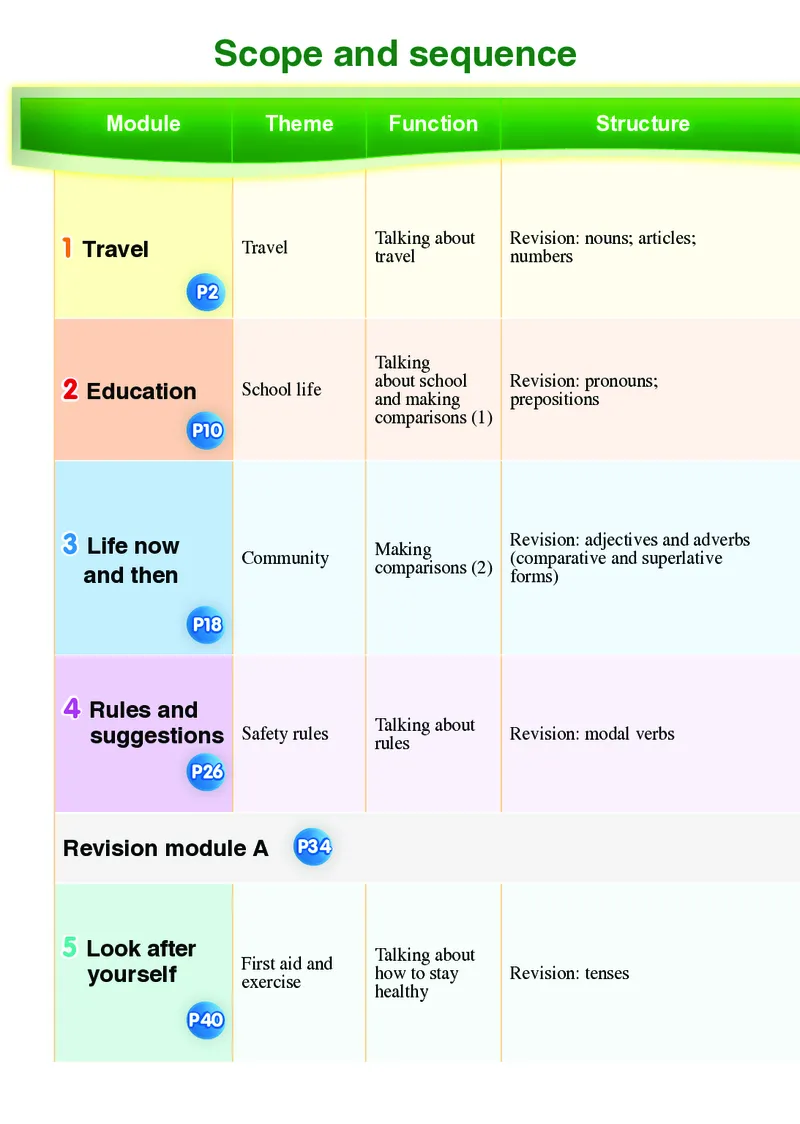
活运用和自由交际。Scope and sequence
Skills (Listening/Speaking/Reading/ Around the
Module Theme Function Structure Task
Writing) world
The first
Listening for specific information; taking notes
pilot to fly Writing and
1 Talking about Revision: nouns; articles; Talking about familiar topics (holidays)
Travel Travel alone across acting out a short
travel numbers Predicting; reading for specific information
the Atlantic play
Writing a short play about a trip
Ocean
P2
Talking Listening for specific information; taking notes
Making a leaflet
2 about school Revision: pronouns; Talking about familiar topics (schools) No teachers
Education School life about your
and making prepositions Reading for specific information needed?
school
comparisons (1) Writing about school life
P10
Listening for specific information; taking notes
Expressing views and opinions
3 Life now Revision: adjectives and adverbs
Making Predicting; reading for main ideas; summarising main ideas in Organising a
Community (comparative and superlative Cars
comparisons (2) notes debate
and then forms)
Writing a composition about the advantages and
disadvantages of life today
P18
4 Listening for specific information; taking notes
Rules and
Describing rules and suggestions Writing advice
Talking about
suggestions Safety rules Revision: modal verbs Reading for specific information Ecotourism for visitors to
rules
Writing a passage about looking after the countryside and China
P26 yourself
Revision module A P34
5
Look after Listening for specific information
Talking about
First aid and Describing an accident Laughter for Giving health
yourself how to stay Revision: tenses
exercise Reading for specific information health advice to people
healthy
Writing rules for a healthy life
P40Skills (Listening/Speaking/Reading/ Around the
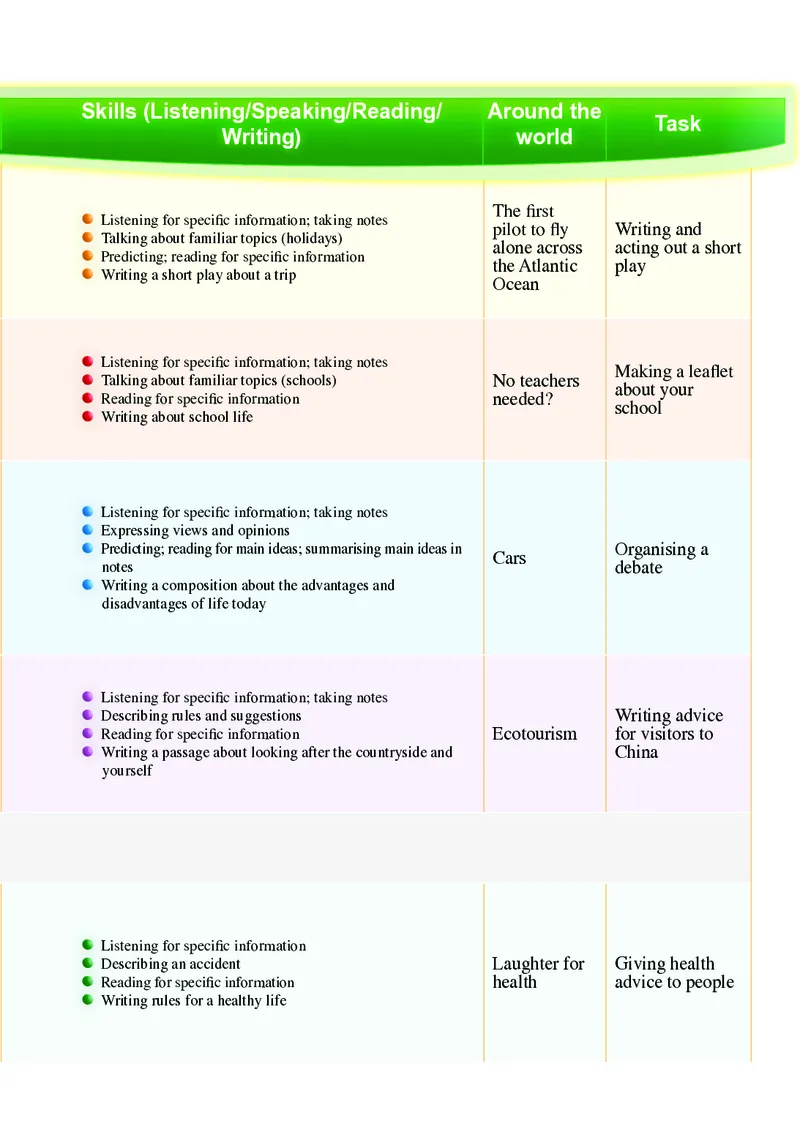
Module Theme Function Structure Task
Writing) world
The first
Listening for specific information; taking notes
pilot to fly Writing and
1 Talking about Revision: nouns; articles; Talking about familiar topics (holidays)
Travel Travel alone across acting out a short
travel numbers Predicting; reading for specific information
the Atlantic play
Writing a short play about a trip
Ocean
Talking Listening for specific information; taking notes
Making a leaflet
2 about school Revision: pronouns; Talking about familiar topics (schools) No teachers
Education School life about your
and making prepositions Reading for specific information needed?
school
comparisons (1) Writing about school life
Listening for specific information; taking notes
Expressing views and opinions
3 Life now Revision: adjectives and adverbs
Making Predicting; reading for main ideas; summarising main ideas in Organising a
Community (comparative and superlative Cars
comparisons (2) notes debate
and then forms)
Writing a composition about the advantages and
disadvantages of life today
4 Listening for specific information; taking notes
Rules and
Describing rules and suggestions Writing advice
Talking about
suggestions Safety rules Revision: modal verbs Reading for specific information Ecotourism for visitors to
rules
Writing a passage about looking after the countryside and China
yourself
Revision module A
5
Look after Listening for specific information
Talking about
First aid and Describing an accident Laughter for Giving health
yourself how to stay Revision: tenses
exercise Reading for specific information health advice to people
healthy
Writing rules for a healthy lifeSkills (Listening/Speaking/Reading/ Around the
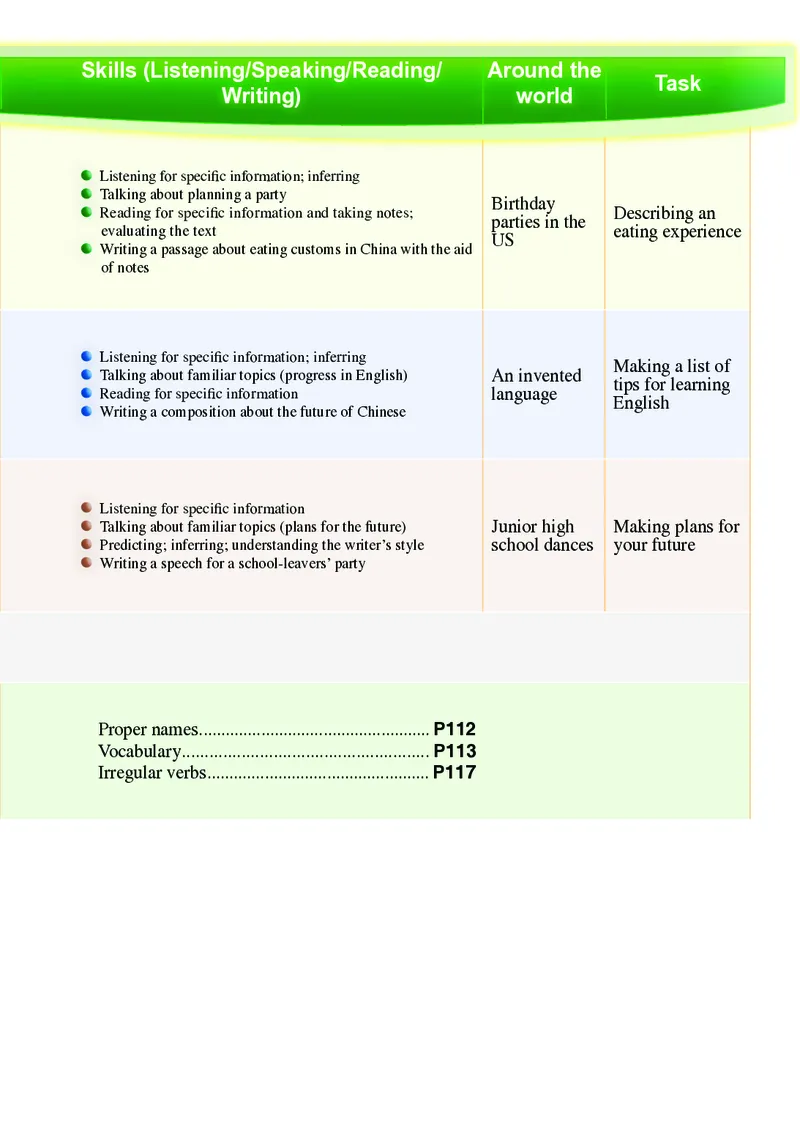
Module Theme Function Structure Task
Writing) world
6 Listening for specific information; inferring
Eating
Talking about planning a party
Talking about Birthday
together Reading for specific information and taking notes; Describing an
Eating customs meals and Revision: passive voice parties in the
evaluating the text eating experience
eating customs US
Writing a passage about eating customs in China with the aid
of notes
P48
7
English for Describing Listening for specific information; inferring
Making a list of
Language and language, Revision: adverbial clauses; Talking about familiar topics (progress in English) An invented
you and me tips for learning
culture people, and infinitives Reading for specific information language
English
things Writing a composition about the future of Chinese
P56
8
My future Listening for specific information
School life and Making future Revision: object clauses; Talking about familiar topics (plans for the future) Junior high Making plans for
life
friends plans attributive clauses Predicting; inferring; understanding the writer’s style school dances your future
Writing a speech for a school-leavers’ party
P64
Revision module B P72
Appendices Language notes............................................... P80 Proper names.................................................... P112
Guide to language use..................................... P89 Vocabulary...................................................... P113
Words and expressions.................................... P108 Irregular verbs.................................................. P117Skills (Listening/Speaking/Reading/ Around the
Module Theme Function Structure Task
Writing) world
6 Listening for specific information; inferring
Eating
Talking about planning a party
Talking about Birthday
together Reading for specific information and taking notes; Describing an
Eating customs meals and Revision: passive voice parties in the
evaluating the text eating experience
eating customs US
Writing a passage about eating customs in China with the aid
of notes
7
English for Describing Listening for specific information; inferring
Making a list of
Language and language, Revision: adverbial clauses; Talking about familiar topics (progress in English) An invented
you and me tips for learning
culture people, and infinitives Reading for specific information language
English
things Writing a composition about the future of Chinese
8
My future Listening for specific information
School life and Making future Revision: object clauses; Talking about familiar topics (plans for the future) Junior high Making plans for
life
friends plans attributive clauses Predicting; inferring; understanding the writer’s style school dances your future
Writing a speech for a school-leavers’ party
Revision module B
Appendices Language notes............................................... P80 Proper names.................................................... P112
Guide to language use..................................... P89 Vocabulary...................................................... P113
Words and expressions.................................... P108 Irregular verbs.................................................. P117odu
M l
e
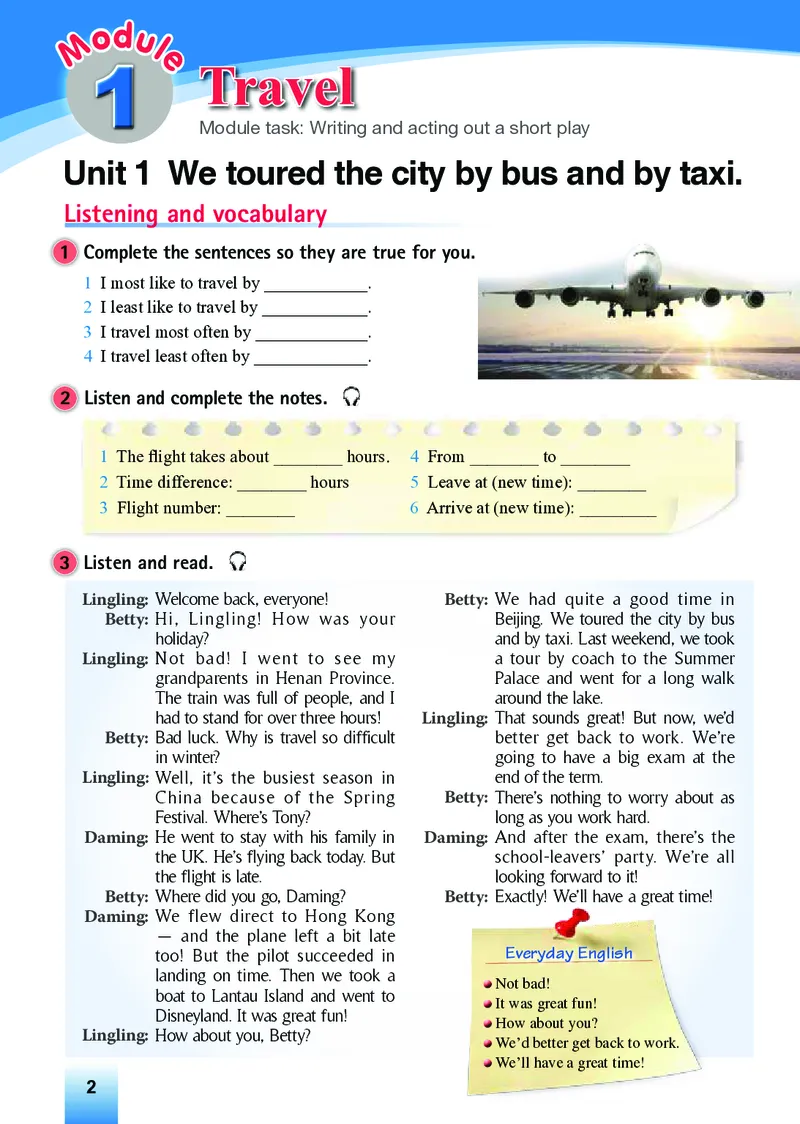
1 Travel
Module task: Writing and acting out a short play
Unit 1 We toured the city by bus and by taxi.
Listening and vocabulary
1 Complete the sentences so they are true for you.
1 I most like to travel by ____________.
2 I least like to travel by ____________.
3 I travel most often by _____________.
4 I travel least often by _____________.
2 Listen and complete the notes.
1 The flight takes about ________ hours. 4 From ________ to ________
2 Time difference: ________ hours 5 Leave at (new time): ________
3 Flight number: ________ 6 Arrive at (new time): _________
3 Listen and read.
Welcome back, everyone! We had quite a good time in
Lingling: Betty:
Hi, Lingling! How was your Beijing. We toured the city by bus
Betty:
holiday? and by taxi. Last weekend, we took
Not bad! I went to see my a tour by coach to the Summer
Lingling:
grandparents in Henan Province. Palace and went for a long walk
The train was full of people, and I around the lake.
had to stand for over three hours! That sounds great! But now, we’d
Lingling:
Bad luck. Why is travel so difficult better get back to work. We’re
Betty:
in winter? going to have a big exam at the
Well, it’s the busiest season in end of the term.
Lingling:
China because of the Spring There’s nothing to worry about as
Betty:
Festival. Where’s Tony? long as you work hard.
He went to stay with his family in And after the exam, there’s the
Daming: Daming:
the UK. He’s flying back today. But school-leavers’ party. We’re all
the flight is late. looking forward to it!
Where did you go, Daming? Exactly! We’ll have a great time!
Betty: Betty:
We flew direct to Hong Kong
Daming:
- and the plane left a bit late
too! But the pilot succeeded in Everyday English
landing on time. Then we took a
Not bad!
boat to Lantau Island and went to
It was great fun!
Disneyland. It was great fun!
How about you?
How about you, Betty?
Lingling:
We’d better get back to work.
We’ll have a great time!
2Unit 1
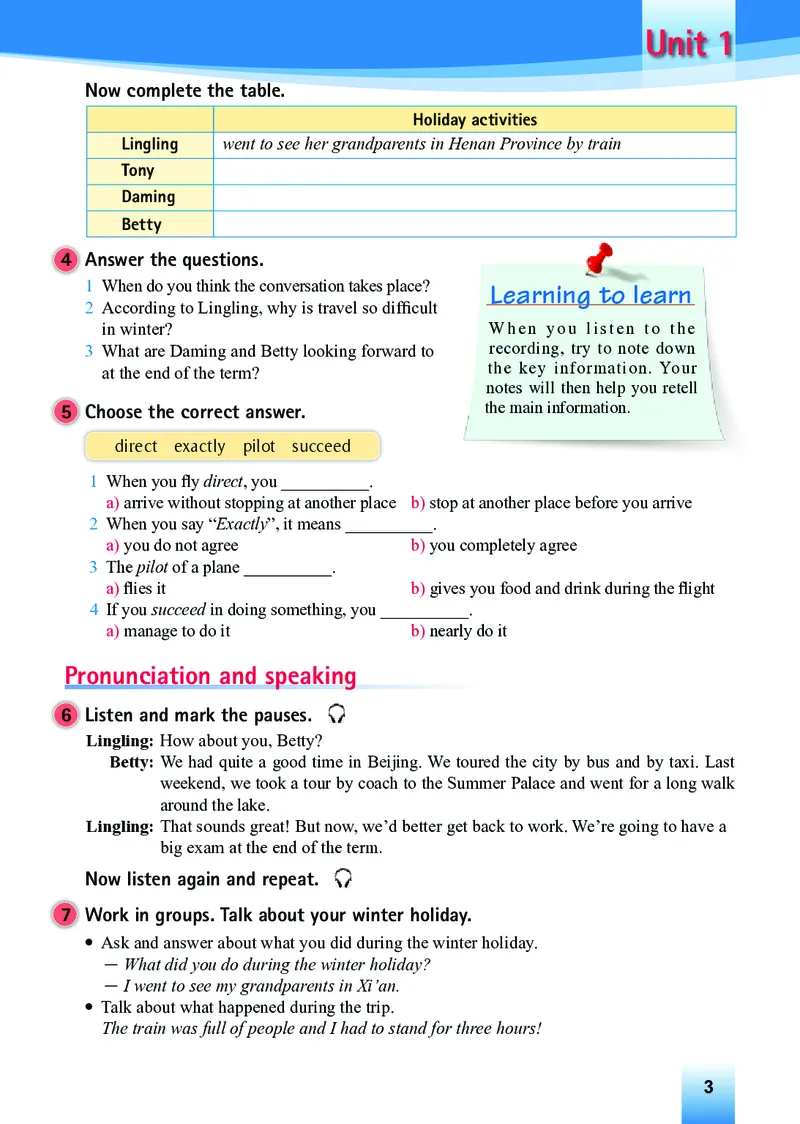
Now complete the table.
Holiday activities
Lingling went to see her grandparents in Henan Province by train
Tony
Daming
Betty
4 Answer the questions.
1 When do you think the conversation takes place? Learning to learn
2 According to Lingling, why is travel so difficult
in winter? When you listen to the
3 What are Daming and Betty looking forward to recording, try to note down
at the end of the term? the key information. Your
notes will then help you retell
5 Choose the correct answer. the main information.
direct exactly pilot succeed
1 When you fly direct, you __________.
a) arrive without stopping at another place b) stop at another place before you arrive
2 When you say “Exactly”, it means __________.
a) you do not agree b) you completely agree
3 The pilot of a plane __________.
a) flies it b) gives you food and drink during the flight
4 If you succeed in doing something, you __________.
a) manage to do it b) nearly do it
Pronunciation and speaking
6 Listen and mark the pauses.
Lingling: How about you, Betty?
Betty: We had quite a good time in Beijing. We toured the city by bus and by taxi. Last
weekend, we took a tour by coach to the Summer Palace and went for a long walk
around the lake.
Lingling: That sounds great! But now, we’d better get back to work. We’re going to have a
big exam at the end of the term.
Now listen again and repeat.
7 Work in groups. Talk about your winter holiday.
● Ask and answer about what you did during the winter holiday.
- What did you do during the winter holiday?
- I went to see my grandparents in Xi’an.
● Talk about what happened during the trip.
The train was full of people and I had to stand for three hours!
3M
odu
l
e
1
Travel
Unit 2 It’s a long story.
Reading and vocabulary
1 Look at the expressions from the play in Activity 2. What do you think the play will
be about?
□ 1 ... gets up and starts to... □ 3 ... goes past people...
□ 2 ... looks for his ticket... □ 4 ... gets on the train...
2 Read the play and number the expressions in Activity 1 in the order they appear.
(Li Lin and Li Wei are on the station platform, Oh, how stupid of me! I’d
Elderly man:
saying goodbye to each other.) better go and find Car 9.
Tell Mum and Dad I’ll miss (The elderly man gets up and starts to collect
Li Lin:
them... I’ll miss you all. his bags.)
And we’ll miss you too. Wait a moment, sir! Please
Li Wei: Li Lin:
See you at the Spring Festival. stay here. I’ll take your seat in
Li Lin:
Take care. Bye! Car 9.
Li Wei:
(Li Lin gets on the train and looks for his seat.) Well, that’s very good of you.
Elderly man:
Excuse me, sir. I’m afraid Thank you.
Li Lin:
you’re sitting in my seat. Yes, thank you, young man.
Ticket officer:
I’m sorry, young man. What (Li Lin goes past people standing in the train
Elderly man:
did you say? I can’t hear very to Car 9.)
well. 10A… 11A… 12A, here it is.
Li Lin:
You’ve taken the wrong seat. That’s my seat.
Li Lin:
Really? But… I thought it was (His friend, Wen Peng, is sitting in Seat 12B.
Elderly man:
my seat. Where’s my ticket? He is surprised to see Li Lin.)
(The elderly man looks for his ticket in his Hi, Li Lin! What a surprise!
Wen Peng:
pocket, his bag and finally in his wallet.) Hey, Wen Peng! It’s great to
Li Lin:
Here it is. Car 9, Seat 12A. see you.
Elderly man:
This is Seat 12A, isn’t it? Great to see you too. Wonderful!
Wen Peng:
(The ticket officer arrives.) I’ll have someone to talk to on
Tickets, please. Please have the long journey. Now, take
Ticket officer:
your tickets ready. off your jacket. Sit down and
Excuse me, is this Seat 12A? make yourself comfortable.
Elderly man:
Yes, it is. Let’s have a look But why are you so late?
Ticket officer:
at your ticket. Oh, I see the Oh, it’s a long story…
Li Lin:
problem. This is Seat 12A,
but you should be in Car 9.
This is Car 8.
4Unit 2
3 Choose the correct answer.
1 Where are Li Lin and Li Wei?
a) They are at home. c) They are on the train.
b) They are at the railway station. d) They are in a car.
2 Who is Li Wei?
a) She is Li Lin’s sister. c) He is Li Lin’s father.
b) She is Li Lin’s friend. d) He is Li Lin’s classmate.
3 Why is the elderly man sitting in Li Lin’s seat?
a) Because he did not buy a ticket. c) Because he thinks it is his seat.
b) Because he is too tired to move. d) Because he cannot find his seat.
4 What does the elderly man want to do?
a) Take the seat. c) Change seats with Li Lin.
b) Go and find Car 9. d) Buy another ticket.
5 What does Li Lin decide to do?
a) Take the seat from the elderly man. c) Change seats with the elderly man.
b) Ask the ticket officer for help. d) Get off the train.
6 Who does Li Lin meet in Car 9?
a) Li Wei. c) His friend.
b) Another elderly man. d) His classmate.
4 Complete the passage with the words and expressions in the box.
afraid miss officer sir take care take off
Li Lin says goodbye to his sister Li Wei. Li Lin says that he will (1) ____________ his
family, and Li Wei tells him to (2) ____________. When Li Lin gets on the train, he sees an
elderly man sitting in his seat. He politely calls the elderly man (3) ____________ and says
he is (4) ____________ the elderly man is sitting in his seat. The ticket (5) ____________
arrives and explains the mistake. Li Lin kindly offers to change seats with the elderly man,
and goes to Car 9. There he sees his friend Wen Peng, who is happy to see him and
tells him to (6) ____________ his jacket, sit down and make himself comfortable.
Writing
5 Write a short play about a trip you have made. Think about:
● when and where you went ● what happened during the trip
● how you travelled ● how the story ended
● who travelled with you
Now write the play.
5odu
M l
e
1
Travel
Unit 3 Language in use
Language practice
He went to stay with his family in the UK.
Why is travel so difficult in winter?
We flew direct to Hong Kong.
We took a tour by coach to the Summer Palace.
Then we took a boat to Lantau Island and went to Disneyland.
This is Seat 12A, but you should be in Car 9. This is Car 8.
1 Complete the conversation with a, an, the or zero article where necessary.
A: I’m really looking forward to (1) __________ summer holiday. We’re taking (2) __________
trip to (3) __________ Paris!
B: How wonderful! It’s (4) __________ interesting and beautiful city. How long will
(5) __________ flight take?
A: The flight takes about (6) __________ hour. When we arrive, we will get to our hotel
by (7) __________ bus. (8) __________ hotel is right in (9) __________ centre of
(10) __________ city, so we can visit all the famous places.
B: Are you planning to visit (11) __________ Louvre Museum?
A: Yes, we are.
2 Underline the correct words.
1 Children have to go to school / the school when they are six years old.
2 I’m a teacher at school / the school on the corner.
3 He’s got a lovely garden. Flowers / The flowers in it are really beautiful.
4 Make sure you get to the airport in time / in the time for your plane.
5 - How many CDs have you got?
- Only few / a few.
6 That’s most / the most interesting news I’ve heard for a long time.
7 How long have Whites / the Whites lived here?
66Unit 3
3 Complete the sentences with the words in the box.
flight landed ready seat station tour
1 She had an important meeting that afternoon, so she had to take an earlier __________.
2 Please take your __________.
3 Sam went with Jane to the railway __________ to see her off.
4 It is wonderful to __________ the streets of the city.
5 Flight KA846 from Hong Kong __________ five minutes ago.
6 “Please have your tickets __________,” said the ticket officer.
4 Complete the sentences with the expressions in the box.
As long as because of full of looking forward to make yourself comfortable
1 They will not arrive on time _______________________ the bad weather.
2 Everyone in China is _______________________ seeing their family members during the
Spring Festival.
3 Lie down on your bed and _______________________.
4 The journey was _______________________ exciting experiences.
5 _______________________ you can come by six, I will be here.
5 Listen and complete the notes.
London to Sydney Sydney to London
● London – Hong Kong: _______ hour(s) ● Sydney – London: _______ hour(s)
Hong Kong – Sydney: _______ hour(s) ● Price of flight: £_______
● From airport to centre of Hong Kong: ● Price of flight and hotel near airport:
_______ hour(s) £_______
● Price of flight: £_______ ● From airport to centre of Sydney:
● Price of flight and hotel: £_______ _______ kilometres
6 Work in pairs. Look at the notes you have made in Activity 5. Talk about:
● Which flight takes a longer time?
● Which flight is more expensive?
77odu
M l
e
1
Travel
7 Read the passage and complete the table.
Concorde could
carry one hundred passengers
and flew faster than the speed of sound.
Many people think Concorde was one of the greatest planes. But now Concorde
is just part of history.
For twenty-seven years, passengers travelled across the Atlantic Ocean on this
plane. Most of them were businesspeople, film stars, rock stars and sports heroes.
Flying at more than twice the speed of sound, Concorde took people from London or
Paris to New York in just over three hours.
The invention of Concorde was a huge step forward. The plane was like a time
machine. If Concorde left London at 10:30 am, it arrived in New York at about 8:30
am (1:30 pm London time) the same day.
However, the plane had many problems. It was very noisy. Some believed that its
noise was bad for the environment, and that it could hurt people’s ears. In a terrible
accident in 2000, near Paris, 113 people died, and after that fewer people wanted
to fly on Concorde. It became too expensive to continue the service. At the end of
October 2003, Concorde stopped flying.
Advantage of Concorde Disadvantage of Concorde
8 Read the passage again and answer the questions.
1 How many passengers could Concorde carry?
2 Why do many people think Concorde was one of the greatest planes?
3 How many hours did Concorde take to fly from London or Paris to New York?
8Unit 3
9 Work in pairs. Talk about your recent travel experience. Say:
● how you travelled
● how long the journey took
● how you felt about it
Now write a passage about your experience.
Around the w rld
The first pilot to fly alone across the Atlantic Ocean
In 1919, a pilot named Charles Lindbergh from St Louis,
the US, decided to try to fly from New York to Paris. It took
him some time, but eventually he developed the right plane.
In April 1927 his plane, Spirit of St Louis, was completed. It
was three metres high and weighed 975 kilos.
Lindbergh took off from New York on 20th May 1927.
He flew for about thirty-three hours over 5,800 kilometres
through freezing weather and fog. He had no sleep, but
when he arrived in Paris, he was very happy. He was the
first person to fly alone across the Atlantic Ocean without
stopping. He became a hero in the US and in France.
Module task:
Writing and acting out a short play
1 0 Work in groups. Find a news story about a good deed and turn it into a short
play. Decide:
● the characters
● the place and time
● the plot
Now write the play.
1 1 Decide who will play each character.
1 2 Act out the play to the whole class.
9odu
M l
e
2 Education
Module task: Making a leaflet about your school
Unit 1 They don’t sit in rows.
Listening and vocabulary
1 Work in pairs and talk about your school.
- What do you like best about our school?
- I like...
2 Listen and complete the sentences.
1 The weather was ____________ when Tony was in
London.
2 Tony played football with ____________.
3 Daming is surprised to hear that Tony ____________.
4 Tony didn’t go to lessons. He was ____________.
3 Listen and read.
Hey, Tony! Did you enjoy yourself in London?
Betty:
Yes! I went to see my friend Susie. And I visited her school.
Tony:
What are English schools like?
Betty:
Here are a few photos. I took them myself.
Tony:
Let’s have a look.
Daming:
So this is Susie’s school. It’s got about 700 pupils, like most schools in England.
Tony:
How many pupils are there in a class in England?
Betty:
About thirty.
Tony:
We have forty in our class. So ours is a bit bigger. Look, everyone is wearing a
Daming:
jacket and tie!
Yes, every student wears school clothes in England.
Tony:
And everyone is sitting around tables in the classroom.
Daming:
That’s right. They don’t sit in rows. Look at the swimming pool and the huge
Tony:
sports ground. Most English schools have sports grounds. Kids there really
enjoy playing football.
We like playing football too. And we also have an
Daming:
excellent swimming team. Everyday English
I hope I can visit Susie’s school one day. It looks
Betty:
Did you enjoy yourself?
really great.
Let’s have a look.
Our school is great too, and we have more
Tony:
It looks really great.
students here. This means more people to play with.
And more friends too.
Betty:
10Unit 1
Now complete Susie's column in the table.
Susie's school Your school
Number of pupils in the school
Number of pupils in a class
Arrangement of seats in
the classroom
Sports areas
4 Answer the questions.
1 Who did Tony visit in London?
2 How did Tony get the photos of Susie’s school?
3 Which class is a bit bigger, Susie’s or Daming’s?
4 What does Betty hope to do one day?
5 Complete the passage with the correct form of the words in the box.
enjoy pool row tie wear
Pupils in England do not sit in (1) _____________ in the classroom. They sit around
tables. Everyone (2) _____________ a jacket and (3) _____________. Most schools have
sports grounds, and English children (4) _____________ playing football, just as pupils in
China do. Some English schools have swimming (5) _____________, but not all of them do.
Pronunciation and speaking
6 Read and predict which words the speaker is likely to stress.
Betty: Hey, Tony! Did you enjoy yourself in London?
Tony: Yes! I went to see my friend Susie. And I visited her school.
Betty: What are English schools like?
Tony: Here are a few photos. I took them myself.
Now listen and check.
7 Work in pairs. Read the conversation in Activity 6 aloud.
8 Complete the Your school column in Activity 3.
Now work in pairs and compare your school with Susie's school. Say:
● what both schools have
● what one school has but the other does not
11M
odu
l
e
2
Education
Unit 2 What do I like best about school?
Reading and vocabulary
1 Look at the photos and say what you can see.
a b c
2 Read the passage and answer the questions.
1 How long has Susie been at River School?
2 How long does her schoolday last?
3 Do all the students at River School have the same subjects?
4 How do you like Susie’s school life? Why?
My school life
My name is Susie Thompson, and I’m This year I have ten subjects: maths,
fifteen. I’ve been at River School, London, English, physics, chemistry, French, history,
since I was eleven. If I pass my exams next geography, music, IT and PE. Some people
year, I’ll stay here until I’m eighteen. learn German instead of French. It’s lucky we
River School is a secondary school, about don’t have exams in every subject.
twenty minutes away from my home by bike. We have a large sports ground for football
Before I came here, I went to the primary and tennis, where we can play both during
school near my home. I started primary and after school hours. After-school activities,
school when I was five and stayed there for such as sports clubs and language societies,
six years. are popular too. During the school year there
We go to school every weekday from 8∶45 are usually visits to museums and to camps
am to 3∶15 pm. Before class, our teacher for activities such as climbing and walking
checks which pupils are present or absent. in the country. Last year a group of us even
Then everyone goes to the main hall. There, went to Japan. There are parties and a sports
our head teacher tells us news about the day, and school plays are really popular.
school. At 9∶05 am the bell rings, and lessons Once a term, there is a parents’ meeting, so
start. Each lesson lasts for an hour. We have our parents and teachers can talk about our
a break from 11∶05 am until 11∶15 am, then progress.
another lesson, and then lunch for an hour. What do I like best about school? English,
In the afternoon, we have two more lessons chemistry, music, sports clubs, school plays…
before school finishes. and above all, my friends!
12Unit 2
3 Put the statements into the correct group.
1 Susie has been at school since she was five and she will be at school until she is eighteen.
2 All schools in the UK are like River School.
3 Lessons start at 9:05 am.
4 The fourth lesson starts at 1:15 pm.
5 There is a parents’ meeting each term.
We can get the information from the passage directly:
We can get the information from the passage indirectly:
We cannot get the information from the passage:
4 Complete the questions with the words in the box.
absent bell pass weekdays
1 When do you hear a at school? Learning to learn
2 Who is from school today? When you write a composition,
remember:
3 What do you usually do on ?
Write about what you know best.
4 How many marks do you need to This usually means your family,
friends, school and yourself.
the English exam? Use something you have read as
Now work in pairs. Ask and answer. a model. So My school life can be a
model for your writing.
Use ideas and sentences from the
Writing model and change the details. This
will help you decide what to write and
how to write it.
5 Make a timetable for your schoolday.
Time when school starts Afternoon lessons
Morning lessons Time when school ends
Lunch break After-school activities
6 Make a list of other events and activities during your school year.
7 Write a passage about your school life. Use the timetable in Activity 5 and the
list you made in Activity 6 to help you. Say:
● when you go to school ● what subjects you are taking this term
● how you get there ● what other events and activities there are
● how long you have been at this school during your school year
● what your daily timetable is ● what you like best about school
My name is Zhang Lin and I’m a pupil at No 1 Junior High School in…
13odu
M l
e
2
Education
Unit 3 Language in use
Language practice
I took them myself.
So ours is a bit bigger.
Everyone is wearing a jacket and tie!
We go to school every weekday from 8:45 am to 3:15 pm.
We have a large sports ground for football and tennis, where we can play both during
and after school hours.
1 Underline the correct words.
Anna: Hi, Bob. How did your exams go last term?
Bob: Great! I got good marks in (1) both / each maths and geography. What about you?
Anna: I did really well in English. That’s (2) anything / something I’ve always enjoyed. My
marks in history and art weren’t so good because (3) none / neither is my favourite
subject. What will you study this term?
Bob: I’ve still got (4) a few / few days before I have to decide. I’m going to speak to
(5) both / all my teachers and ask for their advice.
Anna: The teachers say that we must decide for (6) themselves / ourselves and that (7) none /
neither of them can tell us what to do.
Bob: But I have to get (8) some / any information because there are so (9) much / many
subjects and it’s very hard to choose.
2 Complete the passage with the words and expression in the box.
both each other His mine myself
A good teacher is someone who is helpful and kind, like my history teacher, Mr Miller.
(1) ___________ knowledge of the subject is excellent. Because of him, I love history and
even read history books by (2) ___________ after the lessons. A friend of (3) ___________
called Mark also loves this subject and sometimes we lend (4) ___________ books or DVDs
about history. I like reading (5) ___________ Western and Chinese history books, but I think
Chinese history is my favourite subject.
14Unit 3
3 Complete the sentences with the correct form of the words in the box.
he her him himself our she
their themselves they us we
1 John’s homework is too difficult. _________ is not able to do it _________, so I’m going
to help _________ with it.
2 Some people do not have time to wash _________ pets _________, so _________ pay
someone to do it at the pet shop.
3 - Jane is doing a project about family history. _________ has asked us to give
_________ some of _________ photos that were taken when we were young. Have
_________ got any, Becky?
- Yes, there is a photo of _________ with all the children in our family.
4 Complete the passage with the words in the box. You need to use one word
more than once.
at for in on
The school cinema shows lots of foreign films. Next week (1) ______ Friday and
Sunday it is showing a French film called Never Say Goodbye. The story is set (2) ______
Paris (3) ______ the 1960s. The film lasts two hours and fifteen minutes and starts
(4) ______ 6∶30 and 9∶30 (5) ______ the evenings. Tickets are £5, but there is a special
half-price ticket (6) ______ students from our school. Please bring your student card if you
want a cheap ticket.
5 Complete the sentences so they are true for you.
1 I study _______ subjects: English, ____________________________________________.
2 I don’t study _____________________________________________________________.
3 I take exams in ___________________, but I don’t take exams in ___________________.
4 My favourite sport is ________________ because _______________________________.
5 I usually play sports on ____________________________________________________.
6 After-school activities, such as _____________________ are very popular at our school.
6 Listen and answer the questions.
1 Where does Kate want to go on holiday next year?
2 What game has Pete played since primary school?
3 When do Kate and Pete have sports practice?
15odu
M l
e
2
Education
7 Listen again and complete the table.
School year Special subject Club Sport Plan for next year
Kate
Pete
8 Read the passage and say where you think it comes from.
a) A dictionary. b) A school website. c) A storybook.
1 The schoolday begins at 9 am. Class choose one subject from history, geography,
teachers meet the class and check who is art, French and Chinese. All the students
present or absent at the start of the day. All take PE lessons, but no exams are required.
the classes meet once a week on Fridays. 3 The chess, music, language and theatre
The head teacher speaks to the whole clubs often have meetings after school.
school. Morning lessons begin at 9∶20 am. Students may join as many clubs as they
There are three forty-minute lessons, with a like, but they must join at least one.
twenty-minute break in between. The lunch 4 After-school sports practice and matches
break is from 12 pm to 1 pm. Afternoon take place on Wednesday afternoons and
lessons begin at 1 pm and the schoolday Saturday mornings. The school has a good
finishes at 3 pm. record in sports. Last year, we were the best
2 All the students study and take exams in football and tennis, and some students
in maths, science and English. They also won prizes for swimming and running.
Now match the headings with the paragraphs.
a) Clubs □ b) School hours □ c) Sports □ d) Subjects □
1166Unit 3
9 Read the passage again and check (√) the true sentences.
1 The head teacher speaks to the whole school on Fridays. □
2 The lunch break is less than one hour. □
3 Students take exams in all the subjects they study. □
4 Students can join more than one club. □
Around the w rld
No teachers needed?
When it comes to learning, the environment has a big
part to play. This has been shown in a long-term study
by Professor Mitra from India. He set up computers
in a village in India where children could not speak
English. They did not know what a computer looked
like or what the Internet was. To everyone’s surprise,
children taught themselves how to use the machines in
a very short period of time. This suggests that children
can learn fast with little help. Professor Mitra thinks
this could change schools. He is now working on so-
called SOLEs (Self-Organised Learning Environments).
He explains that SOLEs include at least a computer and
a bench big enough for four pupils. SOLEs have also
been tested in some other countries such as the UK and
Italy, with encouraging results.
Module task:
Making a leaflet about your school
1 0 Work in pairs. Discuss and write sentences about your school.
● Write sentences about the facts.
There are… students and... teachers in our school. Students can study…
After school, there are… and…
● Write sentences about your opinions.
The thing I like best about our school is… because…
1 1 Make a leaflet about your school for new students.
● Make a leaflet to introduce your school to new students. Use the sentences in Activity 10.
● Draw pictures and make designs where necessary.
17odu
M l
e
3 Life now and then
Module task: Organising a debate
Unit 1 They sometimes work harder.
Listening and vocabulary
1 Talk about the photo. Say what life was like
in the early 1980s and what life is like today.
There weren’t so many cars as there are today.
2 Listen and answer the questions.
1 What is the history homework?
2 What is the question they need to answer?
3 What does Betty ask?
4 What does Daming ask?
3 Listen and read.
It’s getting late, Betty. How is your number of cars is doubled, the
Mum:
homework? pollution is also doubled, or even
Nearly finished. Mum, do you think worse.
Betty:
that life is better today than in the What about work? Do people work
Betty:
past? as hard as they did fifty years ago?
Yes, of course, I do. Yes, and they sometimes work
Mum: Mum:
I do too. People are wealthier today, harder. People seldom say they have
Betty:
and they live longer than they did in enough spare time! Why don’t you
the past. go and ask Mrs Li, our neighbour?
That’s true. We know more about She’s over seventy years old. She’s
Mum:
medicine today, and there’s less fear seen how life has changed.
of getting ill because we know how That’s a good idea. I’ll go and ask
Betty:
to deal with the ordinary diseases. But her.
people don’t take as much exercise as Remember to speak up! She’s a bit
Mum:
they used to. deaf now.
I suppose that’s because more
Betty:
people have cars, and they walk or
use their bikes less. Everyday English
Mum: Some people think life in the past Nearly finished.
was simpler and healthier than That’s true.
today. More wealth sometimes I suppose…
means less health. When the
18Unit 1
Now choose the correct answer.
1 People live longer today because ______. 3 People take less exercise because ______.
a) we know more about medicine a) they do not need to
b) they do not work as hard as they did b) they drive cars instead
c) they take more exercise c) they do not have cars or bikes
2 There is less fear of getting ill ______. 4 People work harder today and ______.
a) so people live longer a) they do not live as long as they did
b) because people know how to deal with b) they do not usually have enough free time
the ordinary diseases c) they live a healthier life
c) so people work harder than before
4 Complete the questions with the words or expression in the box.
deaf doubled fear spare used to wealth
1 What kinds of things do you ____________?
2 What do you do in your ____________ time?
3 What can someone not do if they are ____________?
4 If something is ____________, is it more or less?
5 Do you think people ____________ take more exercise than they do today?
6 Do you think people have more ____________ today than they used to?
Now work in pairs. Ask and answer.
Pronunciation and speaking
5 Read and predict which words the speaker is likely to stress.
Some people think life in the past was simpler and healthier than today. More wealth
sometimes means less health. When the number of cars is doubled, the pollution is also
doubled, or even worse.
Now listen and check.
6 Read the paragraph in Activity 5 aloud.
7 Work in pairs. Answer the question and give your reasons.
- Is life better today than in the past?
-Yes, it is. I think it’s because... / No, it isn’t. I think...
Now say what is better or worse in:
● education ● environment ● health
19M
odu
l
e
3
Life now and then
Unit 2 I think life is better today.
Reading and vocabulary
1 Look at the woman in the photo. How do
you think she feels? Think about what
she will talk about:
● family ● work
● health ● education
2 Read the passage and take notes on what Mrs Li says about the points in
Activity 1.
Life now and then
By Betty King
Mrs Li is over seventy years old. She has child! The role of women has changed too.
lived in Beijing all her life. I asked her about My daughter is really lucky. She has a good
life today and in the past. education, and she goes to work even after
getting married. I’m happy to see she’s busy
What was your life like in the past?
working every day, but sometimes I feel lonely
My family lived in a tiny house. There were
because she can’t come to see me often.
no electric lights, only candles. My father
Transport and travel are easier today. When
was a postman, and he often worked twelve
I was young, I went everywhere on foot or
hours a day outside in the winter cold or in the
sometimes by bike. Now you can take the bus
summer heat. My mum was a farm girl before
everywhere, and there’s also the underground.
she met my father. She was a kind and loving
And you young people can take a plane to
mother. She didn’t go out to work. There were
anywhere in the world. The only thing I don’t
five children in my family, and looking after us
like, though, is that there’s so much more
was more than a full-time job.
traffic. It’s so difficult to cross the road.
I remember the family meals. The food
Of course, we didn’t have television when I
was simple. We could only eat meat once or
was a child. I really enjoy watching television
twice a year. I wasn’t sent to school because
today. There’re so many good programmes,
my family couldn’t afford it, and what’s more,
like the Beijing Opera and old films. But some
because I was a girl.
of the shows are too noisy for me.
How has life changed? Generally speaking, I think life is better
Families have got smaller than they were today. We eat better and we live longer.
in the past. Today most people only have one
20Unit 2
Now complete the notes and add more points of your own.
Life in the past Life now
1 Family: bigger; five children 1 Family: smaller; one child
2 Food: 2
3 Work: 3
4 Education: 4
3 Complete the passage with the words and expression in the box.
candles cold generally speaking postman tiny traffic
Mrs Li’s father was a (1) __________. He often worked outside for twelve hours a day in
the summer heat or in the winter (2) __________. They lived in a (3) __________ house and
used (4) __________ for light. Mrs Li says that (5) __________, life is better today. But
not everything is satisfying. There are some things that she is not happy with, for example,
the (6) __________.
Writing
4 Write a passage about the advantages and disadvantages of life today.
● Choose two or three points from the notes in Activity 2 to write about.
Families are smaller…
● Give examples or reasons to support those points.
Most people only have one child today.
● For each of the points you choose, write about an advantage and/or a disadvantage. Use the
words however, but, although or used to where appropriate.
Families are smaller because most people only have one child today. As a result, families
have more money to spend on their child. However, an only child may feel lonely…
● Finish the passage with your conclusion.
Generally speaking, I think…
5 Present your passage to the class.
21odu
M l
e
3
Life now and then
Unit 3 Language in use
Language practice
People are wealthier today, and they live longer than they did in the past.
But people don’t take as much exercise as they used to.
More people have cars, and they walk or use their bikes less.
We eat better and we live longer.
1 Complete the passage with the correct form of the words in brackets.
For many people, life is a lot (1) __________ (easy) today. Medicine and diet are
improving, and people are getting (2) __________ (healthy) and living (3) __________
(long). But communication is changing (4) __________ (fast) of all. Today, with the
Internet, people can communicate (5) __________ (easily) than ever before with friends all
over the world.
Not all the changes are (6) __________ (good) ones. More people drive cars instead of
riding bikes, so they are not as (7) __________ (fit) as they were. Increasing traffic makes
the roads (8) __________ (crowded) than ever, and it also makes pollution (9) __________
(bad). We must all work harder to reduce pollution.
2 Work in pairs. Look at the two pictures and talk about how the town has
changed. Use the words in the box to help you.
big building busy house modern more shop street tall traffic tree
22Unit 3
3 Complete the sentences with the words or expressions in the box.
heat more than seldom spare speak up
1 We ______________ have time to go on holiday.
2 We do not have much ______________ time because we have important exams this year.
3 Never go out in the ______________ of the day without a hat.
4 You have to ______________ because the students in the back cannot hear you.
5 Mr Smith is ______________ a teacher. Most of his pupils think of him as their friend.
4 Read the email and find three examples that show life was harder in the past
than it is today.
Gran
Christine
The lives of children in Victorian Britain
Dear Christine,
You asked me for help about your school project - the lives of children in Victorian
Britain. I was also interested. I searched online and found out the following.
In Victorian Britain, thousands of people came to the cities to work in the factories.
Instead of the green, open countryside, people lived in very small houses, very
close to each other, with no space for children to play. Families in those days were
quite big. Often, there were four or five children in one family, and they all had
to sleep in houses of just two rooms. Sometimes, a whole street had to share one
outside toilet. Can you imagine that?
Most of the big cities were dirty and unhealthy. The pollution from factories filled
the air. People put their rubbish outside in the streets. As a result, there were many
illnesses.
And life was harder for children in those times. They didn’t always go to school,
because they had to work instead. Many children started work in factories when
they were only four or five years old. They worked twelve hours a day in dangerous
jobs for very little money. Many were hurt in accidents with machines.
I hope this is helpful. Write to me if you need more information.
With love,
Gran
23odu
M l
e
3
Life now and then
5 Read the email again. Find sentences that tell us:
1 There was not enough living space for people.
2 Most of the big cities were dirty and unhealthy.
Learning to learn
3 Life was harder for children in those times.
When you do a listening or
Write examples. reading exercise, you should
read the instructions carefully.
1 People lived in very small houses, very close to each
Then you can focus your
other, with no space for children to play.
attention just on the information
2 __________________________________________.
you need. You don’t have to
3 __________________________________________. understand every word.
6 Listen and complete the table.
Grandmother Mother
Age to start school
Age to start work
Age to get married
Number of children
Age to stop working
7 Write a passage comparing the lives of the speaker’s grandmother and mother
in Activity 6.
The speaker’s grandmother and mother have lived very different lives. Her grandmother
had a much bigger family…
24Unit 3
Around the w rld
Cars
The modern car has changed life a great deal. Before
the invention of the car, people had to travel by rail, on
horseback or by horse-drawn carriage, or on foot. Using
horses for travel was slow, and of course walking was even
slower. Cars allow people to travel long distances quickly,
in comfort and convenience.
The car also solved an enormous problem caused by
using horses for transport in cities: manure! There were so
many horses in large cities that it was almost impossible to
get rid of the manure. Modern people are used to the idea
that cars cause pollution, but the first cars actually made
cities cleaner!
Module task:
Organising a debate
8 Work in groups. Read the motion of the debate.
Health is more important than wealth.
Now decide who is for the motion and who is against it. You can use some of
the following ideas:
For: Against:
● Without health, wealth means nothing. ● It is hard to be healthy without wealth.
● You can enjoy life better if you are healthy. ● You can enjoy life better if you are wealthy.
9 Prepare your arguments. Give examples to support your ideas.
1 0 Hold the debate.
● Those for the motion give their opinions.
● Those against the motion give their opinions.
● Take turns to say what you think about each other’s arguments.
1 1 Discuss and find out whether most people are for or against the motion.
25odu
M l
e
4 Rules and suggestions
Module task: Writing advice for visitors to China
Unit 1 You must be careful of falling stones.
Listening and vocabulary
1 Look at the photo. Then say what suggestions you
can give to people who go walking in the mountains.
2 Listen and answer the questions.
1 When is Betty leaving for the trip?
2 What is Mr Jackson going to tell the students?
3 What does Betty’s mum suggest Betty should not do?
4 Does Betty think the trip will be dangerous?
3 Listen and read.
OK, please pay attention for a moment! Before we set off, there are a few
Mr Jackson:
rules and suggestions for you.
Yes, Mr Jackson.
All:
First, is everyone wearing strong shoes and thick socks?
Mr Jackson:
Yes, Mr Jackson.
All:
OK, whenever you go walking in the hills, you should always wear proper
Mr Jackson:
clothes. Now, you mustn’t walk too close to the edge of the hill path because
you might fall and hurt yourselves. Is that clear?
Yes.
All:
And you have to keep together so you don’t get lost. You mustn’t go off on
Mr Jackson:
your own.
No, we won’t, Mr Jackson.
All:
Can we have something to eat now? I’m starving!
Daming:
No, you can’t, Daming! You just had breakfast an hour ago. Let’s start
Mr Jackson:
walking, and we’ll stop at noon for our picnic. Don’t drink all your water in
one go. You may need some later.
Can we go rock climbing?
Betty:
No, you can’t. And you must be careful of falling stones. OK, off we go,
Mr Jackson:
down this path, and across the stream, and then
we’ll…
… have lunch?
Daming: Everyday English
… have lunch when we get up to the top. Come
Mr Jackson:
Please pay attention
on! I’ll lead the way. It should be a fairly smooth
for a moment!
walk to begin with because it’s a straight path,
but it’ll start to get difficult soon! I’m starving!
26Unit 1
Now choose the correct answer.
1 Mr Jackson gives a lot of rules and suggestions, so he probably ________.
a) is happy about walking in the hills
b) has never been to the hills
c) has a lot of experience of walking in the hills Learning to learn
2 The children might hurt themselves if they ________.
When you give suggestions,
a) walk along the edge of the hill path
you may use can, must,
b) wear proper clothes
have to, should, mustn’t and
c) drink all their water before lunch shouldn’t, depending on the
3 Before they have lunch, they ________. strength of your advice.
a) have to get up to the top
b) can have something to eat
c) can go rock climbing
4 Make notes about Mr Jackson’s rules and suggestions.
You should __________________. You can’t _____________________.
You mustn’t __________________. Don’t _____________________.
You have to __________________. You can’t _____________________.
You mustn’t __________________. You must _____________________.
5 Complete the passage with the correct form of the words in the box.
smooth stone straight thick whenever
(1) _____________ you walk in the hills, you must wear strong shoes and (2) _____________
socks. The walk may be fairly (3) _____________ at the start because the path is (4) _____________,
but later it may get difficult. You should also be careful of (5) _____________ falling from
above.
Pronunciation and speaking
6 Read and predict how the speaker is likely to link the words.
Whenever you go walking in the hills, you should always wear proper clothes. Now, you
mustn’t walk too close to the edge of the hill path because you might fall and hurt yourselves.
Now listen and check.
7 Read the paragraph in Activity 6 aloud.
8 Work in pairs. Talk about a trip to:
● the beach ● the mountains ● the countryside ● the theatre
Now give rules and suggestions.
27M
odu
l
e
4
Rules and suggestions
Unit 2 We must keep the camp clean.
Reading and vocabulary
1 Look at the picture and answer the questions.
1 What is the bear doing?
2 What do you think the people in the tent should do?
2 Read the passage and answer the questions.
1 Where do you think is the best place to keep food
safe from bears?
2 What was the noise behind the writer?
3 Do you think their camping trip was interesting?
Watch out! Bears about!
On the first evening, the three of us were sound. And above all, you mustn’t run. No one
tired after walking for about eight hours. We can run faster in the forest than a bear. And
soon fell asleep. remember, we don’t have a gun to keep us
In the middle of the night, I heard a strange safe!”
noise outside. But when I looked out of the That night, we went to sleep… or we tried
tent, there was nothing there. to.
In the morning, I got up to make breakfast. The next day, we stopped at eleven o’clock
The bag of food was open. for a break. While the others were resting, I
“Bears,” said Joe. “We should hang the went for a walk in the forest.
food in a tree tonight.” Suddenly, I saw a baby bear playing with
Later that day, we stopped in a beautiful some sticks and stones. He looked so soft and
field by a stream. We put up the tent and fell friendly, and I remember thinking, “If I reach
asleep. out, I can just touch him.”
During the night, the bears came again. This There was a loud noise behind me.
time they took the food from the tree. I stood very still. I didn’t even turn my head.
“It wasn’t high enough. Bears can climb There was another loud noise. The baby bear
trees. They can smell food from a long way looked up, and ran towards me. I turned pale
away,” said Ben. and he ran past me into the woods.
“We must keep the camp clean,” I said. I was still for a few minutes. Then slowly I
“Bears might think our rubbish is food.” turned round, and I saw the baby bear and his
“OK, let’s tidy up and move on. And we huge mother walking away.
should make lots of noise too. If they know I ran back to my friends. I have never run so
where we are, they may not come any closer,” fast.
said Joe. For the next ten days, every time there was
“But if you see a bear,” said Ben, “you a sudden noise, my blood went cold.
mustn’t make any sudden moves or make a
28Unit 2
3 Complete the table.
What happened What they should or should not do
In the middle of the first night, the writer heard a
_________________ outside. And the bag of food They should ___________________.
_________________.
During the second night, the bears came again and They should ___________________
_________________ from the tree. and __________________________.
On the fourth day, the writer saw ______________.
She should not __________________.
Then ________________ came.
4 Complete the passage with the words in the box.
blood gun sticks sudden
On the third day of our camping trip, Ben told us that if we saw a bear, we should not make any
(1) _________ moves. We did not have a (2) _________ to keep ourselves safe. The next day, I
saw a baby bear playing with some (3) _________ and stones. His mother arrived soon, and I was
so afraid that my (4) _________ went cold. I did not move until the bears walked away. Then I ran
back to my friends as fast as I could.
Writing
5 Think of an area of countryside nearby. Answer the questions and make notes.
You can use reference books or the Internet to help you.
● Where is it? ● How can we protect ourselves?
● Why do people go there? ● What should we do to look after the place?
● Are there any dangers from animals?
6 Write sentences with the notes you have made in Activity 5.
● Say where it is.
Lushan National Park is in Jiangxi Province.
● Say why people go there.
People go there to see the mountains and streams.
● Say if there are any dangers from animals.
The fish and birds there are not dangerous, but there are some snakes.
● Say how we can protect ourselves.
We mustn’t walk in the grass.
● Say what we should do to look after the place.
We should allow only 1,000 people to visit it each day.
7 Write a passage called Look after the countryside and yourself. Use the
sentences you have written in Activity 6 to help you.
29odu
M l
e
4
Rules and suggestions
Unit 3 Language in use
Language practice
You must be careful of falling stones.
You mustn’t walk too close to the edge of the hill path because you might fall and
hurt yourselves.
You should always wear proper clothes.
Bears might think our rubbish is food.
- Can we go rock climbing?
- No, you can’t.
1 Match the signs with the rules and warnings.
a b c
d e f
1 No smoking. □
2 No eating or drinking. □
3 Children crossing. □
4 Danger! Be careful of falling rocks. □
5 Children should be taken care of by parents. □
6 Do not drink and drive. □
30Unit 3
2 Read the list of rules and write sentences using must, mustn’t, should or shouldn’t.
London Indoor Climbing Centre
Visitors please note:
Dos Don’ts
● Check in at the main gate when you ● Don’t climb without a rope.
come to the centre. ● Don’t eat or drink anywhere except in the
● Climb with someone. restaurant.
● Wear a hard hat at all times. ● Don’t listen to personal music players while
● Wear the correct climbing shoes. climbing.
● Wear comfortable clothes. ● Don’t talk on a mobile phone while climbing.
3 Work in pairs. Explain why the rules in Activity 2 are important.
- Why must you check in when you come to the centre?
- Because they want to know who is there.
1 Why must you climb with someone?
2 Why must you wear comfortable clothes?
3 Why mustn’t you climb without a rope?
4 Why shouldn’t you listen to music while climbing?
4 Complete the passage with the correct form of the words in the box.
although keep stream tourist worry
People are very (1) ___________ about the conditions of the ancient forests of Canada
and want to save them. Many visitors to the forests use knives to cut their names into the
trees, some of which are hundreds of years old. (2) ___________ there are litter bins, people
still throw rubbish into the (3) ___________ and this causes plants and fish to die.
People from local villages have helped clean up the forests. We hope (4) ___________
will play their part in (5) ___________ Canada’s forests clean too!
Now write possible rules for visitors to the forests.
1 You should __________________________________________________.
2 You shouldn’t ________________________________________________.
3 You must ____________________________________________________.
4 You mustn’t __________________________________________________.
31odu
M l
e
4
Rules and suggestions
5 Complete the sentences with the words in the box.
gun smooth sticks stone sudden tent whenever
1 Come and visit me ____________ you have time.
2 The wall is made of ____________.
3 The path to the top is not very____________.
4 Remember to take a ____________ with you to sleep in, because it might rain.
5 He lifted up the ____________ and pointed it at the bear.
6 There was a ____________ noise in the woods and we all stopped moving.
7 Birds use small ____________ and leaves to make a home.
6 Read the passage and answer the questions.
1 What does Zhang Wenpeng try to say with his drawing?
2 What does Zhou Zhiyun try to say with his painting?
3 What does the school suggest the students should do?
4 How can a school become a “green school”?
With his drawing in his hand, twelve- The school suggested that the students
year-old Zhang Wenpeng said that people should pass on what they have learnt in
must wake up to the fact that pollution school to their parents and neighbours.
is causing damage to the progress we’ve “I told my family why we should turn
made. off the light when we leave a room,” said
“To save water is to save lives,” he one student.
said. China now has many green schools like
His classmate from the same primary this one.
school in the hilly countryside of western In order to become a “green school”, a
China, eleven-year-old Zhou Zhiyun, school must include education about the
has painted a big shining light, with the environment as part of the timetable.
message that people must not waste “Education is important and can help
electricity. children and young people change their
The students were members of a habits. At the same time, they can pass
project to discuss “changes in the climate on knowledge to their neighbours,” said a
all over the world and what we can do director of the Ministry of Environmental
about them”. Protection.
32Unit 3
7 Listen and complete the sentences.
1 The first thing you have to do is to ________________ carefully.
2 Think about where ________________ and whether there are ________________.
3 You should only take marked ________________.
4 Make sure you know where ________________ for lunch.
5 Don’t forget to tell people to ________________ for the picnic.
6 Don’t walk when it is ________________ or in ________________.
7 You must not try out a ________________ with a group.
Around the w rld
Ecotourism
Ecotourism is also known as “responsible tourism”. It means you
visit places without damaging the environment. Many countries around
the world have started ecotourism holidays and trips. Tourists help the
local communities look after their natural environment. Here are some
rules of ecotourism.
Dos
● Take rubbish away with you.
● Walk on paths or roads.
● Take photos but nothing else.
Don'ts
● Don’t pick flowers or damage trees.
● Don’t pollute rivers or streams.
● Don’t make open fires in the forests.
Module task:
Writing advice for visitors to China
8 Work in pairs. Discuss and give advice for visitors to China. Talk about:
● visiting someone’s home ● eating and drinking ● travelling on public transport
● behaving politely in public ● visiting tourist sights
9 Write your advice.
You must… You mustn’t… You should… You shouldn’t…
1 0 Work in groups and compare your advice. Choose the five most useful pieces of
advice for visitors to China.
33R
evision module A
Listening
1 Listen to the conversations and choose the correct answer.
Conversation A
1 What does John think about fishing?
a) It is fun and exciting. b) It is a weekend hobby. c) It is not interesting.
2 Who caught the most fish in the fishing competition?
a) John. b) John’s mother. c) John’s father.
3 What did John’s mother catch?
a) The smallest fish. b) The nicest fish. c) The biggest fish.
Conversation B
4 What is wrong with Tony?
a) He has got a headache. b) He has got a fever. c) He has got a bad cold.
5 What did the doctor say?
a) He had a fever. b) He was all right. c) It was nothing serious.
6 What does Betty advise Tony to do?
a) Drink lots of water. b) Take some medicine. c) Sleep for a day.
Conversation C
7 What is the Nature Club going to do?
a) Have a meeting. b) Go on a trip. c) Go to the museum.
8 When are they going to meet?
a) At 7∶10. b) At 7∶30. c) At 8∶10.
9 What does everyone have to bring?
a) Food and drink. b) Water. c) A pair of strong shoes.
Conversation D
10 Where does the conversation probably happen?
a) In a shop. b) On a plane. c) At a ticket office.
11 When will the woman leave for London?
a) On 4th May. b) On 5th May. c) On 6th May.
12 What is her flight number?
a) BA727. b) CA757. c) CA737.
Conversation E
13 What did Kate ask David to do?
a) Go to the cinema. b) Go over the lessons. c) Work out maths problems.
14 What subject is Kate weak in?
a) English. b) Physics. c) Maths.
15 What did David decide to do in the end?
a) Watch the film with Kate. b) Go to bed earlier. c) Go over his lessons.
34i
sion m
o
v d
e A u
R
l
e
2 Listen and complete the table.
Time when you can buy tickets at the sports centre
Number of tickets you can buy online at a time
People who will go to the concert
Day when they will go to the concert
Time when the concert starts
Time when the concert finishes
Price of each ticket
Vocabulary and grammar
3 Choose the correct answer.
1 Linda enjoys playing ________ piano, while her parents are interested in listening to
________ music.
a) /; the b) the; / c) /; / d) the; the
2 - Which would you like, coffee or cola?
- ________, thanks. I’d like a cup of tea.
a) Either b) Both c) Neither d) None
3 Tony has read lots of stories by American writers. Now he would like to read ________
stories by writers from ________ countries.
a) other; any b) some; any c) other; some d) some; other
4 - What do you think of the football match?
- Wonderful. Our football team has never played ________.
a) better b) best c) worse d) well
5 Mr Wang lives ________ that building. He lives ________ the sixth floor.
a) on; in b) of; to c) in; on d) to; at
6 - Shall I tell Jim about it?
- No, you ________. I’ve told him already.
a) needn’t b) wouldn’t c) mustn’t d) shouldn’t
7 - You never feel worried before an exam, do you?
- Well, I work hard all the time. I’m ________ any exam.
a) busy with b) afraid of c) ready for d) interested in
8 You ________ walk too close to the edge when you are walking along the Great Wall.
a) wouldn’t b) mustn’t c) needn’t d) won’t
35R
evision module A
4 Complete the passage with the correct form of the words in the box.
dangerous proper safe seldom serious
Many people are afraid of travelling by plane, but flying is the (1) _______________ way
to travel. Safety is something that pilots take very (2) _______________. Before each flight,
technicians will carefully check that everything is working (3) _______________ on the
plane. Because of this, planes (4) _______________ have accidents. In fact, travelling by
car is (5) _______________ than travelling by plane.
Reading
5 Complete the passage with the sentences in the box. There is one extra sentence.
a) Nothing worked.
b) Then I rang my parents and asked them what to do.
c) My classmates could come to help me if I had any problems.
d) I told my classmates what happened.
e) Nothing could go wrong.
My parents were away for a whole week. They were visiting my grandparents in a
city almost 200 kilometres away. I was really excited at the thought of being at home
alone and doing everything by myself. I can cook and use the washing machine and I
told my parents I would remember to lock the door when I went out. (1) ________
But something did! I was watching television one night when the screen
suddenly went black. When I checked, I found that the lights would not work
either. (2) ________ There was no electricity!
It was too late at night to do anything, so I went to bed and waited till the
morning. (3) ________ My mum told me to take the electricity card to the bank and buy
some electricity. I did as my mum told me. When I got back home, I put the card into
the meter and the electricity started working again.
Although I was a bit worried during the night, especially because there were no
lights, I was happy that I could solve the problem in the end. (4) ________ They all
said, “Well done!”
36i
sion m
o
v d
e A u
R
l
e
6 Read the passage and choose the correct answer.
British eating habits are different from food from shops outside school, but often
those in China. People in the UK do not this is not allowed.
usually have rice or noodles for breakfast. The evening meal is the most important
They eat bread instead. Hot tea, coffee and meal in both countries. In China people
milk are their usual breakfast drinks. have dinner at about 6 pm, and so do
Lunch is taken later in the UK, at about many people in the UK. In most families
1 pm. While Chinese people like a hot, in the UK there’s meat with two or three
filling lunch, many British people today may vegetables and then something sweet. But
just have a sandwich, especially if they work in China people often have more dishes,
in a busy city like London. There are also and usually with some soup.
differences in the way schoolchildren eat And of course, in both countries people
lunch. In the past, British children ate hot look forward to their most important
lunches at school, as most children in China festivals: Christmas in the UK, and the
do now, although the food was different. Spring Festival in China. Although the food
Today, it is more common for British they eat then is different, there is one thing
schoolchildren to bring their own lunches that people in the UK and China share -
to school. They will usually eat a sandwich the happiness of being with their families
and a piece of fruit, and drink fruit juice or and loved ones.
other soft drinks. Some children like to buy
1 The best title for this passage is “________”.
a) Children’s food c) Eating habits in the UK and China
b) Christmas and the Spring Festival d) People love food
2 In the past, British schoolchildren ate ________ at school.
a) sandwiches c) bread
b) breakfast d) hot lunches
3 A similar thing in the UK and China is that ________.
a) people have milk in their tea c) the evening meal is the most important one
b) children have hot school lunches d) people eat rice and noodles for breakfast
37R
evision module A
7 Read the passage and match the headings with the paragraphs.
a) A busy street to enjoy yourself □ c) East and West side by side □
b) A wonderful Shanghai at night □ d) Sights from the river □
1 Shanghai, a beautiful city during the famous Nanjing Road. There are busy shops
day, becomes even more beautiful at night. and coffee bars, and you’ll see thousands
At the end of the day, both the older part of people enjoying themselves. Most of
of the city around the Bund and the more the shops close at 10 pm, but at that time
modern part in Pudong are full of colourful teahouses are still open, where you can
lights. The buildings, both new and old, meet old friends and make new ones.
look very different and exciting. 4 If you are in Shanghai for the first
2 If you look across the Huangpu River, time, make sure you visit Xintiandi, a very
you can see the beautiful Oriental Pearl popular area. You can see both Western
Radio & TV Tower and the Jin Mao Tower. buildings and Chinese buildings side by
If you take a boat along the river, you will side. Most of the buildings are modern
have a wonderful experience. and there are shops, restaurants and coffee
3 If you like walking in the streets, try the houses inside.
8 Read the passage and complete the notes about Rosie and John.
Sometimes we feel lonely even though tried not to worry. Slowly, I made friends,
there are lots of people around. We spoke and now I’m so busy that I’m almost never
to some young people about being lonely lonely.”
to find out what we can do about it. Next, we spoke to John. Last year, his
Rosie left the primary school near her family moved to a new city and he started
home to live at a high school two hours at a new school. He told us what he did to
away by bus. It was the first time she had become part of the new school by being
stayed away from her family. She did not patient when he started to worry or feel
know anyone at her new school, and she sad. “It takes time to make new friends,” he
was very lonely. We asked her about it and said. “At first, it’s a bit difficult to trust new
she told us why she felt so lonely. “I was people, but after a while, it gets easier.”
the only person from my village at my new As these young people found out, there
school and I didn’t know anyone at all.” are things you can do to help yourself when
She explained to us what she did about it. you feel lonely. You can change your way
“I decided to join some students’ clubs and of thinking, and you can also change what
take part in as many activities as I could. I you do to help yourself.
introduced myself to the other students and
38i
sion m
o
v d
e A u
R
l
e
Rosie John
Situations: _____________________ _____________________
_____________________ _____________________
Solutions: _____________________ _____________________
_____________________ _____________________
_____________________ _____________________
Writing
9 Read the notice.
Volunteers wanted for the International Teen Games
The International Teen Games are coming! We need some volunteers
aged 12 -16 to help us. Can you speak English well? Are you interested
in sports? Are you good at using a computer? Come and join us!!!
Email your information to interteensgames@vitg.com
For more information, please call 88768876.
Now write an email to introduce yourself. In your email, say:
● how old you are ● why you want to be a volunteer
● what you like ● what your email address and phone
● what you are good at number are
Speaking
1 0 Some foreign guests are visiting your school. As a school guide, show them
around and introduce your school. Use the following questions to help you.
1 When was your school built?
2 When does school start and finish?
3 How many subjects do you have? What are they?
4 What kinds of after-school activities do you have?
5 What are your school rules?
1 1 Work in pairs. Role-play a conversation that may happen between a foreign
guest and a school guide.
3399odu
M l
e
5 Look after yourself
Module task: Giving health advice to people
Unit 1 We’d better get you to hospital.
Listening and vocabulary
1 Look at the picture and answer the questions.
1 Do you think the person is seriously hurt?
2 What do you think has happened to him?
2 Listen and answer the questions.
1 Has Tony’s dad ever had an accident?
2 How long did it take for the wound to get better
after Tony’s dad cut his finger?
3 What parts of his body hurt after Tony’s dad fell
off his bike?
4 What is Tony reading about for his school trip?
3 Listen and read.
I’m tired, Mr Jackson.
Betty:
Let’s wait for the others. They’ll catch up in a few minutes.
Mr Jackson:
Who’s missing?
Betty:
Tony and Daming. They’re always at the back of the group. I thought we had
Mr Jackson:
an agreement to stay together.
They were walking more slowly than us.
Betty:
I think it’s going to rain. I’ll go back and look for them.
Mr Jackson:
(Moving closer) Help! It’s Daming. He’s had an accident. He fell over when
Tony:
he was running down the steps. He’s hit his head and his leg hurts. I think
he’s broken his leg.
When did he fall?
Mr Jackson:
About ten minutes ago.
Tony:
OK, show me where he is... There he is! Hey, Daming, how do you feel?
Mr Jackson:
My leg hurts, and I can’t see very well. Will I go blind?
Daming:
No, you’ve just hit your head. You’ve cut your knee too. There’s blood on
Mr Jackson:
your leg. Can you move your foot?
Yes. Ouch! But I can’t walk.
Daming:
We’d better get you to hospital. I’ll call for
Mr Jackson: Everyday English
help on my mobile.
Daming:
Is it serious? Will I live?
Who’s missing?
Mr Jackson:
Of course you will! It’s nothing serious. Tony,
How do you feel?
tell everyone we have to call off the walk and
It’s nothing serious.
go back home.
40Unit 1
Now complete the accident report.
Learning to learn
Accident report
Timely revision is important
Where: ___________ Who: ____________
in learning. When you review
What happened: ______________________ your lessons, try to list the
How the person was hurt: _______________ key structures and expressions
and more importantly, note any
occasions where you had difficulty
in learning.
4 Answer the questions.
1 Why did Mr Jackson decide to go and look for Tony and Daming?
2 What happened to Daming?
3 When did the accident happen?
5 Complete the passage with the words and expression in the box.
accident agreement blind catch up hurt
We had a(n) (1) ______________ to stay together, but Tony and Daming were too slow. We
stopped to wait for them to (2) ______________. But Daming had a(n) (3) ______________
and (4) ______________ himself. He was afraid of going (5) ______________ because he
could not see very well. It was nothing serious, though. However, we had to call off the walk
and go home.
Pronunciation and speaking
6 Listen and mark the pauses.
It’s Daming. He’s had an accident. He fell over when he was running down the steps.
He’s hit his head and his leg hurts. I think he’s broken his leg.
Now listen again and repeat.
7 Read aloud. Make sure you pause in the right places.
Of course you will! It’s nothing serious. Tony, tell everyone we have to call off the walk
and go back home.
Now listen and check.
8 Work in pairs. Talk about an accident you have had. Say:
● where it happened ● how you were hurt
It happened on my way to school. I cut my face, and hurt my arms and knees.
● what happened ● how long it took to get better
A car stopped in front of me. I fell off It was three weeks before I could ride my
my bike. bike again.
41M
odu
l
e
5
Look after yourself
Unit 2 Get off the sofa!
Reading and vocabulary
b
1 Look at the pictures on the right a
and on the next page. What do the
pictures tell you?
2 Read the passage and match the
rules with the pictures.
Five rules for a healthy life
Thanks to better health care, most the wrong food will harm your health.
people are living healthier and longer lives.
3 Rest while you can!
Someone who is born today can expect
When we were babies, we slept for
to live about thirty-five years longer than
much of the night. Teenagers do not
someone who was born in the nineteenth
need as much sleep as babies, but it is
century. It is even thought that in the future
important for you to get about eight
more and more people will celebrate their
hours’ sleep a night. At weekends, you
hundredth birthdays. Here are five rules for a
have got more time, so use it not just for
healthy life.
your friends, but for rest too.
1 Get off the sofa!
4 Do not worry. Be happy!
Sure, it is comfortable to sit on the sofa
Many people believe that happiness
and watch TV. But doctors say you should
is important for our general health.
get off the sofa. To keep fit, you have to
Sometimes it is not easy to be a teenager
walk at least 10,000 steps every day. In the
because of the difficulties of school,
past, people’s jobs required more physical
effort. They often had to walk for miles exams or friendships. If you are worried
every day. When farmers were working about something, talk to your parents or
in the fields, they were keeping fit at the your teacher.
same time. Think about it: Do you get the
5 Say no to smoking!
same amount of exercise today as they did
Yes, you knew I was going to say this!
in the past?
It is so important. Smoking is not cool. It
2 Eat healthy food!
is dangerous. It harms nearly every part of
It is important to eat food that is fresh and your body. Think about how your family
natural, for example, fruit and vegetables. and friends will feel, and think about what
Fast food is not healthy. You should only it will do to your health.
have it once in a while. Eating too much of
42Unit 2
c d e
3 Answer the questions.
1 What are the five rules for a healthy life according to the writer?
2 Are people today getting the same amount of exercise as they did in the past? Why?
3 Why is it sometimes difficult to be a teenager?
4 Who do you think the passage is written for?
4 Complete the passage with the words in the box.
effort expect harm health sofa
Exercise is very important. If you make a(n) (1) ________ to do exercise for thirty
minutes a day, you can (2) ________ to be in good (3) ________. However, if you are
always sitting on the (4) ________ and do no exercise at all, you will put on weight and
(5) ________ your health.
Writing
5 Read the passage in Activity 2 again. Think of one more example of what you
should or should not do for each rule.
Doctors say you should exercise for at least half an hour each day.
6 Think of more rules and examples of your own.
7 Write a passage called My rules for a healthy life. Include the rules and examples
you have written in Activities 5 and 6.
43odu
M l
e
5
Look after yourself
Unit 3 Language in use
Language practice
I think it’s going to rain.
He fell over when he was running down the steps.
He’s hit his head and his leg hurts. I think he’s broken his leg.
Who’s missing?
Will I live?
1 Complete the conversation with the correct form of the words and expression in
brackets.
Lingling: Are you (1) _________ (plan) to join a summer camp, Daming? My friend
(2) ________ (go) to one of those last year. He said he (3) ________ (get up) at
6 am every day!
Daming: Yes, I’m not very happy about getting up early, but I (4) ________ (love) sports
and often (5) ________ (do) exercise, so it’ll be worth it.
Lingling: There’s a lot of football. You’ll like that.
Daming: Yes, I’ve (6) ________ (play) football for many years. I (7) ________ (have) good
football skills, but I hope I can learn even more at the camp!
2 Complete the passage with the correct form of the words in brackets.
A woman (1) ______________ (come) home to find her husband in the kitchen. He
(2) _____________ (shake) wildly from side to side. Then the woman (3) ______________
(notice) that he (4) ______________ (stand) with one hand on the cooker! Naturally she
thought her husband (5) ______________
(touch) the electricity. To pull him away
from the cooker, she (6) ______________
(hit) his arm with a piece of wood.
“What did you do that for?” he cried in
pain. “I was (7) _____________ (make)
some tea, and (8) _____________ (dance)
to rock music on my MP3 player!”
44Unit 3
3 Work in pairs and describe the pictures. Use the words in the box to help you.
blood cut fever finger hurt knee stomach wound
a b c d
4 Complete the conversation with the correct form of the words in the box.
bad exercise health smoke step
A: What’s that you’re wearing around your stomach?
B: It’s a new piece of technology that records how many (1) ___________ you walk each day.
A: Why do you want to know?
B: Because to keep fit, you need to walk at least 10,000 steps a day! It’s important, both for
a (2) ___________ heart and for you to feel good.
A: You’re taking a sudden interest in exercise!
B: Yes. For the past couple of months, I have put on a lot of weight. I should spend some
time (3) ___________.
A: But at least you’ve never taken up (4) ___________.
B: Yes, I’m really glad about that! Smoking is the (5) ___________ thing you can do for
your health.
5 Complete the sentences with the expressions in the box.
at least in the future keep fit once in a while thanks to
1 The website introduces some good ways to _______________.
2 It takes me _______________ one hour to walk 10,000 steps.
3 My grandfather is having a happy life ______________ many years of healthy food and
exercise.
4 I’m sure we’ll have even better health care _______________.
5 Staying up late ______________ is all right, as long as you usually get about eight hours’
sleep a night.
6 Listen and answer the questions.
1 Where does the conversation take place?
2 Who is talking?
3 What is the problem?
45odu
M l
e
5
Look after yourself
7 Listen again and complete the notes.
Patient: Mr Maxwell General health: Fit / Not fit
Problem: Has a(n) ____________ and often
He started smoking __________ gets ____________.
years ago. Advice: ______________________
Has he tried to stop smoking before? _____________________________
Yes / No
8 Read the email and match the ideas with the paragraphs.
a) Kate asks her father to stop smoking. □
b) Kate tells her father why smoking is also bad for non-smokers. □
c) Kate explains why she is writing the email. □
d) Kate tells her father why smoking is bad for him. □
Kate
Dad
Please stop smoking
Dear Dad,
1 I’m writing this email because I want to ask you to stop smoking, and it’s too
difficult to talk about it face to face. I’ve looked up a lot of information about
smoking and I’ve found out about its dangers.
2 You already know that smoking is bad for you. I’ve found out that it causes many
illnesses. Did you know that thousands of people die from smoking every year in
Britain? I don’t want you to be one of them.
3 When Mum asks you to smoke outside, you think she’s just being difficult. Well,
I don’t think she is. Not many people like the smell of smoke in their house
or on their clothes, and Mum doesn’t like it either. What’s more, doctors have
found that more and more people who don’t smoke are falling ill. It’s caused by
secondary smoking, which could make Mum and me ill too.
4 I know that it is very difficult to stop smoking, but you must try. Please see the
doctor and ask him for help. We will do anything we can to help you. Please
don’t smoke!
Your loving daughter,
Kate
46Unit 3
9 Choose the correct answer.
1 Kate is writing to her father because ____.
a) he has stopped smoking c) she wants him to stop smoking
b) she misses her father d) her mum asked her to
2 Kate has found out that smoking ____.
a) is not so bad c) makes people think slowly
b) causes many illnesses d) outside is dangerous
3 Kate’s mother does not like ____.
a) smoking outside c) the smell in the house
b) the smell of Kate d) the smell of smoke in the house
4 Kate is afraid that ____.
a) she and her mother will fall ill c) she will start to smoke
b) her clothes will smell of smoke d) she cannot help her father
Around the w rld
Laughter for health Laughing helps us feel happier. And it
gives the body exercise too. Doctors say
There is an old saying, “Laughter is
five minutes of laughing is as good for you
the best medicine.” Now people are using
as fifteen minutes in the gym!
laughter to improve their health in countries
all around the world. In some countries
special centres for treating illnesses with
laughter were set up and became popular.
In 2003, a study in Austria showed that
laughing helped patients get better faster. It
made them relax, and this improved their
general health.
Module task:
Giving health advice to people
1 0 Work in groups. Give advice for the following problems.
● I’ve just moved to a new area. I’m unhappy because I don’t know anyone. It’s making me feel sad.
● I can’t get my friend to give up smoking.
● I have difficulty sleeping. I worry so much about my schoolwork.
1 1 Have a class discussion about the problems.
1 2 Write some advice for each problem.
47odu
M l
e
6 Eating together
Module task: Describing an eating experience
Unit 1 When is the school-leavers’ party?
Listening and vocabulary
1 Listen and complete the invitation.
Invitation
You are invited to the _________________
on Saturday, 30th May at _______________
in ________________________________.
Bring a traditional dish ( _______________ ).
Come and enjoy the food, music and dancing.
Now work in pairs and check.
2 Listen and read.
When is the school-leavers’ party? about you?
Lingling:
Look at the school calendar! It’ll be Cheeseburgers. Cheeseburgers
Betty: Betty:
held on the 30th of May. We’re all are made with hamburgers and
invited. cheese.
Daming:
In fact, I was chosen to play the
Tony:
And you, Daming?
dance music.
Daming:
Jiaozi! My grandmother makes
Tony:
And I was asked to bring some the best jiaozi!
balloons and paint some pictures Is she invited to the school-leavers’
Betty:
for the party. party too?
Betty:
The teachers have asked everyone
Daming:
Hmm, I see what you mean.
to prepare a traditional dish from What about you, Tony?
their home country.
Tony:
A traditional English pizza with
Can we cook it at school? cheese, tomato and ham.
Lingling:
We can heat it up in the school Pizza isn’t English! It’s Italian!
Betty: Betty:
kitchen, but it should be cooked at
Tony:
But it’s eaten everywhere in
home. What are you going to make? England.
Lingling:
Hot and sour soup. It’s made with
Daming:
It’s becoming popular in China too!
chicken and vegetables.
But the invitation says finger
Betty:
Everyday English
food! That means you eat it with
your fingers, not with a knife, fork
Soup’s no good then.
or spoon.
And you?
Oh, soup’s no good then. What
Lingling:
I see what you mean.
48Unit 1
Now complete the notes.
Dish Made with…
Lingling __________________ ________________________________
Betty __________________ ________________________________
Daming __________________ _____N_o_t_ m__e_n_ti_o_n_e_d_ i_n_ t_h_e_ p_a_s_s_a_g_e____
Tony __________________ ________________________________
3 Answer the questions.
1 What was Daming chosen to do at the school-leavers’ party?
2 Where are they going to prepare the food?
3 Why does Tony call pizza a traditional English dish?
4 Complete the passage with the words in the box.
balloons calendar fo r k knife paint spoon
The day for the school-leavers’ party is an important date in the school (1) _________.
Tony is going to bring some (2) _________ and (3) _________ some pictures for the party.
Everyone is going to bring a traditional dish that can be eaten with their fingers. Soup is no
good because it is not finger food and people need a (4) _________ for it. Anything that
needs a (5) _________ and (6) _________ is not finger food either.
Pronunciation and speaking
Learning to learn
5 Read and mark the pauses.
You can use English to
Lingling: Can we cook it at school?
communicate with people from
Betty: We can heat it up in the school kitchen,
all over the world - take your
but it should be cooked at home. What
chance to learn something about
are you going to make?
how they live and what they eat.
Now listen and check.
Learning about other cultures is
6 Work in pairs. Read the conversation in not only interesting, it will also help
Activity 5 aloud. you understand the world better.
7 Work in pairs. Make plans for a party. Think about:
● food and drink
● music and dancing
8 Work with another pair. Talk about your party plans.
- What’s your plan for the party?
- Everyone will be asked to bring something to eat…
49M
odu
l
e
6
Eating together
Unit 2 Knives and forks are used for most
Western food.
Reading and vocabulary
1 Look at the photo of a Western meal. Talk about
the differences between a Western meal and a
Chinese meal.
People use a knife and fork at a Western meal.
2 Read the passage and answer the questions.
1 Who is the passage written for?
2 Where might you see a passage like this?
Do as the Romans do
We often say, “When in Rome, do serve yourself (usually the ladies before
as the Romans do.” So when you eat the gentlemen) by someone who says,
Western food, do as Westerners do. Here “Help yourself.” Or you will be served
are some things that you may need to by someone who asks, “Would you like
know about eating together in the West. some…?” You can take it and say, “Thank
In some Western countries, lunch you.” If you are given something you do
is usually eaten at about 1 pm. Dinner not like, you can just say, for example,
is served around 7 pm or even later. In “I’m sorry. I don’t eat meat”, or “I don’t
Spain it is usual to have lunch at 3 pm and eat fish”. No one will be cross. If you
dinner at 10 pm! are offered more food but cannot eat
any more, just say, “No, thanks. It was
At the start of a meal, the French say
delicious, but I’ve had enough.”
“Bon appétit”, and the Italians say “Buon
appetito”. But there is nothing similar Remember that it is polite to say that
to say in English. “Enjoy your meal” is you enjoy every dish when it is served,
usually only said by the person who and that you have enjoyed the food at the
brings the food. end of a meal.
Knives and forks are used for most It is sometimes difficult to know when
Western food. The fork is held in your left the meal is over. If you are invited to
hand and the knife in your right, and the dinner by Western friends, you will be
food is held with the fork and cut with expected to stay and talk around the
the knife. Soup is eaten with a spoon. dinner table long after the last dish is
However, there is some food which you served, and it is not polite if you leave as
can eat with your fingers, such as chicken soon as you finish eating.
wings and hamburgers. The rule is: Watch the other people. Do
During the meal, you may be invited to as they do.
50Unit 2
3 Complete the table with information from the passage.
In the West
Mealtimes ________________________
Things to say at the start of a meal
________________________
Method of eating
________________________
Things you say when offered food
________________________
Things to say and do at the end of the meal
________________________
4 Answer the questions.
1 “So when you eat Western food, do as Westerners do.” So what should you do?
2 “At the start of a meal, the French say ‘Bon appétit’.” What do you say at the start of a
Chinese meal?
3 “I’m sorry. I don’t eat meat.” When might you want to say this?
4 “No, thanks. It was delicious, but I’ve had enough.” Do you mean you do not like the food?
5 “It is sometimes difficult to know when the meal is over.” How do you know that a meal
is over in China?
5 Read the passage in Activity 2 again. Decide which part is surprising,
interesting or unusual to you.
6 Complete the passage with the correct form of the words in the box.
gentleman knife lady serve wing
During a meal in the West, you use (1) __________ and forks most of the time,
although you can use your fingers to eat chicken (2) _________ or hamburgers. You
will be invited to (3) ___________ yourself with food, the (4) ___________ before the
(5) __________.
Writing
7 Write a passage about Chinese eating customs for a tourist magazine with
Western readers.
● Read the table in Activity 3 again. Think ● Write a sentence to introduce your passage.
about Chinese eating customs and write Eating customs in China are in some ways
them down. different from those in the West.
In China, lunch is usually served around ● Write a sentence to finish your passage.
12 pm or even later… Just enjoy your Chinese meal. You’ll never
forget it!
51odu
M l
e
6
Eating together
Unit 3 Language in use
Language practice
I was chosen to play the dance music.
Lunch is usually eaten at about 1 pm.
Knives and forks are used for most Western food.
You will be served by someone who asks, “Would you like some…?”
1 Complete the explanations of the signs.
LUNCH SERVED DAILY
Don’t take food into
Park open for picnics
FROM 12 PM TO 2 PM
the meeting rooms
Dogs not allowed Closed until 10 am
1 Lunch ______________ daily from 12 pm to 2 pm.
2 Food ______________ into the meeting rooms.
3 The park ______________ for picnics.
4 Dogs ______________ in the restaurant.
5 The shop ______________ until 10 am.
2 Complete the passage with the correct form of the words in brackets.
Guests at a new restaurant in London (1) ____________ (serve) by blind waiters. But the
waiters are not the only people who cannot see. The guests cannot see either, because the
restaurant (2) ____________ (keep) dark. No lights (3) ____________ (allow), not even
the light on your mobile phone. The idea is that when you cannot see, your sense of taste
(4) ____________ (improve). “Don’t worry that you won’t enjoy food without seeing it. You
can (5) ____________ (enjoy) it using your nose, fingers and tongue instead,” promises the
restaurant manager.
52Unit 3
3 Complete the passage with the correct form of the words and expressions in the box.
ask call drink eat order pay pick up put on taste
On my mother’s birthday, my father took us to a lovely restaurant to celebrate. I
(1) ________ the menu and looked at the good things to (2) ________. We (3) ________
chicken, noodles and soup. Everything (4) ________ delicious. Then I (5) ________ for some
ice cream while my parents (6) ________ some coffee. My mother was given a birthday cake
and a dish filled with fruit. Then my father (7) ________ the bill. It was cold outside, so he
(8) ________ a taxi. We (9) ________ our coats and went home. My mother was very happy, and
it was a perfect evening.
4 Complete the conversations with the sentences in the box.
a) Is there any food you don’t eat?
b) Would you like something to drink?
c) Would you like some more soup?
d) Anything else?
e) And have you had one of these yet?
f) Is there anything you especially like?
1 A: Eric, have you ever had jiaozi?
B: Yes, but I can never remember the different names.
A: (1) ________
B: Well, I really don’t know...
A: OK. (2) ________
B: Well, I don’t eat beef. But I like any kind of fish or vegetables.
A: Then let me order some food for you.
2 A: Good morning. Are you ready to order?
B: Yes, I am. Thank you. I’ll have tomato soup and chicken wings, please.
A: (3) ________
B: I’ll have an orange juice and some iced tea.
A: (4) ________
B: Could I have some apple pie?
A: Certainly.
3 A: (5) ________
B: Yes, please. It’s delicious.
A: (6) ________ They’re a kind of dumpling.
B: Mm, they look good. What’s inside them?
A: Meat and vegetables.
B: Mm, they’re really good!
53odu
M l
e
6
Eating together
5 Listen and number the pictures.
a b c
6 Listen again and choose the correct answer.
1 The person who went to Britain put his knife and fork on his plate because ________.
a) he finished his meal c) he did not like the food
b) he did not want to talk with knife and fork in his hand
2 The person who went to France offered everyone small dishes of food because ________.
a) she thought they were for everyone b) she was not polite c) she was not French
3 The person who had a Chinese meal drank from the finger bowl because ________.
a) it had lemon in it b) she was hungry c) she thought it was soup
7 Read the email and answer the questions.
Zhang Dawei
Richard
Eating customs in China
Dear Richard,
I’m so glad you’re coming to China! Your mother tells me you’re worried about
what you should and shouldn’t do as a guest in China. Here’s some advice.
You will probably be invited to a dinner. There will be a lot of different dishes,
not just three courses. You may find it difficult to use chopsticks if you haven’t
tried before. It’s a good idea to get some practice beforehand. When the food is
served, you should wait until you’re invited to eat. The plates will be placed in
the middle of the table for everyone to share. Take a little of everything and then
have some more of the things you like.
Preparation of a big meal takes a long time and everything will look beautiful,
so it’s a good topic of conversation. You’d better join in the conversation and say
how much you like it.
At the end of the meal, you will usually be served with fruit.
I hope this is helpful. Email me if you have any other questions.
Yours,
Zhang Dawei
54Unit 3
1 What is Richard worried about?
2 How many courses are usual for a dinner in the West?
3 Why should Richard practise using chopsticks?
4 Why are the plates placed in the middle of the table in China?
5 Is it a good idea to talk about food during a meal in China? Why or why not?
Around the w rld
Birthday parties in the US
In the US, sixteenth birthday parties dancing. Other parties are simpler and
are usually important celebrations for held at home. Sometimes families
teenagers. That is because the sixteenth celebrate in other ways, such as going
birthday is their first step towards being on a special trip together, or going to the
an adult. Some of the parties are very cinema or a nice restaurant for a meal.
big celebrations and cost a lot of
money. Everyone dresses up and
looks beautiful. These parties are
usually held in hotels, and there are
even music groups playing. People
give gifts to the sixteen-year-olds.
Some gifts can be very precious.
The young people enjoy themselves
at the parties with singing and
Module task:
Describing an eating experience
8 Describe a special meal you have eaten. Think about:
● when and where you ate it
● who you were with
● why the meal was special
● what happened during the meal
● what happened at the end of the meal
● what the nicest thing about the experience was
Now write about your eating experience.
9 Work in groups and vote for the most interesting description.
55odu
M l
e
7 English for you and me
Module task: Making a list of tips for learning English
Unit 1 Have you ever been to an English corner?
Listening and vocabulary
1 Look at the photo and answer the questions.
Which is more difficult...
1 speaking to your classmates or speaking to
people from the UK or the US?
2 doing English exercises or reading English stories?
3 understanding written English or spoken English?
2 Listen and choose the correct answer.
1 How has Tony’s dad made progress in learning Chinese?
a) He has been to classes. b) He has practised it every day. c) He did not do anything special.
2 According to Tony’s dad, what do you need to do to be good at a foreign language?
a) You need to be very bright. b) You need to work hard. c) You need to go to classes.
3 What does Tony’s dad think about Chinese?
a) It is easier than English. b) It is more difficult than English. c) It is as easy as English.
3 Listen and read.
How much progress do you think you’ve made in English this year, Lingling?
Betty:
I think I’ve achieved a lot. I hope my English is good enough for the exams, anyway.
Lingling:
It’s also the subject that I’m best at, although my spoken English is not that good.
I can see you really enjoy learning English. Some people think English is too
Betty:
difficult and it requires too much effort to learn it well.
English is difficult to learn at the beginning. But if you keep trying, you can make
Lingling:
progress quickly and find a lot of fun in learning it. I hope I can continue to make
progress next year.
I think you’ve done really well. Have you ever been to an English corner?
Betty:
You mean those clubs where people go to practise their English? I always thought
Lingling:
they were for people who speak good English already.
Well, I went to an English corner once, and there were some people who didn’t
Betty:
speak English very well. But they were happy to try, and other people, including
some English speakers from the UK and the US, were happy to talk to them.
I don’t have to go to an English corner. I can speak English with you whenever we
Lingling:
meet.
Yes, I’m always happy to speak to you in English. At
Betty:
the same time, you can also help me with my Chinese. Everyday English
I think Chinese will be more and more popular in the
future. I hope…
… is not that good.
56Unit 1
Now decide who might agree with the following sentences. Write B for Betty
and L for Lingling.
1 English may not be difficult to learn as long as you keep on trying. ____________
2 Chinese may be more popular in the future. ____________
3 Learning English can be a lot of fun. ____________
4 English is my favourite subject at school. ____________
4 Complete the sentences in your own words.
1 Some people think English is difficult to learn because .
2 You’ll find a lot of fun in learning English if .
3 You can go to an English corner if .
4 It is good to meet other speakers of English, although .
5 Lingling does not have to go to an English corner because .
5 Complete the questions with the correct form of the words in the box.
achieve progress require speaker
1 How much have you __________ this year in English? Have you made much __________?
2 How can you get more practice with English __________ from the UK and the US?
3 What does it __________ to learn English well?
Now work in pairs. Ask and answer.
Pronunciation and speaking
6 Read and predict which words the speaker is likely to stress.
English is difficult to learn at the beginning. But if you keep trying, you can make
progress quickly and find a lot of fun in learning it. I hope I can continue to make progress
next year.
Now listen and check.
7 Read the paragraph in Activity 6 aloud.
8 Read the paragraph aloud. Make sure you stress the important words.
Well, I went to an English corner once, and there were some people who didn’t speak
English very well. But they were happy to try, and other people, including some English
speakers from the UK and the US, were happy to talk to them.
Now listen and check.
9 Work in pairs. Talk about your progress in English. Use your answers in Activity 5
to help you.
- Do you think you’ve made any progress in English this year?
- Yes, I do. I’ve learnt a lot of new words, although…
57M
odu
l
e
7
English for you and me
Unit 2 We all own English.
Reading and vocabulary
1 Work in pairs. Talk about the photos on the right and on the next page. Say:
● where they are ● what languages you can see
a
2 Read the passage and answer the questions.
1 How many people in the world use English?
2 How did English become an international language?
3 When do you think Chinese will become an international language?
4 Who owns English?
Who owns English?
1 English is spoken by about 400 million the common language for international
people, mostly in the US, the UK, Canada, travel, science, industry, and recently,
Australia, New Zealand and South Africa. information technology and the Internet.
In Ghana, India and Singapore, English is 3 It is also important to know that English
used as a working language, for example, has borrowed many words from other
between bosses and secretaries, and languages, for example, “restaurant” from
between doctors and patients, although French, “zero” from Arabic, “piano” from
there are other languages for everyday use. Italian, and “tofu” from Chinese.
In China and many other countries, English 4 Will the importance of English last? As
is the most important foreign language that China continues to grow, many people think
children learn at school, because when they that Chinese will become as common as
grow up, it will be quite possible for them to English by the middle of the twenty-first
meet people from other countries. They will century. More and more schools in Europe
need a common language to communicate are teaching Chinese as a foreign language,
with each other. English is now used by together with some European languages.
nearly a quarter of the world’s population, However, most people still think that
and anywhere you go in the world, there is English will be used most around the world,
a good chance that you will meet someone at least for the next twenty or thirty years.
who speaks English. 5 So who owns English? The answer is
2 The reason why English is spoken everyone who speaks it - the British, the
everywhere is that in the nineteenth Indians and the Chinese all help make it
century, English became the language of a rich language. Even though we speak
world trade. And in the twentieth century, different types of English, we are all part of
the US spread English to the world through an international club. We all own English.
newspapers, television and films. It is now
58Unit 2
b c
3 Match the ideas with the paragraphs.
a) Chinese may be the next world language in the future. □
b) English is the most important international language today. □
c) English spread through trade and the media. □
d) We all own English. □
e) English has borrowed many words from other languages. □
4 Complete the questions with the words in the box.
boss India quarter secretary zero
1 Does a private __________ work for a manager or a teacher?
2 Does a(n) __________ look after office workers or work alone?
3 What are the people who live in __________ called?
4 How many times does __________ appear in 1,000 and 1,000,000?
5 If 1.75 billion is a(n) __________ of the world’s population, what’s the whole population
of the world?
Now work in pairs. Ask and answer. Learning to learn
To attract readers’ attention,
Writing
the writer often begins a
composition with questions
5 Write a composition called The future of Chinese. and then answers them. You
can do the same when writing
● Write notes about the following questions:
your own composition.
How many people speak Chinese in China?
How many people speak Chinese outside China? Where are they?
Who is learning Chinese outside China?
Do you think people will speak Chinese as an international language in the future? Why?
● Based on your notes, decide if Chinese will become more important in future. Write an
introduction to state your point of view.
● Organise your notes into sentences and paragraphs. Use facts to support your opinions.
● Finish your composition with a conclusion.
59odu
M l
e
7
English for you and me
Unit 3 Language in use
Language practice
It’s also the subject that I’m best at, although my spoken English is not that good.
I can speak English with you whenever we meet.
As China continues to grow, many people think that Chinese will become as
common as English by the middle of the twenty-first century.
I hope I can continue to make progress next year.
The British, the Indians and the Chinese all help (to) make it a rich language.
1 Complete the sentences with the words or expressions in the box. There may be
more than one answer.
after although because before if
so that so… that… when while
1 Many Confucius Institutes have been set up around the world ________ more and more
people want to learn Chinese.
2 French was more popular ________ English became important in the nineteenth century.
3 I will make great progress ________ you help me learn English.
4 Tony finds writing Chinese really difficult, ________ he can understand and speak
Chinese pretty well.
5 English spread more quickly all over the world ________ television was invented.
6 I advise you to go to an English corner ________ you can improve your listening and
speaking.
7 English has become ________ important in international communication _________
schools in China and many other countries teach the language.
8 In order to improve his English, my uncle took every chance to talk to people in Australia
________ he was working there.
9 I started learning English ________ I was seven years old, right on my birthday.
2 Complete the sentences with the correct form of the words in brackets.
1 Many people want ________ (study) English so they can get a good job.
2 I asked my teacher ________ (give) me some extra English homework.
3 You need ________ (practise) speaking every day if you want to improve your spoken English.
4 Jenny learnt ________ (speak) English well while she was in Canada.
5 English is easy ________ (learn) if you practise and revise every day.
60Unit 3
3 Work in pairs. Read the remarks and discuss the questions.
Meg has achieved Ned needs to make Toby seems not
a very high level of an effort to improve his to be as interested in
English this year. She handwriting. All he needs schoolwork as he is in
is a bright and hard- is a few minutes on it sport. He will make
working student, and every day. If he practises good progress in all his
we are very proud of it, his handwriting will subjects if he works
her at this school. certainly improve. harder.
1 Who has done very well at school?
2 What does Ned need to do in order to get better at handwriting?
3 What does Toby enjoy? Does he like schoolwork as much as this, or less than this?
4 Complete the conversation with the correct form of the words in brackets.
Teacher: Before we start the lesson, everyone, is there anything you’re worried about or
need help with?
Student A: Yes, I’m worried about my handwriting, because it isn’t good.
Teacher: Good handwriting (1) ___________ (require) a lot of practice. You need
(2) ___________ (practise) writing the letters and joining them together. If
you work hard, you can (3) ___________ (improve) it. Is there anyone else
with a problem?
Student B: I want (4) ___________ (achieve) higher marks in spelling. It’s so difficult!
Teacher: Yes, English spelling is difficult. You need to have a good knowledge of the
way that words are (5) ___________ (write). For example, remember that the
word “letter” has double “t” in it.
Student C: I have a question. Can the Internet help us improve our English?
Teacher: Yes, of course. The Internet has helped (6) ___________ (spread) English around
the world. There are a lot of good websites that you can learn from. Some of
them can even help you practise your (7) ___________ (speak) English. Now,
instead of worrying, let’s go on with the lesson.
61odu
M l
e
7
English for you and me
5 Read the passage and choose the correct answer.
English was once spoken only by language. Remember that there were other
people in a part of Britain. But during important languages in the past which
the twentieth century, it became a world lost their importance or even disappeared.
language - a language used by speakers of In Europe, Latin was used as a common
many different languages to communicate language for many centuries before
with each other. people stopped using it. French was once
Although it is called a “world language”, a language known by all well-educated
more than five billion people - most of people, and was more popular than English.
the people on the earth - do not speak But since the nineteenth century, English
English as either their first or second has become more popular than French.
language. However, hundreds of millions of Today, many people who want to learn a
people use it, and hundreds of millions are new language are learning Chinese, Spanish
learning it. or Arabic. It may be that, one day, instead
Because so many people learn and use of English, another language will be used
English, it may be hard to imagine that one across the world.
day English may not be the world’s leading
1 In the past, people living in ________ spoke English.
a) all of Britain c) all of France
b) a part of Britain d) most of the world
2 English is a world language because ________.
a) five billion people speak it
b) many people are learning it
c) people stopped speaking Latin
d) speakers of many different languages use it
3 People find it difficult to imagine that ________.
a) French was more important than English
b) English will always be important
c) English might be less important in future
d) Latin was used as a common language for many centuries
4 Many people today are learning ________.
a) Chinese, Spanish or French c) Chinese, English or Latin
b) Chinese, Latin or English d) Chinese, Spanish or Arabic
62Unit 3
6 Listen and decide what the passage is about.
a) An English learning website.
b) An English magazine.
c) An English language teacher.
7 Listen again and answer the questions.
1 What can most students easily find to practise their English?
2 What has been developed to help students get the practice they need?
3 Why can students get a lot of speaking practice?
4 Do students need to use an Internet program, if they want to join the course?
Around the w rld
An invented language
Since the twelfth century, people have been
inventing languages, in the hope that a world
language would ease human communication.
Only one of these invented languages has
enjoyed any success, though. It is called
Esperanto. It was invented by a Polish man
named Zamenhof. His language is based on
Latin, German and Greek vocabulary. Each
letter always makes the same sound, and the
grammar rules are simple.
Although Esperanto is spoken by about two
million people and a thousand of them have
learnt it as a first language, it is unlikely to
become a world language.
Module task:
Making a list of tips for learning English
8 Work in groups. Talk about what problems you have in learning English.
● listening ● speaking ● reading ● writing
● vocabulary ● grammar ● cultural knowledge
9 Give tips for solving the problems.
1 0 Make a list of the tips and put them on a poster for others to read.
63odu
M l
e
8 My future life
Module task: Making plans for your future
Unit 1 Here’s to our friendship!
Listening and vocabulary
1 Look at the picture and answer the questions.
1 What is the special event?
2 What is everybody doing?
2 Listen and answer the questions.
1 Where is Betty going tonight?
2 What are Betty and Tony going to do?
3 Why does Betty refuse to eat before she leaves?
3 Listen and read.
You look lovely, Lingling!
Betty:
Lingling: Thanks, you look great too. Betty: I’ll finish my high school
That’s a nice handbag. education here, but I want to go
Betty: It’s my mother’s. Are you back to my home town one day.
enjoying the party? What are your plans, Daming?
Lingling: Yes, I am, but I feel a bit sad. I Daming: I want to become… an English
don’t know when we’ll be back teacher!
in this hall together again. I’m Good for you! Come on! Let’s
Tony:
going to miss you all. fetch something to eat. What’s
Tony: Yes, we’ll all miss each other. on the menu?
Lingling: Hey, Tony. You’ve hung Betty: How about a hot dog? Or some
international flags on the pancakes? And we’ve got some
walls! They make the hall look apple juice.
wonderful. Let’s raise our glasses. Here’s to
Tony:
Tony: They look OK, don’t they? Listen our friendship, everyone… and
to the music. It’s got a great beat! to the future!
Betty: Pardon? Oh, yes, but it’s a bit All: Cheers!
noisy. And now, excuse me. I must
Betty:
Lingling: Do you intend to stay in China make a speech!
for long, Tony?
I hope so. And even if I go back
Tony:
Everyday English
to the UK, I’ll come back and
visit you all. Pardon?
Lingling: What about you, Betty? I hope so.
Good for you!
Here’s to…
Cheers!
64Unit 1
Now complete the notes.
Their feelings __e_n_jo_y_e_d_ _th_e_ _p_a_rt_y_; _a_ _b_it_ s_a_d_________________________
The hall ________________________________________________
The music ________________________________________________
Their plans ________________________________________________
The food and drink ________________________________________________
4 Read the passage again and answer the questions.
1 Why is Lingling sad? 4 What are Tony’s plans?
2 What makes the hall look wonderful? 5 What is on the menu?
3 What do they think of the music? 6 What do they wish for when they raise their glasses?
5 Complete the questions with the words in the box.
future intend pancake pardon
1 If you say ________, does it mean “Please say that again” or “I’m sorry”?
2 Do you think a(n) ________ is something to eat or something to drink?
3 If you ________ to do something, do you want to do it or not?
4 Do you think the ________ will be better than the past?
Now work in pairs. Ask and answer.
Pronunciation and speaking
6 Listen and mark the pauses.
I’ll finish my high school education here, but I want to go back to my home town one day.
What are your plans, Daming?
Now listen again and repeat.
7 Read and mark the pauses.
Let’s raise our glasses. Here’s to our friendship, everyone… and to the future!
Now listen and check.
8 Work in pairs. Ask and answer the questions.
1 What are your plans and hopes for the future?
2 Are you going to have a school-leavers’ party?
3 What will you do on your holiday?
4 Will you miss your friends and classmates? Why or why not?
65M
odu
l
e
8
My future life
Unit 2 I know that you will be
better at maths.
Reading and vocabulary
1 Look at the picture and choose the answers to the
questions. There may be more than one answer.
1 Who will probably get thanks from the school-leavers?
a) Family. □ b) Friends. □ c) Teachers. □
2 What is the speaker probably going to say?
a) Thank you. □ b) Good luck! □ c) Cheers! □
Now read the passage and check.
Dear head teacher, teachers, parents and without effort. When I started running in
fellow students, I’m very proud that you the 800 metres, I always finished last and I
have chosen me to speak to you today. just wanted to give up. But the PE teacher,
I have three roses here: a red one, a Ms Huang, helped me. She ran along with
yellow one and a white one. These roses me, and she said, “You only really lose if
are to thank three groups of people for the you give up!” I still can’t run fast enough,
three most important things that I have but I’ve learnt to try my best, not only with
learnt. These three things are friendship, running but with whatever else I do.
effort and trust. I give the yellow rose to my parents for
I give the red rose to my friends. When teaching me that love is about trust. When
I started school here, my Chinese was not I wanted to learn the violin, my father told
good, and some of my mistakes were very me that I should work harder at maths. I
funny. I once tried to say “xiexie”, but was disappointed. Then, on the morning of
I said “xiaxia” instead. Of course some my birthday, I woke up to find a beautiful
people laughed, and I felt quite silly. But violin at my bedside. There was a note
they were not laughing at me. They taught from my father: “I’m sure you will be good
me to say many things in Chinese and at music. I know that you will be better at
kindly invited me to join them. Today, maths.”
thanks to their kindness, my Chinese is I’m sure that you all have your own
much better, and we have become friends. memories about the happiness of the last
So, let me say “xiexie” again to all of you three years, and the people whom you want
for your help. to thank for it, so let’s all stand up and say,
I give the white rose to my teachers, “Thank you, friends, teachers and parents!
who have taught me that there is no success We love you!”
66Unit 2
2 Find sentences which show:
1 the three things the speaker has learnt
2 the three groups of people the speaker wants to thank
3 what the speaker has learnt from each group of people
3 Answer the questions.
1 Which sentence in Paragraph 4 means “You have to work hard to succeed”?
2 “You only really lose if you give up!” What does the sentence mean?
3 “I’m sure you will be good at music. I know that you will be better at maths.” What did
Betty’s father want her to do?
4 How do you think Betty would write to her father in reply?
5 “I’m sure that you all have your own memories about the happiness of the last three years,
and the people whom you want to thank for it...” What does it mean?
4 Check (√) the answers to the questions. There may be more than one answer.
1 Which words can you use to describe the speech in Activity 1?
careful □ excited □ moving □ polite □
silly □ troubled □ warm □ worried □
2 Which sentence(s) will you probably find in speeches at a school-leavers’ party?
a) Thank you, friends, teachers and parents! □
b) We’ll always stay in touch. □
c) I’m proud to be chosen to speak to you. □
d) Let’s all stand up and say… □
Writing
5 Write a speech you might give at your school-leavers’ party.
● Start your speech by saying what your speech is going to
be about.
Learning to learn
Dear head teacher, teachers and parents, I’d like to
thank you for… You may have to make speeches
● Decide who you want to say thank you to. on the first day at your senior
high. Try to plan ahead what you
There are many people who I’d like to thank. First, I
are going to say, but do not write
want to thank…
the speech in full - just make
● Decide what you want to thank them for with examples. notes. When you make your speech
They have always given me great help… using the notes, you will sound much
● Finish your speech by giving best wishes for the future. more natural.
Thank you and good luck for the future.
67odu
M l
e
8
My future life
Unit 3 Language in use
Language practice
I know that you will be better at maths.
These roses are to thank three groups of people for the three most important
things that I have learnt.
I give the white rose to my teachers, who have taught me that there is no
success without effort.
I’m sure that you all have your own memories about the happiness of the last
three years, and the people whom you want to thank for it.
1 Complete the sentences using which, that, who or whom. Try to explain the
meaning of the words in bold.
1 Finger food is the food _t_h_a_t/_w_h_i_c_h_ w__e _e_a_t _w_i_th_ _o_u_r_ fi_n_g_e_r_s___________.
2 A handbag is a small bag _____________________________________.
3 School-leavers are young people _______________________________.
4 A classmate is someone ______________________________________.
5 A friend is someone _________________________________________.
6 A stranger is someone _______________________________________.
2 Work in pairs. Look at the picture and the menu. Discuss the questions.
1 How do you know that the party is international?
2 Why are the people cheering?
3 What do you think the person making a speech is saying?
a b
School-leavers’
Party
Menu
Jiaozi (China)
C M a e k a e t s a ( n G d e fi rm sh a n d y is , h U e S s , ( A U u K s , t r D al e i n a m ) ark, France)
68Unit 3
3 Complete the passage with the clauses in the box.
a) that success at school is important for our futures
b) if you want to be an engineer
c) that we control the future
d) we can all make a wonderful future if we remember this
e) that I am a very good student
We will finish junior high soon. Many students are worried about the future. School is
hard. We all think (1) _____________.
Some of us are lucky. We are good at studying. I am very lucky. My teachers say
(2) _____________. I especially love studying maths. It is a very important subject. You
need it for physics, or (3) _____________. I want to be an engineer. Engineers and scientists
are important for our country’s future.
My classmates and I are all a bit sad to be leaving junior high. But we are also excited
about taking a new step in our lives. Our future lives and jobs get closer every day.
The English say, “The future is what you make it!” I like this saying. It means
(4) _____________. It reminds us to try our best, and to never give up. I really
think (5) _____________.
4 Join the words in Box A with the words in Box B to make new words. You need
to use one word more than once.
A after class hair hand B bag cut made mate noon
Now complete the conversation with the new words.
Lingling: What are you going to wear to the school-leavers’ party?
Betty: I’m going to wear a dress. And I’m going to buy a new black (1) __________. Do
you want to go with me to the shopping centre to look for one?
Lingling: Sorry, I can’t. I’m having a(n) (2) __________ this (3) __________ at three
o’clock. I want nice short hair for the party!
Tony: I’ll go with you, Betty. I’m going to take photos, and I want to buy a book to put
the photos in. I hope that all of us will remember each other. I’m happy I have
been your (4) __________.
Betty: I’ve already bought a special book for the photos. It’s black, with (5) __________
paper pages.
Tony: You can carry it on the big night, then. It’ll match your clothes.
Betty: Don’t be silly, Tony!
69odu
M l
e
8
My future life
5 Complete the sentences with the words or expressions in the box.
beat laugh at pardon roses wake... up
1 Try to follow the ___________ of the music.
2 Oh, ___________ me. I didn’t see you there.
3 We’re going to put ___________ all around the room this year.
4 I can’t go to school wearing that - everyone will ___________ me.
5 I’ll ___________ you ___________ when it’s time to leave.
6 Listen and answer the questions.
1 Did Adam go to Africa or America?
2 What did Adam do there?
3 What does Adam like most about the country?
4 What did Adam do at weekends?
5 What does Adam want to do in the future?
7 Read the passage and choose the correct answer.
Mark Smith is a student at a vocational school - a school where people learn how to do
many of the jobs that are needed in modern society.
“After I finished secondary school, my results showed that I was better at doing things than at
reading books. I had to decide how I wanted to make a living in the future. I’m the sort of person
who is good at making things with my hands. So I chose to go to vocational school.” Now, he
learns how to repair machines.
“Everyone needs a skill that is useful if they want a good life. And I like learning about how
things work,” he says.
Mark tells people that he is very happy about
his choice. “Now I can study the things that I like
best. Everyone wants to study what they are good
at, don’t they?” He believes that he has a bright
future ahead of him. “You can’t have a society
where everyone works in an office. Workers who
can make things and repair things will always
be needed.”
When people ask Mark what he is most
interested in, he smiles. “Planes. I don’t know
why I’ve always loved machines that fly, but
I do. One day, I’m going to help repair the
planes that carry people all over the world.”
70Unit 3
1 What do students at vocational schools do?
a) They look for jobs there.
b) They learn how to do many of the jobs that are needed in society.
c) They study why the jobs are needed in society.
d) They do the same as students in secondary school.
2 Why did Mark choose to go to vocational school?
a) Because he wanted to know more about society.
b) Because he finished secondary school.
c) Because he found that he was better at doing things than at reading books.
d) Because he did not do well at school.
3 According to the passage, which of the following is NOT the reason why Mark made his choice?
a) Everyone needs a skill for a good life in the future.
b) He can study the things that he likes best.
c) The society needs not just people who work in an office, but also those who can make
things and repair things.
d) He likes physics.
Around the w rld
Junior high school dances
In the US, students often have a school dance to celebrate the
end of junior high. There is usually a student committee which
organises the dance. They decorate the school gym with balloons,
lights and other things so that it looks very nice. They plan the
music and organise the food. Sometimes the parents help make
the food and sometimes it comes from a restaurant. The girls
usually wear pretty dresses and the boys wear smart clothes. They
eat, dance and sometimes have competitions. The dance is usually
supervised by teachers and parents.
Module task:
Making plans for your future
8 Think about your life in the future. Make notes about the following things:
● what you are planning to do in the next three years
● what you would like to do after that
● what other areas of your life you want to develop
● what sort of values you think will be important to you
9 Use your notes to write sentences.
1 0 Join your sentences and write a passage about your future plan.
71R
evision module B
Listening
1 Listen to the conversations and choose the correct answer.
Conversation A
1 Where does the conversation take place?
a) At home. b) In a shop. c) At school.
2 What does the girl want to do?
a) Buy a long dress for a birthday party.
b) Buy a short dress for a school party.
c) Buy a blue dress and a red dress.
Conversation B
3 What does the woman like most about her country?
a) The hills. b) The cities. c) The countryside.
4 According to the woman, when is the best time to visit the country?
a) In April. b) In November. c) From April to November.
5 What does the woman say about the weather?
a) It doesn’t rain from April to November.
b) The weather is very good.
c) It rains a lot in spring.
Conversation C
6 Where is Sally from?
a) America. b) Britain. c) Australia.
7 What do most American people say to each other when they meet?
a) Hi. b) Hello. c) G’day.
Conversation D
8 What does Jane Wang want the students to do when they are out of the classroom?
a) Take a rest. b) Take some exercise. c) Go to the dining hall.
9 How many times is food served in the dining hall?
a) Three times. b) Twice. c) Once.
10 What does Jane Wang say about the food at school?
a) It is not cooked in the school kitchen.
b) There are only a few choices.
c) It is delicious and healthy.
72i
sion m
o
v d
e B u
R
l
e
Conversation E
11 What are they talking about?
a) A menu of finger food.
b) The school pop group.
c) Food for the end-of-term party.
12 How many people are invited?
a) About 100. b) About 200. c) About 300.
13 What have they decided to serve?
a) Only sandwiches.
b) Finger food and some other kinds of food.
c) Hot potatoes and ice cream.
14 What is NOT true about the music for the party?
a) It is classical music.
b) It is music with a good beat.
c) It is going to be played by the school pop group.
15 Which of the following do they need?
a) b) c)
2 Listen and complete the table.
Classrooms for __________, __________, __________
Ground floor
Hall for __________, __________, __________
First floor Classrooms for __________, __________ room
Second floor Classrooms for __________
Top floor Classrooms for __________
73R
evision module B
Vocabulary and grammar
3 Choose the correct answer.
1 My grandmother ________ a lot of changes during her lifetime.
a) should see b) was seeing c) sees d) has seen
2 They ________ work very hard when they were young.
a) had to b) must c) should d) have to
3 Alex is writing an email ________ John will know what he is doing.
a) although b) so that c) but d) because
4 - Would you like some more fish?
- ________
a) No, I wouldn’t.
b) No, thank you. I’ve had enough.
c) Yes, I’d like a drink.
d) No, I don’t like it.
5 He does not often make a ________ in front of so many people.
a) talk b) speech c) conversation d) dialogue
6 Betty and Tony ________ to hang flags in the hall by the head teacher.
a) have asked b) are asking c) were asked d) ask
7 - ________ is the sports meeting going to be held?
- It will be held at the National Stadium.
a) When b) What c) Where d) How
8 I just couldn’t get to sleep last night. The boys and girls ________ a lot of noise upstairs.
a) are going to make b) make c) made d) have made
4 Complete the passage with the correct form of the words in the box.
although famous get great hold musician surprise that who
Every summer, at a farm near Glastonbury, a small town in England, a big rock concert is
held. The world’s most (1) __________ artists play in a building where cows live for most
of the year. In 1970, Michael Eavis had the idea and (2) __________ the first concert on
the farm. At first, the concert was very small, but now it is one of the (3) __________ rock
concerts. That is why (4) __________ from all over the world love to play there. They play
to about 175,000 rock music fans, (5) __________ camp at the farm for the weekend. Many
more watch the concert on TV.
74i
sion m
o
v d
e B u
R
l
e
(6) __________ everyone hopes for clear days and warm sunshine during the concert,
it almost always rains. However, Glastonbury fans say it is their favourite concert. “It’s an
event (7) __________ we look forward to all year round. This weekend we know we are
going to hear the best music, and have the most fun!”
You will not be (8) __________ to hear that it is very difficult to (9) __________ a ticket
to the concert.
5 Read the passage and choose the correct answer.
Talking to computers
If you come to school one day and all your friends are talking to their computers,
do not worry. There is (1) ________ wrong with them. They are all just using a new
kind of program (2) ________ can listen to your voice and remember who you are.
Talking computers are not new. People were interested (3) ________ them twenty
years ago, but they never worked well.
Voice programs are very useful in our daily life. If you make a phone call about
a product or (4) ________ you make a plane booking, you may find you are talking
to a (5) ________. People are now able to (6) ________ messages with their voices.
When you want to call Maria, you just pick up the phone and say “Maria”, and
Maria (7) ________ the phone.
There are even some new programs which can remember 50,000 words. They are
useful (8) ________ people who need to put a lot of text into their computers. This
is a (9) ________ thing for people like doctors and writers because it is very quick.
They can just talk straight into the computer. People who like talking into the
computer say that it is (10) ________ better and faster than using a keyboard.
1 a) something b) nothing c) everything d) anything
2 a) where b) who c) which d) it
3 a) with b) on c) to d) in
4 a) while b) if c) until d) after
5 a) woman b) person c) voice d) computer
6 a) send b) give c) bring d) hand
7 a) will answer b) is answering c) answered d) has answered
8 a) as b) with c) of d) for
9 a) better b) best c) good d) bad
10 a) much b) very c) more d) less
75R
evision module B
Reading
6 Read the passages and choose the correct answer.
A
Some unusual jobs
When we ask students what they studied again. Then she had to buy special
would like to be in the future, they often tools for her work. She is always very busy
talk about ordinary jobs, like doctors or taking care of horses’ teeth. “I really enjoy
teachers. But if you think about it, you will working with horses,” said Linda.
find that many people do not do the jobs As soon as Mike could read, he read
they planned to do. They just start doing books about robots. When he was older he
their jobs by accident. We have talked to decided to make building robots his job. He
two people with unusual jobs. made up his mind to study science, maths
Linda is a dentist, but she does not work and computers so that he could break into
with people. She works with horses. After the world of robot engineering. “Some of
university, she took care of animals’ health the maths is very difficult,” says Mike, “but
for several years. She noticed that there were you must study maths to be an engineer.”
few people who could help with horses’ Luckily, he got top marks in all his maths
teeth. So she went back to college and exams. Now he builds robots for industry.
1 In order to take care of horses’ teeth, Linda ____.
a) worked on farms for several years c) stopped her work at a college
b) went back to college to study d) worked in a hospital
2 Linda does not want to be a dentist for people because ____.
a) the pay is low c) she likes working with horses
b) she has to buy special tools d) she will lose her job
3 To become a robot engineer, Mike ____.
a) had to study hard c) did not have to study maths
b) did not have to go to college d) bought a lot of robots
4 Mike got top marks in all his maths exams, although ____.
a) he does not like maths
b) he could not break into the world of robot engineering
c) he does not like the robots in his books
d) maths was not easy to study
76i
sion m
o
v d
e B u
R
l
e
B
People in the UK are always talking about the weather all the time.
about the weather. In the UK, instead of The changing weather is important for
saying “Hello”, people sometimes say “It’s farmers. It is sometimes difficult to plan
a lovely day” when the weather is sunny, when to plant and when to pick fruit and
or “Terrible weather, isn’t it?” when it is vegetables. Too much rain in July and
bad. There are many words to describe the August is harmful and costs farmers in
weather too. Why is this? the UK a lot of money. But it is not only
Perhaps one of the reasons is that the farmers who pay attention to the weather.
weather in the UK is always changing. The Most British people have gardens, and they
UK is made up of a group of islands. The need to watch the weather carefully to
sea separates it from the rest of Europe. decide what work to do in them.
The winds coming from the sea make the So, there is a good reason for British
weather change all the time. On the same people to talk about the weather. It is a
day, it can be hot and cold, dry and wet, very important part of their lives.
windy and still. So people have to think
1 What is the best title for the passage?
a) The British weather. c) The weather in China and Britain.
b) Talking about the weather. d) The changing weather.
2 According to the passage, which of the following statements is true?
a) It rains all the time in Britain. c) It rains a lot in autumn in Britain.
b) The weather changes a lot in Britain. d) It does not rain very often in Britain.
3 What is the problem for farmers?
a) They get sick in summer.
b) They do not understand the weather.
c) Most British people have gardens.
d) It is difficult to plan the farm work because of the weather.
4 According to the passage, which of the following statements is true?
a) People enjoy the weather in the UK.
b) Weather is an important part of people’s lives in the UK.
c) Everyone thinks the weather is terrible.
d) Only people who have gardens watch the weather.
7777R
evision module B
C
Victoria and Albert Museum Project
The Victoria and Albert Museum in 4 Make your shape.
London has an exciting new project, the 5 Keep going until you have finished the
World Beach Project. It is an art project shape, run out of stones, or have no more
open to anybody, anywhere in the world, ideas.
of any age. Many of us have made simple 6 Take three photos as described below.
shapes with sand and stones on beaches. (You can take more and then choose the
This project is about making simple shapes best three.)
with stones of different colours and sizes. At your computer
An artist at the museum started the 1 Select your three photos:
project. The rule is that there is no drawing ● one of a beach
in - or digging of - sand: just putting ● one of you working on the shape
stones together and nothing else. ● one of the finished work
The project happens in two places: 2 Go to the map page of the website
At the beach and find your beach.
1 Find a place to make your shape. 3 Go to “I want to add my beach project
2 Look for and collect your stones. to the map” to add your three photos.
3 Put your stones in different groups.
You can group them by colour, size or
shape.
1 Who can take part in the project?
a) Only artists. c) Only people in London.
b) Anyone from anywhere in the world. d) Only children.
2 What can you use to make your shape?
a) Sand. c) Earth.
b) Stones. d) Water.
3 What do you need to do with your shape?
a) Take it to the museum. c) Leave it at the beach.
b) Put the photos of the shape on the website. d) Add sand.
4 According to the writer, which of the following statements is true?
a) The project is not very exciting.
b) The project happens at the museum.
c) The project happens in only one place.
d) The project is about making shapes with stones.
78i
sion m
o
v d
e B u
R
l
e
Writing
7 Read the email from Tom.
TWomang Lu
Daming
Can you give me some advice?
Dear Daming,
Time flies!
I’ve been in China for more than two months now. Though I’ve enjoyed my stay
here very much, I do have some problems living in China. For example, when I’m
invited to dinner, my friends always serve me a lot of food, though I’ve told them
I’m full. I don’t know what to do.
Can you give me some advice?
Yours,
Tom
Now write a reply to Tom for Daming.
Speaking
8 Look at the pictures and try to describe what Henry does on Saturday.
1 S 1∶ atu 0 rd 0 ay
9 Talk about Henry’s activities. Give advice about a healthier way to spend Saturday.
79Appendices
L anguage notes
Module 1 Travel
1 But the pilot succeeded in landing on time. 不过飞行员成功地按时着陆了。
succeed in doing… 表示“成功地做……”。例如:
He succeeded in working out the maths problem. 他成功地解出了这道数学题。
We finally succeeded in getting little Johnny up the stairs. 我们最后成功地让小约翰尼
上了楼梯。
2 There’s nothing to worry about as long as you work hard. 只要你努力,没什么好担心的。
as long as在这里引导条件状语从句,表示“只要”,也可以用so long as表达同样的
意思。例如:
You can invite your friends as/so long as you tell me two days before the party. 你可以
邀请朋友来,只要在聚会前两天告诉我就行。
My parents don’t care what job I do as/so long as I’m happy. 我父母对我从事什么工
作无所谓,只要我开心就好了。
3 Car 9, Seat 12A. 9车厢,12A座。
这里的car指火车车厢。例如:
She went to the dining car for lunch. 她去餐车车厢吃午饭了。
4 Please have your tickets ready. 请大家准备好车票。
have sth. ready表示“把某物准备好”。例如:
We had a room ready for you. 我们给您准备了一个房间。
5 Oh, it’s a long story... 哦,说来话长……
it’s a long story常用在口语中,表示某事可能很复杂,一言难尽。例如:
- Why have you only got one shoe on? 你为什么只穿了一只鞋?
- It’s a long story. 说起来话可就长了。
80Module 2 Education
1 River School is a secondary school… 里弗学校是一所中学……
secondary school主要指的是“(为年龄在11至16或18岁之间孩子开办的)中学”,
是primary school(英国的小学)或elementary school(美国的小学)之后、大学之前
的教育阶段。
2 Once a term, there is a parents’ meeting... 每学期要召开一次家长会……
once表示“一次,一回”。例如:
Kate says she goes shopping once a week. 凯特说她每周购物一次。
once, twice, three times, many times, ever常在现在完成时态中用作时间状语,表示说话
前发生过一次或多次的动作,现在已成为一种经验或经历。
- How many times have you visited Beijing? 你去过北京多少次?
- I’ve visited there twice. 我去过两次。
Module 3 Life now and then
1 Remember to speak up! She’s a bit deaf now. 记得说话大点儿声,她现在有点儿耳背了。
speak up表示“大点儿声说”。例如:
Speak up, please. I can’t hear you. 请大声一点儿,我听不见你说话。
2 ... looking after us was more than a full-time job. ……照料我们比做一份全职工作还要
辛苦。
这句话的主语是动名词短语looking after us。句中 more than表示“不只是,多于”。
例如:
He is more than a coach. He is a friend. 他不只是教练,更是朋友。
3 Generally speaking, I think life is better today. 总的说来,我认为今天的生活更好了。
generally speaking表示“一般而言,总的说来”。in general也可以表达同样的意思。
例如:
Generally speaking, we enjoyed the trip. 总的说来,我们这次旅行很愉快。
In general, women live longer than men. 总的说来,女性比男性更长寿。
81Module 4 Rules and suggestions
1 I’m starving! 我都快饿死了!
口语中,人们常用starving表示“非常饿”。例如:
What’s for lunch? I’m starving! 午饭吃什么?我快饿死了!
2 Come on! I’ll lead the way. 走吧!我来带路。
come on 在不同的情境中有不同的意思,请看下面的句子:
Come on - we’re going to be late if you don’t hurry! 快点儿——你不快点儿我们就
要迟到了!(表示“快一点”)
- It’ll take at least two hours to do this! 至少要花两小时才能干完!
- Oh, come on! I could do it in twenty minutes. 噢,得了吧!我20分钟就能干完。
(表示不相信,“得了吧”)
这里 lead 表示“带(路),领(路)”。例如:
I don’t know the way, so you’d better lead. 我不认识路,所以你最好带路。
3 ... the three of us were tired after walking for about eight hours. ……步行了大约八个
小时之后,我们三个人都很累。
在本句中,the 用在数词前,表示特指。the three of us 指的是“我们三个人”(一共就
三个人)。而 three of us 则表示“我们中的三个人”(我们不止三个人)。例如:
They have eight people in the team. The eight of them all know only good teamwork will
enable them to get the job done on time. 这个小组有八个人。这八个人都知道,只有
配合默契,他们才能按时完成任务。
There are ten people in the office and eight of them are women.办公室里有十个人,
其中八个是女士。
4 Suddenly, I saw a baby bear playing with some sticks and stones. 突然间,我看到一只小
熊在玩树枝和石头。
see sb./sth. doing sth.表示“看到某人正在做某事或某事正在发生”。例如:
I saw him crossing the road. 我看到他正在过马路。
82baby bear作谓语saw的宾语,同时作现在分词短语playing with some sticks and stones
的逻辑主语。
5 ... I remember thinking,“ If I reach out, I can just touch him.” ……我现在还记得当时
在想:“我要是伸出手的话,就能摸着他。”
课文讲述的是过去的故事,全文用的都是一般过去时,但此处I remember用的是一般
现在时,表示作者到现在仍记得当时的想法。此外,全文用he(而不是it)指代小熊,
表达了作者对小熊的喜爱之情。这里的reach out表示“伸出(手臂)”,例如:
The monkey reached out a hand for the banana. 猴子伸出手去够香蕉。
6 For the next ten days, every time there was a sudden noise, my blood went cold. 之后的
十天中,每当听到突然的声响,我都会心惊胆战。
every time 在句中引导状语从句,表示“每次……,每当……”。其他用法类似的名词
短语还有the moment, next time, last time等,它们都可以直接引导时间状语从句。例
如:
Be sure to visit the museum next time you come to our city.下次来我们这座城市时,
你一定要去参观博物馆。
Module 5 Look after yourself
1 It’s nothing serious. 没什么大事。
这里的nothing serious 表示“不很严重,没什么大事”。例如:
Don’t worry! Nothing serious! 别担心,没什么大事!
修饰不定代词时形容词要置于不定代词之后。例如:
Is there anything important?有什么重要的事吗?
2 Say no to smoking! 拒绝吸烟!
say no/yes (to…) 表示“(向……)说不/行”。例如:
Did you say yes to her invitation? 你接受她的邀请了吗?
Their offer was so good that I couldn’t say no. 他们提出的条件很好,我无法拒绝。
3 Think about how your family and friends will feel, and think about what it will do to
83your health. 想想你的家人和朋友们的感受吧,也想想抽烟将给你的健康带来的影响。
how your family and friends will feel和what it will do to your health是名词性从句,充
当句子的宾语。it指代smoking。
Module 6 Eating together
1 The teachers have asked everyone to prepare a traditional dish from their home
country. 老师让每个人准备一道自己国家的传统菜肴。
在这句话中,dish 的意思是“烹制好的菜肴,一道菜”。例如:
When I was in Italy, I had a wonderful pasta dish. 我在意大利的时候,吃过一顿很棒
的意大利面食。
dish的另外一个意思是“盘子”,其复数形式dishes还可以表示“待洗的餐具”。例如:
I’ll do the dishes before we go. 我们走之前,我会把餐具洗好的。
2 Oh, soup’s no good... 哦,汤不行……
这里的no good 表示“不适合”。例如:
These glasses are no good for champagne. 这些玻璃杯不适合用来喝香槟。
下面总结一下 no good的用法,供参考。
(1) it is no good doing sth.做某事没用
It’s no good talking to him - he never listens. 跟他讲没用,他从来不听。
(2) no good for sth.不适合某物/某事
This medicine is no good for headache. 这药治不了头痛。
(3) no good to sb.对某人没有好处或没有帮助
A car is no good to me, since I can’t drive. 汽车对我没用,因为我不会开车。
(4) do no good没用处,不成功
I’ll talk to him, but it will do no good. 我会和他谈的,但不会有用。
3 We often say,“ When in Rome, do as the Romans do.” 我们常说:“入乡随俗。”
When in Rome, do as the Romans do是一个西方谚语。在该句中,do as the Romans do
的字面意思是“像罗马人那样去做”,相当于汉语中常说的“入乡随俗”。其中,as 表
84示“和……一样(指以同样的方式处理某事物)”。例如:
While in the chemistry lab, do as I say, please. 在化学实验室时,请按照我说的去做。
了解西方谚语,对我们学好英语非常有帮助。请看下列谚语:
Like father, like son.有其父必有其子。
No pain, no gain.没有耕耘,就没有收获。
Once bitten, twice shy.一朝被蛇咬,十年怕井绳。
Love me, love my dog.爱屋及乌。
4 No one will be cross. 没有人会生气的。
这里的cross 是形容词,表示“生气的”。例如:
The old lady was really cross when the boy’s ball broke her window. 那个男孩的球打
破了老太太的窗户,她非常生气。
All right, you two, don’t be cross with each other.好了,你们俩不要互相生气了。
我们还学过 cross 作动词的用法,表示“横穿,穿过;交叉”。例如:
It took them two months to cross the desert. 他们用了两个月的时间横穿沙漠。
She was sitting on the floor with her legs crossed. 她盘腿坐在地板上。
Module 7 English for you and me
1 ... although my spoken English is not that good. ……尽管我的英语口语不是那么好。
that在这里是副词,意思是“那么,那样”。例如:
Don’t worry. The situation is not that bad. 别着急,情况没那么糟。
2 You mean those clubs where people go to practise their English? 你指的是人们常去练
英语的那些俱乐部吗?
you mean 表示“你是说……”,常用在口语中,用于核实你是否听懂了某人所说的话
或对事实进行澄清。例如:
- Do you remember Jane? 你还记得简吗?
- The woman we met in Scotland, you mean?你指的是我们在苏格兰见到的那位女士吗?
You mean we’re supposed to tell you if we want to leave early?你是说,如果我们想早些
离开就应该告诉你,是吗?
85动词 mean 在口语中还有很多其他的用法,请看下面的句子。
I’ll take that sandwich away if you don’t eat it properly - I mean it! 你要是不好好吃,
我就把三明治拿走——我是认真的!(表示“对某事是认真的”)
See what I mean? Every time she calls me up she wants me to do something for her. 懂我
的意思吗?她每次给我打电话都是想让我给她做事。(表示“意指,意思是说”)
I’m sorry, but I didn’t mean it. 对不起,我不是有意的。(表示“有意,故意”)
3 I always thought they were for people who speak good English already. 我原来一直以
为,这些俱乐部是为那些英语已经说得很好的人开办的。
在这个句子中,thought 表示“原以为(但实际并非如此或现在不那样认为了)”。
I thought he was honest, but I was wrong. 我原以为他是诚实的,但我错了。
4 The reason why English is spoken everywhere is that in the nineteenth century, English
became the language of world trade. 各地都说英语的原因是,在19世纪,英语成为了
世界贸易用语。
the reason why… is that…表示“……的原因是……”。例如:
The reason why he does not come here today is that he is ill.他今天没来,原因是他生
病了。
5 More and more schools in Europe are teaching Chinese as a foreign language, together
with some European languages. 越来越多的欧洲学校在教一些欧洲语言的同时,也教
授中文这门外语。
这里 together with…表示“与……一起,连同……”。例如:
He collects coins, together with stamps and postcards.他在收集邮票和明信片的同时
也收集硬币。
86Module 8 My future life
1 It’s got a great beat! 节奏太棒了!
beat 指“(音乐、诗歌等的)节奏,节拍”。例如:
Follow the beat, please. 请跟上节拍。
2 Do you intend to stay in China for long, Tony? 托尼,你打算在中国待很长时间吗?
intend to do sth. 表示“打算做某事”。例如:
Finney intends to go to Australia next year if all goes well.如果一切顺利,芬尼打算
明年去澳大利亚。
for long 相当于 for a long period of time,表示“很长时间”。例如:
- Have you been waiting for long? 你等了很久了吗?
- No, not for long. Only a few minutes. 没有,不久。只有几分钟。
3 These roses are to thank three groups of people for the three most important things
that I have learnt.这些玫瑰用来表达对三组人的谢意,因为我从他们(那里)学到了
最重要的三件事。
4 I give the white rose to my teachers, who have taught me that there is no success without
effort. 我将白玫瑰献给我的老师们,他们教我(明白了)不努力就不会成功(的道理)。
who have taught me that there is no success without effort是一个非限定性定语从句,对
前面的先行词teachers进行信息的补充,而不是限定性描述。与限定性定语从句不同,
非限定性定语从句前面通常加逗号,从句部分即使被省略也不会造成主句意义上的不
完整。非限定性定语从句中的关系代词不能省略。
这个非限定性定语从句中还包含一个宾语从句that there is no success without effort,作
have taught的宾语。
no/not... without...表示“没有……就不……”。例如:
We cannot achieve anything without you.没有你(们)我们将一事无成。
875 “You only really lose if you give up!”“ 如果你放弃,(那么)你才真的失败了。”
这句话要表达的是:只要你坚持下去,跑完全程,那么就算你最后一个到达终点,你
也不是一个失败者。
6 ... I woke up to find a beautiful violin at my bedside. ……我醒来发现床边放着一把漂
亮的小提琴。
本句中的to find a beautiful violin at my bedside是一个不定式结构,表示行为的结果。
类似的句子还有:
He arrived at the station to find the train gone. 他到车站时发现火车已经开走了。
88G uide to language use
在本册教材中,我们将对初中阶段所学的语法项目进行归纳概括,帮助大家梳理语法
系统。
Module 1 名词、冠词、数词
名词
名词有可数与不可数之分,有数和所有格的变化,在句中可以作主语、宾语、宾语补
足语、表语、同位语等。
1.可数名词与不可数名词
很多情况下,我们可以依靠常识(即用数数的办法)来判断英语名词是否可数。比如,
book, table都是可数名词而water是不可数名词。一般说来,在英语中物质名词和抽
象名词都是不可数名词,如flour, rice, beauty, pleasure, money 等。
学习名词必须区分其是否可数。只有可数名词前才可以使用数词和不定冠词。值得注
意的是,有时同一个单词所指不同,其数的概念也就不同。例如,paper作“纸”解
时为不可数名词,表示“报纸”和“试卷”时是可数名词;fish 指“鱼肉”时是不可数
名词,表示“鱼”时是可数名词,只不过通常是单复数同形;coffee 作“咖啡”解时是
不可数名词,表示“一杯咖啡”时是可数名词。
2.名词的数
对于可数名词数的变化,一要掌握规则变化,即名词后加-s或-es的情况;二要掌握
不规则变化,包括man - men, woman - women, foot - feet, tooth - teeth, mouse -
mice, child - children 等;三要掌握单复数同形的单词,如sheep等。除此以外,还
应注意以下几点:
(1) 在一般情况下,复合名词的单复数形式体现在最后一个名词上,如a pencil box -
pencil boxes, a girl student - girl students。但是如果是由man 或woman 构成的复合名
词,如a man doctor, a woman teacher,其复数形式则为men doctors, women teachers。
89(2) 有些名词往往以复数形式出现,如trousers, glasses(眼镜),在表示数量时需要借
助量词,如a pair of trousers, three pairs of trousers。
(3) 有些名词表达复数概念,往往作为一个整体看待,如police, people。这些单词没
有复数形式,但是其后面的谓语动词却多为复数形式。例如:The police have caught
the thief. Many people have seen the film. 如果要表达单个数量只能换用其他单词,例
如:“一名警察”是 a policeman/policewoman,“一个人”可以是 a person, a man, a
woman等。不过要注意,people作“民族,种族”解时,是可数名词,复数形式是
peoples。
3.名词的所有格
名词的所有格一般采用名词后加’s的形式,如a child’s dream, someone’s bag;以-s
结尾的复数名词的所有格直接加’即可,如the boys’ schoolbags。所有格表示的是所
属关系,采用’s结构的多为有生命的名词。如果是无生命的名词,多采用“of +名词”
的方式表达。例如:
the window of the house 房子的窗户
the end of the year 年末
the gate of our school 我们学校的大门
注意,a friend of my father’s 与my father’s friend 的含义不同,前者含有“我父亲有不
止一个朋友”的意思,而后者没有这一含义。
4.名词的句法功能
名词的句法功能指名词可以充当的句子成分,常见的有:
(1) 主语
The flight takes about thirteen hours. 航程需要大约13个小时。
Mr Wang teaches us English. 王老师教我们英语。
(2) 宾语
Many people were helping the old man when I passed. 我路过的时候,许多人在帮助
这位老人。
He has become very interested in chess recently. 最近他对国际象棋产生了很大的兴趣。
(3) 宾语补足语
We all call him Xiao Li. 我们都叫他小李。
(4) 表语
90My younger brother is a policeman. 我弟弟是警察。
名词还可以用作同位语、呼语等。如:
Mr Wang, my neighbour, has bought a new car. 我的邻居王先生买了辆新车。(my
neighbour 是Mr Wang 的同位语)
Tom, come and play games with us. 汤姆,来和我们玩游戏吧。(Tom 是呼语)
冠词
对于冠词的用法,最重要的是正确区分定冠词与不定冠词。定冠词通常表示特指,不
定冠词表示泛指;定冠词可以修饰可数名词和不可数名词,不定冠词只能修饰单数可
数名词。定冠词所表达的多为特指的概念,例如open the door, the Great Wall, the sun,
the earth 等。
数词
对于数词,主要需掌握两点:一是基数词与序数词的表达方式,二是数词的基本用法。
1.基数词与序数词
注意基数词与序数词的不同写法,尤其要注意以下几组:
one - first; two - second; three - third
four - fourth; fourteen - fourteenth; forty - fortieth
five - fifth; eight - eighth; nine - ninth; twelve - twelfth
2.数词的用法
英语中数词可以在句中作定语、主语、宾语、状语等。
(1) 作定语
He has three children, and they all go to Park School. 他有三个孩子,都在帕克学校
上学。
(2) 作主语
In this accident, four were killed and fifteen were badly wounded. 在这场事故中, 4人
丧生,15人重伤。
(3) 作宾语
He has eaten two eggs and I have eaten three. 他吃了两个鸡蛋,我吃了三个。(第一
个数词作定语,第二个数词作宾语)
91(4) 作状语
First, open the book; second, read the sentences. 首先打开书,然后读句子。
hundred, thousand, million 与数词连用时通常不带复数词尾-s,但若用于表示数百、数
千、数百万这样的泛指概念时,则用复数。
two (several) hundred/thousand/million students 两(几)百/千/百万名学生(表
示具体数目)
hundreds/thousands/millions of students 几百/成千上万/数百万名学生(表示概数)
在以名词为中心,前面有冠词、数词以及形容词的结构中,这些词语的排列顺序为:
“冠词+数词+形容词+名词”。例如:the three little pigs。
Module 2 代词、介词与介词短语
代词
英语中的代词有人称代词、指示代词、物主代词、反身代词、不定代词和疑问代词
等,具体请看下面的表格。
主格:I, you, she, he, it, we, they
人称代词
宾格:me, you, her, him, it, us, them
指示代词 this, these, that, those
形容词性:my, your, her, his, its, our, their
物主代词
名词性:mine, yours, hers, his, ours, theirs
反身代词 myself, yourself, herself, himself, itself, ourselves, yourselves, themselves
some, any, both, either, neither, all, none, each, every, many, much, few, a
不定代词 few, little, a little, other, another, one, somebody, nobody, anybody, everyone,
everything, something, anything, nothing 等
疑问代词 what, which, who, whom, whose等
1.人称代词
(1) 主格与宾格的区分
人称代词在句中作主语时用主格形式,作宾语和表语时一般用宾格形式。如:
92They told us to get ready at once. 他们让我们马上准备好。
He bought very nice birthday presents for you and me. 他给你和我买了非常好的生日
礼物。
- Who is it? 是谁?
- It’s me.是我。
另外,宾格代词(特别是me)可以作主语。主格代词一般不单独使用,也不用于带
not的简短回答中,这些情况下往往用宾格代词。如:
- Who wants a ride on my bike? 谁想骑我的自行车?
- Me!/Not me!我!/我不想!
(2) it 的用法
it 除用来代替上文中出现的事物以外,还可以用来表示时间、天气、距离等。例如:
It’s twelve o’clock now. 现在是12点。
It’s a fine day today. 今天天气不错。
It’s twenty miles from here.(那儿)离这儿20英里。
(3) 人称代词的顺序
当多个人称代词并用时,英语中人称代词的排列顺序与汉语不同。汉语中喜欢说“你、我、
他”,而英语中通常要说you, he/she and I,复数人称代词的排列顺序是we, you and they。
2.指示代词
英语中有的用法可以借助汉语知识来帮助理解和记忆,指示代词的用法就是如此。
汉语中可以用“这个、那个、这些、那些”时,英语中一般就可用this, that, these 和
those。
3.物主代词
物主代词包括形容词性物主代词和名词性物主代词。名词性物主代词从意思上讲相当
于“形容词性物主代词+名词”,其作用与名词相同。要特别注意his,这个代词既可
以是形容词性物主代词,也可以是名词性物主代词。例如:
This is his dictionary. 这是他的字典。
The dictionary is his. 这本字典是他的。
His is the newest dictionary in our class. 他的字典是我们班最新的。
934.反身代词
英语中的反身代词在句中常作宾语和同位语。注意下面句子中反身代词的用法。
She hurt herself when she fell. 她摔倒的时候把自己伤着了。(宾语)
May I introduce myself? 我可以自我介绍一下吗?(宾语)
You may go and ask the teacher himself. 你可以去问老师本人。(同位语,加强语气)
You must do it yourself. 你必须自己做。(同位语,加强语气)
5.不定代词
英语中不定代词很多,用法也比较灵活,这里只介绍常用的几个。
(1) some和any
some和any都表示“一些”,可以指人或其他可数的东西,也可以指不可数的东西,
可用作主语、宾语,some多用于肯定句,any多用于疑问句、否定句和条件句。例如:
Some of the students can speak German. 有些学生会说德语。
He had a lot of music CDs. Did he lend you any? 他有很多音乐光盘。他借给你一些
了吗?
(2) neither和 none
neither和 none 都表示否定的意思,它们的区别在于:neither 表示对两者的否定,而
none 用于表示对三者及以上的否定。例如:
I saw two boys at the door, but neither (of them) is my brother.我看到门口有两个男孩,
但他们都不是我哥哥(弟弟)。
None (of the students) in my class wants/want to take part in this trip.我们班没有学生
想参加这次旅行。
另外,none 除指可数的人和物外,还可以表示不可数的东西。none还可以表示“零”
这一数字概念。
I have a lot of money in my bag, but none is mine. 我的包里有很多钱,但都不是我的。
- How many postcards have you sent? 你寄出了多少张明信片?
- None. 一张都没寄。
(3) (a) little和(a) few
表示数量的代词很多,这里只对(a) little 和(a) few 作简单介绍。对于这一组代词,一
是要区分有冠词与无冠词的不同,二是要区分little 与few 的不同。
94a little 和a few 表示肯定的概念,而little 和few 表示否定的概念。例如:
- Do you have any water? 你有水吗?
- Yes, but only a little. 有,但只有一点儿。
Little is known about these areas of Mars.人类不太了解火星上的这些地区。
He has many friends, but few are true friends / but only a few are true friends.他有很
多朋友,却没有几个真正的朋友/却只有几个真正的朋友。
如以上各例句所示,(a) little 用于不可数名词,而(a) few 用于可数名词。
(4) both 和 all
both 表示“两者都”,而all 表示“全体,一切”,指三者及以上。all还可以指不可数
的事物。例如:
- Which of the two shirts do you like? 这两件衬衫你喜欢哪件?
- I like both. 两件都喜欢。
All of the boys went to the cinema yesterday evening. 昨晚所有的男孩都去看电影了。
All was changed. 一切都被改变了。
both 和 all 还可以用于主语之后。例如:
We both/all passed the exam. 我们俩/大家都通过了考试。
(5) each和either
each 与either 都可以表示“每一个”,each 可以表示两者或两者以上中的“每一个”,
而either 只能表示两者中的“每一个”。例如:
Each of us / We each got a beautiful card on that special day. 在那个特殊的日子,我
们每个人都得到了一张漂亮的卡片。
- Which of the two shirts do you want? 这两件衬衫你想要哪件?
- Either will do. 哪件都行。
注意:either 表示二选一,如上面一例,表示“哪个都可以”,说明购物者要买一件衬
衣而不是两件都要。如表示两件都要,则用both。
6.疑问代词
疑问代词用于构成特殊疑问句,包括what, which, who, whom, whose等,代词的选择
根据句意要求而定。
95介词与介词短语
介词是一种用来表示人物、事件之间关系的词。在本模块中,我们将重点介绍介词短
语的使用和介词的兼词现象。
1.介词短语及用法
介词不能单独构成句子成分,必须以介词短语的形式来构成句子成分。这里重点介
绍由“介词+名词”构成的介词短语,如in the park, by car, on Saturday, in front of the
classroom 等。这类介词短语在句中可以作状语、定语和表语等。
(1) 作状语
The space pen worked in space, under water, even on ice. 太空笔可以在太空中、水
下,甚至冰上使用。
He wrote long poems for children. 他给孩子们写长诗。
(2) 作定语
He seems to know the solution to the problem. 他似乎知道这问题的解决办法。
We had a debate about women’s lives now and in the past. 我们就妇女现在与过去的
生活状况展开了一场辩论。
(3) 作表语
Tom and Jack are from England. 汤姆和杰克来自英格兰。
Our manager is on holiday in the south. 我们经理正在南方度假。
许多介词短语已经成为固定表达方式,我们可以把它们作为一个整体来记忆和使用,
如in the past, in the morning, at the weekend, after school 等。
2.介词的兼词现象
有些单词既可以用作连词也可以用作介词,而有些单词既可以用作介词又可以用作副
词,应注意区分它们在句子中的不同功能。例如:
(1) after 和before
after 和before 两词既可以作连词,也可以作介词。作连词时后面接从句,作介词时后
面接名词或动词的-ing 形式。例如:
What did you do after you called the police? 报警之后,你做了些什么?(after为连
词,连接状语从句)
96I am going to the playground to play basketball after school. 课后我要去操场打篮球。
(after为介词,与名词school构成介词短语作状语)
试比较下面两句话:
You should take off your shoes before you go into a Japanese home.
You should take off your shoes before going into a Japanese home.
以上两句意思相同,都表示“去拜访日本家庭的时候,入室前要脱鞋”,但是第一句
中before 为连词,而第二句中before 为介词。
(2) above 和 below
above 和below可以作介词,也可以作副词。例如:
Do not write below the line. 请勿写在线下。(below 和the line 构成介词短语作状语)
Please write to me at the address below. 请按照下面的地址给我写信。( below为副词)
英语中兼作介词和副词的单词很多,如 about, behind, down, up, in, off, on, over,
through, under 等。
Module 3 形容词与副词
对于形容词与副词,我们主要掌握两点,一是形容词与副词的句法功能,二是形容词
与副词的比较级和最高级。
形容词与副词的句法功能
1.形容词的句法功能
一般说来,形容词可以放在名词之前作定语,也可以放在系动词之后作表语,还可以
作宾语补足语等。例如:
Did you see that old photograph that I found? It’s a lovely picture. 你看见我找到的那
张老照片了吗?画面真美。(定语)
They were very nice. 他们很友善。(表语)
People’s lives seem busy now. 现在人们的生活似乎很忙碌。(表语)
We must keep our classroom clean and tidy. 我们必须保持教室干净整洁(。宾语补足语)
形容词作定语一般都是放在名词之前,但是如果修饰的是不定代词 something,
97anything, nothing, somebody, anybody, nobody 等,就要放在后面。例如:
Is there anything special in the paper today? 今天报纸上有什么特别的新闻吗?
I didn’t find anything funny about it. 我觉得这事一点儿都不可笑。
There is nothing new in the store. 商店里没有什么新东西。
很多副词都以-ly 结尾,但是“名词+ly”的词则多为形容词,如weekly, friendly 等,
应注意区别。例如:
A friendly voice answered the phone. 接电话的是一个友好的声音。
2.副词的句法功能
副词一般用作状语,修饰动词、形容词、副词以及全句,表示程度、方式等。例如:
They speak highly of you. 他们对你的评价很高。
We were very lucky to find you here.我们很幸运在这里找到了你。
The spring passed too quickly. 春天过得太快了。
Hopefully, we’ll meet again on Friday. 希望我们星期五再见面。
形容词与副词的比较级和最高级
就形容词、副词的比较级和最高级而言,一是要掌握比较级和最高级的构成,二
是要掌握比较句型。有关比较级、最高级的构成可以参见八年级上册的Module 2,
Module 3 和Module 4,这里主要介绍相关的句型。
1.比较级的句型
常见的比较级句型有:
(1) 比较级+ than,表示“比……更……”
Health is more important than wealth. 健康比财富更重要。
He got up earlier than I did this morning. 今天早上他起得比我早。
(2) 比较级+and+比较级,表示“越来越……”
The story gets more and more exciting. 故事变得越来越激动人心。
Our lives are getting better and better. 我们的生活越来越好。
(3) The + 比较级,the + 比较级,表示“越……,越……”
The more time you spend on it, the greater progress you will make. 你在这上面花的时
98间越多,你的进步就会越大。
The more he talked, the more excited he grew. 他越说越激动。
同级比较一般采用as… as… 句型,否定句可以用not so/as… as… 表示。例如:
He is as tall as his father. 他和他父亲一样高。
She is as busy as before. 她和过去一样忙。
I get up not so early as you. 我不如你起得早。
2.最高级的表达方式
常见的最高级表达方式有:
(1) the+最高级+of/in…
Jim is the tallest of the three. 吉姆是三人中最高的。
He is the most diligent student in his class. 他是班上最勤奋的学生。
(2) 选择疑问句
Who is the tallest, Tom, Jack or Bill? 汤姆、杰克和比尔,谁个子最高?
(3) the+最高级+定语从句
It is the most interesting book I have ever read. 这是我所读过的最有趣的一本书。
3.比较级和最高级的修饰语
比较级和最高级的修饰语应置于其所修饰的形容词或副词之前。常见的比较级修饰语
有much, still, a lot, even, far等。例如:
He worked much harder then. 那时他工作要努力得多。
常见的最高级修饰语有almost, by far, far, much等。例如:
This is by far the most expensive bag in the shop. 这是目前这家商店里最贵的包。
99Module 4 情态动词
在七年级下册的Module 2 和八年级上册的Module 10和Module 11中,我们已经介绍
过情态动词can, might, must, may等的用法。由于在选择情态动词时我们首先考虑的
是如何达意,所以在本模块中我们将从表意的角度总结一下情态动词的基本用法。
1.表示能力
表示一个人能做某事时,常用情态动词can 或could 表达。例如:
My five-year-old daughter can draw a beautiful picture in five minutes.我五岁的女儿
能在五分钟之内画出一幅漂亮的图画。
As soon as Mike could read, he read books about robots.迈克刚能看懂书,就看关于
机器人的书。
2.表示可能性
如果要表达“可能、可能性”,可以用may/might或can/could。例如:
Jane may be at home.简可能在家。
I might talk to him. 我可能会跟他说说。
You can go to Beijing by train. 你可以坐火车去北京。
3.表示许可或征求对方许可
如果表达允许某人做某事,或征求对方的许可,可以用can/could/may/might。例如:
You can/may start your work now. 你现在可以开始工作了。
Could/May I come a little later tomorrow? I don’t feel myself.我明天可以晚到一会儿
吗?我觉得不太舒服。
4.表示请求对方做事情
如果要请求对方做事情,可以用下列表达方式:
Will/Would/Could you (please)…?
Would you mind…?
例如:
100Would you please help me with this suitcase? 你可以帮我拿这个手提箱吗?
Would you mind turning down the music? 你能把音乐关小点儿声吗?
5.表示建议和邀请
表示建议和邀请可以用下列表达方式:
Would you like (to)…?
Shall we…?
例如:
Would you like to play basketball?你想打篮球吗?
Shall we go?我们走吧?
6.表示意愿
表示想做某事可以用would like/love to…例如:
I’d like to be a scientist. 我想成为科学家。
7.表示应该、义务
表示应该、义务等时常用should, ought to, must。例如:
You should talk to your parents. 你应该跟你父母谈谈。
I ought to train more to improve my skill. 我应该多训练来提高技巧。
8.表示命令、禁止、不得不
表示这类含义时一般用must, mustn’t, have to 等。例如:
You must study maths to be an engineer. 要当工程师,你必须学数学。
You mustn’t tell it to anyone. 你不许把这事告诉任何人。
You have to come early tomorrow. 你明天得早到。
9.表示没必要做某事
表示没必要做某事时常用needn’t, don’t have to等。例如:
You don’t have to worry about money. I can lend you some in time of need.你不用担心
钱,你需要的时候我可以借给你。
101Module 5 时态
在前面几册中我们已经对英语的时态作了详细的介绍。本模块我们将对已学过的各种
时态的概念与用法进行归纳。
动词的时态(以 teach 为例)
时态 构成 含义 例句
一般现在时 teach/teaches 现在经常发生的行为 He teaches us English.
Mr Wang taught me English when
一般过去时 taught 过去发生的行为
I was ten years old.
will teach I am going to/will teach English at
一般将来时 将来发生的行为
be going to teach high school when I graduate.
He is now teaching at a primary
现在进行时 am/is/are teaching 现在正在发生的行为
school.
过去某个时间正在发 He was teaching a group of elderly
过去进行时 was/were teaching
生的行为 people to dance when I got there.
已经发生并对现在造
成影响的,或从过去 I have taught English for about
现在完成时 has/have taught
某一时间开始持续到 twenty years.
现在的行为
Module 6 被动语态
在九年级上册我们分三个模块介绍了被动语态的结构和用法(Modules 7, 8, 9),故本
模块不再作细致分析,只作简单概括。下面将已学的各种时态的被动语态总结如下:
时态 构成 例句
一般现在时 am/is/are +动词过去分词 Knives and forks are used for most Western food.
The play was performed by the Beijing English
一般过去时 was/were +动词过去分词
Theatre Company.
be going to/will be +动词
一般将来时 You are going to/will be invited to a big meal.
过去分词
102除时态以外,还应该注意短语动词在被动语态中的用法。例如:
Old people are taken good care of in China. 在中国,老年人得到很好的照顾。
A notice will be put up on the wall. 墙上会贴出一个告示。
可以看出,take care of, put up 等短语动词的被动语态与单个动词的被动语态构成方式
相同。
Module 7 状语从句和不定式
状语从句
使用状语从句时有两点需要注意:一是状语从句中连词的选用,二是条件状语从句中
的时态。
1.状语从句中连词的选用
状语从句中连词的选用是由句子所表达的逻辑意义决定的,学习时只要知道各种连词
的意思和功能,就能够正确使用相应的连词。常用的连词有:
(1) 时间状语从句连词:when, while, as, before, after, until, as soon as
My father took the photos when we lived in Hong Kong.我们住在香港的时候,我爸
爸拍了这些照片。
You’re not going out until you’ve finished this. 做完这件事以后你才能出门。
(2) 地点状语从句连词:where
We must camp where we can get water.我们必须在能找到水的地方宿营。
(3) 条件状语从句连词:if
If he leaves the vegetables with the goat, the goat will eat them.如果他把蔬菜留给山
羊,山羊就会把它们吃掉。
(4) 比较状语从句连词:than, as
The cost of the repairs was a lot cheaper than I thought. 修理费比我想的要低得多。
(5) 目的状语从句连词:so that, in order that
I’ve brought some photos so that you can see what Britain looks like. 我带来了一些
照片,这样你就能看到英国是什么样子了。
103(6) 原因状语从句连词:because, since, as
Mark could not come because he had to work.马克来不了,因为他得工作。
(7) 结果状语从句连词:so… that…
He got up so late that he missed the first train.
他起得太晚了,以致错过了第一班火车。
(8) 让步状语从句连词:although, though
Although the car is old, it still runs well. 这辆车虽然旧了,但开起来仍然不错。
2.条件状语从句中的时态
在条件状语从句中,如果主句的时态是一般将来时,从句一般用一般现在时。例如:
If it rains tomorrow, we will play inside. 如果明天下雨,我们就在室内玩。
不定式
到目前为止,我们已经学过动词不定式的很多用法,现总结如下:
1.作动词宾语
我们经常会看到和用到want to do sth., agree to do sth., decide to do sth. 等结构,这些放
在谓语动词之后的不定式作谓语动词的宾语。例如:
I decided to join some student clubs and take part in as many activities as I could.
我决定加入一些学生俱乐部,尽我所能多参加活动。
Norman Bethune wanted to help the Chinese people, so he came to China. 诺曼·白求
恩想帮助中国人民,所以他来到了中国。
2.作宾语补足语
我们常说的不定式作宾语补足语是指v. + 名词/代词+ (to) do sth. 结构中的不定式。
这类不定式变否定时只需在不定式前加 not,其中的 to 在某些动词后需省略。请看
以下例句:
I told them to stop, but they wouldn’t. 我让他们停下,可他们不听。
They asked me to leave. 他们让我离开。
Miss Smith made the boys stay in after school. 放学后史密斯小姐让男孩子们留校了。
Let’s not argue about it. 我们就别争论这件事了。
1043.作目的状语
不定式还可以作目的状语。不定式作目的状语时,可以放在句末,也可以放在句首。
例如:
He got up at five o’clock to catch the early bus. 他5点就起床去赶早班车。
To watch baseball, you need to go to the Yankee Stadium.想看棒球比赛,你得去扬基
体育场。
Module 8 宾语从句和定语从句
宾语从句
根据引导词的不同,宾语从句可分为三类:that 引导的宾语从句,whether/if 引导的宾
语从句和疑问词引导的宾语从句。在宾语从句的使用中有以下三点需要注意:
1.宾语从句中引导词的选择
宾语从句的引导词包括that, whether, if 和疑问词。其中that, whether 和if 在从句中不
作任何成分,如下面例句(1)和例句(2)中的that, whether和if。而疑问词在从句中充
当成分,如例句(3)中引导词作从句中的状语。
(1) I hear (that) he has passed the exam. 我听说他通过了考试。
(2) I wonder whether/if he has passed the exam. 我想知道他通过考试了没有。
(3) I asked when he passed the exam. 我问他何时通过了考试。
宾语从句中的引导词that只起连接作用,在从句中不作句子成分,也没有词汇意义,
在口语中常被省略,如例句(1)中的that。
在疑问词引导的从句中,应根据从句的意思决定用什么引导词。
(4) She asked me when he came back home every evening. 她问我他每晚什么时候回家。
(5) Can you tell me how he got back home? 你能告诉我他怎么回家的吗?
(6) I don’t know why he came back home. 我不知道他为什么回家了。
以上三个句子的从句都在表述同一事件——“他回家”,但根据句子的语义选择了不
同的引导词。
1052.宾语从句中的时态
一般情况下,如果主句谓语动词的时态为现在时或将来时,宾语从句中的谓语动词可
根据句意的需要使用任何时态;如果主句的谓语动词为过去时态,宾语从句中的谓语
动词使用相应的过去时态。试比较下面的几个句子:
I don’t know where we will go for the holiday.我不知道我们要去哪里度假。
He asked where we would go for the holiday. 他问我们要去哪里度假。
I always think they’re for people whose English is already quite good. 我一直以为这
些俱乐部是为那些英语已经说得很好的人开办的。
I always thought they were for people whose English is already quite good. 我原来一
直以为这些俱乐部是为那些英语已经说得很好的人开办的。
但应该注意,如果宾语从句中叙述的是真理、实际情况或经常发生的事情时,即使主
句的谓语动词为过去时态,从句的谓语动词仍要保留一般现在时。例如:
In the past, people didn’t know that the earth moves around the sun. 过去人们不知道
地球围绕太阳转。
I didn’t know you like classical music. 我过去不知道你喜欢古典音乐。
3.宾语从句的语序
不管整个句子是表示肯定还是表示疑问,宾语从句都采用陈述语序。例如:
Can you tell me where I can get my car repaired? 你能告诉我到哪里修车吗?
I don’t know when I can get the result of the test. 我不知道什么时候能得知测验结果。
定语从句
定语从句又称形容词性从句,在九年级上册的Module 10与Module 11中,我们已经
学习了that, which, who和whom引导的定语从句。在学习定语从句时,有以下两点
需要注意:
1.定语从句引导词的选择
从所指来看,which 只能用于先行词为物的情况,who和whom只能用于先行词为人
的情况,其中whom用于引导词在定语从句中作宾语的情况,在口语中可用who代
替;而that 既可用于指人,也可用于指物。例如:
Everyone that/who goes to Shenzhen says it is a modern city. 每个去深圳的人都说它
是一座现代化城市。
106This is the song which/that has been extremely popular for the last few months. 这就是
那首近几个月十分流行的歌。
Mr Li is the teacher that/whom/who we like best. 李老师是我们最喜爱的老师。
2.定语从句引导词的省略
当引导词在定语从句中充当宾语成分的时候,可以被省略。例如:
What are the subjects (that) they are studying this term? 他们这学期都学习哪些科目?
She is the woman (who/whom) I met yesterday. 她就是我昨天遇到的那个女人。
107W ords and expressions
Module 1 secondary school 中学 (12)
absent /'æbs2nt/ adj. 缺席的;不在的 (12)
flight /fla!t/ n. 航班;飞行 (2) bell /bel/ n. 钟;铃 (12)
because of 因为;由于 (2)
direct /d!'rekt; da!'rekt/ adv. 径直地;
直接地 (2) Module 3
pilot /'pa!l2t/ n. 飞行员 (2)
succeed /s2k'siːd/ v. 成功;做成 (2) wealthy /'wel8i/ adj. 富有的;富裕的 (18)
as long as 只要 (2) fear /f!2/ n. 担心;害怕 (18)
school-leaver /'skuːl;liːv2/ n. [英]毕业生 (2) used to /'juːst tu/ v. aux(. 用于表示过去
exactly /!g'zæktli/ adv. 确切地;完全; 真实或经常性的行为,特别强调
[口](表示赞同)确实如此 (2) 现在不那样了)过去 (18)
take care( 告别用语)多保重 (4) wealth /wel8/ n. 财富;财产 (18)
sir /s2; s^ː/ n. 先生;长官 (4) double /'d7bl/ v. 使加倍;把……增加
officer /'=f!s2/ n. 军官;官员;警察 (4) 一倍
stupid /'stjuːp!d/ adj. 笨的;糊涂的 (4) adj.( 成)双的;两个…… (18)
take off 脱去 (4) seldom /'seld2m/ adv. 很少地;不常 (18)
jacket /'d3æk!t/ n. 短上衣;夹克 (4) spare /spe2/ adj. 空余的;备用的 (18)
spare time 业余时间;闲暇 (18)
speak up 大点声说 (18)
Module 2 deaf /def/ adj. 聋的 (18)
tiny /'ta!ni/ adj. 微小的;极小的 (20)
ours /a%2z/ pron. 我们的 (10)
electric /!'lektr!k/ adj. 用电的;
tie /ta!/ n. 领带 (10)
电动的 (20)
row /r2%/ n. 一排;一行;一列 (10)
light /la!t/ n. 电灯 (20)
pool /puːl/ n. 水池;游泳池 (10)
candle /'kændl/ n. 蜡烛 (20)
pass /p4ːs/ v. 及格;通过(考试或检查) (12)
postman /'p2%stm2n/ n. 邮递员 (20)
secondary /'sek2nd2ri/ adj(. 教育)中等
cold /k2%ld/ n. 寒冷;冷空气 (20)
的;次要的;间接的 (12)
heat /hiːt/ n. 高温;热度 (20)
注:黑体的单词要求掌握;白体的单词只要求理解。
108full-time /'f%l;ta!m/ adj. 专职的;全日 tent /tent/ n. 帐篷 (28)
制的
(20) fall /f0ːl/ v. 变成,进入(某种状态) (28)
role /r2%l/ n. 作用;职责;角色 (20) fall asleep 入睡;睡着 (28)
education /;edj%'ke!1n/ n(. 个人的) hang /hæ9/ v. (hung /h79/, hung)
教育;学业 (20) 悬挂;吊 (28)
transport /'trænsp0ːt/ n. 运输业;交通 (20) sudden /'s7dn/ adj. 突然的;急剧的 (28)
gun /g7n/ n. 枪 (28)
soft /s=ft/ adj. 软的;柔软的 (28)
Module 4
still /st!l/ adj. 静止的;不动的 (28)
set off 动身;出发 (26) wood /w%d/ n.( 小)树林;林地 (28)
sock /s=k/ n. 短袜 (26) blood /bl7d/ n. 血;血液 (28)
whenever /wen'ev2/ conj. 每当;无论
Module 5
什么时候 (26)
proper /'pr=p2/ adj. 合适的;恰当的 (26) catch up 赶上 (40)
edge /ed3/ n. 边;边缘 (26) agreement /2'griːm2nt/ n. 协议;
yourself /j2'self/ pron. (pl. yourselves) 协定 (40)
你自己 (26) blind /bla!nd/ adj. 失明的 (40)
go off 离开 (26) ouch /a%t1/ int. 哎哟(用于表示突然
starve /st4ːv/ v. 挨饿;饿死 (26) 的疼痛) (40)
go /g2%/ n. 尝试;努力 (26) call off 取消;决定终止 (40)
in one go 一口气;一下子 (26) thanks to 多亏;归功于 (42)
rock /r=k/ n. 岩;岩石 (26) health care 医疗保健(服务) (42)
rock climbing 攀岩 (26) expect /!k'spekt/ v. 预料;预计 (42)
stone /st2%n/ n. 石头 (26) require /r!'kwa!2/ v. 需要 (42)
fairly /'fe2li/ adv. 相当;还算 (26) physical /'f!z!kl/ adj. 身体的;体力的 (42)
smooth /smuːð/ adj. 无困难的;顺利的; effort /'ef2t/ n. 力气;精力 (42)
光滑的;平坦的 (26) once in a while 偶尔;有时;间或 (42)
straight /stre!t/ adj. 直的;笔直的 (26) harm /h4ːm/ v. 损害;伤害 (42)
109Module 6 including /!n'kluːd!9/ prep. 包括;
包含 (56)
invitation /;!nv!'te!1n/ n. 邀请;请柬 (48) speaker /'spiːk2/ n. 说某种语言的人 (56)
calendar /'kæl!nd2/ n. 日历;历书 (48) boss /b=s/ n. 老板;上司 (58)
balloon /b2'luːn/ n. 气球 (48) secretary /'sekr2tri/ n. 秘书 (58)
paint /pe!nt/ v. 绘画 (48) quarter /'kw0ːt2/ n. 四分之一 (58)
heat /hiːt/ v. 使变热;给……加热 (48) industry /'!nd2stri/ n. 制造业;工业 (58)
heat up 使变热;给……加热 (48) zero /'z!2r2%/ n.( 数字)零 (58)
knife /na!f/ n. (pl. knives)餐刀;刀具 (48) Indian /'!ndi2n/ n.印度人
fork /f0ːk/ n. 餐叉 (48) adj. 印度的;印度文化的 (58)
spoon /spuːn/ n. 匙;勺子 (48) type /ta!p/ n. 种;类;类型 (58)
cheeseburger /'t1iːz;b^ːg2/ n. 干酪汉堡包 (48)
Italian /!'tælj2n/ adj. 意大利的;意大利
语的;意大利人的
Module 8
n. 意大利语;
意大利人 (48) handbag /'hænd;bæg/ n.( 女用)
Westerner /'west2n2/ n. 西方人 (50) 小提包 (64)
West /west/ n. 西方(尤指西欧和北美) (50) beat /biːt/ n. 节拍;拍子 (64)
serve /s^ːv/ v. 端上(食物和饮料); pardon /'p4ːdn/ int. [口]对不起,
服侍……进餐 (50) 请原谅(用于礼貌地请求别人
similar /'s!m!l2/ adj. 相似的 (50) 重复自己没听清或不理解的话) (64)
wing /w!9/ n. 翅膀;翼 (50) intend /!n'tend/ v. 计划;打算 (64)
lady /'le!di/ n. 女士;夫人;小姐 (50) fetch /fet1/ v. ( 去)取来;拿来 (64)
gentleman /'d3entlm2n/ n. 先生;男士 (50) pancake /'pæn;ke!k/ n. 薄烤饼;薄煎饼 (64)
help yourself 随便做(或用)吧;请 rose /r2%z/ n. 玫瑰;蔷薇 (66)
自便 (50) laugh at 嘲笑;对……一笑置之 (66)
cross /kr=s/ adj. 生气的 (50) kindness /'ka!ndn2s/ n. 善举;好意 (66)
give up 放弃(努力) (66)
try one’s best 尽某人最大的努力 (66)
Module 7 disappointed /;d!s2#p0!nt!d/ adj.
失望的;沮丧的 (66)
achieve /2't1iːv/ v. 成功;实现 (56)
110bedside /'bedsa!d/ n. 床边;床头 (66)
note /n2%t/ n. 短笺;便条 (66)
whom /huːm/ pron. ……的人,那个人,
那些人(用于提供关于正在谈论的
某人的信息或补充信息) (66)
111P roper names
Names of people 国人 (50)
Rome /r2%m/ 罗马 (50)
Ben /ben/ 本(男名) (28) Singapore /;s!92'p0ː/ 新加坡 (58)
Charles /t14ːlz/ Lindbergh /'l!ndb^ːg/ St Louis /s2nt #luː!s/ 圣路易斯 (9)
查尔斯·林德伯格 (9)
Christine /'kr!stiːn/ 克里斯廷(女名) (23)
Eric /'er!k/ 埃里克(男名) (53)
Others
Jackson /'d3*ksn/杰克逊(姓) (26)
Maria /m2'riː2; m2'ra!2/ 玛丽亚(女名) (75) Bund /b%nd/( 上海的)外滩 (38)
Maxwell /'m*ksw2l/ 马克斯韦尔(姓) (46) Concorde /'k=9k0ːd/ 协和式飞机 (8)
Meg /meg/ 梅格(女名) (61) Confucius /k2n#fjuː12s/ Institute /'!nst!;tjuːt/
Michael Eavis /'iːv!s/ 迈克尔·伊夫斯 (74) 孔子学院 (60)
Miller /'m!l2/ 米勒(姓) (14) Esperanto /;esp2'r*nt2%/ 世界语 (63)
Mitra /'m!tr2/ 米特拉(姓) (17) Lushan National Park 庐山国家公园 (29)
Ned /ned/ 内德(男名) (61) Ministry of Environmental /!n;va!r2n'mentl/
Rosie /'r2%zi/ 罗西;罗茜(女名) (38) Protection /pr2'tek1n/( 中国)环境
Susie /'suːzi/ 苏茜(女名) (10) 保护部 (32)
Thompson /'t=mpsn/ 汤普森(姓) (12) Oriental /;0ːri'entl/ Pearl Radio & TV
Toby /'t2%bi/ 托比(男名) (61) Tower 东方明珠广播电视塔 (38)
Zamenhof /'z4ːm2n;h=f/ 柴门霍夫(姓) (63) Spirit of St Louis 圣路易斯精神号 (9)
Victoria and Albert /'*lb2t/ Museum
维多利亚和阿尔伯特博物馆 (78)
Names of places Victorian /v!k't0ːri2n/ Britain 维多利亚
时代的英国 (23)
Ghana /'g4ːn2/ 加纳 (58)
Glastonbury /'gl*st2nb2ri/ 格拉斯顿伯里 (74)
Huangpu River 黄浦江 (38)
Italy /'!t2li/ 意大利 (17)
Lantau /'l*nta%/ Island 大屿山 (2)
Roman /'r2%m2n/ 古罗马人;古罗马帝
112V ocabulary
A 直接地 (2)
disappointed /;d!s2#p0!nt!d/ adj.
absent /'æbs2nt/ adj. 缺席的;不在的 (12)
失望的;沮丧的 (66)
achieve /2't1iːv/ v. 成功;实现 (56)
double /'d7bl/ v. 使加倍;把……增加
agreement /2'griːm2nt/ n. 协议;
一倍
协定 (40)
adj.( 成)双的;两个…… (18)
as long as 只要 (2)
B
E
balloon /b2'luːn/ n. 气球 (48)
edge /ed3/ n. 边;边缘 (26)
beat /biːt/ n. 节拍;拍子 (64)
education /;edj%'ke!1n/ n.( 个人的)
because of 因为;由于 (2)
教育;学业 (20)
bedside /'bedsa!d/ n. 床边;床头 (66)
effort /'ef2t/ n. 力气;精力 (42)
bell /bel/ n. 钟;铃 (12)
electric /!'lektr!k/ adj. 用电的;
blind /bla!nd/ adj. 失明的 (40)
电动的 (20)
blood /bl7d/ n. 血;血液 (28)
exactly /!g'zæktli/ adv. 确切地;完全;
boss /b=s/ n. 老板;上司 (58)
[口](表示赞同)确实如此 (2)
expect /!k'spekt/ v. 预料;预计 (42)
C
calendar /'kæl!nd2/ n. 日历;历书 (48) F
call off 取消;决定终止 (40)
fairly /'fe2li/ adv. 相当;还算 (26)
candle /'kændl/ n. 蜡烛 (20)
fall /f0ːl/ v. 变成,进入(某种状态) (28)
catch up 赶上 (40)
fall asleep 入睡;睡着 (28)
cheeseburger /'t1iːz;b^ːg2/ n. 干酪汉堡包 (48)
fear /f!2/ n. 担心;害怕 (18)
cold /k2%ld/ n. 寒冷;冷空气 (20)
fetch /fet1/ v. ( 去)取来;拿来 (64)
cross /kr=s/ adj. 生气的 (50)
flight /fla!t/ n. 航班;飞行 (2)
fork /f0ːk/ n. 餐叉 (48)
D
full-time /'f%l;ta!m/ adj. 专职的;全日
deaf /def/ adj. 聋的 (18)
制的 (20)
direct /d!'rekt; da!'rekt/ adv. 径直地;
注:黑体的单词要求掌握;白体的单词只要求理解。
113G
语的;意大利人的
n. 意大利语;
gentleman /'d3entlm2n/ n. 先生;男士 (50)
意大利人 (48)
give up 放弃(努力) (66)
go /g2%/ n. 尝试;努力 (26) J
in one go 一口气;一下子 (26)
jacket /'d3æk!t/ n. 短上衣;夹克 (4)
go off 离开 (26)
gun /g7n/ n. 枪 (28) K
kindness /'ka!ndn2s/ n. 善举;好意 (66)
H
knife /na!f/ n. (pl. knives)餐刀;刀具 (48)
handbag /'hænd;bæg/ n.( 女用)
小提包 (64) L
hang /hæ9/ v. (hung /h79/, hung) lady /'le!di/ n. 女士;夫人;小姐 (50)
悬挂;吊 (28) laugh at 嘲笑;对……一笑置之 (66)
harm /h4ːm/ v. 损害;伤害 (42) light /la!t/ n. 电灯 (20)
health care 医疗保健(服务) (42)
heat /hiːt/ n. 高温;热度 (20) N
v. 使变热;给……加热 (48) note /n2%t/ n. 短笺;便条 (66)
heat up 使变热;给……加热 (48)
O
help yourself 随便做(或用)吧;请
自便 (50) officer /'=f!s2/ n. 军官;官员;警察 (4)
once in a while 偶尔;有时;间或 (42)
I
ouch /a%t1/ int. 哎哟(用于表示突然
including /!n'kluːd!9/ prep. 包括; 的疼痛) (40)
包含 (56) ours /a%2z/ pron. 我们的 (10)
Indian /'!ndi2n/ n.印度人
P
adj. 印度的;印度文化的 (58)
industry /'!nd2stri/ n. 制造业;工业 (58) paint /pe!nt/ v. 绘画 (48)
intend /!n'tend/ v. 计划;打算 (64) pancake /'pæn;ke!k/ n. 薄烤饼;薄煎饼 (64)
invitation /;!nv!'te!1n/ n. 邀请;请柬 (48) pardon /'p4ːdn/ int. [口]对不起,
Italian /!'tælj2n/ adj. 意大利的;意大利 请原谅(用于礼貌地请求别人
114重复自己没听清或不理解的话) (64) smooth /smuːð/ adj. 无困难的;顺利的;
pass /p4ːs/ v. 及格;通过(考试或检查) (12) 光滑的;平坦的 (26)
physical /'f!z!kl/ adj. 身体的;体力的 (42) sock /s=k/ n. 短袜 (26)
pilot /'pa!l2t/ n. 飞行员 (2) soft /s=ft/ adj. 软的;柔软的 (28)
pool /puːl/ n. 水池;游泳池 (10) spare /spe2/ adj. 空余的;备用的 (18)
postman /'p2%stm2n/ n. 邮递员 (20) spare time 业余时间;闲暇 (18)
proper /'pr=p2/ adj. 合适的;恰当的 (26) speak up 大点声说 (18)
speaker /'spiːk2/ n. 说某种语言的人 (56)
Q
spoon /spuːn/ n. 匙;勺子 (48)
quarter /'kw0ːt2/ n. 四分之一 (58) starve /st4ːv/ v. 挨饿;饿死 (26)
still /st!l/ adj. 静止的;不动的 (28)
R
stone /st2%n/ n. 石头 (26)
require /r!'kwa!2/ v. 需要 (42) straight /stre!t/ adj. 直的;笔直的 (26)
rock /r=k/ n. 岩;岩石 (26) stupid /'stjuːp!d/ adj. 笨的;糊涂的 (4)
rock climbing 攀岩 (26) succeed /s2k'siːd/ v. 成功;做成 (2)
role /r2%l/ n. 作用;职责;角色 (20) sudden /'s7dn/ adj. 突然的;急剧的 (28)
rose /r2%z/ n. 玫瑰;蔷薇 (66)
row /r2%/ n. 一排;一行;一列 (10) T
take care( 告别用语)多保重 (4)
S
take off 脱去 (4)
school-leaver /'skuːl;liːv2/ n. [英]毕业生 (2) tent /tent/ n. 帐篷 (28)
secondary /'sek2nd2ri/ adj(. 教育)中等 thanks to 多亏;归功于 (42)
的;次要的;间接的 (12) tie /ta!/ n. 领带 (10)
secondary school 中学 (12) tiny /'ta!ni/ adj. 微小的;极小的 (20)
secretary /'sekr2tri/ n. 秘书 (58) transport /'trænsp0ːt/ n. 运输业;交通 (20)
seldom /'seld2m/ adv. 很少地;不常 (18) try one’s best 尽某人最大的努力 (66)
serve /s^ːv/ v. 端上(食物和饮料); type /ta!p/ n. 种;类;类型 (58)
服侍……进餐 (50)
set off 动身;出发 (26) U
similar /'s!m!l2/ adj. 相似的 (50) used to /'juːst tu/ v. aux(. 用于表示过去
sir /s2; s^ː/ n. 先生;长官 (4) 真实或经常性的行为,特别强调
115现在不那样了)过去 (18) wing /w!9/ n. 翅膀;翼 (50)
wood /w%d/ n.( 小)树林;林地 (28)
W
Y
wealth /wel8/ n. 财富;财产 (18)
wealthy /'wel8i/ adj. 富有的;富裕的 (18) yourself /j2'self/ pron. (pl. yourselves)
West /west/ n. 西方(尤指西欧和北美) (50) 你自己 (26)
Westerner /'west2n2/ n. 西方人 (50)
Z
whenever /wen'ev2/ conj. 每当;无论
什么时候 (26) zero /'z!2r2%/ n.( 数字)零 (58)
whom /huːm/ pron. ……的人;那个人;
那些人(用于提供关于正在谈论的
某人的信息或补充信息) (66)
116I rregular verbs
Infinitive Past tense Past participle
am/is was /w=z; w2z/ been /biːn/
are were /w^ː; w2/ been
beat beat /biːt/ beaten / bi:t2n/
become became /b! ke!m/ become
begin began /b! gæn/ begun /b! g7n/
bet bet /bet/ bet
break broke /br2% k/ broken / br2% k2n/
bring brought /br0ːt/ brought
build built /b!lt/ built
burn burnt /b^ːnt/, burned burnt, burned
buy bought /b0ːt/ bought
can could /k% d/ —
catch caught /k0ːt/ caught
choose chose /t12% z/ chosen / t12% zn/
come came /ke!m/ come
cost cost /k=st/ cost
dig dug /d7g/ dug
do did /d!d/ done /d7n/
draw drew /druː/ drawn /dr0ːn/
dream dreamt /dremt/, dreamed dreamt, dreamed
drink drank /dræ9k/ drunk /dr79k/
drive drove /dr2%v/ driven / dr!vn/
eat ate /e!t/ eaten / iːtn/
fall fell /fel/ fallen / f0ːl2n/
117Infinitive Past tense Past participle
feed fed /fed/ fed
feel felt /felt/ felt
fight fought /f0ːt/ fought
find found /fa% nd/ found
fly flew /fluː/ flown /fl2% n/
forget forgot /f2 g=t/ forgotten /f2 g=tn/
get got /g=t/ got
give gave /ge!v/ given / g!vn/
go went /went/ gone /g=n/
grow grew /gruː/ grown /gr2% n/
hang (悬挂) hung /h79/ hung
have/has had /hæd/ had
hear heard /h^ːd/ heard
hide hid /h!d/ hidden / h!dn/
hit hit /h!t/ hit
hold held /held/ held
hurt hurt /h^ːt/ hurt
keep kept /kept/ kept
know knew /njuː/ known /n2% n/
lay laid /le!d/ laid
lead led /led/ led
learn learnt /l^ːnt/, learned learnt, learned
leave left /left/ left
lend lent /lent/ lent
118Infinitive Past tense Past participle
let let /let/ let
lie ( 躺) lay /le!/ lain /le!n/
lose lost /l=st/ lost
make made /me!d/ made
may might /ma!t/ —
mean meant /ment/ meant
meet met /met/ met
pay paid /pe!d/ paid
put put /p% t/ put
read read /red/ read /red/
ride rode /r2% d/ ridden / r! dn/
ring rang /ræ9/ rung /r79/
rise rose /r2%z/ risen / r! zn/
run ran /ræn/ run /r7n/
say said /sed/ said
see saw /s0ː/ seen /siːn/
sell sold /s2%ld/ sold
send sent /sent/ sent
set set /set/ set
shake shook /1%k/ shaken / 1e! k2n/
shall should /1% d/ —
shine shone /1=n/, shined shone, shined
shut shut /17t/ shut
sing sang /sæ9/ sung /s79/
119Infinitive Past tense Past participle
sit sat /sæt/ sat
smell smelt /smelt/, smelled smelt, smelled
speak spoke /sp2%k/ spoken / sp2%k2n/
spell spelt /spelt/, spelled spelt, spelled
spend spent /spent/ spent
spread spread /spred/ spread
stand stood /st% d/ stood
stick stuck /st7k/ stuck
sweep swept /swept/ swept
swim swam /swæm/ swum /sw7m/
take took /t%k/ taken / te! k2n/
teach taught /t0ːt/ taught
tell told /t2%ld/ told
think thought /80ːt/ thought
throw threw /8ruː/ thrown /8r2%n/
understand understood /;7nd2 st%d/ understood
wake woke /w2% k/ woken / w2%k2n/
wear wore /w0ː/ worn /w0ːn/
will would /w%d/ —
win won /w7n/ won
write wrote /r2%t/ written / r!t n/
120121122后 记
既名为“后记”,一般应该是本教材使用完毕后才看到的吧。
那么,同学们,你们喜欢这套教材吗?大明、玲玲以及他们的朋友们
是否让你们喜爱上了英语,并且掌握了初步运用英语的能力呢?如果回答
是肯定的,那就太好啦!希望你们在以后的英语学习中继续大胆地开口说
英语——课上说、课下说;继续积极地参与各项语言活动。一句话,你们
要尽量主动使用英语来表达意思和做事情,这样才能把英语学好。
可敬的老师们,感谢你们的辛勤劳动,以及你们为国家英语课程改革
付出的努力和做出的贡献。在修订本套教材的过程中,我们也充分考虑了
英语课程改革以及一线教学的需求。修订后的教材更加突出了英语课程工
具性和人文性的统一,优化了各册的结构设计和内容安排,以使教学脉络
更加清晰、梯度更加合理。
为了在最大程度上保证教材与课程标准的契合,便于一线教学使用,
所有参与本套教材编写的人员均付出了艰辛的努力。在此我想特别感谢我
的编写团队,没有他们的努力与付出,就没有本教材的问世。
本册教材的主要编写人员如下:
Jill Florent (英) Deborah Friedland (英) Simon Greenall (英)
Kathryn Harper (英) Mary Tomalin (英)
王 瑾 朱丽萍 杜明环 王笃勤 黄雪祥 王 路
你们的
二〇一二年春日义 务 教 育 教 科 书
义
务
教
育
教
科
书
九 年 级 下 册
英
语
九
年
级
下
册