普通高中教科书
必修
第一册普通高中教科书
必修
第一册
主 编:陈 琳
北京主 编:陈 琳
副 主 编:张连仲
编 者:刘 晓 李陆桂 张京生 钱建源 徐 浩 雷传利
(按照姓氏笔画排序)
项目策划:王 芳 王 勇
项目负责:张黎新 郎 崧 张 涛
基础教育出版分社:
地 址:北京市西三环北路19号 外研社大厦 基础教育出版分社(100089)
咨询电话:(010)88819117/88819688
传 真:(010)88819423前 言
本教材是外语教学与研究出版社根据教育部制定的《普通高中英语课程标准(2017年版)》,在充分
调研和科学论证的基础上推出的中小学“一条龙”英语教材——《英语》(新标准)的高中部分。
本教材的主编为北京外国语大学陈琳教授,副主编为张连仲教授,编写团队包括国内高校的知名专家
学者、教研人员和一线教师。陈琳教授秉承周恩来总理提出的“一条龙”外语教学理念,总结自己从事
外语教育工作70年的经验,提出了符合中国外语教育实践的教育理论——辩证实践外语教育途径,并在
《英语》(新标准)教材中贯彻实施。
根据教育部2017年新课程标准的精神,我们启动了《英语》(新标准)高中教材的修订工作。本次
修订全面依托新课程标准要求,坚持陈琳教授的特色理论,由陈琳教授、张连仲教授指导编写团队,在充
分考虑我国英语教育实际学情和教情的前提下,进行了全面的框架重建和内容设计,保证了理论与实践的
紧密结合。
《英语》(新标准)高中教材共分10册:1—3册为必修课程教材,4—7册为选择性必修课程教材,
8—10册为选修课程中的提高类教材。
必修课程教材具备良好的体系性、延伸性和接续性,能够帮助学生根据自己的需求不断提升个性化的
语言能力,确保学生达到高中毕业基本要求,为日后进入选择性必修课程打下坚实的基础。《英语》(新标
准)必修课程教材的主要特色如下:
一、坚持立德树人根本任务。在教材的选材、内容、语言等各个方面突出学科的育人本质,帮助学生更好
地培育中国情怀,坚定文化自信,拓展国际视野,形成正确的世界观、人生观和价值观。
二、突出学科核心素养的重要性,全面培养学生的语言能力、文化意识、思维品质和学习能力,帮助学生
逐步形成正确的价值观念、必备品格和关键能力。
三、坚持理论与实践的辩证关系。从语言实践的角度设计教材的主题架构、内容结构直至每一项具体活
动,确保有实践、可实践,并通过实践促进提升,帮助学生形成素养,发展素养。
四、遵循“理解—发展—实践”的原则,以“主题”为纲设计单元任务,重要题材在各册教材中均得到体
现,且内容逐步扩展加深、螺旋式上升,符合语言教学规律。
五、语篇题材多样、体裁丰富,语言地道鲜活、难度适中,符合学生的兴趣特点,同时能够提升学生的语
篇意识,丰富语言感知与学习体验,有利于学生通过与主题语篇互动,培养在获取信息、处理信息、
重构信息过程中的逻辑思维、多元思维和批判性思维。
六、活动设计紧密围绕主题语境,注重整合语言技能和学习技能,充分体现了英语学习活动观;同时强调
交际情境的真实性和丰富性,帮助学生掌握语言技能、建构完善的知识基础,在实践中逐步形成交际
能力。
七、强调学习策略的培养,鼓励学生通过体验、实践、讨论、合作、探究等方式,利用各种学习资源完成
学习任务,解决学习中的困难,从而形成自主学习能力。
八、突出文化意识(尤其是跨文化意识)的建构与发展。通过介绍及比较中外文化,帮助学生更好地理解
文化异同,学会理解和包容不同文化,提升道路自信、文化自信,将文化知识内化为正确的文化价值
观和有利于国家和个人发展的跨文化态度与意识。
九、为教师编写了流程清晰、内容丰富的教师用书,帮助教师快速理解教材内容和相关背景知识,明确教
学目标,掌握教学节奏;同时开发了配套的网络教材和其他多媒体配套资源,丰富课程资源,拓展教
学模式。
我们希望,《英语》(新标准)高中必修课程教材能够初步培养学生的语言能力、文化意识、思维品质
和学习能力等英语学科核心素养,为他们继续学习英语和终身发展打下坚实的基础。
《英语》(新标准)系列教材
高中阶段编委会Scope and sequence
Using language
Understanding
Unit Starting out
ideas Grammar Vocabulary
Video: My first day at senior Review: basic School clubs
King Alfred’s high sentence structures
P1 School
A new start
Project: Making a brochure for your school P73
Video: Neither pine nor apple Review: word American and
The history of in pineapple formation British English
English
P13
Exploring English
Project: Identifying and correcting mistranslations P74
Video: Like father, like son Review: tenses Physical
Grandpa‘s trunk appearances
Learning to learn:
Features of a play
P25
Family matters
Project: Planning an itinerary for a family day out P75
Video: Click for a friend? Attributive clauses (1) Keywords of
Auld Lang Syne friendship
P37
Friends forever
Project: Writing a poem on friendship P76
Video: The monarch’s journey Attributive clauses (2) Animal idioms
Pets in the UK
P49
Into the wild
Project: Making a poster about an endangered animal P77
Video: Longji Rice Terraces Attributive clauses (3) Geographical
The floating city features
P61
At one with nature
Project: Making an illustrated handbook of campus plants P78
Appendices Communication bank P81 Vocabulary P114
Learning aid P87 Names and places P124
Words and expressions P105 Junior high school language knowledge overview P126Self-assessment
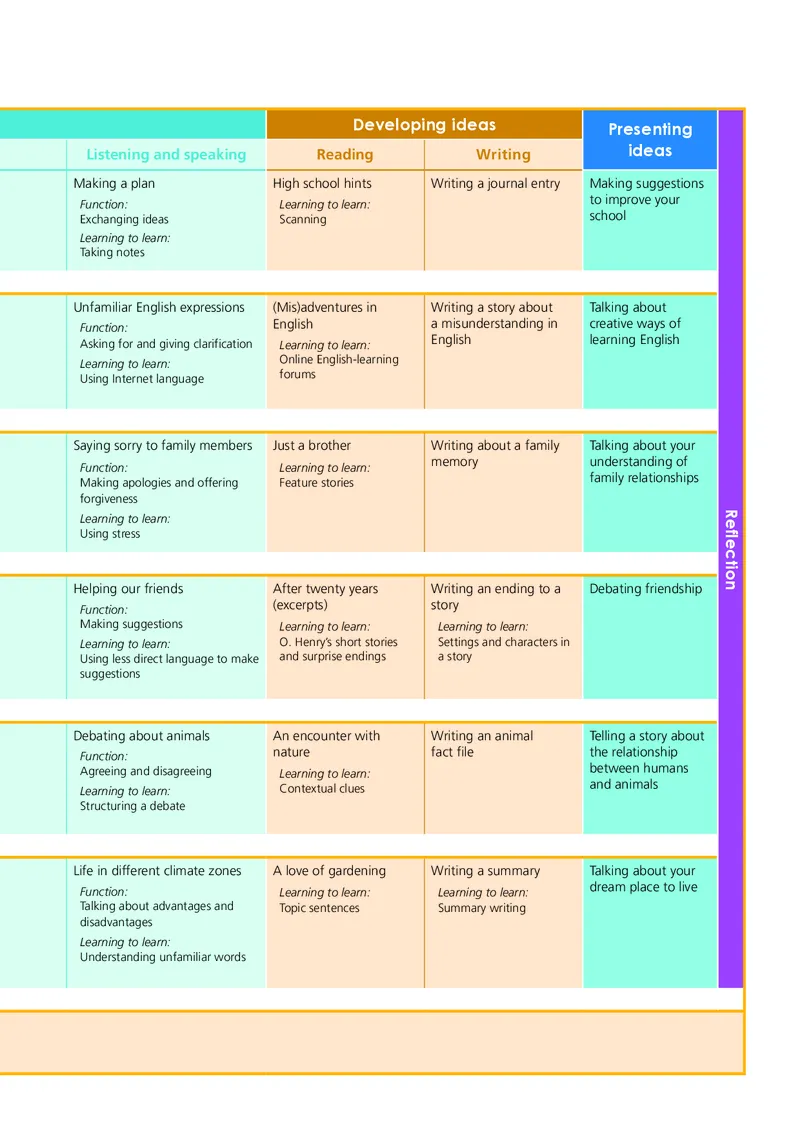
Developing ideas
Presenting
Listening and speaking Reading Writing ideas
Making a plan High school hints Writing a journal entry Making suggestions
to improve your
Function: Learning to learn:
Exchanging ideas Scanning school
Learning to learn:
Taking notes
Unfamiliar English expressions (Mis)adventures in Writing a story about Talking about
English a misunderstanding in creative ways of
Function:
English learning English
Asking for and giving clarification Learning to learn:
Online English-learning
Learning to learn:
forums
Using Internet language
Saying sorry to family members Just a brother Writing about a family Talking about your
memory understanding of
Function: Learning to learn:
family relationships
Making apologies and offering Feature stories
forgiveness
Learning to learn:
Using stress
Helping our friends After twenty years Writing an ending to a Debating friendship
(excerpts) story
Function:
Making suggestions Learning to learn: Learning to learn:
Learning to learn: O. Henry’s short stories Settings and characters in
Using less direct language to make and surprise endings a story
suggestions
Debating about animals An encounter with Writing an animal Telling a story about
nature fact file the relationship
Function:
Agreeing and disagreeing Learning to learn: between humans
and animals
Learning to learn: Contextual clues
Structuring a debate
Life in different climate zones A love of gardening Writing a summary Talking about your
dream place to live
Function: Learning to learn: Learning to learn:
Talking about advantages and Topic sentences Summary writing
disadvantages
Learning to learn:
Understanding unfamiliar words
Reflection致 同 学
同学们,欢迎大家学习《英语》(新标准)高中教材!
由教育部制定并颁布的《普通高中英语课程标准(2017年版)》明确规定:普通高中英语课程
作为一门学习及运用英语语言的课程,与义务教育阶段的课程相衔接,旨在为学生继续学习英语和
终身发展打下良好基础。普通高中英语课程强调对学生语言能力、文化意识、思维品质和学习能力
的综合培养。也就是说,发展学科素养是同学们高中阶段英语学习的方向和目标。经过初中阶段的
学习,大家已经打下了一定的基础。进入高中后,同学们应该对自己的学习目标提出更高的要求。
《英语》(新标准)高中必修课程教材遵循“为用而学,在用中学,在学中用,学而能用”的原
则,为同学们提供了语言地道、优美的阅读文章和灵活多样的学习活动,力图使大家逐步获得独立
学习和自主学习的能力。
必修课程教材第一册从同学们的日常生活出发,逐步展开话题,从校园生活、语言学习,到亲
情、友情,再到对自然的关注,体现了人与自我、人与社会、人与自然三大主题语境,帮助大家轻
松愉快地进入高中阶段的英语学习。本册共六个单元,单元结构如下:
(1) 背景激活(Starting out)
该板块旨在激活同学们已有的背景知识和语言知识。我们把“看”(viewing)的活动作为
预热和导入,通过视频、文字、图片、表格等多模态语篇,帮助同学们更好地了解本单元
主题。
(2) 主题理解(Understanding ideas)
该板块通过语篇和阅读活动聚焦核心语言、结构,帮助大家在达成主题理解、实现语言形
式与意义深度加工的同时培养文化意识和思维品质。
(3) 功能运用(Using language)
该板块是对语言技能的综合学习和运用。通过语法、词汇及听说三个部分的大量语言实践
活动,发展大家的语言技能,为真实生活中的语言交际做好铺垫。
(4) 思维拓展(Developing ideas)
该板块为大家提供新的阅读语篇,从不同角度进一步呈现单元话题,调动大家的逻辑思维、
批判性思维和创造思维,并以一项读写结合的活动来检验大家前述学习活动的成果。
(5) 观点表达(Presenting ideas)
该板块主要以讨论、评选、演讲、辩论等口头表达形式进一步促进同学们对所学内容的复
习与掌握。开放或半开放性的活动有利于大家彼此合作,展示个性,充分表达自己对主题
思想的理解和认识。
(6) 自我反思(Reflection)
该板块列出了本单元话题下可以实现的学习目标,通过自我评价和总结的方式,帮助大家
反思自己的学习成果,进而认识到自己的进步与不足,逐步培养自主学习的能力。
(7) 项目实践(Project)
该板块提供真实的语境和任务,每个项目活动均由小组合作完成,力求培养大家获取信息、
相互合作、学以致用的能力。
我们希望同学们通过使用本教材,全面提高综合语言运用能力,发展英语学科的核心素养,成
为具有中国情怀、国际视野和跨文化沟通能力的社会主义建设者和接班人。1 Watch the video and answer the questions.
1 What do these students do at school? 2 How is this school different from your
school?
2 Complete the questionnaire and share
your answers with the class.
U
N
I
T
A new start
Starting out
First day of school questionnaire
c y W o o m e u l r c p o n le m e t w e e t s t h o c e h s o q e o u n l e i , o s a r t n i h o d i n g h n h o a ! i w r I e ’ d y a o l n i u k d e ’r r e t e o f t e u k e r n n li o n i w t g t a w o b h m o a u e t t . y i o t. u P t le h a in se k of
Your Form Teacher
➊ How did you feel on your first day at senior high?
excited
curious
nervous
proud
happy
other _______
➋ What was your first impression of your new school?
➌ Who’s the first person you’ve got to know? How did you
get to know each other?
➍ What do you like most about your new school?
the campus
its traditions
your teachers
its facilities
your classmates
other _______
➎ What have you found most impressive about senior high?
1Understanding ideas
1 Tick what you want to include in
your diary about your first day at
senior high.
the school campus
new teachers My First Day
school subjects
a new timetable
an embarrassing moment at Senior High
new friends
your feelings
other _________
2 Read the passage and find out
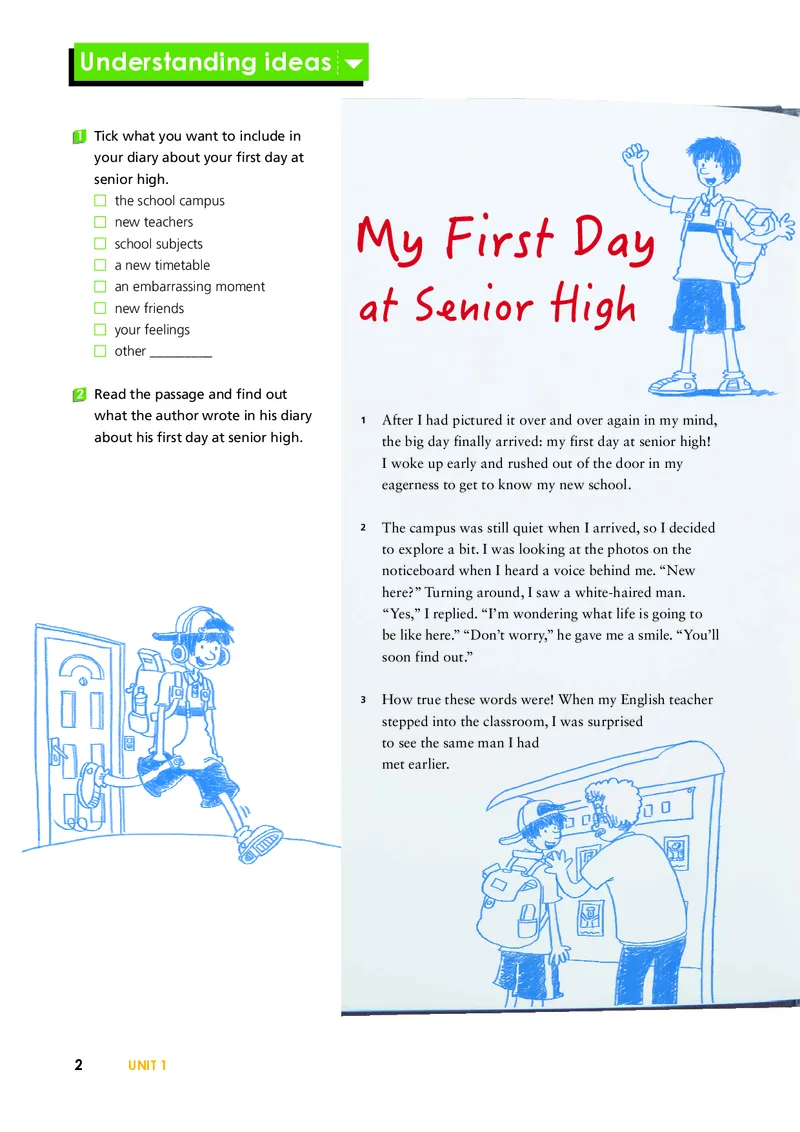
what the author wrote in his diary 1 After I had pictured it over and over again in my mind,
about his first day at senior high. the big day finally arrived: my first day at senior high!
I woke up early and rushed out of the door in my
eagerness to get to know my new school.
2 The campus was still quiet when I arrived, so I decided
to explore a bit. I was looking at the photos on the
noticeboard when I heard a voice behind me. “New
here?” Turning around, I saw a white-haired man.
“Yes,” I replied. “I’m wondering what life is going to
be like here.” “Don’t worry,” he gave me a smile. “You’ll
soon find out.”
3 How true these words were! When my English teacher
stepped into the classroom, I was surprised
to see the same man I had
met earlier.
2 UNIT 1Monday 4 September
4 “Good morning, everyone. Before we start, please come to the front
one by one and introduce yourself to the class. I’ll go first…”
5 “What?!” I tried to turn on my brain but the engine just wouldn’t
start. “I should say my name, of course. But what else? What could
I say to make a good first impression? Something about my insect
collection, perhaps.” I was organising my words in my head when the
girl next to me gave me a nudge. “It’s your turn!”
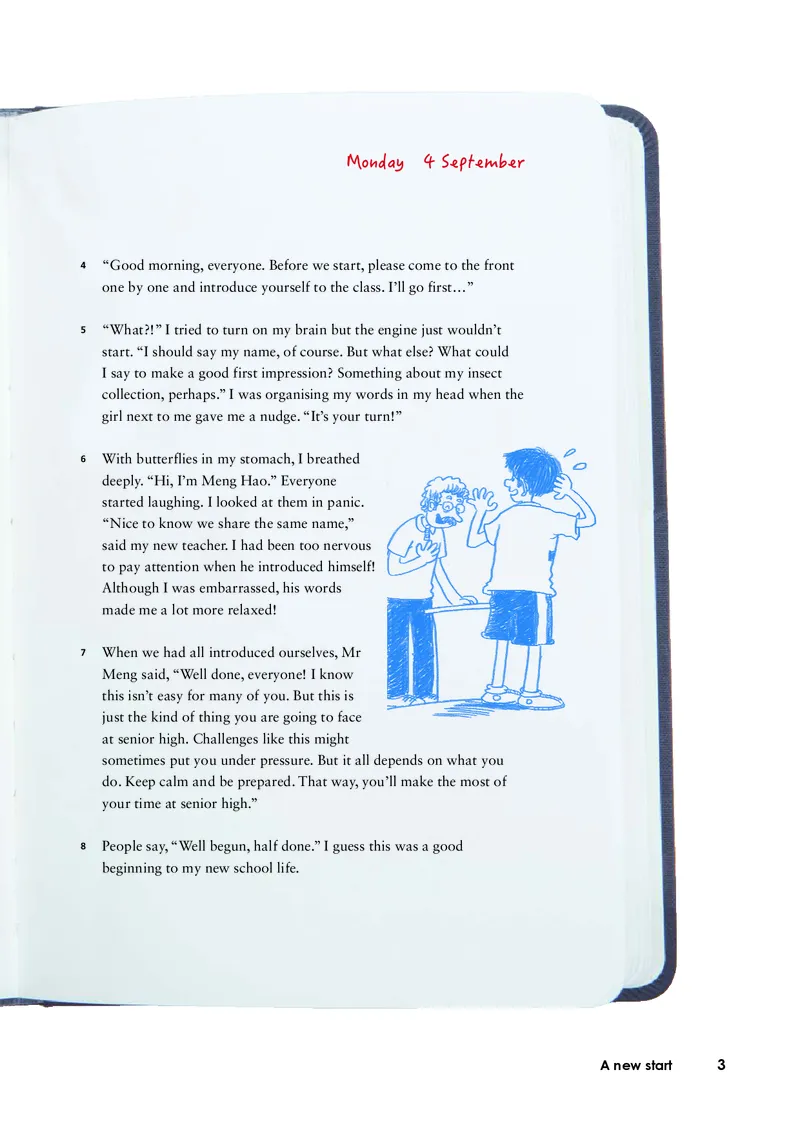
6 With butterflies in my stomach, I breathed
deeply. “Hi, I’m Meng Hao.” Everyone
started laughing. I looked at them in panic.
“Nice to know we share the same name,”
said my new teacher. I had been too nervous
to pay attention when he introduced himself!
Although I was embarrassed, his words
made me a lot more relaxed!
7 When we had all introduced ourselves, Mr
Meng said, “Well done, everyone! I know
this isn’t easy for many of you. But this is
just the kind of thing you are going to face
at senior high. Challenges like this might
sometimes put you under pressure. But it all depends on what you
do. Keep calm and be prepared. That way, you’ll make the most of
your time at senior high.”
8 People say, “Well begun, half done.” I guess this was a good
beginning to my new school life.
A new start 33 Choose the best description of Meng Hao’s first day at senior high.
1 He found the English class difficult and was not sure what to do.
2 With the English teacher’s support, he thought senior high was easy and felt
confident about his future.
3 He was not sure about life at senior high, but after the English class, he felt
more confident.
4 Complete Meng Hao’s experiences with expressions from the passage.
Meng Hao’s experiences Meng Hao’s feelings
Before going to school
excited: woke up early;
Because it was Meng Hao’s first day at 1_______________,
rushed out of the door
he got up early and 2_______________ to his new school.
Arriving at school
The campus was still quiet, so Meng Hao decided to
3_______________. He met a man who he
4_______________ find out later was his English teacher.
During the English class
Meng Hao was nervous about introducing himself in
front of the class. With 5_______________, he began, but
everyone laughed. It turned out that he and his teacher
shared 6_______________.
Mr Meng said that challenges at senior high might put
them 7_______________. He advised everyone to
8_______________ and 9_______________.
After the English class
Meng Hao thought he had 10_______________ to his new
school life.
Now find expressions that show Meng Hao’s feelings and complete the table.
Think & Share
1 What is your understanding of the saying “Well begun, half done”?
2 What happened on your first day at senior high? Share your experiences and feelings
with the class.
4 UNIT 1Using language
Review: basic sentence structures
1 Match the sentences that share the same structures.
1 I saw a white-haired man. a He was friendly.
2 I replied. b The exam made me quite nervous.
3 He gave me a smile. c I passed him a book.
4 I breathed deeply. d She agreed.
5 I looked at them in panic. e He wrote a long letter.
6 I was embarrassed. f He talked loudly.
7 His words made me a lot more relaxed! g She looked after her sister patiently.
Now look for more sentences with these structures in the reading passage.
2 Look at the pictures and tell the story with your own ending. See how many
different basic sentence structures you can use.
a b
c d
A new start 5School clubs
3 Complete the posters with the correct form of the words in the box.
badminton drama band debate gym piano
stage photography science
Club MMuussiicc CClluubb
1____________
Meet new people & Want to play the 5____________
stay fit and healthy! 3 ____________ Club or the guitar?
Or sing in a 6____________?
Love acting? This is the place for you!
Join us on 4____________ and
let our experienced director
Get ready to
help you find
Daily practice after make some
your inner star.
class at the school music !
2____________.
Every Wednesday
Every Tuesday
5 pm-7 pm 4 pm-5 pm
Room 201
The Music Room
8____________ CLUB 9
____________
CLUB
What killed the dinosaurs?
Why are dolphins so intelligent? W E
WANT YO
U
!
Investigat e
a t
q
o
u
u
e
r
s t
c
io
lu
n
b
s
.
like these
n g
a
n d
take great
pictu
r e
o s
Join the 7____________ Club! Room 302 at 4 pm every Tuesday e
al w
i t
m h
o u
Argue about the week’s hottest C s .
topics with the school’s
sharpest minds!
4 pm on Thursdays
Room 301
We meet twice a month on Saturdays.
4 Work in pairs. Talk about the school clubs you would like to join and the activities
you can do in them.
6 UNIT 1Making a plan
6 Listen again and complete the plan.
1. the things we’re
going to do.
2. Record to do the
activities.
3. Only at a time.
4. Do first.
In the UK and the US, senior high school students
take part in various after-school activities, such
as club activities and volunteer work. These
Now talk about how the speakers discuss
activities not only help them gain more skills,
managing their time. Listen again
but also teach them to care about others. After-
if necessary.
school activities also play a part when students
apply to college. However, they can take up a lot
7 Work in pairs. Act out the conversation to
of time, so students have to learn to organise
discuss ideas for a weekend study plan for
their busy schedules. To help them do this,
English.
some senior high schools offer courses in time
Student A: Turn to Page 81.
management.
Student B: Turn to Page 84.
Did You Know ?
8 Work in pairs. Make another weekend plan
5 Listen to the conversation and decide what and have a similar conversation.
the speakers are mainly talking about.
1 The clubs they have joined and the activities
Learning to learn
they do after school.
As you listen, make notes of key information
2 The things they should do to manage their
such as names, numbers, facts and instructions.
time well.
This will help you understand and remember the
3 The challenges they face in their new school.
information you hear.
A new start 7Developing ideas
1 Think about the things you want to
achieve at high school and rank them
in order of importance. (1 = most
important)
join a school club
take a trip with your classmates
get the highest score in a test
at least once
get to know all the schoolmates
in your grade
stand on stage at least once
win an award
read as many books as possible
learn a new skill
other ________
2 Look at the word cloud and the
picture. Predict what is talked about
in the interview.
opportunity
important
deal with
work hard disappointed
give your friends a hand
challenge
fail
keep an open mind
High School Hints
Now read the interview and check
your prediction.
School Talk
ST
Subscribed 3,101
Add to Share More
8 UNIT 1Interviewer: Hello and welcome to School Talk! Today I’m joined by a former student of
our school, Lisa Osborne. Lisa graduated from our school last June and is about to go to
college in New York. Lisa, thank you for coming to share your suggestions for high school
with us.
Lisa: Hi, everybody. I’m very glad to be back. I feel as if high school was only yesterday!
Interviewer: So what helped when you first started high school?
Lisa: Orientation Day was really helpful. It’s a fantastic opportunity for new students to
get to know the school and the other students. I even made some new friends! Just keep
an open mind and take part in as much as possible.
Interviewer: That’s sound advice for sure. But how did you deal with new challenges,
like starting a new course?
Lisa: I had a chemistry test right at the end of the first week. I was frightened at the
sight of the test paper. But then I figured I’d better just go all out and see what happens.
If you fail, no problem – next time you can fail better!
Interviewer: So, hold your head up, then. But life is not always easy. You must have had
some moments when you were disappointed. If so, how did you deal with them?
Lisa: As a member of the school volleyball team, I wasn’t selected for the end-of-year
competition. At first I was really sad, but later I realized that I joined the team for the
love of the sport. It wasn’t just about winning. So I kept working hard to support my
teammates during our training. There’s always a way to be part of something you love,
isn’t there?
Interviewer: Yes, I totally agree. Is there anything else in particular that you’d like to
share with us?
Lisa: Looking back on my high school life, the most important advice I’d give is these
wonderful words from the writer Maya Angelou. She said, “Be a rainbow in somebody
else’s cloud.” So, give your friends a hand when they need it. And this will make you feel
good, too.
1,231 views
Published on 10 July 2017 Interviewer: Neat! Well, thanks again for coming to speak to us, Lisa. And good luck
with college!
998
Lisa: Thank you.
A new start 9Learning to learn 3 Scan the interview and answer the questions.
1 What did Lisa find most helpful when she started high school?
When scanning a text, you read
2 How did she deal with new challenges?
it quickly in order to find a specific
3 How did she handle disappointments?
piece of information. For example,
to find out the answer to the
question “What did Lisa find
most helpful when she started 1 What do you think Lisa means by “If you fail,
Think & Share
high school?”, you would look no problem – next time you can fail better”?
for the key words “helpful” and
2 Think about the words from Maya Angelou: “Be a rainbow in
“started high school”.
somebody else’s cloud.” Do you know of any similar sayings?
3 Which piece of Lisa’s advice is the most helpful to you? Why?
4 What else would you like to ask Lisa about starting high school?
4 Work in groups. Give a speech to the new students on their first
day at high school.
1 Make notes of the problems the new students may face and your
advice. Refer to the interview for ideas.
Problems the new students may face Your advice
2 Organise your speech following the steps below.
• Start by welcoming the new students.
• Talk about the problems and give your advice.
• End by summarising the main points of your speech.
3 Give your speech to the class.
10 UNIT 1Writing a journal entry
5 Read the journal entry and answer the questions. 6 Think of your own experiences
of the first week at senior high
and complete the notes.
Friday 8 September
My impression of the first week
Finally, it’s Friday! I can’t believe the first week is coming
to an end. Things are going well, but there is always
something new just around the corner.
An enjoyable class
At junior high, I took lots of notes during class. So in physics
class on Monday, I did the same, but the teacher spoke so
fast that I couldn’t take everything down. The teacher
found I was struggling with note-taking and told me to stop
After-school activities
and just listen. “Thinking is a more important ability than
note-taking and memorising,” he said.
After class on Wednesday, I hurried to the school
How I made a new friend
skateboarding club. I was running out of the classroom
when I bumped into a girl literally. I said sorry to her
and she smiled at me. At the club, I had my first try at
skateboarding and fell off the board a lot. Suddenly, a girl
bumped into me – the same girl from the corridor! This
Now write a journal entry about
time, both of us laughed. Her name is Sarah. We started to
your first-week experiences at
practise together and soon became friends.
senior high. Use the expressions
in the box to help you.
I’m going to watch a film
with Sarah tomorrow
Useful expressions
evening. I'm looking
• Things are going well…
forward to it!
• At junior high, …
• After class, …
• I’m going to…
1 What’s the passage about?
2 What happened in her physics class? 7 Share your journal entry with
the class.
3 What did she do after class?
A new start 11Presenting ideas
1 Imagine you are a member of your class committee. Think about the changes you
would suggest to the head teacher to improve your school. Give your reasons.
Suggestions to the Head Teacher
• What to change:
lunch break, school uniform,
…
• Why change it:
____________________________
• How to change it:
____________________________
2 Work in groups. Talk about your suggestions Useful expressions
and prepare a short presentation. Use the
• The first thing I would suggest is…
expressions in the box to help you.
• I think it would be a good idea to…
• Another thing I would suggest is…
3 Present your suggestions to the class.
Reflection
1 After completing this unit, I can rate my 2 I’ve learnt to make use of the following
performance 1 (excellent), 2 (good) or words and expressions:
3 (in need of improvement).
talk about school clubs
exchange ideas
write a journal entry
describe my school experiences 3 I still need to improve:
build self-confidence
12 UNIT 1Exploring English
U
N
I
T
Chart 1 Top 5 languages by number of
native speakers
1400
Chinese
1,390 million
1050
Hindi-Urdu
590 million
700
English 530 million
350
Arabic 470 million
Spanish 390 million
0
Chart 2 Top 5 languages by number of
learners around the world
y
a
Chart 3 English learners in China
y
4
3 1 0
2 9 2
0 9
0 1
3
n
o
3
50 million milli
0
0
200
m
illion
T
a
a
p T
nn k
u
a
m n
j z u
B p
f
p
z
N
z
s
a n
T
Yj
K
k
Starting out
1 Look at the charts and answer the questions.
1 According to Chart 1, which language has
the largest number of native speakers?
According to Chart 2, which language has
the largest number of learners?
2 What can you learn from Chart 3? Why
do you think many people in China learn
English?
2 Watch the video and answer the questions.
1 Which countries mentioned in the video
English 1,500 million
have English as their first language?
French 80 million 2 Where do a third of English words
come from? What examples are given in Chinese 30 million
the video? Spanish 15 million
German 15 million
H
p Q
I
L
p
a
13Understanding ideas
1 Look at the title of the passage and
the pictures. Tick what you think
the passage is about. 1 Have you ever asked yourself why people
food often have trouble learning English?
cooking I hadn’t, until one day my five-year-old
words son asked me whether there was ham in
plants a hamburger. There isn’t. This made me
fruit realize that there’s no egg in eggplant
either. Neither is there pine nor apple
2 Read the passage and check your in pineapple. This got me thinking how
answer to Activity 1. English can be a crazy language to learn.
2 For example, in our free time we can
sculpt a sculpture and paint a painting,
but we take a photo. And when we are
traveling we say that we are in the car or
the taxi, but on the train or bus! While
we’re doing all this traveling, we can get
seasick at sea, airsick in the air and carsick
in a car, but we don’t get homesick when
14 UNIT 2we get back home. And speaking of home, 5 Even the smallest words can be confusing.
why aren’t homework and housework the When you see the capitalized “WHO” in a
same thing? medical report, do you read it as the “who” in
“Who’s that?” What about “IT” and “US”?
3 If “hard” is the opposite of “soft”, why are
“hardly” and “softly” not an opposing pair? 6 You also have to wonder at the unique madness
If harmless actions are the opposite of harmful of a language in which a house can burn up
actions, why are shameless and shameful as it burns down, in which you fill in a form
behaviors the same? by filling it out, and in which an alarm is only
heard once it goes off!
4 When we look out of the window and see
rain or snow, we can say “it’s raining” or 7 English was invented by people, not computers,
“it’s snowing”. But when we see sunshine, and it reflects the creativity of the human race.
we can’t say “it’s sunshining”. That is why when the stars are out, they are
visible, but when the lights are out, they are
invisible. And that is why when I wind up
my watch, it starts, but when I wind up this
passage, it ends.
Exploring English 153 Choose the author’s purpose in writing the passage.
1 To tell us that English is very difficult to learn.
2 To give advice on how to learn English.
3 To show that English is interesting and creative.
4 To explain how English was created.
4 Complete the notes with words from the passage.
In order to support his idea, the author uses many examples that show the 1 madness of English.
no egg in eggplant sculpt a sculpture seasick → sick at sea “Hard” is the opposite of
no ham in 2 paint a(n) 4 5 → sick in the air “soft”.
neither pine nor apple in BUT take a photo 6 → sick in a car “Hardly” and “softly” are
3 BUT 7 → sick at home not a(n) 8 pair.
“Harmless” is the Stars are out. → They are I wind up my
opposite of “harmful”. visible. watch. → It starts.
Shameful and shameless burn up → burn down Lights are out. → I wind up the passage. →
9 are the same. fill in a form → 10 They are 11 . It 12 .
a form
The reason is that English was invented by people, and it 13 the creativity of the human race.
5 Read the following information and answer the questions.
The word “pineapple” developed from the Spanish word “piña”, which means pine cone.
When it came to England, “apple” was added to show it is a kind of fruit.
The origin of “hamburger” was a hard beef steak called “Hamburg steak”, eaten without
bread. Later, people reinvented it and called it “hamburger”.
Eggplants used to be smaller and yellow or white. They looked a bit like eggs, which led
to the name “eggplant”.
1 How did pineapples, hamburgers and eggplants get their names?
2 Does the information above give you a better understanding of the passage?
Give your reasons.
Think & Share
1 Do you agree with the author’s opinion about the English
language? Give your reasons.
2 What do you find most challenging about learning English? How do you deal
with this?
16 UNIT 2Using language
Review: word formation
1 Look at the sentences and expressions from the reading passage. 3 Work in groups. Choose
Match the words in bold to the types of word formation. one type and come up
with as many words as
a Neither is there pine nor apple in pineapple.
possible.
b … sculpt a sculpture…
c When we… see rain…, we can say “it’s raining”…
abbreviating
d WHO
changing the part
1 abbreviating of speech
2 changing the part of speech adding a prefix or
3 adding a prefix or suffix suffix
4 combining two or more words combining two or
more words
Now look for more examples of each type in the reading passage.
2 Complete the passage with the help of word formation.
Group A
When you open a dictionary, you often come across a lot of unfamiliar
words. You might think this is a bit scary. But many of them are formed unlike, dislike, likely,
using other simpler words. This is called word formation.
likelihood
Words formed by combining other words are called compounds, for
example,1 (a friend that you contact by writing, traditionally
using a pen) and 2 (known by many people).
Prefixes and suffixes often have fixed meanings. If you add un- or in- to a
word, the new word usually means the opposite. For example, if something
like
isn’t correct it’s 3 , and if someone isn’t happy they’re
4 . Words with the suffixes -ment and -ness are often nouns.
For example, if somebody has improved a lot, they have made great
5 .
Some nouns and adjectives can be used as verbs, or the other way round.
When we calm somebody down, they become 6 . And we Group B
can give someone a present by 7 it. unlike, dislike, likeness,
likely, liking, unlikely
And sometimes a word is made up of the first letters of several words:
“World Trade Organization” can be referred to as 8 , and
9 is short for “as soon as possible”.
It is impossible to know the meaning of every word, but knowing about
word formation can help us guess their meanings.
Group B is the winner.
Exploring English 17American and British English
4 Look at the pictures and get to know the American English words and their British equivalents.
c
a b
theater / theatre
subway / underground highway / motorway
e f
d
gas / petrol apartment / flat elevator / lift
Now complete the passage with the words above.
Today, American English is in common international use. It is different from
British English in several ways, mostly in spelling and vocabulary. Some American
spellings were created by Noah Webster, who made one of America’s first
dictionaries. He changed “-re” spellings to “-er”, which is why
1 is spelt 2 in American English.
The Americans and the British also use different words for everyday things. For
example, Americans talk about putting 3 in their cars and driving
along the 4 , whereas in the UK, people put 5 in their
cars and drive along the 6 . Americans take the 7 to the
top floor of a building, but the British use the 8 . In the US, they take
the 9 , but in the UK, people travel on the 10 . Americans
live in a(n) 11 , while the British live in a(n) 12 .
It’s not as confusing as it seems: usually people from the two countries can
understand each other from the context. But that doesn’t stop them having
a friendly argument about which word is the “right” one!
5 Work in pairs. Find more examples of differences between American and British
English. Use a dictionary or search on the Internet.
18 UNIT 2Unfamiliar English expressions
7 Listen again and complete the table.
Words Meaning Origin
a kind of traditional
dim sum from 2
1
• Each year, many additions are made to a combination of
using a cellphone
English dictionaries. Recent additions the words
3 without caring
include “selfie” (a photograph that 4 and
about others
you take of yourself, usually with 5
a mobile phone) and “netizen” (a
citizen who uses the Internet).
a shorter way of
• Some messaging abbreviations have 6 from the Internet
saying 7
also been added, for example, BRB (be
right back), COZ (because) and G2G
Now talk about how the speakers ask for and explain
(got to go).
the meanings of the words. Listen again if necessary.
Did You Know ?
8 Work in pairs. Act out the conversation to ask for
6 Listen to three conversations and and explain the meanings of the expressions.
match them to the pictures. Student A: Turn to Page 81.
Student B: Turn to Page 84.
a
9 Work in pairs. Find new words and their meanings
on the Internet, and have a similar conversation.
Learning to learn
b Some of the language used on the Internet is different to the
language used in other forms of communication. It may be a
quick and, to you, clear way to communicate, but before you
use it, stop and think: who do you want to communicate with
c
and why? Make sure that any abbreviations and emojis you
use are appropriate for the situation, and consider whether
your readers will even know what you mean by BRB or COZ.
Exploring English 19Developing ideas
1 Read the following expressions and
guess their meanings.
• What’s up?
• ring a bell
Mis adventures
• small potatoes
• toilet water
• at sixes and sevens
• green fingers in English
• pull up one’s socks
Now think about more English
expressions that may cause
misunderstandings.
2 Read the passage and find the
words or expressions that caused
the misunderstandings.
Learning to learn
Last week, our forum asked if you
Online English-learning forums can be a
had any funny or strange stories
very useful learning resource. Not only
can you post specific questions, but you about using English. We didn’t
can also broaden your knowledge by expect to get so many posts! Here
reading posts from other English learners are some of our favourites, to
around the world.
remind us that some of the English
we learn in the classroom is rather
different from the English in the
outside world!
favourites
20 UNIT 2People say that the British always play safe with what they eat.
Not true! I went to a summer school in Manchester and my English
teacher was called Maggie. One day, a different teacher took our
Yancy
class. He told us that Maggie couldn’t teach that day COZ she had
a frog in her throat. Poor Maggie – but why did she try to eat such a
big frog?
135 comments
When I first visited New York, I went to a downtown shopping
centre to buy some winter boots. At the information desk at the
entrance, I asked a lady where the shoe section was. She said that
Sophie
it was on the first floor. So I went up to the first floor, but couldn’t
find any shoes. I decided to leave. When I was looking for the exit,
I saw that shoes were actually sold downstairs on the ground floor,
not the first floor. Why did she give me the wrong information? X-(
I’ve got an English penfriend, who I finally got to meet in London
this summer. He had told me that his grandfather was “really
wicked”. But when I met his grandfather, I liked him a
Julien
lot. I found it very odd. Why did my friend use a negative
word about such a nice man?
63 comments
The British must have really high standards. I was part
of a student exchange programme between a university in
England and my university in China. I spent days preparing and writing
Zheng Xu
my first English paper. I knew I had done a good job and was looking
forward to getting a positive comment. When I got the paper back, I found
my teacher had written the comment “Not bad!” Not bad? But there
weren’t any errors in my paper. :-(
85 comments
Exploring English 213 Read the definitions of the words and expressions that caused the
misunderstandings. Match the definitions to the posts.
a (British English) the floor of a building above the one at ground level;
(American English) the floor of a building at ground level
b pretty good, better than you expected
c unable to speak clearly for a short time because your throat is dry or blocked
d morally wrong and intending to hurt people; (informal) very good, fantastic
Think & Share
1 Which post do you find most interesting? Why?
2 How would you deal with the situations described in the posts?
3 What examples of Internet language are used in the passage? What do they mean?
4 Do you know of any Chinese expressions that often cause misunderstandings for
people from other countries? Share them with the class.
4 Work in pairs. Retell the situations in the four posts.
Yancy Who? Sophie
Where?
What happened?
Julien Zheng Xu
22 UNIT 2Writing a story about a misunderstanding in English
5 Look at the pictures and answer the questions.
a b
Last summer, I stayed with a
We‘ll have toad-in-the-hole
British family.
for dinner.
It’s delicious!
c d
A toad in a hole?!
pancake
sausages
1 Who were the people in the story? 3 What happened?
2 Where did the story take place? 4 What caused the misunderstanding?
6 Write a paragraph to tell the story. Use the expressions in the Useful expressions
box to help you.
• I was really surprised
Last summer, I stayed with a British family. One day, … when…
• I wasn’t sure whether…
7 Share your story with the class.
• To my astonishment, …
• It turned out that…
Exploring English 23Presenting ideas
1 Work in groups. Talk about creative ways to learn English. List your
ideas on a piece of paper.
• changing your mobile phone language to English
• doing a voice-over for English language films
•
•
•
•
2 Choose the most creative idea and prepare a short Useful expressions
presentation following the steps below. Use the
• I think… is the most creative idea.
expressions in the box to help you.
• It can help us…
• Introduce the idea.
• First of all, we can…
• Explain why it is useful.
• Then, …
• Describe what you should do.
3 Present your idea to the class.
Reflection
1 After completing this unit, I can rate my 2 I’ve learnt to make use of the following
performance 1 (excellent), 2 (good) or words and expressions:
3 (in need of improvement).
recognise differences between American English
and British English
ask for and give clarification
write a story based on given pictures 3 I still need to improve:
notice and analyse specific language phenomena
be aware of cultural differences
24 UNIT 2Family matters
1 Watch the video and answer the questions.
1 What is the video mainly about?
2 How do you feel about the family?
2 Look at the pictures and answer the questions.
1 What do you already know about these
families? Which family do you relate to
most? Give your reasons.
2 What other family stories do you know?
U
N
I
T
Starting out
Father and Son
• Father and Son (comic)
• Germany
The von Trapp family
• The Sound of Music (film)
• Austria
The Xia family
• Home with Kids (sitcom)
• China
The Parr
family
• The
Incredibles (film)
•
United States
25Understanding ideas
1 Tick the things you would ask your parents
LLiikkee
about for advice.
school studies
friendship troubles
,,
joining an after-school club FFaatthheerr
getting a new hairstyle
shopping for new clothes and shoes
choosing your future area of study
LLiikkee
2 Read the play and find out what conflict
the son has with his father.
SSoonn
Learning to learn
A play is a story performed on a stage.
It has a plot, settings, characters and actions,
as well as dialogue between characters.
26 UNIT 3(The living room. Friday night. A table and two Grandfather: (stepping between Father
chairs at front centre. Grandfather and Father, and Son and raising his
seated at the table, are playing chess.) voice) Hey! I told you to
calm down, both of you!
Grandfather: And... I win! Father: But I told him to study
(Son enters room.) something useful at university!
Father: Not again! Oh look, here comes my Grandfather: (laughing) Easy, son! I remember
boy. How are you, son? when you were his age, you
Son: (nervously approaching the table) said that you wanted to be a
Erm… Dad, can we talk? professional football player.
Father: Sure! You know you can always Father: And you wanted me to be an
turn to your dad for a chat. engineer!
Son: OK. Here it is. I’ve decided not to Grandfather: I just wanted you to be happy, and
go to university. I want to focus on an engineer – a happy engineer.
my band and have a career in music Father: But in the end, you just advised me
when I leave school. to think carefully.
Father: (raising his voice in surprise) You Grandfather: Yes, and you have found the career
can’t be serious! What about your that suits your talents. I’m so proud
future career as a lawyer?! of you. Your son is proud of you, too.
Son: I knew you’d say that. You just Son: Of course I am, but I have different
assume I want to be a lawyer, but talents.
that’s only because you are a lawyer. Grandfather: (turning to Son) Why don’t you also
Father: What’s wrong with being a lawyer? take my advice and think carefully
Lawyers help people and are before jumping in with both feet?
respected by others. Son: Well, I could try…
Son: Yes, but I’m not interested in law. Grandfather: If you go to university and play
I want to work in a studio, not a court. music at the same time, you will
Grandfather: (looking at Father) Calm down. OK? have two options for your future.
Father: (ignoring Grandfather’s words) Stop And I’m sure playing in a band will
daydreaming! Playing in a band is help you make lots of new friends
not a job. at university.
Son: Of course it is! The music industry Father: Yes, lots of new lawyer friends!
is developing fast now. Making Son: (with a sigh) Dad…
music is a job.
(Curtain)
Family matters 273 Choose another suitable title for the play and give your reasons.
1 The Secret to a Happy Family
2 A Generation Gap
3 A Dream Job
4 Grandfather’s Advice
5 My Career, My Choice
4 Add the tags to the director’s notes.
Setting Plot Characters
The son doesn’t plan to go to
The living room, with
university. He wants to
1 at front centre.
2 and
3 , because
it suits his talents. But the
father wants his son to
4 and
5 , because
• Grandfather – in his 0s,
lawyers help people and
keen chess player
6 . The
• Father – in his 40s, lawyer,
grandfather advises his
football fan
grandson to go to university
• Son – 16 years old, senior high
and 7 at the
student, music lover
same time. This way, he can
8 .
Now complete the director’s notes with expressions from the play.
Think & Share
1 If you were in a similar situation to the son, what would you
do? Why?
2 What conflicts have you had with your parents? How did you solve them?
28 UNIT 3Using language
Review: tenses
1 Look at the sentences from the 2 Complete the dialogue with the correct form of the
reading passage. Decide which tense words and expressions in brackets.
each is in and match the tenses to Dad: Adam, Sally, come here. Mum 1 (have)
what they describe. something to tell you.
Adam: Coming!
a Grandfather and Father, seated at
Sally: Coming!
the table, are playing chess.
Mum: I 2 (call) Grandma yesterday and
b Lawyers help people and are
invited her to our house this Sunday.
respected by others.
We 3 (throw) her a big birthday party!
c ... you said that you wanted to be
So, we each need to choose a present.
a professional football player.
Adam: I know – I 4 (give) her a new tea set.
d ... you have found the career that
She 5 (like) drinking tea!
suits your talents.
Mum: Good choice. What about you, Sally?
e ... you will have two options for
Sally: I 6 (think of) making a scarf for her.
your future.
Mum: Good idea. I’m sure Grandma 7 (love)
1 Something that started in the past it. Oh, 8 you 9 (finish) the
and is affecting the present. guest list yet, dear?
2 Something that is currently taking place. Dad: Yes, I have, and I’m working on the invitations.
3 Something that is certain to take Mum: OK. So we still need to prepare food and drinks.
place in the future. I’ll make a checklist.
4 Something that was completed in
the past. 3 Look at the checklist for Grandma’s birthday party
5 Something that happens regularly in and talk about the preparations. Use as many of the
the present. tenses in Activity 1 as possible.
Who’s
Now match the sentences to the Preparation Done Ongoing To do
responsible?
correct timelines and find more
choose presents
examples of these tenses in the Everyone
for Grandma
reading passage.
draw up the guest
Dad
A list on Wednesday
Past Present Future
make invitations Dad
B
Past Present Future
prepare food and
C drinks on Sunday Mum
Past Present Future
morning
D
Past Present Future They have decided to throw a party to celebrate
Grandma’s birthday…
E
Past Present Future
Family matters 29Physical appearances
4 Read the email and answer the questions.
From Penny To Anna
Subject A family memory
Hi Anna,
Great to hear from you! Yes, we had a fantastic holiday. Mum, Dad and
I went camping in Beidaihe. In fact, we stayed at the same campsite as
we did ten years ago. Dad showed me a photo we had taken then – just
see how time flies!
Dad has changed quite a bit! In his thirties, he was quite thin and pale,
and he had red, bushy hair. Nowadays, he’s well-built and tanned. He’s
always had a square jaw, but now he’s grown a beard. Strangely, his
beard is still red even though his hair is turning grey!
Mum looks almost the same, though. She still has smooth skin and
straight black hair, and jogging has kept her slim and fit.
I still have light skin and black hair, of course. But I usually wear my
hair in a ponytail these days as it has got a lot longer. Mum says I had
cute rosy cheeks, but now I have freckles. I think they are kind of cute
too, right?
Can’t wait to see you back in school!
Penny
1 What did Penny’s dad look like ten years ago?
2 What does Penny’s mum look like now and why?
3 How does Penny look different now compared to ten years ago?
5 Underline the words and expressions used to describe appearances in Activity 4 and
put them into the table. Add any more you can think of.
Face Hair Skin Height and build
6 Work in pairs and describe how your family members’ physical appearances
have changed.
My mother was / had... Now she is / has got...
30 UNIT 3Saying sorry to family members
8 Listen again and complete Alice’s journal entry.
Saturday 22 September
Today, I was in a(n) 1 , but Mum missed it .
Later, on the phone she apologised and explained that she
was busy with work because someone was 2 .
I wish she had come!
I know she’s been busy recently, and I understand that.
I’m just worried about her. I don’t like seeing her so
3 .
The International Day of Families,
I think she needs to take some time off work to 4 .
which was set by the United Nations
in 1993, is held on 15 May every year.
I told her my worries. To make up for it, next week we
The day celebrates the importance
plan to go to the 5 together. We’ll go camping
of families. It aims to deepen people’s
and have a(n) 6 . Most importantly, we’ll have
understanding of issues that are related
time to talk and 7 . I’m really looking forward
to families. With a different theme each
to it!
year, the day is observed with a wide
range of events that are organised at
local, national and international levels.
Did You Know ? Now talk about how Alice’s mother makes an apology.
Listen again if necessary.
7 Listen to the conversation and choose 9 Work in pairs. Act out the conversation to apologise to a
the feelings that the speakers express. family member.
Student A: Turn to Page 82.
Student B: Turn to Page 85.
10 Work in pairs. Think about another situation in which
a b c you need to make an apology and have a similar
conversation.
Learning to learn
Placing stress on particular words can have a big impact on the
meaning and strength of apologies. For example, saying “I am
sorry” has more of an impact than “I’m sorry”. Another way of
d e f
strengthening an apology is by using and stressing adverbs: I’m
really sorry, I’m so sorry.
Family matters 31Developing ideas
1 Look at the words and expressions 03
and choose the ones that can be
applied to your relationship with
your family members.
JUST
support
punish
have
admire
compete arguments
against
encourage hate
cooperate
judge with
settle for
I
1 t was the final part of the 2016
disagree
love with World Triathlon Series in Mexico.
With just 700 metres to go, Alistair
Brownlee was in third place and his
younger brother, Jonny, was in the lead.
Alistair pushed himself towards the
finish line in the burning heat, but as
he came round the corner, he saw his
brother about to fall onto the track.
Now look at the title of the Alistair had to choose – brotherly love,
passage and the picture. or a chance to win the race?
Predict which of the words
and expressions above can 2 For Alistair, the choice was clear. His
be applied to the brothers’ brother was in trouble. He had to help.
relationship. Alistair ran towards Jonny, caught
him and started pulling him towards
Learning to learn the finish line. Alistair then pushed
his brother over the line. The move
Features are “people stories”, and
are typically longer than standard put Jonny in second place and Alistair
news stories. Features are written in himself in third. It was an unexpected
an individual style, with extra detail end to the race, but Alistair did not want
and background.
to discuss it with the media. He just
Feature stories typically start with wanted to see his younger brother, who
a “hook” that gets the interest of had been rushed to the medical area.
the reader. The style of the first
paragraph also needs to set the
tone of the whole piece. The middle
part contains the “meat” of the story,
with the ending being a summary, a
powerful quote or even a surprise
for the reader.
32 UNIT 328 September 2016
A BROTHER
3 The Brownlee brothers have
been doing triathlons since they
were children. “Obviously, when your
older brother is doing it, you think it’s
a cool thing to do,” says Jonny. Alistair
says that they encourage each other
as much as they can when they train.
Despite arguments over “stupid things”
now and then, Alistair agrees that having
a brother is an advantage. “Throughout
my entire life, I’ve had my brother trying
to beat me at everything I do. It has been
an enormously positive force.”
4 Watched by millions, the ending to the
race has divided opinions: should the
brothers have been disqualified or highly
praised for their actions? But for Alistair,
his decision was easy to explain: “Mum
wouldn’t have been happy if I’d left Jonny
behind.” At that moment, he was no longer
an athlete aiming for a medal – he was just
a brother.
Family matters 332 Choose the main message of the passage.
1 Love and competition between the Brownlee brothers make them successful athletes.
2 People have different opinions about Alistair Brownlee‘s actions in the triathlon final.
3 For Alistair Brownlee, family love is more important than winning the triathlon final.
Think & Share
1 How are opinions about the Brownlee brothers divided? Which
do you agree with? Give your reasons.
2 Why does Alistair think that having a brother is “an advantage”?
3 What do you think about having a brother or sister?
4 Do you know any Chinese stories about family love? Share one with the class.
3 Work in groups. Talk about the Brownlee brothers’ story.
1 Answer the questions to help retell the story.
3
Where did the
story happen?
2 4
When did the
What did Alistair do?
story happen?
1 5
Who are they? Why did he do it?
2 Organise your words following the steps below.
1 2 3
Retell the story of the Give your opinion on End by saying what you
Brownlee brothers. Alistair’s actions. have learnt from the story.
3 Share your story and ideas with the class.
34 UNIT 3Writing about a family memory
4 Read the journal entry and answer the questions.
Sunday 20 October
I was tidying my room yesterday and found
an old photo in a notebook. As I was looking
at it, the lovely memory of that day came
back to me.
It was my mother’s birthday ten years ago,
and I decided to surprise her with home-made
scrambled eggs. I woke up really early and tip-
toed to the kitchen. I had never cooked anything
before, so I tried to copy how she did it. But
somehow they ended up burnt.
I was about to throw everything away when my mother came in.
I showed her the eggs and sadly explained what happened. To my
surprise, she tasted them and said they weren’t bad! I guess love is
1 What brought back the
indeed a magical ingredient. In fact, we ended up laughing and ate
author‘s lovely memory?
them all.
2 What happened in the
This weekend is her 45th birthday. I’ll make her scrambled eggs again, author‘s memory?
and this time they won’t be burnt! 3 Why is it a lovely memory?
5 Think of a special family memory of your own and Useful expressions
complete the table.
• Last summer, … / In 2015, … / Many
Who was in the memory? years ago, …
• I was at…
When did it happen? • It made me feel so…
• I remember this because…
Where did it take place?
• I learnt that…
What happened?
6 Share your story with the class.
Why is it special or memorable?
Now write a short story about this memory. Use the
expressions in the box to help you.
Family matters 35Presenting ideas
1 Read the messages and decide who sent each one: Stuart’s friend,
his teacher or his mother. Give your reasons.
a b c
Stuart, what time does Stuart, did you leave
How’s it going? Want
? ? Bob’s birthday party ? your basketball in my
to meet up later and do
finish tonight? Do you office today?
something fun?
need me to pick you up?
Oh yes, I did. Sorry
I was in a big hurry
Cool! What do you I can take care of
then. May I come and
have in mind? myself. I’m no longer
get it early tomorrow
a child...
Stuart Stuart morning? Stuart
2 Read the messages again. Think about the saying “Home Useful expressions
is where you are loved the most and act the worst”.
• I think it means that…
1 What does the saying mean?
• In my opinion, …
2 Do you agree with it? Give examples to support
• Young people should respect…
your opinion.
because…
• As an example, I often…
3 Work in groups. Share your opinions about the saying.
Use the expressions in the box to help you.
4 Present your ideas to the class.
Reflection
1 After completing this unit, I can rate my 2 I’ve learnt to make use of the following
performance 1 (excellent), 2 (good) or words and expressions:
3 (in need of improvement).
describe people’s physical appearances
make apologies and offer forgiveness
write about a family memory
develop my own opinions on controversial issues 3 I still need to improve:
learn how to resolve family conflicts
36 UNIT 3Friends forever
1 Listen and read the poem. Answer the questions.
1 What is the poem about?
2 Who would you send this poem to and why?
Tell the class about him / her.
2 Watch the video and answer the questions.
1 Which poem is mentioned in the video?
2 What idea does the poem mainly express?
3 What other poems do you know on the same topic?
U
N
I
T
Starting out
When I’m sad and feeling low,
And worries are all I know,
Just hearing you say “Hello”
Fills me with a cheerful glow.
When I’m away in places new,
With no familiar faces in view,
It gives me pleasure to think of you
And the adventures we’ve been through.
When life seems like one long night,
And nothing is ever going right,
There’s just one sure delight:
Friendship, like sunrise, warm and bright.
37Understanding ideas
1 Look at the questions about friendship and
tick your answers. 1 How would you feel if moving to a new
1 How do you prefer to make friends? town meant losing track of your friends?
Joining a club to meet people who share What if the only way of getting news from
the same interests. faraway friends was writing letters that
Using a social app. took ages to be delivered? This was how
Through other friends. things worked not very long ago. Thanks
Posting a “friends wanted” notice online. to advances in technology, how we make
Taking part in community activities. friends and communicate with them has
changed significantly.
2 How do you prefer to communicate with
friends every day? 2 Nowadays, we can move around the world
Talking face to face. and still stay in touch with the people that
Using social networking apps. we want to remain friends with. Social
Writing letters. media tools let us see what our friends are
Writing emails. up to and maintain friendships. All you
Telephoning each other. need is a wi-fi connection.
3 How do you stay in touch with faraway
friends?
Using social networking apps.
Writing letters.
Writing emails.
Telephoning.
Visiting friends whenever possible.
Now work in groups and find out the most
popular answers. Share your group‘s result
with the class.
2 Read the passage and find out the author’s
opinions about online friendship.
38 UNIT 4CLICK FOR
A FRIEND?
3 The digital age also enables us to find people 7 On social media sites, people tend to post
who share our interests, such as collecting only positive updates that make them appear
model cars or playing an unusual instrument. happy and friendly. But smiling photos can hide
Whatever our hobbies, the Internet can connect real problems. Remember the saying: on the
us with others who also enjoy doing them, Internet, nobody knows you’re a dog. A young
even if they live on the other side of the world. person could be old; a woman could be a man;
we could even be sharing our information with
4 But when you “friend” people online, does this criminals.
mean that they really are your friends?
8 But this doesn’t mean that we should throw
5 It depends. the baby out with the bathwater. Although
technology has changed the way we acquire
6 If people always exchange true personal friends, the meaning of friendship and our
information online, then yes, these friendships longing for friends remain the same. As
can be real and meaningful. But we need to Aristotle said, no one would choose to live
keep in mind that what we see on social media without friends, even if he had all other goods.
is often not the whole truth about a person.
Friends forever 393 Choose the author’s purpose in writing the passage.
1 To prove that making friends was easier in the past.
2 To illustrate how it is better to make friends online.
3 To persuade people to abandon traditional ways of making friends.
4 To discuss the advantages and disadvantages of making friends online.
4 Complete the diagrams with expressions from the passage.
Past Present
• People lost track of their friends • It’s easy to 3
after 1 . with social media tools.
• The only way to stay in touch was • Online, people can easily make new
2 . Ways of friends with those who
making 4 .
friends
It might not be real because
It can be real if people Online friendship: social media doesn’t present
5 online. real or not? 6 , and people
tend to 7 .
Think & Share
1 Why does the author say “But this doesn’t mean
that we should throw the baby out with the bathwater”? Do you
know of any similar sayings in Chinese?
2 Do you prefer to make friends online? Why?
40 UNIT 4Using language
Attributive clauses (1)
1 Look at the sentences from the reading passage and 2 Rewrite the underlined sentences with
answer the questions. that, which, who, whom or whose.
a We can… stay in touch with the people that we
want to remain friends with.
b The digital age also enables us to find people who
Lucy is my friend. She has a hearing
share our interests…
problem. When she first came to my
1 What does “that” refer to in sentence (a)? school, she seemed lonely, but we
2 What does “who” refer to in sentence (b)? soon became friends. At first it was
difficult to communicate with her.
Compare them with the following sentences and
So I learnt a new language. It allows
answer the questions.
me to “speak” with my hands.
c We can... stay in touch with people. We want to
remain friends with them. Lucy is a smart girl. Her ideas
d The digital age also enables us to find people. are always inspiring. I sometimes
These people share our interests… have problems. I can’t solve them.
When this happens, I always ask
3 What is the difference between the two groups of
Lucy for help. Lucy is a good
sentences?
listener. I enjoy sharing moments
4 Why does the author choose to use sentences (a) and
of my life with her.
(b) in the reading passage?
5 What other words are used to introduce attributive
clauses? What do they refer to?
Now look for more sentences with attributive clauses
in the reading passage.
3 Complete the online forum post with that, which, who, whom or whose.
Walking group welcomes new members!
Walk and Talk is a group 1________ meets every Sunday. It is
free to join. Walk and Talk is perfect for anyone 2________
weekends need some excitement. We are all teenagers
3________ love walking and making new friends.
Wang Lei
We want you to join us! The next walk 4________ is open to new
members is on 22 July. You can also bring your friends. However,
anyone 5________ you bring must be over 12 years old.
Come along and join the fun!
Friends forever 41Keywords of friendship
4 Read the recipe and work out the meaning of the words in bold.
Friendship soup
Like any good soup,
this won’t fail to make you smile when you’re feeling down.
All you need to get started is a box of love.
Pour it into a pot and mix it with five grams of smiles.
Next, add:
two cups of trust,
one spoon of encouragement,
three spoons of helpfulness,
three cups of good conversation,
one pack of similar interests,
one glass of comfort,
two drops of patience,
one bag of passion,
one piece of generosity,
... and a slice of humour!
5 Match the words in bold in Activity 4 to the dictionary entries.
noun [U] an act of being noun [U] words or actions
kind, especially by giving things to others that make people feel better
noun [U] a feeling that noun [U] the quality of being
shows you believe that someone is funny and understanding funny situations
honest and fair noun [U] words or actions
noun [U] a strong feeling that give someone support and hope
of love or interest noun [U] the ability to wait
noun [U] a quality that without becoming anxious or angry
offers help to others
6 Work in pairs. Talk about the keywords of your “Friendship soup”
and create your own recipe. Come up with more words if you can.
42 UNIT 4Helping our friends
7 Listen to the conversation and number the events in the
correct order.
Andy and Clara thought about postponing their trip.
Matt broke his leg.
Andy and Clara agreed on a plan.
Matt called Clara.
Andy, Clara and Matt decided to go to London.
Andy and Clara decided to make a cardboard version
of Matt.
8 Listen again and complete the table.
• The word “friend” comes from
- Suggestion Comment
the Old English word “freond”,
meaning “the loved one”.
We could send him 1 That might make him
• According to a study from Yale
of the places we visit. 2 .
University and the University of
California at San Diego in 2014, How about sending him
They may 4 to
good friends are often genetically 3 from every place
arrive.
similar. In fact, good friends can share we visit?
up to 1% of the same genes – as
How about having a(n)
much as we might share with our They aren’t 6
5 with him at
great-great-great grandparents! in some places.
different places?
Did You Know ?
We can print Matt‘s photo It will feel like he’s there
on a 7 cardboard with us and Matt will
Learning to learn
cutout and take photos with 8 at
When you make a suggestion, use less it everywhere we go. the photos.
direct language than you would to make
a statement or give an order. This makes
it clear to the other person that you Now talk about how Andy and Clara give suggestions.
are giving them a choice. For example, Listen again if necessary.
you can begin with expressions such as
Why don’t we…? How about…? or use a
9 Work in pairs. Act out the conversation to solve a
past tense to distance yourself from the
problem between friends.
suggestion: I was wondering whether…
Student A: Turn to Page 82.
Student B: Turn to Page 85.
10 Work in pairs. Think about a problem that has come
up between you and your friends and have a similar
conversation.
Friends forever 43Developing ideas
1 Read the short introduction to
O. Henry and answer the questions.
After Twenty Years
The short story “After Twenty Years” is set in New York
on a cold, dark night. Most people have left work to go
William Sydney Porter (1862–1910), home, and this part of the city is now quiet. A policeman
whose pen name was O. Henry, was who is checking the area sees a man outside a shop. He
a world-famous American short story
goes up to the man and finds he has a scar on his face.
writer. In his stories, he often focused
They have a chat and the man starts to tell his story.
on the everyday life of ordinary
people in New York City at that time.
His stories are best known for their
surprise endings.
1 “Twenty years ago tonight,” said the man, “I dined
here at ‘Big Joe’ Brady’s with Jimmy Wells, my best
1 Have you read any stories by chum, and the finest chap in the world. He and I
O. Henry? Share one with the class. were raised here in New York, just like two brothers,
2 Do you like stories with surprise together. I was eighteen and Jimmy was twenty. The
endings? Why or why not? next morning I was to start for the West to make my
fortune. You couldn’t have dragged Jimmy out of New
2 Read the passage and find out York; he thought it was the only place on earth. Well,
why the man is standing outside we agreed that night that we would meet here again
the shop. exactly twenty years from that date and time, no matter
what our conditions might be or from what distance
we might have to come. We figured that in twenty years
each of us ought to have our destiny worked out and
our fortunes made, whatever they were going to be.”
Learning to learn
Read the complete short story
“After Twenty Years” and other
short stories by O. Henry, such as
“The Gift of the Magi” and “The Last
Leaf”. This way, you can get a deeper
understanding of his works and the
surprise endings to his stories.
44 UNIT 42 “It sounds pretty interesting,” said the policeman. “Rather a
long time between meets, though, it seems to me. Haven’t you
heard from your friend since you left?”
3 “Well, yes, for a time we corresponded,” said the other. “But
after a year or two we lost track of each other. You see, the
West is a pretty big proposition, and I kept hustling around
over it pretty lively. But I know Jimmy will meet me here if
he’s alive, for he always was the truest, staunchest old chap
in the world. He’ll never forget. I came a thousand miles to
stand in this door tonight, and it’s worth it if my old partner
turns up.”
(Excerpts from “After Twenty Years” by O. Henry)
Friends forever 453 Work in groups. Think of a possible ending to “After Twenty Years” and find
evidence to support your ideas. Use the following questions to help you.
1 Did Jimmy come to meet his friend?
2 What has Jimmy experienced over the past twenty years?
3 What might happen between the policeman and the man?
Now read the note from the original ending and find out what actually happened.
Bob, I was at the appointed place on time. When you struck the match to light your
cigar I saw it was the face of the man wanted in Chicago. Somehow I couldn't do it
myself, so I went around and got a plain clothes man to do the job.
JIMMY
Think & Share
1 What does the note tell you about the ending of the story?
2 How do you think Bob would react when he read the note?
3 Do you think that Jimmy did the right thing? Why or why not?
4 Do you like this ending? Give your reasons.
4 Work in groups. Act out the whole story.
1 Think about what happened in each of the three scenes, using the information you
have already read in the story. Retell the whole story.
Scene 1: Scene 2: Scene 3:
Bob dining with Jimmy at Bob making his fortune Bob and Jimmy meeting
“Big Joe” Brady’s twenty in the West again after twenty years
years ago
The story is about two friends named Bob and Jimmy. Twenty years ago, …
2 Choose a character to play and decide what you will say and do.
3 Act out the whole story.
46 UNIT 4Writing an ending to a story
5 Read Bob’s story after he was released from jail and 6 Read the ending in Activity 5 again.
answer the questions. Find the expressions that describe:
• settings
Stepping out of jail into the cold wind, Bob, now • characters
58, felt lost and helpless. • actions
“Twenty years is a long time,” he smiled bitterly,
7 Come up with your own ending to
not knowing where to go. He had no family, and
Jimmy and Bob’s story, twenty years
had never heard a word from Jimmy again since
after Bob was arrested. Answer the
that cold, dark night. “Was he ashamed of having
questions to help you.
a friend like me?” Bob longed for an answer.
1 What type of ending will it be?
“Excuse me, sir, are you Bob?” Bob heard the voice
2 Do you want to introduce other
of a young man.
characters in the ending? If so, who
“Yes.”He turned around and was surprised to find are they?
a familiar-looking man in his thirties. “Have we 3 Where will the ending take place?
met before?” 4 What has happened to Bob and Jimmy
over the past twenty years?
“No, sir,” replied the man. “My father told me to
5 How will the story end?
meet you today. I have a note for you from him.”
Doubtfully, Bob unfolded the note. His hands were 8 Write your own ending.
shaking by the time he had finished reading.
9 Share your ending with the class.
Bob, the doctor says I’ve only got three months.
I’m afraid I won’t be able to meet you this time,
but you’ll always be my dear friend. Learning to learn
Jimmy
To bring your story to life, describe the
settings and characters.
“You’re Jimmy’s son?!” Bob shouted in surprise.
Settings: time, location and descriptions of
“Yes, sir,” the young man smiled. “And my name the environment or surroundings help your
readers picture the scene. For example, The
is Bob.”
street was long and dark, and there was no
one around…
1 How did Bob feel when he finally got out of jail? Characters: introducing characters means
describing both appearance and personality.
2 What kind of ending is this? More than one description
For example, He was a tall man with curly
may be suitable.
brown hair. She always seemed happy
A happy ending.
and friendly. Characters’ actions, or their
A sad ending.
behaviours, not only tell your readers what
A surprise ending. kind of people they are, but also drive
An open ending. the plot forward and create a particular
3 Do you like this ending? Give your reasons. atmosphere.
Friends forever 47Presenting ideas
1 Read the two points of view about friendship. Decide which one you agree with.
The more friends you have, v
s
A few true friends are enough.
the happier you’ll be.
2 Think of reasons to support your opinion and make notes.
Point of view
Arguments
Supporting examples
3 Team up with a group with the opposite Useful expressions
opinion and hold a debate. Use the expressions
• In my opinion, …
in the box to help you.
• I’m sorry, but I don’t agree because…
• I see your point, but…
• That’s a good point, but…
Reflection
1 After completing this unit, I can rate my 2 I’ve learnt to make use of the following
performance 1 (excellent), 2 (good) or words and expressions:
3 (in need of improvement).
talk about friendship
make suggestions using less direct language
write an ending to a story
give your point of view with logical reasoning 3 I still need to improve:
and supporting facts
appreciate and understand the values of
friendship
48 UNIT 4Into the wild
U
N
I
T
Starting out
1 Watch the video and answer the
questions.
1 What are the most popular pets in
the UK?
2 What is the most important animal
charity in the UK?
2 Look at the pictures and answer
the questions.
1 What are the relationships
between the people and the
animals?
2 What animals do you often interact
with? What is your relationship
with them?
49Understanding ideas
1 Look at the pictures and choose the
animals that migrate.
a
b
monarch
butterfly
c
Siberian
crane
1 Many animals move from one place to
d another at certain times of the year. This
Atlantic
salmon annual movement is called migration. They
migrate to find food, seek a partner, or in
search of warmer weather. One of the most
e red panda wonderful migrations in nature is that of the
North American monarch butterfly.
2 Every autumn, millions of these beautiful
f
insects with fine black and orange wings
killer
whale begin a long and difficult journey. Somehow
they manage to travel around 4,000
kilometres south and find their way to
African
lion California or Mexico. However, until recently
no one knew how they did this.
Now talk about what you know about
animal migration. 3 A team of scientists led by Professor Eli
Shlizerman at the University of Washington
2 Read the passage and find out what has now found the answer. They have found
mystery the scientists have solved. out that the monarch is able to tell the time
of day. It uses its eyes to measure the position
of the sun. These two pieces of information –
the time of day and the point where the sun is
in the sky – allow the butterfly to determine
50 UNIT 5The Monarch’s
Journey
the way to go. Eventually, it manages to reach
the places where it will spend the winter.
4 The solution to the mystery of the monarch’s
amazing ability comes at a time when it is in
serious trouble. Its population has crashed by
as much as 90 per cent in the last few years.
Sadly, human activity is the main reason why the
number of monarch butterflies is falling. In many
of the places where the butterfly can be found,
people are destroying the natural environment.
They cut down trees and use chemicals that kill
the plants that monarch caterpillars eat.
5 The research on the monarch’s behaviour has
however led to a greater awareness of this
creature. People have been working together to
record its migration and make sure that there are
enough plants for it to feed on. If this works, there
may come a time when the number of monarch
butterflies increases once again. The more we
know about this lovely creature, the greater the
chance it will survive and keep its place in the
natural world for a long time to come.
Into the wild 513 Choose where you are most likely to find the passage.
1 In a scientific research paper about the monarch butterfly’s migration.
2 In a popular nature magazine introducing the monarch butterfly.
3 In a travel leaflet encouraging people to visit North America.
4 Complete the sentences with expressions from the passage. Then use the
sentences to complete the “cause-effect” flow charts.
a The monarch butterfly is able to tell 1 .
b Using these two pieces of information, the monarch butterfly determines
2 .
c The monarch butterfly measures 3 with its eyes.
d The monarch butterfly reaches 4 .
d
e Humans 5 trees.
f The 6 where monarchs can be found is destroyed.
g Humans use chemicals that 7 that monarch caterpillars eat.
h The monarch butterfly’s population 8 in the last few years.
h
Think & Share
1 What impresses you most about the monarch butterfly?
2 What can people do to help protect the monarch butterfly?
52 UNIT 5Using language
Attributive clauses (2)
1 Look at the sentences from the reading passage and 2 Read the passage and underline the
answer the question. words that where, when and why
refer to.
a Eventually, it manages to reach the places where it
will spend the winter.
In April 2017, two giant pandas
b The solution… comes at a time when it is in
from China arrived at a zoo in the
serious trouble.
Netherlands. There, they were welcomed
c Sadly, human activity is the main reason why the
to the Chinese-style compound where
number of monarch butterflies is falling.
they were to live. On 30 May, after the
preparations were complete, the day
1 What do “where”, “when” and “why” refer to in
finally came when the pandas met
each sentence?
their fans for the first time. People were
Compare them with the following sentences and
excited – the zoo is the only place in
answer the questions.
the country where it is possible to see
d Eventually, it manages to reach those places. pandas. In fact, the last time there were
It will spend the winter there. pandas in the Netherlands was in 1987.
e It is in serious trouble. The solution… comes at this time. And of course, the main reason why
f Sadly, human activity is the main reason. For this they were so excited is that pandas are
reason, the number of monarch butterflies is falling. just so cute!
2 What’s the difference between the two groups of
sentences?
3 Why does the author choose to use sentences (a), (b)
and (c) in the reading passage?
Now look for more sentences with attributive clauses
in the reading passage.
3 Complete the email with where, when or why.
From David Waters To Kay Silverman
Subject Back to nature
Hi Kay,
We’re having an amazing time here in South Africa. Our accommodation is perfect. It is in a location
1 we can watch animals wandering past on their way to the waterhole. Sunset is the time
of day 2 we sit on the balcony and count how many giraffes or antelopes we can see.
I guess this is the reason 3 this place is so popular. Next week, we are going to fly up to
Zambia. That’s one of the countries 4 you can visit the famous Victoria Falls.
See you soon.
David
Into the wild 53Animal idioms
1
4 Look at the pictures and complete the idioms with
animal names.
1 as busy as a(n)
2
2 kill two with one stone
3 When the cat’s away, the will play.
4 hold your
5 It‘s raining and . 3
5 Complete the paragraph with the animal idioms in
Activity 4.
English idioms are a way of adding colour to the
language. For example, instead of saying “It’s raining
heavily”, you could say “1 ”.
4
Another reason to use idioms is that they are concise.
For example, to describe someone who is always working
or busy doing something, we can say they are
2 . If they’re rushing into
something and should wait and be patient, you could say
“3 ”. Learning idioms can be fun,
especially when we compare them to Chinese equivalents.
Take, for example,“4 ” (people
5
do what they want and have fun when someone in
authority is absent) and “5 ”
(solve two problems with one action) – are there
corresponding idioms in Chinese?
6 Work in pairs. Find more animal idioms. Choose an
idiom and describe a situation with it.
A: She’s as busy as a bee.
B: What makes you say that?
…
54 UNIT 5Debating about animals
8 Listen again and complete the mind map.
Zoos can help protect animals
1 .
For
Zoos are a good way to 2 .
• Dogs were first domesticated
over 14,000 years ago. Sheep, Zoos allow us to see and learn about
cows and pigs have been kept animals in places similar to their
at home as sources of food for 3 .
around 7,000 years.
• The oldest zoo in the world is
in Vienna, opened in 1752. The
Zoo animals can 4 and be
oldest zoo in China is Beijing Zoo,
unable to live on their own when returned to
which was founded in 1906.
the wild.
Did You Know ?
Zoos cannot offer animals
7 Listen to the TV debate and choose
Against an environment that’s 5
the correct topic.
their natural one.
1 Can zoo animals survive in the wild?
2 Can zoos offer animals their natural
environment?
Zoos 6
people
3 Should we keep wild animals in zoos? than for animals.
4 Should we educate people more
about animals? Now talk about how the speakers express agreement
and disagreement. Listen again if necessary.
Learning to learn
9 Work in pairs. Hold a debate on whether we should
In a debate, first listen out for the
keep animals as pets.
main topic. This is usually a statement
or question at the very start of the Student A: Turn to Page 83.
debate. Speakers will state whether they Student B: Turn to Page 86.
are for or against the statement. Then,
they will introduce their supporting 10 Work in pairs. Think of another topic that is related to
arguments with expressions such as
animals and hold a debate.
We must remember that… and We can’t
deny that…
Into the wild 55Developing ideas
1 Look at the word cloud and the
pictures. Predict what happens in
the story.
photographer
nature
bear Yellowstone
show respect
observe animals
national park
forest frightening
press the button
recovered from the shock
1 As a nature photographer, I have to brave the elements.
But despite the wind and the rain, I still enjoy working
outside in the wild. One of the best things about this
job is that you can observe animals in their natural
environment.
2 My favourite place to take photos is Yellowstone
National Park. As the world’s first national park,
Yellowstone is famous for the variety of its wildlife,
but it is probably best known for its bears. These huge,
strong animals can live for 30 years. Despite a weight of
up to 300 kilograms, they can run at a speed of around
2 Read the passage and check 64 kilometres per hour and are also excellent swimmers.
your prediction.
56 UNIT 5An
Encounter with
Nature
3 Last spring in Yellowstone, I followed a path shaking. Somehow, I forced my finger to press
that took me through a dark forest. When I the button. A second later, the bear turned and
finally stepped out of the trees, the view was ran back into the forest. When I recovered from
breathtaking. An eagle flew over the snow- the shock, I looked at my camera. My most
capped mountains, which were reflected in the frightening but magical experience was now
still lake below. While I was concentrating on captured forever in a single image.
photographing this amazing scene, I suddenly
had a feeling that I was being watched. Slowly, 4 From time to time I look at the photo as a
and with the camera still held to my eye, reminder to show respect to all animals. It is
I turned… and froze. Only metres away from after all we who are the visitors to their world.
me was a bear. With water falling off its thick,
brown hair, the bear stared back at me. Time
stood still as the bear and I both waited to
see who would move first. My legs started
Into the wild 573 Number the events in the correct order.
I felt I was being watched. 1 What difficulties do
Think & Share
I admired the landscape. you think a nature photographer might
I took a photo of the bear. encounter?
The bear ran away. 2 What is your opinion of the photographer‘s
I walked through a forest. reaction when he saw the bear?
I saw a bear. 3 How would you react if you were in the
same situation as the photographer?
4 Read the sentences from the passage and 4 What can we do to show our respect
work out the meaning of the words in bold. for animals?
1 When I finally stepped out of the trees, the
view was breathtaking.
2 An eagle flew over the snow-capped
Learning to learn
mountains, which were reflected in the still
When you read an unfamiliar word, make sure that
lake below.
you read the whole sentence. Try to work out what
3 My most frightening but magical experience
type of word it is (noun, adjective, verb, etc), then
was now captured forever in a single image. use the words before and after it to help you guess
the meaning.
5 Work in groups. Give a talk about a job that
involves working with animals.
1 Look at the pictures and choose a job you
would like to talk about.
vet
groomer zoologist police dog handler
2 Refer to the table below to help plan your talk.
Wildlife photographers aim to photograph animals in their
Job description
natural habitats.
Being a wildlife photographer requires good photography skills,
Job requirements
knowledge of animal behaviour and a lot of patience.
Wildlife photographers have the opportunity to see animals in
Rewards of the job
the wild and help improve people’s understanding of them.
3 Give your talk to the class.
58 UNIT 5Writing an animal fact file
6 Read the paragraph about the red-crowned 7 Choose an animal you want to write about
crane and answer the questions. and make notes.
Animal:
Appearance
Habitat
The red-crowned crane is one of the largest
cranes in the world, standing at about 150 cm
tall. Its feathers are as white as snow, except for
some black ones on its face, neck and wings. Its
Migration
unique feature, from which it gets its name, is
the bright red skin on the top of its head. The
red-crowned crane is found in China, Russia,
Mongolia, Japan and the Korean Peninsula.
In China, it spends the warmer months in the
Diet
rivers and wetlands in the north-east. When the
weather gets cold, it migrates to east-central
China. Its food includes fish, snails and water
plants. The red-crowned crane is a symbol of
long life and good luck in Chinese culture.
Other information
1 What does the red-crowned crane look like?
2 Where can you find it?
3 Where does it migrate to?
4 What does it eat?
5 What symbolic meaning does the red-crowned
crane have in Chinese culture? 8 Write a short description of the animal. Use
the notes in Activity 7 and the expressions in
the box to help you.
Useful expressions
• It is… tall.
9 Share your animal fact file with the class.
• It gets its name from…
• Its unique feature is…
• Its food includes…
• It is a symbol of…
Into the wild 59Presenting ideas
1 Work in groups. Think of a film or story you know about relationships
between humans and animals and complete the notes.
• Time
• Place
• Main character(s)
• Relationship between characters
• Main plot
• Message behind the story
2 Practise telling your story in the Useful expressions
group. Use your notes in Activity 1
• The story is about…
and the expressions in the box to
• The main characters are…
help you.
• It takes place in…
• It starts with…
3 Tell the story to the class. Vote for
• It ends with…
the best story.
• It’s written for…
• It’s told through the eyes of…
• It’s based on…
Reflection
1 After completing this unit, I can rate my 2 I’ve learnt to make use of the following
performance 1 (excellent), 2 (good) or words and expressions:
3 (in need of improvement).
understand and use animal idioms
express agreement and disagreement
write an animal fact file
identify cause and effect in a text 3 I still need to improve:
have a better understanding of relationships
between humans and animals and respect nature
60 UNIT 5At one with nature
U
N
I
T
Starting out
1 Watch the video and answer the questions.
1 What are the problems faced by Venice?
2 Are there any similar cities or towns in China?
Introduce one to the class.
Russia
2 Look at the pictures and answer the questions.
1 How does the natural environment influence
the lives of the local people in each picture?
2 What is the natural environment of your home
town like? How is your life influenced by it?
United Kingdom
China
Myanmar
At one with nature 6611Understanding ideas
1 Look at the pictures and talk about what
you know about the Zhuang and Yao 1 Imagine mountains wrapped in silver water,
ethnic groups. shining in the spring sun. Summer sees the
mountains turn bright green with growing
rice. During autumn, these same mountains
are gold, and in winter they are covered in
sheets of white frost. These are the colours
of the Longji Rice Terraces.
2 These terraces were built by the local
Zhuang and Yao people, to whom Guangxi
Zhuang people is home. Starting in the Yuan Dynasty, work
on the terraces took hundreds of years, until
its completion in the early Qing Dynasty.
Reaching as far as the eye can see, these
terraces cover tall mountains, often from the
bottom to the very top.
3 So why did these people go to so much
trouble to turn the entire mountains into
terraces? Firstly, there are few large, flat
areas of land in the region. Building the
terraces therefore meant that they could
Yao people
2 Read the passage and find out what
problems the local people solved by
working with nature.
62 UNIT 6increase the areas in which they could grow clouds from which rain falls down onto the
rice. Secondly, although the region has plenty mountain terraces once again. These terraces
of rain, the mountains are steep and the soil is also provide a perfect environment for birds
shallow. The flat terraces catch the rainwater and fish, some of which feed on insects that can
and prevent the soil from being washed away. harm the rice crops.
4 But perhaps what is most significant is the 5 Although modern technology could help
way in which people have worked in harmony produce more crops, these terraces still mean
with nature to make these terraces and grow a lot to the local people for whom traditions
rice. The terraces are cleverly designed, with hold much value. This knowledge is passed
hundreds of waterways that connect with each down through families, which means that new
other. During the rainy season, it is along these generations continue to use ancient methods
waterways that rainwater moves down the of agriculture to maintain the terraces. Today,
mountains and into the terraces. The sun heats the Longji Rice Terraces attract thousands of
the water and turns it into vapour. This forms visitors who come to admire this great wonder
created by people and nature working together.
At one with nature 633 Choose the author’s purpose in writing the passage.
1 To praise the wisdom of the ethnic groups living in Guangxi Zhuang Autonomous Region.
2 To explain how people worked in harmony with nature to create the Longji Rice Terraces.
3 To describe the beauty of the Longji Rice Terraces and to attract visitors to this scenic spot.
4 Read the summary of the passage and correct four factual mistakes.
The Longji Rice Terraces were built by the local Zhuang ethnic group alone. Though
there are many large, flat areas in the region, they built terraces on the mountains to
have more areas to grow rice. The terraces are cleverly designed, and can wash away the
shallow soil. There are hundreds of waterways, along which rainwater moves down the
mountains and into the terraces. Today, local people use modern methods to maintain
the terraces, and they attract lots of visitors from all over the country.
5 Work in pairs. Read the passage again and find out the working principle of the
Longji Rice Terraces. Then use the picture to retell it in your own words.
Think & Share
1 Why do the local people still keep their traditional way of
growing rice?
2 In what other ways do people live in harmony with nature? Give examples.
64 UNIT 6Using language
Attributive clauses (3)
1 Look at the sentences from the reading passage and 3 Complete the passage with a
answer the questions. preposition + whom / which.
a … they could increase the areas in which they
could grow rice.
b … these terraces still mean a lot to the local
people for whom traditions hold much value.
1 What do “which” and “whom” refer to in each
sentence?
2 Why do we use prepositions before “which” and
Among the many beautiful treasures
“whom”?
people can receive from nature are
3 In sentence (a), can we replace ”in which“ with
natural dyes. The most common
”where“ without changing the meaning?
natural source 1 natural
Compare them with the following sentences and dyes come is plants. Materials for
answer the questions. making natural dyes can often be
found in gardens 2
c … they could increase the areas. They could grow
colourful flowers are planted. Other
crops in these areas.
natural dyes are made from insects,
d … these terraces still mean a lot to the local
sea creatures and mineral compounds.
people. Traditions hold much value for them.
Natural dyes are now returning to
4 What is the difference between the two groups of
popularity, especially with artists
sentences?
and craftspeople. The reasons
5 Why does the author choose to use sentences (a) and
3 they prefer natural dyes
(b) in the reading passage?
are that the colours are brighter and
Now look for more sentences with attributive clauses
can be kept longer. Natural dyes are
in the reading passage.
also becoming more popular with
consumers 4 caring for
2 Connect the sentences with a preposition + whom /
the environment is a priority. More
which.
and more people feel that by using
1 The Zhuang is an ethnic group. Its population is the natural dyes, we can remind ourselves
largest of all ethnic groups in China. of nature’s beauty and protect the
natural world.
2 Guangxi is a province. The Longji Rice Terraces are
located in it.
3 I want to visit this cultural landscape. The title of
UNESCO World Heritage Site was given to it in 2016.
4 He is an expert on rice planting. The local Zhuang
people have learnt a lot from him.
At one with nature 65Geographical features
4 Read the descriptions and match them to the pictures.
1 L B o b o a r y c g r r a v a i i t e n s e r i i t d s i R m n o e g s f e . f a f Y t n h i o s e u u t n h c c d o e a e a n b r s w i t e g x o a g p t f e e l s o A r t r u o e s s t b t t r s r h u a e e c l r t i v a G u a , r r t e t e o h a m r e y t . a G B d a r e e r r a b ie t y r l R iv e in e g f 2 c d C a P e l a a l e e r n p t d y . o o t T f h o n e t u h i r S s e i s k a t C y s v w o c a l a a o l n l l r k e a s y t d t o a o t n h s R d a e i t e o v i e t n s h r a a e l B m n G a a o s r r a i s r n t n o , w t d w t h C g o e a l a k n G s i y s l r o o a p m n n la . d e t t f r o e r s m
3 Victoria Falls is the largest waterfall in the 4 The English Channel separates England from
world. The local people call it “the smoke that France. These two countries are joined by the
thunders”. The Victoria Falls Bridge connects Channel Tunnel, a rail tunnel with a length of about
the countries Zimbabwe and Zambia.
50 kilometres, most of which is under the sea.
a b c d
5 Complete the email with the words in bold in Activity 4.
From Emma
To Jane
Subject Hello from Guizhou! Huangguoshu Waterfall.MP4
Hi Jane,
I’m now back in the hotel after a fantastic day exploring Huangguoshu National Park. The park
is most famous for its 1 . Check out this video that I made – it shows the water
falling into the deep 2 below.
Next week we are flying to the Turpan 3 in Xinjiang, which is famous for its sweet
grapes. I‘ve heard that grapes are dried in drying houses to make raisins. The walls of the houses have
a lot of holes in them to allow wind to pass through. How clever! We are also going to ride camels, “the
ships of the desert”. It sounds like I will be sailing on a(n) 4 of sand!
See you soon.
Emma
6 Work in pairs. Talk about other geographical features in the world.
66 UNIT 6Life in different climate zones
• Around four million people live in the Arctic region, of whom
around 170,000 are Inuit.
• In the Arctic, the temperature can reach as low as —70°C.
• The Arctic includes parts of eight countries: Canada, Russia,
the United States, Denmark, Norway, Iceland, Sweden
and Finland.
Did You Know ?
7 Listen to a girl talking about Inuit life and identify the things that are mentioned.
c
a
e
d
b
8 Listen again and complete the table. 9 Work in pairs. Talk about life
in the tropics and the Arctic.
Inuit life Advantages Disadvantages
Student A: Turn to Page 83.
Igloos are quite warm Igloos can only
Student B: Turn to Page 86.
Housing inside and it’s easy to find 2
the 1 . for around 50 days.
10 Work in pairs. Talk about
Eating a lot of fish and The 4 the differences between
meat keeps our bodies makes it difficult for life in southern China and
Food
strong so that we can us to grow enough
northern China.
3 . vegetables and fruit.
It gives us more Life can be
Polar night 5 to be 6 Learning to learn
with our family and friends. sometimes.
When you hear a word that you
don’t recognise, don’t panic! Try
It brings more money and Our environment is
Tourism
7 . being 8 . to note down how it sounds, and
keep listening. When you have
Now identify the language the girl uses to discuss advantages finished listening, try to work out
the meaning from the context of
and disadvantages. Listen again if necessary.
the word.
At one with nature 67Developing ideas
1 Complete the quiz to see how much
you know about British gardens. Try 1 “If you look the right way, you can see that the whole
to guess if you are not sure of the world is a garden.” These words come from the author of
correct answers. the book The Secret Garden, first published in 1911. At
that time, only the very rich in Britain had gardens. Very
Quiz
soon after this, homes with gardens began to be built.
1 The earliest British gardens were
Today, millions of Brits like to say that they have “green
planted in __________.
fingers”, with around half the population spending their
a the 5th century BC
free time gardening.
b the 1st century AD
c the 6th century AD
2
2 By 2020, about __________ of
Each spring, children plant sunflowers and wait to see
British homes are likely to have a
which one is the tallest. Expert gardeners know just the
garden.
right corner for roses, and others spend hours trying to
a 80%
grow perfect vegetables to enter into competitions. And
b 85%
while many Brits like nothing better than spending their
c 90%
Sunday cutting the grass, some are happy just to sit
3 It is estimated that __________
under the branches of the trees and enjoy the beauty of
species of insects can be found in
the world around them.
a British garden.
a over 800
b over 8,000
c over 80,000
2 Look at the title of the passage and
the picture. Tick what you think is
mentioned in the passage.
different kinds of plants
famous gardens
gardening competitions
greening of cities
air quality
country life
Now read the passage and check
your answer.
68 UNIT 63 4
Those without outside space can rent small What other free-time activity allows you to be
pieces of land on which to grow things. Today, at one with nature and create more beautiful
there are over 4,000 people in London waiting living things? And if you’re in any doubt about
for such pieces of land. One recent idea has this, take a moment to reflect on this line from
been to turn rooftops and walls into private The Secret Garden: “Where you tend a rose…
gardens. These gardens have helped make the A thistle cannot grow.”
cities greener and improve air quality.
A Love of
Gardening
At one with nature 693 Choose the topic sentences and write them on the lines to complete the passage.
a As well as being good for the environment, gardening is also good for the soul.
b But in cities, limited space has led to people looking for new solutions.
c For many people in the UK, their garden is their own private world.
d This is what started the British love of gardening!
Learning to learn
Think & Share
1 What do you think the sentence
A topic sentence is a
“Where you tend a rose… A thistle cannot grow”
sentence that states or
means?
suggests the main idea or
topic of a paragraph. Often, 2 What are the benefits of gardening?
a topic sentence comes at 3 In what ways do people bring nature into their lives?
the beginning of a paragraph; 4 Do you know anyone who loves gardening? Tell the
sometimes, it appears in the
class about him / her.
middle or at the end.
4 Work in pairs. Act out an interview about gardening in Britain.
1 Read the passage again and find out important information.
2 Prepare questions for the interview. Use the information from the passage.
3 Decide the roles of interviewer and interviewee. Act out the interview.
Interview questions
• How many British people love gardening?
•
•
•
•
70 UNIT 6Writing a summary
5 Read the passage and underline the topic sentence of each paragraph.
British people love to make tea with fruit and Flavours such as lemon and ginger have long
herbs. With pleasant flavours and scents, and been popular in the UK. However, recent years
coming in a variety of colours, fruit and herbal have seen more and more unusual flavours come
teas make a nice change to traditional teas. onto the market. Fruit teas now include mango,
Many people grow their very own tea gardens, strawberry, apple and pear. Herbal teas include
in which they plant easy-to-grow herbs such as blackberry leaf and dandelion.
mint and lemongrass.
Herbal tea has various health benefits. Many
people enjoy herbal tea because it can have a
positive effect on energy levels. If you need a good
night’s sleep, choose a tea that helps you relax.
If you haven’t been feeling very well, drink some
ginger tea to give your immune system a helping
hand. Mint tea, meanwhile, is good for digestion.
Now make notes under the headings.
Fruit and herbal teas
Their popularity
Unusual flavours
Health benefits
6 Write a summary of the passage. Use the Learning to learn
notes in Activity 5 to help you.
When writing a summary, don’t just combine all
the topic sentences. Instead, reconstruct the key
7 Share your summary with the class. information to make the paragraph coherent,
concise and natural.
At one with nature 71Presenting ideas
1 Work in groups. Look at the pictures and 2 Think about why you want to live there and
decide in which place you would most like make notes.
to live.
• benefits of living there
• disadvantages of living there
• things you need to bring
• how you deal with the local environment
...
on a tropical island
3 Prepare a talk about your chosen place. Use
the notes in Activity 2 and the expressions in
the box to help you.
Useful expressions
in the mountains
• We think the best place to live in would be…
• Although we like…, we prefer…
• The problem with… is that…
• The good thing about… is…
• If we lived in…, we would miss…
in a jungle • I would love to have…
out in the grasslands 4 Present your talk to the class.
Reflection
1 After completing this unit, I can rate my 2 I’ve learnt to make use of the following
performance 1 (excellent), 2 (good) or words and expressions:
3 (in need of improvement).
describe natural landmarks
talk about advantages and disadvantages
write a summary using topic sentences
respect the traditions of different cultures 3 I still need to improve:
appreciate the wisdom of living in harmony
with nature
72 UNIT 6Making a brochure for your school
UNIT 1 A school brochure is a good way to help the students get to know the school
Project quickly. Make a brochure for your own school for new and future students – and
maybe you can learn something new about your school, too!
Work in groups. Collect some brochures for other schools and find out what
Investigate
features they mention, such as:
• school history • after-school activities
• classroom facilities • teaching staff
• elective subjects • successful alumni
1 Discuss what features of your school to include in your brochure and write a list.
Plan
2 Make notes about each feature.
3 Plan a layout for your brochure to make sure the information is presented
clearly and attractively. Consider the following:
• paper size
• text layout
• text type, size and colour
• headings and subheadings
• pictures
1 Write the text for each feature using your notes.
Create
2 Choose suitable pictures and set them with the text according to your chosen
layout.
3 Decide on a slogan for your school and add it to the brochure.
Show your brochure to the class. Find out what they like about it and whether
Present
there is any other information that they think should be included.
Project 73Identifying and correcting mistranslations
UNIT 2 New measures are in place to regulate English translations in public places in
Project China. Identify mistranslations in your local area and correct them.
1 Work in groups. Think about public places where you might see English
Investigate
translations, for example, road signs and restaurant menus. Decide where
to go.
2 Get out into your local area and look for mistranslations. Take a photo of each
one and make notes in the table.
Location Chinese English mistranslation
1 Discuss what the mistake(s) is / are in each mistranslation:
Plan
• grammar mistake(s) • wrong choice of words
• spelling mistake(s) • word for word translation
• other
2 Work out what the correct translations should be. You may use a dictionary.
Make a list of your corrections using a notebook or slide presentation. Include
Create
any photos you have taken.
Show your list of mistranslations to the class. Explain where you saw them, why
Present
they are incorrect and what corrections you would make.
74Planning an itinerary for a family day out
UNIT 3 Even when members of a family all live under one roof, each member is often
Project busy with their own daily life. A family day out is an opportunity to put aside
work, school and other commitments and spend quality time together.
1 Work in groups. Think about different types of family day out.
Investigate
• visiting a museum • going on a bike ride
• playing games in the park • exploring a national park
2 Look at some websites and brochures to find out which of these family-friendly
activities are on offer in your local area. Make a note of the venue or location.
1 Work individually. Choose one or more of the activities and plan your day out.
Plan
Consider the following:
• transport • clothing
• how long the activity will take • things to take with you
• cost • things to do during the day out
2 Discuss in groups. Help your group members improve their plans.
Make a detailed itinerary for your day out. You may use the following table or
Create
design your own.
A Family Day Out
TO: ON:
Morning Afternoon Evening
• • •
• • •
• • •
1 Present your final itinerary to your group. Give comments on the final
Present
itineraries of other group members.
2 Decide on the two best itineraries in your group and present them to the class.
Project 75Writing a poem on friendship
UNIT 4 For centuries, poetry has been a way for people to express their deepest feelings, and
Project many poems have been written about friendship. Try writing your own friendship
poem. You don’t have to use difficult words or advanced writing skills – expressing
true feelings is the most important thing!
1 Work in groups. Find and read poems on the theme of friendship.
Investigate
2 Make notes about:
• the emotions that are expressed
• the language that moves you most
• the number of verses
• the number of lines in each verse
1 Decide what you would like to write in your poem. You could write about
Plan
your understanding of friendship, your friendship with a specific friend, or a
special memory of friendship.
2 Decide on a structure and point of view for your poem.
1 Write your poem individually or in groups. Use as many creative expressions
Create
as you can.
2 Read the first draft carefully and make revisions or corrections if necessary.
Present the poem to the class and ask for feedback.
Present
76Making a poster about an endangered animal
UNIT 5 Human impact on the animal kingdom, such as hunting and destruction of
Project habitats, has already resulted in certain species becoming endangered. Learning
more about the animals with which we share the planet is key to helping protect
them. Make a poster promoting awareness about an animal under threat of
extinction.
1 Choose an animal that is endangered. You can choose from those in the
Investigate
pictures or any other endangered animal you know.
2 Research information about your chosen animal. Use the Internet to help you.
Make notes about:
• its habitat
• its population
• its distinctive features
• why it has become endangered
• any action already taken by people to protect it
• what needs to be done to ensure its survival
1 Think of an interesting title for your poster.
Plan
2 Sketch the layout of your poster, and decide how to position the text and
pictures.
1 Use your research notes to write a short paragraph about your chosen animal.
Create
2 Find or draw some pictures of your chosen animal and add them to the poster.
Present your poster to the class.
Present
Project 77Making an illustrated handbook of campus plants
UNIT 6 Plants are all around us. Not only do they provide us with food, clothes and oxygen
Project to breathe, but they also make our surroundings more beautiful. Despite all this,
plants often go unnoticed. Next time you go to school, keep an eye out for the
plants you see along the way. Find out information about the plants and make a
handbook to share with other students.
1 Look at the “plant profile” and find out what information is included.
Investigate
Bamboo
Family: grass
Varieties: over 1,000 species
Size: from a few centimetres to over 30 metres
Distribution: Bamboos can be found mostly in East and South-east Asia and on
islands of the Indian Ocean and Pacific Ocean.
Fun facts:
• It is the main source of food for giant pandas.
• It helps prevent erosion and flooding.
• Many bamboo species only flower once in a lifetime.
• A bamboo forest can grow from a single bamboo plant.
2 Explore your school campus to find out what different types of plants grow
there. Take a photo of each one, making a note of its name and where you
found it.
3 Look for information online or in the library about the plants you have found.
1 Get a notebook in which to put the “plant profiles”. You will use this
Plan
notebook to make your handbook.
2 Choose the plants you want to include and make notes about each of them.
1 Write your “plant profiles” in your notebook. Use your notes to help you.
Create
2 Add photos or sketches of the plants.
Present your handbook to the class.
Present
78Appendices
• Communication bank
• Learning aid
• Words and expressions
• Vocabulary
• Names and places
• Junior high school language knowledge overviewCommunication bank
UNIT Useful expressions
• What do you think?
Making a plan
• How about…?
• What’s your opinion?
7 Work in pairs. Act out the conversation to discuss ideas
• It would be a good idea to…
for a weekend study plan for English.
• I’ve got an idea.
Student A
You and Student B want to improve your English and are
making a weekend study plan. Decide on the time and place
for each study activity. You have the following ideas:
• Go to the bookshop to buy a new dictionary. (It’s open
from 9 am to 6 pm.)
• Take part in the English Club Drama Day. (It’s on Saturday
from 6 pm to 8 pm.)
UNIT Useful expressions
Situation 1
Unfamiliar English expressions
• It means…
• You use it to…
9 Work in pairs. Act out the conversation to ask for and
Situation 2
explain the meanings of the expressions.
• I beg your pardon?
Student A
• What does… mean?
Situation 1:
• What’s that for?
You are a waiter / waitress in a restaurant. You ask your
• When you say… you mean…,
customer whether he / she needs a doggy bag.
right?
(Note: A “doggy bag” is a bag or box in which you take
unfinished food home from a restaurant.)
Situation 2:
You see a sign in a supermarket saying “3 for 2”. You
don’t know what it means and ask the shop assistant
to explain.
Communication bank 81Communication bank
UNIT Useful expressions
• I’m so sorry!
Saying sorry to family members
• I’m really sorry that…
• Can you forgive me?
9 Work in pairs. Act out the conversation to apologise to
• Please forgive me for…
a family member.
• Please don’t be angry with me…
Student A
• I didn’t mean to…
You’re Student B’s son / daughter. Student B asked you to
teach him / her how to use a new app to take photos. You
started to help but soon became very impatient. Now, you
feel sorry about your behaviour. Apologise to Student B and
make up.
UNIT Useful expressions
• Can you help me with…?
Helping our friends
• I’d like your advice about…
• What can I do to…?
9 Work in pairs. Act out the conversation to solve a
• Do you think I should…?
problem between friends.
• Maybe, but…
Student A
• That might work.
One of your friends has been avoiding you all week. He /
She doesn’t talk to you and refuses to text or phone you
back. Ask Student B for suggestions and give comments
on them.
82UNIT Useful expressions
Agreeing
Debating about animals
• Exactly!
• I agree.
9 Work in pairs. Hold a debate on whether we should
• That is true.
keep animals as pets.
• I see your point.
Student A
• No doubt about it.
You are in favour of keeping animals as pets. You have the
• I suppose so.
following arguments:
Disagreeing
• Keeping pets develops a kind and caring attitude
• I don’t agree.
towards animals.
• That’s just not true.
• Keeping pets is good for people’s physical and mental
• I’m afraid I totally disagree.
health.
• I’m not so sure about that.
• Keeping pets helps people know more about animals.
• I don’t think so.
• That’s not always the same.
UNIT Useful expressions
• This can only be a good / bad
Life in different climate zones
thing.
• The upside / downside to this is…
9 Work in pairs. Talk about life in the tropics and the Arctic.
• The advantage / disadvantage is…
Student A
• There are pros and cons to this.
You live in the tropics. Talk about your life with Student B
• Another good / negative aspect
from the Arctic.
is…
Advantages of living in the tropics:
• Best / Worst of all, …
• It’s usually warm all year round.
• It’s easy to grow food.
• The jungles are full of beautiful plants and animals.
Disadvantages of living in the tropics:
• It can get too hot to go outside.
• There are tropical storms.
• Food can go bad quickly.
Communication bank 83Communication bank
UNIT Useful expressions
• What do you think?
Making a plan
• How about…?
• What’s your opinion?
7 Work in pairs. Act out the conversation to discuss ideas
• It would be a good idea to…
for a weekend study plan for English.
• I’ve got an idea.
Student B
You and Student A want to improve your English and are
making a weekend study plan. Decide on the time and place
for each study activity. You have the following ideas:
• Review this week’s English lessons together at your or
Student A’s home.
• Watch a new English-language film at the cinema. (There’s
one that starts at 12:30 pm, 3:30 pm and 7:30 pm, lasting
one and a half hours.)
UNIT Useful expressions
Situation 1
Unfamiliar English expressions
• I beg your pardon?
• What does… mean?
9 Work in pairs. Act out the conversation to ask for and
• What’s that for?
explain the meanings of the expressions.
• When you say… you mean…,
Student B
right?
Situation 1:
Situation 2
You are asking for the bill in a restaurant. The waiter /
• It means…
waitress asks you if you need a doggy bag. You don’t
• It’s a shorter way of saying…
know what it is and ask him / her to explain.
• You use it to…
Situation 2:
You are a shop assistant. A customer asks you what
“3 for 2” means.
(Note: “3 for 2” means that if you buy two items,
you get a third one for free.)
84UNIT Useful expressions
• It’s OK.
Saying sorry to family members
• It’s all right.
• I understand that…
9 Work in pairs. Act out the conversation to apologise to
• Let’s forget about it.
a family member.
• Don’t worry about it.
Student B
You’re Student A’s father / mother. You wanted to learn
how to use a new photo-taking app, so you asked Student
A for help. However, he / she was very impatient. Now
Student A wants to apologise to you. Accept the apology
and comfort him / her.
UNIT Useful expressions
• You should…
Helping our friends
• How about…?
• Perhaps you could…
9 Work in pairs. Act out the conversation to solve a
• It might be a good / bad idea to…
problem between friends.
• Why don’t you…?
Student B
Student A has a problem and needs your help. Find out what
the problem is and give him / her some suggestions as to
how to solve it.
Communication bank 85Communication bank
UNIT Useful expressions
Agreeing
Debating about animals
• Exactly!
• I agree.
9 Work in pairs. Hold a debate on whether we should
• That is true.
keep animals as pets.
• I see your point.
Student B
• No doubt about it.
You are against keeping animals as pets. You have the
• I suppose so.
following arguments:
Disagreeing
• Caring for other people is more important than caring for
• I don’t agree.
animals.
• That’s just not true.
• It is bad for animals’ physical and mental health to be kept
• I’m afraid I totally disagree.
as pets.
• I’m not so sure about that.
• Animals kept at home can cause trouble for neighbours.
• I don’t think so.
• That’s not always the same.
UNIT Useful expressions
• This can only be a good / bad
Life in different climate zones
thing.
• The upside / downside to this is…
9 Work in pairs. Talk about life in the tropics and the Arctic.
• The advantage / disadvantage is…
Student B
• There are pros and cons to this.
You live in the Arctic. Talk about your life with Student A
• Another good / negative aspect
from the tropics.
is…
Advantages of living in the Arctic:
• Best / Worst of all, …
• The Northern Lights are amazing.
• Food can be preserved for a long time.
• It’s not too crowded.
Disadvantages of living in the Arctic:
• It gets very cold and is dark during much of the year.
• Fruit and vegetables don’t grow naturally.
• Life can sometimes be boring and dull.
86U
N
I
T
Learning aid
1 Turning around, I saw a white-haired man. “Yes,”
I replied. “I’m wondering what life is going to be like
here.” “Don’t worry,” he gave me a smile. “You’ll soon
Key expressions
find out.”
one by one
butterflies in one’s
stomach We could also say
I turned around and saw a man with white hair.
in panic
“Yes,” I replied. “I’m thinking about what life
put… under pressure
is going to be like here.” “Don’t worry,” he said,
depend on
giving me a smile. “You’ll soon find out.”
make the most of
Q:英语中有哪几种基本句型?
graduate from
A: 英语中有七种最基本的句型。(1)主语+谓语。
be about to do
例如:I replied.(2)主语+系动词+表语。例如:
as if
I was embarrassed(. 3)主语+谓语+宾语。例如:
start high school
I saw a white-haired man.(4)主语+谓语+间
keep an open mind 接宾语+直接宾语。例如:He gave me a smile.
deal with (5)主语+谓语+宾语+宾语补足语。例如:
at the sight of His words made me a lot more relaxed.
(6)主语+谓语+状语。例如:I breathed
go all out
deeply.(7)主语+谓语+宾语+状语。
hold one’s head up
例如:I looked at them in panic.
in particular
Q: 直接宾语和间接宾语的区别是什么?
give… a hand
A: 直接宾语指的是动作的对象、承受者或后果,如
He gave me a smile.中的a smile;间接宾语表示动
作是向某人或为某人做的,如前述例句中的me。
2 Before we start, please come to the front one by one and
introduce yourself to the class.
one by one: separately, one after the other
eg They entered the classroom one by one.
Learning aid 87Learning aid
3 With butterflies in my stomach, I breathed deeply.
butterflies in one’s stomach: (informal) a feeling of being very nervous before
doing something
eg Do you get butterflies in your stomach when you have to talk to lots of
people?
4 Challenges like this might sometimes put you under pressure. But it all depends on
what you do. Keep calm and be prepared. That way, you’ll make the most of your
time at senior high.
depend on: if one thing depends on another, it is changed or affected by the
other thing
eg Their future depends on how hard they work in their study.
make the most of: to gain the greatest possible advantage from something
eg It’s a beautiful day. We should make the most of it.
5 Orientation Day was really helpful. It’s a fantastic opportunity for new students to
get to know the school and the other students.
Background information
In the United States, there is an Orientation Day at the beginning of the school
year for new students. Orientation Day is a way to welcome new students
and help them know the school, including its history, campus, facilities and
other relevant information. School staff and student volunteers will show new
students around the school, and the new students will get their schedules and
find out where their classrooms are.
886 I was frightened at the sight of the test paper. But then I figured I’d better just go all
out and see what happens. If you fail, no problem – next time you can fail better!
We could also say
I was very nervous when I saw the test paper. But then I thought I’d better
try my best and see what happens. It’s okay to fail, just as long as you learn
something that helps you do better next time.
7 So, hold your head up, then.
hold one’s head up: to be very confident and proud
eg If you know that you did your best, you can hold your head up.
8 Looking back on my high school life, the most important advice I’d give is these
wonderful words from the writer Maya Angelou. She said, “Be a rainbow in
somebody else’s cloud.” So, give your friends a hand when they need it.
give… a hand: to help somebody
eg Could you give me a hand with these bags?
Background information
Maya Angelou (1928–2014) was an American poet, writer and civil rights
activist. She received dozens of awards and more than 50 honorary degrees.
Angelou is best known for her series of seven autobiographies, which focus
on her childhood and early adult experiences. Maya Angelou explained she
first heard the “rainbow in the clouds” metaphor in a 19th-century African-
American song. She said, “I’ve had a lot of clouds, but I’ve had so many
rainbows,” and that she always carried the “rainbows” with her to her
speeches and classes. The “rainbow in the clouds” philosophy has encouraged
a lot of people.
Learning aid 89Learning aid
1 Have you ever asked yourself why people often have
trouble learning English? I hadn’t, until one day my
five-year-old son asked me whether there was ham in a
hamburger. There isn’t. This made me realize that there’s
no egg in eggplant either.
本句中出现的five-year-old是把five,year和
old三个单词通过连字符连接而构成的新单词,
词义是“五岁大的”;eggplant是egg和plant
组合在一起构成的新单词,词义是“茄子”。
five-year-old和eggplant都是通过合成法构成
的单词。
Q: 合成法是什么意思?
A: 合成法是构词法的一种,是把两个或两个以上
的单词连在一起合成一个新词,有些带连字符,
有些不带。合成词的词义通常可以由组成它的
几个单词的意思推测出。
Q: painting和madness是什么构词法?
A: 这是派生法,指在单词前面加上前缀或后面加
上后缀而构成新词。常见的前缀有im-,in-,
un-等;常见的后缀有-ful,-ly,-ment,-ness等。
Q: 除了合成法、派生法,还有哪些主要的构词法?
A: 还有转化法、缩写和简写。转化法是指把一种
词性用作另一种词性而词形不变的方法。例如:
snow,rain可以由名词转化成动词使用。缩
写和简写有多种方式。例如,文中的WHO,
IT,US是由多个单词的首字母拼在一起而构
成的单词。
have trouble doing: to find it difficult to do
something
eg Students often have trouble understanding
different English accents.
U
N
I
T
Key expressions
have trouble doing
get… doing
in one’s free time
speaking of
wonder at
burn up / down
fill in / out a form
human race
wind up
play safe
have a frog in one’s
throat
spend time doing
look forward to doing
902 While we’re doing all this traveling, we can get seasick at sea, airsick in the air and
carsick in a car, but we don’t get homesick when we get back home. And speaking of
home, why aren’t homework and housework the same thing?
speaking of: used for introducing another topic that relates to one either you or
someone else has just mentioned
eg Speaking of travel, have you booked our hotel yet?
3 You also have to wonder at the unique madness of a language in which a house can
burn up as it burns down, in which you fill in a form by filling it out, and in which
an alarm is only heard once it goes off!
We could also say
You will also feel confused about the unique craziness of English. When a house
is destroyed by fire, you can say “it burns up”, and you can also say “it burns
down”. “To fill in a form” means the same as “to fill out a form”. And when an
alarm “goes off”, it makes a noise so you can hear it.
4 English was invented by people, not computers, and it reflects the creativity of the
human race. That is why when the stars are out, they are visible, but when the lights
are out, they are invisible. And that is why when I wind up my watch, it starts, but
when I wind up this passage, it ends.
We could also say
English was created by people, not by computers, so it does not follow strict
rules. For example, in English, “the stars are out” means “the stars can be seen
in the sky”, but “the lights are out” means “the lights are off”. And “to wind up
a watch” means “to make a watch work”, while “to wind up a passage” means
“to end a passage”.
wind up: to end something; to make an old-fashioned watch or clock work
eg I’d like to wind up the meeting soon.
I forget to wind up the clock. What time is it?
Learning aid 91Learning aid
5 People say that the British always play safe with what they eat. Not true! I went to a
summer school in Manchester and my English teacher was called Maggie.
play safe: to avoid taking any risks
eg It’s probably OK to eat them raw, but it’s best to play safe by cooking them.
6 He told us that Maggie couldn’t teach that day COZ she had a frog in her throat.
Poor Maggie – but why did she try to eat such a big frog?
have a frog in one’s throat: to be unable to speak clearly for a short period of
time because your throat is dry or blocked
eg I’m supposed to give a presentation today, but I have a frog in my throat!
7 When I was looking for the exit, I saw that shoes were actually sold downstairs on
the ground floor, not the first floor. Why did she give me the wrong information?
Background information
In Britain, the floor of a building at the bottom level is called the “ground floor”
and the floor above it is called the “first floor”. In America, just like in China,
the “first floor” is at the bottom level and the one above it is the “second floor”.
8 When I got the paper back, I found my teacher had written the comment “Not bad!”
Not bad? But there weren’t any errors in my paper.
Background information
“Not bad!” here means “very good”. This way of making something seem less
important or impressive than it actually is, is called understatement, and British
people often use it. Americans use understatement too, but less than British
people do.
921 The living room. Friday night. A table and two chairs at
front centre. Grandfather and Father, seated at the table,
are playing chess.
Key expressions
turn to… for
focus on 这段话为剧本开头的场景描写。Grandfather
raise one’s voice and Father, seated at the table, are playing
you can’t be serious chess. 这句话使用了现在进行时,用来描述舞
台上正在发生的事。
calm down
Q: 到目前为止我们学过哪些时态?
be proud of
A: 我们学过的时态包括:(1)一般现在时。例如:
take one’s advice
Here comes my boy.(2)一般过去时。
jump in with both feet
例如:I told you to calm down. (3)一般
play music 将来时。例如:You will have two options
in the lead for your future.(4)现在完成时。例如:I’ve
decided not to go to university.(5)现在
finish line
进行时。例如:The music industry is
now and then
developing fast now. (6)过去进行时。例如:
leave… behind
We were discussing this then.
2 Father: (raising his voice in surprise) You can’t be
serious! What about your future career as a lawyer?!
you can’t be serious: used for telling someone that
you think what they are saying is not sensible
eg You can’t be serious! You’re actually going to
lend him money again?
3 Grandfather: (looking at Father) Calm down. OK?
calm down: to begin to feel more relaxed and less
emotional, or to make someone do this
eg Calm down and tell us what’s going on.
Learning aid 93Learning aid
4 Grandfather: (turning to Son) Why don’t you also take my advice and think carefully
before jumping in with both feet?
jump in with both feet: to become involved in a situation too quickly without
thinking about it first
eg You’d better not jump in with both feet before you know the facts.
5 It was the final part of the 2016 World Triathlon Series in Mexico. With just 700
metres to go, Alistair Brownlee was in third place and his younger brother, Jonny,
was in the lead.
Background information
• A triathlon is a sports competition in which people run, swim and cycle
over various distances, depending on age and ability. The World Triathlon
Series is held by the International Triathlon Union. It is an annual series of
triathlon events, and athletes compete for a chance to be World Champion.
• Alistair Brownlee, born in 1988, is a British triathlon athlete. He is the 2012
and 2016 Olympic gold medalist in the triathlon. He is also a two-time
Triathlon World Champion and a two-time World Team Champion.
• Jonny Brownlee, born in 1990, is also a triathlon athlete. He won the 2012
World Championship, placed third in the 2012 Olympics and second in the
2016 Olympics.
6 Despite arguments over “stupid things” now and then, Alistair agrees that having a
brother is an advantage. “Throughout my entire life, I’ve had my brother trying to
beat me at everything I do. It has been an enormously positive force.”
We could also say
Although the brothers sometimes argue over “stupid things”, Alistair thinks
that it is a good thing to have a brother. He explains that in his entire life, his
brother always tries to beat him at everything he does and that it has been a
very positive force.
now and then: sometimes, but not regularly or often
eg Now and then I receive letters from my cousin.
941 Thanks to advances in technology, how we make friends
and communicate with them has changed significantly.
Key expressions
thanks to: used for saying that someone or something
lose track of
is responsible for something good that happened
thanks to
eg Thanks to the kind words of her friend, she felt
move around the
much better.
world
stay in touch with
social media tools
be up to
the digital age
2 Nowadays, we can move around the world and still stay
in touch with the people that we want to remain friends
connect… with
with. Social media tools let us see what our friends are up
keep in mind
to and maintain friendships.
leave work
make one’s fortune
Nowadays, we can… stay in touch with the people
ought to do
that we want to remain friends with. → Nowadays,
work out
we can… stay in touch with people. We want to
hear from remain friends with them.
be worth it 这句中的that we want to remain friends with是限制性
定语从句,起定语的作用,修饰the people。
turn up
Q: 限制性定语从句的功能是什么?
A: 限制性定语从句对其前面所修饰的名词加以限
制,使其意思更加清楚、明确。它是句中不可
缺少的部分,如果去掉它,整个句子的意思就
不明确、不完整。
Q: 限制性定语从句的一般结构是什么?
A: 限制性定语从句的一般结构为:先行词+关系词
+其他成分。先行词是指被定语从句修饰的词。
关系词有关系代词和关系副词,其中关系代词包
括that,which,who,whom,whose;关系副
词包括when,where,why。
stay in touch with: to continue to write or speak to
somebody although you do not see them often
eg They moved away five years ago, but we still
stay in touch with each other.
Learning aid 95Learning aid
be up to: (informal) to be occupied or busy with
eg What’s he been up to lately?
3 The digital age also enables us to find people who share our interests, such as
collecting model cars or playing an unusual instrument. Whatever our hobbies, the
Internet can connect us with others who also enjoy doing them, even if they live on
the other side of the world.
We could also say
In the digital age, we are able to find people who have the same interests as we
do, such as collecting model cars or playing an unusual instrument. No matter
what our hobbies are, with the help of the Internet, we can find other people
who enjoy doing the same thing. It doesn’t matter if they live on the other side
of the world.
4 But this doesn’t mean that we should throw the baby out with the bathwater.
Although technology has changed the way we acquire friends, the meaning of
friendship and our longing for friends remain the same. As Aristotle said, no one
would choose to live without friends, even if he had all other goods.
We could also say
But we should not try to get rid of online friendship just because there is
something bad about it. Although technology has changed the way we are
connected, the meaning of friendship and our longing for friends haven’t been
changed. As Aristotle said, no one would choose to live without friends, even if
he had all other things.
Background information
Aristotle (384–322 BC) was an Ancient Greek philosopher and scientist. He is
one of the most influential thinkers of all time. His books cover a lot of subjects,
including philosophy, logic, politics and natural science.
965 The next morning I was to start for the West to make my fortune. You couldn’t have
dragged Jimmy out of New York; he thought it was the only place on earth.
make one’s fortune: to become very rich
eg Jack made his fortune from mining.
Background information
The story is set in the early 1900s. This was near the end of America’s Westward
Expansion, which started in the early 1800s. During the expansion, many
people went to the West to make money. New York City is located in the
north-east of the US and was already a big city by then.
6 We figured that in twenty years each of us ought to have our destiny worked out and
our fortunes made, whatever they were going to be.
We could also say
We thought that no matter what our future held or how much money we would
make, we would find out in twenty years’ time.
ought to do: used when you have strong reasons for believing or expecting something
eg As a true friend, she ought to come and help.
work out: to solve a problem
eg They’ll work out what to do next together.
7 But after a year or two we lost track of each other. You see, the West is a pretty big
proposition, and I kept hustling around over it pretty lively.
We could also say
But after a year or two we lost contact with each other. You see, the West is a
very big business, and I was working hard and moving from place to place.
Learning aid 97Learning aid
8 I came a thousand miles to stand in this door tonight, and it’s worth it if my old
partner turns up.
be worth it: used for saying that there is a good enough reason for doing
something
eg It was hard work, but it was worth it in the end.
turn up: to arrive or show up at an appointed or expected time or place
eg I should not turn up late. I don’t want my friend to wait.
981 These two pieces of information – the time of day and
the point where the sun is in the sky – allow the butterfly
to determine the way to go.
Key expressions
manage to do
We could also say
the solution to
The butterfly is aware of the time of day and the
human activity
position of the sun in the sky, so it can use these
cut down trees
two pieces of information to find out which way
brave the elements to go.
be famous for
be known for
at a speed of
concentrate on
2 Eventually, it manages to reach the places where it will
recover from spend the winter.
show respect to
after all Eventually, it manages to reach the places where it
will spend the winter. → Eventually, it manages to
reach those places. It will spend the winter there.
这句中的where it will spend the winter是关系副词
where引导的定语从句,修饰先行词places。
Q: 关系副词在句子中起什么作用?
A: 关系副词在句子中有双重作用,一方面把定语
从句和主句连接起来,一方面在定语从句中起
状语作用。
Q: 可以引导定语从句的关系副词有哪些?
A: 关系副词包括when,where,why。
Q: 使用关系副词时需要注意什么?
A: when在定语从句中用作时间状语,其先行词
须是表时间的名词。where在定语从句中用作
地点状语,其先行词须是表地点的名词。why
在定语从句中用作原因状语,其先行词一般是
reason(s)。
Learning aid 99Learning aid
3 As a nature photographer, I have to brave the elements.
brave the elements: to go out in bad weather
eg Researchers will be braving the elements over the next two weeks to study
the snow leopards.
4 My favourite place to take photos is Yellowstone National Park. As the world’s
first national park, Yellowstone is famous for the variety of its wildlife, but it is
probably best known for its bears.
be known for: to be famous or known about by a lot of people because of
something
eg This zoo is known for its elephant conservation programme.
Background information
Yellowstone National Park was set up in 1872. It covers an area of about 9,000
square kilometres, and there are lakes, canyons, rivers and mountains. The park
sits on a supervolcano, and visitors can see colourful hot springs, bubbling pots
of mud and geysers. The park is also famous for its bears, wolves and bison and
elk herds.
5 An eagle flew over the snow-capped mountains, which were reflected in the still lake
below. While I was concentrating on photographing this amazing scene, I suddenly
had a feeling that I was being watched. Slowly, and with the camera still held to my
eye, I turned… and froze.
We could also say
An eagle flew over the mountains, whose tops were covered in snow. The
mountains were reflected in the still lake below. I was focusing on taking
photos of the beautiful view, but suddenly I felt that someone or something was
watching me. While still holding the camera to my eye, I turned slowly… then
stopped still.
concentrate on: to give most of your attention or effort to one thing
eg Bryan wants to concentrate on his career in photography.
1006 From time to time I look at the photo as a reminder to show respect to all animals.
It is after all we who are the visitors to their world.
We could also say
Now and then I look at the photo to remind myself that we need to respect all
animals, because we are the visitors to their world.
after all: used when giving a reason to explain what you have just said
eg As a wildlife photographer, I should be patient. After all, the animals aren’t
going to come and pose for me!
Learning aid 101Learning aid
1 Imagine mountains wrapped in silver water, shining in
the spring sun. Summer sees the mountains turn bright
green with growing rice.
Key expressions
be covered in
We could also say
be home to
Imagine that in spring the mountains are covered by
from the bottom to the
strips of water, which shine brightly in the sun. In
very top
summer, rice is growing on these mountains, which
go to the trouble to do
makes them turn bright green.
turn… into
plenty of
prevent… from
wash away
2 These terraces were built by the local Zhuang and Yao
in harmony with
people, to whom Guangxi is home.
provide… for
pass down
These terraces were built by the local Zhuang and
enter… into a
Yao people, to whom Guangxi is home. → These
competition
terraces were built by the local Zhuang and Yao
lead to
people. Guangxi is home to them.
free-time activity
to whom Guangxi is home是由“介词+whom”引导的
allow… to do 定语从句,修饰the local Zhuang and Yao people。
be at one with
Q: 什么情况下使用“介词+关系代词”引导的定
be in doubt
语从句?
reflect on A: 当关系代词在定语从句中作介词的宾语时,通
常用“介词+关系代词”引导定语从句。如果
指人,用“介词+whom”;如果指物,用“介
词+which”。
Q: 如何选用介词?
A: 要根据介词与先行词的关系以及句子的意思来
选择介词。常常可以根据定语从句中谓语动词
的搭配习惯来确定介词。
Q: 使用这个结构时有什么需要注意的?
A: 要注意含有介词的动词固定短语一般不能拆
开,介词仍然放在后面。例如:hear from,
look after等。
102Background information
The Longji Rice Terraces are located in Longsheng County, about 100
kilometres from Guilin, Guangxi. The terraces are built on the slopes that
rise up from the river to the top of the mountains. The terraces got the name
because they look like a dragon’s scales, while the mountain ridge looks like its
backbone.
3 So why did these people go to so much trouble to turn the entire mountains into
terraces?
go to the trouble to do: to make an effort to do something
eg Why did they go to the trouble to build the dam?
4 Secondly, although the region has plenty of rain, the mountains are steep and the
soil is shallow. The flat terraces catch the rainwater and prevent the soil from being
washed away.
plenty of: a large amount of, usually more than enough
eg Plenty of rice can grow on the terraces now.
wash away: if something such as rain or a river washes something away,
it carries it away
eg Heavy rains have washed away the bridge.
5 “If you look the right way, you can see that the whole world is a garden.” These
words come from the author of the book The Secret Garden, first published in 1911.
Background information
The Secret Garden is a children’s novel by British-American novelist Frances
Hodgson Burnett. It was first published in 1911 and is considered a classic of
English children’s literature. It tells the heart-warming story of three children
and the healing power of the secret garden.
Learning aid 103Learning aid
6 But in cities, limited space has led to people looking for new solutions. Those without
outside space can rent small pieces of land on which to grow things.
lead to: to cause something to happen or exist
eg The long hot summer has led to serious water shortages.
7 What other free-time activity allows you to be at one with nature and create more
beautiful living things? And if you’re in any doubt about this, take a moment to
reflect on this line from The Secret Garden: “Where you tend a rose… A thistle
cannot grow.”
be at one with: to feel very calm or relaxed in the situation or environment you
are in
eg Here in the mountains I feel totally at one with nature.
be in doubt: if you are in doubt about something, you do not know what to do
about it
eg If you’re in doubt, you should consult your doctor.
reflect on: to think deeply or carefully about
eg He went into the garden to reflect on the events of the day.
104Words and expressions
UNIT 1 in panic 惊慌地 3
senior / / adj. ( 地位、水平或级别)高的, challenge / / n. 挑战 3
ˈsiːniə ˈtʃæləndʒ
高级的 1 pressure / / n. 压力 3
ˈpreʃə
senior high 高中 1 calm / / adj. 镇静的,沉着的 3
kɑːm
curious / / adj. 好奇的 1 description / / n. 描述,描写,
ˈkjʊəriəs dɪˈskrɪpʃ(ə)n
impression / / n. 印象,感想 1 叙述,形容 4
ɪmˈpreʃ(ə)n
campus / / n. 校园 1 confident / / adj. 有信心的,自信的 4
ˈkæmpəs ˈkɒnfɪd(ə)nt
tradition / / n. 传统 1 poster / / n. 海报 6
trəˈdɪʃ(ə)n ˈpəʊstə
facility / / n. 设施 1 badminton / / n. 羽毛球 6
fəˈsɪlɪti ˈbædmɪntən
▫ impressive / ɪmˈpresɪv / adj. 令人钦佩的, ▫ drama / ˈdrɑːmə / n. 戏剧 6
给人深刻印象的 1 band / / n. 乐队,乐团 6
bænd
moment / ˈməʊmənt / n. 某一时刻 2 ▫ debate / dɪˈbeɪt / n. 讨论,辩论 6
author / / n. 作者,作家 2 gym / / n. 体育馆,健身房 6
ˈɔːθə dʒɪm
eagerness / / n. 热切,渴望 2 piano / / n. 钢琴 6
ˈiːɡənəs piˈænəʊ
explore / / v. 考察,探险 2 stage / / n. 舞台 6
ɪkˈsplɔː steɪdʒ
one by one 依次地,一个接一个地 3 * photography / fəˈtɒɡrəfi / n. 摄影 6
engine / ˈendʒɪn / n. 发动机,引擎 3 ▫ inner / ˈɪnə / adj. ( 想法或情感)未表达出来的,
insect / / n. 昆虫 3 隐藏的,内心的 6
ˈɪnsekt
▫ collection / kəˈlekʃ(ə)n / n. ( 一批)收藏品 3 pm / ˌpiːˈem / 下午 6
organise / / v. 组织 3 argue / / v. 争论,争辩 6
ˈɔːɡənaɪz ˈɑːɡjuː
* nudge / nʌdʒ / n. ( 通常用肘)轻推 3 topic / ˈtɒpɪk / n. 话题,论题 6
* butterfly / ˈbʌtəflaɪ / n. 蝴蝶 3 sharp / ʃɑːp / adj. 敏锐的,聪明的 6
butterflies in one’s stomach 情绪紧张, dinosaur / / n. 恐龙 6
ˈdaɪnəsɔː
心里发慌 3 dolphin / / n. 海豚 6
ˈdɒlfɪn
breathe / / v. 呼吸 3 intelligent / / adj. 有智慧的,聪明的 6
briːð ɪnˈtelɪdʒ(ə)nt
▫ panic / ˈpænɪk / n. 惊恐,惊慌 3 ▫ investigate / ɪnˈvestɪɡeɪt / v. 查明,调查 6
注:词汇表中,未加符号的单词为必修单词;加▫的为选择性必修单词;加*的为未做要求的单词。
Words and expressions 105Words and expressions
various / / adj. 各种各样的,各种不同的 7 refer to 参考,查阅 10
ˈveəriəs
volunteer / / n. 志愿者,义务工作者, journal / / n. 日记,日志 11
ˌvɒlənˈtɪə ˈdʒɜːnl
自愿参加者 7 junior / / adj. 低年级的 11
ˈdʒuːniə
▫ gain / ɡeɪn / v. 获得,赢得 7 struggle / ˈstrʌɡ(ə)l / v. 奋斗,拼搏 11
apply / / v. 申请 7 memorise / / v. 记住,熟记 11
əˈplaɪ ˈmeməraɪz
schedule / ˈʃedjuːl / n. 计划表,进度表,日程表 7 ▫ skateboarding / ˈskeɪtbɔːdɪŋ / n. 滑板运动 11
award / / n. 奖,奖赏 8 forward / / adv. 向前 11
əˈwɔːd ˈfɔːwəd
opportunity / / n. 机会,时机 8 look forward to ( 兴奋地)期待,盼望 11
ˌɒpəˈtjuːnɪti
* hint / hɪnt / n. 有益的建议 8 committee / kəˈmɪti / n. 委员会 12
▫ subscribe / səbˈskraɪb / v. 订阅(报纸或杂志) 8 improve / ɪmˈpruːv / v. 改善,改进 12
view / / n. ( 一次)观看 9 rate / / v. 对……作评估,评价 12
vjuː reɪt
former / / adj. 从前的 9 performance / / n. ( 工作或活动中的)
ˈfɔːmə pəˈfɔːməns
graduate / / v. 毕业 9 表现 12
ˈɡrædʒueɪt
* orientation / ˌɔːriənˈteɪʃ(ə)n / n. ( 新工作或学习 exchange / ɪksˈtʃeɪndʒ / v. 交流(信息、想法等) 12
课程开始前一段时间的)培训,迎新 9
Orientation Day 迎新日 9 UNIT 2
frightened / / adj. 受惊的,害怕的 9 title / / n. 题目,标题 14
ˈfraɪtnd ˈtaɪtl
sight / saɪt / n. 看到,看见 9 ▫ ham / hæm / n. 火腿 14
figure / ˈfɪɡə / v. 认为,以为 9 * eggplant / ˈeɡplɑːnt / n. 茄子 14
go all out 全力以赴,竭尽全力 9 * pine / paɪn / n. 松树 14
select / səˈlekt / v. 挑选,选择 9 * pineapple / ˈpaɪnæp(ə)l / n. 菠萝 14
particular / pəˈtɪkjʊlə / n. 细节 9 ▫ sculpt / skʌlpt / v. 雕刻,雕塑 14
in particular 尤其,特别 9 ▫ sculpture / ˈskʌlptʃə / n. 雕像,雕刻品,
▫ rainbow / ˈreɪnbəʊ / n. 彩虹 9 雕塑作品 14
neat / niːt / adj. 好的,令人愉快的 9 * seasick / ˈsiːˌsɪk / adj. 晕船的 14
specific / spəˈsɪfɪk / adj. 具体的,特定的 10 * airsick / ˈeəˌsɪk / adj. 晕机的 14
refer / rɪˈfɜː / v. 参考,查阅 10 * carsick / ˈkɑːˌsɪk / adj. 晕车的 14
106* homesick / ˈhəʊmˌsɪk / adj. 想家的 14 gas / ɡæs / n. 汽油 18
▫ opposing / əˈpəʊzɪŋ / adj. ( 观点、意见等) petrol / ˈpetrəl / n. 汽油 18
相反的,相对立的 15 apartment / / n. 一套住房,公寓套房 18
əˈpɑːtmənt
behavior / / n. 举止,行为 15 flat / / n. 一套住房,公寓套房 18
bɪˈheɪvjə flæt
▫ confusing / kənˈfjuːzɪŋ / adj. 令人困惑的 15 * elevator / ˈelɪveɪtə / n. 电梯,升降机 18
* capitalized / ˈkæpɪtlaɪzd / adj. 大写的 15 context / ˈkɒntekst / n. 上下文,语境 18
unique / / adj. 独一无二的,独特的 15 addition / / n. 增加物,添加物 19
juːˈniːk əˈdɪʃ(ə)n
burn up 烧毁,烧尽 15 * forum / ˈfɔːrəm / n. ( 因特网上的)论坛,讨论区 20
burn down 烧毁 15 resource / / n. 资料,(教学)资源 20
rɪˈzɔːs
alarm / / n. 警报器;闹钟 15 misadventure / / n. 事故,灾难 20
əˈlɑːm ˌmɪsədˈventʃə
reflect / / v. 显示,反映 15 remind / / v. 提醒,使……想起 20
rɪˈflekt rɪˈmaɪnd
creativity / / n. 创造性,创造力 15 rather / / adv. 相当,颇 20
ˌkriːeɪˈtɪvɪti ˈrɑːðə
▫ visible / ˈvɪzɪb(ə)l / adj. 看得见的,可见的 15 comment / ˈkɒment / n. 评论 20
wind up 给(机械)上发条;使(活动、 ▫ frog / frɒɡ / n. 蛙,青蛙 21
会议等)结束 15 * throat / θrəʊt / n. 喉咙,咽喉 21
creative / / adj. 创造(性)的 16 have a frog in one’s throat ( 尤因喉咙痛)
kriˈeɪtɪv
type / / n. 类型,种类 17 说话困难 21
taɪp
come across 偶然发现 17 downtown / / adj. 在城镇中心区的,
ˌdaʊnˈtaʊn
unfamiliar / / adj. 不熟悉的, 在闹市区的 21
ˌʌnfəˈmɪliə
不了解的 17 boot / / n. 靴子 21
buːt
contact / / v. 联系,联络 17 entrance / / n. 大门(口),入口(处) 21
ˈkɒntækt ˈentrəns
organization / / n. 组织,团体, section / / n. 区域 21
ˌɔːɡənaɪˈzeɪʃ(ə)n ˈsekʃ(ə)n
机构 17 exit / / n. 出口 21
ˈeɡzɪt
likely / / adj. 可能的,可能发生的 17 actually / / adv. 事实上,实际上 21
ˈlaɪkli ˈæktʃuəli
subway / / n. 地铁 18 downstairs / / adv. 在楼下 21
ˈsʌbweɪ ˌdaʊnˈsteəz
* highway / ˈhaɪweɪ / n. 公路 18 * wicked / ˈwɪkɪd / adj. 缺德的,邪恶的;很棒的,
* motorway / ˈməʊtəweɪ / n. 高速公路 18 极好的 21
Words and expressions 107Words and expressions
odd / / adj. 奇特的,古怪的 21 talent / / n. 天赋,才能 27
ɒd ˈtælənt
negative / / adj. 消极的,负面的 21 option / / n. 选择,可选择的东西 27
ˈneɡətɪv ˈɒpʃ(ə)n
error / ˈerə / n. 错误,谬误 21 * sigh / saɪ / n. 叹气,叹息(尤因厌烦、失望、
intend / / v. 计划,打算 22 疲倦等) 27
ɪnˈtend
informal / ɪnˈfɔːm(ə)l / adj. ( 书写或言谈) ▫ curtain / ˈkɜːtn / n. ( 舞台上的)幕,帷幕 27
非正式的 22 generation / / n. 一代(人) 28
ˌdʒenəˈreɪʃ(ə)n
recognise / / v. 认识,辨认出 24 gap / / n. 差距,差别 28
ˈrekəɡnaɪz ɡæp
base / / v. 以……为基础 24 currently / / adv. 现时,当前 29
beɪs ˈkʌrəntli
aware / / adj. 意识到的,明白的 24 regularly / / adv. 经常 29
əˈweə ˈreɡjʊləli
be aware of 意识到,察觉到 24 responsible / / adj. ( 对事故、
rɪˈspɒnsɪb(ə)l
错误、罪行等)负有责任的,应承担责任的 29
UNIT 3 memory / / n. 记忆,回忆 30
ˈmem(ə)ri
character / / n. ( 书、剧本、电影等中的) nowadays / / adv. 现今,现时 30
ˈkærɪktə ˈnaʊədeɪz
人物,角色 26 ▫ jaw / dʒɔː / n. 下巴,下颌 30
approach / əˈprəʊtʃ / v. 走近,靠近 27 ▫ beard / bɪəd / n. 胡须 30
chat / / n. 闲谈,聊天 27 skin / / n. 皮肤 30
tʃæt skɪn
focus / / v. ( 把……)集中(于) 27 jogging / / n. 慢跑锻炼 30
ˈfəʊkəs ˈdʒɒɡɪŋ
▫ career / kəˈrɪə / n. 职业,事业 27 slim / slɪm / adj. 苗条的,修长的 30
▫ lawyer / ˈlɔːjə / n. 律师 27 ▫ cheek / tʃiːk / n. 面颊,脸颊 30
assume / / v. 假定,假设,认为 27 nation / / n. 国家 31
əˈsjuːm ˈneɪʃ(ə)n
respect / / v. 尊敬,敬重 27 aim / / v. 力求达到 31
rɪˈspekt eɪm
studio / / n. ( 音乐)录音室 27 issue / / n. ( 尤指社会或政治方面的)议题;
ˈstjuːdiəʊ ˈɪʃuː
court / / n. 法院,法庭 27 争论的问题 31
kɔːt
ignore / / v. 忽视,不理 27 theme / / n. 主题 31
ɪɡˈnɔː θiːm
professional / / adj. 职业的, observe / / v. 庆祝,过(节日、生日等) 31
prəˈfeʃ(ə)nəl əbˈzɜːv
专业的 27 range / / n. 一系列 31
reɪndʒ
▫ suit / suːt / v. 适合 27
108event / / n. 活动(指演出、体育比赛、 media / / n. 新闻媒体,传媒 32
ɪˈvent ˈmiːdiə
聚会等) 31 obviously / / adv. 明显地,显而易见地 33
ˈɒbviəsli
apologise / / v. 道歉 31 despite / / prep. 尽管,虽然 33
əˈpɒlədʒaɪz dɪˈspaɪt
stress / / n. 重音,重读 31 throughout / / prep. 在整个期间,
stres θruːˈaʊt
impact / / n. 作用,影响 31 自始至终 33
ˈɪmpækt
strength / / n. 强烈程度 31 entire / / adj. 全部的,整个的 33
streŋθ ɪnˈtaɪə
admire / ədˈmaɪə / v. 钦佩,赞美,羡慕 32 ▫ enormously / ɪˈnɔːməsli / adv. 非常,极其 33
judge / / v. 认为,判断 32 positive / / adj. 好的,积极的 33
dʒʌdʒ ˈpɒzɪtɪv
settle / ˈsetl / v. 和解,结束(争论) 32 ▫ million / ˈmɪljən / num. 许多,无数 33
settle for 勉强接受,将就 32 ▫ disqualify / dɪsˈkwɒlɪfaɪ / v. ( 因犯规而)
feature / / n. ( 报纸或杂志的)特写 32 取消……的资格 33
ˈfiːtʃə
typically / / adv. 一般,通常 32 athlete / / n. 运动员,田径运动员 33
ˈtɪpɪkli ˈæθliːt
individual / / adj. 独特的, medal / / n. 奖牌,勋章 33
ˌɪndɪˈvɪdʒuəl ˈmedl
与众不同的(一般含褒义) 32 somehow / / adv. 用某种方法,
ˈsʌmhaʊ
style / / n. 风格 32 不知怎的 35
staɪl
extra / / adj. 额外的,另外的 32 indeed / / adv. 当然,确实(用于强调
ˈekstrə ɪnˈdiːd
detail / / n. 细节,细微之处 32 陈述或回答) 35
ˈdiːteɪl
contain / / v. 包含,含有 32
kənˈteɪn
summary / / n. 总结,概要 32 UNIT 4
ˈsʌməri
powerful / ˈpaʊəf(ə)l / adj. 强有力的, ▫ forever / fərˈevə / adv. 永远 37
有影响(感染)力的 32 familiar / / adj. 熟悉的 37
fəˈmɪliə
* triathlon / traɪˈæθlən / n. 铁人三项运动 32 adventure / ədˈventʃə / n. 历险(经历),奇遇 37
series / / n. 系列比赛 32 prefer / / v. 更喜欢 38
ˈsɪəriːz prɪˈfɜː
in the lead 领先 32 lose track of 不了解……的情况,不了解……
onto / / prep. 到……上,向……上, 的动态 38
ˈɒntə
朝……上 32 deliver / / v. 递送,传送 38
dɪˈlɪvə
track / / n. 跑道 32 thanks to 归功于……,多亏…… 38
træk
Words and expressions 109Words and expressions
advance / ədˈvɑːns / n. 进步,进展 38 ▫ pour / pɔː / v. 灌,注,倒 42
significantly / sɪɡˈnɪfɪkəntli / adv. 重大地, ▫ pot / pɒt / n. 锅 42
显著地 38 ▫ gram / ɡræm / n. 克 42
social media 社交媒体 38 ▫ pack / pæk / n. 小盒,小包 42
maintain / meɪnˈteɪn / v. 保持,维持 38 ▫ comfort / ˈkʌmfət / n. 安慰,慰藉 42
wi-fi / ˈwaɪ faɪ / n. 无线网络,无线上网 38 ▫ patience / ˈpeɪʃ(ə)ns / n. 耐心 42
click / klɪk / v. 点击(鼠标) 39 ▫ passion / ˈpæʃ(ə)n / n. 强烈的情感,激情 42
digital / ˈdɪdʒɪtl / adj. 数字的,数码的 39 * generosity / ˌdʒenəˈrɒsɪti / n. 慷慨,大方 42
enable / ɪˈneɪb(ə)l / v. 使可能,使发生 39 ▫ slice / slaɪs / n. 片,薄片 42
▫ unusual / ʌnˈjuːʒuəl / adj. 异常的,不平常的 39 * humour / ˈhjuːmə / n. 幽默感 42
site / / n. 网站 39 quality / / n. 素质,品德 42
saɪt ˈkwɒlɪti
tend / / v. 易于做某事,往往会发生某事 39 anxious / / adj. 焦虑的,不安的 42
tend ˈæŋkʃəs
update / / n. 最新消息 39 distance / / v. 使与……保持距离,
ˈʌpdeɪt ˈdɪstəns
▫ saying / ˈseɪ-ɪŋ / n. 格言,谚语,警句 39 撇清和……的关系 43
* criminal / ˈkrɪmɪn(ə)l / n. 罪犯 39 postpone / pəʊsˈpəʊn / v. 使(事件、行动等)
▫ bathwater / ˈbɑːθˌwɔːtə / n. 浴水,洗澡水 39 延期,推迟 43
throw the baby out with the bathwater ordinary / / adj. 普通的,平常的 44
ˈɔːd(ə)nəri
不分良莠一起抛弃 39 * scar / skɑː / n. 伤疤 44
acquire / əˈkwaɪə / v. 获得,得到 39 * dine / daɪn / v. 进餐 44
goods / ɡʊdz / n. 商品 39 * chum / tʃʌm / n. 好朋友 44
prove / pruːv / v. 证明,证实 40 * chap / tʃæp / n. 小伙子,家伙 44
illustrate / ˈɪləstreɪt / v. ( 举例)说明,阐明 40 * fortune / ˈfɔːtʃ(ə)n / n. 大笔的钱,巨款 44
diagram / / n. 图解,示意图 40 make one’s fortune 发财 44
ˈdaɪəɡræm
inspiring / ɪnˈspaɪərɪŋ / adj. 鼓舞人心的, ▫ drag / dræɡ / v. 拖,拉 44
启发灵感的 41 ought to 应该,应当 44
teenager / ˈtiːneɪdʒə / n. 青少年,十几岁的孩子 * destiny / ˈdestɪni / n. 命运,天命 44
(13到19岁之间的孩子) 41 ▫ correspond / ˌkɒrɪˈspɒnd / v. 通信 45
110* proposition / ˌprɒpəˈzɪʃ(ə)n / n. 事业,生意 45 annual / ˈænjuəl / adj. 一年一度的,每年的 50
* hustle / ˈhʌs(ə)l / v. 拼命干,努力干 45 * migration / maɪˈɡreɪʃ(ə)n / n. 迁徙 50
* staunch / stɔːntʃ / adj. 坚定的,忠实可靠的 45 * migrate / maɪˈɡreɪt / v. 移栖,迁徙 50
partner / / n. 伙伴,搭档 45 seek / / v. 寻找,寻求 50
ˈpɑːtnə siːk
turn up ( 意外地或终于)出现 45 ▫ professor / prəˈfesə / n. 教授 50
* excerpt / ˈeksɜːpt / n. 摘录,节录 45 measure / ˈmeʒə / v. 量,测量 50
▫ appointed / əˈpɔɪntɪd / adj. 约定的,指定的 46 position / pəˈzɪʃ(ə)n / n. 位置 50
▫ strike / straɪk / v. 划(火柴) 46 determine / dɪˈtɜːmɪn / v. 测定,确定 50
* cigar / sɪˈɡɑː / n. 雪茄烟 46 eventually / ɪˈventʃuəli / adv. 终于,最终 51
▫ plain / pleɪn / adj. 简单的,朴素的 46 solution / səˈluːʃ(ə)n / n. 解决,解决方法 51
scene / siːn / n. 场景 46 * mystery / ˈmɪst(ə)ri / n. 难以理解的事物,谜 51
▫ bitterly / ˈbɪtəli / adv. 痛苦地,愤恨地 47 amazing / əˈmeɪzɪŋ / adj. 惊人的,了不起的 51
▫ ashamed / əˈʃeɪmd / adj. 感到不好意思的, crash / kræʃ / v. 暴跌 51
难为情的 47 per cent / / n. 百分比 51
pəˈsent
▫ unfold / ʌnˈfəʊld / v. ( 卷着的东西)展开,打开 47 destroy / dɪˈstrɔɪ / v. 破坏,毁掉 51
location / ləʊˈkeɪʃ(ə)n / n. 地点,位置 47 ▫ chemical / ˈkemɪk(ə)l / n. 化学品 51
▫ surroundings / səˈraʊndɪŋz / n. 周围的事物, * caterpillar / ˈkætəˌpɪlə / n. 毛虫(蝴蝶等昆虫的
环境 47 幼虫) 51
personality / ˌpɜːsəˈnælɪti / n. 个性,性格 47 ▫ creature / ˈkriːtʃə / n. 生物,动物 51
▫ atmosphere / ˈætməsfɪə / n. 气氛,氛围,环境 47 survive / səˈvaɪv / v. 活下来,幸存 51
effect / / n. 影响,结果 52
ɪˈfekt
UNIT 5 flow chart 流程图,作业图 52
charity / ˈtʃærɪti / n. 慈善机构,慈善团体 49 ▫ accommodation / əˌkɒməˈdeɪʃ(ə)n / n. 住处,
* monarch / ˈmɒnək / n. 君主,国王 50 工作场所 53
monarch butterfly 黑脉金斑蝶 50 ▫ idiom / ˈɪdiəm / n. 习语,成语 54
Atlantic / / adj. 大西洋的 50 kill two birds with one stone 一举两得,
ətˈlæntɪk
whale / / n. 鲸 50 一箭双雕 54
weɪl
Words and expressions 111Words and expressions
when the cat’s away (the mice will play) after all 毕竟,终究 57
猫儿不在,老鼠作怪(指管事的不在,下面的 reaction / / n. ( 对某一情形或事件的)
riˈækʃ(ə)n
人玩个痛快) 54 反应 58
hold your horses 慢点,别急 54 file / / n. 档案,文件 59
faɪl
rain cats and dogs 下倾盆大雨 54
authority / / n. 当权,权力 54 UNIT 6
ɔːˈθɒrɪti
source / sɔːs / n. 来源,出处 55 ▫ wrap / ræp / v. 包,裹 62
▫ found / faʊnd / v. 创立,创建 55 sheet / ʃiːt / n. ( 冰或水等的)一大片 62
▫ photographer / fəˈtɒɡrəfə / n. 摄影师 56 ▫ frost / frɒst / n. 霜 62
button / ˈbʌtn / n. 按钮 56 * terrace / ˈterɪs / n. 梯田 62
recover / rɪˈkʌvə / v. ( 从糟糕经历中)恢复 56 ▫ dynasty / ˈdɪnəsti / n. 朝代 62
shock / ʃɒk / n. 吃惊,震惊 56 * completion / kəmˈpliːʃ(ə)n / n. 完成,结束 62
element / / n. 基本部分,要素 56 region / / n. 地区,区域 62
ˈelɪmənt ˈriːdʒ(ə)n
the elements 天气(尤指坏天气) 56 therefore / / adv. 因此,由此 62
ˈðeəfɔː
brave the elements 不顾天气恶劣,冒着风雨 56 * steep / stiːp / adj. 陡的,陡峭的 63
variety / vəˈraɪəti / n. 多样化,变化 56 ▫ soil / sɔɪl / n. 土壤 63
per / / prep. 每 56 shallow / / adj. 浅的 63
pə ˈʃæləʊ
▫ encounter / ɪnˈkaʊntə / n. 意外的相遇,邂逅 57 prevent / prɪˈvent / v. 阻挡,防止 63
path / pɑːθ / n. 小径,小道 57 ▫ harmony / ˈhɑːməni / n. 融洽相处,和谐 63
* breathtaking / ˈbreθˌteɪkɪŋ / adj. 令人惊叹的 57 design / dɪˈzaɪn / v. 设计 63
▫ eagle / ˈiːɡ(ə)l / n. 鹰 57 * vapour / ˈveɪpə / n. 蒸气 63
concentrate / ˈkɒns(ə)ntreɪt / v. 专注,专心 57 ▫ harm / hɑːm / v. 伤害,损害 63
▫ freeze / friːz / v. 突然停止,呆住 57 ▫ crop / krɒp / n. 庄稼,作物 63
▫ stare / steə / v. 凝视,盯着看 57 agriculture / ˈæɡrɪˌkʌltʃə / n. 农业 63
* capture / ˈkæptʃə / v. ( 用文字或图片)记录, replace / rɪˈpleɪs / v. 以……替换,更换 65
捕捉 57 material / / n. 材料 65
məˈtɪəriəl
image / / n. 图像,影像 57
ˈɪmɪdʒ
112▫ mineral / ˈmɪn(ə)rəl / n. 矿物,矿产 65 ▫ camel / ˈkæm(ə)l / n. 骆驼 66
▫ consumer / kənˈsjuːmə / n. 消费者 65 desert / ˈdezət / n. 沙漠,荒漠 66
▫ priority / praɪˈɒrɪti / n. 优先处理的事,当务之急 65 ▫ sail / seɪl / v. ( 乘船)航行 66
▫ beauty / ˈbjuːti / n. 美,美丽 65 climate / ˈklaɪmɪt / n. 气候 67
▫ barrier / ˈbæriə / n. 障碍,壁垒 66 inside / ɪnˈsaɪd / adv. 在(建筑物、房间)内 67
* reef / riːf / n. 礁 66 publish / ˈpʌblɪʃ / v. 出版 68
▫ structure / ˈstrʌktʃə / n. 结构,构造,组织 66 green fingers 高超的种植技能 68
living / ˈlɪvɪŋ / adj. 活的,活着的 66 * sunflower / ˈsʌnˌflaʊə / n. 向日葵 68
* organism / ˈɔːɡənɪz(ə)m / n. 生物,有机体 66 expert / ˈekspɜːt / adj. 内行的,专家的 68
* observatory / əbˈzɜːvət(ə)ri / n. 天文台,观象台 66 branch / brɑːntʃ / n. 树枝 68
▫ basin / ˈbeɪs(ə)n / n. 盆地,低洼地 66 ▫ rent / rent / v. 租用,租借 69
▫ grand / ɡrænd / adj. 宏伟的,壮丽的 66 ▫ rooftop / ˈruːftɒp / n. 屋顶 69
* canyon / ˈkænjən / n. 峡谷 66 * thistle / ˈθɪs(ə)l / n. 蓟 69
▫ valley / ˈvæli / n. 谷,山谷 66 limited / ˈlɪmɪtɪd / adj. 有限的 70
narrow / / adj. 狭窄的,不宽的 66 benefit / / n. 好处,益处 70
ˈnærəʊ ˈbenɪfɪt
▫ platform / ˈplætfɔːm / n. 高台,平台 66 ▫ herb / hɜːb / n. ( 用于调味)香草 71
* waterfall / ˈwɔːtəfɔːl / n. 瀑布 66 ▫ pleasant / ˈplez(ə)nt / adj. 令人愉快的 71
▫ thunder / ˈθʌndə / v. 打雷 66 ▫ flavour / ˈfleɪvə / n. 味,味道 71
▫ channel / ˈtʃænl / n. 海峡 66 energy / ˈenədʒi / n. 力量,活力 71
* tunnel / ˈtʌnl / n. 隧道 66 system / ˈsɪstəm / n. 系统 71
Words and expressions 113Vocabulary
A Atlantic / / adj. 大西洋的 50
ətˈlæntɪk
▫ accommodation / əˌkɒməˈdeɪʃ(ə)n / n. 住处, ▫ atmosphere / ˈætməsfɪə / n. 气氛,氛围,环境 47
工作场所 53 author / / n. 作者,作家 2
ˈɔːθə
acquire / / v. 获得,得到 39 authority / / n. 当权,权力 54
əˈkwaɪə ɔːˈθɒrɪti
actually / / adv. 事实上,实际上 21 award / / n. 奖,奖赏 8
ˈæktʃuəli əˈwɔːd
addition / / n. 增加物,添加物 19 aware / / adj. 意识到的,明白的 24
əˈdɪʃ(ə)n əˈweə
admire / / v. 钦佩,赞美,羡慕 32
ədˈmaɪə
advance / / n. 进步,进展 38 B
ədˈvɑːns
adventure / / n. 历险(经历),奇遇 37 badminton / / n. 羽毛球 6
ədˈventʃə ˈbædmɪntən
after all 毕竟,终究 57 band / / n. 乐队,乐团 6
bænd
agriculture / ˈæɡrɪˌkʌltʃə / n. 农业 63 ▫ barrier / ˈbæriə / n. 障碍,壁垒 66
aim / / v. 力求达到 31 base / / v. 以……为基础 24
eɪm beɪs
* airsick / ˈeəˌsɪk / adj. 晕机的 14 ▫ basin / ˈbeɪs(ə)n / n. 盆地,低洼地 66
alarm / əˈlɑːm / n. 警报器;闹钟 15 ▫ bathwater / ˈbɑːθˌwɔːtə / n. 浴水,洗澡水 39
amazing / / adj. 惊人的,了不起的 51 be aware of 意识到,察觉到 24
əˈmeɪzɪŋ
annual / ˈænjuəl / adj. 一年一度的,每年的 50 ▫ beard / bɪəd / n. 胡须 30
anxious / ˈæŋkʃəs / adj. 焦虑的,不安的 42 ▫ beauty / ˈbjuːti / n. 美,美丽 65
apartment / / n. 一套住房,公寓套房 18 behavior / / n. 举止,行为 15
əˈpɑːtmənt bɪˈheɪvjə
apologise / / v. 道歉 31 benefit / / n. 好处,益处 70
əˈpɒlədʒaɪz ˈbenɪfɪt
apply / əˈplaɪ / v. 申请 7 ▫ bitterly / ˈbɪtəli / adv. 痛苦地,愤恨地 47
▫ appointed / əˈpɔɪntɪd / adj. 约定的,指定的 46 boot / buːt / n. 靴子 21
approach / / v. 走近,靠近 27 branch / / n. 树枝 68
əˈprəʊtʃ brɑːntʃ
argue / / v. 争论,争辩 6 brave the elements 不顾天气恶劣,冒着风雨 56
ˈɑːɡjuː
▫ ashamed / əˈʃeɪmd / adj. 感到不好意思的, breathe / briːð / v. 呼吸 3
难为情的 47 * breathtaking / ˈbreθˌteɪkɪŋ / adj. 令人惊叹的 57
assume / / v. 假定,假设,认为 27 burn down 烧毁 15
əˈsjuːm
athlete / / n. 运动员,田径运动员 33 burn up 烧毁,烧尽 15
ˈæθliːt
114butterflies in one’s stomach 情绪紧张, * cigar / sɪˈɡɑː / n. 雪茄烟 46
心里发慌 3 click / / v. 点击(鼠标) 39
klɪk
* butterfly / ˈbʌtəflaɪ / n. 蝴蝶 3 climate / ˈklaɪmɪt / n. 气候 67
button / ˈbʌtn / n. 按钮 56 ▫ collection / kəˈlekʃ(ə)n / n. ( 一批)收藏品 3
come across 偶然发现 17
C ▫ comfort / ˈkʌmfət / n. 安慰,慰藉 42
calm / / adj. 镇静的,沉着的 3 comment / / n. 评论 20
kɑːm ˈkɒment
▫ camel / ˈkæm(ə)l / n. 骆驼 66 committee / kəˈmɪti / n. 委员会 12
campus / ˈkæmpəs / n. 校园 1 * completion / kəmˈpliːʃ(ə)n / n. 完成,结束 62
* canyon / ˈkænjən / n. 峡谷 66 concentrate / ˈkɒns(ə)ntreɪt / v. 专注,专心 57
* capitalized / ˈkæpɪtlaɪzd / adj. 大写的 15 confident / ˈkɒnfɪd(ə)nt / adj. 有信心的,自信的 4
* capture / ˈkæptʃə / v. ( 用文字或图片)记录, ▫ confusing / kənˈfjuːzɪŋ / adj. 令人困惑的 15
捕捉 57 ▫ consumer / kənˈsjuːmə / n. 消费者 65
▫ career / kəˈrɪə / n. 职业,事业 27 contact / ˈkɒntækt / v. 联系,联络 17
* carsick / ˈkɑːˌsɪk / adj. 晕车的 14 contain / kənˈteɪn / v. 包含,含有 32
* caterpillar / ˈkætəˌpɪlə / n. 毛虫(蝴蝶等昆虫的 context / ˈkɒntekst / n. 上下文,语境 18
幼虫) 51 ▫ correspond / ˌkɒrɪˈspɒnd / v. 通信 45
challenge / / n. 挑战 3 court / / n. 法院,法庭 27
ˈtʃæləndʒ kɔːt
▫ channel / ˈtʃænl / n. 海峡 66 crash / kræʃ / v. 暴跌 51
* chap / tʃæp / n. 小伙子,家伙 44 creative / kriˈeɪtɪv / adj. 创造(性)的 16
character / / n. ( 书、剧本、电影等中的) creativity / / n. 创造性,创造力 15
ˈkærɪktə ˌkriːeɪˈtɪvɪti
人物,角色 26 ▫ creature / ˈkriːtʃə / n. 生物,动物 51
charity / ˈtʃærɪti / n. 慈善机构,慈善团体 49 * criminal / ˈkrɪmɪn(ə)l / n. 罪犯 39
chat / tʃæt / n. 闲谈,聊天 27 ▫ crop / krɒp / n. 庄稼,作物 63
▫ cheek / tʃiːk / n. 面颊,脸颊 30 curious / ˈkjʊəriəs / adj. 好奇的 1
▫ chemical / ˈkemɪk(ə)l / n. 化学品 51 currently / ˈkʌrəntli / adv. 现时,当前 29
* chum / tʃʌm / n. 好朋友 44 ▫ curtain / ˈkɜːtn / n. ( 舞台上的)幕,帷幕 27
Vocabulary 115Vocabulary
D E
▫ debate / dɪˈbeɪt / n. 讨论,辩论 6 eagerness / ˈiːɡənəs / n. 热切,渴望 2
deliver / dɪˈlɪvə / v. 递送,传送 38 ▫ eagle / ˈiːɡ(ə)l / n. 鹰 57
description / / n. 描述,描写, effect / / n. 影响,结果 52
dɪˈskrɪpʃ(ə)n ɪˈfekt
叙述,形容 4 * eggplant / ˈeɡplɑːnt / n. 茄子 14
desert / / n. 沙漠,荒漠 66 element / / n. 基本部分,要素 56
ˈdezət ˈelɪmənt
design / dɪˈzaɪn / v. 设计 63 * elevator / ˈelɪveɪtə / n. 电梯,升降机 18
despite / / prep. 尽管,虽然 33 enable / / v. 使可能,使发生 39
dɪˈspaɪt ɪˈneɪb(ə)l
* destiny / ˈdestɪni / n. 命运,天命 44 ▫ encounter / ɪnˈkaʊntə / n. 意外的相遇,邂逅 57
destroy / / v. 破坏,毁掉 51 energy / / n. 力量,活力 71
dɪˈstrɔɪ ˈenədʒi
detail / / n. 细节,细微之处 32 engine / / n. 发动机,引擎 3
ˈdiːteɪl ˈendʒɪn
determine / dɪˈtɜːmɪn / v. 测定,确定 50 ▫ enormously / ɪˈnɔːməsli / adv. 非常,极其 33
diagram / / n. 图解,示意图 40 entire / / adj. 全部的,整个的 33
ˈdaɪəɡræm ɪnˈtaɪə
digital / / adj. 数字的,数码的 39 entrance / / n. 大门(口),入口(处) 21
ˈdɪdʒɪtl ˈentrəns
* dine / daɪn / v. 进餐 44 error / ˈerə / n. 错误,谬误 21
dinosaur / / n. 恐龙 6 event / / n. 活动(指演出、体育比赛、
ˈdaɪnəsɔː ɪˈvent
▫ disqualify / dɪsˈkwɒlɪfaɪ / v. ( 因犯规而) 聚会等) 31
取消……的资格 33 eventually / / adv. 终于,最终 51
ɪˈventʃuəli
distance / ˈdɪstəns / v. 使与……保持距离, * excerpt / ˈeksɜːpt / n. 摘录,节录 45
撇清和……的关系 43 exchange / / v. 交流(信息、想法等) 12
ɪksˈtʃeɪndʒ
dolphin / / n. 海豚 6 exit / / n. 出口 21
ˈdɒlfɪn ˈeɡzɪt
downstairs / / adv. 在楼下 21 expert / / adj. 内行的,专家的 68
ˌdaʊnˈsteəz ˈekspɜːt
downtown / / adj. 在城镇中心区的, explore / / v. 考察,探险 2
ˌdaʊnˈtaʊn ɪkˈsplɔː
在闹市区的 21 extra / / adj. 额外的,另外的 32
ˈekstrə
▫ drag / dræɡ / v. 拖,拉 44
▫ drama / ˈdrɑːmə / n. 戏剧 6
▫ dynasty / ˈdɪnəsti / n. 朝代 62
116F * generosity / ˌdʒenəˈrɒsɪti / n. 慷慨,大方 42
facility / / n. 设施 1 go all out 全力以赴,竭尽全力 9
fəˈsɪlɪti
familiar / / adj. 熟悉的 37 goods / / n. 商品 39
fəˈmɪliə ɡʊdz
feature / / n. ( 报纸或杂志的)特写 32 graduate / / v. 毕业 9
ˈfiːtʃə ˈɡrædʒueɪt
figure / ˈfɪɡə / v. 认为,以为 9 ▫ gram / ɡræm / n. 克 42
file / faɪl / n. 档案,文件 59 ▫ grand / ɡrænd / adj. 宏伟的,壮丽的 66
flat / / n. 一套住房,公寓套房 18 green fingers 高超的种植技能 68
flæt
▫ flavour / ˈfleɪvə / n. 味,味道 71 gym / dʒɪm / n. 体育馆,健身房 6
flow chart 流程图,作业图 52
focus / / v. ( 把……)集中(于) 27 H
ˈfəʊkəs
▫ forever / fərˈevə / adv. 永远 37 ▫ ham / hæm / n. 火腿 14
former / ˈfɔːmə / adj. 从前的 9 ▫ harm / hɑːm / v. 伤害,损害 63
* fortune / ˈfɔːtʃ(ə)n / n. 大笔的钱,巨款 44 ▫ harmony / ˈhɑːməni / n. 融洽相处,和谐 63
* forum / ˈfɔːrəm / n. ( 因特网上的)论坛,讨论区 20 have a frog in one’s throat ( 尤因喉咙痛)
forward / / adv. 向前 11 说话困难 21
ˈfɔːwəd
▫ found / faʊnd / v. 创立,创建 55 ▫ herb / hɜːb / n. ( 用于调味)香草 71
▫ freeze / friːz / v. 突然停止,呆住 57 * highway / ˈhaɪweɪ / n. 公路 18
frightened / ˈfraɪtnd / adj. 受惊的,害怕的 9 * hint / hɪnt / n. 有益的建议 8
▫ frog / frɒɡ / n. 蛙,青蛙 21 hold your horses 慢点,别急 54
▫ frost / frɒst / n. 霜 62 * homesick / ˈhəʊmˌsɪk / adj. 想家的 14
* humour / ˈhjuːmə / n. 幽默感 42
G * hustle / ˈhʌs(ə)l / v. 拼命干,努力干 45
▫ gain / ɡeɪn / v. 获得,赢得 7
gap / / n. 差距,差别 28 I
ɡæp
gas / ɡæs / n. 汽油 18 ▫ idiom / ˈɪdiəm / n. 习语,成语 54
generation / / n. 一代(人) 28 ignore / / v. 忽视,不理 27
ˌdʒenəˈreɪʃ(ə)n ɪɡˈnɔː
Vocabulary 117Vocabulary
illustrate / / v. ( 举例)说明,阐明 40 J
ˈɪləstreɪt
image / ˈɪmɪdʒ / n. 图像,影像 57 ▫ jaw / dʒɔː / n. 下巴,下颌 30
impact / / n. 作用,影响 31 jogging / / n. 慢跑锻炼 30
ˈɪmpækt ˈdʒɒɡɪŋ
impression / / n. 印象,感想 1 journal / / n. 日记,日志 11
ɪmˈpreʃ(ə)n ˈdʒɜːnl
▫ impressive / ɪmˈpresɪv / adj. 令人钦佩的, judge / dʒʌdʒ / v. 认为,判断 32
给人深刻印象的 1 junior / / adj. 低年级的 11
ˈdʒuːniə
improve / / v. 改善,改进 12
ɪmˈpruːv
in panic 惊慌地 3 K
in particular 尤其,特别 9 kill two birds with one stone 一举两得,
in the lead 领先 32 一箭双雕 54
indeed / / adv. 当然,确实(用于强调
ɪnˈdiːd
陈述或回答) 35 L
individual / ˌɪndɪˈvɪdʒuəl / adj. 独特的, ▫ lawyer / ˈlɔːjə / n. 律师 27
与众不同的(一般含褒义) 32 likely / / adj. 可能的,可能发生的 17
ˈlaɪkli
informal / / adj. ( 书写或言谈) limited / / adj. 有限的 70
ɪnˈfɔːm(ə)l ˈlɪmɪtɪd
非正式的 22 living / / adj. 活的,活着的 66
ˈlɪvɪŋ
▫ inner / ˈɪnə / adj. ( 想法或情感)未表达出来的, location / ləʊˈkeɪʃ(ə)n / n. 地点,位置 47
隐藏的,内心的 6 look forward to ( 兴奋地)期待,盼望 11
insect / / n. 昆虫 3 lose track of 不了解……的情况,不了解……
ˈɪnsekt
inside / / adv. 在(建筑物、房间)内 67 的动态 38
ɪnˈsaɪd
inspiring / / adj. 鼓舞人心的,
ɪnˈspaɪərɪŋ
启发灵感的 41 M
intelligent / / adj. 有智慧的,聪明的 6 maintain / / v. 保持,维持 38
ɪnˈtelɪdʒ(ə)nt meɪnˈteɪn
intend / / v. 计划,打算 22 make one’s fortune 发财 44
ɪnˈtend
▫ investigate / ɪnˈvestɪɡeɪt / v. 查明,调查 6 material / məˈtɪəriəl / n. 材料 65
issue / / n. ( 尤指社会或政治方面的)议题; measure / / v. 量,测量 50
ˈɪʃuː ˈmeʒə
争论的问题 31 medal / / n. 奖牌,勋章 33
ˈmedl
118media / / n. 新闻媒体,传媒 32 one by one 依次地,一个接一个地 3
ˈmiːdiə
memorise / / v. 记住,熟记 11 onto / / prep. 到……上,向……上,
ˈmeməraɪz ˈɒntə
memory / / n. 记忆,回忆 30 朝……上 32
ˈmem(ə)ri
* migrate / maɪˈɡreɪt / v. 移栖,迁徙 50 opportunity / ˌɒpəˈtjuːnɪti / n. 机会,时机 8
* migration / maɪˈɡreɪʃ(ə)n / n. 迁徙 50 ▫ opposing / əˈpəʊzɪŋ / adj. ( 观点、意见等)
▫ million / ˈmɪljən / num. 许多,无数 33 相反的,相对立的 15
▫ mineral / ˈmɪn(ə)rəl / n. 矿物,矿产 65 option / ˈɒpʃ(ə)n / n. 选择,可选择的东西 27
misadventure / / n. 事故,灾难 20 ordinary / / adj. 普通的,平常的 44
ˌmɪsədˈventʃə ˈɔːd(ə)nəri
moment / / n. 某一时刻 2 organise / / v. 组织 3
ˈməʊmənt ˈɔːɡənaɪz
* monarch / ˈmɒnək / n. 君主,国王 50 * organism / ˈɔːɡənɪz(ə)m / n. 生物,有机体 66
monarch butterfly 黑脉金斑蝶 50 organization / / n. 组织,团体,
ˌɔːɡənaɪˈzeɪʃ(ə)n
* motorway / ˈməʊtəweɪ / n. 高速公路 18 机构 17
* mystery / ˈmɪst(ə)ri / n. 难以理解的事物,谜 51 * orientation / ˌɔːriənˈteɪʃ(ə)n / n. ( 新工作或学习
课程开始前一段时间的)培训,迎新 9
N Orientation Day 迎新日 9
narrow / / adj. 狭窄的,不宽的 66 ought to 应该,应当 44
ˈnærəʊ
nation / / n. 国家 31
ˈneɪʃ(ə)n
neat / / adj. 好的,令人愉快的 9 P
niːt
negative / ˈneɡətɪv / adj. 消极的,负面的 21 ▫ pack / pæk / n. 小盒,小包 42
nowadays / ˈnaʊədeɪz / adv. 现今,现时 30 ▫ panic / ˈpænɪk / n. 惊恐,惊慌 3
* nudge / nʌdʒ / n. ( 通常用肘)轻推 3 particular / pəˈtɪkjʊlə / n. 细节 9
partner / / n. 伙伴,搭档 45
ˈpɑːtnə
O ▫ passion / ˈpæʃ(ə)n / n. 强烈的情感,激情 42
* observatory / əbˈzɜːvət(ə)ri / n. 天文台,观象台 66 path / pɑːθ / n. 小径,小道 57
observe / əbˈzɜːv / v. 庆祝,过(节日、生日等) 31 ▫ patience / ˈpeɪʃ(ə)ns / n. 耐心 42
obviously / / adv. 明显地,显而易见地 33 per / / prep. 每 56
ˈɒbviəsli pə
odd / / adj. 奇特的,古怪的 21 per cent / / n. 百分比 51
ɒd pəˈsent
Vocabulary 119Vocabulary
performance / / n. ( 工作或活动中的) professional / / adj. 职业的,
pəˈfɔːməns prəˈfeʃ(ə)nəl
表现 12 专业的 27
personality / ˌpɜːsəˈnælɪti / n. 个性,性格 47 ▫ professor / prəˈfesə / n. 教授 50
petrol / ˈpetrəl / n. 汽油 18 * proposition / ˌprɒpəˈzɪʃ(ə)n / n. 事业,生意 45
▫ photographer / fəˈtɒɡrəfə / n. 摄影师 56 prove / pruːv / v. 证明,证实 40
* photography / fəˈtɒɡrəfi / n. 摄影 6 publish / ˈpʌblɪʃ / v. 出版 68
piano / / n. 钢琴 6
piˈænəʊ
* pine / paɪn / n. 松树 14 Q
* pineapple / ˈpaɪnæp(ə)l / n. 菠萝 14 quality / ˈkwɒlɪti / n. 素质,品德 42
▫ plain / pleɪn / adj. 简单的,朴素的 46
▫ platform / ˈplætfɔːm / n. 高台,平台 66 R
▫ pleasant / ˈplez(ə)nt / adj. 令人愉快的 71 rain cats and dogs 下倾盆大雨 54
pm / ˌpiːˈem / 下午 6 ▫ rainbow / ˈreɪnbəʊ / n. 彩虹 9
position / / n. 位置 50 range / / n. 一系列 31
pəˈzɪʃ(ə)n reɪndʒ
positive / / adj. 好的,积极的 33 rate / / v. 对……作评估,评价 12
ˈpɒzɪtɪv reɪt
poster / / n. 海报 6 rather / / adv. 相当,颇 20
ˈpəʊstə ˈrɑːðə
postpone / / v. 使(事件、行动等) reaction / / n. ( 对某一情形或事件的)
pəʊsˈpəʊn riˈækʃ(ə)n
延期,推迟 43 反应 58
▫ pot / pɒt / n. 锅 42 recognise / ˈrekəɡnaɪz / v. 认识,辨认出 24
▫ pour / pɔː / v. 灌,注,倒 42 recover / rɪˈkʌvə / v. ( 从糟糕经历中)恢复 56
powerful / ˈpaʊəf(ə)l / adj. 强有力的, * reef / riːf / n. 礁 66
有影响(感染)力的 32 refer / / v. 参考,查阅 10
rɪˈfɜː
prefer / / v. 更喜欢 38 refer to 参考,查阅 10
prɪˈfɜː
pressure / / n. 压力 3 reflect / / v. 显示,反映 15
ˈpreʃə rɪˈflekt
prevent / / v. 阻挡,防止 63 region / / n. 地区,区域 62
prɪˈvent ˈriːdʒ(ə)n
▫ priority / praɪˈɒrɪti / n. 优先处理的事,当务之急 65 regularly / ˈreɡjʊləli / adv. 经常 29
120remind / / v. 提醒,使……想起 20 settle for 勉强接受,将就 32
rɪˈmaɪnd
▫ rent / rent / v. 租用,租借 69 shallow / ˈʃæləʊ / adj. 浅的 63
replace / / v. 以……替换,更换 65 sharp / / adj. 敏锐的,聪明的 6
rɪˈpleɪs ʃɑːp
resource / / n. 资料,(教学)资源 20 sheet / / n. ( 冰或水等的)一大片 62
rɪˈzɔːs ʃiːt
respect / / v. 尊敬,敬重 27 shock / / n. 吃惊,震惊 56
rɪˈspekt ʃɒk
responsible / rɪˈspɒnsɪb(ə)l / adj. ( 对事故、 * sigh / saɪ / n. 叹气,叹息(尤因厌烦、失望、
错误、罪行等)负有责任的,应承担责任的 29 疲倦等) 27
▫ rooftop / ˈruːftɒp / n. 屋顶 69 sight / saɪt / n. 看到,看见 9
significantly / / adv. 重大地,
sɪɡˈnɪfɪkəntli
S 显著地 38
▫ sail / seɪl / v. ( 乘船)航行 66 site / saɪt / n. 网站 39
▫ saying / ˈseɪ-ɪŋ / n. 格言,谚语,警句 39 ▫ skateboarding / ˈskeɪtbɔːdɪŋ / n. 滑板运动 11
* scar / skɑː / n. 伤疤 44 skin / skɪn / n. 皮肤 30
scene / siːn / n. 场景 46 ▫ slice / slaɪs / n. 片,薄片 42
schedule / / n. 计划表,进度表,日程表 7 slim / / adj. 苗条的,修长的 30
ˈʃedjuːl slɪm
▫ sculpt / skʌlpt / v. 雕刻,雕塑 14 social media 社交媒体 38
▫ sculpture / ˈskʌlptʃə / n. 雕像,雕刻品, ▫ soil / sɔɪl / n. 土壤 63
雕塑作品 14 solution / / n. 解决,解决方法 51
səˈluːʃ(ə)n
* seasick / ˈsiːˌsɪk / adj. 晕船的 14 somehow / ˈsʌmhaʊ / adv. 用某种方法,
section / / n. 区域 21 不知怎的 35
ˈsekʃ(ə)n
seek / / v. 寻找,寻求 50 source / / n. 来源,出处 55
siːk sɔːs
select / / v. 挑选,选择 9 specific / / adj. 具体的,特定的 10
səˈlekt spəˈsɪfɪk
senior / / adj. ( 地位、水平或级别)高的, stage / / n. 舞台 6
ˈsiːniə steɪdʒ
高级的 1 ▫ stare / steə / v. 凝视,盯着看 57
senior high 高中 1 * staunch / stɔːntʃ / adj. 坚定的,忠实可靠的 45
series / ˈsɪəriːz / n. 系列比赛 32 * steep / stiːp / adj. 陡的,陡峭的 63
settle / / v. 和解,结束(争论) 32 strength / / n. 强烈程度 31
ˈsetl streŋθ
Vocabulary 121Vocabulary
stress / stres / n. 重音,重读 31 * throat / θrəʊt / n. 喉咙,咽喉 21
▫ strike / straɪk / v. 划(火柴) 46 throughout / θruːˈaʊt / prep. 在整个期间,
▫ structure / ˈstrʌktʃə / n. 结构,构造,组织 66 自始至终 33
struggle / / v. 奋斗,拼搏 11 throw the baby out with the bathwater
ˈstrʌɡ(ə)l
studio / / n. ( 音乐)录音室 27 不分良莠一起抛弃 39
ˈstjuːdiəʊ
style / staɪl / n. 风格 32 ▫ thunder / ˈθʌndə / v. 打雷 66
▫ subscribe / səbˈskraɪb / v. 订阅(报纸或杂志) 8 title / ˈtaɪtl / n. 题目,标题 14
subway / / n. 地铁 18 topic / / n. 话题,论题 6
ˈsʌbweɪ ˈtɒpɪk
▫ suit / suːt / v. 适合 27 track / træk / n. 跑道 32
summary / / n. 总结,概要 32 tradition / / n. 传统 1
ˈsʌməri trəˈdɪʃ(ə)n
* sunflower / ˈsʌnˌflaʊə / n. 向日葵 68 * triathlon / traɪˈæθlən / n. 铁人三项运动 32
▫ surroundings / səˈraʊndɪŋz / n. 周围的事物, * tunnel / ˈtʌnl / n. 隧道 66
环境 47 turn up ( 意外地或终于)出现 45
survive / / v. 活下来,幸存 51 type / / n. 类型,种类 17
səˈvaɪv taɪp
system / / n. 系统 71 typically / / adv. 一般,通常 32
ˈsɪstəm ˈtɪpɪkli
T U
talent / / n. 天赋,才能 27 unfamiliar / / adj. 不熟悉的,
ˈtælənt ˌʌnfəˈmɪliə
teenager / / n. 青少年,十几岁的孩子 不了解的 17
ˈtiːneɪdʒə
(13到19岁之间的孩子) 41 ▫ unfold / ʌnˈfəʊld / v. ( 卷着的东西)展开,打开 47
tend / / v. 易于做某事,往往会发生某事 39 unique / / adj. 独一无二的,独特的 15
tend juːˈniːk
* terrace / ˈterɪs / n. 梯田 62 ▫ unusual / ʌnˈjuːʒuəl / adj. 异常的,不平常的 39
thanks to 归功于……,多亏…… 38 update / / n. 最新消息 39
ˈʌpdeɪt
the elements 天气(尤指坏天气) 56
theme / / n. 主题 31 V
θiːm
therefore / ˈðeəfɔː / adv. 因此,由此 62 ▫ valley / ˈvæli / n. 谷,山谷 66
* thistle / ˈθɪs(ə)l / n. 蓟 69 * vapour / ˈveɪpə / n. 蒸气 63
122variety / / n. 多样化,变化 56 when the cat’s away (the mice will play)
vəˈraɪəti
various / / adj. 各种各样的,各种不同的 7 猫儿不在,老鼠作怪(指管事的不在,下面的
ˈveəriəs
view / / n. ( 一次)观看 9 人玩个痛快) 54
vjuː
▫ visible / ˈvɪzɪb(ə)l / adj. 看得见的,可见的 15 * wicked / ˈwɪkɪd / adj. 缺德的,邪恶的;很棒的,
volunteer / / n. 志愿者,义务工作者, 极好的 21
ˌvɒlənˈtɪə
自愿参加者 7 wi-fi / / n. 无线网络,无线上网 38
ˈwaɪ faɪ
wind up 给(机械)上发条;使(活动、
W 会议等)结束 15
* waterfall / ˈwɔːtəfɔːl / n. 瀑布 66 ▫ wrap / ræp / v. 包,裹 62
whale / / n. 鲸 50
weɪl
Vocabulary 123Names and places
NAMES Joe / / 乔 44
dʒəʊ
Lisa / / 莉萨 9 Brady / / 布雷迪 44
ˈliːzə ˈbreɪdi
Osborne / / 奥斯本 9 Jimmy Wells / / 吉米·韦尔斯 44
ˈɒzbən ˈdʒɪmi welz
Maya Angelou / / 玛雅·安吉罗 9 Eli Shlizerman / / 伊莱·史利
ˈmaɪə ˈændʒəluː ˈiːlaɪ ˈʃlɪzəmən
Sarah / / 萨拉 11 泽曼 50
ˈseərə
Yancy / / 扬西 21 David Waters / / 戴维·沃特斯 53
ˈjænsi ˈdeɪvɪd ˈwɔːtəz
Maggie / / 玛吉 21 Kay Silverman / / 凯·西尔弗曼 53
ˈmæɡi keɪ ˈsɪlvəmən
Sophie / / 索菲 21 Emma / / 埃玛 66
ˈsəʊfi ˈemə
Julien / / 朱利恩 21 Jane / / 简 66
ˈdʒuːliən dʒeɪn
Adam / / 亚当 29
ˈædəm
Sally / / 萨莉 29 PLACES
ˈsæli
Penny / / 彭妮 30 New York / / 纽约(美国城市) 9
ˈpeni ˌnjuː ˈjɔːk
Anna / / 安娜 30 Manchester / / 曼彻斯特(英国
ˈænə ˈmæntʃɪstə(r)
Alice / / 艾丽斯 31 城市) 21
ˈælɪs
Alistair Brownlee / / 阿利斯泰 Austria / / 奥地利(国家) 25
ˈælɪstə ˈbraʊnli ˈɒstriə
尔·布朗利 32 Mexico / / 墨西哥(国家) 32
ˈmeksɪkəʊ
Jonny / / 乔尼 32 San Diego / / 圣迭戈(美国城市) 43
ˈdʒɒni ˌsæn diˈeɪɡəʊ
Stuart / / 斯图尔特 36 Chicago / / 芝加哥(美国城市) 46
stjʊət ʃɪˈkɑːɡəʊ
Bob / / 鲍勃 36 California / / 加利福尼亚(美国州名) 50
bɒb ˌkælɪˈfɔːnjə
Aristotle / / 亚里士多德 39 Netherlands / / 荷兰(国家) 53
ˈærɪstɒtl ˈneðələndz
Lucy / / 露西 41 South Africa / / 南非(国家) 53
ˈluːsi ˈæfrɪkə
Andy / / 安迪 43 Zambia / / 赞比亚(国家) 53
ˈændi ˈzæmbiə
Clara / / 克拉拉 43 Victoria / / Falls 维多利亚瀑布 53
ˈkleərə vɪkˈtɔːriə
Matt / / 马特 43 Vienna / / 维也纳(奥地利首都) 55
mæt viˈenə
O. Henry / / 欧·亨利 44 Venice / / 威尼斯(意大利城市) 61
əʊ ˈhenri ˈvenɪs
William Sydney Porter / / Myanmar / / 缅甸(国家) 61
ˈwɪljəm ˈsɪdni ˈpɔːtə(r) ˈmjænmɑː(r)
威廉·悉尼·波特 44
124Guangxi Zhuang Autonomous / / France / / 法国(国家) 66
ɔːˈtɒnəməs frɑːns
Region 广西壮族自治区(中国自治区名) 64 Turpan / / 吐鲁番(中国城市) 66
tʊəˈpɑːn
the Great Barrier Reef 大堡礁 66 the Arctic / / 北极地区 67
ˈɑːktɪk
Colorado / / River Basin 科罗拉多 Denmark / / 丹麦(国家) 67
ˌkɒləˈrɑːdəʊ ˈdenmɑːk
河流域 66 Norway / / 挪威(国家) 67
ˈnɔːweɪ
Grand Canyon / / 科罗拉多大峡谷 66 Iceland / / 冰岛(国家) 67
ˈkænjən ˈaɪslənd
Zimbabwe / / 津巴布韦(国家) 66 Sweden / / 瑞典(国家) 67
zɪmˈbɑːbweɪ ˈswiːd(ə)n
English Channel / / 英吉利海峡 66 Finland / / 芬兰(国家) 67
ˈtʃænəl ˈfɪnlənd
Names and places 125JJuunniioorr hhiigghh sscchhooooll llaanngguuaaggee kknnoowwlleeddggee oovveerrvviieeww
Part I Functions
Giving personal information Finding out what belongs to whom
My name is Li Fang. Whose bag is this?
I’m Chinese. Is the football Tony’s?
I’m 13 years old. Are these crayons yours?
I’m in Class 4. They’re mine.
Talking about family members Asking and answering about abilities
Liz is Tony’s aunt. What can you do?
Mike and Helen are Tony’s cousins. Can you cook?
These are my parents. Yes, I can. / No, I can’t.
My mother is an English teacher. Can Daming speak Chinese?
Talking about school Describing the future
There are six buildings in our school. Everyone will study at home.
The library is on the left of the playground. We won’t travel by bus or bike any more.
There are 30 students in my class. Maybe there’ll be traffic jams in the air.
Each lesson lasts for 45 minutes.
Talking about going shopping
Talking about healthy food I’d like to buy a T-shirt for my mum.
Too much chocolate isn’t good for you. May I try it on?
Too much sugar is bad for you. There’s a sale on today.
Carrots are good for your eyes. How much are they?
Meat and fish are healthy food.
Asking for, giving and following directions
Talking about daily routines Can you tell me the way to Wangfujing Dajie?
I go to school on weekdays. Go along the street and turn left at the third street on
I get up at half past seven. the left.
We have Chinese at eight o’clock. Is there a bookshop near here?
I go to bed at ten o’clock. Take the Underground to the Olympic Sports Centre.
Describing animals Talking about people’s lives
The tiger lives in Asia. Mark Twain was born in 1835 in Missouri.
It likes water and is good at swimming. He left school and began work at the age of 12.
The panda eats about 30 kilos of bamboo a day. Later he got work on a boat.
It’s black and white. He became famous in the 1860s.
Describing a process Talking about a holiday journey in the past
First, open a new document. I went there two years ago and enjoyed it a lot.
Next, write your homework in the new document. We went to Disneyland.
Finally, click “print” and “OK”. We stayed there for two days.
Yesterday we went to the Louvre Museum.
Inviting and describing birthday parties
Would you like to come to my birthday party? Giving suggestions
Yes, I’d love to. We should always speak English in class.
We eat birthday cake. Why not write down our mistakes in our notebooks?
We sometimes give birthday cards. How about listening to the radio?
Why don’t we try to find some English pen friends?
126Making comparisons Talking about safety and first aid
Ours is a bit bigger. Make sure he’s warm.
We have more students here. Cover him with a coat.
People live longer than they did in the past. Stay away from windows and heavy furniture.
But people don’t take as much exercise as they used to. Do not stand near street lights or under power lines.
The cheapest way is by coach.
Describing feelings and impressions
Talking about intentions It looks lovely.
I want to see the Peking Opera. It smells too strong and it tastes a bit sour.
I hope to understand more next time. I can’t tell you how excited I am about going to China!
I want to go to Xinjiang and ride horses. He’s really friendly and kind.
What a beautiful city!
Telling a story
Once upon a time, there was a little girl called Asking and answering questions about
Goldilocks. experiences
First, she tried the big chair. Have you ever won any prizes before?
Finally, she tried the small chair. Yes, I have. / No, I haven’t.
Suddenly a white rabbit with pink eyes ran by. I’ve never visited the US.
Then she saw the Cheshire Cat. They have been to many interesting places.
I’m having a wonderful time in Beijing.
Talking about what was happening at a
specific time Talking about recent events
While the lights were changing to red, a car suddenly I’ve just made a model spaceship for our school
appeared round the corner. project.
When the accident happened, I was walking along We have not found life on any other planets yet.
the street. They have just received a message from one of our
I was trying to pick it up when it bit me again. spaceships.
Talking about population Talking about healthy living
The population of China is about 1.39 billion. Stop eating fast food and have breakfast every day.
China has a population of about 1.39 billion. Don’t play computer games too much.
That’s almost one fifth of the world’s population. It is important for you to get about eight hours’ sleep
It was a city with 200,000 people. at night.
You should exercise for at least half an hour each day.
Describing the weather
It’s really cold today. Talking about hobbies
It’s between minus eight and minus two degrees. I collect coins and notes.
Most Decembers are wet and rainy. I like playing volleyball, too.
We have cold winters and hot summers. He enjoys playing music as well as listening to it.
My hobby is reading.
Describing customs
In China, we open a gift later. Talking about future plans and activities
You’d better not have your hair cut during the Spring I’m leaving at the end of July.
Festival month. I’m going to stay there for four weeks.
In England, you usually drink tea with milk. I’ll finish my high school education here.
In some places, it isn’t polite to look at people when I want to become an English teacher!
you talk.
Junior high school language knowledge overview 127Junior high school language knowledge overview
Talking about travelling Talking about books and writers
I’m having a wonderful time here in Zhangjiajie. We’re still influenced by Confucius’s ideas.
We’ll be back home next week! The Adventures of Tom Sawyer is a great book.
We toured the city by bus and by taxi. Today, it is still read and loved by people all over
We flew directly to Hong Kong. the world.
It was great fun! It is thought to be one of the greatest American stories.
Plato was a great thinker and writer.
Asking for information
Could you explain what happened then? Describing a country
Do you know why she treats you like that? The Australians have a close relationship with the British.
Can I take a message? The foods that Australians like most are ham and beef
with lots of salad.
Talking about memories They love all sports, but the game that they like most is
When I was four years old, I sat close to the radio in Australian football.
the living room. Australians speak English, but in their own way.
As I grew older, my interest in radio grew.
This was how my first real job in radio began. Measuring
I first appeared on TV at the age of 13. The size of the photo that you take should be 9 cm ×
13 cm.
Describing the location and size of places It’s about 1,700 metres wide and 100 metres high.
It runs for several hundred metres on the eastern coast
of Northern Ireland. Talking about meals and eating customs
It is in the north of China. In some Western countries, lunch is usually eaten at
The Grand Canyon was not just big. about 1 pm.
Knives and forks are used for most Western food.
Giving reasons It is not polite if you leave as soon as you finish eating.
She’s my hero because she’s one of the best table When the food is served, you should wait until you’re
tennis players in the world. invited to eat.
She trained hard, so she became a great player later.
He wrote books so that they could learn about how he Describing language
treated the sick. I think Chinese will be more and more popular in
the future.
Talking about rules It is now the common language for international travel.
Don’t cross that rope. English has borrowed many words from other
No shouting, please! languages.
You must be careful of falling stones.
You mustn’t walk too close to the edge of the hill path.
128Part II Pronunciation guide
( I )
Consonants Vowels
Symbol Keyword Symbol Keyword
pen bit
p ɪ
back
b desk
e
ten
t cat
æ
day
d dog
ɒ
keyboard
k
short cut
ʌ
get
ɡ
put
ʊ
fat
f
about
visit ə
v
happy
thing i
θ
actual
then u
ð
soup bean
s iː
zoo father
z ɑː
shop long four
ʃ ɔː
usually
ʒ pool
uː
hot
h bird
ɜː
chair
tʃ make
eɪ
job
dʒ
lie
aɪ
some
m
boy
ɔɪ
sun
n
home
spring diphthongs əʊ
ŋ
now
war aʊ
w
idea
let ɪə
l
r red eə chair
year tour
j ʊə
Junior high school language knowledge overview 129Junior high school language knowledge overview
( II )
green he me meet back chick kilo kind
/iː/ /k/
busy country family happy bag egg girl green
/i/ /ɡ/
big live sit trip Africa family father friend
/ɪ/ /f/
desk let pen red
/e/ five have very visit
/v/
at bag cat lab
/æ/ thank thing think thirty
/θ/
about America teacher mother
/ə/ brother mother that then
/ð/
bird girl shirt thirty
/ɜː/ sale see send sit
/s/
luck much mum sun
/ʌ/ eggs is labs these
/z/
card farm park start
/ɑː/ fish shall she wash
/ʃ/
box dog hot job
/ɒ/ usually
/ʒ/
forty important morning sport
/ɔː/
home house how hurry
/h/
book cook football good
/ʊ/
read red rice run
/r/
cool food room tooth
/uː/
chair check search such
/tʃ/
cake date game name
/eɪ/
January job join juice
/dʒ/
fine like nice time
/aɪ/
travel train tree trip
boy enjoy join /tr/
/ɔɪ/
draw drink drive driver
close home open those /dr/
/əʊ/
gets lots meets parents
brown down how now /ts/
/aʊ/
cards sends weekends words
dear hear near year /dz/
/ɪə/
home make meat time
chair share their where /m/
/eə/
can name now run
tour /n/
/ʊə/
coming eating standing talking
help map pen put /ŋ/
/p/
bean bear bit bus call leave luck wall
/b/ /l/
cut let tall tea what when where which
/t/ /w/
dad desk good hand year yes you your
/d/ /j/
130后 记
为了在高中英语学科教育中全面贯彻党的教育方针,落实立德树人根
本任务,外语教学与研究出版社以党的十九大精神为指引,组织专业团队,
在深入领会《普通高中英语课程标准(2017年版)》精神的基础上,对
《英语》(新标准)高中教材进行了全面修订。
在主编陈琳教授的指导下,副主编张连仲教授带领作者团队、编辑团
队和设计团队精心设计、反复打磨,确保全面落实党的教育方针,实现从
学科角度培养学生的核心素养,提升高中学生的英语应用能力和学习能力。
我们对整个团队的艰辛努力表示由衷的感谢。
此次修订得到了广大教研员和一线教师的无私帮助。他们丰富细致的
意见和建议,确保修订后的教材具有更为合理的内容和结构设计,更加贴
合一线教学需求。我们向各位可敬的教研员和老师致以诚挚的谢意。
此次修订也得到了英方编审专家和中外社会各界人士及组织的大力
支持。本册的英方编审专家是:Simon Greenall,Ingrid Wisniewska,
Carmel Reilly,Chris Rose,Robert Gott,Sharon Dalgleish,Melanie
Guile,Geraldine Rudge,Andrew Einspruch。本册第二单元“背景激活”
部分的图表一和图表二由《华盛顿邮报》、图表三由《人民日报》提供。
美国作家Richard Lederer先生提供了第二单元“主题理解”部分的文章
版权(Richard Lederer, Crazy English, Pocket Books 1998)。英国作家
Christine Mc Cafferty女士提供了第六单元“主题理解”文章的部分内容。
他们的支持保证了教材的语言真实地道、内容鲜活多样。在此,我们一并
向他们表示真诚的感谢。
教材是学生学习与教师教学的重要内容和手段,是落实学科课程标准
的重要介质。时代在前进,教材的建设也将持续发展,教材编写工作是永
无止境的。我们热切期待修订后的《英语》(新标准)高中教材得到业内
专家持续指正,在未来的实践中亦将广泛征求使用者的意见,使之更加完
善,适应我国高中英语教育的不断发展,为学生继续学习英语和终身发展
打下良好基础,为培养具有中国情怀、国际视野和跨文化沟通能力的社会
主义建设者和接班人做出应有的贡献。
外语教学与研究出版社
2019年3月N e w S t a n d a r d