义 务 教 育 教 科 书
义
务
教
育
教
科
书
英
八 年 级 下 册
语
八
年
级
下
册义 务 教 育 教 科 书
八 年 级 下 册
主 编:陈 琳 Simon Greenall( 英)
副 主 编: 鲁子问 张连仲出 版 人:徐建忠
项目统筹:王 芳 Charlotte Liu(加)
项目策划:徐秀芝 申 蔷
项目负责:申 蔷 陈海燕 邢印姝
Mary-Jane Newton(德)
责任编辑:刘 星 王 蕾
绘制设计:石 蕾 张春玲 王 润
英语 (新标准)
八年级下册 学生用书
主编: 陈 琳 Simon Greenall (英)
基础教育出版分社:
地 址:北京市西三环北路19号 外研社大厦 基础教育出版分社 (100089)
咨询电话:010-88819666 (编辑部)/88819688 (市场部)
传 真:010-88819422 (编辑部)/88819423 (市场部)
电子信箱:
beed@fltrp.com
购书电话:010-88819928/9929/9930 (邮购部)
购书传真:010-88819428 (邮购部)前 言
各位同学,你们好!欢迎大家学习本套英语教材!
2000年,外语教学与研究出版社与麦克米伦出版(中国)有限公司依据
国家《义务教育 英语课程标准(实验稿)》共同组织开发了本套教材;作为
我国第一套中小学“一条龙”英语教材,本套教材已出版使用十余年。2011
年,基于新颁布的国家《义务教育 英语课程标准(2011年版)》,我们对教
材进行了认真修订。
在修订后的初中教材中,我们为同学们保留了大家熟悉并喜爱的四个小
伙伴-中国学生大明和玲玲、英国学生Tony和美国学生Betty,还增加了其
他一些人物。他们会带领大家在一系列有趣的对话、故事、活动和诗歌中学
习英语。
在修订过程中,我们依照《义务教育 英语课程标准(2011年版)》对初中
阶段英语学习者提出的要求,从同学们英语学习的实际出发,补充设计了丰富
而科学的学习内容和活动。教材遵循初中生认知发展的规律,由日常生活中涉
及的语言开始,逐渐扩及安全与救护、通信、自然等话题。
修订后的教材仍以模块为基本构成单位。本册教材包括10个学习模块
(Module)和两个复习模块(Revision module)。每个学习模块的第一、二单
元主要为大家呈现新的语言内容,第三单元为练习与活动,用以巩固第一、二
单元所学的内容。
本套教材同时还配有对应的网络教材,可供同学们在线学习使用。
通过对本套教材的学习,希望同学们能够:
1)形成对英语学习的积极态度和强烈兴趣;
2)掌握基本的英语知识和听、说、读、写技能,提升英语语言的运用能力;
3)形成有效的英语学习策略;
4)增强对世界文化的了解,培养自己的跨文化交流意识。
希望同学们快乐学习,积极参与,大胆听说,认真读写,努力实践。相信
你们会在参与活动、完成任务的过程中体会到学习英语的乐趣,实现英语的灵
活运用和自由交际。Scope and sequence
Skills (Listening/Speaking/Reading/ Around the
Module Theme Function Structure Task
Writing) world
Listening for specific information; matching descriptions
1 Feelings and with pictures
Describing Sense verbs: feel, look, Writing a
impressions Feelings and Talking about likes and dislikes Polite
feelings and sound, smell, taste; description of a
moods Reading and understanding the behaviour of characters; expressions
impressions adjectives classmate
finding specific information
P2
Writing a description of yourself
Listening for specific information
Asking and Writing a
2 Experiences Personal answering Present perfect Describing personal or others’ experiences in simple On the top of questionnaire
language
experiences questions about the world about
Reading and finding specific information
experiences experiences
P10 Writing a passage about your experiences using prompts
3 Journey to Listening for specific information
Talking about space travel; participating in a role-play Names of the Making a poster
space Talking about Present perfect with already,
The universe Reading and finding out information from simple texts and days of the about space
recent events just and yet
choosing the best title week travel
P18
Writing a passage to describe the picture
Listening for specific information; understanding familiar
4 Seeing the topics (seeing the doctor)
Conducting conversations on given topics The World Doing a survey
doctor Hygiene and Talking about Present perfect with for and
Reading and understanding the sequence of events and Health to find the most
health healthy living since
behaviour of characters in simple readings Organization suitable exercise
Writing explanations for the pictures and drafting a passage
P26
about healthy living
Listening for specific information; understanding familiar
topics (cartoons); guessing the meanings of new words from Classic
5 Cartoons Comprehensive use of present the contexts American
Recreation: Talking about
perfect, present simple and Exchanging ideas on familiar topics (cartoons) cartoons: Making a cartoon
cartoons cartoons
past simple Reading and finding out information from simple texts and Batman and
understanding the main idea Spider-Man
P34
Writing a passage about a cartoon, using prompts
Revision module A P42Skills (Listening/Speaking/Reading/ Around the
Module Theme Function Structure Task
Writing) world
Listening for specific information; matching descriptions
1 Feelings and with pictures
Describing Sense verbs: feel, look, Writing a
impressions Feelings and Talking about likes and dislikes Polite
feelings and sound, smell, taste; description of a
moods Reading and understanding the behaviour of characters; expressions
impressions adjectives classmate
finding specific information
Writing a description of yourself
Listening for specific information
Writing a
2 Experiences Personal Present perfect Describing personal or others’ experiences in simple On the top of questionnaire
language
experiences the world about
Reading and finding specific information
experiences
Writing a passage about your experiences using prompts
3 Journey to Listening for specific information
Talking about space travel; participating in a role-play Names of the Making a poster
space Talking about Present perfect with already,
The universe Reading and finding out information from simple texts and days of the about space
recent events just and yet
choosing the best title week travel
Writing a passage to describe the picture
Listening for specific information; understanding familiar
4 Seeing the topics (seeing the doctor)
Conducting conversations on given topics The World Doing a survey
doctor Hygiene and Talking about Present perfect with for and
Reading and understanding the sequence of events and Health to find the most
health healthy living since
behaviour of characters in simple readings Organization suitable exercise
Writing explanations for the pictures and drafting a passage
about healthy living
Listening for specific information; understanding familiar
topics (cartoons); guessing the meanings of new words from Classic
5 Cartoons Comprehensive use of present the contexts American
Recreation: Talking about
perfect, present simple and Exchanging ideas on familiar topics (cartoons) cartoons: Making a cartoon
cartoons cartoons
past simple Reading and finding out information from simple texts and Batman and
understanding the main idea Spider-Man
Writing a passage about a cartoon, using prompts
Revision module ASkills (Listening/Speaking/Reading/ Around the
Module Theme Function Structure Task
Writing) world
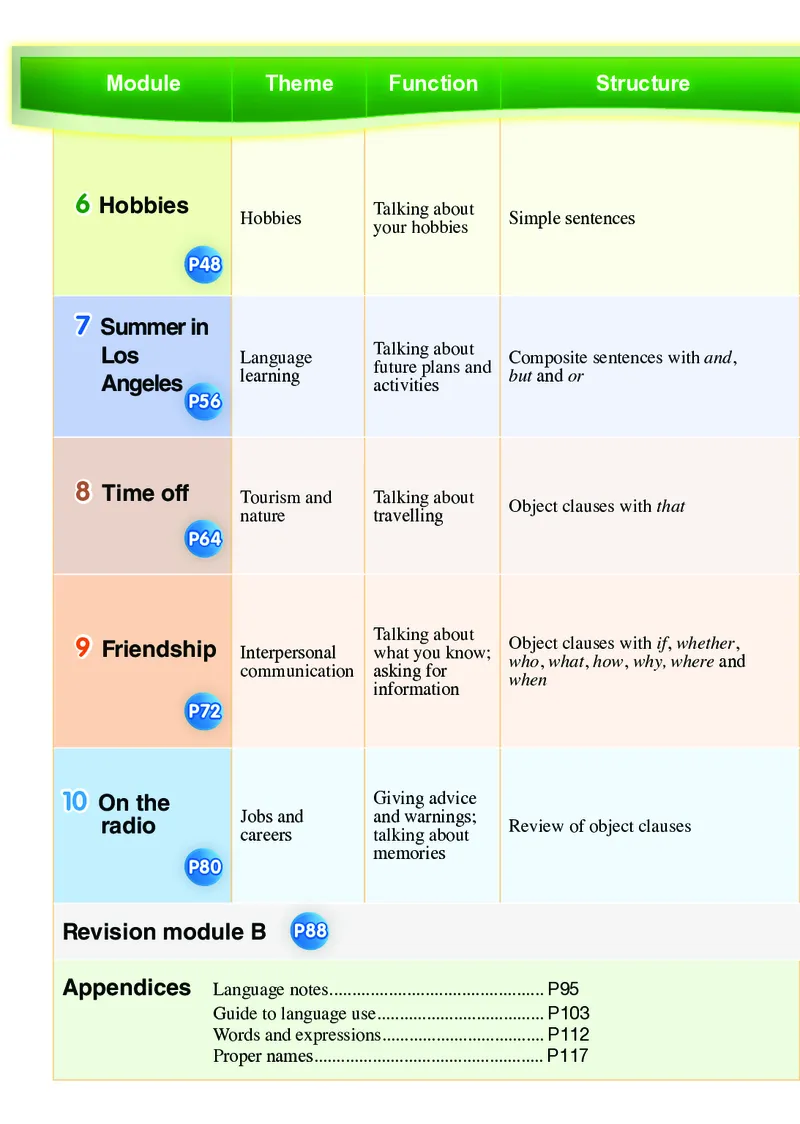
Listening for specific information; understanding familiar
topics (hobbies)
6 Hobbies Exchanging ideas on familiar topics (hobbies)
Talking about Living Making a survey
Hobbies Simple sentences Reading for specific information; understanding the sequence
your hobbies history of hobbies
of events
Writing a short passage about a classmate’s hobby, using as
P48
well as, such as or as a result
7 Summer in Listening for specific information; understanding familiar
topics (studying abroad)
Los Talking about Having a class
Language Composite sentences with and, Exchanging ideas about future plans and activities Summer
future plans and discussion about
Angeles learning but and or Reading for specific information; matching headings with camps
activities summer courses
P56 paragraphs
Writing a description of a Chinese language course, using prompts
Listening for main ideas; listening for specific information
Lake
8 Time off Introducing topics and conducting conversations
Tourism and Talking about District Writing a leaflet
Object clauses with that Reading for specific information; understanding the sequence
nature travelling National for a trip
of events
P64 Park
Writing a passage about Zhangjiajie, using prompts
Listening for specific information; understanding the logical
sequence of a conversation
Talking about
9 Friendship Object clauses with if, whether, Talking about personal information
Interpersonal what you know; Making a poster
who, what, how, why, where and Reading and understanding the sequence of events and Pen friends
communication asking for about friendship
when behaviour of characters
information
Writing about someone or something that changed your life,
P72
using prompts
Listening for specific information
10 On the Giving advice Asking and answering questions about work at a radio station
The
radio Jobs and and warnings; Reading and understanding the sequence of events and Making a school
Review of object clauses clockwork
careers talking about behaviour of characters radio programme
radio
memories Writing about important events in the past and about
P80
background information, using prompts
Revision module B P88
Appendices
Language notes............................................... P95 Vocabulary...................................................... P119
Guide to language use..................................... P103 Pronunciation guide......................................... P125
Words and expressions.................................... P112 Irregular verbs.................................................. P126
Proper names................................................... P117Skills (Listening/Speaking/Reading/ Around the
Module Theme Function Structure Task
Writing) world
Listening for specific information; understanding familiar
topics (hobbies)
6 Hobbies Exchanging ideas on familiar topics (hobbies)
Talking about Living Making a survey
Hobbies Simple sentences Reading for specific information; understanding the sequence
your hobbies history of hobbies
of events
Writing a short passage about a classmate’s hobby, using as
well as, such as or as a result
7 Summer in Listening for specific information; understanding familiar
topics (studying abroad)
Los Talking about Having a class
Language Composite sentences with and, Exchanging ideas about future plans and activities Summer
future plans and discussion about
Angeles learning but and or Reading for specific information; matching headings with camps
activities summer courses
paragraphs
Writing a description of a Chinese language course, using prompts
Listening for main ideas; listening for specific information
Lake
8 Time off Introducing topics and conducting conversations
Tourism and Talking about District Writing a leaflet
Object clauses with that Reading for specific information; understanding the sequence
nature travelling National for a trip
of events
Park
Writing a passage about Zhangjiajie, using prompts
Listening for specific information; understanding the logical
sequence of a conversation
Talking about
9 Friendship Object clauses with if, whether, Talking about personal information
Interpersonal what you know; Making a poster
who, what, how, why, where and Reading and understanding the sequence of events and Pen friends
communication asking for about friendship
when behaviour of characters
information
Writing about someone or something that changed your life,
using prompts
Listening for specific information
10 On the Giving advice Asking and answering questions about work at a radio station
The
radio Jobs and and warnings; Reading and understanding the sequence of events and Making a school
Review of object clauses clockwork
careers talking about behaviour of characters radio programme
radio
memories Writing about important events in the past and about
background information, using prompts
Revision module B
Appendices
Language notes............................................... P95 Vocabulary...................................................... P119
Guide to language use..................................... P103 Pronunciation guide......................................... P125
Words and expressions.................................... P112 Irregular verbs.................................................. P126
Proper names................................................... P117o
du
l
M e
1 Feelings and impressions
Module task: Writing a description of a classmate
Unit 1 It smells delicious.
Listening and vocabulary
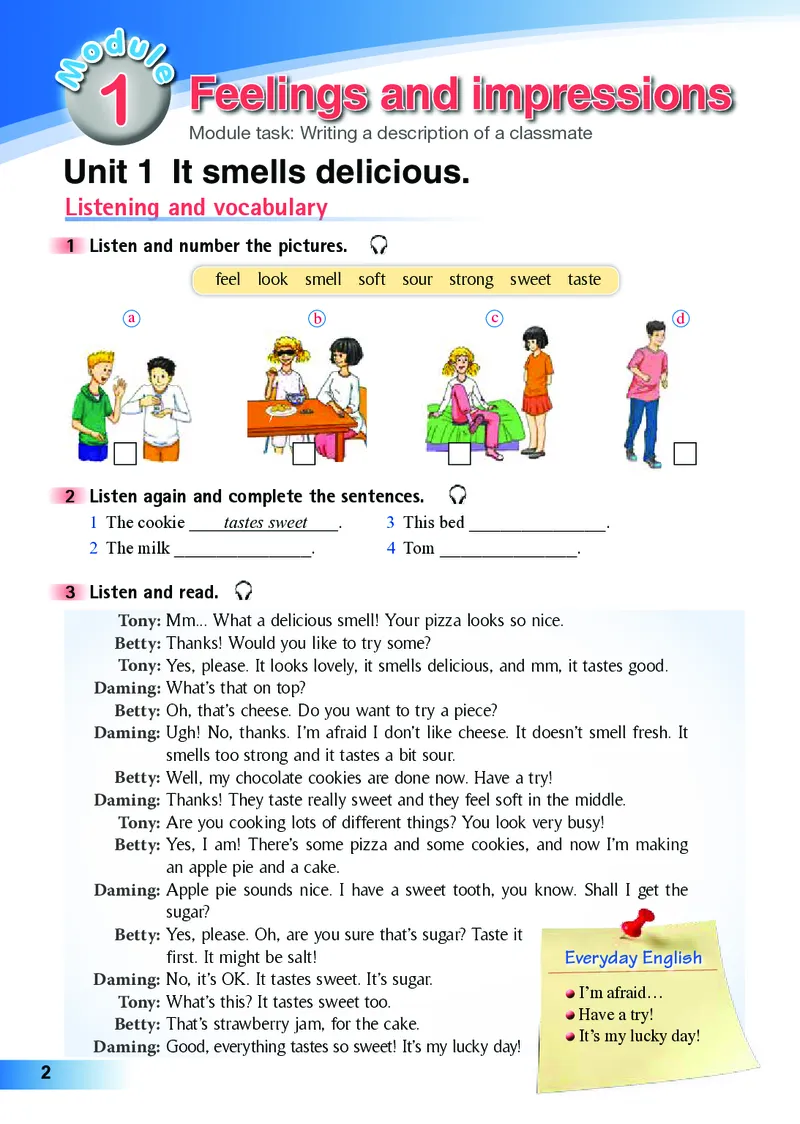
1 Listen and number the pictures.
feel look smell soft sour strong sweet taste
a b c d
2 Listen again and complete the sentences.
1 The cookie tastes sweet . 3 This bed _____________.
2 The milk _____________. 4 Tom _____________.
3 Listen and read.
Mm... What a delicious smell! Your pizza looks so nice.
Tony:
Thanks! Would you like to try some?
Betty:
Yes, please. It looks lovely, it smells delicious, and mm, it tastes good.
Tony:
What’s that on top?
Daming:
Oh, that’s cheese. Do you want to try a piece?
Betty:
Ugh! No, thanks. I’m afraid I don’t like cheese. It doesn’t smell fresh. It
Daming:
smells too strong and it tastes a bit sour.
Well, my chocolate cookies are done now. Have a try!
Betty:
Thanks! They taste really sweet and they feel soft in the middle.
Daming:
Are you cooking lots of different things? You look very busy!
Tony:
Yes, I am! There’s some pizza and some cookies, and now I’m making
Betty:
an apple pie and a cake.
Apple pie sounds nice. I have a sweet tooth, you know. Shall I get the
Daming:
sugar?
Yes, please. Oh, are you sure that’s sugar? Taste it
Betty:
first. It might be salt! Everyday English
No, it’s OK. It tastes sweet. It’s sugar.
Daming:
I’m afraid…
What’s this? It tastes sweet too.
Tony:
Have a try!
That’s strawberry jam, for the cake.
Betty:
It’s my lucky day!
Good, everything tastes so sweet! It’s my lucky day!
Daming:
2Unit 1
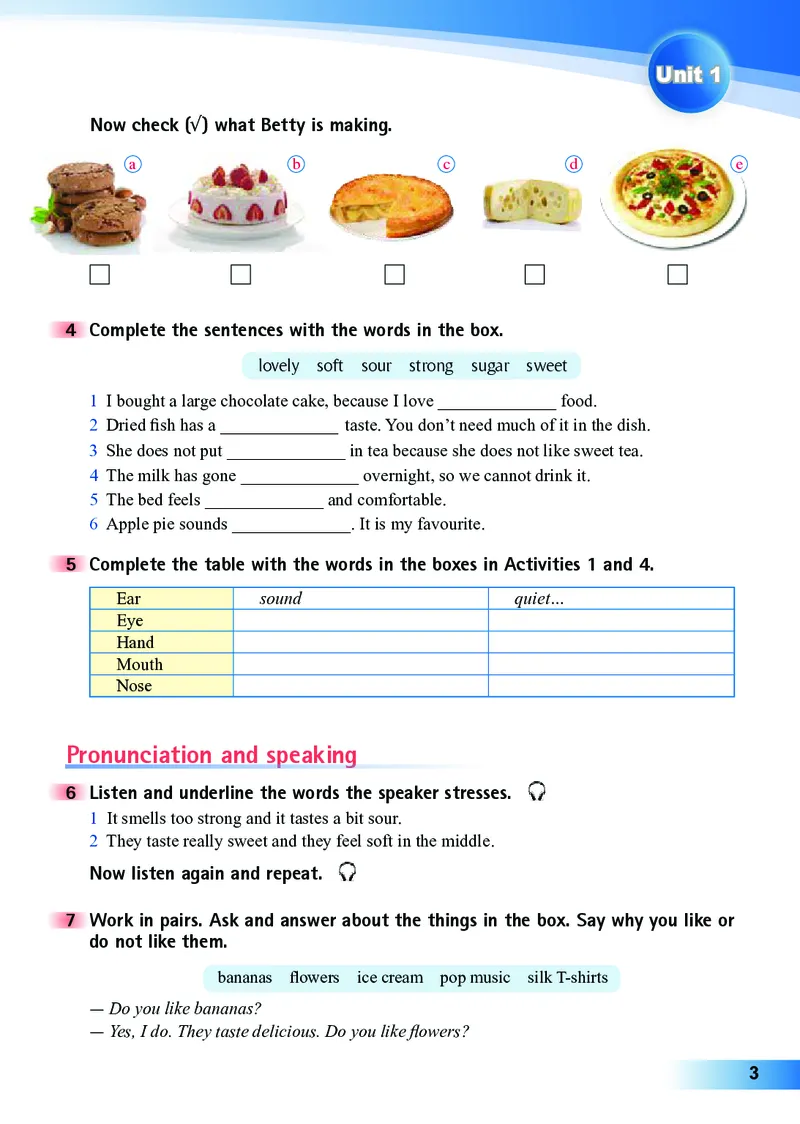
Now check (√) what Betty is making.
a b c d e
4 Complete the sentences with the words in the box.
lovely soft sour strong sugar sweet
1 I bought a large chocolate cake, because I love _________ food.
2 Dried fish has a _________ taste. You don’t need much of it in the dish.
3 She does not put _________ in tea because she does not like sweet tea.
4 The milk has gone _________ overnight, so we cannot drink it.
5 The bed feels _________ and comfortable.
6 Apple pie sounds _________. It is my favourite.
5 Complete the table with the words in the boxes in Activities 1 and 4.
Ear sound quiet…
Eye
Hand
Mouth
Nose
Pronunciation and speaking
6 Listen and underline the words the speaker stresses.
1 It smells too strong and it tastes a bit sour.
2 They taste really sweet and they feel soft in the middle.
Now listen again and repeat.
7 Work in pairs. Ask and answer about the things in the box. Say why you like or
do not like them.
bananas flowers ice cream pop music silk T-shirts
- Do you like bananas?
- Yes, I do. They taste delicious. Do you like flowers?
3o
du
l
M e
1
Feelings and impressions
Unit 2 I feel nervous when I speak Chinese.
Reading and vocabulary
1 Work in pairs. Look at the pictures and
describe the girls. Use the words in
the box to help you.
glasses jeans long nervous
fair pretty proud short
stranger tall young
a b
2 Read Sally’s email and find her picture in Activity 1.
Sally
Lingling
Re: Welcome to China.
Hi Lingling,
1 Thanks for your last message. It was great to hear from you, and I can’t wait to
meet you.
2 I hope you will know me from my photo when I arrive at the airport. I’m quite
tall, with short fair hair, and I wear glasses. I’ll wear jeans and a T-shirt for the
journey, but I’ll also carry my warm coat. I’ve got your photo - you look very
pretty. I’m sure we’ll find each other!
3 Thanks for telling me about your hobbies. You sound just like me! I spend a lot
of time playing classical music with my friends at school, but I also like dance
music - I love dancing! I enjoy sports as well, especially tennis. My brother is in
the school tennis team - I’m very proud of him! He’s good at everything, but I’m
not. Sometimes I get bad marks at school, and I feel sad. I should work harder.
4 You asked me, “How do you feel about coming to China?” Well, I often feel a
bit sad at first when I leave my mum and dad for a few days, and I’m quite shy
when I’m with strangers. I feel nervous when I speak Chinese, but I’ll be fine in
a few days. I’m always sorry when I don’t know how to do things in the right
way, so please help me when I’m with you in China! Oh, I’m afraid of flying too.
But I can’t tell you how excited I am about going to China!
See you next week!
Love,
Sally
4Unit 2
3 Match the questions with the paragraphs.
a) What are your hobbies?
b) How do you feel about coming to China?
c) What do you look like?
4 Read the sentences.
She’s quite tall, with short fair hair, and she’s wearing glasses. She’s wearing a T-shirt and
carrying a warm coat.
Now describe the people. Use the sentences above to help you.
1 the girl in Picture B in Activity 1
2 your classmates
Learning to learn
5 Answer the questions.
Remember that talking to other
How does Sally feel when she… people is not just speaking and
understanding the language. It’s
1 gets bad marks at school?
how you look, how you sound and
2 leaves her mum and dad? what you do. Watch people in films
3 is with strangers? as they talk to others in English. Do
you do the same when you talk in
4 speaks Chinese?
Chinese?
5 does not know how to do things in the right way?
6 travels by plane?
6 Complete the passage with the correct form of the words in the box.
fair hobby mark message proud
Jenny is my classmate. She is pretty and has (1) ______ hair. She always gets good
(2) ______ at school. She has lots of (3) ______ like playing the piano and
swimming. She is also in the school tennis team. She is good at everything. One day she sent
me a (4) ______. She asked me to help her with her English homework because I am
good at English. She wanted my help! I was (5) ______ of myself.
Writing
7 Write a message to your pen friend and describe yourself. Say:
● what you look like ● how you feel when…
I have short black hair and… I feel nervous when…
● what your hobbies are
I like playing basketball and…
5o
du
l
M e
1
Feelings and impressions
Unit 3 Language in use
Language practice
It tastes good. You look very pretty.
It doesn’t smell fresh. I feel nervous when I speak Chinese.
1 Look at the picture. Complete the sentences.
The cookies ____ t_a_st_e_ d_e_l_ic_i_o_u_s______.
1 The bananas _____________________. 4 The juice ________________________.
2 The students _____________________. 5 The chairs _______________________.
3 The flowers ______________________. 6 The music _______________________.
2 Write sentences about yourself. Use the words in the box to help you.
feel look smell sound taste
I like this dress very much. It feels comfortable.
6Unit 3
3 Put the words in the box into the correct columns.
beautiful dark fair friendly nice old pretty
proud quiet short shy strict tall young
What does he/she look like? What is he/she like?
beautiful friendly
4 Work in pairs. Use the table in Activity 3 to ask and answer questions about
the people.
your mum
A: What does your mum look like?
B: She’s tall and beautiful.
A: What is your mum like?
B: She’s friendly.
1 your dad
2 your maths/Chinese/music teacher
3 your uncle
4 your best friend
5 Complete the conversation with the correct form of the words in the box. You
need to use some of the words more than once.
be look taste
Jane: Hi, Alex! How are you today?
Alex: Great!
Jane: You (1) _________ very happy!
Alex: Oh, yes. My mum made a cake for me. Here, have some. It really (2) _________
delicious!
Jane: Thanks. It (3) _________ very pretty too. Mm, you’re right. It’s nice.
Alex: And another good thing is, my friend Ben is coming to stay.
Jane: Oh, really? What (4) _________ he like?
Alex: He’s really friendly and kind.
Jane: What does he (5) _________ like?
Alex: Well, he’s tall and thin. He’s good at sport. Would you like to meet him?
Jane: Yes, I’d like to.
7o
du
l
M e
1
Feelings and impressions
6 Complete the passage with the words in the box.
close friendly look meet noisy with
Americans usually shake hands with each other when they first (1) ___________.
When two Americans are talking, they do not stand too (2) __________ to each other. If
they meet some friends at a party while they are talking (3) __________ someone else,
they usually bring their friends into the conversation. Americans (4) __________ each
other in the eye when they talk. They may be a bit (5) __________ sometimes, but they
are quite (6) __________.
7 Write about how things feel, look, smell, sound or taste. Use the words in the box
to help you.
beautiful comfortable delicious fresh great hot
nervous nice noisy quiet round strong sweet
Flowers look beautiful. They smell nice.
8 Work in pairs. Describe a thing in the box to your partner. Your partner should
guess what it is. Use the words in the box in Activity 7 to help you.
a basketball a bird a cat a flower a hamburger
a lantern a plane grass the sun
A: It looks beautiful.
B: Is it a flower?
A: No, it isn’t. It’s round and hot.
B: Is it a lantern?
A: No, it isn’t. It’s much hotter and bigger than a lantern.
B: Is it the sun?
A: Yes, you’re right.
8Unit 3
9 Listen and complete the notes. What is the speaker complaining about?
The music:
The room:
The food:
The drink:
The people:
Around the w rld
Polite expressions
In the West, people are quite open
about their feelings. Many people hug
each other when they meet. People are
friendly and informal. They usually use
given names, even at work. It is polite
for people to say “thank you” very
often, even to their family members.
Module task: Writing a description of a classmate
10 Think about one of your classmates:
● age ● hair ● hobbies
● face ● height ● size
11 Write a description of him/her.
My friend is fourteen years old. He is tall and looks strong. He plays football well…
12 Work in groups. Share your description with your classmates. Let them guess
who he/she is.
9o
du
l
M e
2
Experiences
Module task: Writing a questionnaire about experiences
Unit 1 I’ve also entered lots of speaking competitions.
Listening and vocabulary
1 Listen and number the words as you hear them.
ever □ exciting □ tired □ visit □ wonderful □
2 Listen again and choose the correct answer.
1 Lingling has visited / hasn’t ever visited the US. Everyday English
2 Betty has asked / hasn’t asked her parents.
Good luck!
3 Lingling has travelled / hasn’t travelled by plane.
That’s a pity.
3 Listen and read. That sounds wonderful!
Hi, Lingling. What are you What do you mean?
Tony: Tony:
doing? Look! Here’s a writing competition:
Lingling:
I’m entering a competition. Around the World in 80 Days. To
Lingling:
What kind of competition? win it, you need to write a short
Tony:
A speaking competition. story about a place you’ve visited.
Lingling:
Great. It’ll help you improve your That sounds wonderful, but I
Tony: Tony:
speaking. And maybe you will haven’t travelled much. How can I
win a prize. write about it?
The first prize is “My dream Don’t worry. It doesn’t need to be
Lingling: Lingling:
holiday”. true! You can make it up.
Have you ever won any prizes You’re right. I’ll try. I hope I will
Tony: Tony:
before? win, then I will invite you to come
No, I haven’t. I’ve always wanted with me.
Lingling:
to go on a dream holiday. But I Sorry! The first prize is only the
Lingling:
can’t afford it. The plane tickets book called Around the World in
are too expensive. 80 Days!
Well, good luck! I’ve also entered
Tony:
lots of speaking competitions,
but haven’t won any prizes. I’ve
stopped trying now.
That’s a pity. Have you ever
Lingling:
thought about other kinds of
competitions?
1100Unit 1
Experiences
Now check (√) what Lingling and Tony have or have not done.
Name Experiences Yes No
has won some prizes.
Lingling
has always wanted to go on a dream holiday.
has entered lots of speaking competitions.
Tony has won some prizes.
has travelled a lot.
4 Work in pairs. Ask and answer questions about what Lingling and Tony have or
have not done.
- Has Lingling ever won any prizes before?
- No, she hasn’t.
5 Complete the sentences with the correct form of the words in the box.
afford competition dream invite pity prize
1 Her _________ was to study at a good university one day.
2 When I was in school, I won many _________ for my writing.
3 You must enter the music _________! You will beat everybody.
4 My family cannot _________ to buy a ticket for the match.
5 It is a(n) _________ that you did not come to see the film with us.
6 John _________ his new friends to his birthday party last week.
Pronunciation and speaking
6 Read and predict which words the speaker is likely to stress.
- Have you ever wanted to travel around the world?
- Yes, I have. I’ve always wanted to travel around the world.
- Have you ever visited New York?
- No, I haven’t. I’ve never visited the US.
- Have you ever entered a competition?
- No, I haven’t. I haven’t entered any competitions.
Now listen and check.
7 Work in pairs. Read the conversations in Activity 6 aloud.
8 Work in pairs. Ask and answer questions about yourself.
- Have you ever visited...?
- Yes, I have. / No, I haven’t. I’ve...
11o
du
l
M e
2
Experiences
Unit 2 They have seen the Pyramids.
Reading and vocabulary
1 Work in pairs. Ask and answer the questions.
1 Which interesting places in China have you visited?
2 Have you ever seen the Great Wall?
3 Have you ever visited another country?
2 Read the passage and answer the questions.
Mike Robinson is a fifteen-year-old Mike and Clare have also begun to learn
American boy and his sister Clare is fourteen. the language of the country, Arabic. This
At the moment, Mike and Clare are in Cairo language is different from English in many
in Egypt, one of the biggest and busiest cities ways, and they find it hard to spell and
in Africa. pronounce the words. However, they still
They moved here with their parents two enjoy learning it. So far they have learnt to
years ago. Their father, Peter, works for a speak German, French, Chinese and Arabic.
very big company. The company has offices Sometimes they mix the languages. “It’s
in many countries, and it has sent Peter to really fun,” said Clare.
work in Germany, France and China before. The Robinsons are moving again. The
Peter usually stays in a country for about two company has asked Peter to work back in
years. Then the company moves him again. the US. Mike and Clare are happy about
His family always goes with him. this. They have friends all over the world,
The Robinsons love seeing the world. but they also miss their friends in the US.
They have been to many interesting places. They are counting down the days.
For example, in Egypt, they have seen the
Pyramids, travelled on a boat on the Nile
Learning to learn
River, and visited the palaces and towers of
When you read a passage
ancient kings and queens.
about travel, use a map to
find out where the places
are, and the names of the
other countries, regions
and cities nearby.
1122Unit 2
1 How long have the Robinsons been in Egypt?
2 Why do they live in Cairo?
3 What have they seen and done in Egypt?
4 What do Mike and Clare find difficult about Arabic?
5 Who do they miss in the US?
6 Are they looking forward to going home?
3 Complete the passage with the correct form of the words in the box.
ancient count example king mix queen
Mike and Clare live in Cairo in Egypt because their father works there. They have
visited many places in Egypt. For (1) __________, they have seen the Pyramids,
and they have visited the (2) __________ palaces of the (3) __________ and
(4) __________ of Egypt. Mike and Clare have learnt a little Arabic, and when
they speak it, they often (5) __________ it with German, French and Chinese.
Recently, their father’s company has asked him to go back to the US. Mike and Clare
are (6) __________ down the days.
Writing
4 Work in pairs. Think of a special trip. Write notes and explain:
● where you went
● when you went there
● why it was special
5 Write sentences to describe what you have seen or done. Use the passage in
Activity 2 to help you.
Now write a passage about your experiences.
13o
du
l
M e
2
Experiences
Unit 3 Language in use
Language practice
Have you ever won any prizes before?
I haven’t travelled much.
They have been to many interesting places.
1 Write questions for the questionnaire with Have you ever...?
1 have a Western meal 5 travel to the seaside
2 live in another city 6 try seafood
3 enter a singing competition 7 cook dinner for your parents
4 travel by train
Activities You Your partner
1 Have you ever had a Western meal?
2
3
4
5
6
7
Now complete the You column.
2 Work in pairs. Ask and answer the questions in the questionnaire in Activity 1.
Then complete the Your partner column.
- Have you ever had a Western meal?
- Yes, I have. / No, I haven’t.
3 Complete the sentences about your partner and read them to the rest of the class.
1 He/She __________________ a Western meal.
2 He/She __________________ in another city.
3 He/She __________________ a singing competition.
4 He/She __________________ by train.
5 He/She __________________ to the seaside.
6 He/She __________________ seafood.
7 He/She __________________ for his/her parents.
14Unit 3
4 Complete the postcard. Use the list of Things to do in Beijing to help you.
Dear David,
I’m having a wonderful time in Beijing. I’ve
done so many things! I’ve…
T
I …
h e r e ’ s o n l y o n e t h i n g I h a v e n ’ t d o n e :
•
• •
T
e
h
c s
a
l
i
e i
n
t
m e
g
B
b t
s
e
h t
i
e
t
h
ji
o
n
e B
g
G e
d
d
i r
o
ji
u
e n
c
a
i
g
n
k
t O
√
W
B
p a
e
e l r
i
l
j
a
i
X
n
√
g
Bye for now, • visit the Palace Museum
√
Rob
5 Complete the sentences with the words in the box. You can use some of the
words more than once.
afford competition pronounce spell tower
1 I wrote a story for a(n) _______________ in my English class and I won a prize.
2 Alice can _______________ very well, and what’s more, she can write beautifully.
3 Some English words are difficult to _______________.
4 We visited an ancient palace with a tall _______________ and a beautiful garden.
5 Mary wants to visit the US, but the plane tickets are very expensive and she cannot
_______________ to go.
6 Listen and check (√) the country that the people have been to.
People China the US
Winnie
Diana
Bob
15o
du
l
M e
2
Experiences
7 Listen again and answer the questions.
1 How many times has Winnie been to the US?
2 Which country would Diana like to go again?
3 Which part of China has Diana travelled around?
4 How did Diana travel there?
5 Has Bob ever visited Germany?
8 Complete the passage with the sentences in the box. There is one extra
sentence.
a) Call today to find out more!
b) Then we will send a gift box from you to your family or friend.
c) A tree is also something special for a festival or a new baby.
d) Have you ever been to a forest?
e) Grow a tree near you!
Grow a Forest!
(1) ___________________________ Have you ever wanted to save the trees in the
forest? Do you love nature and want to keep forests safe? Now you can! Buy a tree - it
is the perfect birthday or wedding present for someone in your family or for a friend.
(2) ___________________________ Your tree will help our world and will last longer
than toys, clothes or computers. The world needs more trees - buy one today, watch it
grow bigger and feel proud!
The Grow-a-Forest gift is part of an exciting plan to make our world greener,
and every gift helps to protect our world. It is easy! Buy a Grow-a-Forest gift today
and choose your forest and your tree. We will take it and put it in the earth for
you. (3) ___________________________
In your gift box there will be:
● a map of the forest
● a photo of your tree
● a pair of Grow-a-Forest gloves
● a card with your message to your family or friend
(4) ________________________
1166Unit 3
Around the w rld
On the top of the world
The world witnessed one of the wind and the lack of oxygen, they
greatest climbing achievements in 1953, finally reached the top at 11:30 am
when Tenzing Norgay from Nepal and on 29th May. They could only spend
Edmund Hillary from New Zealand about fifteen minutes on the summit
climbed Mount Qomolangma for the before they had to come down. But they
first time. After a long and difficult remained heroes around the world for
climb, troubled by heavy snow, freezing the rest of their lives.
Module task: Writing a questionnaire about experiences
9 Write a question about life experiences for each of the topics. Use Have you ever...?
Transport: Have you ever travelled by plane? Food: ______________________________
Book: _______________________________ Sport: ______________________________
Country: _____________________________ Film: ______________________________
1 0 Work in groups. Choose the best question for each topic in Activity 9 and
prepare a questionnaire.
11 Go around the classroom and ask other students your questions. Write their
answers in the questionnaire.
Topics Questions Student 1 Student 2 ...
Transport Have you ever travelled by plane?
Book
Country
Food
Sport
Film
12 Return to your group and talk about other students’ answers to your questionnaire.
17o
du
l
M e
3 Journey to space
Module task: Making a poster about space travel
Unit 1 Has it arrived yet?
Listening and vocabulary
1 Listen and number the words as you hear them.
earth □ land □ message □
moon □ news □ planet □
reach □ scientist □
2 Listen again and complete the notes.
● news about the trip to (1) _________
● journey of (2) _________ months
● has not sent back any (3) _________ yet
● hope to find (4) _________ on Mars
3 Listen and read.
Hi, Tony. What are you up to?
Daming:
Hi, Daming. I’ve just made a model spaceship for our school project.
Tony:
I haven’t started yet because I’m not sure how to make it. Can you help me?
Daming:
Sure, no problem. Have you heard the latest news? Scientists have sent a
Tony:
spaceship to Mars. The journey has taken several months.
Has it arrived yet?
Daming:
Yes, it has arrived already. That’s why it’s on the news.
Tony:
So have they discovered life on Mars?
Daming:
No, they haven’t yet.
Tony:
Are there any astronauts in the spaceship?
Daming:
No, there aren’t.
Tony:
Why not? Astronauts have already been to the moon.
Daming:
Yes, but no one has been to Mars yet, because Mars is very far away, much
Tony:
farther than the moon. Lots of scientists are
working hard in order to send astronauts to Mars
one day. Everyday English
That’s interesting! How can I get information on
Daming:
What are you up to?
space travel?
Sure, no problem.
You can go online to search for information.
Tony:
I will. Thank you, Tony!
Daming:
18Unit 1
Now answer the questions.
1 What school project have Daming and Tony got?
2 How does Daming feel about the school project?
3 What news has Tony heard?
4 Has anyone been to Mars? Why?
4 Complete the passage with the correct form of the words in the box.
arrive discover planet send yet
On today’s news, Tony has heard that scientists have (1) _____ a spaceship to
Mars and it has (2) _____ on the (3) ______ after a journey of several months
from the earth. Scientists have not (4) _____ life on Mars (5) ______. And no
astronaut has ever been to Mars because it is very far away.
Pronunciation and speaking
5 Listen and underline the words the speaker stresses.
1 I’ve just made a model spaceship for our school project.
2 I haven’t started yet because I’m not sure how to make it.
3 Has it arrived yet?
4 Astronauts have already been to the moon.
Now listen again and repeat.
6 Make lists of what we have and have not done in space travel.
We have… We have not…
______________________ ______________________
______________________ ______________________
______________________ ______________________
______________________ ______________________
______________________ ______________________
7 Work in pairs. Talk about space travel with the lists in Activity 6.
- Have we sent a spaceship to Mars?
- Yes, we have. But...
19o
du
l
M e
3
Journey to space
Unit 2 We have not found life on any other planets yet.
Reading and vocabulary
1 Work in pairs. Look at the picture and talk about what you know about Chinese
spaceships.
Shenzhou-9 is a manned spaceship.
Learning to learn
When you read a passage
with a title and pictures, think
about the words you may find
in the passage, and the questions
you may want to ask before you
start to read.
2 Read the passage and choose the best title for it.
1 Anyone out there? 2 Life on the earth 3 The sun and other stars 4 The stars at night
Scientists think that there has been life very far away and their light has to travel
on the earth for hundreds of millions of for many years to reach us. So how large is
years. However, we have not found life on the universe? It is impossible to imagine.
any other planets yet. Scientists have sent spaceships to the
The earth is a planet and it goes around planet Mars to take photos. They have
the sun. Seven other planets also go around even sent spaceships to travel outside the
the sun. None of them has an environment solar system. However, no spaceship has
like that of the earth, so scientists do not travelled far enough to reach other stars in
think they will find life on them. The sun and our Galaxy.
its planets are called the solar system, and Scientists have always asked the
our solar system is a small part of a much questions: with so many stars in the
larger group of stars and planets, called the universe, are we alone, or is there life out
Galaxy or the Milky Way. There are billions there in space? Have there been visitors
of stars in the Galaxy, and our sun is only to the earth from other planets? Why has
one of them. no one communicated with us? We do not
Scientists have also discovered many know the answers… yet.
other galaxies in the universe. They are
20Unit 2
3 Check (√) the true sentences.
1 The earth is a star.
2 The sun is a star.
3 There is more than one galaxy in the universe.
4 The light from the stars in other galaxies has travelled for a long time to reach us.
5 Scientists have received many messages from space.
6 Spaceships have visited most of the universe.
4 Complete the passage with the words and expression in the box.
communicate environment none solar system universe
Is there life on other planets? There are seven other planets in our (1) ____________,
but (2) ____________ of them has a(n) (3) ____________ like that of the earth. Spaceships
from the earth have done surveys of the other planets, but they have not found any life
there. Why has no one from other planets tried to (4) ____________ with us? It is true that
scientists have not discovered life on other planets in the (5) ____________ yet, but some
scientists believe that they will find it some day.
Writing
5 Look at the picture from a science story for children and answer the questions.
What have the scientists just received?
(a message from one of our spaceships)
They have just received a message from one of
our spaceships.
1 Where has the spaceship landed? (Mars)
2 What has the spaceship discovered? (people
on Mars)
3 Why have the people on Mars not sent us a
message? (do not know how to)
4 Why have the people on Mars not visited
us on the earth? (do not know how to)
6 Write a passage to describe the picture. Use your answers to the questions in
Activity 5 to help you.
We have just received a message from our spaceship to Mars…
21o
du
l
M e
3
Journey to space
Unit 3 Language in use
Language practice
I’ve just made a model spaceship. Astronauts have already been to the moon.
Has it arrived yet? We have not found life on any other planets yet.
1 Complete the news with already, just and yet.
Spaceship on Mars!
Astronauts have (1) __________ been to the moon but they have not been to
any other planets. However, a spaceship has (2) __________ arrived on Mars and
it has (3) __________ sent back photos of the red planet. Is there life on Mars?
We do not know (4) __________ .
2 Look at these sentences.
● The spaceship has gone to Mars.
It has gone there, but it has not come back yet.
● Astronauts have been to the moon.
They went there and then they came back.
Now choose the correct answer.
1 Astronauts have been / gone to the moon and returned.
2 The spaceship has been / gone into space. It will travel for ten days.
3 The astronaut has been / gone to the space station. He will come back tomorrow.
4 The spaceship has been / gone to the space station. It brought back two astronauts.
2222Unit 3
3 Complete the sentences with the expressions in the box.
have/has been have/has gone
1 A spaceship _______ to Mars. It is coming back to the earth next year.
2 Lots of astronauts _______ to the space station. They found it very interesting.
3 Some astronauts _______ to the moon twice.
4 Two British astronauts _______ to the space station. They will come back in January.
4 Complete the conversation with the correct form of the verbs in brackets.
Nicky: I’ve just (1) _______ (watch) a great TV programme about space. Did you
know that scientists have (2) _______ (discover) water on Mars?
Bill: Yes, I did. And scientists (3) _______ (try) to find life on Mars now.
Nicky: Yes, they’re looking for life but they (4) _______ (not find) anything yet.
Bill: There were some new photos of Mars in the newspaper today. (5) _______ you
_______ (see) them yet?
Nicky: Yes. They’re amazing!
5 Work in pairs. Role-play the conversation in Activity 4.
6 Complete the email with the words in the box.
been just met never read written yet
Liu Dan
Li Fang
I’ve found a great book.
Dear Li Fang,
I’ve (1) ________ finished reading a great book at school. I haven’t
(2) ________ anything as good as that for a long time! It’s a story about
the solar system. In the book, the writer imagines that astronauts have
(3) ________ to Mars. I’ve (4) ________ thought about that before and
I think it’s very interesting.
I haven’t (5) ________ anyone famous in my life but I hope one day I can
meet an astronaut. I’ve (6) ________ to a Chinese astronaut for more
information about space and his experience of space travel. I hope he will
write back. He hasn’t (7) ________. Maybe he is too busy. I’m still
waiting.
Best wishes,
Liu Dan
23o
du
l
M e
3
Journey to space
7 Listen and complete the notes.
1 The astronaut joined CNSA ________
years ago.
2 He has flown in a spaceship ________
times.
3 He felt ________ when he was in the
spaceship.
4 He has been to the space station
________.
5 The earth was blue and very ________
when he saw it from the space station.
6 He decided to be an astronaut because he
has always been ________ in space.
8 Complete the word map with the words and expressions in the box.
astronaut Mars spaceship space station the earth the moon the sun
SPACE solar system
space travel
Now add more words about space to the word map and write five sentences.
24Unit 3
9 Complete the passage with the correct form of the words in
the box.
astronaut discover moon news reach spaceship yet
In July 1969, Neil Armstrong became the first (1) ____________ to walk on the
(2) ____________. People all around the world watched their televisions and waited for
the (3) ____________ to (4) ____________ the earth. We have now (5) ____________ a
lot more about our solar system, and we have sent (6) ____________ to Mars, but no one has
walked on that planet (7) ____________. But I believe one day someone will!
Around the w rld
Names of the days of the week
Many European languages use the names of the heavenly bodies for the
days of the week. For example, in English, Saturday is named after the planet
Saturn, the sixth planet from the sun. Sunday is the day of the sun, a traditional
day of rest. Monday gets its name from the moon and is the day of the moon.
Module task: Making a poster about space travel
10 Work in groups. Choose a subject, for example, the first moon landing or China’s
manned space travels. Look for some photos and information about it.
11 Write captions for the photos and use the information you found in Activity 10
to write a description of each one.
12 Give your poster a title. Put it up for your classmates to see.
25o
du
l
M e
4 Seeing the doctor
Module task: Doing a survey to find the most suitable exercise
Unit 1 I haven’t done much exercise since I got my computer.
Listening and vocabulary
1 Match the words and expression in the box with the pictures.
cough □ fever □ headache □ stomach ache □ toothache □
a b c d e
2 Listen and check (√) what’s wrong with Betty and Daming.
cough fever headache stomach ache toothache
Betty
Daming
3 Listen and read.
Doctor: How can I help you? Daming: Not really. I haven’t done much
Daming: I feel ill. I’ve got a stomach ache exercise since I got my computer
and my head hurts. last year.
Doctor: How long have you been like this? Doctor: You spend too much time in front
Daming: Since Friday. I’ve been ill for about of the computer. It can be very
three days! harmful to your health.
Doctor: I see. Have you caught a cold? Daming: OK, so what should I do?
Daming: I don’t think so. Doctor: Well, don’t worry. It’s not
Doctor: Let me take your temperature… serious. First, stop eating fast
Hmm, there’s no fever. What kind food and have breakfast every
of food do you eat? day. Second, get some exercise,
Daming: Usually fast food. such as running. And I’ll give
Doctor: Do you have breakfast? you some medicine. Take it three
Daming: No, not usually. times a day.
Doctor: That’s the problem! Fast food and Daming: Thank you, doctor.
no breakfast. That’s why you’ve
got a stomach ache. Everyday English
Daming:
What about the headache?
How can I help you?
Doctor:
Do you do any exercise?
No, not usually.
That’s the problem!
26
Not really.UUnniitt 11
Now complete the table about Daming.
Illness
How long
Why
What to do
4 Complete the passage with the words and expression in the box.
cough fever health stomach ache temperature
It is easy to look after your (1) _______________. Just do some exercise, such as
running. Do not eat fast food! It may give you a (2) _______________. Most illnesses are
not dangerous but when you catch a cold or get a (3) _______________, you may also get
a (4) _______________. This means your (5) _______________ is higher than usual. You
must go to the doctor.
Pronunciation and speaking
5 Listen and notice the intonation.
1 How can I help you?
2 How long have you been like this? ↘
3 Have you caught a cold? ↘
4 Do you do any exercise? ↘
Now listen again and repeat.
6 Work in pairs. Act out a conversation between a doctor and a patient.
You are a doctor.
Student A:
You are at the doctor’s. Choose one of the illnesses from the box in Activity 1.
Student B:
- How can I help you?
- I’ve got a bad cough.
27o
du
l
M e
4
Seeing the doctor
Unit 2 We have played football for a year now.
Reading and vocabulary
1 Describe the activities in the pictures. Which ones are healthy?
a c
d
b e
2 Read the passage and match the people with the pictures in Activity 1. There is
one extra picture.
Healthy living
1 I was not feeling very well so the I always felt very sleepy and I was not
doctor checked my heart and said I happy. I bought a bike in January. Since
needed more exercise. I have never been then, it has become part of my life. Now
I ride to work every day. It is my daily
very active, and I do not like sports. I
exercise. I arrive at work with a smile on
have always wanted a pet, so my parents
my face. - Thomas
gave me a dog for my birthday. Now I
get exercise by taking him for a walk 4 I was weak after a long illness, so
every day. I have had him for three months I wanted to exercise more. Then a
now and I feel really healthy. - Anna friend suggested, “Why don’t we go
for a run before school?” So we started
2 Our teacher decided to start a girls’
running a week ago. But I do not enjoy
football team and I thought, “What a
running, and when I get to school, I feel
great idea!” I was the first member of the
awful. My legs hurt and I am hot all
team. We have played football for a year over. Perhaps I am too weak to do any
now and we all feel very fit. Our teacher exercise. What do you think? - Richard
is the coach, and she also takes part in
the training with us. She is in excellent
Learning to learn
condition too. - Wang Wei
When you write your
3 For the last few years, I went to work advice, you can use you…,
on the underground. When I got to work, you should/should not…
and sentences like Do… or
Do not…
28Unit 2
3 Complete the notes.
Anna Thomas
1 She was not feeling very ________. 6 He went to work on the _______
2 She needed more ________. for several years.
3 She got a pet ________ from her 7 He bought a _______ in January.
parents and she takes him for a 8 He arrives at work with a _______
________ every day. on his face.
Wang Wei Richard
4 She was the ________ member of 9 He started running a ________
the football team. ago.
5 She has played football with the 10 He does not _______ running.
team for a ________ and all the 11 He thinks he is perhaps too
members feel very ________. _______ to go for a run.
4 Complete the sentences with the words in the box.
active awful condition daily member Perhaps
1 Tom runs six miles every morning, so he is in very good ________.
2 Jill is a very ________ girl and plays lots of sports.
3 I had a very bad headache yesterday, and I felt ________.
4 Ben is a(n) ________ of the school football team.
5 You do not look very well. ________ you should see a doctor.
6 I saw your grandfather taking his ________ walk this morning.
Writing
5 Work in pairs. Look at the pictures of
Colin. Write notes and explain:
● what the problem was
● what suggestions the doctor gave him
● what happened next
● how Colin feels now
Now write four sentences to describe
what happened.
6 Write a passage about healthy living. Use the sentences you wrote in Activity
5 to help you.
29o
du
l
M e
4
Seeing the doctor
Unit 3 Language in use
Language practice
I haven’t done much exercise since I got my computer last year.
I have had him for three months now.
Since then, it has become part of my life.
1 Work in pairs. Ask and answer the questions.
- How long have you had your bike?
- I’ve had it for about two years.
1 How long have you studied at this school? 4 How long have you lived in this place?
2 How long have you studied English? 5 How long have you used this book?
3 How long have you known your best friend?
2 Complete the questionnaire about healthy living. Use since or for where necessary.
Healthy Living Questionnaire
1 What kind of exercise do you do? 4 If yes, how long have you played
in the team?
2 How long have you done this kind
of exercise? 5 Do you have a healthy diet?
3 Do you play in a school sports 6 If yes, when did you start having
team? a healthy diet?
30Unit 3
3 Complete the sentences.
1 - I fell ill two days ago.
- So you’ve _____________ ill for two days?
- That’s right.
2 - I saw the doctor three days ago.
- So you haven’t _____________ her in the last three days?
3 - I’ll walk to school for the first time tomorrow.
- So you’ve never _____________ to school before?
4 - I came into hospital two days ago.
- So you’ve already _____________ in hospital for two days?
5 - How long _____________ you _____________ a headache?
- Oh, it began about two hours ago.
4 Complete the passage with the words and expressions in the box.
cold coughs exercise fast food stomach ache weak well
For a long time John did not feel (1) _____________. He often had (2) _____________
and colds. He went to see a doctor. The doctor told him to take more (3) _____________
and stop eating (4) _____________. So he started riding a bike to school. At first, he
felt tired and (5) _____________. Then he got fitter and started enjoying it. Since he
started riding a bike, he has not had a(n) (6) _____________ and he has not had a(n)
(7) _____________ since he stopped eating fast food.
5 Complete the conversation with the sentences in the box.
Can I help you? How long have you been like this?
That’s it. What’s wrong with me?
Doctor: (1) ___________________________
Bill: Well, I’ve got a pain in my back.
Doctor: (2) ___________________________
Bill: For about two weeks.
Doctor: Let me have a look. Where do you work?
Bill: I work in an office.
Doctor: Do you play computer games?
Bill: Yes, a lot. I usually play computer games late at night.
Doctor: (3) ___________________________
Bill: (4) ___________________________
Doctor: Well, you spend too much time in front of the computer.
Bill: What can I do?
Doctor: Stand up and do some exercise from time to time. Don’t play computer games too much.
Now work in pairs. Read out the conversation.
31o
du
l
M e
4
Seeing the doctor
6 Read the passage and match the problems with the advice.
What can I do?
1 I would like to take more exercise, but I have not found a favourite sport. The
coach has not chosen me to play in the football team because I am not fit, and I am
not a good player. I went running in the park to get fit, but I felt lonely and sad. What
can I do? - Alan
2 I went to school by bus in the past, and I did not feel fit. So last month I decided
to take more exercise and started walking to school. I have walked to school for three
weeks now. I am getting a lot fitter and I feel healthier. The problem is, all my friends
take the bus to school and I do not have anyone to talk with on the way! What can I
do? - Barbara
3 I love playing computer games with my friends. I also watch TV and eat fast food.
I know it is not healthy and sometimes I get a stomach ache. The problem is, I do not
know how to stop and become fitter and healthier. I do not want to spend all my life
sitting in a chair. What can I do? - John
Have you tried this?
a) Walking has helped you get fitter, so why not ask a friend to walk to school with you?
b) How about asking a friend to go running with you? Have you practised to improve your
football skills?
c) Why not turn off the computer and TV and join a sports club? Go with your friends so
that you will still spend time together. And how about choosing some healthy food to
eat?
Work in pairs. Do you have similar problems? Talk about your advice.
32Unit 3
7 Listen and complete the passage.
The man feels (1) _____________. He is hot and (2) _____________. He has been like
this for about (3) _____________. He has got a temperature and a (4) _____________
but has not got a (5) _____________ or a cough. The doctor suggests he should
(6) _____________ and take the medicine (7) _____________ a day. And he should
(8) _____________ until he feels better.
Around the w rld
The World Health Organization
The World Health Organization
(WHO) was set up in 1948 to help
ordinary people all over the world,
especially in developing countries. It
cures, prevents and controls serious
diseases such as malaria, and educates
people about how to protect their health.
The WHO has helped millions of people
by training doctors and nurses, and by
teaching mothers how to take better
care of their children.
Module task: Doing a survey to find the most suitable exercise
8 Work in groups. Do a survey to find what exercise your group members do and
the effects.
● What exercise do you often do?
● When did you begin doing it?
● How often do you do it?
● Is it good for you?
● How do you feel after you do the exercise?
9 Decide what exercise is the most suitable for you.
1 0 Talk about your decision and your reasons with the rest of the class.
33o
du
l
M e
5 Cartoons
Module task: Making a cartoon
Unit 1 It’s time to watch a cartoon.
Listening and vocabulary
1 Answer the questions.
1 What kind of cartoons do you like?
2 Do cartoons always end in a happy way?
3 What cartoons do you think are funny?
2 Listen and find out Betty’s and Tony’s answers to the
questions in Activity 1.
brave cartoon cute funny handsome smart
Now work in pairs and check. Do they like the same cartoons as you?
3 Listen and read.
Daming, we’ve finished our homework. It’s time to watch a cartoon.
Tony:
Good idea, Tony. Let’s watch Superman!
Daming:
We watched Superman yesterday. Why don’t we watch Spider-Man? It’s more
Tony:
modern.
I think Superman is better. He’s stronger than Spider-Man. He can fly through the
Daming:
sky and fight bad people.
Spider-Man can’t fly, but he climbs up buildings with his hands and feet. That’s
Tony:
cool. I want to be someone like him.
Well, Superman is brave. He keeps fighting bad people. That’s a real hero!
Daming:
I don’t think we agree.
Tony:
All right. Let’s watch Tom and Jerry then.
Daming:
Yeah! I like humorous cartoons. Tom and Jerry
Tony:
are very funny. I can’t help laughing when I
Everyday English
watch them!
Yes, Jerry is too smart for Tom. It’s time to...
Daming:
That’s cool.
The cute mouse always beats the cat! They
Tony:
I don’t think we agree.
fight a lot, but they really love each other.
Sometimes they protect each other and work
together. I think there’s a lesson there!
34Unit 1
Now answer the questions.
1 What does Tony think about Spider-Man?
2 Why does Daming think Superman is better?
3 Why do they both like Tom and Jerry?
4 What lesson can Tony learn from Tom and Jerry?
4 Complete the passage with the correct form of the words in the box.
cartoon fight hero humorous laugh lesson
Children and adults all over the world love (1) ______________. Some, like Tom and
Jerry, are (2) ______________, and people enjoy (3) ______________ at the funny
stories in them. Others, like Superman and Spider-Man, are about (4) ______________.
They (5) ______________ bad people to protect the world. These cartoons are not just
stories - they also teach (6) ______________ about good and bad.
5 Work in pairs. Describe your favourite cartoon character or the characters
below. Use the words in the box in Activity 2 to help you.
Nezha Mickey Mouse Pleasant Goat Snow White
- I think Nezha is brave.
- Yes, I think so too. / No, I think he is...
Pronunciation and speaking
6 Listen and underline the words the speaker stresses.
1 That’s a real hero!
2 I don’t think we agree.
3 They fight a lot, but they really love each other.
4 I think there’s a lesson there!
Now listen again and repeat.
7 Work in pairs. Ask and answer the questions.
1 What cartoons do you like reading or watching on TV?
2 When do you read or watch them?
3 Which one do you like best? Why?
- What cartoons do you like reading?
- I like reading...
35o
du
l
M e
5
Cartoons
Unit 2 Tintin has been popular for over eighty years.
Reading and vocabulary
1 Work in pairs. Answer the questions about the cartoon characters.
Nemo Shrek the Monkey King Tintin Snoopy
1 Which of them do you know?
2 Which of them do you like? Why?
2 Read the passage and choose a sentence that best summarises it.
Cartoon heroes
Nemo is a cute orange-and-white fish and
Shrek is an ugly green man. They look very
different, but both of them have won the hearts
of young people all over the world. The pictures
of these popular cartoon heroes are everywhere,
on office desks, schoolbags and computer
screens.
There are also some older cartoon favourites,
for example, the Monkey King. He is the hero
of a story called Havoc in Heaven. He leads
a group of monkeys against the Emperor of
Heaven and his men. He is brave, clever and
humorous. Parents and children laugh together fifty languages. Tintin appeared in
as the Monkey King makes a terrible mess China in the 1980s. Many Chinese still
in heaven. They always expect to see more collect these black-and-white Tintin
Monkey King cartoons. books.
Tintin is another favourite cartoon hero. He Finally, Snoopy, a cute dog,
has been popular for over eighty years, ever celebrated his sixtieth birthday in 2010.
since the artist Hergé invented him in 1929. Snoopy lives in his own private world
Tintin has red hair and a small white dog. He and finds real life hard to understand.
works for a newspaper and has lots of exciting Charles Schulz created Snoopy and
experiences. Fans have bought about 200 his friends, and drew the cartoons to
million copies of Tintin’s stories in more than satisfy older people as well as children.
a) Cartoon heroes are popular all over the world, and some are more than eighty years old.
b) The most popular cartoons come out as books and not as films.
c) Many children read cartoons today.
d) Many foreign cartoons have become very popular in China.
36Unit 2
3 Complete the notes.
Nemo and Shrek Tintin
1 Nemo is a __________ 5 He has __________ hair and a
orange-and-white fish and Shrek small __________ dog.
is an __________ green man. 6 He works for a __________ and has
2 Both Nemo and Shrek have won lots of __________ experiences.
the hearts of __________ people Snoopy
all over the world. 7 He lives in his own __________
the Monkey King world and finds real life
3 He is the __________ of a story __________ to understand.
called Havoc in Heaven. 8 Charles Schulz drew the
4 He leads a group of __________ cartoons to satisfy __________
against the Emperor of Heaven people as well as children.
and his men.
4 Complete the sentences with the correct form of the words in the box.
copy invent lead private satisfy schoolbag ugly
1 Cartoon heroes - even Shrek, the ___________ green man - are everywhere, on desks,
___________ and computer screens.
2 The Monkey King ___________ a group of monkeys against the Emperor of Heaven
and his men.
3 Hergé ___________ Tintin and his stories have sold about 200 million ___________.
4 Snoopy lives in a(n) ___________ world. Charles Schulz created Snoopy and his
friends to ___________ older people as well as children.
Writing
5 Write down the name of your favourite cartoon. Then answer the questions.
1 What is it about? 2 Who is in it? 3 Why do you like it?
Now write a passage using your answers.
My favourite cartoon is…
37o
du
l
M e
5
Cartoons
Unit 3 Language in use
Language practice
He has been popular for over eighty years.
Tintin appeared in China in the 1980s.
Snoopy lives in his own private world.
1 Complete the conversation with the correct form of the words in brackets.
Daming: Hi, Tony. What are you reading?
Tony: The Adventures of Tintin. It’s fantastic. (1) ____________ you ____________
(ever read) a Tintin book?
Daming: No, I (2) ____________ (never read) a Tintin story. (3) ____________ (be) they
popular?
Tony: Yes, they (4) ____________ (be) popular for more than eighty years. The first
Tintin story (5) ____________ (appear) in 1929.
Daming: What does Tintin do?
Tony: He (6) ____________ (work) for a newspaper and he (7) ____________ (have)
lots of exciting experiences.
Daming: And (8) ____________ the stories ____________ (have) happy endings?
Tony: Oh, yes, they always do.
Daming: Sounds great! Do you mind if I borrow your book?
2 Complete the passage with the correct form of the words in brackets.
When I was young, I (1) ___________ (not like) green vegetables. The only vegetable I
(2) ___________ (eat) was potatoes. I was quite small and not very strong, so I was not
very good at sport. Then when I (3) ___________ (watch) television one day I saw the
cartoon Popeye. When Popeye stands next to the bad man, Bluto, he (4) ___________ (look)
small and weak, and when they fight, he always (5) ___________ (lose). Then he eats some
green vegetables. His arms (6) ___________ (grow) thicker. He becomes stronger and he
wins his fights. The next day I was going to play football at school, so I asked my mother
for some green vegetables. I (7) ___________ (score) three times and we won the match! I
(8) ___________ (love) green vegetables ever since.
38Unit 3
3 Complete the passage with the words in the box.
create laugh mess own private satisfy ugly
Many people love cartoons because they are great fun. Parents and children (1) __________
together as the Monkey King makes a terrible (2) __________ or Shrek, the (3) __________
green man, sings a song. Cartoon heroes often live in a(n) (4) __________ world of their
(5) _________. Artists (6) __________ good cartoon heroes as well as bad people. The
heroes always win, and their stories (7) __________ us and help us feel safe.
4 Work in pairs and number the pictures in the correct order.
a c
b d
Stop!
Now listen and check.
Learning to learn
5 Listen again and answer the
When you are listening, do not
questions.
stop paying attention when you
1 Why does Betty not think the hear a word you do not know.
cartoon is funny at first? Keep listening. The word might not
be important, or the speaker may say
2 Why does Tony think the
something to explain its meaning.
cartoon is really clever?
39o
du
l
M e
5
Cartoons
6 Read the passage and complete the sentences.
The first cartoons appeared in newspapers. but in Disney’s films it was called Alice in
They told stories using pictures. The first Cartoon Land. Walt Disney’s most famous
photographed cartoon film (in 1906) was cartoon character was Mickey Mouse. He
about humorous faces. In the film, an artist appeared in 1928, first in a black-and-white
drew pictures of two faces on a blackboard. film without sound, then very soon after
The faces came to life. They smiled and a that in a talking film and later in colour. A
small dog jumped through a ring. Mickey Mouse film was the first cartoon
There were lots of animals in early film with sound to become really popular.
cartoons. One famous early cartoon Today, over a hundred years later,
character was Felix the Cat. cartoons are still popular with people of
Walt Disney started to make films in all ages. They will probably be popular for
the 1920s. Some of his earliest films were many more years in the future.
about a famous story, Alice in Wonderland,
1906 1920s
4 Walt Disney started to
1 The first cartoon film was
______________ in the 1920s.
about ______________.
5 A Mickey Mouse film was the first
2 In the film, the faces ______________.
cartoon film ______________ to
They ______________.
become really popular.
3 A small dog ______________.
Today
and in the future
6 Cartoon films
are still popular with
____________________________.
7 They will probably be popular for
______________ years in the
future.
40Unit 3
Around the w rld
Classic American cartoons:
Batman and Spider-Man
Batman and Spider-Man are two of
the most famous American cartoons.
Batman is older than Spider-Man.
The first Batman cartoon appeared in
1939. Batman is one of the few cartoon
heroes to appear in books continuously
since 1940.
Spider-Man was created a lot later.
He first appeared in 1962. In 1977 he
appeared in daily newspapers. The
Spider-Man cartoon has been seen in
over 500 different newspapers around
the world. People have also made films
based on Batman and Spider-Man.
Module task: Making a cartoon
7 Work in groups. Plan your cartoon.
● Talk about your favourite cartoons and decide on the kinds of cartoon hero you would
like to create.
● Talk about developing the heroes. What are they like? What do they look like? What do
they do? How will they win people’s hearts?
● Decide who will write the story and who will do the drawings.
8 Make your cartoon.
● Plan your story. How many different pictures will you need to tell the story?
● Write the story first and decide how it will be presented with the drawings.
● Make some drawings. Use a computer, if you like.
● Put the finished drawings and the story together and present them on large pieces of
paper.
9 Show your cartoon to your classmates.
41R
evision module A
Grammar and speaking
1 Work in pairs. Describe the pictures.
b
a d
flower, smell
c
music, sound dress, look
cake, taste
2 Make a questionnaire. Write questions with Have you ever...?
visit / the US
Have you ever visited the US?
1 be / on TV 4 hear / a bird sing 7 read / an English book
2 meet / a film star 5 learn / to cook 8 write / an email to an
3 eat / a hamburger 6 ride / a horse English friend
Questions Student 1 Student 2 ...
1 Have you ever been on TV?
2
3
4
5
6
7
8
4422e
vision mo
d
u
R A l e
Now work in groups. Ask and answer the questions. Complete the
questionnaire.
3 Complete the sentences with the correct form of the words in brackets.
She has never lived (never live) in Australia.
1 He __________________ (never write) a book.
2 In 2003, he __________________ (leave) primary school.
3 We __________________ (not meet) before. My name is Mei Ling.
4 __________________ (you / see) the latest film?
5 When __________________ (you / go) to school this morning?
6 While you were playing tennis, Tony ______________ (call).
7 They ______________ (arrive) while we were having dinner.
8 She was still doing her homework when I ______________ (go) to bed.
4 Complete the report with already, just and yet.
Yesterday, I went to the cinema to meet my friends John, Tim and Linda. John was
there when I arrived. “I’ve (1) ____________ got a message from Linda,” he said. “She’s
nearly here.” A few minutes later, Linda arrived. “Hello,” she said. “Has anyone seen
Tim (2) ____________?” “No,” said John. “It’s (3) ____________ seven o’clock. We’ll
miss the start of the film!” Then Tim hurried in. “Hi! Sorry I’m late. Have we got the tickets
(4) ____________?” “Yes,” said John. “I’ve got them (5) ____________. Let’s go!”
5 Complete the conversation with the correct form of the words in the box. You
need to use some of the words more than once.
be drink eat get go look
Doctor: What’s the matter with you? You (1) _______ ill. How long have you (2) _______
like this?
Jack: Ever since this morning. I (3) _______ a stomach ache.
Doctor: What did you (4) _______ yesterday?
Jack: Nothing strange. I (5) _______ to my friend’s birthday party. I just (6) _______
some cola and (7) _______ a little cheese.
Doctor: Do you often (8) _______ cola?
Jack: Yes, I do. But I don’t often (9) _______ cheese.
Doctor: That’s it. You can’t have cheese. Never (10) _______ cheese again.
4433R
evision module A
Vocabulary
6 Complete the word map with the words in the boxes. There may be more than
one possibility.
ear eye hand mouth nose
feel look smell sound taste
cold cute delicious fresh lovely noisy
sour strong sweet terrible ugly warm
mouth
eye
BODY
nose sound
feel
7 Complete the sentences with the correct form of the words in the second box
in Activity 6. There may be more than one possibility.
Betty and Lingling are working very hard. They look busy.
1 The shoes __________ too small for my feet.
2 Daming does not like the pizza on the table. It does not __________ fresh.
3 The music __________ wonderful!
4 You need to wear a coat. It __________ cold outside.
5 Shrek is friendly but he __________ ugly.
6 Lingling is making chocolate cookies. They __________ delicious.
4444ee
vviissiioonn mmoo
dd
uu
RR A ll ee
8 Complete the passage with the correct form of the words in the box.
create discover expect fight laugh
William Hanna and Joseph Barbera (1) _____________ the cartoon series Tom and
6 Complete the word map with the words in the boxes. There may be more than Jerry in the 1940s. The stories are about a cat called Tom and a mouse called Jerry.
one possibility. They (2) _____________ all the time and seem to hate each other. Tom tries to lead
Jerry to dangerous places or catch him. But Jerry is too clever and he always manages
to run away. I (3) _____________ this funny show when I was four years old, and I
still (4) _____________ when I watch Tom and Jerry today. Why don’t you try it? I
(5) ___________ you will enjoy it too!
9 Complete the conversation with the correct form of the expressions in the box.
arrive at at the moment catch a cold proud of take part in
James: Hi, Helen. How are you feeling? You were off school yesterday, weren’t you?
Helen: Yes, I was. I (1) ________________ and had a headache. I felt quite ill when I
(2) ________________ school and the teacher sent me home. But I’m fine now.
James: Oh good. So are you still going to (3) ________________ the cartoon competition?
Helen: Yes, I’d like to. But (4) ________________ I don’t think I can do it.
James: Hey, don’t say that! You’re great at drawing cartoons. I’ll be unhappy if you don’t
try!
Helen: No, you won’t!
James: Yes, I will. You’re the best in the class. We’ll all be very (5) ________________
you if you try.
Helen: Well… OK.
4455R
evision module A
Listening
10 Listen and check (√) the correct answer.
Questions Daming Betty
1 Who has a pet?
2 Who walks his/her dog?
3 Whose dog has entered a competition?
4 Who can go to Qingdao?
11 Listen again and answer the questions.
1 Who gave Daming the dog? 3 What was the competition?
2 When did Daming enter his dog for 4 What was the prize?
a competition?
12 Listen to the poem and read.
Look up at the sky
Look up at the sky,
Bright white stars shining so high.
I see them twinkle one by one,
Turning, turning around.
When the dark night falls,
I stand and watch the soft white moon.
Gravity keeps me standing on the ground,
While the earth is spinning around.
44446666e
vision mo
d
u
R A l e
Reading
1 3 Read the passage and complete the poster.
Do you want to know more about the Mr Lu, our science teacher, has invited a
stars and planets? Would you like to make famous scientist to come and talk to us
a model space station? Or would you like about the latest space news.
to visit the science museum to discover Our first meeting will be in the Science
more about space? You would? Then join Lab on the first floor of the Science
our school’s new Space Club. Building. The meeting is on Thursday at
At our first meeting we are going to 5:00 pm. First, Mr Lu will tell us about the
learn about the moon and the planets. We different things that we are going to do at
have learnt something about them in our the club, and then at 5:30 pm the talk will
science lessons, but at the Space Club we begin. There will be time for you to ask
are going to find out a lot more. We know questions, so please think about what you
that scientists have recently made new would like to ask before you come.
discoveries about several of the planets.
Join the Space Club!
What to do?
To know more about (1) ___________________.
To make (2) __________________________.
To visit (3) _______________.
To discover (4) _______________.
When and where will be the first meeting?
The first meeting will be on (5) __________ at
(6) __________ in (7) _____________.
Who will come?
(8) __________________will come and talk to us about the
latest space news.
Writing
1 4 Work in pairs. Talk about your favourite cartoons using the following questions.
Take notes when necessary.
1 What is your favourite cartoon? 3 What happens in the cartoon?
2 Who are the main characters? 4 Why do you like it?
- What’s your favourite cartoon?
- My favourite cartoon is... It’s...
Now write a passage about your partner’s favourite cartoon.
4477o
du
l
M e
6 Hobbies
Module task: Making a survey of hobbies
Unit 1 Do you collect anything?
c
Listening and vocabulary
1 Listen and find out who collects the things in the
pictures.
a b d
Tony
Tony’s dad
Tony’s mum
e
2 Answer the questions. Use the words and
expression in the box to help you.
collect fan postcard stamp ticket tidy up toy
1 What does Tony’s mum want him to do?
2 Which hobby does Tony think is expensive?
3 Which hobby do you think takes up the most space?
Now listen again and check.
3 Listen and read.
Hi, everyone! Come in and find somewhere to sit down. Sorry, it’s a bit of a mess.
Lingling:
I’ll put the fans on the shelf.
Let me have a look. You’ve got so many fans.
Betty:
Yes, about sixty.
Lingling:
Where did you get them?
Betty:
Most of them are presents. People often give me fans as presents because they
Lingling:
know I like them. Do you collect anything?
Yes, I collect coins and notes, you know, like British pounds and US dollars.
Betty:
Coins? They must be really valuable. Can I see them?
Lingling:
Sure! I’ll show you my stamps too. I’ve collected stamps from all over the world. I’ve
Betty:
got six or seven books of stamps.
Tony: My hobby doesn’t cost as much as yours - I collect tickets, bus tickets and train
tickets!
You can’t do anything with old tickets!
Betty:
I know, but when I look at them, I remember some
Tony: Everyday English
wonderful places.
Sorry, it’s a bit of a mess.
Right! Their value isn’t always important. People also
Lingling:
Let me have a look.
collect things just to remember something important
Can I see them?
in their lives.
Right!
48Unit 1
Now complete the notes.
Lingling’s hobby:
Betty’s hobbies:
Tony’s hobby:
4 Complete the passage with the correct form of the words in the box.
coin dollar pound remember shelf somewhere
Many people collect things, like postcards and toys. They like to put them (1) __________
special to look at. Lingling collects fans and keeps them on a (2) __________ in her bedroom.
Betty collects (3) __________ and notes, such as British (4) __________ and US (5) __________.
She also collects stamps from all over the world. Tony collects tickets, but Betty thinks that
you cannot do anything with old tickets. Lingling thinks that people also enjoy collecting
things to (6) __________ something important in their lives.
Pronunciation and speaking
5 Listen and notice the intonation.
1 Let me have a look. ↘
2 Do you collect anything?
3 Yes, I collect coins and notes. ↘
4 Can I see them? ↘
Now listen again and repeat.
6 Work in pairs. Ask and answer questions about your hobbies.
1 What’s your hobby?
2 Why do you enjoy your hobby?
3 When did you start doing it?
4 How often do you…?
5 Where do you…?
49o
du
l
M e
6
Hobbies
Unit 2 Hobbies can make you grow as a person.
Reading and vocabulary
1 Work in pairs. Talk about your hobbies. Use the words and expressions in
the box to help you.
climbing dancing growing vegetables looking after animals
painting playing volleyball singing writing
2 Work in pairs. Choose the words from the box to describe your hobbies.
active dangerous healthy interesting relaxing
3 Read the passage and answer the questions.
David’s hobbies
Many students have hobbies, such as 2010, he spent four weeks at a summer
reading, painting, growing vegetables and camp. As well as the usual activities,
looking after animals. Some hobbies are such as sailing and climbing, there was
relaxing and others are active. Hobbies can a writing class. “The teacher was a
make you grow as a person, develop your writer, and she asked us to talk about
interests and help you learn new skills. our lives and tell interesting stories. Then
David Smith is a student, and one of his she encouraged us to write about our
hobbies is writing. During the summer of experiences at the camp.”
Back at school, David wrote a story
about the life of a sixteen-year-old boy,
and it came out as a book in 2012. Many
young people love his book, and as a
result, David has become a successful
young writer.
David has been very lucky because
his hobby has brought him pleasure and
success. But writing is not his only hobby.
He is also interested in many other
things. “I like playing volleyball too,” says
David. “I spend some of my free time
playing volleyball for my school team.
Maybe I’ll write about my volleyball team
in my future books.”
50Unit 2
1 What advantages can hobbies bring to young people?
2 What hobbies does David have?
3 When did David become a successful writer? Learning to learn
4 Will David’s new books be successful? Find a hobby to help you
improve your English. If you like
4 Complete the sentences with the correct football, follow an English team.
If your hobby is watching films,
form of the words in the box.
try to watch English films.
activity pleasure result skill success
1 What __________ do you enjoy doing?
2 What new __________ have you learnt through your hobbies?
3 Has any of your hobbies brought you __________ and __________?
4 Have you made new friends as a(n) __________ of your hobby?
5 Work in pairs. Ask and answer the questions in Activity 4.
Writing
6 Look at the following sentences.
As well as the usual activities…
… such as sailing and climbing…
… as a result, David has become a successful young writer.
Now rewrite the following sentences using as well as, such as or as a result.
1 Some hobbies, for example, reading and painting, are very relaxing.
2 David likes writing. He also likes playing volleyball.
3 Many young people love David’s book, and so his hobby has brought him success.
7 Work in pairs. Find out about your partner’s hobby and make notes.
Now write a short passage called My classmate’s hobby. Use as well as, such as or
as a result. Use the following example to help you.
Li Kai is my classmate. His hobby is music. He enjoys playing music as well as listening
to it. His favourite music bands are…, such as… As a result, his band is now…
51o
du
l
M e
6
Hobbies
Unit 3 Language in use
Language practice
David Smith is a student. Hobbies can make you grow as a
It came out as a book in 2012. person.
David wrote a story about the life I’ll show you my stamps too.
of a sixteen-year-old boy. There was a writing class.
1 Read the sentences and pay attention to their structures. Write new sentences.
1 In my spare time, I read. 4 My mother bought us a lot of books.
In my spare time, I ___w__ri_t_e________. _______________________________.
2 My hobby is reading. 5 Reading can make you clever.
My hobby ______________________. _______________________________.
3 My mother likes reading too. 6 There are many interesting facts in books.
_______________________________. _______________________________.
2 Work in pairs. Look at the picture. Ask and answer the questions about the
activities in it.
1 Which activity do you think is the most interesting?
2 Which skills do you have?
3 Which skill do you want to learn most? Why?
4 Which skill do you think would be the most useful for young people?
52Unit 3
3 Complete the sentences with the correct form of the words or
expressions in the box.
activity as a result come out pleasure success
1 I get lots of ____________ from my hobbies.
2 I like doing outdoor ____________ best.
3 I hope David will have great ____________ in the future.
4 The Harry Potter stories are very popular. ____________, the writer of the books, J. K.
Rowling, has become very famous.
5 I buy the magazines when they ____________ each month.
4 Complete the passage with the correct form of the words and expressions in the box.
1 Read the sentences and pay attention to their structures. Write new sentences. as a result fan hobby interesting model stamp such as ticket tidy up
When I was (1) ______________ my room yesterday, I found an old box of my father’s. He
gave it to me two years ago. It was really (2) ______________ to discover something about my
father’s life as a child. He once told me about his (3) ______________ as a child. He wrote to
people from all over the world, and they sent him letters back. (4) ______________, he had
a book of interesting (5) ______________. People also gave him things from different
countries, (6) ______________ a silk (7) ______________ from China, a little model car
from Germany and a small (8) ______________ ship from Australia. My father even kept the
(9) ______________ from his first football match. The box made me think about my hobby.
I want to keep my old picture books and magazines for a long time too.
5 Put the words and expressions in the boxes into the correct columns.
camping climbing growing vegetables looking after animals
painting swimming taking photos
fans models stamps tennis tickets volleyball
Sports Collections Others
Now make at least five sentences about your hobbies.
My hobby is swimming.
Swimming can make me strong and healthy.
53o
du
l
M e
6
Hobbies
6 Listen and complete the diagram.
What hobbies do they have?
Girl
s Boys
Now listen again and answer the question.
Why is it good to have hobbies?
7 Read the passage and complete the notes.
A fantastic hobby
A British boy has become one of the alone. It’s difficult to cook something to eat
youngest people to sail alone across the on this kind of journey because you have to
Atlantic Ocean. Seb Clover has a fantastic watch the sea all the time. Usually, you eat
and exciting hobby - sailing. He something small and often. That way, you
sailed his 9.8-metre-long boat 5,000 don’t have to stop working.” The worst part
km from Tenerife to Antigua. of the journey? “That’s easy to answer,” said
Fifteen-year-old Seb said, “Sometimes Seb. “I ran out of chocolate!”
I was afraid. But I still enjoyed every Seb has sailed boats since he was very
moment. The best thing was seeing fish young and started to get ready for this journey
and other sea animals swimming close when he was only twelve. Seb said, “I enjoyed
to the boat.” He was also very happy to sailing alone, but I’m looking forward to going
arrive in Antigua. back to school now. Next time, I’d like to go
“You are busy all the time on a boat sailing with my friends.”
Experiences
● At twelve years old, Seb started to (1) ____________________________.
● At fifteen years old, Seb sailed (2) __________________ across the Atlantic Ocean.
Feelings
● The best thing was seeing (3) __________________ swimming close to the boat.
● The worst part of the journey was when he ran out of (4) __________________.
● In the future, he would like to (5) ____________________________.
5544Unit 3
Around the w rld
Living history
A popular hobby in America and some the past and live in the way that people
other countries is to live in the way that did then. They not only enjoy the
people lived long ago. Groups of people weekend, but also learn a lot about life
find out about the past. At the weekend, they in the old days.
dress in the clothes which people wore in
Module task: Making a survey of hobbies
8 Work in pairs. Plan your survey on hobbies.
● Decide the questions you want to ask.
● Think about what kind of information might be interesting - if people in the same family
have the same hobbies, which hobbies young people usually do not like, which hobbies
your classmates all like, etc.
● Look up new words.
9 Write your survey.
● Make sure that the sentences are clear and easy to understand.
● Ask your teacher or your classmates to check the survey when you have finished.
1 0 Do your survey with other students.
● Ask your questions and make notes on the answers.
11 Present the results of your survey to the rest of the class.
55o
du
l
M e
7 Summer in Los Angeles
Module task: Having a class discussion about summer courses
Unit 1 Please write to me and send me some photos!
Listening and vocabulary
1 Listen and complete the notes.
1 Where Daming and Lingling are going: _____________________
2 What they are going to do: _____________________
3 How long they will stay: _____________________
4 How many students there are in the group: _____________________
2 Listen and read.
(Lingling is preparing for her trip to LA.)
Hi, Betty. I’m making a list of things for my trip. I like to get things ready
Lingling:
earlier. Can you help me?
Sure. How can I help?
Betty:
Well, it sounds crazy, but I don’t know what to take.
Lingling:
You should take notebooks, pens and a dictionary.
Betty:
OK. What clothes should I take to LA?
Lingling:
When are you leaving and how long are you going to stay there?
Betty:
I’m leaving at the end of July and I’m going to stay there for four weeks.
Lingling:
Shorts are good, or you can wear light trousers. It’ll be sunny and hot there.
Betty:
I haven’t got any sunglasses. I’ll buy a pair there.
Lingling:
That’s a good idea. Butremember, many things are more expensive in America.
Betty:
Have you got any American dollars?
Yes. Is 200 dollars enough?
Lingling:
Ifyou’ve already paid for the air tickets and for homestay, it should be OK.
Betty:
What else?
Lingling:
Your bag mustn’t weigh too much. You’d better
Betty:
ask the travel company about the total weight
Everyday English
for all your bags. Oh, by the way, don’t forget to
take your passport. Can you help me?
OK. Thank you.
Lingling: How can I help?
Betty: You’re welcome. You’ll have a great time. Please Well, it sounds
write to me and send me some photos! crazy, but...
Yes, I will! By the way, ...
Lingling:
56Unit 1
Now check (√) the things Betty suggests Lingling take.
1 dollars □ 4 T-shirts □ 7 passport □
2 shorts □ 5 pens □ 8 sunglasses □
3 jeans □ 6 a dictionary □ 9 notebooks □
3 Find sentences in the conversation which suggest that…
1 Lingling wants help. 3 Lingling asks for more help.
2 Betty is glad to offer help. 4 Betty tells Lingling to remember something important.
4 Complete the passage with the words in the box.
crazy list passport shorts total trousers weigh weight
When you are planning a trip, make a (1) _________ of things to take. Do not go
(2) _________ and take too many clothes. For warm countries you can keep cool with
(3) _________ and some light (4) _________. If you travel by plane, your bag cannot
(5) _________ too much. For some flights, twenty kilos may be the (6) _________
you can take. To make sure, ask the travel company for help. Remember to check the
(7) _________ of your bag. And finally, the most important thing: do not forget to take your
(8) _________!
Pronunciation and speaking
5 Listen and underline the words the speaker stresses.
1 What clothes should I take to LA?
2 I haven’t got any sunglasses. I’ll buy a pair there.
3 Many things are more expensive in America.
Now listen again and repeat.
6 Work in pairs. Talk about Lingling’s plans and Betty’s advice.
Lingling likes to get things ready earlier.
7 Imagine you are going to travel to LA. Make notes about your plans.
Now work in pairs. Ask and answer questions about your trip to LA.
A: How are you going to travel to LA?
B: ...
A: Where are you going to stay?
B: ...
57o
du
l
M e
7
Summer in Los Angeles
Unit 2 Fill out our form and come to learn English in Los Angeles!
Reading and vocabulary
1 Work in pairs. Look at the photos in Activity 2 and say what you can see.
course Disneyland family Hollywood shopping
2 Read the passage and choose the best answer.
The passage is __________.
a) a guide to Los Angeles c) a story of life in Los Angeles
b) information about English courses d) a newspaper story about language courses
Learn English in Los Angeles
1 Come to learn English in Los Angeles! We can offer
you great summer English courses. You will love coming
to Los Angeles to learn about American culture and
improve your English at the same time.
2 The courses last for four, six or eight weeks. They
start at the end of July. Our teachers are well trained and
have a lot of experience. They teach English classes for
four hours a day. You can work in small or large groups:
it depends on your personal choice. We provide books,
and we set tests every week to check your progress.
There are also computers for personal study.
3 As well as learning English, we want you to
experience life in the US. You can stay as a guest with
an American family and take part in their daily life. You
will have meals with the family and do some activities
with them too. For many of our students this is the best
part of the course. Many families form close friendships
with the students and stay in touch with them. But if you
prefer, of course, you can stay in a hotel.
4 There are many exciting things to do in Los Angeles.
We plan activities every day after class. You can choose
to take trips to Hollywood, Disneyland or San Francisco,
or you can go shopping.
5 You are certain to get the best possible experience
of English learning and life in the US. You must pay for
your course at least one month before it starts. Do not
wait - fill out our form and come to learn English in
Los Angeles!
58Unit 2
3 Match the headings with the paragraphs.
a) Teaching d) More information
b) Free time e) Study English with us
c) Places to stay
4 Read the passage again and answer the questions.
1 How long does the shortest course last? 3 What is the best part of the course?
2 How do you check your progress? 4 When should you pay for the course?
5 Complete the passage with the correct form of the words and expressions in the box.
certain culture depend on fill out friendship
guest progress provide test
Come and study in Los Angeles! You are (1) _____________ to learn a lot from the
course and understand more about American (2) _____________. We also hope you
will form close (3) _____________ with the other students in your class. You can stay
in a hotel or as a (4) _____________ with a family but that (5) _____________
your personal choice. The school (6) _____________ books and computers to help
you study, and the teachers set (7) _____________ every week to check your
(8) _____________. Do not forget - you must (9) _____________ a form and pay
at least one month before you start the course.
Writing
6 Think about a course for foreign students Learning to learn
learning Chinese in your town or city.
In the passage in Activity 2,
Make notes on:
some sentences about what will
● teaching happen are used to convince you to
● where to stay and what to eat learn English in Los Angeles. Find
● what to see and what to do the sentences.
● why students will enjoy the course
Now write about the course.
● Describe the language course.
Classes last for four hours a day. The teachers…
● Say where the students live.
Students live either… or…
● Say what other activities the students can do.
There are many things to do in… For example, …
● Say why the students will enjoy themselves learning Chinese.
All our students have a wonderful time learning Chinese in…
59o
du
l
M e
7
Summer in Los Angeles
Unit 3 Language in use
Language practice
When are you leaving and how long are you going to stay there?
It sounds crazy, but I don’t know what to take.
Shorts are good, or you can wear light trousers.
1 Join the two parts of the sentences with and, but or or.
1 I would like to go to England… a) … I have got my passport.
2 You should wear a raincoat… b) … practise my English.
3 You can go by plane… c) … I can buy a new pair.
4 I did not bring my sunglasses… d) … they must not weigh too much.
5 I have bought my ticket… e) … you can carry an umbrella.
6 You can take two bags… f) … you can take the train.
Now work in pairs and say the sentences.
2 Complete the passage with and, but and or.
There are many English language courses
all over the world. You can go to the UK
(1) ___________ take lessons at a language
school. There are usually classes in the
morning, (2) ___________ in the afternoon
you can go sightseeing. You can stay in a
cheap hotel, (3) ___________ you can stay
with a family. With a family, you get a
lot more speaking and listening practice,
(4) ___________ you may not be so close to
the school or the city centre.
60Unit 3
3 Work in pairs.
Student A: Say a sentence about travel.
New York is a long way from Beijing.
Student B: Add to Student A’s sentence with another sentence beginning with but.
But London is closer.
Student A: Add to Student B’s sentence with another sentence beginning with but.
But the weather isn’t as good as that in New York.
Continue to add sentences.
4 Read the advertisement.
Want to learn about the culture in the UK?
Come and join us !
● Let a British family teach you all about the culture in the UK.
● Students study together in groups.
● After-school activities for students.
● For students from all over the world.
● Cost: £800 for a four-week course.
Now complete the sentences with the words or expression in the box.
come cost culture progress studies take part in
1 The ___________ of the course is £800.
2 It is a great way to learn about British ___________.
3 Students ___________ from all over the world.
4 In the course, each group ___________ together.
5 All students will be able to ___________ different activities.
6 During the course, students will make lots of new friends - and good ___________
in English!
5 Work in pairs. Imagine that you are going to take a summer English course in
Australia. Write down questions about the course. Use the words or expression
in the box in Activity 4 to help you.
How long does the course last?
Now ask and answer.
- How long does the course last?
- It lasts for four weeks.
61o
du
l
M e
7
Summer in Los Angeles
6 Complete the conversation with the words and expressions in the box.
chance experience grow up information last provide take part in
Mrs Smith Excuse me.
:
David Yes, how can I help you?
:
Mrs Smith I’d like to get some (1) ________________ about your summer camp.
:
David Yes, of course. Our summer camp is a great (2) _______________ for children.
:
They learn about themselves, live close to nature and make new friends.
Mrs Smith It sounds wonderful. And how long does it (3) ________________?
:
David Three weeks, starting from the beginning of July.
:
Mrs Smith How many students are there in each group?
:
David Eight. Through the small group size, we (4) ________________ students with
:
the chance to make new friends.
Mrs Smith That’s great. And do you plan different activities?
:
David Yes, of course. Students can (5) _________________ different activities to get
:
close to nature and try out new ideas.
Mrs Smith Sounds good.
:
David Yes, and it gives your child the (6) ________________ to live away from home.
:
Mrs Smith: That’s true. Summer camping is always good to help children (7) ______________.
7 Listen and answer the questions.
1 Who has left the message? 4 What is his American family going to
2 Where is Wang Feng now? watch on the beach this afternoon?
3 What does he think of his American family? 5 What does his American family think
of the French group?
8 Listen again and complete the advertisement.
This evening
Concert in the park
Come and listen to some fantastic music by the group,
(1) . They are from (2) .
Price: (3) — with a (4) !
Come and join us!
62Unit 3
Around the w rld
Summer camps
Summer camps for children are very popular in many countries. In Canada and the
US, some of the summer camps are in the countryside or on lakes. Children stay there
for one to four weeks and sleep in cabins. They do arts and crafts, and play sports or
music. Sometimes they go for long walks in forests or trips on rivers or lakes. They
learn many useful outdoor skills.
Module task: Having a class discussion about summer courses
9 Plan what you want to say about summer courses. Think about the answers to
the following questions.
● Have you ever taken a summer course? How was it?
● Is it better to take a summer course or do something completely different?
● Do you like taking summer courses in subjects you are not doing well in?
● Do summer courses make it easy to start school again in autumn?
Now write two good things and two bad things about taking summer courses.
10 Take part in your class discussion.
● Think about what you want to say and how you want to say it.
● Speak loudly and clearly so everyone can understand what you say.
● Listen politely to what the other students say and ask questions.
11 Work in pairs and write sentences describing the conclusions of the class
discussion. Say if you agree or disagree with the conclusions.
63o
du
l
M e
8 Time off
Module task: Writing a leaflet for a trip
Unit 1 I can hardly believe we’re
in the city centre.
Listening and vocabulary
1 Look at the photo and listen. What is the
conversation about?
2 Listen again and choose the correct answer.
1 Tony has / hasn’t heard about Beihai 3 Lingling suggests that they spend the
Park. day there / Daming and Betty come too.
2 Tony guesses that the park is very 4 Lingling thinks / doesn’t think the park
popular / not very popular. will be busy.
3 Listen and read.
Here we are. Welcome to Beihai I don’t think they allow people to
Lingling: Lingling:
Park. swim in the lake. It’s dangerous.
Wow! It’s so quiet here that I can That’s too bad. Then why don’t
Tony: Daming:
even hear the birds singing! I can we have our picnic here? I’m so
hardly believe we’re in the city hungry and thirsty.
centre. I think it’s better to have our
Lingling:
This park is famous for its lake, picnic at the top of the hill.
Lingling:
bridges and the ancient buildings on Come on! Let’s not waste any
Tony:
the hill. The lake takes up over half more time.
of the park area. Let’s walk along All right. I hope it will be cooler
Daming:
the lake, cross the bridge and climb up there.
up the hill. Then I can point out the
sights of Beijing for you.
Tony: Yes, good idea. I’m sure it’ll be Everyday English
fantastic to see the city from the top.
Here we are.
But I’m so tired, and it’s so hot here.
Daming: Wow!
I don’t want to climb. The lake looks I can hardly believe…
nice and cool. Why don’t we go for That’s too bad.
a swim? Come on!
64Unit 1
Now complete the sentences about Beihai Park.
1 Beihai Park is so ____________ that you can even hear the birds singing.
2 The park is famous for its ____________, bridges and the ancient buildings on
the hill.
3 The lake takes up ____________ of the park area.
4 You can point out the ____________ of Beijing from the top of the hill.
5 They do not allow people to swim ____________.
4 Read the sentences and answer the questions.
hardly sights thirsty waste
1 “I can hardly believe we’re in the city centre.”
Does Tony know they are in the city centre or not?
2 “Then I can point out the sights of Beijing for you.”
Does Lingling want them to look at something or listen to something?
3 “I’m so hungry and thirsty.”
Does Daming want something to drink?
4 “Let’s not waste any more time.”
Does Tony think they are spending their time well or badly?
Pronunciation and speaking
5 Listen and notice how the speaker pronounces the words.
1 It’s so q u iet here that I can even hear the birds singing.
2 Let’s walk along the lake, cross the bridge and climb up the hill.
3 I don’t want to climb.
Now listen again and repeat.
6 Work in pairs. Talk about a place of interest in your home town.
Student A: You’re a visitor from another country.
Student B: You’re introducing a place of interest in your home town to Student A. You
can talk about:
● where it is ● what is special about it
● how big it is ● any other information you know about it
● how old it is
Use these expressions:
I guess (that)… I’m sure (that)…
I know (that)… I can’t believe (that)…
I think (that)…
65o
du
l
M e
8
Time off
Unit 2 We thought somebody was moving about.
Reading and vocabulary
1 Look at the photo and write down words that can best describe it.
2 Work in pairs. What do you know about Zhangjiajie?
Can you answer the questions?
1 Where is it?
2 How large is it?
3 Where can you stay?
4 What animals can you see?
5 What is the most famous thing to see?
3 Read the email and check your answers to Activity 2.
Betty
Mum and Dad
Wonderful time in Zhangjiajie
Dear Mum and Dad,
I promised to write, so...
We’re staying with Lingling’s uncle in Hunan Province, and I’m having a wonderful
time here in Zhangjiajie. It’s a magic land of mountains, forests and rivers. It’s very
large, about 480 square kilometres. It’s famous for the strange shape of its tall
rocks. Some of them look like humans while others look like wild animals.
Last night we camped by a small lake. During the night, we heard a noise! It woke
everybody up. We thought somebody was moving about. Lingling’s uncle said it was
an animal. We came out without making any noise, and found it was just a hungry
monkey looking for food.
This morning, we climbed Mount Tianzi! From the top we hoped to see the lakes
and forests. But it was a pity that it was cloudy. We could only see the mountain
tops above the clouds. Then we walked down the path, along a river, past trees
and other plants and back to the camp. I pulled a leaf off a plant, but Lingling’s
uncle said that it was wrong to pull leaves off plants and that we should protect
everything here. I was very sorry.
Tomorrow we’re going to Dongting Lake,
Learning to learn
the second-largest freshwater lake in China.
We’ll be back home next week! Wish you Read and find out how Betty
were here! starts and finishes her email
to her mum and dad. Next time
Love,
when you write your email, you
Betty
can start and finish the email in
the same way.
66Unit 2
4 Number the sentences in the correct order.
a) Betty pulled a leaf off a plant. □
b) The noise woke everybody up. □
c) They climbed Mount Tianzi. □
d) A monkey made some noise. □
e) They camped by a small lake. □
f ) Lingling’s uncle said that people should protect everything in Zhangjiajie. □
5 Complete the sentences with the correct form of the words in the box.
human kilometre path shape wish
1 Are there rocks in ___________ or animal ___________ in your home town?
2 How many ___________ is Zhangjiajie from your home town?
3 Is it safer to walk along a ___________ or climb over rocks?
4 Where do you ___________ you were right now?
6 Work in pairs. Ask and answer the questions in Activity 5.
Writing
7 Read the information about Zhangjiajie.
How large is it? about 480 square kilometres
Where is it? about 400 kilometres from Changsha
What can you see? mountains, rivers, forests, many kinds of plants and animals
What is special? strange shape of tall rocks, beautiful sights
Where can you sleep? hotels or camps
Now decide which is more personal, Betty’s email or the information in this table.
8 Choose the most important or interesting facts about Zhangjiajie and write a
passage about it.
Zhangjiajie is about 480 square kilometres. It is about 400 kilometres from...
67o
du
l
M e
8
Time off
Unit 3 Language in use
Language practice
I can hardly believe we’re in the city centre.
I don’t think they allow people to swim in the lake.
We thought somebody was moving about.
Lingling’s uncle said that it was wrong to pull leaves off plants and that we
should protect everything here.
1 Match the two parts of the sentences. There may be more than one possibility.
1 I think (that)… a) … we can go out alone at night.
2 He says (that)… b) … he almost got lost in the forest.
3 She is sure (that)… c) … we should stay together.
4 They do not believe (that)… d) … the park is over 500 years old.
5 We know (that)… e) … we will see better from up there.
2 Complete the passage with the correct form of the words and expression in
brackets.
I want to go on a trip with my family in the summer holiday, but I do not think we
(1) ____________ (agree) on where to go. I think that we should (2) ____________ (go)
to the beach but Mum and Dad say they (3) ____________ (want) to go to the countryside.
Danny is sure that the beach and the countryside (4) ____________ (be) boring. He wants
to go to a big city and do sightseeing. Milly doesn’t think that sightseeing (5) ____________ (be)
interesting. She wants to stay at home and watch TV or go swimming. I tell my family that
we (6) ____________ (have to) decide soon because the holiday starts next week!
6688Unit 3
3 Complete the sentences with the correct form of the expressions in
the box.
famous for not... any more point out wake up
1 My uncle ______________ the monkey in the tree next to us.
2 We ate some cakes and I was ______________ hungry ______________.
3 I ______________ in the middle of the night and could not fall asleep again.
4 The town is ______________ its cheese.
4 Complete the passage with the correct form of the words in the box.
air along bird clear climb cross quiet shout
It was early in the morning. The park was very (1) ________ and the only sound was
the (2) ________ singing. There was no one (3) ________ nor were any dogs barking. The
sun was very bright and the (4) ________ was very (5) ________ and fresh. We walked
(6) ________ the lake, (7) ________ the small bridge and (8) ________ up the hill. We felt
very happy at the top.
5 Listen and complete the notes.
Holiday plan:
Number of people:
Things to take:
Where to sleep:
What to eat:
6699o
du
l
M e
8
Time off
6 Read and match the people with the best clubs for them.
1 Welcome to our photo club!
Do you like taking photos?
Would you like to learn more
about how to take good photos?
Or how to make them better?
Come to our photo club on
Thursday evening and find out.
2 Dance to the music of the world!
Have you ever listened to music
from Africa or South America?
Do you like American pop or
rock? And do you like to dance?
If you love listening to music from
countries all around the world,
come along every Wednesday A Jack plays the guitar really well,
but he would like to play with
evening - listen to new songs
some other people. He also likes
and learn how to dance.
dancing, but has no one to dance
with.
3 Film night
Tuesday night is film night!
B Annie has just received a new
Come and watch the latest films,
camera for her birthday, but she
enjoy them with your friends, talk
does not know how to use it, and
about them… all without going
would like to learn more.
to a cinema in the city centre.
C Dan usually spends his evening
watching films on television and
DVDs. He lives a long way from
the city centre, and his parents
would like him to make some new
friends.
70Unit 3
Around the w rld
Lake District National Park
Lake District National Park is in the north of England. It is England’s biggest national
park. It is very beautiful, with hills, lakes and forests. Most visitors enjoy walking
around the lakes or climbing up the mountains. The highest mountain in England is in
Lake District National Park. On a clear day, you can see a long way from the top of
the mountain. Walkers have to be careful because the weather can change suddenly,
especially in the mountains. The Lake District is popular with artists who like to paint
the beautiful countryside. Many English poets have written poems about the beautiful
landscape, and these poems have made the Lake District even more famous.
Module task: Writing a leaflet for a trip
7 Work in pairs. Think about a holiday trip to a place of interest and answer the
following questions.
● Where is it?
● What can you do there?
● When can you go?
● How many people are there in each group?
● How long will you stay?
● What have people said about their trip to the place?
8 Write a leaflet for the trip. Use your answers to the questions in Activity 7
and the language points below to help you.
Come to... for your holiday.
You can...
You will be in a group of... people.
You will stay for... days.
Many people have said that the trip is very enjoyable.
71o
du
l
M e
9 Friendship
Module task: Making a poster about friendship
Unit 1 Could I ask if you’ve mentioned this to her?
Listening and vocabulary
1 Listen and choose the correct answer.
1 Lingling wants to speak to Betty / Mrs King.
2 Betty is in / out.
3 Betty’s friend / Mrs King’s friend works on the Friendship Helpline.
2 Number the sentences in the order you hear them.
a) I’m sorry, she’s not in at the moment. □ d) May I have the number? □
b) Is that Mrs King? □ e) Can I take a message? □
c) Could I speak to Betty, please? □ f ) Thanks so much. □
Now listen again and check.
3 Listen and read.
Hello, Friendship Helpline. Who’s calling, please?
Helpline:
Hello. This is Lingling speaking.
Lingling:
Hi, Lingling! How can I help you?
Helpline:
I have a problem with my best friend. She’s called…
Lingling:
No, don’t tell me who she is. Tell me when the problem started.
Helpline:
Yes. Well, we’ve been friends for five years. We got separated when we went to
Lingling:
different schools last term, but we stayed in touch.
So could you explain what happened then?
Helpline:
This term, she came to study at my school. I was so happy at first. But she’s so
Lingling:
different.
Can you tell me how she’s different?
Helpline:
She doesn’t like me to see my other friends.
Lingling:
Could I ask if you’ve mentioned this to her?
Helpline:
Yes, but she refused to listen.
Lingling:
OK. Do you know why she treats you like that?
Helpline:
No. I don’t know.
Lingling:
Maybe she doesn’t feel very sure of herself in her new school.
Helpline:
Maybe.
Lingling:
Try to find out whether she feels lonely without
Helpline:
you. I’m sure she regrets hurting you. So be
patient with her and explain to her that she can
Everyday English
make friends with your other friends too. Try to
introduce her to them. Who’s calling, please?
I see. I’ll encourage her to join in more. Thanks. This is... speaking.
Lingling:
No problem, Lingling. You’re welcome!
Helpline:
72Unit 1
Now check (√) the true sentences.
1 Lingling called to ask for advice about her schoolwork. □
2 Lingling and her best friend are now in the same school. □
3 Lingling is happy to see her best friend at the same school. □
4 Lingling is having a hard time in the new school. □
5 Lingling gets help from the helpline. □
4 Complete the passage with the correct form of the words in the box.
encourage herself introduce lonely
patient regret separate treat
When you get (1) ___________ from a friend, it may create problems for your
friendship. She may not want you to see your other friends. If this is the case, she probably
(2) ___________ you like that because she does not feel sure of (3) ___________. Try to
find out whether she feels (4) ___________ without you. It is natural to feel like that. She
probably (5) ___________ hurting you. Be (6) __________ with her, (7) __________ her to
your other friends and (8) ___________ her to join in more.
Pronunciation and speaking
5 Listen and underline the words the speaker stresses.
1 Don’t tell me who she is.
2 Tell me when the problem started.
3 Can you tell me how she’s different?
4 Maybe she doesn’t feel very sure of herself in her new school.
5 I’ll encourage her to join in more.
Now listen again and repeat.
6 Work in pairs. Talk about your problems with friendship.
Student A: You call the helpline to ask for advice on your problems:
● I’m shy and I haven’t had many friends.
● I had a big fight with my best friend and we don’t talk to each other now.
● I have to go to a new school, but I don’t want to leave my friends.
Student B: You work on the helpline. Listen to Student A’s problems and try to help.
- This is… on the helpline. How can I help you?
- This is… speaking. I have a problem…
73o
du
l
M e
9
Friendship
Unit 2 I believe that the world is what
you think it is.
Reading and vocabulary
Learning to learn
1 Work in pairs and answer the questions. When you read a story, focus on
the five wh-questions:
1 When was the last time you felt sad?
Who is the main character?
2 Who did you tell that you were sad?
What happens?
3 What did you do to feel better?
When does the main event or
4 How can you make other people feel happy? story take place?
Where does it take place?
2 Read the passage and answer the questions. Why?
A beautiful smile
By Zhang Bei
1 When I was thirteen years old, a girl my parents to worry about me.
gave me an important gift. It was a 4 One day, my classmates were talking
smile. with their friends, but I sat in silence. At that
2 It was the early autumn of my first moment, a girl entered the classroom. I did not
year at a new school. No one knew know who she was. She passed me and then
me. I was very lonely, and afraid to turned back. She looked at me and, without a
make friends with anyone. word, smiled.
3 Every time I heard the other students 5 Suddenly, I felt the touch of something
talking and laughing, I felt even more bright and friendly. It made me feel happy,
lonely. I could not talk to anyone lively and warm. It was like a hidden treasure.
about my problem, and I did not want 6 That smile changed my life. I started to talk
with the other students. Day by day, I learnt
to trust people, and they included me in their
circle of friends. The girl with the bright smile
has become my best friend now, and we stick
together like glue.
7 One day, I asked her why she smiled at me
that day. She said she could not remember!
8 Now I believe that the world is what you
think it is. If you think you are lonely, you
might always be alone. My suggestion is: smile
at the world and it will smile back.
74Unit 2
1 Does the beginning of the passage surprise you? Why?
2 How did the writer feel in the past?
3 How does the writer feel now?
4 What advice does she give?
3 Complete the sentences.
Then one day
At first ● A girl looked at me and Now
● (1) ____________ knew me. (4) ______________. ● The girl has become my
● I felt (2) ______________ and ● I felt (5)____________, (6) _____________.
was afraid to (3) ____________ lively and warm. ● I believe that the world is
with anyone. (7) _____________ it is.
Fact
Opinion: Smile at the world
and (8) ___________________.
4 Complete the sentences with the words in the box.
circle glue silence stick suggestion treasure trust
1 My father made the ____________ that I should find a hobby.
2 Even today, some people search for ____________ under the sea.
3 You can ____________ them to look after the house.
4 You must make the stamp wet before you ____________ it to the letter.
5 Have you got any ____________? I want to stick these pieces of paper together.
6 John’s ____________ of friends includes some students from the UK.
7 I like the ____________ in the countryside. The city is too noisy for me!
Writing
5 Read the passage again. Find the paragraphs that describe the following stages.
● What happened and when. ● What happened suddenly.
● Where she was and how she felt. ● What happened after this.
● Why she felt that way. ● What happened later.
● What happened one day. ● What she thinks now.
6 Write a passage about someone or something that changed your life. Use the
stages in Activity 5 to help you.
75o
du
l
M e
9
Friendship
Unit 3 Language in use
Language practice
Could you explain what happened then? Do you know why she treats you like that?
Can you tell me how she’s different? I did not know who she was.
Could I ask if you’ve mentioned this to her? I asked her why she smiled at me that day.
1 Match the two parts of the sentences. There may be more than one possibility.
1 I asked her… a) … when I should call her.
2 I do not remember… b) … why he looks worried.
3 I cannot find out… c) … if she would like to go with me.
4 I do not understand… d) … how long he would be away.
5 I could not decide… e) … where I met her for the first time.
2 Complete the conversation with if, what, when, whether, or why.
Jo: Hi, Anna. Did you get the invitation to the end-of-term concert?
Anna: Yes, I did.
Jo: Could you tell me (1) _________ you’re going to come?
Anna: Yes, I’d love to.
Jo: That’s great. What about Tony? Do you know (2) _________ he’s coming?
Anna: Yes, he’s coming. Don’t forget, he’s in the school band.
Jo: So do you know (3) __________ the band will play at the concert?
Anna: Of course! But I don’t know (4) _________ they will play.
Jo: I think they’ll play first.
Anna: Do you know (5) __________ Tony has written a new song for the concert?
Jo: Yes, he told me that he had, but I think it’s a surprise.
Anna: I’ve heard that Arthur isn’t going to play the piano at the concert. Do you know
(6) __________?
Jo: Yes. He’s broken his arm.
Anna: Oh dear, that’s terrible!
76Unit 3
3 Complete the sentences so that they are true for you.
1 I do not remember who __________________________________________.
2 I do not understand why _____________________________________________.
3 I cannot decide where _____________________________________________.
4 I want to know when ____________________________________________.
5 I asked him whether ____________________________________________.
4 Complete the conversations with the sentences in the box.
a) I’m afraid you have the c) I’ll call back later.
wrong number. d) Jack isn’t here right now.
b) Can I help you? e) Who’s calling, please?
A: Good morning. This is 23456789. (1) _______________________
B: Hello. May I speak to Jack?
A: Jack? (2) _______________________
B: Oh, sorry.
A: That’s OK.
…
B: Hello. May I speak to Jack, please?
C: (3) _______________________
B: It’s Sally.
C: Just hold the line, please.
(A moment later.)
Sorry, (4) _______________________ Can I take a message?
B: No, thanks. (5) _______________________
Now work in pairs. Act out the conversations.
5 Complete the conversation with the words in the box.
include lonely suggestion trust worried
A: Why are you so (1) ______________?
B: I’m new here and the students in my class don’t (2) ______________ me. I feel so
(3) ______________. Can you help me?
A: I see. It takes some time before they (4) ______________ new students in their
circle of friends. My (5) ______________ is: keep trying to make friends.
B: OK. I’ll try.
77o
du
l
M e
9
Friendship
6 Complete the passage with the correct form of the words and expressions in the box.
circle of friends follow treasure stay in touch
When my grandmother died, I felt my heart break. Many dark days (1) ______________,
and I missed her so much. She was full of love for everyone in the family and every piece
of advice she gave me was a (2) ______________. She had a wide (3) ______________
and they often came to see her. She (4) ______________ with them until her last days.
7 Listen and choose the problem the speaker describes.
a) My best friend has found a new best friend. □
b) My long-lasting friendship with someone is coming to an end. □
c) I have moved to a new school and I’m lonely. □
d) My best friend’s parents don’t like me. □
8 Work in pairs. Choose the best piece of advice in your opinion for the problem
in Activity 7.
a) Talk about your feelings. □
b) Try to spend some time with your friend. Do something that is special to both of you. □
c) Forget about your friend. Nothing stays the same all the time. □
Now listen and number the pieces of advice in the order you hear them.
9 Write about a friend.
1 Describe your friend. How did your 3 What do you do together to have fun?
friendship start? 4 Do you think your friendship will stay
2 What makes your friend so special? the same in the future? Why or why not?
78Unit 3
Around the w rld
Pen friends
Many people make friends by writing letters.
One way to find a pen friend is on a special website,
where you can “meet” people from all over the
world. Members can be any age, and they can write
to each other either online or via snail mail. Some
people write to find out about life
in another country. Others
want to practise their foreign
languages or share their
hobbies. Stamp collectors,
for example, write to
people in different
countries so that
they can collect
the stamps on
the letters they receive. Most people just enjoy
making friends, and they invite their pen friends
to visit them.
Module task: Making a poster about friendship
10 Work in groups. Read the list. Discuss what is important about friendship.
Make choices and give reasons why you choose them.
● always help each other ● be honest to each other ● be kind to each other
● go to school together ● share things with each other
11 Make your poster with your group members. Write about your own experience
and draw some pictures.
12 Present your poster to the rest of the class.
79o
du
l
M e
10 On the radio
Module task: Making a school radio programme
Unit 1 I hope that you can join us one day.
Listening and vocabulary
1 Listen and check (√) the types of news you hear.
culture □ government □ sports □ weather □
2 Listen again and complete the sentences.
1 Zhang Li reads _____________ on Radio Beijing.
2 The president of Russia will stay in China for _____________.
3 The match is between _____________ and _____________.
3 Listen and read.
Hi, everybody. I’m the news director at Radio Beijing.
Chen Huan:
Thank you for showing us around.
Lingling:
No problem! Now, come this way. Look at the red light. When it’s on, it
Chen Huan:
means we’re on air. And we should avoid making any noise in the background!
OK.
Tony:
This is the newsroom. We collect the latest national and international news
Chen Huan:
and write reports here. It gets crazy in here just before the programme begins.
How can I become a presenter?
Lingling:
I think you need to speak English really well. So keep studying, and I hope
Chen Huan:
that you can join us one day.
What about the sports news?
Tony:
That’s over there. And it is where we do interviews with the big sports stars.
Chen Huan:
Let’s watch the presenter. Remember what I said: we need to keep quiet if
the red light is on.
Finally, we’ve just heard that Germany has won
Presenter:
Everyday English
the football match, 2–1 against England.
Lingling:
Hey! That’s great news!
Come this way.
No, it’s awful news!
Tony: It gets crazy in here...
All: Ssh! That’s great news!
...And that’s the end of the six o’clock news.
Presenter:
80Unit 1
Now complete the notes.
1 When the red light is on, it means _____________________.
2 We collect _____________________ and write reports in the newsroom.
3 You should _____________________ if you want to be a presenter.
4 This is also where we _____________________ with the big sports stars.
4 Complete the sentences with the words in the box.
avoid background international interviews national
1 Newspapers and television programmes often have __________ with famous people.
2 More and more __________ students are coming to China to learn Chinese.
3 Every country has its own __________ hero – a person who did something very
important for the country and its people.
4 Try to __________ drinking too much tea or coffee, or you will not be able to sleep well.
5 Could you speak a little bit louder, please? It is very noisy in the __________.
Pronunciation and speaking
5 Read and predict how the speaker is likely to pronounce the.
1 the red light 5 the end
2 the interview 6 the reports
3 the programme 7 the sports news
4 the football match
Now listen and check.
6 Say the expressions in Activity 5 aloud.
7 Work in pairs. Ask and answer questions about the radio.
1 What do you like listening to?
2 What do you not like listening to?
3 What programme did you listen to the last time you turned on the radio?
4 What do you need to do if you want to be a presenter?
Now work with other pairs. Find out who has the same answers.
81o
du
l
M e
10
On the radio
Unit 2 It seemed that they were speaking
to me in person.
Reading and vocabulary
1 Look at the photo and say what it shows.
2 Read the passage and decide where you are
likely to see the photo.
a) In a book about the history of radio.
b) In the life story of a famous radio presenter.
c) In a book on how radio works.
Radio times
“How old are you?” The radio manager research by reading articles about music
looked down at me. and sports news. We also did research for
“Fifteen,” I said. jokes and the weather report (I did this by
“And you want a job in radio? Shouldn’t looking out of the window).
you be at school?” he asked. “OK, come with me,” the manager said.
How could I explain? I’ve always loved I sat down in the studio. He was in another
the radio. I still remember, when I was room, behind a glass wall.
four years old, I sat close to the radio in “OK, let’s do a sound check. Just tell me
the living room, listening to my favourite what you had for breakfast.”
programmes and to the voices of my All radio presenters need to answer the
favourite presenters. It seemed that they same question before they begin work. The
were speaking not to lots of listeners but to purpose is to check the sound level.
me in person. At the age of nine, I asked “I had eggs, fruit and some milk.”
for part-time jobs in small radio stations. “OK, that’s great!” the man behind the
As I grew older, my interest in radio glass said.
grew. One day I learnt about Internet radio. This was how my first real job in radio
Once a week, I played my favourite music began.
from my father’s computer, talked about
life at school, and hoped someone might
Learning to learn
be listening.
When you read a story, it is
Soon my friends at school started to
important to understand the order
listen, and then they wanted to help. We
in which different events happen.
prepared a programme once a week, doing You may find it useful to draw a
timeline and write notes about each
event.
82Unit 2
3 Complete the sentences.
1 The writer met _______________________ in a radio station.
2 The manager asked why he wanted a job _______________________.
3 At the age of four, the writer _______________________, listening to his favourite
programmes.
4 At the age of nine, he asked for part-time jobs in _______________________.
5 As he grew older, he learnt about _______________________.
6 This was how the writer’s _______________________ began.
4 Complete the passage with the correct form of the words and expressions in the box.
article at the age of listener purpose seem studio
Peter (1) __________ to be very happy with his new job. He works in the (2) _________
of a local radio station. He is lucky that (3) _____________ only twenty he is doing
something he loves and has a real (4) ____________. Every morning when he starts work,
he does a sound check and then he looks for interesting newspaper (5) _______________
to talk about on the show. The (6) ____________ can phone in to talk to Peter or they
can send emails to ask him to play their favourite songs. At the end of the show, he
closes down all the equipment and goes home.
Writing
5 Look at the sentences from the passage.
“How old are you?” The radio manager looked down at me.
● describing an
“Fifteen,” I said.
important event in the
“And you want a job in radio? Shouldn’t you be at school?”
past
he asked.
I’ve always loved the radio. I still remember, when I was
four years old, I sat close to the radio in the living room, ● giving background
listening to my favourite programmes and to the voices of my information
favourite presenters.
Now find sentences in the passage in Activity 2 which show:
● important events in the past ● background information
6 Write a passage describing an important event in the past and giving
background information.
I first appeared on TV at the age of thirteen. A television presenter stopped me in the
street, and started to interview me…
83o
du
l
M e
10
On the radio
Unit 3 Language in use
Language practice
I hope that you can join us one day.
When it’s on, it means we’re on air.
It seemed that they were speaking to me in person.
Just tell me what you had for breakfast.
1 Match the two parts of the sentences. There may be more than one possibility.
1 The listeners tell us… a) … when she came into this room.
2 They were happy to know… b) … what they want to hear.
3 He asked… c) … that they won the first prize last week.
4 Did they know… d) … that he will come?
5 Have you heard… e) … what he was doing at that time?
2 Complete the conversation with the words in the box.
how if that when who why
Tony: Hello, everyone! Thanks for waiting - now I can tell you (1) _______________
has won the English Writing Competition. It’s Lingling! Lingling, tell us,
(2) _______________ do you feel?
Lingling: Well, I feel great. I was quite surprised (3) _______________ I heard
(4) _______________ I was the winner.
Tony: I don’t know (5) _______________ you were surprised. You’ve always been the
best at writing in the school.
Lingling: I don’t know about that! A lot of other students are good at writing as well.
Tony: But there’s only one winner. Well done, Lingling! What’s the prize?
Lingling: It’s an electronic dictionary.
Tony: Fantastic! And (6) _______________ you want to read Lingling’s article, you can
find it in the school magazine.
84Unit 3
3 Read the conversation in Activity 2 again and complete Daming’s diary.
18th May Saturday
I have heard that Lingling (1) ________________________________. Tony
said (2) _______________________________ at the news in the beginning.
I know (3) ________________________________ an electronic dictionary,
and I think (4) _____________________________ fantastic. I have decided
(5) ________________________________. Then maybe next time I will write
an article for the competition.
4 Complete the passage with the correct form of the expressions in the box.
be on air in person make noise show you around the end of
I am going to (1) ________________ the radio station. When the red light is on, it means
we (2) ________________. You have to avoid (3) _________________. I know some of
you would like to work in radio. I will introduce you to the presenters. They will talk to you
(4) _________________. This screen shows us what is happening in the world. The first
programme of the day starts at 5 am, and the station closes down at 12 pm. OK, that is
(5) ________________ the tour. Has anyone got any questions?
5 Listen and say what Kate’s job is.
a) A newspaper reporter. b) A radio presenter. c) A newsreader.
6 Listen again and complete Kate’s timetable.
10 am Kate _______________ in a park.
11 am ____________________________________.
The programme _____________.
● In the first part of the show, Kate _____________ her guests.
4 pm ● Then the _________ comes in. This takes about _________ minutes.
● After that is the _____________.
● Finally listeners _____________ the station and _____________ Kate.
7∶30 pm The programme _____________.
85o
du
l
M e
10
On the radio
7 Read the interview and complete the notes.
John, one of the school radio presenters, interviews Bernard. Bernard was once a
student of the school, and he is now very successful in radio.
John: It’s really nice of you to agree to talk to us, Bernard. I know you’re very busy.
Bernard: I’m very happy to talk to you. I enjoyed my time at school - it was a good school.
John: It still is. I’m very happy there.
Bernard: So you present programmes for the school radio station?
John: Yes, and we want you to tell us about your work as a presenter for a popular
radio programme. We want to know how you’ve become so successful.
Bernard: Well, to become successful, you need to work hard, you know. And I’ve
always worked very hard. It’s also important to love your job, and I’ve
loved radio since I was quite young.
John: How old were you when you decided you wanted to work in radio?
Bernard: I started presenting music shows for the school radio when I was fifteen. I
became the youngest presenter of a popular national teenage radio show
when I was seventeen. And then, when I went to university, I worked on the
university radio station in my free time. After that, it was easy to get a job with
a local radio station in a small town. And after about two years, a national radio
station asked me to work for them. I’ve worked for them for four years now.
John: It sounds very easy when you talk about it.
Bernard: It was quite easy, really. If you’re very interested in something, you usually
want to be good at it. You’ll keep on practising and you’ll be successful.
John: Thanks. I’ll remember that.
Experiences
● At fifteen years old, Bernard started to (1) _________________.
● At seventeen years old, Bernard became the (2) _________________ presenter of
a teenage radio show.
● He has worked for a national radio station for (3) _________________ years now.
Opinions
● To become successful, you need to (4) _________________.
● It is also important to (5) _________________.
86Unit 3
Around the w rld
The clockwork radio
Trevor Baylis, a British inventor, was
listening to a radio programme about health
problems in Africa one day. He then realised
how much a radio could help African
people learn about health and health care.
Electricity and batteries are expensive and African people. Even in tiny villages
hard to get in some parts of Africa, so he which had no electricity or other
developed a clever radio that works without forms of communication, people
batteries or electricity. The clockwork or began to listen to the radio, not only
wind-up radio, first made in South Africa for entertainment, but to educate
in the 1990s, changed the lives of many themselves too.
Module task: Making a school radio programme
8 Work in groups. Decide what to include in your school radio programme.
● News
● Music
● Stories
● Interviews
● Phone-ins
● Weather reports
9 Write each section of the programme.
● Decide who will write each section.
● Write the reports and show them in your group.
1 0 Do your school radio programme. Try to record it if possible.
11 Present your radio programme to the rest of the class.
87R
evision module B
Grammar and speaking
1 Work in pairs. Ask for and give advice.
what / do / if I want to develop new skills
- Can you tell me what I should do if I want to develop new skills?
- You should get a hobby.
1 how / make friends
2 why / not talk to me
3 who / talk to
2 Choose the correct answer.
1 - What did the teacher say just now?
- He said that the earth ______ round the sun.
a) go b) goes c) going d) will go
2 The girl wanted to know ______.
a) whose digital camera it was c) how much did the digital camera cost
b) whose digital camera is it d) where her father will buy her a digital camera
3 - What did your parrot say, Bill?
- It asked us ______ today.
a) what is the weather like c) what does the weather like
b) what the weather was like d) what did the weather like
4 - Do you know ______? I’m going to visit him.
- Sorry, I don’t know.
a) where does Mr Li live c) where did Mr Li live
b) where Mr Li lives d) where Mr Li lived
5 - I don’t know if he ______ to Kate’s birthday party.
- He’s sure to go because he ______ her very well.
a) goes; knows b) will go; knows c) goes; will know d) will go; will know
6 I’d like to know ______.
a) when will he give back the tape
b) whether has he received higher education
c) that he has been busy
d) whether she will join in our English Evening
8888e
vision mo
d
u
R B l e
3 Complete the diary with the words and expressions in the box.
how long how old if that when where why
Last night I had a very strange dream. I dreamt I met an alien! I asked
him (1) __________ he was from and (2) __________ he was here. He told
me (3) __________ he was from Mars and he won a competition to visit the earth. I
asked him (4) __________ he was and he told me he was 500 years old. Then I asked
him (5) __________ he was going to stay on the earth and (6) __________ he was
going back to Mars. He said he did not know. He asked me (7) __________ I would
like to visit Mars one day. Then I heard my mum calling me, “Wake up, William.
Time for school!” What a strange dream!
4 Complete the passage with the correct form of the words and expressions in
brackets.
I am really (1) _______________ (look forward) to going to China. I am sure that it
(2) _______________ (be) the trip of a lifetime. My plane (3) ________________
(take off) from London on Saturday evening and will arrive in Beijing on Sunday
afternoon. I (4) ________________ (never be) on a long plane journey before, but I
think that I (5) ________________ (enjoy) it. When I arrive, I am going to stay with
my friend Lingling and her family. We are going to do lots of sightseeing and she
(6) ________________ (tell) me that I could go to school with her for the day. I am
learning Chinese, but I am not sure that I (7) ________________ (understand) what the
teacher says. Lingling (8) ________________ (write) to me and explained a lot about
Chinese life - and I can tell you there is a lot (9) ________________ (remember)! And
do you want (10) _______________ (know) why I am going to China? Well, to eat all the
delicious food, of course!
8899R
evision module B
5 Complete the conversation with and, but and or.
Kate: I want to start a new hobby, (1) __________ I don’t know what to choose. Do you
have any ideas?
Mike: Well, my hobbies are playing football and table tennis.
Kate: Thanks, Mike! Football and table tennis aren’t my favourite sports.
Mike: Have you tried other sports? At school you can join the tennis club, the swimming
club, (2) __________ you can try the basketball club, (3) __________ they are all on
the same day.
Kate: I like tennis, (4) __________ it’s very tiring. Perhaps swimming? I don’t know…
Mike: Wait a minute - you’re good at art and music. The art teacher is going to start a new
after-school club - you can learn to draw cartoons (5) __________ write songs. You
can join the club.
Kate: That sounds interesting…
Vocabulary
6 Put the words and expressions in the box into the correct columns.
beach camp chess classmate fan get on well magazine make friends
painting programme relaxing stamp stay in touch the latest news travel
Hobby Holiday Friendship News
Now write at least five sentences with the words or expressions in the table.
Let’s take a walk along the beach.
9900e
vision mo
d
u
R B l e
7 Choose five adjectives from the box. Write as many expressions
as you can with them.
bright busy dangerous interesting lonely loud
lucky magic main successful usual wonderful
a bright future / a bright colour / a bright boy
______________________ ______________________ ______________________
______________________ ______________________ ______________________
______________________ ______________________ ______________________
______________________ ______________________ ______________________
______________________ ______________________ ______________________
Now think of:
● someone you know ● something you do ● somewhere you go
Write sentences about them. Use as many of the expressions you wrote as possible.
8 Complete the sentences with the expressions in the box.
ask for know about pay for think of wake up
1 I _____________ my books with my pocket money.
2 What do you _____________ my new mobile phone?
3 Keep quiet, or you will _____________ your parents.
4 I will _____________ the lives of many English writers after I finish reading this article
next week.
5 You have the right to _____________ help from your teacher.
9 Complete the passage with the correct form of the words in the box.
depend encourage include introduce mention provide separate
Last term, I (1) ______________ to my classmate Li Wei that I was having trouble with
English. Li Wei (2) ______________ me to Karen, a British student in our school. Karen was
very kind, and she (3) ______________ me to work harder. She even (4) ______________
me in her study group although we were in (5) ______________ classes.
Now Karen has become my close friend. When we are not studying, we talk about our
troubles and hopes. Karen (6) ______________ me with trust and support. I do the same for
her. We (7) ______________ on each other!
9911R
evision module B
Listening and speaking
10 Listen and complete the notes.
Exciting things about being a TV news reporter
● the first to know about (1) _______________________________
● travelling around the world and talking to (2) ___________________________
Things you have to learn
● how to use a(n) (3) _______________________________
● how to write (4) _______________________________
● how to speak to the (5) _______________________________
A good place to learn to be a TV news reporter
● a(n) (6) _______________________________
11 Listen to the poem and read.
At the seaside
By Robert Louis Stevenson
When I was down beside the sea,
A wooden spade they gave to me
To dig the sandy shore.
My holes were empty like a cup.
In every hole the sea came up,
Till it could come no more.
Robert Louis Stevenson
12 Make a list of the problems you have when you are learning English.
Now work in pairs. Ask for and give advice about the problems on your lists.
9922e
vision mo
d
u
R B l e
Reading and writing
13 Read the passage and answer the questions.
An introduction to Treasure Island
Treasure Island is a famous they will take him back to England.
story. The hero, Jim Hawkins, finds When Jim and his friends leave the island, Ben
Captain Flint’s map. Captain Flint goes with them. All of the pirates have to stay
was a pirate and had lots of gold. on the island except Long John Silver. Although
He hid his gold before he died, and he is also a pirate, he helps Jim and his friends.
there is a cross on the map to show On their way home, they stop in America for one
where the gold is. It is on an island night. In the morning, they find that Long John
in the Caribbean Sea. Jim and his Silver has gone, and he has taken some of the
friends buy a ship, get some men gold. When they get back to England, Jim decides
and go to the island to look for the never to go looking for gold again.
gold.
They set sail but then they
discover that Long John Silver, the
cook, and the other men on the
ship are all pirates. The pirates are
planning to kill them. As soon as
they get to the island, Jim and his
friends fight the pirates. The pirates
do not kill them, but take the map.
The pirates go to look for
the gold, and Jim follows them.
Although they find the place, the
gold is not there. Later, Jim knows
it is because of Ben Gunn. Jim
meets Ben Gunn on the island
and he tells Jim and his friends
his story. He tells them he was a
pirate, a friend of Captain Flint. He
has now decided not to be a pirate.
Ben Gunn found the gold some
time before. He agrees to share it
with Jim and his friends because
1 What is Treasure Island? 3 Who is Jim Hawkins?
2 Why is it called Treasure Island? 4 What does he do?
9933R
evision module B
14 Number the events from the story in Activity 13 in the correct order.
a) Ben Gunn agrees to share the gold with Jim and his friends. □
b) Captain Flint hides his gold. □
c) Jim and his friends buy a ship. □
d) Jim Hawkins finds a map. □
e) Long John Silver takes away some of the gold. □
f) The pirates plan to kill Jim and his friends. □
15 Answer the questions.
1 Why do Jim Hawkins and his friends buy a ship?
2 Who are the people that work on the ship?
3 Why does Jim follow the pirates on the island?
4 Why do the pirates not find the gold?
5 Why do Jim and his friends take Long John Silver with them when they leave the
island?
16 Work in pairs. Answer the questions.
1 What do you think of Long John Silver?
2 Why do you think that Jim decides never to go looking for gold again?
3 Would you like to read Treasure Island? Why or why not?
4 Do you think Treasure Island would make a good film? Why or why not?
17 Write about a book you have read or a film you have seen. Use the following
questions to help you.
1 What is the name of the book/film?
2 What kind of book/film is it?
3 Who is the hero?
4 What is the story?
5 Did you enjoy it? Why or why not?
9944Appendices
L anguage notes
Module 1 Feelings and impressions
1 Well, my chocolate cookies are done now. 嗯,我的巧克力饼干做好了。
句中的be done表示“做好了,完成了”。例如:
I am nearly done. 我差不多做完了。
Are you done with that pen?那支笔你用完了吗?
The beds are done.床铺都整理好了。
2 Shall I get the sugar? 我来拿糖吧?
当说话人主动提出要做某事,尤其是主动提出帮助时,我们常用Shall I…? 例如:
Shall I get some water for you? 我去给你弄点儿水喝吧?
我们还可以用Shall we…? 来提出建议。例如:
Shall we buy Betty a cake? 我们给贝蒂买个蛋糕吧?
3 … are you sure that’s sugar? ……你确定那是糖吗?
be sure后面接句子,表示“确信,相信”。例如:
I am sure tomorrow is Betty’s birthday. 我确定明天是贝蒂的生日。
I am sure we will find each other. 我相信我们能找到对方。
4 My brother is in the school tennis team - I’m very proud of him! 我哥哥(或弟弟)是
校网球队队员——我为他感到非常骄傲!
be proud of表示“以……为骄傲”。例如:
We are so proud of her for telling the truth. 我们为她说了真话而感到骄傲。
5 But I can’t tell you how excited I am about going to China! 但是我没法表达对去中国
的兴奋之情!
be excited about表示“对……兴奋”。例如:
I am so excited about the trip! 对于这次旅行,我真是兴奋极了!
Module 2 Experiences
1 Have you ever won any prizes before? 你以前曾经得过奖吗?
“have/has sb. ever +动词的过去分词”用于询问某人过去的经历,ever表示“曾经”,
用以加强语气。例如:
9955Has she ever been to France? 她曾经去过法国吗?
Have you ever climbed the Great Wall? 你曾经登过长城吗?
2 I’ve stopped trying now. 我现在已经不再尝试了。
注意,stop doing sth.表示“停止正在做的事情”,而stop to do sth.表示“停下正在做
的事去做另一件事”。试比较:
She stopped singing. 她停止了歌唱。
She stopped to sing. 她停下来去唱歌了。
3 You can make it up. 你可以编(一个故事)。
make up表示“创造,编造”。例如:
He made up an interesting story and told it to his friends. 他编了个有趣的故事,讲给
他的朋友们听。
make up还有“组成,构成”的意思。例如:
The three paragraphs make up a passage. 这三个段落构成了一篇文章。
4 They have been to many interesting places. 他们去过很多有趣的地方。
have/has been to 表示“已经去过某地”,而have/has gone to表示“已经去某地了”。例如:
I have been to Shanghai. 我已经去过上海了。(此时已经回来了)
She has gone to Shanghai. 她已经去上海了。(此时已经在去上海的路上或已经到达
上海了)
5 They are counting down the days. 他们正在倒计时。
count down表示“倒数,倒计时”。例如:
We are counting down the days until the end of this semester. 我们正在进行期末倒计
时。
count表示“计数,计算”。例如:
Can you count from one to ten in French? 你能用法语从一数到十吗?
He put all the money in his bag without counting it. 他数也没数就把钱全放进了包里。
Module 3 Journey to space
1 What are you up to? 你在干什么呢?
be up to用于表示“正在做某事,忙于某事”。例如:
What is he up to with all those books on the floor? 这么多书放在地上,他在干什么呢?
当我们说be up to sb. 时,表示“由……决定”。例如:
Do you want to stay or go? It’s up to you. 你是要留下还是要走呢?你自己定。
99662 That’s why it’s on the news. 这就是它(宇宙飞船)上新闻的原因。
that is why…表示“这就是……的原因”。例如:
That is why he is late. 这就是他迟到的原因。
Everyone in Dublin is friendly, and that is why I love the city. 在都柏林人人都很友好,
这就是我喜欢这座城市的原因。
3 However, we have not found life on any other planets yet. 然而,我们还没有在任何其
他行星上发现生命。
yet用于否定句和疑问句,意思是“还,尚”。not... yet的意思是“还没,尚未”,表
示某事物在某一时间尚未发生,但未来也许会发生。例如:
I have not learnt any further information yet. 我还没得到进一步的信息。
Have you received her letter yet? 你收到她的信了吗?
4 The earth is a planet and it goes around the sun. Seven other planets also go around the
sun. 地球是颗行星,它围绕着太阳转。此外还有七颗行星也围绕着太阳转。
七颗行星指的是:水星(Mercury)、金星(Venus)、火星(Mars)、木星(Jupiter)、
土星(Saturn)、天王星(Uranus)和海王星(Neptune)。
5 ... and our solar system is a small part of a much larger group of stars and planets,
called the Galaxy or the Milky Way. ……我们的太阳系只是一个由恒星和行星组成的
星系的一小部分,这个星系比太阳系大得多,称作银河系或银河。
这里的the Galaxy专指“银河系”,也可以称作the Milky Way。而galaxy则泛指“星
系”。例如:
Scientists have discovered a distant galaxy. 科学家发现了一个遥远的星系。
6 ... with so many stars in the universe, are we alone, or is there life out there in space?
……宇宙中有这么多星球,我们是孤独的吗,抑或太空中还有其他生命存在呢?
这里with so many stars in the universe是介词短语,在句中作状语。类似的例子还有:
With so many things to do, we have no time to play. 要做的事情这么多,我们都没时间
玩了。
Module 4 Seeing the doctor
1 I’ve got a stomach ache and my head hurts. 我胃痛,头也痛。
注意疾病的表达方式,以“我头痛”为例,常见的表达方式有:
I have got a headache.
My head hurts/aches.
I have a pain in my head.
99772 Do you do any exercise? 你锻炼吗?
本句中exercise表示“锻炼”,为不可数名词,没有复数形式。例如:
You should take more exercise. 你应该多锻炼。
Try to do twenty minutes of vigorous exercise every day. 每天要尽量做20分钟的高强度
锻炼。
3 Now I get exercise by taking him for a walk every day. 现在我每天都通过遛狗来锻炼
身体。
by doing sth.表示“通过某种方式”。例如:
You can do your shopping from home by using the Internet. 通过上网你就可以在家里
购物了。
4 She is in excellent condition too. 她的身体状况也很好。
in excellent condition或in condition 表示“健康状况很好”。例如:
Do exercise every day and you will be back in condition soon. 每天锻炼身体,你很快就
会恢复健康的。
out of condition则指“健康状况不佳”。例如:
The horse is still out of condition after a serious illness. 这匹马生了一场大病,目前
健康状况仍然不佳。
Module 5 Cartoons
1 I can’t help laughing when I watch them! 看到他们的时候我就忍不住发笑!
can’t help doing sth.表示“忍不住做某事”。例如:
I couldn’t help thinking about the past. 我禁不住想起了过去。
She couldn’t help crying.她禁不住哭了起来。
2 … both of them have won the hearts of young people all over the world. ……他们俩都
赢得了全世界年轻人的喜爱。
win the heart of sb./win sb.’s heart表示“赢得某人的喜欢”。例如:
The play won the hearts of the audience. 该剧赢得了观众的喜爱。
3 Fans have bought about 200 million copies of Tintin’s stories in more than fifty
languages. 丁丁迷们已累计购买了约两亿本被译成50多种语言的丁丁故事书。
copy表示“一册,一份”。例如:
Have you got a copy of yesterday’s newspaper? 你有昨天的报纸吗?
We are offering a free gift with each copy you buy. 每买一册就可以得到一份免费的礼物。
9988Module 6 Hobbies
1 … I collect coins and notes, you know, like British pounds and US dollars. …… 我收集
硬币和纸币,你知道,比如英镑和美元。
notes在这里表示“纸币”,为复数形式,其单数形式为note。例如:
Have you read the book One Million Pound Note by Mark Twain? 你读过马克·吐温
的《百万英镑》吗?
notes还可以表示“记录,笔记”,一般只用复数形式。例如:
Take notes on the important points while you are listening. 听的时候把重点记录下来。
2
Hobbies can make you grow as a person, develop your interests and help you learn new
skills. 爱好可以促使你成长,培养你的兴趣,并帮助你学习新的技能。
develop表示“发展,形成,成长,提高”。例如:
This course can help you develop your speaking skills. 这门课程可以帮助你提高口头
表达能力。
Tom has developed into a strong leader. 汤姆已经成长为一名强有力的领导人。
I developed a taste for classical music when I was in high school. 我中学的时候开始
喜欢上古典音乐。
3 As well as the usual activities, such as sailing and climbing, there was a writing class.
除了像帆船运动和爬山这样常见的活动以外,还有一门写作课程。
as well as表示“也,还,而且”。例如:
We all want to visit Beijing as well as Shanghai. 我们都想去北京,还想去上海。
He gave help and support to the local people, as well as raised money for poor children.
他为当地的人们提供帮助和支持,还为贫穷的孩子募捐。
4 Back at school, David wrote a story about the life of a sixteen-year-old boy, and it came
out as a book in 2012. 回到学校后,戴维以一名16岁男孩的生活为题材写了一个故
事,并于2012年成书出版。
come out在本句中的意思是“出版,发行”。除此之外,它还有“显露”“传出”等含义。
例如:
When will your new book come out? 你的新书什么时候出版?
At last the truth came out. 真相终于大白了。
5 I spend some of my free time playing volleyball for my school team. 我花了一部分业余
时间在校队打排球。
spend time (in) doing sth.表示“花时间做某事”,介词in可以省略;如果要表示“在
某事物上花费时间”,则用spend time on sth.。例如:
I spend one hour (in) reading every evening. 我每天晚上花一个小时来读书。
9999Julia hasn’t spent enough time on her child. 朱莉娅在孩子身上花的时间不够。
Module 7 Summer in Los Angeles
1 If you’ve already paid for the air tickets and for homestay, it should be OK. 如果你已经付
过机票钱和家庭寄宿费了,那就应该够了。
pay for表示“支付……的费用,为……付款”。例如:
My father paid for my driving lessons. 我爸爸支付了我学车的费用。
homestay 指吃住在当地人家里,实际体验当地人的生活。
2 Oh, by the way, don’t forget to take your passport. 噢,顺便说一下,别忘了带你的
护照。
by the way的意思是“顺便说一下,附带说一下”,用于转入与刚才说的主题无关的
事。例如:
By the way, why not drop in for a drink this evening? 顺便说一句,今晚来我家喝一
杯怎么样?
By the way, have you seen my glasses anywhere? 顺便问问,你在什么地方见过我的
眼镜吗?
3 Many families form close friendships with the students and stay in touch with them. 很
多家庭和学生建立了亲密的友谊,而且和他们保持着联系。
form a friendship with sb.表示“和某人建立友谊”。例如:
Did you form a close friendship with anyone while you were in high school? 你上中学
时有没有关系很密切的朋友?
stay in touch 表示“保持联系”,还可以说keep in touch。例如:
Wherever you go, keep in touch with me, please. 无论你去哪里,请与我保持联络。
We kept in close touch while they were in Shanghai. 他们在上海时,我们保持着密切联系。
Module 8 Time off
1 The lake takes up over half of the park area. 湖占据了这个公园一半多的面积。
这里的take up表示“占去(地方、时间等)”。例如:
This desk takes up too much room. 这张桌子太占地方。
2 Then I can point out the sights of Beijing for you. 然后我可以为你们指出北京的景点。
这里的point out表示“指出”。例如:
If you see that boy, please point him out for me. 如果你看到那个男孩,请把他指给
我看。
110000Did Ms Du point out where you were wrong?杜老师有没有指出你什么地方错了?
3 It woke everybody up. 每个人都被吵醒了。
这里的wake up为及物短语动词,表示“唤醒,弄醒”。它还可以作不及物短语动词,
表示“ 醒来”。例如:
Jerry usually wakes up early. 杰里通常醒得早。
Module 9 Friendship
1 Could I ask if you’ve mentioned this to her? 我能问问你跟她说过这事吗?
mention sth. to sb.的意思是“向某人说起某事”。例如:
I mentioned this idea to my mum, and she seemed to like it. 我把这个想法跟妈妈说了,
她好像挺喜欢的。
2 So be patient with her and explain to her that she can make friends with your other
friends too. 所以对她要有耐心,向她解释她也能与你的其他朋友交朋友。
be patient with表示“对……有耐心”。例如:
Ms Wang is always patient with her students. 王老师对她的学生总是很有耐心。
make friends with sb. 表示“与某人交朋友”。例如:
I am glad to make friends with you. 我很高兴能和你交朋友。
3 Every time I heard the other students talking and laughing, I felt even more lonely. 每
次听到其他同学有说有笑,我觉得自己更加孤单了。
every time 在本句中引导一个状语从句,意思是“每次……”。every time 也可以换成
each time。例如:
Every/Each time I ask you to do something, you always say you are too busy. 每次我让
你做点儿什么,你总是说太忙。
Module 10 On the radio
1 When it’s on, it means we’re on air. 当它(红灯)亮时,表示我们正在广播。
on air 的意思是“正在广播”。例如:
We will be on air in about five minutes. 我们将在大约五分钟后开始广播。
2 I still remember, when I was four years old, I sat close to the radio in the living room,
listening to my favourite programmes and to the voices of my favourite presenters.
我仍然记得在我四岁的时候,我紧挨着客厅里的收音机坐着,听我喜欢的节目和喜欢
的主持人的声音。
listening to my favourite programmes and to the voices of my favourite presenters在句中作
110011状语,表示伴随情况。
my favourite programmes 和 the voices of my favourite presenters并列作listening to 的宾
语,and后面省略了listening。
3 It seemed that they were speaking not to lots of listeners but to me in person. 感觉好像
他们不是在和广大听众说话,而是在亲自和我说话。
“ It seems + that从句”表示“看起来似乎……”。“It seems to sb. + that从句”表示“在
某人看来似乎……”。例如:
It seemed that she was interested in the book. 她看上去对这本书感兴趣。
It seems to me that you do not have much choice. 在我看来,你似乎没有太多选择
余地。
in person表示“亲自,本人”。例如:
She went to New York to receive the award in person. 她亲自去纽约领奖了。
110022G uide to language use
Module 1 表示感觉和知觉的系动词
英语动词中,有的动词后面要接名词或代词等作宾语,有的可以单独作谓语,而有的则
要接形容词或名词等作主语的补充成分。我们把后面接主语补充成分的动词称为系动词。
同学们最熟悉、最常用的系动词就是be。除be以外,很多感官动词,如feel, taste, look等,
也可以当系动词使用。例如:
This bed feels hard. 这张床摸起来硬邦邦的。
The cookies taste sweet. 饼干吃起来甜甜的。
You look tired. 你看上去累了。
The milk smells sour. 牛奶闻起来有股馊味儿。
The idea sounds good. 这主意听起来不错。
上面用到的系动词feel,taste,look,smell,sound相当于汉语中的“摸起来”“尝起来”“看
上去”“闻起来”和“听起来”的概念。
要注意这类系动词与系动词be不同,其否定形式和疑问形式的构成要借助助动词 do。
例如:
The dishes do not smell very nice. 这些菜肴闻起来不是很好。
Does he look worried? 他看起来焦虑吗?
The cake does not taste very good. 这个蛋糕不是很好吃。
Module 2 现在完成时(1)
首先请看下面的句子:
(1) I have seen the film. I do not want to see it again. 这部电影我已经看过了,不想再看了。
(2) I have entered lots of competitions.我参加过很多比赛。
(3) Have you ever won any prizes before? 你以前得过奖吗?
(4) My aunt has travelled all over the world. 我姑姑已经周游了世界。
(5) Many people have agreed to help us.许多人都同意帮助我们。
以上句子的谓语有一个共同的特点,就是由“have/has + 动词的过去分词”构成,我们把
这种时态称为“现在完成时”。现在完成时表示在以前某个时间已经发生的行为或曾经做
过的事情对目前有某种影响,如(1)表示看过电影了,对电影比较熟悉,不想再看了;
还可以表示到目前为止已经完成的事情,如(4)。
我们可以从上面的例句中推知现在完成时的各种句型,下面列表加以归纳:
110033人称 肯定句 否定句 疑问句及回答
I have seen the I have not (haven’t) seen Have you seen the questionnaire in
questionnaire in the questionnaire in this this newspaper?
this newspaper. newspaper. Yes, I have.
第一
No, I have not (haven’t).
人称
We have travelled We have not (haven’t) Have you travelled around the world?
around the world. travelled around the world. Yes, we have.
No, we have not (haven’t).
You have been to You have not (haven’t) Have you been to England?
第二
England. been to England. Yes, I/we have.
人称
No, I/we have not (haven’t).
He/She has been He/She has not (hasn’t) Has he/she been to Disneyland in
to Disneyland in been to Disneyland in Los Los Angeles?
Los Angeles. Angeles. Yes, he/she has.
第三 No, he/she has not (hasn’t).
人称
They have given They have not (haven’t) Have they given concerts all over
concerts all over given concerts all over the the world?
the world. world. Yes, they have.
No, they have not (haven’t).
现在完成时中除第三人称单数形式用“has/has not (hasn’t) + 动词的过去分词”以外,其他
人称都用“have/have not (haven’t) + 动词的过去分词”形式。大部分动词过去分词的变化
方式是规则的,但是有一部分动词的变化是不规则的,同学们需要记住它们的不规则变
化形式。例如:
be - was/were - been find - found - found
do - did - done have - had - had
eat - ate - eaten make - made - made
go - went - gone let - let - let
see - saw - seen put - put - put
Module 3 现在完成时(2)
当表示动作已经完成并对现在有一定影响时,我们一般用现在完成时。同时,可分别用
just, already或yet加以强调或说明。例如:
I have just heard the news. 我刚听到消息。
Astronauts have already been to the moon.宇航员已经去过月球了。
We have just started to explore other planets.我们才刚刚开始探索其他行星。
110044可以看出,just用来表示“刚刚”, already用来表示“已经”,两者都用于肯定句中,一般
是置于have/has之后。在否定句中则可用yet,表示“还未”,有“以后可能会”的含义。
例如:
The scientists have not heard from it yet. 科学家还没有收到它发出的信息。
Man has not discovered any life in space yet.人类尚未在太空中发现任何生命。
另外,在使用现在完成时的时候,要注意它与一般过去时的区别。现在完成时在表达经
历时只表示该事件是在现在之前的某一个时间里发生的,重点在于已完成动作对现在的
影响。而一般过去时则表示在过去某一具体时间发生的事情。例如:
I have just been to London. I went there last month. 我刚去过伦敦,上个月去的。
I have already finished my homework. I finished it an hour ago. 我已经完成家庭作业了,
一小时前完成的。
在没有明确的过去时间状语时,如何判断该用现在完成时还是该用一般过去时呢?判断
的标准是看该行为是否对现在有影响,也就是说该句所强调的是什么。试看以下对话:
A: Where have you put my book? I can’t find it.你把我的书放哪儿去了?我找不到。
B: I put it on your desk yesterday. 我昨天放在你桌上了。
该对话中,当A问对方把自己的书放在何处时, A强调的是现在找不到了,因此用现在完
成时。但是B回答时只是说明当时放的位置,所以用一般过去时。再看下面的对话:
A: Would you like to go and see the film with me tonight? 你今晚想和我去看电影吗?
B: Sorry, I have seen it already. 不好意思,我已经看过那部电影了。
对话中的现在完成时表示对结果的强调:“电影看过了,所以不想再看了”。
Module 4 现在完成时(3)
要表达某一行为或状态从过去某时间一直持续到现在,我们也可借助现在完成时。例如:
I have been like this since Friday. 从周五开始我就一直这样。
I have not done much exercise since I got my computer last year. 自从去年有了电脑,我就
没怎么锻炼了。
I have had the dog for three months now. 这条狗我现在已经养了三个月了。
We have played football for a year now. 我们现在已经踢了一年的足球了。
从以上例句可以看出,在表示行为或状态从过去一直持续到现在时,通常要与表示一段
时间的时间状语连用,这类状语通常由for或since引导。需要注意的是,for后接一段时
间,如for a long time, for five years等;而since 后多接时间点,如since August 2003, since
110055yesterday, since two o’clock等。
在对现在完成时的时间状语进行提问时,我们常用how long。例如:
How long have you played football? 你踢足球踢了多长时间了?
How long have you been like this? 你这个样子有多久了?
How long have you had the dog? 这条狗你养了多久了?
注意,在表示某一行为或状态持续多长时间时,根据终止时间的不同,需要使用不同的时态。
例如:
I stayed in the hotel for a week last summer. 去年夏天我在这家酒店住了一周。
I have stayed in the hotel for a week now. 迄今我已在这家酒店住了一周了。
I will stay in the hotel for a week next month. 下个月我要在这家酒店住一周时间。
同样表示“在某一酒店住一周”的概念,第一句讲述的是去年夏天的事情,故用一般过去
时;第二句表示到现在为止已经住了一周,故用现在完成时;第三句讲述的是下个月的
事情,故用一般将来时。
注意,在现在完成时的句子中,表示持续的动作或状态时,动词通常与表示时间段的时
间状语连用;而表示动作已经完成时,动词不能与表示时间段的时间状语连用。试比较:
Tom has been here for two hours. 汤姆已经来了两小时了。
Tom has just come. 汤姆刚到。
除表示经历、持续至今的行为或状态外,现在完成时还表示到目前为止量的累积。例如:
I have learnt twenty English songs. 我已经学会了20首英文歌曲。
I have collected 300 stamps. 我已经收集了300枚邮票。
Module 5 几种时态的区分
到目前为止,我们已经学过用多种时态来表达行为或状态。本模块重点复习一般现在时、
一般过去时和现在完成时。那么,如何区分这三种时态呢?下面我们以一种行为或状态
为例,来看一下它们有什么不同。请看下面的句子:
(1) I often watch cartoon films. 我经常看卡通片。
(2) I watched Spider-Man last week. 我上周看了《蜘蛛侠》。
(3) I have already watched Spider-Man. I do not want to watch it again. 我已经看过《蜘
蛛侠》了,不想再看了。
可以看出,(1)表示经常性、习惯性的动作,所以用一般现在时;(2)表示在过去某个时间
110066发生的行为,用一般过去时;(3)中发生的动作也是在过去,但是没有明确的表示过去的
时间,并且本句强调的是结果,即“现在不想再看了”,所以用的是现在完成时。
Module 6 简单句的基本句型
为了帮助同学们掌握英语简单句的结构,在本模块我们一起来总结一下已经学过的几种
基本句型。请大家特别注意句子中动词的用法。
1.主语 + 系动词 + 表语( + 状语)
主语 系动词 表语 状语
These books are interesting.
Tom is very happy today.
2.主语 +谓语(不及物动词)(+状语)
主语 谓语 状语
The first book came out in 2009.
The rain has stopped.
3.( 状语 + )主语 + 谓语(及物动词) + 宾语( + 状语)
状语 主语 谓语 宾语 状语
I bought a very good book yesterday.
My father loves pictures of cars.
Every morning my mother prepares breakfast for me.
Back at school, he wrote a story.
4.主语 + 谓语(及物动词) + 间接宾语 + 直接宾语( + 状语)
主语 谓语 间接宾语 直接宾语 状语
His hobby has brought him enjoyment.
My father bought me a very good bike on my birthday.
My aunt sent me a box of chocolates last week.
1100775.主语 + 谓语(及物动词) + 宾语 + 宾语补足语( + 状语)
主语 谓语 宾语 宾语补足语 状语
We can help you develop new skills step by step.ss
I do not want you to work too hard.
The news made everyone happy.
6. There + be + 主语( + 状语)
There be 主语 状语
There are many books in his schoolbag.
There is a very nice cup on the table.
从以上例子可以看出,英语的句子以谓语为中心,前面是动作的执行者(被动语态除外),
后面接动作的承受者。 Module 7
Module 7 并列复合句
并列复合句是指由并列连词and, but, or等把两个或两个以上的简单句连在一起而构成的
句子。
1. 并列复合句的构成
并列复合句的基本结构是:简单句+并列连词+简单句。例如:
I help him and he helps me. 我帮助他,他也帮助我。
2. 并列连词前后简单句之间的关系
(1)并列关系。例如:
They are watching TV, and the others are listening to the radio. 他们在看电视,其他人在
听广播。
(2)选择关系。例如:
The children can go with us, or they can stay at home. 孩子们可以跟我们走,也可以呆在
家里。
(3)转折关系。例如:
She was tired, but she did not stop working. 她累了,但她没有停止工作。
3. 使用并列复合句要注意的几种情况
(1)并列复合句有时可不用连词,而用分号隔开(前后句之间的关系须相当紧密)。例如:
110088We fished all day; we did not catch a single fish.我们钓了一整天鱼,但一条鱼都没有
钓到。
(2)并列连词后面的简单句如果与前面的简单句有相同的部分,则相同的部分常可省略。例如:
史努比生活
Snoopy lives in his own world and (Snoopy) finds real life hard to understand.
在自己的世界里,觉得现实生活难以理解。
Module 8 that 引导的宾语从句
从本模块起,我们开始学习宾语从句。那么什么是宾语从句呢?我们在第六模块复习了
简单句的几种基本句型,其中有一种句型是“主语+谓语+宾语”的结构。我们知道,名
词、代词、动词的-ing形式或to do形式都可以作宾语,例如buy a book, beat him, stop
doing sth., want to do sth.等。这些例子中的宾语是用一个单词或短语来表达的。
但是,当要用英语表达“我知道你昨天去看电影了”时,我们就无法在know后用一个单
词表达出“你昨天去看电影了”这个意思。“你昨天去看电影了”这个结构中包含行为本身、
行为的发出者和行为的承受者,是一个完整的句子,因此只能用句子表达。这种放在动
词后面作宾语的句子,我们称为“宾语从句”。
宾语从句可以分为三类:一类是that引导的宾语从句;一类是whether/if引导的宾语从句;
还有一类是疑问词引导的宾语从句。在本模块我们学习that引导的宾语从句。
当谓语动词表示肯定的概念,如“希望”“相信”“知道”或“说”时,其后面的句子一般
用that引导。that没有任何词汇意义,只具有语法功能,目的是使读者清楚后面的句子是
作前面动词的宾语的,多数情况下that可以省略。例如:
I hope (that) it will snow this winter. 我希望今年冬天会下雪。
I believe (that) we shall become good friends. 我相信我们会成为好朋友。
Betty thinks (that) trees can improve the air. 贝蒂认为树可以改善空气质量。
有一点要提醒同学们注意:并非所有的动词后面都可接that引导的宾语从句。常接that
引导的宾语从句的谓语动词有:believe, expect, explain, feel, hear, hope, imagine, prefer,
promise, report, say, see, tell, think, understand, warn, wish等。
Module 9 whether/if 及疑问词引导的宾语从句
上一模块中我们学习了that引导的宾语从句,在本模块中,我们来学习另外两类宾语从
句——whether/if 引导的宾语从句和疑问词引导的宾语从句。
1. whether/if引导的宾语从句
110099如果我们要表达像“他不知道他们周六是否会去植树”或“我记不清以前是否见过他”这
样的不确定的概念时,从句就要用whether或if来引导,不能用that。例如:
He does not know whether they will plant trees on Saturday or not. 他不知道他们周六是否
会去植树。
He asks whether/if we will go fishing on Sunday. 他问周日我们是否会去钓鱼。
Tom wants to know whether/if he needs to come early tomorrow. 汤姆想知道明天他是否有
必要早来。
同学们可能会问,这里有两个引导词,一个是whether,一个是if,应如何选择呢?在宾
语从句后面没有or not的情况下,一般来说两个词都可以用。如果从句后面还有or not的
话,一般就要选择whether,构成whether… or not的结构。
2.疑问词引导的宾语从句
通过本模块的学习,相信同学们已经注意到,有的宾语从句既不用that引导,也不用
whether或 if引导,而是用when, where, how或why等疑问词引导,这是从句意思表达的
需要。例如要表达“他问什么时间出发”时,句中的“什么时间”必须用一个疑问词才能
表达。如果遇到“什么时间、什么地点、什么方式、什么原因”之类的疑问时,我们就
要使用相应的疑问词来引导从句。但是同学们一定要注意,在疑问词引导的宾语从句中,
一定要用陈述句语序。例如:
He asks how we can help protect the environment. 他问我们怎样才能为保护环境出力。
I do not understand why they like computer games so much. 我不理解他们为什么如此喜
欢电脑游戏。
They have not decided where they should go for the holiday. 他们还没有决定到什么地方
去度假。
Do you know when we will hold the sports meeting? 你知道我们什么时候开运动会吗?
Module 10 宾语从句的时态问题
在前两个模块中,我们学习了三种宾语从句。除了前面我们讲过的引导词和语序的问题
外,想必同学们还注意到了另外一个问题——宾语从句中的时态问题。现在我们来回顾
一下这三个模块中出现的一些句子,请同学们注意观察宾语从句的时态特点。
(1) I can hardly believe we’re in the city centre. 真不敢相信我们是在市中心。
(2) I’m sure it’ll be fantastic to see the city from the top. 我相信从山顶上看到的城市风景
将会是极好的。
(3) I did not know who she was. 我不知道她是谁。
(4) We thought somebody was moving about. 我们以为有人在走动。
111100(5) Lingling’s uncle said that it was wrong to pull leaves off plants... 玲玲的叔叔说摘树叶
是不对的……
从上面所给的句子中我们不难发现,宾语从句的时态和主句的时态是息息相关的。例如,
在句子(1)(2)中,主句的谓语都是现在时态,那么从句的时态呢?we’re in the city
centre是一般现在时,it’ll be fantastic to see the city from the top是一般将来时,所以我们
可以这样说:当主句是现在时态时,从句可以根据实际情况选择不同时态。
我们再来看后三个句子,主句的谓语都是过去时态,从句中who she was和it was wrong
to pull leaves off plants是一般过去时,somebody was moving about是过去进行时,由此可
见:当主句是过去时态时,从句一般使用相应的过去时态。
111111W ords and expressions
Module 1 骄傲的 (4)
be proud of…为……而感到骄傲 (4)
smell /smel/ v. (smelled /smeld/, smelled;
stranger /'stre!nd32/ n. 陌生人 (4)
smelt /smelt/, smelt)有……
message /'mes!d3/ n. 电子邮件;口信;
的气味;闻;闻出
信息 (4)
n.气味 (2)
sb. can’t wait某人等不及了 (4)
soft /s=ft/ adj. 软的;柔软的 (2)
hobby /'h=bi/ n. 业余爱好 (4)
sour /'sa%2/ adj. 酸的;馊的 (2)
at school在学校;上学 (4)
cookie /'k%ki/ n. 小甜饼;曲奇饼 (2)
* in /!n/ prep. 参加;加入
mm /m/ int. 呣(用于表示食物味道好) (2)
在……期间
pizza /'piːts2/ n. 比萨饼 (2)
用,按照,以(某方式或风格) (4)
lovely /'l7vli/ adj. 令人愉快的;可爱的 (2)
mark /m4ːk/ n. 分数 (4)
done /d7n/ adj. 做完的 (2)
* love /l7v/ n. (用于信尾)爱你的…… (4)
try /tra!/ n. 尝试;努力 (2)
have a try尝一尝;试试看 (2) Module 2
pie /pa!/ n. 馅饼;派 (2)
ever /'ev2/ adv. 曾经;从来;在任何时候 (10)
sound /sa%nd/ v. 听起来;令人觉得 (2)
enter /'ent2/ v(. 使)参加;(使)报名 (10)
sweet tooth 对甜食的爱好 (2)
competition /;k=mp2't!1n/ n. 比赛;竞争 (10)
salt /s0ːlt/ n. 盐;食盐 (2) prize /pra!z/ n. 奖品;奖项 (10)
jam /d3æm/ n. 果酱 (2) first prize一等奖 (10)
* for /f0ː;f2/ prep. 用于;( 表示持续的时 dream /driːm/ n. 梦;梦想;[只用于名
间) 达,计 (2)
词前]梦寐以求的
* favourite /'fe!v2r2t/ n. 最喜欢的人或事 (3) v. (dreamed /driːmd/,
* ear /!2/ n. 耳朵 (3) dreamed; dreamt /dremt/,
glasses /'gl4ːs!z/ n. [用复数]眼镜 (4) dreamt)做梦;梦到;
jeans /d3iːnz/ n. [用复数]牛仔裤 (4) 梦想 (10)
nervous /'n^ːv2s/ adj. 情绪不安的; afford /2'f0ːd/ v.( 有财力)买得起,
紧张的 (4) 付得起 (10)
fair /fe2/ adj(. 头发)金色的,浅褐色的 (4) write about编写;写作 (10)
pretty /'pr!ti/ adj. 秀丽的;标致的 (4) make up编写;创作 (10)
proud /pra%d/ adj. 感到自豪的;感到 invite /!n'va!t/ v. 邀请 (10)
注:黑体的单词要求掌握;加*的单词表示复习强化;白体的单词只要求理解。
111122move /muːv/ v. 搬家;改变……的位置 (12) space travel 航天旅行 (18)
send /send/ v. (sent /sent/, sent)派遣去; none /n7n/ pron. 没有一人;没有一个;
命令……去 (12) 一点儿也没有 (20)
Germany /'d3^ːm2ni/德国 (12) environment /!n'va!r2nm2nt/ n. 环境 (20)
France /fr4ːns/法国 (12) * that /ðæt/ pron. 那,那个(指代已被提及
tower /'ta%2/ n. 塔 (12) 的事物) (20)
ancient /'e!n12nt/ adj. 古老的;古代的 (12) solar /'s2%l2/ adj. 太阳的;与太阳有关的 (20)
king /k!9/ n. 国王;君王 (12) system /'s!st2m/ n. 系统;体系 (20)
queen /kwiːn/ n. 女王;王后 (12) solar system 星系;(尤指)太阳系 (20)
Arabic /'ær2b!k/ n. 阿拉伯语 (12) group /gruːp/ n. 群;组 (20)
* way /we!/ n. 方面;态度 (12) galaxy /'gæl2ksi/ n. 星系 (20)
mix /m!ks/ v. 相混合;融合 (12) universe /'juːn!;v^ːs/ n. 宇宙 (20)
miss /m!s/ v. 惦念;怀念;想念 (12) * light /la!t/ n. 光;光线;光亮 (20)
count /ka%nt/ v. 数;清点 (12) impossible /!m'p=s2bl/ adj(. 事情)办
count down 倒数;倒计时 (12) 不到的,不可能的 (20)
out /a%t/ adv. 在远方 (20)
Module 3
communicate /k2'mjuːn!ke!t/ v. 联系;交流 (20)
earth /^ː8/ n. 地球 (18)
Module 4
* moon /muːn/ n. 月亮;月球 (18)
news /njuːz/ n. 新闻;消息 (18) cough /k=f/ n.咳嗽
planet /'plæn!t/ n. 行星 (18)
v.咳嗽 (26)
fever /'fiːv2/ n. 发烧;发热 (26)
reach /riːt1/ v. 到达;抵达 (18)
headache /'hede!k/ n. 头痛 (26)
yet /jet/ adv. 还,尚(用于表示某事在
stomach /'st7m2k/ n. 腹部;肚子 (26)
某一时间尚未发生,但未来也许
ache /e!k/ n. 痛;疼痛 (26)
会发生) (18)
stomach ache 胃痛;腹痛 (26)
just /d37st/ adv. 刚才;刚刚 (18)
toothache /'tuː8e!k/ n. 牙痛 (26)
model /'m=dl/ n. 模型 (18)
* ill /!l/ adj. 不健康的;有病的 (26)
spaceship /'spe!s;1!p/ n. 航天器;宇宙飞船 (18)
* this /ð!s/ pron. 这,这个(指刚提到
project /'pr=d3ekt/ n. 计划;工程;项目 (18)
的或显而易见的人、物或事实等)(26)
no problem 没问题(用于表示乐于
since /s!ns/ prep. 自……以来
做某人要求做的事) (18)
conj.自……以来 (26)
latest /'le!t!st/ adj. 最近的;最新的 (18)
cold /k2%ld/ n. 感冒;伤风 (26)
* on /=n/ prep. 在(播放)中;关于…… (18)
catch a cold 感冒 (26)
discover /d!'sk7v2/ v. 发现;找到 (18)
* take /te!k/ v. (took /t%k/, taken /'te!k2n/)
astronaut /'æstr2;n0ːt/ n. 宇航员 (18)
111133( 用机器)测定,量取 ,拍摄 滑稽的 (34)
( 尤指有规律地)吃,喝 (26) can’t help doing sth. 忍不住做某事 (34)
take sb.’s temperature 量某人的体温 (26) laugh /l4ːf/ v. 笑;发笑 (34)
fast food 快餐食品 (26) * lesson /'lesn/ n. 经验;教训 (34)
health /hel8/ n. 健康(状况) (26) orange-and-white /;=r!nd3 2nd 'wa!t/
* well /wel/ adj. 健康的 (28) adj. 橙白相间的 (36)
heart /h4ːt/ n. 心;心脏 (28) ugly /'7gli/ adj. 难看的;丑陋的 (36)
active /'ækt!v/ adj. 积极的;活跃的 (28) win the heart of sb. 赢得某人的心 (36)
pet /pet/ n. 宠物;宠畜 (28) schoolbag /'skuːlbæg/ n. 书包 (36)
member /'memb2/ n. 成员;会员 (28) lead /liːd/ v. (led /led/, led)领导;率领 (36)
take part (in sth.) 参加,参与(某事) (28) * clever /'klev2/ adj. 聪明的;机灵的 (36)
condition /k2n'd!1n/ n. 状况;身体状况 (28) as /æz;2z/ conj. 当……时 (36)
in excellent condition健康状况很好 (28) mess /mes/ n. 脏乱;凌乱 (36)
sleepy /'sliːpi/ adj. 困的;想睡的 (28) heaven /'hevn/ n. 天国;天堂 (36)
* then /ðen/ adv. 当时;那时 (28) expect /!k'spekt/ v. 期盼;等待 (36)
daily /'de!li/ adj. 每天的;天天的 (28) artist /'4ːt!st/ n. 艺术家;画家 (36)
weak /wiːk/ adj. 弱的;虚弱的 (28) invent /!n'vent/ v. 发明;创造 (36)
illness /'!ln2s/ n. 病;疾病 (28) copy /'k=pi/ n.( 一)本;(一)份 (36)
* exercise /'eks2;sa!z/ v. 运动;锻炼 (28) black-and-white /;blæk 2nd 'wa!t/
awful /'0ːfl/ adj. 极讨厌的;极坏的 (28) adj. 黑白的 (36)
feel awful 感到不舒服 (28) own /2%n/ adj. 自己的 (36)
all over 浑身;到处 (28) private /'pra!v2t/ adj. 私人的;个人的 (36)
perhaps /p2'hæps/ adv. 可能;也许 (28) create /kr!'e!t/ v. 创造 (36)
satisfy /'sæt!sfa!/ v. 满足;使满意 (36)
Module 5
Module 6
cartoon /k4ː'tuːn/ n. 漫画;动画片 (34)
handsome /'hæns2m/ adj. 漂亮的;英俊的 (34) fan /fæn/ n. 扇子 (48)
smart /sm4ːt/ adj. 聪明的;机灵的 (34) stamp /stæmp/ n. 邮票 (48)
sky /ska!/ n. 天;天空 (34) tidy up 使整齐;使整洁 (48)
fight /fa!t/ v. (fought /f0ːt/, fought) shelf /1elf/ n. 隔板;架子 (48)
与……战斗 have a look 看一看 (48)
n. 战斗;斗争 (34) as /æz; 2z/ prep. 作为;当 (48)
* cool /kuːl/ adj. 时髦的;酷的 (34) coin /k0!n/ n. 硬币 (48)
hero /'h!2r2%/ n. 英雄;男主角 (34) note /n2%t/ n. 纸币 (48)
humorous /'hjuːm2r2s/ adj. 幽默的; pound /pa%nd/ n. 英镑 (48)
111144dollar /'d=l2/ n.( 美国、加拿大、澳大 culture /'k7lt12/ n. 文化 (58)
利亚等国的货币单位)元 (48) at the same time 同时 (58)
must /m7st; m2st/ v. aux. 一定,肯定 last /l4ːst/ v. 持续;延续 (58)
( 用于表示某事可能是真实的) (48) depend /d!'pend/ v. 视……而定;
valuable /'vælj%bl/ adj. 值钱的;有价值的 (48) 决定(于) (58)
with /w!ð/ prep. 用…… (48) depend on 取决于;决定于 (58)
value /'væljuː/ n. 价值;有用性 (48) provide /pr2'va!d/ v. 提供;供应 (58)
just /d37st/ adv. 只是;仅仅 (48) test /test/ n.测验;考试
person /'p^ːsn/ n. 人(通常指成年人) (50) v.测验;考查 (58)
interest /'!ntr2st/ n. 兴趣;爱好 (50) progress /'pr2%gres/ n.进步;进展
skill /sk!l/ n. 技能;技艺 (50) /pr2%'gres/ v. (继续)发展,
activity /æk't!v2ti/ n. 活动 (50) 推进 (58)
sailing /'se!l!9/ n. 航海;航行 (50) guest /gest/ n. 客人;宾客 (58)
encourage /!n'k7r!d3/ v. 鼓励;激励 (50) daily life 日常生活 (58)
come out 出版;问世 (50) form /f0ːm/ v. 形成
result /r!'z7lt/ n. 结果;后果 (50) n.表格 (58)
as a result结果;因此 (50) friendship /'frend1!p/ n. 友谊;友好 (58)
pleasure /'ple32/ n. 愉悦;快乐 (50) stay in touch (with sb.)( 与某人)保持
success /s2k'ses/ n. 成功;成就 (50) 联系 (58)
prefer /pr!'f^ː/ v. 更喜爱;钟爱 (58)
Module 7
certain /'s^ːtn/ adj. 确定的;无疑的 (58)
list /l!st/ n. 名单;清单 (56) fill /f!l/ v. 填满;填充 (58)
make a list 列清单 (56)
fill out 填写;填充 (58)
crazy /'kre!zi/ adj. 发疯的;荒唐的 (56)
Module 8
at the end of… 在……的结尾; Module 8
在……的末端 (56) hardly /'h4ːdli/ adv. 几乎不;几乎没 (64)
shorts /10ːts/ n. [用复数]短裤 (56) take up 占去(时间或空间) (64)
* trousers /'tra%z2z/ n. [用复数]裤子 (56) point out 指出;指明 (64)
sunglasses /'s7n;gl4ːs!z/ n. [用复数] sights /sa!ts/ n. [用复数]风景;名胜 (64)
太阳镜;墨镜 (56) thirsty /'8^ːsti/ adj. 渴的 (64)
homestay /'h2%m;ste!/ n. 家庭寄宿 (56) at the top of… 在……的顶端 (64)
weigh /we!/ v. 重量有……;重…… (56) waste /we!st/ v.浪费;滥用
total /'t2%tl/ adj. 总的;全部的 (56) n.浪费;滥用 (64)
weight /we!t/ n. 重量 (56) square /skwe2/ adj. (表示面积单位)
passport /'p4ːsp0ːt/ n. 护照 (56) 平方的 (66)
111155kilometre /'k!l2;miːt2; k!'l=m!t2/ n.千米; treasure /'tre32/ n. 珍宝;珍贵之物 (74)
公里 (66) day by day 一天天地;渐渐地 (74)
shape /1e!p/ n. 外形;形状 (66) trust /tr7st/ v.信任;信赖
human /'hjuːm2n/ n. 人 (66) n.信任;信赖 (74)
wake /we!k/ v. (woke /w2%k/, include /!n'kluːd/ v. 包括;把……列为
woken /'w2%k2n/) 唤醒;醒来 (66) 一部分 (74)
wake sb. up 唤醒某人 (66) circle /'s^ːkl/ n.( 熟悉的、相关的人形
somebody /'s7mb2di/ pron. 某人;有人 (66) 成的)圈子 (74)
about /2'ba%t/ adv. 向四周;向各处 (66) stick /st!k/ v. (stuck /st7k/, stuck)粘;粘贴 (74)
path /p4ː8/ n. 小路;路径 (66) glue /gluː/ n. 胶水 (74)
pull /p%l/ v(. 用手)拉,牵,扯 (66) suggestion /s2'd3est12n/ n. 提议;建议 (74)
freshwater /'fre1;w0ːt2/ adj. 淡水的 (66)
Module 10
0
Module 9
Module 9 director /d2'rekt2; da!'rekt2/ n. 导演;
主管;经理 (80)
helpline /'help;la!n/ n. 服务热线 (72)
separate /'sep2;re!t/ v. 使分开;分隔 show /12%/ v. 引领;带领 (80)
/'sep2r2t/ adj. 分开的;单独的(72) around /2'ra%nd/ adv. 到处;向各处 (80)
show sb. around 带某人参观;给某
explain /!k'sple!n/ v. 解释;说明 (72)
人做向导 (80)
mention /'men1n/ v. 提及;谈到 (72)
on air( 广播或电视)播出 (80)
refuse /r!'fjuːz/ v. 拒绝 (72)
avoid /2'v0!d/ v. 避免;防止 (80)
treat /triːt/ v. 对待;看待 (72)
background /'bæk;gra%nd/ n. 背景;后景 (80)
herself /h2'self; 2'self/ pron. 她自己 (72)
national /'næ1n2l/ adj. 国家的;国内的 (80)
whether /'weð2/ conj. 是否 (72)
international /;!nt2'næ1n2l/ adj. 国际
lonely /'l2%nli/ adj. 孤独的;寂寞的 (72)
的;世界的 (80)
regret /r!'gret/ v. 懊悔;遗憾 (72)
presenter /pr!'zent2/ n. 主持人 (80)
patient /'pe!1nt/ adj. 有耐心的;能忍耐的 (72)
interview /'!nt2;vjuː/ n.采访;访谈
introduce /;!ntr2'djuːs/ v. 介绍;引见 (72)
v.采访;访问 (80)
join in 参加 (72)
seem /siːm/ v. 看来;似乎 (82)
no problem 没什么,没关系(用于
listener /'l!sn2/ n. 听众;听者 (82)
礼貌地回答某人的感谢或道歉) (72)
in person 亲自;本人 (82)
silence /'sa!l2ns/ n. 寂静;无声 (74)
part-time /;p4ːt'ta!m/ adj. 兼职的 (82)
in silence 安静地;沉默地 (74)
article /'4ːt!kl/ n. 文章;报道 (82)
pass /p4ːs/ v. 经过;通过 (74)
studio /'stjuːdi2%/ n. 录制室;录音室 (82)
bright /bra!t/ adj. 欢快的;明亮的 (74)
purpose /'p^ːp2s/ n. 意图;目的 (82)
111166P roper names
Names of people Thomas /'t=m2s/ 托马斯(男名) (28)
Tim /t!m/ 蒂姆(男名) (43)
Annie /'*ni/ 安妮(女名) (70)
Trevor /'trev2r/ Baylis /'be!lis/
Arthur /'4ː82r/ 阿瑟(男名) (76)
特雷弗·贝利斯 (87)
Barbara /'b4ːb2r2/ 芭芭拉(女名) (32)
Walt /w0ːlt/ Disney /'d!zn!/
Bernard /'b^ːn2d/ 伯纳德(男名) (86)
沃尔特·迪斯尼 (40)
Bill /b!l/ 比尔(男名) (23)
William Hanna /'h*n2/ 威廉·汉纳 (45)
Charles /t14ːlz/ Schulz /1ulz/
Winnie /'w!ni/ 温妮(女名) (15)
查尔斯·舒尔茨 (36)
Clare /kle2r/ 克莱尔(女名) (12)
Colin /'k=l!n/ 科林(男名) (29) Names of places
Dan /d*n/ 丹(男名) (70)
Antigua /*n'tiːg2/ 安提瓜岛 (54)
Danny /'d*ni/ 丹尼(男名) (68)
Cairo /'ka!2r2%/ 开罗 (12)
Edmund /'edm2nd/ Hillary /'h!l2ri/
Caribbean /;k*r2'biː2n/ Sea 加勒比海 (93)
埃德蒙·希拉里 (17)
Dongting Lake 洞庭湖 (66)
Hergé /'e23e!/ 艾尔热 (36)
Egypt /'iːd3!pt/ 埃及 (12)
Jerry /'d3eri/ 杰里(男名) (34)
Mars /m4ːz/火星 (18)
J. K. Rowling /'r2%l!9/ J. K. 罗琳(乔安
Mount /ma%nt/ Qomolangma
娜·凯瑟琳·罗琳) (53)
/;t12%m2'l%9m2/ 珠穆朗玛峰 (17)
Joseph /'d32%z!f/ Barbera /b4ː'be!r2/
Mount Tianzi 天子山 (66)
约瑟夫·巴伯拉 (45)
Nepal /n2'p0ːl/ 尼泊尔 (17)
Karen /'k*r2n/ 卡伦(女名) (91)
Nile /na!l/ River 尼罗河 (12)
Milly /'m!li/ 米莉(女名) (68)
San Francisco /;s*nfr*n's!sk2%/ 旧金山 (58)
Neil /niːl/ Armstrong /'4ːmstr=9 /
Saturn /'s*t2n/ 土星 (25)
尼尔·阿姆斯特朗 (25)
South Africa 南非 (87)
Nicky /'n!ki/ 尼基(女名) (23)
Tenerife /;ten2'r!f/ 特内里费岛 (54)
Peter /'piːt2r/ 彼得(男名) (12)
the US /;juː'es/ 美国 (10)
Richard /'r!t12d/ 理查德(男名) (28)
Rob /r=b / 罗布(男名) (15)
Others
Others
Robert Louis /'luːi/ Stevenson /'stiːv2ns2n/
罗伯特·路易斯·史蒂文森 (92) Alice in Cartoon Land《爱丽丝游历卡
Robinson /'r=b!ns2n/ 罗宾逊(姓) (12) 通国》 (40)
Seb /seb/ Clover /'kl2%v2/ 塞巴·克洛弗 (54) Around the World in 80 Days《八十天环
Tenzing /'tenz!9/ Norgay /'n0ːge!/ 游地球》 (10)
丹增·诺尔盖 ( 17) Batman /'b*tm2n/《 蝙蝠侠》 (41)
111177Beihai Park 北海公园 (64) Palace Museum 故宫博物院 (15)
Ben /ben/ Gunn /g7n/ 本·甘(《金银 Pleasant /'pleznt/ Goat /g2%t/ 喜羊羊 (35)
岛》中的角色) (93) Popeye /'p=pa!/ 《 大力水手》 (38)
Bluto /'bluːt2%/ 布鲁托(《大力水手》 Shrek /1rek/ 史瑞克(《怪物史瑞克》中
中的角色) (38) 的角色) (36)
Captain Flint /f l!nt/ 弗林特船长(《金 Snoopy /'snuːpi/ 史努比(《花生漫画》
银岛》中的角色) (93) 中的角色) (36)
Emperor of Heaven 玉皇大帝 (36) Spider-Man /'spa!d2;m*n/ 《 蜘蛛侠》 (34)
Felix /'fiːl!ks/ the Cat 菲利克斯猫 (40) Superman /'suːp2;m*n/ 《 超人》 (34)
Havoc /'h*v2k/ in Heaven /'hevn/ The Adventures of Tintin /'t!nt!n/《 丁丁历
《大闹天宫》 (36) 险记》 (38)
International Pen Friends 国际笔友会 (79) the Pyramids /'p!r2m!dz/( 开罗近郊
Jim /d3!m/ Hawkins /'h0ːk!nz/ 吉姆· 吉萨的)古埃及三大金字塔 (12)
霍金斯(《金银岛》中的角色) (93) Tintin 丁丁(《 丁丁历险记》中的角色) (36)
Lake District National Park 湖区国家公园 (71) Tom and Jerry 《 猫和老鼠》 (34)
Long John Silver /'s!lv2/ 高个子约翰· Treasure Island 《 金银岛》 (93)
斯尔维尔(《金银岛》中的角色) (93) World Health Organization /;0ːg2na!'ze!1n/
Milky /'m!lki/ Way 银河系 (20)
世界卫生组织 (33)
Nemo /'niːm2%/ 尼莫(《海底总动员》
中的角色) (36)
111188V ocabulary
A C
about /2'ba%t/ adv. 向四周;向各处 (66) can’t help doing sth. 忍不住做某事 (34)
ache /e!k/ n. 痛;疼痛 (26) cartoon /k4ː'tuːn/ n. 漫画;动画片 (34)
active /'ækt!v/ adj. 积极的;活跃的 (28) certain /'s^ːtn/ adj. 确定的;无疑的 (58)
activity /æk't!v2ti/ n. 活动 (50) circle /'s^ːkl/ n.( 熟悉的、相关的人形
afford /2'f0ːd/ v.( 有财力)买得起, 成的)圈子 (74)
付得起 (10) * clever /'klev2/ adj. 聪明的;机灵的 (36)
all over 浑身;到处 (28) coin /k0!n/ n. 硬币 (48)
ancient /'e!n12nt/ adj. 古老的;古代的 (12) cold /k2%ld/ n. 感冒;伤风 (26)
Arabic /'ær2b!k/ n. 阿拉伯语 (12) catch a cold 感冒 (26)
around /2'ra%nd/ adv. 到处;向各处 (80) come out 出版;问世 (50)
article /'4ːt!kl/ n. 文章;报道 (82) communicate /k2'mjuːn!ke!t/ v. 联系;
artist /'4ːt!st/ n. 艺术家;画家 (36) 交流 (20)
as /æz;2z/ conj. 当……时 (36) competition /;k=mp2't!1n/ n. 比赛;竞争 (10)
prep. 作为;当 (48) condition /k2n'd!1n/ n. 状况;身体状况 (28)
astronaut /'æstr2;n0ːt/ n. 宇航员 (18) in excellent condition健康状况很好 (28)
at school在学校;上学 (4) cookie /'k%ki/ n. 小甜饼;曲奇饼 (2)
at the end of… 在……的结尾; * cool /kuːl/ adj. 时髦的;酷的 (34)
在……的末端 (56) copy /'k=pi/ n.( 一)本;(一)份 (36)
at the same time 同时 (58) cough /k=f/ n.咳嗽
at the top of… 在……的顶端 (64) v.咳嗽 (26)
avoid /2'v0!d/ v. 避免;防止 (80) count /ka%nt/ v. 数;清点 (12)
awful /'0ːfl/ adj. 极讨厌的;极坏的 (28) count down 倒数;倒计时 (12)
feel awful 感到不舒服 (28) crazy /'kre!zi/ adj. 发疯的;荒唐的 (56)
create /kr!'e!t/ v. 创造 (36)
B
culture /'k7lt12/ n. 文化 (58)
background /'bæk;gra%nd/ n. 背景;后景 (80)
D
black-and-white /;blæk 2nd 'wa!t/
adj. 黑白的 (36) daily /'de!li/ adj. 每天的;天天的 (28)
bright /bra!t/ adj. 欢快的;明亮 的 (74) daily life 日常生活 (58)
注:黑体的单词要求掌握;加*的单词表示复习强化;白体的单词只要求理解。
111199day by day 一天天地;渐渐地 (74) fever /'fiːv2/ n. 发烧;发热 (26)
depend /d!'pend/ v. 视……而定; fight /fa!t/ v. (fought /f0ːt/, fought)
决定(于) (58) 与……战斗
depend on 取决于;决定于 (58) n. 战斗;斗争 (34)
director /d2'rekt2; da!'rekt2/ n. 导演; fill /f!l/ v. 填满;填充 (58)
主管;经理 (80) fill out 填写;填充 (58)
discover /d!'sk7v2/ v. 发现;找到 (18) * for /f0ː;f2/ prep. 用于;( 表示持续的时
dollar /'d=l2/ n.( 美国、加拿大、澳大 间) 达,计 (2)
利亚等国的货币单位)元 (48) form /f0ːm/ v. 形成
done /d7n/ adj. 做完的 (2) n.表格 (58)
dream /driːm/ n. 梦;梦想;[只用于名 France /fr4ːns/法国 (12)
词前]梦寐以求的 freshwater /'fre1;w0ːt2/ adj. 淡水的 (66)
v. (dreamed /driːmd/, friendship /'frend1!p/ n. 友谊;友好 (58)
dreamed; dreamt /dremt/,
G G
dreamt)做梦;梦到;
梦想 (10)
galaxy /'gæl2ksi/ n. 星系 (20)
Germany /'d3^ːm2ni/德国 (12)
E
glasses /'gl4ːs!z/ n. [用复数]眼镜 (4)
* ear /!2/ n. 耳朵 (3) glue /gluː/ n. 胶水 (74)
earth /^ː8/ n. 地球 (18) group /gruːp/ n. 群;组 (20)
encourage /!n'k7r!d3/ v. 鼓励;激励 (50) guest /gest/ n. 客人;宾客 (58)
enter /'ent2/ v(. 使)参加;(使)报名 (10)
H
environment /!n'va!r2nm2nt/ n. 环境 (20)
ever /'ev2/ adv. 曾经;从来;在任何时候 (10) handsome /'hæns2m/ adj. 漂亮的;英俊的 (34)
* exercise /'eks2;sa!z/ v. 运动;锻炼 (28) hardly /'h4ːdli/ adv. 几乎不;几乎没 (64)
expect /!k'spekt/ v. 期盼;等待 (36) have a look 看一看 (48)
explain /!k'sple!n/ v. 解释;说明 (72) headache /'hede!k/ n. 头痛 (26)
health /hel8/ n. 健康(状况) (26)
heart /h4ːt/ n. 心;心脏 (28)
F
heaven /'hevn/ n. 天国;天堂 (36)
fair /fe2/ adj(. 头发)金色的,浅褐色的 (4) helpline /'help;la!n/ n. 服务热线 (72)
fan /fæn/ n. 扇子 (48) hero /'h!2r2%/ n. 英雄;男主角 (34)
fast food 快餐食品 (26) herself /h2'self; 2'self/ pron. 她自己 (72)
* favourite /'fe!v2r2t/ n. 最喜欢的人或事 (3) hobby /'h=bi/ n. 业余爱好 (4)
112200homestay /'h2%m;ste!/ n. 家庭寄宿 (56) 公里 (66)
human /'hjuːm2n/ n. 人 (66) king /k!9/ n. 国王;君王 (12)
humorous /'hjuːm2r2s/ adj. 幽默的;
L
滑稽的 (34)
last /l4ːst/ v. 持续;延续 (58)
I
latest /'le!t!st/ adj. 最近的;最新的 (18)
* ill /!l/ adj. 不健康的;有病的 (26) laugh /l4ːf/ v. 笑;发笑 (34)
illness /'!ln2s/ n. 病;疾病 (28) lead /liːd/ v. (led /led/, led)领导;率领 (36)
impossible /!m'p=s2bl/ adj(. 事情)办 * lesson /'lesn/ n. 经验;教训 (34)
不到的,不可能的 (20) * light /la!t/ n. 光;光线;光亮 (20)
* in /!n/ prep. 参加;加入 list /l!st/ n. 名单;清单 (56)
在……期间 make a list 列清单 (56)
用,按照,以(某方式或风格) (4) listener /'l!sn2/ n. 听众;听者 (82)
in person 亲自;本人 (82) lonely /'l2%nli/ adj. 孤独的;寂寞的 (72)
include /!n'kluːd/ v. 包括;把……列为 * love /l7v/ n. (用于信尾)爱你的…… (4)
一部分 (74) lovely /'l7vli/ adj. 令人愉快的;可爱的 (2)
interest /'!ntr2st/ n. 兴趣;爱好 (50)
M
international /;!nt2'næ1n2l/ adj. 国际
的;世界的 (80)
make up编写;创作 (10)
interview /'!nt2;vjuː/ n.采访;访谈 mark /m4ːk/ n. 分数 (4)
v.采访;访问 (80)
member /'memb2/ n. 成员;会员 (28)
introduce /;!ntr2'djuːs/ v. 介绍;引见 (72) mention /'men1n/ v. 提及;谈到 (72)
invent /!n'vent/ v. 发明;创造 (36) mess /mes/ n. 脏乱;凌乱 (36)
invite /!n'va!t/ v. 邀请 (10) message /'mes!d3/ n. 电子邮件;口信;
信息 (4)
J
miss /m!s/ v. 惦念;怀念;想念 (12)
jam /d3æm/ n. 果酱 (2) mix /m!ks/ v. 相混合;融合 (12)
jeans /d3iːnz/ n. [用复数]牛仔裤 (4) mm /m/ int. 呣(用于表示食物味道好) (2)
join in 参加 (72) model /'m=dl/ n. 模型 (18)
just /d37st/ adv. 刚才;刚刚 (18) * moon /muːn/ n. 月亮;月球 (18)
只是;仅仅 (48) move /muːv/ v. 搬家;改变……的位置 (10)
must /m7st; m2st/ v. aux. 一定,肯定
K
( 用于表示某事可能是真实的) (48)
kilometre /'k!l2;miːt2; k!'l=m!t2/ n.千米;
112211N point out 指出;指明 (64)
pound /pa%nd/ n. 英镑 (48)
national /'næ1n2l/ adj. 国家的;国内的 (80)
prefer /pr!'f^ː/ v. 更喜爱;钟爱 (58)
nervous /'n^ːv2s/ adj. 情绪不安的;
presenter /pr!'zent2/ n. 主持人 (80)
紧张的 (4)
pretty /'pr!ti/ adj. 秀丽的;标致的 (4)
news /njuːz/ n. 新闻;消息 (18)
private /'pra!v2t/ adj. 私人的;个人的 (36)
no problem 没问题(用于表示乐于
prize /pra!z/ n. 奖品;奖项 (10)
做某人要求做的事) (18)
first prize一等奖 (10)
没什么,没关系(用于礼貌地回
progress /'pr2%gres/ n.进步;进展
答某人的感谢或道歉) (72)
/pr2%'gres/ v. (继续)发展,
none /n7n/ pron. 没有一人;没有一个;
推进 (58)
一点儿也没有 (20)
project /'pr=d3ekt/ n. 计划;工程;项目 (18)
note /n2%t/ n. 纸币 (48)
proud /pra%d/ adj. 感到自豪的;感到
骄傲的 (4)
O
be proud of…为……而感到骄傲 (4)
* on /=n/ prep. 在(播放)中;关于…… (18) provide /pr2'va!d/ v. 提供;供应 (58)
on air( 广播或电视)播出 (80) pull /p%l/ v.( 用手)拉,牵,扯 (66)
orange-and-white /;=r!nd3 2nd 'wa!t/ purpose /'p^ːp2s/ n. 意图;目的 (82)
adj. 橙白相间的 (36)
out /a%t/ adv. 在远方 (20) Q
own /2%n/ adj. 自己的 (36)
queen /kwiːn/ n. 女王;王后 (12)
P
R
part-time /;p4ːt'ta!m/ adj. 兼职的 (82)
reach /riːt1/ v. 到达;抵达 (18)
pass /p4ːs/ v. 经过;通过 (74)
refuse /r!'fjuːz/ v. 拒绝 (72)
passport /'p4ːsp0ːt/ n. 护照 (56)
regret /r!'gret/ v. 懊悔;遗憾 (72)
path /p4ː8/ n. 小路;路径 (66)
result /r!'z7lt/ n. 结果;后果 (50)
patient /'pe!1nt/ adj. 有耐心的;能忍耐的 (72)
as a result结果;因此 (50)
perhaps /p2'hæps/ adv. 可能;也许 (28)
person /'p^ːsn/ n. 人(通常指成年人) (50) S
pet /pet/ n. 宠物;宠畜 (28)
sailing /'se!l!9/ n. 航海;航行 (50)
pie /pa!/ n. 馅饼;派 (2)
salt /s0ːlt/ n. 盐;食盐 (2)
pizza /'piːts2/ n. 比萨饼 (2)
satisfy /'sæt!sfa!/ v. 满足;使满意 (36)
planet /'plæn!t/ n. 行星 (18)
sb. can’t wait某人等不及了 (4)
pleasure /'ple32/ n. 愉悦;快乐 (50)
112222schoolbag /'skuːlbæg/ n. 书包 (36) stay in touch (with sb.)( 与某人)保持
seem /siːm/ v. 看来;似乎 (82) 联系 (58)
send /send/ v. (sent /sent/, sent)派遣去; stick /st!k/ v. (stuck /st7k/, stuck)粘;粘贴 (74)
命令……去 (12) stomach /'st7m2k/ n. 腹部;肚子 (26)
separate /'sep2;re!t/ v. 使分开;分隔 stomach ache 胃痛;腹痛 (26)
/'sep2r2t/ adj. 分开的;单独的(72) stranger /'stre!nd32/ n. 陌生人 (4)
shape /1e!p/ n. 外形;形状 (66) studio /'stjuːdi2%/ n. 录制室;录音室 (82)
shelf /1elf/ n. 隔板;架子 (48) success /s2k'ses/ n. 成功;成就 (50)
shorts /10ːts/ n. [用复数]短裤 (56) suggestion /s2'd3est12n/ n. 提议;建议 (74)
show /12%/ v. 引领;带领 (80) sunglasses /'s7n;gl4ːs!z/ n. [用复数]
show sb. around 带某人参观;给某 太阳镜;墨镜 (56)
人做向导 (80) sweet tooth 对甜食的爱好 (2)
sights /sa!ts/ n. [用复数]风景;名胜 (64) system /'s!st2m/ n. 系统;体系 (20)
silence /'sa!l2ns/ n. 寂静;无声 (74) solar system 星系;(尤指)太阳系 (20)
in silence 安静地;沉默地 (74)
T
since /s!ns/ prep. 自……以来
conj.自……以来 (26) * take /te!k/ v. (took /t%k/, taken /'te!k2n/)
skill /sk!l/ n. 技能;技艺 (50) ( 用机器)测定,量取,拍摄
sky /ska!/ n. 天;天空 (34) ( 尤指有规律地)吃,喝 (26)
sleepy /'sliːpi/ adj. 困的;想睡的 (28) take part (in sth.) 参加,参与(某事) (28)
smart /sm4ːt/ adj. 聪明的;机灵的 (34) take sb.’s temperature 量某人的体温 (26)
smell /smel/ v. (smelled /smeld/, smelled; take up 占去(时间或空间) (64)
smelt /smelt/, smelt)有…… test /test/ n.测验;考试
的气味;闻;闻出 v.测验;考查 (58)
n.气味 (2) * that /ðæt/ pron. 那,那个(指代已被提及
soft /s=ft/ adj. 软的;柔软的 (2) 的事物) (20)
solar /'s2%l2/ adj. 太阳的;与太阳有关的 (20) * then /ðen/ adv. 当时;那时 (28)
somebody /'s7mb2di/ pron. 某人;有人 (66) thirsty /'8^ːsti/ adj. 渴的 (64)
sound /sa%nd/ v. 听起来;令人觉得 (2) * this /ð!s/ pron. 这,这个(指刚提到的
sour /'sa%2/ adj. 酸的;馊的 (2) 或显而易见的人、物或事实等) (26)
space travel 航天旅行 (18) tidy up 使整齐;使整洁 (48)
spaceship /'spe!s;1!p/ n. 航天器;宇宙飞船 (18) toothache /'tuː8e!k/ n. 牙痛 (26)
square /skwe2/ adj. (表示面积单位) total /'t2%tl/ adj. 总的;全部的 (56)
平方的 (66) tower /'ta%2/ n. 塔 (12)
stamp /stæmp/ n. 邮票 (48) treasure /'tre32/ n. 珍宝;珍贵之物 (74)
112233treat /triːt/ v. 对待;看待 (72) W
* trousers /'tra%z2z/ n. [用复数]裤子 (56)
wake /we!k/ v. (woke /w2%k/,
trust /tr7st/ v.信任;信赖
woken /'w2%k2n/) 唤醒;醒来 (66)
n.信任;信赖 (74)
wake sb. up 唤醒某人 (66)
try /tra!/ n. 尝试;努力 (2)
waste /we!st/ v.浪费;滥用
have a try试试看 (2)
n.浪费;滥用 (64)
U * way /we!/ n. 方面;态度 (12)
weak /wiːk/ adj. 弱的;虚弱的 (28)
ugly /'7gli/ adj. 难看的;丑陋的 (36) weigh /we!/ v. 重量有……;重…… (56)
universe /'juːn!;v^ːs/ n. 宇宙 (20) weight /we!t/ n. 重量 (56)
* well /wel/ adj. 健康的 (28)
V
whether /'weð2/ conj. 是否 (72)
valuable /'vælj%bl/ adj. 值钱的;有价值的(48) win the heart of sb. 赢得某人的心 (36)
value /'væljuː/ n. 价值;有用性 (48) with /w!ð/ prep. 用…… (48)
) write about编写;写作 (10)
Y
yet /jet/ adv. 还,尚(用于表示某事在
某一时间尚未发生,但未来也许
会发生) (18)
112244P ronunciation guide
/iː/ green he me meet /k/ back chick kilo kind
/i/ busy country family happy /g/ bag egg girl green
/!/ big live sit trip /f/ Africa family father friend
/e/ desk let pen red /v/ five have very visit
/*/ at bag cat lab /8/ thank thing think thirty
/2/ about America teacher mother
/6/ brother mother that then
/^ː/ bird girl shirt thirty
/s/ sale see send sit
/7/ luck much mum sun
/z/ eggs is labs these
/4ː/ card farm park start
/1/ fish shall she wash
/=/ box dog hot job
/3/ usually
/0ː/ forty important morning sport
/h/ home house how hurry
/%/ book cook football good
/r/ read red rice run
/uː/ cool food room tooth
/t1/ chair check search such
/e!/ cake date game name
/d3/ January job join juice
/a!/ fine like nice time
/tr/ travel train tree trip
/0!/ boy enjoy join
/dr/ draw drink drive driver
/2%/ close home open those
/ts/ gets lots meets parents
/a%/ brown down how now
/dz/ cards sends weekends words
/!2/ dear hear near year
/e2/ chair share their where /m/ home make meat time
/%2/ sure usually /n/ can name now run
/p/ help map pen put /9/ coming eating standing talking
/b/ bean bear bit bus /l/ call leave luck wall
/t/ cut let tall tea /w/ what when where which
/d/ dad desk good hand /j/ year yes you your
112255I rregular verbs
Infinitive Past tense Past participle
am/is was /w=z; w2z/ been /biːn/
are were /w^ː; w2/ been
beat beat /biːt/ beaten / biːtn/
become became
/b! ke!m/
become
begin began
/b! gæn/
begun
/b! g7
n/
break broke /br2% k/ broken / br2% k2n/
bring brought
/br0ːt/
brought
build built
/b!lt/
built
buy bought
/b0ːt/
bought
can could /k% d/ —
catch caught
/k0ːt/
caught
choose chose /t12% z/ chosen / t12% zn/
come came
/ke!m/
come
cost cost /k=st/ cost
do did
/d!d/
done
/d7
n/
draw drew /druː/ drawn /dr0ːn/
dream dreamed, dreamt /dremt/ dreamed, dreamt
drink drank
/dræ9k/
drunk
/dr79k/
drive drove /dr2%v/ driven / dr!vn/
eat ate /e!t/ eaten / iːtn/
fall fell /fel/ fallen / f0ːl2n/
feed fed /fed/ fed
feel felt /felt/ felt
fight fought
/f0ːt/
fought
find found /fa% nd/ found
112266Infinitive Past tense Past participle
fly flew /fluː/ flown /fl2% n/
forget forgot /f2 g=t/ forgotten /f2 g=tn/
get got /g=t/ got
give gave /ge!v/ given / g!vn/
go went /went/ gone / g=n/
grow grew /gruː/ grown /gr2% n/
have/has had
/hæd/
had
hear heard /h^ːd/ heard
hide hid /h!d/ hidden / h!d n/
hit hit
/h!t/
hit
hold held /held/ held
hurt hurt /h^ːt/ hurt
keep kept /kept/ kept
know knew /njuː/ known /n2% n/
lead led /led/ led
learn learned, learnt /l^ːnt/ learned, learnt
leave left /left/ left
let let /let/ let
lie ( 躺) lay /le!/ lain /le!n/
lose lost /l=st/ lost
make made
/me!d/
made
may might
/ma!t/
—
mean meant /ment/ meant
meet met /met/ met
pay paid
/pe!d/
paid
112277Infinitive Past tense Past participle
put put /p% t/ put
read read /red/ read /red/
ride rode /r2% d/ ridden / r!dn/
rise rose /r2%z/ risen / r!zn/
run ran
/ræn/
run
say said /sed/ said
see saw /s0ː/ seen /siːn/
sell sold
/s2%ld/
sold
send sent /sent/ sent
shake shook /1%k/ shaken / 1e! k2n/
shall should /1% d/ —
sing sang
/sæ9/
sung
/s79/
sit sat
/sæt/
sat
smell smelled, smelt /smelt/ smelled, smelt
speak spoke /sp2%k/ spoken / sp2%k2n/
spell spelled, spelt /spelt/ spelled, spelt
spend spent /spent/ spent
stand stood /st% d/ stood
stick stuck
/st7k/
stuck
sweep swept /swept/ swept
swim swam
/swæm/
swum
/sw7m/
take took /t%k/ taken / te! k2n/
teach taught
/t0ːt/
taught
tell told
/t2%ld/
told
think thought
/80ːt/
thought
112288Infinitive Past tense Past participle
throw threw
/8ruː/
thrown
/8r2%n/
understand understood /;7nd2 st%d/ understood
wake woke /w2% k/ woken / w2%k2n/
wear wore
/w0ː/
worn
/w0ːn/
will would
/w%d/
—
win won
/w7n/
won
write wrote /r2%t/ written / r!t n/
112299后 记
既名为“后记”,一般应该是本教材使用完毕后才看到的吧。
那么,同学们,你们喜欢这套教材吗?大明、玲玲以及他们的朋友们
是否让你们喜爱上了英语,并且掌握了初步运用英语的能力呢?如果回答
是肯定的,那就太好啦!希望你们在以后的英语学习中继续大胆地开口说
英语——课上说、课下说;继续积极地参与各项语言活动。一句话,你们
要尽量主动使用英语来表达意思和做事情,这样才能把英语学好。
可敬的老师们,感谢你们的辛勤劳动,以及你们为国家英语课程改革
付出的努力和做出的贡献。在修订本套教材的过程中,我们也充分考虑了
英语课程改革以及一线教学的需求。修订后的教材更加突出了英语课程工
具性和人文性的统一,优化了各册的结构设计和内容安排,以使教学脉络
更加清晰、梯度更加合理。
为了在最大程度上保证教材与课程标准的契合,便于一线教学使用,
所有参与本套教材编写的人员均付出了艰辛的努力。在此我想特别感谢我
的编写团队,没有他们的努力与付出,就没有本教材的问世。
本册教材的主要编写人员如下:
Jill Florent (英) Deborah Friedland (英) Simon Greenall(英)
Kathryn Harper(英) Mary Tomalin(英)
杜明环 王笃勤 王 瑾 朱丽萍 黄雪祥 王 路
你们的
二〇一二年春日义 务 教 育 教 科 书
义
务
教
育
教
科
书
英
八 年 级 下 册
语
八
年
级
下
册