惠州市实验中学 2026 届高三(上)12 月阶段性检测答案详解
英 语
A 篇
21-23 DDC
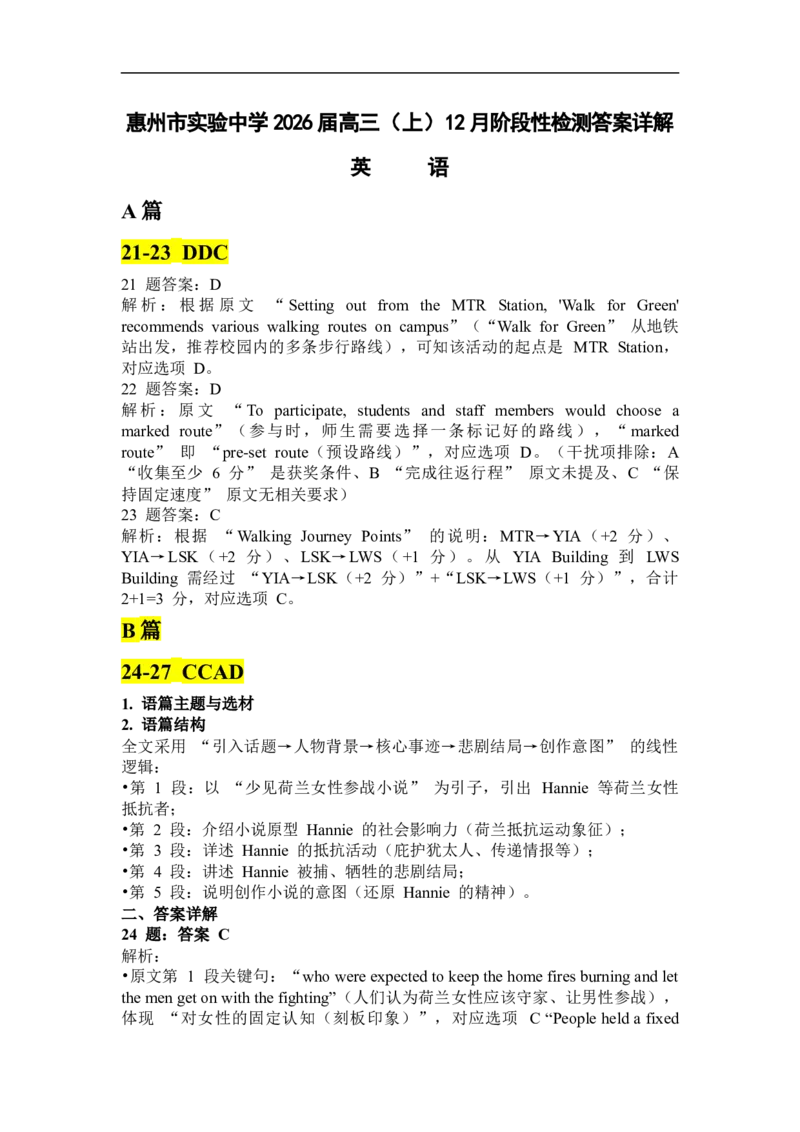
21 题答案:D
解析:根据原文 “Setting out from the MTR Station, 'Walk for Green'
recommends various walking routes on campus”(“Walk for Green” 从地铁
站出发,推荐校园内的多条步行路线),可知该活动的起点是 MTR Station,
对应选项 D。
22 题答案:D
解析:原文 “To participate, students and staff members would choose a
marked route”(参与时,师生需要选择一条标记好的路线),“marked
route” 即 “pre-set route(预设路线)”,对应选项 D。(干扰项排除:A
“收集至少 6 分” 是获奖条件、B “完成往返行程” 原文未提及、C “保
持固定速度” 原文无相关要求)
23 题答案:C
解析:根据 “Walking Journey Points” 的说明:MTR→YIA(+2 分)、
YIA→LSK(+2 分)、LSK→LWS(+1 分)。从 YIA Building 到 LWS
Building 需经过 “YIA→LSK(+2 分)”+“LSK→LWS(+1 分)”,合计
2+1=3 分,对应选项 C。
B 篇
24-27 CCAD
1. 语篇主题与选材
2. 语篇结构
全文采用 “引入话题→人物背景→核心事迹→悲剧结局→创作意图” 的线性
逻辑:
•第 1 段:以 “少见荷兰女性参战小说” 为引子,引出 Hannie 等荷兰女性
抵抗者;
•第 2 段:介绍小说原型 Hannie 的社会影响力(荷兰抵抗运动象征);
•第 3 段:详述 Hannie 的抵抗活动(庇护犹太人、传递情报等);
•第 4 段:讲述 Hannie 被捕、牺牲的悲剧结局;
•第 5 段:说明创作小说的意图(还原 Hannie 的精神)。
二、答案详解
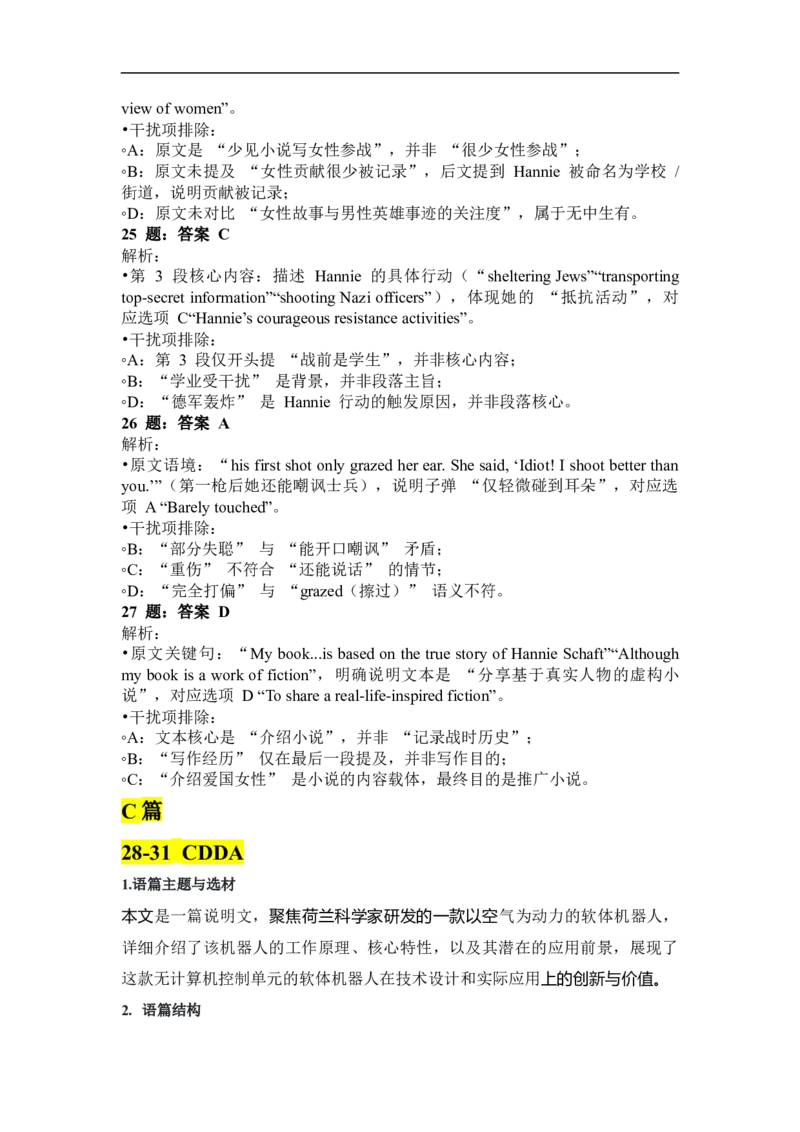
24 题:答案 C
解析:
•原文第 1 段关键句:“who were expected to keep the home fires burning and let
the men get on with the fighting”(人们认为荷兰女性应该守家、让男性参战),
体现 “对女性的固定认知(刻板印象)”,对应选项 C “People held a fixedview of women”。
•干扰项排除:
◦A:原文是 “少见小说写女性参战”,并非 “很少女性参战”;
◦B:原文未提及 “女性贡献很少被记录”,后文提到 Hannie 被命名为学校 /
街道,说明贡献被记录;
◦D:原文未对比 “女性故事与男性英雄事迹的关注度”,属于无中生有。
25 题:答案 C
解析:
•第 3 段核心内容:描述 Hannie 的具体行动(“sheltering Jews”“transporting
top-secret information”“shooting Nazi officers”),体现她的 “抵抗活动”,对
应选项 C“Hannie’s courageous resistance activities”。
•干扰项排除:
◦A:第 3 段仅开头提 “战前是学生”,并非核心内容;
◦B:“学业受干扰” 是背景,并非段落主旨;
◦D:“德军轰炸” 是 Hannie 行动的触发原因,并非段落核心。
26 题:答案 A
解析:
•原文语境:“his first shot only grazed her ear. She said, ‘Idiot! I shoot better than
you.’”(第一枪后她还能嘲讽士兵),说明子弹 “仅轻微碰到耳朵”,对应选
项 A “Barely touched”。
•干扰项排除:
◦B:“部分失聪” 与 “能开口嘲讽” 矛盾;
◦C:“重伤” 不符合 “还能说话” 的情节;
◦D:“完全打偏” 与 “grazed(擦过)” 语义不符。
27 题:答案 D
解析:
•原文关键句:“My book...is based on the true story of Hannie Schaft”“Although
my book is a work of fiction”,明确说明文本是 “分享基于真实人物的虚构小
说”,对应选项 D “To share a real-life-inspired fiction”。
•干扰项排除:
◦A:文本核心是 “介绍小说”,并非 “记录战时历史”;
◦B:“写作经历” 仅在最后一段提及,并非写作目的;
◦C:“介绍爱国女性” 是小说的内容载体,最终目的是推广小说。
C 篇
28-31 CDDA
1.语篇主题与选材
本文是一篇说明文,聚焦荷兰科学家研发的一款以空气为动力的软体机器人,
详细介绍了该机器人的工作原理、核心特性,以及其潜在的应用前景,展现了
这款无计算机控制单元的软体机器人在技术设计和实际应用上的创新与价值。
2. 语篇结构这篇语篇采用 “总 — 分 — 总” 的逻辑结构,并以“技术介绍→特性分析
→应用展望” 的递进式脉络展开,各段落分工明确、层层深入,符合科技说明
文典型的 “现象 / 发明介绍 — 原理阐释 — 价值分析” 的写作架构。
第 1 段:提出核心发明
第 2-4 段:工作原理、核心特性的详细阐释
第 5 段:结尾总结-价值与前景
3. 答案详解
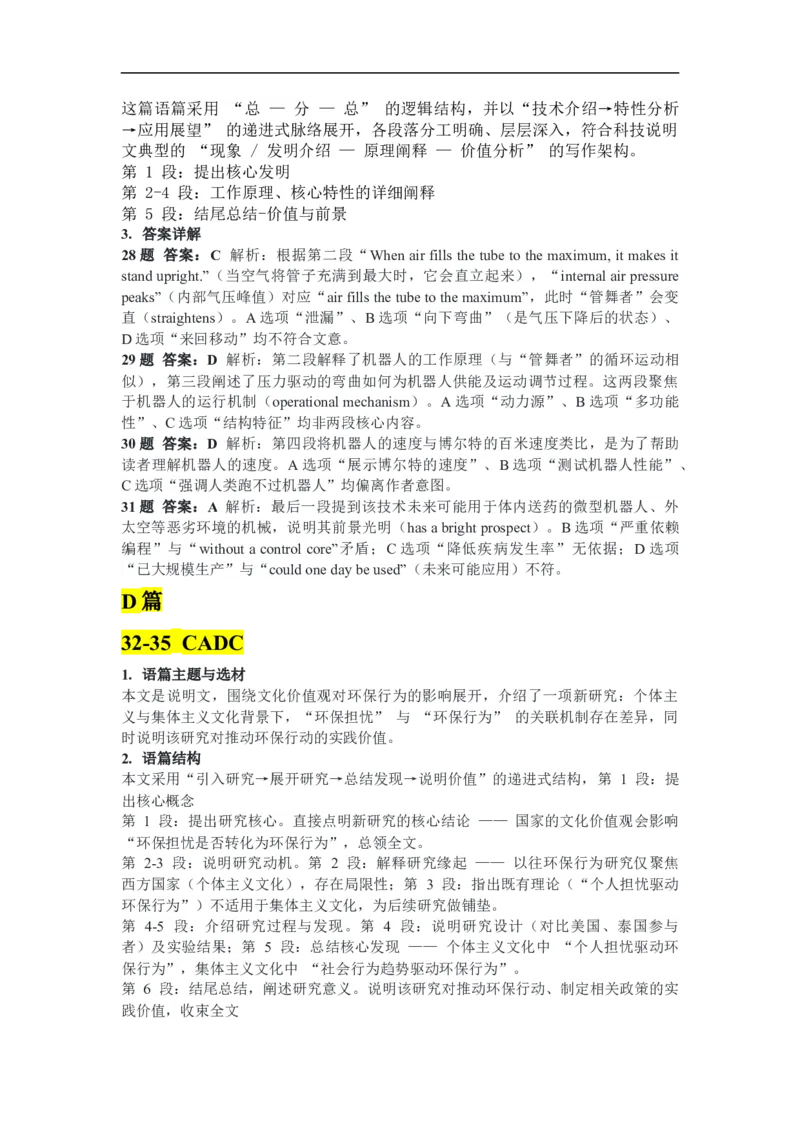
28题 答案:C 解析:根据第二段“When air fills the tube to the maximum, it makes it
stand upright.”(当空气将管子充满到最大时,它会直立起来),“internal air pressure
peaks”(内部气压峰值)对应“air fills the tube to the maximum”,此时“管舞者”会变
直(straightens)。A选项“泄漏”、B选项“向下弯曲”(是气压下降后的状态)、
D选项“来回移动”均不符合文意。
29题 答案:D 解析:第二段解释了机器人的工作原理(与“管舞者”的循环运动相
似),第三段阐述了压力驱动的弯曲如何为机器人供能及运动调节过程。这两段聚焦
于机器人的运行机制(operational mechanism)。A选项“动力源”、B选项“多功能
性”、C选项“结构特征”均非两段核心内容。
30题 答案:D 解析:第四段将机器人的速度与博尔特的百米速度类比,是为了帮助
读者理解机器人的速度。A选项“展示博尔特的速度”、B选项“测试机器人性能”、
C选项“强调人类跑不过机器人”均偏离作者意图。
31题 答案:A 解析:最后一段提到该技术未来可能用于体内送药的微型机器人、外
太空等恶劣环境的机械,说明其前景光明(has a bright prospect)。B选项“严重依赖
编程”与“without a control core”矛盾;C选项“降低疾病发生率”无依据;D选项
“已大规模生产”与“could one day be used”(未来可能应用)不符。
D 篇
32-35 CADC
1. 语篇主题与选材
本文是说明文,围绕文化价值观对环保行为的影响展开,介绍了一项新研究:个体主
义与集体主义文化背景下,“环保担忧” 与 “环保行为” 的关联机制存在差异,同
时说明该研究对推动环保行动的实践价值。
2. 语篇结构
本文采用“引入研究→展开研究→总结发现→说明价值”的递进式结构,第 1 段:提
出核心概念
第 1 段:提出研究核心。直接点明新研究的核心结论 —— 国家的文化价值观会影响
“环保担忧是否转化为环保行为”,总领全文。
第 2-3 段:说明研究动机。第 2 段:解释研究缘起 —— 以往环保行为研究仅聚焦
西方国家(个体主义文化),存在局限性;第 3 段:指出既有理论(“个人担忧驱动
环保行为”)不适用于集体主义文化,为后续研究做铺垫。
第 4-5 段:介绍研究过程与发现。第 4 段:说明研究设计(对比美国、泰国参与
者)及实验结果;第 5 段:总结核心发现 —— 个体主义文化中 “个人担忧驱动环
保行为”,集体主义文化中 “社会行为趋势驱动环保行为”。
第 6 段:结尾总结,阐述研究意义。说明该研究对推动环保行动、制定相关政策的实
践价值,收束全文3. 参考答案
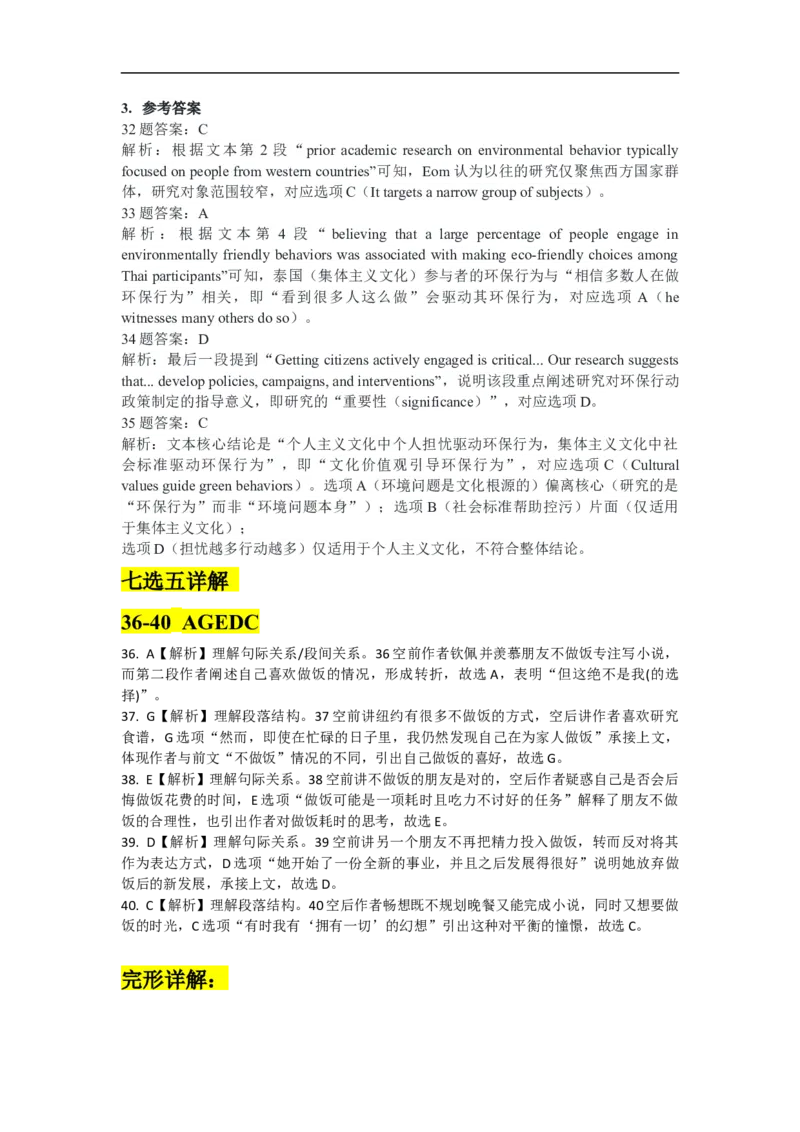
32题答案:C
解析:根据文本第 2 段“prior academic research on environmental behavior typically
focused on people from western countries”可知,Eom认为以往的研究仅聚焦西方国家群
体,研究对象范围较窄,对应选项C(It targets a narrow group of subjects)。
33题答案:A
解 析 : 根 据 文 本 第 4 段 “ believing that a large percentage of people engage in
environmentally friendly behaviors was associated with making eco-friendly choices among
Thai participants”可知,泰国(集体主义文化)参与者的环保行为与“相信多数人在做
环保行为”相关,即“看到很多人这么做”会驱动其环保行为,对应选项 A(he
witnesses many others do so)。
34题答案:D
解析:最后一段提到“Getting citizens actively engaged is critical... Our research suggests
that... develop policies, campaigns, and interventions”,说明该段重点阐述研究对环保行动
政策制定的指导意义,即研究的“重要性(significance)”,对应选项D。
35题答案:C
解析:文本核心结论是“个人主义文化中个人担忧驱动环保行为,集体主义文化中社
会标准驱动环保行为”,即“文化价值观引导环保行为”,对应选项 C(Cultural
values guide green behaviors)。选项A(环境问题是文化根源的)偏离核心(研究的是
“环保行为”而非“环境问题本身”);选项B(社会标准帮助控污)片面(仅适用
于集体主义文化);
选项D(担忧越多行动越多)仅适用于个人主义文化,不符合整体结论。
七选五详解
36-40 AGEDC
36. A【解析】理解句际关系/段间关系。36空前作者钦佩并羡慕朋友不做饭专注写小说,
而第二段作者阐述自己喜欢做饭的情况,形成转折,故选A,表明“但这绝不是我(的选
择)”。
37. G【解析】理解段落结构。37空前讲纽约有很多不做饭的方式,空后讲作者喜欢研究
食谱,G选项“然而,即使在忙碌的日子里,我仍然发现自己在为家人做饭”承接上文,
体现作者与前文“不做饭”情况的不同,引出自己做饭的喜好,故选G。
38. E【解析】理解句际关系。38空前讲不做饭的朋友是对的,空后作者疑惑自己是否会后
悔做饭花费的时间,E选项“做饭可能是一项耗时且吃力不讨好的任务”解释了朋友不做
饭的合理性,也引出作者对做饭耗时的思考,故选E。
39. D【解析】理解句际关系。39空前讲另一个朋友不再把精力投入做饭,转而反对将其
作为表达方式,D选项“她开始了一份全新的事业,并且之后发展得很好”说明她放弃做
饭后的新发展,承接上文,故选D。
40. C【解析】理解段落结构。40空后作者畅想既不规划晚餐又能完成小说,同时又想要做
饭的时光,C选项“有时我有‘拥有一切’的幻想”引出这种对平衡的憧憬,故选C。
完形详解:41-45 BACDA
46-50 CABAA
51-55 BCADA
本篇讲述了冷漠高傲的高管Tom收养了一只胆小的小狗Twinkles。共同搬到新环境后,
他们被迫一起成长。他变得温和耐心,它变得自信勇敢。这段相互治愈的旅程最终让他们
都以更好的版本回归生活。
详细解析:
第41题 B Despite 意为"尽管",表示转折关系。前半句提到"25年以上成功的职业生涯",
后半句说"情感上濒临破产",两者形成对比,说明尽管事业成功但内心空虚。With(具
有)会使得逻辑矛盾,Without(没有)和Except(除了)均不符合语境。
第42题 A favor 意为"帮忙",指朋友请求收养她的狗。gift(礼物)、tip(小费)、
permission(许可)均不符合"请求帮助"的语境。后文提到收养狗的行为也证实这是朋友请
主人公帮忙。
第43题 C agreed 意为"同意",与前面的reluctantly(不情愿地)搭配,表示勉强同意。
rejected(拒绝)与后文收养狗的事实矛盾,quit(放弃)、replied(回答)不符合收养狗
的语境。
第44题 D sheltered 意为"受庇护的",与后文"从未在草地上走过"相呼应,说明狗被过度
保护。isolated(孤立的)偏重孤独感,spoiled(溺爱的)强调放纵,ruined(毁掉的)程
度过重。
第45题 A dragged 意为"拖拽",生动描绘狗不愿出门时主人公的动作。dropped(掉落)、
threw(扔)、shut(关闭)都不符合带狗出门的场景,且dragged能体现双方的不情愿。
第46题 C developed 意为"发展",指人与狗之间的感情和信任逐步建立。changed(改
变)过于笼统,suffered(遭受)是负面词汇,delivered(传递)不能体现关系的渐进性。
第47题 A force 意为"力量",指不适感是启动成长所需的外部推动力。means(手段)偏
重方法,value(价值)强调重要性,pressure(压力)负面含义过重。
第48题 B socially 意为"在社会交往中",对应新环境要求改变强势形象。limitlessly(无限
地)、tirelessly(不知疲倦地)与容忍度无关,normally(正常地)不符合语境。
第49题 A adaptable 意为"适应性强",与relaxed、calm并列,描述在新环境中需要的特
质。reliable(可靠的)强调可信度,admirable(令人钦佩的)和adorable(可爱的)不符
合转变主题。
第50题 A chance 意为"机会",呼应前文"good chance to change",指狗也有转变的机遇。title(头衔)、award(奖项)过于具体,choice(选择)不符合被动接受的语境。
第51题 B experiences 意为"经历",能涵盖后文提到的散步、探索等各种活动。events
(事件)过于正式,journeys(旅程)偏重旅行,achievements(成就)未体现过程性。
第52题 C drew in 意为"吸引",描述狗的魅力自然吸引当地人。grew on(逐渐喜爱)需
要时间过程,took after(相似)指 resemblance,spoke to(交谈)不符合"吸引"的含义。
第53题 A bridged 意为"弥合",与"cultural gaps"是固定搭配,指促进交流、消除隔阂。
expanded(扩大)会使隔阂加深,applauded(称赞)、identified(识别)不适用。
第54题 D replaced 意为"取代",体现旧身份被新身份替代的根本转变。greeted(迎接)、
expected(期待)不能表达身份更替,decided(决定)不符合被动转变的语境。
第55题 A celebrated 意为"庆祝",与"joy of doing incredible things"完美呼应,强调共享
成就的喜悦。communicated(沟通)过于平淡,pictured(想象)和interpreted(解读)不
符合实际经历的语境。
语法填空
本文围绕良渚文化的突然消失展开,结合考古研究揭示气候变迁(厄尔尼诺现
象)是关键诱因,关联夏朝治水历史,兼具文化传承与科普属性。
56. called 57. as 58. was 59. a 60. why 61. and
62. itself 63. probably 64. warming 65. founder
56. called 句子已有谓语动词 “disappeared”,此处需用非谓语动词。“canals”
与 “call” 是被动关系,所以填 called。
57. as “point to … as …” 是固定搭配,意为 “指出…… 作为……”,填 as。
58. was 主语 “Liangzhu” 是单数概念,句子描述的是良渚文化存在的过去事
实(已消失),用一般过去时 was。
59. a “UNESCO” 发音以辅音音素 /j/ 开头,需用不定冠词修饰,填 a。
60. why “explain” 后接宾语从句,语境指 “研究者试图解释良渚为何被遗弃”,
所以填 why。
61. and “between … and …” 是固定搭配,此处表示 “良渚文明的终结与长江洪
水或东海洪水之间的联系”,填 and。
62. itself 此处需强调 “泥层本身”,“itself” 可表强调。
63. probably 修饰动词 “caused”,要用副词;“probable” 的副词形式为
probably。
64. warming 定冠词 “the” 后需接名词,此处表示 “太平洋海水的变暖”,
填 warming。
65. founder 此处指 “夏朝著名的建立者大禹”,填 founder。
第四部分 写作(共两节,满分40分)
66. 第一节(满分15分)
假定你是李华,学校组织学生进行劳动实践活动,外教 Jenny 作为指导老师,给出“Community English Teaching”和“School Garden Beautifying”两个项目供同学们选择。请
给Jenny 写一封邮件,内容包括:
(1)你的选择,
(2)说明理由。
注意:
(1)写作词数应为80左右:
(2)可适当增加细节,以使行文连贯,
Dear Jenny,
Best regards,
Li Hua
评分原则
1. 本题总分为 15 分,按 5 个档次给分。
2. 评分时,先根据作答的整体情况初步确定其所属档次,然后以该档次的要求来综合衡量,
确定或调整档次,最后给分。
3. 词数少于60的,酌情扣分。
4. 评分时,应注意的主要内容为:内容要点、应用词汇和语法结构的丰富性和准确性及上
下文的连贯性。
5. 拼写和标点符号是写作规范的重要方面,评分时应视其对交际的影响程度予以考虑。英、
美拼写及词汇用法均可接受。
6. 书写较差以致影响交际的,酌情扣分。
(二) 各档次给分范围和要求
档次 描述
第五档:(13—15 分) 能写明全部要点;语言基本无误;行文连贯,表达清楚。
第四档:(10—12 分) 能写明全部或绝大部分要点;语言有少量错误;行文不够连贯,表
达基本清楚。
第三档:(7—9 分) 能写明基本要点;语言虽有较多错误,但能基本达意。
第二档:(4—6 分) 能写出部分要点;语言错误多,影响意思表达。
第一档:(1—3 分) 只能写出一两个要点;语言错误很多,只有个别句子正确。
0 分 未能传达给读者任何信息,内容太少,无法评判,写的内容均与所
要求内容无关或所写内容无法看清。
Possible version 1:
Dear Jenny,
I'm excited to participate in the labor practice activity. After careful consideration, I've
decided to join the Community English Teaching project.
This project aligns perfectly with my passion for language education. Teaching English to
community members not only helps them improve their skills but also strengthens social
connections. Additionally, it's a great opportunity for me to develop communication and leadership
abilities while contributing to the community. I believe this experience will be both meaningful
and rewarding.
Thank you for organizing these wonderful options! (83)Best regards,
Li Hua
Possible version 2:
Dear Jenny,
I'm thrilled about the upcoming labor practice. I've chosen the School Garden Beautifying
project because I'm deeply interested in environmental sustainability.
By participating in this project, I can help create a greener and more pleasant campus
environment. Gardening not only enhances the school's appearance but also promotes eco-friendly
habits among students. Moreover, working outdoors with my peers will foster teamwork and a
sense of responsibility. I'm eager to contribute to making our school more beautiful!
Thank you for offering such meaningful activities. (82)
Best regards,
Li Hua
Possible version 3:(教师下水文,字数偏多,可选择性删减。)
Dear Jenny,
Having considered your two proposed projects for the upcoming labor practice activity, I
would like to choose the Community English Teaching option. Here are my key reasons.
Firstly, as an English education enthusiast, I see this project as a valuable chance to apply my
knowledge in a practical setting while contributing to the community in a sustainable way. Unlike
one-time efforts, teaching English can deliver a lasting impact and motivate me to continue
supporting others beyond the program, further strengthening my sense of social responsibility.
Most importantly, I view education as a powerful tool for fostering cross-cultural understanding.
Through this project, I hope to help bridge communication gaps and equip individuals with
language skills that may encourage a broader perspective on global issues and open doors to new
opportunities.
Thank you for your efforts in offering these inspiring activities and I'd be truly privileged to
contribute to the Community English Teaching initiative. (152)
Best regards,
Li Hua
67. 第二节 (满分 25 分)阅读下面材料,根据其内容和所给段落开头语续写两段,使之构
成一篇完整的短文。
The last lesson of the day was PE class. Mary was skipping rope on the playground, surrounded
by several classmates watching her. It was her best sport. The rope spun (旋转) quickly as she jumped.
When time was up, the counter showed 201 skips. Smiling, Mary flashed a victory sign to the crowd.
Just then, the school bell rang-class was over. Mary packed up her skipping rope. It was time to give
her answer to Ms. White.
That morning, Ms. White had asked her if she would be willing to take charge of the class bulletin
board (板报) for the upcoming competition. The student who usually handled it, Lily, was sick, and
someone needed to step in. Mary was shocked that Ms. White had chosen her. She responded
nervously, insisting that her handwriting was terrible. But Ms. White reassured her, saying she believedin her ability and encouraged her to think it over and let her know her decision after school.
Now, walking toward the teachers' office, Mary felt nervous. The thought of her messy
handwriting being put up on the wall for everyone to see made her stomach turn. She had already made
up her mind to say no. With that decision in mind, she quickened her pace and ran across the sports
ground
Mary was about to pass the sandpit (沙坑) when someone nearby caught her attention. It was Tom
from a different class. In her mind, Tom had never been good at long jump, but he was practicing it.
Curious, she went over to ask what he was doing. Tom explained that no one else had signed up for the
long jump event, and without a participant, their class wouldn't get any points in the school sports
meeting. So when the headteacher asked if anyone would give it a try, he volunteered. Mary reminded
him that he wasn't good at it, but Tom simply said that he knew that and that it wasn't about being the
best, but about trying and doing his part for the class. Then he went back to practicing. What a similar
issue they both faced.
注意:
1. 续写词数应为 150 左右;
2. 请按如下格式在答题卡的相应位置作答。
Mary stood there, watching Tom practicing patiently and hard.
With determination, Mary stepped into the teachers' office.
One possible version:
Mary stood there, watching Tom practice patiently and hard. Every time he jumped, he would
stumble a little, but he never stopped. He wiped the sweat from his forehead, adjusted his posture,
and tried again. Mary thought about how Tom was willing to take on something he wasn't good at
—all just to help their class. She felt a little ashamed of herself. She was so scared to show her bad
handwriting, but what if she tried her best like Tom? Maybe the bulletin board wouldn't be perfect,
but she could put her whole heart into it. The nervous flutter in her stomach slowly faded, and a
new sense of determination took its place. She turned around and headed straight for the teachers'
office, her steps no longer hesitant.
With determination, Mary stepped into the teachers' office. Ms. White was sitting at her desk,
grading papers. When she saw Mary, she looked up and smiled. “Have you made your decision?”
Mary took a deep breath and nodded firmly, promising to take charge of the class bulletin board.
“My handwriting isn't good,” she added, “but I'll practice hard and do my best to make it nice. I
want to help our class, just like Tom is doing.” Ms. White's eyes lit up with pride. She stood up
and patted Mary's shoulder. “That's exactly what I wanted to hear, Mary. Bravery to try is more
important than being perfect. I'll be right here to help you.” Mary left the office with a big smile
on her face, already looking forward to starting her new task.
One possible version:
Mary stood there, watching Tom practicing patiently and hard. A wave of shame and
admiration welled up in her heart as she realized how easily she had wanted to escape her own
task. Sweat trickled down Tom's forehead as he kept charging forward and landing heavily in the
sandpit. Upon clenching her fists, she took a deep breath, whispered to herself, and fixed her gaze
on Tom's determined figure. Noticing her presence, Tom gave a brief nod, as though silentlyencouraging her to keep going. No sooner had she seen his persistence than she felt a spark of
courage ignite within herself.
With determination, Mary stepped into the teachers' office. Having gathered her courage,
Mary felt her steps grow steady and her heartbeat calm down. The golden sunlight streamed
through the corridor windows, casting a warm glow on the floor beneath her feet. Taking a deep
breath, she looked at Ms. White and said firmly, “I'd like to try handling the bulletin board.”
Having voiced her decision, she felt an overwhelming sense of relief and pride flooding her heart.
This experience taught her that true growth lies not in avoiding weaknesses, but in facing
challenges with bravery.
One possible version:
Mary stood there, watching Tom practicing patiently and hard. His clumsy movements
looked awkward, yet there was a kind of beauty in his persistence. Sweat rolled down his
forehead, but he didn't stop. The sight struck Mary deeply. Tom wasn't good at long jump, but he
was still giving his best for his class. Wasn't I facing the same thing? she thought. Her heart began
to race as she realized that fear, not handwriting, was holding her back. If Tom could face his
weakness, why couldn't I? She suddenly felt her face warm with determination. As the sun dipped
lower, she took one last look at Tom landing in the sandpit and smiled slightly, a quiet decision
forming in her heart: she would accept the challenge.
Paragraph 2:With determination, Mary stepped into the teachers' office. Her hands were still
trembling, but she spoke clearly. “Ms. White, I... I'd like to try,” she said. Ms. White looked up, a
gentle smile spreading across her face. “I knew you would, Mary,” she said softly. Relief flooded
through Mary's chest. The nervousness that once tied her tongue was gone. When she left the
office, she felt lighter, the world outside glowing with golden sunlight. She knew her handwriting
might not be perfect, but her courage was. Sometimes, she realized, the best handwriting is written
not with a pen, but with the heart.
One possible version:
Mary stood there, watching Tom practicing patiently and hard. Each of his jumps, though not
particularly far, was executed with unwavering focus. Sweat glistened on his forehead under the
afternoon sun, and his breaths came out in puffs of mist, yet a determined smile never left his face.
The sight of him embracing his imperfection for the sake of the class struck a deep chord within
Mary. She thought of her own perfect 201 skips, a skill performed for personal glory, and then of
the bulletin board, a task she was shying away from for fear of personal embarrassment. Tom's
selfless act served as a mirror, reflecting her own hesitation. His struggle was not about winning
but about participating, about contributing. Suddenly, her own problem seemed smaller, handled
by a sense of collective responsibility. Inspired by his perseverance, she knew what she had to do.
With determination, Mary stepped into the teachers' office. The air inside was warm and
carried the faint scent of books and coffee. Ms. White looked up from her desk. "Ms. White,"
Mary began, her voice firmer than she had expected, "I've thought it over. I would be honored to
take charge of the bulletin board." She went on, "My handwriting might not be the best, but I will
try my hardest, just like Tom is practicing for the long jump. It's not about being perfect; it's about
doing my part for our class." A warm, approving smile spread across Ms. White's face." Mary,
that's exactly the spirit I was hoping for," she said. At that moment, any lingering anxiety inMary's heart was replaced by a clear, purposeful calm, ready to face the challenge—not for
herself, but for everyone.
【分析】本文以人物为线索展开,讲述放学后,擅长跳绳的玛丽本打算拒绝怀特老师
让她接手班级板报的请求,因她担心自己字迹差。途中,她看到不擅长跳远的汤姆为给班
级争分,正主动练习跳远,汤姆认为重要的是尝试和为班级出力。这让玛丽面临与汤姆相
似的是否承担任务的问题。
1. 段落续写:
①由第一段首句内容 “玛丽站在那里,看着汤姆耐心又努力地练习。” 可以预测续
写这段主要内容:玛丽见汤姆虽不擅长跳远仍努力练习,羞愧自身胆怯,决心接办板报,
走向教师办公室。
②由第二段首句内容 “玛丽满怀决心地走进教师办公室。” 可以预测续写这段主要
内容:玛丽决心走进教师办公室,答应负责板报并说明会努力,获得怀特老师的肯定与支
持,满心期待新任务。
2. 续写线索:见汤姆努力练习 —— 自我感到羞愧 —— 决心接办板报 —— 答应负
责板报 —— 获老师肯定与支持 —— 满怀期待
【评分原则】
1. 本题总分为 25 分,按 5 个档次给分。
2. 评分时,先根据所续写短文的内容和语言初步确定其所属档次,然后以该档次的要求来
衡量、确定或调整档次,最后给分。
3. 词数少于 120 的,从总分中减去 2 分。
4. 评分时,应主要从以下四个方面考虑:
(1) 与所给短文及段落开头语的衔接程度;
(2) 内容的丰富性;
(3) 应用语法结构和词汇的丰富性和准确性;
(4) 上下文的连贯性。
5. 拼写与标点符号是语言准确性的一个重要方面,评分时,应视其对交际的影响程度
予以考虑。
6. 如书写较差以致影响交际,可将分数降低一个档次。
【各档次的给分范围和要求】
第五档:(21-25 分)
1. 与所给短文融合度高,与所提供各段落开头语衔接合理。
2. 所使用语法结构和词汇丰富、准确,可能有些许错误,但完全不影响意义表达。
3. 有效地使用了语句间的连接成分,使所续写短文结构紧凑。
第四档:(16-20 分)
1. 与所给短文融合度较高,与所提供各段落开头语衔接较为合理。
2. 所使用语法结构和词汇较为丰富、准确,可能有些许错误,但不影响意义表达。
3. 比较有效地使用了语句间的连接成分,使所续写短文结构紧凑。
第三档:(11-15 分)
1. 与所给短文关系较为密切,与所提供各段落开头语有一定程度的衔接。
2. 应用的语法结构和词汇能满足任务的要求,虽有一些错误,但不影响意义表达。
3. 应用简单的语句间连接成分,使全文内容连贯。
第二档:(6—10 分)1. 与所给短文有一定的关系,与所提供各段落开头语有一定程度的衔接。
2. 语法结构单调,词汇项目有限,有些语法结构和词汇方面的错误,影响了意义的表达。
3. 较少使用语句间的连接成分,全文内容缺少连贯性。
第一档:(1-5 分)
1. 与所提供短文和开头语的衔接较差。
2. 语法结构单调,词汇项目很有限,有较多语法结构和词汇方面的错误,严重影响了意义
的表达。
3. 缺乏语句间的连接成分,全文内容不连贯。
不得分:(0 分)
白卷、内容太少无法评判或所写内容与所提供内容无关。