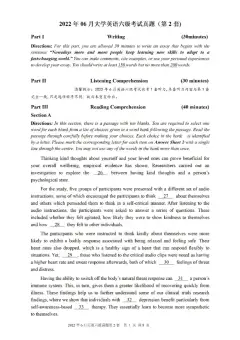
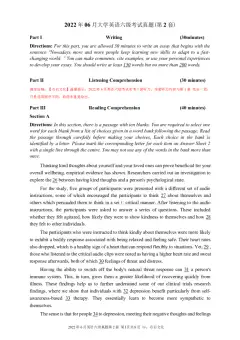
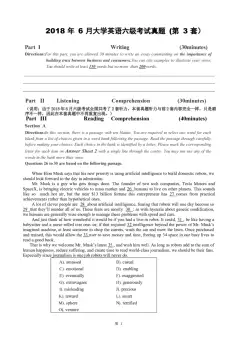
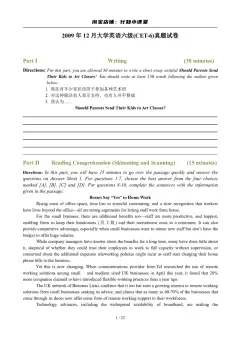
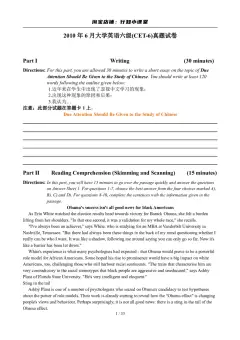
2009年6月大学英语六级(CET-6)真题试卷
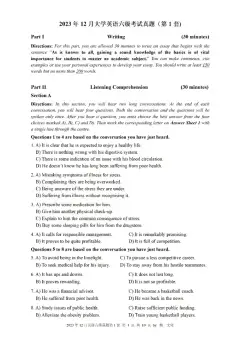
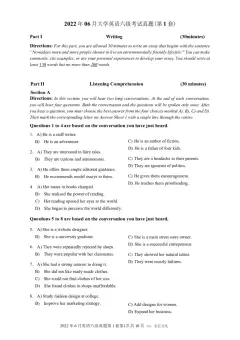
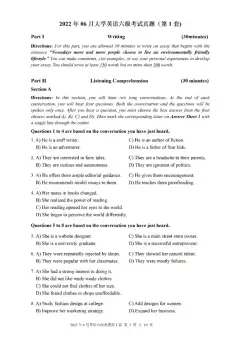
Part Ⅰ Writing (30 minutes)
注意:此部分试题在答题卡1上。
Directions: For this part, you are allowed 30 minutes to write a short essay entitled On
the Importance of a Name. you should write at least 150 words following the
outline given below.
1. 有人说名字或名称很重要
2. 也有人觉得名字或名称无关紧要
3. 我认为...
On the Importance of a Name
Part II Reading Comprehension (Skimming and Scanning) (15 minutes)
Directions: In this part, you will have 15 minutes to go over the passage quickly and answer the
questions on Answer Sheet 1. For questions 1-7, choose the best answer from the four choices
marked [A], [B], [C] and [D]. For questions 8-10, complete the sentences with the information
given in the passage.
Helicopter Moms vs. Free-Range Kids
Would you let your fourth-grader ride public transportation without an adult? Probably not.
Still, when Lenore Skenazy, a columnist for the New York Sun, wrote about letting her son take the
subway alone to get back to "Long story short :my son got home from a department store on the
Upper East Side, she didn’t expect to get hit with a wave of criticism from readers.
“Long story short: My son got home, overjoyed with independence,” Skenazy wrote on April
4 in the New York Sun. “Long story longer: Half the people I’ve told this episode to now want to
turn on in for child abuse. As if keeping kids under lock and key and cell phone and careful watch is
the right way to rear kids. It’s not. It’s debilitating (使虚弱)—for us and for them.”
Online message boards were soon full of people both applauding and condemning Skenazy’s
decision to let her son go it alone. She wound up defending herself on CNN (accompanied by her
1 / 28son) and on popular blogs like the buffing ton post, where her follow-up piece was ironically
headlined “More From America’s Worst Mom.”
The episode has ignited another one of those debates that divides parents into vocal opposing
camps. Are Modern parents needlessly overprotective, or is the world a more complicated and
dangerous place than it was when previous generations were allowed to wander about
unsupervised?
From the “she’s an irresponsible mother” camp came: “Shame on you for being so careless
about his safety,” in Comments on the buffing ton post. And there was this from a mother of four:
“How would you have felt if he didn’t come home?” But Skenazy got a lot of support, too, with
women and men writing in with stories about how they were allowed to take trips all by them selves
at seven or eight. She also got heaps of praise for bucking the “helicopter parent” trend: “Good for
this Mom,” one commenter wrote on the buffing ton post. “This is a much-needed reality check.”
Last week, encouraged by all the attention, Skenazy started her own blog—Free Range, kids—
promoting the idea that modern children need some of the same independence that her generation
had. In the good old days nine-year-old baby boomers rode their bikes to school, walked to the
store, took buses—and even subways—all by themselves. Her blog, she says, is dedicated to
sensible parenting. “At Free Range Kids, we believe in safe kids. We believe in car seats and safety
belts. We do NOT believe that every time school-age children go outside, they need a security
guard.”
So why are some parents so nervous about letting their children out of their sight? Are cities
and towns less safe and kids more vulnerable to crimes like child kidnap and sexual abuse than they
were in previous generations?
Not exactly. New York City, for instance, is safer than it’s ever been; it’s ranked 36th in crime
among all American cities. Nationwide, stringer kidnaps are extremely rare; there’s a one-in-a-
million chance a child will be taken by a stranger, according to the Justice Department. And 90
percent of sexual abuse cases are committed by someone the child knows. Mortality rates from all
causes, including disease and accidents, for American children are lower now than they were 25
years’ ago. According to Child Trends, a nonprofit research group, between 1980 and 2003 death
rates dropped by 44 percent for children aged 5 to 14 and 32 percent for teens aged 15 to 19.
Then there’s the whole question of whether modern parents are more watchful and nervous
about safety than previous generations. Yes, some are. Part of the problem is that with wall to wall
Internet and cable news, every missing child case gets so much airtime that it’s not surprising even
normal parental anxiety can be amplified. And many middle-class parents have gotten used to
managing their children’s time and shuttling them to various enriching activities, so the idea of
letting them out on their own can seem like a risk. Back in 1972, when many of today’s parents
were kids, 87 percent of children who lived within a mile of school walked or biked every day. But
today, the Centers for Disease Control report that only 13 percent of children bike, walk or
otherwise t themselves to school.
The extra supervision is both a city and a suburb phenomenon. Parents are worried about
crime, and they are worried about kids getting caught in traffic in a city that’s not used to
pedestrians. On the other hand, there are still plenty of kids whose parents give them a lot of
independence, by choice or by necessity. The After School Alliance finds that more than 14 million
kids aged 5 to 17 are responsible for taking care of themselves after school. Only 6.5 million kids
participate in organized programs. “Many children who have working parents have to take the
2 / 28subway or bus to get to school. Many do this by themselves because they have no other way to get
to the schools,” says Dr. Richard Gallagher, director of the Parenting Institute at the New York
University Child Study Center.
For those parents who wonder how and when they should start allowing their kids more
freedom, there’s no clear-cut answer. Child experts discourage a one-size-fits-all approach to
parenting. What’s right for Skenazy’s nine-year-old could be inappropriate for another one. It all
depends on developmental issue, maturity, and the psychological and emotional makeup of that
child. Several factors must be taken into account, says Gallagher. “The ability to follow parent
guidelines, the child’s level of comfort in handling such situations, and a child’s general judgment
should be weighed.”
Gallagher agrees with Skenazy that many nine-year-olds are ready for independence like
taking public transportation alone. “At certain times of the day, on certain routes, the subways are
generally safe for these children, especially if they have grown up in the city and have been taught
how to be safe, how to obtain help if they are concerned for their safety, and how to avoid unsafe
situations by being watchful and on their toes.”
But even with more traffic and fewer sidewalks, modern parents do have one advantage their
parents didn’t: the cell phone. Being able to check in with a child anytime goes a long way toward
relieving parental anxiety and may help parents loosen their control a little sooner. Skenazy got a lot
of criticism because she didn’t give her kid her cell phone because she thought he’d lose it and
wanted him to learn to go it alone without depending on mom—a major principle of free-range
parenting. But most parents are more than happy to use cell phones to keep track of their kids.
And for those who like the idea of free-range kids but still struggle with their inner helicopter
parent, there may be a middle way. A new generation of GPS cell phones with tracking software
make it easier than ever to follow a child’s every movement via the Internet—without seeming to
interfere or hover. Of course, when they go to college, they might start objecting to being monitored
as they’re on parole (假释).
注意:此部分试题请在答题卡1上作答。
1. When Lenore Skenazy’s son was allowed to take the subway alone, he ________.
A.was afraid that he might get lost
B.enjoyed having the independence
C.was only too pleased to take the risk
D.thought he was an exceptional child
2. Lenore Skenazy believes that keeping kids under careful watch
A.hinders their healthy growth
B.adds too much to parents’ expenses
C.shows traditional parental caution
D.bucks the latest parenting trend
3. Skenazy’s decision to let her son take the Subway alone has net with________.
A.opposition from her own family
B.share parenting experience
C.fight against child abuse
D.protect children’s rights
4. Skenazy started her own blog to ________.
A.promote sensible parenting
3 / 28B.share parenting experience
C.fight against child abuse
D.protect children’s rights
5. According to the author, New York City ________.
A.ranks high in road accidents
B.is much safe than before
C.ranks low in child mortality rates
D.is less dangerous than small cities
6. Parents today are more nervous about their kids’ safety than previous generations
because________.
A.there are now fewer children in the family
B.the number of traffic accidents has been increasing
C.their fear is amplified by media exposure of crime
D.crime rates have been on the rise over the years
7. According to child experts, how and when kids may be allowed more freedom depends on
________.
A.the traditions and customs of the community
B.the safety conditions of their neighborhood
C.their parents’ psychological makeup
D.their maturity and personal qualities
8. According to Gallagher and Skenazy, children who are watchful will be better able to stay away
from Unsafe situations.
9. Being able to find out where a child is anytime helps lessen parents’ Their anxiety and control.
10. Nowadays with the help of GPS cell phones, parents can, from a distance, track their children’s
Movements.
Part III Listening Comprehension (35 minutes)
Section A
Directions: In this section, you will hear 8 short conversations and 2 long conversations. At the end
of each conversation, one or more questions will be asked about what was said. Both the
conversation and the questions will be spoken only once. After each question there will
be a pause. During the pause, you must read the four choices marked [A], [B], [C] and
[D], and decide which is the best answer. Then mark the corresponding letter on Answer
Sheet 2 with a single line through the centre.
注意:此部分试题请在答题卡2上作答。
11. A.Fred forgot to call him last night about the camping trip.
B.He is not going to lend his sleeping bag to Fred.
C.He has not seen Fred at the gym for sometime.
D.Fred may have borrowed a sleeping bag from someone else.
12. A.Summer has become hotter in recent years.
B.It will cool down a bit over the weekend.
4 / 28C.Swimming in a pool has a relaxing effect.
D.He hopes the weather forecast is accurate.
13. A.Taking a picture of Prof. Brown.
B.Commenting on an oil-painting.
C.Hosting a TV program.
D.Staging a performance.
14. A.She can help the man take care of the plants.
B.Most plants grow better in direct sunlight.
C.The plants need to be watered frequently.
D.The plants should be placed in a shady spot.
15. A.Change to a more exciting channel.
B.See the movie some other time.
C.Go to bed early.
D.Stay up till eleven.
16. A.Both of them are laymen of modern art.
B.She has beamed to appreciate modem sculptures.
C.Italian artists’ works are difficult to understand.
D.Modern artists are generally considered weird.
17. A.They seem satisfied with what they have done.
B.They have called all club members to contribute.
C.They think the day can be called a memorable one.
D.They find it hard to raise money for the hospital.
18. A.The man shouldn’t hesitate to take the course.
B.The man should talk with the professor first.
C.The course isn’t open to undergraduates.
D.The course will require a lot of reading.
Questions 19 to 21 are based on the conversation you have just heard.
19. A.Current trends in economic development.
B.Domestic issues of general social concern.
C.Stories about Britain’s relations with other nations.
5 / 28D.Conflicts and compromises among political parties.
20. A.Based on the poll of public opinions.
B.By interviewing people who file complaints.
C.By analyzing the domestic and international situation.
D.Based on public expectations and editors’ judgment.
21. A.Underlying rules of editing.
B.Practical experience.
C.Audience’s feedback.
D.Professional qualifications.
Questions 22 to 25 are based on the conversation you have just heard.
22. A.The average life span was less than 50 years.
B.It was very common for them to have 12 children.
C.They retired from work much earlier than today.
D.They were quite optimistic about their future.
23. A.Get ready for ecological changes.
B.Adapt to the new environment.
C.Learn to use new technology.
D.Explore ways to stay young.
24. A.When all women go out to work.
B.When family planning is enforced..
C.When a world government is set up.
D.When all people become wealthier.
25. A.Eliminate poverty and injustice.
B.Migrate to other planets.
C.Control the environment.
D.Find inexhaustible resources.
Section B
Directions: In this section, you will hear 3 short passages. At the end of each passage, you will
hear some questions. Both the passage and the questions will be spoken only once. After you hear a
question, you must choose the best answer from the four choices marked [A], [B], [C] and [D].
Then mark the corresponding letter on Answer Sheet 2 with a single line through the centre.
Passage One
6 / 28Questions 26 to 28 are based on the passage you have just heard.
26. A.To help young people improve their driving skills.
B.To alert teenagers to the dangers of reckless driving.
C.To teach young people road manners through videotapes.
D.To show teens the penalties imposed on careless drivers.
27. A.Road accidents.
B.Street violence.
C.Drug abuse.
D.Lung cancer.
28. A.It has changed teens’ way of life.
B.It has made teens feel like adults.
C.It has accomplished its objective.
D.It has been supported by parents.
Passage Two
Questions 29 to 31 are based on the passage you have just heard.
29. A.Customers may get addicted to the smells.
B.Customers may be misled by the smells.
C.It hides the defects of certain goods.
D.It gives rise to unfair competition.
30. A.Flexible.
B.Critical.
C.Supportive.
D.Cautious.
31. A.The flower scent stimulated people’s desire to buy.
B.Stronger smells had greater effects on consumers.
C.Most shoppers hated the small the shoe store.
D.84% of the customers were unaware of the smells.
Passage Three
Questions 32 to 35 are based on the passage you have just heard.
32. A.A goods train hit a bus carrying many passengers.
B.Two passenger trains crashed into each other.
C.A passenger train collided with a goods train.
7 / 28D.An express train was derailed when hit by a bomb.
33. A.The rescue operations have not been very effective.
B.More than 300 injured passengers were hospitalized.
C.The cause of the tragic accident remains unknown.
D.The exact casualty figures are not yet available.
34. A.There was a bomb scare.
B.There was a terrorist attack.
C.A fire alarm was set off by mistake.
D.50 pounds of explosives were found.
35. A.Follow policemen’s directions.
B.Keep an eye weather.
C.Avoid snow-covered roads.
D.Drive with special care.
Section C
Directions: In this section, you will hear a passage three times. When the passage is read for the f
irst time, you should listen carefully for its general idea. When the passage is read for
the second time, you are required to fill in the blanks numbered from 36 to 43 with the
exact words you have just heard. For blanks numbered from 44 to 46 you are required to
fill in the missing information. For these blanks, you can either use the exact words you
have just heard or write down the main points in your own words. Finally, when the
passage is read for the third time, you should check what you have written.
English is the leading international language. In different countries around the globe, English
is acquired as the mother (36) ________, in others it’s used as a second language. Some nations use
English as their (37) ________ language, performing the function of (38) ________; in others it’s
used as an international language for business, (39) ________ and industry.
What factors and forces have led to the (40) ________ of English? Why is English now
considered to be so prestigious that, across the globe, individuals and societies feel (41) ________ if
they do not have (42) ________ in this language? How has English changed through 1,500 Years?
These are some of the questions that you (43) ________ when you study English.
You also examine the immense variability of English and (44) ________. You develop in-depth
knowledge of the intricate structure of the language. Why do some non-native speakers of English
claim that it’s a difficult language to learn, while (45) ________? At the University of Sussex, you
are introduced to the nature and grammar of English in all aspects. This involves the study of sound
structures, the formation of words, the sequencing words and the construction of meaning, as well
8 / 28as examination of the theories explaining the aspects of English usage. (46) ________, which are
raised by studying how speakers and writers employ English for a wide variety of purposes.
Part IV Reading Comprehension (Reading in Depth) (25 minutes)
Section A
Directions: In this section, there is a short passage with 5 questions or incomplete statements. Read
the passage carefully. Then answer the questions or complete the statements in the
fewest possible words. Please write your answers on Answer Sheet 2.
Questions 47 to 51 are based on the following passage.
There is nothing new about TV and fashion magazines giving girls unhealthy ideas about how
thin they need to be in order to be considered beautiful. What is surprising is the method
psychologists at the University of Texas have come up with to keep girls from developing eating
disorders. Their main weapon against super skinny (role) models: a brand of civil disobedience
dubbed “body activism.”
Since 2001, more than 1,000 high school and college students in the U.S. have participated in
the Body Project, which works by getting girls to understand how they have been buying into the
notion that you have to be thin to be happy or successful. After critiquing (评论) the so-called thin
ideal by writing essays and role-playing with their peers, participants are directed to come up with
and execute small, nonviolent acts. They include slipping notes saying “Love your body the way it
is” into dieting books at stores like Borders and writing letters to Mattel, makers of the impossibly
proportioned Barbie doll.
According to a study in the latest issue of the Journal of Consulting and Clinical Psychology,
the risk of developing eating disorders was reduced 61% among Body Project participants. And
they continued to exhibit positive body-image attitudes as long as three years after completing the
program, which consists, of four one-hour sessions. Such lasting effects may be due to girls’
realizing not only how they were being influenced but also who was benefiting from the societal
pressure to be thin. “These people who promote the perfect body really don’t care about you at all,”
says Kelsey Hertel, a high school junior and Body Project veteran in Eugene, Oregon. “They
purposefully make you feel like less of a person so you’ll buy their stuff and they’ll make money.”
注意:此部分试题请在答题卡2上作答。
47. Were do girls get the notion that they need to be thin in order to be considered beautiful?
48. By promoting “body activism,” University of Texas psychologists aim to prevent
________.
49. According to the author, Mattel’s Barbie dolls are ________.
50. The positive effects of the Body Project may last up to ________.
51. One Body Project participant says that the real motive of those who promote the perfect
9 / 28body is to ________.
Section B
Directions: There are 2 passages in this section. Each passage is followed by some questions or
unfinished statements. For each of them there are four choices marked [A], [B], [C] and
[D] You should decide on the best choice and mark the corresponding letter on Answer
Sheet 2 with a single line through the centre.
Passage One
Questions 52 to 56 are based on the following passage.
For hundreds of millions of years, turtles (海龟) have struggled out of the sea to lay their eggs
on sandy beaches, long before there were nature documentaries to celebrate them, or GPS satellites
and marine biologists to track them, or volunteers to hand-carry the hatchlings (幼龟) down to the
water’s edge lest they become disoriented by headlights and crawl towards a motel parking lot
instead. A formidable wall of bureaucracy has been erected to protect their prime nesting on the
Atlantic coastlines. With all that attention paid to them, you’d think these creatures would at least
have the gratitude not to go extinct.
But Nature is indifferent to human notions of fairness, and a report by the Fish and Wildlife
Service showed a worrisome drop in the populations of several species of North Atlantic turtles,
notably loggerheads, which can grow to as much as 400 pounds. The South Florida nesting
population, the largest, has declined by 50% in the last decade, according to Elizabeth Griffin, a
marine biologist with the environmental group Oceana. The figures prompted Oceana to petition the
government to upgrade the level of protection for the North Atlantic loggerheads from “threatened”
to “endangered”—meaning they are in danger of disappearing without additional help.
Which raises the obvious question: what else do these turtles want from us, anyway? It turns
out, according to Griffin, that while we have done a good job of protecting the turtles for the weeks
they spend on land (as egg-laying females, as eggs and as hatchlings), we have neglected the years
spend in the ocean. “The threat is from commercial fishing,” says Griffin. Trawlers (which drag
large nets through the water and along the ocean floor) and long line fishers (which can deploy
thousands of hooks on lines that can stretch for miles) take a heavy toll on turtles.
Of course, like every other environmental issue today, this is playing out against the
background of global warming and human interference with natural ecosystems. The narrow strips
of beach on which the turtles lay their eggs are being squeezed on one side by development and on
the other by the threat of rising sea levels as the oceans warm. Ultimately we must get a handle on
those issues as well, or a creature that outlived the dinosaurs (恐龙) will meet its end at the hands of
humans, leaving our descendants to wonder how creature so ugly could have won so much
affection.
注意:此部分试题请在答题卡2上作答。
52. We can learn from the first paragraph that ________.
A.human activities have changed the way turtles survive
B.efforts have been made to protect turtles from dying out
C.government bureaucracy has contributed to turtles’ extinction
D.marine biologists are looking for the secret of turtles’ reproduction
53. What does the author mean by “Nature is indifferent to human notions of fairness” (Line 1,
Para. 2)?
10 / 28A.Nature is quite fair regarding the survival of turtles.
B.Turtles are by nature indifferent to human activities.
C.The course of nature will not be changed by human interference.
D.The turtle population has decreased in spite of human protection.
54. What constitutes a major threat to the survival of turtles according to Elizabeth Griffin?
A.Their inadequate food supply.
B.Unregulated commercial fishing.
C.Their lower reproductively ability.
D.Contamination of sea water
55. How does global warming affect the survival of turtles?
A.It threatens the sandy beaches on which they lay eggs.
B.The changing climate makes it difficult for their eggs to hatch.
C.The rising sea levels make it harder for their hatchlings to grow.
D.It takes them longer to adapt to the high beach temperature.
56. The last sentence of the passage is meant to ________.
A.persuade human beings to show more affection for turtles
B.stress that even the most ugly species should be protected
C.call for effective measures to ensure sea turtles’ survival
D.warn our descendants about the extinction of species
Passage Two Questions 57 to 61 are based on the following passage.
There are few more sobering online activities than entering data into college-tuition calculators
and gasping as the Web spits back a six-figure sum. But economists say families about to go into
debt to fund four years of partying, as well as studying, can console themselves with the knowledge
that college is an investment that, unlike many bank stocks, should yield huge dividends.
A 2008 study by two Harvard economists notes that the “labor-market premium to skill”—or
the amount college graduates earned that’s greater than what high-school graduate earned—
decreased for much of the 20th century, but has come back with a vengeance (报复性地) since the
1980s. In 2005, The typical full-time year-round U.S. worker with a four-year college degree earned
$50,900, 62% more than the $31,500 earned by a worker with only a high-school diploma.
There’s no question that going to college is a smart economic choice. But a look at the strange
variations in tuition reveals that the choice about which college to attend doesn’t come down merely
to dollars and cents. Does going to Columbia University (tuition, room and board $49,260 in 2007-
08) yield a 40% greater return than attending the University of Colorado at Boulder as an out-of-
state student ($35,542)? Probably not. Does being an out-of-state student at the University of
Colorado at Boulder yield twice the amount of income as being an in-state student ($17,380) there?
Not likely.
No, in this consumerist age, most buyers aren’t evaluating college as an investment, but rather
as a consumer product—like a car or clothes or a house. And with such purchases, price is only one
of many crucial factors to consider.
As with automobiles, consumers in today’s college marketplace have vast choices, and people
search for the one that gives them the most comfort and satisfaction in line with their budgets. This
accounts for the willingness of people to pay more for different types of experiences (such as
attending a private liberal-arts college or going to an out-of-state public school that has a great
11 / 28marine-biology program). And just as two auto purchasers might spend an equal amount of money
on very different cars, college students (or, more accurately, their parents) often show a willingness
to pay essentially the same price for vastly different products. So which is it? Is college an
investment product like a stock or a consumer product like a car? In keeping with the automotive
world’s hottest consumer trend, maybe it’s best to characterize it as a hybrid (混合动力汽车); an
expensive consumer product that, over time, will pay rich dividends.
注意:此部分试题请在答题卡2上作答。
57. What’s the opinion of economists about going to college?
A.Huge amounts of money is being wasted on campus socializing.
B.It doesn’t pay to run into debt to receive a college education.
C.College education is rewarding in spite of the startling costs.
D.Going to college doesn’t necessarily bring the expected returns.
58. The two Harvard economists note in their study that, for much of the 20th century, ________.
A.enrollment kept decreasing in virtually all American colleges and universities
B.the labor market preferred high-school to college graduates
C.competition for university admissions was far more fierce than today
D.the gap between the earnings of college and high-school graduates narrowed
59. Students who attend an in-state college or university can ________.
A.save more on tuition
B.receive a better education
C.take more liberal-arts courses
D.avoid traveling long distances
60. In this consumerist age, most parents ________.
A.regard college education as a wise investment
B.place a premium on the prestige of the College
C.think it crucial to send their children to college
D.consider college education a consumer product
61. What is the chief consideration when students choose a college today?
A.Their employment prospects after graduation.
B.A satisfying experience within their budgets.
C.Its facilities and learning environment.
D.Its ranking among similar institutions.
注意:此部分试题请在答题卡2上作答。
Some historian say that the most important contribution of Dwight Eisenhower’s presidency
(总统任期) in the 1950s was the U.S. interstate highway system. It was a __62__ project, easily
surpassing the scale of such previous human __63__ as the Panama Canal. Eisenhower’s interstate
highways __64__ the nation together in new ways and __65__ major economic growth by making
commerce less __66__. Today, an information superhighway has been built—an electronic network
that __67__ libraries, corporations, government agencies and __68__. This electronic superhighway
is called the Internet, __69__ it is the backbone (主干) of the World Wide Web.
The Internet had its __70__ in a 1969 U.S. Defense Department computer network called
ARPAnet, which __71__ Advanced Research Projects Agency Network. The Pentagon built the
12 / 28network for military contractors and universities doing military research to __72__ information. In
1983 the National Science Foundation (NSF), __73__ mission is to promote science, took over.
This new NSF network __74__ more and more institutional users, may of __75__ had their
own internal networks. For example, most universities that __76__ the NSF network had
intracampus computer networks. The NSF network __77__ became a connector for thousands of
other networks. __78__ a backbone system that interconnects networks, internet was a name that fit.
So we can see that the Internet is the wired infrastructure (基础设施) on which web __79__
move. It began as a military communication system, which expanded into a government-funded
__80__ research network.
Today, the Internet is a user-financed system tying intuitions of many sorts together __81__ an
“information superhighway.”
62. A.concise C.massive
B.radical D.trivial
63. A.behaviors C.inventions
B.endeavors D.elements
64. A.packed C.suppressed
B.stuck D.bound
65. A.facilitated C.mobilized
B.modified D.terminated
66. A.competitive C.exclusive
B.comparative D.expensive
67. A.merges C.relays
B.connects D.unifies
68. A.figures C.individuals
B.personalities D.humans
69. A.and C.or
B.yet D.while
70. A.samples C.origins
B.sources D.precedents
71. A.stood by C.stood against
B.stood for D.stood over
72. A.exchange C.switch
B.bypass D.interact
73. A.their C.when
B.that D.whose
74. A.expanded C.attracted
B.contracted D.extended
75. A.what C.these
B.which D.them
76. A.joined C.participated
B.attached D.involved
77. A.moreover C.likewise
B.however D.then
78. A.With C.In
13 / 28B.By D.As
79. A.contexts C.messages
B.signs D.leaflets
80. A.citizen C.amateur
B.civilian D.resident
81. A.into C.over
B.amid D.toward
Part VI Translation (5 minutes)
Directions: Complete the sentences by translating into English the Chinese given in brackets.
Please write your translation on Answer Sheet 2.
注意: 此部分试题请在答题卡2上作答,只需写出译文部分。
82. With the oil prices ever rising, she tried to talk ______________ (说服他不买车).
83. _____________ (保持幽默有助于) reduce stress and promote creative thinking in today’s
competitive society..
84. When confronted with the evidence, _______________________ (他不得不坦白自己的
罪行).
85. When people say, “I can feel my ears burning,” it means they think __________________
(一定有人在说他们坏话).
86. She has decided to go on a diet, but finds ________________________ (很难抵制冰淇
淋的诱惑).
14 / 282009年6月大学英语六级(CET-6)参考答案
写作范文:
On the importance of a name
Interestingly, recently the importance of a name has been brought into hot discussion.
Some people strongly believe that a name is responsible for a person’s fate, that’s why they
would take all the trouble to try various ways to find wonderful names for their children, expecting
the names would work magic for a glorious future. According to these people, a child may grow up
happy, smart, attractive, elegant or successful due to their names.
Despite that, others have voiced a different opinion that a name is relatively insignificant
comparing to the efforts a person makes to realize his/her future dream as a person’s fate is
dominantly decided by a person himself/herself instead of the name he/she was given at his/her
birth. Opportunities may count; and a person’s own efforts and decisions definitely count; but a
name simply functions as the way of the person being called by others, which doesn’t work to
change one’s life.
As far as I am concerned, a beautiful name certainly is one of the factors to make a great first
impression. However, it’s not so important and powerful as to decide a person’s future. To grab the
fate, we need intelligence, honesty, sincerity and efforts more than a name.
快速阅读:
1. B) enjoyed having the independence
2. A) hinders their healthy growth
3. D) somewhat mixed responses
4. A) promote sensible promoting
5. B) is much safer than before
6. C) their fear is amplified by media exposure of crime
7. D) their maturity and personal qualities
8. unsafe situation
9. anxiety
10. every moment
15 / 28听力:
Section A 短对话
16 / 2811. D) Fred may have borrowed a sleeping bag from someone else.
12. B) It will cool down over the weekend.
13. C) Hosting a TV program.
14. D) The plants should be put in a shady spot.
15. C) Go to bed early.
16. B) She has learned to appreciate modern sculptures.
17. A) They seem satisfied with what they have done
18. A) The man shouldn't hesitate to take the course.
长对话
19 B)Domestic issues of general social concern.
20 D)Based on public expectation and ...
21 D) Professional qualification
22 A)Their average life span was less than 50
23 C)learn to use now technology.
24 D) When all people become wealthier
25 C)Control environment
短文听力
26. B) 27 .A) 28. C) 29 .B) 30. B) 31. A) 32. C) 33. D) 34 .A) 35. D)
36. tongue 37. official 38. administration 39 commerce
40 spread 41 disadvantaged 42 confidence 43 investigate
44. come to understand how it is used as a symbol of both individual identity and social connection
45. infants born into English-speaking communities acquire their language before they learn to use
folks and knives
46. You are encourage to develop your own individual responses to various practical and theoretical
issues
仔细阅读
17 / 2818 / 28完型填空
62. C 63. B 64. D 65. A 66. D 67. B 68. C 69. A 70. C 71. B 72. A 73. D 74. C 75. B
76. A 77. D 78. D 79. C 80. B 81. A
19 / 2820 / 28翻译
82. With the oil prices ever rising, she tried to talk ______________(说服他不买车).
解析:做四六级翻译题的实质是补全句子,所以已给英文题干和中文部分都要仔细分析。说服
某人,考生第一反应是 persuade sb. into doing sth.,但是题干已给动词talk,所以考察点是talk
sb. into doing sth.,考生如果对这个词组不熟悉,可以大胆套用persuade这个词组的格式。
参考答案:him into stopping buying a car.
83. ________________(保持幽默感有助于)reduce stress and promote creative thinking in
today’s competitive society.
解析:考点有两个,“幽默感”和“有助于”。某方面的“感”,如正义感,责任感,在英语(论
坛)中都用“sense”来表达,即sense of justice, sense of responsibility。“有助于”可用两种表达
方式,be helpful to do sth., 或者help to do sth. 另外注意动词短语做主语,要转化为动名词形式,
即keep表达为keeping。
参考答案:Keeping a sense of humor helps to
84. When confronted with the evidence, _______________(他不得不坦白自己的罪行).
解析:本题考察一个完整的主句,考点在于“坦白”和“罪行”两个单词的表达。
参考答案:he had to confess his crime.
85. When people say, “I can feel my ears burning”, it means they think___________________(一
定有人在说他们的坏话).
解析:本题考察“说某人坏话”,六级高频词组,有两种表达方式,speak evil of sb.或者talk sb.
21 / 28behind one’s back.后者在我的课堂上曾经以周星驰电影中的经典翻译摘举中给大家讲过,很多
同学考后致电,感到很开心。另外,推断某人一定在做某事,考察情态动词“must be doing
sth.”。
参考答案:someone must be talking about them behind their back.
86. She has decided to go on a diet, but finds ___________________(很难抵制冰淇淋的诱惑) .
解析:本题考察词组“发现某事很难(find it hard/difficult to do sth.)”,以及高频词“抵制
(resist)”和“诱惑(temptation)”
参考答案:it hard/difficult to resist the temptation of ice-cream.
22 / 282009年6月英语六级真题听力原文
短对话
11. W: I forgot to tell you that Fred called last night to borrow your sleeping bag.
M: Oh, I saw him at the gym this morning, but he didn’t say anything. So he must have asked
somebody else.
Q: What does the man imply?
12. W: These summer days are getting to be more than I can take. It was even too hot to go to the
pool yesterday.
M: Hang in there. According to the weather report we should have some relief by the end of the
week.
Q: What does the man mean?
13. W: Well, tonight we have Professor Brown in our studio to talk about the famous oil painting of
Queen Victoria. Good evening, professor.
M: Good evening, madam, my pleasure to be here tonight.
Q: What is the woman doing?
14. M: The plants next to the window always look brown. You wouldn’t know by looking at them
that I water them every week.
W: Maybe they don’t like direct sunlight. I had the same problem with some of my plants. And a
little shade helps them immensely.
Q: What does the woman imply?
15. M: I’m really exhausted, Mary. But I don’t want to miss the Hollywood movie that comes on at
11.
23 / 28W: If I were you, I’d skip it. We both have to get up early tomorrow. And anyway I’ve heard it’s not
as exciting as advertised.
Q: What does the woman suggest the man do?
16. M: Those modern sculptures over there are really weird. Don’t you think so?
W:Well, I couldn’t stand them either at first. But now I’ve come to like modern art, particularly
those sculptures carved by Italian artists.
Q: What does the woman mean?
17. M: I’m really glad our club decided to raise money for the children’s hospital. And most of the
people we phoned seemed happy to contribute.
W: Yeah! I agree. Now that we’ve gone through all the numbers on our list, I guess we can call it a
day.
Q: What do we learn about the speakers?
18. M: Have you heard of Professor Smith? I’m thinking of taking an advanced engineering course
with him. What do you think?
W: Yeah! You really should. He’s published dozens of books so far, once been recommended as a
textbook for postgraduates.
Q: What does the woman imply?
长对话
Long conversation one
W: You’re the editor of Public Eye. What kind of topics does your program cover?
M: Well, there are essentially domestic stories. We don’t cover international stories. We don’t cover
party politics or economics. We do issues of general social concern to our British audience. They
can be anything from the future of the health service to the way the environment is going downhill.
W: How do you choose the topic? Do you choose one because it’s what the public wants to know
about or because it’s what you feel the public ought to know about?
24 / 28M: I think it’s a mixture of both. Sometimes you have a strong feeling that something is important
and you want to see it examined and you want to contribute to a public debate. Sometimes people
come to you with things they are worried about and they can be quite small things. They can be a
story about corruption in local government, something they cannot quite understand, why it doesn’t
seem to be working out properly, like they are not having their litter collected properly or the
dustbins emptied.
W: How do you know that you’ve got a really successful program? One that is just right for the
time?
M: I think you get a sense about it after working in it in a number of years. You know which stories
are going to get the attention. They are going to be published just the point when the public are
concerned about that.
Q19-21
19. What kind of topics does Public Eye cover?
20. How does Public Eye choose its topics?
21. What factor plays an important role in running a successful program?
Passage 1
Getting behind the wheel of a car can be an exciting new step in a teen’s life. But along with that
excitement comes a new responsibility---understanding the need for common sense and maturity to
avoid accidents. In an effort to spread awareness to teens across the nation, the Allstate Foundation
sponsored a Keep-The-Drive Summit at Sunset Station on January 23rd. Students from Kennedy
and Alamo Heights High schools participated in the summit which was held here for the first time.
The goal of the year-long effort is to educate teens on the rules of safe driving and the severe
consequences that can result if those rules are not followed, and then have them communicate that
information to their peers. The students watched videos that told them about the numbers of teenage
driving injuries and deaths. They listen to the videos as students from other cities share their stories
of how their reckless driving affected not only their lives but also those of their passengers. “We are
trying to create awareness in high schools across the countries,” said Westerman, an Allstate
representative, “we focus on changing how teens think behind the wheel.” According to the
presentation, more teens die in automobile crashes in the United States each year than from drugs,
violence, smoking and suicide. An average of 16 teens die every day in motor vehicle crashes and
nearly forty percent of those are caused by speeding. Texas is the state with the most teen driving
deaths according to the presentation. Students agreed that the statistics were amazing and made
them think twice about how they drive.
25 / 28Questions 26 to 28 are based on the question you have just heard.
Q26. For what purpose did the Allstate Foundation sponsor the Keep-The-Drive Summit?
Q27. What causes the greatest number of deaths among American teens according to the
presentation?
Q28. What can we conclude about the Keep-The-Drive Summit?
Passage 2
Dr. Allen Hersh designs smells for businesses. He says that it doesn’t take a whole lot of smell to
affect you. Store owners can lure you to the candy aisle, even if you don’t realize your are smelling
candy. This idea scares a lot of people. Groups that protect the rights of shoppers are upset. They
say the stores are using a kind of brainwashing which they call “smell-washing”. “It’s pretty
dishonest,” says Mark Silbergeld. He runs an organization that checks out products for consumers.
The scientists hired to design the scents disagree. “There’s soft background music. There’s special
lighting. There’re all sorts of bells being used,” says Dr. Hersh, “why not smells?” “One reason why
not,” says Silbergeld, “is that some people are allergic to certain scents pumped into products or
stores.” But there is a whole other side to this debate, “do the smells really work?” So far, there is
little proof one way or the other. But Dr. Hersh has run some interesting experiments. In one of
Hersh’s experiments, 31 volunteers were led into a shoe store that smells slightly like flowers.
Later, another group shopped in the same store, but with no flower odor. Dr. Hersh found that 84%
of the shoppers were more likely to buy the shoes in the flower-scented room, but Hersh found out
something even stranger. “Whether the volunteers like the flower scent or not didn’t matter,” Hersh
says, “Some reported that they hated the smell, but they still were more likely to buy the shoes in
the scented room.”
Questions 29 to 31 are based on the passage you’ve just heard.
Q29. Why are some people against the use of smells to attract customers?
Q30. What is Dr. Hersh’s attitude to the use of smells for business?
Q31. What did Hersh’s experiment show?
Passage 3
This is Ray McCarthy with the news. Reports are coming in of a major train crash in Japan. A
passenger train carrying hundreds of workers home from the center of Tokyo is reported to have hit
26 / 28an oncoming goods train. Both were traveling at high speed. Figures are not yet available but it is
believed that the death toll could be as high as 300, with hundreds more injured. Emergency and
rescue services rushed to the scene. But our reporter says it will take days to clear the track and to
establish the numbers of the dead and injured. There was a similar accident on the same stretch of
track four years ago.
There was another bomb scare in a large London store last night during late night shopping.
Following a telephone call to the police from an anonymous caller, hundreds of shoppers were
shepherded out of the store while roads in the area were sealed off. Police dogs spent hours
searching the store for a bag which the caller claimed contained 50 pounds of explosives. Nothing
was found and the store was given the all-clear by opening time this morning. A police spokesman
said that this was the third bomb scare within a week and that we should all be on our guard.
And finally, the motoring organizations have issued a warning to drivers following the recent falls
of snow in many parts of the country. Although the falls may be slight, they say extra care is
needed.
Questions 32 to 35 are based on the passage you have just heard.
Q32: What accident happened recently in Japan?
Q33: What do the reports say about the recent accident in Japan?
Q34: Why did people have to leave the London store last night?
Q35: What did motoring organizations advise drivers to do?
English is the leading international language. In different countries around the globe English is
acquired as the mother tongue; in others it is used as a second language. Some nations use English
as their official language, performing the function of administration; in others it is used as an
international language for business, commerce and industry.
What factors and forces have led to the spread of English? Why is English now considered to be so
prestigious that, across the globe, individuals and societies feel disadvantaged if they do not have
competence in this language? How has English changed through 1,500 years? These are some of the
questions that you investigate when you study English.
You also examine the immense variability of English and come to understand how it is used as a
symbol of both individual identity and social connection. You develop in-depth knowledge of the
intricate structure of the language. Why do some non-native speakers of English claim that it is a
difficult language to learn, while infants born into English-speaking communities acquire their
27 / 28language before they learn to use forks and knives? At the university of Sussex, you are introduced
to the nature and grammar of English in all its aspects. This involves the study of sound structures,
the formation of words, the sequencing of words and the construction of meaning, as well as
examination of the theories explaining these aspects of English usage. You are encouraged to
develop your own individual responses to various practical and theoretical issues, which are raised
by studying how speakers and writers employ English for a wide variety of purposes.
28 / 28