surprises.
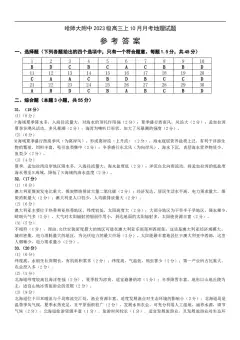
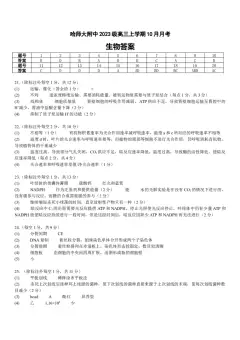
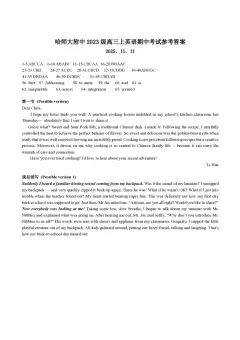
哈师大附中 2023 级高三上学期 10 月月考答案
听力1-5 BCBCB 6-10 CAACA 11-15 CAACB 16-20 CABBA 听力原文:
阅读21-23 CDA 24-27 BAAD 28-31 BBCC 32-35 CCDD 36-40 (Text 1)
ADGBE W: What kind of sports do you like?
完型41-55 DBCCA BBDCB DCBAD M: I like almost all sports, especially skating and mountain climbing.
语填56. recognition 57. has pleased/has been pleasing 58. delicately 59. Served 60. W: Cool! I like swimming and tennis.
from (Text 2)
61. or 62. are sourced 63. to achieve 64. that 65. consisting M: The meeting begins at five. But I think we should be there by four thirty to get everything ready.
W: So let’s meet at the station by 2:30 and we travel up together.
Possible version: M:All right.
Dear Peter, (Text 3)
I’m thrilled to get your practice video for the Chinese poetry recital contest—your passion for W: Did you see May today?
Chinese poetry really shows! I’m writing to share small suggestions that might help you do even better. M: Yes. But why does she have such a long face?
After watching, I found two points to adjust: first, you mispronounced a few ancient words, like W: I have no idea.
“jiu” (wine) sounding a bit like “ju”; second, your rhythm was too fast, especially in the middle M: I thought she’d be happy, especially since she got a promotion recently.
verses, which weakened the poem’s gentle mood. For improvement, listen to professional recitals online (Text 4)
to copy correct pronunciations and pause briefly at each couplet’s end to stress the poem’s rise and fall. M: Just take it easy and breathe. You will feel much less nervous.
Keep practicing, and you’ll stand out! If you have more questions or want to share another video, W: Easy for you to say. You’re not the one that’s going to speak in front of a thousand people.
just reach out anytime. (Text 5)
Yours, M: Oh, that looks delicious. I think I’ll have that. But I hope there aren’t a lot of bones.
Li Hua W: They’ll take the bones out for you, and I'm sure it’s fresh from the ocean. It’ll taste delicious.
Possible version: (Text 6)
Para.1: When I met Halley again, I forced a smile. I told him about my mistake—how I’d signed up W: Excuse me. Does the No.235 bus go by the department store?
for Nature Camp by accident instead of Tech Camp. Halley’s eyes widened at first, but then he patted M: No, it doesn’t, but you can change to No.325 bus at the National Museum by taking No.226 bus from here, or
my shoulder gently. “Nature Camp is awesome too!” he said, pulling out a small notebook filled with you can take the 105 to the Public Library and change to No.325 bus there.
sketches of squirrels and fireflies. “We can watch birds at dawn, collect pinecones, and even stargaze W: Oh, it sounds far from here. How much does it cost?
tonight. Who knows? These might give you cooler ideas for your animated characters than a computer M: Yeah, it is really far. The bus fare is $2 for you and $1 for your child.
screen!” His words made me feel a little less upset, though I still missed the coding plans I’d dreamed W: OK. Thank you.
of. (Text 7)
W: Our luggage hasn’t arrived.
Para. 2: “ Okay , I ’ l l giv e i t a try ! ” I said a s I looked a t Halley . That afternoon, we joined the group M: Are you with Sunny Times tours?
to hike through the woods. Halley pointed out a family of deer hiding behind oak trees, and I quickly W: Yes. Mr. and Mrs. Cameron.
took photos with my phone—mentally noting their soft fur for animation details. At night, we lay on M: And which flight were you on, Mrs. Cameron?
the grass, watching stars twinkle. Halley pointed out the Big Dipper, and I imagined turning it into a W: The Fast Jet flight from Manchester to Berlin. I think it’s FJ2498
magical background for my characters. By week’s end, I hadn’t touched a computer, but I’d filled a M: It seems some bags have gone to another airport.
notebook with animal sketches and story ideas. When I got home, I animated a little deer with a W: Do you know which airport our bags have gone to?
pinecone necklace—my favorite memory from Nature Camp. Sometimes, mistakes lead to the best M: I’m afraid the luggage has gone to Rome.W: Rome? Well, how did that happen? studied mathematics and geography as well as shipbuilding in Fairhaven. But he missed his mother, and his
M: I’m not sure, but all the missing bags are coming on the next flight. Which hotel are you staying at? Your bags own country. Eventually in 1851 he went back to Japan where he had a responsible position as a university
will go there directly. teacher. He also served an invaluable role as an interpreter to build up and improve the relationship between
W: But all our summer clothes are in the suitcases ... Japan and the United States. Tosashimizu and Fairhaven now have the official status of sister cities. In
(Text 8) Fairhaven there have been a number of visits by the people of Tosashimizu, in particular at the time of the
W: Robert, tell us about your last visit to Argentina. What was the weather like? festival, which is held every two years to celebrate the life and achievements of Manjiro. It takes place in the
M: Well, it was winter there, so mornings were cold, but I’d expected that. Every day they said on the radio that it fall, and there an ever-growing program including drumming, singing, and small open shops selling Japanese
would be sunny later and sure enough, it was! I wanted to go sightseeing, and the weather was perfect for that. and American food. So, if you're going to be in the area around then, it’s really worth a visit.
W: And where did you go when you went sightseeing?
M: Well, I went to a wonderful shop that sold everything from modern art to old records of traditional music,
which I collect. I came home with a beautiful painting of the area. I also saw a wonderful chair, but
unfortunately it was too big for me bring back.
W: What a pity!
(Text 9)
M: Please come in, Officer!
W: Wow! The thief really made a mess.
M: Uh, my apartment always looks like this.
W: Well, did you lock your door and windows when you left this morning?
M: I’m sure I locked the door. I clearly remember locking it. But the windows ... I don’t remember.
W: OK. sir. What time did you come home?
M: 1 came home at 6:00 p.m.
W: When did you notice that something was wrong?
M: Well, I went to turn on the TV, but it was gone. And so was my computer!
W: Don’t worry. We’ll try our best to search for the thief. Now, we’ll have to dust for fingerprints. Did you touch
anything else besides the door when you came in?
M: I opened the refrigerator, and my leftover Chinese food was gone, too. I was saving that food for dinner
tonight!
W: I’ll call the detectives, and they will check for fingerprints. Then you’ll have to fill out a report.
M: Thank you, Officer.
(Text10)
M: Right, so here we are in Fairhaven. And we’re visiting Fairhaven because of its historical links with
a man called Manjiro Nakahama. So I’ll begin by giving you a brief introduction to his life, and
then you can take your time to explore the town. Manjiro Nakahama was born in 1827 in a village by
the sea in Tosashimizu, Japan. And like many people in that town, he became a fisherman when he was
young. One day in 1841, he and some others were fishing far off the coast of Japan when they were caught in
a storm. He was rescued by an American whale ship. And Manjiro became friends with the captain William
Whitfield, who came from the town of Fairhaven. That is where we are now. He chose to remain aboard, and
to come with the boat to the U.S.A. So Manjiro became the first Japanese to set foot on American soil. He