四级通关模拟卷(第三套)
Part I Writing (30minutes)
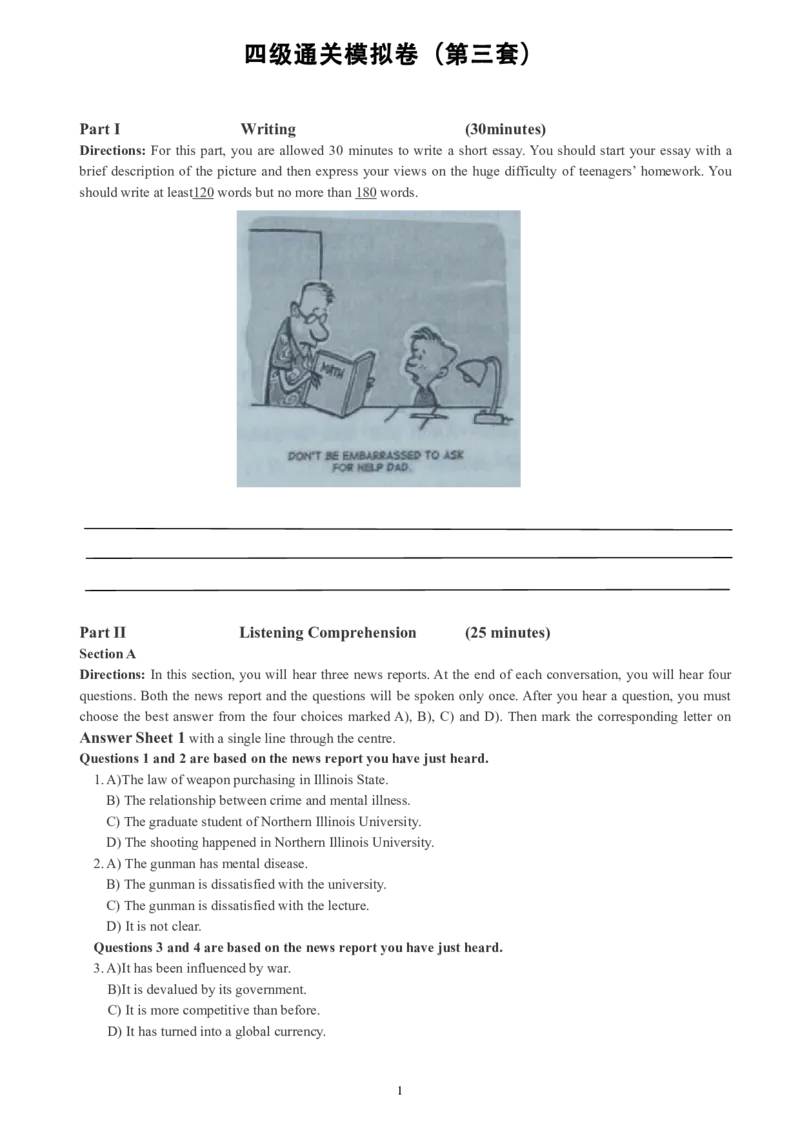
Directions: For this part, you are allowed 30 minutes to write a short essay. You should start your essay with a
brief description of the picture and then express your views on the huge difficulty of teenagers’ homework. You
should write at least120 words but no more than 180 words.
PartII ListeningComprehension (25minutes)
SectionA
Directions: In this section, you will hear three news reports.At the end of each conversation, you will hear four
questions. Both the news report and the questions will be spoken only once.After you hear a question, you must
choose the best answer from the four choices marked A), B), C) and D). Then mark the corresponding letter on
AnswerSheet 1withasinglelinethroughthecentre.
Questions1and2arebasedonthenewsreportyouhavejustheard.
1.A)ThelawofweaponpurchasinginIllinoisState.
B)Therelationshipbetweencrimeandmentalillness.
C)ThegraduatestudentofNorthernIllinoisUniversity.
D)TheshootinghappenedinNorthernIllinoisUniversity.
2.A)Thegunmanhasmentaldisease.
B)Thegunmanisdissatisfiedwiththeuniversity.
C)Thegunmanisdissatisfiedwiththelecture.
D)Itisnotclear.
Questions3and4arebasedonthenewsreportyouhavejustheard.
3.A)Ithasbeeninfluencedbywar.
B)Itisdevaluedbyitsgovernment.
C)Itismorecompetitivethanbefore.
D)Ithasturnedintoaglobalcurrency.
14.A)Mostexpertssupportthefourcountries’currencychange.
B)ThemeetingonFridayisuselessforglobalrecovery.
C)Currencywarsthreatenglobaleconomicrecovery.
D)Policymakersshouldcooperatewithcentralbankers.
Questions5to7arebasedonthenewsreportyouhavejustheard.
5.A)Thepreservationofcoastalresorts. C)Thegapbetweentherichandthepoor.
B)Theclosureofpoliticaldisputes. D)Thecommitmentstoreducecarbonemissions.
6.A)Promising.
B)Hopeful.
C)Disappointing.
D)Satisfying.
7.A)18. C)94.
B)80. D)194.
SectionB
Directions:In this section, you will hear two long conversations.At the end of each conversation, you will hear
four questions. Both the conversation and the questions will be spoken only once.After you hear a question, you
must choosethe bestanswer fromthe four choices markedA), B), C), andD).Then mark thecorresponding letter
onAnswerSheet 1withasinglelinethroughthecentre.
Questions8to11arebasedontheconversationyouhavejustheard.
8.A)Heeatsalotaftermarriage.
B)Hesleepsalotaftermarriage.
C)Heexerciseslessaftermarriage.
D)Hedrinksalotaftermarriage.
9.A)Itsmembershipisexpensive.
B)Itsmembershipisinexpensive.
C)Mostofitsmembersworkouttwotimesaweek.
D)Mostofitsmembersarewhite-collarworkers.
10.A)Sheis under20yearsold.
B)Sheisinher20s.
C)Sheisunder30yearsold.
D)Sheisinher30s.
11.A)Buyaticketforthehealthclub.
B)Bringaguestpass.
C)Makeamembershipcard.
D)Borrowthewoman’scard.
Questions12to15arebasedontheconversationyouhavejustheard.
12.A)Askherassistanttowettheman’shair.
B)Talkwiththemanabouthishair.
C)Communicatewithherassistantaboutthehaircut.
D)Showthemanthelateststyle.
13.A)Itisdryandthick.
B)Itisverycurly.
C)Itisdryandhassplitends.
D)Itisquiteoily.
214.A)Hisdiet.
B)Hishabit.
C)Hislivingenvironment.
D)Hisinheritance.
15.A)Useairblowertomakethehairdry.
B)Useshampooofhighquality.
C)Letthehairdrynaturally.
D)Cuthaironceaweek.
SectionC
Directions:Inthissection,youwillhearthreepassages.Attheendofeachpassage,youwillhearsomequestions.
Both the passage and the questions will be spoken only once.After you hear a question,you must choose the best
answer from the fourchoices markedA), B), C)and D).Then mark the corresponding letter on Answer Sheet 1
withasinglelinethroughthecentre.
Questions16to18arebasedonthepassageyouhavejustheard.
16.A)Peoplecanbuyslicedbreadatstores.
B)Therewasnoslicedbreadatstores.
C)Therewasnodeliciousbreadatstores.
D)Peoplemadebreadathomeandneverboughtit.
17.A)Fromthecustomer.
B)Fromtheingredient.
C)Fromtheballoon.
D)Fromthetradition.
18.A)Itisfullofdeliciousbread. C)Itisfullofcolorfulballoons.
B)Itlooksveryserious. D)Itiscoveredwithoaintings.
Questions20to22arebasedonthepassageyouhavejustheard.
19.A)Askincarebrand.
B)Aleatherbrand.
C)Awatchbrand.
D)Adailyusebrand.
20.A)Mostofitcomesfromskincareline. C)50%ofitisderivedfromfoundation.
B)Morethanhalfofitisfrommakeup. D)25%ofitisfrommakeupbrushes.
21.A)Itwasinventedin1968. C)Itcannotdealwithskinproblemssuchasburning.
B)Itisavailableineverystore. D)Itisdesignedforpre-andpost-operationskincare.
Questions23to25arebasedonthepassageyouhavejustheard.
22.A)Theygetmorefreedom. C)Theyshouldermoresocialresponsibilities.
B)Theyencountermorepressure. D)Theyarerequiredtodobetteratresearching.
23.A)Theyteachstudentshowtoresearchandwrite.
B)Theyaskstudentstostudyindependently.
C)Theyhelpstudentstolearnaboutsociety.
D)Theycommunicatewithstudentsfrequently.
24.A)Theypreventstudentsfromthinking.
B)Theydon’tprovideenoughexplanationsforfacts.
C)Theydon’tofferinformativeresearches.
D)Theydon’thavebasicfacts.
325.A)Takeencyclopediasastheirmereinformationresource.
B)Focusonmoreinformationofspecifictopics.
C)Beindependentfromtheirprofessors.
D)Accumulatetheirownevidencefrombroadersources.
PartⅢ Reading Comprehension (40minutes )
SectionA
Directions: In this section, there is a passage with ten blanks.You are required to select one word for each blank
from a list of choices given in a word bank following the passage. Read the passage through carefully before
making your choices. Each choice in the bank is identified by a letter. Please mark the corresponding letter for
each item on Answer Sheet 2 with a single line through the centre. You may not use any of the words in the
bankmorethanonce.
Questions26to35arebasedonthefollowingpassage.
Cloud-to –ground lightning bolts are a common phenomenon, yet their power is extraordinary. Each bolt can
containuptoonebillionvoltsofelectricity.
This enormous electrical discharge is caused by an ___26___between positive and negative charges .During a
storm,collidingparticles(对撞粒子)ofrain,ice,orsnow____27____thisimbalanceandoftennegativelycharge
the lower reaches of storm clouds . Objects on the ground , become positively charged-creating an imbalance that
natureseekstoremedybypassingcurrentbetweenthetwocharges.
Astep-like series of negative charges, called a stepped leader ,___28____its way increasingly downward from
the bottom of a storm cloud toward the Earth . Each of these segments is about 46 meters long . When the
lowermoststep comes within 46meters of apositively charged___29____itis met bya climbingsurge ofpositive
electricity, whichcanrise upthrough abuilding ,orevena person.Theprocessforms a___30___through which
electricityistransferredaslightning.
Some types of lightning never leave the clouds but ___31____between differently charged areas within or
betweenclouds.Otherrareformscanbesparkedbyextremeforestfiresandsnowstorms.
Lightning is ____32___hot-a flash can heat the air around it to temperatures five times hotter than the sun’s
surface.Thisheatcauses___33___airtorapidlyexpandandshake,whichcreatesthepealingthunder.
Lightning is ___34___.About 2,000 people are killed worldwide by lightning each year . Hundreds more
survive strikes butsufferfrom a variety of ___35___aymptoms ,including memory loss, dizziness,weakness, and
otherlife-alteringsicknesses.
A)absolutely I)obstacle
B)channel J)powerful
C)dangerous K)surrounding
D)extremely L)track
E)imbalance M)travel
F)increase N)unsteadiness
G)lasting O)works
H)object
SectionB
Directions: In this section, you are going to read a passage with ten statements attached to it. Each statement
containsinformationgiveninoneoftheparagraphs.Identifytheparagraphfromwhichtheinformationisderived.
You may choose a paragraph more than once. Each paragraph is marked with a letter. Answer the questions by
markingthecorrespondingletteronAnswerSheet2.
4TestingBaby’sBrain
[A]As faras herfriendsandteachersare concerned,Ashdodis an ordinary, bright,playful 5-ywar-old girl .
Theymight be surprised to learnthatnotlong ago therapists (治疗专家) were fighting to keep her from suffering
from autism (孤独症) –a brain disorder that afflicts one in 100 children , typically leaving them with lifelong
difficultiesincommunicating, socializingandcarryingoutmanybasictasks .Ashdodwaslucky;whenshewas10
months old , her parents became alarmed that she had little interest in looking them in the wyes , wating and
movingfromherback,andtookhertotheMifneCenterinRoshPinna,Israel,aclinicthatfocusesonchildren5
months and older who show early warning signs of autism . The results of the Mifne treatment were shocking ,
recalls the girl’s mother ,Tikva. “Now she goes to a regular schoolwhere she is the same sort of active ,funny ,
normalchildasanyonewlse,”shesays.
[B]Despite abigjump inautism awarenessinthepastdecade,parents,schoolsandschoolsanddoctorsstill
frequently ignore warning signs in very young children , These can be difficult to detect : a child never points at
things , shows more interest in objects than people, has delayed speech and develops a fascination with toys
turning around . Many experts regard these symptoms as harmless habits that kids will outgrow . New research
and experience in some autism clinics , however , suggests that staring treatment by age 2 is critical to mitigating
andinsomecasesentirelyavoidingthedisorder.
[C]That’s because unlike the brain of an adult or even an older child, a 12-or 18-month-oid’s brain is, in a
sense, highly reprogrammable—that is, it responds well to treatments designed to permanently change basic
patterns of thought and behavior. “All the evidence we have suggests that outcomes tor these children will be
better with an earlier diagnosis(诊断),before they reach 18 months, if possible,” says Christopher Gillberg, a
professoratGothenburgUniversityinSweden.
[D]Although there are currently no effective treatments for autism symptoms in older children or adults, the
prospects are turning out to be entirely differentfor very young children who get prompt treatment. Psychologists
have hadremarkable success with behavioral therapy,which involves therapists working intensively with children
togetthem todotasks they’rehaving difficultywith.TheMifneCenter in Israelappliesits ownform ofintensive
therapy, typically lasting about two weeks and focusing on getting the child to make contact with parents and to
eat and move normally. Some 200 children have been through the program; about three quarters have remained
free of any signs of autism or any other significant developmental disorder, according to Mifne founder and
director HannaAlonim. “If we can get them here as babies, close to 100 percent won’t develop autism,” she says.
“Ifwedon’tseethemuntilthey’re2,it’sadifferentstory.”TosupportMifne’sfindingswithmore-formalresearch,
doctors at the TelAviv Sourasky Medical Center have begun screening and videotaping infants thought to be at
riskofpre-autismbeforetheMifnetreatment.
[E] Having a treatment choice for infants raises the hard issue of diagnosis . Autism can be tricky to
recognize—it encompasses any or all of a broad range of symptoms, including difficulty with social interactions,
language, motor skills and taking in sensory information, as well as repetitive behaviors, eating problems and in
some cases unusually high or low levels of activity. A study of nearly 10,000 children in Bergen, Norway,
indicatedthatthenumber ofchildrenwhoshowed“pronouncedautistic features”wasaboutfivetimes higher than
thenumberwhoqualifiedforaformaldiagnosisofautism.
[F]Even children who exhibit only partial or mild versions of autism symptoms are atrisk ofending up with
lifelong challenges, say researchers, and would benefit from autism therapies. But tagging more very young
children as candidates for autism therapy creates another problem. The cost of behavioral therapy is
eye-opening--applied behavior analysis, an intensive treatment that requires 15-to-25 hours of sessions a week,
costs about $30,000 a year, and even a modest program typically runs about $10,000a year. That’s one reason
studies estimate that less than one in 10 very young children with a diagnosis of autism get 25 hours a week of
therapy.
5[G]Health-caresystemsarenotuptothistask.IntheUnitedStates,wherehealthinsurancerarelycoverssuch
treatments, the chances of having the government pay for therapy varies wildly from state to state. Children don’t
necessarily fare much better under national health care. The United Kingdom pays for treatment—but often only
after the parents hire a lawyer and win their case at a regional“tribunal”, where more often than not communities
will fight to force the parents to settle for the few hours a week of therapy offered in a local special-education
program.In Italy,toddlers with disorderswholove nearlarge cities in thenorth-central partof thecountrycanget
theattentionofateamoftherapists,butthoseinthesouthern,ruralareastendtogetfewservices.LaurenceRobel,
a child psychiatrist and autism researcher at the Necker Children’s Hospital in Paris, notes that France keep a bias
against behavioral therapy, which critics compare to training a dog or programming a robot. “Away from Paris,”
shesays,“childrenareluckytoreceivemuchtreatmentatall.”
[H]Experts insist that governments are being penny-wise and pound-foolish in refusing to pony(付清)up for
intensive therapy to infants and toddlers who show early signs of a developmental disorder. Simple, brief
screeningtests are nowdesigned toflag childrenatrisk asearly as18months.Earlier diagnosis might bepossible
by measuring brain activity and recognizing patterns that are unique to autism. Researchers at the Baby Lab in
Uppsala University in Sweden are looking for these patterns by placing dozens of soft-foam sensors on infant’s
heads.
[I] The benefits of early treatment are likely to grow in coming years as new research into developmental
disorderscontinuestopayoff.
36. In Italy, the chances for young children to receive services of a team of autism therapists vary between the
north-centralpartofthecountryandthesouthern,ruralareas.
37.In detecting the warning signs of autism in young children, parents, schools and doctors now haven’t done
sufficientlyonit.
38.Autismisnoteasytorecognizebecauseitcoversawiderangeofsymptoms.
39.It is very important to treat a child with autism by age of two, because children at that age respond well to
therelatedtreatment.
40.Accordingtothetext,childrenwhogetautismmaysufferfromtroublesincommunicating.
41.It is an effective treatment for older children with signs of autism to ask them to do tasks which are difficult
forthem.
42.Accordingtoexperts,thosegovernments areextremelyfoolishiftheyrefusetosupporttheintensivetherapy
toyoungchildrenshowingearlysignsofadevelopmentaldisorder.
43.Most very young children with a diagnosis of autism do not have an intensive treatment, because it’s too
expensivetoreceivetheintensivetreatment.
44.About150childrenhaverecoveredfromsignsofautismintheMifneCenter.
45.In the United States, different state governments pay differently for autism therapy because health insurance
rarelycoverssuchtreatments.
SectionC
Directions: There are 2 passages in this section. Each passage is followed by some questions or unfinished
statements. For each of them there are four choices marked A), B), C) and D). You should decide on the best
choiceandmarkthecorrespondingletteronAnswerSheet 2withasinglelinethroughthecentre.
PassageOne
Questions46to50arebasedonthefollowingpassage.
Students in Washington will return to classrooms this month to begin a new school year. But at least 50% of
theirteacherswillnotreturnwith them. Lastmonth,theDistrictofColumbiapublicschoolstold206teachersthat
theyarenotgoodenoughtostay.
6Theschoolsystemdismissed75teacherslastyear.Itwasthefirstyearofanewteacherratingsystem.
Experts say such large numbers of dismissals are rare in American schools. But in Washington the rating
systemisnotgovernedbythelaborcontractwiththeteachersunion.Soschoolofficialshavemorefreedom.
The system is called IMPACT. Teachers are observed in the classroom five times a year for at least thirty
minuteseachtime.Theyarealsojudgedbystudenttestscores.
Administrators rated 65 of the 206 teachers as “ineffective”. The others lost their jobs because they were
rated“minimallyeffective”forasecondyear.
The National Council on Teacher Quality is a research group that works to increase the number of effective
teachers. Emily Cohen, a policy director there, says the council supports the IMPACT system. “This is an
evaluation instrument that is finally able to capture who is highly effective and who is ineffective and who could
be doing better and could use some assistance. Most evaluation instruments in the country do not capture teacher
performance—allteachersareratedsatisfactory.”
Teachers with the highest rating can receive a performance bonus of up to twenty-five thousand dollars. In
addition,theycanreceiveapayincrease.
SomeWashingtonteacherssaytheirratingsdependtooheavilyontestscores.Forsometeachers,halfoftheir
rating is based on how well their students do. But Emily Cohen says test scores are important. “Testing is the
mostobjective datathatwehave onteacherperformance.TheDistrictalsois lookingatotherthings, usingmaster
educators to evaluate teachers. So it’s not just looking at student test performance, it is using other sources of
data.”
Michelle Rhee created the IMPACT system. She gained national attention for her aggressive reform efforts
whensheledthetroubledschoolsysteminthenation’scapital.Sheleftlastyearandherdeputytookherplace.
TheWashingtonTeachersUnionsaysIMPACTunfairlyhurtsteacherswhoworkinschoolswithhighratesof
poverty.Mostoftheteacherswiththehighestratingworkinschoolswithlowerpovertyrates.
46.WhycanschoolsinWashingtondismisssomanyteachers?
A)Becausethoseteachersdidnotperformwellintheclassroom.
B)Becausetheymustbestrictinthefirstyearofthenewratingsystem.
C)Becausethoseteacherswererated“minimallyeffective”forasecondyear.
D)Becausetheyarenotrestrictedbytheteachersunion’slaborcontract.
47.WhydiestheNationalCouncilsupporttheIMPACTsystem?
A.Becausethesystemcanprovideteachersalargeamountofbonus.
B)Becausethesystemcandistinguishgoodteachersfrombadones.
C)Becausethesystemhassuccessfullydismissedineffectiveteachers.
D)Becausethesystemhasincreasedthenumberofeffectiveteachers.
48.SomeWashingtonteachershavedifferentopinionswithEmilyCohenonwhether______.
A)testscoresshouldplaysuchanimportantroleintheirratings
B)teacherswiththelowestratingshouldstayatschool
C)thestudentsshouldperformwellintheratingsystem
D)theDistrictshouldusemastereducatorstoevaluateteachers
49.WhatcanwelearnaboutMichelleRhee?
A)Sheledtheschoolsystemfallingintothebiggesttroubleitevermet.
B)Sheleftherworkbecauseshehadabetterofferinthenation’scapital.
C)Shedidnotperformaswellasherdeputyintheworkingability.
D)Shewasnotedforhereffortsinchangingthechaoticschoolsystem.
50.TheWashingtonTeachersUnion’sattitudetowardstheIMPACTsystemis______.
A)supportive B)unclear
C)optimistic D)critical
7PassageTwo
Questions51to55arebasedonthefollowingpassage.
More than 40 years ago, U.S. Supreme Court Justice Potter Stewart said that while it was difficult to define
pornography(色情文学), “IknowitwhenIseeit.”
The etiquette(礼仪)police who are trying to keep up with the rapidly evolving world of mobile devices and
theireffectontheworkplaceprobablywouldsaythesame.Theymaynotbeabletodefinewhatisconsideredbad
manners, but they know the terrible behavior when they see an employee’s email, text, blog entry, or Facebook
posting.
It appears others do, too. A recent Intel survey found that 9 of 10 Americans report they’ve seen others
misusetechnology; 75%agreethatmobileetiquetteisworsethanitwasayearago.Theresultsdon’tsurpriseLisa
Grotts,areputedetiquetteconsultant.
“Welcome to the new world,” she says. “Someday a sociologist is going to have a study on how our rules
havechangedbecauseoftechnologyandonlinecommunication.”
Because technological changes are so constant, she thinks it’s inevitable that some social and professional
misbehaviorswillbemade.
TheIntelstudyfoundthatwe’reoftenawareofourownpoorbehavior.Almost1in5respondentsreportthey
knowthey’rebeingrudebutdoitbecauseeveryoneelsedoes.
So it’s a little difficult to complain about a cubicle(小隔间)mate for talking too loudly on a cellphone when
you’vebeenguiltyofdoingthesamething—orsomethingequallyannoying.
Addingto the problem:Whatmay beOK in your socialcircles could beconsideredannoyingin professional
ones.
Still, the Intel study found that it’s worth making an effort to adjust your behavior when using your iPhone,
BlackBerry or other mobile device if you want to keep the peace in your office and not bother the boss. Of those
participatinginthesurvey,65%saytheygetangryatthosewhoaredisrespectfultowardotherswithtechuse.
So, even though your cubicle mate talks loudly on her cellphone or texts her boyfriend constantly, it doesn’t
mean you should do the same thing Instead, taking the time to find a private place to have a private conversation
mayimpresscolleaguesandyourmanagerwithyourprofessionalism.
51.Wecanlearnfromthepassagethattheetiquettepolice________.
A)cannotfindproperwordstodescribebadmanners
B)wanttoknowmoreaboutmobiledevices
C)haveknownaboutJusticePotterStewartformanyyears
D)agreewiththedefinitionofbadmannersbyPotterStewart
52.AccordingtoarecentIntelsurvey,wecanlearnthattechnologymisuse________.
A)istotallyignoredbythemajorityofpeople
B)becomesacommonphenomenoninAmerica
C)hasgreatlyinfluencedpeople’swayoflife
D)isacceptedbymorepeoplethanbefore
53.WhatcanwelearnaboutLisaGrotts?
A)Shebecomesfamousforheruniqueviewsaboutbadmanners.
B)Sheisnotsatisfiedwiththepresentsituationofmobileetiquette.
C)Sheisgoingtostudywhathavecausedourrulestochange.
D)Shebelievessomebadsocialmannersareinevitabletooccur.
854.Whydopeoplestillbehavebadlyalthoughtheyknowitisrude?
A)Becausetheydon’trealizethattheirmannersarebad.
B)Becausetheydon’tcareaboutothers’opinionaboutthem.
C)Becausetheywanttoattractotherpeople’sattention.
D)Becausetheyseeothersdothesamethingastheydo.
55.Whattheauthormaysuggestusdoabouttechuse?
A)Getangryatthosewhobotherotherswiththeirtechuse.
B)RefusetopostanypersonalinformationonyourFacebook.
C)Impressyourmanagerwithyourprofessionaltechskills.
D)Talkprivatelywhenyouhaveamobilephonecall.
PartⅣ Translation (30 minutes)
Directions:Forthispart,youareallowed30minutestotranslateapassagefromChineseinto
English.YoushouldwriteyouransweronAnswerSheet2.
中国受欢迎的体育运动在过去的50年间得到了迅速的发展。在新中国的早期,人们只在休息时间随
着广播音乐做一些有氧运动(aerobicexercises),以及每年参加春季、秋季的运动会。随着社会的进步和
经济的发展,娱乐性的体育运动开始在社会各个阶层蔓延(permeate)。自改革开放以来,体育活动在种
类上变得丰富起来,越来越多的人将规律的体育运动视为他们日常生活的一部分。
9